
PREV ARTICLE
NEXT ARTICLE
FULL ISSUE
PREV FULL ISSUE
BEACH MYSTERY COIN IDENTIFIED AS REPLICA OF THE PHAISTOS DISKE-Sylum readers have come through again, this time with a positive identification of the "coin" recently discovered on a Florida beach. -Editor.
Steve D'Ippolito writes:
The mystery coin found in Florida appears to be a reproduction of the Phaistos disk, found on Crete. It's the only sample of that particular writing known and has never been
deciphered. (Not to be confused with the also undeciphered Linear A script.) Apparently it dates to the 17th century BCE.
Bill Daehn writes: 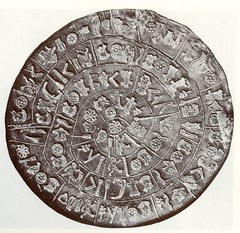 Regarding the "unusual coin found on Florida beach," of course it is not a coin at all. It
is a cheap souvenir sold in museum shops around the world. It is a miniature metallic imitation of the famous "Phaistos disc." The Phaistos disc is a circular, inscribed clay tablet found
in 1908 near a Minoan palace on the island of Crete. The object makes a nice souvenir and conversation piece. But unfortunately, it is not ancient and it is not a coin. Regarding the "unusual coin found on Florida beach," of course it is not a coin at all. It
is a cheap souvenir sold in museum shops around the world. It is a miniature metallic imitation of the famous "Phaistos disc." The Phaistos disc is a circular, inscribed clay tablet found
in 1908 near a Minoan palace on the island of Crete. The object makes a nice souvenir and conversation piece. But unfortunately, it is not ancient and it is not a coin.John-Dominic Cadorini adds: The Phaistos Disk is a controversial find that may or may not represent an ancient alphabet and may or may not be as old as one would wish. Google "Phaistos Disk" and you
will find numerous articles discussing and photographing the original piece. It's odd that "experts" would not recognize this given the extent of coverage on this disk over time.
John Isles writes:  This appears to be a tourist reproduction of the Phaistos Disk, perhaps bought as a souvenir in
Greece. See the Wikipedia article on the original, http://en.wikipedia.org/wiki/Phaistos_Disc, for the story of this still-undeciphered artifact from Minoan Crete. You can in fact buy a reproduction
of it for $8 from this website: http://sacredearthdesigns.com/Symbols/Pendants/Festos.htm though it's a different one than that shown in the E-Sylum. This appears to be a tourist reproduction of the Phaistos Disk, perhaps bought as a souvenir in
Greece. See the Wikipedia article on the original, http://en.wikipedia.org/wiki/Phaistos_Disc, for the story of this still-undeciphered artifact from Minoan Crete. You can in fact buy a reproduction
of it for $8 from this website: http://sacredearthdesigns.com/Symbols/Pendants/Festos.htm though it's a different one than that shown in the E-Sylum.Jonathan Brecher writes: The unusual 'coin' found by detectorist Vinny Mariotti is a replica of the Phaistos Disc -- one of the larger mysteries in modern archaeology and linguistics. Since the
original disc was found in 1908, this medallion is presumably a souvenir of someone's trip to Crete during the last 100 years. Unless, of course, you want to speculate that the original creators
of the disc also took a side trip to Florida some 3500 years ago. Personally, I'd recommend the 'souvenir' interpretation.
This sort of thing raises an interesting question -- how would someone go about identifying an object like this from its picture? I recognized it, then found a picture online to confirm my memory. If I didn't recognize it off the bat, I wouldn't have had a clue how to identify it otherwise. For something as distinctive -- literally unique -- as this one, there ought to be a way to come up with an identification that doesn't involve finding someone who happens to recognize it. I can't come up with an approach that would work, though, it just feels like there should be one. I'd be curious to hear how many others also identified it. It isn't a huge stretch from numismatics to archaeology. With 1000+ readers, I'd expect other folks to recognize it also. I knew E-Sylum readers were a smart bunch. Opinion seems unanimous. The first image above was forwarded by Bill Daehn - it shows the original Phaistos Disk. The second image is the
beach find. I'll forward everyone's responses to the Florida newspaper. -Editor
To read the original newspaper article, see: Port Richey treasure hunter has uncanny knackTHE JOB BAZARREWayne Homren, Editor The Numismatic Bibliomania Society is a non-profit organization promoting numismatic literature. See our web site at coinbooks.org. To submit items for publication in The E-Sylum, write to the Editor at this address: whomren@gmail.com To subscribe go to: https://my.binhost.com/lists/listinfo/esylum All Rights Reserved. NBS Home Page Contact the NBS webmaster 
|