PREV ARTICLE
NEXT ARTICLE
FULL ISSUE
PREV FULL ISSUE
TREASURE TALK WITH BOB EVANS, EPISODE 9In January, our good friend Bob Evans began publishing a series of blog articles on the Finest Known website detailing his experience as co-discoverer and curator of the treasures recovered from the wreck of the S.S. Central America. Subject of the book "Ship of Gold", many exhibits, countless interviews and articles, books and auction catalogs feature the legendary haul of gold coins, bars, nuggets, gold dust and more from the 1857 shipwreck. Here's another excerpt - see the complete article online. -Editor 
"We are going to find gold dust." I made the statement with confidence. "Nah… what? Gold dust? We're not looking for gold dust. We're looking for specie, coins. And gold bars." Tommy Thompson replied. "Yes, we are. And we're also going to find gold dust."
Reading the accounts, I began to envision a shower of golden particles, falling more than a mile, a cloud that surrounded the steamship, and descended with it into the abyss. I began to think about what forensic science might reveal, the constituents of the remaining deposit. Descriptions of the ship's final moments on the surface tell of gold dust and coins being spread on the deck. So, sometime around 1985, my conclusion was, "Absolutely! There should be gold dust all over this shipwreck site, if we ever find it." Fast forward to 1988. We have discovered what we believe with near certainty is the shipwreck site of the S.S. Central America. In 1988, Bob had an opportunity to finally test his theory with a batch of mud, "fresh and cold from the bottom of the Atlantic." -Editor I had muriatic acid on board, nothing fancy, just some industrial grade pool chlorine that could serve multiple purposes, including as a cleaning agent, or maybe as a magic gold dust revealer. I took a portion of the sample, something around 150ml, and put it in a one-liter Pyrex beaker. I mixed tap water into the mud until it was a slurry, then slowly introduced the acid, carefully watching the violent effervescence as the foam rose and fell within the vessel. Once the reaction died down to a steady bubbling, I tied it to the shelf at the back of my lab bench, secured against spillage from the ship's motions, and left it to digest overnight. The next morning the engineers had things to fix on Nemo, prior to the next dive. A few crewmembers were on deck, awaiting the successful testing of the engineering tweaks, so they could take their positions on deck for the dive. The testing took a few iterations, each one involving a time-consuming unsealing of a pressure sphere, the adjustment of the electronics inside, followed by the resealing of the air-tight chamber. When it became obvious it was going to take a while, the deck crew started to break out the fishing rods. The "dolphin" were schooling around the ship. While waiting for Nemo to work the right way so we could dive, the guys grabbed the fishing gear and started casting. I went below to my lab, to check on that bubbling beaker of oozy mud, by that time reduced to a murky mix that looked like bad chocolate milk. I half-filled a 5-gallon bucket with water, to catch and dilute the acid as I carefully decanted the solution and poured off everything but the remaining sediment. As expected, the calcium carbonate had dissolved, and all that remained was about a teaspoon of acid-resistant components. I dumped it into a Petri dish with a little clean water and started to search through it under the microscope. It was about like the samples I had seen from the previous year's shipwreck studies, coal dust, wood fragments, etc., with one key difference. THIS ONE HAD A TINY TABLE-SALT-SIZE CHUNK OF GOLD! It was unmistakable. I shared this "find" with Tommy Thompson and our experienced shipwreck expert John Doering who were justifiably amazed and delighted. Tommy remarked that this was not something to write to the investors about. We were looking for larger amounts than a tiny grain of golden sand. In the next three dives we found and recovered the ship's bell, confirming beyond question the shipwreck's identity, then photographed and found the Garden of Gold, the commercial shipment deposit with its thousands of mint-state 1857-S double eagles. This sort of overshadowed my tiny fleck of gold in a Petri dish. But my long conjecture about gold dust being everywhere on the SSCA site was verified. From that point on, collection of native gold, the gold dust and nuggets, became an integral part of the recovery strategy. Gold dust from the S.S. Central America shipwreck has been recovered in two main ways. Large parcels, both within the commercial shipment and also within consignments inside the purser's safe, were major sources for gold dust, yielding a whole lot in individual units sometimes weighing many pounds. The other major source of gold dust was the shipwreck at large. As we have seen, gold dust was everywhere, and so "vacuuming up" the sediment while excavating, and processing those particles for gold dust became the standard operating procedure. After every dive, it was my responsibility to process the sediment traps. This was both wonderfully surreal and significantly arduous. I generally processed the sediment traps at night. I did this on deck, under the crane next to the portside scuppers (drains over the side) so the fine mud and junk from my sifting through the sediment would wash easily overboard, keeping the deck acceptably clean. The wee hours of the AM were ideal, since temperatures would drop into the tolerable eighties. I had bright work lights overhead, and it was easy enough to spot coins, large gold nuggets, and bits of jewelry that had been swept up during our operations. But ultimately, it came down to panning for gold. I used a gold pan, following the practice that had been used originally to win these precious particles from the dirt of the Sierra foothills over thirteen decades earlier. 
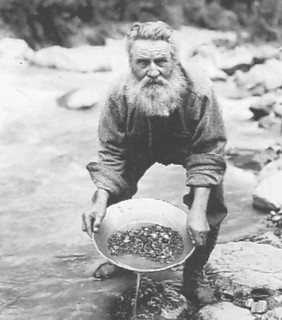
Prospector Bob Evans and his Gold Pan, c1990 I sat on the deck of a rolling ship on the Atlantic, locked into the motions, at night with the moon seeming to wave back and forth in the sky overhead, often sleep-weary, while panning for gold, echoing those who did so long ago in California. When I got to the bottom of the bottom, I could just spoon out the gold dust into "high-grade" jars. With the perspective of half a lifetime, I look back on this with experience with wonder almost beyond words. For much more, including many images of large gold nuggets and a massive gold dust concretion, check out the full article online. -Editor
To read the complete article, see:
For the complete series, see:
To read the earlier E-Sylum article, see:
Wayne Homren, Editor The Numismatic Bibliomania Society is a non-profit organization promoting numismatic literature. See our web site at coinbooks.org. To submit items for publication in The E-Sylum, write to the Editor at this address: whomren@gmail.com To subscribe go to: Subscribe All Rights Reserved. NBS Home Page Contact the NBS webmaster 
|