PREV ARTICLE
NEXT ARTICLE
FULL ISSUE
PREV FULL ISSUE
NUMISMAGRAM MEDAL SELECTIONS: DECEMBER 7, 2025Numismagram's Jeremy Bostwick sent along these four medals from his most recent upload of new material to his site. For all of the new items, please visit https://www.numismagram.com/inventory. -Garrett 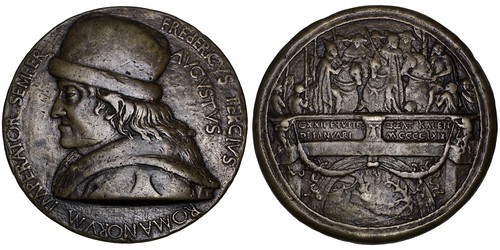
103428 | ITALY. Holy Roman Emperor Federico (Frederick) III cast bronze Medal. Dated 1469, though a contemporary or an early cast from the late 15th/early 16th centuries. (55mm, 61.31 g, 1h). By Bertoldo di Giovanni, [circa 1420/30-1491]. FREdERICVS TERCIVS ROMANORVM IMPERATOR SEMPER / AVGVSTVS, robed bust left, wearing brimmed cap // The emperor creating new knights in the presence of the pope, cardinals, and foot soldiers upon Ponte Sant' Angelo in Rome; boat below the bridge, from which a swag hangs supported by two putti; on the bridge reads a legend in two lines: CXXII EqVITES CREAT KALEN / DE IANVARE MCCCCLXIX (he created 122 knights on the first of January, 1469). Edge: Some scattered marks, otherwise plain. Pollard 283 = Kress 249; Scher Coll. 90; Michael Hall Coll., part I, 11 (this piece). Rare and full of dramatic, intricate imagery upon the reverse, this pleasing specimen offers a fantastic pedigree to the Hall Collection, where it realized a total price of £1,593 ($2,408 after the buyer's fee) at auction in May 2010. Pollard, in Renaissance Medals, writes that "...Emperor Frederick III (1415-1493) visited Pope Paul II in Rome to discuss action against the Turkish invasions. The emperor had previously visited Rome in 1452 for his coronation, when Cristoforo di Geremia made a medal with an imaginary portrait of Emperor Constantine the Great. On I January 1469, the emperor created 122 knights on the Ponte Elio (Ponte Sant' Angelo), and it is this event that the medal illustrates and commemorates. On the obverse, the inscription refers to Frederick as "perpetual Augustus," in imitation of antique practice. The medal may have been a gift to the emperor from Filippo de Medici and has also been incorrectly attributed to Candida." In The Scher Collection of Commemorative Medals, it is mentioned that "...some early specimens have the misspelling of "senper" for "semper" in the reverse inscription, but later casts corrected the mistake." and that "...given the fresh eyewitness character of the reverse, it is possible that Bertoldo—artist of the de' Medici family—witnessed the event as a member of the archbishop's retinue."
To read the complete item description, see:

103331 | ITALY & FRANCE. Cecilia Gonzaga of Mantova bronze Medal. Dated 1447, though a modern restrike issued late 19th/early 20th centuries. "Innocence and Unicorn in a Moonlight Landscape" (85mm, 265.71 g, 12h). After Antonio di Puccio Pisano (Pisanello) [circa 1380/95-1450/5], and struck at the Paris mint. CICILIA VIRGO FILIA IOHANNIS FRANCISCI PRIMI MARCHIONIS MANTVE, garlanded and draped bust left // Seminude maiden and shaggy unicorn each kneeling left; crescent above hilly landscape in background; to right, column bearing legend in seven lines: OPVS / PISAN / I PICT / ORIS / M / CCCC / XLVII. Edge: «cornucopia» BRONZE and some mottled staining. Cf. Pollard 20 = Kress 17 (for original); cf. Scher Coll. 9 = Michael Hall Coll., part I, 7 (same); cf. Jones, The Art of the Medal, p. 22 & fig. 46 (same). Gem Mint State. Tan-brown surfaces, with a pleasing matte aspect and some alluring brilliance. A tremendous modern reissue of undoubtedly one of the most iconic Renaissance medals ever produced—a type that, when offered for sale or presented in literature, tends to figure prominently in the cover or full page art, as was the case for the Michael Hall specimen—now in the Scher Collection on display among the Frick Collection. In particular, said Hall/Scher specimen realized a total price of £64,900 ($98,096 after the buyer's fee) when it last sold at auction in May 2010. Pollard, in Renaissance Medals, writes that "...Cecilia Gonzaga (1426-1451) was the daughter of Gianfrancesco I, marquess of Mantua. Beautiful and gifted, she was one of the most brilliant of Vitorino da Feltre's pupils. She refused to marry the disreputable Oddantonio da Montefeltro, son and heir of the first count of Urbino. Oddantonio was murdered in 1444. In this, with the support of Vittorino da Feltre, she defied her father, Gianfrancesco Gonzaga, and took refuge in a convent. After her father's death in 1444 she became a nun, entering the convent of Santa Paola in Mantua in February 1445. The medal presumably was commissioned by her brother Lodovico, but the occasion is not known. The portrait is entirely secular in character, although by the medal's date Cecilia had been withdrawn from the world for two years. This is the only instance in which Pisanello translates his own conventional format for a painted portrait into the medal roundel. It is composed in the same way as his panel of Ginevra d'Este, now in the Louvre, Paris. The medal effigy may be based on lost preparatory drawings by Pisanello that had been intended for a painted portrait. Cecilia is depicted wearing a balzo augmented with a small mazzocchio (false hair in the shape of a corn cob). The forehead is shaven, in the contemporary fashion. If Cecilia was forbidden by the rules of the convent to pose for a portrait medal, Pisanello would have been forced to use drawings prepared before February 1445. The carriage of the figure in the medal is more self confident than that of Ginevra d'Este. The reverse is a gracious and charming conceit in honor of Cecilia. The unicorn was a symbol of chastity, a creature reputedly tamed only by the touch of a virgin. The figure of the unicorn is based on Pisanello's drawing of a goat. A contemporary drawing by Stefano da Verona, in the Uffizi Gallery, Florence, illustrates the reverse type. The crescent moon shown in the field was a classic symbol of purity." About the artist of this medal, see chapter 2 in Mark Jones's classic, The Art of the Medal, for an entire chapter dedicated to this exceptionally important and influential artist.
To read the complete item description, see:
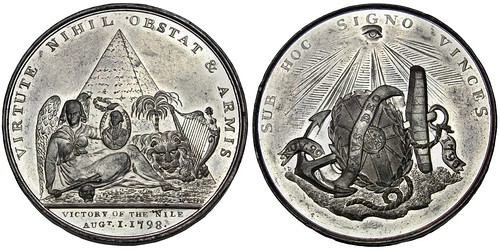
103277 | GREAT BRITAIN. Battle of the Nile white metal Medal. Issued 1798 (38mm, 22.81 g, 12h). By William Wyon, Sr. VIRTUTE NIHIL OBSTAT & ARMIS (nothing can stand in the way of virtue and arms), angel reclining right, head facing slightly left, holding oval medallion of Horatio Nelson and cross; skull before; to right, reclining lion, harp, and palm tree; pyramid in background; in two lines in exergue, VICTORY OF THE NILE / AUGT I 1798 // SUB HOC SIGNO VINCES (under this sign you shall be victorious), radiant Eye of Providence over garlanded shield and anchor. Edge: Plain. BHM 450; Eimer 892; Hardy 8; Julius 640. Choice Mint State. Highly brilliant and flashy, and excellent for the metal type. As such, very rare this attractive and appealing. The Battle of the Nile, also known as the Battle of Aboukir Bay, was fought in the spacious bay near Alexandria between French and British naval forces. The latter, under the command of Vice-Admiral Horatio Nelson, pursued his French counterparts throughout the Mediterranean, finally encountering them at Aboukir Bay. The result was a very decisive British victory, serving as a power shift within the Mediterranean and a repelling of Napoléon's desired advances into British India.
To read the complete item description, see:
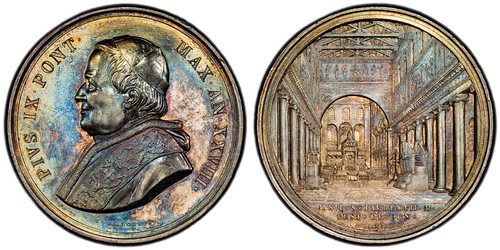
103273 | ITALY. Pope Pius IX/Basilica of San Lorenzo silver Medal. Issued Year XXVIII (1873/4). Commemorating the restoration of the Basilica (44mm, 34.43 g, 12h). By Giuseppi Bianchi at the Rome mint. PIVS IX PONT MAX AN XXVIII, bust left, wearing zucchetto, mantum, and pallium // Interior view of the nave, from a vantage point to the left of center; in two lines in exergue, BASIL S LAVRENTII M / REST ET ORN. Edge: Plain. Bartolotti E 873; Rinaldi 67. PCGS SP-62. Highly brilliant and most attractively toned a cosmic array of iridescence. Architecture in general plays a heavy role in the medallic art of Pius IX, given the number of restorations done to religious edifices during his rather lengthy reign. He presided over the longest verified papal reign in history, serving as pope from 1846 to 1878, and also saw the loss of papal dominion over the states (parts of central mainland Italy) to which it laid claim for centuries. Following Italian unification under the King of Sardegna (Sardinia), Vittorio Emanuele II, the peninsula began to coalesce under a single regnum, leaving the rule of Pius in question. When Rome fell, then taking a new role as the capital of the Kingdom of Italy, Pius became trapped, literally and figuratively, and considered himself a prisoner in the Vatican—a standoff between the papacy and the kingdom that would last for nearly 60 years. In 1929, and brokered by then-Pope Pius XI and leader of the Fascist Party, Benito Mussolini, the Lateran Treaty ended the longstanding feud between the two factions over the sovereignty of the papacy within the kingdom. The treaty gave the Vatican City to the papacy—a separate city-state headed by the pope within the city of Rome itself—as well as compensation to the papacy by the Italian government for the loss of the territory within the papal states.
To read the complete item description, see:
Wayne Homren, Editor The Numismatic Bibliomania Society is a non-profit organization promoting numismatic literature. See our web site at coinbooks.org. To submit items for publication in The E-Sylum, write to the Editor at this address: whomren@gmail.com To subscribe go to: Subscribe All Rights Reserved. NBS Home Page Contact the NBS webmaster 
|