PREV ARTICLE
NEXT ARTICLE
FULL ISSUE
PREV FULL ISSUE
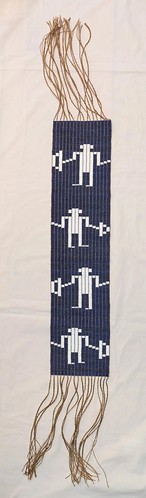
KEN MARACLE, MODERN WAMPUM MAKERThe art of wampum-making lives on with Ken Maracle, who was profiled recently in the New York Times. Here's an excerpt - see the complete article online. -Editor 
The license plate on the Jeep Cherokee reads WAMPUM. And the man who owns it — Ken Maracle, who also goes by his Cayuga name, Haohyoh — is widely acknowledged to be one of the premiere practitioners of the centuries-old craft of creating wampum, strips with geometric patterns woven in purple and white beads.
"We taught your ancestors diplomacy," Mr. Maracle said during an interview at his studio on Manitoulin, an island just off the Canadian coast of Lake Huron. He has spent nearly 40 years creating belts that now are owned by collectors and museums such as the National Museum of the American Indian in Washington and the Canadian Museum of History in Gatineau, Quebec. On his worktable were two purple-and-white quahog clam shells from Long Island near New York City, the traditional source of the hard shells used for purple and white wampum beads. Mr. Maracle still uses quahog beads for important commissions, but he also has purple and white glass beads, separated on two paper plates in his studio, for more everyday creations.
"It's a friendship belt," he said, referring to the glass-bead piece that was about halfway done. At the left end of the loom was a blocky human figure connected to a purple line that, once Mr. Maracle wove some more, would reach another human figure at the opposite end. Belts can be as long as seven feet and as wide as two feet, but this one, he said, would be about 23 inches long and 3.5 inches wide when it was completed. A large belt with a complicated pattern can take as many as 90 hours of focused work, he said, and may involve as many as 13,000 beads. Mr. Maracle said the effort required could be exhausting. There is one piece that wampum experts refer to as Mr. Maracle's masterwork: his interpretation of a belt whose formal name is the 1764 Covenant Chain Wampum Belt Delivered at Niagara by the British to the Western Nations. The original was made by artisans hired by British authorities, who presented it during peace negotiations with 2,000 representatives of 24 different Indigenous nations. Mr. Maracle was commissioned by the Canadian Museum of History to recreate the piece, which had disappeared at some point in the historical record, so he had to rely on archival sketches and written descriptions. When he delivered the completed belt to the museum in 2016, Jonathan Lainey, a noted wampum expert, was working there. Such belts, Mr. Lainey said in a recent interview, were often displayed during council meetings and exchanged when agreements were made — which was why the 2023 exhibition he curated at the McCord Stewart Museum in Montreal, where he now works, was titled, "Wampum: Beads of Diplomacy."
To read the complete article, see:
Wayne Homren, Editor The Numismatic Bibliomania Society is a non-profit organization promoting numismatic literature. See our web site at coinbooks.org. To submit items for publication in The E-Sylum, write to the Editor at this address: whomren@gmail.com To subscribe go to: Subscribe All Rights Reserved. NBS Home Page Contact the NBS webmaster 
|