PREV ARTICLE
NEXT ARTICLE
FULL ISSUE
PREV FULL ISSUE
GILBERT STUART WASHINGTON PORTRAIT FOR SALEIn the that-would-look-really-nice-hanging-in-my-office department, an iconic painting of George Washington is up for sale. -Editor
George Washington's rendering on the $1 bill may be the most widely distributed portrait in U.S. history. And now one of the original painted portraits that inspired the U.S. Mint's engraving can be yours, if you have 500,000 to 1 million Washingtons to spare. On Jan. 23 in New York, the auction house Christie's will put up for bidding an 1804 oil portrait of Washington by Gilbert Stuart. The painting, commissioned by James Madison, has a storied history passing through the hands of the Founding Father and a gold rush tycoon. Stuart churned out more than 100 paintings of Washington that later served as the model for the image on the dollar bill, including the piece on offer. The image isn't just "deeply ingrained" in the American psyche, said Carrie Rebora Barratt, who co-curated a Stuart retrospective for the Metropolitan Museum of Art in New York. It is also "the kind of magnificent story of America that collectors of American art want." Having survived a long chain of custodians, from Gilbert Stuart to James Madison to a trio of fun-seeking frat boys, the painting is now poised to change hands yet again. It will be on view at Christie's in New York from Jan. 16 to 22 and auctioned Jan. 23. 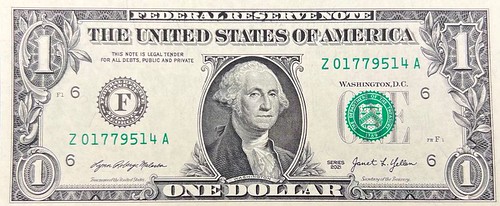
But, no, the portrait on the dollar is not the U.S. Mint's engraving work - paper money is produced by the Bureau of Engraving and Printing. Anyway, the article includes a fascinating timeline of events in the portrait's history - see the complete article online. -Editor
To read the complete article, see:
Numismatic bibliophiles and researchers will appreciate the detective work that went into confirming the painting's provenance. This Artnet article was passed along by Alan Luedeking, who adds, "This'll require a veritable torrent of spondulix to acquire, no doubt!" -Editor No one painted Washington as prolifically as Stuart. "Washington was famously not fond of sitting for artists," Martha Willoughby, a consultant specialist in Christie's Americana department, told me over the phone. Yes, he was humble, but the process was terribly boring, too. Willoughby was "very suspicious" when Clarkson University, who consigned the iteration in next month's sale, claimed Madison had commissioned it. Stuart scholars rely on definitive volumes from the 1920s and 1930s to document his work. This example appears in those books—without any Madison mention. First, Willoughby's team found a catalog that American magnate William Henry Aspinwall, who owned this work in the 1850s, had compiled for his collection. It confirmed the work's Madison origins. Then a note from Madison's secretary turned up, sealing the deal. "He writes that he's the one that convinced Stuart to fulfill it in 1811 after it had been commissioned and paid for in 1804," Willoughby said. Elsewhere, she found accounts where visitors spotted the work in Madison's home during 1806. With Stuart, the record's rarely simple. Madison definitely requested his own portrait alongside the Washington commission, though he displayed Washington's more prominently. It eventually went to Madison's wife, then his son, then Aspinwall—followed by industrialist James W. Ellsworth, art collector William K. Bixby, and Richard L. Clarkson, whose family founded Clarkson University. There, three frat boys stole the painting as part of a prank—and landed in jail.
To read the complete article, see:
The Washington Post article had more background on the prank. -Editor
A trio from the Theta Xi fraternity were split between stealing a pedestal ashtray and what they thought was a reproduction portrait of Washington from Clarkson University. The two pledges and a brother, all from the Rochester Institute of Technology, were planning a pledge-week prank. "We, in our brilliance, chose the painting," said Stephen Pazian, one of those pledges. The 76-year-old retiree still wishes they'd gone for the ashtray. The group took the art back to their campus and quickly learned — either from a newspaper article or from the nightly news, Pazian says — that it was an American treasure insured for $125,000. "We had the ‘Oh, s---' moment," he recalled.
Wayne Homren, Editor The Numismatic Bibliomania Society is a non-profit organization promoting numismatic literature. See our web site at coinbooks.org. To submit items for publication in The E-Sylum, write to the Editor at this address: whomren@gmail.com To subscribe go to: Subscribe All Rights Reserved. NBS Home Page Contact the NBS webmaster 
|
