PREV ARTICLE
NEXT ARTICLE
FULL ISSUE
PREV FULL ISSUE
SILVER LIBERTAS AMERICANA MEDAL OFFEREDHeritage Auctions will be selling the probable finest known example of the Silver Libertas Americana Medal on June 25. The medal is discussed below. -Garrett 

Circa 1783 Medal Libertas Americana Medal, Silver, Loubat-14, Betts-615, Adams-Bentley 15, MS64+ PCGS. CAC. The Libertas Americana is arguably the most important American medal. Examples were struck in bronze, silver, and gold, with a silver example of the latter chosen to illustrate the front cover of 100 Greatest American Medals and Tokens where this medal holds the top spot. These medals that combine beauty and historical significance served as the inspiration for some of our earliest federal coin designs. Obverse Design: A female head facing left represents Liberty, her hair flowing back, with a pole and cap over the right (hidden) shoulder. Above, the legend LIBERTAS AMERICANA. The date, 4 JUIL. 1776 is below in exergue. The engraver's signature, DUPRE, is placed on the edge of the bust. Reverse Design: An infant Hercules in its cradle represents the United States, strangling two serpents, while a helmeted Minerva with her spear and shield, protects the infant from a lion, representing England. Above, the legend, NON SINE DIIS ANIMOSUS INFANS, translates to "The courageous child is not without the aid of the gods." Below, in exergue, are the dual dates of October 17, 1777, and October 19, 1781. This is symbolism at its finest. Military Record: The two dates on the reverse of this medal mark the Continental Army's victories at Saratoga on October 17, 1777, and at Yorktown on October 19, 1781. The Battle of Saratoga included several skirmishes beginning in September 1777 and ended with British General John Burgoyne surrendering his army on October 17, 1777. That battle marked a turning point in the American Revolution, capturing the attention of France who signed a Treaty of Alliance to support the young nation in their fight against England. The Battle of Yorktown was a three-week siege with the British army experiencing substantial losses. British general Charles Cornwallis surrendered his troops to General George Washington and French general Rochambeau on October 19, 1781. This was the last major battle of the American Revolution, leading to peace negotiations marked by signing the Treaty of Paris two years later on September 3, 1783. Historical Record: Benjamin Franklin who was in France, wrote a March 4, 1782, letter to Robert R. Livingston, the secretary of foreign affairs, noting an idea for a medal that he wanted to commission. In his letter, Franklin wrote: "The extinguishing of two entire armies in one war is what has rarely happened, and it gives a presage of the future force of our growing empire." Just over a year later on April 15, 1783, Franklin followed up that the medal had been produced, enclosing a silver medal for the President of Congress, as well as one in copper for Secretary Livingston: "The impression in copper is thought to appear best, and you will soon receive a number of them for the members [of Congress]." Franklin also noted that he presented one in gold to the King of France, and another in gold to the Queen. Additional silver medals were presented to the ministers [of France]. He observed of the silver medals that they are "a monumental acknowledgment, which may go down to future ages, of the obligations we are under to this nation." French artist Esprit-Antoine Gibelin (1739-1813) sketched designs for the medal, and Augustin Dupré (1748-1833) engraved the dies. Modern numismatic thought suggests that about 100 to 125 examples are known in copper and perhaps 30 to 35 are known in silver (at least 32 silver pieces are currently traced). The whereabouts of the two gold medals presented to the King and Queen of France is unknown today.< Notice of the Libertas Americana medal appeared in American newspapers as early as May 1783. On May 15, Poulson's American Daily Advertiser published an extract of a March 3, 1783, letter from Paris: "If ever an event deserved a lasting monument, it is doubtless that of the American war, and the acknowledgement of their independence, which followed it. In consequence of this, Dr. Franklin has struck a medal relative to these events. It represents Hercules in his cradle, strangling two serpents; a leopard, amazed at his strength, is ready to fall upon him; he is repulsed by France, who, under the figure of Minerva, turns her shield, on which are three fleurs de lis, towards him. At bottom, are the years 1777 and 1781, epochs of the capitulations of the armies of Burgoyne and Cornwallis, represented by the two serpents. On the other side is liberty, emblematically pourtrayed [sic] by a fine woman; and in the exergue, Libertas Americana." Provenance: Ex: Stack's (privately, date unrecorded); Rarities Night (Stack's Bowers, 8/2024), lot 3001, $336,000. A portion of the proceeds of the sale will be donated to Washington University where Mr. Warshaw and Eric P. Newman's son, Andy Newman serve as trustees. Washington University is the home of the Eric P. Newman numismatic portal which aims to be the world's largest freely accessible online archive of numismatic information, extending the legacy of Eric P. Newman's decades of scholarly research.
To read the complete item description, see:

Wayne Homren, Editor The Numismatic Bibliomania Society is a non-profit organization promoting numismatic literature. See our web site at coinbooks.org. To submit items for publication in The E-Sylum, write to the Editor at this address: whomren@gmail.com To subscribe go to: Subscribe All Rights Reserved. NBS Home Page Contact the NBS webmaster 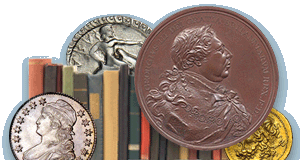
|