PREV ARTICLE
NEXT ARTICLE
FULL ISSUE
PREV FULL ISSUE
U.S. ENCASED POSTAGE STAMPSWith permission, we're publishing this excerpt on U.S. encased postage stamps from the recently-published Encyclopedia of Encased Postage by Paul Montz. -Editor
Soon, improvements were devised, such as pasting stamps onto boards for transactions under $100, which started to appear in July 1862. Notes with affixed stamps were produced by some merchants in various denominations under $1. The Department of the Treasury began issuing stamps pasted to their letterhead which were cut to a uniform size. Stamps could be exchanged for greenbacks by an act of July 17, 1862. This authorized the Secretary of the Treasury to supply postage and other stamps for use as currency in payments to the United States less than $5. Another proposal was the use of small envelopes (now referred to as Postage Stamp Envelopes), some with an advertising message, to keep the stamps clean, but that had the disadvantage of needing to open the envelope to confirm the stamp value.
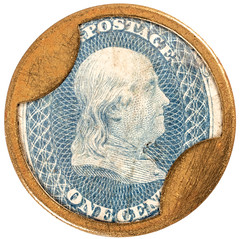
Gault made money in two ways: he sold the encased stamps to firms that needed coinage for 20% over face value (the same premium silver coinage was bringing at the time) and he charged advertisers a two-cent premium for putting their messages on the back. The components of a U.S. encased postage stamp are simply a round piece of mica, a stamp, a piece of cardboard, a brass frame, and a brass back. The cardboard was cut into rounds, and the stamp corners were folded over the edges. The protective mica was then placed on top, and the assembly was inserted into the brass back, then the brass frame was fitted over the combination, with button-making machinery used to form the brass enclosure. Arlie Slabaugh has estimated that the smaller firms ordered 500-2000 pieces. He interpolates from that that the larger issuers such as Ayer ordered many thousands (200,000 by one account, mostly 1- and 3-cent denominations). James Ruddy studied the rarity of merchants carefully and based on offerings over a long period of time, came up with the following rarest merchants, beginning with Arthur M. Claflin, the rarest, and followed by B.F. Miles, Sands' Ale, N. & G. Taylor & Co., Pearce, Tolle & Holton, and Dougan. The encased stamps were made by the Scovill Manufacturing Company of Waterbury, Connecticut, a major producer of buttons for the military. The cases were made from a brass disc (the advertising side) and the "wraparound" stamp frame with the tabs. The surface of the wraparound comes in two different types, those with a ribbed surface and those with smooth. The ribbing has been the topic of much speculation, but according to Fred Reed, the ribbed pieces were simply those pieces made using leftover button stock. Once Gault ramped up to full production, smooth brass stock was used. The ribbed type is generally rarer than the smooth. The ribbed type only exists for some of the advertisers. It was Postage Currency that was the ultimate replacement for Gault's encased postage, along with the inability of Gault to purchase enough stamps for his product, the influx of official copper-nickel cents and privately issued Civil War Tokens, and not having enough companies interested in advertising. The alternatives to encased postage were much cheaper to produce and became more attractive economically. It is uncertain how long he was able to continue production, but Summer 1863 seems to be the latest he could have continued. Arnold Perl once estimated that Gault operated his venture for about eight months. The alternative approaches began to take hold and by the summer of 1863, the coin shortage had begun to fade. In all, Gault's output of all types reliably totals over 750,000 pieces, according to the Smithsonian Institution. Only $50,000 or a bit more in encased postage ever circulated. For a short period, the U.S. government was actually considering using Gault's invention but ultimately decided on Fractional Currency as the better solution. Encased postage continued to circulate throughout the war and was occasionally seen in circulation as late as the 1870's.
The U.S. section pictures one example of the advertising side of each issuing merchant. Prices are listed for each stamp denomination. More photos and detail on varieties and the issuing merchants can be found in more specialized books on the topic like Reed and Hodder-Bowers. -Editor
For more information, or to order, see:
To read the earlier E-Sylum articles, see:

Wayne Homren, Editor The Numismatic Bibliomania Society is a non-profit organization promoting numismatic literature. See our web site at coinbooks.org. To submit items for publication in The E-Sylum, write to the Editor at this address: whomren@gmail.com To subscribe go to: Subscribe All Rights Reserved. NBS Home Page Contact the NBS webmaster 
|