PREV ARTICLE
NEXT ARTICLE
FULL ISSUE
PREV FULL ISSUE
NUMISMAGRAM MEDAL SELECTIONS: SEPTEMBER 20, 2026Numismagram's Jeremy Bostwick sent along these five medals from his most recent upload of new material to his site. For all of the new items, please visit https://www.numismagram.com/inventory. -Garrett 
103724 | UNITED STATES. San Francisco. Mechanics' Institute silver Award Medal. Engraved and awarded to Weed & Kingwell in 1885. (49mm, 43.50 g, 12h). By Albert Kuner. MECHANIC'S' INSTITUTE, Columbia standing facing upon base featuring "MI" (Mechanics' Institute) monogram; she presents laurel crown to personifications of industry—with hammer, anvil, gear, and compass—and of agriculture—with plow, sickle, bushel, grapes, palette, and harp; in background, locomotive crossing stone bridge and steamship sailing in the bay; SAN FRANCISCO in exergue // INDUSTRIAL EXHIBITION / AWARDED TO, Weed & Kingwell / "Best Plumbers Goods" elaborately engraved in two lines; decorative scroll work above and below; all within laurel wreath; 1885 in cartouche in exergue. Edge: Plain. Harkness CA-92. NGC MS-63. Extremely brilliant and prooflike, with very colorful toning throughout. A popular series and very rare when encountered this attractive and problem free. The Mechanics' Institute in San Francisco was originally established as a vocational school for unemployed miners in 1854, just a few years after the gold rush and California statehood. Without the presence of facilities such as universities and public libraries, it served as one of the only sources by which one could attain a more advanced education in a trade. In this role, the institute was instrumental in the formation of the University of California in 1868, along with its eventual public university system. The institute is still extant, though now mostly acts in a different role, housing a vast library as well as serving as a cultural center and as a home to the oldest continually operating chess club in the United States. No stranger to technical prizes at industrial shows, the California Brass Works—with Joseph H. Weed and Vincent Kingwell as proprietors—was established in 1851 by Gallagher & Weed and recognized as one of the leading firms in this branch of trade. Located at 125 1st Street in San Francisco, their operation is summarized by this print advertisement from the 1883 Strangers' Guide to San Francisco and Vicinity: "Manufacturers of all kinds of Brass, Composition, Zinc and Babbit Metal Castings. Church and Steamboat Bells. Also, a full assortment of Steam and Water Cocks and Valves, Hydraulic Pipes, Nozzles and Hose Couplings, etc. Brass Ship Work, Spikes, Sheathing Nails, Rudder Braces, etc. Agents for Siebert's Eureka Lubricator." The registry for the 1885 event mentions that they won this medal in class 18—a class in which they also took the third (bronze) place for best assortment of steam fittings.
To read the complete item description, see:

103411 | GERMANY & FRANCE. Black Shame/The Watch on the Rhine cast bronze Medal. Dated 1920. "Die schwarze Wacht am Rhein"—on the supposed sexual crimes against German women by Franco-African soldiers (58mm, 64.93 g, 12h). By Karl Goetz at the München mint. DIE WACHT AM RHEIN!!, helmeted head of French-African soldier right, with heavily caricatured features such as the lower lip and stretched earlobe; in four lines to lower left, LIBERTÉ / ÉGALITÉ / FRATERNI / TÉ // DIE SCHWARZE SCHANDE, nude Lorelei (representing vulnerable German women in the Rhineland) with her arms behind her, chained to oversized male genitalia surmounted by helmet (representing supposed sexual crimes committed by Franco-African soldiers); broken lyre to left, with tops terminating in heads of eagles; radiant Eye of Providence above, with rays almost acting as tears. Edge: Plain. Kienast 262; Jones, Dance of Death, 52. Choice Mint State. Warm brown surfaces, with a pleasing matte aspect mostly throughout. An extremely provocative and popular medal. Following Germany's defeat in World War I, French and British troops occupied portions of Germany to ensure that reparations would be paid. In some areas, such as the Rhineland, France utilized colonial troops from North Africa for patrolling and occupying—possibly serving as an act of further humiliation—making the local Germans be subject to those who were, in turn, subject to a colonial power. Within Germany, however, sentiments became overtly racialized, with anti-African propaganda found everywhere in the print media, and with caricatures and stereotypes endlessly employed. This biased and unfounded campaign even found its way into numismatics, with many medals featuring iconography that reveals these feelings. At the forefront was the belief that African troops, racially portrayed as oversexed and primal, were ravaging German women. Though this campaign subsided in the early 1930's, it wasn't the first appearance of this form of racism, and certainly wouldn't be the last. Along with the "Sinking of the Lusitania" medal, this extremely provocative medal stands as one of the more iconic, controversial, popular, and rather infamous (all at the same time) of Goetz's entire oeuvre.
To read the complete item description, see:
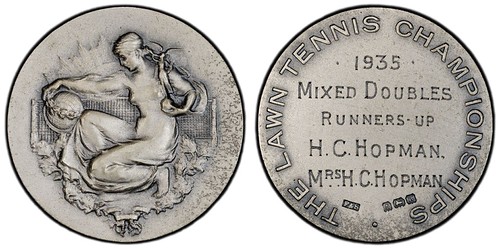
103565 | GREAT BRITAIN & AUSTRALIA. Wimbledon/Harry Hopman silver Award Medal. Engraved and awarded in 1935 for the mixed doubles runners-up at the Wimbledon Championships (38mm, 25.66 gms, 12h). By Fattorini & Sons. Athena, representing the virtues of athletic competition, kneeling left before tennis net, holding crowning Nike on globus and wrapping laurel wreath around the earth // THE LAWN TENNIS CHAMPIONSHIPS, "• 1935 • / MIXED DOUBLES / RUNNERS–UP / H. C. HOPMAN, / MRS H. C. HOPMAN" engraved in five lines. Edge: Plain. PCGS MS-64. Matte gray surfaces, with some darker highlights around the devices. An incredibly attractive and interesting medal from one of Australia's greatest tennis players and coaches. Born in a suburb of Sydney, Australia in 1906, Henry Christian Hopman began playing tennis at the age of 13, and would go on to be the men's finalist at the Australasian Championship (now Australian Open) in 1930, 1931, and 1932. Though he would never garner a Grand Slam singles title, he did so in doubles, winning the Australasian in 1929 and 1930, and the mixed doubles title there in 1930, 1936, 1937, and 1939, as well as the mixed doubles at the US Open in 1939. The medal offered here was earned for his runners-up finish—along with his then-wife, Nell Hall—for their mixed doubles loss in the Wimbledon Finals in 1935. Following World War II, his focus turned more toward journalism and coaching, eventually serving as the captain-coach of some 22 Australian Davis Cup teams from 1939 to 1967. In this role, his Davis Cup coaching coincided with Australia's golden era in tennis, alongside such greats as Ken Rosewall and Rod Laver, among others. At the end of the '60's, he relocated to the United States, coaching a young future star, John McEnroe, at the Port Washington Tennis Academy on Long Island, and then at his own academy founded in Bardmoor, Florida in 1976. Hopman passed away from a heart attack in 1985 at the age of 79, having been predeceased by his first wife Nell in 1968. This item was featured in our E-Sylum ad.
To read the complete item description, see:

103401 | SWEDEN. Torbern Olof Bergman bronze Medal. Issued 1957. Commemorating the chemist and mineralogist, and issued for the Swedish Academy of Sciences (45mm, 34.63 g, 12h). By Erik Lindberg at the Stockholm mint. + TORBERN • BERGMAN • PROF • CHEM • UPSALIENSIS + / N • MDCCXXXV • OB • MDCCLXXXIV, garlanded bust left // + ATTRACTIONES • ELECTIVAS • INVESTIGAVIT + / SOCIO • MERITISS • R • AC • SCIENT • SUEC • MCMLVII (he investigated the elective forces of attraction), representation of one of Bergman's affinity formulas, showing copper nitrate, copper, silver, and silver nitrate. Edge: MJV BRONS 1957. Ehrensvärd 471. Choice Mint State. Olive-bronze surfaces. From a mintage of just 200 pieces in bronze.
To read the complete item description, see:

103598 | UNITED STATES. Benjamin Cardozo bronze Medal. Issued 1987. Jewish-American Hall of Fame series: commemorating the famous lawyer and associate justice of the US Supreme Court (44mm x 43mm, 58.14 g, 12h). By Gerta Ries Wiener for the Medallic Art Company. Bust facing slightly right left; facsimile signature to lower right // Façade of the US Supreme Court building; in four lines in exergue, THE FINAL CAUSE OF LAW / IS THE WELFARE OF SOCIETY / JUSTICE BENJAMIN NATHAN CARDOZO / 1870-1938. Edge: MAGNES MUSEUM / 076 / MACO–BRONZE. JAHF 19. Choice Mint State. Paler bronze surfaces. Serially numbered 76 of 400.
To read the complete item description, see:
Wayne Homren, Editor The Numismatic Bibliomania Society is a non-profit organization promoting numismatic literature. See our web site at coinbooks.org. To submit items for publication in The E-Sylum, write to the Editor at this address: whomren@gmail.com To subscribe go to: Subscribe All Rights Reserved. NBS Home Page Contact the NBS webmaster 
|