PREV ARTICLE
NEXT ARTICLE
FULL ISSUE
PREV FULL ISSUE
NAC NOVEMBER AUCTIONS 169, 170, 171Numismatica Ars Classica will be hosting their November Auctions 169, 170, 171. Select items are discussed below. -Garrett 
Sicily, Agrigentum.
Extremely rare, only ten specimens known, of which only four are in private hands.
An issue of exquisite style, the work of a very talented master engraver. Ex Hess/Leu 3, 1956, 65; Sotheby's 4 December 1990, Hunt (1926-2014), 22; New York XXVII, 2012, Prospero (1910-2001), 121 and NAC 116, 2019, Man in Love with Art part I, 40 sales. From the Käppeli collection. While Agrigentum had managed to remain neutral during the Sicilian Expedition of the Athenian fleet in 415-413 BC, in the aftermath of its failure a serious new threat began to emerge in the form of the Carthaginians. In 409 BC, a great Punic force attacked the neighbouring city of Selinous. Always ready to dispose of rivals, Agrigentum provided no military aid, but instead accepted its refugees, thereby adding to its population. Three years later, in 406 BC, the Carthaginians advanced to Agrigentum and besieged the city for eight long months, before it finally fell. The city was given over to plunder and all the inhabitants (who had not escaped to Gela and Leontinoi) were slaughtered in the streets. After spending the winter in the conquered city, the Carthaginian general Himilco ordered the destruction of Agrigentum. Nevertheless, under the terms of the Peace of Himilco that concluded the Punic advance in Sicily in 405 BC, Agrigentine refugees were permitted to return and rebuild their city as tributary subjects of Carthage. This didrachm may have been struck in order to finance the defence of Agrigentum by strengthening fortifications and hiring mercenaries.
To read the complete item description, see:

Sicily, Syracuse. Extremely rare and among the finest specimens in private hands. An interesting and fascinating issue with a lovely portrait of excellent style and a finely engraved reverse composition. Wonderful reddish tone, absolutely unobtrusive marks on reverse field, otherwise extremely fine Ex NAC 13, 1998, formerly exhibited at the Antikenmuseum Basel, 522 and Heritage 3089, 2021, 31012 sales. From the Athos (1907-1993) and Dina Moretti, and Penn collections. Graded Ch AU Strike 5/5 Surface 3/5, Fine Style, marks, NCG certificate number 4241981-004 (previously graded and no longer in holder) In 280 BC, Pyrrhus of Epirus accepted the request of Tarentum to defend it and the other cities of Magna Graecia from the expanding power of Rome. The Epirote king defeated the Romans at both Herakleia (280 BC) and at Asculum (279 BC), but at such high cost that it became clear his army would soon be destroyed. In 278 BC, while considering his options, the Syracusans begged him to come and fight the Carthaginians who had always been at war with the Greek cities for control of Sicily. As a break from the problematic Roman war, Pyrrhus accepted this diversion and was so successful that by 277 BC he had all but driven the Carthaginians from the island and claimed the title King of Sicily. All that remained was to expel the Punic garrison from Lilybaeum, but because of its location, the only means was through a naval blockade. To obtain the necessary ships, Pyrrhus required money from the Greek cities to build and man a proper fleet. When they balked at this, Pyrrhus imposed his own garrisons. This development immediately destroyed the king's previous popularity in Sicily and the Greek cities began negotiating with the Carthaginians against him. Realising that Sicily would be nothing but trouble to rule, Pyrrhus inflicted one further defeat on a new Punic army and then returned to Italy for a second round against the Romans. This stunning gold stater was struck at Syracuse in the context of Pyrrhus' wars against the Carthaginians. It is a true work of art, having taken the standard Athena and Nike types introduced by Alexander the Great in c. 334 BC, and run with the high Hellenistic sculptural style and the manipulation of the details specific to Pyrrhus.
To read the complete item description, see:

Macedonia, Dicaia. An apparently unique variety of an exceedingly rare type. A very fascinating issue of superb late Archaic style perfectly centred on a full flan and with a delightful old cabinet tone. Two minor marks on reverse field, otherwise extremely fine / about extremely fine Ex Leu 28, 1981, 66 and Sotheby's 4 April 1991, 40 sales. From the Viscount Ivor Fox-Strangways Guest (1939-1993) collection. Dikaia (literally "City of Justice") was a coastal settlement established by Euboean Greek colonists from Eretria in the northeastern Chalcidian Peninsula of Macedonia. It is sometimes confused with the homonymous Greek city of Dikaia founded in the territory of the Bistonian Thracians further to the east. The circumstances that led to the name of these settlements are, unfortunately, entirely unknown, although one suspects that something "unjust" took place in the home cities of the colonists, prompting them to leave and seek justice in new cities. The coinage of Dikaia in Macedonia makes it abundantly clear that the city's founders came from Eretria on the island of Euboea. Not only does this wonderful tetradrachm employ the Euboic weight standard used on that island, but it also features types closely copied from the contemporary coinage of Eretria.
To read the complete item description, see:

Kings of Cappadocia, Orophernes usurper circa 160 – 156. Extremely rare, only very few specimens known of which this is the finest in private hands. A realistic portrait of superb style, work of a very talented master engraver. Undoubtedly one of finest Hellenistic portraits on a Greek coin. Struck in high relief and with a wonderful old cabinet tone, extremely fine Ex Hess-Leu 27 March 1956, 320; Leu 20, 1978, 152; NFA 25, 1990, 178 and NAC 106, 2018, 331 sales. From a Distinguished Northern Californian Collector and from the Priene hoard of 1870 (IGCH 1323). From the Harald Salvesen (1928-2016) collection. Desperate to retain her status as queen of Cappadocia, the apparently infertile Antiochis presented her husband, King Ariarathes IV, with two false sons, named Ariarathes and Orophernes. These were to be heirs to the Cappadocian throne, but then something unexpected happened. Antiochis conceived and gave birth to two daughters and a son by her husband. Having produced a proper heir (the future Ariarathes V), Antiochis revealed the truth to Ariarathes IV and sent her false sons far away from Cappadocia in order to prevent them from challenging the rights of her true son. The young Ariarathes was sent off to Rome while Orophernes was dispatched to the Ionian city of Priene. Although he lived in luxury at Priene, Orophernes remained desirous of what he had lost. In 163 B.C., Ariarathes IV died and Ariarathes V became king in Cappadocia and soon provided Orophernes with his chance to claim the throne for himself. Concerned to keep his kingdom on the good side of the Romans, Ariarathes V refused a marriage alliance with the Seleukid king, Demetrios I, who ruled in Syria without the sanction of the Senate. Offended by the refusal, Demetrios I plotted to overthrow Ariarathes V and establish Orophernes as Cappadocian king. In 158 B.C., Orophernes invaded Cappadocia at the head of a Seleucid army and forced Ariarathes V to flee. This coin represents the pinnacle of Hellenistic portrait coinage. Not only is it an extremely rare piece depicting an obscure and dramatic royal personage, but the artistry of the portrait itself is superlative. Looking upon the image of Orophernes here, it is hardly a wonder that the modern Alexandrian poet, C. P. Cavafy (1866-1933), found himself moved to write a poem about the life and adventures of the Cappadocian pretender in response to the coin portrait. The reverse type, depicting Nike crowning Orophernes' name, is a grand and oft repeated Hellenistic cliché that can be traced all the way back to the coins of Lysimachos (323-281 B.C.), which feature Athena holding a Nike who crowns the king's name. Here, Nike also serves to visually express Orophernes' title Nikephoros ("Victory-bearer") but gives no hint that the Cappadocian pretender was about to drop it. Adding further to the already great interest of this particular coin is the fact that it actually belongs to the 400 talents that Orophernes left with the Prieneans for safekeeping. It is one of only six specimens that were found beneath the pedestal of a statue of Athena Polias during the early excavations at Priene in 1870. Evidently Ariarathes V and Attalos II had not managed to find everything that Orophernes had spirited away. The owl and altar mint mark combined with the treatment of the flan and the high quality of the engraving and composition all suggest that not only did Orophernes deposit his ill-gotten gains at Priene, but he had it coined there too.
To read the complete item description, see:

Galba, 68 – 69. Aureus 68-69, AV 20 mm, 7.33 g. IMP SER GALBA CAESAR AVG Laureate and draped bust r. Rev. VIR – TVS Virtus nude, standing, facing, holding parazonium in r. hand and spear in l. C 345. BMC p. 316 and pl. 52, 25 (this coin illustrated). RIC 222. Calicó 518 (this coin). Biaggi 268 (this coin). Extremely rare and probably the finest specimen known of this issue and among the finest aurei of Galba in private hands. A bold portrait struck on an exceptionally large flan and an interesting reverse representation. Virtually as struck and almost FdcGraded Ch AU*, Strike: 5/5, Surface: 4/5, NGC photo certificate number 6711261-002 Ex Bourgey 16-18 December 1913, Vidal Quadras (1818-1894), 109; Glendining 1951, Ryan, 1670; Rauch 102, 2016, 46 and NGSA 20, 2024, 1036 sales. Servius Sulpicius Galba had served in various capacities under Caligula and Claudius and was virtually retired for most of Nero's reign until he received command of the province of Hispania Tarraconensis in AD 59 or 60. When Nero committed suicide on 9 June AD 68, Galba assumed the imperial title and marched on Rome in October. There, he established himself as the first emperor of the bloody Year of the Four Emperors (AD 69) despite his advanced age. Unfortunately, he lacked wide popularity with the army, and on 1 January 69, the German legions refused to swear their loyalty to him and instead chose Aulus Vitellius as a rival emperor. The reverse of this gold aureus features Virtus, the Roman personification of valor, in an effort to project an illusory air of legitimacy.
To read the complete item description, see:

Hadrian augustus, 117 – 138. Sestertius, Roma 130-133, Æ 32 mm, 26.50 g. HADRIANVS – AVG COS III P P Bare head r. Rev. [EX]ERC BRITANNI/[CV]S Hadrian standing r. on low platform, holding scroll and raising hand; before him, three soldiers with standards. In field, S – C. C 555 var. (bare head and cuirassed). BMC 1673. RIC 1918. L. D'Orazi, La collezione Numismatica di Prospero Sarti e il Mistero del Ripostiglio di Bolsena, in Quaderni di Studio XV, 2020, p. 146 (this coin illustrated). SCBC 637 (this coin illustrated). Extremely rare and by far the finest of very few specimens known. An issue of tremendous fascination and historical importance with a portrait of enchanting beauty, the work of a very talented engraver, and a finely engraved reverse composition, with a miniature portrait of the Emperor showcasing great craftsmanship. Undoubtedly one of the most desirable sestertii to have survived from antiquity. Wonderful brown tone and good extremely fineGraded AU*, Strike: 5/5, Surface: 5/5 - Fine style, NGC photo certificate number 8235162-002 Ex Sangiorgi 7 May 1906, Sarti, 428; Leu 25, 1980, 305 and NAC-CNG-NGSA 144, 2024, Cope, 1064 sales. Although Hadrian is only known for certain to have personally visited the province of Britannia in 122, this remarkable sestertius and other related issues suggest a second visit at some time between 130 and 137. The reverse type appears to celebrate an appearance made by Hadrian before the military forces present in Britannia since the exergue legend identifies the EXERCITVS BRITANNICVS. The scene is of the typical adlocutio type, in which the emperor is shown on a podium addressing the troops. In this particular case, the listeners are legionary standard bearers wearing their full armour. The two closest to Hadrian even wear animal skins on their heads – a means of increasing their visibility to the soldiers who followed them into battle – but it is unclear whether they are intended as lion, panther, or bear skins. All three are known to have been worn by Roman standard bearers. The standard bearer closest to Hadrian is an aquilifer, the soldier responsible for carrying the aquila, or eagle, standard of the legion while the soldier behind him is the signifer, who carries the signum standard of a Roman cohort. It is easily distinguished by its composition of ornamental disks topped by an open hand emblematic of the oath of loyalty sworn by the legionary to the emperor. Holding a transverse standard behind the signifer is the vexillarius, the soldier responsible for carrying the vexillum banner of a Roman maniple. Together the movements of these men and their standards combined with shouted orders allowed the legion and its parts to fight with great skill and overcome great enemies.
To read the complete item description, see:

Commodus augustus, 177 – 192.
Aureus 191-192, AV 21 mm, 7.17 g. L AEL AVREL COMM AVG P FEL Head r., wearing lion skin headdress. Rev. HER – CVL / RO – MAN / AV – GV at sides of club. All within wreath. C 188. BMC 339 note. RIC 251. Calicò 2259. Ex Künker sale 419, 2025, 493. Few Roman coins excite as much commentary as those of Commodus which show him possessed of Hercules. Not only do they present an extraordinary image, but they offer incontrovertible support to the literary record. The reports of Commodus' megalomania and infatuation with Hercules are so alarming and fanciful that if the numismatic record was not there to confirm, modern historians would almost certainly regard the literary record as an absurd version of affairs, much in the way reports of Tiberius' depraved behaviour on Capri are considered to be callous exaggerations.
To read the complete item description, see:

Postumus, 259 – 268. Aureus, Cologne January-June 266, AV 21 mm, 6.63 g. POSTVMVS PIVS FELIX AVG Jugate busts of Postumus and Hercules r. Rev. FELICITAS AVG Jugate busts r. of Victory, holding wreath and palm, and Pax, holding olive branch. C 45. Elmer 452. RIC 329.15 (this coin). Jameson 271. Schulte 109b (this coin). Calicó 3720. Extremely rare. A coin of great beauty with two impressive jugate portraits of excellent style struck on a very broad flan. Almost invisible marks, otherwise extremely fineGraded AU*, Strike: 5/5, Surface: 4/5, Fine Style, NGC photo certificate number 8494937-003 Ex Rollin & Feuardent 14-26 May 1988, de Quelen, 1750; Rollin & Feuardent 20-26 April 1896, Montagu, 656; Sotheby's 10 November 1972, Metropolitan, 188 and Künker 419, 2025, 535 sales. As the extravagant appearance of this aureus would suggest, it was struck at a moment of relative security in the western provinces ruled by the rebel Postumus. Its reverse trumpets the happiness of the emperor (FELICITAS AVG) and, in essence, depicts victory and peace in union, something rarely found on other ancient coins. Postumus had good grounds to make such claims, for he had ruled over the impoverished and vulnerable West more effectively than the ordained emperors Valerian and Gallienus, who were constantly distracted by crises elsewhere.
To read the complete item description, see:

Duchy of Bayern. Albrecht V, 1550-1579.
Medal (25 Ducats) undated (c. 1575), AV 73 mm, 86.67 g.
Unique and from the Wittelsbach family's collection. An exquisite struck medal
and a true masterpiece from the late German Renaissance. Ex Waldo Newcomer Collection - privately purchased from J. Schulman 13.12.1936. Ex Leo Hamburger, Frankfurt sale 7.4.1924, 501 (result 7'150.- Rentenmark =1'700 USD). From the collection of the former Kings of Bavaria.
To read the complete item description, see:

City of Hamburg.
2 Portugalöser (20 Ducats) undated (1574/1577), mint master Andreas Metzner, AV 41 mm, 70.05 g.
Of the greatest degree of rarity. The second specimen known and the only one
in private hands. The heaviest German gold coin of 16th century and
of outstanding numismatic importance. Ex Glendining, London sale 26.10.1938, 147 ('of the highest rarity') Probably before 1560, but no earlier than 1553, the city of Hamburg began minting large gold coins. These were probably intended primarily as representative pieces and only secondarily as trade coins. The Portuguese 10 cruzado coins, which had been minted since 1498, served as a model. Portugal had considerable gold reserves through its colonies, which were then distributed in coin form, mainly via Flanders. The city of Hamburg was the first German mint to produce these Portugalöser coins weighing 10 ducats, initially in small numbers, probably mainly for representative purposes, as is suggested by the very scarce double Portugalöser coins weighing 20 ducats, minted only at the very beginning of Portuguese coinage up to 1577. Of these double Portugalöser, only four are known to date; three of the type minted between 1553 and 1566 are held in the public collections of Copenhagen, St. Petersburg and Hamburg (cf. for this type the single Portuguese coin in the Traveller Collection, NAC sale 162, 6 November 2025, 1148). Of the type presented here, struck between 1574 and 1577, only the specimen in the collection of the Museum für Hamburgische Geschichte remains.
To read the complete item description, see:

Polish–Lithuanian Commonwealth. Zygmunt III Waza, 1587-1632, 1592/1599 King of Sweden.
70 Ducats 1621, Bydgoszcz (Bromberg) mint, mint master Jacob Jacobson van Emden, AV 69 mm, 243 g.
Of the highest rarity.Possibly the only specimen in private hands and of three known. Ex Waldo Newcomer Collection - privately purchased from J. Schulman 13.12.1936. Ex Eugen Merzbacher, München sale 7.1.1896, 202. For further information on this ceremonial coin of exceptional historical and numismatic significance, see the entry on the 100-ducat coin struck from the same dies in the Traveller Collection, NAC sale 162, 1398. Weighing 70 ducats, this coin is even rarer than the 100-ducat coin; it is probably the third known specimen at this weight.
To read the complete item description, see:
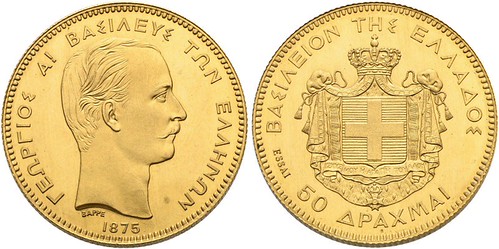
Georgios I (Ge??????), 1863-1913.
50 Drachmai 1875, Paris mint, AV 28 mm, 16.09 g.
One of the very greatest rarities in modern Greek numismatics
To read the complete item description, see:
THE BOOK BAZARRE
Wayne Homren, Editor The Numismatic Bibliomania Society is a non-profit organization promoting numismatic literature. See our web site at coinbooks.org. To submit items for publication in The E-Sylum, write to the Editor at this address: whomren@gmail.com To subscribe go to: Subscribe All Rights Reserved. NBS Home Page Contact the NBS webmaster 
|