PREV ARTICLE
NEXT ARTICLE
FULL ISSUE
PREV FULL ISSUE
NAC NOVEMBER AUCTIONS 172, 173, 174Ars Classica will be hosting their NAC November Auctions 172, 173, 174. Select items are discussed below. -Garrett 
Edward VIII, 1936. AE Pattern Penny, 1937, by T. H. Paget & C. W. Coombes.
Of the highest rarity. Lightly toned with considerable blazing red lustre.
Much as struck and the sole example of a Penny
of this king available to commerce. Ex Showpiece fractional sale in partnership with Baldwin's 2022 (4000 shares sold at £50 per share); Waterbird (Spink 264, 24 September 2019), lot 63; M. Rasmussen, FPL 5, Summer 2003, no. 398; Bowers & Ruddy Galleries, ANA Auction, Houston, 21-26 August 1978, lot 2929; R. Lobel [Coincraft], June 1977. This coin originally formed part of a complete set of the thirteen denominations of the projected coinage for the new king. Only six of these sets were made at the Royal Mint in anticipation of a wider release of proof sets to coincide with Edward's planned coronation on 12 May 1937, and the general currency issue that would have ensued. Full-scale production of the new coinage was scheduled to commence at 8 a.m. on 1 January 1937, but the Abdication brought these plans to an abrupt end. Today, the other five known Pennies remain housed in their original sets: three of these sets are at the Royal Mint Museum, one of which was previously on loan to the British Museum; a fourth set is in the Royal Collection at Windsor Castle; and the fifth set is in the Tyrant Collection, California, USA. Consequently, this Penny is the only example of the type available to collectors as an individual coin.
To read the complete item description, see:
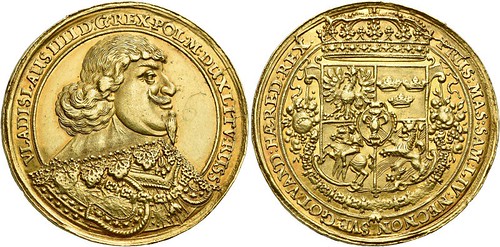
Poland, Kingdom, Wladislaw IV Waza, 1633-1648. AV Donative of 6 Ducats, undated, Bydgoszcz (Bromberg).
F. - (cf. 84, 10 Ducats and 84a, 7 Ducats; these 'very rare'); Kopicki - (cf. 1466, 10 Ducats, this R*); Dutkowski - (cf. 146, 10 Ducats, this R8); Parchimowicz - (cf. 1837, 10 Ducats); Kunker 233, 1004.
Mark of value '6' lightly scratched in obverse field. A few light nicks on edge.
Otherwise with a deep orange tone and much brilliance. From the collection of Druso and Bartolomeo Franceschi.
To read the complete item description, see:

Romania, Principality, Carol I of Hohenzollern-Sigmaringen, 1866-1914, from 1881 King. AV Pattern 20 Lei, 1868. Berlin. From the collection of Druso and Bartolomeo Franceschi. The 20 Lei of 1868 occupies a vital place in the political and monetary history of modern Romania. Struck while the Principality remained under Ottoman suzerainty, at a time when its right to issue national coinage was conditional upon the inclusion of an Ottoman emblem, the portrait of Carol I and the legend CAROL I DOMNULU ROMÂNILORU represented a conspicuous assertion of Romanian sovereignty. As the country had no mint of its own, the coins were commissioned to be struck in Berlin. Only a very small number were produced, and the issue was not released into circulation. Of the reported 100 coins struck, half were distributed to dignitaries, whilst the remainder are traditionally said to have been deposited beneath the foundations of Pele? Castle at Sinaia in 1875.
To read the complete item description, see:

Spain, Fernando and Isabel, 1474-1504. AV 10 Excelentes, Segovia, assayer F, im. cross potent. Struck after 1497. Museo Arqueológico Nacional 104732 – same dies; HAS 8512 – this coin; A.C. type 197, no. 779 – this coin illustrated. Some double striking on reverse. Minor marks. Otherwise richly toned and better than VF. Excellent detail to portraits. A most impressive multiple of the highest rarity and great numismatic importance. Ex Selección de Monedas del Colleción Archer M. Huntington (J. Vico, 26 June 2012), lot 438. Hispanic Society of America collection. The 10 excelente belongs to one of the most transformative periods in Spanish history. Following the conquest of Granada in 1492 and the arrival of Columbus in the New World, the power and international ambitions of the Catholic Monarchs were expanding rapidly. The monetary reform promulgated at Medina del Campo in 1497 sought to modernise Castilian coinage, establishing the excelente de la Granada on the weight and fineness of the Venetian ducat, then the principal gold coin of international commerce. The type of this new coin, bearing the facing busts of the king and queen on the obverse and the quartered shield of Castile-Leon and the territories of the Crown of Catalonia-Aragon above the emblem of the Kingdom of Granada on the reverse, provided a potent visual affirmation of the unity of the Spanish realms. The reform also provided for multiples of the excelente, including the exceptional 10, 20 and 50 excelente pieces. Large gold multiples had been issued by earlier Spanish monarchs, but the production of these extraordinary pieces represents an Iberian genesis of what would become a wider European development towards increasingly substantial gold denominations, exemplified by Manuel I's 10-cruzado português of Portugal, issued at about the same time. The largest Spanish multiples appear to have been confined to the mints of Segovia and Seville, with the 10-excelente represented only at Segovia. The possible presence of such multiples within the royal treasury is documented by an inventory of the Cámara of Ferdinand at Madrid in 1510, which records ‘un excelente de diez excelentes'.
To read the complete item description, see:
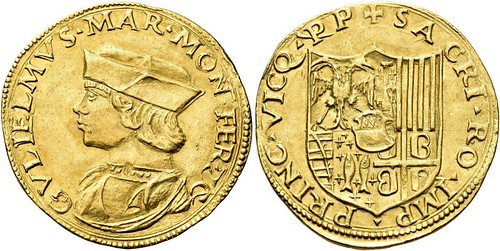
Casale. Guglielmo IX Paleologus, 1494–1518. First period: 1499/1505 – circa 1509. Double ducat, AV 6.89 g. ø 29 mm. GVLIELMVS MAR MONT FER 7 C' Armoured and draped youthful bust l., wearing cap. Rev. SACRI RO IMP PRINC VICQ P P Quartered coat of arms with the small shield of Montferrat in heart. CNI –. Bernareggi 31. Ravegnani Morosini 3 (this coin illustrated). MIR 177. Friedberg 165a. Extremely rare and in exceptional condition for the issue, possibly the finest of very few specimens known in private hands. A portrait of excellent style and a lovely reddish tone. Extremely fine Son of Marquis Boniface III and Maria Brankovic, he succeeded his father upon the latter's death. William protected the French army during its retreat from Milan in 1513 and, to avoid reprisals by Massimiliano Sforza, was forced to pay him 30,000 scudi. The agreements with Massimiliano were not respected, and his troops entered Montferrat, bringing death and destruction. At the same time, having learned of the attempt by his distant relative Oddone, Marquis of Incisa, to have himself crowned Marquis of Montferrat, William marched against his kinsman and occupied the town of Incisa in 1514, annexing the territories of the marquisate and sentencing Oddone and his son Badone to death. However, this execution drew the wrath of the Empire upon William, which, while decreeing the annexation of the territory of Incisa, ordered Paleologus to stand trial. The subsequent bureaucratic proceedings ended in William's favour. The portrait of the marquis, shown in profile and rendered with crisp, incisive modelling, displays a remarkable Renaissance character, reflecting a taste directly derived from the tradition of Italian medallic art of the fifteenth and early sixteenth centuries. Particularly refined is the treatment of the hair, neatly emerging from beneath the headdress, while the latter, broad and slightly inclined, helps to define the contours of the bust. The clothing, with the rich folds of the garment and the detailed rendering of the shoulder, is treated in a manner reminiscent of Renaissance commemorative portraiture.Enclosed by the legend and set against a relatively broad field, the effigy acquires a particular monumentality, characteristic of the visual culture of the period. Taken as a whole, this magnificent coin becomes a veritable portrait in miniature, conveying the prestige and elegance of the die engraving.
To read the complete item description, see:
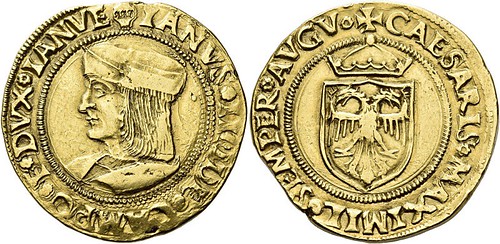
Genova. Republic, 1139 – 1339. Second period: Life-Tenured Doges and Foreign Dominations, 1339-1528. Giano II di Campofregoso, 1512-1513. 10 scudi, AV 34.42 g. ø 37 mm. Campofregoso coat of arms IANVS II DE CAMPO F DVX IANVE Male bust l., wearing cap (Maximilian I or Giano II?). Rev. + CAESARIS MAXIMIL SEMPER AVGV Crowned coat of arms, charged in centre with double-headed eagle. L. Travaini-B. Prokisch, QT XXXIX, 2010, p. 417, pl. I, 1 (this coin illustrated). MEC 12, p. 300. Friedberg 395a (this coin illustrated). Apparently unique and a numismatic riddle of the greatest historical interest. An issue of tremendous importance and fascination with a very interesting portrait of the Emperor of fine style struck on a very broad flan. About extremely fine From the collection of the City of Leipzig deaccessioned in 1840 to a Viennese dealer and eventually sold to William Albert, Prince of Montenuovo. Ex Dura-Sambon 6th December 1880 and ff. days, Rossi 1529 (erroneously attributed to Giano I) and Stack's 7th March, session I, 2006, 834 (also erroneously attributed to Giano I) sales.
To read the complete item description, see:

Milano. Gian Galeazzo Maria Sforza, regency of his mother Bona of Savoy, 1476-1480. Double ducat 1479–1480, AV 6.93 g. ø 24 mm. Small head of St. Ambrose BONA'DVCI – SA'MLI'7C' Veiled bust of Bona r. Rev. Small head of St. Ambrose IO'G3 M SF VI – CECO DVX M SX Armoured bust of Gian Galeazzo r. Bernareggi 91. Ravegnani Morosini 2. Crippa 1. MIR 217/1. MEC 12, unlisted. Friedberg 690. Extremely rare and in exceptional condition for the issue, possibly the finest specimen in private hands. Two very elegant portraits of fine style perfectly centred on a full flan. Good extremely fine Ex Leu sale 68, 1996, 360 Bona of Savoy assumed the regency of the duchy in 1477, following the recognition of her son Gian Galeazzo Maria as the VI Duke of Milan. Following the assassination of her husband, the V Duke Galeazzo Maria, the regent had to navigate numerous pitfalls, and thanks to the great mediation work conducted by the ducal councillor Francesco "Cicco" Simonetta, she managed to have her regency recognized. In 1481, under pressure from the ambitious and cunning uncle of the young duke, Ludovico Maria, the duchess was exiled to the castle of Pavia and the government was assumed by Il Moro. During the regency of Bona, doppio ducati and testoni were issued, all of which are today extremely rare; in particular, the gold denominations display remarkable artistic quality. For example, the subtle rendering of the string of pearls falling along the duchess's head expresses the high, almost painterly execution of the work. Regarding the author of these beautiful dies, Ravegnani hypothesizes that it might be Ambrogio di Matteo da Clivate, who had already worked for Galeazzo Maria Sforza, creating his doppio ducato (cf. lot 192). Finally, this coin is among the few of the Renaissance to feature a female portrait.
To read the complete item description, see:

Venezia.
Alvise IV Mocenigo, 1763-1778. Tallero for the Levant 1768 of 10 zecchini, AV 34.75 g. ø 41 mm. ALOYSIO MOCENICO DUCE Winged and nimbate lion, seated and facing r., holding open book in front paws; on exergual line, A – S (Antonio Schabel, engraver) and, below, 1768. Rev. RESPUBLICA – VENETA Bust of Venice r. Paolucci II –. The tallero for the Levant belongs to the final series of Venetian trade coinage intended for circulation in the eastern Mediterranean during the dogeship of Alvise IV Mocenigo (1763–1778). Talleri of this type were normally struck in silver and formed part of Venice's long-established monetary relationship with the Levant. The present specimen is of exceptional interest as an 10-zecchini gold striking of the tallero type, rather than the customary silver issue. Apparently unique and unrecorded in the published literature, it represents an extraordinary adaptation of a denomination normally associated with silver to a high-value gold format. Its combination of rarity, unusual metal and denomination makes it a particularly remarkable product of the Venetian mint in the final decades of the Republic.
To read the complete item description, see:

AUGUSTALE of FREDERICK II
Augustale of first type, Brindisi? c. 1231-1232, AV 5.19 g. o IMP ROM – CESAR AVG Crowned and draped bust r. Rev. + FRIDE – RICVS• Eagle with wings spread, head l. MEC XIV, see pages 172-173. Spahr 105. MIR 60 (R5, Messina). Probably the most important coin of the entire Hohenstaufen coinage and an issue of tremendous importance and fascination. A portrait of superb style inspired by Roman numismatic portraiture, absolutely extraordinary for the period when this coin was produced, Light reddish tone and good very fine / about extremely fine
WJC: There are four known specimens of the type (Vienna, Rome, Dresden, this). This coin is an obverse die duplicate of the coin in Vienna. The reverse die is unknown.
To read the complete item description, see:

AUGUSTALE of FREDERICK II
Augustale normal type, Brindisi 1232-1250, AV 5.32 g. •IMP ROM• – •CESAR AVG• Laureate and draped bust r. Rev. • + FRIDE – RICVS • Eagle with spread wings, facing ¾ l., head r. Kowalski 149, dies E35/B4. MEC XIV, 516. Spahr 100 (Brindisi e Messina). MIR 266 (this coin).
A coin of incredible beauty, the work of a very skilled master-engraver.
Ex NAC/Spink-Taisei 52, 1994, 918.
To read the complete item description, see:

COINS of CHARLES I of ANJOU before the Vespri siciliani (30th March 1282) Reale, Messina 1266-1278, AV 5.29 g. + •KAROL' – DEI:GR? Crowned and draped bust r.; behind, lis. Rev. + R – EX: SI – CILI – E Shield of ten lis surmounted by label. Kowalski 148 (obverse, L4/-). MEC XIV, 624 var. (with symbol). Spahr 1. MIR 143/1 (misdescribed as 138/1). Friedberg 653 for the type. Rare and in exceptional condition for the issue, among the finest specimens in private hands. A portrait of masterly style, the work of an extremely talented master engraver. Perfectly struck in high relief on a very large flan, almost invisible mark on the King's cheek, otherwise good extremely fine
Ex Spink-Taisei sale 43, 1992, 119.
To read the complete item description, see:

COINS of CHARLES I of ANJOU before the Vespri siciliani (30th March 1282)
Tarì or cavallino, Messina 1266-1278, AV 8.65 g. +•K•DEI•GRACIA°o° Mounted King riding r. holding sword; the horse's harness decorated with lis. Rosette below. Rev. + •R•SICILIE°o° Long cross between IC – XC/NI – K? below omega suspension marks and three pellets below at each side of the foot of the cross. MEC XIV see page 200, A1. Spahr 15 (this coin). MIR 329 (Brindisi, R4, this coin). Friedberg 653a.
Ex Bank Leu/M&M sale 11 March 1987, Spahr 206 and NAC/Spink Taisei sale 52, 1994, 1053. After the victory in the Battle of Benevento, Charles I of Anjou took control of the Kingdom, keeping the mint of Messina active, a strategic center for Mediterranean trade and a key hub in commercial networks between the West and the East. The issue, attributable to the early phase of Angevin rule in Sicily (1266–1282), is traditionally known as the "cavallino" due to the distinctive depiction of the sovereign on horseback—an iconography of clear chivalric origin, intended to exalt royal power and dynastic legitimacy.
To read the complete item description, see:
Wayne Homren, Editor The Numismatic Bibliomania Society is a non-profit organization promoting numismatic literature. See our web site at coinbooks.org. To submit items for publication in The E-Sylum, write to the Editor at this address: whomren@gmail.com To subscribe go to: Subscribe All Rights Reserved. NBS Home Page Contact the NBS webmaster 
|