PREV ARTICLE
NEXT ARTICLE
FULL ISSUE
PREV FULL ISSUE
STACK'S BOWERS: U.S. COINS RARITIES NIGHTStack's Bowers will be hosting their November 2026 Showcase Auction Rarities Night for U.S. Coins on November 17. Select items are discussed below. -Garrett 

None Graded Finer by PCGS in the CAM Category 1877 Indian Cent. Snow-PR3. Proof-66 RD Cameo (PCGS). This is an incredible strike and condition rarity that will nicely represent this eagerly sought issue in the Proof Indian cent series. Both sides are wonderfully original with vivid color. The obverse displays even rose-orange and the reverse exhibits a medium orange and olive with hints of silvery tinting. Otherwise highly reflective in finish, a soft satin texture to the devices provides appreciable cameo contrast. The strike is full and the surfaces are silky smooth and virtually pristine. With a mintage of 852,500 pieces and a low rate of survival in high grades, the circulation strike 1877 is the key date in the Indian cent series. Consequently, survivors of the year's Proof mintage enjoy heightened demand. The United Sates Mint did not begin recording the number of Proof minor coins struck each year until 1878, so there is no way of knowing exactly how many Proof cents were produced in 1877. In his 1977 Encyclopedia of U.S. and Colonial Proof Coins, Walter Breen estimated the mintage of the 1877 at 510+ pieces, but more recent research by R.W. Julian confirmed that Breen's figure represented only the total number of silver and minor coin Proof sets sold. According to Rick Snow (2014), a more accurate estimate for the distribution of this issue is 910 coins, which takes into account the fact that the Mint also sold at least 400 minor coin Proof sets that year. It is thought that upward of 1,500 Proof 1877 cents were actually struck, the unsold pieces destroyed in the Mint. The 1877 Proof cent commands a significant premium in all grades due to the rarity of the circulation strike 1877 in Mint State. On the other hand, most Proofs are in lower grades through Proof-64 RB. The present full Red Cameo Gem is a significant strike and condition rarity in its own right and numbers among the finest examples of the date available.
To read the complete item description, see:


1792 Half Disme. LM-1, Judd-7, Pollock-7. Rarity-4. MS-65 (NGC). Smith-Orosz-Augsburger Coin 65-2. Die Sate 1-A, with no damage to the reverse die. Obv: A bust of Liberty with short, curly hair faces left, the date 1792 in small digits immediately below the curved truncation of the bust. The legend LIB. PAR. OF SCIENCE & INDUSTRY is around the border, an abbreviation of "Liberty, parent of science and industry." Rev: A small eagle with spread wings faces to the left with the denomination HALF DISME and a single star below. The legend UNI. STATES OF AMERICA encircles most of the reverse periphery. All 1792 half dimes except for the unique copper impression (Judd-8) are struck in silver with a diagonally reeded edge, and a single set of dies was used to complete the entire mintage of approximately 1,500 pieces. The coins were struck with medallic alignment. Following passage of the Mint Act of April 2, 1792, the Treasury Department made arrangements to set up a mint. Although there had been private mints in America dating back to the days of the Massachusetts Bay Colony, this was to be the first federal institution. Dr. David Rittenhouse, an eminent scientist and craftsman, was named director. By mid-July of the same year a press was on hand and stored in the shop of John Harper at the corner of Sixth and Cherry streets, not far from where the Mint would be erected. That awaited the laying of a foundation stone on July 31 and work after that time, including rehabilitation of a large existing structure and the building of new ones. At the time Philadelphia was the seat of the federal government and it was only logical that the Mint be located there. The Federal City, as it was first known, was in the planning stage. It was not until 1800 that the government was moved there, by that time known as Washington City or simply Washington. On October 15, 1792, George Washington received a report from Secretary of State Thomas Jefferson noting that there has been a small beginning in the coinage of the half dismes, and included this milestone in his Annual Address to Congress that November. Struck from $75 of silver bullion deposited by Jefferson, the coins were produced in the cellar of John Harper's shop several blocks from where the first United States Mint was still being readied. Jefferson took delivery of 1,500 half dismes on July 13, 1792, his last day in Philadelphia that summer, and it appears he spent them on his trip back to Monticello, largely as tips for the servants he encountered along the way. At Chester, Christiana, Elkton, Bushtown, Baltimore, Elkridge, Bladensburg, Georgetown, Elkrun Church, and Orange, Jefferson recorded tips to servants all in neat multiples of five cents. While the quartered pistareen (also worth 5 cents) was the coin of the realm in the Chesapeake colonies, they were also difficult to carry in quantities for one simple reason: they were pointy and inconvenient (this is why folks in the Ohio Valley called them "sharp money"). The very first payment of precisely $0.05 Jefferson recorded in his Memorandum Book after receiving the half dismes took place in Virginia on July 19, 1792. The recipient was recorded as, simply, "a child." It's a moment anyone can imagine - dropping a bright shiny new coin in a tiny hand. Over the next 24 hours, Jefferson delivered two more half dismes into the hands of children he encountered. These were not pattern coins. They were spending money that Jefferson, then a man approaching 50, was enjoying handing out on his long trip home. One wonders if the upcoming arrival of his first grandchild was turning him into a softy. Thomas Jefferson Randolph was born on September 12, 1792, just two months later. Although 1,500 pieces is generally regarded as the entire mintage for this issue, research published by Pete Smith, Dr. Joel Orosz and Leonard Augsburger in their excellent reference 1792: Birth of a Nation's Coinage (2017) confirms a second striking period in October 1792. The authors believe that the 1,500 coins from the July strike were made on Harper's press while the October striking utilized the Mint press. A third striking period is also discussed, the dies having been removed from the press after the second striking period to create an interruption in coinage. Exactly how much time elapsed between the second and third striking periods is unknown. Provenance: Property from an Alabama Family. Earlier ex Henry Chapman's sale of June 1914, lot 1692; James W. Ellsworth, March 1923, via Wayte Raymond; John Work Garrett, to The Johns Hopkins University, by gift, 1942; our (Bowers and Ruddy's) sale of the Garrett Collection for The Johns Hopkins University, Part IV, March 1981, lot 2351; Superior's Jascha Heifetz Collection sale, October 1989, lot 891; Superior's The Father Flanagan's Boys Home Sale, May 1990, lot 3350; our (Stack's) sale of October 1995, lot 267; our (Bowers and Merena's) Rarities Sale of August 2004, lot 1383; our (Bowers and Merena's) Rarities Sale of August 2009, lot 677; Rare Coin Wholesalers (Steven L. Contursi); offered on eBay, September 2012-January 2013; offered by U.S. Rare Coin Investments (Tom Pilitowski), 2015, reported sold May 22, 2015; offered on eBay, June 2015; Rare Coin Wholesalers (Steven L. Contursi), August-November 2015; offered on eBay March-May 2016.
To read the complete item description, see:


1794 Flowing Hair Silver Dollar. BB-1, B-1. Rarity-4. MS-62+ (NGC). BB Die State II. The silver dollar was authorized by the Act of April 2, 1792, that also established the United States Mint and created our nation's coinage. While not the highest denomination coin authorized by that act, the silver dollar was obviously the most important as it was the standard unit upon which the United States' monetary system would be based. All other coins struck in the United States Mint from the 1790s to the present day are either fractional parts of the dollar or multiples of that unit. The silver dollar is, without a doubt, the most popular and widely collected coin ever struck in the United States Mint, and is eagerly sought by both advanced numismatists and the general public as a historic treasure, a cherished collectible and (for common date examples of the later Morgan and Peace types) a storehouse of wealth for those with an interest in owning silver bullion. The most important silver dollar ever struck - and also one of the rarest - is the 1794 Flowing Hair. The first coin of its kind and a major numismatic rarity in all grades with a net mintage of just 1,758 pieces, the 1794 Flowing Hair silver dollar is a coin of which legends are made. Survivors are always greeted with eager anticipation when they are offered for sale either through auction or via private treaty. Such is the importance and popularity of the 1794 Flowing Hair dollar that it has been honored with the #3 ranking in the widely distributed book 100 Greatest U.S. Coins by Jeff Garrett and Ron Guth (fifth edition, 2019). The design of the nation's first silver dollar was entrusted to Engraver Robert Scot, whose obverse features the most mature evolution of the Flowing Hair Liberty portrait that was first featured on Augustin Dupre's Libertas Americana medal of 1782. By the time Dupre's Liberty found her way onto the silver dollar, however, she had been turned to the right and no longer displayed the liberty pole and cap. The basic design is superficially similar to its earliest inception, nonetheless, with Liberty's hair free flowing along the back of her head and neck, thus explaining the widely used Flowing Hair name. Scot's dollar obverse also exhibits 15 stars arranged around the border eight left, seven right in honor of the number of states that made up the Union in 1794, as well as the word LIBERTY at the upper border and the date at the lower. The reverse of the Flowing Hair silver dollar mirrors Scot's work for the Flowing Hair half dime and half dollar. A spread-wing eagle is surrounded by two branches bound at their base by a thin ribbon with the legend UNITED STATES OF AMERICA around the border. Curiously, the denomination is not featured on either the obverse or reverse of the Flowing Hair silver dollar - something that might appear as a sign of ineptitude on the part of early Mint employees to someone familiar with United States coinage of the 21st century. The omission was intentional, however, as United States coinage was new to the world market of the 18th century. In order to facilitate the coins' acceptance in as many quarters as possible, therefore, the Mint omitted the denomination from the design and opted to let the silver dollar's weight and precious metal content establish its value. For those willing to look closer, nonetheless, they would find the denomination on the edge, which for Flowing Hair silver dollars is lettered HUNDRED CENTS ONE DOLLAR OR UNIT with decorations between the words. By the time Mint employees had posted the necessary bonds to begin working with precious metals - which was not until 1794, even though the silver dollar had been authorized by Congress in 1792 - Mint Director David Rittenhouse wanted to begin production of these coins as soon as possible. His decision was a bold one, for the press he had on hand was better suited for striking smaller coins such as dimes, quarters and half dollars. Additionally, he could have opted to strike additional half dimes to follow on the heels of the 1792 half disme (coins that George Washington described as a "small beginning" to the nation's coinage after they were struck at another facility prior to establishment of the first Mint building). In recognition of the silver dollar's status as the basic unit of our national currency and the largest coin authorized by the Act of April 2, 1792, however, Rittenhouse insisted that it be the first precious metal coin struck in the United States Mint. On October 15, 1794, Chief Coiner Henry Voigt delivered 1,758 silver dollars to David Rittenhouse, representing the entire mintage for the year. The Mint's workmen could have struck all of these coins in a single afternoon, using a press ill-suited for the rigors of striking the large diameter dies. Rittenhouse later received $242.50 in half dollars, plus six half dimes, to complete the total initial deposit, but according to traditional numismatic wisdom the original mintage of 1794 dollars amounted to 2,000 coins. Proponents of this theory believe that the remaining 242 examples were judged to be underweight and/or too poorly struck to be released, the coins either remelted or used as planchets for 1795-dated silver dollars. At least one poorly struck 1794 dollar was used as a planchet for a 1795 dollar, but since that coin's discovery in the 1960s no other examples have come to light. If the original mintage of the 1794 dollar was 2,000 pieces, the remaining 242 or so coins were almost certainly remelted. Alternatively, the total mintage might be just 1,758 pieces, the failure of the press under the rigors of striking these large coins ending the day's work prematurely and prompting the chief coiner to make up the balance of Rittenhouse's bullion deposits in half dollars and half dimes, as related above. We will never know for sure because no details were recorded and no ceremony was held, despite the historical significance of the event. A leading highlight of our current Showcase Auction, this is a truly exceptional 1794 dollar. It is sure to see spirited bidding among advanced type collectors, early dollar enthusiasts, and other numismatists who appreciate the historical significance and well known rarity of this issue. Provenance: Property from an Alabama Family. Earlier ex "Austrian private collection" (or possibly the Paris Mint Collection or that of the Bibliotheque Nationale); Paul H. Wittlin; James Kelly's ANA sale of 1956, lot 1509; Stack's; private owner, repurchased by the following in 1975; Stack's; Julian Leidman and Mike Brownlee; Paul Nugget; Dave Berg; private owner; our (Bowers and Ruddy's) Dr. Edward B. Willing Collection sale, June 1976, lot 412; Superior's Father Flanagan's Boys Home Sale, May 1990, lot 3875; Larry H. Miller; our sale of the Larry H. Miller Collection, December 2020 Auction, lot 1089.
To read the complete item description, see:


1857-O Liberty Head Half Eagle. Winter-1. MS-61 (PCGS). Bright honey-orange gold surfaces are attractive in all regards. Full mint luster remains, and the texture is soft, frosty, and undisturbed by sizeable or otherwise singularly distracting marks. Bold to sharp strike detail further enhances the desirability of this superior quality 1857-O half eagle. This issue is the last in the trio of rare New Orleans Mint fives that commenced with the 1855-O. Although not quite as rare as either the 1855-O or 1856-O, the 1857-O is more challenging to locate in high grades (AU and Mint State). In fact, our online archives going back at least 20 years do not include a Mint State example of this issue. In PCGS MS-61 the offered coin is solidly in the Condition Census for the 1857-O, and is undoubtedly the #3 coin in Doug Winter's list of "Significant Pieces Known" published in the 2025 edition of his Gold Coins of the New Orleans Mint: 1839-1909, in which it is described as "PCGS MS-61: New England Collection, ex Douglas Winter Numismatics." Although PCGS reports three Mint State grading events for this issue in grades from MS-61 to MS-63, astute Liberty Head or Southern gold enthusiasts would be hard pressed to find a nicer survivor that that offered here, and probably not any time in the near future. Provenance: Ex Doug Winter Numismatics; New England Collection.
To read the complete item description, see:


1862 Liberty Head Double Eagle. JD-1. Rarity-7-. Proof-65 Cameo (NGC). An elegant example of a very rare classic Proof gold issue. The eye appeal is superior, as expected at the assigned grade level, the surfaces with bold cameo contrast between mirror fields and fully impressed, softly frosted motifs. No sizable marks are present, and even trivial signs of handling are virtually nonexistent. The coin's color is delightful and combines subtle pinkish-rose highlights with dominant orange-gold and deep olive. In deference to the fact that some of the 66 Proofs struck in 1861 were melted as unsold in January 1862, the Mint reduced its output of Proof double eagle to 35 coins in the latter year. The Civil War raged through its first full year in 1862, however, a year that would see the first of the conflict's truly cataclysmic battles both in the West and in the East, at Shiloh (April 6-7, 1862) and Antietam (September 17, 1862), respectively. As these and other battles made it clear to Americans what they had signed up for with this war, those in the North found little time (and even less disposable income) for pleasurable pursuits such as numismatics. As in the previous year, it seems that fewer than 15 Proof double eagles were actually sold in 1862, the remaining coins eventually melted in the Mint; several of the distributed pieces may have been spent by early owners when confronted by the economic realities of the Civil War and Reconstruction eras, further reducing the population available to later collectors. The modern census for confirmed Proof 1862 double eagles put forth by John W. Dannreuther in his 2018 reference United States Proof Coins includes only nine specimens, two of which are impounded in the National Numismatic Collection at the Smithsonian Institution, with a third in the collection of the American Numismatic Society. The author also provides a list of "Additional Appearances" in early auctions that cannot be reconciled with any of the pieces seen in the modern market. It is with great pleasure that we present this extraordinary absolute and condition rarity in NGC Proof-65 Cameo for the consideration of advanced bidders. It is a lovely specimen that would serve as a highlight of any collection in which it is included. Provenance: Property from an Alabama Family.
To read the complete item description, see:


1872 Pattern Amazonian Half Dollar. Judd-1200, Pollock-1340. Rarity-7-. Silver. Reeded Edge. Proof-66+ (PCGS). Obv: William Barber's famed Amazonian design. Seated figure of Liberty left with standing eagle, her right hand upon its head, her left hand and arm supporting a sword and shield. Thirteen stars are arranged around the border seven left, six right, and the date 1872 is below. Rev: An eagle with spread wings clutches three arrows in its right talon and supports a shield with its left talon. An olive branch is in front of the shield, and a scroll inscribed with the motto IN GOD WE TRUST is draped across the shield. The legend UNITED STATES OF AMERICA encircles the periphery and the denomination HALF DOL. is below. This gorgeous premium Gem is fully struck with handsome toning in dominant pewter gray and olive-russet. Direct lighting calls forth vivid undertones of reddish-gold, lilac-blue and pinkish-apricot, as well as modest contrast between lightly frosted design elements and mirrored fields. The surfaces are free of significant post-production blemishes and offer superior quality as well as outstanding eye appeal. The uspatterns.com website notes: William Barber's 'Amazonian' design [is] considered to be one of the most beautiful ever made by the US Mint. This design was issued in sets of the quarter dollar, half dollar and silver dollar in silver, copper....and aluminum. The Amazonian name dates to the 1890 New York Coin and Stamp auction of the Lorin G. Parmelee collection and was probably given by David Proskey. Only 10 specimens in silver are positively confirmed to exist, although the actual total may be as high as 12 or 13 pieces. Judd-1200 is rare in either case, of course, the beauty and popularity of the Amazonian design resulting in extremely strong demand among pattern enthusiasts. The lovely specimen offered here is the highest graded at PCGS, a highlight of this sale, and is sure to have no difficulty finding its way into another significant cabinet. Provenance: Property from an Alabama Family. Earlier from our (Stack's) sale of the Thomas A. Bergin Collection of U.S. Pattern Coins, June 1984, lot 1239; Superior's Pre-Long Beach Auction of September 2008, lot 793, as NGC Proof-65; Heritage's sale of the Bob R. Simpson Collection, January 2021 FUN Signature Auction, lot 3204.
To read the complete item description, see:


Judd-1597 Silver 1879 Pattern Washlady Half Dollar. Judd-1597, Pollock-1791. Rarity-6+. Silver. Reeded Edge. Proof-67 Cameo (PCGS). CAC. Obv: Chief Engraver Charles E. Barber's Washlady or Society Lady motif with a left facing head of Liberty. Liberty is wearing a headband inscribed LIBERTY and ornamented with ears of wheat, cotton leaves and bolls. Thirteen stars are arranged around the border seven left, six right with the motto IN GOD WE TRUST above and the date 1879 below. Rev: An eagle with outstretched wings clutches an olive branch in its right talon and three long arrows in its left talon. The Latin motto E PLURIBUS UNUM is inscribed in the field directly above the eagle, the legend UNITED STATES OF AMERICA is above the motto, and the denomination HALF DOLLAR is inscribed along the lower border. Crescents of cobalt blue decorate the peripheries and give way to lighter, somewhat mottled, yet equally attractive champagne-pink iridescence elsewhere. Although there is a touch of softness to the high points in and around the centers, this as a well struck, overall sharply defined example of this perennially popular pattern type. Boldly cameo in finish with expertly preserved, virtually pristine surfaces. This silver striking of the Washlady half dollar is rare and there are just 12 to 15 examples known per the uspatterns.com website. This one is among the absolute finest. Provenance: From New Netherlands' sale of the Taylor Collection, 61st Sale, June 1970, lot 73; Legend Rare Coin Auctions' Regency Auction XXIII, October 2017, lot 433. PCGS Population: 2; 0 graded higher in any category. CAC Stickered Population: 1; 0. PCGS# 389268. NGC ID: 2AGM. Click here for certification details from PCGS. Image with the PCGS TrueView logo is obtained from and is subject to a license agreement with Collectors Universe, Inc. and its divisions PCGS and PSA.
To read the complete item description, see:

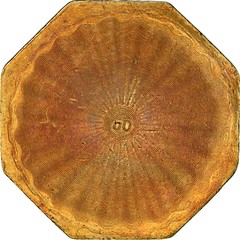
Lettered Edge, 887 THOUS, 50 on Reverse 1851 Augustus Humbert $50. Lettered Edge. K-4. Rarity-5. 50 DC, 887 THOUS., 50 on Reverse. MS-61 (PCGS). A highly significant offering for the specialist, and even more so as one of the finest Lettered Edge Humbert "slugs" known to PCGS. Handsome surfaces display pleasing deep honey-olive gold color with iridescent reddish-rose highlights. Surprisingly well preserved with mostly small, singularly inconspicuous handling marks scattered about - far from serious and far less obtrusive than typically seen for the issue. We're certain that in-hand inspection will convince you this specimen is entirely deserving of the coveted Mint State rating assigned by PCGS. The edge of this elusive variety reads AUGUSTUS HUMBERT UNITED STATES ASSAYER OF GOLD CALIFORNIA 1851, while the reverse exhibits a sunken 50 at the center of the design. James Wilson Marshall's discovery of gold in California's American River on January 24, 1848 kicked off one of the largest, and certainly the most romanticized gold rush in United States history. As news of this discovery spread, 300,000 people from both the Eastern United States and abroad would eventually make their way to California seeking wealth and prosperity. Some did strike it rich, although the majority bettered themselves little, either financially or otherwise. A small settlement of 200 souls in 1846, San Francisco had grown exponentially into a city of 36,000 people by 1852. Such a tremendous surge in population in a short period of time resulted in an acute shortage of circulating currency. Gold dust, which was quickly adopted as a medium of exchange, proved difficult to work with in this regard and little more than a stopgap measure. Then there was the additional problem of what to do with all of the gold that was being mined. Clearly it needed to be converted into a form that was universally acceptable so that it could not only be used in commerce in California, but could also be transported to major economic centers so as to contribute to the nation's larger economy. As early as 1849 proposals were introduced both in the California Legislature and United States Congress calling for the establishment of an assay office or branch mint in California. Competing political interests delayed action on the federal government's part, and most Californians wanted more than simply a state-run assay office. To meet the immediate economic needs of Gold Rush California while final action on the part of the state and/or federal government was awaited, various private minting firms sprang up in and around San Francisco. The firm of Moffat & Co., however, became the most important private minter serving the California Gold Rush; its successors Curtis, Perry and Ward eventually sold their facility to the United States government, which reopened it as the San Francisco Mint in March 1854. While still under the auspices of Moffat & Co., the firm's reputation caught the eye of the federal government when the latter was finally able to take action in the establishment of a local coinage facility to service the Gold Rush. Unfortunately, however, Californians did not initially get the branch mint they desired, due to competing political interests. Rather, a compromise bill passed through Congress on September 30, 1850, and established the United States Assay Office, to be located in San Francisco. Moffat & Co. received the contract to operate as the United States Assay Office, with New York watchmaker Augustus Humbert appointed as United States Assayer. Humbert arrived in San Francisco on January 30, 1851, bringing with him the first dies for coinage that had been prepared by Charles C. Wright. The first coins - $50 gold pieces - were issued under Humbert's authority the following day, with ingots following on February 14. The United States Assay Office continued to operate with these principals until the dissolution of Moffat & Co. in early 1852, after which the federal contract was assumed by Curtis, Perry & Ward under the name of the United States Assay Office of Gold. Humbert remained as assayer under the successor firm until it ceased operations on December 14, 1853. Nearly a branch mint in its own right, the operations of the United States Assay Office in 1851 and 1852 represent an important and defining chapter in the coinage history of the California Gold Rush and, indeed, the nation as a whole. One of Humbert's $50 gold pieces from his first year as assayer in California, this virtually About Uncirculated coin offers the advanced collector with an important opportunity to own a truly memorable memento of this widely studied and avidly collected era in United States frontier history. While all Lettered Edge slugs are early productions of Humbert's United States Assay Office of Gold, the 2023 Kagin and McCarthy book suggests the Kagin-4 variety represented here was actually struck earlier than its K-2 counterpart. This variety, like Kagin-1, includes the denomination 50 at the center of the reverse. Kagin and McCarthy suggest, sensibly, that the slugs with a denomination were likely struck during the first two months of 1851 when the assay office was manufacturing ingots of substantially higher values. Once the U.S. Assay Office was out of that business, "sometime before March 1," they could safely leave off the denomination and likely struck the $50 slugs after that date with no reverse denomination. This explains why some slugs have the stamped 50 and some lack it; it also explains why this variety is so rare while the 880 THOUS / No 50 variety (Kagin-2) is somewhat more common. Provenance: Property from an Alabama Family. Earlier from Heritage's sale of the Bob R. Simpson Collection, Part III, January 2021 FUN Signature Auction, lot 3053.
To read the complete item description, see:

Wayne Homren, Editor The Numismatic Bibliomania Society is a non-profit organization promoting numismatic literature. See our web site at coinbooks.org. To submit items for publication in The E-Sylum, write to the Editor at this address: whomren@gmail.com To subscribe go to: Subscribe All Rights Reserved. NBS Home Page Contact the NBS webmaster 
|