PREV ARTICLE
NEXT ARTICLE
FULL ISSUE
PREV FULL ISSUE
MORE ON THE ANA PINSDoug Ward submitted these notes on lapel pins in general, and a discovery relating to the ANA pin Nick Graver asked about. Thanks! -Editor
Whitehead & Hoag was determined to incorporate their logo onto most medals and pins, and would charge more if it was excluded. For screw back pins, their logo was consistently located on the back of the screw nut. Unfortunately, the nuts on the back of Nick Graver's pins were removed decades ago, before he acquired them. This is probably why they became artifacts rather than being sold or distributed and why they remained together as a group. The only inscription on the back of the pins is the word "STERLING." That inscription also appears on the edge of the Heath Medal, together with "WHITEHEAD – HOAG." Again, in my limited searching, sterling silver was not commonly used to make screw back lapel pins and I found none similarly labeled. Sterling silver was commonly used to make numismatic medals. Early pins were more commonly made of brass, gilt brass and 10 or 14 carat gold. Another prominent maker of lapel pins was Bastian Bros. Corp. of Rochester, NY, founded in 1895. They also made medals, but in letters to the ANS that ability was only introduced in 1919. They were making and advertising lapel pins in the early 1900s. However, the earliest of their screw back pins I was able to find date to the 1920s or 30s. Bastian Bros. was less consistent with their logo placement, with some appearing on the pin back and others on the nut. Bastian Bros. bought Whitehead & Hoag in 1959 and promptly destroyed its thorough manufacturing records. They're still in business and I've asked them for possible information. As David Fanning mentioned, the question of when Nick's pins were made remains unknown and will until more information comes to light. Perhaps there is further information waiting to be found in The Numismatist. I would think more of these pins exist than just the nine Nick's had. They were made purposely and likely by an ANA member for an ANA event. Hopefully, someone recognizes them or has one with a nut that will shed more light on their origin. Also, I'm curious what David thinks the loop and wavy device below it represents, as part of the ANA's lamp? The consensus is it's not a magnifying loop. Perhaps it is the lip of a vessel pouring oil into the lamp? That would be consistent with the original seal's description. I believe the first appearance of the seal's design with the loop device and looped handle is in the January 1907 issue of The Numismatist. Nick's pins likely appeared sometime after that. Hold the presses: I found a reference to Nick's pin in The Numismatist. It's described in the August 1943 issue, page 641, in regard to the Chicago ANA convention:
(Emphasis mine). Great discovery! -Editor Nick's silver pins are actually a little bigger than 3/8 inch in diameter or 11mm. There's no image in The Numismatist article. That solves the mystery. Although, if anyone has one we might yet find out who the manufacturer was. My money is on Whitehead & Hoag! 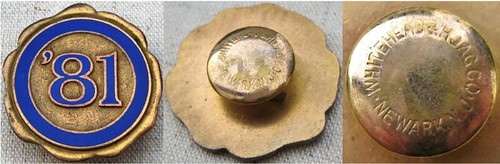
'81 screw back pin made by Whitehead & Hoag, possibly in 1881. Courtesy of Worthpoint. 
1892 dated screw back pin made by Whitehead & Hoag, probably in 1892. Courtesy of Ebay. 
American Legion screw back pin made by Bastian Bros. Co., probably made in the 1920's. Courtesy of Pinterest.
To read the earlier E-Sylum articles, see:

Wayne Homren, Editor The Numismatic Bibliomania Society is a non-profit organization promoting numismatic literature. See our web site at coinbooks.org. To submit items for publication in The E-Sylum, write to the Editor at this address: whomren@gmail.com To subscribe go to: Subscribe All Rights Reserved. NBS Home Page Contact the NBS webmaster 
|
