PREV ARTICLE
NEXT ARTICLE
FULL ISSUE
PREV FULL ISSUE
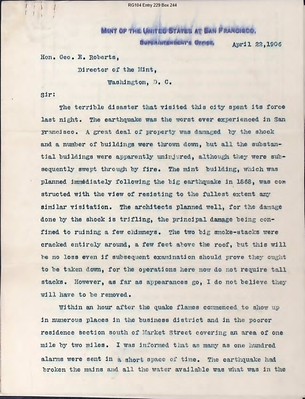
LEACH'S ACCOUNT OF 1906 SAN FRANCISCO MINT FIRERoger Burdette provided a transcription of an April 22, 1906 letter from San Francisco Mint Superintendent Frank Leach to Mint Director George Roberts the day after the city was struck with raging fires unleashed by a massive earthquake. Leach and Mint personnel fought valiantly, and with much of the city destroyed, the Mint stood damaged, but intact. Here's a lengthy excerpt. A fascinating, scary account. -Editor
Within an hour after the quake flames commenced to show up in numerous places in the business district and in the poorer residence section south of Market Street covering an area of one mile by two miles. I was informed that as many as one hundred alarms were sent in a short space of time. The earthquake had broken the mains and all the water available was what was in the pipes. The department succeeded in putting out some of the fires, but they were too numerous, and in a little while the fire was beyond the control of any human agency, and spread in all directions. It burned down to the eastern water-front and was stopped there with the aid of apparatus stationed along the wharves, the wide spaces there helping also to check its progress. Westward the fire took its course, being stubbornly fought by dynamiters and the crippled fire department, but no success followed their efforts for thirty-six hours, when a wide street, Van Ness Avenue, was reached. Here by dynamiting, back-firing and with the aid of the department, the fire was controlled and a large residence section saved. From Van Ness and Market another arm of the fire continued over into the S. W. part of the city, where it was headed off about a mile and a half further out. Over this area a very large residence and manufacturing district was burned out. The entire business part of the city was swept by the flames. I can learn of only two large business houses which escaped; one was near the water-front, and the other near the railroad. With the renewal of the wooden parts and windows, several of the modern buildings will be made as good as new. I hear that the stock of goods in one of these large buildings consisting of hardware and machinery was uninjured, although the lower stories were gutted, and that the large office building at the corner of Market and California Streets with its contents was safe. Our building was the only building directly in the path of the fire, after it had burned one mile, that withstood the attack. Everything around us was destroyed, and it was only by the heroic conduct of the men that the building was saved. Some two or three years ago it occurred to me that we ought to be equipped with fire apparatus so to be able to put out any blazes that might start in the building, never thinking of its application against an attack from the outside, and it is wholly due to the furnishing of that equipment that the mint was saved. After the earthquake about 50 employees reported at the mint, which includes the watchmen who had been on duty during the last watch. The fire had reached fifth and Mission Streets before I could get to the building, but Mr. McLaughlin, Superintendent of Machinery, and Capt. Hawes had proved equal to the emergency and were making a grand fight against the flames. I had to make a wide detour on foot, going around the north side of the city and working my way through the guards to reach the building. Upon arriving at the mint I found our greatest danger would be when the fire worked around to the north side, so I immediately distributed the men on the various floors from the basement to the roof, and had all inflammable stuff removed to the other side of the building, the shutters closed on the lower stories and lines of hose ready to put out the fires if they should appear in the building. We had considerable lumber upon the roof where we had been making new tanks. The old tanks had been taken down and sawed up into fire wood and had been thrown off into the court, making a rubbish pile there which subsequently was a great menace to the building. Lieut. G. R. Armstrong, 6th Infantry, was here with a detail of soldiers, and his men as well as himself were very active with their assistance. When the big buildings to the north of us on Market Street caught they sent terrific showers of burning material over the mint. It came down into the court as thick as hail, in pieces from the size of a walnut to the size of a man's hat, and I had two streams from the basement busily occupied in extinguishing flames started by these flakes of fire. The roof, you can imagine, was a pretty warm place. Mr. McLaughlin, with head melter Kennedy, assisted by Autzen, Terry and some of the soldiers, remained there to the end. After the danger was over they came down, blistered with heat and so blinded with the smoke they could hardly see. The basement and refinery floors gave us the hardest battle to save. The fire would creep in behind the shutters and between cracks in the basement, giving off a blinding, choking smoke and terrific heat, but the stream of water handled by workmen Cuneo and Fredrichs, aided by J. C. Hansen, baffled the fire in that quarter. On the refinery and adjusting room floor another lot of heroic fellows, Chittenden, foreman Bierce, Hastings, Hammill, E. Fisher, McCabe, French, Butler, Sherman, Mackie, Leith, assistant assayer Martin, Toner, Currier and Jacobs, headed by Captain Hawes, fought the fire with buckets and two streams of water. With blistered hands and faces they stood their ground, being driven back time and time again. At one time the smoke was so thick and choking they were driven to the extreme south end, or assay part, of the building, but I had some windows on the east side opened which gave them a little fresh air, and back the boys went at it again. Getting another stream of water with a greater head we found that we were able to control the situation, and that the flames could get no foothold upon the mint.

Wayne Homren, Editor The Numismatic Bibliomania Society is a non-profit organization promoting numismatic literature. See our web site at coinbooks.org. To submit items for publication in The E-Sylum, write to the Editor at this address: whomren@gmail.com To subscribe go to: Subscribe All Rights Reserved. NBS Home Page Contact the NBS webmaster 
|