PREV ARTICLE
NEXT ARTICLE
FULL ISSUE
PREV FULL ISSUE
BOSTON NUMISMATIC SOCIETY 150TH ANNIVERSARY REDBOOK
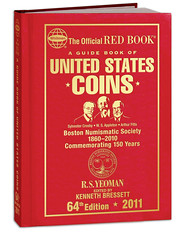
Ken Bressett submitted this item on the 150th anniversary of the Boston Numismatic Society and the accompanying special edition "Red Book".
-Editor
Throughout the years the BNS membership has included many well known personalities that have contributed to the literature and advancement of numismatic knowledge. Some of the more prominent are Sylvester S. Crosby, William Sumner Appleton, Howland Wood, Malcolm Storer, Shepard Pond, James Clapp, Cornelius C. Vermeule and George Fuld. In celebration of this historic event the BNS has issued a medal and will also be the host club for the upcoming ANA World’s Fair of Money© convention that is being held August 10-14, in Boston at the Hynes Convention Center. The sponsoring committee also managed issuing a special commemorative issue of the Guide Book of United States Coins (the 2011 Red Book). Under the leadership of bibliophile Charles Davis, and through the cooperation of Whitman Publishing Company, a very special limited edition book has been designed and printed for the benefit of the BNS. The cover contains illustrations of Crosby, Appleton, and Arthur Fitts, along with the original BNS logo and the words “Boston Numismatic Society. 1860-2010. Commemorating 150 years”. I was extremely pleased to get a copy of this commemorative Red Book and add it to my collection. It is very attractive and has some unique features not found in any other of the past similar commemorative Red Books. The “extras” include a letterpress bookplate and accomplishment card, and each book is individually numbered from 1 to 450, the total amount printed. Its closest rival is the one printed for the Milwaukee convention in 1987. That particular edition is considered a rare collector’s version that now sells for $1,000. According to Frank Colletti, author of A Guide Book of The Official Red Book of United States Coins, the “Boston” Red Book now takes its place alongside only twelve other similar unique edition Red Books that have been made over the past 23 years as special events for various organizations. With a “mintage” of only 450 copies the Boston edition has been eclipsed in rarity by only the 2008 Numismatic Literary Guild leather-bound, with 135 pieces, and the 250 similar pieces provided for the American Numismatic Society banquet in 2008. In a recent statement to me Frank opined “there is little doubt that this will be a sellout in a very short time, and that it will become one of the more popular Special Editions”. The Boston Red Book is being offered for sale to collectors and attendees at the Boston ANA convention through Charles Davis, Numismatic Literature, Box 547 Wenham MA, 01984. The price has been set at $85 plus $5 shipping. BOOK REVIEW: ASTRONOMICAL SYMBOLS ON ANCIENT AND MEDIEVAL COINS
Me, I'm no expert on ancient and medieval coins, nor am I an astronomer. But I have recruited one to write a more nuanced review than I can provide. Kavan Ratnatunga has been reading the book, reviewing calculations, and jotting his thoughts. A regular E-Sylum participant, I met Kavan in Pittsburgh where he was an astronomer working at Carnegie-Mellon University and began attending meetings of the Pittsburgh Numismatic Society. Kavan now lives in his native Sri Lanka and maintains an extensive web site on Sri Lankan coinage (www.lakdiva.org/). Look for Kavan's review later this summer. Meanwhile, here are my thoughts as a general reader and bibliophile. If bibliomaniacs are a little crazy, authors must be crazier to invest so much of their time and life's energy into a book writing project. For most authors, it must be a passion. And so it was for Faintich, as he wrote in his Preface:
Writing this book has been a passion for me. Ancient and medieval numismatics, history, cartography, and astronomy are the foundations of this book... When I saw a figure of the 1290 denier of Edward II of Ponthieu, which depicts a crescent, an annulet, and then another crescent, my immediate thought was that it represented the phases of an annular eclipse. When I discovered than an annular eclipse actually did cross Ponthieu in 1290, I was hooked. From that moment on, the pieces of the puzzle began to come together, one coin at a time. (p1) The result of Faintich's passion is a delightful reference for numismatists. I greatly enjoyed reading it, and I think others will, too. All it takes is our common love of history, some high school science and an appreciation for numismatics. The book opens with an overview of astronomical symbols on coins throughout ancient and medieval times. The sun, moon and planets were often represented. Even the famous Athenean Owl includes a crescent moon image. Most of the book's coin illustrations are line drawings, and I think this is an excellent choice, for the drawings make very explicit design elements that can often be very hard to discern from photos. For me, this part of the book ranks in importance with Tempus in Nummis, as coverage of an overarching theme that appears again and again in coinage. Numismatists are missing something if they study a particular series of coins without taking a step back to review overall themes and the context in which they fit. Going far beyond the simple theme of celestial representation however, Faintich makes a very good case for tying particular coin issues to particular known celestial events such as the appearance of comets and lunar and solar eclipses. The rarest and most spectacular event is a total solar eclipse, which I've never had the opportunity to experience. A solar eclipse in 585BC was reported to have "stopped the war between the Lydians and the Medes. During a battle in Northern Turkey, the two sides immediately stopped fighting when the eclipse occurred, and took the eclipse as a sign that they should make peace."
Then moments before totality, the shadow of the moon raced across the earth and darkened the sky as if a divine curtain had been pulled across the heavens.... and finally the magnificent solar corona became visible. During this process the temperature dropped by as much as 15oF. Wind currents changed. Animals became still and night creatures awoke. The planets and bright stars became visible.... those who had been mesmerized by the eclipse .. found themselves with permanent blind spots in their eyes. No wonder that ancient man took such rare sights as divine omens. (p33) By correlating astronomical data with the appearance of related astronomical symbols on coins minted in the path of celestial events, the author proposes revised dates for the issuing sequence of coins such as those of Norman England. While the "precipitating event" of many coin changes is military or political (such as the Battle of Hastings or a ruler's coronation), others have a celestial trigger, such as the appearance of a comet, an alignment of planets or lunar or solar eclipse. The author justly couches his conclusions as tentative. The final chapter, originally planned to be titled "Conclusions" is called "Beginnings". Here the author notes that much work remains to be done. I should note that I found the author's style and tone quite readable and matter-of-fact throughout. Facts are presented, hypotheses clearly labeled as such, and credit is given where due to others. I've seen too many scholarly books where the author's haughty know-it-all tone is so thick I could choke - this book is not one of them. Scholarly yes, but quite approachable. Returning to the Preface, Faintich writes: As I began to write this book, I thought I was writing a book about numismatics. By the time I finished, I had found that the book is much more than that. It is the basis for a new tool to explore and understand the political and mystical beliefs of ancient and medieval life. Thus I have not finished a book, but rather I have opened the door for more research. This is the passion: each new discovery answers one question, and at the same time asks another. Where will it lead? I do not know, but I invite you to join me on the journey." The book is a very interesting journey of discovery, and for me it's a "keeper". There's nothing quite like it already in my library. Before closing I should add that it passes my "back of the book" test - there is a good five-page index, a four-page bibliography, and three appendices addressing the accuracy of analysis, additional examples of coins with astronomical symbols, and sources of figures. I'm curious to learn what Kavan and other reviewers have to say.
232 pages $55 hardcover (7 × 10)
McFarland & Company, Inc., Publishers
336-246-4460
To read the earlier E-Sylum article, see: NEW BOOK: ASTRONOMICAL SYMBOLS ON ANCIENT AND MEDIEVAL COINS (www.coinbooks.org/esylum_v13n20a04.html) THE BOOK BAZARREWayne Homren, Editor The Numismatic Bibliomania Society is a non-profit organization promoting numismatic literature. See our web site at coinbooks.org. To submit items for publication in The E-Sylum, write to the Editor at this address: whomren@gmail.com To subscribe go to: https://my.binhost.com/lists/listinfo/esylum All Rights Reserved. NBS Home Page Contact the NBS webmaster
|