Visit our NBS Sponsors











About UsThe Numismatic Bibliomania Society is a non-profit association devoted to the study and enjoyment of numismatic literature. For more information please see our web site at coinbooks.org SubscriptionsThose wishing to become new E-Sylum subscribers can go to the following web page
Subscribe
MembershipThere is a membership application available on the web site Membership Application To join, print the application and return it with your check to the address printed on the application. Print/Digital membership is $40 to addresses in the U.S., and $60 elsewhere. A digital-only membership is available for $25. For those without web access, write to: Jeff Dickerson, Treasurer AsylumFor Asylum mailing address changes and other membership questions, contact Jeff at this email address: treasurer@coinbooks.org SubmissionsTo submit items for publication in The E-Sylum, write to the Editor at this address: whomren@gmail.com 
BUY THE BOOK BEFORE THE COINSale CalendarWatch here for updates! |
- WAYNE'S WORDS: THE E-SYLUM JANUARY 11, 2026
- BRYCE BROWN CATALOG INVENTORY UPDATED
- NEW BOOK: CHARLTON CANADIAN COINS 2026
- NEW BOOK: ARCE'S DOUBLOONS
- NEW BOOK: MACEDONIAN BANKNOTES
- CHARLES JAMES "SKIP" CULLEITON (1938-2026)
- CARMEN F. ARNOLD-BIUCCHI (1947-2026)
- VIDEO: LARGEST SILVER COIN IN THE WORLD
- AUGUSTUS B. SAGE PHOTO FOUND
- NOTES FROM E-SYLUM READERS: JANUARY 11, 2026
- BULLION AUTHENTICATION COMPANY LAUNCHED
- VOCABULARY TERM: SEGMENTED COLLAR
- COIN BAGS AT THE SECOND PHILADELPHIA MINT
- ATLAS NUMISMATICS SELECTIONS: JANUARY 11, 2026
- NUMISMAGRAM MEDAL SELECTIONS: JANUARY 11, 2026
- HERITAGE: FUN CURRENCY AUCTION
- STACK'S BOWERS: PETER JONES COLLECTION
- AMBASSADOR'S GRANDCHILDREN FIND COINS
- 1844-O HALF DOLLAR REPUNCHED DATE
- SCARINCI INTERVIEW: UNCHOSEN 2026 COIN DESIGNS
- MINT SEEKS ARTISTIC INFUSION PROGRAM ARTISTS
- SOCIETE DE ARTISTES FRANCAIS GOLD MEDAL
- NEW ORLEANS BANKING DURING THE CIVIL WAR
- EMPEROR NORTON BOND AND PHOTO OFFERED
- U.S. TREASURER TALKS UP TRUMP $250 BILL
- ABOUT THIS ISSUE: JANUARY 11, 2026
Content presented in The E-Sylum is not necessarily researched or independently fact-checked, and views expressed do not necessarily represent those of the Numismatic Bibliomania Society.
WAYNE'S WORDS: THE E-SYLUM JANUARY 11, 2026
 New subscribers this week include:
Welcome aboard! We now have 6,669 subscribers.
New subscribers this week include:
Welcome aboard! We now have 6,669 subscribers.
Thank you for reading The E-Sylum. If you enjoy it, please send me the email addresses of friends you think may enjoy it as well and I'll send them a subscription. Contact me at whomren@gmail.com anytime regarding your subscription, or questions, comments or suggestions about our content.
This week we open with a numismatic literature site update, three new books, two obituaries, updates from the Newman Numismatic Portal, notes from readers, and more.
Other topics this week include Canadian coins, Macedonian banknotes, Augustus B. Sage, a new grading firm, coin bags at the Philadelphia Mint, fixed price and auction selections, more on the unchosen semiquincentennial designs, New Orleans banking during the Civil War, and Emperor Norton.
To learn more about Colombian gold cob coinage, the largest silver coin, wrong planchet errors, vintage and modern bullion, segmented collars, Jean-Pierre Droz, the Peter Jones M.D. Collection, the 1844-O half dollar repunched date, the Mint's Artistic Infusion Program, and duck canvas, read on. Have a great week, everyone!
Wayne Homren
Editor, The E-Sylum

Image of the week
BRYCE BROWN CATALOG INVENTORY UPDATED
Numismatic literature dealer Bryce Brown writes:
"I've made a long-overdue update to my coin auction catalog price list. There are updates throughout (highlighted in green and blue), but most notable are additions of catalogs from across the Atlantic (Christie's, Glendining's, and Sotheby's).
"The webpage is found here:
brycebooks.squarespace.com/storage/Coin-Auction-Catalogs.htm."
NEW BOOK: CHARLTON CANADIAN COINS 2026
The new 2026 Charlton Canadian Coins book is available in both English and French versions. -Editor


First published in 1952, the Charlton Standard Catalogue of Canadian Coins has stood for more than seven decades as the primary reference trusted by collectors, dealers and auction professionals across Canada. Originating with James E. Charlton's ground breaking catalogue of Canadian coins, tokens and fractional currency, the series quickly became an essential tool for identifying, valuing and studying Canadian numismatic issues.
Over the years, the catalogue has evolved alongside the hobby. When the line was divided into two volumes, Volume One became dedicated to numismatic issues—covering business strikes, commemoratives and all legal tender coinage circulating or issued in Canada from the 19th century to the present. Each edition continues Charlton's longstanding commitment to accurate, research-based pricing that reflects real conditions in the Canadian market.

NEW BOOK: ARCE'S DOUBLOONS
Daniel Frank Sedwick has announced his new book on Bogotá Gold (1692–1714). The official launch will take place at the 1715 Fleet Society event in Vero Beach on Monday, January 12. All online sales will be processed after the NYINC show on January 19th. -Editor
 This landmark work examines hundreds of examples to chronologically sequence the dies used to make 2 escudos gold coins ("doubloons") at the Bogotá mint in 1692-1714, during the tenure of assayer Buenaventura de Arce Penagos, all in the name of Charles II of Spain, whose death in 1700 marked the beginning of the War of the Spanish Succession and an increase in Caribbean piracy.
The majority of these hand-struck coins were recovered by divers in our time from the wrecks of the Spanish 1715 Fleet off the east coast of Florida, and many of the recovered coins now reside in the State of Florida Collection, which the author studied extensively for this project.
This work reveals several heretofore unknown aspects about these coins, including muling with 1 escudo dies, transpositions and retrograde characters, and even a secret debasement.


NEW BOOK: MACEDONIAN BANKNOTES
 Author Dusty Dragicevic writes:
"I have just written a new book in collaboration with another author (Zoran Strezoski). It is my second publication since I released Croatian Banknotes: A Standard Reference in 2022.
"This one details the history of the Macedonian denar from its Genesis to the present day. ISBN number is 97 83949 958113 (in Europe). The book details the artists behind each design, the people behind the signatures and a thorough description of each cultural monument and landmark that appears on each denomination.
"It is in full colour and it has been published by RB Numisbooks in Europe."


CHARLES JAMES "SKIP" CULLEITON (1938-2026)
Very sorry to hear about this - Skip Culleiton was one of my good friends and mentors from my hometown club, the Western Pennsylvania Numismatic Society (WPNS). -Editor
 Charles James "Skip" Culleiton, 87, of Cabot, formerly of Tarentum, passed away Wednesday, Jan. 7, 2026, surrounded by his family.
Born to the late Charles M. and Margaret A. Culleiton, Skip built a long and steady career as a research chemist with Alcoa in New Kensington, retiring after 39 years of service. Skip earned his B.S. in Chemistry from the University of Pittsburgh in 1966 and later completed his master's degree in Chemistry at Duquesne University in 1982.
He was a dedicated member of the Allegheny-Kiski Valley Historical Society for more than 25 years, serving as a board member, treasurer for over a decade, and editor of the Alle-Kiski Chronicle since 1997. He also authored several books on local history. He contributed to Holy Martyrs Parish through his work creating dyed-sawdust carpets for the Feast of Corpus Christi and maintained extensive collections of vintage postcards and rare communion tokens.
CARMEN F. ARNOLD-BIUCCHI (1947-2026)
American Numismatic Society Curator of Greek Coins Carmen Arnold-Biucchi has passed. Sorry to hear this news. Here's an announcement from ANS. -Editor
 The American Numismatic Society is deeply saddened to learn of the passing of Carmen Arnold-Biucchi, an ANS Life Fellow and former staff member. A prominent numismatist and classical archaeologist, Arnold-Buicchi was the First Margaret Thompson Curator of Greek Coins at the ANS and the former Damarete Curator of Ancient Coins at Harvard Art Museums.
Arnold-Buicchi first joined the ANS staff as a curatorial assistant in the Greek and Roman departments in 1982. She then served as Assistant Curator of Ancient Coins before being appointed Margaret Thompson Curator of Greek Coins, a position she held until 2000. Many will fondly remember Arnold-Biucchi from her time teaching students in the ANS Graduate Summer Seminar from 1982 to 1999. After she left the ANS, Arnold-Biucchi became the Harvard Art Museums' first curator of ancient coins in 2002. She held this position, which was endowed as the Damarete Curator of Ancient Coins in 2009, for nearly two decades before her retirement in 2019.

VIDEO: LARGEST SILVER COIN IN THE WORLD
The David Lisot Video Library on the Newman Numismatic Portal can be found at:
https://nnp.wustl.edu/library/multimediadetail/522852
We highlight one of his videos each week in The E-Sylum. Here's one from 2016 about a massive silver coin. -Editor
AUGUSTUS B. SAGE PHOTO FOUND
A web site visitor writes:
"I recently acquired what I believe is a previously unknown carte de visite photograph of Augustus B. Sage that is inscribed by him. I am a collector of a broad swath of Americana, and have collected Charles Bushnell's antiquarian historical writings for years. I learned of the Bushnell-Sage connection through Sage's token with Bushnell's bust, then learned more from David Bowers's book about Sage. I just happened to be at the right place at the right time to acquire this signed photograph."


NOTES FROM E-SYLUM READERS: JANUARY 11, 2026
Wrong Planchet Error Photo Libraries

Regarding the Walking Liberty Half on a steel cent planchet, Saul Teichman writes:
"I created a photo library for this type which is the support for the catalog description. It is available on the Newman portal at the following link -
https://nnp.wustl.edu/library/book/648936.
Other error photo libraries can be found at the following link.
https://nnp.wustl.edu/library/archivedetail/556461."
- 1906 Liberty Nickels on Cent Planchets
- 1934 Buffalo Nickels on Cent Planchets
- 1943 Copper Cent
- 1943S Copper Cent
- 1944D-S Steel Cents
- 1964 Lincoln Cents on Clad Dime Planchets
- 1964 Half Dollars on Clad Quarter Planchets
- 1965 Lincoln Cents on Silver Dime Planchets
- 1999 Anthony Dollars on Sacagawea Planchets
- 2000 Sacagawea Dollars on SBA Dollar Planchets
- 1976 Bicentennial Ike Dollars on Wrong Planchets
- Buffalo Nickels on Dime Planchets
- Cents Struck on Quarters
- Cents Struck on Dollars
- Copper Nickel Indian Cent Die Caps
- Miscellaneous Mule Errors
- Presidential Dollars on Wrong Planchets
- Sacagawea Dollars on Wrong Planchets
- Shield Nickels on Cent Planchets
Thank you - great resources. -Editor
To read the earlier E-Sylum article, see:
WALKING LIBERTY HALF ON STEEL CENT PLANCHET
(https://www.coinbooks.org/v29/esylum_v29n01a18.html)
Other topics this week include bent talisman coins, and the 2026 ANA National Money Show. -Editor

BULLION AUTHENTICATION COMPANY LAUNCHED
Here's the press release for some hobby news announced at this week's FUN show. The image shows BAC Chairman, Michael Greenwood and Christie Keene cutting the ribbon for BAC official launch on January 8, 2025. -Editor
 Vintage & Modern Bullion Authentication Companies, LLC doing business as Bullion Authentication Company (BAC) makes their formal launch at the FUN Convention in Orlando, Florida.
"We have the chance now to showcase the history, rarity, pricing and artistry of vintage and modern bullion" said BAC Chairman Michael Greenwood." By authenticating these often beautiful products, we formally launch them as a collector's item." The launch marks the fulfillment of several years of research, listening to collectors and dealers, and developing a first class product with first class professionals.
BAC's goal is to be the first company to:
- Authenticate, grade, and encapsulate vintage and modern rounds and bars of silver, gold and other precious metals.
- Create a public specialized database aggregating known types of vintage bullion, which will be the foundation to develop a bullion wholesale/retail price guide.
- Provide Population Reports (based on grade & condition), Registry Sets and Customized "My Portfolio" Information.
- Bring together buyers and sellers of bullion where customers can place orders for BAC bullion or sell bullion through a select group of verified Dealers.
VOCABULARY TERM: SEGMENTED COLLAR
Here's another entry from Dick Johnson's Encyclopedia of Coin and Medal Terminology. -Editor
Segmented Collar. A mechanical device of several parts to impart raised letters or raised ornamentation on the edge of a struck piece. The collar is made in 3, 4 or 6 sections (3 being most common) with incuse ornamentation or lettering on the collar wall (the restraining surface inside the aperture). The sections are assembled and held in place by a retaining ring within a collar plate. The obverse and reverse dies come together inside the collar aperture. When struck the metal from the blank spreads in all directions filling the cavities in the die and up against and into the cavities of the collar.
Edge lettered coins. Coins with ornamentation in raised (or sunken) relief appeared as early as 1685. Jean Castaing developed this process at the Paris Mint where he forced the blank to roll between two engraved bars with a groove in the center. The ornamentation was engraved sunken or raised into this groove. The coins were struck after this was applied to the blanks.

COIN BAGS AT THE SECOND PHILADELPHIA MINT
E-Sylum Feature Writer and American Numismatic Biographies author Pete Smith submitted this article on how coin bags were used at the Second Philadelphia Mint. Thanks! Obscure but interesting topic - perfect for inquisitive E-Sylum readers. -Editor
The recent issue of The Journal of the Old Bag Collectors Club included the transcript of an October 25, 1885, letter from mint cashier M. H. Cobb to superintendent Daniel M. Fox. This described the space requirement for storing bags of different types in the vaults of the Mint. Thanks to Roger Burdette fur providing copies of correspondence at the National Archives.

I am most interested in the storage of silver dollars in bags. The Bland-Allison Act of February 28, 1878, provided for the production of Standard Silver dollars and also for the issue of certificates of deposit. The actual coins saw little circulation and were held in deposit by the Treasury Department as backing for the commonly used silver certificates.
In the nineteenth century, women adjusters at the mint were expected to do sewing during slack periods. They made sleeves, mitts and bags by hand.

ATLAS NUMISMATICS SELECTIONS: JANUARY 11, 2026
Atlas Numismatics has updated their website with 317 new coins, medals, and tokens at fixed prices. Select items are discussed below. -Garrett

1084576 | GREEK. PTOLEMAIC KINGS OF EGYPT. Arsinoe II Philadelphos. (Wife of Ptolemy II, died 270/268 BC). Posthumous issue, Class III, circa 164/163 - 140 BC. AV Mnaieion – 'Oktadrachm'. NGC MS (Mint State) Strike 5/5 Surface 2/5. Alexandria mint. 27mm. 27.47gm. Veiled head of deified Arsinöe II right, wearing diademed stephane and horn of Ammon, scepter surmounted by lotus over left shoulder; K in left field, dotted border APSINOHS-FI?A?E?FOY. Double cornucopia bound with royal diadem, containing pyramidal cakes, pomegranates and other fruits, grape cluster hanging from the rim of each horn; dotted border. CPE II K-43; Svoronos 1498-1499. Highly lustrous and very attractive for the grade assigned.

NUMISMAGRAM MEDAL SELECTIONS: JANUARY 11, 2026
Numismagram's Jeremy Bostwick sent along these four medals from his most recent upload of new material to his site. For all of the new items, please visit https://www.numismagram.com/inventory. -Garrett

103379 | MEXICO. Maximiliano I & Carlota silver Medal. Issued 1867. Memorial to Maximiliano (30mm, 10.88 g, 12h). By Cayetano Ocampo.
MAXIMILIANO Y CARLOTA EMPERADORES, jugate bare heads left of Maximiliano and Carlota; laurel branch to left and right // 12 / DE JUNIO / DE 1864 / 19 / DE JUNIO / DE 1867 in six lines; all within garlanded laurel and oak wreath. Edge: Plain.
Grove 133a. About Uncirculated. Deep gunmetal gray surfaces, with some light rub upon the high points; a few lightly scattered marks and two cuds at the edge are noted for completeness. Compare to an NGC MS-61 which realized a total of $2,520 in October 2025.

HERITAGE: FUN CURRENCY AUCTION
Heritage Auctions will be hosting their FUN U.S. Currency Auction from January 13-16. Select items from the Curators' Picks are discussed below. -Garrett

T5 $100 1861 PF-1 Cr. 5 PMG Choice Uncirculated 64 EPQ.
This note was designed, engraved, and printed by the New Orleans
branch of the ABNCo under the banner of the Southern Bank Note
Company, a trade name from the 1840s dusted off to provide some
cover from negative publicity for the parent company in New York.
The tiny New Orleans office was ill-suited to design and produce
new designs in volume, and deliveries stretched out into August and
September 1861 before production and design efforts were shifted to
other lower denominations needed by the Confederacy. Only 5,798
notes were issued as a result, and this well printed intaglio
engraved design is one of the keys to the Confederate series. A
lovely addition to any Confederate collection.
STACK'S BOWERS: PETER JONES COLLECTION
Stack's Bowers will be selling the Peter Jones M.D. Collection as part of their January 2026 NYINC Auction. Select items are discussed below. -Garrett


ITALY. Bruttium. Kaulonia. AR Stater (7.03 gms), ca. 535-500 B.C. NGC Ch EF, Strike: 5/5 Surface: 2/5. Brushed. HGC-1, 1416; HN Italy-2035; Noe-Group A, 21 (same dies). Obverse: Apollo advancing right, holding branch overhead and extending hand upon which a small daimon, holding branch in each hand, runs right; to right, stag standing right, head left; dot-and-cable border around; Reverse: Incuse of obverse, but daimon in outline and with no ethnic; radiate border around. Always counted among the most iconic issues of Archaic Greek Italy, this example portrays a crisp strike on its characteristically large round flan. Some pitting and roughness, but this is mostly limited to the reverse; the obverse retains an enchanting lustrous and argent appearance.
AMBASSADOR'S GRANDCHILDREN FIND COINS
Aaron Oppenheim passed along this article about coins found by grandchildren of US Ambassador to Israel Mike Huckabee. Thank you. -Editor
 "Grandpa, look what we found!" exclaimed the grandchildren of US Ambassador to Israel Mike Huckabee as they excitedly pulled five ancient coins from a recently discovered cave near the community of Na'ale in the Binyamin region.
The Binyamin Regional Council is accustomed to hosting senior figures from around the world as part of official tours and ceremonies, but this time the Huckabee family chose a completely different format. The ambassador, his wife, his daughter Arkansas Governor Sarah Huckabee Sanders, her husband, and their children decided to spend their Christmas holiday on a hands-on field tour in the Binyamin region.
The family participated in an archaeological tour initiated by Ruthie Lieberman, political consultant and founder of the Yes! Israel Project, together with Sarah Paley. The tour was guided by Dr. Dvir Raviv of Bar-Ilan University, who is leading an archaeological survey of the area.
1844-O HALF DOLLAR REPUNCHED DATE
Stack's Bowers Senior Numismatist Greg Cohen published an article highlighting an interesting doubled date coin in the firm's February Showcase Auction. -Editor

As I was scrolling through the February Showcase Auction, a coin that most would just scroll past caught my eye. Lot 25114 is a VF-25 example of the dramatically doubled date 1844-O half dollar. While by no means the rarest or most expensive coin in the auction, it is quite an interesting variety for the specialist collector.
The Liberty Seated series is full of interesting die varieties, but few reach the status of having a separate listing on PCGS CoinFacts or in the Guide Book of United States Coins (Red Book). The repunching on the 1844-O however is so dramatic that it has earned its place as an important part of the series.

SCARINCI INTERVIEW: UNCHOSEN 2026 COIN DESIGNS
Longtime Citizens Coinage Advisory Committee member Donald Scarinci was interviewed this week on National Public Radio about the unchosen semiquincentennial circulating coin designs. -Editor
New coins begin to circulate today, commemorating the 250th anniversary of the United States' founding. The coins feature pilgrims and early presidents — George Washington, Thomas Jefferson and James Madison. But other coins honoring civil rights figures and suffragettes won't be minted.
The special coins were authorized back in 2021 in anticipation of this year's big semiquincentennial celebration. That launched a lengthy design process that involved lots of focus groups and public outreach.
"In a democracy and a country as vast as this, the only way to do this is exactly the way Congress decided it should be done, which is to form a committee of people from different regions of the country, different perspectives, and let them talk it through," says Donald Scarinci, who has served on the Citizens Coinage Advisory Committee for two decades.
The committee ultimately recommended five commemorative quarters to roll out during the year. One would feature Frederick Douglass, to mark the abolition of slavery. Another would highlight the 19th Amendment, which gave women the right to vote. A third coin would have shown 6-year-old Ruby Bridges, to celebrate school desegregation and the civil rights movement.
THE BOOK BAZARRE
MINT SEEKS ARTISTIC INFUSION PROGRAM ARTISTS
Despite the hubbub over unused designs, the U.S. Mint presses on. Mint Director Paul Hollis was sworn in, and a call was made for artists to participate in its Artistic Infusion Program. Here's the press release. -Editor

The United States Mint (Mint) is pleased to announce a call for artists to participate in its Artistic Infusion Program (AIP). The Mint will begin accepting applications for the program on January 8, 2026, at 12:00 p.m. EST. Applicants must fill out an application form and submit five to 10 images of work from their portfolio. Following Evaluation Phase One, the Mint may invite selected participants to join the AIP without further evaluation. Those applicants selected for further evaluation will be invited to Evaluation Phase Two, which may require the submission of a resumé or CV, a web link to their online portfolio, or the development and submission of a demonstration design for which each selected artist will be paid a fee of $1,500.
SOCIETE DE ARTISTES FRANCAIS GOLD MEDAL
Stack's Bowers Senior Numismatist Henrik Berndt published an article about a nice gold medal from the L. E. Bruun collection. -Editor

We start with a painting, a painting of a group of hatters. Italian Village Hatters it is called, and it was created in 1880 by Danish painter Peter Severin Krøyer while traveling on a grant from the Royal Academy of Arts. No, I am not mad, and I assume the hatters weren't either.
- The painting features a skinny, sweaty, Italian man working in a dusty, hot room, his two equally skinny sons assisting him. A masterpiece for sure, recognized as such by the Société de Artistes Francais in Paris, who awarded him their third prize and gold medal in their inaugural year of 1881. With such an accolade from the artistic center of world, Krøyer was elevated to the top of the Danish artists' league and became the front figure of the so-called ‘modern break-through,' an important new direction of art. Krøyer is today best known for his paintings from the village of Skagen on the north tip of Jutland, often tranquil scenes on the beach.
NEW ORLEANS BANKING DURING THE CIVIL WAR
The Tontine Coffee-House published an article about New Orleans banking during the Civil War. Here's an excerpt - see the complete article online. -Editor

City of New Orleans $1 Note, 1862
Generally, Southern banking was not as developed as it was in the North; New York provided financial services to southern clients because, in large parts of the South, there were too few banks, or rather, the banks there were too small. An exception was to be found in New Orleans, the largest port in the southern states. Half of the South's cotton production transited through New Orleans each year and, since the city first became a part of the United States, it was an important financial center too. Both the First and Second Bank of the United States had branches established in New Orleans and the city also possessed a federal mint. New Orleans was further home to a wide variety of merchants, brokers, and bankers; many of these had arrived there from the northern states or from abroad.
The city's banks were well respected and may have been among the strongest in the country. An 1842 banking law in Louisiana required the state's banks to keep reserves in precious metals equal to one-third of their banknotes and deposits. Otherwise, the banknotes were appropriately backed by other short-term assets like loans or discounted bills due within ninety days. This composition of assets kept New Orleans banks, like the Citizens Bank, strong. New Orleans banks fared comparatively well during the Panic of 1857, either suspending payments only briefly or not at all.
EMPEROR NORTON BOND AND PHOTO OFFERED
John Lumea of the Emperor Norton Trust notified me of the upcoming sale of two great Norton items - a fifty-cent bond and studio cabinet card portrait. The auction is being held by the Sacramento house Witherell's on January 29. Thank you. I always wanted one of the bonds, but only managed to purchase a set of reproductions for my numismatic ephemera collection. -Editor
A fifty-cent bond issued by the self-proclaimed Emperor Norton I of San Francisco, dated October 12, 1878. Printed note reads: "Promises to pay the holder hereof, the sum of Fifty Cents in the year 1880, with interest at 5 per cent per annum, from date, the principal and interest to be convertible, at the option of the holder, at maturity, into 20 years' 5 per cent Bonds, or payable in Gold Coin. Given under our Royal hand and seal." Signed "Norton I, Emperor." This example is No. 7180 and features his portrait at left with ornate borders and a United States Treasury seal design at right. Emperor Norton I remains a beloved folk figure of California history for his eccentric reign and proclamations as Emperor of the United States and Protector of Mexico.
U.S. TREASURER TALKS UP TRUMP $250 BILL
In a recent interview, U.S. Treasurer Brandon Beach was asked about a $250 bill for the semiquincentennial. -Editor
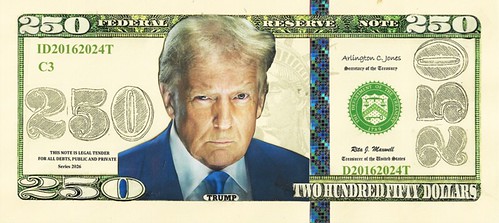
U.S. Treasurer Brandon Beach told the Daily Caller News Foundation on Wednesday that he is working on creating a $250 bill bearing the image of President Donald Trump.
The U.S. treasurer supervises the nation's currency and coinage production, with direct oversight of the U.S. Mint and Fort Knox.
Beach served as a Republican member of the Georgia State Senate for more than a decade before being appointed by Trump to his current position in May.
ABOUT THIS ISSUE: JANUARY 11, 2026
This was a pretty normal week for creating The E-Sylum. Throughout the week I triaged incoming email, queuing up content for potential inclusion. On Wednesday I started forwarding some tasks to Garrett. Most of my free time over the weekend was spent pulling together and finalizing the issue.
With all the January auctions happening, we have a lot of auction previews. I enjoy these because of the great variety of numismatic items we're exposed to, including many high-condition "eye-candy" rarities.
But the weekend wasn't all work. On Saturday night my wife and I went out for a bowling night with three neighborhood couples. Hadn't done that since our kids were little. It was fun, even though my scores were horrible and Sunday I had soreness in leg muscles I forgot I had. In a group chat we exchanged photos from the evening, and my neighbor Scott couldn't resist the opportunity to use AI to turn a couple of us into ripped, bare-chested Chippendale dancers. At least my haircut and glasses are real. And the sixpack abs.

Finally, here are some interesting non-numismatic articles I came across this week. Be sure to scroll down on the Hollywood analysis - it gets interesting. And while "The Ridiculous Engineering Of The World's Most Important Machine" is a long video, it's very well done and informative. Where else could you get a free crash course in extreme ultraviolet lithography?
Did the ancient Romans wear underwear? The truth is surprisingly complicated
(https://www.historyextra.com/period/roman/ancient-roman-underwear-fashion-complicated-truth/)
What is the Most Successful Hollywood Movie of All Time?
(https://informationisbeautiful.net/visualizations/what-is-the-most-successful-hollywood-movie-of-all-time/)
Marking today's 250th anniversary of Thomas Paine's world-changing "Common Sense"
(https://www.axios.com/newsletters/axios-finish-line-ca3ac3f0-ee3d-11f0-b8ed-a71d8a85adcd.html)
The Ridiculous Engineering Of The World's Most Important Machine
(https://3quarksdaily.com/3quarksdaily/2026/01/the-ridiculous-engineering-of-the-worlds-most-important-machine.html)
-Editor


Editor Wayne Homren, Assistant Editor Garrett Ziss

|
|
| |