Visit our NBS Sponsors











About UsThe Numismatic Bibliomania Society is a non-profit association devoted to the study and enjoyment of numismatic literature. For more information please see our web site at coinbooks.org SubscriptionsThose wishing to become new E-Sylum subscribers can go to the following web page
Subscribe
MembershipThere is a membership application available on the web site Membership Application To join, print the application and return it with your check to the address printed on the application. Print/Digital membership is $40 to addresses in the U.S., and $60 elsewhere. A digital-only membership is available for $25. For those without web access, write to: Jeff Dickerson, Treasurer AsylumFor Asylum mailing address changes and other membership questions, contact Jeff at this email address: treasurer@coinbooks.org SubmissionsTo submit items for publication in The E-Sylum, write to the Editor at this address: whomren@gmail.com BUY THE BOOK BEFORE THE COINSale CalendarWatch here for updates! |
- WAYNE'S WORDS: THE E-SYLUM APRIL 26, 2026
- LANG NUMISMATIC LITERATURE AUCTION 11
- NEW BOOK: STAN AND GUS
- JOEL ISKOWITZ (1946-2026)
- ERROR COIN LEGEND MIKE CHAMBERS
- DIRECTOR HOLLIS SPEAKS AT NNP SYMPOSIUM
- VIDEO: 70 YEARS OF RED BOOK PUBLICATION
- 2026 ANA SUMMER SEMINAR REGISTRATION
- HICKORY BANK SATIRICAL NOTE OFFERED
- THE 1790 T. DEXTER SHILLING
- NOTES FROM E-SYLUM READERS: APRIL 26, 2026
- PNG 2026 AWARD WINNERS ANNOUNCED
- VOCABULARY TERMS: SILVERPLATE, SILVERPLATING
- MILFERD HENRY BOLENDER (1894-1977)
- HERITAGE: CENTRAL STATES WORLD AND ANCIENTS
- HERITAGE: VILA RICA COLLECTION SELECTIONS
- HERITAGE: THE ALAMO COLLECTION
- HERITAGE: CENTRAL STATES U.S. COIN AUCTION
- WAYNE'S NUMISMATIC DIARY: APRIL 26, 2026
- SILPHIUM ON ANCIENT COINS
- AUSTRALIAN WWII SHORT SNORTERS
- 2025 IBNS BANK NOTE OF YEAR
- LOOSE CHANGE: APRIL 26, 2026
- ABOUT THIS ISSUE: APRIL 26, 2026
Content presented in The E-Sylum is not necessarily researched or independently fact-checked, and views expressed do not necessarily represent those of the Numismatic Bibliomania Society.
WAYNE'S WORDS: THE E-SYLUM APRIL 26, 2026
 New subscribers this week include:
Tim Montgomery,
Daniel Londoño,
and
Ryan Dibilio.
Welcome aboard! We now have 6,553 subscribers.
New subscribers this week include:
Tim Montgomery,
Daniel Londoño,
and
Ryan Dibilio.
Welcome aboard! We now have 6,553 subscribers.
Thank you for reading The E-Sylum. If you enjoy it, please send me the email addresses of friends you think may enjoy it as well and I'll send them a subscription. Contact me at whomren@gmail.com anytime regarding your subscription, or questions, comments or suggestions about our content.
This week we open with a numismatic literature sale, one new book, updates from the Newman Numismatic Portal, notes from readers, and more.
Other topics this week include Augustus Saint-Gaudens, Joel Iskowitz, the Red Book, the ANA Summer Seminar, the Hickory Bank satirical note, silverplating, M. H. Bolender, auction sale previews, short snorters, and the IBNS Banknote of the Year.
To learn more about Africa's Journey to Modern Money, the Numismatics of Fairs and Expositions, spindle cancelling, coin usage heuristics, flash plating, the Geoctroyeede West-Indische Compagnie, the 1818 Jola, Spanish double dimes, half pistareens, silphium, and the 1790 Lord Dexter shilling, read on. Have a great week, everyone!
Wayne Homren
Editor, The E-Sylum

Image of the week
LANG NUMISMATIC LITERATURE AUCTION 11
REMINDER: The 11th numismatic literature auction from Numismatic Antiquarian Bookshop Lang closes April 29, 2026. -Editor

Please remember that on April 29, 2026, our 11th auction of numismatic literature will take place on Auex. Don't forget to submit your pre-bids!
Details:
- Date: April 29, 2026
- Location: Auex.de
- Time: Starting at 3:00 p.m. CEST

NEW BOOK: STAN AND GUS
At our Nummis Nova meeting this week, John Kraljevich tipped me off to a recently published book the famed sculptor and coin designer Augustus Saint-Gaudens. I ordered a copy and it arrived Friday. -Editor
Stan and Gus: Art, Ardor, and the Friendship That Built the Gilded Age
by Henry Wiencek
 Stanford White was a louche man-about-town and a canny cultural entrepreneur-the creator of landmark buildings that elevated American architecture to new heights. Augustus Saint-Gaudens was the son of an immigrant shoemaker, a moody introvert, and a committed procrastinator whose painstaking work brought emotional depth to American sculpture. They met when Stan was walking down the street and heard Gus whistling Mozart in his studio. They pursued their own careers in Italy and France, then came together again in New York, where they maintained an intimate friendship and partnership that defined the art of the Gilded Age. Over the course of decades, White would help sustain his friend's troubled spirits and vouch for Saint-Gaudens when he failed to complete projects. Meanwhile, Saint-Gaudens would challenge White to take his artistic gifts seriously-and so it went amid brilliant commissions and sordid debaucheries all the way to White's sensational murder by an enraged husband in 1906.
In Stan and Gus, the acclaimed historian Henry Wiencek sets the two men's relationship within the larger story of the American Renaissance, where millionaires' commissions and delusions of grandeur collided with secret upper-class clubs, new aesthetic ideas, and two ambitious young men to yield work of lasting beauty.

JOEL ISKOWITZ (1946-2026)
 On Friday, April 24th
David Menchell wrote:
On Friday, April 24th
David Menchell wrote:
"I recently received word that Joel Iskowitz passed away. Joel was an extraordinarily talented graphic artist who designed over 50 coins and medals as a US Mint infusion artist. In addition, he did paintings for the US Navy and Air Force as well as designing over 2000 stamps and other foreign coins and art medals. It was my good fortune to know Joel and work with him to produce commemorative medals for the Bronx and Flushing Coin Clubs. Aside from being a skilled artist, he was a kind and generous person. I am deeply saddened by his passing."
John Janeczek, Secretary-Treasurer of the New York Numismatic Club writes:
"It is with deep regret that the New York Numismatic Club announces the death of our fellow member Mr. Joel Iskowitz.
"Joel Iskowitz passed away on April 23, 2026. He was born in 1946 and became a member of the NYNC in 2009. Joel was a renowned sculptor and illustrator, designing many coins, medals, and stamps for different countries and organizations. These include the 2009 Lincoln Bicentennial cent and the 2011 Fallen Heroes of New York Congressional gold medal. He was also the designer of several of the Club's medals.
"He is survived by his wife Suzanne and children Julia and Adam. A graveside burial will be held at the Woodstock Artists' Cemetery, 12 Mountainview Avenue, Woodstock, NY on Wednesday, April 29, 2026, at 11:00AM. In lieu of flowers, donations may be made to the Woodstock Artists Association and Museum at www.woodstockart.org."

ERROR COIN LEGEND MIKE CHAMBERS
Greg Bennick compiled these remembrances about error coin specialist Mike Chambers of California, who passed away recently. -Editor
JON SULLIVAN: (Error coin dealer):
I was sad to hear of the recent passing of Mike Chambers. He was a legend in the error hobby both for his knowledge and his ability to find some of the rarest and most desirable error coins for his collection. Mike always had a story to tell you about a coin he'd owned, or some detailed history of a particular mint error. He taught me a lot over the years.
If you asked Mike a question about a rare mint error, he usually knew not only the answer, but had deep insights into the coin's background, who owned it, when it came to market, what it sold for years ago, and so on. I thoroughly enjoyed talking errors with him when I was out in California visiting shows. Mike would consistently awe me with what he had in his collection, or coins he'd owned in the past.
One of his favorite things to do would be to make a comment such as, "Hey, have you ever seen an 85c piece?" and proceed to hand you some wild double-denomination that the viewer certainly had never seen before. My condolences to his family and friends, and he will be missed in the hobby by those who knew him.

DIRECTOR HOLLIS SPEAKS AT NNP SYMPOSIUM
Newman Numismatic Portal Project Coordinator Len Augsburger provided the following report on this week's NNP Symposium. -Editor
Mint Director Paul Hollis Speaks at NNP Symposium
 Among 21 presenters at this year's NNP Symposium, U.S. Mint Director Paul Hollis took center stage with remarks surrounding the Semiquincentennial coinage programs. Additionally, Hollis responded to numerous questions from attendees, both in the room and online. Local media including the Daily Herald and FOX32 News covered the event. At the conclusion of his talk, Central States Numismatic Society (CSNS) president Mitch Ernst presented Hollis with the 2026 Q. David Bowers award for lifetime service to
numismatics.
Among 21 presenters at this year's NNP Symposium, U.S. Mint Director Paul Hollis took center stage with remarks surrounding the Semiquincentennial coinage programs. Additionally, Hollis responded to numerous questions from attendees, both in the room and online. Local media including the Daily Herald and FOX32 News covered the event. At the conclusion of his talk, Central States Numismatic Society (CSNS) president Mitch Ernst presented Hollis with the 2026 Q. David Bowers award for lifetime service to
numismatics.
Video from all NNP Symposium sessions will be posted in 2-3 weeks. The NNP Symposium is sponsored by the Eric P. Newman Numismatic Education Society and produced by Lianna Spurrier of Numismatic Marketing.
Link to NNP Symposium home page:
https://nnpsymposium.org/
VIDEO: 70 YEARS OF RED BOOK PUBLICATION
The David Lisot Video Library on the Newman Numismatic Portal can be found at:
https://nnp.wustl.edu/library/multimediadetail/522852
We highlight one of his videos each week in The E-Sylum. Here's one from 2016 commemorating the 70th anniversary of the Red Book. -Editor
2026 ANA SUMMER SEMINAR REGISTRATION
Time to register for the American Numismatic Association's annual Summer Seminar. -Editor

Summer Seminar is a once-a-year opportunity for numismatic learning and camaraderie that offers students a varied selection of week-long courses designed for discovery or continued study. This year's sessions are June 20-25 and June 27-July 2, and take place on the Colorado College campus adjacent to ANA headquarters in Colorado Springs, Colorado.

HICKORY BANK SATIRICAL NOTE OFFERED
A website visitor writes:
"In 2023 Ernie Nagy wrote to you asking for info about a Hard Times satirical note from the Hickory Bank of the U.S. One just turned up at auction, and it's apparently the only known example! "
Thanks! Here's the image and description from the upcoming Heritage offering. A added the newspaper clipping Ernie found. -Editor

(Unknown Location)- Hickory Bank of U.S. 50 Mills Hard Times Satirical Note ND (ca. 1837) UNL PMG Choice Fine 15 Net.
THE 1790 T. DEXTER SHILLING
Last week we discussed Lord Timothy Dexter (1747-1806), a wealthy eccentric from Newburyport, Massachusetts. Dick Hanscom writes: "See page 82 of the 8th edition of my book "Striking gold in Alaska" for a bit about Lord Tim." I pulled the book from my shelf and read that Dick once struck a coin honoring his hometown celebrity. He kindly passed along the text and images to share with readers. Thank you. -Editor
Being from Newburyport, Mass., I decided that a local eccentric needed to have his own coin. Thus, the 1790 "T. Dexter Shilling" was born. It is struck in sterling silver to the approximate weight of a then current British Shilling. Large and small diameter tokens were struck, similar to the Massachusetts Pine Tree Shilling. These were antiqued by darkening with a sulphur and petroleum jelly mix and then tumbled with rocks.
The obverse bears the legend "T. Dexter, His Shilling" surrounding a glove. Dexter was a leather dresser, and his shop was at the "sign of the glove." The reverse states "Newbury Port, 1790" surrounding "XII" for 12 pence. (Newbury Port because Newburyport did not come into existence until 1764 when it split from Newbury)
Dexter claimed to have 4,000 Pounds Sterling. Now this can be interpreted as pounds by weight, or Pound by currency. Most likely it was Pounds by currency, which was a substantial sum at the time.
Dexter made a fortune speculating in Continental Currency, and this was probably the source of his 4,000 Pounds. He was also a successful merchant, trading with Europe and the Caribbean. (sending coal to Newcastle and bed warming pans to the Caribbean, which were used for molasses)
Go to www.lordtimothydexter.com for more information than you ever wanted to know! His is a truly remarkable story.
NOTES FROM E-SYLUM READERS: APRIL 26, 2026
Query: Spindle Cancelling
A reader asked what "spindle cancelled" means. The term was used in this Great Collections lot description. -Editor

Fr. MA-280 May 5, 1780 $3 Massachusetts Colonial Note PCGS Banknote Choice Unc 63
Spindle cancelled. With interest paid stamp.
Can anyone help? There is a hole though the "Dec" in "December" that could have been caused by impalement in a spindle. Is that all this is referring to? -Editor
To read the complete lot description, see:
Fr. MA-280 May 5, 1780 $3 Massachusetts Colonial Note PCGS Banknote Choice Unc 63
(https://www.greatcollections.com/Coin/2130132/Fr-MA-280-May-5-1780-3-Massachusetts-Colonial-Note-PCGS-Banknote-Choice-Unc-63)
Other topics this week include coin usage heuristics, and safe deposit boxes. -Editor
THE BOOK BAZARRE
PNG 2026 AWARD WINNERS ANNOUNCED
The Professional Numismatists Guild has announced their 2026 Award Winners, including the Abe Kosoff Founders Award, The Harvey G. Stack Lifetime Achievement Award, The Robert Friedberg Award, and more. -Garrett
 The Professional Numismatists Guild (www.PNGdealers.org) has selected Donald Kagin, Ph.D., as the 2026 recipient of the nonprofit organization's highest honor, the Abe Kosoff Founders Award.
The announcement was made at the PNG's annual awards dinner following the April 22, 2026 PNG Dealer Day at the Central States Numismatic Society (www.CSNS.org) convention in the Chicago suburb of Schaumburg, Illinois.
Kagin is President of Kagin's, Inc. of Belvedere Tiburon, California, author of the reference book Private & Pioneer Gold Coins of the United States 1786-1862, and other numismatic works. He has been a PNG member since 1994 and is also a former Vice President of the American Numismatic Association.

VOCABULARY TERMS: SILVERPLATE, SILVERPLATING
Here's another entry from Dick Johnson's Encyclopedia of Coin and Medal Terminology. -Editor
Silverplate, Silverplating. Depositing a layer of silver on a piece of base metal by the process of electrolysis. Formerly such items that were given a coating of silver by firesilvering before the development of electrolysis in the 1840s. While not as widely used as gold coating or gilding, silver coating was done for the same reason: to reduce cost. An object could be fabricated in base metal then coated with gold or silver. However, since silver, historically, was not that relatively expensive, small objects intended to be silver in color were usually made in solid silver without the need of additional process of silver coating. It was the award industry, particularly for sports medals, that demanded a cheaper silver medal and silverplating filled this need for a low cost silver class of award medals.
MILFERD HENRY BOLENDER (1894-1977)
E-Sylum Feature Writer and American Numismatic Biographies author Pete Smith submitted this article on dealer and author M. H. Bolender. Thank you. -Editor
 This week I asked Google a question "Who was the first to write a book about American Silver
Dollars? In its infinite wisdom, Google replied, "Leroy C. Van Allen and A. George Mallis are
generally credited with writing the first comprehensive book focused specifically on a major
series of American silver dollars with their 1971 publication, [The Comprehensive Catalog and
Encyclopedia of Morgan and Peace Dollars]." I had someone else in mind.
This week I asked Google a question "Who was the first to write a book about American Silver
Dollars? In its infinite wisdom, Google replied, "Leroy C. Van Allen and A. George Mallis are
generally credited with writing the first comprehensive book focused specifically on a major
series of American silver dollars with their 1971 publication, [The Comprehensive Catalog and
Encyclopedia of Morgan and Peace Dollars]." I had someone else in mind.
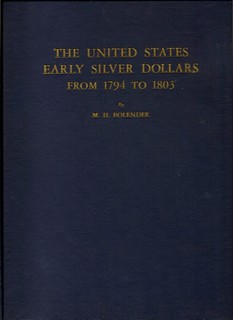
M. H. Bolender wrote The United States Early Silver Dollars 1794 to 1803. It was published in 1950 with reprints in 1970, 1980, 1982 and 1988. This was not the first book on silver dollars, but it did establish Bolender numbers to describe the series.
Milferd Henry Bolender was born in Orangeville, Illinois, on August 23, 1894. He was the son of Stewald Emerson Bolender (1861-1937) and Clara Alma Beaver (1865-1949). His father was a stone mason. (His name appears variously as Milferd and Milford)
Bolender developed an interest in coins at age 12 after his grandfather gave him a bag of 70 coins as a reward for scholastic achievement. This group included an 1822 English gold sovereign. His first numismatic purchase was a coin book. During the summer of 1910, he took a heavy construction job working ten-hour days at $.15 per hour. He spent his spare money on rare coins. In 1910, he could buy 1909-S VDB cents for $3 a roll and 1908-S Indian cents for half that.

HERITAGE: CENTRAL STATES WORLD AND ANCIENTS
Heritage Auctions will be selling a number of very important coins as part of its CSNS World & Ancient Coins Auction. -Garrett
An exceedingly rare Russian 10 Roubles coin will land in a new collection when it is offered in Heritage's CSNS World & Ancient Coins Platinum Session and Signature® Auction April 29-30. An exceedingly rare Russian 10 Roubles coin will land in a new collection when it is offered in Heritage's CSNS World & Ancient Coins Platinum Session and Signature® Auction April 29-30.


Nicholas II gold Specimen Imperial of 10 Roubles 1896-A? SP61 PCGS
The Nicholas II gold Specimen Imperial of 10 Roubles 1896-A? SP61 PCGS is an extraordinary coin in a high grade, even rarer than originally believed.
HERITAGE: VILA RICA COLLECTION SELECTIONS
Heritage Auctions will be selling the Vila Rica Collection Selections of Brazilian Coins, Part I on April 29. Select items are discussed below. -Garrett
The Vila Rica Collection of Brazilian Coins, Part I It is with great pleasure that we present The Vila Rica Collection, Part I, the opening chapter of a remarkable cabinet more than three decades in the making. Built through over 30 years of dedicated and passionate collecting, the Vila Rica Collection was assembled with the ambitious goal of forming a comprehensive record of Brazilian gold, silver, and copper coinage. While rooted in this traditional pursuit of completeness, the collector was notably ahead of his time in prioritizing exceptional quality and eye appeal above all else-an approach that is evident throughout the coins offered here.
Following the successful sale of the silver portion of the collection in May 2021, Heritage Auctions is proud to present the gold coinage in a three-part offering. This first installment, presented at CSNS 2026, begins with early Dutch-Brazil siege coinage and continues through the first official mint emissions of Brazil beginning in 1695, extending through the final issues of João V. These coins represent the formative period of Brazilian numismatics, capturing both the earliest colonial coinages and the emergence of a sophisticated minting tradition in the New World. To further enhance the scope and continuity of the offering, a small number of complementary pieces from outside the Vila Rica cabinet have also been included, helping to provide an even more complete representation of the series.
HERITAGE: THE ALAMO COLLECTION
Heritage Auctions will be selling the Alamo Collection of Colonial Coins on April 30. Select items are discussed below. -Garrett
The Alamo Collection of U.S. Colonial Issues This diverse 314-lot Colonials collection is featured in its own standalone catalog and Floor Session 2. This collection spans the full gamut of American Colonial coinage, rare varieties, high-end condition rarities, and seldom-seen types. These coins demonstrate the highest level of numismatic scholarship and discipline to comprise one of the greatest single offerings of important Colonial coinage in modern times.


1662 Oak Tree Twopence, Small 2, Noe-30, W-240, Salmon 1-A, R.4, AU55 PCGS. 13.9 grains. A pleasing Choice AU example with lilac, sea-green, and powder-blue toning. Noe-30 was struck from misaligned dies, and surviving pieces have the appearance of an off-center strike toward 7 o'clock. Designated as Garrett on the PCGS insert, though the present coin was neither lot 1212 or 1213 in the October 1980 Bowers and Ruddy catalog, and a Garrett pedigree is disavowed in its 2003 Stack's catalog appearance. Listed on page 8 of the 2026 Guide Book.

HERITAGE: CENTRAL STATES U.S. COIN AUCTION
Heritage Auctions will be hosting their Central States Signature auction of U.S. coins from April 29 to May 2. Select items from the Curators' Picks are discussed below. -Garrett


1880 $4 Flowing Hair, Judd-1657, Pollock-1857, JD-1, R.6, PR65 NGC. CAC. One cannot deny the worthiness of the 1879 and 1880 Coiled Hair stellas in this auction to be included in a list of favorite lots. They are rare, beautiful, and in all things captivating. However, I find myself increasingly appreciative of the CAC-endorsed Gem 1880 Flowing Hair coin in lot 3167. In my opinion, the 1880 Flowing Hair is significantly underrated, largely due to the shadow-casting fame of the two Coiled Hair issues. In reality, the 1880 Flowing Hair is nearly as rare as the 1879 Coiled Hair; just 18 examples are traced, and they appear at auction just as infrequently as the 1879 Coiled Hair specimens. If I had to guess, I'd say this issue is restrained in terms of collector appreciation due to it sharing its design type with the widely available 1879 Flowing Hair stella. But in my opinion, this is a travesty. The 1880 Flowing Hair is a major rarity, and this is a stunning example.

WAYNE'S NUMISMATIC DIARY: APRIL 26, 2026
Tuesday April 21, 2026 was the meeting night of my Northern Virginia numismatic social group, Nummis Nova. Mike Markowitz and Robert Hoppensteadt were our co-hosts. Robert and various regulars were unable to attend this month, and we had a more intimate group consisting of me, Mike, Tom Kays, Dave Schenkman, John "JK" Kraljevich, Julian Leidman, and Erik Douglas. Our venue was a repeat performance from last month - Southside 815 in Alexandria.


My exhibits consisted of a group of recent numismatic periodicals and a couple of non-numismatic books. I recently completed "The Infinity Machine: Demis Hassabis, DeepMind, and the Quest for Superintelligence" by Sebastian Mallaby, and just started the new book by Richard Vague, "The Banker Who Made America: Thomas Willing and the Rise of the American Financial Aristocracy, 1731-1821."
SILPHIUM ON ANCIENT COINS
The numismatic aspect is tangential to this recent article about the extinct plant silphium. The coin image is courtesy of the Australian Centre for Ancient Numismatic Studies. -Editor
 Roman leader Julius Caesar is said to have kept a stock of it in the treasury. Ancient writer Pliny the Elder says Rome's Emperor Nero owned the last stalk of it.
And some have suggested rampant extramarital sex in elite Roman circles led to demand outstripping supply, and it dying out altogether.
What is it?
Silphium: an extinct plant that once grew wild in modern-day Libya.
Used for contraception and abortion, medicine, food seasoning, perfume and as a livestock improver, its special properties made this herb one of the most precious commodities in Graeco-Roman antiquity.

AUSTRALIAN WWII SHORT SNORTERS
Don Cleveland passed along this article about short snorters from Australia. -Editor

Australian War Memorial Curator Andy Muir
Andy Muir's eyes widen as he pulls a 4-metre roll of banknotes out of a collection.
Each creased and scribbled turn reveals notes from a new corner of the world — Africa, the Caribbean, Europe, North America, the Pacific and Australia.
The black, hand-drawn signatures on the notes are part of a military tradition of collecting "short snorters".

2025 IBNS BANK NOTE OF YEAR
The International Bank Note Society (IBNS) has awarded the 2025 Bank Note of Year award to Curaçao and Sint Maarten. -Garrett


The International Bank Note Society (IBNS) announces that its voting membership has for the first time selected the Central Bank of Curacao and Sint Maarten to receive its annual prestigious "Bank Note of the Year Award" for 2025.
With almost 100 new banknotes released worldwide during 2025, only 17 were deemed of sufficiently new design to be member nominated. From the onset of voting the Curacao and Sint Maarten 200 Gulden note was the overwhelming favorite.
The 200 Gulden is part of a new series launched by the Central Bank with 5 denominations, all drawing inspiration from the "World Under the Sea." The face of each note is horizontally orientated and features marine life native to the islands while the reverse is vertically orientated with historical and cultural landmarks. The winning note is the largest denomination of the set and is predominantly purple and features long snout seahorses and a giant tun shell in blue-to-green OVI on the face. The back of the note showcases the iconic Queen Emma Bridge.
LOOSE CHANGE: APRIL 26, 2026
Here are some additional items in the media this week that may be of interest. -Editor
Should be an easy one. Did you get it right? -Editor

There's only one spot outside the nation's capital that you'll see featured on some of the seven U.S. banknotes currently in circulation. The $5 bill features the Lincoln Memorial, while the $10 features the Treasury Building — fitting, since Alexander Hamilton, whose visage adorns the obverse, served as the Treasury Department's first secretary. The $20 and $50 bills finish the architectural tour of Washington with the White House and Capitol, respectively. The $1 is notably absent from this list, as the only building-like structure on its reverse side is a pyramid with a floating eye — and no such pyramid exists in the U.S. (or the world).
To read the complete article, see:
Only one building outside Washington, D.C., is featured on U.S. banknotes.
(https://interestingfacts.com/fact/only-one-building-outside-washington-d-c-is-featured-on-u-s-banknotes/)
Other topics this week include Euro Banknotes, and What Abraham Lincoln Had in his Pockets. -Editor
ABOUT THIS ISSUE: APRIL 26, 2026
My Diary says it all this week - it's been a fun and interesting one, and I think many of you will agree that this has been a particularly interesting issue. Lots of neat topics.
This week's perplexing internet observation: "If Cinderella's shoe fit perfectly, why did it fall off?"
Finally, here are some interesting non-numismatic articles I came across this week.
Chicago just built the largest magic venue in the world—take a peek inside (https://www.fastcompany.com/91529348/the-hand-the-eye-worlds-largest-magic-venue)
Your AI can't read an invoice (https://www.fastcompany.com/91526152/your-ai-cant-read-an-invoice-that-should-worry-you-more-than-whether-it-can-pass-a-math-exam-technology-ai-leadership)
What Do I Know? Stanley Druckenmiller (https://pittsburghquarterly.com/articles/what-do-i-know-stanley-druckenmiller/)
Shall We Play a Game? (History of Wargames) (https://asteriskmag.com/issues/14/shall-we-play-a-game)
A Young Black Girl Was the First to Desegregate a Maryland Carousel in the 1960s. Now, the Historic Merry-Go-Round Will Entertain Visitors on the National Mall (https://www.smithsonianmag.com/smithsonian-institution/a-young-black-girl-was-the-first-to-desegregate-a-maryland-carousel-in-the-1960s-now-the-historic-merry-go-round-will-entertain-visitors-on-the-national-mall-180988596/)
The Simon Abundance Index 2026 (https://humanprogress.org/the-simon-abundance-index-2026/)
-Editor


Editor Wayne Homren, Assistant Editor Garrett Ziss

|
|
| |