Visit our NBS Sponsors











About UsThe Numismatic Bibliomania Society is a non-profit association devoted to the study and enjoyment of numismatic literature. For more information please see our web site at coinbooks.org SubscriptionsThose wishing to become new E-Sylum subscribers can go to the following web page
Subscribe
MembershipThere is a membership application available on the web site Membership Application To join, print the application and return it with your check to the address printed on the application. Print/Digital membership is $40 to addresses in the U.S., and $60 elsewhere. A digital-only membership is available for $25. For those without web access, write to: Jeff Dickerson, Treasurer AsylumFor Asylum mailing address changes and other membership questions, contact Jeff at this email address: treasurer@coinbooks.org SubmissionsTo submit items for publication in The E-Sylum, write to the Editor at this address: whomren@gmail.com BUY THE BOOK BEFORE THE COINSale CalendarWatch here for updates! |
- WAYNE'S WORDS: THE E-SYLUM MAY 17, 2026
- NEW BOOK: WHITMAN DOUBLE EAGLES, 2ND ED.
- NEW BOOK: COINAGES IN THE ACHAEMENID EMPIRE
- NEW BOOK: ENJOYING COIN COLLECTING, 2ND EDITION
- 2026 IAPN BOOK PRIZE NOMINATIONS
- MICHAEL G. BEAN, PLATE PRINTER
- SPRING 2026 NNP SYMPOSIUM VIDEOS AVAILABLE
- VIDEO: JOHN HIGHFILL, PART 1 OF 3
- AMERICAN HISTORY IN MEDALS LECTURE
- THE DIXSON LIBRARY 1920 SYDNEY SOVEREIGN
- NOTES FROM E-SYLUM READERS: MAY 17, 2026
- ALAN STAHL RETIRES FROM PRINCETON
- UMASS LOWELL DAVID MENCHELL COIN DONATION EVENT
- VARDERA'S AI COIN CONDITION ASSESSMENT
- VOCABULARY TERM: SO-CALLED DOLLAR
- DONALD JOSEPH PFAU (1945-1985)
- HERITAGE: MESQUITE COLLECTION OF CONDER TOKENS
- ARCHIVES INTERNATIONAL SALE 113 SELECTIONS
- THE CAINE COLLECTION OF OBSOLETE BANKNOTES
- SOVEREIGN RARITIES AUCTION XXII
- THE EARLIEST KNOWN MENORAH COIN
- ANTI-VIKING COIN CHARMS
- HOLLIS NEW ORLEANS MINT MUSEUM VISIT REPORT
- BEN FRANKLIN'S LIBERTAS AMERICANA MEDAL DESIGN
- THE FIRST MODERN ZIONIST MEDALS
- LOOSE CHANGE: MAY 17, 2026
- ABOUT THIS ISSUE: MAY 17, 2026
Content presented in The E-Sylum is not necessarily researched or independently fact-checked, and views expressed do not necessarily represent those of the Numismatic Bibliomania Society.
WAYNE'S WORDS: THE E-SYLUM MAY 17, 2026
 New subscribers this week include:
Chris Huttner, courtesy Bruce Perdue,
and
Julian Wong.
Welcome aboard! We now have 6,505 subscribers.
New subscribers this week include:
Chris Huttner, courtesy Bruce Perdue,
and
Julian Wong.
Welcome aboard! We now have 6,505 subscribers.
Thank you for reading The E-Sylum. If you enjoy it, please send me the email addresses of friends you think may enjoy it as well and I'll send them a subscription. Contact me at whomren@gmail.com anytime regarding your subscription, or questions, comments or suggestions about our content.
This week we open with three new books, the 2026 IAPN Book Prize nominations, updates from the Newman Numismatic Portal, notes from readers, and more.
Other topics this week include intaglio printing, the NNP Symposium, John Highfill, Alan Stahl, David Menchell, Don Pfau, the 1920 Sydney Sovereign, auction previews, the Libertas Americana medal, and the first modern Zionist medals.
To learn more about double eagles, coinage of the Achaemenid Empire, the Semiquincentennial coins, Rebecca Salisbury, Sir William Dixson, Vardera's AI coin grader, so-called dollars, Conder tokens, James Stanley, 10th Earl of Derby, 2026 Coin of the Year Nominees, and slug laws, read on. Have a great week, everyone!
Wayne Homren
Editor, The E-Sylum

Image of the week
NEW BOOK: WHITMAN DOUBLE EAGLES, 2ND ED.
Whitman has released the long-awaited second edition of Bowers' double eagle book, including full color images, expanded coverage, updated research, and Greysheet-based pricing. -Garrett
 Whitman Brands™, a leading full-service provider of data, media, and product distribution for the numismatics and collectibles marketplace, announces the official release of Double Eagle Gold Coins by Q. David Bowers, the most recent release covering some of the most famous (and infamous) coins of the last two centuries. More than twenty years after the first edition helped establish Whitman's Red Book Series, this fully updated second edition returns with new research, modern pricing, and a stunning full-color presentation for collectors and gold enthusiasts alike.
Part of Whitman's acclaimed Red Book Series, Double Eagle Gold Coins explores the history, artistry, and collecting appeal of America's $20 gold pieces—from the Liberty Head design introduced in 1849 during the California Gold Rush to the iconic Saint-Gaudens double eagle struck until 1933. Now presented in full color and illustrated with more than 550 high-resolution photographs, the new edition offers collectors an immersive look at one of the most celebrated series in American numismatics.

NEW BOOK: COINAGES IN THE ACHAEMENID EMPIRE
The University of Edinburgh has published a new book by Keith Rutter on coinage of the Achaemenid Empire. Found via the Oriental Numismatic Society, courtesy David Fanning. -Editor
Coinages in the Achaemenid Empire
Keith Rutter
 Brings together the evidence for coin production and use over the whole Achaemenid Empire
- Demonstrates how the actual production of coins was a phenomenon mostly confined to the western satrapies of the empire
- Unlike other studies of ancient coinage which focus on its spread westward into Greek lands after its invention in Asia Minor, this book looks east, to communities and kingdoms where the dominant culture was often not Greek
- Treats coins as part of the wider context of exchange and resource allocation in the empire
The Achaemenid Empire was huge and the material available for studying it is disparate. The coinages produced in the empire offer distinctive perspectives and provide insights into crucial questions about how the empire was organised and administered. The numismatic evidence is particularly important due to its first hand, contemporary nature: it speaks to us directly, not through the prism of later accounts.
NEW BOOK: ENJOYING COIN COLLECTING, 2ND EDITION
A new edition of Helpful Hints for Enjoying Coin Collecting has been published by the Metropolitan Coin Club of Atlanta. -Editor
 The Metropolitan Coin Club of Atlanta (MCCA) announces the release of Helpful Hints for Enjoying Coin Collecting, Second Edition, a fully updated and expanded guide to the joys and practicalities of numismatics in today's world.
Authored by renowned numismatist Bill Fivaz, with David Crenshaw as co-author, this 144-page US trade paperback builds on the beloved original—first published in 1999 with a reprint in 2004—that has guided generations of collectors. The second edition brings its timeless advice into 2026, with modern updates on topics such as digital tools, online marketplaces, high-resolution imaging, PVC-free storage, instant submissions, package tracking, and evolving grading standards.
Key features include
- Practical chapters on coin cleaning basics (with a strong emphasis on what not to do), safe storage, shopping the bourse at conventions, buying/selling through mail or auctions, mailing tips, and grading hints for popular series, including Indian cents, Lincoln cents, Buffalo nickels, Mercury dimes, Morgan dollars, and more.
- A brand-new chapter, "Understanding AU-58 and the Nuances of Coin Grading," compiles and updates several influential articles by Fivaz on why top-end About Uncirculated (AU-58) coins often represent exceptional value and eye appeal.
- Expanded sections on the modern US minting process, numismatic terms, recommended reading (categorized by topic and series), specialty clubs (with web and social media contacts), 10 rules of thumb, and a fun 25-question coin quiz.
- A warm, mentor-like tone drawn from decades of club meetings, conversations, and real-world experience—perfect for beginners and veterans alike.

2026 IAPN BOOK PRIZE NOMINATIONS
At my request Peter Preston-Morley of the International Association of Professional Numismatists kindly forwarded this list of nominations for the 2026 IAPN Book Prize. Several of these have not yet been mentioned in The E-Sylum and we'll feature them in coming weeks. Thank you. -Editor
Peter adds:
"For this year's Prize there are 27 entries; 16 from Europe, 7 from North America and 4 from Asia. The Prize will be determined by vote of the members of the IAPN at its General Assembly in Rome on 24 May, and the winner will receive CHF 1,000, a medal and a diploma at a future award ceremony."


BERTUZZI, Stefano. Corpus Numismatum Omnium Romanorum Pontificum: Pio IX nelle medaglie, nelle croci capitolari e nella faleristica
3 vols. Edizioni D'Andrea, Rome, 2025
ISBN 979-1-28207-242-7
Price: €300. Order from www.liberdomus.it
CHORNEY, Dominic. Treasures of the Occult: A Guide to History's Unorthodox Money
Stanley Gibbons Baldwin's, Ringwood, UK, 2025
ISBN 978-1-83688-477-4
Price: GBP 34.95. Order from www.baldwin.co.uk
MICHAEL G. BEAN, PLATE PRINTER
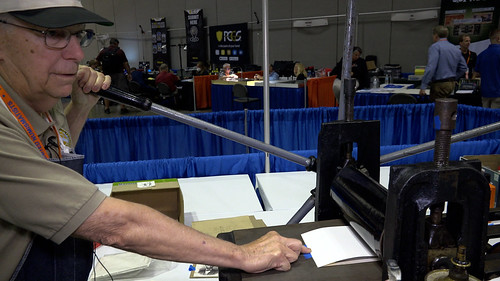
Mike Bean operating his spider press
I caught this post from Matt Hansen Saturday night on the National Bank Note Collectors Facebook group. -Editor
This was posted about two hours ago on Paper Money Forum:
"It is with great sadness that I have been told that my long time friend Mike Bean has passed. One of the last of the old school master craftsmen… a great loss to the dying intaglio trade. May he rest in peace…"
I am sure that many here knew and appreciate great person that Mike was and the tremendous talent that he possessed as an intaglio plate printer. Mike was a master printer who was trained at the Bureau of Engraving and Printing and worked there for many years. He was enthusiastic about sharing intaglio printing with anyone he came in contact with, and was a regular fixture at the annual F.U.N. show each year with his spider press intaglio printing live demonstrations.
Mike will be greatly missed.
SPRING 2026 NNP SYMPOSIUM VIDEOS AVAILABLE
Newman Numismatic Portal Project Coordinator Len Augsburger submitted this announcement. -Editor
NNP Symposium Videos Now Available
The tenth Newman Numismatic Portal Symposium was held April 23-25 in Schaumburg, IL, in conjunction with the Central States Numismatic Society convention. Video from this event, covering 20 presentations, is now available on YouTube. YouTube views are accreting even as I perform the video uploads, and among the more popular presentations is John Feigenbaum and Patrick Perez speaking on "Rare Coin Pricing in a Volatile Precious Metals Market." A big thanks to all the speakers who participated in this year's Symposium, to Central States Numismatic Society for ever-present onsite support, and to Lianna Spurrier of Numismatic Marketing for producing this event.

VIDEO: JOHN HIGHFILL, PART 1 OF 3
The David Lisot Video Library on the Newman Numismatic Portal can be found at:
https://nnp.wustl.edu/library/multimediadetail/522852
We highlight one of his videos each week in The E-Sylum. Here's one from 2016 with David interviewing ational Silver Dollar Roundtable founder John Highfill. -Editor

AMERICAN HISTORY IN MEDALS LECTURE
A lecture on "250 Years of American History in Medals" will take place May 27 at the Fall River Historical Society (Massachusetts). -Editor
 The Fall River Historical Society plans to host an illustrated lecture by Alexander Krapf, first vice president of the American Numismatic Society, at 6:30 p.m. May 27.
The event, titled "250 Years of American History in Medals," will take place at Bristol Community College, 777 Elsbree St., Room C111. The lecture is free and open to the public, according to a community announcement.
The program will offer a visual journey through 250 years of American history, highlighting both well-known and lesser-known events commemorated in medallic form. Attendees will learn how these small objects can provide insight into the minds and attitudes of past generations.

THE DIXSON LIBRARY 1920 SYDNEY SOVEREIGN
Zach Filis writes:
"To supplement Don Cleveland's submission about David Gee, I thought the below article would interest some of your readers. Three additional TPG submissions have been certified since the article was written. Howard has granted permission to publish his article in the E-Sylum."
Thank you. The article by Howard Hodgson was a paper given at the June 2020 online conference of the Australian Numismatic Society. -Editor
 Sir William Dixson (1870-1952) was a wealthy businessman with a wide range of interests and during his lifetime he amassed a collection of over 20,000 items.
This included paintings, books, manuscripts, maps, trophies, curios, china and some 8,000 coins, medals, and tokens. Dixson was a benefactor to a number of
institutions but the major recipient of his generosity was the State Library of New South Wales. He bequeathed the State Library his entire collection which is now housed in the Dixson Galleries (1929) and the Dixson Library (1959).
Sir William Dixson (1870-1952) was a wealthy businessman with a wide range of interests and during his lifetime he amassed a collection of over 20,000 items.
This included paintings, books, manuscripts, maps, trophies, curios, china and some 8,000 coins, medals, and tokens. Dixson was a benefactor to a number of
institutions but the major recipient of his generosity was the State Library of New South Wales. He bequeathed the State Library his entire collection which is now housed in the Dixson Galleries (1929) and the Dixson Library (1959).
The Dixson numismatic collection is one of the largest ever assembled in Australia and is world-renowned. A selection of proclamation coins, including holey dollars and dumps, sovereigns and other coins, medals and tokens are on display in the State Library's public galleries and entrance is free.
THE BOOK BAZARRE
NOTES FROM E-SYLUM READERS: MAY 17, 2026
 Subscriber Profile: Julian Wong
New subscriber Julian Wong is a numismatist from China.
He writes:
"My main research focus is modern Chinese banknotes. I have been engaged in collecting and research for over 20 years and have published more than ten academic papers in China's most authoritative numismatic journal, China Numismatics. I hope to have the opportunity to learn from collectors and scholars in the United States."
Welcome aboard! -Editor
For more information on China Numismatics, see:
China Numismatics (????)
(https://caod.oriprobe.com/journals/zgqb/China_Numismatics.htm)
Other topics this week include a Jewelry "Red Book", and a Bathroom Coin Floor. -Editor
ALAN STAHL RETIRES FROM PRINCETON
Alan Stahl, Curator of Numismatics in Princeton University Library's Special Collections and lecturer in the Departments of Art & Archaeology, Classics, and History, has retired from Princeton after 22 years. -Garrett
 Faculty from various disciplines, students and staff (present and former), and, of course, a treasury of numismatists gathered at Prospect House on May 13 to pay tribute to Alan Stahl upon his retirement from his position as Curator of Numismatics in Princeton University Library's Special Collections, which also brings to a close his long career of lecturing in the Departments of Art & Archaeology, Classics, and History.
Crowning the tribute, Stahl was presented with an advance copy of Coins & Money in the Middle Ages; Studies in Honor of Alan Stahl. The festschrift volume was edited by Princeton Department of History alumni Merle Eisenberg '18 and Lee Mordechai '17, alongside David Yoon, Curator of Medieval, Renaissance, and Early European Numismatics at the American Numismatic Society, which plans to release the book next month.
UMASS LOWELL DAVID MENCHELL COIN DONATION EVENT
The University of Massachusetts Lowell campus held an event on April 24, 2026 to thank David Menchell for his contributions to the university, including many coins and artifacts. -Editor
In spring 2025, the UMass Lowell History Department received a donation of thirty-eight ancient Hellenistic and Roman coins from David Menchell, a notable coin collector and philanthropist. On Friday, April 24, he visited UMass Lowell, and Professor Jane Sancinito organized an event to honor him. After Professor Sancinito spoke about the history and pedagogical importance of the collection, five of her students gave brief presentations about the iconography (both front and back) of coins they had studied.
Gabriela Manduca Oliviera discussed a coin depicting Mercury and a ship's prow; Lauren Torpey, Janus and a ship's prow; Owen Schultz, Emperor Vespasian and Victory; Gabriela Mejia, Emperor Commodus and Providentia; and Anthony Avoglia, Emperor Gordian III and Pietas. The coin collection was on display for the event, during which refreshments were served.

VARDERA'S AI COIN CONDITION ASSESSMENT
Recently we discussed Quantitative Coin Grading's digital microscope for coin grading. An ad in the June 2026 Numismatist alerted me to another company using computer vision to identify, grade and price coins and other collectibles - Vardera. An article about coins from their blog is republished here with permission. Vardera positions their system as a high-end tool for third-party grading companies, auction companies and marketplaces. -Editor
How AI Measures strike, luster, and surfaces.
 Professional graders agree on a coin's grade only 85-90% of the time within one point. That is not a flaw in your team. It is the inherent ceiling of human visual assessment applied to a 70-point scale where a single grade difference can mean thousands of dollars. Now multiply that challenge by submission volumes that grow faster than you can hire, and the math becomes unavoidable: AI coin condition assessment is not a threat to your standards. It is the only way to maintain them.
This guide breaks down exactly how AI evaluates the same four factors your graders evaluate: strike quality, luster, surface preservation, and eye appeal. You will see the specific techniques, the accuracy data, and how production-grade systems differ from the consumer apps making headlines.
Why Grading Bodies Need Scalable Coin Condition Analysis at Scale
Your graders are good. The problem is arithmetic.
VOCABULARY TERM: SO-CALLED DOLLAR
Here's another entry from Dick Johnson's Encyclopedia of Coin and Medal Terminology. -Editor
So-called Dollar. Originally political medals struck in silver similar to a United States silver dollar including such items as Bryant dollars (1896, 1900) and Lesher or Referendum dollars (1900–1901). Later the term was corrupted to include any medal similar in size and relief – but not necessarily similar in composition – to the U.S. silver dollar (1 1/2-inch or 38mm) or gold dollar (14mm). The term is similar in concept to a German word, gedenkthaler, a coin-like medal in similitude to the large silver coins of three or five-mark denomination, and to the French word, jetton, for a small, coin-size medal. True so-called dollars are indeed coin-medals, struck on a coining press, utilizing equipment normally used for striking large coins: upsetting (rimming) machines, blanking dies, collars and such.
There was no problem utilizing exact diameters of existing coins when these medals were issued for the U.S. centennial of 1876 and for the Columbian Exposition of 1892-93, nor for the political medals of 1896-1901. Silver dollar-size vending machines and turnstiles did not exist at that time but with the rise of this industry in the 20th century, slug laws were enacted to prohibit the manufacture of coin-like pieces that would work in these machines.
DONALD JOSEPH PFAU (1945-1985)
E-Sylum Feature Writer and American Numismatic Biographies author Pete Smith submitted this article on NBS charter member Don Pfau. Thanks! -Editor
For the 40th anniversary of the Numismatic Bibliomania Society, I wrote an article about the NBS charter members. Don Pfau was given membership number 61. At the time, I couldn't distinguish him from others with the same name.
Last week I found an item in the November-December 1985 issue of The Repository. Cal Wilson wrote, "I have just received word that Don Pfau, an immediate past board member of the Numismatic Bibliomania Society, passed away in late November, following a long bout with cancer. Don was more interested in philatelic literature that he was in numismatic pursuits, although he did own a number of fine and scarce coin works. When the organization of the NBS was first being discussed, I contacted Don to see if he would accept nomination for a board position, and he readily accepted, and offered his services as required. My most sincere sympathy to his family."
That was enough for me to research his biography.

HERITAGE: MESQUITE COLLECTION OF CONDER TOKENS
Heritage Auctions will be selling The Mesquite Collection of Conder Tokens on May 18. Select items are discussed below. -Garrett
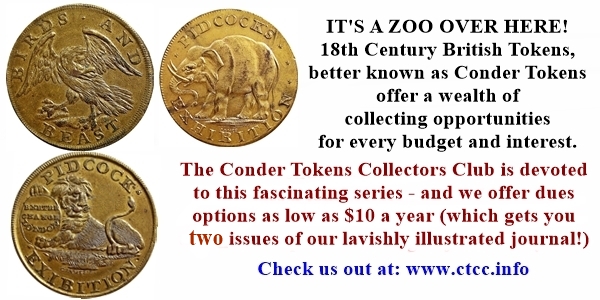
One of our most curious auctions closing this month is the Mesquite Collection of Conder Tokens, a testament to the everyday history of Georgian and Regency Britain, Scotland, Wales, and Ireland. Never before has Heritage offered such a complete assemblage of Conder Tokens; rarity and preservation collide in an extensive spectrum of series, manufacturers, and regions. But what are Conder Tokens? And how do they interact with the social framework of the period?
Conder Tokens came from humble beginnings, originally circulating among the lower classes as a substitute monetary system due to severe shortages of the United Kingdom's official currency and coinage. These provincial Tokens were usually copper, used at local businesses, and decorated with depictions associated with trade and manufacture. What started as utilitarian soon turned into a "collecting mania", leading to individuals and organizations manufacturing tokens with the express purpose of appealing to contemporaneous collectors. The majority of Conder Tokens were issued between 1787 and 1804, with many still acting as trade coinage in addition to being an early collectible.
ARCHIVES INTERNATIONAL SALE 113 SELECTIONS
Here are some selected lots from the May 27 sale by Archives International Auctions. -Garrett


Ottawa, Canada, 1991, $20, P-97tp, BC-58bPE, Bonin | Thiessen signatures, "Printers Essay" DuraNote Polymer paper test banknote, Printed on DuraNote polymer plastic paper substitute, the obverse has the portrait of Queen Elizabeth II at right and the m/c undertint with security feature and Pin-punch SPECIMEN. The reverse has the normal design and color with the "Common Loon" swimming duck on a lake with trees in the background and with the security device also appearing on the back. This essay note was part of a project by Mobil Oil for testing petroleum based hydrocarbon polymer paper for printing banknotes. Note Appears Choice to Gem Uncirculated. BABN.

THE CAINE COLLECTION OF OBSOLETE BANKNOTES
Stack's Bowers will be selling The Caine Collection of Obsolete Banknotes on May 28. Select items are discussed below. -Garrett

Richmond, Virginia. Bank of the Commonwealth. 1861 $100. PMG Very Fine 30. No. 627. Plate A. Chartered in 1858, the Bank of the Commonwealth was ultimately short-lived and the bank's charter was repealed in 1861. The Bank of the Commonwealth nonetheless continued operations until 1865 when the bank's offices were burned when Union forces during the so-called "Evacuation Fire" which consumed much of downtown Richmond. Today notes on this institution are recognized as rarities and the Whitman Encyclopedia of Obsolete Paper Money Vol. 8 notes that "the $20, $50, and $100 denominations will pose any serious challenge to obtain." Bidders should also note that the Treasurer's signature line is cancelled on this particular specimen.

SOVEREIGN RARITIES AUCTION XXII
Sovereign Rarities will be hosting Auction XXII on June 3. Select items are discussed below. -Garrett
We are proud to present Sovereign Rarities Auction XXII which is now open for pre bidding with the live sale commencing on Wednesday, June 3rd at 10am BST. The sale spans centuries of numismatic history, bringing together rare, hammered issues and proof strikes and pattern pieces.
Opening with medieval Scottish coinage, including a rare silver Penny of William I "the Lion," struck during the late 12th or early 13th century (lot 1).

THE EARLIEST KNOWN MENORAH COIN
Julian Leidman forwarded this Times of Israel article about two ancient coins turned over to Israel following a joint law-enforcement operation with the United States -Editor
Two rare coins dating to over 2,000 years ago have been returned to Israel, following a joint law-enforcement operation between Israel and the United States, the Israel Antiquities Authority said in a statement on Tuesday.
One of the coins bears the earliest known depiction of the seven-branched Jewish menorah, along with a showbread table used in the First and Second Temples in Jerusalem. It was minted in bronze in the first half of the first century CE, when the Second Temple was still standing.
The other coin, a 2,500-year-old silver coin most likely minted in the ancient city of Ashkelon, is only the second of its kind known worldwide.
ANTI-VIKING COIN CHARMS
This Popular Science article highlights recently discovered medieval coin charms. Great topic - are there studies of these in numismatic literature? -Editor
A pair of rare silver coins discovered by metal detectorists in Denmark were meant to offer 11th century Christians a bit of protection against Viking raiders. According to the National Museum of Denmark, only 30 of these silver coins laden with Christian imagery have ever been found.
The coins were uncovered in northern and southern parts of Denmark's Jutland peninsula. England minted the coin in 1099 during the reign of King Æthelred II, also known as "Æthelred the Unready" after the Anglo-Saxon king did not adequately prepare his country for Viking attacks. The nickname "unready" is also a bit of wordplay from the 12th century. According to History Extra, people pronounced the word Aethelred as Av-el-raid, meaning "noble council" or "good council." By tweaking it with the Old and Middle English term "unræd," which means "ill-counselled," the nickname became a way for people to mock him.
HOLLIS NEW ORLEANS MINT MUSEUM VISIT REPORT
Last week we mentioned U.S. Mint Director Paul Hollis' visit to the old New Orleans Mint. Here's the Mint's post-event report. -Editor

U.S. Mint Director Paul Hollis
The Semiquincentennial celebration is all about connections. Connecting what happened in our Nation's past with what is happening today and moving forward.
New Orleans is home to the oldest surviving structure to have served as a U.S. Mint. During the Civil War, it briefly produced coins under both Union and Confederate authority, reflecting a complex and divided chapter in the Nation's history. While coins are no longer minted here, the building itself has been redesigned and repurposed to uphold the history, legacy, and growth of a distinctive musical style that was born right here in New Orleans—Jazz!
On May 8, the United States Mint (Mint), hosted an event at the New Orleans Jazz Museum (Museum) entitled, "Minting the American Spirit: Celebrating our Nation's Semiquincentennial," in New Orleans, Louisiana. The event was supported by the Museum (also known as the Old U.S. Mint) and the Louisiana America 250 Commission. Special guests included Paul Hollis, 41st Director of Mint, Brandon Beach, Treasurer of the United States, and Billy Nungesser, Lieutenant Governor of Louisiana. Members of the Crescent City Coin Club attended as well.
BEN FRANKLIN'S LIBERTAS AMERICANA MEDAL DESIGN
This Smithsonian article highlights Ben Franklin's role in creating the iconic Libertas Americana medal and notes that the Paris Mint has rolled out an updated version for the semiquincentennial. -Editor

In the early 1780s, as the Revolutionary War was drawing near its end in favor of the upstart American nation, Benjamin Franklin, ever the innovator, sought to honor the victors and their allies with a brand new work of art.
Then living in Paris as the United States' ambassador to France, the founding father—and first-ever American diplomat to a foreign country—wanted to properly thank France for its help during the war. Franklin envisioned pressing a medal that would express gratitude for the past and commemorate an independent future.
The design by Franklin and French artists Augustin Dupré and Esprit-Antoine Gibelin was evocative.
THE FIRST MODERN ZIONIST MEDALS
Tsadik Kaplan published an article in The Jewish Press about the irst modern Zionist medals issued. Here's an excerpt - see the complete article online. -Editor
Seventy-eight years ago this week, on May 14, 1948, the State of Israel was established. To celebrate this monumental event in Jewish history, here are some related medals from my personal collection.
Theodor Herzl was the founder of political Zionism, whose purpose was to create a modern homeland for the Jewish people. Witnessing the public degradation of Alfred Dreyfus – the French Jewish army officer falsely accused of treason – and hearing antisemitic shouts in the streets of Paris, Herzl became convinced that Jews needed a sovereign state. In 1897, Herzl created the Zionist Congress; the first meeting was held that year in Basel, Switzerland. Following the success of that inaugural meeting, for the second Zionist Congress in 1898, Herzl asked his friend Samuel Friedrich Beer, a sculptor who had gained recognition as a portraitist, to design a medal to commemorate the gathering, held again in Basel.
LOOSE CHANGE: MAY 17, 2026
Here are some additional items in the media this week that may be of interest. -Editor

The 2026 Coin of the Year (COTY) awards officially began in early January with a worldwide call for nominations. From the many issues released in 2025, mints, banks, and enthusiasts submitted nearly 600 coins for consideration.
A nominating committee then narrowed this number into the COTY 100, which contains 100 2025-dated candidates from 41 countries. Over 40 mints and central banks are represented in this group.
This selection features 10 outstanding coins in 10 specific categories. Voting has already commenced, and our panel of over 100 judges is casting ballots designed to select one coin in each category as a winner.
The COTY champion will be honored with the other category winners at the American Numismatic Association's World's Fair of Money on August 27, 2026, in Pittsburgh, Pennsylvania, at the David L. Lawrence Convention Center. We welcome you to attend that ceremony and hope you enjoy the 2026 COTY Awards.
To read the complete article, see:
The 2026 COTY 100
(https://www.numismaticnews.net/the-coty-100-2026)
Other topics this week include the changing demographics of ancient coin collecting, and a large hoard of Viking coins. -Editor
ABOUT THIS ISSUE: MAY 17, 2026
After work Wednesday I drove through traffic and rain to Alexandria, where I returned to our frequent Nummis Nova venue Southside 815 for a relaxing dinner with my old friend Dave Schenkman. We chatted about a wealth of topics, including my upcoming retirement. Numismatically, we spoke mainly about the many numismatists he's known, including George and Melvin Fuld, Ellis Edlow, Joe Levine, "Nutsy Stutzy", Ben Swanson, Max Schwartz, John Coffee and (more recently), our mutual Nummis Nova friend Eric Schena.
At 86, Dave's got a lifetime of great experiences (and doesn't look a day over 70)! We share an interest in blues music and I was enthralled and aghast to hear his recollections of living in the segregated South, where he listened to "race music" on the radio and wanted to go to a local Norfolk concert with Little Richard, Fats Domino and other performers, but couldn't attend because he was white.
Seen on the Interwebs (doubleheader edition):
- Best nickname I ever heard was ‘Toeless Pete'
- Could we genetically modify chickens to lay hamburgers?
Finally, here are some interesting non-numismatic articles I came across this week. First up - Albert Einstein's neighbor, Bob Dylan's roommate, and the official clown of the Grateful Dead. Our mutual friend Dr. Larry Brilliant attended a special film screening event on his birthday yesterday.

Joan Baez, Wavy Gravy and Steve Earle
Wavy Gravy, most famous counterculture icon alive in Berkeley, turns 90. (https://www.berkeleyside.org/2026/05/12/wavy-gravy-90th-birthday)
Searching Paris for Ben Franklin, America's ‘Least-Dead' Founder (https://www.nytimes.com/2026/05/13/travel/ben-franklin-paris.html)
Do you ever think about the paths you didn't take? (https://www.fastcompany.com/91537880/do-you-ever-think-about-the-paths-you-didnt-take-regrets)
The Anatomy of an Exhibition (https://theobjectlabels.substack.com/p/the-anatomy-of-an-exhibition)
Too close for comfort? (https://triblive.com/local/valley-news-dispatch/for-residents-of-virginias-data-center-alley-the-industry-underpins-economy-but-with-costs/)
Dithering Part 1 - Introduction (https://visualrambling.space/dithering-part-1/)
AI robot can change your tires in half the time (https://www.axios.com/2026/05/14/ai-robot-tire-change)
Tiny data centers may be coming into the homes of Americans in the future (https://www.cnbc.com/2026/05/09/ai-data-center-construction-public-opposition.html)
-Editor


Editor Wayne Homren, Assistant Editor Garrett Ziss

|
|
| |