Visit our NBS Sponsors










About UsThe Numismatic Bibliomania Society is a non-profit association devoted to the study and enjoyment of numismatic literature. For more information please see our web site at coinbooks.org SubscriptionsThose wishing to become new E-Sylum subscribers can go to the following web page
Subscribe
MembershipThere is a membership application available on the web site Membership Application To join, print the application and return it with your check to the address printed on the application. Print/Digital membership is $40 to addresses in the U.S., and $60 elsewhere. A digital-only membership is available for $25. For those without web access, write to: Jeff Dickerson, Treasurer AsylumFor Asylum mailing address changes and other membership questions, contact Jeff at this email address: treasurer@coinbooks.org SubmissionsTo submit items for publication in The E-Sylum, write to the Editor at this address: whomren@gmail.com 
BUY THE BOOK BEFORE THE COINSale CalendarWatch here for updates! |
- WAYNE'S WORDS: THE E-SYLUM DECEMBER 7, 2025
- ASYLUM WINTER 2025 ISSUE PUBLISHED
- BRYCE BROWN SALE OF DICK JOHNSON LIBRARY
- LANG NUMISMATIC LITERATURE AUCTION 9
- TAMS BOWERS BOOK SALE
- NEW BOOK: U.S. PROOF COINS VOL III: SILVER
- NEW BOOK: COINS IN FASHION
- NEW BOOK: SYLLOGE NUMMORUM ARABICORUM OSTERREICH
- NEW BOOK: PAPER MONEY OF EASTERN BAVARIA, VOLUME 2
- THE TAMS JOURNAL NOV-DEC 2025
- ORIENTAL NUMISMATIC SOCIETY AUTUMN 2025
- APP REVIEW: COINSNAP
- 1933 DOUBLE EAGLE LITIGATION RECORDS
- VIDEO: SEATED LIBERTY COINAGE
- PCGS HIRES COINWEEK'S CHARLES MORGAN
- NOTES FROM E-SYLUM READERS: DECEMBER 7, 2025
- VOCABULARY TERM: SCHOOL OF ART, ART STYLE
- JOHN WILLIAM MIDDENDORF II (1924-2025)
- TREASURE TALK WITH BOB EVANS, EPISODE 9
- ATLAS NUMISMATICS SELECTIONS: DECEMBER 7, 2025
- NUMISMAGRAM MEDAL SELECTIONS: DECEMBER 7, 2025
- HERITAGE: GREAT BRITAIN SHOWCASE AUCTION
- SOVEREIGN RARITIES AUCTION XX
- STACK'S BOWERS: ASIAN COINS
- STACK'S BOWERS: DECEMBER 2025 HONG KONG AUCTION
- ROMAN-ERA COINS UNEARTHED IN FRENCH VILLAGE
- KEN MARACLE, MODERN WAMPUM MAKER
- 1715 FLEET: SCABBARD
- ABOUT THIS ISSUE: DECEMBER 7, 2025
Content presented in The E-Sylum is not necessarily researched or independently fact-checked, and views expressed do not necessarily represent those of the Numismatic Bibliomania Society.
WAYNE'S WORDS: THE E-SYLUM DECEMBER 7, 2025
 New subscribers this week include:
Marc Vazsonyi, courtesy Jeff Garrett; and
A. Ikraam (United Kingdom).
Welcome aboard! We now have 6,729 subscribers.
New subscribers this week include:
Marc Vazsonyi, courtesy Jeff Garrett; and
A. Ikraam (United Kingdom).
Welcome aboard! We now have 6,729 subscribers.
Thank you for reading The E-Sylum. If you enjoy it, please send me the email addresses of friends you think may enjoy it as well and I'll send them a subscription. Contact me at whomren@gmail.com anytime regarding your subscription, or questions, comments or suggestions about our content.
This week we welcome two new sponsors - Stack's Bowers Galleries and Florida United Numismatists. Thank you for your support!
This week we open with a new Asylum issue, three numismatic literature offerings, four new books, two periodicals, an app review, updates from the Newman Numismatic Portal, and more.
Other topics this week include U.S. silver proof coins, coins in fashion, the Farouk 1933 double eagle, Charles Morgan, Bill Middendorf, Bob Evans, fixed price and auction offerings, a Roman-era "piggybank", and making wampum.
To learn more about George F. Kolbe, U.S. Shell Cards, hats and hairstyles on coins, paper money of Eastern Bavaria, the Volunteers of Cuba, CoinSnap, the Royal Mint Museum, gold dust, the Battle of the Nile medal, and the Ferracute Machine Company, read on. Have a great week, everyone!
Wayne Homren
Editor, The E-Sylum

Image of the week
ASYLUM WINTER 2025 ISSUE PUBLISHED
The Winter 2025 issue of The Asylum is on the way from our sponsor, the Numismatic Bibliomania Society. -Editor
 Welcome to The Asylum's Winter 2025 digital edition.
The George F. Kolbe Memorial Issue
Remembrances by:
- Douglas Saville
- Dan Hamelberg
- P. Scott Rubin
- Per-Göran Carlsson
- Pete Smith
- Leonard Augsburger
- David Gladfelter
- Dave Steine
- Dennis Tucker
- Joel J. Orosz
- David F. Fanning
- and lots of photos!
From the Editor
Welcome to the George F. Kolbe Tribute Edition of The Asylum. Since George's passing, David and I have received many condolences and remembrances of George through email, phone calls and hand-written letters, all talking about how much he changed others' lives for the better, and I am certainly included in that group. In fact, I wouldn't be writing this editorial without his influence. George made it possible for my husband David to quit his job as the editor of a technical journal to pursue his passion for numismatic books as a business. At first I merely supported him in this risky move, but soon started helping around the office, mostly due to the fact that there were mass layoffs at the textbook publishing company where I was a designer. I was never happy working in a corporate environment, so spending my time finding ways to help the burgeoning Kolbe & Fanning grow in the former yoga studio in Gahanna was a perfect fit for me. George was a constant presence, always available to give advice and encouragement to both of us. He graciously allowed me to take over production of our catalogues, and I always admired the experimental flare he brought to many of his covers, using interesting colors and printing effects to highlight the material offered within.
I first met George in 2010 when he came to Columbus to visit, and spent time with him at NYINC shows, sometimes with his daughter Jennifer and her husband Tim, who were a great help with our live auctions at the Waldorf. I visited him and Linda at their home in Crestline in August of 2016 with David and our son Sam, then 12 years old. George showed us around his beloved mountain, and it was wonderful to see his library and how he set up his own business, and to meet the rest of his family. I was a bit nervous about the wildfire that was burning only a few miles away, and although we could see and smell the smoke, George was nonchalant about the danger. Apparently he had seen a lot worse! (See The Asylum Spring 2024 issue for more about the 2003 wildfire.)
Lately I've reflected on how wonderfully strange it is that a numismatic bookdealer in California hugely altered the life of a graphic designer working on a tiny newspaper in New York, resulting in my co-ownership of a business in a field that I had never heard of twenty-five years ago. With his support and encouragement, George has given my family a life of freedom, passion and fulfillment. I will always be grateful for George's faith in both David and me to be worthy of carrying on his legacy. We will strive to continue to bring honor to his name, the business he has built, and the field of numismatic literature, which has given us so much.
Maria Fanning
NBS Membership Renewal Time!
 Please renew your membership in the NBS to continue receiving The Asylum. Go to coinbooks.org to pay by PayPal or download a membership form today. Your current expiration date is printed to the right of your name on your subscription envelope, which should be arriving soon.

BRYCE BROWN SALE OF DICK JOHNSON LIBRARY
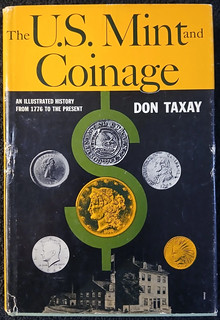
Bryce Brown is auctioning the Dick Johnson library on eBay. Here's the announcement. This first batch is of books signed and inscribed by their authors, famous numismatic personalities themselves. Great opportunity for bibliophiles! -Editor
of Signed and Inscribed Numismatic Literature
Dick Johnson (1930-2020) was an author, editor, researcher, cataloguer, and long-time medal and medallic art dealer. Along the way, he acquired dozens of numismatic books and catalogs which were either signed or inscribed by the authors. These are now individually offered on eBay, under seller name dwj-numismatic-library. Link: https://www.ebay.com/sch/i.html?item=317632104582&rt=nc&_trksid=p4429486.m3561.l170197&_ssn=dwj-numismatic-library

Any questions can be asked through eBay, or by contacting me at dwj.library@gmail.com


Notable authors include J. F. Loubat, Eric Newman, William H. Sheldon, Cornelius Vermeule, Dorothy Paschal, John Willem, James Ruddy, Harry X. Boosel, Walter Breen, Ken Bressett, and Q. David Bowers.
The highlight of the lots ending on December 16th is a 1962 Fuld reprint of the 1809 Perkin's Bank Bill Test with his inscription to Johnson, and the highlight ending on December 17th is Johnson's rare first printing of The Fantastic 1804 Dollar, with inscriptions by both authors (with a great story behind it).

For more information, or to bid, see:
https://www.ebay.com/sch/i.html?item=317632104582&rt=nc&_trksid=p4429486.m3561.l170197&_ssn=dwj-numismatic-library
To read the earlier E-Sylum articles, see:
D. WAYNE JOHNSON (1930-2020)
(https://www.coinbooks.org/v24/esylum_v24n01a06.html)
A DICK JOHNSON BIOGRAPHY
(https://www.coinbooks.org/v27/esylum_v27n13a20.html)
LANG NUMISMATIC LITERATURE AUCTION 9
The ninth numismatic literature auction from Numismatic Antiquarian Bookshop Lang closes December 16, 2025. Here's the announcement. -Editor

We cordially invite you to our 9th literature auction at Numismatisches Antiquariat Lang GmbH. On December 16, 2025, at 4:00 p.m. CET, we will be presenting the first part of the duplicates from the Leu Numismatik AG library on Auex. As usual, you can also place advance bids via the Sixbid, Numisbids and Biddr platforms. The focus is on monographs on ancient numismatics and auction catalogs up to 1945. Many titles feature beautiful bindings, significant collections, and important reference works. The pleasantly moderate estimated prices offer a wonderful opportunity to enrich your own library – perhaps even with an early Christmas present.
Auction details:
- Date: December 16, 2025
- Location: Online on the auction platform Auex.de
- Time: From 4:00 p.m. CET

We look forward to welcoming you online and hope you enjoy browsing.
For more information, see:
https://www.numismatisches-antiquariat.de/
TAMS BOWERS BOOK SALE
The Token & Medal Society is having a book sale. -Editor
About the author:
Q. David Bowers is best known for his work as a historian of American coins and has authored numerous books, including detailed cataloging of coins, auction records, and historical accounts. His writings have shaped the understanding of American numismatics and are highly regarded in the field.
Bowers has been involved in various prestigious numismatic institutions, including TAMS. He played a significant role in auction houses, serving as an expert consultant and advisor, and was instrumental in organizing major coin auctions. Throughout his career, Bowers has been recognized with numerous awards for his outstanding achievements in numismatics. His long-standing influence on both the academic and commercial aspects of numismatics has left a lasting legacy. Today, he is considered one of the foremost authorities on US coins, particularly in the areas of historical coin cataloging and valuation, and continues to be a leading voice in the numismatic community.
About the books:
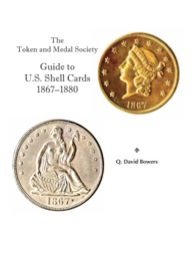
Guide to U.S. Shell Cards 1867-1880 by Q. David Bowers, 2014. Hard
bound, 360+ pages, full color catalog of US shell cards. The first book-length treatment of these early examples of American advertising tokens. Over 1,000 shell cards described and most illustrated in color. The study includes a history of shell cards, their makers, and rarity information for many pieces.
$46 post-paid
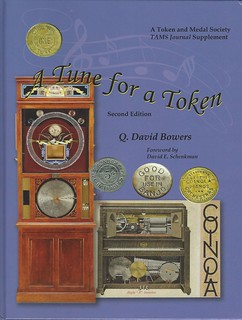
A Tune for a Token, second edition, by Q. David Bowers, 2019. Hardbound,
234 pages; illustrated in color throughout. The standard work on the subject of tokens produced for use in automatic musical instruments.
$26 post-paid
Checks should be made payable to the Token and Medal Society and sent to:
TAMS, Larry Baber
PO Box 20196
El Cajon, CA 9202
For more information on the Token and Medal Society (TAMS), see:
https://www.tokenandmedal.org/

NEW BOOK: U.S. PROOF COINS VOL III: SILVER
John Dannreuther's new two-part volume on proof silver coinage is now available for pre-order! Here's the announcement. -Editor
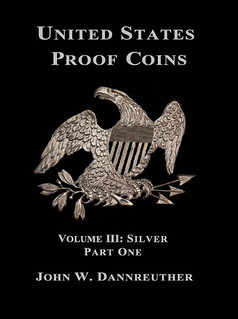

Dannreuther's United States Proof Coins Volume III: Silver Available for Pre-order
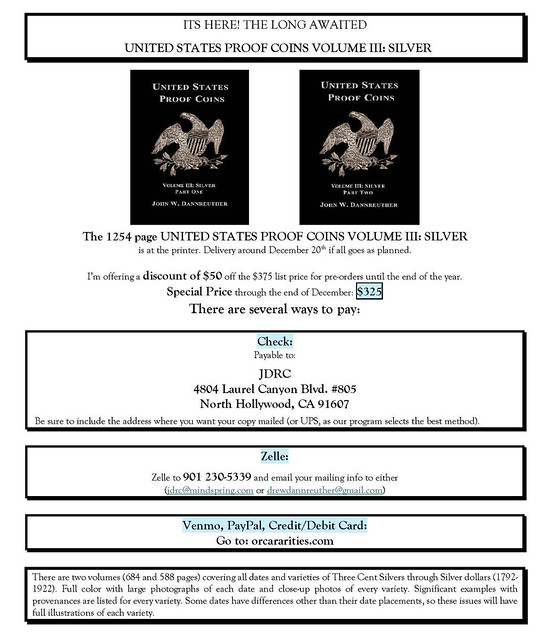
There are two volumes (684 and 588 pages) covering all dates and varieties of Three Cent Silvers through Silver dollars (1792-1922). Full color with large photographs of each date and close-up photos of every variety. Significant examples with provenances are listed for every variety. Some dates have differences other than their date placements, so these issues will have full illustrations of each variety.


United States Proof Coins: Volume III (Silver) Part 1 & 2 - HARDBOUND - PREORDER
$325.00
This is a preorder price that will expire January 1st, 2026. Books are estimated to ship late December/early January.


For more information, see:
https://www.orcararities.com/
To read the earlier E-Sylum articles, see:
NEW BOOK: U.S. PROOF COINS VOL IV: GOLD
(https://www.coinbooks.org/v21/esylum_v21n07a02.html)
BOOK REVIEW: UNITED STATES PROOF COINS, VOLUME IV
(https://www.coinbooks.org/v21/esylum_v21n41a06.html)
NEW BOOK: U.S. PROOF COINS VOL II: NICKEL
(https://www.coinbooks.org/v26/esylum_v26n18a03.html)
NEW BOOK: COINS IN FASHION
The Kunsthistorisches Museum in Vienna is currently hosting "Head and Shoulders: Coins in Fashion," an exhibition exploring how coins as miniature portraits functioned as style statements and political power symbols through 2,400 years of history, showcasing elaborate hairstyles, crowns, beards, and accessories from rulers, effectively acting as ancient fashion billboards for subjects to see daily.
Accompanying the exhibition is the publication Coins in Fashion – designed like a fashion magazine that elegantly, visually opulently and surprisingly differently combines historical trends and modern inspirations. Available in German only. -Editor
Coin images are among the smallest portraits in the world. Making use of extremely confined space, they show finely detailed half-length likenesses, usually in profile. The small size of coin portraits frequently calls for highly symbolic imagery. The hairstyles, garments, and accessories that are depicted go beyond being aesthetically pleasing add-ons: they reflect the Zeitgeist and open a window into the cultures of bygone ages.
More than a hundred coin portraits are on show from a cultural history perspective in the exhibition Head & Shoulders, illustrating several millennia of fashion and lifestyle.

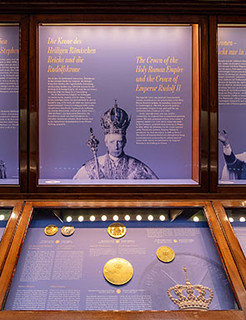
Like small time capsules, coins and medals preserve the elaborate hairstyles, magnificent beards, and intricate head coverings of each period. The exhibition travels through more than 2,400 years of fashion history with the help of over 100 coins.
Coins were minted in large amounts and were in daily use. A coin portrait was therefore the image that was most frequently seen by a ruler's subjects. Hence, the way the sovereigns styled themselves carried particular importance.


Some became real trendsetters: their fashion turned into distinctive trademarks.

Everybody who was anybody during the Italian Renaissance would make sure to show their status. The hat or biretta was a telltale sign of social standing, education, and political attitude. Elaborate head coverings were particularly prevalent at the Northern Italian courts as fashion statements and reflections of the way people perceived themselves in a society that hovered between tradition and new beginnings.

For more information, see:
Head and Shoulders
(https://www.khm.at/en/exhibitions/head-and-shoulders-coins-in-fashion)
Head and Shoulders: When Coins Became Fashion Statements at KHM Vienna
(https://couturenotebook.com/best-haute-couture-blog/coins-in-fashion-exhibition-kunsthistorisches)
New exhibition reveals how coins became history's smallest fashion statements
(https://artdaily.cc/news/187976/New-exhibition-reveals-how-coins-became-history-s-smallest-fashion-statements)
NEW BOOK: SYLLOGE NUMMORUM ARABICORUM OSTERREICH
A notice in Journal of the Oriental Numismatic Society alerted us to this new book by Nikolaus Schindel. With permission, we're republishing it here. -Editor
 Nikolaus Schindel (2025)
Sylloge Nummorum Arabicorum Österreich Band I:
Early Islamic Copper Coins after the Reform of 77 AH (696/697 AD)
Wien, hardback, black-and-white illustrations, ISBN 9783200103207, €44 (plus shipping), order directly from the author, Nikolaus Schindel, Nikolaus.Schindel@oeaw.ac.at Numismatische Gesellschaft.
It presents early Islamic copper coins dating from the coin reform of the Umayyad caliph ?Abd al-Malik (77 AH, 696/697 CE) to the middle of the eighth century CE. The plates depict a total of 1,434 bronze coins. In addition, more than 150 pages offer a general overview of copper coinage from the Umayyad period, and the collection is discussed in its broader numismatic context.
This volume represents the first comprehensive treatment of Umayyad copper coinage since John Walker's 1956 British Museum catalogue. While it does not aim for completeness, it will be used as a reference for post-Reformation Islamic bronze coins up to about 750 CE.
For more information on the Oriental Numismatic Society, see:
https://www.orientalnumismaticsociety.org/

NEW BOOK: PAPER MONEY OF EASTERN BAVARIA, VOLUME 2
Here's a Google-translated Geldscheine Online article by Dr. Sven Gerhard about a new book in German on the paper money of Eastern Bavaria. -Editor
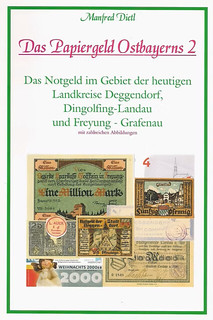 The paper money of Eastern Bavaria 2
The emergency money in the area of ??today's districts of Deggendorf, Dingolfing-Landau and Freyung-Grafenau
Manfred Dietl
Self-published by the author, oO 2025.
Paperback, softcover. 274 + VIII pages.
21.5 x 29.7 cm, full color throughout.
Price: 50 EUR plus shipping, to order from the author:
Dietl.Manfred@yahoo.de
In October 2022, Manfred Dietl presented the first volume of the series "The Paper Money of Eastern Bavaria", which was reviewed here on the blog by Hans-Ludwig Besler: https://www.geldscheine-online.com/post/neuer-katalog-das-papiergeld-ostbayerns.
This volume covers the emergency money of the present-day districts of Cham, Straubing-Bogen, and Regen, and is now out of print. The second volume, covering the emergency money in the area of ??the present-day districts of Deggendorf, Dingolfing-Landau, and Freyung-Grafenau, is now available.
All banknotes are depicted at 50% of their original size, allowing even the smallest details to be clearly seen. The author has set himself the goal of cataloging and illustrating every known variant. He thus goes significantly deeper than overview catalogs that also cover this area. This is evident, for example, in the Osterhofen banknotes, which occupy 50 pages in Dietl's catalog. While this depth of reference unfortunately comes at the cost of practical usability for collectors, Dietl's work is not a catalog in the traditional sense, where one can simply "tick off" banknotes. It is a comprehensive documentation of all emergency banknotes as they actually circulated in the three districts of eastern Bavaria.
For the first time, he also conducted an appraisal of the banknotes, without making any reference to their condition. The appraisal reflects an average price, representing an assessment of rarity, which can vary upwards or downwards depending on the banknote's condition as well as supply and demand.
Anyone who enjoys delving deeply into the variations of emergency banknotes from the aforementioned districts in Eastern Bavaria will find this work rewarding – and perhaps even take on the challenge of discovering new variations not yet recorded by the author. He is always happy to receive new information about banknotes and variations of Eastern Bavarian paper money that are still unknown to him.
To read the complete article, see:
Das Papiergeld Ostbayerns – Band 2: Das Notgeld im Gebiet der heutigen Landkreise Deggendorf, Dingolfing-Landau und Freyung-Grafenau
(https://www.geldscheine-online.com/post/das-papiergeld-ostbayerns-band-2-das-notgeld-im-gebiet-der-heutigen-landkreise-deggendorf-dingol)
THE TAMS JOURNAL NOV-DEC 2025
The November-December issue of The TAMS Journal has been published by the Token and Medal Society. If you have even the slightest interest in the topics, you need to be a member. See the link below for more information. -Editor
Table of Contents
 Articles
The 20th Century Medallic Milestones of New Rochelle, NY
Harry Waterson
An Interesting Die Sinker Brochure
David E. Schenkman
Remembering the "Madness" of the Past – Beanie Babies
Mark Benvenuto
Dossier of the Medal Design for the Volunteers of Cuba (1871)
Ángel O. Navarro Zayas, PhD
Sacagawea: Hero, Mother, Native American
Bennett Henrikson


Columns
From the President
James Brokamp
Fingers on the Keyboard
Greg Burns
Token and Medal Trailblazers
Pete Smith
This & That
Harry Waterson
American Token Manufacturers & Their Agents
David E. Schenkman


Counterstamp Corner
Greg Bennick
So-Called Dollar Stories
Jeff Shevlin
Sixty Years Ago in TAMS
Greg Burns
Mavericks
Ryan Kordziel
Society News and Reports
General News/Pleas
Secretary's Report
Letters
For more information on the Token and Medal Society (TAMS), see:
https://www.tokenandmedal.org/

ORIENTAL NUMISMATIC SOCIETY AUTUMN 2025
The Autumn 2025 issue of the Journal of the Oriental Numismatic Society has been published. -Editor
 Journal of the Oriental Numismatic Society
261 Autumn 2025
Editorial
Pankaj Tandon
A new variant on a copper coin of the Sasanian King Kawad I
Nikolaus Schindel
An imitation of a solidus of Anastasius from Kafir Kala, the site of ancient Rivdad near Samarkand
Aleksandr Naymark, Simone Mantellini and Amriddin Berdymuradov
The Rustam hoard of late Sasanian and Arab-Sasanian coins
Joe Cribb and Muhammad Khalid
The forgotten Qing dynasty mint and its coinage
Tong Yu
Typology of cash coins of the Borneo Da Gang gongsis
Tjong Yih
‘Badabad' Herat and the ‘rat series' copper coins
Bernard Millancourt
A token featuring a folk story from Punjab
Jeevandeep Singh
Comment on article by Gholami in JONS 260
ONS News
The Nicholas Rhodes Collection of Nepalese Coins and Medals Part One
Georgie Potter
Book reviews and notice
A book notice in this issue alerted us to the new book Sylloge Nummorum Arabicorum Österreich Band I: Early Islamic Copper Coins after the Reform of 77 AH (696/697 AD) by Nikolaus Schindel. See the article elsewhere in this issue for more information.
For more information on the Oriental Numismatic Society, see:
https://www.orientalnumismaticsociety.org/

APP REVIEW: COINSNAP
Back in March 2023, CoinWeek published an article reviewing the CoinSnap app. See E-Sylum's excerpt at the link below. Andrew Crellin of Sterling & Currency in Australia published a new review of the app this week. Here's an excerpt - see the complete article online. -Editor
 This article is intended to help me think through and explain why I believe Coinsnap (as well as the many other similar apps) aren't fit for anything more than having a bit of fun.
Don't get me wrong, I love the possibility that an app can be used to identify and value coins, but the reality is, the technology isn't there yet. Coinsnap has been around since late 2022, I downloaded the free version shortly after it was released and thought the technology showed real potential. I don't want a potential solution though - I want an actual solution! So after a few fails, I've never bothered with it.
If you haven't heard of Coinsnap before, let me bring you up to speed - it's described as the
"TOP 1 Coin ID App" in the Apple App Store. The developer claims: "CoinSnap is a companion for coin enthusiasts. Whether you're identifying a rare error coin, uncovering the value of a hidden gem, or organising a collection of hundreds of coins, CoinSnap makes it fast, easy, and fun to explore the fascinating world of numismatics."
Sounds fantastic in theory, but in reality, it's a little like having a year 10 geography student act as your guide on a trip into the Amazon jungle. They'll be earnest and will have a basic grasp of the knowledge required, but they will be woefully inadequate when the stakes are high.
The developer claims to have more than 22 million "users" worldwide, and independent information from Sensor Tower (a platform that provides intelligence on the market for mobile apps) estimates the app generated US$700,000 in income in the past 30 days alone. More than US$8,000,000 a year is big business, so this solution clearly resonates with people right around the world. There's clearly an itch that needs scratching here!
The developer behind the app is Next Vision Limited, they're based in China. There's very little publicly available information about them online, but Sensor Tower reports they have a suite of 24 apps that have generated about US$3 million in revenue last month alone.
A few of the other apps in their suite include such useful titles as: "Rock Identifier: Stone ID", "VinylSnap: Scan & Value Record", "Picture Mushroom: Identifier", "StarSnap: Sports Card Scanner" and "Picture Fish - Fish Identifier".
The common technology across CoinSnap, Rock Identifier, Picture Insect, NoteSnap, VinylSnap and others is an image recognition AI tool. The Next Vision platform is built around this central engine as well as a library of millions of images (of coins and apparently rocks and records) that users' images are compared against.
In each app, the user takes a photo, which is immediately sent to a cloud-based server where the AI model processes it. The AI's accuracy in identification (or lack thereof) relies entirely on the training data it has access to, and this is where the app falls short.
I believe the coin apps are being trusted with 4 tasks by those that use them - identification (broad and granular), grading and valuation.
It's a well-written review and I appreciate Andrew's thorough approach. As a lifelong techno-optimist I also believe the basic technology shows real potential, and could greatly improve with continued investment and greatly expanded and well-classified image libraries. But I haven't seen evidence of serious investment. The app's performance on the most basic task of broad identification hasn't improved since the CoinWeek review, where it did well at identifying basic U.S. coins and failed on world and ancient. Here's what Andrew found for "Task 1: Broad Identification."
The first task is broad identification - finding out what a coin is, in general terms. This isn't the only job people use an app like Coinsnap for, but it is the first task it's asked to do.
If we're talking about Australian users of the app, I think most of us know what a 2-dollar coin is. We know how to tell what year an Australian coin was made and can even have a basic idea about a commemorative coin just by looking at it. Foreign coins are another thing altogether - the letters are in different languages, they have different images on them, and even use different numbering systems, so conceivably that's where an app like CoinSnap can save a lot of time in identifying something that'd otherwise take hours to work out.
Unfortunately, my experience of the accuracy of CoinSnap's system when it comes to foreign coins is much lower than their stated accuracy rate of 99%. I've snapped a Tongan coin and it has said it was Mexican, I've snapped an Iraqi coin and it said it was from Switzerland! On both of those occasions, I could see the AI algorithm had matched the photos I took with images that looked similar in very broad terms, but the identification was completely wrong. An app that fails this basic task doesn't even pass the first test as far as I'm concerned.
I've seen the CoinSnap app develop capability over time (it's pretty neat the way you take 2 photos, it crops out the background and spins them around while it does the data matching in the background), so their image library will no doubt build over time, but it's sure inadequate at the moment.
You have to walk before you can run, and you have to crawl before you walk. These apps need to get the basics right before touting high-level capabilities. They're selling a mirage into a strange online feedback loop of bizarro articles claiming that common quarters "could be worth up to" a zillion dollars, and ads promoting apps like this that claim to be able to accurately tell you what any coin is worth. That makes downloading CoinSnap sound like a bargain, but it's a lottery ticket with a payoff that will never come.
I do think we'll one day see an app that does a good job of basic broad identification, and that will be useful and fun. But again, that will require investment and hard work, and higher levels of granular identification, grading and valuation might only work after much, much more investment and deep, deep specialization. -Editor
Andrew adds:
"I have to say I was shocked when I saw the revenue that the app generates.
"The game-changing app is going to be one that marries that image-matching technology with an accurate image library and accurate market values.
"With $10m a year flowing through their coffers, if they choose to invest that in some numismatic assets to build an app that actually works, that will be a significant development for our industry."
To read the complete article, see:
CoinSnap - A Fantastic App That's Not Fit for Purpose
(https://www.sterlingcurrency.com.au/blog/news-research/the-fine-art-of-numismatics/coinsnap-a-fantastic-app-thats-not-fit-for-purpose/)
To read the earlier E-Sylum article, see:
APP REVIEW: COINSNAP
(https://www.coinbooks.org/v26/esylum_v26n12a07.html)

1933 DOUBLE EAGLE LITIGATION RECORDS
The latest additions to the Newman Numismatic Portal are legal documents related to the Farouk 1933 double eagle. Project Coordinator Len Augsburger provided the following report. -Editor
 1933 Double Eagle Litigation Records on Newman Portal
If multiple books have been written about a single issue of coinage, the subject is probably the 1794 large cent or the 1933 double eagle. In the case of the 1933 twenty, the legal records extend the available documentation even further. Courtesy of Todd Imhof of Heritage Auctions, nearly a thousand pages related to the litigation surrounding the Fenton/Weitzman example of the 1933 $20 is now available on NNP. While some material is redacted, the available papers clearly outline both the U.S. government and Stephen Fenton's respective cases for ownership of the coin. In the end, the two parties split the difference, and created the only example that is legal to own. Note, this material relates only to the Fenton coin and not the Langbord examples that appeared later.
Link to "United States of America vs. A $20 Gold Coin" litigation records on Newman Portal:
https://nnp.wustl.edu/library/archivedetail/557482
Link to "King Farouk and the Fenton 1933 Double Eagle," featuring Alison Frankel:
https://archive.org/details/ANA06019KingFarouk
Link to "Strange Case of the 1933 Double Eagles," featuring Greg Weinman, U.S. Mint Counsel:
https://archive.org/details/PAN18005Strange
VIDEO: SEATED LIBERTY COINAGE
The David Lisot Video Library on the Newman Numismatic Portal can be found at:
https://nnp.wustl.edu/library/multimediadetail/522852
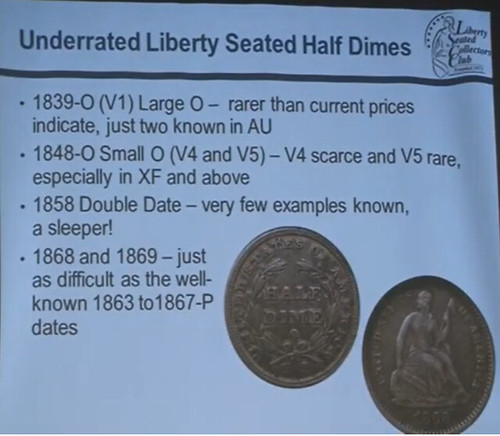
We highlight one of his videos each week in The E-Sylum. Here's one from 2016 with Dennis Fortier speaking about Liberty Seated coinage. -Editor
Mr. Fortier is the regional program team leader for the Liberty Seated Collector's Club and a happenings and developments in the error/variety market. New discoveries, counterfeit errors, and other key current issues will be discussed in detail. Speaker: Dennis Fortier.
To watch the complete video, see:
Overrated and Underrated Seated Liberty Coinage
(https://youtu.be/qxcdL-e_Mv4)
Overrated and Underrated Seated Liberty Coinage
(https://nnp.wustl.edu/library/book/549014)

PCGS HIRES COINWEEK'S CHARLES MORGAN
Professional Coin Grading Service (PCGS) has hired Charles Morgan of CoinWeek and promoted four others within the company. Here's the announcement. -Editor
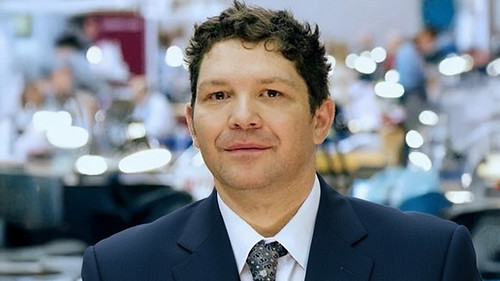
Charles Morgan
Professional Coin Grading Service (www.PCGS.com) welcomes longtime CoinWeek publisher and editor Charles Morgan to the team while promoting several internal specialists to new leadership roles within the company. Morgan joins PCGS as its manager of numismatic research and programs, a new position created by the company as it looks to further develop PCGS CoinFacts and enhance its numismatic education outreach programs. Meanwhile, several longtime PCGS employees are being elevated to new leadership roles, including Taryn Warrecker as director of sales, Luke San to become PCGS chief of staff, Jordan Lang as principal professional of business development management, and Colin Hudson as director of strategy and corporate development.
"We are thrilled that we have so many bright minds and collector-oriented professionals rising the ranks," said PCGS President Stephanie Sabin. "And we are excited to welcome Charles, who brings his decades of numismatic experience and the incredible industry insights he gained from helming CoinWeek, a popular website that had a large presence in the growing digital sphere of numismatics." Sabin says Morgan's talents go beyond running a popular coin media website.
"Charles is a meticulous numismatic researcher who will bring new depth to PCGS CoinFacts and other educational hubs here at PCGS. He also has a background in creating immersive multimedia experiences that will add a new dimension to our many online and social media platforms."
Morgan became editor of CoinWeek in 2013 and was the host of the award-winning CoinWeek Podcast, producing more than 160 episodes from 2016 through 2024. During that time, Morgan also produced more than 500 videos covering a wide range of coin collecting topics and events.
His extensive research background includes serving as the co-author of 100 Greatest Modern World Coins and acting as a contributor to several essential numismatic volumes, including the A Guide Book of United States Coins and A Guide Book of Modern United States Dollar Coins (both produced by Whitman Publishing). A winner of numerous NLG awards for writing, Morgan served as the executive director of the organization in 2021 and was also a member of the American Numismatic Association Board of Governors from 2021 to 2023.
"My first foray into serious numismatic collecting came in 1999, when I bought my first PCGS-graded coin," said Morgan. "From that moment on, PCGS – to me – was the gold standard in serious numismatic collecting and investing. The coin collecting hobby is where it is today thanks to PCGS, and I look forward to playing my part to write the next chapter of that great story."
 Taryn Warrecker, who has been with PCGS for nearly two decades, has long been known in the
industry for her ability to foster professional relationships in the hobby and is a familiar face to
many on the bourse floors of coin shows across the country. "I'm energized by the opportunity to
help more dealers grow their businesses through PCGS," Warrecker said. "Whether it's vintage,
world, or show submissions, or showcasing special auction collections, my focus is on
strengthening partnerships and getting more great coins in PCGS holders. As I approach 20
years with Collectors, I've never been more proud of our team or more confident in PCGS's role
at the heart of the hobby."
Taryn Warrecker, who has been with PCGS for nearly two decades, has long been known in the
industry for her ability to foster professional relationships in the hobby and is a familiar face to
many on the bourse floors of coin shows across the country. "I'm energized by the opportunity to
help more dealers grow their businesses through PCGS," Warrecker said. "Whether it's vintage,
world, or show submissions, or showcasing special auction collections, my focus is on
strengthening partnerships and getting more great coins in PCGS holders. As I approach 20
years with Collectors, I've never been more proud of our team or more confident in PCGS's role
at the heart of the hobby."
 Luke San moves into a role that enhances PCGS President Stephanie Sabin's ability to operate
the company and flex its numismatic muscle. Coming from an engineering background, San
worked in the aerospace industry and e-commerce giant Amazon before joining PCGS in 2023.
"As PCGS chief of staff, I serve as Stephanie Sabin's strategic partner across all aspects of the
company," San explains. "I play the role of conductor and ensure her staff can work efficiently,
with clear priorities and communication across teams. It feels like a natural evolution of my
previous role building PCGS's new digital experiences, where thoughtful planning and
collaboration were key to projects like the new Online Submission Center. I'm energized by the
way PCGS is always seeking to innovate and look forward to meeting more of the passionate
numismatic community."
Luke San moves into a role that enhances PCGS President Stephanie Sabin's ability to operate
the company and flex its numismatic muscle. Coming from an engineering background, San
worked in the aerospace industry and e-commerce giant Amazon before joining PCGS in 2023.
"As PCGS chief of staff, I serve as Stephanie Sabin's strategic partner across all aspects of the
company," San explains. "I play the role of conductor and ensure her staff can work efficiently,
with clear priorities and communication across teams. It feels like a natural evolution of my
previous role building PCGS's new digital experiences, where thoughtful planning and
collaboration were key to projects like the new Online Submission Center. I'm energized by the
way PCGS is always seeking to innovate and look forward to meeting more of the passionate
numismatic community."
 Jordan Lang, with a background in finance and prowess for procuring and compiling actionable
data, joins PCGS as principal professional of business development management. "My main
goal in joining the PCGS team is to bring my experience in corporate financial planning and
analysis, which is building budgets and communicating financials to the chief financial officer
and executive staff," explains Lang, who will use his skills to help the sales team expand the
company's reach. "I will partner with everyone I can to build new understanding, tools, and
communications so that they can accomplish more." He adds that he will be using his skills "to
help everyone at PCGS accomplish their goals and get them the resources they need."
Jordan Lang, with a background in finance and prowess for procuring and compiling actionable
data, joins PCGS as principal professional of business development management. "My main
goal in joining the PCGS team is to bring my experience in corporate financial planning and
analysis, which is building budgets and communicating financials to the chief financial officer
and executive staff," explains Lang, who will use his skills to help the sales team expand the
company's reach. "I will partner with everyone I can to build new understanding, tools, and
communications so that they can accomplish more." He adds that he will be using his skills "to
help everyone at PCGS accomplish their goals and get them the resources they need."
 Colin Hudson, who served three years on the Collectors Corporate Development team, moves
into a new role with PCGS as director of strategy and corporate development. "In my first 3
years at Collectors on the Corporate Development team, I had the opportunity to partner with
PCGS on a few projects and learn more about the business," Hudson says. "I look forward to
working with the team to identify and execute on growth opportunities for the company, and
propel PCGS into its fifth decade."
Colin Hudson, who served three years on the Collectors Corporate Development team, moves
into a new role with PCGS as director of strategy and corporate development. "In my first 3
years at Collectors on the Corporate Development team, I had the opportunity to partner with
PCGS on a few projects and learn more about the business," Hudson says. "I look forward to
working with the team to identify and execute on growth opportunities for the company, and
propel PCGS into its fifth decade."
To read the complete article, see:
PCGS Hires CoinWeek's Charles Morgan as Numismatic Researcher, Expands Leadership Team
(https://www.pcgs.com/news/pcgs-hires-coinweeks-charles-morgan)
NOTES FROM E-SYLUM READERS: DECEMBER 7, 2025
Time Enough at Last
Alan Luedeking writes:
"In Praise of Bibliomania reminded me of The Twilight Zone episode "Time Enough at Last". That's all we need to see to understand everything!"
Indeed. We discussed this back in 2009 - see the earlier article (linked below) for more. -Editor
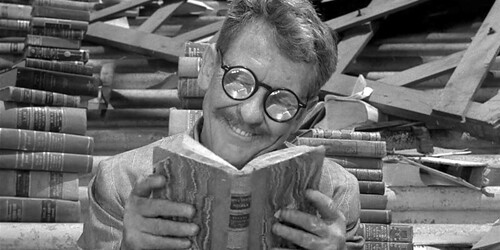
The photo is from an episode of the "Twilight Zone". This bibliophile was named Henry Bemis (played by Meredith) and is from the first season of the show, in 1959. The name of the story is "Time Enough at Last" and is about a bookish bank teller who has a childlike fascination for the written word...any written word be it books, periodicals, or newspapers.
He delights in taking any moment to read, through his incredibly thick "coke-bottle" glasses, even on his salaried time. He is constantly harassed by his wife, customers and boss for his love of print to the point that he must sneak into the bank's vault where he works to read on his lunch hour.
During one such visit, a nuclear bomb blast levels his city, leaving him unscathed, whereupon he exits to find that he has "time enough at last" to read all he wants when he finds the local library's contents scattered about.
To read the earlier E-Sylum articles, see:
IN PRAISE OF BIBLIOMANIA
(https://www.coinbooks.org/v28/esylum_v28n48a27.html)
QUIZ ANSWER: HENRY BEMIS, LAST BIBLIOPHILE ON EARTH
(https://www.coinbooks.org/esylum_v12n13a14.html)
Thanksgiving Tale
Regarding the article about a young man whose car skidded off the road in a 1980 blizzard, Gerry Tebben writes:
"Thanks for sharing this non-numismatic story. It brightened my day."
You're welcome. I drop a lot of random links in my "About This Issue" commentaries, and I'm happy some readers find and enjoy some of them. -Editor
To read the earlier E-Sylum article, see:
ABOUT THIS ISSUE: NOVEMBER 30, 2025
(https://www.coinbooks.org/v28/esylum_v28n48a30.html)
Frossard & Parsons on Franco-American Jetons
David Fanning submitted this minor correction. Thank you. -Editor
I enjoyed Pete Smith's article on Frossard, who has always been a favorite of mine. I have a small correction to make, though. He wrote:
"With George M. Parsons, he wrote Franco-American Jetons, Fully Described and Illustrated [bound with] The Colonial Jetons of Louis XV and Other Pieces Relating to the French Colonial Possessions in America, and to their Conquest by England, published in 1899."


These are two completely different works, one by Parsons and the other by Frossard. Neither work was jointly written. They were published 15 years apart and are usually encountered separately. I have handled two copies that were bound together, as both are short monographs on the same subject, such as this:
Frossard & Parsons on Franco-American Jetons
127 Frossard, Ed. FRANCO-AMERICAN JETONS, FULLY DESCRIBED AND ILLUSTRATED. New York: Privately Published, 1899. 14, (2) pages; 52 descriptions; 2 very fine plates. [bound with] Parsons, George M. THE COLONIAL JETONS OF LOUIS XV AND OTHER PIECES RELATING TO THE FRENCH COLONIAL POSSESSIONS IN AMERICA, AND TO THEIR CONQUEST BY ENGLAND. Columbus: Reprinted for Private Circulation from the American Journal of Numismatics, 1884. 15, (1) pages; 1 fine plate of jetons and medals. Tall 8vo, later blue cloth, gilt; original printed card covers bound in. The Frossard work is a bit worn, and bears some modern annotations; the Parson work is nearly fine; the overall volume is near fine. $200
The first work is very scarce, of which only 100 copies were printed. The monograph was dedicated to the notable Chicago numismatist Charles Morris, whose collection of jetons undoubtedly formed the basis of Frossard's detailed catalogue. Still cited and quite useful. The offprint of Parsons's AJN article is at least as scarce: this copy is unusually well-preserved and includes the original printed card covers. Ex Joseph Foster Library; ex Richard Cooper Library.
To read the earlier E-Sylum article, see:
EDOUARD FROSSARD (1837-1899)
(https://www.coinbooks.org/v28/esylum_v28n48a16.html)
Richmond, VA Chinese Workers Paid in Chinese Cash Coins?
David Pickup writes:
"I picked up a cheap Chinese cash coin and when I found it there was a reference to Chinese labourers working on the railroad in Richmond, Virginia who were paid in Chinese cash. Do any readers know of this? I could only find one reference to it. It would make sense as they would have to use the cash at company stores. It was a coin of the Emperor of China, Kao Tsung. His reign title was Ch'ien Lung."
David found a discussion on a metal detecting forum. Can anyone help? -Editor
To read the complete thread, see:
Chinese Coin: Real or Fake?
(https://metaldetectingforum.com/index.php?threads/chinese-coin-real-or-fake.24142/)
The Hidden Treasures Of The Royal Mint Museum
Kavan Ratnatunga writes:
"To mark the coronation of King Charles the III and the entry of coins with the Kings image into circulation HistoryHit were invited behind closed doors of the Royal Mint to get a unique glimpse of the processes that go into designing and minting of Britain's currency and discover some of the pivotal moments in the history of the relationship between the crown and their coinage.
A very interesting YouTube Video, including Newton, Henry VIII, Elizabeth I, and the value of coinage. Worth watching the 15-minute video 1.25X works. I learned a lot that I did not know."
Thanks! -Editor
To watch the video, see:
Is This the Most Valuable Coin in the World?
(https://www.youtube.com/watch?v=tnBQF1A9D9U)

VOCABULARY TERM: SCHOOL OF ART, ART STYLE
Here's another entry from Dick Johnson's Encyclopedia of Coin and Medal Terminology. -Editor
School of Art, Art Style. Two or more artists whose style is so similar that their work is well known collectively or as a group, than perhaps individually. The name of the school is often that of the founder, the leader, or the city in which the artists practiced. There is not necessarily a "school" involved, yet some of the practitioners may have studied together or some may have legitimately been the student of another. Schools of art do not usually last for more than a generation or two, but their influence may indeed be widespread. The common denominator, of course, among the members whose work is attributed to a school, is their style. Often the style is the result of a technique of modeling or production which is intentionally passed along – or copied – among the members.
The designation for a school of art is usually applied by an author or art historian after considerable study of the collective work (very seldom by contemporary writers). Such classification is similar to historians who like to group related events or people together and give them a name for posterity.
Early Italian medals were studied, for example, by George Frances Hill who coined the name of a dozen schools of the period; his Corpus includes medallic works up to 1530. Later work by Alfred Armand continued the names of some of Hill's designated schools of art as: Mantuan, Neapolitan, Venetian, Bolognese, Milanese, Roman, Florentine, Paduan and Emilian.
German schools of medallic art favored cast medals in the 16th century. In the 18th through 20th centuries they strongly favored the hand-engraved die, even when the 19th century French school of David d'Angers, Henri Chapu, Jules-Clement Chaplain, Alexandre Charpenter and Oscar Roty displayed their success with the sculptured oversize model which was reduced to the intended size die required by die-engraving pantograph. British schools of medallic art existed, as well as those of the low countries.
In America there were eight periods of art styles during the 350 years coins and medals have been made here.
- Colonial Hand Engraving in Provisional Style, 1652-1792.
- Hand Engraving at the Mint in Federal Style, 1792-1920.
- Private Individual Engraving in Simplistic Style, 1792-1865.
- Engraving and Diesinking in Philadelphia Style, 1865-1880s.
- Sculptural Art of beauty in Beaux Arts Style, 1880s-1930.
- Modelled Sculptural Patterns in Traditional Style, 1930-Date
- Modern Art as Medallic Objects in Free Style, 1965-Date.
- Computer Engraved Coins and Medals in Unified Style, 21st century.
There was a beaux arts school of medallic sculptors that existed near the turn of the 20th century. With Augustus St-Gaudens as the forerunner, it included such artists as John Flanagan, Victor Brenner, Paul Manship, James Earle Fraser, Daniel Chester French, and others. The beaux arts medallic genre was characterized by an idealism and naturalism with a softer modeled design.
But a Philadelphia school of hand engravers preceded this. Composed of William W. Warner, Silas Quint, William H. Key, Peter L. Krider, August Frank (and others). Their medallic work all look similar, as if any one could have prepared the dies. Their work is noted for a stark design with a single device, no subsidiary adornment, and minimal diesinking activity. It was as if the technology of medal making, including design, die engraving, striking and finishing was passed around among the members, all in Philadelphia. This is, in effect, a true characteristic of a school of art.
To read the complete entry on the Newman Numismatic Portal, see:
School of Art, Art Style
(https://nnp.wustl.edu/library/dictionarydetail/516704)
JOHN WILLIAM MIDDENDORF II (1924-2025)
E-Sylum Feature Writer and American Numismatic Biographies author Pete Smith submitted this article on collector J. William Middendorf II. Thanks! -Editor
John William Middendorf II (1924-2025)
 An entire article could be written about Bill Middendorf's public service and the honors he received under
five presidents (Eisenhower, Nixon, Ford, Carter, Reagan). Another article could be written about his
collections of paintings, prints and documents. He was so much more than these. He was a successful
athlete, an accomplished artist, a prolific composer, a published author and a collector of coins and
exonumia. I chose to feature his activities beyond his public service, which I find more interesting.
An entire article could be written about Bill Middendorf's public service and the honors he received under
five presidents (Eisenhower, Nixon, Ford, Carter, Reagan). Another article could be written about his
collections of paintings, prints and documents. He was so much more than these. He was a successful
athlete, an accomplished artist, a prolific composer, a published author and a collector of coins and
exonumia. I chose to feature his activities beyond his public service, which I find more interesting.
John William Middendorf II was born on September 22, 1924, in Baltimore, Maryland. He was the son of Henry Stump (1893-1972) and Sarah "Sally" Kennedy Boone (1902-1971) Middendorf. His father was an investment banker.
Ambassador Middendorf had a grandfather, uncle and cousin named John William Middendorf. In German families it is not unusual for all sons to be named John and be known by their middle names. The original John William Middendorf Sr. (1849-1928) had three brothers named John. He had twin sons John William Middendorf Jr. (1893-1973) and Henry Stump Middendorf (1893-1972). Henry's son became John William Middendorf II (1924-2025) and John's son became John William Middendorf III (1935- 1985). The ambassador's son was John William Middendorf IV (1959-2024).
The grandfather formed J. William Middendorf & Co. He was a well-known Baltimore banker and contemporary of the Garretts. Middendorf was one of the organizers of the Seaboard Air Line Railway and Garrett was with the Baltimore and Ohio. The uncle was also known as J. William Middendorf.
Bill began drawing at the age of four and studied art at the Middlesex School under Frank Benson of the Boston Museum of Fine Arts. He was also on the school rowing team.
It was said that Bill could throw a baseball through a wall. In 1944, Middendorf was invited to a tryout as a pitcher for the New York Giants baseball team. He reported to Mel Ott on March 12, 1944. He left after a week to join the Navy.
Middendorf was enrolled in a NROTC program and played basketball at Holy Cross College. After graduation. he served as an engineering officer and navigator in the Navy during the Second World War 1944 to 1946 and was stationed in China.
Middendorf received a B. A. from Harvard College in 1947. While at Harvard. He took a fine arts class at the Fogg Museum. It kindled a growing interest in art and encouraged his sketching and watercolor. At Harvard he was a member of the Hasty Pudding Club and the Owls Club. He received an MBA from New York University in 1954. He was an investment banker with his firm of Middendorf, Colgate and Company.
He married Isabelle Jackson Paine (1930-2016) in 1953 and had five children. She was a granddaughter of William Alfred Paine and daughter of Francis Ward Paine with the firm of Paine Webber.
Throughout his life, he sketched people he met from presidents to world leaders and documented the growth of his children and grandchildren. He accumulated more than 10,000 drawings.
Bill was a judge at the 1960 Olympics in Rome. In 1963 he was on the U. S. Nationals Team for the World Championships of Men's Field Hockey at Lyon, France.
He was appointed by Richard Nixon as Ambassador to The Netherlands in 1969 and served until 1973. He then became Under Secretary of the Navy. He was promoted to Secretary of the Navy serving from 1973 to 1977.
While ambassador to The Netherlands in 1971. He studied with Somtow Sucharitkul to be a music composer. He wrote nocturnes and operas. He composed eight symphonies and more than eighty marches for Navy ships. One of these was the "J. William Middendorf March" to commemorate the naming of a destroyer in his honor.
{Smarty Pants question of the week, what presidential cabinet member wrote the Franklin D, Roosevelt March?]
While he was Secretary of the Navy, Middendorf announced the production of the Bicentennial medals to honor the United States Navy and Marine Corps.
Middendorf helped to promote the first Marine Corps Marathon in 1976 and presented the Middendorf Trophy to the winner. He completed the Marathon eight times with a best finish at 4:22. (I am not impressed. I completed three marathons faster than that.)
He collected American prints and European art on his travels. In 1967, The Met had an exhibit on "American Paintings and Historical Prints from the Middendorf Collection." Much of his collection was donated to the Metropolitan Museum of Art in New York and the Museum of Fine Arts in Boston. His name is carved in marble on a staircase at the Met.
Presidential Coin and Antique conducted a sale of The Ambassador J. William Middendorf, II Collection of exonumia on December 8. 1990. Middendorf had bought heavily at the David W. Dreyfus collection sale of April 12, 1986. The Dreyfus medals became the highlights of the Middendorf sale.
The first 41 lots were U. S. Mint medals. Lot 32 was a silver Washington Before Boston medal, one of five known (at the time) with four in private hands. At the Dreyfus sale the medal realized $18,150 and at the Middendorf sale it realized $17,500.
These were followed by Indian Peace medals, Hard Times Tokens, 19 th Century Merchant tokens, Civil War Tokens, Civil War Storecards, Sutler Tokens, Military. So-Called Dollars, and many other classifications. Many of the lots realized less than $100. The collection represented diversity but not high valuations.
This did not represent the full extent of his numismatic collections. On November 30, 1990, Christie's conducted a sale that included Greek coins from his collection.
Christie's offered 35 lots from the Middendorf collection of rare documents in their sale of January 21, 2021. A highlight was a John Dunlap broadside of the 1776 Declaration of Independence. It sold for $990,000.
In 2025, he was nominated for The Presidential Medal of Freedom. Middendorf died at Charleton Memorial Hospital in Fall River, Massachusetts, on October 24, 2025, and is buried at Arlington National Cemetery.
The Providence Journal ran a two-page obituary on October 28, 2025, listing all the accomplishments I am leaving out. It did not mention his art collection, rare documents or numismatics.
If all goes well, we will have a new 100-year-old numismatist to announce next week.
To read the complete obituary, see:
J. William Middendorf II
(https://www.providencejournal.com/obituaries/ppvp1314429)

TREASURE TALK WITH BOB EVANS, EPISODE 9
In January, our good friend Bob Evans began publishing a series of blog articles on the Finest Known website detailing his experience as co-discoverer and curator of the treasures recovered from the wreck of the S.S. Central America. Subject of the book "Ship of Gold", many exhibits, countless interviews and articles, books and auction catalogs feature the legendary haul of gold coins, bars, nuggets, gold dust and more from the 1857 shipwreck. Here's another excerpt - see the complete article online. -Editor

"We are going to find gold dust."
I made the statement with confidence.
"Nah… what? Gold dust? We're not looking for gold dust. We're looking for specie, coins. And gold bars." Tommy Thompson replied.
"Yes, we are. And we're also going to find gold dust."
 I was in the early months of historical research about the S.S. Central America, having been recruited by Tommy, my neighbor, in the autumn of 1983. I pored over the fuzzy microfilm printouts of contemporary newspapers, the early white-on-black xerox pages of tiny print.
Reading the accounts, I began to envision a shower of golden particles, falling more than a mile, a cloud that surrounded the steamship, and descended with it into the abyss. I began to think about what forensic science might reveal, the constituents of the remaining deposit. Descriptions of the ship's final moments on the surface tell of gold dust and coins being spread on the deck.
So, sometime around 1985, my conclusion was,
"Absolutely! There should be gold dust all over this shipwreck site, if we ever find it."
Fast forward to 1988. We have discovered what we believe with near certainty is the shipwreck site of the S.S. Central America.
In 1988, Bob had an opportunity to finally test his theory with a batch of mud, "fresh and cold from the bottom of the Atlantic." -Editor
I had muriatic acid on board, nothing fancy, just some industrial grade pool chlorine that could serve multiple purposes, including as a cleaning agent, or maybe as a magic gold dust revealer. I took a portion of the sample, something around 150ml, and put it in a one-liter Pyrex beaker. I mixed tap water into the mud until it was a slurry, then slowly introduced the acid, carefully watching the violent effervescence as the foam rose and fell within the vessel. Once the reaction died down to a steady bubbling, I tied it to the shelf at the back of my lab bench, secured against spillage from the ship's motions, and left it to digest overnight.
The next morning the engineers had things to fix on Nemo, prior to the next dive. A few crewmembers were on deck, awaiting the successful testing of the engineering tweaks, so they could take their positions on deck for the dive. The testing took a few iterations, each one involving a time-consuming unsealing of a pressure sphere, the adjustment of the electronics inside, followed by the resealing of the air-tight chamber. When it became obvious it was going to take a while, the deck crew started to break out the fishing rods. The "dolphin" were schooling around the ship.
While waiting for Nemo to work the right way so we could dive, the guys grabbed the fishing gear and started casting. I went below to my lab, to check on that bubbling beaker of oozy mud, by that time reduced to a murky mix that looked like bad chocolate milk. I half-filled a 5-gallon bucket with water, to catch and dilute the acid as I carefully decanted the solution and poured off everything but the remaining sediment. As expected, the calcium carbonate had dissolved, and all that remained was about a teaspoon of acid-resistant components. I dumped it into a Petri dish with a little clean water and started to search through it under the microscope. It was about like the samples I had seen from the previous year's shipwreck studies, coal dust, wood fragments, etc., with one key difference.
THIS ONE HAD A TINY TABLE-SALT-SIZE CHUNK OF GOLD!
It was unmistakable. I shared this "find" with Tommy Thompson and our experienced shipwreck expert John Doering who were justifiably amazed and delighted. Tommy remarked that this was not something to write to the investors about. We were looking for larger amounts than a tiny grain of golden sand.
In the next three dives we found and recovered the ship's bell, confirming beyond question the shipwreck's identity, then photographed and found the Garden of Gold, the commercial shipment deposit with its thousands of mint-state 1857-S double eagles. This sort of overshadowed my tiny fleck of gold in a Petri dish.
But my long conjecture about gold dust being everywhere on the SSCA site was verified. From that point on, collection of native gold, the gold dust and nuggets, became an integral part of the recovery strategy.
Gold dust from the S.S. Central America shipwreck has been recovered in two main ways. Large parcels, both within the commercial shipment and also within consignments inside the purser's safe, were major sources for gold dust, yielding a whole lot in individual units sometimes weighing many pounds. The other major source of gold dust was the shipwreck at large. As we have seen, gold dust was everywhere, and so "vacuuming up" the sediment while excavating, and processing those particles for gold dust became the standard operating procedure.
After every dive, it was my responsibility to process the sediment traps. This was both wonderfully surreal and significantly arduous.
I generally processed the sediment traps at night. I did this on deck, under the crane next to the portside scuppers (drains over the side) so the fine mud and junk from my sifting through the sediment would wash easily overboard, keeping the deck acceptably clean. The wee hours of the AM were ideal, since temperatures would drop into the tolerable eighties.
I had bright work lights overhead, and it was easy enough to spot coins, large gold nuggets, and bits of jewelry that had been swept up during our operations. But ultimately, it came down to panning for gold.
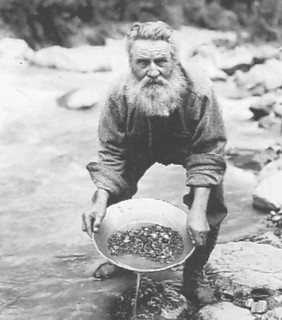
I used a gold pan, following the practice that had been used originally to win these precious particles from the dirt of the Sierra foothills over thirteen decades earlier.
Prospector Bob Evans and his Gold Pan, c1990
I sat on the deck of a rolling ship on the Atlantic, locked into the motions, at night with the moon seeming to wave back and forth in the sky overhead, often sleep-weary, while panning for gold, echoing those who did so long ago in California. When I got to the bottom of the bottom, I could just spoon out the gold dust into "high-grade" jars. With the perspective of half a lifetime, I look back on this with experience with wonder almost beyond words.
For much more, including many images of large gold nuggets and a massive gold dust concretion, check out the full article online. -Editor
To read the complete article, see:
Treasure Talk: Episode 9
The Rocks – Gold Dust & Nuggets
(https://finestknown.com/treasure-talk-episode-9the-rocks-gold-dust-nuggets/)
For the complete series, see:
Category Archives: Treasure Talk with Bob Evans
(https://finestknown.com/treasure-talk-with-bob-evans/)
To read the earlier E-Sylum article, see:
TREASURE TALK WITH BOB EVANS, EPISODE 1
(https://www.coinbooks.org/v28/esylum_v28n12a12.html)
TREASURE TALK WITH BOB EVANS, EPISODE 2.1
(https://www.coinbooks.org/v28/esylum_v28n13a17.html)
TREASURE TALK WITH BOB EVANS, EPISODE 2.2
(https://www.coinbooks.org/v28/esylum_v28n14a15.html)
TREASURE TALK WITH BOB EVANS, EPISODE 3.1
(https://www.coinbooks.org/v28/esylum_v28n15a16.html)
TREASURE TALK WITH BOB EVANS, EPISODE 3.2
(https://www.coinbooks.org/v28/esylum_v28n17a16.html)
TREASURE TALK WITH BOB EVANS, EPISODE 4.1
(https://www.coinbooks.org/v28/esylum_v28n18a13.html)
TREASURE TALK WITH BOB EVANS, EPISODE 4.2
(https://www.coinbooks.org/v28/esylum_v28n19a20.html)
TREASURE TALK WITH BOB EVANS, EPISODE 5.1
(https://www.coinbooks.org/v28/esylum_v28n22a13.html)
TREASURE TALK WITH BOB EVANS, EPISODE 5.2
(https://www.coinbooks.org/v28/esylum_v28n23a16.html)
TREASURE TALK WITH BOB EVANS, EPISODE 6.1
(https://www.coinbooks.org/v28/esylum_v28n27a14.html)
TREASURE TALK WITH BOB EVANS, EPISODE 6.2
(https://www.coinbooks.org/v28/esylum_v28n30a21.html)
TREASURE TALK WITH BOB EVANS, EPISODE 7.1
(https://www.coinbooks.org/v28/esylum_v28n32a16.html)
TREASURE TALK WITH BOB EVANS, EPISODE 7.2
(https://www.coinbooks.org/v28/esylum_v28n40a15.html)
TREASURE TALK WITH BOB EVANS, EPISODE 8
ATLAS NUMISMATICS SELECTIONS: DECEMBER 7, 2025
Atlas Numismatics has updated their website with 212 new coins, medals, and tokens at fixed prices. Select items are discussed below. -Garrett

1083465 | GREEK. MACEDON UNDER ROME. Macedonia, as Roman Province. Aesillas, as Quaestor. Struck circa 95-65 BC. AR Tetradrachm. NGC MS (Mint State) Strike 4/5 Surface 4/5. Thessaloniki . 27.5mm. 16.96gm. MAKE?ONON// B?. Portrait of Alexander III, the Great with flowing hair and Ammon's horn facing right; monogram in lower right field AESILLAS// Q. AESILLAS/ Q with club between fiscus (treasury chest) and the praetor's chair all within laurel wreath. SNG Cop.-1327; Bauslaugh Group III.
Struck in the name of Aesillas; uncertain mint without mint mark.
To read the complete item description, see:
1083465 | GREEK. MACEDON UNDER ROME. Macedonia, as Roman Province. Aesillas, as Quaestor. Struck circa 95-65 BC. AR Tetradrachm. NGC MS (Mint State) Strike 4/5 Surface 4/5.
(https://atlasnumismatics.com/1083465/)

1085711 | BRAZIL. Joao V. 1732-M AV 12800 Reis. NGC MS63. Minas Gerais. 28.68gm. IOANNES · V · D · G · PORT · ET · ALG · REX. Laureate head right Arms on crowned ornate shield. KM 139; Fr.-55; Gomes-61.06; LMB-288.
To read the complete item description, see:
1085711 | BRAZIL. Joao V. 1732-M AV 12800 Reis. NGC MS63.
(https://atlasnumismatics.com/1085711/)

1084092 | GREAT BRITAIN. England. Commonwealth. 1656 AV Broad (20 Shillings). NGC MS62. Dies by Simon. Blondeau's mint, Drury House, London. Edge: Reeded. LIVAR · D · G · R · P · ANG · SCO · HIB · &c PRO ·. Laureate and draped bust of Oliver Cromwell left PAX · QVÆRITVR · BELLO ·. Crowned coat of arms below date. KM Pn25; SCBC-3225; Friedberg 273; North 2744; W&R 39.
Fully prooflike and attractive.
To read the complete item description, see:
1084092 | GREAT BRITAIN. England. Commonwealth. 1656 AV Broad (20 Shillings). NGC MS62.
(https://atlasnumismatics.com/1084092/)
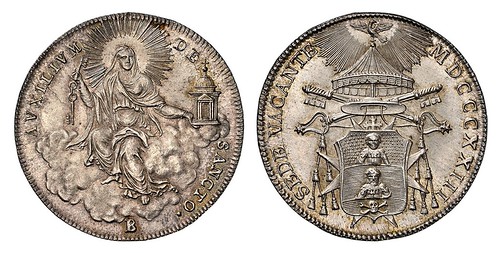
1082648 | ITALIAN STATES. Papal States. MDCCCXXIII (1823)-II-B AR 1/2 Scudo. NGC MS67. Bologna. 35mm. 13.21gm. SEDE VACANTE... Cardinal arms Seated female in clouds holding keys and church. KM 1291.
Sede Vacante issue. Currently the finest known at NGC as of April 2025
To read the complete item description, see:
1082648 | ITALIAN STATES. Papal States.
(https://atlasnumismatics.com/1082648/)

1084591 | NETHERLANDS. Holland. (1681) ND AV Off-Metal Pattern 2 Gulden of 8 Ducats Weight. PCGS SP62. 27.6gm. Crowned arms divides denomination 2 – G Standing female figure leaning on Bible on column, holding spear with Liberty cap. KM Pn13; Vanhoudt-Saunders 1250; Delmonte 797 (R3).
To read the complete item description, see:
1084591 | NETHERLANDS. Holland.
(https://atlasnumismatics.com/1084591/)
Updates to their online inventory are issued monthly.
For more information and to sign up for the firm's monthly newsletter, visit:
atlasnumismatics.com.
NUMISMAGRAM MEDAL SELECTIONS: DECEMBER 7, 2025
Numismagram's Jeremy Bostwick sent along these four medals from his most recent upload of new material to his site. For all of the new items, please visit https://www.numismagram.com/inventory. -Garrett
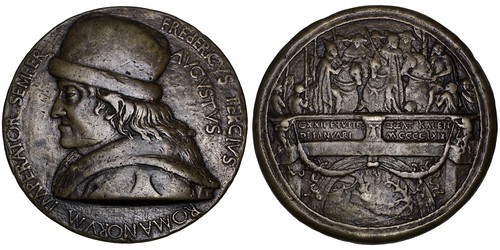
103428 | ITALY. Holy Roman Emperor Federico (Frederick) III cast bronze Medal. Dated 1469, though a contemporary or an early cast from the late 15th/early 16th centuries. (55mm, 61.31 g, 1h). By Bertoldo di Giovanni, [circa 1420/30-1491].
FREdERICVS TERCIVS ROMANORVM IMPERATOR SEMPER / AVGVSTVS, robed bust left, wearing brimmed cap // The emperor creating new knights in the presence of the pope, cardinals, and foot soldiers upon Ponte Sant' Angelo in Rome; boat below the bridge, from which a swag hangs supported by two putti; on the bridge reads a legend in two lines: CXXII EqVITES CREAT KALEN / DE IANVARE MCCCCLXIX (he created 122 knights on the first of January, 1469). Edge: Some scattered marks, otherwise plain.
Pollard 283 = Kress 249; Scher Coll. 90; Michael Hall Coll., part I, 11 (this piece). Rare and full of dramatic, intricate imagery upon the reverse, this pleasing specimen offers a fantastic pedigree to the Hall Collection, where it realized a total price of £1,593 ($2,408 after the buyer's fee) at auction in May 2010.
Pollard, in Renaissance Medals, writes that "...Emperor Frederick III (1415-1493) visited Pope Paul II in Rome to discuss action against the Turkish invasions. The emperor had previously visited Rome in 1452 for his coronation, when Cristoforo di Geremia made a medal with an imaginary portrait of Emperor Constantine the Great. On I January 1469, the emperor created 122 knights on the Ponte Elio (Ponte Sant' Angelo), and it is this event that the medal illustrates and commemorates. On the obverse, the inscription refers to Frederick as "perpetual Augustus," in imitation of antique practice. The medal may have been a gift to the emperor from Filippo de Medici and has also been incorrectly attributed to Candida." In The Scher Collection of Commemorative Medals, it is mentioned that "...some early specimens have the misspelling of "senper" for "semper" in the reverse inscription, but later casts corrected the mistake." and that "...given the fresh eyewitness character of the reverse, it is possible that Bertoldo—artist of the de' Medici family—witnessed the event as a member of the archbishop's retinue."
To read the complete item description, see:
103428 | ITALY. Holy Roman Emperor Federico (Frederick) III cast bronze Medal.
(https://www.numismagram.com/product-page/103428)

103331 | ITALY & FRANCE. Cecilia Gonzaga of Mantova bronze Medal. Dated 1447, though a modern restrike issued late 19th/early 20th centuries. "Innocence and Unicorn in a Moonlight Landscape" (85mm, 265.71 g, 12h). After Antonio di Puccio Pisano (Pisanello) [circa 1380/95-1450/5], and struck at the Paris mint.
CICILIA VIRGO FILIA IOHANNIS FRANCISCI PRIMI MARCHIONIS MANTVE, garlanded and draped bust left // Seminude maiden and shaggy unicorn each kneeling left; crescent above hilly landscape in background; to right, column bearing legend in seven lines: OPVS / PISAN / I PICT / ORIS / M / CCCC / XLVII. Edge: «cornucopia» BRONZE and some mottled staining.
Cf. Pollard 20 = Kress 17 (for original); cf. Scher Coll. 9 = Michael Hall Coll., part I, 7 (same); cf. Jones, The Art of the Medal, p. 22 & fig. 46 (same). Gem Mint State. Tan-brown surfaces, with a pleasing matte aspect and some alluring brilliance. A tremendous modern reissue of undoubtedly one of the most iconic Renaissance medals ever produced—a type that, when offered for sale or presented in literature, tends to figure prominently in the cover or full page art, as was the case for the Michael Hall specimen—now in the Scher Collection on display among the Frick Collection. In particular, said Hall/Scher specimen realized a total price of £64,900 ($98,096 after the buyer's fee) when it last sold at auction in May 2010.
Pollard, in Renaissance Medals, writes that "...Cecilia Gonzaga (1426-1451) was the daughter of Gianfrancesco I, marquess of Mantua. Beautiful and gifted, she was one of the most brilliant of Vitorino da Feltre's pupils. She refused to marry the disreputable Oddantonio da Montefeltro, son and heir of the first count of Urbino. Oddantonio was murdered in 1444. In this, with the support of Vittorino da Feltre, she defied her father, Gianfrancesco Gonzaga, and took refuge in a convent. After her father's death in 1444 she became a nun, entering the convent of Santa Paola in Mantua in February 1445. The medal presumably was commissioned by her brother Lodovico, but the occasion is not known. The portrait is entirely secular in character, although by the medal's date Cecilia had been withdrawn from the world for two years. This is the only instance in which Pisanello translates his own conventional format for a painted portrait into the medal roundel. It is composed in the same way as his panel of Ginevra d'Este, now in the Louvre, Paris. The medal effigy may be based on lost preparatory drawings by Pisanello that had been intended for a painted portrait. Cecilia is depicted wearing a balzo augmented with a small mazzocchio (false hair in the shape of a corn cob). The forehead is shaven, in the contemporary fashion. If Cecilia was forbidden by the rules of the convent to pose for a portrait medal, Pisanello would have been forced to use drawings prepared before February 1445. The carriage of the figure in the medal is more self confident than that of Ginevra d'Este. The reverse is a gracious and charming conceit in honor of Cecilia. The unicorn was a symbol of chastity, a creature reputedly tamed only by the touch of a virgin. The figure of the unicorn is based on Pisanello's drawing of a goat. A contemporary drawing by Stefano da Verona, in the Uffizi Gallery, Florence, illustrates the reverse type. The crescent moon shown in the field was a classic symbol of purity." About the artist of this medal, see chapter 2 in Mark Jones's classic, The Art of the Medal, for an entire chapter dedicated to this exceptionally important and influential artist.
To read the complete item description, see:
103331 | ITALY & FRANCE. Cecilia Gonzaga of Mantova bronze Medal.
(https://www.numismagram.com/product-page/103331)
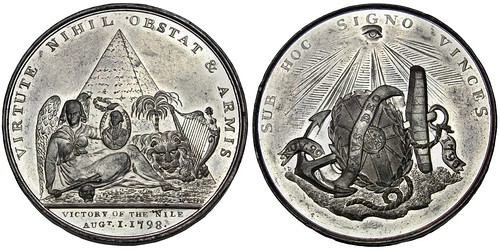
103277 | GREAT BRITAIN. Battle of the Nile white metal Medal. Issued 1798 (38mm, 22.81 g, 12h). By William Wyon, Sr.
VIRTUTE NIHIL OBSTAT & ARMIS (nothing can stand in the way of virtue and arms), angel reclining right, head facing slightly left, holding oval medallion of Horatio Nelson and cross; skull before; to right, reclining lion, harp, and palm tree; pyramid in background; in two lines in exergue, VICTORY OF THE NILE / AUGT I 1798 // SUB HOC SIGNO VINCES (under this sign you shall be victorious), radiant Eye of Providence over garlanded shield and anchor. Edge: Plain.
BHM 450; Eimer 892; Hardy 8; Julius 640. Choice Mint State. Highly brilliant and flashy, and excellent for the metal type. As such, very rare this attractive and appealing.
The Battle of the Nile, also known as the Battle of Aboukir Bay, was fought in the spacious bay near Alexandria between French and British naval forces. The latter, under the command of Vice-Admiral Horatio Nelson, pursued his French counterparts throughout the Mediterranean, finally encountering them at Aboukir Bay. The result was a very decisive British victory, serving as a power shift within the Mediterranean and a repelling of Napoléon's desired advances into British India.
To read the complete item description, see:
103277 | GREAT BRITAIN. Battle of the Nile white metal Medal.
(https://www.numismagram.com/product-page/103277)
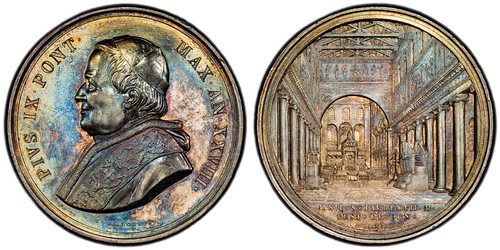
103273 | ITALY. Pope Pius IX/Basilica of San Lorenzo silver Medal. Issued Year XXVIII (1873/4). Commemorating the restoration of the Basilica (44mm, 34.43 g, 12h). By Giuseppi Bianchi at the Rome mint.
PIVS IX PONT MAX AN XXVIII, bust left, wearing zucchetto, mantum, and pallium // Interior view of the nave, from a vantage point to the left of center; in two lines in exergue, BASIL S LAVRENTII M / REST ET ORN. Edge: Plain.
Bartolotti E 873; Rinaldi 67. PCGS SP-62. Highly brilliant and most attractively toned a cosmic array of iridescence.
Architecture in general plays a heavy role in the medallic art of Pius IX, given the number of restorations done to religious edifices during his rather lengthy reign. He presided over the longest verified papal reign in history, serving as pope from 1846 to 1878, and also saw the loss of papal dominion over the states (parts of central mainland Italy) to which it laid claim for centuries. Following Italian unification under the King of Sardegna (Sardinia), Vittorio Emanuele II, the peninsula began to coalesce under a single regnum, leaving the rule of Pius in question. When Rome fell, then taking a new role as the capital of the Kingdom of Italy, Pius became trapped, literally and figuratively, and considered himself a prisoner in the Vatican—a standoff between the papacy and the kingdom that would last for nearly 60 years. In 1929, and brokered by then-Pope Pius XI and leader of the Fascist Party, Benito Mussolini, the Lateran Treaty ended the longstanding feud between the two factions over the sovereignty of the papacy within the kingdom. The treaty gave the Vatican City to the papacy—a separate city-state headed by the pope within the city of Rome itself—as well as compensation to the papacy by the Italian government for the loss of the territory within the papal states.
To read the complete item description, see:
103273 | ITALY. Pope Pius IX/Basilica of San Lorenzo silver Medal.
(https://www.numismagram.com/product-page/103273)
HERITAGE: GREAT BRITAIN SHOWCASE AUCTION
Heritage Auctions will be hosting their Great Britain Showcase Auction on December 8. Select items are discussed below. -Garrett

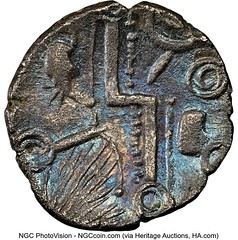
BRITAIN. Durotriges. Ca. 50 BC-AD 40. AR unit (13mm). NGC Choice VF. Badbury Rat type. 'Three men in a boat' design / Vertical thunderbolt and line of pellets across field; rodent-like object, two rings with annulets, and clamshell motif on each side. ABC 2214. Van Arsdell 1260. Fascinating lapis and aquamarine toning glimmers in the light.
From A Pugnus Maximus Collection by Mandy Farris Woods.
To read the complete item description, see:
BRITAIN. Durotriges. Ca. 50 BC-AD 40. AR unit (13mm). NGC Choice
VF.
(https://coins.ha.com/itm/ancients/celtic/celtic-britain-durotriges-ca-50-bc-ad-40-ar-unit-13mm-ngc-choice-vf/a/61575-25001.s?ctrack=200071&type=featured-1-coinus-news-tem120225)

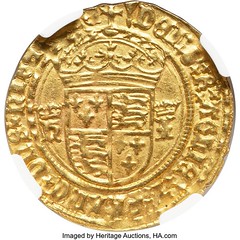
Henry VIII (1509-1547) gold Crown of the Double Rose ND (1536-1537) MS61 NGC, Tower mint, Arrow mm, S-2279, N-1790. Bearing a crowned I on the reverse denoting Jane Seymour, Henry's wife from 1536-1537 who died giving birth to the later Edward VI. Boldly rendered from aged dies, which exhibit some cracking and strong polish lines. The planchet is lemon-gold and untoned, amongst the finest of this rare type available to collectors.
To read the complete item description, see:
Henry VIII (1509-1547) gold Crown of the Double Rose ND
(1536-1537) MS61 NGC,
(https://coins.ha.com/itm/great-britain/great-britain-henry-viii-1509-1547-gold-crown-of-the-double-rose-nd-1536-1537-ms61-ngc-/a/61575-25031.s?ctrack=200071&type=featured-2-coinus-news-tem120225)


Henry VIII (1509-1547) Testoon ND (1544-1547) AU53 NGC, Southwark mint, S mintmark, Third Coinage, S-2367. 7.74gm. Rare Testoon type with strong portrait doubling, making for great dynamism on the flan. Tied with the Abbeygate just shy of the highest grade at NGC.
Ex. Parkinson Collection; Alfred Leonard Fuller Collection
To read the complete item description, see:
Henry VIII (1509-1547) Testoon ND (1544-1547) AU53 NGC,
(https://coins.ha.com/itm/great-britain/great-britain-henry-viii-1509-1547-testoon-nd-1544-1547-au53-ngc-/a/61575-25030.s?ctrack=200071&type=featured-3-coinus-news-tem120225)


Charles I Octagonal Pontefract Siege Shilling 1648 VF35 PCGS, KM381, S-3148. Incredible relic from the English Civil War and a type that we see all too rarely, last in this octagonal shape in 2007. The obverse and reverse testify to King Charles' desperate situation before his capture, trial, and execution in January 1649. Here, the obverse reads DVM SPIRO SPERO ("Whilst I live, I hope"), while the reverse shows a crude depiction of his safehouse Pontefract Castle with "OBS" for "besieged" vertically to the left. Perhaps the most historically significant piece in this auction.
Pontefract Castle holds a special place in English history as a strategic site during the War of the Roses and as the scene of imprisonment and probable murder of Richard II. Royalist forces trapped inside the castle during the English Civil War cast hand-made dies in order to strike coinage for the king's troops. Usually crude, these coins were struck in irregular shapes and sizes, including lozenge and octagonal. In 1649, after driving out the Royalists, Oliver Cromwell ordered the Castle to be demolished.
To read the complete item description, see:
Charles I Octagonal Pontefract Siege Shilling 1648 VF35
PCGS,
(https://coins.ha.com/itm/great-britain/great-britain-charles-i-octagonal-pontefract-siege-shilling-1648-vf35-pcgs-/a/61575-25041.s?ctrack=200071&type=featured-4-coinus-news-tem120225)
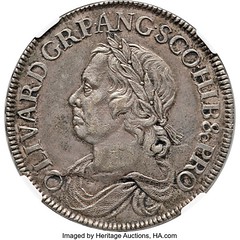
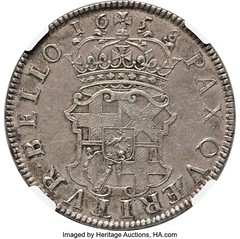
Oliver Cromwell Crown ND (1658/1657) AU58 NGC, KM-D207, S-3226, ESC-240 (prev. ESC-10). By Thomas Simon. The first Crown produced by England utilizing the screw press, the issue's historical significance and offered grade make it a highly sought-after addition to a collection.
To read the complete item description, see:
Oliver Cromwell Crown ND (1658/1657) AU58 NGC,
(https://coins.ha.com/itm/great-britain/great-britain-oliver-cromwell-crown-nd-1658-1657-au58-ngc-/a/61575-25043.s?ctrack=200071&type=featured-5-coinus-news-tem120225)

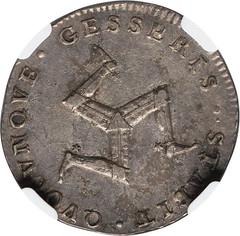
British Dependency. James Stanley silver Pattern 1/2 Penny 1723 AU53 NGC, KM-Pn10, Prid-26. By William Wood, with engrailed edge. An exceedingly rare issue, struck as a form of unofficial coinage under a local partnership, which leased the Isle of Man's customs from the Earl of Derby in 1721 for a fixed yearly sum. Beautiful caramel toning in the crevices. Incredibly challenging condition for the type, more often appearing holed and with qualifiers.
To read the complete item description, see:
British Dependency. James Stanley silver Pattern 1/2 Penny 1723
AU53 NGC,
(https://coins.ha.com/itm/isle-of-man/isle-of-man-british-dependency-james-stanley-silver-pattern-1-2-penny-1723-au53-ngc-/a/61575-25245.s?ctrack=200071&type=featured-6-coinus-news-tem120225)
THE BOOK BAZARRE
SOVEREIGN RARITIES AUCTION XX
Sovereign Rarities will be selling Auction XX on December 10, with British coins from the earliest coinage up to Charles III, in partnership with the Royal Mint. More select items are discussed below. -Garrett

Charles III (2022- ), Charles III (2022- ), gold proof One Ounce of One Hundred Pounds, 2025, The Two Georges, One Ounce of 999.9 fine gold, design by Bella Biggs to commemorate the start of the American Revolutionary War, head left, CHARLES. III. D. G. REX. F. D. 100 POUNDS. 2025, effigy by Martin Jennings,rev. images of George III and George Washington, facing each other in two frames, either side of a scrolling flourish 'OUR LIVES, OUR FORTUNES AND OUR SACRED HONOR' a phrase from the Declaration of Independence surrounding, 31.21g.Immaculate proof state, slabbed and graded by NGC as PF70 Ultra Cameo, First Day of Issue.
To read the complete item description, see:
Charles III (2022- ),
(https://auctions.sovr.co.uk/index.php?option=com_timed_auction&view=lot_detail&auction_id=30&lot_id=759498)

Elizabeth II (1952-2023), Elizabeth II (1952-2023), gold 10-coin proof Set, 2022, to commemorate The Platinum Jubilee of Queen Elizabeth II, comprised Bimetallic Britannia Two Pounds, Nations of the Crown One Pound, Platinum Jubilee 50p, Platinum Jubilee Five Pounds Crown, circulation Fifty Pence, Twenty Pence, Ten Pence, Five Pence, Two Pence, One Penny each bearing a segment of the royal arms, 136.76 (S.PGCS41). Proof state with light toning to Five Pounds and haze to Ten Pence, a very pleasing and rare set, accompanied by Royal Mint box and Certificate of Authenticity #02.
To read the complete item description, see:
Elizabeth II (1952-20223),
(https://auctions.sovr.co.uk/index.php?option=com_timed_auction&view=lot_detail&auction_id=30&lot_id=759551)
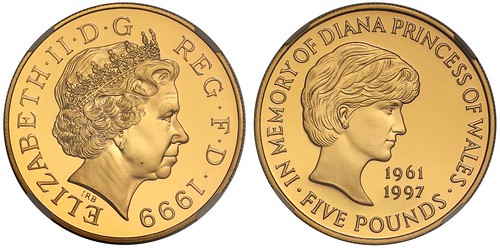
Elizabeth II (1952-2022), Elizabeth II (1952-2022), gold proof Five Pounds, 1999, Diana Princess of Wales Memorial, crowned head right, IRB initials below for designer Ian Rank Broadley, Latin legend surrounding ELIZABETH. II. D. G REG. F. D. 1999., rev. design by David Cornell, a portrait of Diana, Princess of Wales, with the dates '1961' and '1997', the circumscription 'IN MEMORY OF DIANA PRINCESS OF WALES' and the value of 'FIVE POUNDS', 39.94g (S.L6). Slabbed and graded by NGC as PF68 Ultra Cameo.
To read the complete item description, see:
Elizabeth II (1952-2022),
(https://auctions.sovr.co.uk/index.php?option=com_timed_auction&view=lot_detail&auction_id=30&lot_id=759506)

Elizabeth II (1952-2022), Elizabeth II (1952-2022), gold proof Five Pounds, 2016, 90th Birthday of Her Majesty the Queen, crowned head right, J.C initials below neck for designer Jody Clark, ELIZABETH II. D. G. REG. F. D. 5 POUNDS. 2016, rev. crowned Royal Cypher above the number '90' encircled by roses with the edge inscription 'FULL OF HONOUR AND YEARS', CJH to right for designer Christopher Hobbs (S.L44). Trial of the Pyx usual handling and test marks as for all Trial of the Pyx specimens, with booklet from The Goldsmith Company.
To read the complete item description, see:
Elizabeth II (1952-2022),
(https://auctions.sovr.co.uk/index.php?option=com_timed_auction&view=lot_detail&auction_id=30&lot_id=759556)

Elizabeth II (1952-2022), Elizabeth II (1952-2022), gold proof Fifty Pence, 2009, 250thAnniversary of the foundation of the Royal Botanical Gardens in Kew, crowned bust right, IRB below truncation for designer Ian Rank-Broadley, Latin legend surrounding, ELIZABETH. II. D. G REG. F. D. FIFTY PENCE,rev. design by Christopher Le Brun, Kew pagoda encircled by a vine, dates 1759 and 2009 either side, Kew at the base of the pagoda, 15.50g (S.H19).Slabbed and graded by NGC as PF70 UCAM.
To read the complete item description, see:
Elizabeth II (1952-2022),
(https://auctions.sovr.co.uk/index.php?option=com_timed_auction&view=lot_detail&auction_id=30&lot_id=759347)


Elizabeth II (1952-2022), Elizabeth II (1952-2022), gold proof Piedfort Fifty Pence 5-coin Set, 2019, celebrating Fifty Years of the Fifty Pence. This Set comprises five gold proof Fifty Pence coins, each with a military connection: 50th Anniversary of the Normandy Landings on D-Day, 150th Anniversary of the Institution of the Victoria Cross with depiction of the medal, 150th Anniversary of the Institution of the Victoria Cross with depiction of a soldier carrying a comrade, 75th Anniversary of the Battle of Britain, 950thAnniversary of the Battle of Hastings, each weighing 31g (S.PGCS35). Fully struck and lustrous with some handling marks, accompanied by Royal Mint box and Certificate of authenticity.
To read the complete item description, see:
Elizabeth II (1952-2022),
(https://auctions.sovr.co.uk/index.php?option=com_timed_auction&view=lot_detail&auction_id=30&lot_id=759523)

Elizabeth II (1952-2022), Elizabeth II (1952-2022), gold proof piedfort Fifty Pence 5-coin Set, 2019, celebrating British Culture. This Set comprises five gold proof piedfort Fifty Pence coins, each with a Jody Clark obverse and reverse designs from previously issued commemoratives and all dated 2019: Britannia, 1st sub Four Minute Mile, Boy Scout Movement, Girl Guide Movement, Kew gardens, each weighing 31g (S.PGCS33). Proof state with haze to all coins accompanied by original Royal Mint box and Certificate of Authenticity.
To read the complete item description, see:
Elizabeth II (1952-2022),
(https://auctions.sovr.co.uk/index.php?option=com_timed_auction&view=lot_detail&auction_id=30&lot_id=759524)

Elizabeth II (1952-2022), Elizabeth II (1952-2022), gold proof piedfort Fifty Pence, 2020, Characters from A.A. Milne 'Winnie the Pooh' books, crowned head right by designer Jody Clark, Latin legend and toothed border surrounding, ELIZABETH II. D. G. REG. F. D. 50 PENCE. 2020,rev.design by the Walt Disney Company, Winnie the Pooh with a jar of honey and honeybee, 31.00g (S.H87). Proof state accompanied by original Royal Mint box and Certificate of Authenticity.
To read the complete item description, see:
Elizabeth II (1952-2022),
(https://auctions.sovr.co.uk/index.php?option=com_timed_auction&view=lot_detail&auction_id=30&lot_id=759406)

Elizabeth II (1952-2022), Elizabeth II (1952-2022), gold proof piedfort Fifty Pence, 2021, Characters from A.A. Milne 'Winnie the Pooh' books, crowned head right by designer Jody Clark, Latin legend and toothed border surrounding, ELIZABETH II. D. G. REG. F. D. 50 PENCE. 2021,rev.design by the Walt Disney Company, Tigger, 31.00g (S.H102).Proof state with haze in fields, accompanied by original Royal Mint box and Certificate of Authenticity.
To read the complete item description, see:
Elizabeth II (1952-2022),
(https://auctions.sovr.co.uk/index.php?option=com_timed_auction&view=lot_detail&auction_id=30&lot_id=759407)

German East Africa German East Africa, gold 15-Rupien, 1916-T, Tabora mint, elephant advancing right, rev. DEUTSCH OSTAFRIKA 15 RUPIEN, displayed eagle, arabesque ending under first A of OSTAFRIKA, 7.24g, 12h (KM 16.2; Friedberg 1). Extremely fine.
To read the complete item description, see:
German East Africa
(https://auctions.sovr.co.uk/index.php?option=com_timed_auction&view=lot_detail&auction_id=30&lot_id=759554)

India, British India, East India Company, Victoria (1837-1901), India, British India, East India Company, Victoria (1837-1901), gold Mohur, 1841 (c), divided legend, VICTORIA QUEEN, head left, W.W. on truncation, crossbar of 4 without serif, rev. EAST INDIA COMPANY, lion standing left, palm behind, ONE MOHUR and ??? ????? (yek ashrafi - one Ashrafi) in exergue, 11.64g (SW 3.7; Pridmore 22). Edge filed at 7 o'clock, otherwise good very fine.
To read the complete item description, see:
India, British India, East India Company, Victoria (1837-1901),
(https://auctions.sovr.co.uk/index.php?option=com_timed_auction&view=lot_detail&auction_id=30&lot_id=759485)

India, British India, uniform series, Victoria (1837-1901), India, British India, uniform series, Victoria (1837-1901), gold Mohur, 1882C, VICTORIA EMPRESS, youthful bust left, V on groundline, rev. ONE MOHUR INDIA 1882, within ornate border, C privy mark, 11.65g (SW 6.11; Pridmore 19). Good very fine.
To read the complete item description, see:
India, British India, uniform series, Victoria (1837-1901),
(https://auctions.sovr.co.uk/index.php?option=com_timed_auction&view=lot_detail&auction_id=30&lot_id=759486)
STACK'S BOWERS: ASIAN COINS
Stack's Bowers will be hosting their December 2025 Hong Kong Auction of Chinese, Asian & other foreign coins from December 12-15. Select items are discussed below. -Garrett


Impressive Mother Coin 10 Cash (t) CHINA. Qing Dynasty. Mother Coin or Pattern 10 Cash, ND (June 1853-February 1854). Board of Revenue Mint, Southern Branch. Emperor Wen Zong (Xian Feng). Graded 88 by Zhong Qian Ping Ji Grading Company. cf. Hartill-22.691 (for regular issue). Weight: 19.9 gms. Variety with Er bao and seven stroke bei. Nicely preserved and attractive, these special issues seldom appear on the market and should be considered VERY RARE and highly desirable. The characters are well-formed and easily read as would be expected for the issue with smooth fields. The surfaces display light brassy patina with richer coloration amongst the devices. Close inspection reveals minor deposits on both sides mentioned for accuracy. A heavily sought after type offering a pleasing appearance with much originality that is sure to catch the attention of many collectors.
Estimate: $15,000 - $20,000.
To read the complete item description, see:
Impressive Mother Coin 10 Cash
(https://auctions.stacksbowers.com/lots/view/3-1OD7SK/t-china-qing-dynasty-mother-coin-or-pattern-10-cash-nd-june-1853-february-1854-board-of-revenue-mint-southern-branch-emperor-w)


CHINA. Hunan. Dollar, Year 11 (1922). Changsha Mint. NGC MS-64. L&M-867; K-763; KM-Y-404; WS-0930. "Hunan Provincial Constitution" type, struck to commemorate the promulgation of the document. A popular and RARE type within the provincial series, this issue also remains popular with collectors of Republican-era issues, and was struck to commemorate the provincial constitution in Hunan. Very lustrous and sharply struck, with a mostly argent nature and little toning throughout, though some hints of almond are noted for subtle character.
Estimate: $40,000 - $60,000.
To read the complete item description, see:
CHINA. Hunan. Dollar, Year 11 (1922). Changsha Mint. NGC MS-64.
(https://auctions.stacksbowers.com/lots/view/3-1ODAPA/china-hunan-dollar-year-11-1922-changsha-mint-ngc-ms-64)
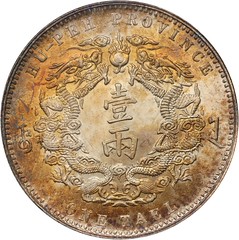

Breathtaking near-Gem Hupeh Tael (t) CHINA. Hupeh. Tael, Year 30 (1904). Wuchang Mint. Kuang-hsu (Guangxu). PCGS MS-64. L&M-180; K-933; KM-Y-128.2; WS-0878. Small characters variety. An elite example of this legendary Chinese crown, whose failure in commerce has made it one of the most celebrated RARITIES in the series. While Mint State examples do appear with some frequency, a near-Gem of this caliber is a true prize. The beautiful design is rendered with striking clarity and enveloped by velvety luster, all beneath a captivating veil of burnt amber tone. A landmark offering that is certain to attract the attention of collectors at the high-end of the market.
648,000 Hupeh Taels were originally minted, inclusive of both large and small characters types; however, it is unknown exactly how many of each were struck. This Tael was introduced as part of a projected coinage reform based upon the traditional Chinese weight standard, rather than the Dollar system. In the initial proposal to produce these coins, it was also suggested to produce smaller denominations in the values of 1, 2, and 5 Mace. However, no such pieces have surfaced (even in pattern form), and it is unlikely that they were ever produced. The general populace found it complicated to convert two distinctly different coinage systems, especially when making change, with this system being quickly abandoned.
To read the complete item description, see:
Breathtaking near-Gem Hupeh Tael
(https://auctions.stacksbowers.com/lots/view/3-1ODASN/t-china-hupeh-tael-year-30-1904-wuchang-mint-kuang-hsu-guangxu-pcgs-ms-64)


Enticing Off-Metal Pattern Striking with an American Connection (t) CHINA. Szechuan. Brass 3 Mace 6 Candareens (50 Cents) Pattern, ND (1898). New Jersey (Ferracute) Mint. Kuang-hsu (Guangxu). PCGS SPECIMEN-53. L&M-347 var. (silver); K-146Y; KM-Y-Pn13/Pn20; WS-0741 var. (same). A VERY RARE pattern issue in brass, this lightly circulated specimen striking was created by the Ferracute Machine Company in New Jersey. Presenting mostly olive-yellow hues, this example displays some scattered areas of red-brown, and exhibits only a light degree of gentle wear across the high points. For the advanced collector of the province, or of vintage trials and curiosities more broadly, this elevated and highly enticing specimen should generate great enthusiasm.
Estimate: $25,000 - $40,000.
To read the complete item description, see:
Enticing Off-Metal Pattern Striking with an American Connection
(https://auctions.stacksbowers.com/lots/view/3-1ODE7A/t-china-szechuan-brass-3-mace-6-candareens-50-cents-pattern-nd-1898-new-jersey-ferracute-mint-kuang-hsu-guangxu-pcgs-spe)
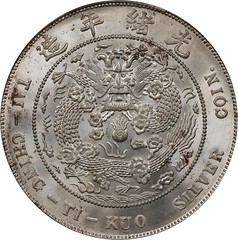
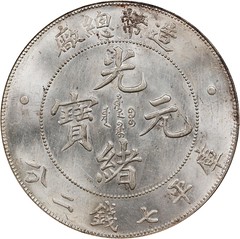
An Imperial "Dragon" Dollar of Staggering Quality (t) CHINA. 7 Mace 2 Candareens (Dollar), ND (1908). Tientsin Mint. Kuang-hsu (Guangxu). PCGS MS-63. L&M-11; K-216; KM-Y-14; WS-0029. Counted among the classic crowns of the Imperial Chinese series, this type is SCARCE in any Mint State grade, let alone as an astonishing Choice survivor like this example. The exceptional strike and lack of wear combine to give the coin a mesmerizing cartwheel luster that races around the needle-sharp design elements. Virtually devoid of tone, adding to its almost unbelievably mint-fresh appearance. This high-end beauty deserves a place as a highlight within an advanced collector's cabinet.
Estimate: $30,000 - $50,000.
To read the complete item description, see:
An Imperial "Dragon" Dollar of Staggering Quality
(https://auctions.stacksbowers.com/lots/view/3-1ODG9E/t-china-7-mace-2-candareens-dollar-nd-1908-tientsin-mint-kuang-hsu-guangxu-pcgs-ms-63)


(t) CHINA. Silver Dollar Pattern, ND (1914). Tientsin Mint. PCGS SPECIMEN-63. L&M-859; K-642A; KM-Pn28; Hsu-15; Wenchao-(rarity: ???). Variety with "L. GIORGI" signature. One of the loftier representatives of this VERY RARE type that one will encounter, the present crown offers exceptional lustrous radiance and alluring brilliance among the fields, all while some frosting imparted unto the portrait allows for a tantalizing cameo contrast. Meanwhile, some tinges of burnished toning are present nearer the peripheries, enveloping the opulent flair that is abundantly obvious throughout. For the connoisseur of patterns of the Republican era or colossal RARITIES among the vintage Chinese series, this Choice specimen should no doubt thoroughly excite.
Estimate: $100,000 - $150,000.
To read the complete item description, see:
(t) CHINA. Silver Dollar Pattern, ND (1914). Tientsin Mint. PCGS SPECIMEN-63.
(https://auctions.stacksbowers.com/lots/view/3-1ODI1P/t-china-silver-dollar-pattern-nd-1914-tientsin-mint-pcgs-specimen-63)
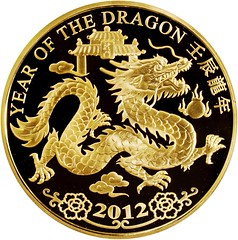

(t) HONG KONG (SAR). Year of the Dragon Gold Medal (5 Ounces), 2012. Llantrisant Mint. GEM PROOF. AGW: 5.0 oz. Mintage: 150. Comes with original box and certificate of authenticity # 018.
Estimate: $20,000 - $30,000.
To read the complete item description, see:
(t) HONG KONG (SAR). Year of the Dragon Gold Medal (5 Ounces), 2012. Llantrisant Mint. GEM PROOF.
(https://auctions.stacksbowers.com/lots/view/3-1ODOS8/t-hong-kong-sar-year-of-the-dragon-gold-medal-5-ounces-2012-llantrisant-mint-gem-proof)


ANNAM. 5 Tien, ND (1848-83). Tu Duc. PCGS MS-62. KM-458; Sch-372.1. Obverse: "Long Van", facing dragon in clouds around; Reverse: "Tu Duc Thong Bao". A simply gorgeous example of this charming draconic type, offered in shimmering Mint State preservation with rich luster and hints of burnt orange toning about the peripheries. Struck with enviable precision, the design deeply impressed and bearing no trace of wear.
Estimate: $8,000 - $12,000.
To read the complete item description, see:
ANNAM. 5 Tien, ND (1848-83). Tu Duc. PCGS MS-62.
(https://auctions.stacksbowers.com/lots/view/3-1ODPAC/annam-5-tien-nd-1848-83-tu-duc-pcgs-ms-62)

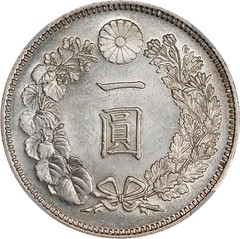
JAPAN. Yen, Year 7 (1874). Osaka Mint. Mutsuhito (Meiji). NGC MS-63. KM-Y-A25.2; JNDA-01-10; JC-09-10-1. Variety with counter-clockwise spiral. A RARE date that also stands as a KEY to the series, this Choice crown glistens with exceptional cartwheel brilliance and vibrant luster. The strike is captivating and sharp, and there is very little in the way of toning or color to mention. No doubt one of the finest of the year that one can hope to encounter, and the finest observed in the NGC census.
Estimate: $10,000 - $15,000.
To read the complete item description, see:
JAPAN. Yen, Year 7 (1874). Osaka Mint. Mutsuhito (Meiji). NGC MS-63.
(https://auctions.stacksbowers.com/lots/view/3-1ODZIZ/japan-yen-year-7-1874-osaka-mint-mutsuhito-meiji-ngc-ms-63)
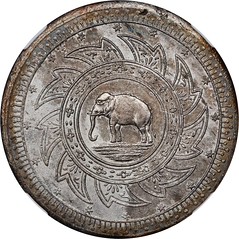
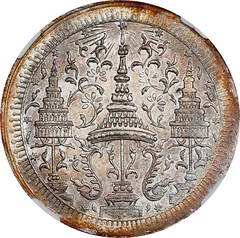
THAILAND. 2 Baht (1/2 Tamlung), ND (1863). Bangkok Mint. Rama IV. NGC MS-61. Dav-308; KM-Y-12. An enchanting Mint State example of this popular crown sized issue. With steel gray surfaces and a delightful toning in some areas, this piece is rather stunning in hand.
Estimate: $4,000 - $6,000.
To read the complete item description, see:
THAILAND. 2 Baht (1/2 Tamlung), ND (1863). Bangkok Mint. Rama IV. NGC MS-61.
(https://auctions.stacksbowers.com/lots/view/3-1OE6KH/thailand-2-baht-12-tamlung-nd-1863-bangkok-mint-rama-iv-ngc-ms-61)
STACK'S BOWERS: DECEMBER 2025 HONG KONG AUCTION
Stack's Bowers will be hosting their December 2025 Hong Kong Auction of world paper money from December 12-15. Select items are discussed below. -Garrett
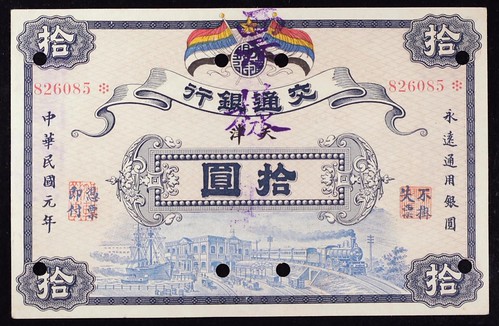

(t) CHINA--REPUBLIC. Bank of Communication. 10 Dollars, 1912. P-108c. Expedient Specimen. PMG About Uncirculated 55. Tientsin. An extremely rare Year 1 (1912) 'Crossed Five Colour Flags' 10 Dollar specimen on serial number 826085.
This is the first issue by the Bank in the Republic of China era and is instantly recognsiable by the design elements including the crossed Five Colour Flags and vignette of a steam locomotive passing by a busy dockside.
Although notes from Year 2 are occasionally and Year 3 quite frequently encountered, Year 1 notes are, with the exception of Yingkow branches, extremely rare, let alone a high denomination such as a 10 Dollar. The total PMG population from this note stands at three, and this the SOLE TOP POP note. An exceptional note not to be missed! PMG Comments "Cancelled".
Estimate: $10,000 - $15,000.
To read the complete item description, see:
(t) CHINA--REPUBLIC. Bank of Communication. 10 Dollars, 1912. P-108c. Expedient Specimen. PMG About Uncirculated 55.
(https://auctions.stacksbowers.com/lots/view/3-1OIL61/t-china-republic-bank-of-communication-10-dollars-1912-p-108c-expedient-specimen-pmg-about-uncirculated-55)


CHINA--FOREIGN BANKS. Hong Kong & Shanghai Banking Corporation. 5 Dollars, 1.9.1922. P-S316cts. S/M#Y13. Color Trial Specimen. PMG Choice About Uncirculated 58. Chefoo. Printed by TDLR. Cancelled perforated. A visually striking note, offering bold colours which are quite different from those found on the issued note. Arms are depicted at the left, while a woman making lace is shown at the right. Dark green "5" underprint below the central written denomination. The bank name is encased within a light blue ink, while the rest of the design is in a dark and light brown colour. The two bank buildings are on the reverse (Hong Kong and Shanghai). The back showcases intricate lathe work in dark brown ink. Counters are in each corner. One of just five examples graded by PMG. PMG Comments "Previously Mounted."
Estimate: $3,000 - $5,000.
To read the complete item description, see:
CHINA--FOREIGN BANKS. Hong Kong & Shanghai Banking Corporation. 5 Dollars, 1.9.1922. P-S316cts. S/M#Y13. Color Trial Specimen. PMG Choice About Uncirculated 58.
(https://auctions.stacksbowers.com/lots/view/3-1OILGA/china-foreign-banks-hong-kong-shanghai-banking-corporation-5-dollars-191922-p-s316cts-smy13-color-trial-specimen-pmg-choic)

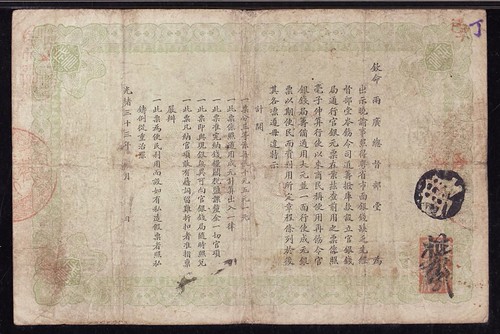
CHINA--EMPIRE. Kwangtung Currency Bureau. 5 Mexican Dollars, 1907. P-S2390. PMG Choice Fine 15. Shanghai. A phenomenal offering of a 5 Mexican Dollar note issued by the Kwangtung Currency Bureau in the waning years of the Qing Dynasty.
Printed by PYOG, in black on light green, it shows the typical design of facing dragons, Kwangtung silver dollars and a Chinese mansion on the obverse. The Chinese characters 'Shang Hai' and 'Ying Yuan' (Eagle Dollars, i.e. Mexican Dollars) are found near the lower border. The note has seen circulation but is completely original and untampered.
The is one of the great classical rarities from the Qing era and no more than three notes are thought to be extant, despite its total PMG population of two at the time of cataloguing. Here is the chance to acquire this phenomenal piece for your collection.
Estimate: $25,000 - $30,000.
To read the complete item description, see:
CHINA--EMPIRE. Kwangtung Currency Bureau. 5 Mexican Dollars, 1907. P-S2390. PMG Choice Fine 15.
(https://auctions.stacksbowers.com/lots/view/3-1OILK8/china-empire-kwangtung-currency-bureau-5-mexican-dollars-1907-p-s2390-pmg-choice-fine-15)
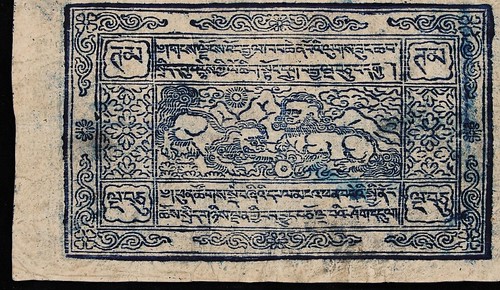
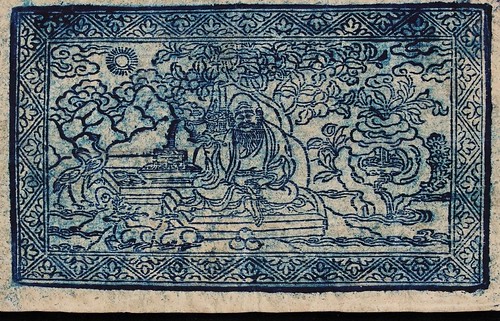
CHINA--TIBET. Local Government of Tibet. 50 Tam, ND (1913). P-5r. Remainder. PMG Very Fine 25. A phenomenal offering of the highest denomination from the first Tibetan issue, believed to be the only note known without seals and serial numbers. Wood block printing in deep blue, the obverse features two facing lions playing with a ball against a mountainous background. The reverse shows a venerable elderly man sitting under a tree with two cranes and two deer beside him.
Early Tibetan notes from this period, except for the 5 Tam, are all rare to extremely rare. The 50 Tam is the highest denomination of the series and considered rare. In fact, PMG has only graded four issued examples of the blue colour variety and just one example of this 'remainder' type.
Regardless of whether this note was intended as a proof, remainder or an error note without the seals or serial numbers, it is hitherto unique and an exciting note for the Tibetan specialist. Not to be missed. PMG Comments "Ink Rub."
Estimate: $7,000 - $10,000.
To read the complete item description, see:
CHINA--TIBET. Local Government of Tibet. 50 Tam, ND (1913). P-5r. Remainder. PMG Very Fine 25.
(https://auctions.stacksbowers.com/lots/view/3-1OILLK/china-tibet-local-government-of-tibet-50-tam-nd-1913-p-5r-remainder-pmg-very-fine-25)

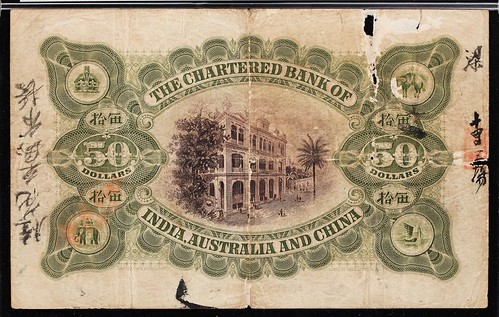
HONG KONG (SAR). Chartered Bank of India, Australia & China. 50 Dollars, 1.5.1924. P-44. KNB29. PMG Very Fine 20. A splendid offering of the iconic 'Gourd 50 Dollars, so called due to the shape of its central vignette, issued between 1912 and 1929.
Brightly coloured in orange and green, with the printed signature of Fergusson at lower right and a deep and neat hand drawn signature at lower left. Some minor paper damage that is mostly outside of the printed design and a couple of light annotations on the reverse. Otherwise a great looking note with good retention of is original colours. An iconic and rare note that is missing in many advanced collections of Hong Kong paper money. PMG Comments "Paper Damage."
Estimate: $30,000 - $45,000.
To read the complete item description, see:
HONG KONG (SAR). Chartered Bank of India, Australia & China. 50 Dollars, 1.5.1924. P-44. KNB29. PMG Very Fine 20.
(https://auctions.stacksbowers.com/lots/view/3-1OILWE/hong-kong-sar-chartered-bank-of-india-australia-china-50-dollars-151924-p-44-knb29-pmg-very-fine-20)


HONG KONG (SAR). Chartered Bank of India, Australia, & China. 50 Dollars, 1.7.1931. P-56. KNB36a. PMG Very Fine 25. Serial number U/H 005723. Brown and black on light blue, male Roman soldier at left, watermark area at right, a large and clear hand-signed signature at lower left, reverse brown, rice harvesting scene and pagoda at right.
A nice, first date of issue 50 Dollars from the 'Roman' series. With the note largely retaining its original colours and details, expert minor repair and a few brush pen annotations are all there is to report. Given the immense popularity of this note, it will be closely watched and attract strong interest on the day of the live sale. PMG Comments "Minor Repair."
Estimate: $15,000 - $20,000.
To read the complete item description, see:
HONG KONG (SAR). Chartered Bank of India, Australia, & China. 50 Dollars, 1.7.1931. P-56. KNB36a. PMG Very Fine 25.
(https://auctions.stacksbowers.com/lots/view/3-1OILX1/hong-kong-sar-chartered-bank-of-india-australia-china-50-dollars-171931-p-56-knb36a-pmg-very-fine-25)


HONG KONG (SAR). Hong Kong & Shanghai Banking Corporation. 50 Dollars, 1.1.1923. P-168s. KNB56S. Specimen. PMG About Uncirculated 55. Excellent offering of the 'Apollo' 50 Dollars issued by HSBC from 1921 to 1923.
Coloured in rich purple and black on a light green underprint, together with the classic bust of Apollo at centre, this combination results in a distinctive and iconic design that is instantly recognisable. Issued notes bearing both dates exist and are all extremely rare given its short issue life owing to severe counterfeiting problems. The total PMG population for issued notes is only four. Specimens are slightly more available but still only has a total PMG population of twelve.
Missing in many collections advanced Hong Kong paper money, here is the chance to acquire a specimen to help you complete you collection! PMG Comments "Pinholes, Rust."
Estimate: $20,000 - $30,000.
To read the complete item description, see:
HONG KONG (SAR). Hong Kong & Shanghai Banking Corporation. 50 Dollars, 1.1.1923. P-168s. KNB56S. Specimen. PMG About Uncirculated 55.
(https://auctions.stacksbowers.com/lots/view/3-1OIM38/hong-kong-sar-hong-kong-shanghai-banking-corporation-50-dollars-111923-p-168s-knb56s-specimen-pmg-about-uncirculated-55)


JAPAN. Great Imperial Japanese Government. 5 Yen, 1880 (ND 1882). P-18. PMG Choice Very Fine 35. Block 23. A highly scarce Five Yen denomination on this Empress Jingu series and one of just a scant few we have handled. Pleasing mid-grade appeal and as such is bested by only 2 examples on the PMG census. A truly significant opportunity for the serious collector of Japanese rarities.
Estimate: $2,000 - $3,000.
To read the complete item description, see:
JAPAN. Great Imperial Japanese Government. 5 Yen, 1880 (ND 1882). P-18. PMG Choice Very Fine 35.
(https://auctions.stacksbowers.com/lots/view/3-1OIMTJ/japan-great-imperial-japanese-government-5-yen-1880-nd-1882-p-18-pmg-choice-very-fine-35)


STRAITS SETTLEMENTS. Government of the Straits Settlements. 5 Dollars, 1.1.1925. P-10a. KNB18a. PMG Very Fine 30. Much nicer than typically seen for this popular and quintessential type of the Straits Settlements. Entirely problem-free, with lovely green colors and both sides, and no heavy or distracting folds that break the paper. While their may be numerically higher-graded examples in the PMG population report, we suspect many come with problems such as stains, foxing, or rust, but this note is entirely problem-free and an excellent representative for the type.
Estimate: $3,000 - $5,000.
To read the complete item description, see:
STRAITS SETTLEMENTS. Government of the Straits Settlements. 5 Dollars, 1.1.1925. P-10a. KNB18a. PMG Very Fine 30.
(https://auctions.stacksbowers.com/lots/view/3-1OIN6G/straits-settlements-government-of-the-straits-settlements-5-dollars-111925-p-10a-knb18a-pmg-very-fine-30)
ROMAN-ERA COINS UNEARTHED IN FRENCH VILLAGE
An interesting household cache of Roman coins has been uncovered in France. -Editor

Archaeologists in France have discovered three ancient storage jars brimming with tens of thousands of Roman coins. The vessels were buried in pits 1,700 years ago in the house floor of an ancient settlement, possibly as a type of safe or piggy bank.
These three jugs, known as amphorae, were uncovered during excavations run by the National Institute for Preventive Archaeological Research (INRAP) in the village of Senon in northeastern France, and may contain a total of more than 40,000 Roman coins.
The first hoard held an estimated 83 pounds (38 kilograms) of coins, which "corresponds to approximately 23,000 to 24,000 coins," Vincent Geneviève, a numismatist with INRAP who is analyzing the hoards, told Live Science in an email.
The second jug and its coins weighed about 110 pounds (50 kg), "and, based on the 400 coins recovered from the neck, which was broken at the time of discovery, it could contain 18,000 to 19,000 coins," Geneviève said. The third jug was retrieved in ancient times and only three coins were left in the pit where the vessel once sat.
Among the hoard are coins that feature busts of the emperors Victorinus, Tetricus I, and his son Tetricus II, the emperors of the so-called Gallic Empire, which ruled Gaul and the surrounding provinces independently of the rest of the Roman Empire from 260 to 274, until it was reintegrated by emperor Aurelian in 274.
The coin-stuffed amphoras had been carefully sunk into well-constructed pits within the living room of a residence. The jugs' openings were level with the ground and therefore easily accessible as a kind of ancient piggy-bank.
The accessible jars suggest the owners were using them as a long-term savings vehicle rather than a hastily hidden hoard.
To read the complete article, see:
1,800-year-old 'piggy banks' full of Roman-era coins unearthed in French village
(https://www.livescience.com/archaeology/romans/1-800-year-old-piggy-banks-full-of-roman-era-coins-unearthed-in-french-village)
KEN MARACLE, MODERN WAMPUM MAKER
The art of wampum-making lives on with Ken Maracle, who was profiled recently in the New York Times. Here's an excerpt - see the complete article online. -Editor

The license plate on the Jeep Cherokee reads WAMPUM.
And the man who owns it — Ken Maracle, who also goes by his Cayuga name, Haohyoh — is widely acknowledged to be one of the premiere practitioners of the centuries-old craft of creating wampum, strips with geometric patterns woven in purple and white beads.
 While there is a common misconception that wampum was Indian money, it primarily was used in the negotiation and confirmation of agreements among Indian nations and between them and colonial authorities. Mr. Maracle's belts are close copies of those traditionally created in the Great Lakes region.
"We taught your ancestors diplomacy," Mr. Maracle said during an interview at his studio on Manitoulin, an island just off the Canadian coast of Lake Huron. He has spent nearly 40 years creating belts that now are owned by collectors and museums such as the National Museum of the American Indian in Washington and the Canadian Museum of History in Gatineau, Quebec.
On his worktable were two purple-and-white quahog clam shells from Long Island near New York City, the traditional source of the hard shells used for purple and white wampum beads. Mr. Maracle still uses quahog beads for important commissions, but he also has purple and white glass beads, separated on two paper plates in his studio, for more everyday creations.
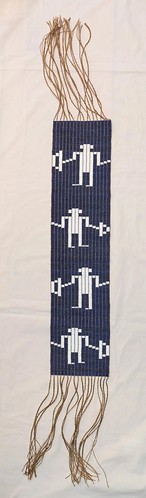 He sat down at his worktable in front of a homemade loom: 11 strings of a synthetic version of deer sinew that had been stretched taut between two bits of blond wood and clamped to the table with a vice.
"It's a friendship belt," he said, referring to the glass-bead piece that was about halfway done.
At the left end of the loom was a blocky human figure connected to a purple line that, once Mr. Maracle wove some more, would reach another human figure at the opposite end. Belts can be as long as seven feet and as wide as two feet, but this one, he said, would be about 23 inches long and 3.5 inches wide when it was completed.
A large belt with a complicated pattern can take as many as 90 hours of focused work, he said, and may involve as many as 13,000 beads. Mr. Maracle said the effort required could be exhausting.
There is one piece that wampum experts refer to as Mr. Maracle's masterwork: his interpretation of a belt whose formal name is the 1764 Covenant Chain Wampum Belt Delivered at Niagara by the British to the Western Nations. The original was made by artisans hired by British authorities, who presented it during peace negotiations with 2,000 representatives of 24 different Indigenous nations.
Mr. Maracle was commissioned by the Canadian Museum of History to recreate the piece, which had disappeared at some point in the historical record, so he had to rely on archival sketches and written descriptions. When he delivered the completed belt to the museum in 2016, Jonathan Lainey, a noted wampum expert, was working there.
Such belts, Mr. Lainey said in a recent interview, were often displayed during council meetings and exchanged when agreements were made — which was why the 2023 exhibition he curated at the McCord Stewart Museum in Montreal, where he now works, was titled, "Wampum: Beads of Diplomacy."
To read the complete article, see:
His Wampum Creations Help Keep a Centuries-Old Craft Alive
(https://www.nytimes.com/2025/10/27/fashion/craftsmanship-wampum-ken-maracle-ontario.html)
1715 FLEET: SCABBARD
The 1715 Fleet Society is a non-profit organization that is "dedicated to researching the history of the 1715 Fleet, its loss, rediscovery, and recovery." The 1715 fleet was part of the Spanish New World Treasure Fleets that funded Spain's activities as a world leader.
Each month the group highlights a "Treasure of the Month". December's treasure isn't numismatic, but is interesting nonetheless. Nice find. -Editor
 Our Treasure of the Month for December is this scabbard, which was found during the 2023 dive season by a subcontractor for 1715 Fleet-Queens Jewels, LLC.
This artifact measures approximately 7.6" long and 2.3" at its widest point. The scabbard itself is unique in that it is made of wood with silver adornments. The silver on the scabbard is engraved, as is the hand guard, which was also recovered with this piece. It is believed that there was a knife in the scabbard when it was lost, as ferrous material was found in the scabbard at the time of conservation. This supports the opinion that the knife blade was made of iron or steel and disintegrated after years of submersion.
Upon close inspection, a tiny thread can be found adhering to the back of the scabbard. This has led to the conclusion that the wood on the scabbard was covered with something, most likely leather, which would explain the remarkable state of preservation of the scabbard itself.
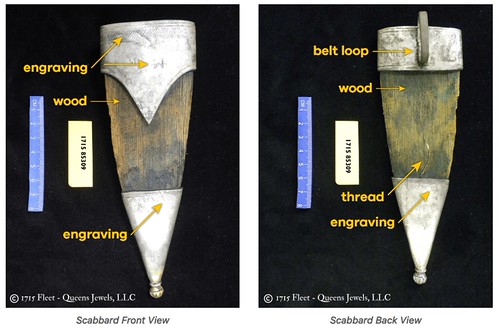
Wood does not take kindly to decades of exposure to seawater. So, another reason had to exist to explain why this artifact has survived in its current condition. This hypothesis was advanced by Sal Guttuso, Director of Operations for 1715 Fleet-Queens Jewels, LLC. His inspection of this artifact served as the basis for this determination.
But a more important question remains. Who would own such an item? Was this possibly the property of a sailor? Soldier? Passenger? What type of knife would this scabbard hold, and what could it be used for? Our research led us to believe that this scabbard might have held a trade knife, a favorite of Spanish sailors and soldiers at the time. Trade knives were cheap and readily available, so we believed that this artifact may indeed fall within that category. But all we had was a scabbard.
For a possible answer, we reached out to an expert in this field, Noel Wells. Noel authored "Small Arms of the Spanish Treasure Fleets". John Powell, a professor of history in St. Augustine, Florida, said this about the book: "This is a remarkable and quite original book about weaponry, well sourced and set into the framework of battle in the Spanish Main."
Noel was impressed with the artifact, especially how it was conserved. In his book (pages 84 and 85), there is a section dealing with trade knives. There, it is stated that trade knives were very plain, usually with no adornment. The quality of the steel used was good, but the materials used for the handle and pommel were generally basic.
While our featured treasure does not come with a knife, the scabbard does offer some clues as to who might have owned it and what type of knife it was.
Noel believed that the silver features on this scabbard suggested that it was not the property of a sailor or soldier. Although possible, it is more likely that this item was owned by an officer, or even a merchant or passenger. Also, the silver knife guard that was found with the piece lends support to this conclusion. Regardless, our featured artifact is truly a unique find.
This item was recovered by Grant Gitschlag, a diver for the MV Lilly May, a subcontractor of 1715 Fleet-Queens Jewels, LLC. The vessel was captained by Mike Penninger. The find occurred at the North Corrigan's/South Green Cabin Wreck site. The excellent conservation of this artifact was conducted by Mike Perna, who painstakingly worked to preserve the wood elements.
Special thanks to Sal Guttuso, Director of Operations for 1715 Fleet-Queens Jewels, LLC., who provided images and personal comments used in this text. Also, thanks to Noel Wells, who took the time to review our research and offer his opinions on our featured treasure, and allowed us to use information featured in his book.
To read the complete article, see:
December 2025 — Treasure of the Month
(https://1715fleetsociety.com/december-2025-treasure-of-the-month/)
ABOUT THIS ISSUE: DECEMBER 7, 2025
Let's see, how did this week go? We had our first snow and sub-freezing temperatures this week, but it was only a dusting. While Christmas shopping on Black Friday I'd decided to buy myself a present, too - a new laptop computer. It arrived this Friday and I picked it up at our local Best Buy while also doing some other gift shopping, which these days means frantically texting our daughter for advice.
Saturday we woke up to find a flat tire on my wife's van, and I ended up shuttling her back and forth getting that fixed. While waiting at the tire shop I got a nice call from Dave Hirt wishing us a happy holiday - he and his wife Emi were about to depart to spend the holidays in Budapest.
I had a little time to kill anyway, as our Flickr photo archive wouldn't let me upload new images for several hours. But I got back in business late Saturday afternoon. The issue came together as it always does, and I hope everyone enjoyed it. Thanks again to my assistant Garrett for his speedy work turning around lengthy image-rich articles. I enjoy these sale preview articles and their numismatic eye-candy. Quite often one of these great coins or medals becomes my choice for Image of the Week.
Finally, here are some interesting non-numismatic items I came across this week.
building a castle from scratch
(https://www.guedelon.fr/en/)
This gross habit could reduce your risk of alzheimer's by 37%, according to experts
(https://www.independent.co.uk/news/health/farts-alzheimers-health-benefits-b2878834.html)
Police recover $19k Fabergé egg swallowed by NZ man
(https://www.bbc.com/news/articles/cj4qedglzpwo)
-Editor


Editor Wayne Homren, Assistant Editor Garrett Ziss
Wayne Homren
Wayne Homren is the founding editor of The E-Sylum and a consultant for the Newman Numismatic Portal. His collecting interests at various times included U.S. Encased Postage Stamps, merchant counterstamps, Pittsburgh Obsolete paper money, Civil War tokens and scrip, Carnegie Hero Medals, charge coins and numismatic literature. He also collects and has given presentations on the work of Money Artist J.S.G. Boggs. In the non-numismatic world he's worked in artificial intelligence, data science, and as a Program Manager for the U.S. Department of Defense.
Garrett Ziss
Garrett Ziss is a numismatic collector and researcher, with a focus on American paper money and early U.S. silver and copper coins. He is also a part-time U.S. coin cataloger for Heritage Auctions. Garrett assists Editor Wayne Homren by editing and formatting a selection of articles and images each week. When he's not engaged in numismatics, Garrett is pursuing a Master's Degree in Quantitative Economics at the University of Pittsburgh.

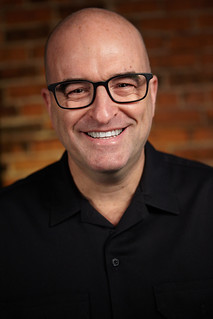
Contributors Pete Smith and Greg Bennick
Pete Smith
Numismatic researcher and author Pete Smith of Minnesota has written about early American coppers, Vermont coinage, numismatic literature, tokens and medals, the history of the U.S. Mint and much more. Author of American Numismatic Biographies, he contributes original articles to The E-Sylum often highlighting interesting figures in American numismatic history.
Greg Bennick
Greg Bennick (www.gregbennick.com) is a keynote speaker and long time coin collector with a focus on major mint error coins and US counterstamps. He is on the board of both CONECA and TAMS and enjoys having in-depth conversations with prominent numismatists from all areas of the hobby. Have ideas for other interviewees? Contact him anytime on the web or via instagram
@minterrors.


Website host John Nebel and webmaster Bruce Perdue
John Nebel
Numismatist, photographer, and ANS Board member and Fellow John Nebel of Boulder, CO helped the ANA and other clubs like NBS get online in the early days of the internet, hosting websites gratis through his Computer Systems Design Co. To this day he hosts some 50 ANA member club sites along with our
coinbooks.org site, making the club and our E-Sylum archive available to collectors and researchers worldwide.
Bruce Perdue
Encased coinage collector (encasedcoins.info) Bruce Perdue of Aurora, Illinois has been the volunteer NBS webmaster from its early days and works each week to add the latest E-Sylum issue to our archive and send out the email announcement.

|
|
The E-Sylum is an electronic publication of the Numismatic Bibliomania Society Copyright © 1998 - 2025 | |