Visit our NBS Sponsors











About UsThe Numismatic Bibliomania Society is a non-profit association devoted to the study and enjoyment of numismatic literature. For more information please see our web site at coinbooks.org SubscriptionsThose wishing to become new E-Sylum subscribers can go to the following web page
Subscribe
MembershipThere is a membership application available on the web site Membership Application To join, print the application and return it with your check to the address printed on the application. Print/Digital membership is $40 to addresses in the U.S., and $60 elsewhere. A digital-only membership is available for $25. For those without web access, write to: Jeff Dickerson, Treasurer AsylumFor Asylum mailing address changes and other membership questions, contact Jeff at this email address: treasurer@coinbooks.org SubmissionsTo submit items for publication in The E-Sylum, write to the Editor at this address: whomren@gmail.com 
BUY THE BOOK BEFORE THE COINSale Calendar
|
- WAYNE'S WORDS: THE E-SYLUM FEBRUARY 15, 2026
- KOLBE & FANNING SALE 176 HIGHLIGHTS
- NEW BOOK: PAPER CURRENCY OF HYDERABAD
- PERIODICAL: ORIENTAL NUMISMATIC SOCIETY WINTER 2025
- JOHN R. MELVILLE-JONES (1933–2026)
- JOSEPH ALI DOW (1940-2026)
- DR JOHN RAINEY MBE (1951-2026)
- NNP ADDS AMERICAN TAX TOKEN SOCIETY NEWSLETTERS
- VIDEO: 2016 EAC BOURSE CHAIRMAN JOHN KRALJEVICH
- 2026 TRIAL OF THE PYX HELD AT MANSION HOUSE
- MORE ON THE FIRST OLYMPIC MEDAL
- NOTES FROM E-SYLUM READERS: FEBRUARY 15, 2026
- MODEL DORIS BAUM AND KARL BITTER'S POMONA
- DICK JOHNSON AND NUMISMATIC LITERATURE
- OHIO WELCOMES ANS RELOCATION
- VOCABULARY TERM: SHAPE
- NUMISMATIST MIRRORS
- HERITAGE: ITALY WORLD COINS SHOWCASE
- ARCHIVES INTERNATIONAL SALE 111 SELECTIONS
- KUENKER AUCTION SALES 438-441, PART ONE
- THE TRADE DOLLAR'S LINK TO OPIUM TRAFFICKING
- MAKING CHANGE AT THE LINCOLN PRESIDENTIAL LIBRARY
- CHARTERS OF FREEDOM DECLARATION COIN
- $2.50 SEMIQUINCENTENNIAL COIN PROPOSAL
- HERITAGE: MASSACHUSETTS HORTICULTURAL SOCIETY
- 1978 CAMP DAVID ACCORDS PEACE MEMORIAL
- PUERTO RICAN PAPER MONEY
- HOW TO START A COIN COLLECTION
- ABOUT THIS ISSUE: FEBRUARY 15, 2026
Content presented in The E-Sylum is not necessarily researched or independently fact-checked, and views expressed do not necessarily represent those of the Numismatic Bibliomania Society.
WAYNE'S WORDS: THE E-SYLUM FEBRUARY 15, 2026
 New subscribers this week include:
Mitchell G. Davis, and
Cho Chun Loong.
Welcome aboard! We now have 6,682 subscribers.
New subscribers this week include:
Mitchell G. Davis, and
Cho Chun Loong.
Welcome aboard! We now have 6,682 subscribers.
Thank you for reading The E-Sylum. If you enjoy it, please send me the email addresses of friends you think may enjoy it as well and I'll send them a subscription. Contact me at whomren@gmail.com anytime regarding your subscription, or questions, comments or suggestions about our content.
This week we open with numismatic literature sale highlights, one new book, a periodical, three obituaries, updates from the Newman Numismatic Portal, and more.
Other topics this week include paper currency of Hyderabad and Puerto Rico, the American Tax Token Society, the Trial of the Pyx, Dick Johnson, the ANS move to Ohio, numismatist mirrors, Trade Dollars and the opium trade, the proposed new $2.50 coin, and How to Start a Coin Collection.
To learn more about Numismatic Notes and Monographs, Lorin G. Parmelee's collection, Muhr countermarks, Dr. John Rainey, tax tokens, the first Olympic medal, the Year of the Fire Horse, Karl Bitter's Pomona, auction selections, making change at the Lincoln Presidential Library, and Horticultural Society Award Medals, read on. Have a great week, everyone!
Wayne Homren
Editor, The E-Sylum

Image of the week
KOLBE & FANNING SALE 176 HIGHLIGHTS
Here are some highlights from Kolbe & Fanning's upcoming February 28 numismatic literature sale. -Garrett
 The 50th anniversary auction of Kolbe & Fanning Numismatic Booksellers is being held on Saturday, February 28, 2026. The sale celebrates the 50th anniversary of the first mail-bid sale held by our founder, George Frederick Kolbe, on February 28, 1976. The sale features a wide array of rare and out-of-print works on ancient, world and U.S. numismatics, including a selection of works from Kolbe's personal library.
Some highlights of the sale include:

Lot 5
Lot 5: a complete set of Numismatic Notes and Monographs, comprising 172 monographs published on a variety of numismatic subjects by the ANS from 1920 to 2020


Lots 84 and 198
Lot 84: a handsome volume of 1840–1848 London numismatic auction catalogues, bound with the rare 1841 descriptive catalogue of the James Robinson collection
Lot 198: the extraordinary copy of Chretien de Mechel's important early work on Hedlinger's medals, in a beautiful fine binding, from the Prince Fürstenberg Library at Donaueschingen

Lot 217
Lot 217: a complete set of C. Hearn Nunn's rarely offered periodicals, the Numismatic Quarterly and the Numismatic Magazine, finely bound, from the library of S.H. Hamer


Lots 309 and 311
Lot 309: the Stack Family Library's copy of Henry Chapman's 1909 catalogue of the Andrew Zabriskie collection, with 13 fine photographic plates
Lot 311: an original plated copy of the catalogue of Clarence S. Bement's outstanding collection of American coins, from the library of John J. Ford, Jr.


Lots 340 and 344
Lot 340: a small-format copy of Eckfeldt & Du Bois's 1850 New Varieties of Gold and Silver Coins, with actual samples of California gold mounted within, ex the George F. Kolbe Library
Lot 344: Tom Elder's important 1910 catalogue of the Peter Mougey collection, with an impressive 42 photographic plates, from the Eric P. Newman Library


Lots 350 and 412
Lot 350: William Sumner Appleton's copy of Joseph B. Felt's 1839 Historical Account of Massachusetts Currency, acquired by Appleton when he only 16 years old
Lot 412: a plated copy of the catalogue of Lorin G. Parmelee's magnificent collection of American coins, sold by the New York Coin & Stamp Company in 1890.
Review Bidder Information
When registering to bid, please review your contact and payment information, especially shipping address, to ensure that your lots are shipped quickly and correctly.
Register early to bid online
Bids may be placed via post, email or phone, as well as online. Kolbe & Fanning use Auction Mobility as our third-party online bidding platform. Auction Mobility is an app-based platform allowing users the ability to participate in the sale through phones, tablets and computers. To register for the sale, bidders must go to bid.numislit.com and sign up. Once you have set up an account, you may browse lots, place advance bids, or participate in the live sale online. Those wishing to participate on their devices can download the Kolbe & Fanning app through the Apple or Google Play Store.
The printed catalogue is being mailed to all active customers on our mailing list. As international mail speeds have been inconsistent, we encourage our foreign clients to consult the electronic catalogue in case their printed catalogue does not arrive promptly. A PDF of the printed catalogue has been posted to our main website at numislit.com for those who prefer that format. Bids placed via post, email, fax, or phone must be received by February 27, the day before the sale, in order for them to be processed. Advance absentee bids may also be placed at any time online at bid.numislit.com. Live internet bidding will be available during the sale itself through the same platform.
Kolbe & Fanning Numismatic Booksellers LLC, is licensed by the State of Ohio Department of Agriculture (license 2025000025) as an auctioneer, and is bonded as required by law in favor of the State of Ohio.
For more information, please see the Kolbe & Fanning website at numislit.com or email David Fanning at df@numislit.com. To register for the sale, go to bid.numislit.com. We look forward to your participation.
To read the earlier E-Sylum article, see:
KOLBE & FANNING SALE 176 ANNOUNCED
(https://www.coinbooks.org/v29/esylum_v29n06a02.html)
In her Newsletter #239 last week, NBS Board Member Shanna Schmidt had this to say about the K&F sale. -Editor
I know we are smack dab in the age of the internet and anti-book. Someone forgot to tell me though with an ever growing library and research center. If you are like me and love the written word on actual paper then check out K&F's 176th auction with 447 lots. Despite having over 4,000 titles already scanned from the S&S Library, I still relish in checking my references in the actual paper form. It makes attribution so much easier (at least for me).
What I love about the K&F auctions are the beautiful, and in many instances, first edition copies, many owned by some of the numismatic greats. We are a niche industry but if you collect, there is nothing close to the satisfaction of owning a book by a well-known and sourced numismatist/scholar. A few highlights include lot 5, a complete set of a 100 year period (1920-2020) of the ANS Numismatic Notes and Monographs. The series starts in 1920 in a smaller version sextodecimo in printed card covers with Sidney P. Noe's Coin Hoards. After the 109th issue the books become objectively larger to an octavo size. There is a lot of interesting information held in this series.
Lot 34, the eight volume set of Joseph Eckhel's magnus opus on numismatics. Eckhel's works, from 1828, are considered among the most important and groundbreaking works in the field of numismatics as we know it. First edition.
Lot 43, the beautiful antiquarian set of Hubertus Goltzius, five volumes from 1708. If you want to see some gorgeous woodcut works of art that can be affordably owned you'll want to check this out.
Lot 132, for those that collect British trade tokens (otherwise known as Condor tokens), an original Dalton and Hamer is imperative (1910-1918). This lot also comes with a handwritten letter (photocopied here) from Hamer.
Lot 148, Catalogue of the Byzantine Coins in the Dumbarton Oaks Collection, the definitive work on Byzantine coinage. This is a must-have set for anyone interested in coins of that period.
Lot 177, George Hill's two volume set on Italian Medals of the Renaissance before Cellini. It is a wonderful book showcasing medals from the time period of 1390 to approximately 1530.
Lot 284, a cool photograph that proves that numismatics was a man's world. This photograph from the 1912 ANA convention is a very interesting piece of history from an organization that still is the backbone of modern numismatics. There are also a number of deluxe editions of numismatic sales from the George Kolbe library. George recently passed away which created a major loss in the world of numismatic booksellers.
Lot 385 is a wonderful hard bound set of the K&F auctions from 2009-2025. Lot 411, a two volume set of Washington medals from Neil Musante covering the period 1777-1890. Lot 419, a complete set, 1980-2024 of the NBS Aslyum, something that all numismatic bibliophiles should have.
There are also a few duplicates being sold from the S&&S Library (we have many) so they can be found within the auction as well.
NEW BOOK: PAPER CURRENCY OF HYDERABAD
A new book has been published on the paper currency of Hyderabad, India. Found via News & Notes from the Society of Paper Money Collectors (Volume XI, Number 35, February 10, 2026). -Editor
 Bengaluru-based numismatist Rezwan Razack's latest book, ‘Paper Money of the Princely State of Hyderabad', was launched last Saturday. It traces the story of Hyderabad's currency from the time of the first Nizam in 1724 to its withdrawal in 1959.
The book is a result of three years of in-depth research and builds on his 25-year study of Indian paper money. With little material available online, he relied on frequent visits to Hyderabad, where he explored archives and interacted with dealers, private collectors, and professionals at auction houses.
The book features over 600 photographs of notes, design patterns, and archival material. It goes beyond simple cataloguing and documents details of design, printing, packaging, circulation, and forgery of notes.
It also recounts the 1920 sinking of the SS Egypt, which was carrying Hyderabad notes printed in England, many of which were later salvaged.
A businessman, Razack notes that Hyderabad was the only princely state allowed by the British to issue paper currency, following a shortage of metal during the First World War. Comprising 33 chapters, the book also explains "the Osmania Sicca system, in which seven Hyderabad rupees equalled six British Indian rupees".
To read the complete articles, see:
New book on paper currency of the princely state of Hyderabad
(https://www.deccanherald.com/india/karnataka/bengaluru/new-book-on-paper-currency-of-the-princely-state-of-hyderabad-3888205)
Rezwan Razack Launches Landmark Work on the Monetary History of Hyderabad State
(https://www.timesnownews.com/bizz-impact/rezwan-razack-launches-landmark-work-on-the-monetary-history-of-hyderabad-state-article-153528028)

PERIODICAL: ORIENTAL NUMISMATIC SOCIETY WINTER 2025
The Winter 2025 issue of the Journal of the Oriental Numismatic Society has been published. -Garrett
 Journal of the Oriental Numismatic Society
262 | Winter 2025
Editorial
Paula Turner
XRF and other new evidence on the dating of the boar/lion coins of Bactria
Pankaj Tandon
The Western K?atrapa ruler Visvasi?ha and a (not so) new Brahmi inscription
Shailendra Bhandar
Numismatic traces of the Aksumite intervention(s) in Yemen at the time of Justinian
Wolfgang Hahn
Notes on Phase 1 Byzantine-Arab coins of Greater Syria
Andrew Oddy
Struck in the north of Iran: Muhr countermarks on silver coins
Seyed Omid Mohammadi and Saeed Soleimani
Coins of the Sikhs: Sikh gold mohurs of the Bhangi misl
Gurprit Singh
While gold mohurs of the Sikhs are extremely rare and those of the misls are unknown, in this article 12 examples of gold mohurs
ONS News
ONS Videos
Book notices
For more information, see:
https://www.orientalnumismaticsociety.org/

JOHN R. MELVILLE-JONES (1933–2026)
The American Numismatic Society submitted this announcement of the passing of author John R. Melville-Jones. I added some images. -Editor
In Memory of John R. Melville-Jones (1933–2026)
 The ANS is deeply saddened to learn of the passing of John R. Melville-Jones AM, ANS
Life Fellow, and Emeritus Professor in the Department of History and Classical Studies
at the University of Western Australia.
The ANS is deeply saddened to learn of the passing of John R. Melville-Jones AM, ANS
Life Fellow, and Emeritus Professor in the Department of History and Classical Studies
at the University of Western Australia.
Born in the United Kingdom, Melville-Jones was a graduate from the University of Cambridge and earned his Ph.D. from the University of Western Australia in 1963. While at the University of Western Australia, he became a junior lecturer, first teaching Ancient Greek history and language. He went on to become a well-known educator in numismatics, particularly ancient Greek and Roman coinage. His seminal book Testimonia Numaria: Greek and Latin Texts Concerning Ancient Greek Coinage (vol. 1, Spink, 1993; vol. 2, Spink, 2007) has become a resource that many researchers keep within arm's reach when studying the nature of ancient money. His other prominent publications include A Dictionary of Ancient Greek Coins (Seaby, 1986), A Dictionary of Ancient Roman Coins (Seaby, 1990), and Testimonia Numaria Romana: Greek and Latin Texts Concerning Roman Coinage (Spink, 2023), which have been used by numerous students and collectors.


Melville-Jones was the Winthrop Professor in Classics and Ancient History from 2008 to 2012, before becoming Emeritus Professor and Senior Honorary Research Fellow in 2012. His professional activities and associations included serving as President of the Australian Society for Byzantine Studies from 1995 to 2003; fellow of the Australian Academy of the Humanities since 1994; member of the Numismatic Association of Australia; and as a member of the Institute for Advanced Study, Princeton, in 1974. He was awarded the Aristotle Award by the Ministry of Macedonia and Thrace in 1999 and was granted an honorary Doctor of Letters from Macquarie University in 2016. In 2021, he was appointed a Member of the Order of Australia for his significant service to tertiary education in Greek, Roman, and Byzantine history and numismatics.
We express our sincerest condolences to John's family and friends. He will be greatly missed by all who crossed paths with him as a scholar, colleague, or teacher, and his admirable legacy in numismatic studies will not be forgotten.


For more information, see:
John Melville-Jones
(https://collected.uwa.edu.au/nodes/view/562)
JOSEPH ALI DOW (1940-2026)
Joseph A. Dow, author of Ancient Coins through the Bible, has passed. Here's an excerpt from his obituary. -Editor
 Joseph A. Dow, age 85, passed away Thursday, February 5 at Mercy Hospital in Oklahoma City. Joseph was born March 17, 1940 in the city of Latakia, Syria to Ali and Zaynab Dow. He immigrated to the gulf coast of the United States when he was 25, where a few years later he met his wife and lifelong partner, Marjorie Havard Dow.
Joseph graduated from Louisiana State University with a Bachelor of Science in Petroleum Engineering. His true passion was, however, history. He was an accomplished numismatic scholar, lifetime member of the American Numismatic Association, and published author on biblical coins.
He loved his friends and family deeply and cared greatly for his community. He served as treasurer on his neighborhood homeowners association and led a Bible study group at his church. Joseph was a devoted husband and adoring father. His warmth, selflessness, and care left its mark on everyone who knew him.
Pete Smith located this David Lisot interview with Dow, published when David was affiliated with CoinWeek. Thanks! -Editor
 Pete adds:
"He joined the ANA in 1981 as member R-110271. The book was advertised for sale in The Numismatist and mentioned in the ANA Library."
To read the CoinWeek article, see:
New Numismatic Book – Ancient Coins through the Bible
(https://coinweek.com/new-numismatic-book-ancient-coins-through-the-bible/)
To read the complete obituary, see:
Joseph Ali Dow
(https://www.oklahoman.com/obituaries/
pokl1406446)


DR JOHN RAINEY MBE (1951-2026)

Dr John Rainey, chairman of Denman and Denroy
On Tuesday, February 10, 2026, Keith Mawhinney, Secretary of the Numismatic Society of Ireland (Northern Branch) wrote:
"It is with deep sadness that I need to inform you of the passing of Dr. John Rainey early this morning. John was the current vice-Chair the Numismatic Society of Ireland (Northern Branch) and an important and enthusiastic member since its founding. He will be very much missed.
"As a mark of respect, the Members' meeting scheduled for the 13th February been cancelled."
Thanks to Darryl Atchison for passing along this news. -Editor
Darryl writes:
To say that I am shocked by the contents of the above email would be a gross understatement.
In November of 1996, I received a letter from Whyte's Auctioneers in Dublin inviting me to exhibit at their upcoming coin fair at the Gresham Hotel in Dublin in February 1997. Unbeknownst to me, Jerry Remick had sent a letter to Ian Whyte telling him that a coin collector from Canada had recently moved to Cork. I happily accepted Ian's invitation and prepared an exhibit as requested.
I decided to exhibit my "IF Day" propaganda note that was issued during a mock invasion of Winnipeg that was held on February 19, 1942. This event promoted the sale of Canadian War Bonds by showing the citizens of the city what it would be like to live under Nazi occupation.
As I was assembling my exhibit, I started up a conversation with the exhibitor next to me who was displaying extremely rare examples of the emergency money that was issued in Yugoslavia after that county broke-up in 1991. That gentleman turned out to be Neil McCormick who would later volunteer to be the principal proof-reader of the Canadian Numismatic Bibliography.
Somewhat later in the day, a well-dressed gentleman stopped in front of my exhibit (not by choice it turned out) because a crowd of collectors and dealers swarmed him upon his arrival into the hall - each vying for a small portion of his attention. Eventually that crowd drifted away one-by-one, until I was left on my own with him. Believing that I too had something to sell him (most likely), he asked me 'What the H*** do you want". When I replied that I didn't even know who the H*** he was, he laughed and I began to talk him through my display. He showed genuine interest and was quite prepared to listen and ask questions. Within the space of 15 minutes, he then invited me to join him for dinner that evening. And that is how I met John Rainey.
We had a very lovely meal that evening and discussed our interests in numismatics. Of course, my interests lie with Canadian numismatics and John was principally interested in Irish and Isle of Man coinages - and is undoubtedly a highly-regarded expert in both of these fields. I initially thought we wouldn't have much to discuss but it turned out that we shared a common passion for numismatic literature. When I mentioned that we had just started work on a new Canadian Numismatic Bibliography he was genuinely interested and excited. When he invited me to go up and visit him in Belfast, I jumped at the opportunity.
Little did I realize until the next day that Neil and John lived about 10 minutes apart and were very good friends.
I have to laugh when I remember that every single time John invited me to visit him and his wife Sally Ann, I ended up staying at Neil's house instead. Somehow, John was always in the midst of some calamity that prevented me from being able to stay at his place. But Neil and his wife, Margaret, were always very gracious hosts.
 The friendships I made with the McCormicks and John Rainey made my move to Ireland much easier. They helped me adapt and understand more about my new homeland and I really couldn't have asked for two finer mentors.
The three of us have enjoyed many meals together and copious amounts of wine and port over the years. I'll never forget on one trip up to Belfast, John invited us to brunch at the Royal Ulster Yacht Club (John was a member even though he didn't own a boat - not even a dinghy!). I think Doug Saville might have joined us as well if memory serves me correctly. The only catch was that you had to be 'dressed' - i.e. jacket and tie. Well, I hadn't brought either a jacket or a tie with me from Cork so I had to borrow both from Neil. Now, I can't blame Neil for giving me a suit jacket that I could have swam in (at the time we had very different physiques) but I'm sure he picked out the ugliest tie that he owned. The jacket was burgundy and tie was brown with splotches of other colours that really looked like someone had just vomited on a brown tie. I promptly removed the jacket as soon as we passed the doors but I had to wear that d*** tie for the rest of the day!
As I mentioned earlier, John and I both shared a passion for numismatic literature and he joined the Numismatic Bibliomania Society sometime later. He published a small bio and at least one other article in The Asylum. We spent many hours discussing both old and new publications and sharing our latest purchases with each other. In a way, John was an ex-official member of the Canadian Numismatic Bibliography project. He allowed me to review many rare numismatic references that I never would have known about otherwise.
Something that many NBS members can relate to - John's library was substantial but highly disorganized! At least that was the way it was the last time I visited him back in the summer of 2018. But he had grand plans to renovate his coach house and move the library from the main house. He even showed me the architects' drawings. But I don't know whether he ever managed to do this or if the Covid years squashed those ambitions.
I looked forward to seeing John again at the upcoming British Association of Numismatic Society's Congress in Dublin in April. My enjoyment of that event will be somewhat dampened as I recall that I've now lost two very dear friends.
My deepest condolences to his wife, Sally Ann and his family as well as the Numismatic Society of Ireland community who will greatly miss John's leadership and friendship.
Darryl provided the above photo of John Rainey and Neil McCormick that was taken at a BANS Congress in Rochester Kent in 2018. -Editor
Douglas Saville writes:
John passed away yesterday early morning- he had been in hospital for a few weeks - I spoke with him the day before it happened - and I had met him in London just before the holidays. He was probably my closest friend within numismatics, possibly anywhere.
Dr. John Rainey MBE, my friend, passed away during the early hours of February 10, 2026. He was just 75 years of age. I had known John since the early 1980s at least, when he had started to become a customer of mine at Spinks in London. He was a born collector, but his focus at this time appeared to be Irish coins, tokens and medals, and the associated Isle of Man series.
John understood that to fully appreciate coins he needed the relevant reference books and catalogues. I don't think he ever realised to what extent that interest would develop - nor did I have any inkling at that time, of how determined a collector he was or rather, was to become.
At that time John was somewhat inevitably becoming increasingly involved with the family business that his father had started some 20 years or more before. John was to become a key guiding light in the Denroy and Denman businesses, and they were to become highly successful and respected international organisations based in Northern Ireland. Much of that success must be due to him.
I recall visiting John – possibly in the early noughties - when he took me for a tour around the factory. He went up to virtually everyone there, individually, as we walked around, they would stop work, and each one would say: "Good morning, John", and he would call each by their first names. The mutual respect was palpable, and a truly memorable part of my visit. John loved people, was a caring and tremendous leader - and a true humanist.
His passion for learning and for commitment to a subject was reflected in his tremendous collection of coins, medals and tokens, and all manner of associated material. I remember, almost certainly on a later visit, around 2010 perhaps, he showed me around his "library room"- actually, lots of hotch-potch "library space" all over his lovely house in Donaghadee, Co Down. He was slightly shamed-face, perhaps, at the disorganisation of it all…. with books piled everywhere. I recall I had sent him a very large number of books a few years prior to my visit, and he showed me the 15 or so large empty boxes in which the books I had shipped to him, piled high in a corridor, and arranged like a piece of modern art!
On that visit he struggled to find something he wanted to show me. I think it was then that he conceived the idea of building a library - a physical two-story library building in his garden- with facilities for sleeping and a kitchen area, on two floors and with as much as 500 yards (yes!) of shelving. He reckoned that would just about accommodate what he already had around the house……maybe, perhaps, with any luck, he told me. I smiled and told him that I had about 180 yards of shelving in my offices in Caversham – and that basically was about enough for me. I told John that I did just once have to use a warehouse to temporarily house some 8 tons of books I had shipped from the Continent- he said he had more than 8 tons of books- but the 500 yards of shelving he planned in his new library building would be quite enough - John smiled when he said that. He often showed to me his architect's drawings of the proposed library building- and we discussed during many phone conversations before the building had started.
I am incredibly grateful to have known John and so appreciate the trust he has shown in me over the years. Our friendship seems only to have increased in the almost 50 years of knowing one another. He is a huge irreplaceable loss not only to a large number within the global numismatic fraternity, to the Denman and Denroy businesses, and to his wife Sally Ann, and daughters Zoe and Victoria.
David Fanning writes:
In one of his last emails to me, John Rainey was regretting that he'd had to cancel his recently planned trip to the United States. Not because of the missed opportunity to add to his impressive numismatic collection or his incredible library, but because of the "missed opportunity to continue to interact with American collectors again and build up relationships." That says a lot about his priorities, especially given how passionate he was about his collection and library. People were more important.
I didn't know John for as long as I would have liked, having met him (I think) in 2017. His strong interest in British and Irish numismatics had led him to form one of the best libraries ever formed on these subjects, remarkable not only for its breadth but for its depth. John would regularly purchase copies of books already represented on his shelves if there was something distinctive about the newcomer: that it was annotated, or bore an illustrious provenance, was beautifully bound, or was a special edition of some sort. Annotations in books were recognized by him as of profound interest, especially when they were the work of an advanced collector or scholar.
Given my line of work, I spend a lot of time talking to collectors, and it's not unusual for us to bond over shared enthusiasms. John's British and Irish focus began to spread into the American colonies, and this new interest in North American colonials brought me closer to him, given that they are one of my own fields of collecting. I was able to steer him toward books with which he was unfamiliar and advise him more thoroughly. I even managed to bring the occasional coin to his attention, and was happy to have helped him add a special piece or two to his outstanding holdings. In turn, he became a very good customer of ours, and I occasionally let him buy books from my personal library when I thought it was more appropriate that they be part of his. He got to know my wife, Maria, and would talk to me about his family as well.
While numismatics may have brought us together to begin with, a shared love of Irish literature deepened our friendship. After a while, many of our conversations had little or nothing to do with coins. John had been a student of the poet Michael Longley, and collected the works of Seamus Heaney and others. I had a strong background in the works of James Joyce and Samuel Beckett, and John and I discussed Joyce regularly. Indeed, I'll take credit (or responsibility) for John's buying a nice first edition copy of Joyce's Finnegans Wake not all that long ago! John's enthusiasm for collecting knew few bounds.
John had told me of his recent health problems but, while I knew they were troubling and annoying, I did not realize how potentially serious they were. News of his death took me greatly by surprise, and I found myself not knowing how to respond beyond sitting quietly and idly flipping through my copy of William Nicolson's 1724 The Irish Historical Library while reflecting on our friendship. John was an impressive person on a number of different levels, but at the end of the day he was to me simply a friend I enjoyed talking to—and I'm going to miss that.
For more information, see:
'He was, quite simply, an extraordinary boss and an exceptional human being': Northern Ireland mourns Denman and Denroy chairman Dr John Rainey
(https://www.newsletter.co.uk/business/he-was-quite-simply-an-extraordinary-boss-and-an-exceptional-human-being-northern-ireland-mourns-denman-and-denroy-chairman-dr-john-rainey-5524045)
Well-known Co Down businessman who died suddenly was ‘extraordinary boss and exceptional human being'
(https://www.belfasttelegraph.co.uk/business/northern-ireland/well-known-co-down-businessman-who-died-suddenly-was-extraordinary-boss-and-exceptional-human-being/a/131030757.html)
Dr John RAINEY MBE
(https://www.funeraltimes.com/dr-johnrainey-mbe211795430)

NNP ADDS AMERICAN TAX TOKEN SOCIETY NEWSLETTERS
The latest addition to the Newman Numismatic Portal is a set of the American Tax Token Society Newsletter. Project Coordinator Len Augsburger provided the following report. -Editor

Newman Portal Adds American Tax Token Society Newsletters
Courtesy of John Ostendorf, NNP has added the American Tax Token Society (ATTS) Newsletters for the years 2011-2025, completing a 50+ year run of the publication that began in 1971. The ATTS concluded its operation at the end of 2025, and the club leaves an extensive legacy of related research.
For those not familiar, tax tokens represent a short-lived fiscal convenience created to handle fractional sales taxes that arose when states and municipalities imposed rates like 1%, 2%, or 3% on low-priced goods. States authorized inexpensive metal or fiber tokens, typically valued at 1 mill (one-tenth of a cent), to make exact change possible. Retailers used these tokens to collect the precise tax due, then returned them in bulk to state tax authorities or wholesalers for redemption. Their use peaked in the late 1940s and early 1950s, and faded as prices rose, rounding rules were adopted, and tax rates were adjusted to avoid fractions. Today, tax tokens hearken to an era when a penny remained substantial enough that splitting it into further parts actually made sense (pardon the pun).
Image: Missouri One-tenth cent token stamped by the Silver Seal Seltzer American Soda Water Company of St. Louis, MO.
Link to American Tax Token Society Newsletter on NNP:
https://nnp.wustl.edu/library/publisherdetail/524434

VIDEO: 2016 EAC BOURSE CHAIRMAN JOHN KRALJEVICH
The David Lisot Video Library on the Newman Numismatic Portal can be found at:
https://nnp.wustl.edu/library/multimediadetail/522852
We highlight one of his videos each week in The E-Sylum. Here's one from 2016 with EAC Show Chairman John Kraljevich. -Editor

Known as JK, John Kraljevich talks about what it takes to host the EAC convention in Charlotte. Speaker: John Kraljevich, member, Early American Coppers. Interviewer: David Lisot, CoinTelevision.com. Running time: 1:36. From the 2016 EAC convention.
To watch the complete video, see:
John Kraljevich Bourse Chairman for EAC in Charlotte 2016.
(https://youtu.be/RLUpkKYBjNA)
John Kraljevich Bourse Chairman for EAC in Charlotte 2016.
(https://nnp.wustl.edu/library/book/540246)

2026 TRIAL OF THE PYX HELD AT MANSION HOUSE
The Royal Mint's ancient ceremony, the Trial of the Pyx, has been held in a new venue this year, only the second time since 1871 that it has been held outside of Goldsmiths' Hall. -Editor
The Royal Mint has submitted 7,838 coins for testing at one of the UK's oldest judicial ceremonies, the Trial of the Pyx.
For the first time, this has been held for the first time in its 777-year history at Mansion House in the City of London.
The official residence of the Lord Mayors of the City of London since 1752, in November 2025 Mansion House became home to the first Lady Mayor, Dame Susan Langley, DBE.
A freeman of the Goldsmiths' Company, the Lady Mayor welcomed spectators to the Egyptian Hall, which is based on designs by the classical Roman architect Vitruvius of Roman buildings in Egypt.
This is only the second time since 1871 that the Trial of The Pyx has been held outside of Goldsmiths' Hall, which is designated as the location for the Trial by the Coinage Act of 1870.
The Trial of The Pyx aims to protect consumers by upholding the quality of the nation's coinage through rigorous independent inspection and testing.
As important today as it was at the first recorded public trial in 1248, the modern process ensures that the coins produced by The Royal Mint meet the standards of precision, accuracy and exceptional craftsmanship for which it is internationally renowned.
Alongside a wide range of bullion coins in silver, gold, and platinum, this year's submission featured a bounty of collectable coins commemorating important achievements, anniversaries, people and characters, available in a variety of metals and finishes.
These include celebrations of the 15th anniversary of Julia Donaldson and Axel Scheffler's beloved children's character, Zog; 50 years of Liberty; 200 years of the modern railway and 350 years of the Royal Observatory.
While the Royal Mint's popular Music Legends series welcomed new additions from Iron Maiden, Freddie Mercury, John Lennon, and Paul McCartney.
As well as UK coins, occasionally interesting pieces produced for other countries enter the trial.
To read the complete article, see:
Trial of The Pyx held for first time at Mansion House
(https://www.professionaljeweller.com/trial-of-the-pyx-first-mansion-house/)

It is called the Trial of the Pyx. Having been held since 1248, it is one of Britain's oldest ceremonies and full of flummery and pomp. The judge, wearing a wig, a tricorn hat and breeches, was the King's Remembrancer — a position that predates the Magna Carta. The jurors were members of The Goldsmiths' Company, such as the property developer Sir Stuart Lipton and Brigadier Ed Butler, and the courtroom was the Egyptian Hall of Mansion House, because Goldsmiths' Hall is undergoing refurbishment.

To many, the spectacle may seem silly at best, an expensive charade at worst. For starters, aren't coins in Britain dying out? And considering Britain stopped using silver in its coins after 1947 — and those in our pockets are purely symbolic tokens — does it matter if the cupronickel in a 50p isn't top notch?
Possibly the main reason why coins persist is because they speak to an anxiety of our age, and one that the Trial of the Pyx addresses. The trial may be — mostly — a piece of theatre, but it is also one of the very oldest forms of consumer protection in the world. Famously, Sir Isaac Newton was master of the Mint, introducing the ridges around the edge of our coins to stop forgers "clipping" them. He got into an almighty row during the 1710 trial when he was accused of producing coins without enough gold. He proved that it was the gold "trial plate" — used as a control — that was faulty, not his coins.
What is the equivalent test for crypto? Defenders of these magic beans claim it is more secure than fiat currency because it is backed up on the blockchain. But what is the gold plate, the acid test, for the blockchain behind Trump meme coins? Can you assay Melania coins or bitcoin? No, you can't.
The Trial of the Pyx survives, indeed coins themselves survive, not because of nostalgia and not because Britain is obsessed with its past — though it is. We persevere with this ritual because for currency to have, well, currency we need to trust the most basic form of money: the metal tokens in our pocket. The rigmarole of transporting the coins in a wooden box — the "pyx" — the sorting by liverymen, who then hand them over to the laboratories at the Goldsmiths' Company, is a reminder that all money is a form of trust. But that trust has to be rooted in something.
The Royal Mint, in fact, makes much more money from selling gold sovereigns and gold collectable coins to investors than from minting coins for the Treasury. At this week's trial a couple of huge 5kg gold coins, including one celebrating Paul McCartney, were being tested.
To read the complete article, see:
Rachel Reeves and the ancient ritual that keeps our money honest
(https://www.thetimes.com/business/economics/article/coins-royal-mint-gold-trial-pyx-city-goldsmiths-pqkqnf6j2)

Modern pyx boxes

Pyx jurors at work
To read the complete article, see:
Pyx and Ceremony: London hosts one of England's oldest legal rituals
(https://www.ianvisits.co.uk/articles/pyx-and-ceremony-london-hosts-one-of-englands-oldest-legal-rituals-87497/)

MORE ON THE FIRST OLYMPIC MEDAL
Jeff Pritchard submitted these notes of the 1896 Olympic medal discussed last week. Thank you. -Editor

As we're still watching our Olympic team compete for gold, I thought I'd follow up to the 1896 Olympic medal portrayed in last week's E-Sylum currently offered for sale by Danish auction house Bruun Rasmussen. The 1896 silver Olympic medals were only awarded to the winners of the 43 events which were held in nine different sports. Engraved by Jules-Clement Chaplain, the Paris Mint's official medalist at the time, the medals were struck, had a dull or brushed finish, and measured 50 millimeters in diameter.
The medal's obverse portrays Zues with beard and curling hair, often remarked for its similarity to the famous mask of Jupiter found at Otricoli, Italy, and now housed in the Vatican Museum. In his right hand Zues holds a globe upon which balances the winged figure of Victory holding a laurel branch. On the left is a perpendicular "Olympia" in Greek. The reverse portrays the Acropolis topped with the ruins of the Parthenon, with the Propylaea to the left. On the far left, barely visible, rises the peak of Corydallus, from which, according to legend, Xerxes viewed the Battle of Salamis and the destruction of his Persian fleet. The Greek legend atop the reverse reads, "International Olympic Games," and in the exergue, in two lines, it reads, "At Athens, 1896."


A Bronze version of the medal was awarded to 2nd place finishers
A bronze version was also created and awarded to all second-place finishers, with third-place finishers receiving no official award. The silver version was "recycled" for use in a non-IOC-sanctioned Olympics in 1906. However, since it was not approved by the International Olympic Committee, the results and the event itself were disqualified and removed from all official records. They are often referred to the "Forgotten Olympics."

The silver medal design was re-used for the unofficial and non-sanctioned Olympics of 1906. The IOC disqualified all results and as such they are often called the "forgotten Olympics."
The 1896 silver medals are extremely rare and highly prized by collectors of both medals and Olympics memorabilia. That rarity is reflected in the minimum opening bid for the medal currently being offered by Bruun Rasmussen - $22,000., although the final price will likely far exceed that amount.
To read the earlier E-Sylum article, see:
THE WORLD'S FIRST OLYMPIC MEDAL
(https://www.coinbooks.org/v29/esylum_v29n06a29.html)

NOTES FROM E-SYLUM READERS: FEBRUARY 15, 2026
More on the Keinen Mann, Keinen Pfennig Poster

Regarding the question by Steve Roach about the German Poster "Keinen Mann, Keinen Pfennig", Ron Guth writes:
"The poster promotes a referendum (Volksbegehren) that opposed remilitarization during the Weimar Republic. The Treaty of Versailles, imposed on Germany following World War I, severely restricted the size of Germany's army and its war machine. The Germans chafed under the restrictions and began to secretly rearm. The illustration of the front of a battleship and the printing date of 1928 most likely relates to the construction (beginning in 1929) of three battleships: Deutschland, Admiral Scheer, and Admiral Graff Spree. Though the Treaty of Versailles permitted construction of these ships, the Germans violated the specifications and made the ships heavier and larger than allowed. Any referendum to prevent their production failed, as all three ships were completed and all three went on to see service in World War II.
"The German Pfennig illustrated is of the type issued between 1923 and 1936, which spanned the period from the early years of the Weimar Republic to the third year of the Nazi government. This fits in with the reported printing date of 1928."
Thank you! E-Sylum readers are a smart bunch. -Editor
To read the earlier E-Sylum article, see:
NOTES FROM E-SYLUM READERS: FEBRUARY 8, 2026 : Keinen Mann, Keinen Pfennig Poster
(https://www.coinbooks.org/v29/esylum_v29n06a18.html)
More on Philip Skingley
Eric Hodge writes:
 "As I enter my 80th year I reflect again on the unfairness in life. The death of Philip has come as a profound shock.
"I have known Philip for many years though I only met him about half a dozen times. Each time our meetings ended I remember thinking how much I was looking forward to seeing him again. My first contact was when Philip was managing the Spink Numismatic Circular. Philip convinced me to write an article and more importantly he gave me the confidence to put pen to paper. Without that initial support I doubt all my other articles would have followed.
"I have read the other contributions to his memory in your blog and fully support them. He was a pleasant, helpful, friendly and supportive man and will be sorely missed by me and I am sure many others in the numismatic community."
It's always especially sad to lose someone young. Phil Skingley was just 54, born January 12, 1972. -Editor
To read the earlier E-Sylum article, see:
PHILIP SKINGLEY (1972-2026)
(https://www.coinbooks.org/v29/esylum_v29n06a10.html)
The Foxfire Collection
 Newman Numismatic Portal Project Coordinator Len Augsburger writes:
"Rich Burdick shared the Foxfire catalog with us a few years ago."
Thank you! -Editor
To read the complete catalog, see:
The Foxfire Collection: Featuring United States Type Coins... 1793 to Date
(https://archive.org/details/foxfirecollect2003rich)
Happy Year of the Fire Horse
Jim Contursi writes:
"I'd like to wish you and your entire readership all the best in the year of the Fire Horse!"
NOTE: That's not the "Year of the Firehose", although we feel we're drinking our news from one. It's the Chinese New Year. Thanks! -Editor

Quantitative Coin Grading Indiegogo Campaign
 Richard Colonna of Quantitative Coin Grading writes:
"One of the best ways to get early access to our product launch is to follow us from the Indiegogo web site. The campaign will be launching soon within the next 7 days. People can preview our campaign by going to the Indiegogo site and typing in 'QCG Coin Gradr'. If you follow us from the preview page, you will be notified when the campaign goes live so you can support with a pledge to help bring this amazing technology to the wonderful hobby of coin collecting. An early pledge will get you an amazing deal for this technology and put in your hands a quantitative approach to coin grading."
To visit the campaign page, see:
QCG Coin Gradr by QCG_Coins QCG_Coins
(https://www.indiegogo.com/en/projects/qcg_coins/qcg-coin-grader)
To read the earlier E-Sylum articles, see:
DIGITAL COIN GRADING MICROSCOPE LAUNCHES
(https://www.coinbooks.org/v29/esylum_v29n05a08.html)
MORE ON QUANTITATIVE COLLECTORS GROUP
(https://www.coinbooks.org/v29/esylum_v29n06a17.html)
Sinners National Bank Notes
Over on Facebook John Kraljevich wrote:
"If you haven't seen the movie Sinners yet, you should.
"Also, props to the propmaster. Someone gave them good advice on what kind of currency might be in someone's pocket in 1932 and what kind of condition that currency would be in. The character who handled this had just arrived in Mississippi from Chicago, though, and it sure would have been cool if they had had a Douglass NB note instead!"


While films and the popular press get a lot wrong about numismatics, it's nice to see someone get it right. -Editor
JK adds:
"The Douglass NB was a bank on the South Side of Chicago that happened to be one of two Black owned National Banks (Dunbar NB in Harlem was the other)."
To read the complete post, see:
https://www.facebook.com/share/p/1At3WLf54V/
Franklin Peale Galvano of Franklin Terracotta Medallion
Tony Terranova passed along this image of a unique work by Franklin Peale of the U.S. Mint - it's an electrotype galvano of one of his terracotta medallions of Franklin, modelled after Nini. Wow - thanks! -Editor


Tony adds:
"See the Margolis book on Nini. Margolis 24 is the closest source for the hair. Also Margolis 19 for the chin and Margolis 26 for a combination thereof."
To read the earlier E-Sylum article, see:
NEW BOOK: BENJAMIN FRANKLIN IN TERRA COTTA
(https://www.coinbooks.org/esylum_v18n18a03.html)
BOOK REVIEW: NINI MEDALLIONS OF BENJAMIN FRANKLIN
(https://www.coinbooks.org/v20/esylum_v20n46a06.html)
MODEL DORIS BAUM AND KARL BITTER'S POMONA
Mike Costanzo submitted this article about another present-day connection to Doris Baum, who modeled for the Standing Liberty Quarter. -Editor
 In Sara Cedar Miller's 2003 book, Central Park, An American Masterpiece, Miller revealed a
numismatic tidbit regarding model Doris Discher Baum, who posed for Herman MacNeil's
Standing Liberty quarter. While the controversy surrounding the identity of MacNeil's model is
well known, Baum apparently kept her involvement with another statue a secret as well.
In Sara Cedar Miller's 2003 book, Central Park, An American Masterpiece, Miller revealed a
numismatic tidbit regarding model Doris Discher Baum, who posed for Herman MacNeil's
Standing Liberty quarter. While the controversy surrounding the identity of MacNeil's model is
well known, Baum apparently kept her involvement with another statue a secret as well.
In 1916, the Pulitzer Fountain was dedicated at Fifth Avenue and 59th Street, along the outskirts of Central Park. The fountain featured a statue of Pomona, the Roman goddess of abundance. While working on the figure, sculptor Karl Bitter was killed in a car accident, and an assistant completed the piece. For whatever reason, Baum chose to keep her identity a secret and later revealed it along with her revelation that she also posed for a piece of American coinage.
Miller's text reads:
"For years people could only guess at the identity of the model for Pomona, but the secret was revealed in 1966 on the once-popular television show I've Got a Secret. Eighty-four-year-old Doris Discher Baum claimed that not only had she posed for the Pomona, but she was also the model for the Miss Liberty quarter first minted in 1916. It may be true, but perhaps in a flight of fancy she identified with Alice Butler from Windsor, Vermont, who was one of the models for Saint-Gaudens Victory across the street as well as the classically profiled Liberty for his ten- and twenty-dollar gold pieces.
"Baum's revelation concerning the Pomona statue was naturally overshadowed by the publicity surrounding the quarter and soon forgotten. It is interesting to note her proximity to Saint Gauden's Sherman Monument and model Alice Butler, who was used for his twenty-dollar gold piece, a fact not lost on Miller. It is also ironic that the Pomona statue and Standing Liberty quarter both debuted in 1916.
As an interesting footnote, Miller claimed that millionaire Cornelius Vanderbilt III sold his mansion because "he took offense to his rear view of Pomona."
Author Jim Haas discussed this connection in an earlier article. Follow the link below for more. Here's a video of that segment of the show. I'm old enough to remember watching I've Got a Secret on television, but I don't recall this episode. -Editor
To watch the episode, see:
Model for Liberty quarter (I've Got a Secret 4/4/66)
(https://www.youtube.com/watch?v=aS39StcYE58)
For more information on the statue, see:
City Beautiful Movement (1): Pulitzer Fountain
(https://diannedurantewriter.com/city-beautiful-movement-1-pulitzer-fountain)
Pulitzer Fountain
(https://en.wikipedia.org/wiki/Pulitzer_Fountain)
To read the earlier E-Sylum articles, see:
STANDING LIBERTY QUARTER MODELS
(https://www.coinbooks.org/v26/esylum_v26n28a12.html)
VIDEO: STANDING LIBERTY QUARTERS
(https://www.coinbooks.org/v26/esylum_v26n27a14.html)
DICK JOHNSON AND NUMISMATIC LITERATURE
A longtime subscriber offers these thoughts on Dick Johnson, numismatic literature and The E-Sylum as Dick's library comes to market. Thank you! -Editor
Twenty-six years ago Fred Lake said he was going to "sign-me-up" to a new and really helpful online publication, and in the January 23, 2000 E-Sylum you announced that I was one of four new subscribers, bringing the total to 275.
You've done a great job, Wayne, with a lot of dedicated time, and with remarkable consistency as well from week-after-week . . . and I also think you're a great dad to take your daughter to Switzerland for a Taylor Swift concert!
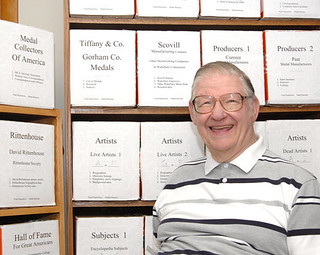 My friend and shoreline neighbor Bryce Brown started to sell Dick Johnson's library in January. You also had a related announcement in a recent E-Sylum. Dick was a prolific E-Sylum contributor. When he died a few years ago at age 90 (D. Wayne Johnson, August 27, 1930 – December 29, 2020) there were many kind tributes to him. However, I don't know if anyone included a photo of Dick on the front page of the March 1960 Volume 1, Whole No. 0 "Sample Edition" of the first issue of Coin World, for which Dick served as Coin World's first editor. The newspaper made its debut with the announcement: "The first weekly newspaper devoted entirely to coins and coin collecting, the Coin World will be published and edited by experienced newspaper people."

When I was ten years old in 1960, my mother purchased a copy of Coin World for me. It was fascinating. I also was given a copy of a Red Book, which I read multiple times, back and forth.
Fred Lake also advised me, among his many other recommendations, that I should buy the set of "Penny-Wise" journals hardbound by John Ward, Jr., a founding member of Early American Coppers (EAC). Fred described that EAC began with only 76 members, and that in its early years Penny-Wise was mailed simply as groups of loose pages, so that few copies have survived, and that it's rare to find any in bindings. That was 22 years ago, and I'm contributing these volumes to Bryce's auction, in order to entrust them to another generation. Internet access to Penny-Wise for research is very helpful, but it's particularly interesting to hold in-hand and go back in time with the original pages, and to see the evolution of the hobby, such as with the following photos and caption:

Authors of the definitive large cent books-in-progress:
Bob Grellman (Late Dates), John Wright (Middle Dates), Walter Breen (Early Dates)
I share my friend Dave Bowers' affinity for books. It's therefore been great to see recent articles in the E-Sylum about the importance of a library that can go hand-in-hand with the advantages of complementary but very different Internet resources.
It seemed like an appropriate time to remember Dick Johnson, particularly for newer readers who might not have known how far back in time and how substantially his numismatic roots extended. Perhaps newer readers also may find some helpful resources as Bryce makes Dick's library available.
Our son worked for Google New York, and I can't recall if I ever saw in a prior E-Sylum the fact that the first issue of the E-Sylum on September 4, 1998 was on the very same day that Larry Page and Sergey Brin founded Google in a garage in Menlo Park California on September 4, 1998. It's worth noting.
You were at the leading edge of the transformations that were occurring at that time.
eBay had its IPO in Sept. 1998, PayPal (a company that fascinated Fred Lake from its beginnings) began in December 1998, and Amazon branched-out at the start of 1999 to sell items other than the books and CDs which had been its sole business model in the prior three to four years.
Fred specially commented in 2004 that the first three decades of EAC from 1967 to 1997 now were entering a new era from 1998 through 2003, and that the early years of EAC's "Penny-Wise" preserve the way information on early copper had been compiled into groundbreaking numismatic books.
To read Dick Johnson's obituary, see:
Richard Wayne Johnson
(https://www.cookfuneralhomect.com/obituaries/richard-johnson)
To read the earlier E-Sylum articles, see:
D. WAYNE JOHNSON (1930-2020)
(https://www.coinbooks.org/v24/esylum_v24n01a06.html)
MORE ON D. WAYNE JOHNSON
(https://www.coinbooks.org/v24/esylum_v24n02a15.html)
VIDEO: DICK JOHNSON LECTURE ON MEDAL ARTISTS
(https://www.coinbooks.org/v24/esylum_v24n02a14.html)
BRYCE BROWN SALE OF DICK JOHNSON LIBRARY
(https://www.coinbooks.org/v28/esylum_v28n49a03.html)
BRYCE BROWN DICK JOHNSON LIBRARY SALE, PART II
(https://www.coinbooks.org/v28/esylum_v28n52a02.html)
BRYCE BROWN NUMISMATIC PERIODICAL SALE
(https://www.coinbooks.org/v29/esylum_v29n05a02.html)

OHIO WELCOMES ANS RELOCATION
Ohio media are warming up to the impending relocation of the American Numismatic Society to Toledo. Here's an excerpt of a story published last week - see the complete article online. -Editor

ANS New York Headquarters in 1909
In 1858, the American Numismatic Society was founded by a 16-year-old coin enthusiast in his family apartment in Manhattan. It has since transformed from one hobbyist's passion project into an extensive collection of coins and medals, and now attracts scholars from all over the world.
But the rising cost of living and real estate in New York eventually became an unsustainable burden for the group.
Seeking a new home that better suited their financial and spatial needs, the ANS executive director, Ute Wartenberg Kagan, began looking beyond the island of Manhattan. Ultimately, the solution didn't come from a boardroom or a broker — it came from a fifteen-minute phone call with an old friend.
Now, after 168 years in New York, the ANS and its historic collection are moving their headquarters to Toledo.
In 2009, Adam Levine — a graduate student in art history — completed a summer seminar at the ANS. While there, he forged a lasting friendship with Ute Wartenberg Kagan, the society's president.
Years later, Levine heard about the ANS's struggle to find a suitable new home.
The society had been in various New York locations since its founding. But the city's rent prices continue to rise, and with low attendance and a $1.8 million annual lease set to expire in 2028, the society knew they needed a change. They considered partnerships with UPenn and UChicago, as well as a potential move to the Armory in Fall River, Massachusetts.
As a native New Yorker, Levine intimately understood the real estate difficulties the ANS faced. As the director and CEO of the Toledo Museum of Art, he knew of a recently vacant space on the TMA campus.
It only took Levine 15 minutes on the phone to convince Wartenberg Kagan that she should fly out and give Toledo a look. After touring the campus and meeting with the TMA staff, as well as Toledo mayor Wade Kapszukiewicz, she was sold.
"I fell in love with Toledo," she said. "I thought, ‘Wow, that's a great place.'"
The new headquarters will be located in the Professional Arts Building, a four-story Art Deco building on the TMA campus. Toledoans might recognize it as the former home of the Toledo Alliance for the Performing Arts and the Arts Commission of Greater Toledo.
The building was purchased as part of a $20 million plan to expand the society's educational and research capabilities and to display coins that would otherwise remain in storage. At the new headquarters, Wartenberg Kagan envisions a small, dedicated gallery that would see their coin collection interspersed with other works of art on loan from TMA and other museums nearby.
Compared to significant European numismatic collections, which often grew out of royal collections over centuries, the ANS's collection is young, with the majority of its current holdings accumulated in the 20th century. Many of these coins have yet to be studied and catalogued.
To read the complete article, see:
Cha-ching: Ohio lands America's most prestigious coin collection
(https://www.statenews.org/section/the-ohio-newsroom/2026-02-04/cha-ching-ohio-lands-americas-most-prestigious-coin-collection)
To read the earlier E-Sylum articles, see:
ANS ANNOUNCES MOVE TO TOLEDO, OHIO
(https://www.coinbooks.org/v28/esylum_v28n47a05.html)
NEW YORK TIMES COVERS ANS MOVE
(https://www.coinbooks.org/v28/esylum_v28n47a06.html)
TOLEDO COVERAGE OF THE ANS MOVE
(https://www.coinbooks.org/v28/esylum_v28n47a07.html)
VOCABULARY TERM: SHAPE
Here's another entry from Dick Johnson's Encyclopedia of Coin and Medal Terminology. -Editor
Shape. The outer configuration of a numismatic or medallic piece. Most struck numismatic pieces are, of course, round (see circular form) and are formed by blanking or turning off. While most medallic items are also round, some are noncircular and are formed by trimming, jigsawing or silhouetting (see unusual shape). Shape has considerable impact on the meaning of the item; round items are traditional, sensuous and utilitarian. Unusual shapes are symbolic, assertive, and beauteous. Shape not only adds to the symbolic nature of these medallic items, but also adds to their charm, and in the case of a talisman or amulet, to their mysticism. Product shape adds to their commercial appeal, often a token of the product indicated; map shape emphasizes a geographical outline.
To read the complete entry on the Newman Numismatic Portal, see:
Shape
(https://nnp.wustl.edu/library/dictionarydetail/516740)

NUMISMATIST MIRRORS
E-Sylum Feature Writer and American Numismatic Biographies author Pete Smith submitted this article on Numismatist Mirrors. Thanks! -Editor
This week I return to my occasional articles on numismatic association items. I suspect that most E-Sylum readers are not familiar with the extent of numismatist mirrors. All items illustrated are from my collection.
Typical numismatist mirrors are round and 2.25 to 2.5 inches in diameter. One side has a glass mirror with the other side a steel shell, a printed image and a plastic cover. The machine to make them is also used to make pinback buttons. The machine to make them is sold by Badge-a- Minute Company to individuals who want to make up a small quantity.

Numismatist mirrors have been produced as personal tokens for collectors, as store cards for dealers and as commemoratives for clubs, In addition they can include elongated coins, encased coins or encased postage. Some are also "Good For" trade mirrors which have been highly collected in the past.
At one time personal tokens were very popular among members of the American Vecturist Association (AVA). More than a thousand were produced. Numismatist mirrors were the prized items among AVA tokens. Ten AVA members produced 28 mirrors.
Dorothy C. Baber (1920-2021) is on our list of 100-year-old numismatists. Her mirror includes a nice photograph. It states that it is "GOOD FOR 1 DRINK." This makes it a "Good For" trade token as well as a personal token and a TAMS Banquet souvenir.
Dottie Dow (1940-2004) was known for elongated coins and one of her mirrors has an elongated coin (not shown). She also produced several with a primitive look suggesting they may have been home made using the Badge-a-Minute press. Some may be unique and other may not have been seen.
I met Hal V. Dunn (1935-2006) waiting for a shuttle bus at the 1996 ANA convention in Denver. He produced mirrors in two styles and five colors. The ones promoting his run for sheriff are both personal tokens and election campaign items.
Maurice M. Gould issued a mirror "Good For 65c In Cash" so it is a "Good For" trade token. It also has an encased 1974-D Lincoln Cent This is in addition to being a personal token.
Alvin Hendrickson (1920-2011) featured the American Vecturist Association (AVA) trolley on his mirror. He was one of five AVA members to use this logo in eight color combinations. Other AVA members used other busses, trains and trollies on their mirrors.
The Ed McClung (1920-1995) mirror includes an encased postage stamp with a picture of Will Rogers. McClung was the owner of EM Creations that produced many of the numismatist mirrors issued in Southern California during 1973-1976.
The EM Creations mirror includes an encased 1974-D Lincoln Cent This is a business card offering "Advertising Mirror Cards." They issued one mirror for several southern California numismatic organizations. Most did not issue a second mirror. A Coin World article stated that EM produced 100 to 400 examples of each mirror.
I like the photo of Ruth and Ralph "Curly" Mitchell. He was a prominent numismatist in Southern California. I sat next to his son at a dinner in Colorado Springs.
One of the institutional pieces was for the 1975 reception of the Numismatic Literary Guild (NLG). Ed McClung was a founding member of the NLG. Other NLG members with mirrors include James Betton, Dotty Dow, Gordon Green and Maurice Gould.
Emilie D. Searle (1917-2018) noted that she was a collector of "Advertising Mirror Cards." I didn't realize until February 12 that she was another 100-year-old numismatist. I have only come across two other collectors of mirrors and I bought their collections.
The lavender mirror appears to be issued for the 14 th annual convention of the Token and Medal Society (TAMS). I was not aware that TAMS had conventions. I wrote to David Schenkman who would have been there and he said there were no TAMS conventions back then. Sometimes there is memorabilia for an event that did not happen.
The 1975 mirror for TEC member Richard Townsend includes an elongated coin. The maker is not marked. This was during the middle of the EM Creations period but was not done by them.

A Philatelic Numismatic Commemorative (PNC) has a stamp and a coin with a commemorative cancellation. This 5.5 x 7.5 inch envelope includes the 1976 ANA Convention cancellation with a Dick Townsend wooden nickel, a Richard Townsend elongated cent and a TEC mirror. This is one of three mirrors I have seen on a PNC that I have not seen as an individual mirror. It is possible that some have been removed from the envelope.
Most numismatist mirrors are now fifty-years-old or older. In the twenty-first century, a few new ones were produced with encased Lincoln cents (not shown). These were done for Steven & Eileen Drake, Millard W. Hajek, and Vic Nolan, plus the Maryland Token and Medal Society (MDTAMS).
I have about 115 mirrors in my collection. I was only missing one other that I had seen. I believe this is the largest collection of numismatist mirrors that has been ever formed. Then this week I discovered a new one on eBay. I immediately ordered it. I suspect there are other discoveries yet to be made.
I believe it would be impossible to duplicate this collection starting from scratch. I was fortunate to acquire the collection formed by Ray Dillard. It had a great group of EM mirrors but few AVA mirrors. A couple of AVA collections filled in that group. I also acquired some new items in 2001-2002 while they were issued.
The entire collection may be seen on the Newman Numismatic Portal. Search for "Numismatist Mirrors" to find it.
To read the collection catalog, see:
The Foxfire Collection: Featuring United States Type Coins... 1793 to Date
(https://archive.org/details/foxfirecollect2003rich)
HERITAGE: ITALY WORLD COINS SHOWCASE
Heritage Auctions will be hosted their Italy World Coins Showcase auction today, February 15. Select items are discussed below. -Garrett


Republic gold Prova 20 Lire 1925-R MS62 NGC, Rome mint, Pag-565. "PROVA DI STAMPA" on reverse. Mintage: 75. The accompanying Prova 10 Lire we have in this sale. Very rare.
To read the complete item description, see:
Republic gold Prova 20 Lire 1925-R MS62 NGC,
(https://coins.ha.com/itm/san-marino/san-marino-republic-gold-prova-20-lire-1925-r-ms62-ngc-/a/61597-22103.s?ctrack=200071&type=featured-1-coinus-news-tem021026)


Naples & Sicily. Ferdinando IV gold 6 Ducati 1766-DG-CCR MS66 NGC, Naples mint, KM167, Fr-846. A magnificent example, flaunting strong cartwheel luster and velveteen smooth surfaces, coated in a bright aurous tone. Exceptional also through only a limited presence of adjustments marks, a phenomenon so-oft plaguing the 6-Ducati denomination and preventing the full design to shine through in other Gem-level pieces. With only two other MS66's graded at NGC, a true conditional rarity well-worthy of a premium bid.
To read the complete item description, see:
Naples & Sicily. Ferdinando IV gold 6 Ducati 1766-DG-CCR MS66
NGC,
(https://coins.ha.com/itm/italy/naples/italy-naples-and-sicily-ferdinando-iv-gold-6-ducati-1766-dg-ccr-ms66-ngc-/a/61597-22016.s?ctrack=200071&type=featured-2-coinus-news-tem021026)

Papal States. Clement XIV Testone Anno V (1773) MS65+ PCGS, Rome mint, KM1020, Berman-2931. Crisp strike and polychromatic tone. Top Pop and especially nice in hand.
To read the complete item description, see:
Papal States. Clement XIV Testone Anno V (1773) MS65+ PCGS,
(https://coins.ha.com/itm/italy/papal-states/italy-papal-states-clement-xiv-testone-anno-v-1773-ms65-pcgs-/a/61597-22030.s?ctrack=200071&type=featured-3-coinus-news-tem021026)


The Order of St. John at Rhodes. Juan Fernandez von Heredia Gigliato ND (1376-1396) MS63 PCGS, Malloy-25d. Extremely rare quality.
To read the complete item description, see:
The Order of St. John at Rhodes. Juan Fernandez von Heredia
Gigliato ND (1376-1396) MS63 PCGS,
(https://coins.ha.com/itm/crusader-states/crusader-states-the-order-of-st-john-at-rhodes-juan-fernandez-von-heredia-gigliato-nd-1376-1396-ms63-pcgs-/a/61597-22001.s?ctrack=200071&type=featured-4-coinus-news-tem021026)

Papal States. Pius VI 5 Paoli (1/2 Scudo) 1797 MS63 PCGS, Bologna mint, KM338, Mont-64. Elusive revolutionary issue proclaiming liberty to the reverse, with an obverse depicting Madonna and Child. Among the finest available to collectors.
To read the complete item description, see:
Papal States. Pius VI 5 Paoli (1/2 Scudo) 1797 MS63 PCGS,
(https://coins.ha.com/itm/italy/papal-states-bologna/italy-papal-states-pius-vi-5-paoli-1-2-scudo-1797-ms63-pcgs-/a/61597-22033.s?ctrack=200071&type=featured-5-coinus-news-tem021026)


Genoa. Biennial Doges gold Scudo d'Oro 1543 AU55 NGC, Fr-412. 3.31 gm. A lightly circulated, early example of this Genoese Castle gold, mellow in tone and wholesome in appearance.
To read the complete item description, see:
Genoa. Biennial Doges gold Scudo d'Oro 1543 AU55 NGC,
(https://coins.ha.com/itm/italy/genoa/italy-genoa-biennial-doges-gold-scudo-d-oro-1543-au55-ngc-/a/61597-22003.s?ctrack=200071&type=featured-6-coinus-news-tem021026)
ARCHIVES INTERNATIONAL SALE 111 SELECTIONS
Here are some selected lots from the February 17, 2026 sale by Archives International Auctions. -Garrett


Ethiopia…., 1932. 50 Thalers, P-9, Issued Banknote, Blue-green on m/c underprint, Lion at center with bank building at upper left and arms at right, Back is m/c, S/N C/1 08066, PMG graded Choice Very Fine 35 with comment "Minor Rust," BWC. This is the highest graded example to be offered at auction since 2022, where 2 different examples sold for over $2000 each, one graded a PMG 20 and the second graded PMG 45. A lovely note that is sure to attract attention.
To read the complete item description, see:
Ethiopia Bank of Ethiopia 1932 50 Thalers Issued Banknote
(https://auction.archivesinternational.com/Ethiopia-Bank-of-Ethiopia-1932-50-Thalers-Issued-Banknote_i59251778)

Germany, ca.1921. 10 Mark, Promissory Note, Black and red print with swastika designs in border and at bottom left, S/N 004060, Fine to VF condition. This Unverzinslicher Schuldschein (non-interest-bearing obligation) was issued by the National Socialist German Workers' Association (NSDAP), Munich headquarters, pursuant to a party resolution dated January 19, 1921, during the movement's formative years. The document was created specifically to finance the acquisition, preservation, and expansion of the party newspaper, Völkischer Beobachter, which became one of the regime's most important propaganda organs. Unlike a conventional bond, the Schuldschein paid no interest and functioned as an ideological contribution rather than an investment. Redemption was promised in cash between 1925 and 1940, but only to holders deemed of "Aryan descent," embedding racial doctrine directly into a financial instrument. Richly ornamented with Nazi symbolism and heroic worker imagery, the document illustrates how early National Socialist organizations merged finance, propaganda, and ideology into a single, carefully controlled fundraising mechanism.
To read the complete item description, see:
Germany Third Reich Nationalsozi alistischer Deutscher Arbeiterverein Series A Unverzinslicher
(https://auction.archivesinternational.com/Germany-Third-Reich-Nationalsozi-alistischer-Deutscher-Arbeiterverein-Series-A-Unverzinslicher_i59251780)


Greece, 1935. 1000 Drachmai, P-106a, Issued Banknote, M/c printing with woman at center dressed in National Costume, Back shows same woman now printed in color with others behind her, S/N AE058 140716, PMG graded Choice Uncirculated 64.
To read the complete item description, see:
Greece Bank of Greece 1935 Issued Banknote
(https://auction.archivesinternational.com/Greece-Bank-of-Greece-1935-Issued-Banknote_i59251794)


Greece, ND (1944). 1000 Drachmai, P-172s, Specimen Banknote, Brown on m/c underprint with portrait of Kolokotronis at left, Back is brown with figure at center, S/N N.G-200 000000, POCs along bottom and top, PMG graded Gem Uncirculated 66 EPQ, BWC. Only 1 note grades higher out of 17 graded in the PMG census.
To read the complete item description, see:
Greece Bank of Greece ND 1944 Specimen Banknote
(https://auction.archivesinternational.com/Greece-Bank-of-Greece-ND-1944-Specimen-Banknote_i59251796)


Mexico, ND (ca.1900). 1000 Peso, P-Unlisted M293s, Specimen Banknote, Black on pale purple underprint, Group of three women together at center, Back is purple with denomination at center, S/N 00000, Specimen overprints and POCs, PMG graded Choice Uncirculated 63 EPQ, ABNC.
To read the complete item description, see:
Mexico Banco Mexicano de Comercio e Industria ND ca 1900 Bono De Caja Specimen Banknote
(https://auction.archivesinternational.com/Mexico-Banco-Mexicano-de-Comercio-e-Industria-ND-ca-1900-Bono-De-Caja-Specimen-Banknote_i59251830)


Mexico, ND (1908). 1000 Pesos, P-Unlisted M205, Series C, Specimen Banknote, Black and red/orange print with seated allegorical figure beside shield at right with harbor scene in rear, Back is orange-red, Specimen overprints and POC's, S/N C 0000, PMG graded Gem Uncirculated 65 EPQ with comment "Printer's Stamp", ABNC.
To read the complete item description, see:
Mexico Bono de Caja Banco Central Mexicano ND 1908 Bono de Caja Specimen Banknote
(https://auction.archivesinternational.com/Mexico-Bono-de-Caja-Banco-Central-Mexicano-ND-1908-Bono-de-Caja-Specimen-Banknote_i59251833)

Gilpin County, Colorado Territory (Offices & Inc. in New York, NY), 100 Shares I/U stock certificate, black on buff with ornate border and three steel-engraved vignettes including an allegorical figure and prospector at left, a busy mining camp at upper right, and a small scene of Native American hunting buffalo below, "Mining Works, Gilpin Co., Colorado" noted at bottom, signed Edward T. Latham, Secretary and George Hyatt, President, organized in 1864 during the New York–financed boom to work gold lodes in Gilpin County and typical of issues traded on the New York Mining Stock Board, the condition ranges from Choice Fine to VF condition or better, Printed by Sarony, Major & Knapp, New York.
To read the complete item description, see:
CO Gold Mining Co of Colorado 1864 I U Stock Certificate
(https://auction.archivesinternational.com/CO-Gold-Mining-Co-of-Colorado-1864-I-U-Stock-Certificate_i59252164)
THE BOOK BAZARRE
KUENKER AUCTION SALES 438-441, PART ONE
Künker's Spring Auction Sales feature many highlights – from ancient coins with extensive selections of Celtic and Byzantine issues, to early modern coins from Denmark, the Habsburgs, Malta, Norway, Poland, Württemberg, Saxony, Saxe-Coburg-Gotha and the Habsburg Empire, as well as orders from the estate of Duke Wilhelm in Bavaria. Here's the first part of the press release for sales 438-441. -Garrett
Künker is the place to go when it comes to selling large and important collections. Many collectors know this, as is demonstrated once again by Künker's upcoming Spring Auction Sales. They will be held from 16 to 20 March 2026 and contain numerous important and extensive collections.
Coins from the Ancient World
Auction 438 with coins from the ancient world is dominated by three large collections. On offer are the Topp / Dormagen Collection, the Jürgen and Erika Schmidt / Bovenden Collection as well as the Everglades Collection. Anyone who loves ancient coins will find carefully selected specimens from all areas that will make a collector's heart beat faster.
Celtic Coins
This is particularly evident in the case of Celtic coins, most of which are from the Topp Collection. More than 100 lots, some of which are of a high caliber, cover the full spectrum – from England to the Balkans. Gaul is particularly well represented, with numerous early imitations of Philip II's gold coins, inspired by those earned by Celtic mercenaries during the Macedonian campaigns.
The highlight is an extremely rare gold stater of Vercingetorix, who has found his way into modern popular culture. The Averni prince once succeeded in uniting the Celtic tribes against the Romans, almost preventing Caesar's conquest of Gaul. In the 19th century, Vercingetorix became a symbol of French identity, and he is still depicted as such in Asterix comics and films today, throwing his arms on – not at – Caesar's feet when he surrenders. Coins bearing his name are among the great and coveted rarities of Celtic numismatics.


No. 14: Celts. Gaul. Anonymous. Gold stater, "Pons Sainte-Eanne" type, early 2nd century BC. Rare. From the Topp Collection. About extremely fine. Estimate: 6,000 euros


No. 29: Celts. Gaul. Vercingetorix, 52 BC. Gold stater. Very rare. Signs of weak strike, otherwise very fine. Estimate: 40,000 euros


No. 104: Celts. Southern Germany. Gold stater, rainbow cup. Extremely rare. From the Topp Collection. Very fine. Estimate: 7,500 euros
Greek Coins
You will also find numerous carefully selected pieces of great beauty and excellent quality in the section of Greek coins. For fans of US gradings, it is worth mentioning that all coins in the Everglades Collections have been graded.
Of particular interest is a series of 20 electrum staters from Cyzicus that always depict a tuna on the obverse.
The Schmidt couple were particularly interested in the enemies of the Romans – the peoples who lived on the eastern border of the Roman Empire. You will find an extensive range of Parthian and Sasanian issues, including pieces from rare rulers, such as a tetradrachm of Phraatakes and Musa, as well as a drachm of Queen Buran, and the entire royal family of Vahran II. Of course, there is also an extensive offer of Bactrian issues from the Schmidt Collection. So if you are interested in the ancient cultures of the East, take the time to study this catalog in detail.


No. 162: Syracuse (Sicily). 100 litrae, 295-289. Rare. About extremely fine. Estimate: 10,000 euros


No. 320: Rhodes (Caria). Gold stater, 125-88. Extremely rare. Very fine. Estimate: 50,000 euros


No. 388: Parthians. Phraatakes and Musa. Tetradrachm, 2nd century BC to 4th century AD, Daisios 312 of the Seleucid Era (= May 1 AD). Very rare. Very fine +. Estimate: 5,000 euros


No. 416: Sasanians. Buran, 630-631. Drachm, year 2 Sakasan. Very rare. From the Jürgen and Erika Schmidt Collection. Extremely fine. Estimate: 1,000 euros


No. 449: Zeugitania. Carthage. Trihemistater, around 260 BC. Very rare. NGC AU, 4/5, 4/5, Fine Style, light marks. Extremely fine. Estimate: 40,000 euros
Gold, Silver and Bronze from Rome
Of course, there are also plenty of fascinating Roman coins to discover. No matter your budget or which period you collect – be it coins from the Republic, the Civil War, the Empire or the Later Roman period – you will find the piece of your dreams in this auction.


No. 518: M. Iunius Brutus. Denarius, 42, military mint in Asia Minor or Northern Greece. Very rare. Obv. fine. Rev. fine to very fine. Estimate: 50,000 euros


No. 559: Roman Empire. Spintria, 22-37. Extremely rare. Extremely fine. Estimate: 8,000 euros


No. 691: Pertinax, 193. Aureus. Very rare. About extremely fine. Estimate: 40,000 euros
An Extensive Collection of Byzantine Coins
Most of the Byzantine rarities on offer at auction 438 are from the Topp Collection. Prepare to be amazed by rare solidi of a quality rarely seen! The highlight is a probably unpublished solidus created during the Heraclian revolt. At the time, Heraclius, the Exarch of Carthage, and his son of the same name rebelled against the unpopular Phocas. The titles and attire of the two men are remarkable: on this coin, they refer to themselves as consuls, a title bestowed upon them by the Carthagian senate. This is not the only rarity. The Topp Collection includes many coins of historically significant figures, including a solidus of Empress Irene and one of Michael III with his mother, Theodora, and his sister, Thekla.


No. 945: Byzantium. Heraclian revolt, 608-610. Solidus, unknown mint. Extremely rare. Probably unpublished. From the Topp Collection. About extremely fine. Estimate: 15,000 euros


No. 1034: Byzantium. Michael III with Theodora and Thekla. Solidus 842/3. Very rare. From the Topp Collection. Very fine to extremely fine. Estimate: 7,500 euros
Rarities of the Gupta Dynasty
Friends of Indian culture will find two exceptionally rare Gupta gold coins in this auction. They were minted by Kumaragupta I between 415 and 455. His reign is now considered the late heyday of the Gupta Empire, when the economy and arts flourished once more before regional interests permanently weakened the empire and initiated its slow decline.


No. 1076: Gupta. Kumaragupta, 414-455. Stater, rhinoceros slayer type. Very rare. About extremely fine. Estimate: 25,000 euros
To order a catalog contact Künker, Nobbenburger Straße 4a, 49076 Osnabrück; phone: +49 541 / 962020; fax: +49 541 / 9620222; or via e-mail: service@kuenker.de. You can access the auction catalogs online at www.kuenker.de. If you want to submit your bid from your computer at home, please remember to register for this service in good time.
THE TRADE DOLLAR'S LINK TO OPIUM TRAFFICKING
Recently we excerpted articles by Eric Brothers on the Silver Panic of 1893 and Bust Half Dollars in the China Trade. He also published a nice piece on the Trade Dollar's link to opium trafficking in the May 2023 issue of The Numismatist. Eric submitted these notes on researching and writing that article. Thank you! -Editor
 In 2020, I was researching an article for The Numismatist debunking the tired myth that the
U.S. Trade dollar was an overall failure; it was a success in the Orient for its intended purpose
as an instrument of international trade. Nonetheless, while working on that article I
discovered two sources that grabbed my interest. They were both from the American Journal
of Numismatics, which was published from 1866-1924. I consider the Journal to be among the
best published numismatic source material available. Those two sources were the spark for
my researching and writing a different article: "Blood Money: America's Role in the Opium
Trade" (The Numismatist, May 2023).
In 2020, I was researching an article for The Numismatist debunking the tired myth that the
U.S. Trade dollar was an overall failure; it was a success in the Orient for its intended purpose
as an instrument of international trade. Nonetheless, while working on that article I
discovered two sources that grabbed my interest. They were both from the American Journal
of Numismatics, which was published from 1866-1924. I consider the Journal to be among the
best published numismatic source material available. Those two sources were the spark for
my researching and writing a different article: "Blood Money: America's Role in the Opium
Trade" (The Numismatist, May 2023).
I am including the first two paragraphs of "Blood Money" below. Material from the two sources are incorporated into these paragraphs.
It was in late 1875 that a report in a San Francisco newspaper discussed the U.S. Trade dollar's link to opium trafficking. Devised to compete with the Mexican dollar for trade in China, once the coinage arrives there, "it encounters an ignominious fate. The Chinese send it to India for the purchase of opium. They go into the Calcutta Mint and come out as rupees," according to the article.
At the time the report was published, Chinese trade with India for opium exceeded that of all other goods. From 1867 to 1875, China sent a total of 97,440,930 in British pounds, virtually all in silver, to India for the drug. The report continues, "The amount of American silver which annually goes to India from China to pay for opium is immense. A base use for so beautiful a coin as the Trade Dollar, surely." Corroborating evidence is found in the pages of the American Journal of Numismatics (October 1874): "The American Trade Dollars have gained a wide circulation. At the Calcutta mint 223,000 of them have been received during three months of the present year."
What I discovered in my research was that the Chinese were compelled to pay India (in actuality Britain) only silver (coins and sycee bullion) to purchase opium. During the 19th century, the United States supplied China with about 97 percent of its silver via exports (mostly Spanish-American dollars and Mexican Eagle dollars, but also significant amounts of U.S. silver dollars and half dollars).
Therefore, the famous triangular opium trade between China, India, and Britain was in reality a de facto quadrilateral opium trade between U.S., China, India, and Britain. It was de facto because the American silver exports were solely for the purpose of trade, not opium trafficking. However, the triangular opium trade would have been impossible had it not been for U.S. exports of silver coins. E-Sylum readers who are ANA members and would like to read "Blood Money" may find it in the archives of The Numismatist on the ANA website (money.org).


I had to love this image of a massive opium warehouse, which reminded me of the Shenzhen Library robotic book retrieval system discussed earlier. -Editor

To read the earlier E-Sylum articles, see:
THE SILVER PANIC OF 1893
(https://www.coinbooks.org/v29/esylum_v29n05a20.html)
LOOSE CHANGE: FEBRUARY 1, 2026 : Bust Half Dollars in the China Trade
(https://www.coinbooks.org/v29/esylum_v29n05a26.html)
PRESERVING THAT SPECIAL LIBRARY SCENT
(https://www.coinbooks.org/v29/esylum_v29n05a27.html)
MAKING CHANGE AT THE LINCOLN PRESIDENTIAL LIBRARY
Even the Abraham Lincoln Presidential Library and Museum has to come to terms with the phaseout of the Lincoln cent. -Editor

At the Abraham Lincoln Presidential Library and Museum in Springfield, visitors can shop for sweatshirts, pillows, jewelry and chocolates using coins bearing the face of perhaps the most-famous Illinoisian, Abraham Lincoln.
But even here, pennies are growing scarce at the cash register.
The museum gift shop, like the rest of the country, is grappling with a penny shortage after the United States Mint halted production of the coin in November, citing the rising cost of producing them.
For many Illinoisans, there is a sad, end-of-an-era feeling watching the slow disappearance of the one-cent coin, which was one of the first coins made by the U.S. Mint after its establishment in 1792. President Lincoln's profile has been on the "heads" side since 1909, and that change made him the first president featured on U.S. coins in honor of his 100th birthday.

Mary Disseler has been working as a volunteer at the Lincoln Museum for over 20 years since its founding in 2005. As a die-hard fan of Lincoln, she sees the decision to stop penny production as a sad but sensible decision.
"It kind of breaks my heart. I think it's a nice tribute to Mr. Lincoln, but I understand that it's costing four cents to make a penny, so there's a part of us that has to be practical, too," she said.
To read the complete article, see:
Penny shortage causes headaches for retailers in the Land of Lincoln
(https://capitolnewsillinois.com/news/penny-shortage-causes-headaches-for-retailers-in-the-land-of-lincoln/)

CHARTERS OF FREEDOM DECLARATION COIN
While circulating coin designs have gotten a lot of attention lately, they're not the only new U.S. Mint products. Here's a February 4th press release about the 2026 Charters of Freedom Platinum Proof Coin – Declaration of Independence. -Editor


The United States Mint announced today that it is releasing the first coin in the three-year Charters of Freedom Platinum Proof Coin Series on Friday, February 6, 2026, at noon EST. The first coin in the series is the 2026 Charters of Freedom Platinum Proof Coin – Declaration of Independence (product code 26EJ. Each coin is encapsulated and then placed in a stylish clamshell and presentation box. It is accompanied by a certificate of authenticity bearing an image of the obverse. Orders are limited to one coin per household for the first 24 hours of sales. The mintage is limited to 15,000 units.
American Eagle Gold, Platinum, and Palladium Coins are priced according to the United States Mint's Pricing Policy.
The obverse (heads) design depicts sun rays beginning to emerge through storm clouds, representing both the dawn of a new nation arising from the turmoil of revolution and the Enlightenment ideas that influenced the Declaration of Independence. A quill symbolizing the Declaration sweeps over the landscape, marking our Nation's founding and the power of revolutionary ideas to catalyze change. The design features 13 stars along the border representing the 13 colonies. Inscriptions are "LIBERTY," "IN GOD WE TRUST," "E PLURIBUS UNUM," "2026," and "DECLARATION OF INDEPENDENCE."
The common reverse (tails) design for this series depicts an eagle in flight, an olive branch in its talons. Inscriptions are "UNITED STATES OF AMERICA," "$100," "1 OZ.," and ".9995 PLATINUM."
The Charters of Freedom Platinum Proof Coin Series traces the transformational impact of the Declaration of Independence, the Constitution, and the Bill of Rights, together illustrating a living embodiment of our American democracy. Individually, these documents express the principles and ideals of American sovereignty, outline our system of government, and define the rights of states and citizens. Collectively, they mark the birth of the United States and our enduring commitment to American liberty.
To read the complete press release, see:
United States Mint Announces Release of First Coin in Charters of Freedom Platinum Proof Series
(https://www.usmint.gov/news/press-releases/united-states-mint-announces-release-of-first-coin-in-charters-of-freedom-platinum-proof-series)
For more information, or to order, see:
Charters of Freedom 2026 Platinum Proof Coin - Declaration of Independence
(https://www.usmint.gov/charters-of-freedom-2026-platinum-proof-coin-declaration-of-independence-26EJ.html)

$2.50 SEMIQUINCENTENNIAL COIN PROPOSAL
The U.S. House passed legislation calling for a $2.50 coin for the 250th anniversary of the nation. I've also linked to a Greysheet article by Larry Jewett. -Editor

In honor of the signing of the Declaration of Independence 250 years ago, the U.S. House unanimously approved legislation Monday to make $2.50 coins to commemorate the anniversary.
The bicameral, bipartisan $2.50 for America's 250th Act would authorize the U.S. Treasury to mint a collectible $2.50 commemorative coin this year. Rep. Robert Aderholt, R-Haleville, sponsored the bill.
"This coin will memorialize and celebrate our moment in American history," Aderholt said on the House floor.
The legislation also calls for a viability study on a potential circulating $2.50 coin for everyday use. The coins would feature the historical design originally issued for America's 150th anniversary coins.
"The 250th anniversary coin for the 250th anniversary provides an opportunity for the American people to engage with and to take personal ownership of their national heritage through a tangible and lasting tribute," Aderholt said.
The design on the front of the coin would bear the image of allegorical liberty, wielding the Declaration of Independence. On the back would be the image of Independence Hall as it was displayed on the 150th anniversary coin. The coins would also be inscribed with the "Semiquincentennial of American Independence."
The bill text calls for the U.S. Mint to issue the special edition coins before July 4.
The House also passed a bill Monday to create a 250th anniversary time capsule to be buried in the Capitol Visitor Center and sealed until 2276.
To read the complete articles, see:
U.S. House passes Aderholt's bill to create a $2.50 coin for America's 250th anniversary
(https://aldailynews.com/u-s-house-passes-aderholts-bill-to-create-a-2-50-coin-for-americas-250th-anniversary/)
One Step Closer to Return of $2.50 Coin
(https://www.greysheet.com/news/story/one-step-closer-to-return-of-2-50-coin)

HERITAGE: MASSACHUSETTS HORTICULTURAL SOCIETY
Heritage published the following article in their latest Coin News email entitled Massachusetts Horticultural Society Award Medals. -Garrett


The Massachusetts Horticultural Society was founded in 1829, and from the beginning some of its primary objectives were "recognition and reward for accomplishments in horticulture." Initially, awards were generally cash prizes given to individuals who were recognized as advancing the Society's objectives. However, in 1845, award medals began to be issued.
The Society's medals and awards went through numerous changes over the course of the ensuing century, not only in design and purpose, but in how liberally they were handed out. By the early 20th century, cash prizes were entirely replaced, and the medal system was redefined.
Perhaps one of the most distinctive of the Society's awards was the large size gold medal designed by Francis Napoleon Mitchell. The obverse design featured two allegorical female figures: Pomona and Ceres, holding grapes and flowers, while the primary motifs of the reverse were a wreath of garlands surrounded by the legend MASSACHUSETTS HORTICULTURAL SOCIETY. The goddess Pomona in Roman mythology represented fruitful abundance, her name being derived from the Latin pomum, meaning "fruit." Ceres' complementary association is clear, her being the Roman goddess of agriculture, grain crops, and fertility. During the 19th century, when classical motifs and figures were paramount to medallic art, these figures were well suited to the Society's largest gold award. Francis Napoleon Mitchell was a prominent Boston medalist and diesinker during the early to mid-1800s, until about 1860, with a long list of medal designs attributed to him. Several medals bearing his designs can be found in the ANS and Smithsonian collections.
An excerpt from the Massachusetts Horticultural Society on Honorary Medals reads:
"[The medal] was designated for 'gardens showing unusual skill in arrangement and management; garden superintendents who have done eminent service in the promotion of horticulture; other persons or entities for eminent horticultural accomplishments or outstanding service to this Society.' Initially this medal was rarely given; later gold medals were given for a wide variety of accomplishments. In 1932, the Society determined that the Society's Large Gold Medal should be reserved for gardens of unusual merit or for individuals for eminent services to horticulture or the Society. Later, the criteria for the award was changed to 'for eminent horticultural accomplishments or for outstanding service to the Society.'"
Lot 52098 in Heritage's February 16th Certified American Tokens & Medals Showcase auction is one of these large gold medals with the Pomona and Ceres motif. It is engraved on the reverse to Mrs. Lester Leland for "Old Fashioned Garden" and is dated March 25, 1930. The 51mm medal is 14k gold and weighs nearly three troy ounces (1.71 ounces actual gold weight). Mrs. Lester Leland was apparently an individual who long participated in various floral, garden, and horticultural pastimes, her name appearing in flower exhibits and horticultural contests as early as 1906, and possibly earlier. For many of her exhibitions, she won prizes, often placing second or third in various contests. The Society's large gold medal presented here may have been one she saw as a crowning achievement. Her "old fashioned garden," for which the medal was awarded, was exhibited at the M.H.S. Flower Show in Boston, on March 27, 1930. At least two other gold medals for horticulture were awarded to Mrs. Lester Leland, including a small gold M.H.S. medal on March 26, 1925, for a rock garden, and a Lord & Burnham Co. gold medal awarded on August 25, 1909. The latter piece also appears in the current Heritage Showcase auction as lot 52094.
1978 CAMP DAVID ACCORDS PEACE MEMORIAL
Jim Haas submitted these notes about the 1978 Camp David Accords Peace Memorial medal by Domenico Mazzone. Thank you. -Editor


80.218.1 Jimmy Carter Library and Museum, Atlanta, GA
This is a photo of the Peace Memorial medal modeled by sculptor/artist Domenico Mazzone in 1978 to commemorate the Camp David Accords. On the obverse of the 1¼" bronze medallion are three bas-relief portraits of Prime Minister Menachem Begin of Israel, President Jimmy Carter and Egyptian President Anwar Sadat and the word peace in Hebrew, Egyptian and English. On the reverse is seen a stylized Pyramid on which appears the word Peace in both Hebrew and Egyptian along with a rendering of the stone tablets on which are inscribed the Ten Commandments. The branches and tree leaves are symbolic of the Nile River, the life-source of Egypt and the pharaohs. I do not know the number of copies that were made, but how one came into my possession a quarter century ago has a backstory.
In the late 1990's, a co-worker, knowing I had written a number of articles for our company newsletter, asked if I might be interested in interviewing a sculptor friend of his who lived in New Jersey. At the time, my knowledge of sculpture was limited to having taken an art survey course in college, but because interviewing a sculptor sounded interesting, I agreed to do it. A few weeks later Domenico Mazzone and I had an enjoyable conversation during which I learned that he was born in the village of Rutigliano, di Bari in Italy in 1927. At age thirteen he began working as an apprentice stone cutter and over time became a sculptor, in the process achieving some success. He emigrated to America in 1966, quickly gained recognition, opened a studio in Manhattan in 1968 and then settled in New Jersey. In the ensuing years he produced works in marble, plaster, terra cotta, clay, wood and bronze. He was also a painter of note.
Mazzone was appointed instructor of sculpture for the United Nations International School in 1976 and in time modeled a portrait bust of Secretary General U Thant and a bas-relief of former Secretary General Dag Hammarskjold. At the close of our conversation, he offered me two of his works. One was a small plaster model, about six inches high, of what was obviously a head of the crucified Christ that had been separated from its wooden plaque. The other was the 1¼" Peace Medal.
Unknown to me, Domenico Mazzone, whose works have been exhibited and are held in museums and collections around the world, yet relatively unheralded in the United States, died shortly after our day together. The medal appears to be the only one he ever executed and while I believe it was cast by Roman Bronze Works, according to Jonathan Frembling, Curator of the Amon Carter archives, where the company's files are held, those files only go up to 1970. Interestingly, an undated copy of a letter sent from Menachem Begin in Israel to Mazzone in New Jersey thanked the sculptor for sending the medal to him. My guess was that medals were also sent to Presidents Anwar Sadat and James Earl Carter, Jr.

Jim adds:
"Emily Curl, Technician for the Jimmy Carter Presidential Library and Museum sent a note confirming three of the bronze medals had been sent to President Carter, Prime Minister Begin and President Sadat in 1980 and one was retained for the archive's collection.
"Mazzone modeled a number of portrait busts including Frank Sinatra, Princess Diana, Mother Theresa of Calcutta, and Ronald Reagan to name just a few. They were not commissioned as far as I know and many thank you notes were received."

PUERTO RICAN PAPER MONEY
Stack's Bowers Director of World Currency Auctions Aris Maragoudakis published an article summarizing the interesting history of Puerto Rican paper money. Here's an excerpt - see the complete article online. -Editor

Puerto Rico has a rich paper money history. They were the first jurisdiction in the New World to issue local paper money because of a shortage of silver currency that was largely due to piracy. This was the beginning of Puerto Rico's lengthy history of lacking resources due to outside forces.
Provisional paper money known as tengos or papeletas as well as loans from merchants were adopted to confront this emergency. These items were prone to counterfeiting due to their simplicity, which prompted an official issuance of paper money for Puerto Rico in 1766. (Pedro Tomás de Córdova in 1832)
While there are records of the money from 1766, there are no surviving examples known. The earliest discovered example of this type of currency is a 1781 issue of the 8 Reales which would be a second issue in 1769 under Governor Muesas.
To address the persistent monetary crisis, Governor Salvador Meléndez Bruna approved the issuance of provincial papeletas in 1812, starting at 80,000 pesos and rising to 500,000 pesos by 1813. These notes remained in circulation until early 1816, when Intendant Alejandro Ramírez withdrew them as part of his financial reforms.
The 1812 and 1813 issues, authorized by Governor Salvador Meléndez Bruna and totaling 500,000 pesos, remained in circulation until their eventual withdrawal in 1816 under the financial reforms of Intendant Alejandro Ramírez. These emissions marked a pivotal phase in Puerto Rico's monetary crisis, precipitated by the permanent cessation of situado remittances.
Amid an acute fiscal crisis, Alejandro Ramírez emerged as the newly appointed intendant. He arrived in Puerto Rico from Guatemala on February 11, 1813, and held the position of Intendant of the Royal Treasury until early 1816, following the separation of that office from the Captaincy General under the Power Law drafted by Ramón Power in 1811. Ramírez promptly introduced measures to strengthen the public treasury, with his foremost priority being the amortization and withdrawal of the severely devalued paper currency in circulation, estimated at approximately 500,000 pesos.
Because the poorly printed papeletas were easily forged and fueled extreme inflation—at times reaching 300 percent—Ramírez later ordered higher-quality banknotes from Murray, Draper, Fairman & Co. in Philadelphia. Today, both the early papeletas and the later 3- and 5-peso notes are exceptionally rare and highly significant in Puerto Rican numismatic history.
The article goes on to discuss the Macuquina Coinage (1813–1857) and Local Bank Paper Money Issues (1865–1913). -Editor
To read the complete article, see:
A Deep Dive into Puerto Rican Paper Money
(https://stacksbowers.com/a-deep-dive-into-puerto-rican-paper-money/)

HOW TO START A COIN COLLECTION
Donn Pearlman was interviewed for a nice article on "How to start a coin collection." Great advice - I passed it along to an old boss who'd reached out to me about beginning to collect. You could do the same - who do you know who might be interested in starting a collection? Here's an excerpt - see the complete article online. -Editor

This year, the Federal Reserve will begin officially "phasing out" the penny. The plucky little copper-colored coin used to be able to fetch you a piece of candy from the corner store. Then it was found mostly tucked into loafers and floating at the bottom of wishing wells and fountains. As much as we hate to see them go, you have to admit you haven't had an actual use for a penny in years…unless you found one on the street (face up, of course) and picked it up hoping for a good luck boost.
But the idea that a coin could do its duty and then be retired might spark something else in you–maybe a desire to find more out-of-date and discontinued coins. Maybe this leads you to dig into the history of coin production, and the hidden secrets and details that distinguish one from another. Before you know it, you might want to become a full-fledged coin collector. A numismatist, if you want to use the proper term.
But then what?
To give you some tips on how to get started, we reached out to former journalist and spokesman for the Professional Numismatists Guild, Donn Pearlman. Pearlman's own journey started when he was 8 years old and "received a mint state, shiny red Lincoln cent." He came back to the hobby later in life, and this "a reborn numismatist" has found coin collecting to be a fascinating and fulfilling hobby.
"Even though I have never owned a multi-million-dollar trophy coin," says Pearlman. "I've been lucky and thrilled in my professional life to see and hold many of the world's most famous rare coins."
Here is Pearlman's advice on how budding numismatists can get started…
Start simple
According to Pearlman, most people begin their collecting journey with everyday coins found in circulation. But knowing what to look for is what separates a coin collection from just a collection of coins. And for that you need to read up.
"There's an old saying in numismatics: ‘Buy the book before the coin.' If you're interested in United States coins, buy the latest edition of A Guide Book of United States Coins, commonly known in the hobby simply as ‘The Red Book' because of its red cover. There are similar reference books and online resources for information about U.S. coins and those of other countries."
Pearlman advises starting out with something that has some personal resonance. "Do you like the historical event or person depicted on the coin or bank note?" he says. "Perhaps you want to put together what's known as a ‘type set,' one representative example of each denomination and design struck during a certain time period, such as the 20th or 19th century? Bottom line: Collect what you enjoy, whether it is a Wheat Stalk design Lincoln cents from 1909-1958, or ancient Roman coins depicting the 12 Caesars."
And the best part is, you don't have to spend a lot to get started. "You can enjoyably begin a collection for less than a dollar by starting with the many designs, dates, and mintmarks of coins easily found in circulation." Pearlman suggests attending coin shows and asking questions to learn the lingo and understand the tiny details that differentiate one coin from another.
To read the complete article, see:
How to start a coin collection
(https://www.popsci.com/diy/how-to-start-coin-collection/)
ABOUT THIS ISSUE: FEBRUARY 15, 2026
It finally warmed up above freezing this week, melting some of the snow. All day today it rained, which melted even more and washed away some of the salt and dirt. I got out Friday night, taking my wife to a comedy show at a brewery, and Saturday we went out for a nice Valentine's dinner. Nothing numismatic to report other than the usual flood of E-Sylum email.
Here are some interesting non-numismatic articles I came across this week. A history of early photo manipulation shows that AI fakes are nothing new - just another outlet for human creativity and mischief.
And it's come to this: "28% of pupils were not able to use books correctly – for example, they were trying to swipe or tap pages like a phone or tablet." That reminds me of a line from Woody Allen's "Take the Money and Run," where his cello teacher recalled he had "no concept of the instrument...he was blowing into it."
One in four children in England start school without being toilet trained, say teachers (https://www.theguardian.com/education/2026/jan/22/children-england-start-school-without-being-toilet-trained-teachers)
Rijksmuseum unveils 'FAKE!' - A history of early photo manipulation (https://artdaily.cc/news/190870/Rijksmuseum-unveils--FAKE-----A-history-of-early-photo-manipulation)
The Internet Was Imagined Before World War I (https://3quarksdaily.com/3quarksdaily/2026/02/the-internet-was-imagined-before-world-war-i.html)
David J. Farber, ‘Grandfather of the Internet,' Dies at 91 (https://www.nytimes.com/2026/02/14/technology/david-farber-dead.html)
Phonographs, Player Pianos and Betamax: The Inventions That Transformed Entertainment (subscription required) (https://www.wsj.com/business/media/10-inventions-entertainment-phonograph-streaming-a7b97be6)
The oldest building in Virginia is set to undergo a restoration Bacon's Castle is the oldest brick dwelling in North America. (https://www.pilotonline.com/2026/02/11/bacons-castle-restoration/)
What separates a lake from a pond? What about creeks and rivers? (https://www.washingtonpost.com/business/2026/02/09/department-of-data-lake-vs-pond/)
And these words of wisdom: "When you're dead, you don't know you're dead. The pain is felt by others. The same thing happens when you're stupid."
-Editor


Editor Wayne Homren, Assistant Editor Garrett Ziss
Wayne Homren
Wayne Homren is the founding editor of The E-Sylum and a consultant for the Newman Numismatic Portal. His collecting interests at various times included U.S. Encased Postage Stamps, merchant counterstamps, Pittsburgh Obsolete paper money, Civil War tokens and scrip, Carnegie Hero Medals, charge coins and numismatic literature. He also collects and has given presentations on the work of Money Artist J.S.G. Boggs. In the non-numismatic world he's worked in artificial intelligence, data science, and as a Program Manager for the U.S. Department of Defense.
Garrett Ziss
Garrett Ziss is a numismatic collector and researcher, with a focus on American paper money and early U.S. silver and copper coins. He is also a part-time U.S. coin cataloger for Heritage Auctions. Garrett assists Editor Wayne Homren by editing and formatting a selection of articles and images each week. When he's not engaged in numismatics, Garrett is pursuing a Master's Degree in Quantitative Economics at the University of Pittsburgh.

Contributors Pete Smith and Greg Bennick
Pete Smith
Numismatic researcher and author Pete Smith of Minnesota has written about early American coppers, Vermont coinage, numismatic literature, tokens and medals, the history of the U.S. Mint and much more. Author of American Numismatic Biographies, he contributes original articles to The E-Sylum often highlighting interesting figures in American numismatic history.
Greg Bennick
Greg Bennick (www.gregbennick.com) is a keynote speaker and long time coin collector with a focus on major mint error coins and US counterstamps. He is on the board of both CONECA and TAMS and enjoys having in-depth conversations with prominent numismatists from all areas of the hobby. Have ideas for other interviewees? Contact him anytime on the web or via instagram
@minterrors.

Website host John Nebel and webmaster Bruce Perdue
John Nebel
Numismatist, photographer, and ANS Board member and Fellow John Nebel of Boulder, CO helped the ANA and other clubs like NBS get online in the early days of the internet, hosting websites gratis through his Computer Systems Design Co. To this day he hosts some 50 ANA member club sites along with our
coinbooks.org site, making the club and our E-Sylum archive available to collectors and researchers worldwide.
Bruce Perdue
Encased coinage collector (encasedcoins.info) Bruce Perdue of Aurora, Illinois has been the volunteer NBS webmaster from its early days and works each week to add the latest E-Sylum issue to our archive and send out the email announcement.

|
|
The E-Sylum is an electronic publication of the Numismatic Bibliomania Society Copyright © 1998 - 2026 | |