PREV ARTICLE
NEXT ARTICLE
FULL ISSUE
PREV FULL ISSUE
EARLY AMERICAN HISTORY NOVEMBER 14 SALEHere are several selections from the upcoming Early American History Auctions sale. -Garrett 

ELIAS BOUDINOT (1740-1821). 10th President of the Continental Congress (1782-1783); a Founding Father; Member of the Continental Congres who served in the First Congress of 1789; Signed the "Treaty of Paris" with Great Britain ending the Revolutionary War; Member of the Committee on Correspondence; New Jersey Provincial Congress; Commissary-General of Prisoners; in 1795 Appointed Third Director of the United States Mint by George Washington; founded the American Bible Society and began "Thanksgiving" in America as a National Holiday. December 16, 1790, Newark (New Jersey) First Presbyterian Church in Newark, Signed "E Boudinot" as Church president, Private Four Pence Small Change Note, Newman page 266, Wait 1410, PCGS graded Very Fine-25. This Church money series was printed by Kollock and is clearly Signed in brown ink by Elias Boudinot. This note is quite superior in its eye appeal to most we have seen and the signature is strong. The holder notes edges trimmed (all are... this one in a wavy fashion). Worthy of a premium being an excellent representative of the series with a very clear strong signature. An American Revolutionary War era Statesman, Elias Boudinot was a close friend of George Washington, and was a tireless supporter of the Revolution and the fledgling Federal government. Despite not signing the Declaration of Independence, the Constitution or the Articles of Confederation, he is one of the more important political figures from the American Revolutionary Era. Elias Boudinot was a member of the New Jersey Committee on Correspondence (1774-1775) and the New Jersey Provincial Congress (1775). In 1777 during the Revolutionary War he was appointed Commissary-General of Prisoners. He was a Member of the Continental Congress (1777-1788 and 1781-1784) and its President (1782-1783). Boudinot Signed the "Treaty of Paris" with Great Britain to end the Revolutionary War. He served in first Congress of 1789; and in 1795 was made the Third Director of the United States Mint. From 1816 to 1821 served as the First President of the American Bible Society.
To read the complete item description, see:


March 1, 1770, Maryland, Half Dollar, Second Finest PMG Certified on the Population Report, PMG graded About Uncirculated-53. Fr. MD-53. The second Finest PMG Certified Maryland $1/2 note on this issue. Printer's initials "A. C. and W. Green" on the back who was "Anne Catherine Green" the widow of Jonas Green, and this is one of the few female printer issues known on early American Colonial paper currency. This note is boldly signed and lightly circulated noted on its holder as previously mounted and has a small hole which are faint trivial traces at the extreme corner tips and a natural tiny worm hole. The face is boldly printed having four full even margins with nice centering. The 2008 5th Edition of Newman lists a value in Extremely Fine of $700 and no listed values higher due to its rarity in higher grades.
To read the complete item description, see:


August 18, 1775, Paul Revere Engraved Massachusetts Colonial Currency, Six Shillings, "Sword In Hand" Issue, PCGS graded Fine-15. Fr. MA-163. An attractive Revolutionary War issued circulated Paul Revere Engraved "Sword in Hand" issue note with PCGS holder stating apparent center split repaired, small edge splits. The PMG population report lists only three examples certified, with their highest graded being Very Fine-20, just one grade higher. This evenly circulated note appears solid and has full margins on both its face and back with all text and devices being clear, including the historic Minuteman holding his Sword in his right hand while carrying a copy of the MAGNA CHARTA in his other. It displays well with light even overall tone and the blue ink signature of J. Wheeler is clearly readable. A very popular highly collectable note for those who desire an authentic Paul Revere engraving.
To read the complete item description, see:


December 31, 1763, New Jersey Colonial Currency, Six Pounds, Red and Blue Printed Face, in a PMG Comment Free holder graded Very Fine-25. Fr. NJ-160. This colorful 1763 French & Indian War period £6 note with a Red and Blue printed face is the highest denomination on the issue, with only a mere 500 notes printed in 1763. In fact, this issue was to be redeemed back into the treasury by December 31, 1782, after which time is was invalid. This example has deep red and blue printed text and designs all being clearly readable on its well centered face side. Remarkably for a note of this rarity and age PMG found no detractions and it is a rare comment free holdered note. It is clean and even in overall circulation and a nice example for display. The Friedberg reference lists a Fine at $1,500 and displays a "dash" in Very Fine, whereas the 2008 5th edition of Newman has a $2,000 in Very Fine.
To read the complete item description, see:

April 21, 1760, New York, Two Pounds, rated the Third Finest Certified, PCGS graded Very Fine-25. Fr. NY-149. This well printed French and Indian War period note has nice eye appeal for the discriminating New York currency collectors. Of only 17 notes listed from both services in the Track & Price census, this example is the Third Finest Certified. It also bears the lowest Serial Number 99, recorded. The two higher graded notes are both PCGS graded as Apparent VF-30. This attractive note received the apparent designation for repaired splits which is reinforcement of the vertical centerfold seen only on its blank reverse. Boldly signed in rich brown ink by; John Bogert, Jr., Robert G. Livingston, and Elias Des Brosses. Overall, the reverse is clean and free from all typical notations, the bottom right corner is rounded, yet the eye appeal is well above average. Friedberg calls this note "Extremely Rare."
To read the complete item description, see:

October 20, 1777 Act, Treasury of Virginia Colonial Currency, Handwritten Date, Eight Dollars, Choice Crisp Extremely Fine. Fr. VA-129. This boldly printed quality 1777 Revolutionary War note is superior to most. It has excellent centering, and the "B. Dickson" and "Ja(mes) Wray" signatures and red serial number add to its eye appeal. The blank reverse is perfectly clean. The heavy rag period paper is crisp and extremely clean, only lightly circulated made with a thin blue thread in the paper as made. A desirable high quality note.
To read the complete item description, see:


1862 Civil War Encased Postage Stamp Emergency Currency, EP-68, HB-69, S-40, Reed-BU05, Five Cents, F. BUHL & CO., Detroit, Extremely Fine. Rarity-8 (5 to 10 known) according to Fred Reed. F. Buhl & Company was the only Detroit-based firm to utilize John Gault's encased postage. This example being one of the finest known, and it appears finer in quality than the Hodder-Bowers plate specimen illustrated on page 72 of THE STANDARD CATALOGUE reference. The mica remains very clear and unbroken with one very slight natural craze atop the left moon. The perfectly centered stamp remains a deep, bold deep rich brown, a faint insertion crease in the stamp near center only seen viewed at an angle. Overall, virtually like the day it was printed. The detail is extremely sharp, with no detractions to the legends on the perfect, natural medium chestnut-brown reverse surfaces. Extremely rare as a major Merchant type in this quality, having particularly pleasing eye appeal. (VF Scott Cat. $2,250) Provenance ex: Collection of Robert Bauer. In 1833, brothers Frederick and Christian Buhl launched F. Buhl & Company, focusing on the sale of hats and furs. Their commitment to quality and fair dealings quickly earned them a reputation, and their business flourished. Frederick served as Detroit's Mayor in 1848; Christian served as Mayor from 1860 to 1861.
To read the complete item description, see:
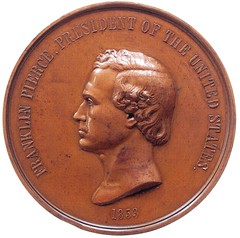

(1853-Dated) Franklin Pierce Indian Peace Medal, 76 mm, First and Largest Size, Original, Julian IP-32, Belden-48, Struck at the United States Mint in Bronze, Choice Mint State. Julian IP-32. Belden-48. 76 mm. This genuine first and largest size Franklin Pierce Indian Peace Medal was struck in bronze at the United States Mint in Philadelphia. This is the "Large Date" variety mentioned in Julian's catalog of U.S. Mint Medals. One tiny hard to see partial hole made in the center rim at 3:00 likely for prior display mounting is unseen from the face or back. Julian states that this "Large Date" variety medal was struck from the original dies starting about 1855. This beautiful medal appears Choice Mint State having smooth lovely natural medium brown surfaces and sharply detailed highpoints.
To read the complete item description, see:

ORVILLE WRIGHT, (1871-1948). Orville Wright had as much influence in the creation of the first airplane as his brother Wilber and was, in fact, the first to fly the Wright's Airplane and have a successful lift-off, traveling 120 feet. It was during the years between 1900 and 1903 that the Wright Brothers developed the first working airplane. "Orville Wright" Signed, 1932-Dated Printed Check issued from The Winters National Bank & Trust Co. in Dayton, Ohio, with typical small punch cancels, Choice Crisp About Uncirculated. This choice quality tan paper check with black text is nicely penned in blue ink with a red ink meter payment amount. Date stamped on the reverse. His full signature, "Orville Wright" is also in easily readable pencil, measuring about 2.5" long. Wright was born in Dayton, Ohio, and it was there that he and his brother, Wilbur, conceived and developed the idea of the airplane. Orville Wright (1871-1948). Orville Wright was born in 1871 in Dayton, Ohio. He is less well known than his older brother, Wilbur, but had as much influence in the creation of the first airplane as did his brother. Orville was in fact, the first to fly the Wright's airplane and have a successful lift-off, traveling 120 feet. It was during the years between 1900 and 1903 that the Wright Brothers developed the first working airplane. They made the first controlled, sustained flight of an engine-powered, heavier-than-air aircraft with the Wright Flyer on December 17, 1903, four miles (6 km) south of Kitty Hawk, North Carolina, at what is now known as Kill Devil Hills. In 1904 the Wright brothers developed the Wright Flyer II, which made longer-duration flights including the first circle, followed in 1905 by the first truly practical fixed-wing aircraft, the Wright Flyer III. Their first two gliders had not worked as designed, and the Wrights were beginning a critical shift that would enable them to discover the reason. "The Wright Brothers Aeroplane" appeared in Century magazine in 1908, after Wilbur had made his flights in France. The Wright brothers always presented a unified image to the public, sharing equally in the credit for their invention. Biographers note that Wilbur took the initiative in 1899 and 1900, writing of "my" machine and "my" plans before Orville became deeply involved when the first person singular became the plural "we" and "our". Author James Tobin asserts, "it is impossible to imagine Orville, bright as he was, supplying the driving force that started their work and kept it going from the back room of a store in Ohio to conferences with capitalists, presidents, and kings. Will did that. He was the leader, from the beginning to the end."
To read the complete item description, see:

Wayne Homren, Editor The Numismatic Bibliomania Society is a non-profit organization promoting numismatic literature. See our web site at coinbooks.org. To submit items for publication in The E-Sylum, write to the Editor at this address: whomren@gmail.com To subscribe go to: Subscribe All Rights Reserved. NBS Home Page Contact the NBS webmaster 
|