Visit our NBS Sponsors








About UsThe Numismatic Bibliomania Society is a non-profit association devoted to the study and enjoyment of numismatic literature. For more information please see our web site at coinbooks.org SubscriptionsThose wishing to become new E-Sylum subscribers can go to the following web page
Subscribe
MembershipThere is a membership application available on the web site Membership Application To join, print the application and return it with your check to the address printed on the application. Print/Digital membership is $40 to addresses in the U.S., and $60 elsewhere. A digital-only membership is available for $25. For those without web access, write to: Jeff Dickerson, Treasurer AsylumFor Asylum mailing address changes and other membership questions, contact Jeff at this email address: treasurer@coinbooks.org SubmissionsTo submit items for publication in The E-Sylum, write to the Editor at this address: whomren@gmail.com 
BUY THE BOOK BEFORE THE COINSale CalendarWatch here for updates! |
- WAYNE'S WORDS: THE E-SYLUM NOVEMBER 30, 2025
- NEW BOOK: SIEGE NOTES OF THE WORLD 1793–1913
- PERIODICAL: SCRIPOPHILY OCTOBER 2025
- PRICE LIST: COUNTERFEIT BUST HALF DOLLARS
- A DIE STUDY OF KEICHO ICHIBU
- AGRICULTURAL-THEMED COINS AND MEDALS
- A VISIT TO ALASKA RARE COINS
- VIDEO: ALTERED AND DOCTORED PAPER MONEY
- 2026 ANS GALA TO HONOR ADAM M. LEVINE
- STACK'S BOWERS ACQUIRES LONG BEACH COIN EXPO
- MORE ON STEVE FELLER
- NOTES FROM E-SYLUM READERS: NOVEMBER 30, 2025
- SANTA CLAUS, OR ELI AND SAMUEL…OR BOTH?
- FIVE FUTURE DIRECTIONS IN NUMISMATICS
- VOCABULARY TERM: SCALES
- EDOUARD FROSSARD (1837-1899)
- STACK'S BOWERS DECEMBER 2025 CONFEDERATE PAPER
- HERITAGE DECEMBER 2025 HONG KONG SALE
- FRED HOLABIRD DECEMBER 2025 SALE SELECTIONS
- SOVEREIGN RARITIES AUCTION XX
- LOT 10232: THE VERY LAST CENTS AND DIES
- FLORIDA MAN WANTS TO SPEND OMEGA CENTS
- GOLD AND SILVER THNICKELS OFFERED
- THEODORE'S THICK COIN MINT
- JEWELRY INCORPORATING ANCIENT COINS
- REPAIRING GAZA'S TATTERED BANKNOTES
- IN PRAISE OF BIBLIOMANIA
- LOOSE CHANGE: NOVEMBER 30, 2025
- PUTTING HELL MONEY IN A TEMPLE DONATION BOX
- ABOUT THIS ISSUE: NOVEMBER 30, 2025
Content presented in The E-Sylum is not necessarily researched or independently fact-checked, and views expressed do not necessarily represent those of the Numismatic Bibliomania Society.
WAYNE'S WORDS: THE E-SYLUM NOVEMBER 30, 2025
 New subscribers this week include:
Glenn Hamilton, courtesy Steve Starlust;
Katie Williams, courtesy Bob Hurst; and
David S Dunlop.
Welcome aboard! We now have 6,741 subscribers.
New subscribers this week include:
Glenn Hamilton, courtesy Steve Starlust;
Katie Williams, courtesy Bob Hurst; and
David S Dunlop.
Welcome aboard! We now have 6,741 subscribers.
Thank you for reading The E-Sylum. If you enjoy it, please send me the email addresses of friends you think may enjoy it as well and I'll send them a subscription. Contact me at whomren@gmail.com anytime regarding your subscription, or questions, comments or suggestions about our content.
This week we open with one new book, a periodical and a price list, updates from the Newman Numismatic Portal and ANS, and more.
Other topics this week include siege notes, stock certificates, agricultural medals, Alaska Rare Coins, doctored paper money, Steve Feller, Adam Levine, Ed. Frossard, the Long Beach Expo, auction previews, the Omega cents, gold thnickels and the Thick Coin Mint, Gaza banknotes, bibliomania, and Hell Notes.
To learn more about A.P. Giannini, counterfeit Capped Bust half dollars, rectangular Japanese gold coins, Civilian Camp Money of World War II, benders, Eli and Samuel, water scrip, Hauptmann Trial commemorative cents, and gemme numari, read on. Have a great week, everyone!
Wayne Homren
Editor, The E-Sylum

Image of the week
NEW BOOK: SIEGE NOTES OF THE WORLD 1793–1913
My friend Larry Korchnak has collected and studied siege money since 1972; Kolbe & Fanning has published his long-awaited book on the siege notes. Here's the announcement. -Editor
 SIEGE NOTES OF THE WORLD 1793–1913
Korchnak, Lawrence C.
Gahanna: Kolbe & Fanning, 2025. 8vo, original dark gray leatherette, printed in silver. iv, 92 pages; illustrated in color.
Kolbe & Fanning Numismatic Booksellers have announced the publication of Siege Notes of the World 1793–1913, by Lawrence C. Korchnak, Ph.D. A companion volume to the author's previously published Siege Coins of the World 1453–1902, Korchnak's new study focuses attention on the paper currency issued to pay soldiers involved in sieges. It is the first book-length work of its kind, bringing together information scattered throughout a number of more general references and supplementing this synopsis with new information gleaned from decades of study.
Given the late adoption of paper money in Europe, it is no surprise that there are fewer issues of siege notes compared to siege coins. Siege Notes of the World 1793–1913 lists nineteen recognized instances when they were produced. Siege notes appeared during late 18th century following the French Revolution. Lyon is recognized for issuing the first siege notes, which were redeemable in assignats after the 1793 siege. Since that time, siege notes have taken many forms including cloth fragments, canvass strips, postage stamps attached to cards, and even railway tickets.
A historical account of each siege is provided to give context to the notes. The description of each note is cross-referenced to more general works on paper money to provide the reader with the opportunity to seek additional information. Each siege is listed alphabetically, and each note is assigned a number. Information on rarity is also provided. Our hope is that Siege Notes of the World 1793–1913 generates new interest and motivates others to conduct further research into this fascinating collecting specialty.
Siege Notes of the World 1793–1913 is available for purchase from Kolbe & Fanning at numislit.com. The 104-page hardcover volume is illustrated in color and is $70 plus shipping.


For more information, or to order, see:
SIEGE NOTES OF THE WORLD 1793–1913
(https://www.numislit.com/pages/books/7761/lawrence-c-korchnak/siege-notes-of-the-world-1793-1913)
To read the earlier E-Sylum article, see:
NEW BOOK: SIEGE COINS OF THE WORLD 1453-1902
(https://www.coinbooks.org/v24/esylum_v24n27a04.html)
THE BOOK BAZARRE
PERIODICAL: SCRIPOPHILY OCTOBER 2025
The October 2025 issue of Scripophily (number 128) has been published by the International Bond & Share Society (IBSS). Here are the contents. Thanks to Editor Max Hensley for forwarding the information. -Editor
 NEWS AND REVIEWS
- IBSS AGM 2025
- Holabird Reports Retirement; Auctions to Cease
- Medieval Tally Stick Sells for GBP 50,400
- ... and more besides
EVENTS CALENDAR
COX'S CORNER
FEATURES
The Curious Experience of Confiscated Letters of Credit and the Nightmares of their Owners
by Alex Witula
The Long History of Fiat and its Stocks
by Alex Witula
Samuel Sarphati, an Amsterdammer of Stature
by Gerrit Terpstra
Scripophily Accessories
by Max Hensley
Scripophily of A.P. Giannini
by Max Hensley
Italian "Tonnare" Reflected in Stock Certificates
by Alex Witula
The Franco-Italian Co, Nice, 1923
by Peter Jones
Houdini Stock Certificates
by Fred Fuld III and Bob Kerstein
AUCTION NEWS AND REVIEWS


Max adds:
"This time we focused on Italy, including a piece on AP Giannini and the Bank of Italy/Bank of America story.
"A "$35 annual membership in the International Bond and Share Society will get you three issues and other benefits for those interested in old stocks and bonds certificates."
For more information on the International Bond & Share Society, see:
http://www.scripophily.org/
PRICE LIST: COUNTERFEIT BUST HALF DOLLARS
Winston Zack's books on circulating contemporary counterfeit coins have cemented the importance of this field of numismatic research. Now Winston is further documenting the field with his first fixed price list. Here's the list's opening statement. -Editor
 I am pleased to provide you with my 1st ever fixed pricelist (FPL) sale with highlights from none other than the
long-time collector of counterfeit Capped Bust half dollars (CBH), Larry Schmidt. Larry assembled his advanced
collection of more than 100 die struck counterfeit CBH varieties over several decades. For this collection subject
matter, this is a level of completion and achievement that fewer than 10 numismatists (per my estimate) have ever
ascended to, notably due to how rare or scarce many of these varieties are.
I am pleased to provide you with my 1st ever fixed pricelist (FPL) sale with highlights from none other than the
long-time collector of counterfeit Capped Bust half dollars (CBH), Larry Schmidt. Larry assembled his advanced
collection of more than 100 die struck counterfeit CBH varieties over several decades. For this collection subject
matter, this is a level of completion and achievement that fewer than 10 numismatists (per my estimate) have ever
ascended to, notably due to how rare or scarce many of these varieties are.
For many years, Larry managed the website http://cccbhcc.com/, growing the content and uniting collectors with this shared interest following Keith Davignon's second edition of Contemporary Counterfeit Capped Bust Half Dollars in 2010. Many of Larry's pieces have been off the market for decades offering a rare opportunity to acquire some seldom available pieces. Included in this FPL are 98 lots including about 80 of Larry's CBH varieties (with some duplicates), other type, and 3 counterfeit coin detector devices.
To my knowledge, Larry's collection and selection of counterfeit CBHs in this sale constitutes the largest single offering of its kind to come to market in approximately a decade. Other comparably large and diverse collections have sold over this time period, such as from Harvey Bastacky, but Larry's offering here edges those out. As such, it must be mentioned that these sale opportunities are few and far between, and may only come to market every 5 to 10 years.
I had the privilege of studying these pieces for more than a month in order to adequately study, document, photo graph, describe, and catalog these pieces to the maximum level of detail I could provide. The pieces offered here provided us with new information about this subject that have never been documented before, including new planchet alloy groups for a given obverse-reverse (O-R) die marriage (DM), the first time a lettered edge die marriage could be attributed to O-R DMs, newly attributed lettered edge DMs, and the first time a reeded edge was documented for an O-R DM that should not have a reeded edge! This illustrates that there is much more to learn about these counterfeit coins—and I anticipated this type of new information being documented for years after my Bad Metal publication.


This sale opens new opportunities for the current collector base to add and cherish these rare and scarce varieties to their collections, upgrade varieties, and even add unusual pieces to their collections, such as some double struck examples!
For more information, or to order, see:
https://www.badmetalcoin.com/shop
FIXED PRICE LIST #1
https://www.badmetalcoin.com/_files/ugd/e42934_088e8c8dfa024683a778b977cf1bc0b3.pdf
To read the earlier E-Sylum articles, see:
NEW BOOK: BAD METAL
(https://www.coinbooks.org/v22/esylum_v22n31a07.html)
NEW BOOK: BAD METAL: SILVER 3 TO 25 CENTS
(https://www.coinbooks.org/v25/esylum_v25n32a06.html)
NEW BOOK: BAD METAL: SILVER 50C TO $1
(https://www.coinbooks.org/v28/esylum_v28n21a04.html)

A DIE STUDY OF KEICHO ICHIBU
The latest addition to the Newman Numismatic Portal is UNTANGLED: A Die Study of Keicho Ichibu by Lianna Spurrier. Project Coordinator Len Augsburger provided the following report. -Editor
Lianna Spurrier Publishes UNTANGLED: A Die Study of Keicho Ichibu
 This work presents the first comprehensive die study of the Keicho ichibu, a rectangular Japanese gold coin minted from 1601 to 1695. Spurrier analyzes 306 specimens—including auction records, museum holdings, and reference-site images—to reconstruct how dies were made, shared, and reused across mints and time periods. The study proposes a new three-phase chronology (early, intermediate, late) based on the position of the character ?, the arrangement of border dots, stylistic features of the inscriptions, and the overall quality of manufacture.
Spurrier also redefines the traditional calligraphic attributions, replacing the historical Kyoto/Suruga/Edo classifications with neutral letter-groups (K, S, E) and identifying three rare subsidiary handstyles (H, U, Y). Extensive die maps show how A- and B-side dies pair across hundreds of examples, revealing patterns of reuse, sequencing, and cross-type relationships.
A major contribution of the book is documenting how certain Keicho ichibu were struck over earlier Gaku ichibu issues, especially in the earliest phase, supporting the historical transition from the earlier form into the Keicho series. Spurrier also demonstrates that ryohon ("double-hon") coins—those bearing two ??? marks—show signs of being more carefully struck, with cleaner edges, fewer circulation marks, and higher rates of complete border impressions. Combining statistical analysis and die-link evidence, she suggests these may have served a ceremonial or presentation function rather than normal commerce.
The study concludes with comparative rarity tables, mint-location indicators, pricing trends, and a detailed set of appendices including typical examples and full die maps, offering the most technically rigorous examination of Keicho ichibu dies to date.
Link to UNTANGLED: A Die Study of Keicho Ichibu on Newman Portal:
https://nnp.wustl.edu/library/booksbyauthor/529486
Link to Lianna Spurrier's site on Japanese bar money:
https://rectanglecoins.com/

AGRICULTURAL-THEMED COINS AND MEDALS
Newman Numismatic Portal Project Coordinator Len Augsburger also submitted this Thanksgiving-themed item. -Editor


Tokens of Plenty and Prosperity
Many agricultural-themed coins and medals naturally lend themselves to Thanksgiving imagery, including Hard Times Tokens (cornucopias), So-Called Dollars (celebrating expositions of agriculture and industry), and Civil War Tokens (liberty caps, wheat, and farming implements). These pieces remind us that prosperity has always been expressed through the symbols of food, harvest, and industriousness. This South Carolina Agricultural Society award medal from the Alan Weinberg collection is typical, with imagery evoking agricultural production. This is a rare item, and one can be "thankful" simply for owning an example of the medal itself!
Images: South Carolina Agricultural and Mechanical Society award medal
Link to Alan Weinberg Agricultural and Mechanical Society Medals on NNP:
https://nnp.wustl.edu/library/imagecollection/510056

A VISIT TO ALASKA RARE COINS
Newman Numismatic Portal Project Coordinator Len Augsburger provided this report on his visit to Alaska Rare Coins. Thanks. -Editor
A Visit to Alaska Rare Coins in Fairbanks, Alaska

Len Augsburger and Dick Hanscom
I was in Fairbanks over Thanksgiving (long story) and had the opportunity to visit Alaska Rare Coins. Dick Hanscom and his partner Jerry Cleworth have been in business in Fairbanks for nearly half a century, opening in 1976. Like most storefront coin shops, they do their share of gold and silver bullion business. Dick noted their over-the-counter business is healthy on the buy side, surprising to me as the city is rather remote. Still, the metro population is about 100,000, the second largest in Alaska, and includes a good number of collectors. They also have the most extensive book selection of books I've ever seen in a coin store, focusing on Alaska content (Alaskiana?) and early Alaskan imprints.


Alaska Rare Coins interior and book section
 Dick further exhibited a set of Alaska tokens that he strikes by hand, using gold mined in various parts of the state. I bought a book (of course), Striking Gold in Alaska: Making Tokens from Placer Gold, which Dick published (8th edition) in 2025. The work describes the technology behind the Hanscom "Mint" (he uses a drop press) and catalogs the various tokens he has produced.
Link to the Alaskan Token Collector and Polar Numismatist on Newman Portal:
https://nnp.wustl.edu/library/publisherdetail/523362

VIDEO: ALTERED AND DOCTORED PAPER MONEY
The David Lisot Video Library on the Newman Numismatic Portal can be found at:
https://nnp.wustl.edu/library/multimediadetail/522852
We highlight one of his videos each week in The E-Sylum. Here's one from 2016 about detecting altered and doctored paper money. -Editor
Learn the ways you can be deceived when you buy bank notes. Speaker: Jeff Paunicka.

To watch the complete video, see:
How to Detect Altered and Doctored Paper Money
(https://youtu.be/PlMzKIvFpKo)
How to Detect Altered and Doctored Paper Money
(https://nnp.wustl.edu/library/book/549008)
2026 ANS GALA TO HONOR ADAM M. LEVINE
The American Numismatic Society will honor Adam M. Levine of the Toledo Museum of Art at their upcoming 2026 Gala. -Editor
 The Board of Trustees of the American Numismatic Society (ANS) is pleased to
announce that the 2026 Trustees' Award has been given to Adam M. Levine, the Edward
Drummond and Florence Scott Libbey President, Director, and CEO at the Toledo
Museum of Art (TMA). The award, which will be presented at the ANS Annual Gala on
January 15, 2026, at the Harvard Club of New York, recognizes Levine's tremendous
assistance and partnership with the ANS in facilitating the future relocation of the Society
to Toledo, Ohio.
The Board of Trustees of the American Numismatic Society (ANS) is pleased to
announce that the 2026 Trustees' Award has been given to Adam M. Levine, the Edward
Drummond and Florence Scott Libbey President, Director, and CEO at the Toledo
Museum of Art (TMA). The award, which will be presented at the ANS Annual Gala on
January 15, 2026, at the Harvard Club of New York, recognizes Levine's tremendous
assistance and partnership with the ANS in facilitating the future relocation of the Society
to Toledo, Ohio.
Adam M. Levine joined TMA in 2012 as an Andrew W. Mellon Fellow and later served as deputy director and curator of ancient art before assuming his current role as director of the TMA. In his current role, he oversees the TMA's $23.5 million budget and 220 employees, advanced the Museum's first campus master plan, and has curated a diverse range of exhibitions. Prior to the TMA, Levine served as the George W. and Kathleen I. Gibbs Director and CEO of the Cummer Museum of Art & Gardens in Jacksonville, Florida, and as a collections management assistant in the Greek and Roman Art Department at the Metropolitan Museum of Art.
Levine graduated summa cum laude and Phi Beta Kappa from Dartmouth College, where he majored in anthropology, art history, and mathematics & social science. He continued his studies as a Rhodes Scholar at the University of Oxford, where he earned his master's degree with distinction and his doctorate in the history of art. In addition to his research in ancient art, Levine has published and presented on museum and management practices. In 2009, he co-founded Art Research Technologies, a data and research company that eventually was sold to Podium Capital. In the same year, he participated in the ANS Eric P. Newman Graduate Summer Seminar in Numismatics. Levine has also consulted for several departments at Sotheby's and for Art & Auction Magazine. He is currently a Henry Crown Fellow at the Aspen Institute and serves on the Board of Trustees of the University of Toledo.
On the award, ANS Sydney F. Martin Executive Director Ute Wartenberg notes, "As the ANS enters an exciting next chapter with its relocation to Toledo, Adam has been a vital partner in this ambitious endeavor. This award celebrates not only his standing as a leader in the museum community but also his support of the ANS as we enter this exciting new chapter for our institution. We are incredibly grateful for his tireless support of the ANS, and are delighted to present him with this award."
The Annual Gala provides critical support for the Society's mission to advance the research, education, and appreciation of numismatics through proceeds from ticket sales, sponsorships, advertising, and other donations. The Trustees' Award was established in 2003 and honors those who have helped in extraordinary ways to forward the mission of the ANS. For more information about the Annual Gala, visit numismatics.org/2026gala.
To read the complete article, see:
2026 ANS Gala to Honor Adam M. Levine
(https://numismatics.org/2026gala-press-release/)
To read the earlier E-Sylum articles, see:
ANS ANNOUNCES MOVE TO TOLEDO, OHIO
(https://www.coinbooks.org/v28/esylum_v28n47a05.html)
NEW YORK TIMES COVERS ANS MOVE
(https://www.coinbooks.org/v28/esylum_v28n47a06.html)
STACK'S BOWERS ACQUIRES LONG BEACH COIN EXPO
Stack's Bowers Galleries has acquired the long-running Long Beach Expo. Here's the announcement. -Editor

Stack's Bowers Galleries is pleased to announce that it has acquired from Collectors Universe, Inc. the popular Long Beach Expo, The Collectibles Show, one of the longest-running and most respected numismatic events in the United States. Celebrated by collectors and dealers alike, this iconic West Coast venue has served the numismatic community for more than 60 years, offering a premier gathering place for buying, selling, education, and camaraderie.
"Our mission is to ensure that this historic venue remains a vibrant hub for collectors and dealers," said Brian Kendrella, President of Stack's Bowers Galleries. "We are proud to support a show that has played such an important role in numismatics, and we look forward to strengthening its future, beginning with our first Expo in February 2026."
 The first event under the new ownership will be a smaller and more intimate "invitational" edition of the show at the Long Beach Convention & Entertainment Center, Hall C. The show will be open to attendees February 18-20, 2026, with dealer setup on Tuesday, February 17.
Stack's Bowers Galleries, a proud Platinum Sponsor of the Professional Numismatists Guild (PNG), is pleased to offer members of the PNG special benefits as the show is reintroduced, including discounted table fees, priority table selection, and additional perks. PCGS will serve as a major supporter and the official grading service of the event, and PCGS Collectors Club members will enjoy free admission.
"PCGS is thrilled to support the return of the Long Beach Expo to Southern California," said PCGS President Stephanie Sabin. "The show has been a West Coast tradition for more than 60 years, and PCGS has had a presence at the show since our beginning in 1986. As the Long Beach Expo enters a new era, we are excited to continue serving a role in what is one of the most important events on the numismatic calendar."
Kerry Pieropan, a veteran of the rare coin industry, owner of Riverside Coin and Bullion, and director of Pacific Expos which operates the Buena Park and Anaheim coin shows, is serving as a special consultant to the Long Beach Coin Expo.
Dealers and collectors interested in reserving a table are invited to contact the show management team, led by David Talk, by emailing info@LongBeachExpo.com or calling 562-250-3300.
Living on the east coast, I've only ever gone to one Long Beach show. But I'm glad to hear of this acquisition. Despite the rise of online trading, in-person coin shows remain a key part of the hobby, and many continue to thrive and grow. Most of the major shows are run by hobby organizations such as the ANA and various regional (Central States) and state organizations (FUN, MSNS, PAN etc.), but the Whitman Baltimore Expos and Long Beach Expo are commercially-run shows. The hobby is big enough for all of them, and I'll look forward to attending another Long Beach show someday. -Editor
For more information, see:
https://longbeachexpo.com/

MORE ON STEVE FELLER
The recent passing of Steve Feller was an unexpected shock. Readers offered additional comments. -Editor
Mel Wacks writes:
 "Terrible news about Steve Feller. A long time ago he invited me to speak at Coe College, and they paid my way. I slept at Steve's home and that night there was a heavy snowfall. In the morning I helped his daughter to make a snowman. A great loss to the world of numismatics in general, and to Judaic numismatics in particular."
Jeff Burke writes:
"I was surprised to learn that Steve Feller passed away on November 19th. I appreciated Len Augsburger's wonderful obituary and remembrance piece on Steve in last week's issue of The E-Sylum. I learned a number of new facts about him. Thanks for the links that you included as well. I am grateful for the lively email correspondence that I had with Steve in August. Sadly, I never had the chance to meet him in person. I am sorry for the loss of your friend."
Steve was active in the Military Payment Certificate group, and their newsletter MPCGram published a number of tributes. Here are some excerpts. -Editor
Larry (Ski) Smulczenski wrote:
I have known Steve for a long time. No, we didn't live in the same town, nor did we go to the same college or work together. But we did collect banknotes and the hobby put us in the same place several times each year. I remember the first time we met, I believe it was at a Memphis Paper Money Show. Steve was walking the bourse floor with a young girl and would tell her about the various items of his interest. I thought to myself that a young child as this would not remember anything he spoke about. I was wrong as this young lady was Steve's daughter, Ray and she has continued going to paper money shows with her father for all these years and she still listens to him. Together they have made presentations about the money used by civilian internees in camps around the world during World War Two. Their studies resulted in numerous discoveries and were documented in a book entitled Silent Witnesses: Civilian Camp Money of World War II. And that young lady has grown up to be a good wife, a fine mother and an outstanding, knowledgeable numismatist in the field her father cherished.
Steve was a college professor and became the Director of the Physics Department at Coe College in Cedar Rapids, Iowa. As such, he usually traveled to conferences around the world during the summers. Somehow. he was always able to find an internment camp in the immediate vicinity of the meeting that he could visit. One such visit was to the Isle of Mann located equidistant between England and Ireland in the Irish Sea. This island was used as an internment camp for Axis civilians during World War Two.
Steve explored the island and some of the hotels where the internees were lodged and gathered what information anyone he met could provide.
About seven or eight years ago, I received a call from Steve asking if I knew of an internment camp in Texas known as Crystal City. I replied that I did, and that it was about 200 miles from me southwest of San Antonio. Also, that I had a few tokens from there. Steve asked if he and Ray flew into Austin, could we make a trip? Sure, I replied, I can pick you up at the airport, provide room and board and the four of us...
The camp was very interesting and in better condition than most of the POW camps I have visited but still suffered from the hot south Texas weather for over fifty years. We saw the swimming pool that was built by the internees with two sets of dressing rooms because the Germans would not use the same facilities as the Japanese.
MPCGram Editor Fred Schwan wrote:
Steve and I met via a phone call. He and Barbara had written an article for The Numismatist on Operation Bernhard. I was excited about it and called Steve to discuss it (Operation Bernhard). We bonded immediately. I believe that the article appeared in the December 1981 The Numismatist.
I invited Steve and family to visit as soon as possible for a WWII numismatic meeting...
At that meeting, I learned the answer to a mystery. In 1979 I had received an order for fifteen copies of Schwan-Boling I--World War II Military Currency--from a small college book store. It was the only such order that I ever received. I learned at that meeting that the books had been from the Coe College book store. Coe was where Steve taught physics. In addition, Steve taught a class on World War II numismatics during a mini term between the major college terms.
To read the earlier E-Sylum article, see:
STEVE FELLER (1951-2025)
(https://www.coinbooks.org/v28/esylum_v28n47a02.html)

NOTES FROM E-SYLUM READERS: NOVEMBER 30, 2025
Coins Carried But Not to Be Spent
Further on the topic of those conjoined Large Cents, Carol Bastable
adds:
"The act of soldering/riveting them together also helps keep them from being spent. This way they can be carried in the pocket without fear of spending them. Centuries ago in England, "Benders" were similarly carried in a pocket. A coin of some significance to the owner was twice bent and the bends helped keep them from being spent accidentally."

I hadn't heard the term "Benders" before. Interesting concept - thanks. -Editor
To read the earlier E-Sylum article, see:
NOTES FROM E-SYLUM READERS: NOVEMBER 23, 2025 : Double Large Cent Birth Years Token?
(https://www.coinbooks.org/v28/esylum_v28n47a08.html)
Indian Chief Medal Electrotypes
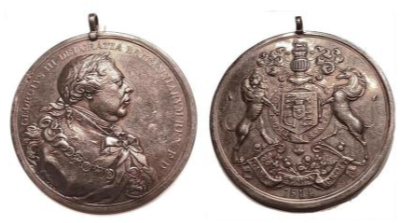
 "I think the 1814 Indian Chief Medal will prove to be an electrotype copy made in the middle-to-late 19th century. The image is not that good but the fact it is silvered and underweight says a lot. Also the loop looks well made, a forger wouldn't go to that trouble. The electrotypes were made in two halves, so the owner may care to look at the rim and the line where the join line may well be visible. If it were made by a member of the Ready family there could be the letter "R" stamped on the edge. If by Robert Ready it is often "RR". The medal doesn't have to be silver as you demonstrate each week with an illustration of a copper example in your tail-end photo. Over the years I've been in the business, I've seen a number of electrotypes of various Indian medals."
Good points. Thank you. -Editor
To read the earlier E-Sylum article, see:
OCCASIONAL NUMISMATIC PAPERS DECEMBER 2025
(https://www.coinbooks.org/v28/esylum_v28n47a03.html)
Combating Coin Show Marketing Spam
Regarding Dick Hanscom's inquiry about spam coin show emails,
a reader writes:
"One can try using the "Unsubscribe" option; but, it usually does not work as they usually ignore it.
"If one uses a program like Outlook, then they could build a rule or rules to simply block or totally delete it.
"Another option would be to mark it as "Spam". It then shows up in your ‘Junk' folder."
To read the earlier E-Sylum article, see:
NOTES FROM E-SYLUM READERS: NOVEMBER 23, 2025 : Combating Coin Show Marketing Spam
(https://www.coinbooks.org/v28/esylum_v28n47a08.html)
One Penny For Every Star!
Eric Holcomb (practitioner of both numismatic and astronomy hobbies) writes:
"The comparison, "The U.S. Mint estimates that there are 300 billion pennies in circulation—which, if true, means that the Milky Way galaxy contains about three times more American pennies than stars," (Nov. 23 E-Sylum) is interesting. The traditional estimate of 100 billion stars in the Milky Way is considered low-end. Most likely including dim red dwarf stars raises the estimate closer to 400 billion, which makes it closer to a one-to-one correspondence – one penny for every star!
But we don't know for sure. In a 2015 NASA article, https://asd.gsfc.nasa.gov/blueshift/index.php/2015/07/22/how-many-stars-in-the-milky-way/, counting stars in the galaxy is likened to counting coins in a bag, with a photo of a penny (and what appear to be grains of rice) being shown! Does this mean that astronomers and numismatists think alike in some ways?"
Cool - thanks. -Editor
To read the earlier E-Sylum article, see:
WHAT NEXT FOR THE CENTS?
(https://www.coinbooks.org/v28/esylum_v28n47a26.html)
Centimental Journey
Harry Waterson submitted this limerick of the times. Thank you! -Editor
A penny for thoughts just took a steep dive.
Red cents for a tribute, not one will survive.
Alas, alack,
It won't be back!
The final D-cent is a twenty twenty five

SANTA CLAUS, OR ELI AND SAMUEL…OR BOTH?
John Sallay submitted this article ahead of St. Nicholas Day (December 6). Thank you! Nice medal. -Editor
With Saint Nicholas Day in a few days and Christmas less than a month away, I thought it might be a good time to share a Sunday School medal that depicts Santa Claus with an excited child, or maybe not – you decide!


Early this year I acquired from a good friend this medal from the St. John's Protestant Episcopal Sunday School in Lower Merion, Pennsylvania. It was intended to be presented at Christmas, although this example is unawarded. It is struck in white metal, 38mm in diameter. Although the medal is unsigned and undated, it can be attributed to William H. Key, circa 1875-1877. This is based on several other dated award medals using this same reverse die paired with obverse dies that are signed by or die-linked to dies signed by Key. Indeed, it belongs to a group of several dozen Sunday School award medal dies by Key from that period, many of which are also used in combination with dies of various So-Called Dollars from that U.S. Centennial era.
OK, a nice Santa Claus medal by Key from the mid-1870s, something to add to my very long list of medals to research further at some point. But then, a couple of months later, my wife and I were returning home from a long weekend away and decided to stop in Hartford at the Wadsworth Atheneum, a wonderful museum if you've never been – highly recommended.
 And what to my wondering eyes did appear, high up on the wall of the Morgan Great Hall, but
this large painting, the source of the image on the Santa Claus medal! Rushing over to the
associated museum placard below, I expected to read something about Santa Claus, and maybe
even the Key Sunday School medal.
And what to my wondering eyes did appear, high up on the wall of the Morgan Great Hall, but
this large painting, the source of the image on the Santa Claus medal! Rushing over to the
associated museum placard below, I expected to read something about Santa Claus, and maybe
even the Key Sunday School medal.
But no, the painting is entitled "Samuel Relating to Eli the Judgments of God Upon Eli's House," by John Singleton Copley, painted in 1780 and acquired by the museum in 1941 through the Ella Gallup Sumner and Mary Catlin Sumner Collection Fund. It depicts the scene from 1 Samuel 3:18 where the young prophet Samuel reveals his vision from God to Eli, the high priest of Israel, of the severity of God's judgement on Eli's family because of the wickedness of his sons.
Key could have taken the image directly from the painting, or perhaps more likely from one of several engravings of it published in the late 18th and early 19th centuries. These include faithful mezzotints by Valentine Green (London, 1782) and James Daniell (London, 1797), and a somewhat wonky engraving by Henry Moses (London, 1829) published for the Society for Promoting Christian Knowledge.
So, Santa Claus or Eli with Samuel, or maybe both? Personally, given the Christmas connection mentioned on the medal and the fact that by the 1870s Santa Claus and Christmas celebrations were becoming popular in America, it seems possible that Key intended the image to represent Santa Claus with a child, and found that this animated Copley painting (or an engraving of it) served as a wonderful model.
I'm not sure if we'll ever know, so you decide!
FIVE FUTURE DIRECTIONS IN NUMISMATICS
What do readers think about this essay on future directions in numismatics? -Editor
Numismatics has always been a field that honors the past while quietly reinventing itself. Archival researchers still sift through dusty ledgers; metal detectors still hum across old fields; collectors still chase the elusive die state or the coin with the "look." And yet beneath this long continuity, the hobby is shifting. New tools, new communities, and new forms of evidence are emerging. If the last generation was shaped by the computer and the online auction, the next will be shaped by expanded access, sharper data, and a willingness to rethink how knowledge is built.
Here are five future directions likely to influence the next decade of numismatic study.
1. The Digitization of Everything—And the Rise of Open Evidence
The first great wave of digitization brought us searchable journals, auction listings, and
public archives. The next wave goes deeper: high-resolution imaging of mint records; AI-
assisted transcription of manuscripts; searchable datasets of die marriages, plate matching,
and provenance; universal access to back issues of club journals previously lost to time.
This doesn't eliminate traditional research—it multiplies it. A young collector today could
begin a serious study without leaving home. The barriers to entry are lower; the
possibilities for depth are higher.
2. AI-Enhanced Research and the "New Microscope"
Artificial intelligence will not replace numismatists, but it will give them sharper tools. AI
can compare hundreds of coin images, highlight surface anomalies, cluster coins by
engraving hand, and detect questionable surfaces or modern tooling. It will serve as a
second set of eyes—a microscope for both the novice and the veteran.
3. A Renaissance in Provenance Research
We are entering a golden age of provenance. More auction houses link coins to decades-old
catalogues; improved provenance chains appear for colonial and ancient coins; blockchain-
based custody trails emerge; online registries integrate past sales and pedigree photos.
Future generations will seek coins with documented narratives.
4. A Re-Centering of Local and Specialized Collecting
Ironically, the more global numismatics becomes, the more value local specialties will hold.
Expect renewed activity in early American coppers, Canadian Victorian decimals, pre-Confederation tokens, modern varieties, and technical mint errors. These areas reward
patience and deep reading—qualities computers support but cannot replace.
5. A Coming Boom in Educational and Mentoring Resources
Many collectors 20–40 entered the hobby through online marketplaces and lack mentors
who explained original surfaces or recoloring. The next decade will see updated home-study
courses, short video modules, guided virtual tours, and hybrid meetings with distant
experts. The goal is to rebuild a culture of scholarship and enthusiasm.
Conclusion: Tradition, Data, and the Human Eye
The future of numismatics will be shaped by tools our predecessors never dreamed of—yet the heart of the hobby remains unchanged. Technology will broaden access and enhance our research. But meaning still arises in the dialogue between the numismatist and the object itself.
A reader from New York writes:
"I have been trying things out with AI. That is an essay it wrote on five future trends in the hobby. Interesting that it didn't mention grading."
It didn't mention pricing either, but here at The E-Sylum we rarely discuss either grading or pricing. But we do care a lot about research, serious study, sharper tools, provenance, specialization, educational resources, and scholarship. So I liked this essay. It's like the AI was trained on millions of pages of Newman Numismatic Portal documents and archived E-Sylum articles. Maybe it was. -Editor

VOCABULARY TERM: SCALES
Here's another entry from Dick Johnson's Encyclopedia of Coin and Medal Terminology. -Editor
Scales. Machine for determining weight, as a balance scale. Scales have been employed to weight coins and medals, as metal for formulation of their composition, as blanks, as freshly struck pieces and as specimens for collecting, archiving or offered for sale. These scales appear in a variety of kinds: balance beam, double or triple beam, collapsible, folding, spring scales, platform and electronic. Since individual coins or medals are fairly low in weight, as a few grams to less than a pound, the scales for their measurement are fairly small or simple. These are in contrast to scales that weigh large amounts of bullion, ingots or precious metal ore once used by mints. Calibrations of these scales are in the weighing systems used for metal commerce or local custom (see weights and weighing).
Balances and scales at mints. Prior to the twentieth century, when one of the functions of mints was to accept any precious metal brought to them for coinage, mints had to have balances that could accommodate large deposits. Since this was precious metal – silver, gold – it had to be accurate to fractions of a gram. Thus mints customarily had large balances for these measurements, in addition for such mundane measurements as a balance to weigh individual blanks at the table in front of everyone who adjusted the weight of these planchets to a prescribed tolerance.
At U.S. Mints balances were used well into the 20th century. Balances were more accurate and easier to maintain than scales. Until about 1875 mints often had to manufacture their own balances. At the Philadelphia Mint balances were first made by Joseph Saxton (1790-1873), an employee of the mint, and later by Henry Troemner, a German-born scalemaker of Philadelphia (established 1840). In Great Britain, balances were made at the Royal Mint by William Cotton and Richard Pilcher. Commercial scale makers included James Napier in London, Baron Seguier in Paris, Paul Stuckrath in Berlin, Paul Bunge and his successor, Kuhlmann in Hamburg.
These mint's balance beams, interestingly, it was found could not be made of iron or steel. In time the beam became magnetized by the earth's magnetic forces (affecting its accurate measurement). The Philadelphia Mint solved this problem by making their beam of platinum. A gust of wind in the room where the weighing was made would also affect the scale, thus most were housed in glass cases.
Automatic weighing machines. These were really sets of several small balances used in parallel and packaged into a single frame, much like the cells in a car battery. In 1871, an Austrian machinery maker, Ludwig Seyss, developed a scale that would weigh coin blanks (or struck coins) automatically. The Philadelphia Mint obtained their first Seyss automatic scale in the early 1880s, by then the mechanism was developed to accommodate ten positions – ten blanks could be weighed simultaneously. Blanks (half dollar denomination and above) would be hand fed into tubes feeding the scales. Mechanical fingers would move a blank from the tube and place it in a pan, that would register the weight and according to preset limits would place it into one of four chutes. The four divisions were: (1) underweight, (2) within tolerances, (3) slightly overweight which could be adjusted, and (4) grossly overweight.
Divisions (1) and (4) would be sent to be remelted, (3) would be sent to adjusting, (2) would be sent to the coining room. Automatic weighing machines could also be used to weigh and count the pieces after striking, a counter could be mounted on the scales to accomplish this. Philadelphia Mint engineer Leslie A. Lambert made substantial improvements to automatic balances and these went into operation in 1910.
Scales as counterfeit detectors. A popular device in the 19th century was a small scale with prescribed slots in a flat balance beam, one slot for each denomination. A coin placed in a slot should balance the scale, any others were considered suspect. Interestingly, when coin issuing states in medieval Germany debased their coins , they prohibited their citizens from owning scales.
Modern scales. Perhaps the most used scales outside the mint for weighing coins and medals are the triple-beam balance scales (Ohaus brand). These are ideal since little can go wrong with them, they are very rugged and they can even be adjusted to perform specific gravity tests. This is in contrast with modern electronic scales, often with a platform, that have an electronic calibrated weight readout.
To read the complete entry on the Newman Numismatic Portal, see:
Scales
(https://nnp.wustl.edu/library/dictionarydetail/516703)

EDOUARD FROSSARD (1837-1899)
E-Sylum Feature Writer and American Numismatic Biographies author Pete Smith submitted this article on American dealer Ed Frossard. Thanks! -Editor
I came across an interesting newspaper article this week in the San Francisco Chronicle for April 14, 1899. It announced that famous numismatist Edourad Fossard was dead. I did not recognize the name and began to search various resources.

Spelling was a problem. Similar articles giving the name as Edouard Fossard appeared in papers from Bay City, Michigan, Butte, Montana, Chambers, Nebraska, Esterville, Iowa, Macon, Missouri, Marion, Indiana, Muscatine, Iowa, Norfolk. Nebraska, and Warrington, Missouri.
Other articles giving the name as Eduard Fossard appeared in Earlington, Kentucky, and Unionville, Missouri.
He must have been famous for his death to get such wide coverage. I suspect most E-Sylum readers have gotten ahead of me by now.
 Obituaries for Professor Edouard Frossard were published in the Brooklyn Citizen, the Brooklyn Eagle, the Brooklyn Times Union. The New York Herald, The New York Times, and The New-York Tribune. The New York obituaries were extensive and got the spelling right.
For many public records there is another contradictory record. I may mention both.
The Numismatist (Mar 1892) stated that he was born near Lake Leman (Lake Geneva) in Switzerland in 1937. His obituaries state that he was born in Paris, France. In The Numismatist it was mentioned that he received a good collegiate education but the school was not mentioned.
The Numismatist stated that he came to America in 1858. However, there is a ship record of Edouard Frossard, age 17, arriving in New York in 1854.
Before the Civil War he was a professor of languages at the school of the A. Boursand Academy in Brooklyn.
He married Hannah (a/k/a Anna) Amanda Philips (1841-1917). They had three children with one dying young.
Although an immigrant to this country, he volunteered with his two younger brothers for service during the Civil War. He enlisted as a sergeant-major with the 31st New York Volunteers. He was promoted to lieutenant, then captain and acting Colonel. He was "badly wounded whilst advancing boldly upon the enemy," at the battle of West Point, Virginia, on May 7, 1862. Frossard saw detached service at Fort McHenry, near Baltimore. He was appointed judge-advocate with the general court-martial.
After the war he opened a private school at Irvington-on-Hudson.
Frossard began collecting coins about 1872. He collected the U. S. Large cents and also worked to form a collection for George Merritt. In 1875 he was editor of The Coin Collectors Journal for J. W. Scott. His collecting grew into dealing and he opened a business in 1877.
He had one of the major auction companies of his era. Between 1878 and his death in 1899, he conducted 176 auction sales. He promoted the business and hobby through his newsletter Numisma. It reported on upcoming sales and had reports on past sales. He also had articles and general commentary. A hundred copies of the periodical were reprinted by RAMM Communications.
His auction series was continued with fifteen more sales by his son Ed, (Edwin Maire Frossard 1875-1939) between 1899 and 1901. Then he left the hobby and "went South" leaving considerable debt.


Frossard compiled Monograph of United States Cents and Half Cents 1793-1857 published in 1879. It was based primarily on the Merritt Collection.
With William Wallace Hayes, he compiled Varieties of United States Cents of 1794, published in 1893. The varieties became known by their Hays numbers. The book was reprinted in 1910.


With George M. Parsons, he wrote Franco-American Jetons, Fully Described and Illustrated [bound with] The Colonial Jetons of Louis XV and Other Pieces Relating to the French Colonial Possessions in America, and to their Conquest by England, published in 1899.
The Numismatist Directory for 1891 listed Frossard as member #42 at 787-789 Broadway in New York City. He placed his first ad in The Numismatist in the issue of July, 1891. In 1895 he was at 108 East 14th Street. Numbers were reassigned and he became charter member #14. He was an officer of the American Numismatic Association and served as Counterfeit Detector in 1892 but declined reelection. He was also a member of the New York Numismatic and Archaeological Society.
In the 1880 Census he is indexed as Edward Frassard. The variance in the last name is probably a misinterpretation of the handwriting, In 1880 he was listed as a teacher, born in France and living in Irvington, New York. Frossard began a feud with William Woodward in 1881. In his sale of January 10, 1881, Woodward described lot 469 as a gold coin of Pescennius Niger. It was actually a fake perpetrated by German forger Carl Wilhelm Becker.
Frossard published his fable, "The False Talisman," in the March 1881 issue of Numisma. Knowledgeable readers took this as an attack on Woodward. He.in turn, responded with a review of Frossard's book, "it is perhaps the only book ever written, from which no new fact may be gleaned…"
Woodward told the story of Ichabod Crane, a teacher at Irvington-on-Hudson. In this he challenged Frossard's claims of service during the Civil War.
"He sometimes boasts of being in the army during the late war which he says he entered as a non com. and from which he emerged as a colonel, with shoulder straps, brass buttons and things. When his back is turned the neighbors pityingly tap their foreheads and say the non com (short for Non Compos Mentis) part is evident enough now, but they don't see the colonel."
It is an amusing piece of banter that is probably not justified. Frossard is mentioned in the Official Records of the war and he was honored for his military service.
Frossard also made an occasional mistake. He identified a Betts fabrication as the discovery of a new variety of Novum Belgium piece.
In the 1892 New York Census, he was listed as Edward Frossard, a coin dealer married to Anna.
His obituaries state that he had a stupendous art collection, the work of John Trumbull. When the collection came up for sale, it was exposed as a "massive, deliberate fraud."
Frossard was a member of The Masons and a member of the U.S. Grant Post 327 of the GAR,
He died at home at 221 Lexington Avenue, New York, on April 12, 1899, and is buried in White Plains Rural Cemetery. In 2015, he was inducted into the PCGS Coin Dealer Hall of Fame.
In my opinion, a much better telling of the Frossard story can be found in The Numismatist for January 1995, pages 71-74.

STACK'S BOWERS DECEMBER 2025 CONFEDERATE PAPER
Stack's Bowers will be hosting their December 4, 2025 Confederate Currency Auction. Select items are discussed below. -Garrett

T-5. Confederate Currency. 1861 $100. PCGS Currency Choice About New 58. Apparent Minor Mounting Remnants on Back. No. 5771. Plate B. Following the breakout of open hostilities after the Bombardment of Fort Sumter in April 1861, the Confederacy was forced to look inwards to fulfill its currency needs. One such institution that worked to fulfill that need was the Southern Bank Note Company out of New Orleans. Formed from the remnants of the American Bank Note Company's operations in New Orleans, the SBNC was able to produce notes with a level of technical sophistication that came close or even sometimes matched its northern counterparts. Issues such as the T-5 and T-6 were produced in limited quantities and offer a stark contrast to the oft-seen issues of Hoyer & Ludwig and Keatinge & Ball in technical terms. That contrast is brought to a distinct form by this lightly handled albeit slightly imperfect specimen that was issued during the opening stages of the conflict and should serve the collector well in representing a difficult entry in their collection. PCGS Currency comments "Minor Mounting Remnants on Back."
Estimate: $1,000 - $1,500.
Provenance: From the José Octavio Busto Collection.
To read the complete item description, see:
T-5. Confederate Currency. 1861 $100. PCGS Currency Choice About New 58. Apparent Minor Mounting Remnants on Back.
(https://auctions.stacksbowers.com/lots/view/3-1OGG0D/t-5-confederate-currency-1861-100-pcgs-currency-choice-about-new-58-apparent-minor-mounting-remnants-on-back)

T-7. Confederate Currency. 1861 $100. PMG Very Fine 25 EPQ. No. 5607. Plate C. A rarity from the early months of the conflict. This evenly circulated $100 represents a crude product of Hoyer & Ludwig albeit an example that offers exceptional qualities for the grade assigned. Nice margins are easily noticed while the penned elements remain both original and bold in their application. The added benefit of PMG's EPQ designation for "Exceptional Paper Quality" is a rare bonus at this grade level as the typical T-7 has sustained its share of impairments in circulation. Noted for "Exceptional Paper Quality" by PMG.
Estimate: $800 - $1,200.
To read the complete item description, see:
T-7. Confederate Currency. 1861 $100. PMG Very Fine 25 EPQ.
(https://auctions.stacksbowers.com/lots/view/3-1OGG0Y/t-7-confederate-currency-1861-100-pmg-very-fine-25-epq)

T-17. Confederate Currency. 1861 $20. PMG Very Fine 20. No. Unknown. Plate A. A short-lived design produced by Hoyer & Ludwig that was quickly replaced by the ever-common T-18. The tendrils of the green underprint notably extend over Liberty's head on this specimen while decent margins for the design may be observed. PMG comments "Thinning."
Estimate: $600 - $900.
To read the complete item description, see:
T-17. Confederate Currency. 1861 $20. PMG Very Fine 20.
(https://auctions.stacksbowers.com/lots/view/3-1OGG4M/t-17-confederate-currency-1861-20-pmg-very-fine-20)

T-22. Confederate Currency. 1861 $10. PCGS Banknote Very Fine 20. No. 16298. Plate A. PF-1. An attractive evenly circulated example of this design produced by the Southern Bank Note Company of New Orleans. This design features a trio of vignettes with the primary vignette represented by family of Native Americans overlooking a town in the distance. The two remaining vignettes are represented by Thetis at left and the likes of a Native American woman holding an ear of corn along the right margin. The orange underprint retains its distinctive coloration and lacks apparent evidence of oxidation. PCGS Banknote comments "Writing in Pencil."
Estimate: $500 - $750.
To read the complete item description, see:
T-22. Confederate Currency. 1861 $10. PCGS Banknote Very Fine 20.
(https://auctions.stacksbowers.com/lots/view/3-1OGG8Q/t-22-confederate-currency-1861-10-pcgs-banknote-very-fine-20)

T-30. Confederate Currency. 1861 $10. PMG Choice Uncirculated 64. No. 7246. Plate 3. A rarity at this level of preservation. Full margins may be observed on this truly exceptional specimen. PMG comments "Pinholes."
Estimate: $1,000 - $1,500.
To read the complete item description, see:
T-30. Confederate Currency. 1861 $10. PMG Choice Uncirculated 64.
(https://auctions.stacksbowers.com/lots/view/3-1OGGGY/t-30-confederate-currency-1861-10-pmg-choice-uncirculated-64)


T-41. Confederate Currency. 1862 $100. PMG Gem Uncirculated 65 EPQ. Penned Military Endorsement. "Paymaster. Felix Senac, Confederate States Navy." No. 28827. Plate Y. A rather scarce prospect at this level of preservation. Distinct and full margins serve as the primary attraction on this Gem Uncirculated T-41 $100 that comes printed upon watermarked paper with "CSA" in script letters. This note was also endorsed in 1863 by Felix Senac who was a Navy Paymaster who seemingly served in a desk role for the duration of the conflict.
Estimate: $800 - $1,200.
To read the complete item description, see:
T-41. Confederate Currency. 1862 $100. PMG Gem Uncirculated 65 EPQ. Penned Military Endorsement. "Paymaster. Felix Senac, Confederate States Navy."
(https://auctions.stacksbowers.com/lots/view/3-1OGGRK/t-41-confederate-currency-1862-100-pmg-gem-uncirculated-65-epq-penned-military-endorsement-paymaster-felix-senac-confederate-st)

T-45. Confederate Currency. 1862 $1. PCGS Currency Extremely Fine 45 PPQ. No. 48008. Plate 6. Lightly circulated and wholly original with decent margins that lend this note a strong degree of eye appeal.
Estimate: $400 - $600.
To read the complete item description, see:
T-45. Confederate Currency. 1862 $1. PCGS Currency Extremely Fine 45 PPQ.
(https://auctions.stacksbowers.com/lots/view/3-1OGH1T/t-45-confederate-currency-1862-1-pcgs-currency-extremely-fine-45-ppq)

T-64. Confederate Currency. 1864 $500. PCGS Currency Choice New 63 PPQ. No. 38087. Plate B. Numbered and issued likely just before Union forces under the command of Major General William T. Sherman took Columbia in February 1865. This particular note was printed from a fresh stock of ink that was likely sourced in the months and weeks before Columbia fell to the advancing elements of Sherman's forces. Rich colors are exemplified by the dark pinkish-red shade used for the underprinting and serves to offer a fine contrast against the portrait of Lieutenant General Thomas "Stonewall" Jackson and the Great Seal of the Confederacy at right surrounded by the motto "DEO VINDICE" which translates to "God Vindicates." Margins are fairly even while a degree of originality often foreign to this issue is likewise retained. Visually striking and on par with the example we sold in our Spring 2024 Auction (Lot 20188) for $2,880 in terms of both originality and eye appeal.
Estimate: $1,500 - $2,500.
To read the complete item description, see:
T-64. Confederate Currency. 1864 $500. PCGS Currency Choice New 63 PPQ.
(https://auctions.stacksbowers.com/lots/view/3-1OGHC7/t-64-confederate-currency-1864-500-pcgs-currency-choice-new-63-ppq)


T-68. Confederate Currency. 1864 $10. PMG About Uncirculated 53. Solid Serial Number. No. 66666. Plate B. A barely circulated example of a prolific design. This example is not your typical specimen on account of one distinction evident at both ends of the primary vignette. A solid five-digit serial number of "66666" may be noticed on this specimen and offers a rare opportunity for the specialist.
Estimate: $300 - $500.
To read the complete item description, see:
T-68. Confederate Currency. 1864 $10. PMG About Uncirculated 53. Solid Serial Number.
(https://auctions.stacksbowers.com/lots/view/3-1OGHNA/t-68-confederate-currency-1864-10-pmg-about-uncirculated-53-solid-serial-number)

HERITAGE DECEMBER 2025 HONG KONG SALE
Heritage published the following Press Release entitled Peh Family Collection Pattern Dollars Take Center Stage at Heritage's HKINF World & Ancient Coins Auction. -Garrett
Numerous Pattern Dollars from one of the world's premier numismatic collections are expected to claim many of the top results in Heritage's HKINF World & Ancient Coins Platinum Session® and Signature® Auction Dec. 6-9.


Republic Chang Tso-lin silver Specimen Pattern Dollar Year 16 (1927) SP63 PCGS
A Republic Chang Tso-lin silver Specimen Pattern Dollar Year 16 (1927) SP63 PCGS, from the Peh Family Collection, Part III, is a spectacular example of a coin that has become among the most sought-after and record-breaking items in all of Chinese numismatics. Only four official dollar designs were minted across the Mukden Tiger's brief hold over Tientsin and Beijing from 1926-28, but they were not released into circulation and are currently available to collectors only in Pattern format.
"This is a spectacular coin — one of only two known across PCGS and NGC — from one of the most important private collections in Chinese numismatics," says Kyle Johnson, Heritage's Managing Director of World & Ancient Coins. "It is a true trophy piece that epitomizes the world-class caliber of the Peh Family Collection — more of which will be offered in future auctions at Heritage."


Hsüan-t'ung Specimen Pattern "Large-Tailed Dragon" Dollar Year 3 (1911) SP64 PCGS
Also from the Peh Family Collection comes a Hsüan-t'ung Specimen Pattern "Large-Tailed Dragon" Dollar Year 3 (1911) SP64 PCGS, an elusive Pattern that earned the "Large-Tailed Dragon" moniker due to the spread nature of the expanded tail when compared to the production issue. Pattern Dollars from this era are highly sought-after, struck in the final years of the Qing dynasty and usually featuring an emblematic, stoic dragon. Heritage has handled rarities throughout Hsüan-t'ung's short reign, but examples of this particular type are virtually never seen, coming to market once every decade or two. Of the six certified by PCGS, this specimen ranks as the second-finest and just a single point from the peak.


Kuang-hsü gold Specimen Pattern Kuping Tael (Liang) CD 1906 SP64+ PCGS
The finest example of a Kuang-hsü gold Specimen Pattern Kuping Tael (Liang) CD 1906 SP64+ PCGS is a magnificent offering from the Peh Family Collection that is virtually without equal, propelled by its rarity and level of preservation into an elite tier within the greater Chinese series, and was struck toward the tail end of Kuang-hsü's prolific reign by the Ministry of Revenue as one of a handful of attempts at monetary reform.
Other top offerings from the Peh Family Collection include, but are not limited to:


Republic Tuan Chi-jui gold Specimen Pattern Dollar ND (1924) SP64 PCGS


A Kiangnan. Kuang-hsü Specimen Pattern Dollar ND (1897) SP66 PCGS that is tied for the top PCGS grade


Geneva Collection
Collectors of Russian coins will be drawn to this 105-lot collection, a landmark cabinet that represents the most distinguished of Russian numismatic material to reach the collecting market in years. The range of items in the collection is vast, from the most iconic issues of the Russian Empire through plate coins, elusive patterns and conditional rarities that rarely change hands.


Nicholas II gold 37 Roubles 50 Kopecks 1902 MS64 NGC
Among the top offerings from the collection is the finest Nicholas II gold 37 Roubles 50 Kopecks 1902 MS64 NGC. From an original mintage of just 235, it is among the most instantly recognizable types in all of Russian numismatics. The nation's largest gold coin at the time it was issued remains a giant, both in notoriety and size.


Elizabeth gold Pattern 2 Ducats 1755 MS62 NGC
Also from the Geneva Collection comes an Elizabeth gold Pattern 2 Ducats 1755 MS62 NGC. Friedberg lists the 1755 date in its reference for Catherine's 2 Ducat (with reverse eagle) but also states, in the margin prior to the reference, that the same 1755 2 Ducat is actually a pattern and is unique — a major declaration that would place this specimen among the most desirable trophies of Russia's most esteemed numismatic rarities. If the current NGC census information for this issue is completely accurate, this is not a unique type, as currently two MS62s appear in the population report. But it is beyond dispute that this 1755 2 Ducat is a spectacularly rare issue, of extreme importance to Russia's passionate collector base, as research has uncovered no previous auction records.


Alexander II gold "Emancipation of Serfs" Medal 1861-Dated MS60 Prooflike NGC
The only certified example of an Alexander II gold "Emancipation of Serfs" Medal 1861-Dated MS60 Prooflike NGC from the Geneva Collection is a historically significant prize that only has been seen before at Heritage in silver. It was struck to a substantial weight of 51 grams in commemoration of the emancipation of the serfs in 1861.
Mahal Collection of Spanish and U.S. Philippines Coins
This landmark, 70-lot collection was assembled by a collector who was dedicated to both historical depth and visual beauty, spanning the arc of Philippine coinage from the Spanish colonial era through the U.S. Administration period. This magnificent collection features a wide range of treasures for collectors of all kinds, from early issues from Ferdinand VII through Alfonso XIII to U.S.-Philippine pieces struck at the mints in San Francisco and Philadelphia.


Spanish Colony. Alfonso XIII Peso 1897 SG-V MS65 PCGS
Among the top offerings in the Mahal Collection is a Spanish Colony. Alfonso XIII Peso 1897 SG-V MS65 PCGS, which is one of just three to attain comparable "Top Pop" status, the same designation awarded to the Cape Coral example that Heritage Auctions handled in 2021.


USA Administration Peso 1911-S MS67 PCGS
From the same collection comes a USA Administration Peso 1911-S MS67 PCGS from the San Francisco Mint, an exceptional example of a magnificent coin that is among the most challenging issues across the entire Philippines series to acquire in high grades, a fact confirmed by the paucity of auction records past a Gem assignment. It is one of the finest — if not the finest — known examples, topping the three previous Mahal examples, and with only one ranking just a half-point finer, making this one conceivably the finest that will be seen on the market for years.


Spanish Colony. Alfonso XII 20 Centavos 1880 MS65 PCGS
Collectors of Spanish Philippines coins will want to keep an eye on a Spanish Colony. Alfonso XII 20 Centavos 1880 MS65 PCGS that is a highly respectable representation of this popular and often celebrated type, examples of which have generated substantial interest in Mint State preservations. Only one other example ranks as highly as the one offered in this auction.
The named collections include many of the top lots in the auction … but definitely not all.


Republic "Auto" Dollar Year 17 (1928) MS62 NGC
Commissioned by governor Chow Hsi-chen to commemorate the completion of the first provincial highway in Kweichow, the Republic "Auto" Dollar Year 17 (1928) MS62 NGC departed from tradition by featuring his car as the centerpiece of the design, a declaration of the importance of Chinese modernization efforts and their successful execution. A marvelous example of the "three blades of grass variety," it offers the "triple threat" within numismatics: the type rarity and variety scarceness, advanced visual quality and superior level of preservation. Heritage recently has handled examples in comparable Mint State quality, but those have been of the more common "two blades of grass" variety, making this offering all the more pivotal to the provincial specialist. Only one example across all types of the famed Kweichow "Auto" Dollar that have received a straight-grade certification, numbering at more than 450 examples, has received a higher grade.


Republic Yuan Shih-kai gold Pattern "Plumed Hat" Dollar ND (1916) MS63 NGC
A Republic Yuan Shih-kai gold Pattern "Plumed Hat" Dollar ND (1916) MS63 NGC is among the top choices of the Yuan Shih-kai series, with few varieties or types in silver or gold ever achieving as much prestige as the example offered in this auction. This coveted commemorative was struck to memorialize Yuan Shih-kai's ill-fated dynastic campaign and his adoption of the title Emperor Hung-hsien. This coin clearly was recognized for its importance and likely tucked away soon after its production to account for its covetable Choice preservation and full brilliant appearances.


Fengtien. Kuang-hsü Dollar Year 25 (1899) MS63+ PCGS
A Fengtien. Kuang-hsü Dollar Year 25 (1899) MS63+ PCGS is among the rarer provincial dragon Dollars, with unique appearances that render it instantly recognizable as a product of the Fengtien Arsenal mint. Largely eluding even seasoned collectors in anything comparable, examples typically are found with lower grades, with specimens witnessing even AU grades only once every few years, and those attaining a Mint State assignment last witnessed in 2015.
Images and information about all lots in the auction can be found at HA.com/3127.
FRED HOLABIRD DECEMBER 2025 SALE SELECTIONS
Here are some selected lots from the December, 2025 sale by Fred Holabird. -Garrett

State of Arkansas Script, issued 1861, "Ten Dollars", #65262 War Bond. Ragged edges.
Provenance: Ken Prag Collection
To read the complete item description, see:
State of Arkansas 10 Scrip 205543
(https://holabirdamericana.liveauctiongroup.com/State-of-Arkansas-10-Scrip-205543_i58705320)

Dated October 7, 1867 at Campo Seco. Water Scrip No. 25. Mokelumne Hill and Campo Seco Canal and Mining Company promise to pay Lee Ling (or Sung), twenty five dollars in water at the established rates. Adhesive five cent revenue stamp attached. Note is 7 x 4 inches. Formed in 1852, the Mokelumne Hill and Campo Seco Canal and Mining Company worked the immense gravel deposits between Mokelumne Hill and Chili Gulch. The company first constructed a ditch from the South Fork Mokelumne River to Mokelumne Hill, a distance of 16 miles. Much of the work was done by Chinese laborers. The canal was extended another 16 miles to Campo Seco.
Provenance: Douglas McDonald Collection
To read the complete item description, see:
Mokelumne Hill Campo Seco Canal Mining Co Scrip 200277
(https://holabirdamericana.liveauctiongroup.com/Mokelumne-Hill-Campo-Seco-Canal-Mining-Co-Scrip-200277_i58705321)

Amador Canal & Mining Co. $1 Note c.1870s This is an unissued remainder $1 note, graded Very Fine 35 by PCGS: (small edge split at top left of center). An extremely rare California scrip item which is as close to a true obsolete note as exists from California. This note is payable for water used by the bearer and is "an equivalent for a One Dollar Gold Note," a clear reference to the then current National Gold Bank. Signed by the President J. S. Emery. Vignette at left shows a miner operating a water cannon in a hydraulic mining scene with two miners working below near a tunnel. On the right is a vignette of Mercury standing with an open safe with piles and sacks of coins and ingots. The back is in ornate gold-orange color and features a portrait of Neptune. Printed by Britton, Rey of San Francisco. Extremely rare. Approx. 3 x 6 1/2 inches.
Printed by Britton, Rey Co., S. F. Extremely Rare; A few specimens of a $1 dollar note are known by the same company and one is listed in the Holabird-Kagin RUSH FOR GOLD catalog Summer 2008 (item #72) at a price was $12,500. Only a few unissued $5 notes are known, one of which was sold by this company in 2018 and again in August 2023. (The other known $5 note was from the Horwedel Collection, item # 15431 in the Heritage Auction No. 354 on Sept. 8th, 2004.)
"The Amador Canal and Mining Company had its roots as the Sutter Canal and Mining Company, which began in 1870. They had purchased the rights of the Butte Ditch Company, a company formed to acquire and supply water to hydraulic mines and a few quartz mines. Their work was under funded, and the Amador Canal and Mining Company was formed and purchased the assets in 1873. The new company completed the ditch, providing water to mills which greatly lowered their operating costs. It remained in operation until well after 1881." [Ref: Mason, J: History of Amador County; 1881, pg 266-267] Ross Raymond, U.S. Mineral Commissioner, stated in 1874 that this company was one of the most important of the region: "This canal is intended to supply with motive power the hoisting works and mills of the various mines on the Mother Lode in this country . . . for sixteen months, the work was prosecuted steadily, until the canal was completed to its junction with the old Butte ditch, a distance of thirty five miles from the reservoir at Sutter Creek."
Unfortunately, the Butte ditch portion suffered losses of water by evaporation that were unacceptable, and a new ditch to the Mokelumne River had to be dug. The ditch was designed to be full at three feet, five feet wide at the bottom, eight feet wide at the top, with a grade of eight feet per mile, set to deliver 55 cubic feet of water per minute. Sherman Day was the mining engineer in charge of the project in 1873-74. Day consulted with Henry Knight, superintendent of the successful Natoma Canal at Folsom. (Sherman Day had been previously superintendent of the New Almaden Quicksilver Mine [Mercury} near San Jose). In the field the company was run by General Alexander. The company had drawn contracts with many of the larger gold producing mines, such as the Amador, Oneida, Maxwell, Keystone Mining Companies, and hoped for contracts with the Kennedy, Downes, Mahoney and Summit Mining companies. [Ref: Raymond, Mines and Mining West of the Rocky Mountains, 1875, pp. 69-71] Additional references: (1.) Mitchell vs. Amador Canal & Mining Company, Case No. 12,387; March 30, 1888 in the Pacific Reporter 1888 p. 246-58. (2.) Holabird-Kagin RUSH FOR GOLD Catalog Summer 2008.
Provenance: Douglas McDonald Collection
To read the complete item description, see:
Amador Canal Mining Co 1 Note c 1870s 200117
(https://holabirdamericana.liveauctiongroup.com/Amador-Canal-Mining-Co-1-Note-c-1870s-200117_i58705324)

First National Bank, Denver, $5 Depression Scrip, 1907. This unissued bearer note is a cashier's check meant to circulate as currency. Because the "panic" was short-lived, few of these notes were issued. Very scarce. 3.5 x 7.25"
Provenance: Douglas McDonald Collection
To read the complete item description, see:
First National Bank Denver 5 Depression Scrip 1907 204523
(https://holabirdamericana.liveauctiongroup.com/First-National-Bank-Denver-5-Depression-Scrip-1907-204523_i58705326)

Five dollar scrip note No. 11375 issued by The Central Mining Company of Eagle Harbor Michigan 1868. Circle punch cancelled, Sept. 1, 1869. 7 x 3 inches; G-VG condition, creased.
Provenance: Ken Prag Collection
To read the complete item description, see:
Central Mining Company 5 Scrip 202658
(https://holabirdamericana.liveauctiongroup.com/Central-Mining-Company-5-Scrip-202658_i58705334)


Here is a three note set: 25 cents, 50 cents and one dollar; dated 1933. Issued by the Delbert Reeves Post No. 7 American Legion of Silverton and secured 100% by Marion County School Warrants. Waterfall vignette, each note 6 x 2 1/2 inches.
Provenance: Douglas McDonald Collection
To read the complete item description, see:
Silverton Depression Scrip 3 200273
(https://holabirdamericana.liveauctiongroup.com/Silverton-Depression-Scrip-3-200273_i58705342)

Five vintage auction catalogs from Bangs, Merwin & Company of New York: two copies of the October 7, 1863 sale featuring Ancient Coins and rare American pieces (covers in fragile condition, one detached). December 28 and 29, 1863 sale featuring English gold and silver and American coins and medals; September 22, 1873, 59 pages with prices written in pencil; June 8 & 9, 1876 sale; 40 pages.
Provenance: Fred Weinberg Numismatic Ephemera Collection
To read the complete item description, see:
Bangs Merwin Co Coin Auction Catalogs 1863 1876 5 196470
(https://holabirdamericana.liveauctiongroup.com/Bangs-Merwin-Co-Coin-Auction-Catalogs-1863-1876-5-196470_i58705380)

These commemorative cents were made in 1934. Lincoln cent obverse, reverse of the Hauptmann Trial (Lindbergh baby kidnapping); Morro Castle Fire. The SS Morro Castle was an American ocean liner that caught fire and ran aground in New Jersey on the morning of September 8, 1934, en route from Havana, to New York City, United States, with the loss of 137 passengers and crew. Because of its proximity to the Asbury Park Boardwalk and the adjacent Asbury Park Convention Hall pier, from which it was possible to wade out and touch the wreck with one's hands, the wreck was treated as a destination for sightseeing trips, complete with stamped penny souvenirs and postcards for sale.
To read the complete item description, see:
Hauptmann Trial Morro Castle Fire Lincoln Cents 206396
(https://holabirdamericana.liveauctiongroup.com/Hauptmann-Trial-Morro-Castle-Fire-Lincoln-Cents-206396_i58705411)


Extremely rare unusual token. Features the words "AUX DOLLARS," "LA COURSE BERNY" and "CHATELET". Wm, rd., 38 mm. "Chatelet" can refer to a small castle, a historic district in Paris, or the famous Place du Chatelet square. FH says according to the web, it's thought to be from a French brothel.
To read the complete item description, see:
French Morgan Dollar Medal Token 205732
(https://holabirdamericana.liveauctiongroup.com/French-Morgan-Dollar-Medal-Token-205732_i58705763)
SOVEREIGN RARITIES AUCTION XX
Sovereign Rarities will be selling Auction XX on December 10, with British coins from the earliest coinage up to Charles III. Select items are discussed below. -Garrett
Sicily, Syracuse, Timoleon and the Third Democracy (344-317 BC), Sicily, Syracuse, Timoleon and the Third Democracy (344-317 BC), silver Stater, struck under Timoleon, 344-339/8 BC, Pegasus flying left, rev. S?????S?O?, head of Athena right, wearing Corinthian helmet, 8.57g, 6h (Calciati II, 607, 1-2, HGC 2, 1400). Slabbed and graded by NGC as Ch XF Strike: 5/5 Surface: 4/5.
To read the complete item description, see:
Sicily, Syracuse, Timoleon and the Third Democracy (344-317 BC),
(https://auctions.sovr.co.uk/index.php?option=com_timed_auction&view=lot_detail&auction_id=30&lot_id=759279)

Anastasius (491 - 518), Anastasius (491 - 518), gold Solidus, Constantinople, officina I, DN ANASTASIVS PP AVG, helmeted and cuirassed bust, three-quarters facing, holding spear and shield, rev. VICTORI - AAVCCC S, in exergue CONOB, Victory standing holding long staff with reverse tau-rho, 4.49g (S 5). Slabbed and graded by NGC as MS 2/5 3/5 brushed.
To read the complete item description, see:
Anastasius (491 - 518),
(https://auctions.sovr.co.uk/index.php?option=com_timed_auction&view=lot_detail&auction_id=30&lot_id=759269)

Edward III (1327-77), Edward III (1327-77),gold Half-Noble of three shillings and four pence, Fourth Coinage (1351-77), Tower Mint London, Treaty Period (1361-69), King standing in ship with upright sword and quartered shield, beaded circle surrounding, saltire at start of legend, xED WARDxx DEIxx Gxx REXxx AnGLxx D'x hYBx Zx AQ T, rev.,E at centre of ornamental cross with lis terminals, crowns over lions over trefoils in angles, all within a beaded and linear tressure, fleurs in spandrels, legend +DOmInExx nExx Inxx FVRORExx TVOxx ARGVASxx mE (Doubleday 228-232; Schneider 77; N.1238; S.1506). Toned, well struck and centred, just a touch of wear to upper obverse, straight graded by NGC as AU55.
To read the complete item description, see:
Edward III (1327-77),
(https://auctions.sovr.co.uk/index.php?option=com_timed_auction&view=lot_detail&auction_id=30&lot_id=759443)

George III (1760-1820) George III (1760-1820), silver Bank of England Dollar, 1804, struck by the Soho Mint entirely over a Spanish Empire Eight Reales, laureate and draped bust right, C.H.K initials on truncation for engraver C H Kuchler, Latin legend and toothed border surrounding, GEORGIUS III DEI GRATIA REX, top leaf points to centre of letter E, no stop at end of legend, under-type of Eight Reales visible both sides, host coin is Mexico City Mint, rev. Britannia seated left with spear and shield, holding olive branch, K initial in relief under shield, cornucopia below, beehive of industry to left, all within castellated garter, English legend on garter FIVE SHILLINGS DOLLAR, and surrounding with toothed border, BANK OF ENGLAND, date at bottom, 27.07g (ESC 164 dies E/2; Bull 1951; S.3768). Slabbed and graded by NGC as MS65, a delightful example and a coin illustrated in David Dykes's work on Provincial Coinage in Eighteenth Century Britain.
To read the complete item description, see:
George III (1760-1820)
(https://auctions.sovr.co.uk/index.php?option=com_timed_auction&view=lot_detail&auction_id=30&lot_id=759257)

George III (1760-1820), g George III (1760-1820), gold Sovereign, 1817, first laureate head right, date below, Latin legend commences lower left GEORGIUS III D: G: BRITANNIAR: REX F:D:, rev. St George and dragon right, incuse BP below broken lance at lower left for designer and engraver Benedetto Pistrucci, garter motto surrounding, buckle with incuse WWP for Master of the Mint William Wellesley Pole, French motto HONI. SOIT. QUI. MAL. Y. PENSE. (Bentley 4; Hill 1; Bull EGC 895; S.3785). Slabbed and graded by NGC as AU55.
To read the complete item description, see:
George III (1760-1820),
(https://auctions.sovr.co.uk/index.php?option=com_timed_auction&view=lot_detail&auction_id=30&lot_id=759367)

Victoria (1837-1901), g Victoria (1837-1901), gold Sovereign, 1888, Sydney, Australia Mint, Golden Jubilee style bust facing left, small crown and veil on head, pearl earring and 13 pearl necklace, J.E.B. initials raised on truncation with hooked J, initials of engraver J Edgar Boehm, first abbreviated Latin legend and toothed border surrounding, VICTORIA D:G: BRITT: REG: F:D:, rev. struck en medaille, St George and dragon right, horse with short tail, broken lance to left on ground-line, tiny WWP under lance, initials of William Wellesley Pole, Master of Mint when design introduced, S mint mark at centre of ground-line, date in exergue, initials B.P to upper right, for engraver Benedetto Pistrucci, edge milled (DISH S7 R3; Marsh 139 R3; S.3868A). Light surface marks both sides, toned, has been graded and slabbed by PCGS as AU50, very rare.
To read the complete item description, see:
Victoria (1837-1901),
(https://auctions.sovr.co.uk/index.php?option=com_timed_auction&view=lot_detail&auction_id=30&lot_id=759370)

Victoria (1837-1901), g Victoria (1837-1901), gold Half-Sovereign, 1887, London Mint, Jubilee style bust facing left, small crown and veil on head, J.E.B. initials close together raised at base of truncation with hooked J, legend and toothed border surrounding, VICTORIA DEI GRATIA, rev. crowned quartered high shield of arms, date below either side of bottom of frame, legend commences lower left with toothed border surrounding, BRITANNIARUM REGINA FID: DEF:, 4.00g (DISH L503 R5; Hill 478B R5; Bull EGC 1354; S.3869A). Toned with some light surface marks and nicks, has been slabbed and graded by NGC as MS62, very rare.
To read the complete item description, see:
Victoria (1837-1901),
(https://auctions.sovr.co.uk/index.php?option=com_timed_auction&view=lot_detail&auction_id=30&lot_id=759324)

Victoria (1837-1901), Victoria (1837-1901), silver proof Double-Florin of Four Shillings, 1887, Roman I in date for 1, crowned and veiled Jubilee type bust left, two horizontal bands to crown, pellet on top of cross on crown points to right side of bead into space in border, J.E.B. at the base of truncation, legend surrounding both sides, VICTORIA DEI GRATIA, rev. crowned cruciform shields, sceptres in angles, garter star at centre with raised outline to cross and central pellet off-centre to left, date either side of top crown, legend reads BRITT: REG: FID: DEF:, 22.69g (L&S 97; Bull 2695; Davies 540 dies 1+A; ESC 394; S.3922). Attractively toned with a nice cameo effect, practically as struck with just a few trifling nicks, has been slabbed and graded by NGC as PF63 Cameo.
To read the complete item description, see:
Victoria (1837-1901),
(https://auctions.sovr.co.uk/index.php?option=com_timed_auction&view=lot_detail&auction_id=30&lot_id=759331)

George V (1910-36), g George V (1910-36),gold Sovereign, 1928 SA, Pretoria mint, South Africa, bare head left, B.M. on truncation for designed Bertram Mackennal, Latin legend and toothed border surrounding, GEORGIVS V D.G. BRITT: OMN: REX F.D. IND: IMP:,rev. St. George slaying dragon with sword, WWP under lance, mint mark SA at centre of ground-line, date in exergue, B.P. to upper right of exergue for designer Benedetto Pistrucci, edge milled (Bentley 925; Kaplan 105; Hill 292; S.4004).Slabbed and graded by NGC as MS64.
To read the complete item description, see:
George V (1910-36),
(https://auctions.sovr.co.uk/index.php?option=com_timed_auction&view=lot_detail&auction_id=30&lot_id=759344)

George V (1910-36), g George V (1910-36),gold Sovereign, 1929 P, Perth Mint, Australia, second smaller bare head left, B.M. on truncation, GEORGIVS V D.G. BRITT: OMN: REX F.D. IND: IMP:, rev. struck en médaille, St George slaying dragon with sword, WWP under lance, Mint letter P at centre of ground-line, date in exergue, B.P. to upper right of exergue (Bentley 875; McDonald 290; Hill 268; S.4001).Slabbed and graded by NGC as MS63.
To read the complete item description, see:
George V (1910-36),
(https://auctions.sovr.co.uk/index.php?option=com_timed_auction&view=lot_detail&auction_id=30&lot_id=759345)

Elizabeth II (1952-2022), g Elizabeth II (1952-2022), gold proof Five Ounces of Five Hundred Pounds, 2019, Una and the Lion, struck in 999.9 fine gold, from the Great Engravers series, commemorating the Una and the Lion design by William Wyon, crowned head right, JC initials below for designer Jody Clark, Latin legend surrounding, ELIZABETH II. D. G. REG. F. D. 500 POUNDS., rev. Queen Victoria as Una leading the British lion left, holding orb and sceptre, thick plain ground line, date in Roman numerals below, MMXIX, W. WYON R.A. below, legend around upper half, DIRIGE DEUS GRESSUS MEOS., milled edge, 156.30g (S.GE4).Proof state accompanied by original Royal Mint box and Certificate of Authenticity.
To read the complete item description, see:
Elizabeth II (1952-2022),
(https://auctions.sovr.co.uk/index.php?option=com_timed_auction&view=lot_detail&auction_id=30&lot_id=759559)

Elizabeth II (1952-2022), g Elizabeth II (1952-2022), gold proof Five Ounces of Five Hundred Pounds, 2020, Three Graces, struck in 999.9 fine gold, crowned head right, JC below for designer Jody Clark, Latin legend surrounding, ELIZABETH II. D. G. REG. F. D. 500 POUNDS.2020, rev. three female figures representing England, Scotland and Ireland embracing with a harp, thistle and shield at their feet, quiver and palm branch in exergue, FOEDUS INVIOLABILE around, and W. WYON in the left field, edge milled, 156.30g (S.GE13). Proof state accompanied by original Royal Mint box and Certificate of Authenticity.
To read the complete item description, see:
Elizabeth II (1952-2022),
(https://auctions.sovr.co.uk/index.php?option=com_timed_auction&view=lot_detail&auction_id=30&lot_id=759560)

Elizabeth II (1952 -2022), g Elizabeth II (1952 -2022), gold proof Five Ounces of Five Hundred Pounds, 2021, struck in 999.9 fine gold, Completer Coin for the Queen's Beast series, Crowned head right, initials JC below for designer Jody Clark, Latin legend surrounding, ELIZABETH II. D. G. REG. F. D. 500 POUNDS, rev. design by Jody Clark of all 10 of the Queen's beasts in a heraldic design including lions, a griffin, a falcon, a bull, a yale, a greyhound, a dragon, a unicorn and a horse. The 10 beasts were initially chosen as part of a tribute to Queen Elizabeth as she succeeded the throne from her father George VI. Each of the animals represents an aspect of the history of the British monarchy, milled edge, 156.30g (S.QBCGD11). Slabbed and graded by NGC as PF70 Ultra Came,accompanied by original Royal Mint box and Certificate of Authenticity.
To read the complete item description, see:
Elizabeth II (1952 -2022),
(https://auctions.sovr.co.uk/index.php?option=com_timed_auction&view=lot_detail&auction_id=30&lot_id=759561)

Elizabeth II (1952 - 2022), g Elizabeth II (1952 - 2022),gold proof Two Ounces of Two Hundred Pounds, 2021, The Queen's Beasts Completer, struck in .999 fine gold, from the Queen's Beasts series, Crowned head right, JC initials below for designer Jody Clark, Latin legend surrounding, ELIZABETH II. D. G. REG. F. D. 200 POUNDS,rev. design by Jody Clark of all 10 of the Queen's beasts in a heraldic design including lions, a griffin, a falcon, a bull, a yale, a greyhound, a dragon, a unicorn and a horse. The 10 beasts were initially chosen as part of a tribute to Queen Elizabeth as she succeeded the throne from her father George VI. Each of the animals represents an aspect of the history of the British monarchy, 62.42g (S. QBCGC1).Slabbed and graded by NGC as PF70 Ultra Cameo, accompanied by original Royal Mint box and outer packaging with number certificate of Authenticity.
To read the complete item description, see:
Elizabeth II (1952 - 2022),
(https://auctions.sovr.co.uk/index.php?option=com_timed_auction&view=lot_detail&auction_id=30&lot_id=759277#/gallery)

Elizabeth II (1952-2022), g Elizabeth II (1952-2022), gold proof Two Ounces of Two Hundred Pounds, 2022, struck in 999.9 fine gold, to celebrate the Platinum Jubilee of Her Majesty the Queen, bearing the Queen on horseback in her role as Head of the Armed Forces, surrounded by the Order of the Garter with a buckle, HONI SOIT QUI MAL Y PENSE, JB below for designer John Bergdahl, Latin legend and toothed border surrounding, ELIZABETH. II. D. G. REG. F. D. 200 POUNDS., date below, rev. a Crowned depiction of the Royal Arms in royal mantle accompanied by dates '1952' and '2022', 62.42g(S.OC5). Slabbed and graded by NGC as PF70 Ultra Cameo, accompanied by Royal Mint box and Certificate of Authenticity no.1.
To read the complete item description, see:
Elizabeth II (1952-2022),
(https://auctions.sovr.co.uk/index.php?option=com_timed_auction&view=lot_detail&auction_id=30&lot_id=759497)

Charles III (2022-) g Charles III (2022-), gold proof Two Ounces of Two Hundred Pounds, 2023, struck in .999 fine gold, to honour the Coronation of His Majesty King Charles III and Queen Camilla, bearing the special Crowned effigy of His Majesty King Charles III wearing the Tudor crown, crowned head left, MJ initials below for Martin Jennings, CHARLES. III. D. G. REX. F. D. 200 POUNDS. 2023,rev. design by John Bergdahl with the Crowned Quartered Arms, surrounded by a garter bearing the motto 'HONI SOIT QUI MAL Y PENSE' all surrounded by heraldic symbols with Three interlocking C's and King Charles' cypher within cartouches, 'THE CORONATION OF KING CHARLES III 6 MAY 2023' around, 62.42g (S.CCG49).Slabbed and graded by NGC as PF70 Ultra Cameo, accompanied by Royal Mint box and Certificate of Authenticity.
To read the complete item description, see:
Charles III (2022-)
(https://auctions.sovr.co.uk/index.php?option=com_timed_auction&view=lot_detail&auction_id=30&lot_id=759542)
LOT 10232: THE VERY LAST CENTS AND DIES
The very last lot in the Stack's Bowers Galleries sale of the Omega Privy Mark 2025 Lincoln Cents includes the cancelled dies used to strike them. Here's an excerpt - see the complete lot description online. As of this morning, the current bid was $170,000. -Editor

Omega Privy Mark 2025 Lincoln Cents Three-Coin Set. The Last Circulating Cents. Set Number 232 of 232. (PCGS).
Set #232 of 232, corresponding to 2025. Included are:
- 2025 24 Karat Gold Cent, Omega Privy Mark, MS-69 (PCGS)
- 2025 Circulating Cent, Omega Privy Mark, MS-64 RD (PCGS)
- 2025-D Circulating Cent, Omega Privy Mark, MS-66 RD (PCGS)


This set represents the VERY LAST cents struck in the classic circulating finish, the true Omega to the Alpha first rendered in 1793. It is impossible to overstate the historic nature of these three pieces, which are likely the most significant coins to emerge from the United States Mint this century. Each of these three coins stands as the crowning jewel of their respective issues-Philadelphia Mint cents, Denver Mint cents, and elite American gold coins-which instantly elevates the winning bidder to prestigious level of within these categories. Additionally, the Philadelphia Mint circulating cent and the 24 Karat gold cent was struck by United States Treasurer Brandon Beach, who personally operated the presses on their final stamping for the series.
Also presented with this set are the canceled original three pairs of dies used to strike the entire run of Omega cents. Included are:
- 2025 Philadelphia Mint circulating cent obverse and reverse dies (Serial #P250721804 and P990097849 )
- 2025-D Denver Mint circulating cent obverse and reverse dies (Serial # D250440791 and D990857212)
- 2025 24 Karat gold cent obverse and reverse dies (Serial # P250801027 and P990320202).

These dies are historic relics of not only American coinage but of our nation's economic journey as a whole. They are likely the only one cent dies available for private ownership which have not been completely effaced.
To read the complete lot description, see:
Omega Privy Mark 2025 Lincoln Cents Three-Coin Set. The Last Circulating Cents. Set Number 232 of 232. (PCGS).
(https://auctions.stacksbowers.com/lots/view/3-1OMVPU/omega-privy-mark-2025-lincoln-cents-three-coin-set-the-last-circulating-cents-set-number-232-of-232-pcgs)
To read the earlier E-Sylum article, see:
STACK'S BOWERS: THE LAST "OMEGA" CENTS
(https://www.coinbooks.org/v28/esylum_v28n47a23.html)
FLORIDA MAN WANTS TO SPEND OMEGA CENTS
In the let's-buy-an-ice-cream-with-that-1894-S-dime department, a Tallahassee man has launched a campaign to buy and spend one of those last-minted "omega" cents. -Editor

A Tallahassee-based artist and content creator known for gag gifts like the "thnickel" (a thick nickel) is launching a protest against the U.S. Mint over their plan to auction off the final "Omega pennies."
Legboot, a play on "bootleg," is launching a fundraiser in an attempt to purchase one of the final sets of pennies and return them to circulation. That way, he said, any collector or everyday person might own a rare penny.
The protest is quirky, no doubt, but also serious. There's a lot of work to do. So far, the GoFundMe has raised just over $1,100, but one thousand of that is from Legboot himself.
"It really rustled my jimmies hearing that a public institution like the Mint, charged with creating currency for people to use and collect... would be doing this in a way that normal people will never benefit from," he said. "It's about a symbolic protest against how public institutions are managing our money. In this case, literally."

The artist believes he'll need to raise at least $50,000 to have a realistic shot at purchasing one of the sets. The Mint said it will auction off 232 sets of pennies, some of which will be gold-plated. They'll have an Omega mark, signifying that they're the last pennies struck.
 If successful, Legboot would crack the plastic covers and circulate the pennies like any other transaction at the ticket counter or vending machine.
"It's like Charlie in the Chocolate Factory, Charlie getting the golden ticket. If Wonka had just auctioned his tickets off to the highest bidder, it would've been a much different story," he said.
The auction is December 11. The artist said that if he's unable to purchase at least one set, the money will be refunded to donors.
To read the complete article, see:
Tallahassee artist protests the US Mint auctioning final pennies
(https://www.wctv.tv/2025/11/26/tallahassee-artist-protests-us-mint-auctioning-final-pennies/)
GOLD AND SILVER THNICKELS OFFERED
Why bid on a mere gold cent when you can get a gold thnickel? Here's the order form on Legboot's site. -Editor
This is a pre-order for one (1) of Theo's new Thnickels, made in either 22k gold or pure silver. You can read more about them on his website.

- Coins to be die-struck in 22k gold and .999 fine silver
- Total weight: 3 oz t (2.75 oz t fine gold), and 1.75 oz t (silver)
- Each coin will have a serial number engraved on the side
- Both versions come with a mahogany display / presentation box
- Gold version will have an assay certificate from an independent firm verifying gold content
- US Only! Free shipping fully insured (USPS Registered Mail)
- Expected to ship Fall 2025
- Total quantities to be produced: 7 gold / 77 silver (there will NEVER be more made)
- Remaining: 5 gold / 0 silver
The coins feature the classic designs of a regular Thnickel, only they are now being struck in highly valuable precious metals.


 Theo's Thick Coin Mint has produced hundreds of regular stainless steel Thnickels this summer, and Legboot has shipped them out to customers all over the world.
Despite having a humorous tone and silly subject matter, the coins are very much real.
This new offer is just as solid as the previous one. The only difference is that the value of the materials is much higher (which makes them a much more valuable investment), and the quantity produced is much lower (which makes them rarer and more collectible).
To read the complete article, see:
Gold & Silver Thnickels
(https://www.legboot.com/gold-thnickels/)
THEODORE'S THICK COIN MINT
How did I miss this one - a mint I wasn't aware of. Here's the backstory of Theodore's Thick Coins, excerpted from its delightfully old-fashioned web page. -Editor
 Hello this is Theodore Nichols and welcome to my world wide web page.
Nickels are too thin we need a much heftier coin. That is why I am making thicker coins in my new minting facility.
Some burglars recently entered my garage to pilfer my things. The only weapon nearby was a bag of nickels, which I brandished at the ruffians.
The burglars laughed at me about the slight bag of coins. They did not respect me or fear my purse.
They stole the nickels and my best push broom. I have never felt so humiliated.
That's when I resolved to NEVER be disrespected about my pocketchange again.

My new coins have a much meatier handfeel when compared to currency from the U.S. Mint.
The enhanced weight is both satisfying to good guys and threatening to bad guys.

You can see in the photograph above how pathetically thin a regular "nickel" is between my fingers.
The "thnickel" is substantial and solid, there is much more coin per coin.
I have converted my garage into a mint. I am dedicated to producing enough thnickels for everyone in need of respect.

My new state of some art facility is equipped with several tools and a powerful workhorse (me)!
To read the complete article, see:
https://thick-coins.net/
JEWELRY INCORPORATING ANCIENT COINS
This New York Times article discusses new and old jewelry incorporating ancient coins. -Editor
 You might be surprised to know that "Modern Uses of Old Coins" — a New York Times article about what it called the "popular craze" for jewelry set with ancient coins — was published in 1881. But Joost van Rossum, a Dutch lawyer living in Chicago, was not.
As the founder of Peregrine Pendants, an online business specializing in such jewelry, he knew the genre had been a popular style for some time — and added that it was "very neat" to be among the scores of artisanal jewelers today working with a lot of those same coins.
Mr. van Rossum, 35, had been collecting coins for about two years. But when he found himself "wanting to wear them," he said, he began to teach himself how to work with gold. "Now, it's this side thing that I love."
To create pendants, for example, he framed a Roman silver denarius in 18-karat gold accented with aquamarine and sapphire cabochons ($1,375) and he looped 18-karat gold rings through two holes that had been bored previously into a Roman aureus, so it could hang from a chain ($4,750).

Most of the coins Mr. van Rossum uses were struck in the Greco-Roman world from 475 B.C. to A.D. 500. He deals with what he described as medium-worn coins because people — "myself included," he said — liked to see some wear. "People don't want mint."
And customers typically choose coins for their images, he said. His best sellers include the Athenian silver tetradrachm, which has a saucer-eye owl and olive branches — it was the "dollar of its day in the Mediterranean," he said — and the Roman bronze follis, which shows a she-wolf suckling the twins Romulus and Remus, a well-known symbol of the founding of Rome. "Medusa is popular. Pegasus is popular," he added.
So too is this genre of jewelry: "We've been making coin jewelry for as long as we've been making coins," he said.
Examples of coin jewelry before the Roman period are "extremely rare," said Jack Ogden, a jewelry historian and author in England.
Such jewelry — called gemme numari, a Latin phrase meaning coin gems — did not really become fashionable until the Roman Empire, he said: "Around the third century A.D. is when you start to get pendants and occasionally rings."
Mr. Ogden noted that jewelry with ancient coins was "like the tide." After almost disappearing from Europe by the 11th century, for example, it reappeared on elites during the 16th century and then almost disappeared again during the Baroque and Georgian eras, when gems, pearls and enamel were favored, he said.
"Something lights the fuse again," Mr. Ogden said, pointing to how public interest in archaeology in the 1800s led to what he described as a "great revival" of ancient coin jewelry in Europe. For a modern example he cited Bulgari's Monete line, introduced in the 1960s to showcase antique Roman, Greek and Persian coins and still sold today.
To read the complete article, see:
From Ancient Coins Come Modern Jewelry
(https://www.nytimes.com/2025/11/24/fashion/jewelry-ancient-coins.html)
REPAIRING GAZA'S TATTERED BANKNOTES
Gaza's battered banknote problem persists. Here's a new article excerpt - see the complete article online. From Agence France-Presse (AFP)via The Times of Israel. -Editor

With a pot of glue, a blade and a keen eye, Manal al-Saadani repairs tattered banknotes -- a necessity in the Gaza Strip, where the cash in circulation is wearing out.
For every revived note she gives back to a customer, they give her a few coins in return.
As Gaza remained blockaded for much of the Israel-Hamas war since October 2023, basic supplies were depleted, including banknotes, with no new ones supplied to its banks.
Every day, Saadani carries her small plastic table a few kilometres from Al-Bureij refugee camp and sets it up in the market in Nuseirat camp in the central Gaza Strip.
A string of people come to Saadani's table, showing her the flaws in their Israeli shekel notes.
"I decided to work and started repairing banknotes," she told AFP, explaining it is her only source of income.
"Because I'm a woman... most people on the street stood by me and supported me. They would bring me 20-shekel notes and tell me: 'We want you to repair this for one or two shekels.' Which I accepted, and thank God for that."
Working on a thick sheet of glass, she uses the blade from a utility knife to work the glue into the paper and smooths it out on the surface with her fingertips.
Saadani holds the notes up to the light, studying the damage and examining her handiwork.
The Israeli new shekel is used throughout the Palestinian territories. One shekel is worth $0.30.
The Bank of Israel's first Series C notes entered circulation in 2014. They feature the portraits of prominent Hebrew poets, with the 20 note in red, the 50 in green, the 100 in orange and the 200 in blue.
Saadani rubs colours back into the notes to refresh their appearance.
To read the complete article, see:
Gazan woman repairs enclave's tattered banknotes
(https://www.timesofisrael.com/gazan-woman-undertakes-tiring-task-of-repairing-enclaves-tattered-banknotes/)
IN PRAISE OF BIBLIOMANIA
For our bibliophiles, here's a new essay on our shared affliction. Here's an excerpt - see the complete article online -Editor

Using my own rudimentary arithmetic to arrive at an estimate of how many volumes I've collected over the past thirty years and I've arrived at around 3,000 books, which though paltry when compared to the vast hoard of the black-clad vampiric fashion designer Karl Lagerfeld's 300,000, is within spitting distance of Ernest Hemingway (9,000), Thomas Jefferson (6,487), and Hannah Arendt (4,000). "I have always imagined that Paradise will be a kind of library," wrote Jorge Luis Borges, and of course.
People ask me if I've read them all, to which I waggishly respond that I've opened all of them (mostly), but while there is the stereotype of the book collector valuing status more than knowledge, whether the fool in Brandt's illustration or Jay Gatsby with his uncut volumes, for me these titles represent the knowledge I'm anxious to acquire but which mortality prevents me from ever fulfilling. In this way, I hope that I'm much closer (if nothing else) to an Erasmus or an Eco. There is, within my larger library, a contingent of books that I'm trying to read at any given time, a mercurial syllabus that I'm always adding and subtracting from, moving the pile of volumes from room to room over the course of a day. Much of my day, it seems to me, is parsing what I'm including or not, figuring out what I'll be reading next while I'm in the midst of my current book, like a hungry man at lunch deciding on dinner.
Personal libraries are assembled for reasons that are different from other collections. For sure there is overlap; when the Ptolemaic pharaohs confiscated every book in-port at Alexandria to add to their celebrated library, this was equal parts about knowledge and power. But in general, the private book hoarder is motivated by different impulses than to serve the public (as with the New York Public Library guarded by Fifth Avenue's stone lions), create a center for scholarly research (as with the glass-cube that house's Yale's Beinecke), or collate everything that has ever been published (the Library of Congress, at least for now).
These libraries are keepers of knowledge, which a private citizen can also be, but the latter's reasoning is often of its own sort. "By the books we call ours we will be judged," writes bibliophile Alberto Manguel in The Library at Night. Banker J.P. Morgan's private holdings, including a thirteenth-century illuminated Bible, Catherine of Cleves' fourteenth-century Book of Hours, and a complete copy of John Audobon's exceedingly rare The Birds of America, was a testament to his wealth more than to his learning. Furthermore, there is little it would seem that Bill Gates can learn from his ownership of Leonardo da Vinci's Codex Leicester, the most expensive book in the world at $65.3 million dollars, but there is, however, much we can learn about Gates when we consider that manuscript squirreled away in some dark, temperature-controlled vault.
A Morgan or Gates exhibit the impulse which causes the wealthy to bid over a half-million dollars on a 1945 bottle of Domaine de la Romanee-Conti or to spend $33 million on Tsar Alexander III's Third Imperial Faberge Egg. Yet as the true bibliomaniac understands, fruit juice and easter eggs are one thing, but books are entirely different. Margaret Cavendish, the Restoration-era writer, called books "paper bodies," and it speaks to how they can never be mere commodities. Even a mass-produced book acquires its own individuality, the nicks and notes, wounds and dog-ears that transform this inert mass of paper, glue, cardboard, and thread into a strangely human thing. Those who agree with Manguel that "Unpacking books is a revelatory activity" are lonely without this crowd of paper bodies; they understand how the cover is a flesh, the binding a nervous system, the chapters as organs, sentences veins, and the words the very blood that circulates meaning.
Book collecting is a vocation assisted by money (they all are), but it's also rewarded with patience. There are some 20,000 books in Morgan's collection, but Anke Gowda, a former worker in a Karnataka, India sugar plant, amassed nearly two-million books, mostly titles decommissioned by public libraries and given away for free (there is presumably no Medieval Book of Hours amongst the collection). Photos of his cramped house, where trenches have been made out of piles of books, make me simultaneously anxious and envious. I suspect that ours is a difference of degree rather than of kind, for like myself, Gawda is very much a reader, but being a reader alone doesn't make a bibliomaniac (nor is the opposite the case). Plenty of vociferous readers can sustain themselves by library card alone, but the coveting of the physical object of the codex is its own thing.
Books are possessed and possessing, they exist to fortify, to preserve, to radiate their own charged auras. Owning them isn't the same as possessing the knowledge within, but it's the second-best thing. There is a sense that I'm keeping these books for when I need them, what Eco compares to having a stocked medicine cabinet for when a certain ailment might strike. Sometimes, like a monk eyeing the encroaching vandals, I feel like I'm fortifying myself as I pile them up on windowsills, leaving the ever more-prevalent censors on the other side. Their very physicality is central to this, because unlike an e-book or text entombed in the cloud, my books don't rely on the good will of algorithms or tech billionaires; they'll still be readable long after the lights have gone out (at least by daylight).
To read the complete article, see:
Nothing Better Than a Whole Lot of Books: In Praise of Bibliomania
(https://lithub.com/nothing-better-than-a-whole-lot-of-books-in-praise-of-bibliomania/)
LOOSE CHANGE: NOVEMBER 30, 2025
Here are some additional items in the media this week that may be of interest. -Editor
The Toledo Blade published an editorial about the American Numismatic Society's announcement of its planned move to that city. Great headline! -Editor
 The choice of a handsome Old West End building to house the American Numismatic Society's relocated museum from New York City shows a reassuring vote of ...
To read the complete article (subscription required), see:
Editorial: Arts community wins coin toss - Toledo Blade
(https://www.toledoblade.com/opinion/editorials/2025/11/26/editorial-arts-community-coin-toss-numismatic-society/stories/20251127029)
The sale may be over by the time most of you read this, but here goes. CoinWeek published an article about a massive 1,069.5-ounce fine silver ingot recovered from the wreck of the S.S. Gairsoppa. -Editor
 Few pieces of WWII-era bullion ever surface with the raw historical energy of the massive 1,069.5-ounce fine silver ingot recovered from the wreck of the S.S. Gairsoppa. On November 30, 2025, at 8:07:30 PM Pacific, GreatCollections will offer one of the most imposing artifacts of underwater numismatics: Ingot No. JZ459-5, a 99.9% fine silver bar weighing more than 1,057 troy ounces of pure silver (ASW), accompanied by its original Odyssey Marine Exploration certificate of authenticity.
Few pieces of WWII-era bullion ever surface with the raw historical energy of the massive 1,069.5-ounce fine silver ingot recovered from the wreck of the S.S. Gairsoppa. On November 30, 2025, at 8:07:30 PM Pacific, GreatCollections will offer one of the most imposing artifacts of underwater numismatics: Ingot No. JZ459-5, a 99.9% fine silver bar weighing more than 1,057 troy ounces of pure silver (ASW), accompanied by its original Odyssey Marine Exploration certificate of authenticity.
To read the complete article, see:
Historic 1,069-Ounce S.S. Gairsoppa Silver Ingot Surfaces at GreatCollections Auction
(https://coinweek.com/historic-1069-ounce-s-s-gairsoppa-silver-ingot-surfaces-at-greatcollections-auction/)
Dick Hanscom sent along an article about a 3,000-year-old gold mining and processing complex in Egypt. Thanks. Some Ptolemaic bronze coins were among the unearthed artifacts. -Editor

According to a press statement issued by the Ministry of Tourism and Antiquities, the complex dates from as early as 3,000-years-ago during the Third Intermediate Period of Egypt.
This period is considered a time of decline and political instability characterised by state fragmentation. It coincided with the Late Bronze Age collapse, which saw the downfall of civilisations across the ancient Near East and Eastern Mediterranean, including the onset of the Greek Dark Ages.
SCA Secretary-General Mohamed Ismail Khaled, said: "Excavations revealed a 3,000-year-old gold processing complex, featuring grinding and crushing stations, filtration and sedimentation basins, and ancient clay furnaces used for smelting gold extracted from quartz veins."
Excavations also revealed an associated residential district which served as the home of gold miners and workers in the complex, as well as workshops, temples, administrative buildings, and bathhouses that date from the Ptolemaic era.
Architectural remnants from the Roman and Islamic periods indicate that the site remained active for at least 1,000 years, highlighting the regions historical significance for gold mining and processing among Egypt's various ruling cultures.
To read the complete articles, see:
Archaeologists reveal a 3,000-year-old gold processing complex
(https://www.heritagedaily.com/2025/02/archaeologists-reveal-a-3000-year-old-gold-processing-complex/154621)
A 3,000-year-old Egyptian gold mine reveals a lost world
(https://www.msn.com/en-us/money/markets/a-3-000-year-old-egyptian-gold-mine-reveals-a-lost-world/ar-AA1RodsS)
Kavan Ratnatunga passed along this article with an interesting and detailed discussion of the concept of a BRICS currency. Thank you. -Editor
 The BRICS nations, originally composed of Brazil, Russia, India, China and South Africa, have had many discussions about establishing a new reserve currency backed by a basket of their respective currencies.
The creation of a potentially gold-backed currency, known as the "Unit," as a US dollar alternative is also under consideration by BRICS members. However, whether or not these countries can fully separate themselves from the ruling global currency is up for debate even amongst themselves.
At the 2024 BRICS Summit, the movement away from US dollar supremacy really came to a head when Russian President Vladimir Putin appeared on stage holding what appeared as a prototype of a possible BRICS banknote.
However, he soon backed away from his previous aggressive calls for de-dollarization, stating the goal of the BRICS member nations is not to move away from the US dollar-dominated SWIFT platform, but rather to deter the "weaponization" of the US dollar by developing alternative systems for using local currencies in financial transactions between BRICS countries and with trading partners.
To read the complete article, see:
How Would a New BRICS Currency Affect the US Dollar?
(https://investingnews.com/brics-currency/)
PUTTING HELL MONEY IN A TEMPLE DONATION BOX
All hell broke loose online when a Chinese man put Hell Money into a Japanese temple donation box. -Editor

A Chinese man who placed joss paper into a fortune-drawing money collection box at Japan's Sensoji Temple has sparked online outrage and criticism of bad tourist behaviour.
A video that circulated on social media in November showed the unidentified man putting a piece of joss paper, also known as "hell money", into the box on the desk where fortune sticks are drawn.
Visitors are required to put 100 yen (US$1) into the box to draw from 100 bamboo sticks in a tube. They then need to find the omikuji, or paper fortunes that match the number of the stick they draw.
His friend who appeared to film the video said he was "cheating the devils".
If the word "devils" is used in connection with Japan in certain contexts related to China, it is considered a derogatory term referring to Japanese invaders during the Second World War.
It was unknown when the incident happened or when they posted the video, as the original post cannot be traced.
But the man's behaviour and his attitude drew criticism from online observers, including those from China.
"He is an idiot, asking for blessing with hell money," one said.
"He spent hell money in exchange for happiness in hell," said another.
In China, people only burn "hell money" for the dead out of the superstition that the deceased will have a better existence if they have it in the afterlife.
It is considered bad luck to have hell money at home, let alone take it with you when you are travelling or use it to ask for good fortune.
"He is breaking the law by drawing the fortune without paying. He should be punished for this," a third online observer said.
To read the complete article, see:
Public outrage over Chinese man placing hell money into Japanese temple donation box
(https://www.scmp.com/news/people-culture/trending-china/article/3333557/public-outrage-over-chinese-man-placing-hell-money-japanese-temple-donation-box)
ABOUT THIS ISSUE: NOVEMBER 30, 2025
Well, I didn't run a Turkey Trot this week, but I did do a post-Thanksgiving dinner neighborhood waddle down to and around a nearby lake. We didn't go anywhere for the holiday, so it was a relaxing time at home with family and neighbors, who came over to share pies Thursday evening.
I'm thankful for all of the above, as well as our readers and advertisers for making The E-Sylum possible. I got a nice note from our friend Bob Evans, who published a new installment of his series on his adventures as Chief Scientist, Historian and Curator for the fabulous gold treasure from the wreck of the S.S. Central America.
Bob recently pointed someone who inquired about his work to the article he submitted last September: REVIEW: CURSED GOLD: A SHIPWRECK SCANDAL . I'm always glad to hear how The E-Sylum archive is of use to people. We're also seeing that The E-Sylum and the Newman Numismatic Portal are starting to drive some AI summaries by Google's Gemini and other tools.
In a follow-on from last week's Stack's Bowers announcement of their upcoming sale of 232 sets of the last "Omega" Lincoln Cents, I added an excerpt of the last lot description, which includes the cancelled dies used to strike them. I also went down a rabbit hole following the story of an artist piggybacking on the coin's massive media coverage to promote himself. It worked. Interesting story and his "thnickels" are clever satire. Plus, it gave me a chance for our first "Florida Man" headline ala The Onion.
And here are some interesting non-numismatic articles I came across this week.
His car broke down on Thanksgiving 1980 and he entered an empty house. Then the occupants came home
(https://www.cnn.com/travel/car-broke-down-strangers-friendship-farmhouse-chance-encounters)
Car towed twice in 15 days before anyone noticed a dead body in the back seat
(https://www.kgw.com/article/news/nation-world/car-towed-twice-in-15-days-before-anyone-noticed-a-dead-body-in-the-back-seat/507-7c4fb4aa-303b-4775-9686-e80392da3e20)
Harbinger's rolling electric chassiss
(https://www.axios.com/newsletters/axios-future-of-mobility-ad6ce340-ca0f-11f0-a360-4d9ed528c623.html)
One Year Later: A Dam Removal and a River's Rebirth
(https://reasonstobecheerful.world/kwoneesum-dam-removal-river-rebirth/)
Cryptographers Held an Election. They Can't Decrypt the Results
(https://www.nytimes.com/2025/11/21/world/cryptography-group-lost-election-results.html)
-Editor


Editor Wayne Homren, Assistant Editor Garrett Ziss
Wayne Homren
Wayne Homren is the founding editor of The E-Sylum and a consultant for the Newman Numismatic Portal. His collecting interests at various times included U.S. Encased Postage Stamps, merchant counterstamps, Pittsburgh Obsolete paper money, Civil War tokens and scrip, Carnegie Hero Medals, charge coins and numismatic literature. He also collects and has given presentations on the work of Money Artist J.S.G. Boggs. In the non-numismatic world he's worked in artificial intelligence, data science, and as a Program Manager for the U.S. Department of Defense.
Garrett Ziss
Garrett Ziss is a numismatic collector and researcher, with a focus on American paper money and early U.S. silver and copper coins. He is also a part-time U.S. coin cataloger for Heritage Auctions. Garrett assists Editor Wayne Homren by editing and formatting a selection of articles and images each week. When he's not engaged in numismatics, Garrett is pursuing a Master's Degree in Quantitative Economics at the University of Pittsburgh.

Contributors Pete Smith and Greg Bennick
Pete Smith
Numismatic researcher and author Pete Smith of Minnesota has written about early American coppers, Vermont coinage, numismatic literature, tokens and medals, the history of the U.S. Mint and much more. Author of American Numismatic Biographies, he contributes original articles to The E-Sylum often highlighting interesting figures in American numismatic history.
Greg Bennick
Greg Bennick (www.gregbennick.com) is a keynote speaker and long time coin collector with a focus on major mint error coins and US counterstamps. He is on the board of both CONECA and TAMS and enjoys having in-depth conversations with prominent numismatists from all areas of the hobby. Have ideas for other interviewees? Contact him anytime on the web or via instagram
@minterrors.

Website host John Nebel and webmaster Bruce Perdue
John Nebel
Numismatist, photographer, and ANS Board member and Fellow John Nebel of Boulder, CO helped the ANA and other clubs like NBS get online in the early days of the internet, hosting websites gratis through his Computer Systems Design Co. To this day he hosts some 50 ANA member club sites along with our
coinbooks.org site, making the club and our E-Sylum archive available to collectors and researchers worldwide.
Bruce Perdue
Encased coinage collector (encasedcoins.info) Bruce Perdue of Aurora, Illinois has been the volunteer NBS webmaster from its early days and works each week to add the latest E-Sylum issue to our archive and send out the email announcement.

|
|
The E-Sylum is an electronic publication of the Numismatic Bibliomania Society Copyright © 1998 - 2025 | |