Visit our NBS Sponsors











About UsThe Numismatic Bibliomania Society is a non-profit association devoted to the study and enjoyment of numismatic literature. For more information please see our web site at coinbooks.org SubscriptionsThose wishing to become new E-Sylum subscribers can go to the following web page
Subscribe
MembershipThere is a membership application available on the web site Membership Application To join, print the application and return it with your check to the address printed on the application. Print/Digital membership is $40 to addresses in the U.S., and $60 elsewhere. A digital-only membership is available for $25. For those without web access, write to: Jeff Dickerson, Treasurer AsylumFor Asylum mailing address changes and other membership questions, contact Jeff at this email address: treasurer@coinbooks.org SubmissionsTo submit items for publication in The E-Sylum, write to the Editor at this address: whomren@gmail.com 
BUY THE BOOK BEFORE THE COINSale CalendarWatch here for updates! |
- WAYNE'S WORDS: THE E-SYLUM JANUARY 11, 2026
- BRYCE BROWN CATALOG INVENTORY UPDATED
- NEW BOOK: CHARLTON CANADIAN COINS 2026
- NEW BOOK: ARCE'S DOUBLOONS
- NEW BOOK: MACEDONIAN BANKNOTES
- CHARLES JAMES "SKIP" CULLEITON (1938-2026)
- CARMEN F. ARNOLD-BIUCCHI (1947-2026)
- VIDEO: LARGEST SILVER COIN IN THE WORLD
- AUGUSTUS B. SAGE PHOTO FOUND
- NOTES FROM E-SYLUM READERS: JANUARY 11, 2026
- BULLION AUTHENTICATION COMPANY LAUNCHED
- VOCABULARY TERM: SEGMENTED COLLAR
- COIN BAGS AT THE SECOND PHILADELPHIA MINT
- ATLAS NUMISMATICS SELECTIONS: JANUARY 11, 2026
- NUMISMAGRAM MEDAL SELECTIONS: JANUARY 11, 2026
- HERITAGE: FUN CURRENCY AUCTION
- STACK'S BOWERS: PETER JONES COLLECTION
- AMBASSADOR'S GRANDCHILDREN FIND COINS
- 1844-O HALF DOLLAR REPUNCHED DATE
- SCARINCI INTERVIEW: UNCHOSEN 2026 COIN DESIGNS
- MINT SEEKS ARTISTIC INFUSION PROGRAM ARTISTS
- SOCIETE DE ARTISTES FRANCAIS GOLD MEDAL
- NEW ORLEANS BANKING DURING THE CIVIL WAR
- EMPEROR NORTON BOND AND PHOTO OFFERED
- U.S. TREASURER TALKS UP TRUMP $250 BILL
- ABOUT THIS ISSUE: JANUARY 11, 2026
Content presented in The E-Sylum is not necessarily researched or independently fact-checked, and views expressed do not necessarily represent those of the Numismatic Bibliomania Society.
WAYNE'S WORDS: THE E-SYLUM JANUARY 11, 2026
 New subscribers this week include:
Welcome aboard! We now have 6,669 subscribers.
New subscribers this week include:
Welcome aboard! We now have 6,669 subscribers.
Thank you for reading The E-Sylum. If you enjoy it, please send me the email addresses of friends you think may enjoy it as well and I'll send them a subscription. Contact me at whomren@gmail.com anytime regarding your subscription, or questions, comments or suggestions about our content.
This week we open with a numismatic literature site update, three new books, two obituaries, updates from the Newman Numismatic Portal, notes from readers, and more.
Other topics this week include Canadian coins, Macedonian banknotes, Augustus B. Sage, a new grading firm, coin bags at the Philadelphia Mint, fixed price and auction selections, more on the unchosen semiquincentennial designs, New Orleans banking during the Civil War, and Emperor Norton.
To learn more about Colombian gold cob coinage, the largest silver coin, wrong planchet errors, vintage and modern bullion, segmented collars, Jean-Pierre Droz, the Peter Jones M.D. Collection, the 1844-O half dollar repunched date, the Mint's Artistic Infusion Program, and duck canvas, read on. Have a great week, everyone!
Wayne Homren
Editor, The E-Sylum

Image of the week
BRYCE BROWN CATALOG INVENTORY UPDATED
Numismatic literature dealer Bryce Brown writes:
"I've made a long-overdue update to my coin auction catalog price list. There are updates throughout (highlighted in green and blue), but most notable are additions of catalogs from across the Atlantic (Christie's, Glendining's, and Sotheby's).
"The webpage is found here:
brycebooks.squarespace.com/storage/Coin-Auction-Catalogs.htm."



To visit Bryce's site, see:
brycebooks.squarespace.com/storage/Coin-Auction-Catalogs.htm
NEW BOOK: CHARLTON CANADIAN COINS 2026
The new 2026 Charlton Canadian Coins book is available in both English and French versions. -Editor


First published in 1952, the Charlton Standard Catalogue of Canadian Coins has stood for more than seven decades as the primary reference trusted by collectors, dealers and auction professionals across Canada. Originating with James E. Charlton's ground breaking catalogue of Canadian coins, tokens and fractional currency, the series quickly became an essential tool for identifying, valuing and studying Canadian numismatic issues.
Over the years, the catalogue has evolved alongside the hobby. When the line was divided into two volumes, Volume One became dedicated to numismatic issues—covering business strikes, commemoratives and all legal tender coinage circulating or issued in Canada from the 19th century to the present. Each edition continues Charlton's longstanding commitment to accurate, research-based pricing that reflects real conditions in the Canadian market.
Collectors rely on the catalogue for its clear presentation of dates, mintages, varieties and key diagnostics, all compiled in a convenient, portable format ideal for use at shows, in shops or at home. Now in its 78th edition, the Charlton Standard Catalogue remains Canada's longest-running and most respected coin identification and price guide, a resource used by generations of numismatists.
This catalogue illustrates, lists and prices the entre range of Canadian Coins from the 1600s to the present.
Besides the complete coverage of circulating coinage, there are listings on foreign coins in Canada from the 17th to 19th centuries; local pre-decimal coins; and coins from Nova Scotia, New Brunswick, Prince Edward Island, Newfoundland and the Province and Dominion of Canada.
There are sections on maple leaf bullion coins, specimen coins, patterns, trial pieces and official fabrications, test tokens, collector sets and proof platinum coins.
Includes Part 3 of the Canadian Coin Variety Catalog 1st Ed. by Hans Zoell
For more information, or to order, see:
Charlton Standard Catalogue – Volume One, Numismatic Issues 2026
(https://coinstampsupplies.com/products/charlton-standard-catalogue-volume-one-numismatic-issues-2026)
Canadian Coins - Vol. 1, Numismatic Issues 2026 - 78th Edition
(https://www.charltonpress.com/collections/current-editions/products/canadian-coins-vol-1-numismatic-issues-2024-2025-77th-edition-copy)
Monnaies Canadiennes - Tome 1 - Édition numismatique 2026 - 78e édition
(https://www.charltonpress.com/collections/current-editions/products/monnaies-canadiennes-tome-1-edition-numismatique-2024-2025-77e-edition-copy)

NEW BOOK: ARCE'S DOUBLOONS
Daniel Frank Sedwick has announced his new book on Bogotá Gold (1692–1714). The official launch will take place at the 1715 Fleet Society event in Vero Beach on Monday, January 12. All online sales will be processed after the NYINC show on January 19th. -Editor
 This landmark work examines hundreds of examples to chronologically sequence the dies used to make 2 escudos gold coins ("doubloons") at the Bogotá mint in 1692-1714, during the tenure of assayer Buenaventura de Arce Penagos, all in the name of Charles II of Spain, whose death in 1700 marked the beginning of the War of the Spanish Succession and an increase in Caribbean piracy.
The majority of these hand-struck coins were recovered by divers in our time from the wrecks of the Spanish 1715 Fleet off the east coast of Florida, and many of the recovered coins now reside in the State of Florida Collection, which the author studied extensively for this project.
This work reveals several heretofore unknown aspects about these coins, including muling with 1 escudo dies, transpositions and retrograde characters, and even a secret debasement.



After a lengthy introduction, the coins are presented in three chapters representing distinct periods: Lifetime issues 1692-1699, Transitional issues 1700-1704, and Post-Transitional issues 1703-1714 (the overlap of the last two considered Half-Transitionals 1703-1704). Each chapter shows diagrams of the obverse (shield) die designs and key aspects of the reverse (cross) die designs, with summaries and photos of all the known die combinations. Two appendices do the same for Philip V Arce 2 escudos 1718-1722 and all Arce 1 escudos 1692-1722.
132 pages, fully illustrated, ISBN 979-8-9937390-0-7 (soft cover) or 979-8-9937390-1-4 (hard cover)
Hard Cover
Retail: $89.95
Soft Cover
Retail: $49.95


For more information, or to order, see:
ARCE'S DOUBLOONS: A Die Study of the Colombian Gold Cob Coinage of Assayer Arce in the name of Charles II, 1692–1714 by Daniel F. Sedwick
(https://sedwickcoins.com/collections/newest-products/products/softcover-arce-s-doubloons-a-die-study-of-the-colombian-gold-cob-coinage-of-assayer-arce-in-the-name-of-charles-ii-1692-1714-by-daniel-f-sedwick)

NEW BOOK: MACEDONIAN BANKNOTES
 Author Dusty Dragicevic writes:
"I have just written a new book in collaboration with another author (Zoran Strezoski). It is my second publication since I released Croatian Banknotes: A Standard Reference in 2022.
"This one details the history of the Macedonian denar from its Genesis to the present day. ISBN number is 97 83949 958113 (in Europe). The book details the artists behind each design, the people behind the signatures and a thorough description of each cultural monument and landmark that appears on each denomination.
"It is in full colour and it has been published by RB Numisbooks in Europe."


Thank you, and congratulations on the new book. The webpage linked below has links for purchasing the book in the EU, US, Canada and the rest of the world. -Editor


About the author
 Dusty Dragicevic was born in Australia to Croatian parents...
His mother is a native of Split and his father is from Donji Humac on the island of Brac. Learning to speak Croatian from a young age, Dusty immersed himself in Croatian culture, cuisine and history. Upon his first trip to Croatia as a free nation, in the summer of 2001, he got his first look at Croatian banknotes. Thinking about all the people and landmarks on each of them, he wondered who they were and if every Croatian knew who these people and places were.
This began his interest in Croatia's numismatic history and he would discover that there is a very rich history indeed when it comes to numismatics in Croatia. So much so, that he felt compelled to write [his first] book.
For more information, or to order, see:
https://www.velered.com/
Macedonian Banknotes, A Standard Reference, Dusty Dragicevic & Zoran Strezoski, 2025, English
(https://rbcurrency.com/en/p/macedonian-banknotes-a-standard-reference-dusty-dragicevic-and-zoran-strezoski-2025-english)
CHARLES JAMES "SKIP" CULLEITON (1938-2026)
Very sorry to hear about this - Skip Culleiton was one of my good friends and mentors from my hometown club, the Western Pennsylvania Numismatic Society (WPNS). -Editor
 Charles James "Skip" Culleiton, 87, of Cabot, formerly of Tarentum, passed away Wednesday, Jan. 7, 2026, surrounded by his family.
Born to the late Charles M. and Margaret A. Culleiton, Skip built a long and steady career as a research chemist with Alcoa in New Kensington, retiring after 39 years of service. Skip earned his B.S. in Chemistry from the University of Pittsburgh in 1966 and later completed his master's degree in Chemistry at Duquesne University in 1982.
He was a dedicated member of the Allegheny-Kiski Valley Historical Society for more than 25 years, serving as a board member, treasurer for over a decade, and editor of the Alle-Kiski Chronicle since 1997. He also authored several books on local history. He contributed to Holy Martyrs Parish through his work creating dyed-sawdust carpets for the Feast of Corpus Christi and maintained extensive collections of vintage postcards and rare communion tokens.
He was also a past president of the Western Pennsylvania Numismatic Society. Skip is survived by his wife of 66 years, Ann Marie Culleiton; and his sons...
Skip's life was marked by dedication to his family, his work, his parish, and the preservation of local history. His contributions will be cherished by his family and continue to benefit the community he cared for throughout his life.
Fellow WPNS member Ed Krivoniak writes:
"Skip and I had many conversations about coinage metals and techniques, since I have always been more interested in the material side of numismatics as opposed to the historical side. He had been failing over the past years due to his getting Parkinson's Disease, so the talks gradually faded but he was still a little bit active a few years ago. He will be greatly missed."
Fellow WPNS member Larry Korchnak writes:
"Skip was a gentleman and a true collector. The numismatic community will miss him for his knowledge, dedication to the hobby, and his enduring friendship."
WPNS President Corleen Chesonis writes:
"While most of us knew Skip as a serious student of local history and a collector of local coins and tokens, I keep remembering some of his other interests. The orchids by the casket at the viewing reminded me of how he had his entire office window at Alcoa full of orchids that he grew. When I got home and looked up at a clear winter sky, I remembered how much he loved astronomy and his telling me how he had built his own telescope as a young man. He definitely had an avid interest in many different areas."
 Skip was inspired to collect English coins by Pittsburgher Ray Bryne, and spoke on the topic at the 1985 PAN show. He also wrote about the National Bank Notes of Tarentum, PA. and local history such as the Pennsylvania Salt Manufacturing Company, one of the earliest industries in Western PA. Numismatic connections included Cryolite Mining Tokens - the rare mineral was imported from Greenland and used to extract aluminum from bauxite ore by the Pittsburgh Reduction Company (later the Aluminum Corporation of America or ALCOA).
Two numismatic specialties we shared were Pittsburgh obsolete paper money and Communion Tokens. Skip assembled and exhibited an important collection of the incredibly rare communion tokens of Allegheny County, PA. In 2015 Skip co-authored with Robert Liddell a book on the Obsolete Currency, Scrip and Notes of Allegheny County, Pennsylvania.
Skip also served as PAN's Exhibit and Membership Chairman. Here's a photo from the June 2014 PAN eNews with the gold PAN shirted Tom Uram, Corleen Chesonis, and Charles Culleiton posing with US Postal worker Dina Lord. Tom is posing with a First Day Cover honoring the placement of the motto "In God We Trust" on coinage. -Editor

Tom Uram, Dina Lord, Corleen Chesonis, and Charles Culleiton
To read the complete article, see:
Charles J. Culleiton
(https://www.legacy.com/us/obituaries/triblive-valley-news-dispatch/name/charles-culleiton-obituary?id=60482479)
To read the earlier E-Sylum article, see:
NEW BOOK: OBSOLETE CURRENCY OF ALLEGHENY COUNTY
(https://www.coinbooks.org/esylum_v18n05a04.html)
CARMEN F. ARNOLD-BIUCCHI (1947-2026)
American Numismatic Society Curator of Greek Coins Carmen Arnold-Biucchi has passed. Sorry to hear this news. Here's an announcement from ANS. -Editor
 The American Numismatic Society is deeply saddened to learn of the passing of Carmen Arnold-Biucchi, an ANS Life Fellow and former staff member. A prominent numismatist and classical archaeologist, Arnold-Buicchi was the First Margaret Thompson Curator of Greek Coins at the ANS and the former Damarete Curator of Ancient Coins at Harvard Art Museums.
Arnold-Buicchi first joined the ANS staff as a curatorial assistant in the Greek and Roman departments in 1982. She then served as Assistant Curator of Ancient Coins before being appointed Margaret Thompson Curator of Greek Coins, a position she held until 2000. Many will fondly remember Arnold-Biucchi from her time teaching students in the ANS Graduate Summer Seminar from 1982 to 1999. After she left the ANS, Arnold-Biucchi became the Harvard Art Museums' first curator of ancient coins in 2002. She held this position, which was endowed as the Damarete Curator of Ancient Coins in 2009, for nearly two decades before her retirement in 2019.
Her field of expertise included the coinages of Greek Sicily and the Hellenistic world, with her publications including The Randazzo Hoard and Sicilian Chronology in the Early Fifth Century BC (American Numismatic Society, 1990), as well as Alexander's Coins and Alexander's Image (Harvard Art Museums, 2006). She co-edited, with Martin Beckmann, Sculpture and Coins: Margaret Bieber as Scholar and Collector (Harvard Department of the Classics, 2014).
In 2003, she was elected to the International Numismatic Council, serving as Secretary until 2009 and then as President until 2015. In 2022, she was awarded the Medal of the Royal Numismatic Society.
We would like to express our deepest condolences to her family, friends, and former colleagues. She will be greatly missed by all who had the opportunity to work with her, including the countless students whom she inspired. A full obituary detailing her life and career will be published at a later date.
To read the complete article, see:
Remembering Carmen Arnold-Biucchi
(https://numismatics.org/pocketchange/remembering-carmen-arnold-biucchi/)
Here's what Harvard had to say. -Editor
 Carmen Arnold-Biucchi, Damarete Curator of Ancient Coins at the Harvard Art Museums and lecturer in Harvard's Department of the Classics, passed away peacefully on Jan. 2.
Arnold-Biucchi is remembered as a warm person with a joyful streak, always ready to support her colleagues and students and to celebrate achievements and milestones. An enthusiastic educator on ancient coins and their importance in history, Arnold-Biucchi began her career at Harvard in 2002 as the curator of numismatic collections at the Harvard Art Museums and became the inaugural Damarete Curator of Ancient Coins, a position endowed in 2009. Among her main areas of interest were the coinages of ancient Sicily, which are alluded to in the position's name. (Damarete, wife of tyrant Gelon of Syracuse in Sicily, helped bring about peace after the Syracusan victory over the Carthaginians in 480 B.C. The first Damareteion, a decadrachm or ten-drachma coin, reportedly was struck from the crown she was awarded by the grateful Carthaginians). Arnold-Biucchi taught numerous seminars for undergraduates and graduates in the Department of the Classics and dedicated time to training graduate student assistants and interns. She retired from the University in July 2019.
As Harvard's first coin curator, Arnold-Biucchi carried out the foundational work of arranging the museums' distinguished collection of more than 20,000 mostly Greek, Roman, and Byzantine coins by mints and emperors, and improved the cataloguing of the coins in the museums' database. Arnold-Biucchi also made roughly 2,000 acquisitions to broaden the range of the collection and organized thematic coin displays throughout the museums' galleries. Her publications include Alexander's Coins and Alexander's Image (2006) and Sculpture and Coins: Margarete Bieber as Scholar and Collector (2019), and she also authored the museums' first comprehensive digital guide to its ancient coins.
Originally from Ticino, in south Switzerland, Arnold-Biucchi studied classical archaeology and ancient history at the University of Fribourg. She initially worked at the Lexicon Iconographicum Mythologiae Classicae (LIMC) and then, for almost two decades, at the American Numismatic Society in New York City, where she became the first Margaret Thompson curator of Greek coins and also taught. Among her numerous appointments, she spent a year as the J. Clawson Mills Art History Fellow at the Metropolitan Museum of Art, New York (2001–02), and was a visiting scholar at the University of Oxford and the Sorbonne. From 2009 to 2015, she served as president of the International Numismatic Council. She was awarded the Gunnar Holst Numismatic Foundation Medal in Göteborg in 2012, the Jeton de Vermeil of the French Numismatic Society in 2014, and in 2022, the Medal of the Royal Numismatic Society, UK.
To read the complete articles, see:
In memoriam: Carmen Arnold-Biucchi, respected numismatist and educator
(https://news.harvard.edu/gazette/story/newsplus/in-memoriam-carmen-arnold-biucchi-respected-numismatist-and-educator/)
Carmen Arnold-Biucchi
(https://www.harvardmagazine.com/2003/09/carmen-arnold-biucchi-html)
George Cuhaj writes:
"She is survived by her husband Bruce, son Philip, and daughter Emma who lives in Hong Kong."
George also provided these photos. Thank you! -Editor

Bruce and Carmen Arnold-Biucchi

William Metcalf, Carmen Arnold-Biucchi, Alan Stahl

VIDEO: LARGEST SILVER COIN IN THE WORLD
The David Lisot Video Library on the Newman Numismatic Portal can be found at:
https://nnp.wustl.edu/library/multimediadetail/522852
We highlight one of his videos each week in The E-Sylum. Here's one from 2016 about a massive silver coin. -Editor
This coin contains 1,750 ounces of silver valued at 1,000,000 francs issued by the Ivory Coast in Africa. Hear the fascinating story of this coin's creation from the man responsible for its creation.

Speaker: Dr. Rolf Musller-Syring, Geiger Edelmetalle GmbH, Germany. Running time: 5:15. From the 2016 World Money Fair.
To watch the complete video, see:
Largest Silver Coin in the World Features African Elephant.
(https://youtu.be/Lf9JeslxryM)
Largest Silver Coin in the World Features African Elephant.
(https://nnp.wustl.edu/library/book/540379)
AUGUSTUS B. SAGE PHOTO FOUND
A web site visitor writes:
"I recently acquired what I believe is a previously unknown carte de visite photograph of Augustus B. Sage that is inscribed by him. I am a collector of a broad swath of Americana, and have collected Charles Bushnell's antiquarian historical writings for years. I learned of the Bushnell-Sage connection through Sage's token with Bushnell's bust, then learned more from David Bowers's book about Sage. I just happened to be at the right place at the right time to acquire this signed photograph."


Our visitor adds:
 "Based on my on-line research about Sage, I think there's an opportunity for someone to write an "addendum" to Mr. Bowers's book—not dealing with the founding of the ANS, but with Sage's life. Various archives have been digitized since the Bowers book on Sage was issued in 1998 that were probably not available to him. They include Sage's correspondence with his family and commanding officer during the Civil War.
One inquiry I would appreciate posing to the readers of E-Sylum: what is the origin of the photograph of Augustus B. Sage in his Civil War uniform—until now, the only known photograph of him? It is reproduced in the Bowers book and on many websites, but without an indication of provenance or any information that might be gleaned from the photographer's imprint on the reverse of the photo."
Wow, great discovery! - thank you. The uniformed Sage photo is shown above for comparison - I found it on the ANS Augustus B. Sage Society page. Can anyone supply its provenance? Where was it first published? -Editor
Joel Orosz writes:
"What a sensational find! I was not aware of this image prior to the current fund.
"The carte de visite format was patented in France in 1854, but was not widely used in the U.S. until 1859. This mustachioed image therefore dates to just prior to Sage's military service, or afterwards. My guess is afterwards. Research on the photographer in New York directories could be helpful in identifying a range of possible dates.
"The writer is certainly correct that a better biography of Sage could be constructed making use of sources that were unavailable to Dave Bowers nearly 30 years ago. "
To read the complete ABSS page, see:
The Augustus B. Sage Society
(https://numismatics.org/giving/abss/)

NOTES FROM E-SYLUM READERS: JANUARY 11, 2026
Wrong Planchet Error Photo Libraries

Regarding the Walking Liberty Half on a steel cent planchet, Saul Teichman writes:
"I created a photo library for this type which is the support for the catalog description. It is available on the Newman portal at the following link -
https://nnp.wustl.edu/library/book/648936.
Other error photo libraries can be found at the following link.
https://nnp.wustl.edu/library/archivedetail/556461."
- 1906 Liberty Nickels on Cent Planchets
- 1934 Buffalo Nickels on Cent Planchets
- 1943 Copper Cent
- 1943S Copper Cent
- 1944D-S Steel Cents
- 1964 Lincoln Cents on Clad Dime Planchets
- 1964 Half Dollars on Clad Quarter Planchets
- 1965 Lincoln Cents on Silver Dime Planchets
- 1999 Anthony Dollars on Sacagawea Planchets
- 2000 Sacagawea Dollars on SBA Dollar Planchets
- 1976 Bicentennial Ike Dollars on Wrong Planchets
- Buffalo Nickels on Dime Planchets
- Cents Struck on Quarters
- Cents Struck on Dollars
- Copper Nickel Indian Cent Die Caps
- Miscellaneous Mule Errors
- Presidential Dollars on Wrong Planchets
- Sacagawea Dollars on Wrong Planchets
- Shield Nickels on Cent Planchets
Thank you - great resources. -Editor
To read the earlier E-Sylum article, see:
WALKING LIBERTY HALF ON STEEL CENT PLANCHET
(https://www.coinbooks.org/v29/esylum_v29n01a18.html)
Bent Copper Coins as a Talisman
Steve Rush writes:
"Season 13, Episode 9 of The Curse of Oak Island, includes an interview with Sandy Campbell, numismatist, suggesting folded copper coins may have a religious or spiritual value or symbolism. Perhaps a talisman to ward off bad things used years ago and buried in the earth.
"The piece in the Ron Bude pic may have been one of these talisman items. The treasure hunting person finding the item may have opened it up unaware of its purpose. On the television program, they were afraid to open a tri-fold piece up for fear of what it might bring."

To read the earlier E-Sylum article, see:
OTES FROM E-SYLUM READERS: JANUARY 4, 2026 :
On Bent British Medieval Coins
(https://www.coinbooks.org/v29/esylum_v29n01a06.html)
The Coin Act of 1696
Paul Hybert writes:
"I spotted a small typo in the ISAAC NEWTON AT THE ROYAL MINT article. The sixth paragraph, the one starting with "He interviewed alleged coin clippers," mentions "the Coin Act of 1796." I think the year should be 1696."
Good catch - thanks. -Editor
To read the earlier E-Sylum article, see:
ISAAC NEWTON AT THE ROYAL MINT
(https://www.coinbooks.org/v29/esylum_v29n01a20.html)
2026 ANA National Money Show Exhibiting
Paul Hybert also submitted this note about exhibiting at the upcoming ANA National Money Show. Thanks! -Editor

Although we have six weeks until the ANA's National Money Show (NMS) will be held in Savannah, Georgia on February 26-28, the deadline for submitting an application to show an exhibit is almost here: this Friday, January 16, is the official deadline.
At this show, there are only 6 competitive classes, versus the more than 20 classes at the World's Fair of Money show in August. These classes focus on the type of story each exhibit tells, rather than on the type of material in each exhibit.
See the ANA's webpage at: https://www.money.org/convention-exhibits/ for more details on entering an exhibit -- this page has links to the 2026 NMS Rules as well as to the online application. Unfortunately, as of January 9, the Rules have some wrong details: The show's public days are Thursday, February 26 through Saturday, February 28 (not the listed dates of February 27 through March 1); The National Coin Week (NCW) Theme for 2026 is "Striking Independence: 250 Years of American Numismatics."
There is an "overlay" class for NCW exhibits -- see the rules for details.
The details for exhibiting at the 2026 World's Fair of Money in Pittsburgh (to be held very late in August) will be posted later. For anyone wondering, the convention theme for Pittsburgh will be "Peace and Treaties in Numismatics."
For more information on the show, see:
https://www.money.org/nationalmoneyshow/

BULLION AUTHENTICATION COMPANY LAUNCHED
Here's the press release for some hobby news announced at this week's FUN show. The image shows BAC Chairman, Michael Greenwood and Christie Keene cutting the ribbon for BAC official launch on January 8, 2025. -Editor
 Vintage & Modern Bullion Authentication Companies, LLC doing business as Bullion Authentication Company (BAC) makes their formal launch at the FUN Convention in Orlando, Florida.
"We have the chance now to showcase the history, rarity, pricing and artistry of vintage and modern bullion" said BAC Chairman Michael Greenwood." By authenticating these often beautiful products, we formally launch them as a collector's item." The launch marks the fulfillment of several years of research, listening to collectors and dealers, and developing a first class product with first class professionals.
BAC's goal is to be the first company to:
- Authenticate, grade, and encapsulate vintage and modern rounds and bars of silver, gold and other precious metals.
- Create a public specialized database aggregating known types of vintage bullion, which will be the foundation to develop a bullion wholesale/retail price guide.
- Provide Population Reports (based on grade & condition), Registry Sets and Customized "My Portfolio" Information.
- Bring together buyers and sellers of bullion where customers can place orders for BAC bullion or sell bullion through a select group of verified Dealers.
BAC Partner, Richard Jaffe, summed up the mission of BAC as "Filling in the final piece of certification in the numismatic community" "We are the world's first company dedicated solely to authenticating, grading, encapsulating and certifying, vintage and modern bullion."
A public specialized database of old and new bullion items would be welcome research resource. -Editor

To visit the firm's website, see:
https://www.bacgrading.com/
VOCABULARY TERM: SEGMENTED COLLAR
Here's another entry from Dick Johnson's Encyclopedia of Coin and Medal Terminology. -Editor
Segmented Collar. A mechanical device of several parts to impart raised letters or raised ornamentation on the edge of a struck piece. The collar is made in 3, 4 or 6 sections (3 being most common) with incuse ornamentation or lettering on the collar wall (the restraining surface inside the aperture). The sections are assembled and held in place by a retaining ring within a collar plate. The obverse and reverse dies come together inside the collar aperture. When struck the metal from the blank spreads in all directions filling the cavities in the die and up against and into the cavities of the collar.
Edge lettered coins. Coins with ornamentation in raised (or sunken) relief appeared as early as 1685. Jean Castaing developed this process at the Paris Mint where he forced the blank to roll between two engraved bars with a groove in the center. The ornamentation was engraved sunken or raised into this groove. The coins were struck after this was applied to the blanks.
It wasn't until 1783, when Jean-Pierre Droz created the process, again at the Paris Mint, where edge ornamentation or lettering was formed at the same time the coin was struck on the screw press. This was the segmented collar Droz called virole brisée. Droz carried this technology with him when he was hired by Matthew Boulton at the Soho Mint, in Birmingham, in 1789. The production for coins was slow and only infrequently employed.
Edge lettered medals. A planchet or preformed blank – or partially struck up medal – is inserted within the assemblage, as laying it on the lower die. With the blow of the press the metal expands in all possible directions; it takes the form of the obverse and reverse die designs, filling each of their cavities as much as possible; plus the metal flows outward between the dies (much like flash between open face dies). This expansion also fills the lettered cavities of the segmented collar sections and forms the raised lettering on the edge.
The assemblage has to be broken apart after every blow to be ejected, and the collar reassembled and placed in its collar plate for each subsequent blow, or to repeat the process for the next piece. Thus it is impractical for long production runs, and is usually reserved for exotic medals requiring raised relief lettering on the edges. The tooling and additional press time makes this an expensive procedure.
Raised edge lettering formed by the segmented collar is in contrast to sunken edge lettering which was applied, formerly, with the use of the Castaing machine, or in modern times by the roller die. Such sunken lettering can be applied before the item is struck, or afterwards.
History of the segmented collar. There was a primitive form of segmented collar in use at the Paris Mint in 1550 under the direction of mintmaster Aubin Olivier, but this technology was lost when the moneyers fought the mint and reverted to hammer coinage in 1585. The segmented collar was reinvented and perfected by Jean-Pierre Droz (1746-1823) for use on the screw press at the Paris Mint in 1783.
Droz, a Swiss engraver who had great mechanical skill, was hired away from the Paris Mint by Matthew Boulton in 1789 to provide technical expertise for Boulton's new Soho Mint in Birmingham. Droz provided Boulton with this – and much other – coining technology while he was there but Droz was unhappy in England. He returned to Paris (1799), after which Boulton continued the use of many processes he had acquired from Droz.
Boulton and Watt employed the segmented collar at the Soho Mint when required. Notably Boulton employed its use to create raised lettering on the edge of his famed medal, Lord Nelson Battle of Trafalgar Medal, 1805. From this early beginning, the knowledge of the segmented collar spread to other mints and medal makers of the world.
The first use in the United States was at the Philadelphia Mint in 1907 with the striking of gold coins: the Saint-Gaudens designed eagles and double eagles. The first private mint use of segmented collars in America was at Medallic Art Company in 1915 with the striking of the American Academy of Arts and Letters Gold Medal by James Earle Fraser.
The use of the segmented collar remains today as the most practical way to achieve raised lettering on the edge of a medal (despite its high cost). It is impractical for the production of coins.
To read the complete entry on the Newman Numismatic Portal, see:
Segmented Collar
(https://nnp.wustl.edu/library/dictionarydetail/516724)

COIN BAGS AT THE SECOND PHILADELPHIA MINT
E-Sylum Feature Writer and American Numismatic Biographies author Pete Smith submitted this article on how coin bags were used at the Second Philadelphia Mint. Thanks! Obscure but interesting topic - perfect for inquisitive E-Sylum readers. -Editor
The recent issue of The Journal of the Old Bag Collectors Club included the transcript of an October 25, 1885, letter from mint cashier M. H. Cobb to superintendent Daniel M. Fox. This described the space requirement for storing bags of different types in the vaults of the Mint. Thanks to Roger Burdette fur providing copies of correspondence at the National Archives.

I am most interested in the storage of silver dollars in bags. The Bland-Allison Act of February 28, 1878, provided for the production of Standard Silver dollars and also for the issue of certificates of deposit. The actual coins saw little circulation and were held in deposit by the Treasury Department as backing for the commonly used silver certificates.
In the nineteenth century, women adjusters at the mint were expected to do sewing during slack periods. They made sleeves, mitts and bags by hand.
Large quantities of coins were shipped in bags inside oak kegs. In 1865 and 1874, there were complaints that nails used to seal the kegs were too long and tore bags as the kegs were rolled. Collectors are familiar with bag marks on uncirculated coins. We can add to that keg marks and deep scratches damaging coins prior to circulation.
A July 29, 1886, letter from mint director James P. Kimball to superintendent Daniel M. Fox, notified Fox that a contact was made with the John Shillito Co, of Cincinnati to produce bags for the Mint. A bag for a thousand silver dollars would cost 6.98 cents.
A letter dated August 10, 1886, from coiner W. S. Steel to superintendent Fox reported on the sample bags. He said the bags were machine sewn with cotton thread and the stitches were likely to break with handling the heavy coins. The bags made by the women in the Mint were sewn by hand with linen thread and overseamed to be much stronger. Steel reported that the Mint produced bags cost about five cents each.
A letter dated March 28, 1888, indicated supplies ordered for the 1888-89 fiscal year. This included 368 bolts of 8 oz duck for bags, 60 yards long. If we estimate three bags per yard, this would produce 66,240 bags (3 x 60 x 368) or enough for 66,240,000 silver dollars.
NOTE: Per Wikipedia, "Cotton duck (from Dutch: doek, meaning "cloth"), also simply duck, sometimes duck cloth or duck canvas, is a heavy, plain woven cotton fabric. Duck canvas is more tightly woven than plain canvas. There is also linen duck, which is less often used.
Cotton duck is used in a wide range of applications, from sneakers to painting canvases to tents to sandbags." -Editor
The lowest bid by a prospective vendor may also represent low quality. Fabric acquired for bags was often found to be unsuitable after use.
The standard unit for storage of silver dollars was a thousand-dollar bag made on 8-ounce cotton duck. With the bag sealed and stacked in the proper order, an audit did not require the count of individual coins but could be done by verifying the number of bags in the pile. There were complaints that bags were not uniform in size and might not stack properly.
The vaults at the Mint became overcrowded. Shipments to the Treasury Department provided some relief. In 1885, provisions were made to modify a vault at the Post Office for secure storage of dollars. Six additional guards were needed with three working days and three working nights.
On January 7, 1895, Robert E Preston reported that the bags on the bottom tier were wet and rotting. On January 15, 1996, Preston authored superintendent Herman Kretz to acquire rot resistant bags to replace the damaged bags.
While the bags were convenient to maintain inventories, they did not hold up to extended storage. It could also be said that damp conditions in the vault were not suitable for long term storage of cotton bags.
By 1897, vault "C" at the Philadelphia Mint contained $50,000,000 in silver dollars packed twelve rows wide, sixteen rows deep and 18 layers high in at least a dozen compartments.
On April 29, 1897, superintendent Herman Kretz reported to director R. E. Preston that a count of silver dollars in Vault C had been completed. The results were $747,782,104 perfect pieces, 2,217,000 rusty pieces and 896 missing.
An earlier report had suggested that missing pieces may have fallen out of broken bags into open spaces in the columns of the vault.
I am intrigued by the description of coins as rusty. Did these represent a chemical reaction between wet coins and the iron in the vaults? Is it also possible that it was a chemical reaction with sulfur in the cotton bags? Perhaps this is what is called toning today.
At the same time that the Mint was producing cotton duck bags for long term storage of dollars, the Mint was making bags of lighter muslin. These were probably for lower denomination coins and for shipping coins in smaller quantities desired by the customers.
A study reported that every time a gold bag was moved, there was gold lost to abrasion. A count might require that the bag be moved eight times. Bags that were too worn to be used were gathered and burned with gold recovered from the ash.
Much has been published about the Mint and the machinery and processes used to produce coins. Little has been written about the requirements to store coins for long periods. This has been a brief introduction into the important role of bags for storage.
To read issues of the Journal of the Old Bag Collectors Club on the Newman Portal, see:
Journal of the Old Bag Collectors Club
(https://nnp.wustl.edu/library/publisherdetail/549372?Year=2025&displayAmt=50)

ATLAS NUMISMATICS SELECTIONS: JANUARY 11, 2026
Atlas Numismatics has updated their website with 317 new coins, medals, and tokens at fixed prices. Select items are discussed below. -Garrett

1084576 | GREEK. PTOLEMAIC KINGS OF EGYPT. Arsinoe II Philadelphos. (Wife of Ptolemy II, died 270/268 BC). Posthumous issue, Class III, circa 164/163 - 140 BC. AV Mnaieion – 'Oktadrachm'. NGC MS (Mint State) Strike 5/5 Surface 2/5. Alexandria mint. 27mm. 27.47gm. Veiled head of deified Arsinöe II right, wearing diademed stephane and horn of Ammon, scepter surmounted by lotus over left shoulder; K in left field, dotted border APSINOHS-FI?A?E?FOY. Double cornucopia bound with royal diadem, containing pyramidal cakes, pomegranates and other fruits, grape cluster hanging from the rim of each horn; dotted border. CPE II K-43; Svoronos 1498-1499. Highly lustrous and very attractive for the grade assigned.
To read the complete item description, see:
1084576 | GREEK. PTOLEMAIC KINGS OF EGYPT. Arsinoe II Philadelphos. Posthumous issue, Class III, circa 164/163 - 140 BC. AV Mnaieion – 'Oktadrachm'.
(https://atlasnumismatics.com/1084576/)

1083776 | DANZIG. (1644) AR Medal. PCGS SP63. By S. Dadler. 60.80mm. 66.81gm. Bellona the allegorical figure of War struggles with Pax, fighting for peace on earth. At left, a globe with Mercury's caduceus, palm and olive branches, offered to the combatants; to the right, the Gorgoneion (shield of Pallas Athena with the Gorgon's head) and a lance leaning against an olive tree Allegorical figure of Pax (Peace) standing over the war god, Mars who is lays defeated upon the ground. In her right hand she holds Mercury's caduceus and three ears of grain, in her left hand a palm, laurel and olive branch. In the background, Themis standing with her sword and scales, while to the right Abundantia stands with cornucopia and olive branch. Between them a farmer ploughs a field before a cityscape. Van Loon II, S. 315 (Histoire metallique II, S. 304); Pax in Nummis 102; Deth./Ord. 1; Maué 54.
On the beginning of the negotiations for the Peace of Westphalia. The Peace of Westphalia is the collective name for two peace treaties signed in October 1648 in the Westphalian cities of Osnabrück and Münster. They ended the Thirty Years' War (1618–1648) and brought peace to the Holy Roman Empire, closing a calamitous period of European history that killed approximately eight million people. [Wikipedia.org]. Housed in an oversized holder.
To read the complete item description, see:
1083776 | DANZIG. (1644) AR Medal. PCGS SP63.
(https://atlasnumismatics.com/1083776/)

1083769 | GERMAN STATES. Eichstatt. 1790 W AR 2 Thaler. PCGS MS64. 55.94gm. CAPITULUM EYSTETTENSE - REGNANS SEDE VACANTE, below: 17.V EINE FEINE MARK. Saints above vacant throne EX UNO OMNIS NOSTRA SALUS, below: WILIBALDS-BURG. in band. Tree with 15 shields in branches, one shield below trunk, abbey and lands in background. KM 95; Dav.-2212; Zepernick 80; Cahn 148. Housed in an oversized holder.
To read the complete item description, see:
1083769 | GERMAN STATES. Eichstatt. 1790 W AR 2 Thaler. PCGS MS64.
(https://atlasnumismatics.com/1083769/)

1083748 | GERMAN STATES. Münster. 1648 AV Medallic 10 Ducats (Struck from Thaler Dies). PCGS AU55. By E. Ketteler. 34.70mm. 52.61gm. HINC TOTI PAX INSONAT ORBI// PAX// MONASTERIVM / WESTPHA/ 1648. Two angels above the cityscape of Münster; one holding a palm leaf and trombone sounding, "PAX" and the other holding laurel branch and wreath. Signed EK lower left CÆSARIS REGVM IVNXIT PAX AVREA DEXTRAS 24 8 tbris *. Radiant name of Jehovah above two interlocking hands emerging from the clouds, behind them two cornucopias and a laurel branch; scattered weapons below. Pax in Nummis 114; Deth./Ord. 124.
Upon the Peace of Westphalia of Münster and Osnabrück on 14th of October, 1648 (by the Gregorian calendar, 24 October 1648). Struck from the dies of the 1 1/4 Thaler (KM-49: https://www.ngccoin.com/price-guide/world/german-states-munster-1-1-4-thaler-km-49-1648-cuid-1182226-duid-1391863). Housed in an oversized holder.
To read the complete item description, see:
1083748 | GERMAN STATES. Münster.
(https://atlasnumismatics.com/1083748/)

1084636 | GREAT BRITAIN. Anne. (Queen, 1702-1714). 1708 AR Shilling. PCGS MS66. ANNA · DEI · - GRATIA ·. Third bust left MAG - BR · FRA - ET · HIB - REG ·. Crowned shield in cruciform. KM 523.1; SCBC-3610.
Ex Terner Collection.
To read the complete item description, see:
1084636 | GREAT BRITAIN. Anne. (Queen, 1702-1714). 1708 AR Shilling.
(https://atlasnumismatics.com/1084636/)

1084592 | NEW ZEALAND. George V. (King, 1910-1936). 1935 AR Crown. NGC PR67. 38.8mm. Crowned bust left Crown above standing figures shaking hands. KM 6; Dav.-443.
Treaty of Waitangi in 1840. From a reported mintage of just 468 pieces.
To read the complete item description, see:
1084592 | NEW ZEALAND. George V. (King, 1910-1936). 1935 AR Crown.
(https://atlasnumismatics.com/1084592/)
Current and Upcoming Events
Atlas will be attending the following numismatic convention in January 2026:
Please stop by our booth (#311) and say Hello if you have a chance.
The 54th Annual New York International Numismatic Convention (NYINC)
InterContinental New York Barclay
111 East 48th Street and Lexington Avenue.
Bourse dates: January 16-18, 2021
Further information: http://www.nyinc.info/
Updates to their online inventory are issued monthly.
For more information and to sign up for the firm's monthly newsletter, visit:
atlasnumismatics.com.

NUMISMAGRAM MEDAL SELECTIONS: JANUARY 11, 2026
Numismagram's Jeremy Bostwick sent along these four medals from his most recent upload of new material to his site. For all of the new items, please visit https://www.numismagram.com/inventory. -Garrett

103379 | MEXICO. Maximiliano I & Carlota silver Medal. Issued 1867. Memorial to Maximiliano (30mm, 10.88 g, 12h). By Cayetano Ocampo.
MAXIMILIANO Y CARLOTA EMPERADORES, jugate bare heads left of Maximiliano and Carlota; laurel branch to left and right // 12 / DE JUNIO / DE 1864 / 19 / DE JUNIO / DE 1867 in six lines; all within garlanded laurel and oak wreath. Edge: Plain.
Grove 133a. About Uncirculated. Deep gunmetal gray surfaces, with some light rub upon the high points; a few lightly scattered marks and two cuds at the edge are noted for completeness. Compare to an NGC MS-61 which realized a total of $2,520 in October 2025.
Maximiliano was of Austrian descent from the mighty Habsburg ruling family (he was a younger brother of Austro-Hungarian emperor Franz Joseph), and was installed as the Emperor of Mexico under the auspices of the French—the latter hoping to extend their influence in Mexico. The empire was short lived, however, as Maximiliano was dethroned a little after three years, being captured and executed by Republican forces. The dates on the reverse of this medal pertain to the couple's first entrance into Mexico City in 1864 and Maximiliano's execution in Querétaro in 1867.
To read the complete item description, see:
103379 | MEXICO. Maximiliano I & Carlota silver Medal.
(https://www.numismagram.com/product-page/103379)

103328 | UNITED STATES. Christopher Columbus/"Committee of 100" white metal Medal. Issued 1893. Commemorating the 400th anniversary of the discovery of America (57mm, 58.41 g, 12h). By Charles Frederick Naegele for Gorham Mfg. Co. in New York.
CHRISTOPHER COLVMBVS, bust of Columbus facing slightly left in central medallion; around, Nina, Pinta, and Santa Maria between dolphins and set upon wave-like border // OCTOBER XII MCCCCXCII / TO COMMEMORATE THE FOVR / HVNDREDTH ANNIVERSARY OF / THE DISCOVERY OF AMERICA BY / CHRISTOPHER COLVMBVS / BY AVTHORITY OF THE / COMMITTEE OF ONE / HVNDRED CITIZENS / OF NEW YORK / OCTOBER XII MDCCCXCII in ten lines; crowned coat-of-arms of Castile and León above; Union shield below. Edge: Minor bruise on the obverse between 4h and 5h noted for completeness, otherwise plain.
Eglit 98A; Starlust ST-eg-98b; Rulau B19. Choice Mint State. Lustrous and highly brilliant.
During the lead-up to the quadricentennial of Columbus's initial contact with the New World, numerous medals were designed and struck, both in the United States—in conjunction with the 1893 Columbian Exposition in Chicago—and abroad—sometimes for this event or for similar others.
To read the complete item description, see:
103328 | UNITED STATES. Christopher Columbus "Committee of 100" white metal Medal.
(https://www.numismagram.com/product-page/103328)

103342 | UNITED STATES & GERMANY. Woodrow Wilson cast iron Medal. Issued 1915. American Neutrality (57mm, 93.60 g, 12h). By Karl Goetz in München.
• WOODROW • WILSON • / LIBERTY • NEVTRALITY • HVMANITY, bust of U.S. president Woodrow Wilson facing slightly right, wearing laurel wreath and stole decorated with imperial eagle of Germany and double eagle of Austria-Hungary // AMERIKA'S NEVTRALES • HANDELN (America's "neutral" action), Uncle Sam seated left on cannon balls, presenting battleship and holding bag of money [$]100[,]000; canon in background. Edge: Some light filing marks as made, otherwise plain.
Kienast 149; The Art of Devastation, p. 143, fig. 6 & p. 274, no. 69; Böttcher Coll. 5428. Mint State Details. Deep forest green-charcoal surfaces, with dustier highlights around the devices; a few very minor spots of rust are noted, fairly consistent with the metal type, and accounting for the designation.
Following the outbreak of the European conflict that would become the world's first war, the United States immediately wanted to refrain from entering into the fray, with President Woodrow Wilson declaring that America would have a policy of strict and impartial neutrality. What was expressed publicly by the government, however, didn't match private sentiments, with numerous American institutions lending financial support to the Allies, giving the United States a stake in the outcome. After the sinking of the Lusitania in 1915, sentiments shifted even further, with increased support of not only continuing financial aid, but also outright entry into the growing conflict. This medal pokes fun at Wilson's neutrality as seen from the German point of view, with Uncle Sam handing over money and munitions to Germany's enemies.
To read the complete item description, see:
103342 | UNITED STATES & GERMANY. Woodrow Wilson cast iron Medal.
(https://www.numismagram.com/product-page/103342)

103362 | SWEDEN. Alfred Nobel gilt silver Award Medal. Issued circa 2024 for participation on the nominating committee for the prize in physics or chemistry (27mm, 13.06 g, 12h). By Erik Lindberg (in 1901), and struck by Sporrong.
Bust left, wearing frock coat; ALFR• / NOBEL – NAT• / MDCCC / XXXIII / OB• / MDCCC / XCVI across field // REG • ACAD • SCIENT • SVEC, crowned and winged coat-of-arms of Sweden; radiant North Star above. Edge: SPORR 925.
Ehrensvärd 21. PCGS SP-68. Highly attractive matte yellow surfaces. No doubt one of the more enthralling, nearly-flawless examples of the type that one will encounter. Please note that the TrueView for this medal is cropped near the bottom of the obverse, giving the impression that the medal is not perfectly round.
One of Lindberg's early tasks was the creation of the Nobel Prize medals, the Nobel institution for the awarding of these prizes having been newly established. Outside of the Peace Prize (presented instead in Oslo) and the Economics Prize (created much later by the Sveriges Riksbank and not considered part of the Nobel canon), Lindberg's renditions continue to be used for the prize medals to this day, as well as the medals presented to the respective nominating committees. Though the actual prize medals are almost never encountered in the market, the nominating medals do appear and have become quite popular, as they are generally as close as one can realistically get to an actual prize medal.
To read the complete item description, see:
103362 | SWEDEN. Alfred Nobel gilt silver Award Medal.
(https://www.numismagram.com/product-page/103362)

HERITAGE: FUN CURRENCY AUCTION
Heritage Auctions will be hosting their FUN U.S. Currency Auction from January 13-16. Select items from the Curators' Picks are discussed below. -Garrett

T5 $100 1861 PF-1 Cr. 5 PMG Choice Uncirculated 64 EPQ.
This note was designed, engraved, and printed by the New Orleans
branch of the ABNCo under the banner of the Southern Bank Note
Company, a trade name from the 1840s dusted off to provide some
cover from negative publicity for the parent company in New York.
The tiny New Orleans office was ill-suited to design and produce
new designs in volume, and deliveries stretched out into August and
September 1861 before production and design efforts were shifted to
other lower denominations needed by the Confederacy. Only 5,798
notes were issued as a result, and this well printed intaglio
engraved design is one of the keys to the Confederate series. A
lovely addition to any Confederate collection.
To read the complete item description, see:
T5 $100 1861 PF-1 Cr. 5 PMG Choice Uncirculated 64 EPQ.
(https://currency.ha.com/itm/confederate-notes/1861-issues/t5-100-1861-pf-1-cr-5-pmg-choice-uncirculated-64-epq/a/3600-20027.s)

Canton, MA- Neponset Bank $20 Feb. 1, 186__ G34a PCGS Banknote
About Unc 55.
The bank was incorporated in 1836 and remained in business until
succeeded by the Neponset National Bank of Canton in December 1864.
The word "spectacular" probably comes closest to describing this
note's visual appeal. ABNCo made lavish use of color with vibrant
red end panels containing vignettes of children feeding a foal at
left and another titled The Calmady Children based on a
painting by Sir Thomas Lawrence at right. The center of the note is
covered by an overall red tint and a gray TWENTY DOLLARS security
panel. Printed on India paper, the note has four POCs in the
signature lines. The note serves as the plate note in the Whitman
catalog and likely filled the same role in the Haxby catalog. This
appearance marks our first offering of this striking note which
Bowers pegs as one of two surviving examples known in Proof
form.
From The Charles River Collection
To read the complete item description, see:
Canton, MA- Neponset Bank $20 Feb. 1, 186__ G34a PCGS Banknote
About Unc 55.
(https://currency.ha.com/itm/obsoletes-by-state/massachusetts/canton-ma-neponset-bank-20-feb-1-186-g34a-pcgs-banknote-about-unc-55/a/3600-20091.s)

Taunton, MA- Taunton Bank $500 18__ as G130a Proof PMG About
Uncirculated 50.
The bank was incorporated in 1812 and remained in business until
becoming the Taunton National Bank in 1865. Printed and designed by
National Bank Note Company, this $500 design features a fantastic
eagle vignette that was also used on the first $100 United States
Legal Tender notes (Fr. 165-167b). An oval male portrait, taken
from life, is at lower right and an intricate green protector panel
and border as well as two ornate black 500 counters complete the
design. The note is printed on India paper, with minor stains and
equally minor edge tears, mounted on cardstock with five POCs in
the signature lines. All high denomination color Proofs are both
excessively rare and popular with collectors and this note's great
provenance, once being part of The Eric P. Newman Collection, will
also stoke interest. This marks the third time we have offered this
note in the last decade. The prices realized have been volatile,
bringing $30,550 in 2015 and $13,200 in 2020. We believe that this
third offering should settle someplace in between those two price
levels in today's market environment.
From The Charles River Collection
To read the complete item description, see:
Taunton, MA- Taunton Bank $500 18__ as G130a Proof PMG About
Uncirculated 50.
(https://currency.ha.com/itm/obsoletes-by-state/massachusetts/taunton-ma-taunton-bank-500-18-as-g130a-proof-pmg-about-uncirculated-50/a/3600-20155.s)

Charlottesville, VA- Monticello Bank $9 July 1, 1861 G19a PMG
Very Fine 20.
The Monticello Bank was established on March 22, 1853, under
Virginia's Free Banking Law. A successful period of operations
followed, and in 1865, this concern shuttered its doors to make way
for the Charlottesville National Bank, charter 1468. Well-known
amongst the collecting community for its eye-catching, colorful
notes, this institution also emitted several odd denomination
examples in the form of $6, $7, $8, and $9 notes. This $9, produced
by Danforth, Wright & Co., is a marvelous representative of an
excessively rare type. At left, Proserpina clutches a
cornucopia, at center, livestock drink from a pond under the
watchful eyes of several farmers, and at right, Virtus
stands over her fallen enemy in an illustration of the Virginia
state seal. A large, ornate red "NINE" overprint is observed at
lower center. While we have offered a small number of $6s and $7s
over the past half decade, a $9 from this organization has not
crossed our auction block since July 2020, when a PMG 15 certified
piece brought $9,000. Prior to that offering, we had only auctioned
one other representative of this design and denomination, a PCGS
Apparent VF 20 graded note which fetched $8,225. Based on these
realizations, we will estimate quite conservatively, but we could
very well see spirited bidding which will propel this example's
price beyond our evaluation. PMG comments on several
inconsequential annotations and pinholes.
To read the complete item description, see:
Charlottesville, VA- Monticello Bank $9 July 1, 1861 G19a PMG
Very Fine 20.
(https://currency.ha.com/itm/obsoletes-by-state/virginia/charlottesville-va-monticello-bank-9-july-1-1861-g19a-pmg-very-fine-20/a/3600-20189.s)


Jackson, MS - $5 1882 Brown Back Fr. 467 The First National Bank
Ch. # 3332 PMG Very Fine 30.
A spectacular capital city Brown Back, this piece is making its
first public appearance since our 2005 FUN auction where we said,
"A note which truly offers everything a collector of National Bank
Notes could ever desire. It is making its first appearance on the
market in forty-nine years, having last appeared as part of lot 287
of New Netherlands' T. James Clarke collection, sold in April of
1956. Why it was in a group lot we have no idea, since the
cataloger identified it as "really rare" and took pains to point
out the "Ornate embellishment of the bank title and plate make up."
It's the only fancy layout Brown Back we've ever seen or heard of
from any Mississippi bank and the only Brown Back of any
denomination known from the state capital." Since then, one other
$5 Brown Back has surfaced from this charter, but it does not bear
the fancy "Circus Poster" style layout. In the halcyon days of
2005, this great note fetched a strong $34,500. While we do not
expect that type of realization tonight, this pen-signed beauty is
rare and desirable enough to still bring a strong five-figure
price.
To read the complete item description, see:
Jackson, MS - $5 1882 Brown Back Fr. 467 The First National Bank
Ch. # 3332 PMG Very Fine 30.
(https://currency.ha.com/itm/national-bank-notes/mississippi/jackson-ms-5-1882-brown-back-fr-467-the-first-national-bank-ch-3332-pmg-very-fine-30/a/3600-20539.s)


Lima, OH - $5 1882 Brown Back Fr. 477 The American National Bank
Ch. # 5125 PMG About Uncirculated 55 EPQ.
This wonderful Ohio rarity is a true miracle of survival. It comes
from a very short-lived Allen County bank that was only in business
for ten months from June of 1898 until April of 1899. During that
brief time, its total issuance was only $23,000 and, by 1910, it
had just $295 outstanding. This lovely note is the only known
survivor from this very rare charter and is making its first public
appearance since we auctioned it as part of The Lowell Yoder
Collection in 2009. It is as pretty as it is rare, with only the
lightest of centerfolds removing it from the Gem category. As we
said over fifteen years ago, this is truly a note fit for the
finest of collections.
To read the complete item description, see:
Lima, OH - $5 1882 Brown Back Fr. 477 The American National Bank
Ch. # 5125 PMG About Uncirculated 55 EPQ.
(https://currency.ha.com/itm/national-bank-notes/ohio/lima-oh-5-1882-brown-back-fr-477-the-american-national-bank-ch-5125-pmg-about-uncirculated-55-epq/a/3600-20726.s)

Fr. 346e Hessler 1411 (H1411FD) $1,000 1891 Silver Certificate
Face/Front Proof PMG Choice Uncirculated 63 EPQ.
A beautiful Face Proof with a stunning design that was printed on
India paper. The portrait at left is of Liberty, who bears a
striking resemblance to stage actress Josie Mansfield, the paramour
of robber baron and patron of the arts, "Jubilee Jim" Fisk or if
you like, the "Barnum of Wall Street." Fisk was murdered by another
one of Ms. Mansfield's suitors and Fisk's business partner, Ned
Stokes, in 1872. Stokes would endure three trials before being
found guilty of manslaughter and sentenced to four years in prison.
The portrait at right is of William L. Marcy, life-long politician,
with stops as governor of New York, 1833-1839; United States
Secretary of War, 1845-1849; and United States Secretary of State,
1853-1857. The actual Proof impression is flawless, with PMG
mentioning that the impression is unaffected by an issue in the
selvage, which is minor handling and a penciled "(9)" at back upper
right.
There are only two issued notes of this design known. One is held by the Smithsonian Institution, and the other Fr. 346e is in private hands, being ex: Amon Carter and Joel Anderson. The Carter-Anderson issued example sold for $1,920,000 in 2019. As far as Proofs are concerned, Hessler was aware of only three examples, all face designs. Tonight is an exciting opportunity to add this Friedberg number to your collection.
To read the complete item description, see:
Fr. 346e Hessler 1411 (H1411FD) $1,000 1891 Silver Certificate
Face/Front Proof PMG Choice Uncirculated 63 EPQ.
(https://currency.ha.com/itm/large-size/silver-certificates/fr-346e-hessler-1411-h1411fd-1-000-1891-silver-certificate-face-front-proof-pmg-choice-uncirculated-63-epq/a/3600-22117.s)
STACK'S BOWERS: PETER JONES COLLECTION
Stack's Bowers will be selling the Peter Jones M.D. Collection as part of their January 2026 NYINC Auction. Select items are discussed below. -Garrett


ITALY. Bruttium. Kaulonia. AR Stater (7.03 gms), ca. 535-500 B.C. NGC Ch EF, Strike: 5/5 Surface: 2/5. Brushed. HGC-1, 1416; HN Italy-2035; Noe-Group A, 21 (same dies). Obverse: Apollo advancing right, holding branch overhead and extending hand upon which a small daimon, holding branch in each hand, runs right; to right, stag standing right, head left; dot-and-cable border around; Reverse: Incuse of obverse, but daimon in outline and with no ethnic; radiate border around. Always counted among the most iconic issues of Archaic Greek Italy, this example portrays a crisp strike on its characteristically large round flan. Some pitting and roughness, but this is mostly limited to the reverse; the obverse retains an enchanting lustrous and argent appearance.
Provenance: From the Peter Jones M.D. Collection (Greek Coin Art pg. 19; #1024). Ex: Classical Numismatic Group 67 (9/2004) Lot # 175 (with ticket). Ex: Dr. J. S. Wilkinson Collection (Malter 49 - 11/1992 Lot # 106 [with ticket]).
To read the complete item description, see:
ITALY. Bruttium. Kaulonia. AR Stater (7.03 gms), ca. 535-500 B.C. NGC Ch EF, Strike: 5/5 Surface: 2/5. Brushed.
(https://auctions.stacksbowers.com/lots/view/3-1P08TC/italy-bruttium-kaulonia-ar-stater-703-gms-ca-535-500-bc-ngc-ch-ef-strike-55-surface-25-brushed)


SICILY. Leontini. AR Tetradrachm (17.24 gms), ca. 455-430 B.C. NGC Ch EF, Strike: 4/5 Surface: 3/5. Fine Style. Flan Flaws, Marks. HGC-2, 671; SNG ANS-257; Boehringer-55 (same dies). Obverse: Laureate head of Apollo left; Reverse: Head of roaring lion left; three barley grain around; leaf to right. Gorgeous mottled cabinet tone with glistening brilliance throughout. An elegant example of the type that is worthy of a premium bid on account of its superior eye appeal.
Provenance: From the Peter Jones M.D. Collection (Greek Coin Art pg. 45; #933).
To read the complete item description, see:
SICILY. Leontini. AR Tetradrachm (17.24 gms), ca. 455-430 B.C. NGC Ch EF, Strike: 4/5 Surface: 3/5. Fine Style. Flan Flaws, Marks.
(https://auctions.stacksbowers.com/lots/view/3-1P08UW/sicily-leontini-ar-tetradrachm-1724-gms-ca-455-430-bc-ngc-ch-ef-strike-45-surface-35-fine-style-flan-flaws-marks)


SICILY. Messana. AR Tetradrachm (17.29 gms), ca. 425-421 B.C. NGC Ch EF, Strike: 4/5 Surface: 2/5. Die Shift, Brushed, Scuff. HGC-2, 787; Caltabiano-487. Obverse: Charioteer driving mule biga right; above, Nike flying left, crowning charioteer; below exergual line, laurel leaf; Reverse: Hare springing right; below, dolphin to right. Very well-centered, with an excellent sharp strike appearing on each side. Even dove-gray tone with persistent luster flashing throughout the fields.
Provenance: From the Peter Jones M.D. Collection (Greek Coin Art pg. 37; #941). Ex: Freeman & Sear 10 (2/2004) Lot # 63 (with ticket).
To read the complete item description, see:
SICILY. Messana. AR Tetradrachm (17.29 gms), ca. 425-421 B.C. NGC Ch EF, Strike: 4/5 Surface: 2/5. Die Shift, Brushed, Scuff.
(https://auctions.stacksbowers.com/lots/view/3-1P08W6/sicily-messana-ar-tetradrachm-1729-gms-ca-425-421-bc-ngc-ch-ef-strike-45-surface-25-die-shift-brushed-scuff)


SICILY. Syracuse. Hieron II, 275-215 B.C. AR 16 Litrai (Tetradrachm) (13.33 gms), ca. 218/7-214 B.C. NGC Ch EF, Strike: 5/5 Surface: 4/5. Fine Style. HGC-2, 1554; BAR Issue-65. Obverse: Diademed and veiled bust left; torch to right; Reverse: Nike driving quadriga right; E below. A lovely example of this ever popular type, yielding impressive strike, and escaping the faults that are often seen. Deserving of a premium bid from any specialist seeking an impressive example.
Provenance: From the Peter Jones M.D. Collection (Greek Coin Art pg. 43; #2419). Ex: Kunker 273 (3/2016) Lot # 177. Ex: Kunker 26 (3/1994) Lot # 583. Ex: Munzen und Medaillen list (1983) Lot # 31.
To read the complete item description, see:
SICILY. Syracuse. Hieron II, 275-215 B.C. AR 16 Litrai (Tetradrachm) (13.33 gms), ca. 218/7-214 B.C. NGC Ch EF, Strike: 5/5 Surface: 4/5. Fine Style.
(https://auctions.stacksbowers.com/lots/view/3-1P08ZX/sicily-syracuse-hieron-ii-275-215-bc-ar-16-litrai-tetradrachm-1333-gms-ca-2187-214-bc-ngc-ch-ef-strike-55-surface-45)


MACEDON. Kingdom of Macedon. Alexander I, ca. 498-454 B.C. AR Tetradrachm (12.55 gms), ca. 476-460 B.C. NGC EF, Strike: 4/5 Surface: 2/5. Scuffs. HGC-3.1, 767; SNG ANS-25-26. Obverse: Horseman riding right, wearing kausia and holding spears; Reverse: Forepart of goat right within incuse square. A RARE issue in general, and usually well-worn when encountered. This example, by contrast, preserves a fine strike in sharp attractive condition. A few marks and scuffs, mostly obscured by the coin's mottled gray tone. A high-class representative of this early Macedonian type.
Provenance: From the Peter Jones M.D. Collection (Greek Coin Art pg. 55; #1261). Ex: Classical Numismatic Group 73 (9/2006) Lot # 122 (with ticket).
To read the complete item description, see:
MACEDON. Kingdom of Macedon. Alexander I, ca. 498-454 B.C. AR Tetradrachm (12.55 gms), ca. 476-460 B.C. NGC EF, Strike: 4/5 Surface: 2/5. Scuffs.
(https://auctions.stacksbowers.com/lots/view/3-1P093A/macedon-kingdom-of-macedon-alexander-i-ca-498-454-bc-ar-tetradrachm-1255-gms-ca-476-460-bc-ngc-ef-strike-45-surface-25)


ISLANDS OF TROAS. Tenedos. AR Tetradrachm (16.50 gms), ca. 100-70 B.C. NGC VF, Strike: 5/5 Surface: 2/5. Bent, Brushed. HGC-6, 390. Obverse: Janiform head of bearded male left, and female right, wearing stephanos; Reverse: Labrys, monogram and grape bunch to left; trident to right; all within wreath. Quite RARE and always demanded, this striking Tetradrachm offers pleasing bold strike, and the noted bend and brushing are not so significant as to demerit the coin much. Certain to be much sought given the difficulty of finding a presentable example of the type.
Provenance: From the Peter Jones M.D. Collection (Greek Coin Art pg.153; #3213). Ex: Roma XXVII (3/2023) Lot # 259.
To read the complete item description, see:
ISLANDS OF TROAS. Tenedos. AR Tetradrachm (16.50 gms), ca. 100-70 B.C. NGC VF, Strike: 5/5 Surface: 2/5. Bent, Brushed.
(https://auctions.stacksbowers.com/lots/view/3-1P09XI/islands-of-troas-tenedos-ar-tetradrachm-1650-gms-ca-100-70-bc-ngc-vf-strike-55-surface-25-bent-brushed)


JUSTINIAN II with TIBERIUS. Second Reign, 705-711. AV Solidus (4.40 gms), Constantinople Mint. NGC MS, Strike: 4/5 Surface: 4/5. S-1414. Obverse: Facing bust of Christ Pantokrator; cross behind; Reverse: Crowned and draped facing busts of Justinian and Tiberius, holding between them a cross potent set on two steps. Though exhibiting a hint of off-centering of strike, this glistening specimen struck upon a compact flan features resounding brilliance along with a very distinctive and iconic eastern depiction of Christ.
Provenance: From the Peter Jones M.D. Collection.
To read the complete item description, see:
JUSTINIAN II with TIBERIUS. Second Reign, 705-711. AV Solidus (4.40 gms), Constantinople Mint. NGC MS, Strike: 4/5 Surface: 4/5.
(https://auctions.stacksbowers.com/lots/view/3-1P0C4W/justinian-ii-with-tiberius-second-reign-705-711-av-solidus-440-gms-constantinople-mint-ngc-ms-strike-45-surface-45)


THEODORA, 1055-1056. AV Histamenon Nomisma (4.36 gms), Constantinople Mint. NGC AU, Strike: 5/5 Surface: 4/5. S-1837. Obverse: Christ Pantokrator standing facing on dais; Reverse: Theodora and the Theotokos standing facing, holding between them a labarum with pellet on shaft. A rather appealing example of the SCARCE and constantly demanded Theodora type, with this Histamenon Nomisma displaying a bold strike and none of the faults normally encountered on this era of Byzantine gold. An impressive representative that is certain to be demanded any collector with an advanced cabinet of Byzantine coinage.
Provenance: From the Peter Jones M.D. Collection. Ex: Savoca 34 (6/2019) Lot # 528.
To read the complete item description, see:
THEODORA, 1055-1056. AV Histamenon Nomisma (4.36 gms), Constantinople Mint. NGC AU, Strike: 5/5 Surface: 4/5.
(https://auctions.stacksbowers.com/lots/view/3-1P0CFC/theodora-1055-1056-av-histamenon-nomisma-436-gms-constantinople-mint-ngc-au-strike-55-surface-45)
AMBASSADOR'S GRANDCHILDREN FIND COINS
Aaron Oppenheim passed along this article about coins found by grandchildren of US Ambassador to Israel Mike Huckabee. Thank you. -Editor
 "Grandpa, look what we found!" exclaimed the grandchildren of US Ambassador to Israel Mike Huckabee as they excitedly pulled five ancient coins from a recently discovered cave near the community of Na'ale in the Binyamin region.
The Binyamin Regional Council is accustomed to hosting senior figures from around the world as part of official tours and ceremonies, but this time the Huckabee family chose a completely different format. The ambassador, his wife, his daughter Arkansas Governor Sarah Huckabee Sanders, her husband, and their children decided to spend their Christmas holiday on a hands-on field tour in the Binyamin region.
The family participated in an archaeological tour initiated by Ruthie Lieberman, political consultant and founder of the Yes! Israel Project, together with Sarah Paley. The tour was guided by Dr. Dvir Raviv of Bar-Ilan University, who is leading an archaeological survey of the area.
The highlight of the tour took place in another cave that is not known to the general public. Dr. Raviv provided the children with a metal detector, and they began scanning the floor of the cave. "Unfortunately, the cave had been subject to looting excavations, so there are finds literally on the surface," he explained. "The children scanned the cave and found five coins, possibly from the period of the Bar Kokhba Revolt, the Great Revolt, or the late Roman period. What they enjoyed most was digging in the soil, crawling through cracks, and finding coins."
 According to participants, the very choice of an American ambassador to take his grandchildren on an archaeological activity was far from obvious. "It was really not taken for granted that the ambassador took his grandchildren, who were visiting Israel for the first time, to an archaeological activity. It was amazing to see such a senior figure for whom it was so important to connect to the land together with his family."
A true friend of the Jewish communities in Judea and Samaria, Huckabee has made his visits to Binyamin a tradition. This marks the third time he has returned to Ancient Shiloh, this time with his grandchildren.
To read the complete article, see:
During Visit To Cave In Binyamin, Mike Huckabee's Grandchildren Made Astonishing Discovery
(https://vinnews.com/2026/01/06/during-visit-to-cave-in-binyamin-mike-huckabees-grandchildren-made-astonishing-discovery/)
1844-O HALF DOLLAR REPUNCHED DATE
Stack's Bowers Senior Numismatist Greg Cohen published an article highlighting an interesting doubled date coin in the firm's February Showcase Auction. -Editor

As I was scrolling through the February Showcase Auction, a coin that most would just scroll past caught my eye. Lot 25114 is a VF-25 example of the dramatically doubled date 1844-O half dollar. While by no means the rarest or most expensive coin in the auction, it is quite an interesting variety for the specialist collector.
The Liberty Seated series is full of interesting die varieties, but few reach the status of having a separate listing on PCGS CoinFacts or in the Guide Book of United States Coins (Red Book). The repunching on the 1844-O however is so dramatic that it has earned its place as an important part of the series.
The die sinker at the Mint, when preparing this obverse die, punched the entire logotype too high, with the tops of all four digits penetrating the base of the rock on which Ms. Liberty is seated. Upon realizing the mistake, rather than efface the improperly placed digits, he just punched the logotype again over the top. The result is one of the most dramatic repunchings in the entire Liberty Seated half dollar series. Although graded VF-25 by PCGS, the example we are offering is wonderfully wholesome and original. A scarce variety overall, PCGS CoinFacts estimates only 300 survive in all grades; it is very rare in high grade with only a handful in Mint State.
Collectors of this series should really take note of this piece as it will fit nicely in any set of mid-grade Seated Liberty half dollars.

Varieties and errors offer great insight into the coin-making process, and a fun way to learn the ins-and-outs of numismatics. Interesting piece. -Editor
Link to Bill Bugert's NNP die variety notes on the 1844-O Doubled Date half dollar:
A Register of Liberty Seated Half Dollars, Part 3
(https://archive.org/details/LSHDVol3NOpart1/page/198/mode/2up)
To read the complete lot description, see:
1844-O Liberty Seated Half Dollar. WB-22, FS-301. Rarity-4. Doubled Date, Medium O. VF-25 (PCGS).
(https://auctions.stacksbowers.com/lots/view/3-1PHIKR/1844-o-liberty-seated-half-dollar-wb-22-fs-301-rarity-4-doubled-date-medium-o-vf-25-pcgs)
To read the complete article, see:
A Coin that Caught My Eye: Dramatic Repunching on 1844-O Half Dollar
(https://stacksbowers.com/a-coin-that-caught-my-eye-dramatic-repunching-on-1844-o-half-dollar/)

SCARINCI INTERVIEW: UNCHOSEN 2026 COIN DESIGNS
Longtime Citizens Coinage Advisory Committee member Donald Scarinci was interviewed this week on National Public Radio about the unchosen semiquincentennial circulating coin designs. -Editor
New coins begin to circulate today, commemorating the 250th anniversary of the United States' founding. The coins feature pilgrims and early presidents — George Washington, Thomas Jefferson and James Madison. But other coins honoring civil rights figures and suffragettes won't be minted.
The special coins were authorized back in 2021 in anticipation of this year's big semiquincentennial celebration. That launched a lengthy design process that involved lots of focus groups and public outreach.
"In a democracy and a country as vast as this, the only way to do this is exactly the way Congress decided it should be done, which is to form a committee of people from different regions of the country, different perspectives, and let them talk it through," says Donald Scarinci, who has served on the Citizens Coinage Advisory Committee for two decades.
The committee ultimately recommended five commemorative quarters to roll out during the year. One would feature Frederick Douglass, to mark the abolition of slavery. Another would highlight the 19th Amendment, which gave women the right to vote. A third coin would have shown 6-year-old Ruby Bridges, to celebrate school desegregation and the civil rights movement.

The idea of the series was to honor not only the 250-year-old Declaration of Independence but also some of the battles fought in the centuries that followed to help realize that founding creed.
"We struggled as a nation with civil rights," Scarinci says. "We struggled as a nation with women's suffrage. But we persevered and we've made, at least in some situations, some progress."
But when the Trump administration unveiled the new anniversary coins a few weeks ago, the Frederick Douglass, Ruby Bridges and suffragette quarters had been scrapped, replaced by coins featuring pilgrims, the Revolutionary War and the Gettysburg Address.
"We saw designs we'd never seen before," says Scarinci, who boycotted the unveiling ceremony.


Semiquincentennial Dime


Semiquincentennial Mayflower Compact Quarter


Semiquincentennial Revolutionary War Quarter


Semiquincentennial Declaration of Independence Quarter


Semiquincentennial Constitution Quarter


Semiquincentennial Gettysburg Address Quarter
The segment also discussed the proposed commemorative coin featuring President Trump. See the complete article or listen to a recording of the broadcast at the link below. -Editor
To read the complete article, see:
New redesigned coins marking nation's 250th birthday begin circulating today
(https://www.npr.org/2026/01/05/nx-s1-5660747/new-redesigned-coins-250th-anniversary)
To read the earlier E-Sylum articles, see:
U.S. MINT SEMIQUINCENTENNIAL COIN LAUNCH
(https://www.coinbooks.org/v28/esylum_v28n50a23.html)
UNCHOSEN SEMIQUINCENTENNIAL COIN DESIGNS
(https://www.coinbooks.org/v28/esylum_v28n50a24.html)
MORE ON THE UNCHOSEN SEMIQUINCENTENNIAL COINS
(https://www.coinbooks.org/v28/esylum_v28n50a25.html)
THE BOOK BAZARRE
MINT SEEKS ARTISTIC INFUSION PROGRAM ARTISTS
Despite the hubbub over unused designs, the U.S. Mint presses on. Mint Director Paul Hollis was sworn in, and a call was made for artists to participate in its Artistic Infusion Program. Here's the press release. -Editor

The United States Mint (Mint) is pleased to announce a call for artists to participate in its Artistic Infusion Program (AIP). The Mint will begin accepting applications for the program on January 8, 2026, at 12:00 p.m. EST. Applicants must fill out an application form and submit five to 10 images of work from their portfolio. Following Evaluation Phase One, the Mint may invite selected participants to join the AIP without further evaluation. Those applicants selected for further evaluation will be invited to Evaluation Phase Two, which may require the submission of a resumé or CV, a web link to their online portfolio, or the development and submission of a demonstration design for which each selected artist will be paid a fee of $1,500.
To serve as an AIP Designer, a candidate must be:
- A citizen of the United States
- At least 18 years old at the time of application submission
- A professional artist with work either published, produced, or exhibited in any design-driven media such as illustration, graphic design, animation, concept art, comics, collectibles, poster art, street art, tattoo art, or any other outlets where design integrity is at a premium
To be considered, artists must register online at www.usmint.gov/call-for-artists and submit their application, including images, by February 9, 2026, at 12:00 p.m. EST.
Established in 2003, the Mint's AIP contracts with talented, professional American artists who represent diverse backgrounds and a variety of interests. The AIP was specifically designed with the objective of enriching and invigorating the designs of United States coins and medals. The program meets that goal by developing a pool of talented external artists who are prepared to work closely with the Mint's staff to create and submit new designs for selected coin and medal programs throughout the year. Interested artists are highly encouraged to submit applications for consideration.
Artists who join the AIP work under a delivery order contract from their own studios, providing candidate designs in the form of finished drawings. Under current AIP provisions, artists are paid $3,000 per assignment. In addition, artists receive a $5,000 bonus for every design selected for use on a coin or medal.
AIP artists' designs are found on many coins and medals. In most cases, the artist's initials appear on the final coins or medals, along with the initials of the Mint Medallic Artist who sculpted the selected designs. Artist information is included in historical documents, Certificates of Authenticity, and promotional materials.
To read the complete press release, see:
United States Mint Announces Call for Artists
(https://www.usmint.gov/news/press-releases/united-states-mint-announces-call-for-artists0)
SOCIETE DE ARTISTES FRANCAIS GOLD MEDAL
Stack's Bowers Senior Numismatist Henrik Berndt published an article about a nice gold medal from the L. E. Bruun collection. -Editor

We start with a painting, a painting of a group of hatters. Italian Village Hatters it is called, and it was created in 1880 by Danish painter Peter Severin Krøyer while traveling on a grant from the Royal Academy of Arts. No, I am not mad, and I assume the hatters weren't either.
- The painting features a skinny, sweaty, Italian man working in a dusty, hot room, his two equally skinny sons assisting him. A masterpiece for sure, recognized as such by the Société de Artistes Francais in Paris, who awarded him their third prize and gold medal in their inaugural year of 1881. With such an accolade from the artistic center of world, Krøyer was elevated to the top of the Danish artists' league and became the front figure of the so-called ‘modern break-through,' an important new direction of art. Krøyer is today best known for his paintings from the village of Skagen on the north tip of Jutland, often tranquil scenes on the beach.
L. E. Bruun purchased the medal Krøyer was awarded in 1881 at some point and kept it as part of his collection, stored for 100 years, bound by his will. On March 24-25, 2026 Stack's Bowers Galleries will sell Part IV of the L. E. Bruun Collection in New York at the Kosciuszko Foundation. Featured in the auction is the very medal, Krøyer was awarded in 1881, a medal that changed Danish painting and made history.
The medal is made of gold and weighs 157 gms (more than 5.5 ounces) and is in beautiful condition with no real traces of handling. The Krøyer Medal is but one of hundreds of coins and medals in the sale, many of which are of the highest historical or numismatic importance.
The painting of the Italian Village Hatters is on permanent display here in Copenhagen, at the Hirschsprung Collection, only a few hundred meters from this office.
To read the complete article, see:
Mad for Hatters
(https://stacksbowers.com/mad-for-hatters/)
NEW ORLEANS BANKING DURING THE CIVIL WAR
The Tontine Coffee-House published an article about New Orleans banking during the Civil War. Here's an excerpt - see the complete article online. -Editor

City of New Orleans $1 Note, 1862
Generally, Southern banking was not as developed as it was in the North; New York provided financial services to southern clients because, in large parts of the South, there were too few banks, or rather, the banks there were too small. An exception was to be found in New Orleans, the largest port in the southern states. Half of the South's cotton production transited through New Orleans each year and, since the city first became a part of the United States, it was an important financial center too. Both the First and Second Bank of the United States had branches established in New Orleans and the city also possessed a federal mint. New Orleans was further home to a wide variety of merchants, brokers, and bankers; many of these had arrived there from the northern states or from abroad.
The city's banks were well respected and may have been among the strongest in the country. An 1842 banking law in Louisiana required the state's banks to keep reserves in precious metals equal to one-third of their banknotes and deposits. Otherwise, the banknotes were appropriately backed by other short-term assets like loans or discounted bills due within ninety days. This composition of assets kept New Orleans banks, like the Citizens Bank, strong. New Orleans banks fared comparatively well during the Panic of 1857, either suspending payments only briefly or not at all.
After having been apprehensive for months following the election of 1860, the city saw a commercial crisis. Money was not lent anymore. Banks stopped making loans to shift the balance of their assets towards precious metal specie and reduce their liabilities. Those advancing money against merchants' receivables suspended their operations. As for the city's economy, the credit freeze was offset somewhat by frenzied export activity as buyers, nervous about the future, sought to buy up and export as much cotton as they could.
Still, the economy struggled in the winter as the credit crunch continued. By April 1861, the banknotes of New Orleans banks in circulation had declined by one-third. The short-term assets of the city's banking system, much of it tied up in forms of trade finance, had fallen from $24.4 million to $14.1 million. Despite the crisis, New Orleans banks did not have to suspend withdrawals or redemptions into precious metal, something that cannot be said of banks elsewhere in the South and North alike.
When the war started, taxes had to be raised and money borrowed. The Confederate government used the bullion inventories of the New Orleans mint to make new coins. The offices of the American Bank Note Company in the city were employed to print new banknotes for the Confederacy.
New Orleans banks initially refused to accept or pay out Confederate banknotes. Such paper money would discourage the use of the banks' own notes. True, the Confederate notes were not redeemable into precious metal specie whereas the banks' own notes were, meaning it was more secure for the banking system to transition to the new paper money as the primary circulating medium. However, New Orleans banks had just survived a remarkable crisis without resorting to suspending convertibility into precious metals.
The city quickly felt the effects of the war. As in other southern cities, goods became scarce. Buying by city merchants in the countryside caused considerable tension between New Orleans and the population in rural Louisiana which faced its own shortages. The U.S. Navy blockaded southern ports and the Union army tried to split the Confederacy in two along the Mississippi River. This made capturing New Orleans an early military objective.
When the attack got underway, a retreating Confederate army took specie out of the city. At the start of the occupation, there was panic buying but grocers and others were uncertain about the value of money paid for these goods. When New Orleans was captured, locals began trading their goods for food obtained from Union soldiers in the city. With the occupation, Confederate banknotes ceased to circulate as money starting on May 27, 1862. Only private banknotes, Union ‘greenbacks', gold, or silver could circulate as money under orders from the occupying army. People rushed to spend their Confederate money before it became demonetized.
A shortage of money ravaged the city. Few silver coins circulated in practice, so paper money issued by private banks, the city government, or merchants were practically the only money in use. Paper notes had to be printed in denominations as small as five cents. Even trolley tickets changed hands as money. In these conditions, merchants found it difficult to collect on debts and trading in securities stopped because there was no money.
To address the situation, New Orleans's city government printed small-denomination notes to replace the myriads of monies issued by city merchants, generally redeemable only in merchandise and which were easily counterfeited. These municipal notes were accepted in payment of taxes. Issuance of the money grew in 1863 and there were $2.23 million of these notes outstanding by February 1864. Especially in 1864, money from the north, specifically the greenbacks introduced during the war, came to circulate more and more. Still, this municipal government money circulated as well, albeit trading at a small discount to greenbacks.
To read the complete article, see:
New Orleans Banking During the Civil War
(https://tontinecoffeehouse.com/2026/01/05/new-orleans-banking-during-the-civil-war/)
EMPEROR NORTON BOND AND PHOTO OFFERED
John Lumea of the Emperor Norton Trust notified me of the upcoming sale of two great Norton items - a fifty-cent bond and studio cabinet card portrait. The auction is being held by the Sacramento house Witherell's on January 29. Thank you. I always wanted one of the bonds, but only managed to purchase a set of reproductions for my numismatic ephemera collection. -Editor
A fifty-cent bond issued by the self-proclaimed Emperor Norton I of San Francisco, dated October 12, 1878. Printed note reads: "Promises to pay the holder hereof, the sum of Fifty Cents in the year 1880, with interest at 5 per cent per annum, from date, the principal and interest to be convertible, at the option of the holder, at maturity, into 20 years' 5 per cent Bonds, or payable in Gold Coin. Given under our Royal hand and seal." Signed "Norton I, Emperor." This example is No. 7180 and features his portrait at left with ornate borders and a United States Treasury seal design at right. Emperor Norton I remains a beloved folk figure of California history for his eccentric reign and proclamations as Emperor of the United States and Protector of Mexico.
To read the complete lot description, see:
Emperor Norton I "Imperial Government" Bond, Dated 1878
(https://www.liveauctioneers.com/item/221989920_emperor-norton-i-imperial-government-bond-dated-1878-sacramento-ca)


A studio cabinet card portrait of Emperor Norton I, the eccentric self-proclaimed Emperor of the United States and Protector of Mexico. This seated image shows Norton in full uniform with epaulets, feathered hat, and holding his cane, photographed by Houseworth's at 12 Montgomery St., San Francisco. Captioned below the image: "Norton 1. Emperor of the United States of America and Protector of Mexico." Verso features the elaborate Houseworth's Souvenir Photographs backmark.
To read the complete lot description, see:
Emperor Norton I Cabinet Card by Houseworth's, ca. 1870s
(https://www.liveauctioneers.com/item/221989921_emperor-norton-i-cabinet-card-by-houseworth-s-ca-1870s-sacramento-ca)
U.S. TREASURER TALKS UP TRUMP $250 BILL
In a recent interview, U.S. Treasurer Brandon Beach was asked about a $250 bill for the semiquincentennial. -Editor
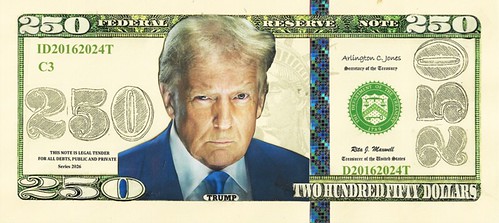
U.S. Treasurer Brandon Beach told the Daily Caller News Foundation on Wednesday that he is working on creating a $250 bill bearing the image of President Donald Trump.
The U.S. treasurer supervises the nation's currency and coinage production, with direct oversight of the U.S. Mint and Fort Knox.
Beach served as a Republican member of the Georgia State Senate for more than a decade before being appointed by Trump to his current position in May.
"When Trump appointed me to the job, I told him I wanted to do a $250 bill with his picture on the 250th birthday celebration" of the U.S., Beach told the Caller, adding that first, Congress must pass legislation changing the current law, which states that a president must be deceased to be featured on paper currency.
Beach confirmed that, if a bill passes Congress and is signed into law, he will immediately get to work on the $250 bill, which would become one of the highest-denomination bills currently in circulation.
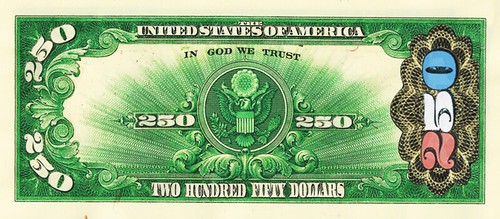
Notice that Beach's statement is conditional - "if a bill passes Congress." And given the multi-year (decade?) lead times for new paper money designs (due to the elaborate anti-counterfeiting measures required), I doubt this will ever happen. But for illustration, I included a couple design concepts submitted earlier by Wayne Pearson. -Editor
To read the complete article, see:
US Treasurer Pushes $250 Bill Honoring Trump
(https://www.newsmax.com/newsfront/u-s-treasurer-250-bill-trump/2025/12/31/id/1240310/)
To read the earlier E-Sylum article, see:
NOTES FROM E-SYLUM READERS: MARCH 9, 2025
(https://www.coinbooks.org/v28/esylum_v28n10a11.html)
ABOUT THIS ISSUE: JANUARY 11, 2026
This was a pretty normal week for creating The E-Sylum. Throughout the week I triaged incoming email, queuing up content for potential inclusion. On Wednesday I started forwarding some tasks to Garrett. Most of my free time over the weekend was spent pulling together and finalizing the issue.
With all the January auctions happening, we have a lot of auction previews. I enjoy these because of the great variety of numismatic items we're exposed to, including many high-condition "eye-candy" rarities.
But the weekend wasn't all work. On Saturday night my wife and I went out for a bowling night with three neighborhood couples. Hadn't done that since our kids were little. It was fun, even though my scores were horrible and Sunday I had soreness in leg muscles I forgot I had. In a group chat we exchanged photos from the evening, and my neighbor Scott couldn't resist the opportunity to use AI to turn a couple of us into ripped, bare-chested Chippendale dancers. At least my haircut and glasses are real. And the sixpack abs.

Finally, here are some interesting non-numismatic articles I came across this week. Be sure to scroll down on the Hollywood analysis - it gets interesting. And while "The Ridiculous Engineering Of The World's Most Important Machine" is a long video, it's very well done and informative. Where else could you get a free crash course in extreme ultraviolet lithography?
Did the ancient Romans wear underwear? The truth is surprisingly complicated
(https://www.historyextra.com/period/roman/ancient-roman-underwear-fashion-complicated-truth/)
What is the Most Successful Hollywood Movie of All Time?
(https://informationisbeautiful.net/visualizations/what-is-the-most-successful-hollywood-movie-of-all-time/)
Marking today's 250th anniversary of Thomas Paine's world-changing "Common Sense"
(https://www.axios.com/newsletters/axios-finish-line-ca3ac3f0-ee3d-11f0-b8ed-a71d8a85adcd.html)
The Ridiculous Engineering Of The World's Most Important Machine
(https://3quarksdaily.com/3quarksdaily/2026/01/the-ridiculous-engineering-of-the-worlds-most-important-machine.html)
-Editor


Editor Wayne Homren, Assistant Editor Garrett Ziss
Wayne Homren
Wayne Homren is the founding editor of The E-Sylum and a consultant for the Newman Numismatic Portal. His collecting interests at various times included U.S. Encased Postage Stamps, merchant counterstamps, Pittsburgh Obsolete paper money, Civil War tokens and scrip, Carnegie Hero Medals, charge coins and numismatic literature. He also collects and has given presentations on the work of Money Artist J.S.G. Boggs. In the non-numismatic world he's worked in artificial intelligence, data science, and as a Program Manager for the U.S. Department of Defense.
Garrett Ziss
Garrett Ziss is a numismatic collector and researcher, with a focus on American paper money and early U.S. silver and copper coins. He is also a part-time U.S. coin cataloger for Heritage Auctions. Garrett assists Editor Wayne Homren by editing and formatting a selection of articles and images each week. When he's not engaged in numismatics, Garrett is pursuing a Master's Degree in Quantitative Economics at the University of Pittsburgh.

Contributors Pete Smith and Greg Bennick
Pete Smith
Numismatic researcher and author Pete Smith of Minnesota has written about early American coppers, Vermont coinage, numismatic literature, tokens and medals, the history of the U.S. Mint and much more. Author of American Numismatic Biographies, he contributes original articles to The E-Sylum often highlighting interesting figures in American numismatic history.
Greg Bennick
Greg Bennick (www.gregbennick.com) is a keynote speaker and long time coin collector with a focus on major mint error coins and US counterstamps. He is on the board of both CONECA and TAMS and enjoys having in-depth conversations with prominent numismatists from all areas of the hobby. Have ideas for other interviewees? Contact him anytime on the web or via instagram
@minterrors.


Website host John Nebel and webmaster Bruce Perdue
John Nebel
Numismatist, photographer, and ANS Board member and Fellow John Nebel of Boulder, CO helped the ANA and other clubs like NBS get online in the early days of the internet, hosting websites gratis through his Computer Systems Design Co. To this day he hosts some 50 ANA member club sites along with our
coinbooks.org site, making the club and our E-Sylum archive available to collectors and researchers worldwide.
Bruce Perdue
Encased coinage collector (encasedcoins.info) Bruce Perdue of Aurora, Illinois has been the volunteer NBS webmaster from its early days and works each week to add the latest E-Sylum issue to our archive and send out the email announcement.

|
|
The E-Sylum is an electronic publication of the Numismatic Bibliomania Society Copyright © 1998 - 2026 | |