Visit our NBS Sponsors











About UsThe Numismatic Bibliomania Society is a non-profit association devoted to the study and enjoyment of numismatic literature. For more information please see our web site at coinbooks.org SubscriptionsThose wishing to become new E-Sylum subscribers can go to the following web page
Subscribe
MembershipThere is a membership application available on the web site Membership Application To join, print the application and return it with your check to the address printed on the application. Print/Digital membership is $40 to addresses in the U.S., and $60 elsewhere. A digital-only membership is available for $25. For those without web access, write to: Jeff Dickerson, Treasurer AsylumFor Asylum mailing address changes and other membership questions, contact Jeff at this email address: treasurer@coinbooks.org SubmissionsTo submit items for publication in The E-Sylum, write to the Editor at this address: whomren@gmail.com BUY THE BOOK BEFORE THE COINSale Calendar
|
- WAYNE'S WORDS: THE E-SYLUM APRIL 5, 2026
- KOLBE & FANNING BCD LIBRARY WEB SALE #2
- WORKMAN'S BOOKS SALE 8 SELECTIONS
- HOLABIRD RESEARCH LITERATURE SALE, PART 2
- WHITMAN ACQUIRES RIGHTS TO OVERTON BOOK
- NEW BOOK: OREGON CENTENNIAL TOKENS AND MEDALS
- NEW BOOK: MONEY BEYOND BORDERS
- BOOK REVIEW: TAIWAN PATTERN COINS, 1949–1987
- MARTIN ANTHONY LOGIES (1960-2025)
- 2026 NEWMAN GRANT APPLICATIONS DUE
- VIDEO: NUMISMATIC PROFILE: RANDY CAMPBELL
- MORE ON NUMORUM HUNGARIAE TRANSILVANIAE
- NOTES FROM E-SYLUM READERS: APRIL 5, 2026
- MSNS SPRING 2026 SPEAKERS AND MEETINGS
- VOCABULARY TERM: SIGNET MEDAL
- PAUL VITRY (1872-1941)
- MORE ON PAUL VITRY CATALOGUES
- PHILIPPINE COIN DESIGNER PAUL BALAN
- ANS ANNOUNCES RENAISSANCE MEDALS ONLINE
- NUMISMAGRAM MEDAL SELECTIONS: APRIL 5, 2026
- ARCHIVES INTERNATIONAL SALE 112 SELECTIONS
- ST. JAMES AUCTION 120 SELECTIONS
- STACK'S BOWERS: APRIL 2026 WORLD PAPER MONEY
- EARLY AMERICAN APRIL 2026 HISTORY AUCTION
- SEDWICK AUCTION 39 AND WINTER PARK SHOW
- CHICKENS ON ANCIENT COINS
- THE 2026 ROYAL MAUNDY MONEY CEREMONY
- OLYMPIAN GIVES TRUMP HER ORDER OF IKKOS
- BANKNOTES SALVAGED FROM THE SS EGYPT
- WYOMING'S GOLD STASH
- LOOSE CHANGE: APRIL 5, 2026
- PURPLE HEART MEDAL FOUND IN LOCKER
- ABOUT THIS ISSUE: APRIL 5, 2026
Content presented in The E-Sylum is not necessarily researched or independently fact-checked, and views expressed do not necessarily represent those of the Numismatic Bibliomania Society.
WAYNE'S WORDS: THE E-SYLUM APRIL 5, 2026
 New subscribers this week include:
Richard Long.
Welcome aboard! We now have 6,584 subscribers.
New subscribers this week include:
Richard Long.
Welcome aboard! We now have 6,584 subscribers.
Thank you for reading The E-Sylum. If you enjoy it, please send me the email addresses of friends you think may enjoy it as well and I'll send them a subscription. Contact me at whomren@gmail.com anytime regarding your subscription, or questions, comments or suggestions about our content.
This week we open with three literature sales, three books and one book review, an obituary, updates from the Newman Numismatic Portal, notes from readers and more.
Other topics this week include the Michigan State Numismatic Society Spring show events, signet medals, Paul Vitry, Paul Balan, Renaissance medals, fixed price and auction highlights, Maundy coins, another medal for Trump, Wyoming's gold stash, and a found Purple Heart.
To learn more about the Treasure of the Atocha, Capped Bust half dollars, Oregon Centennial Municipal Trade Tokens and Medals, world trade currencies, Taiwan Pattern Coins, Randy Campbell, the 1865 SS Pewabic shipwreck, Indian banknotes recovered from the 1922 wreck of the SS Egypt, Civil War Soldier Identification Discs, Encased Postage Stamps, chickens on ancient coins, and "the Hebrew Hammer", read on. Have a great week, everyone!
Wayne Homren
Editor, The E-Sylum

Image of the week
KOLBE & FANNING BCD LIBRARY WEB SALE #2
Numismatic Booksellers Kolbe & Fanning have a web sale closing April 16, 2026. Here are some selections. -Editor

Second BCD Web Sale April 16
Kolbe & Fanning Numismatic Booksellers are pleased to announce that we will be holding the second Web Sale devoted to selections from the outstanding BCD Library on Thursday, April 16. The BCD Library is famous for its extraordinary depth, particularly in works pertaining to ancient Greek coinage and culture. Carefully formed over the course of half a century, the library includes thousands of titles on various aspects of Greek life, art and coinage.
Our Web Sales focus on useful but lower-price books, catalogues and periodicals, and this offering of material from the BCD Library includes publications on a wide variety of topics, mostly pertaining to antiquity, all of which are listed with a starting price of only $10. The online catalogue can be accessed at bid.numislit.com. There is no printed catalogue.
Along with more commonly available references, a number of rarities and other delicacies are included.
Some highlights of this second BCD Web Sale include:


Lots 274 and 304
Lot 274: Paul Lambros's 1870 study of the coins of the island of Amorgos, in a remarkable binding featuring hand-crafted metalwork in a distinctive style
Lot 304: Alfred Mamroth's Die Bronzemünzen des Königs Philippos V. von Makedonien (1935), with two fine plates and supplemented with added illustrations of the coins discussed


Lots 286 and 104
Lot 286: Christian Sigismund Liebe's massive, handsomely produced 1730 catalogue of the Saxe-Gotha collection, featuring 316 fine engravings of ancient coins in the text
Lot 104: Ludovico de Biel's 1733 study of ancient coinage, Utilitas Rei Numariae Veteris, with two folding plates of coins

Lot 495: J.N. Svoronos's 1898 portfolio of 35 fine phototype plates of ancient Greek coins, issued to accompany the 1898 Greek edition of Head's Historia Numorum
 Register early to bid online
Kolbe & Fanning use Auction Mobility as our third-party online bidding platform, which is separate from our retail site. Auction Mobility is an app-based platform allowing users the ability to participate in the sale through phones, tablets and computers. To register for the sale, bidders must go to bid.numislit.com and sign up. Once you have set up an account, you may browse lots, place advance bids, or participate in the live sale online. Those wishing to participate on their devices can download the Kolbe & Fanning app through the Apple or Google Play Store.
Kolbe & Fanning Numismatic Booksellers LLC is a licensed and bonded auction firm in the State of Ohio, and our sales are conducted by licensed auctioneers. For more information, please see the Kolbe & Fanning website at numislit.com or email David and Maria Fanning at orders@numislit.com. To register for the sale, go to bid.numislit.com. We look forward to your participation.

WORKMAN'S BOOKS SALE 8 SELECTIONS
Alan Workman has a numismatic literature sale closing April 25, 2026. Here's an update and selected lots. -Editor

A Fine Selection of Numismatic and Treasure Books, Auction Catalogs and Magazines
 Workman's Books is pleased to present its eighth sale, featuring a substantial and carefully curated selection of literary material and related media focused on Spanish American, United States, Ancient, and World numismatics, as well as buried and sunken treasure, metal detecting, treasure hunting, underwater archaeology, and piracy. The auction includes a number of rare and desirable works bearing author signatures or inscriptions, with notable names such as Mel Fisher, Kip Wagner, Mendel Peterson, Robert Marx, and "Frogfoot" Weller represented. This single-session sale will begin closing at 10:00 AM EDT on April 25, 2026, and will offer 503 lots, including rare, vintage, and out-of-print books, post-auction catalogs, magazines and journals, maps, postcards, and vintage media formats such as VHS tapes and DVDs.
This bid sale is being held through the online venue iCollector, and all registrations, approvals, and bids will be handled there. For this bid sale the lots will be closing on a timed interval with extensions of 1 minute for any bids placed within 1 minute of closing. If you already have an iCollector account, you still must "GET APPROVED" to bid for each sale by entering and confirming your information for this bid sale, like reviewing your shipping information and choosing your preferred way of payment. Remember, tie bids go to the earliest bidders, so don't wait for the lots to close to bid on anything for which you have a strict number in mind.
Now is the perfect time to register for the bid sale, as any registration issues can certainly be accommodated more easily in advance. Do not wait to register the last day. Registration and bidding online are always FREE (no extra fees or percentages for bidding online). Once you are registered and automatically approved, first be sure to bookmark the items that interest you.


Lots 30 and 40
Lot 30: Borrell, Pedro J. THE QUICKSILVER GALLEONS - THE SALVAGE OF THE SPANISH GALLEONS NUESTRA SENORA DE GUADALUPE AND EL CONDE DE TOLOSA. Underwater Archaeological Recovery Commission, Dominican Republic. 1984. 8vo. 122 pages. original pictorial card covers. B&w and color photos and illustrations throughout. English text. Fine. This book tells how two Spanish Galleons, the 'Nuestra Senora de Guadalupe' and 'El Conde de Tolosa', sank in 1724 off the coast of the Dominican Republic.. and the salvage of them in the late 1970's and early 1980's. Many of the artifacts recovered are illustrated. Lot weight: 0 lbs 11oz. Subject(s): Sunken Treasure.
Lot 40: Breen, Walter. WALTER BREEN'S COMPLETE ENCYCLOPEDIA OF U.S. AND COLONIAL COINS. FCI Press, Inc/Doubleday, New York. 1988. 4to. xiv, 754 pages. original black cloth, gilt, jacket. Tables. Glossary. Bibliography. b&w coin photos throughout. English text. Fine. Drawing on a lifetime of research, America's top coin historian presents the most comprehensive guide to U.S. coins ever published. It covers every conceivable aspect of American numismatics. The definitive numismatic reference book for the advanced collector, with over 4,000 illustrations. Lot weight: 5 lbs 0oz. Subject(s): United States Coinage.


Lots 61 and 85
Lot 61: Calico, Xavier. NUMISMATICA ESPANOLA. CATALOGO DE LAS ACUNACIONES REALIZADAS DESDE LOS REYES CATOLICOS A JUAN CARLOS I 1474 A 2020. Aureo & Calico, Barcelona. 2019. 4to. 575, (1) pages. original black leatherette, gilt, jacket. Eleventh Edition. Color coin photos throughout. Spanish text. Fine. This book is a comprehensive illustrated catalog and price guide to the gold, silver, and copper coinage of the various monarchs and mints in Spain and Spanish America from 1474 to 2020. Lot weight: 5 lbs 13oz. Subject(s): Spanish, Spanish American Coinage.
Lot 85: Craig, Alan K. SPANISH COLONIAL GOLD COINS IN THE FLORIDA COLLECTION. The University of Florida Press, Gainesville. 2000. 4to. xiv, (2), 94, (2) pages. original dark tan cloth over ochre boards, gilt, jacket. Inscribed by the author. Map. Tables. Appendices. Notes. Bibliography. 16 color coin plates. B&w photos and line illustrations. English text. Fine. This is a catalog of the gold cobs in the State of Florida Collection that were recovered from the 1715 Spanish Plate Fleet wrecks and handed over to the state as part of their division from the salvors. A history of the salvage operations, the minting processes, the mints, and the coins are covered in this work. Lot weight: 1 lbs 2oz. Subject(s): Spanish American Coinage.


Lots 145 and 201
Lot 145: Gilboy, Frank F. THE MILLED COLUMNARIOS OF CENTRAL AND SOUTH AMERICA - SPANISH AMERICAN PILLAR COINAGE, 1732 TO 1772. Prairie Wind Publishing, Inc., Regina. 1999. 4to. x, 293, (1) pages. original blue cloth, lettered in silver, jacket. Maps. Appendix. Bibliography. B&w coin photos and line illustrations throughout. Errata sheet laid in. English text. Fine. This is THE BOOK on pillar dollars, with incredible detail on design features and changes, development history, and background. Covers all denominations and mints and notes each coin's rarity. Lot weight: 2 lbs 13oz. Subject(s): Spanish American Coinage.
Lot 201: Lazaro, Jose Luis. LOS REDONDOS DE LIMA, MEJICO Y POTOSI Y OTRAS ACUNACIONES ESPECIALES. Jose Luis Lazaro Dominguez, Madrid. 1996. 8vo. 461, (3) pages. original brown leatherette, lettered in silver. First Edition. Limited edition, copy #546 of 1000 copies. B&w coin photos throughout. addenda booklet laid in. Spanish and English text. Fine. This book is a foundational reference for identifying and classifying some of the rarest and most prestigious Spanish colonial silver coins: the "redondos" (round) pieces of eight. Unlike the typical irregularly shaped "cobs" of the era, these special round strikes from the mints of Lima, Mexico City, and Potosí were often produced for specific ceremonies or as high-quality presentation pieces. The work provides essential technical data, historical context, and detailed illustrations that help collectors distinguish authentic specimens from common issues and understand the unique minting circumstances of these "special strikes". Lot weight: 3 lbs 1oz. Subject(s): Spanish American Coinage.


Lots 239 and 308
Lot 239: Mathewson, R. Duncan, III. TREASURE OF THE ATOCHA - A FOUR HUNDRED MILLION DOLLAR ARCHAEOLOGICAL ADVENTURE. Pisces Books, New York. 1986. 8vo. 160 pages. original black embossed cloth, gilt, jacket. Signed and inscribed by Mel Fisher. Published in conjunction with the Seafarers Heritage Library. Mapped endpages. Appendices. Bibliography. Maps. B&w and color photos and illustrations throughout. English text. Fine. This book tells the story of the finding and salvage of the 'Atocha', which sank off Key West, Florida in 1622, from the archaeologist's perspective. The author was the lead archaeologist who worked on the 'Atocha' salvage. Lot weight: 1 lbs 5oz. Subject(s): Sunken Treasure.
Lot 308: Rock, Jeff. ROSA AMERICANA, LTD. PRESENTS FIXED PRICE LIST NUMBER NINETEEN. Rosa Americana, Ltd, San Diego. 2010. 4to. 276 pages. original tan printed card covers. 28 b&w coin plates. English text.Fine. Lot weight: 1 lbs 14oz. Subject(s): United States Coinage.


Lots 444 and 454
Lot 444: Ponterio & Associates, Inc. THE PAUL KARON POTOSI COB COLLECTION. March 17, 1990. 4to. 1-1212 Lots. Original pictorial card covers. Public Auction Sale. Sale No. 42. Chicago. 96 Pages. 29 b&w plates. PRL. English text. Fine. This post auction sale catalog is a seminal reference work specifically focused on the Potosi mint. It documents the Paul Karon Collection, which was groundbreaking for its time because it featured high-quality photographs of nearly every lot, including smaller and often overlooked denominations. Beyond being a simple auction record, the catalog is valued for its expert scholarly articles on rare 1652 transitional cobs and half-reale denominations, making it an essential "bookcase" resource for identifying and pedigreing high-grade Bolivian silver cobs. Of special note in this collection are 28 heart-shaped cobs including a 1710 and a 1734 8 reales, a 1701 and a 1734 4 reales, and 58 royals including a 1725, 1751 and 1756 8 reales and 1727 4 reales. Lot weight: 1 lbs 0oz. Subject(s): Bolivian Coinage.
Lot 454:Sotheby's - New York. TREASURES FROM THE 'S.S. CENTRAL AMERICA'. December 8-9, 1999. 4to. 1-250 Lots. Original pictorial card covers. Signed by several well-known individuals related to Sotheby's, United States gold coin market and sunken treasure salvage as follows (from top to bottom, left to right): Dick Downes, treasure salvor and coin dealer; Tom Sebring, author of the sunken treasure book, "Treasure Tales. Shipwrecks and Salvage"; James Morton, head of Sotheby's numismatic branch; David Tripp, the Sotheby's cataloger for the sale; Don Kagin, well-known US gold coin dealer; the late David Redden, Sotheby auctioneer; John Kleeburg, a well-known numismatic author; and an unidentified signature. Public Auction Sale. New York. 205 pages. b&w and color coin and ingot photos throughout. PRL. English text. Fine.
This auction sale catalog includes numismatic material from the United States with the main focus on coins recovered from the wreck 'S.S. Central America'. The sale includes 250 lots of spectacular Gold Rush era gold coins (mostly double eagles), gold bars (many from rare private California mints), and nuggets salvaged from the steamer, 'S.S. Central America,' which sank off the coast of North Carolina in 1857. The history of many of the private mints are also provided, along with many vivid color photographs.
New York, Sale 7415, original pictorial card covers, 205 pages, color & b&w plated throughout, fine, includes revised estimates list laid in, The auction was originally scheduled to be held on December 8 & 9, 1999 in New York City but was actually held on June 20 & 21, 2000 due to a law suit which delayed the sale. Lot weight: 1 lbs 9oz. Subject(s): United States Coinage.
For more information, or to bid, see:
A Fine Selection of Numismatic and Treasure Books, Auction Catalogs and Magazines, Sale 8
(https://www.icollector.com/A-Fine-Selection-of-Numismatic-and-Treasure-Books-Auction-Catalogs-and-Magazines-Sale-8_as113955)
To read the complete .pdf catalog, see:
https://workmansbooks.com/downloads/WB%20Auction%20008%20catalog.pdf

HOLABIRD RESEARCH LITERATURE SALE, PART 2
Books on mining, metals, numismatic and historical research are being offered by recently retired dealer Fred Holabird. Here's the announcement from an April 2, 2026 emailing. -Editor
Second Release from Fred Holabird's Research Library
 Wow! I was really excited after my first duplicate book list went out. I tried to put little notes here and there, as well as try to keep the prices reasonable to cheap, except great rarities.
I've gone through another round, added about 100 more, and deleted those sold from the first go-round. I've got more boxes to go through yet. When I combined two libraries of decades in the making, there were bound to be duplicates, many of complete surprise to me, like the Truckee directory, and some of the Gold Rush stuff.
Wow! I was really excited after my first duplicate book list went out. I tried to put little notes here and there, as well as try to keep the prices reasonable to cheap, except great rarities.
I've gone through another round, added about 100 more, and deleted those sold from the first go-round. I've got more boxes to go through yet. When I combined two libraries of decades in the making, there were bound to be duplicates, many of complete surprise to me, like the Truckee directory, and some of the Gold Rush stuff.
You can view my updated book list and prices here.
For years, I have been after the contents. The info out of that author's brain is what I'm after. I also have been after signed copies from the great geologists and mining men. I might be the only collector… well, maybe…
I generally only acquired primary source material. Thus my Cal gold rush, Nevada, California, Arizona; assaying, mining & metallurgy sections are exceptional. This is the stuff I use to write so many papers.
Speaking of primary source material, Newspapers.com just published a great portion of the Territorial Enterprise within the last week! We've never been able (us historians and archivists) to put together a full run of that famous paper. The early years are generally missing, with a few issues scattered about in various institutions.
 During the process, I even discovered a couple books I wrote that I had completely forgotten about. It also reminded me of some articles I wrote regarding Browne, Raymond and more, and I just found those today, and hope to re-work them and publish again so you can download the info.
Dave Schenkman and I have been working on a fun book about American mining history and the mining tokens and scrip that were used in the early 19th c to early 20th c. I thought I had my part mostly done, until I reread my original manuscript, and … well, you know, … it's clear a rewrite is in order after sitting for 30 years…..
If you'd like books, please email me at fredholabird@gmail.com
Or call 775 843-0229.
To read the earlier E-Sylum article, see:
FRED HOLABIRD OFFERS RESEARCH LITERATURE
(https://www.coinbooks.org/v29/esylum_v29n13a02.html)

WHITMAN ACQUIRES RIGHTS TO OVERTON BOOK
Whitman Brands has acquired the rights to the Overton-Parsley works on Capped Bust half dollars, the definitive reference in the field. -Garrett
 Whitman Brands™, a leading full-service provider of data, media, and product distribution for the numismatics and collectibles marketplace, announces the landmark acquisition of the rights to the esteemed works of Al C. Overton and Donald L. Parsley. This acquisition secures the future of the definitive authority on the Capped Bust Half Dollar series: Early Half Dollar Die Varieties 1794–1836.
For over half a century, the Overton numbers have served as the universal language for collectors of early American silver. By bringing this foundational research into the Whitman portfolio, the company ensures that the legacy of meticulous scholarship established by Al Overton and continued by Donald Parsley will be preserved and expanded for future generations of numismatists.
A Legacy of Family and Scholarship
The story of the Overton reference is one of passion and family devotion. Al C. Overton published his first full-length book on the series in 1967, revolutionizing the hobby by introducing a systematic methodology for identifying die marriages. His work turned a complex field of study into an accessible pursuit for thousands of collectors.
Upon his passing, Al's daughter, Bonnie, and her husband, Donald Parsley, took up the mantle to ensure the work remained the industry standard. Donald, who had assisted Al with the very first edition, spent over 40 years studying the series. Under Donald's stewardship—and with Bonnie's steadfast support—the reference evolved through multiple editions, significantly improving plate quality and rarity data. The Parsleys' dedication transformed a family heritage into a monumental contribution to American numismatic history.
The Union of Two Publishing Giants: Whitman and CDN
This acquisition marks another milestone for Whitman Brands. Whitman, founded in 1934, is the creator of the iconic Guide Book of United States Coins (the "Red Book") and the Handbook of United States Coins (the "Blue Book"). Originally a subsidiary of Western Publishing, Whitman helped popularize coin collecting for the masses with its ubiquitous blue coin boards, which later evolved into the folders and albums that continue to define the hobby today.
In 2023, Whitman was acquired by CDN Publishing, the esteemed publisher of the Greysheet and the industry's leader in wholesale pricing data since 1963. In 2024 Whitman acquired the rights to the entire Friedberg Collection—Paper Money of the Unted States, Gold, Coins of the World, So-Called Dollars, and Early Dated Coins of Europe—and the industry-standard Friedberg Numbering System. Last year, Whitman launched a completely reimagined and redesigned 2026 edition of the Red Book, integrating industry standard, Greysheet-based retail market values in up to nine grades for more 12,000 coins, tokens, medals, sets, and other collectibles.
Today, as one company under the leadership of John Feigenbaum, President and CEO of Whitman Brands, Whitman continues to provide authoritative content, market insight, and trusted experiences to collectors, dealers, and institutions worldwide
Looking Forward
"The Overton-Parsley research is the bedrock of early half-dollar collecting," said John Feigenbaum, President and CEO of Whitman Brands. "It is a profound honor to be entrusted with Al and Donald's legacy. We look forward to utilizing our digital and print resources to keep this essential data at the fingertips of every specialist in the field."
Plans for future editions and digital integrations of the Overton-Parsley data will be announced in the coming months.
For more information, upcoming book releases, and other collecting supplies, visit whitman.com.

NEW BOOK: OREGON CENTENNIAL TOKENS AND MEDALS
 Jan Monroe writes:
William (Bill) Hyder and I have published a new book on Oregon Centennial Municipal Trade Tokens and Medals from 1959. This book includes about 38 different major types and over 100 different varieties. The municipal locations are arranged alphabetically. The book includes a detailed analysis of die varieties with four major varieties identified. A suggested emission sequence is included. Mintage figures are included where known and newspaper reports were analyzed for details about the local issues.
The book is 55 pages long with enlarged photos detailing the 4 die varieties. A checklist is included at the end of the book. This book is available from the publisher at Blurb Books at blurb.com. The cost is about $21."
Here's an excerpt from the book's Introduction. -Editor


This catalog is part of a larger body of work by the authors (and other contributors) that endeavors to catalog information on Official, Semi-official, and private state and territorial anniversary commemorative medals, medallions, medalets and commemorative coins (which are collectively referred to as exonumia).
Other locations cataloged so far include Montana, Wyoming, Nebraska, Kansas, and Vermont. None of these are in print yet, however presentations have been made to small audiences.
The emphasis in these efforts is on exonumia that commemorates officially sanctioned events about the state by the state and or federal government. Such events include anniversaries of discovery, exploration, settlement, creation of a Territory, and Statehood. It does not include state medals that celebrate federal anniversaries such as the revolutionary war, declaration of independence, etc. It also does not include Town or City anniversaries unless it is the first location of settlement. Dual purpose exonumia that celebrate a state anniversary and a local event in the same year are included.
Typical anniversary dates are: 25th year (silver jubilee), 50th year (semi-centennial or golden jubilee), 75th year (diamond jubilee), 100th year (centennial), 150th year (sesquicentennial), 200th year (bicentennial) etc.
To be listed in this catalog (and other catalogs in this endeavor), items must be issued within two years of the actual anniversary date. The only anniversary items that are included are anniversaries not more often than every 25 years. For example, a medal issued to celebrate the 35th anniversary would not be included.
There are also many privately issued exonumia items that have not been sponsored or authorized by local government, state government, or the federal government. Some of the more common privately issued exonumia items will be listed as Appendices at a later date (For example Heraldic Art Medals).
This catalog is intended to be an asset to collectors of historical medals and other exonumia. It is organized by state and chronologically (oldest items first). Within each anniversary year items are listed alphabetically by location with statewide items listed first.


Congratulations - this took a lot of work and the effort will be appreciated by collectors future and present. Here's some additional information and a link to the ordering page. -Editor
- Format: Softcover
- Size: 8.5×11 in, 22×28 cm
- # of Pages: 64
- Publish Date: Mar 03, 2026
- Language: English
For more information, or to order, see:
Oregon Centennial Medals
(https://www.blurb.com/b/12798608-oregon-centennial-medals)
NEW BOOK: MONEY BEYOND BORDERS
A new book by international monetary expert Barry Eichengreen provides an historical perspective on world trade currencies from ancient times to today. -Editor
 Doubts about the international dominance of the dollar are only growing amid worries about tariffs, political dysfunction, and fraying international alliances. Will the dollar continue to reign supreme? In Money Beyond Borders, the leading authority on international currencies, Barry Eichengreen, puts the dollar's prospects in deep historical perspective by chronicling the entire history of cross-border currencies, from the invention of coins in the seventh century BCE to the cryptocurrencies of today and the central bank digital currencies of tomorrow.
Money Beyond Borders recounts how Greek and Roman coins became the first true international currencies. It tells how the Florentine gold florin became the "greenback of the Renaissance," and how it was succeeded by Spanish silver and a Dutch fiat currency. The book explains why the British pound dominated the international economy in the nineteenth century, why the dollar rose to the top during World War II, and why the dollar has survived predictions of the imminent loss of its preeminence since the 1970s.
The long history of international currencies shows that the same factors that encourage their widespread use eventually lead to their abandonment. Money Beyond Borders makes a powerful case that the dollar is now on the downside of this cycle, and it considers who the winners and losers will be when there is flight away from the greenback. Revealing important patterns in the life cycles of international currencies over the past 2,500 years, the book offers valuable lessons and insights about how currencies rise—and why they fall.
For more information, or to order, see:
Money Beyond Borders: Global Currencies from Croesus to Crypto
(https://press.princeton.edu/books/hardcover/9780691280530/money-beyond-borders)
The author was interviewed in an article found via News & Notes from the Society of Paper Money Collectors (Volume XI, Number 40, March 17, 2026). -Editor
What inspired you to write a history of global currencies, and why did this feel like the right moment?
Barry Eichengreen: I wrote the book because of a confluence of two factors. First, angst about the global role of the U.S. dollar. The dollar is used, as everyone knows, not just in the United States but around the world. But now there are worries that the U.S. is squandering the benefits of the currency's singular status. Some worries are familiar, such as those around the country's soaring debts. But others are new, such as whether the U.S. is a reliable alliance partner. We see the Europeans actively seeking to move away from the dollar as a way of hedging their bets, as a way of limiting their exposure to the currency of an erratic foreign power. I thought that looking at these issues historically – at how geopolitics and not just economics have shaped the international influence of currencies – could shed light on our current predicament.
Second, we're in the midst of a digital revolution where new financial technologies – cryptocurrencies, stablecoins, central bank digital currencies and the like – are radically reshaping the global financial landscape. Of course, the monetary and financial landscape has never stood still. There have been financial innovations before. But I thought that tracing the impact of such innovations on the rise and fall of monies, going back all the way to the invention of coinage itself, in Lydia in the 7th century BCE, could help us better understand what is coming.
Your book shows that currencies rise and fall for similar reasons. Is there a past example that really captures this pattern?
BE: My favorite example is probably by solidus of Byzantium, and not just because the historian Robert Lopez, writing 75 years ago, dubbed it "the dollar of the Middle Ages." By the 5th century CE, the solidus was used in trade everywhere from India to Britain. Its wide acceptance rested on its stability – its value remained unchanged for 7 centuries. It rested on Byzantium's prowess as a trading power – as an economy strategically positioned between Europe and Asia. It rested on the reputation of Byzantine officials for fiscal probity and fair administration of taxes.
But over the centuries, Byzantium's economy decayed for a combination of internal and external reasons. Land became concentrated in the hands of large estate holders, who used their political leverage to extract concessions, including tax exemptions, from the imperial administration. Powerful enemies bogged down the Byzantines in endless military conflicts. Rising powers like the city-states of Genoa and Venice challenged seafaring Byzantine traders but also developed international currencies of their own. By the end of the 11th century, the gold solidus was history, as they say.
To read the complete article, see:
Barry Eichengreen on Money Beyond Borders
(https://press.princeton.edu/ideas/barry-eichengreen-on-money-beyond-borders)
BOOK REVIEW: TAIWAN PATTERN COINS, 1949–1987
James Contursi submitted this review of the new bilingual (Chinese and English) book Taiwan Pattern Coins, 1949–1987. Thank you! -Editor
 Wang, Yung-Ching 王永慶.
Taiwan yang bi, 1949 – 1987 台灣樣幣, 一九四九 – 一九八七
Taiwan Pattern Coins, 1949–1987
Taipei City: Author, 2025
Taipei City: Author, 2025
Hardcover, 18.5cm x 26cm, 272 pages, full color throughout: photos, facsimiles.
ISBN: 978-626-01-3899-8
Largely bilingual (Chinese and English)
Price: US$199, includes shipping; or for E-Sylum readers contacting the seller directly, US$179, includes shipping
Contact:
tigercoins@gmail.com
The Taiwan coin-collecting community was surprised and delighted in March of 2025 by the publication of Wang Yung-Ching's work: Taiwan Patterns, 1949-1987.
In 1995, the author's father, Wang Ming-Zong, at the age of 49, bought his first Taiwan pattern. In his new book, Wang Yung-Ching publishes the prototypes, largely from his father's collection, but augmented with examples and data contributed by fellow-collectors. He distills his research findings, ferreted out from earlier publications, from documents and correspondence of the Central Mint of China, the National Archives, and the US Treasury Department, and uses these to reconstruct the developmental history of Taiwan's coinage.

There are two hugely important differences, distinguishing Wang's book from those of his predecessors: 1) he provides more and original source data; and 2) through the benefits of X-ray Fluorescence (XRF), he was able to ascertain a more accurate alloy composition analysis of his specimens.
The book is composed of three chapters and five appendices.
The first three headings of Chapter 1 deal with the formation of the Bank of Taiwan; the multiple and severe, inflationary crises it faced from June, 1948 to June, 1950; and its attempts at currency reform, including the issuance of the New Taiwan dollar. In 1950, with the outbreak of the Korean War, the US, recognizing Taiwan's strategic value, shifted its foreign relations policy and resumed aid to Taiwan. Since Taiwan's military expenditures were gobbling up nearly three-quarters of the nation's budget, this injection of US financial aid assisted in the eventual arresting of inflation, and the propelling of Taiwan to a near-miraculous economic recovery.
The last section of Chapter 1 briefly reviews, as the heading states, the "Inaugural Design" for the first New Taiwan dollar-coin.

Chapter 2, the "Catalog," comprised of 170 pages, represents the bulk of the book. However, before immersing oneself in Wang's photo gallery and detailed analyses, there is a six-page prelude. In a subsection, entitled "The Definition of PATTERN Coins," Wang clearly defines his terms and explains his use of "PATTERN" in the upper case as encompassing—much to any numismatists delight—the full array of pre-circulation-strike numismatic products: patterns, off-metal strikes, trial pieces, die trials, and specimens.
Further, he offers a rarity scale, ranging from R1 (rarest) to R5 (most common), "estimated to be not more than 40 pieces," and UTD (unique-to-date) items.
It is worth noting that the latest (47th) edition of the Standard Catalog of World Coins, 1901-2000, published in 2019, lists 74 Taiwan patterns. Wang, using his expanded definition of PATTERN, more than doubles that figure, archiving and picturing 161 examples, including 20 UTDs.


In Chapter 3, "Provenance," Wang discusses the 1949 hubs and dies; the varying colors of PATTERN coins; and pre-casting proposals. This is followed by some intriguing data analysis—all substantiated by translations of telegrams and mint directives—of the 1949 weight-based gold ingots. Finally, the appendices. The first offers a 4-page layout of the Central Mint's year 57 (1968) and year 58 (1969) design drafts for F.A.O. (the United Nations Food and Agriculture Organization) coinage, none of which designs was ever adapted.
The index informs that ensuing appendices include: "The Manuscript of Mr. He Lien-Sheng"; "Die Trials"; "How Dies Are Made"; and "Evacuation of the Sichuan Branch."
The only notable quibble with this book is that the “Preface” (前言) and “Introduction” (序) are completely monolingual (Chinese), while the “Appendix” offers less than a handful of words bilingually. This, however, only amounts to an inconvenience, since it is readily rectifiable with Google translator (as the author of this review has done). The few untranslated preliminary pages detail how the collection was formed, over what time-period, and the names a half-dozen influential pattern collectors from whom purchases were made. Further, it mentions earlier Taiwanese pattern-research publications, with the 1984 work, Taiwan Pattern Coins (1949-1976) (台灣試鑄幣 / Taiwan shi zhubi) by Chen Hong-pin (陳宏賓), previously considered the most comprehensive reference in this specialized disciple.
Wang Yung-Ching's book is at once a masterful piece of numismatic sleuthing and a labor of love. The scope, meticulous research and analysis, and high-resolution color photos have already earned his work shelf-space in the libraries of such esteemed institutions as the American Numismatic Association, the National Museum of American History, National Palace Museum in Taipei, and The Royal Mint Museum; and belongs in the library of anyone with an interest in the evolution of Taiwan's coinage—whether neophyte or advanced specialist. It is already an invaluable research tool, and it is sure to remain unsurpassable for years, if not decades, to come.

MARTIN ANTHONY LOGIES (1960-2025)
David Gladfelter alerted me to last year's passing of collector and bibliophile Martin A. Logies of The Cardinal Collection Educational Foundation and author of The Flowing Hair Silver Dollars of 1794. Here's an excerpt from his online obituary. -Editor
 Martin A. Logies
October 20, 1960 ~ March 6, 2025
Martin A. Logies, 64, of Middlefield, OH, passed away Thursday morning, March 6th, 2025 at UH-Geauga Medical Center. He was born in Cleveland, OH on October 25th, 1960 to the late Raymond C. and Joan R. (Pishnery) Logies.
Martin was a graduate of Case-Western Weatherhead School of Management and a CPA, a long-time owner of his own firm in Sunnyvale, California. He was also a well-known author and numismatist, specializing in rare Early American coins, and an avid floriculturist, growing and photographing roses and orchids.

Pete Smith submitted this biographical note. Thank you! -Editor
While Martin Logies received much publicity for his collections, he left very little record of his personal life.
Martin was born in Cleveland, Ohio, on October 20, 1960. His parents were Raymond C. Logies (1924-2017) and Joan R. Pishnery Logies (1929-2002).
As a high school senior in 1978, he received an award "for exceptional classroom achievement" in science.
He graduated from Case-Western Weatherhead School of Management. He did business as Martin A. Logies & Co., a CPA with Logies Skirtich & Co., in Sunnyvale, California.
Logies joined the American Numismatic Association in 1995 and 2001. He was life member 5927.
Martin had an extensive library that he used to establish pedigrees for coins in his collection. He served on the board for the Numismatic Bibliomania Society for two terns 2009 to 2013.
He was a floriculturist growing roses and orchids.
He died on March 6, 2025, at UH-Geauga Medical Center in Chardon, Ohio. There was no public service and his death went generally unnoticed in the numismatic press for more than a year.
For a 2004 article in The Numismatist, he wrote, "As a collector with a particular interest in early U. S. silver dollars, I have researched the series intensively for more than a decade and published several books and articles." I am not familiar with these publications.
Logies established the Cardinal Collection Educational Foundation in 2003 devoted to research and education, The Cardinal is a red bird, and symbol of his home state of Ohio. There are other institutions in Ohio named The Cardinal Collection including a virtual museum for the Ohio Department of Natural Resources.
Coins from the Cardinal Collection have been featured in a number of auction sales. The Stack's Bowers sale of January 24, 2013, included a number of finest known U. S. large cents, the highest graded 1792 half disme, and the 1794 silver dollar described as the first silver dollar struck at the Mint.
In 2010, Logies bought that first 1794 silver dollar from Steve Contirsi for 7.85 million dollars. At the time it was described as the most expensive coin in the country. It was acquired at auction in 2013 by Legend Numismatics for $10 million.
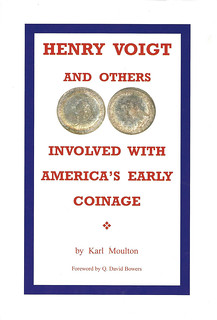

The Cardinal Collection Educational Foundation published Karl Moulton's book, Henry Voigt and Others Involved in America's Early Coinage in 2007.
Logies wrote The Flowing Hair Silver Dollars of 1794: An Historical and Population Census Study.
John "JD" Dannreuther writes:
"He bought the 1794 PCGS SP66 for his foundation (The Cardinal Foundation). I did the appraisal, as a non-profit required one. He later consigned it to auction and it was the first coin to sell for 10 million dollars. The foundation owned other coins but that was the only involvement I had with anything he purchased."
David Fanning writes:
"I knew Martin fairly well and was aware of his death. He was very private, though, so word didn't get around much. He was the Cardinal Collector, and was responsible for forming and curating the collection and library sold under the name of the Cardinal Collection. Our Sales 164 and 166 had a lot of his library in them—as did others.
"He wanted pretty much anything American, but was especially interested in auction catalogues. He formed some wonderful sets of the classic 19th-century cataloguers, often buying multiple large groupings to combine them and form the best he could assemble. His set of Steigerwalt catalogues was particularly memorable. He was one of my best customers back when I was a solo act, and remained a strong K&F customer for a decade or so."
Here are two David Lisot interviews relating to the Neil/Carter/Contursi specimen 1794 Flowing Hair silver dollar. -Editor
The Neil/Carter/Contursi specimen 1794 Flowing Hair silver dollar was sold in May for $7,850,000, setting a new record as the world's most valuable rare coin. Graded PCGS Specimen-66, it is the finest known 1794 dollar and believed by several prominent experts to be the first silver dollar ever struck by the United States Mint.
It was sold by Steven L. Contursi, President of Rare Coin Wholesalers of Irvine, California, to the nonprofit Cardinal Collection Educational Foundation (CCEF) in Sunnyvale, California. Collector and numismatic researcher Martin Logies represented the foundation of which he is a director and its numismatic curator. The private sale was brokered by Greg Roberts, President and Chief Executive Officer of Spectrum Group International of Irvine, California.
David Lisot interviewed Martin Logies, Curator Cardinal Collection Educational Foundation at the Long Beach Expo in June 2010.
To watch the video, see:
Interview with Martin Logies on the Purchase of the 1794 Silver Dollar for the Cardinal Collection
(https://www.youtube.com/watch?v=aj_dGIwXZ0g)
The Cardinal Foundation Collection specimen of the 1794 silver dollar recently set a record price as the most expensive coin selling for more than $10 million. Steven Contursi of Rare Coin Wholesalers sold the coin to the Foundation in 2007 and comments on the price realized.
To watch the video, see:
Steven Contursi Talks about the $10 Million Cardinal 1794 Dollar Sale.
(https://www.youtube.com/watch?v=RM7ToFi95EY)
To read the complete online obituary, see:
Martin A. Logies
(https://www.bestfunerals.com/obituary/MartinA-Logies)
To read earlier E-Sylum articles, see:
REVIEW: HENRY VOIGT AND OTHERS INVOLVED WITH AMERICA'S EARLY COINAGE
(https://www.coinbooks.org/esylum_v10n49a06.html)
ARL MOULTON ON HIS 'HENRY VOIGHT AND OTHERS' BOOK
(https://www.coinbooks.org/esylum_v10n50a11.html)
1794 DOLLAR BOOK PUBLISHED
(https://www.coinbooks.org/esylum_v07n33a08.html)
1794 DOLLAR OWNER MARTIN LOGIES INTERVIEWED
(https://www.coinbooks.org/esylum_v13n26a17.html)
2026 NEWMAN GRANT APPLICATIONS DUE
Newman Numismatic Portal Project Coordinator Len Augsburger submitted this reminder of the upcoming 2026 Newman Grants program deadline. Don't miss the boat - get some assistance for your numismatic research project! -Editor
Newman Grant Application Deadline
 The deadline for applications to this year's Newman Grants program is April 15. These grants are intended to subsidize the costs of numismatic research such as traveling, graphics arts and reproduction costs, or electronic database access. Awarded amounts are typically in the $1,000 to $5,000 range. Applications may be found on the Newman Numismatic Portal at
https://nnp.wustl.edu/library/archivedetail/530553?Year=2026 and should be submitted to
NNPCurator@wustl.edu.
The deadline for applications to this year's Newman Grants program is April 15. These grants are intended to subsidize the costs of numismatic research such as traveling, graphics arts and reproduction costs, or electronic database access. Awarded amounts are typically in the $1,000 to $5,000 range. Applications may be found on the Newman Numismatic Portal at
https://nnp.wustl.edu/library/archivedetail/530553?Year=2026 and should be submitted to
NNPCurator@wustl.edu.
Link to 2026 Newman Grants announcement in E-Sylum:
https://www.coinbooks.org/v29/esylum_v29n06a12.html

VIDEO: NUMISMATIC PROFILE: RANDY CAMPBELL
The David Lisot Video Library on the Newman Numismatic Portal can be found at:
https://nnp.wustl.edu/library/multimediadetail/522852

We highlight one of his videos each week in The E-Sylum. Here's one from the 2016 Central States show with Randy Campbell. -Editor
Current FUN president and former NSDR president has a long and honorable career in numismatics. Speaker: Randy Campbell. Running time: 65:37.
From the 2016 Central States Numismatic Society convention.
To watch the complete video, see:
Numismatic Profile: Randy Campbell 50 Years in the Coin Business
(https://youtu.be/eNBGqB31HAM)
Numismatic Profile: Randy Campbell 50 Years in the Coin Business
(https://nnp.wustl.edu/library/book/540213)

MORE ON NUMORUM HUNGARIAE TRANSILVANIAE
Last week Michael Wehner asked about a recently-purchased book on Hungarian and Transylvanian numismatics. David Fanning of Kolbe & Fanning Numismatic Booksellers passed along listings from two previous sales - the first is the plate volume only, the second is the text volumes. The images are from last week's article. -Editor


From our Sale 151:
Exquisite Plates of Hungarian & Transylvanian Coins
322 (Schönvisner, Stephan). TABULAE NUMISMATICAE PRO CATALOGO NUMORUM HUNGARIAE AC TRANSILVANIAE INSTITUTI NATIONALIS SZÉCHÉNYIANI. (Pest, 1810). Plate volume only. Oblong folio [35 by 22 cm], contemporary brown leather and marbled boards; old numeric annotation on front cover. Engraved title; 79 + 20 + 8 engraved plates of coins and medals. Binding somewhat worn. Very good. $150
While the three accompanying text volumes are not present, this remains a valuable and useful work in addition to being quite beautiful. Fejér & Huszár 21. Leitzmann 23.
From a 2003 Kolbe fixed price list:
585 (Schönvisner, Stephan). CATALOGUS NUMORUM HUNGARIAE AC TRANSILVANIAE INSTITUTI NATIONALIS SZÉCHÉNYIANI. PARS I. NUMI HUNGARIAE. PARS II. NUMI TRANSILVANIAE. PARS III. NUMI MISCELLANEI. APPENDIX AD CATALOGUM NUMORUM HUNGARIAE AC TRANSILVANIAE INSTITUTI NATIONALIS SZÉCHÉNYIANI). Pestini: Typis Matthiae Trattner, 1807-1810. Four volumes of text, bound in three, plate volume not present. 492, (12); 109, (3); 399, (9); 252, (8) pages. Matching tan calf and boards, gilt, joints cracked, internally fine. 275.00
Fejér & Huszár 21. Leitzmann page 23. Herstal: "Elementarwerk, wichtig und selten." With the rarely offered Appendix volume but lacking the plate atlas
Former NBS President Marc Ricard writes:
"I found that Michael and Stefan Lenzen of Antiquariat Lenzen in Düsseldorf, Germany are selling the 1810 first edition in a different format on AbeBooks. And as expected from the Lenzen's, there is a significant historical description on the sale page."
Here's a Google-translated excerpt from the AbeBook item listing, with some images. -Editor

Oblong 4to. 23 x 38 cm. [1], 79, 20, 8 leaves. Provisional cardboard binding with a cloth-reinforced spine. First Edition. Latin edition [titles and captions]. Leitzmann 23 [Schoenvisner]. 107 plates, each featuring multiple numismatic copper engravings.
The plate volume accompanying Schönwiesner's authoritative three-volume coin catalogue, *Catalogus numorum Hungariae ac Transilvaniae Instituti Nationalis Széchényiani*. The first section comprises 79 plates depicting coins of the three Hungarian royal dynasties, ranging from Stephen I to Francis II; the second section contains 20 plates with corresponding Transylvanian coins; and the third section consists of 8 plates of *Miscellanea*, including Hungarian prelates as well as Hungarian and Transylvanian families.


Here's what Adrián González-Salinas found. -Editor
I did read the article of Michael Wehner about "Numorum Hungariae Transilvaniae Information Sought" appeared in The E-Sylum (Volume 29, Number 13, March 29, 2026) and I'd like to share the information I found in Internet and some books that I have in my library.
Book: "Tabulae Numismaticae Pro Catalogo Numorum Hungariae ac Transilvaniae Instituti Nationalis Széchényiani" The translation would be "Numismatic Tables (Plates) for the Catalog of Coins of Hungary and Transylvania of the National Széchényi Institute".
Instituti Nationalis Széchényiani is the Latin name for present-day Hungarian National Museum, which was founded in 1802 and was based on a collection donated by Count Ferenc Széchényi de Sárvár-Felsovidék (Fertoszéplak, Hungary 28 April 1754 - Vienna, Austria 13 December 1820).


Author: Stephan Schönwiesner (Prešov, Slovakia 1735 - Oradea, Romania 1815). Also known as Stephan or Stephano Schoenvisner.
Published: Pestini (Budapest, Hungary)
Printer: Matthias Trattner (1789 – 1824)
Year: 1810
Size: 23 x 38 cm
Language: Latin
Catalogue: "Catalogus Numorum Hungariae et Transilvaniae, Instituti Nationalis Széchényani". Pestin (Budapest) 1807-1810. 3 Volumes of text and one Volume of illustrations (Kupfertafeln) by Johann Jakob Leitzmann (Erfurt 24 September 1798 – Tunzenhausen 23 October 1877). Bibliotheca Numaria. Verzeichniss sämmtlicher in dem Zeitraume 1800 bis 1866 erschienenen Schriften über Münzkunde. (The Supplement to 1866). Weissensee, Austria. 1867. Verlag der G. F. Grossmann'schen Buchhandlung. Page 23. A digital copy of the first 2 volumes can easily be downloaded from the internet.
Numismatic Auctions' Appearances (I have just found one reference): - Asta # 103. 15 December 2017. La Biblioteca Numismatica di Marco Ratto. Sold in association with Sovereign Rarities Lot # 1338. "[...] rarely offered [...]. Original dark blue cloth the spine lettered in gilt [...]".
Comments:
It is the fourth volume of a very rare book of plates accompanying the definitive three-volume coin catalog of "Catalogus Numorum Hungariae ac Transilvaniae Instituti Nationalis Széchényiani" containing approximately 107 engraved plates featuring numerous numismatic illustrations (several with copperplate engravings). This volume of plates (4th) is divided into three primary parts:
1) Numi Hungariae. Coins of Hungary. The first section comprises 79 plates with the coins of the three Hungarian royal dynasties beginning with Stephen I and ending with Francis II.
2) Numi Transilvaniae: Coins of Transylvania. 20 plates with Transylvanian coins.
3) Numi Miscellanei: Miscellaneous coins. 8 plates, including Hungarian prelates and Hungarian and Transylvanian families.
Bibliography:
- Google Gemini and Wikipedia
- Antiquariat Lenzen in Düsseldorf, Germany (abebooks.com and ebay.com)
-
https://dn790003.ca.archive.org/0/items/catalogusnumorum12budauoft/
catalogusnumorum12budauoft.pdf - https://www.digitale-sammlungen.de/en/search?filter=volumes:bsb10742260%2FBV001646171
Thanks, everyone. Neat book. -Editor
To read the complete item description, see:
Tabulae Numismaticae pro Catalogo Numorum Hungariae ac Transilvaniae Instituti Nationalis Széchényiani.
(https://www.abebooks.com/servlet/BookDetailsPL?bi=31497989136)
To read the earlier E-Sylum article, see:
NOTES FROM E-SYLUM READERS: MARCH 29, 2026 :
Numorum Hungariae Transilvaniae Information Sought
(https://www.coinbooks.org/v29/esylum_v29n13a09.html)
NOTES FROM E-SYLUM READERS: APRIL 5, 2026
Thoughts on the Ed Schedler Counterstamp

Regarding the question from Adrian Gonzalez-Salinas, Bill Groom writes:
"I found two Edward Schedlers in Trow's 1886 NY City directory, one being a clerk and another selling tobacco, Assuming this coin was stamped in the 19th century, Lord knows how many other "Ed" Schedlers may have settled between these two coastal cities?
"Given this counterstamp's use of nickname "ED", might the subject have been an Edwin, an Eduardo or? Also, might he have resided outside the USA, say Canada or Mexico?
"Counterstamps that were produced by individual letter punches such as this, those lacking additional info like an address or city, are virtually impossible to positively attribute. Prepared name punches, those impressed by a single stamping, offer potential of being matched with stampings on products, like silverware, gun barrels, photo frames, etc,
"My suspicion is that this unique subject coin was likely stamped to be carried as a pocket piece, a conversation starter, for someone in a fraternal order, a masonic or oddfellow member. Note the heavy wear on this 1867 coin; this, often indicative of pocket pieces that were frequently handled.
"Granted that counterstamped coins like this are "rare" by virtue of so few survivors of say any given name, their numismatic worth in dollars is gauged by whatever proven history can be attached via attribution."


To read the earlier E-Sylum article, see:
ED SCHEDLER COUNTERSTAMP INFORMATION SOUGHT
(https://www.coinbooks.org/v29/esylum_v29n13a11.html)
On Ancient Coins Seized From Smuggler
 Regarding last week's item about ancient coins seized from smuggler near Jerusalem,
Michael Winckless writes:
Regarding last week's item about ancient coins seized from smuggler near Jerusalem,
Michael Winckless writes:
"A rather one-sided article, as one has come to expect from that part of the world. Some of those coins illustrated appear to be silver tetra drachmas minted in Antioch under Nero, which were probably destined for Corbulo's Armenian campaign. Lots more were to follow under Vespasian to suppress the Jewish revolt."
To read the earlier E-Sylum article, see:
ANCIENT COINS SEIZED FROM SMUGGLER
(https://www.coinbooks.org/v29/esylum_v29n13a21.html)
More on "Ad Astra Per Aspera"
Peter Jones writes:
"Just a comment on your note about the vignette on the uniface Rogers Coal Co. note:
 "Ad astra per aspera" means "to the stars through hardships" and is the state motto of Kansas, which explains its use on the Kansas note.
Translating Latin can be difficult because the words are often metaphorical rather than strictly literal. Astra is the accusative plural of astrum and can mean "the stars," but also "the heavens" or "great heights." Traditionally, however, it is rendered simply as "the stars."
Aspera is a neuter plural accusative noun meaning "rough things," "hardships," or "difficulties." As a result, one must choose the most appropriate wording for the intended sense. A more figurative translation would be "overcoming obstacles to reach success."
My father served in the Royal Signals in the UK, and we often saw "Ad astra per aspera" used as the motto of Britain's Royal Air Force."
Thanks so much - that makes sense. I always prefer human insights to whatever a machine spits out, although I probably would have had a better experience using an AI chatbot for help rather than going straight to Google Translate, which has been my habit. The bot would likely have that larger context. Anyway, thanks for setting this straight. -Editor
To read the earlier E-Sylum article, see:
NOTES FROM E-SYLUM READERS: MARCH 29, 2026
: Uniface Rogers Coal Company Trade Note $5 Sample Note
(https://www.coinbooks.org/v29/esylum_v29n13a09.html)
Melted Nickels from the San Francisco Earthquake
Inspired by Donn Pearlman's melted Buffalo Nickels,
Ben Costello writes:
"Here's a picture of my melted nickels from the San Francisco earthquake. I got this at a Holabird auction last year."
Neat - thanks! These once were hot, but now they're just super cool. -Editor
To read the earlier E-Sylum article, see:
NOTES FROM E-SYLUM READERS: MARCH 29, 2026
: Melted Buffalo Nickels Paperweight
(https://www.coinbooks.org/v29/esylum_v29n13a09.html)
Query: Numismatics International
 Philip Mernick writes:
"I was a member of Numismatics International, for many years after its take-over of Dick Upton's Emergency Money Society - is it still active? I ask because the "current" bulletin issue on its web site seems to be dated 2023."
Can anyone help? -Editor
For the Numismatics International website, see:
http://numis.org/
Query: Has Thickness of Cent Copper Layer Changed?
Wayne Pearson writes:
 "I found a 1995 Lincoln cent on the floor of Dollar General, and two days ago a 2024 Lincoln cent in street. The 2024 is very shiny but is already looking like the copper is wearing through with little pitted areas. The 1995 is looking a lot better.
"My question is-if we are (as of 2012) using only 8 microns of copper over the zinc were we using more microns of copper in earlier years after 1982?"
Good question. Can anyone help? Has the thickness changed over the years? -Editor
THE BOOK BAZARRE
MSNS SPRING 2026 SPEAKERS AND MEETINGS
Here are the speakers and meetings lined up for the Spring 2026 Michigan State show. Great topics! -Editor
 Michigan State Numismatic Society is pleased to announce its lineup for the Spring Convention, held from April 17-19, 2026. Below is the schedule for speakers and meetings for Friday, April 17 and Saturday, April 18.
Friday, April 17

Dave Gelwicks and Lev Linkner
The 1865 Lake Huron shipwreck between the sister steamships PEWABIC and METEOR sent the Pewabic, and 125 souls, to the lake bottom in minutes. Reports of $160,000 of copper ingots and $50,000 in the safe drew many divers and speculators to the wreckage in 185' of cold water east of Alpena, Michigan. In 1974 the Busch Oceanographic Equipment team, complete with proper Michigan give permits, recovered both the safe and many copper ingots. This presentation highlights the various mining scrip and national currency recovered from the rusty safe.
 Lev has been collecting coins for 70 years. From the blue Whitman penny books to special interest in Type coins, U.S. Patterns and Trial pieces, Civil War tokens, and presently an obsession with tokens made by the Civil War era engraver Joseph Merriam, he has enjoyed the numismatic hobby. This presentation will focus on Civil War Identification Discs (we now call Dog Tags). These rare historic pieces were worn by soldiers at that time. There will be a "show and tell" as well as a PowerPoint presentation.

Join the discussion as we try to finalize awards and other items of necessity for the new society!
Saturday, April 18
Join us as we celebrate our youth with pizza, auction bucks, and a great auction with lots of items. A scavenger hunt is also available as youth talk to our dealers to find answers to questions!
 Join Jerry as he helps us understand how as collectors we need to plan for our future and how to take care of our collectibles!
Jerry is from the Detroit Area. He graduated from Albion College with a Bachelor of Arts in Economics and Management and Political Science. He earned his Masters of Business Administration with a concentration in Accounting and Finance from Wayne State University. He attended the University of Detroit School of Law where he earned his Juris Doctor degree. He also served as an adjunct professor at University of Detroit teaching Client Counseling and Negotiations to third year law students. He is a co-founder of "Ask the Lawyer" a legal clinic which provides advice to senior citizens regarding Elder Law issues.
 This presentation will be an overview of the denominations, designs and context of US Coins from the early 1800s until the twentieth century. Using a collection assembled in a Dansco United States Major Coin Types album, the talk will delve into stories which have been told over the years about changes in material, art, legends and mottoes seen on these coins.
For more information about the Michigan State Numismatic Society and the show, see:
https://michigancoinclub.org/
VOCABULARY TERM: SIGNET MEDAL
Here's another entry from Dick Johnson's Encyclopedia of Coin and Medal Terminology. -Editor
Signet Medal. A medal used like a signet ring to press into molten wax to make a wax seal. Signet medals are always negative (so any wax impression would be positive) and are usually coin size and uniface. Often they are diestruck to be mounted on a ring, otherwise they would be mounted on a handle (of varying ornateness, from plain wood to carved metal or ivory). In 1874 the United States Mint struck signet medals in silver for the Order of Mutual Protection (RF-8). These were undoubtedly distributed to members who could use it for their correspondence. Signet medals could be struck from a hub (rather than a die) for the intaglio relief.
To read the complete entry on the Newman Numismatic Portal, see:
Signet Medal
(https://nnp.wustl.edu/library/dictionarydetail/516754)

PAUL VITRY (1872-1941)
E-Sylum Feature Writer and American Numismatic Biographies author Pete Smith submitted this article on curator and author Paul Vitry and sculptor Pierre Roche. Thank you! -Editor
In The E-Sylum last week, Trey Todd asked about citations to Vitry related to medals of Pierre Roche. Many of the prospective references are in French and not available in The Newman Numismatic Portal. This is what I found.
 As an art historian and museum curator, he produced many catalogs on architecture, sculpture
and their artists. Of special interest was the study of French Gothic cathedrals. He was one of the
founders of the French historical method in art history. Among his topics were the war medals of
Pierre Roche.
As an art historian and museum curator, he produced many catalogs on architecture, sculpture
and their artists. Of special interest was the study of French Gothic cathedrals. He was one of the
founders of the French historical method in art history. Among his topics were the war medals of
Pierre Roche.
Eugene Paul Vitry was born in Paris on November 11, 1872. He graduated from the Sorbonne in 1892 with a degree in literature. He later graduated from the Ecole du Louvre in 1897.
He was a professor at the Ecole des Arts Decoratifs (National School of Decorative Arts) between 1901 and 1920.
In 1905 he was appointed assistant curator for the sculpture department at the Louvre in Paris. In 1906 he compiled Musee et monuments de France to protect local art from being sold In 1910, he reorganized the Museum of Fine Arts in Tours. In 1920 he was promoted to curator of the sculpture department at the Louvre. He was a professor at the Ecole du Louvre from 1920 to 1939.
Known as Monsieur Paul Vitry, he went on a lecture tour of the United States for the Alliance Francaise.
 From 1913 to 1922 he was president of the Society of Decorative Artists. He was vice president
of the 1914 organizing committee for the Lyon International Urban Exposition and for the 1915
World's Fair in San Francisco.
From 1913 to 1922 he was president of the Society of Decorative Artists. He was vice president
of the 1914 organizing committee for the Lyon International Urban Exposition and for the 1915
World's Fair in San Francisco.
Vitry was a soldier during World War I from March 1915 through April 1919. After the war he was appointed assistant minister in the Ministry of Foreign Affairs to work on restitution of art dispersed by the war.
As war again threatened in Europe, he worked to remove some items from the Louvre and was assigned to the Chateau de Chambord. He retired in 1939. Paul Vitry was the subject of a 1939 medal by Henri Bouchard.
He died in Paris on April 7, 1941. He had a daughter and two sons.
 The name, Pierre Roche, is a pseudonym for Pierre Henry Ferdinand Massignon, born in Paris on
August 2, 1855. He was the son of Ferdinand Charles Massignon and Louise Genevieve Coelina
Roche.
The name, Pierre Roche, is a pseudonym for Pierre Henry Ferdinand Massignon, born in Paris on
August 2, 1855. He was the son of Ferdinand Charles Massignon and Louise Genevieve Coelina
Roche.
He began as a student of medicine and chemistry but switched to the study of painting at the Academie Julian during 1873-1878. He received commissions for some monumental sculptures. He is best known for medals in the Art Nouveau style. He developed a process of printing from plaster molds. These are called gypsographs. He also made prints from metal plates. He was married to Marie Ferdinande Catherine Hovyn in Paris on January 5, 1880.
He produced a catalogue of 100 medals in L'Histoire metallique de la Guerre 1914-1918. All of his medals were cast and not struck.
Roche came from a family of means and did not rely on the sale of his art to make a living. Many of his works were produced in small quantities for friends.
He was co-founder of the Societe Nationale des Beaux-Arts.
He died in Paris on January 18, 1922. His family donated 4000 items from his studio to the Petit Palais in Paris.
Several recent exhibitions of the medals of Pierre Roach have been mentioned in The E-Sylum. The exhibition catalogues may include Vitry numbers and bibliographies.
Art of Devastation was an on-line exhibition for the American Numismatic Society in 2014.
The Art of Devastation: Medals and Posters of the Great War opened at the Lehman Loeb Art Center at Vassar on January 27, and closed on April 9, 2017. It was curated jointly by Patricia Phagan of Vassar and Peter van Alfen of the ANS. It was followed by a catalog published by the ANS. This won the 2017 award from the NLG for best book on tokens and medals.
Medallic Images of War: Death and Destruction 1850-1950 was curated by Scott Miller from the collection of David Simpson. It was exhibited at Medialia Gallery in New York City in 2018.
An exhibition, The Art Nouveau Spirit / The Pierre Roche donation to the Petit Palais from March 10 to September 11, 2022. This is available as a virtual exhibit. The war medals do not include Vitry numbers.
I wrote to Peter van Alfen, chief curator at the ANS, and asked if he could identify the Vitry citations. He suggested it was Catalogue de guerre des médailles, médaillons, plaquettes, jetons et gypsgraphes de Pierre Roche (1918). The ANS has a copy.
Scott Miller reported that he used Catalogue de Guerre Pierre Roche by Paul Vitry, and published by Canale, 1918.
I suspect those may be two names for the same thing. The catalog is 23 pages with plates. It was issued as 250 copies.
I enjoy looking for answers to numismatic questions and tracking down unknown biographies. I am always looking for questions from E-Sylum readers.
To read the earlier E-Sylum articles, see:
NEW CATALOG: FRENCH MEDALLIC ART IN THE 19TH AND 20TH CENTURY
(https://www.coinbooks.org/esylum_v15n47a05.html)
EXHIBIT: MEDALLIC IMAGES OF WAR
(https://www.coinbooks.org/v21/esylum_v21n38a24.html)
MEDALLIC REPRESENTATIONS OF DANCE
(https://www.coinbooks.org/v25/esylum_v25n28a21.html)
NOTES FROM E-SYLUM READERS: MARCH 29, 2026: Vitry Publication Sought
(https://www.coinbooks.org/v29/esylum_v29n13a09.html)

MORE ON PAUL VITRY CATALOGUES
Now that we know more about Vitry, here's what readers had to say about the catalogue. -Editor
 Scott Miller writes:
"You received an inquiry about the Vitry references from Trey Todd. I actually wrote most of the notes for the medals belonging to my friend, David Simpson. The reference is Catalogue de Guerre Pierre Roche by Paul Vitry, and published by Canale, 1918.
"Here is a link to the large collection of works by Pierre Roche at the Legion of Honor in San Francisco. It includes many of the medals listed in the Vitry catalogue.
https://www.famsf.org/art-finder?artist=1547&page=1"
Trey Todd writes:
"By chance, I answered my own inquiry posed in last week's E-Sylum. Today a small booklet arrived that I had ordered from a dealer in Spain (the only available copy I could locate). Here is a photo of the title page. Though this book is usually credited to the medallist Roche himself, as you can see at lower right, Paul Vitry has added a forward, and this is certainly the reference meant by the entries in the Stack's Bowers auction. I had no idea before I received the delivery today. Mystery solved; case closed.
 "Roche, Pierre, forward by Paul Vitry. MDCCCCXXII (1922). Une Histoire Métallique de la Guerre 1914 - 1918. Gautherin (typography), Longuet (plates), Paris. Soft-cover brochure, 33 un-numbered pages, 6 plates, illustrating 80 medals, with medal titles on facing pages. Plates printed in collotype; thus the medallic images, though small, are very sharp.
"Though the book is rare, this copy was not expensive (€40). Though extensive, this book does not record Roche's complete oeuvre: at least three of his wartime medals are not illustrated."
Thanks, everyone! It appears there are multiple works (or at least multiple editions or translations) cataloguing Roche's work. -Editor
To read the earlier E-Sylum article, see:
NOTES FROM E-SYLUM READERS: MARCH 29, 2026: Vitry Publication Sought
(https://www.coinbooks.org/v29/esylum_v29n13a09.html)

PHILIPPINE COIN DESIGNER PAUL BALAN
Local newspaper articles are a great source for information on less-well-known coin designers, such as many of the participants in the U.S. Mint's Artistic Infusion Program. Here's an excerpt from a Manila Times article about artist Paul Balan - see the complete article online. -Editor

Paul Balan, a renowned painter and designer from Paete, Laguna, now holds the distinction of being the first Filipino and first Asian artist in the prestigious United States Mint's Artistic Infusion Program (AIP).
His success, which includes designing circulating coins and congressional medals, followed a challenging journey that began when he immigrated to the United States with only $5 in his pocket.
Balan, whose maternal great-grandfather was master sculptor Pablo Bague, grew up in Paete, a town famous for its artists. Inspired by local folklore, he developed a love for drawing and briefly studied fine arts at the University of Santo Tomas in Manila before dropping out to support himself. He began his career by painting religious murals and designing stained glass for churches.
In 2001, he immigrated to Chicago, Illinois, at the urging of his wife, Marra, leaving behind a budding commercial art business. After initially working as a waiter, he secured a stable job with an electronics company, which allowed him to resume his artistic pursuits. He started producing a wide range of pieces centered on faith, nature and his Filipino heritage, joining local art competitions and exhibits.
Balan's career-defining break came when he won a spot in the U.S. Mint's AIP. Established in 2003, AIP invites American artists to create designs for U.S. coins and medals. Balan contributed designs to commemorative coins and congressional medals since joining the program in 2009.
In 2018, his design for the Pictured Rocks National Lakeshore was selected for the reverse of an "America the Beautiful Quarter." This coin, first circulated in 2010 as part of the program featuring national sites, marked his first design to enter circulation.
Balan's version of the American eagle was chosen for the reverse of the 2016 American Eagle Platinum Proof Coin. The design — part of a two-year series — depicts an American eagle rising in flight, symbolizing U.S. core values of liberty and freedom.
To read the complete article, see:
CHANGEMAKER-PAUL CAINTO BALAN
(https://www.manilatimes.net/2026/04/06/diaspora-spotlight/other-side-of-the-coin/2314440)
ANS ANNOUNCES RENAISSANCE MEDALS ONLINE
A new online resource for Renaissance medals has been announced by the American Numismatic Society. -Editor

The ANS is pleased to announce the launch of Renaissance Medals Online (RMO), a new, open-source research tool focused on the beginnings of medallic art in Italy during the fifteenth and sixteenth centuries. The resource gathers known specimens of medals from both public and private collections, as well as from publications, including old catalogues and auction records. RMO is the result of an international collaboration between Agnieszka Smolucha-Sladkowska (Curator of Medals at the numismatic cabinet of the National Museum in Kraków), Ethan Gruber (ANS Director of Data Science), Peter van Alfen (ANS Chief Curator), and Karsten Dahmen (Deputy Director of the Coin Cabinet, Staatliche Museen zu Berlin).

The first component of RMO, the Condottieri Medals (CM) typology, focuses on medals related to the condottieri, or Italian mercenary leaders. These medals constitute a significant group of the earliest Renaissance medals of the fifteenth century. The database consists of more than 100 medallic types, based on the standard catalogue of Italian Renaissance Medals, A Corpus of Italian Medals of the Renaissance Before Cellini by George Francis Hill (1930).

The CM typology accompanies Medals of Condottieri in Quattrocento Italy: The Art of Aspiration, by Smolucha-Sladkowska (Routledge, 2026), with the online typology and catalogue of the condottieri medals found in RMO serving as a key resource for the study. The book seeks to answer why military leaders were interested in having these medals made, exploring motivations such as vanity, propaganda, and commemoration, and discusses the functions, significance, and artistic issues, as well as the goals sought by patrons and their advisers through the medium. The timeframe adopted for the catalogue covers ca. 1438 to 1495, spanning the period from the first Renaissance medal to the battle of Fornovo, which ended the golden age of the condottieri system.The current contributors to this resource include the American Numismatic Society, the National Gallery of Art, Washington, the Münzkabinett of the Staatliche Museen zu Berlin, and the British Museum. For more information about RMO, visit numismatics.org/cm.
To read the complete article, see:
Now Live: Renaissance Medals Online
(https://numismatics.org/pocketchange/now-live-renaissance-medals-online/)
NUMISMAGRAM MEDAL SELECTIONS: APRIL 5, 2026
Numismagram's Jeremy Bostwick sent along these five medals from his most recent upload of new material to his site. For all of the new items, please visit https://www.numismagram.com/inventory. -Garrett

103512 | FRANCE. Automobile-Club de France gilt silver Award Medal. Issued circa mid 20th century and awarded to "Soulat" (68mm, 125.24 g, 12h). By Jean-Baptiste Daniel-Dupuis at the Paris mint.
Seminude female holding torch and reclining right in horseless carriage, with wings on front wheel and being drawn among the clouds; 1894–1895 below // AUTOMOBILE • CLUB • DE • FRANCE / SOCIETE / D'ENCOURAGEMENT, central plaque embossed "SOULAT" and within decorative garnishing; gear below with garlanded oak and laurel branches. Edge: «cornucopia» 1 ARGENT.
Cf. Maier 117 (for a uniface plaque with a similar obverse design); MdP –; cf. Silich III, 978 (for a similar gilt silver example for a different awardee). Choice Mint State. Wondrous golden-yellow matte surfaces; only a few stray marks at the bottom of the reverse prevent a higher gem designation. Includes original case of issue. No doubt one of the finest examples of the type extant, and an excellent Beaux-Arts commemorative from the dawn of the automobile era.
The recipient(s) of this automotive medal is likely the Établissements Soulat, or the Soulat Family Company, which originated under patriarch Jean Soulat in the late 19th century. The company featured inventors who were pioneers in electromechanics, in important aspect especially as the late 19th and early 20th centuries saw electricity becoming a more dominant force in one's daily life.
Ex Richard Jewell Collection (acquired from Didier Dahirel).
To read the complete item description, see:
103512 | FRANCE. Automobile-Club de France gilt silver Award Medal.
(https://www.numismagram.com/product-page/103512)

103515 | FRANCE. Compagnie pour la Diffusion d'Électricité bronze Medal. Issued 1932 for the 25th anniversary of the company (63mm, 122.28 g, 12h). By Paul-Marcel Dammann for Arthus-Bertrand in Paris.
Facing female head with eyes closed and hair that is seemingly electrified; radiant halo around // Draped female figure standing right, with foot on step, raising arms overhead and guiding energy in the forms of rays toward city view of Paris at a distance to right; C-P-D-E / MCMVII in two lines. Edge: «triangle» BRONZE.
Maier 319; Silich I, 101. Mint State. Olive-bronze surfaces.
Ex Richard Jewell Collection.
To read the complete item description, see:
103515 | FRANCE. Compagnie pour la Diffusion d'Électricité bronze Medal.
(https://www.numismagram.com/product-page/103515)

103474 | UNITED STATES. Panama-Pacific International Exposition bronze award Medal. Issued 1915. Presented at the expo for the bronze (third place) award (70mm, 131.85 g, 12h). By John Flanagan.
Nude male and female (personifications of the Atlantic and Pacific Oceans or eastern and western hemispheres) greeting one another as the sun rises over the Panama Canal in the background; DIVINE DISIVNCTA IVNXIT HOMO (the divine difference unites mankind) // PANAMA–PACIFIC INTERNATIONAL EXPOSITION SAN-FRANCISCO / MCMXV, façade of the Tower of Jewels within wreath of palm fronds; MEDAL OF AWARD in garnished cartouche below. Edge: Plain.
Baxter 114; cf. Marqusee 152. Choice Mint State. Olive-brown surfaces, with an enticing matte aspect.
Designed by the famous American sculptor John Flanagan (best known in U.S. numismatics as the designer of the Washington quarter), the Panama-Pacific medal was issued as an award for many products and exhibits on display at the expo. Just 2,000 of these were struck and issued in bronze by the U.S. mint, and are now often encountered with spotting, scuffs, and other blemishes. The elegant design features personifications of the two oceans meeting, with the Panama Canal being at their middle. The expo itself was styled as a celebration of the completion of the canal (its first use was just six months before the opening of the expo), but in a wider sense, the fair gave the world a chance to see the recovery of host city San Francisco following the devastation of the 1906 earthquake.
To read the complete item description, see:
103474 | UNITED STATES. Panama-Pacific International Exposition bronze award Medal.
(https://www.numismagram.com/product-page/103474)

103492 | UNITED STATES & FRANCE. Franklin Delano Roosevelt uniface bronze Medal. Issued circa 1935 (68mm, 135.50 g). By Théodore Spicer-Simson at the Paris mint.
• PRESIDENT • FRANKLIN • D • ROOSEVELT, bust right // Blank. Edge: FRANCE «cornucopia» BRONZE.
MdP 3, 367e; University of Miami Libraries, Spicer-Simson Special Collection box 4, 18. Choice Mint State. Brown-bronze surfaces. An extremely rare and exceptionally impressive portrait medal.
To read the complete item description, see:
103492 | UNITED STATES & FRANCE. Franklin Delano Roosevelt uniface bronze Medal.
(https://www.numismagram.com/product-page/103492)

103500 | UNITED STATES. Hank Greenberg bronze Medal. Issued 1991. Jewish-American Hall of Fame series: commemorating the first Jewish baseball star (46mm x 44mm, 79.68 g, 12h). By Hal Reed for the Medallic Art Co.
Uniformed bust right, wearing Tigers cap and looking over shoulder in batting stance; facsimile signature below // Full view from ground level during follow through of an at bat; in background in nine lines: "We shall miss / him on the / infield. We shall / miss him at the bat. / But he's true to his / religion and honor him / for that. / HENRY 'HANK' / BENJAMIN GREENBERG"; 1911-1986 on rim. Edge: MAGNES MUSEUM / 125 / MACO–BRONZE.
JAHF 23. Choice Mint State. Brassy-yellow surfaces. Serially numbered 125 of 690.
Known as "the Hebrew Hammer" as well as the original "Hammerin' Hank," Hank Greenberg had a lengthy career that saw him as one his era's premier power hitters. Primarily known for his time with the Detroit Tigers, he was a four-time AL homerun leader, four-time All-Star, two-time league MVP (for the AL) and two-time World Series champion (1935 & 1945, both with the Tigers), and his 1937 season, which saw him drive in 183 runs, stands as the most in a single season in the AL by a right-handed batter, as well as the third most in a single season ever, behind only Hack Wilson and Lou Gehrig. He was elected into the National Baseball Hall of Fame in 1956.
To read the complete item description, see:
103500 | UNITED STATES. Hank Greenberg bronze Medal.
(https://www.numismagram.com/product-page/103500)

ARCHIVES INTERNATIONAL SALE 112 SELECTIONS
Here are some selected lots from the April 6 and 7, 2026 sale by Archives International Auctions. -Garrett


Bielefeld..., Germany, 1922. Lot of 3 Issued Notgeld printed on linen and silk, Includes: 500 Mark linen Notgeld from the Not-Opferkonto Leinenfonds; 1000 Mark linen Notgeld; and 1000 Mark silk Notgeld, Notes feature bright colors and bold designs and range from EX to UNC condition. Notes were issued by the Stadtsparkasse Bielefeld during the German hyperinflation period. (3). Sold "AS IS" no returns accepted.
To read the complete item description, see:
German City of Bielefeld 1922 Linen and Silk Notgeld Trio
(https://auction.archivesinternational.com/German-City-of-Bielefeld-1922-Linen-and-Silk-Notgeld-Trio_i59609029)


Germany, 1917-18. Lot of 15 Issued municipal Notgeld notes from various towns and districts. Includes examples from Königshütte O.S., Kreis Moers, and Miechowitz O.S., among others. Denominations include 25 Pfennig, 50 Pfennig, and 1/2 Mark issues printed in a variety of colors and formats with official signatures, stamps, and municipal authorizations. Several examples show overprints, control stamps, and cancellation markings typical of emergency currency issues. These notes were issued by local authorities during World War I to address shortages of small denomination coinage and facilitate local commerce. Notes show circulation wear with folds, staining, and handling, grading Fine to CU condition overall. (15). Sold "AS IS" no returns accepted.
To read the complete item description, see:
Germany German Municipalities 1917 to 1918 Issued Notgeld Banknote Assortment
(https://auction.archivesinternational.com/Germany-German-Municipalities-1917-to-1918-Issued-Notgeld-Banknote-Assortment_i59609040)


Great Britian, ND (1948). 5 Pounds, P-M23 (100), Second Series Sequential Issued Banknote Assortment, Dark blue on olive and brown underprint, Back is blue and brown with denomination at center, Notes are bundled into group of 100, S/Ns EE/I 329501 to EE/I 329600, UNC to Gem UNC condition. TDLR. (100). Sold "AS IS" no returns accepted.
To read the complete item description, see:
Great Britian British Armed Forces Special Voucher ND 1948 Sequential Issued Banknote Assortmen
(https://auction.archivesinternational.com/Great-Britian-British-Armed-Forces-Special-Voucher-ND-1948-Sequential-Issued-Banknote-Assortmen_i59609064)

Mexico, ND (1900-1910). 1000 Pesos, P-Unlisted M205s, Specimen Banknote, Black and red/orange print with seated allegorical figure beside shield at right with harbor scene in rear, Back is orange with denomination at center, Specimen overprints and POC's, S/N C 0000, PMG graded Gem Uncirculated 66 EPQ with comment "Printer's Stamp," ABNC.
To read the complete item description, see:
Mexico Bono de Caja Banco Central Mexicano ND 1900 10 1000 Pesos Specimen Banknote
(https://auction.archivesinternational.com/Mexico-Bono-de-Caja-Banco-Central-Mexicano-ND-1900-10-1000-Pesos-Specimen-Banknote_i59609121)


Papua New Guinea, 2014. 20 Kina, P-31cs, Specimen Banknote, Purple and pink and m/c underprint with building at center, Back is brown on m/c with boar at center, Polymer note, S/N AA14000000, Specimen overprints, PMG graded Superb Gem Uncirculated 67 EPQ.
To read the complete item description, see:
Papua New Guinea Bank of Papua New Guinea 2014 Specimen Banknote
(https://auction.archivesinternational.com/Papua-New-Guinea-Bank-of-Papua-New-Guinea-2014-Specimen-Banknote_i59609124)


Hartford, Connecticut, 1782. Lot of 2 Tax Pay Orders Issued by the Pay-Table Office, Black print with black handwriting and signatures, Both are signed by early Connecticut leaders Fenn Wadsworth and Oliver Wolcott Jr. Fenn Wadsworth (1750/51-1785) was a brigade major to General James Wadsworth from 1776 to 1779. Oliver Wolcott Jr. (1760-1833) was the second United States Secretary of the Treasury, a judge of the United States Circuit Court for the Second Circuit, and the 24th Governor of Connecticut. VF condition. (2).
To read the complete item description, see:
CT Connecticut Pay Table Office 1782 Tax Warrant Pair
(https://auction.archivesinternational.com/CT-Connecticut-Pay-Table-Office-1782-Tax-Warrant-Pair_i59609270)

Lander County, Parker Ledge, Nevada Territory, (Offices in San Francisco, California), June 1st, 1863. 77 Shares I/U Capital Stock Certificate, S/N 26, Black text with black border on light green underprint, Men at work in mine at center with sailor at left, 25 Cent Revenue stamp at left, VF condition. Issued to George R. Turner, signed by Wm. H. Stevens as President, Mines were located at Parker Ledge in Lander County, Nevada Territory. Rare and early Nevada Territorial stock certificate, Towne & Bacon.
To read the complete item description, see:
Nevada Territory King Gold Silver Mining Co 1863 I U Stock Certificate
(https://auction.archivesinternational.com/Nevada-Territory-King-Gold-Silver-Mining-Co-1863-I-U-Stock-Certificate_i59609685)

ST. JAMES AUCTION 120 SELECTIONS
St. James Auction will be holding its Auction 120 on April 15. Select items are discussed below, including some fresh-to-market U.S. coins. -Garrett

Elizabeth I, first to fourth issues, half pound, mm. cross crosslet (1560-1561), crowned bust l., rev. crowned shield of arms, ER at sides (S.2520; N.1982), certified and graded by NGC as About Uncirculated 55
To read the complete item description, see:
Elizabeth I, first to fourth issues, half pound, mm. cross crosslet (1560-1561)
(https://bsjauctions.auctionmobility.com/lots/view/1-C5Z4YB/british-coins)

Commonwealth, pattern shilling, 1651, by Blondeau, English shield of arms within wreath, rev. conjoined shields, mark of value above (ESC.1002; Bull 173), attractively toned on prooflike fields, minimal marks, extremely fine, very rare
*ex. Seaby, 1970, with tickets.
To read the complete item description, see:
Commonwealth, pattern shilling, 1651, by Blondeau, English shield of arms within wreath, rev. conjoined shields, mark of value above (ESC.1002; Bull 173)
(https://bsjauctions.auctionmobility.com/lots/view/1-C5Z4YH/british-coins)

George III, sovereign, 1817, laur. head r., rev. St. George and the dragon (S.3785), certified and graded by PCGS as Mint State 64
Only 3 examples are graded higher by PCGS.
To read the complete item description, see:
George III, sovereign, 1817, laur. head r., rev. St. George and the dragon (S.3785)
(https://bsjauctions.auctionmobility.com/lots/view/1-C5Z4Z9/british-coins)

William IV, proof sovereign, 1831, second bare head right, rev. crowned shield and mantle, plain edge (S.3829B; WR.261), certified and graded by PCGS as Proof 63 Deep Cameo
Mintage unknown but generally thought to be 225 for inclusion in the Coronation Proof Set.
To read the complete item description, see:
William IV, proof sovereign, 1831, second bare head right, rev. crowned shield and mantle, plain edge (S.3829B; WR.261)
(https://bsjauctions.auctionmobility.com/lots/view/1-C5Z4ZZ/british-coins)

USA, draped bust dollar, 1802, draped bust r., rev. eagle with shield on breast (KM.32), certified and graded by PCGS as About Uncirculated 53
In old PCGS holder, encapsulated c. early 1990s.
To read the complete item description, see:
USA, draped bust dollar, 1802, draped bust r., rev. eagle with shield on breast (KM.32)
(https://bsjauctions.auctionmobility.com/lots/view/1-CAXU1L/dollars)

USA, Commemorative coinage, Norfolk, bicentennial, 1936, Seal of the City of Norfolk, rev. Royal Mace of Norfolk (KM.184), certified and graded by PCGS as Mint State 68
Mintage of 16936.
In old PCGS holder, encapsulated c. late 1980s, nicknamed the ‘rattler'. Scarce and harder to find these holders due to resubmitting coins for grading.
To read the complete item description, see:
USA, Commemorative coinage, Norfolk, bicentennial, 1936, Seal of the City of Norfolk, rev. Royal Mace of Norfolk (KM.184)
(https://bsjauctions.auctionmobility.com/lots/view/1-CAXU3P/dollars)

USA, capped bust half dollar, 1811, Liberty bust l., rev. eagle with shield on breast (KM.37), certified and graded by PCGS as Mint State 62
In old PCGS holder, encapsulated c. early 1990s.
To read the complete item description, see:
USA, capped bust half dollar, 1811, Liberty bust l., rev. eagle with shield on breast (KM.37)
(https://bsjauctions.auctionmobility.com/lots/view/1-CAXU3V/half-dollars)

USA, half dollar, 1863, Liberty seated, rev. eagle with shield on breast (KM.A68), certified and graded by PCGS as Mint State 63
Mintage of 503,660
In old PCGS holder, encapsulated c. late 1980s, nicknamed the ‘rattler'. Scarce and harder to find these holders due to resubmitting coins for grading.
To read the complete item description, see:
USA, half dollar, 1863, Liberty seated, rev. eagle with shield on breast (KM.A68)
(https://bsjauctions.auctionmobility.com/lots/view/1-CAXU4P/half-dollars)

STACK'S BOWERS: APRIL 2026 WORLD PAPER MONEY
Stack's Bowers will be hosting their April 2026 Collectors Choice Online World Paper Money Auction. Select items are discussed below. -Garrett


ALGERIA. Banque de l'Algerie. 1000 Francs, 18.7.1939. P-83a. PMG About Uncirculated 50. Estimate: $750 - $1,250.
To read the complete item description, see:
ALGERIA. Banque de l'Algerie. 1000 Francs, 18.7.1939. P-83a. PMG About Uncirculated 50.
(https://auctions.stacksbowers.com/lots/view/3-1RRW3V/algeria-banque-de-lalgerie-1000-francs-1871939-p-83a-pmg-about-uncirculated-50)

AUSTRIA. Privileged Austrian National Bank. 5 Gulden, 1.5.1859. P-A88. PMG Choice Very Fine 35. Much nicer than typically seen for this issue, with restoration mostly visible from the back. PMG Comments "Restoration."
Estimate: $300 - $500.
To read the complete item description, see:
AUSTRIA. Privileged Austrian National Bank. 5 Gulden, 1.5.1859. P-A88. PMG Choice Very Fine 35.
(https://auctions.stacksbowers.com/lots/view/3-1RRW8A/austria-privileged-austrian-national-bank-5-gulden-151859-p-a88-pmg-choice-very-fine-35)


BRAZIL. Caixa de Conversao. 20 Mil Reis, 6.12.1906. P-95. PMG Very Fine 30. Estimate: $500 - $1,000.
To read the complete item description, see:
BRAZIL. Caixa de Conversao. 20 Mil Reis, 6.12.1906. P-95. PMG Very Fine 30.
(https://auctions.stacksbowers.com/lots/view/3-1RRWNY/brazil-caixa-de-conversao-20-mil-reis-6121906-p-95-pmg-very-fine-30)


CANADA--BANK OF CANADA. Bank of Canada. 20 Dollars, 1935. BC-9b. English Text. PMG Very Fine 20. Osborne - Towers signature combination. PMG Comments "Pinholes, Tears, Annotation."
Estimate: $700 - $1,000.
To read the complete item description, see:
CANADA--BANK OF CANADA. Bank of Canada. 20 Dollars, 1935. BC-9b. English Text. PMG Very Fine 20.
(https://auctions.stacksbowers.com/lots/view/3-1RRWTJ/canada-bank-of-canada-bank-of-canada-20-dollars-1935-bc-9b-english-text-pmg-very-fine-20)


CUBA. Banco Nacional de Cuba. 100 Pesos, 1958. P-82s3. Specimen. PMG Gem Uncirculated 66 EPQ. Estimate: $300 - $500.
To read the complete item description, see:
CUBA. Banco Nacional de Cuba. 100 Pesos, 1958. P-82s3. Specimen. PMG Gem Uncirculated 66 EPQ.
(https://auctions.stacksbowers.com/lots/view/3-1RRX8U/cuba-banco-nacional-de-cuba-100-pesos-1958-p-82s3-specimen-pmg-gem-uncirculated-66-epq)


GERMAN STATES / LUBECK. Commerz-Bank. 20 Thaler, 1.7.1865. P-S312r. Remainder. PMG Choice Uncirculated 63. PMG Comments "Tear."
Estimate: $500 - $1,000.
To read the complete item description, see:
GERMAN STATES / LUBECK. Commerz-Bank. 20 Thaler, 1.7.1865. P-S312r. Remainder. PMG Choice Uncirculated 63.
(https://auctions.stacksbowers.com/lots/view/3-1RRXVT/german-states-lubeck-commerz-bank-20-thaler-171865-p-s312r-remainder-pmg-choice-uncirculated-63)


MEXICO. Banco de Mexico. 100 Pesos, 1.9.1936. P-31a. M4628a. PMG Very Fine 30. Estimate: $400 - $800.
To read the complete item description, see:
MEXICO. Banco de Mexico. 100 Pesos, 1.9.1936. P-31a. M4628a. PMG Very Fine 30.
(https://auctions.stacksbowers.com/lots/view/3-1RRZ8V/mexico-banco-de-mexico-100-pesos-191936-p-31a-m4628a-pmg-very-fine-30)


URUGUAY. Emision Nacional. 5 Pesos, 1.2.1875. P-A119. PMG Very Fine 20. PMG Comments "Minor Repairs."
Estimate: $300 - $500.
To read the complete item description, see:
URUGUAY. Emision Nacional. 5 Pesos, 1.2.1875. P-A119. PMG Very Fine 20.
(https://auctions.stacksbowers.com/lots/view/3-1RS0PQ/uruguay-emision-nacional-5-pesos-121875-p-a119-pmg-very-fine-20)


WEST AFRICAN STATES / SENEGAL. Banque Centrale des Etats de l'Afrique de l'Ouest. 5000 Francs, ND (1961-65). P-704Kl. PMG Gem Uncirculated 65 EPQ. Estimate: $500 - $1,000.
To read the complete item description, see:
WEST AFRICAN STATES / SENEGAL. Banque Centrale des Etats de l'Afrique de l'Ouest. 5000 Francs, ND (1961-65). P-704Kl. PMG Gem Uncirculated 65 EPQ.
(https://auctions.stacksbowers.com/lots/view/3-1RS0VG/west-african-states-senegal-banque-centrale-des-etats-de-lafrique-de-louest-5000-francs-nd-1961-65-p-704kl-pmg-gem-uncirculat)
EARLY AMERICAN APRIL 2026 HISTORY AUCTION
Here are a number of items that caught my eye in the upcoming Early American History Auctions sale. -Editor
& Our Commemoration of PAUL REVERE'S Historic Famous Ride on APRIL 18th, 1775


ELIAS BOUDINOT (1740-1821). 10th President of the Continental Congress (1782-1783); a Founding Father; Member of the Continental Congress who served in the First Congress of 1789; Signed the "Treaty of Paris" with Great Britain ending the Revolutionary War; Member of the Committee on Correspondence; New Jersey Provincial Congress; Commissary-General of Prisoners; in 1795 Appointed Third Director of the United States Mint by George Washington; founded the American Bible Society and began "Thanksgiving" in America as a National Holiday. December 16, 1790, Newark (New Jersey) First Presbyterian Church in Newark, Signed "E Boudinot" as Church president, Private Four Pence Small Change Note, Newman page 266, Wait 1410, PCGS graded Very Fine-25. This Church money series was printed by Kollock and is clearly Signed in brown ink by Elias Boudinot.
An American Revolutionary War era Statesman, Elias Boudinot was a close friend of George Washington, and was a tireless supporter of the Revolution and the fledgling Federal government. Despite not signing the Declaration of Independence, the Constitution or the Articles of Confederation, he is one of the more important political figures from the American Revolutionary Era.
To read the complete lot description, see:
Elias Boudinot Signed First Presbyterian Church in Newark New Jersey December 16, 1790 Pence Note as President
(https://earlyamerican.com/pages/page-single.php?r=350125x535190&lot=3&auction=2026-04-18)

1787 Benjamin Franklin Signed Land Sale Deed His Large Bold Signature Measures 2.75 inches long and His Flourish
July 13th, 1787-Dated, historic Partially-Printed Vellum Land Sale Deed from The Supreme Executive Council of the Commonwealth of Pennsylvania Signed, "B Franklin" by Benjamin Franklin in his capacity as the Council's President, Choice Very Fine+. This impressive original document measures 15.5" x 12.8", with the purchaser's name, Joseph McGuffin, and the land's location information completed in manuscript, boldly handwritten. It is one of the finest examples, with the strongest Benjamin Franklin signature we have offered, being one of a pair presented to McGuffin on the same day, which is also being offered. A large paper and wax Pennsylvania State Seal is Embossed Stamped at center located on the front upper left corner, with a matching Embossed Great Seal of Pennsylvania on the back side, both adhered back-to-back at the document's top left corner.
This deed cedes "A CERTAIN Tract of land, called 'Down Patrick' situate on the North West Side of the Ohio River in the Count of Westmoreland" containing 201 acres to a Mr. Joseph McGuffin who purchased it for "the Sum of Five pounds and Six pence" at public auction. It goes into detail regarding the property's boundaries, states that the land was surveyed by Daniel Seet, the Deputy Surveyor of Pennsylvania's District No. 2, lists the conditions of its sale and stipulates that the land is "free and clear of all Restrictions and Reservations as to Mines, Royalties, Quitrents, or otherwise, excepting and reserving only the fifth part of all Gold and Silver Ore, for the Use of this Commonwealth, to be delivered at the Pit's Mouth, clear of all charges."

To read the complete lot description, see:
1787 Benjamin Franklin Signed Land Sale Deed His Large Bold Signature Measures 2.75 inches long and His Flourish
(https://earlyamerican.com/pages/page-single.php?r=350125x535190&lot=14&auction=2026-04-18)

September 27, 1785, (Indents of 1782-1787) Continental Congress Federal Indent Bearer Certificate, One Dollar and Eighteen ninetieths of a Dollar, Partly-Printed Typeset form, Printed Denomination, Signed by John Hardy, No Cancel, Anderson 165, Crisp Extremely Fine.
Listed by Anderson as Number 165, Hi Rarity-7 (4 to 6 known), in his reference, THE PRICE OF LIBERTY. Continental Congress Federal Indent Bearer Certificate, boldly Signed, "J.(ohn) Hardy", an exceedingly rare Signer of these Continental Currency Indent issues of September 27, 1785 and October 11, 1787. This wonderful Indent type is listed and illustrated in Newman on page 75 of the 5th Edition.
This Partly-Printed Typeset Fiscal form was for funds "received for TAXES". It is printed in black typeset on thin tissue laid period paper. This rare form measures about 6" x 3.5". It is boldly printed in black Typeset with ornate top and bottom borders. At the left side border is an indent with a protector reading, "ONE DOLLAR, and Eighteen ninetieths of a Dollar".
An exceedingly rare series of Continental Congress notes that were issued and meant to circulate. Space was set aside on the form for a written fractional denomination in the form of "ninetieths of a Dollar". This was based on the conversion of 90 Pence to a Spanish Milled Dollar in New Jersey, Delaware, and Pennsylvania. A nice clean well printed and boldly signed example for its paper quality. Overall, sharp looking very clean example with only some sealed ink burn noted on it's blank reverse. An important opportunity to acquire one of perhaps a handful known of this Continental Congress Bearer Certificate.
To read the complete lot description, see:
Rare Continental Congress Typeset Federal Indent One Dollar Certificate "received for TAXES" PMG Very Fine-20
(https://earlyamerican.com/pages/page-single.php?r=350125x535190&lot=56&auction=2026-04-18)
 August 1, 1740, (Massachusetts) The Silver or Specie Bank, "We jointly and severally promise to pay Isaac Winslow.", Fifteen Shillings, Ex. Ford-Boyd Collections, PCGS Banknote graded Very Good-10 (Finest Certified), however, it was graded raw Fine by noted cataloger Bruce Hagen when sold by Stack's in May 2004.
This engraved Merchant Bills issue was to be loaned out with land promised as security. The directors formed the Silver Bank as a conservative "hard money" response to the Land Bank of 1740, which they viewed as inflationary and dangerous. While the Land Bank was popular with farmers and small traders (including Samuel Adams' father), the Silver Bank directors represented the wealthy elite who favored a stable currency pegged to precious metals.
This Uniface note is fully Signed by James Boutineau, Joshua Winslow, H. Hall, and James Bowdoin (whose son was the namesake of Bowdoin College in Maine). The blank back is ink Signed "Isaac Winslow" (1709-1777), small penciled "iayx" cost code also present. Other than two small chip repairs at upper left edge, and another small pair of like repairs at lower right edge, the visual impact of this rare and important note has not changed when compared to the photo in the Ford sale catalog.
Pedigree: Ex F.C.C. Boyd Estate; Stack's sale of the John J. Ford, Jr. Collection, Part III, May, 2004, Lot 521. The Isaac Winslow associated with the 1740 Silver Bank was a prominent Boston merchant born in 1709. He should not be confused with his ancestor, Colonel Isaac Winslow (1671-1738) of Marshfield, who died before the bank was established. This younger Isaac was a member of the Sandemanian religious sect and a Loyalist during the American Revolution.
To read the complete lot description, see:
August 1, 1740 (Massachusetts) "Silver Bank" or "Specie Bank" Stating: "We jointly and severally promise to pay Isaac Winslow."
(https://earlyamerican.com/pages/page-single.php?r=350125x535190&lot=66&auction=2026-04-18)


January 15, 1741/42, Province of ye Massachusetts Bay, Copper-Plate Engraved Unique PROOF, Twenty Shillings, New Tenor (or Four Pounds, Old Tenor), Unique, The Newman Plate Note, PCGS graded Uncirculated-60. Fr. MA-99PR. This unique Proof note is sharply printed on sturdy laid period paper printed from the engraved copper-plates by Kneeland and Green. As a Proof specimen there is no serial number or signatures, as intended. On the signature line written in clear brown ink it reads: "Copy from The Plate" (written vertically). This "Tall Note" measures 100mm x 140mm, printed on both sides. The face side is very well centered, the reverse more towards the right edge.
This is a truly gorgeous note, exceptional for the era, despite PCGS qualifiers; repairs, design redrawn, piece added, contemporary notation. The bottom left corner at the Lion vignette, about 1" x .5" was restored and expertly conserved, otherwise this note is crisp and undeniably highly attractive. As written by cataloger Bruce Hagen in the 2004 Ford catalog, "Not issued, but a ‘Proof' from the engraved face plate (so-called First Plate) and with the typeset back printed also... this striking certainly was done contemporary to the period and probably used for counterfeit detection."
The back has some old faint penciled collector notations reading: "old bill unsigned" / "6,000 issued" and "msxy" (which is Boyd's cost code, indicating he paid $75 for this note likely circa 1910). This unique note represents the finest example of the issue extant
To read the complete lot description, see:
The Newman Plate Note for January 15, 1741/42 Unique PROOF Twenty Shillings PCGS Uncirculated-60 Proof with "Copy from The Plate" Contemporary Handwritten Notation
(https://earlyamerican.com/pages/page-single.php?r=350125x535190&lot=67&auction=2026-04-18)


"War of 1861" American Eagle Union Army Dog Tag Struck in Bronze for Private Thomas Lane of Company B, 57th New York Infantry, Choice Extremely Fine. Private Lane's name and unit designation are stamped on the reverse. A hole has been drilled through the tag's top to allow it to be worn around the owner's neck. This Tag measures about 1" across, minor deep tone on the reverse rim edge and having traces of light golden luster within the obverse legends, American Eagle and lettering on the reverse side.
Thomas Lane enlisted on September 17, 1861 at the age of 20 in Utica, NY. He was mustered out on December 15th, 1864 in Rochester, NY. Additional copied information on this soldier will accompany the item. (See additional unit history online at: www.EarlyAmerican.com)
The 57th New York Infantry Regiment was formed by amalgamating companies of several smaller military formations in and around New York City, including the National Guard Rifles, the Clifton Rifles, the United States Voltigeurs, the Washington Zouaves, and the Manhattan Rifles. They were mustered as the 57th on August 12th, 1861.
To read the complete lot description, see:
"War of 1861" Civil War Union Army Dog Tag for Thomas Lane Company B of the 57th New York Infantry Regiment
(https://earlyamerican.com/pages/page-single.php?r=350125x535190&lot=158&auction=2026-04-18)


1862 Civil War Encased Postage Stamp, EP-11, HB-89, S-59, Reed CL01-01, ARTHUR M. CLAFLIN, One Cent, Hopkinton, MA., Choice New. The Finest Known Arthur M. Claflin One Cent Merchant Type.
Rated Rarity-8 (5 to 10 known) according to Fred Reed. The Claflin, Merchant Type, is the single rarest of all 34 different major Encased Postage Merchants known. Owning a Claflin is the most important "Key" if one hopes to ever complete a 34 Merchant Set of Encased Postage Stamps. The example we offer here is to our best knowledge the absolute Finest in quality of all the known Claflin, of all denominations.
This very specimen was sold as part of a fabulous quality collection where it had resided for some twenty years. In a Robert Siegel multimillion dollar major stamp public sale over 25 years ago this example brought $13,500 in strong competitive bidding to our present consignor. An exceptional opportunity to acquire the single Finest of all known "Claflin" merchant pieces of any denomination. Certainly worthy of our current estimate range. (Friedberg EF & Scott VF $13,500 - *apparently based on the sale of this item 25 years ago). Provenance ex: Robert Siegel Auctions; Early American History Auctions, February 10, 2001; Collection of Robert Bauer.
To read the complete lot description, see:
Finest Known "Arthur M. Claflin" One Cent Merchant Type The Highlight of this Extensive Encased Postage Collection
(https://earlyamerican.com/pages/page-single.php?r=350125x535190&lot=166&auction=2026-04-18)


1865-Dated (Struck post-1886), Silver Abraham Lincoln "Presidential" Second Term Commemorative Medal. Original Version. Struck in Silver at the United States Mint in Philadelphia, with its Original Hanger Intact at Top. King-518. Julian PR-12. (76mm) NGC Certified "GENUINE.", EAHA graded Extremely Fine. Choice Extremely Fine.
76mm. Julian PR-12. The 1865 (post-1886) Abraham Lincoln Second Term Commemorative Presidential Medal (King-518, Julian PR-12) is a prestigious United States Mint Struck Medal designed by George T. Morgan. While frequently seen offered struck in bronzed-copper, original examples Struck in Silver are extremely rare and highly collectible. We believe that this current example is the Only Silver "Presidential" Second Term Commemorative Abraham Lincoln Medal available for private collectors, as the few others known are locked away in institutional collections. Though 1865-dated, this Silver Abraham Lincoln Medal was officially struck at the United States Mint in Philadelphia in circa 1886. The Obverse: displays a large Bust Profile of President Abraham Lincoln facing to the right. The Reverse has an ornate decorative Wreath which wraps around the central legends which read:
"INAUGURATED PRESIDENT Of The UNITED STATES March 14, 1861. - SECOND TERM March 4, 1865. - ASSASSINATED April 14, 1865."
This is the rare Original Version was produced Without the engraver Morgan's name on the truncation (the Julian reference believes that his name was later added in 1917 when Morgan became an official Engraver). This medal is holed at the top for suspension with its original added Silver Hanger intact for suspension and has natural medium silver tone presenting an overall attractive appearance, as shown.
To read the complete lot description, see:
Silver Abraham Lincoln Second Term "Presidential" United States Mint Struck Medal, The Only Available Collector Specimen, NGC Certified "Genuine", Top Hanger Intact
(https://earlyamerican.com/pages/page-single.php?r=350125x535190&lot=210&auction=2026-04-18)
For more information, see:
https://earlyamerican.com/
SEDWICK AUCTION 39 AND WINTER PARK SHOW
For their upcoming Auction 39, Sedwick & Associates are running a pre-auction Treasure, World, U.S. and Paper Money bourse in Winter Park, FL. Here's the announcement. NOTE: the auction lots will be online starting April 10th. -Editor
 We're excited to welcome you to this new event and bring everyone together in a relaxed, well-organized setting where dealers, collectors, and bidders can connect and do business comfortably. Our goal is to create a smooth, enjoyable experience with the right balance of professionalism and ease, making it worthwhile for everyone involved. Admission is free (ID required).
This is the inaugural edition of this event, and we are excited to introduce this new format. If everything develops as expected, we anticipate expanding into a significantly larger show next year upon the completion of a new event center adjacent to the Marriott.
If you wish to view lots in advance of the auction before the show, we can accommodate private viewing appointments at our office as follows.
- Monday, May 4, 9:30 AM to 5:00 PM
- Tuesday, May 5, 9:30 AM to 1:00 PM
Lot viewing will also be available during the show, next to the bourse.
The event will take place at the SpringHill Suites by Marriott in Winter Park. You may use the special booking link below to secure your room at a discounted group rate:
Book your group rate for Sedwick & Associates Auction #39
The auction will take place in the same room, the day following the bourse:
- Wednesday, May 7 — beginning at 9:30 AM, continuing into the evening
- Thursday, May 8 — beginning at 9:30 AM, continuing into the evening
On Saturday, May 9, the online-only session will be held from 9:00 AM to 2:00 PM. Following its conclusion, we will begin closing out the event. Saturday will be primarily dedicated to packing and checkout.
We appreciate your participation in this inaugural event and are confident it will create valuable opportunities for dealers, bidders, and the auction as a whole. Please encourage your friends, clients, and other collectors to attend as well! More information can be found at
https://sedwickcoins.com/pages/upcoming-auction.
We look forward to welcoming you to Winter Park!
CHICKENS ON ANCIENT COINS
Mike Markowitz wrote an article in CoinWeek about chickens on ancient coins. -Garrett

Chickens may seem ordinary today. However, in antiquity, they carried deep meaning.
Modern chickens descend from jungle fowl native to Southeast Asia. Archaeology shows that the Phoenicians introduced domesticated chickens to the Mediterranean around 2000 BCE. From there, their importance spread quickly.
At first, chickens symbolized wealth. Both meat and eggs counted as luxury foods. Soon after, they gained religious and cultural meaning.
By 700 BCE, chickens appeared in Western art. Corinthian pottery provides the earliest known depictions. Not long after, they entered the world of coinage.
And once they did, they stayed.
Sacred Chickens and Roman Superstition

Roman Republic Ingot circa 280-260, Æ 1461 g. Two chickens feeding and facing each other and below chickens' heads, an eight rayed star. Rev. Two tridents pointing inwards; between them, two dolphins snout to snout. Haeberlin pl 53, 1. Thurlow-Vecchi AS 24, pl. 23. Crawford 12/1. Numismatica Ars Classica Auction 52 7 October 2009 Lot: 201 realized: 130,000 CHF Approx. $125,847
The Romans took chickens seriously. In fact, they treated them as oracles.
Priests observed how sacred chickens ate. If the birds fed eagerly, the omen was good. If they refused, disaster might follow.
One famous story proves the point.
In 249 BCE, Roman admiral P. Claudius Pulcher prepared for battle at Drepana. Unfortunately, the sacred chickens refused to eat. That signaled danger. Pulcher ignored it. Instead, he mocked the birds and ordered them thrown overboard. He reportedly said, "Then let them drink."
He lost the battle.
This belief even appears in early Roman currency. A bronze aes signatum bar, dated c. 280–260 BCE, shows two feeding chickens . The piece weighs 1,461 grams (3.22 pounds). In 2009, it sold for over $125,000 in a Swiss auction .
Himera: A Rooster That Speaks in Wordplay

Circa 520/515-500 BC. Drachm (Silver, 20 mm, 5.44 g, 5 h). Rooster standing to right; border of dots. Rev. Hen standing to right in a square frame decorated with rays within an incuse square. de Luynes 970 (this reverse die). Kraay 151-157 var. A particularly well struck example, toned and attractive. Nearly extremely fine. Nomos Auction 35 – 15 June 2025 Lot: 131 realized: approx. $3,448
Greek cities often used animals as symbols. Himera, in Sicily, chose the rooster.
Founded around 648 BCE, Himera began striking silver coins circa 550 BCE. The metal likely came from Carthaginian traders.
The rooster symbol may not be random. It likely forms a pun. The Greek word for "day" is hemera. Roosters announce the dawn. Therefore, the bird reflects the city's name.
Himera also stood at the center of conflict. Two major battles took place there. The Greeks defeated the Carthaginians in 480 BCE . Later, Carthage destroyed the city in 409 BCE .
Collectors still prize these coins. In 2025, an archaic drachma sold for over $13,000 . Another example shows a hen in a square frame on the reverse .
To read the complete article, see:
Chickens On Ancient Coins
(https://coinweek.com/chickens-on-ancient-coins-from-sacred-omens-to-civic-symbols/)
THE 2026 ROYAL MAUNDY MONEY CEREMONY
One of the oldest royal traditions is the annual distribution of ‘Maundy money' commemorative coins to elder church members in recognition of their service to their church or community. I haven't yet seen images of this year's coins, but I included a photo from last year.
I learned about Maundy money young, when I received a box of coins that had belonged to my step-grandfather; in it was a set of four 1910 Maundy coins, which I still have in my collection. -Editor

Hundreds of people gathered at St Asaph Cathedral on Thursday for the annual Royal Maundy service, held in Wales for only the second time in the service's 800-year history.
King Charles III and Queen Camilla attended the ceremony, where 77 men and 77 women were honoured with Maundy gifts in recognition of longstanding Christian service to their communities. Most recipients were from Wales, with others drawn from dioceses across the United Kingdom..
The Royal Maundy tradition dates back to at least the 13th century, when King John is recorded as distributing alms in 1210. The number of recipients has since been linked to the age of the reigning monarch.
 During the ceremony, recipients were presented with Maundy Money, a traditional royal gift distributed each year on Maundy Thursday.
Each recipient received two purses - a white purse containing specially minted silver coins totalling 77 pence, reflecting the King's age, and a red purse containing a £5 coin commemorating the centenary of Queen Elizabeth II's birth, along with a 50 pence piece marking the 50th anniversary of The King's Trust.
The service featured music by Welsh composers and features the Cross of Wales, a ceremonial cross gifted by the King to the Christians of Wales and which led the procession at the King's coronation in 2023. It was gifted to the monarch by the late Pope Francis and contains a fragment said to be from the True Cross on which Christ was crucified.
The Dean of St Asaph, the Very Rev Nigel Williams, said it had been "a delight" to host the royal couple.
"We hope that the recipients of these honours will cherish this day for years to come," he said.
To read the complete article, see:
King Charles attends Royal Maundy service in Wales
(https://www.christiantoday.com/news/king-charles-attends-royal-maundy-service-in-wales)
See also:
Royal Maundy 2026
(https://www.royal.uk/royal-maundy-2026)
Princess Diana Started This Laid-Back Easter Tradition That Her Sons Have Carried On
(https://www.aol.com/articles/princess-diana-started-laid-back-113000111.html)
King Charles hands out Maundy Money in traditional service and the cathedral is a royal first
(https://royalcentral.co.uk/royal-news/king-charles-maundy-217244/)
To read the earlier E-Sylum article, see:
2025 ROYAL MAUNDY COINAGE CEREMONY
(https://www.coinbooks.org/v28/esylum_v28n16a16.html)
OLYMPIAN GIVES TRUMP HER ORDER OF IKKOS
I wasn't aware of the Order of Ikkos medal, but one was in the news recently when the recipient gave hers to President Trump. -Editor

At a White House event celebrating Women's History Month on March 12, U.S. Olympic bobsledder Kaillie Humphries presented President Donald Trump with her Order of Ikkos medal.
Humphries, a naturalized citizen who won two bronze medals for Team USA at the 2026 Milan Cortina Winter Olympics, became emotional while explaining the gesture.
The Order of Ikkos is a medal that Team USA medalists can award to a coach, mentor, or individual who was instrumental in their success.
"I'm so honored to present this, my Order of Ikkos medal, to you, Donald Trump," Humphries said.
"Wow," Trump replied.
"I knew I liked her," Trump gleamed.

Humphries is the most decorated woman in bobsledding history. Before joining Team USA in 2019, she competed for Canada, winning gold medals in 2010 and 2014. At the Milan Cortina 2026 Games, she won bronze in both the women's monobob and the two-woman bobsled.
This latest medal handoff adds to the president's collection of medals and trophies he either didn't earn or were made just for him, including the FIFA Peace Prize, the "Undisputed Champion of Beautiful Clean Coal" Award, and Venezuelan opposition leader Maria Corina Machado's 2025 Nobel Peace Prize, which she gave to him during a White House visit after he continuously complained about not receiving one.
To read the complete article, see:
Olympian Kaillie Humphries Fawns Over Donald Trump as She Gifts Him Order of Ikkos Medal: 'He's the Best'
(https://www.aol.com/articles/olympian-kaillie-humphries-fawns-over-134724672.html)
Olympian Kaillie Humphries Fawns Over Donald Trump as She Gifts Him Order of Ikkos Medal: 'He's the Best'
(https://okmagazine.com/p/olympian-kaillie-humphries-fawns-over-donald-trump-gifts-medal/)
To read the earlier E-Sylum article, see:
MACHADO GIFTS NOBEL PEACE PRIZE MEDAL TO TRUMP
(https://www.coinbooks.org/v29/esylum_v29n03a26.html)
BANKNOTES SALVAGED FROM THE SS EGYPT
We regularly discuss stories of coins and bullion recovered from wreck sites under the sea. But shipwreck-recovered banknotes are far less common. Here's an excerpt from an article about a shipment of new Indian banknotes recovered from the 1922 wreck of the SS Egypt. It is in turn excerpted from Rezwan Razack's book Paper Money of the Princely State of Hyderabad. -Editor

Salvaged note with seal documenting recovery details
On a foggy evening in May 1922, somewhere in the grey waters of the Atlantic Ocean, a tragedy unfolded that would echo through maritime and numismatic history for decades. It involved a luxury passenger liner, a cargo of precious metals worth a fortune, and thousands of Indian banknotes that would spend ten long years at the bottom of the sea. When they were finally recovered, these fragile pieces of paper, once destined to circulate in the Princely State of Hyderabad, would emerge as some of the most unusual banknotes ever known. They would come to be remembered simply as the Hyderabad's sea-sunk notes from the SS Egypt.
Deep inside the ship's strongroom lay an extraordinary consignment of treasure. There were seven tonnes of gold bars, 43 tonnes of silver bullion, and 1,65,979 gold sovereign coins destined for India. The precious cargo alone was valued at more than one million pounds sterling, a staggering sum in the early 20th century.
But among this glittering treasure lay something less obvious yet historically remarkable. Packed in carefully sealed containers were 1,65,000 newly printed banknotes commissioned by the Nizam of Hyderabad from the renowned London printers Waterlow & Sons.
These notes: denominated in Osmania Sicca Rupees 5, 10 and 100 had a total face value of Rs 51,25,000, a vast amount for the time. They were brand new, freshly printed in London, and were being shipped to Hyderabad so that they could enter circulation. Yet there was one important detail. They had not yet been signed by the Finance Member of the Hyderabad Government. Without that signature, they were technically not valid currency. They were, in effect, beautiful pieces of paper awaiting official endorsement. No one could have imagined that these notes were about to embark on the most extraordinary journey any banknote has ever made.
When news of the disaster spread, the insurance companies were stunned. The liner had been carrying an immense fortune. But the wreck lay 400 ft below the sea, deeper than any successful salvage operation attempted at the time.
Salvage companies worldwide deliberated whether it was even possible to recover the cargo. The insurers partnered with marine specialists to raise the lost riches from the depths.
The loss of Hyderabad's currency notes at sea had caused considerable concern, and the Nizam's Government acted swiftly to set matters right. They commissioned M/s. Waterlow and Sons in London to print a replacement batch. It was meticulously specified that the replacement stock had to match the original denominations, bear the same date, with identical series of prefixes and serial numbers of the lost notes. Yet, to distinguish them from the unfortunate originals, a unique antique font was chosen—a subtle mark of their extraordinary journey.
When the new notes finally arrived in Hyderabad, they were carefully overprinted with the signature of Sir Akbar Hydari before entering circulation. With this, the saga of the lost shipment was laid to rest.

Osmania Sicca Rs. 10 replacement note
 The lost treasure rested untouched for years on the ocean floor. Finally, after eight to nine years, a daring salvage firm organised a bold expedition to recover the lost treasure. The task was undertaken by an Italian marine salvage company known as SORIMA (Societa Ricuperi Marittimi), led by the determined Commander Giovanni Quaglia. Their salvage ship was called the Artiglio—Italian for "the claw". It was an appropriate name. The mission would require enormous courage, technical ingenuity and perseverance.
In June 1932, after years of effort, the divers finally succeeded in entering the ship's bullion room. What they saw inside was astonishing. The floor was covered with rows of gold bars and stacks of silver ingots, piled layer upon layer like bricks in a warehouse. Bags containing thousands of gold sovereigns had burst open, scattering coins across the floor. It was a treasure trove unlike anything the salvors had imagined.
As the salvage work progressed, boxes of bullion were hauled to the surface. Then something unexpected happened. During one recovery operation, a bundle of muddy paper emerged among the cargo.
At first the salvors assumed it was worthless debris. But when the bundle was washed and spread out to dry, the truth emerged. They were banknotes. Hyderabad banknotes.
To read the complete article, see:
The banknotes that slept beneath the sea
(https://www.newindianexpress.com/magazine/2026/Apr/05/the-banknotes-that-slept-beneath-the-sea)
To read the earlier E-Sylum article, see:
NEW BOOK: PAPER CURRENCY OF HYDERABAD
(https://www.coinbooks.org/v29/esylum_v29n07a03.html)
WYOMING'S GOLD STASH
Paul Horner, Len Augsburger and I all came across this Wall Street Journal piece about Wyoming's stash of gold. Here's an excerpt. -Editor
 There's treasure inside a low-slung building on the outskirts of Casper, Wyo.—roughly $11.6 million in state-owned gold bars.
Wyoming bought the gold in December after passing a law requiring the state's investment portfolio to add precious metals as a hedge against economic turmoil. Among the worries are rising federal debt, inflation and a weak U.S. dollar—but also more extreme calamities, according to Bob Ide, a Republican state senator and lead sponsor of the "Wyoming Gold Act." The state legislature passed the bill last year with widespread support.
"I can't put a timeline on it, but there's gonna be a sovereign-debt crisis," Ide said. "There's no will to rein in spending."
A sovereign-debt crisis would mean the U.S. can't pay its debts, or there is such widespread fear of default that interest rates soar and the economy nosedives.
The state spent about $10 million as required by law to buy 2,312 troy ounces of gold, which equals about 72 roughly smartphone-sized bars. The stockpile, which has since risen in value, adds Wyoming to a growing cohort of states, including some with mining heritages, looking to add precious metal to their investment portfolios.
The gold is stored in a vault run by the private company Wyoming Reserve inside a beige, single-story building that used to be the Casper Star-Tribune's home. The vault is structured like "an onion layer," moored to bedrock and closely guarded, according to company Chief Executive Josh Phair. He testified in support of the gold-buying bill, which he said would help the state become a precious-metals hub for the country.
While state lawmakers mused about the logistics of transporting precious metals to Wyoming via aircraft and armored vehicle, the state ultimately bought gold from a bank that already had a stockpile in the Reserve, according to Phair. The storage fees there began at $7,021 a year when the state purchased the gold, but the cost fluctuates daily depending on the gold's value, according to the state treasurer's office
The concept has drawn some criticism, including from Gov. Mark Gordon, a Republican who let the bill become law without his signature while calling it a threat to Wyoming's financial security. Among Gordon's concerns were gold's volatility as an investment asset and the legislature's intrusion into managing the state's portfolio.

The article pictures a "recently stamped coin at the Casper facility." but I don't think that's linked to the Wyoming gold holdings. I assume this is a bullion coin manufactured for sale. Would anyone have more information about it? -Editor
To read the complete article (subscription required), see:
Inside an Old Newspaper Building, Wyoming Is Stashing 2,312 Ounces of Gold
(https://www.wsj.com/finance/commodities-futures/inside-an-old-newspaper-building-wyoming-is-stashing-2-312-ounces-of-gold-67c68ea8?st=FbtqC6)
See also:
https://www.thewyomingreserve.com/
LOOSE CHANGE: APRIL 5, 2026
Here are some additional items in the media this week that may be of interest. -Editor
A Numismatic News article by Sebastian Wieschowski reviews recent innovations in coins and medal production, from laser-engraved surfaces to hidden security features. Here's an excerpt - see the complete article online. -Editor
Coin technology and design have made major strides in recent years. A prominent example is Germany's introduction of polymer-coated coins. Since 2016, the Federal Republic has issued €5 commemorative coins featuring a colored polymer ring, followed in 2019 by €10 coins with a transparent polymer ring. These innovative pieces combine metal and plastic, enhancing both security against counterfeiting and visual appeal. But what comes after the polymer ring?
In recent years, mints around the world have introduced a wide range of innovations that enrich both the technology of coin production and the design of circulation and collector coins. Here is an overview that looks at new materials, security features, striking technologies, and design methods that have been implemented in series production since 2020—not mere prototypes or decades-old concepts revived on paper
 Laser-Engraved Micro Features
Since 2020, modern coins have increasingly incorporated microscopic structures for anti-counterfeiting, made possible by precision laser-engraving processes. One pioneer is the 2021 Britannia bullion coin from the Royal Mint, equipped with four new security features. These include a latent image that shifts between a padlock and Neptune's trident depending on the angle, like a holographic effect. The coin also carries micro-lettering that encircles the figure of Britannia with the Latin inscription "DECUS ET TUTAMEN" (an ornament and a safeguard), rendered in tiny text that is barely visible to the naked eye. A further innovation is a laser-generated surface pattern that makes the background appear as moving waves when the coin is tilted in the light.
This "surface animation" is created using nano-engraving with ultra-short picosecond laser pulses that cut grooves into the dies up to 200 times thinner than a human hair. The Royal Mint was one of the first mints to deploy such high-resolution lasers, which are otherwise used in fields like medicine and aerospace. The result is a set of security elements (latent image, micro-text, dynamic lines) that are visually compelling and extremely difficult to reproduce with conventional methods. Similar micro-engraving techniques are now used worldwide; many countries equip circulation coins with tiny laser-applied marks, images, or text because, once the process is set up, they can be mass-produced on standard presses yet remain very hard to imitate.
To read the complete article, see:
Innovations in Numismatics: What Comes After the Polymer Ring?
(https://www.numismaticnews.net/innovations-in-numismatics-what-comes-after-the-polymer-ring)
This Coin World article by Paul Gilkes highlights Working Dog coin design themes reviewed by the Citizens Coinage Advisory Committee. Here's an excerpt - see the complete article online. -Editor

Proposed obverse and reverse designs for the Proof and Uncirculated gold $5, silver dollar and copper-nickel clad half dollar coins in the legislated 2027 Working Dog commemorative coin program were considered and recommended by the Citizens Coinage Advisory Committee.
Commemorative coins are authorized by laws approved by both houses of congress and the president. This 2027 commemorative coin program is authorized under provisions of the Working Dog Commemorative Coin Act, Public Law 118-109 signed by President Joe Biden on Nov. 25, 2024.
The coins recognize the service of military and law enforcement K-9s and service animals in the private sector.
The law mandates production and release of up to 50,000 gold $5 coins; 400,000 silver dollars; and 750,000 copper-nickel clad half dollars.
To read the complete article, see:
CCAC sticks with Mint coin themes
(https://www.coinworld.com/news/us-coins/ccac-sticks-with-mint-coin-themes)
In a rare good news story, the ancient golden helmet stolen from a Dutch museum last year has been recovered. -Editor

A priceless ancient golden helmet from Romania stolen last year from a museum in the Netherlands has been recovered, Dutch authorities announced Thursday.
Under the guard of heavily armed, balaclava-clad police, prosecutors unveiled the 2,500-year-old Cotofenesti helmet, one of Romania's most revered national treasures from the Dacia civilization, during a news conference in the eastern Dutch city of Assen.
"We are incredibly pleased," Corien Fahner of the prosecution service told reporters. "It has been a roller-coaster. Especially for Romania, but also for employees of the Drents Museum."
To read the complete article, see:
A 2,500-year-old golden helmet, stolen in a museum heist last year, has been recovered
(https://www.cnn.com/2026/04/02/style/golden-helmet-dutch-museum-recovered-intl)
To read the earlier E-Sylum article, see:
EXPLOSION AND THEFT AT DRENTS MUSEUM
(https://www.coinbooks.org/v28/esylum_v28n04a23.html)
PURPLE HEART MEDAL FOUND IN LOCKER
The New York Times published an article about a New Jersey high school student who deals in the contents of abandoned storage lockers. He's already had one big score, and has the heart to try returning a Purple Heart. -Editor
 He took a long look at the intel generated by a computer program he had developed with ChatGPT. It listed storage units that had been abandoned by people whose names had appeared at some point in the news. One was connected to a politician in Piscataway, N.J. Another locker had belonged to a minor celebrity: "Rapper known as ‘Ackquille Pollard' or ‘Bobby Shmurda,'" the listing read.
Michael's mother, Anna Haskell, was in her study, reading The Wall Street Journal. "It all started in middle school," Ms. Haskell, an investor, said. "Michael would go to book fairs, where he discovered he could buy books by the bag and resell them. Then he started researching Legos that were going out of production, and he started buying those up, reselling them as they got more valuable. Then he saw ‘Storage Wars.'"
"I don't know what he could be one day, but what he's doing is almost like distressed investing, buying distressed assets," she added. "Maybe he'll go into the investment path."
Ms. Haskell considered what her son might be gaining from his locker dives, aside from money.
About a year ago, one night after Michael cleared the locker of its valuable works of art, he searched the name Andrew Crispo online and learned about a harrowing crime that transfixed New York in the 1980s.
As Michael learned in his online sleuthing, the case became known as the Death Mask Murder. Mr. LeGeros was arrested and charged with the killing. Mr. Crispo denied involvement and was never charged, though the murder weapon, a .22-caliber rifle, was found hidden in his gallery.
Mr. Crispo later served prison time for tax evasion and for threatening to kidnap a lawyer's 4-year-old child. He died destitute in 2024 in a Brooklyn nursing facility, causing his storage unit to go delinquent.
The auction house Bonhams handled the artworks that Michael found in the Crispo locker. With his mother's help, he invested the proceeds from the nearly $50,000 sale into the S&P 500. There may be more windfall yet. Still unsold from the collection is a Yoruban ceremonial staff, which will soon go to auction. Bonhams has set the bidding at $4,500.
But around the time that Crispo's grim life story left Michael feeling shaky about humanity, he came upon something quite different in a storage unit he had unlocked in Union City, N.J. Its contents seemed routine at first — tool boxes, hammer holsters, saws, drills, some Spanish-language comic books. But deep within the clutter, in a tattered box, Michael found a Purple Heart.
After clearing the locker, he went on eBay and found a lively market for Purple Hearts. One could easily fetch $300. But he didn't list it.
"I felt I should return it," Michael said. "I didn't have much to go on because I didn't have an owner's name for this unit. But there was a faded address on one package."
The address brought him to a home with a rusted white fence in an immigrant enclave of Union City. A pair of dust-caked Timberland boots sat by the entrance. No one answered Michael's knocks at the door. No one answered his calls after he pulled a phone number through public records. Then he sent a letter. He is still waiting to hear back.
He keeps the Purple Heart in a drawer. "Selling it would be disrespectful to a life, to someone who fought for something, even if I don't know who they are," Michael said. "I'll never sell it."
To read the complete article, see:
A New Jersey Teen Finds Treasure, and More, in Abandoned Storage Units
(https://www.nytimes.com/2026/03/31/style/new-jersey-teen-storage-units.html)
ABOUT THIS ISSUE: APRIL 5, 2026
Another Monday, another medical appointment. Guess I'm reaching the "organ recital" stage of life, always talking about some body part gone wrong. This time it's one of my fingers. It has a bump near the fingernail. I mentioned it during a routine annual screening with my dermatologist, but he said a permanent fix might require a hand surgeon. So he made a referral, noting his diagnosis as a "digital cyst," which means "you have a bump on your finger." But a diagnosis isn't a cure, and the surgeon said it's due to bone spurs from arthritis. So I'm going to schedule a procedure.
Since I ordinarily leave the house very early for work, when I have one of these morning medical appointments I often leave at the normal time and go to the nearby Panera for breakfast and to get some work done on my laptop. This time I was able to go through a lot of email and get a start on this week's E-Sylum issue. But instead of going to work after my appointment, I took the rest of the day off and went home to work on the quarterly invoices for our advertisers and supporters so they could be mailed out Tuesday morning. As of yesterday, 42% of the money has already been collected. Wow! When you see one of these great folks at a coin show, please do what I always strive to do and thank them for their steadfast support for this effort. We couldn't do it at this level without them.
Tuesday night I had a Zoom call with NBS President Len Augsburger and my E-Sylum Assistant Garrett Ziss. We talked through some ideas for updating our RSS feed, which other websites could use to incorporate some of our content.
Finally, here are some interesting non-numismatic articles I came across this week.
A Civil War battle was briefly paused so that soldiers could watch a fistfight. (https://historyfacts.com/us-history/fact/a-civil-war-battle-was-briefly-paused-so-that-soldiers-could-watch-a-fistfight/)
The last surviving Civil War veteran died in 1956. (https://interestingfacts.com/fact/the-last-surviving-civil-war-veteran-died-in-1956/)
The costume maker who convinced Hersheypark to embrace candy mascots and ‘chocolatize' their old-timey theme park (https://theconversation.com/the-costume-maker-who-convinced-hersheypark-to-embrace-candy-mascots-and-chocolatize-their-old-timey-theme-park-269780)
‘Hannah Montana' Understood the Internet Before We Did (https://www.thefp.com/p/hannah-montana-understood-the-internet)
I used AI to dispute a $1,200 dental bill. I don't see the glory in wasting my energy on tedious life tasks. (https://www.businessinsider.com/used-ai-help-me-dispute-medical-bill-1200-2026-3)
An AI Agent Was Banned From Creating Wikipedia Articles, Then Wrote Angry Blogs About Being Banned (https://www.404media.co/an-ai-agent-was-banned-from-creating-wikipedia-articles-then-wrote-angry-blogs-about-being-banned/)
-Editor


Editor Wayne Homren, Assistant Editor Garrett Ziss
Wayne Homren
Wayne Homren is the founding editor of The E-Sylum and a consultant for the Newman Numismatic Portal. His collecting interests at various times included U.S. Encased Postage Stamps, merchant counterstamps, Pittsburgh Obsolete paper money, Civil War tokens and scrip, Carnegie Hero Medals, charge coins and numismatic literature. He also collects and has given presentations on the work of Money Artist J.S.G. Boggs. In the non-numismatic world he's worked in artificial intelligence, data science, and as a Program Manager for the U.S. Department of Defense.
Garrett Ziss
Garrett Ziss is a numismatic collector and researcher, with a focus on American paper money and early U.S. silver and copper coins. He is also a part-time U.S. coin cataloger for Heritage Auctions. Garrett assists Editor Wayne Homren by editing and formatting a selection of articles and images each week. When he's not engaged in numismatics, Garrett is pursuing a Master's Degree in Quantitative Economics at the University of Pittsburgh.

Contributors Pete Smith and Greg Bennick
Pete Smith
Numismatic researcher and author Pete Smith of Minnesota has written about early American coppers, Vermont coinage, numismatic literature, tokens and medals, the history of the U.S. Mint and much more. Author of American Numismatic Biographies, he contributes original articles to The E-Sylum often highlighting interesting figures in American numismatic history.
Greg Bennick
Greg Bennick (www.gregbennick.com) is a keynote speaker and long time coin collector with a focus on major mint error coins and US counterstamps. He is on the board of both CONECA and TAMS and enjoys having in-depth conversations with prominent numismatists from all areas of the hobby. Have ideas for other interviewees? Contact him anytime on the web or via instagram
@minterrors.

Website host John Nebel and webmaster Bruce Perdue
John Nebel
Numismatist, photographer, and ANS Board member and Fellow John Nebel of Boulder, CO helped the ANA and other clubs like NBS get online in the early days of the internet, hosting websites gratis through his Computer Systems Design Co. To this day he hosts some 50 ANA member club sites along with our
coinbooks.org site, making the club and our E-Sylum archive available to collectors and researchers worldwide.
Bruce Perdue
Encased coinage collector (encasedcoins.info) Bruce Perdue of Aurora, Illinois has been the volunteer NBS webmaster from its early days and works each week to add the latest E-Sylum issue to our archive and send out the email announcement.

|
|
The E-Sylum is an electronic publication of the Numismatic Bibliomania Society Copyright © 1998 - 2026 | |