Visit our NBS Sponsors











About UsThe Numismatic Bibliomania Society is a non-profit association devoted to the study and enjoyment of numismatic literature. For more information please see our web site at coinbooks.org SubscriptionsThose wishing to become new E-Sylum subscribers can go to the following web page
Subscribe
MembershipThere is a membership application available on the web site Membership Application To join, print the application and return it with your check to the address printed on the application. Print/Digital membership is $40 to addresses in the U.S., and $60 elsewhere. A digital-only membership is available for $25. For those without web access, write to: Jeff Dickerson, Treasurer AsylumFor Asylum mailing address changes and other membership questions, contact Jeff at this email address: treasurer@coinbooks.org SubmissionsTo submit items for publication in The E-Sylum, write to the Editor at this address: whomren@gmail.com BUY THE BOOK BEFORE THE COINSale CalendarWatch here for updates! |
- WAYNE'S WORDS: THE E-SYLUM MAY 10, 2026
- NEW BOOK: THE COINAGE OF ANCIENT THASOS
- NEW BOOK: U.S. LARGE CENTS 1840–1857 VARIETY GUIDE
- NEW BOOK: TRAVELLERS' MONEY
- BANKNOTE BOOK HANOVER, BRUNSWICK, NASSAU CHAPTERS
- PERIODICAL: ORIENTAL NUMISMATIC SOCIETY SPRING 2026
- DIANE WILLIAMS (1953-2026)
- NEWMAN PORTAL ADDS HALF CRAZY
- VIDEO: CREATING THE CSNS COIN CONVENTION
- LATIN AMERICA NUMISMATIC LITERATURE SURVEY
- NOTES FROM E-SYLUM READERS: MAY 10, 2026
- EXHIBIT AT THE 2026 ANA IN PITTSBURGH
- SYMPTOMS OF NUMISMATIC BIBLIOMANIA
- DIRECTOR PAUL HOLLIS AT NEW ORLEANS MINT MUSEUM
- DECLARATION COIN LAUNCH AT MONTICELLO
- VOCABULARY TERM: SINGLE-SIDED
- CALVIN OTTO WILSON, JR. (1944-2018)
- DAVID GEE, AUSTRALIA'S AUDACIOUS COIN FORGER
- AI HUNTS FOR STOLEN HARVARD COINS
- KELLEHER & ROGERS: AUCTION 50
- STACK'S BOWERS: COLLECTORS CHOICE U.S. CURRENCY
- NAC: AUCTIONS 166-168
- FOOD ON ANCIENT COINS
- THE CONTENTS OF A FIFTH-CENTURY PURSE
- DECLUSTERED 1861-O SS REPUBLIC HALF DOLLARS
- THE DODGY U.S. MINT GOLD SUPPLY CHAIN
- THE 2026 VERDICT OF THE PYX
- A NEW COMBINATION OF 1840 RUPEE
- THE WALPOLE SILVER GILT SEAL SALVER
- LOOSE CHANGE: MAY 10, 2026
- ABOUT THIS ISSUE: MAY 10, 2026
Content presented in The E-Sylum is not necessarily researched or independently fact-checked, and views expressed do not necessarily represent those of the Numismatic Bibliomania Society.
WAYNE'S WORDS: THE E-SYLUM MAY 10, 2026
 New subscribers this week include:
Bradley Hopper, courtesy Eric Hodge; and
Tim Baker.
Welcome aboard! We now have 6,529 subscribers.
New subscribers this week include:
Bradley Hopper, courtesy Eric Hodge; and
Tim Baker.
Welcome aboard! We now have 6,529 subscribers.
Thank you for reading The E-Sylum. If you enjoy it, please send me the email addresses of friends you think may enjoy it as well and I'll send them a subscription. Contact me at whomren@gmail.com anytime regarding your subscription, or questions, comments or suggestions about our content.
Thanks to David Menchell for promoting The E-Sylum on the Google Colonial Coins group!
This week we open with three new books, a periodical, updates from the Newman Numismatic Portal, notes from readers, and more.
Other topics this week include U.S. Large Cent varieties, travellers' money, Liberty Seated half dollars, the Central States show, exhibiting at the upcoming ANA show, numismatic bibliomania, U.S. Mint road shows, Cal Wilson, David Gee, the hunt for Harvard's stolen coins, auction lots, the SS Republic, and the Trial of the Pyx.
To learn more about the coinage of ancient Thasos, the Medal Collectors of America, the old New Orleans Mint, single-sided medals, Bank Of China notes, the Timber Cutter's Bank, the 1817 Pattern 'Incorrupta' Crown, the 1837 Pattern 'Bonomi' Crown, a new combination of 1840 Rupee, declustered half dollars and hackbronze, read on. Have a great week, everyone!
Wayne Homren
Editor, The E-Sylum

Image of the week
NEW BOOK: THE COINAGE OF ANCIENT THASOS
CNG has published a new book by Bill Daehn on the coinage of ancient Thasos. Here's the announcement. -Editor
 Classical Numismatic Group is proud to announce the publication of an important new reference work for the study of ancient Greek numismatics: The Coinage of Ancient Thasos: A Guide for Collectors Featuring "The Titan Collection" by William E. Daehn, with a Foreword by Nina Hadzhieva, PhD.
This comprehensive new volume offers the most detailed collector-focused study to date of the coinage of the Aegean island of Thasos, tracing its numismatic history from the island's early colonization in the seventh century BCE through its incorporation into the Roman Empire.
Drawing on both decades of personal experience and the latest scholarship—including the work of Georges Le Rider, Olivier Picard, François de Callataÿ, Ilya Prokopov, and others—Daehn provides a major synthesis of research, including important studies previously published only in French or in difficult-to-access journals.
This publication presents:
- A catalogue of 66 coin-types traditionally attributed to Thasos—some previously unpublished—from their beginning circa 530 BCE until the end of coinage at Thasos under the Roman Emperor Geta in 217 CE. Based on the latest research, 14 of these types are now known to belong to a common coinage system, produced by multiple communities and circulating in what the author calls the Thracian Monetary Zone. The remaining 52 types belong to Thasos.
- All known varieties of each type are listed, including 197 from The Titan Collection—perhaps the most comprehensive private collection of these coins, and supplemented by coins from museum collections and the private market, resulting in 408 distinct listed varieties.
- A thorough bibliography of important references for the history and coinage of Thasos is included, as well as a guide to commonly seen forgeries.
To order or inquire, please contact CNG directly.
For more information, or to order, see:
The Coinage of Ancient Thasos. A Guide for Collectors Featuring "The Titan Collection."
(https://cngcoins.com/Coin.aspx?CoinID=397329)

NEW BOOK: U.S. LARGE CENTS 1840–1857 VARIETY GUIDE
Dave Kahn writes:
"In Robert Powers' latest publishing effort, he has tackled the Late Date Large Cents, but not in comprehensive form. For that, you'll still need to consult your Noyes or Grellman. What Powers has given us is a "cherry-picker" concept, for those who prefer to look for the rarities in the series, which is very handy indeed. Take a look at "U.S. Large Cents, 1840 - 1857, Variety Identification Guide, R5 to R8, Top 60 Die Marriages" here, and order your copy today. As usual, Powers' efficient, concise format and high quality, full-color photos take center stage."
Here's more information. -Editor
U.S. Large Cents, 1840 – 1857, Variety Identification Guide, R5 to R8, Top 60 Die Marriages
by Robert Powers
$89.00
 Attributing Late Date Large Cents (1840–1857) presents a unique set of challenges largely absent in the study of Early Date and, to a large extent, Middle Date Cents. In the Sheldon era (1793–1814), the primitive, hand-cut nature of the dies resulted in unmistakable variations—errant leaf counts, distinct lettering positions, and dramatic date offsets that remain visible even on heavily circulated examples.
By contrast, the Late Dates reflect a period of increasing mechanical sophistication and the mastery of the portrait hub. As production became more uniform, the obvious "low-hanging fruit" of die identification nearly vanished, replaced by a landscape of frustratingly similar dies. The specialist no longer searches for varying berry counts or leaf positions, but must instead hunt for "whisper" diagnostics: a microscopic die dot near a star, a razor-thin polishing line through the field, or—if one is lucky—the occasional, though often subtle, die crack. Consequently, Late Date attribution is less about recognizing major design differences and more about the disciplined observation of minute, often ephemeral, die fingerprints.


For these reasons, many collectors—including yours truly—have in the past had their eyes glaze over when attempting to nail down a Newcomb number. This guide therefore seeks to demystify and simplify the process of attributing these challenging specimens by offering an uncluttered, step by step flow to identifying every rare (R5 to R8) die marriage, as well as the more common but major varieties.
Methodology and Caveats
Each coin should be approached using the step-by-step observations presented in this guide. However, it is vital to understand that many of the diagnostics described—particularly die lines, dots, and similar irregularities—will not be visible on every specimen. Their visibility is contingent upon:
- Die State: Whether the coin was struck before or after the die began to wear or was polished.
- Condition: Circulation wear, environmental damage, improper cleaning, artificial recoloring, or surface debris can all obscure critical markers.
Your conclusions will therefore often depend on a preponderance of evidence or exclusion, rather than checking off all the boxes, so to speak. Approach each coin with the mindset that, with a little luck and the help of this guide, you will find the markers necessary to identify the variety in your hand. One piece of advice: Do not get stuck on one coin. If you aren't finding the markers, move on. Particularly with lower-grade coins, attribution can sometimes be nearly impossible or simply not worth the exhaustive time required.


The author of this book has had a strong interest in Early U.S. coins for over 30 years. He set out to write this series of books because he has wanted to read them for many years, and finally gave up on waiting for someone else to write them.
I've got a copy, and it's well-produced with great color photos on glossy paper stock. -Editor
For more information, or to order, see:
US Large Cents, 1840 – 1857, Variety Identification Guide, R5 to R8, Top 60 Die Marriages, Robert Powers
(https://davidkahnrarecoins.com/product/us-large-cents-1840-1857-variety-identification-guide-r5-to-r8-top-60-die-marriages-robert-powers/)
NEW BOOK: TRAVELLERS' MONEY
A new book on bank orders, letters of credit, and traveler's checks has been published in Finland. Here's a Google-translated excerpt from the Geldscheine Online newsletter. -Editor

Travellers' Money: An Illustrated History of Bank Orders, Letters of Credit, and Traveller's Checks
Dr. Ilkka Mäkitie:
Jerne Ltd., Lahti / Finland 2026.
Format 21 x 29.7 cm, hardcover,
188 pages, fully illustrated in color.
In English.
ISBN 978-952-88-1261-6 .
Price: 20 EUR plus postage
To order, contact the author: ilkka.makitie@saunalahti.fi
These days, people who travel usually rely on credit cards they have with them, electronic payment options, or their smartwatch for payments on site.
Just a few decades ago, the question of which means of payment to carry was [difficult].
In order to be able to pay for hotel costs, transport and restaurant visits while traveling – especially abroad – it is an important part of travel planning.
Foreign currency was acquired at the home bank counter, provided its import into the destination country was permitted. Travelers also purchased traveler's checks and gasoline vouchers; in some European countries, money could be withdrawn from local post offices using a postal savings book. If the export of foreign currency from the home country and/or the import of local currency into the destination country were restricted, new challenges arose: Travelers opened letters of credit with their banks for cash withdrawals abroad, applied for the allocation of travel currency, and paid an amount in advance to shipping lines in their home currency for onboard expenses, receiving equivalent onboard money orders that were valid only during the voyage. There is hardly any research on the means of payment that travelers carried with them in the 19th and 20th centuries.
In his new book, the author explores payment methods related to travel during this period. He presents the commonly used travel payment methods of the time—money orders, letters of credit, and traveler's checks—explaining their origins and precise usage. For each of these three forms of travel payment, various issues are then presented and explained, organized by country.
While money orders were primarily used in England during the 19th and early 20th centuries, letters of credit were still being issued by various banks worldwide until the 1970s. Their use was complicated, as a special identification card had to be presented alongside the letter of credit to receive cash in local currency from so-called correspondent banks of the issuing bank. Furthermore, the bank had to have previously approved the amount of the letter of credit for the holder as a one-time loan. A letter of credit was therefore unsuitable as a means of payment for smaller amounts or as a flexible payment option on the spot. With the advent of traveler's checks at the beginning of the 20th century, it became possible to carry travel funds in flexible amounts, and these checks were accepted not only by banks but also by hotels and travel agencies. The peak of traveler's check use was from the 1970s to the 1990s, before they were superseded by credit cards.
Another section deals with payment instructions on board ships.
This section presents various onboard payment methods used by US, British, and German shipping lines, illustrated with numerous images. Onboard money also existed on airplanes: at a time when a trip from London to Australia, even by plane, took several days and involved overnight stays, passengers needed to have means of payment for their journey. A brief overview of hotel vouchers and traveler's checks for Muslim pilgrims to Mecca completes the book.
Mäkitie provides a wealth of information that contributes to understanding how travel payment methods worked, who issued such payment methods (besides banks, often shipping lines before the Second World War) and how they were used locally in payment transactions.
Mäkitie's beautifully produced, richly illustrated book makes no claim to completeness and contains no catalog prices, but only some assessments of rarity. For those seeking a catalog for this collecting area, the same author's books on traveler's checks (2nd edition 2020) and on money orders and letters of credit (new edition 2025) are highly recommended. Unfortunately, a comprehensive catalog of ship money is still lacking on the collectors' market.
To read the complete article, see:
Travellers' Money (Reisegeld). Eine illustrierte Geschichte von Bankanweisungen, Reisekreditbriefen und Reiseschecks
(https://www.geldscheine-online.com/post/travellers-money-reisegeld-eine-illustrierte-geschichte-von-bankanweisungen-reisekreditbriefen)

BANKNOTE BOOK HANOVER, BRUNSWICK, NASSAU CHAPTERS
Three new chapters of The Banknote Book written by Mark Irwin and Owen Linzmayer have been published by Whitman-CDN. -Editor

To read the complete articles, see:
Hanover chapter now available
(https://banknotenews.com/?p=49959)
Brunswick chapter now available
(https://banknotenews.com/?p=49956)
Nassau chapter now available
(https://banknotenews.com/?p=49751)
For more information, or to subscribe, see:
The Banknote Book The ultimate reference for world paper money
(https://www.greysheet.com/publications/the-banknote-book-world-paper-money)
PERIODICAL: ORIENTAL NUMISMATIC SOCIETY SPRING 2026
The Spring 2026 issue of the Journal of the Oriental Numismatic Society has been published. -Garrett
Journal of the Oriental Numismatic Society
263 | Spring 2026
 Editorial
Paula Turner
Punchmarked coins and politico-religious transformation in the post-Mauryan north-west of India
Some interesting copper coins of Je?hamitra and Je?habhuti of Kausambi
Devendra Handa
Two new coins of ruler Damabhadra from Tembhurni village, west Maharashtra
S. D. Misar
Religious symbolism on Sasanian base metal coinage
O. Kucera
Notes on Phase 1 Byzantine-Arab coins of Greater Syria: Another workshop?
Andrew Oddy
A unique Ilkhanid dirham of Hülegü citing Möngke: The Ahmad Washtaq issue of Natanz, 6[58?] H
Yigit Altay
Unlisted treasures: Five Pahang Sultanate gold coins in the British Museum
Amru Sazali
Some nisars of Jahangir, with the invocation ‘allahu akbar'
Ritvik Rekhi
A numismatic curiosity from modern China
Joe Cribb
ONS News
ONS Videos
Book Notices
 Brook, T. (2026) The Price of Collapse: The Little Ice Age and the fall of Ming China Princeton University Press, $22.95/£18.99, 256 pages, 4 black-and-white illustrations, 15 tables, paperback, ISBN 9780691253695
Byrne, S. (Ed.) (2026) ??????? ???? ???????? ???? ????? ?? (Treasures of Mongolian Culture and Historical Heritage in the United Kingdom) Chinggis Khaan Museum, Ulaanbaatar, 352 pages, ISBN 9789919060534
Leyten, J. (2025) History, Genealogy, Titles and Coins of the Rulers of Samudra-Pasai and Aceh with an Updated Catalogue of their Coins, C. V. Djawa Baru, Indonesia, 233 pages, paperback, ISBN 9786239018818
Pasmans, P., P. Petit, L. Everaert, R. Waerzeggers, C. Lauwers and P. Smith (eds) (2026) Liber Amicorum Harry Dewit, Royal Numismatic Society of Belgium and the Numismatic Society of Diest, 255 pages, ISBN 9789492771957. This tribute to the late Harry Dewit features contributions by 20 numismatists including several ONS members
Raja Reddy, D. (2025) The Buddhapada type gold coins Delhi, Buddhist World Press, xiv + 94, colour illustrations, hardback, ISBN 9789391985608
For more information, see:
https://www.orientalnumismaticsociety.org/

DIANE WILLIAMS (1953-2026)
On the Google "Colonial Coins" group Tuesday, Ray Williams announced:
 "Sorry to share that your former First Lady, Diane Williams has passed this AM. She has befriended all of my numismatic family and many of you have had wonderful experiences with her. She attended every C4 Convention at which I was president (2000-2010) and many since then. She could often be seen behind the C4 Table with Angie Ish, welcoming members, collecting dues and selling items. Her support enabled me to have hobby fun exponentially. Cherish the memory of the most kind, compassionate and patient woman in the world."
So sorry to hear this news. Our condolences to Ray and his family. She was born September 1, 1953 and died May 5, 2026.
When New Jersey coin dealer Harry Garrison passed, Diane submitted a remembrance. That's Ray on the right. -Editor
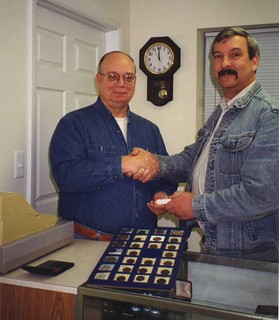 The time is 11:59:55 PM on December 31, 1999. The end of the century – the end of the second millennium! Where do I find myself on this momentous occasion? In Times Square watching the ball drop? Hardly! At a festive party, with family and friends, watching the ball drop on TV? Not exactly… I find myself in the not-quite-open-for-business, new location of Colonial Valley Coins, camera poised and ready to record a transaction between my husband, Ray Williams and the proprietor, Harry Garrison. A small transaction, Ray selling Harry a roll of Connecticut quarters, but a transaction none the less. The last of the millenium? Perhaps...
Seventeen seconds later, 12:00:12 AM on January 1, 2000, as the sound of the town fireworks echo through the windows and the TV in the next room faintly delivers the celebration in Times Square, my camera is flashing again. This time it's Harry selling Ray an R6 Connecticut Copper (M14.2-A.2 for all Ray's Colonial friends). The first transaction of the new millenium? It's hard to say.
I can't help but imagine that at 12:00:12 AM GMT in a little coin shop overlooking the Thames, that some British coin collector and his dealer friend are conducting similar business with the bright flashes of the London fireworks display lighting up the shop through the windows. Or maybe a couple of hours earlier, a tiny shop in the narrow streets of Bethlehem has two numismatists huddled over a counter conducting their business with an eye on the clock and making history.
But whether the actual last and first numismatic transactions of 1999 and 2000 in the world or not, I know this much –If nothing else, they were the last and first millennial transactions in Hamilton, NJ! And perhaps the way I spent New Year's Eve 1999 wasn't in the most festive or exciting or traditional manner, but it made two really nice guys smile from ear to ear, so I can't think of a better way to start the next millennium!

Diane Williams manning Colonial Coin Collectors Club table
For funeral services information, see:
https://www.brennafuneralhome.com/
NEWMAN PORTAL ADDS HALF CRAZY
The latest addition to the Newman Numismatic Portal is the recent May issue of Half Crazy. Project Coordinator Len Augsburger provided the following report. -Editor

Newman Portal Adds Half Crazy
Among the publications regularly archived by Newman Portal is the Seated Half Society (SHS) newsletter, Half Crazy, edited by Dennis Fortier. The SHS is akin to the Bust Half Nut Club, which requires members to build a significant collection of half dollar die marriages as a condition of membership. Half dollars of this era were struck in large quantities and remain eminently collectible today at many price points. The recent May issue of Half Crazy includes a feature on the 1846 Tall Date and Medium Date varieties, one of the most incorrectly attributed issues in the series, despite the clarifying images in the Guide Book and other sources.
Image: 1846 Tall and Medium Date comparison, from the May 2026 Half Crazy.
I absolutely love the name Half Crazy. I've trademarked Full Blown Batshit Crazy for a future publication. -Editor
Link to Half Crazy on Newman Portal:
https://nnp.wustl.edu/library/publisherdetail/548913

VIDEO: CREATING THE CSNS COIN CONVENTION
The David Lisot Video Library on the Newman Numismatic Portal can be found at:
https://nnp.wustl.edu/library/multimediadetail/522852
We highlight one of his videos each week in The E-Sylum. Here's one from 2016 about creating and running the annual Central States convention. -Editor

Kevin Foley, Convention Chairman, CSNS Coin Convention.
Interviewer: David Lisot, CoinTelevision.com.
Have you ever wondered what was involved in creating a major nation coin convention? Kevin Foley is one of the most experienced convention chairmen in the United States with decades of experience. He shares the many complexities of creating a world class coin show.
To watch the complete video, see:
Creating the Central States Numismatic Society Coin Convention
(https://youtu.be/tvfnsHQFMlM)
Creating the Central States Numismatic Society Coin Convention
(https://nnp.wustl.edu/library/book/548584)
LATIN AMERICA NUMISMATIC LITERATURE SURVEY
Ángel O. Navarro Zayas published this call for survey responses relating to Latin American numismatic books and articles published between 2020 and May 2026 -Editor
 Dear esteemed brothers and sisters, fellow numismatists from across Latin America (South America, Central America, and the Greater Caribbean):
I hope you are all doing well at the time you receive this message. Today I write to you respectfully, as a volunteer collaborator of the International Numismatic Council (INC), on behalf of our colleague, numismatist and subeditor of The Survey, Dr. Jesse Kraft. The Survey is published every six years in collaboration with the International Numismatic Congress (INC). The last time the Congress met was in 2022 (postponed one year due to COVID-19) in Warsaw, Poland, and the next meeting will take place in 2027 in Frankfurt, Germany.
This Survey will essentially serve as an update of all peer-reviewed numismatic articles as well as books published since the previous Congress; this edition will cover approximately the period from 2020 to 2026. I respectfully write to all Latin American numismatic colleagues to encourage you to include your numismatic bibliographies, both books and journal publications, related to Latin American numismatics. Those interested in having their work included may submit, by country or by author, numismatic literature published on Latin America between 2020 and May 2026.
You may include abstracts or summaries of journal articles and/or numismatic books published over the past six years. Individuals who would like their numismatic publications to be included in The Survey of the International Numismatic Council (INC) for 2027 may submit their contributions free of charge. Additionally, scholars from different parts of the world who have published works on Latin American numismatics (South America, Central America, and the Greater Caribbean) may also include their bibliographies of articles or books on these topics, published within the last six years, at no cost.
This represents an excellent opportunity to showcase—free of charge for authors and researchers—their work and to increase the visibility of Latin American numismatics (South America, Central America, and the Greater Caribbean) in Europe, alongside other international numismatists. Here you can find the link to the previous Survey (as you will notice, there is no section on Latin America because the previous subeditor was unable to establish direct contact with authors, making this a valuable opportunity to ensure that our entire Latin American community is well represented in this important international numismatic forum):
https://inc-cin.org/wp-content/uploads/2022/11/Survey-2014-2020.pdf.
Those who wish to collaborate may do so via email at angelnavarro2000@gmail.com until May 26, 2026, at 12:00 p.m. I hope you will choose to include your research in The Survey so that others may become acquainted with the results of your numismatic work.
For more information on the Survey of Numismatic Research, see:
https://inc-cin.org/home/publications/survey/
For more information on the International Numismatic Council (INC), see:
https://inc-cin.org/
THE BOOK BAZARRE
NOTES FROM E-SYLUM READERS: MAY 10, 2026
More on Herbert Kreindler
Paul Bosco writes:
 "Herb was a top-notch numismatist. Also, he was very possibly the best coin auctioneer ever, able to see every bid in a large room and call lots at an almost breath-taking speed. Without him, many attendees of the auction-heavy New York International Numismatic Convention would have been sleep-deprived.
"I'm guessing the thing he knew best was simply HOW TO EXCEL. His 69-year marriage being one more case in point.
"He will be greatly missed and long remembered."
To read the earlier E-Sylum article, see:
HERBERT LEWIS KREINDLER (1935-2026)
(https://www.coinbooks.org/v29/esylum_v29n18a06.html)
Stack's Bowers Galleries Vault Program
Christine Karstedt writes:
"I noticed the article on safe deposit box problems in the last issue and wanted to share a few additional thoughts. Safe deposit boxes still project old-school security—vault doors, dual keys, and constant surveillance—but in 2026, their reputation as the safest place for valuables is increasingly out of date.
"As we know, many institutions have reduced or eliminated safe deposit boxes. Most importantly, contents aren't insured the way bank deposits are. Federal protections don't apply, and bank liability is often minimal. If items are lost to theft, fire, or flooding, the financial risk largely falls on the owner. Even security isn't absolute—high-profile thefts and insider abuses show that determined thieves can still breach systems once considered impenetrable.
"Safe deposit boxes simply are no longer a near-perfect solution. Limited access, lack of insurance, and real-world risks mean clients are seeking alternative options. One such option is the Stack's Bowers Galleries Vault program. I encourage collectors to take a moment to review its services at https://vault.stacksbowers.com/. It essentially provides secure coin storage and banknote storage with no monthly fees, free insurance, and instant access to items online, a spectacular combination of benefits for all types of collections. I'd be happy to answer any questions about the program ckarstedt@stacksbowers.com."
Third-party safekeeping services work until they don't. While there are bank horror stories such as the one we recently discussed, most collectors have not run into such troubles. But we're all feeling the pinch as more and more banks get out of the safe deposit business.
Nonbank storage services have a more mixed history, and some have proven to be scams. But as one of the oldest and largest coin firms Stack's Bowers is reputable and would never risk their reputation or the numismatic material in their possession. If you plan to sell through Stack's Bowers it sounds like a great deal, although there are fees incurred for withdrawal other than through a sale. -Editor
To read the earlier E-Sylum article, see:
NOTES FROM E-SYLUM READERS: APRIL 26, 2026 : On Safe Deposit Boxes
(https://www.coinbooks.org/v29/esylum_v29n17a11.html)
Book Reminder: U.S. Naval Awards of the Spanish – American War
Harry Waterson writes:
U.S. Naval Awards of the Spanish – American War
by John E. Strandberg and Allen R. Menke.
 A complete guide to the U.S. Navy awards of the Spanish-American War, including the Marine
Corps Brevet Medal, the Cardenas Medal, the Specially Meritorious Service Medal, the Sampson
Medal and the Dewey Medal. Each chapter contains background information on the historical
events surrounding each medal, an in-depth study of the medal, to include its history, production
details, manufacturing variations, naming styles, and tips on spotting reproductions. Includes 413
photographs and illustrations, 280 in color. Hardcover Large 5.5 x 11 format with 439 pages.
Available on Amazon for $75.95 and on your favorite eBook platform for $26.99.
A complete guide to the U.S. Navy awards of the Spanish-American War, including the Marine
Corps Brevet Medal, the Cardenas Medal, the Specially Meritorious Service Medal, the Sampson
Medal and the Dewey Medal. Each chapter contains background information on the historical
events surrounding each medal, an in-depth study of the medal, to include its history, production
details, manufacturing variations, naming styles, and tips on spotting reproductions. Includes 413
photographs and illustrations, 280 in color. Hardcover Large 5.5 x 11 format with 439 pages.
Available on Amazon for $75.95 and on your favorite eBook platform for $26.99.
Thanks. Love the cover photo. -Editor
For more information, or to order, see:
US Naval Awards of the Spanish-American War
(https://www.amazon.com/US-Naval-Awards-Spanish-American-War-ebook/dp/B0FF23THSX/ref=sr_1_2)
To read the earlier E-Sylum article, see:
NEW BOOK: U.S. NAVAL AWARDS
(https://coinbooks.org/v28/esylum_v28n09a06.html)
Medal Collectors of America Facebook Group

"The Medal Collectors of America has re-established its Facebook Group, aptly named "Medal Collectors of America." The group is the only one on Facebook wholly dedicated to sharing, discussing, and enjoying medals with fellow medal collectors, 220+ of whom have already joined. We encourage you to join us in the Group and to consider sharing some parts of your collection or expertise there; it is set to be a wonderful community space."
Check it out! -Editor
To visit the Medal Collectors of America Facebook Group, see:
https://www.facebook.com/groups/890603274826461/
Met Gala 2026: Sarah Paulson BLINDFOLDS Herself With Money
Kavan Ratnatunga passed along this YouTube clip of actress Sarah Paulson at the 2026 Met Gala, clad in a gray ball gown, with her eyes covered with a giant dollar bill. -Editor
To watch the video, see:
Met Gala 2026: Sarah Paulson BLINDFOLDS Herself With Money
(https://www.youtube.com/watch?v=jQ-5xkVsU_M)
Dannreuther's US Proof Coins Volume III: Silver Spiral Bound
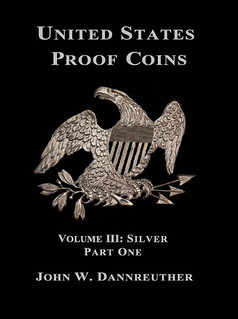 John Dannreuther writes:
I will have samples of the spiral bound silver proof books at Baltimore in June. I had to break it into three books because of size limitation (450 pages).
The three books can be bought individually or as a group:
- Three cent silvers to twenty cents
- quarters and half dollars
- silver dollars
To read the earlier E-Sylum article, see:
NOTES FROM E-SYLUM READERS: MAY 3, 2026 :
Dannreuther's United States Proof Coins Volume III: Silver Update
(https://www.coinbooks.org/v29/esylum_v29n18a10.html)
EXHIBIT AT THE 2026 ANA IN PITTSBURGH
Paul Hybert is one of the ANA's National Exhibit Coordinators, and he submitted this reminder of the upcoming deadline for applications to exhibit at this summer's ANA show in Pittsburgh.
BIBLIOPHILES! Don't forget about Class 17 - Numismatic Literature! Let's see some great exhibits this year! -Editor

We have three months until the ANA's World's Fair of Money is held in Pittsburgh on August 25-29, but members who would like to enter an exhibit at that show must submit an application form well before the show's start.
Please visit https://www.money.org/convention-exhibits/ for an overview of the Collector Exhibit Area -- this page has links to the WFM Exhibit Rules and to the WFM Exhibit Application (each exhibit requires its own application form).
In a number of places, the deadline for submitting an application is stated as June 1, so do not procrastinate. (I thought the deadline was extended to July 1 after a discussion during the ANA's NMS in Savannah in late February -- however, the ANA website still shows the June 1 deadline as of May 8.) If you have been working on an exhibit, please do not rely upon a last-minute extension.
All Collector exhibits must be in place by 1pm on Tuesday, August 25; they can be removed starting at 4pm on Saturday, August 29. See the Rules document for using an agent to setup or remove an exhibit -- a first-time exhibitor must setup the exhibit(s) in person. Real life means that very few people can attend the entire show -- ANA members who live within a few-hours drive from Pittsburgh might be able to show an exhibit by attending the show only on Tuesday and Saturday.
Did I mention Class 17 - Numismatic Literature? -Editor
To submit your exhibit application, see:
Display an Exhibit at an ANA Convention
(https://www.money.org/convention-exhibits/)
SYMPTOMS OF NUMISMATIC BIBLIOMANIA
Mike Costanzo submitted these thoughts (observations?) on Numismatic Bibliomania. Thanks. I'm guilty of #10. And #1. -Editor
 1. Not only do you "buy the book before you buy the coin," you sometimes never even get
around to buying the coin.
1. Not only do you "buy the book before you buy the coin," you sometimes never even get
around to buying the coin.
2. You have more books by Q. David Bowers than Q. David Bowers does.
3. All your Dansco Bookshelf Albums are empty and were only bought because they look good on the bookshelf.
4. You have nightmares that the latest edition of Krause Standard Catalog of World Coins will only be available on kindle.
5. You dream about the ANA publishing ANA Grading Standards for Numismatic Books.
6. No one understands why you must purchase a new edition of the Red Book every year, and neither do you.
7. You refuse to part with your decrepit hoard of The Numismatist even though you have access to every issue on the ANA Digital Archive.
8. You possess a reference book on foreign coinage, written in a foreign language, which you cannot speak or read, but still bought it because it was the best reference available.
9. You are always surprised whenever numismatic books arrive in the mail because you don't recall ever ordering them.
10. You possess a perfectly good copy but buy a second one just for a better dust jacket.
12. You continue to buy "other" (non-numismatic) books but rarely find time to read them.
13. Numismatic booksellers consider you a whale.
14. You go out of your way to find a personal physician named Dr. Sheldon.
15. You name your dog "Whitman."
That last one gives you an out should you utter "Whitman is full of crap!" at a coin show within earshot of a Red Book editor or contributor... have a photo handy on your phone. -Editor

DIRECTOR PAUL HOLLIS AT NEW ORLEANS MINT MUSEUM
Here's a U.S. Mint press release about Director Hollis' visit to the old New Orleans Mint building this week. Were any of our readers there? I haven't seen any news coverage yet. I added images from an earlier article of Joshua McMorrow-Hernandez's visit to the New Orleans Mint Museum. -Editor
 United States Mint (Mint) Director Paul Hollis will attend a special event at the New Orleans Jazz Museum, "the Old U.S. Mint" to celebrate the Nation's Semiquincentennial on May 8 from 4 to 6 p.m. CDT.
Hollis, the 41st director of the United States Mint and a Louisiana native, will share how the Mint is celebrating the Nation's 250th anniversary with special coins and medals. Brandon Beach, Treasurer of the United States, will also be in attendance.
The event will also feature:
- The opportunity to purchase 2026 products from the Mint's pop-up retail space, including the American Buffalo 2026 One Ounce Gold Proof Coin (26EL), American Eagle 2026 One Ounce Silver Proof Coin (26EA), Congratulations Set 2026 (26RF), and American Eagle 2026 Gold Proof coins (26EC, 26EB, 26ED and 26EE).
- Free educational and informational resources from the Mint and Louisiana America 250.
- A coin machine exchanging $1 and $5 bills for the circulating 2026 Emerging Liberty Dime and 2026 Revolutionary War Quarter.
- Access to the museum's first-floor exhibit from the Old New Orleans Mint, including a Morgan & Orr coin press, a Troemner bullion scale, and displays of coins minted on-site.

To read the complete press release, see:
United States Mint Director Paul Hollis to Host Special Event at New Orleans Jazz Museum, "the Old U.S. Mint"
(https://www.usmint.gov/news/press-releases/united-states-mint-director-paul-hollis-to-host-special-event-at-new-orleans-jazz-museum-the-old-u-s-mint)
To read the earlier E-Sylum article, see:
VISITING THE NEW ORLEANS MINT MUSEUM
(https://www.coinbooks.org/v24/esylum_v24n32a22.html)

DECLARATION COIN LAUNCH AT MONTICELLO
In other U.S. Mint news, Chris Neuzil passed along an announcement from Thomas Jefferson's Monticello that the new Semiquincentennial Coin celebrating the Declaration of Independence will be launched there on June 24, 2026. Thanks. -Editor


 Join Monticello and the United States Mint for a celebration of the new Declaration of Independence Semiquincentennial Coin, commemorating 250 years since the signing of Jefferson's Declaration in 1776.
There are few places more fitting to mark the 250th anniversary of American independence than Monticello — the home of the man who wrote the words that launched a nation.
The program includes remarks from the Director of the U.S. Mint and a special appearance by Thomas Jefferson, portrayed by Bill Barker, bringing the moment to life at the site where so much of America's history took shape.
Coins for Young Visitors
Stop by the U.S. Mint table in the visitor center courtyard, where children under 18 can pick up a complimentary commemorative coin and semiquincentennial coin holder while supplies last. It's a tangible piece of history to take home.
About the Coin
The new Declaration quarter is part of the 2026 Semiquincentennial Circulating Coin Program, commemorating 250 years of American independence. It honors Jefferson as the Declaration's principal author and the nation's third president.
Description
The obverse design features Thomas Jefferson, author of the Declaration of Independence and third President of the United States. The inscriptions are "E PLURIBUS UNUM," "IN GOD WE TRUST," and "1776 ~ 2026."
The reverse design depicts the Liberty Bell ringing. While it is unclear whether it rang out in July 1776, the Liberty Bell often rang to draw people near and share an announcement, or a declaration. The Bell's crack is visible; the fragility of the Bell echoing the fragility of a young nation at its founding. The inscriptions are "THE DECLARATION OF INDEPENDENCE," "QUARTER DOLLAR," "LIBERTY," and "UNITED STATES OF AMERICA."
To read the complete article, see:
US Mint at Monticello: Celebrating the Declaration Coin
(https://www.monticello.org/events/us-mint-celebrating-declaration-coin)
VOCABULARY TERM: SINGLE-SIDED
Here's another entry from Dick Johnson's Encyclopedia of Coin and Medal Terminology. -Editor
Single-sided. A uniface cast medallic item. The backside or reverse of a single-sided item may be smooth, rough, have depressed areas congruent with the high relief of the obverse (called cast hollow), or have a surface of ripples and rounded edges typical of an open mold casting. The back side may also have a backplate. The reverse often has a maker's mark, a foundry mark or hallmarking, or, the item can have a hanger for wall mounting. The term is applied only to cast pieces (a one-sided struck piece is called uniface). Cast medallic items with both obverse and reverse designs are said to be double-sided.
In cataloging, if the piece is identified as a cast and only one side is described, it is not necessary to specify the item is single-sided (that is obvious). Otherwise if no description is given the piece is called single-sided.
To read the complete entry on the Newman Numismatic Portal, see:
Single-sided
(https://nnp.wustl.edu/library/dictionarydetail/516764)
CALVIN OTTO WILSON, JR. (1944-2018)
E-Sylum Feature Writer and American Numismatic Biographies author Pete Smith submitted this article on NBS pioneer and numismatic literature dealer Cal Wilson. Thanks! -Editor
 Cal Wilson helped guide the Numismatic Bibliomania Society through its formative years. He served as first president of the Society. He also helped many bibliomaniacs expand their libraries.
He was born in Pensacola, Florida, on August 18, 1944. His father, Calvin Otto Wilson, Sr. (1920-2001), was a veteran and Pearl Harbor survivor who served 27 years in the Navy. The father brought home coins from his foreign deployments that he gave to his three sons. His mother was Nevada Hall (1926-2005).
Wilson included an autobiography in the first issue of his newsletter, Wilson's Numismatic Repository. He mentioned a Boy Scout Merit Badge counselor who told him the importance of numismatic literature. His first coin book, acquired in 1957, was a thirteenth edition "Red Book."
Cal graduated from Pensacola High School in 1962, attended Pensacola Junior College and Florida State University where he was a member of Phi Kappa Tau fraternity.
Wilson settled in Sacramento where he was employed with Continental Can and later with Crown Cork and Seal Manufacturing Company as a production Planning Supervisor. By 1974 he was in Fremont, California, and resumed his hobby by buying up numismatic libraries.
Cal had at least three marriages. He was married to Teresa Bronson on May 4, 1964, in Escambia, Florida. They had a daughter. He was married again on March 2, 1968, to Marcia Lynne Elliot. They had a son. His surviving widow was Cindie Wilson.
Wilson retired from the canning business and became a numismatic literature dealer in 1980. He advertised to sell a complete collection of "Red Books" in Coin World and Numismatic News.
As Calvin O. Wilson, he was enrolled as ANA life member LM-2828 in April 1981. He was a sponsor for the Numismatic Bibliomania Society joining the ANA in 1984.
The newly formed Numismatic Bibliomania Society had no president for a few years. The struggling organization conducted their first regional NBS meeting in Long Beach on February 19, 1983. In attendance were nearly thirty NBS members. At that event, Cal Wilson was elected NBS President for a two-year term. He then served on the NBS Board from the summer of 1985 to the summer of 1989.

Jack Collins and Walter Breen at the 1983 NBS Meeting
At some point, looking back, a list of NBS Charter Members was prepared but has proven to be unreliable. Logically, Jack Collins was assigned member number 1 and George Kolbe was assigned member number 2. This was followed by numbers 3 through thirteen that were "Reserved." No explanation was given and the numbers were never assigned.
Number 14 was given to Cal Wilson and was followed by a listing in alphabetical order. His low number may have been given in recognition of his role as first elected president. The reserved numbers gave a buffer to separated him from the founding members.
Cal published a newsletter, Wilson's Numismatic Repository beginning with the issue of October 1982. The name was shortened to The Repository in July 1984 and ended publication in 1988. During its run, his newsletter was more regular and more informative than the NBS Journal, The Asylum.
Cal Wilson issued a fixed price list in 1980. He produced 18 auctions of numismatic literature between 1981 and 1988.
The ANA convention was in San Diego in 1983. During the show, Wilson conducted his fifth sale on August 14, 1983. I attended with my mentor, Dick Punchard. I am sure there were many NBS members present, but I specifically remember Armand Champa and his wife.
Wilson announced that he was writing a book with biographies of important numismatists. In the April 1988 issue of The Asylum, Wilson wrote,
"I have commenced work on a manuscript that I hope to publish sometime in 1988. Essentially it will be a compendium of biographical sketches of some two hundred and fifty or so ‘old time' numismatic personalities of the U. S. and Canada."
When he later announced that he was dropping the project, it opened the opportunity for someone else to write a book of numismatic biographies.
Wilson made a comfortable living in private industry. He was not financially successful with his numismatic literature business. By 1989, he had closed the business with bills owed and consignors not paid. He expressed the hope that he could eventually pay off his debts.
For the next thirty years, he was heard from occasionally but he had nearly disappeared from the hobby.
He died at home in Hartselle, Alabama, on October 16, 2018.
NBS Historian Joel J. Orosz contributed this item:
Summarized from contemporary documentation in the NBS Archives:
Cal Wilson served as the unofficial (indeed, self-appointed), NBS historian from its earliest days, actively soliciting and saving archival material regarding the Society's founding and development. By the late 1980s, Cal had closed his numismatic literature business, and left the hobby.
In late 1998 and early 1999, I (by then official NBS Historian, having been appointed in 1993) had email contact with Cal whose email handle was "Biblionumis," in Fremont, California. On three separate occasions during the course of these communications, Cal promised to send me two boxes of early NBS archival records. He never fulfilled his promises.
In early April, 2002, a number of NBS Board members, including you (then NBS President, Pete Smith) and George Kolbe, became aware that "Biblionumis" was offering eBay item #1343985770, consisting of photographs, audiotapes, correspondence, clippings and news reports, minutes of Board meetings, and records of Annual meetings. The lot had a reserve bid of $99.99, and closed on April 13, 2002 at 19:41:18 PDT.
The NBS Board agreed that, although the title to the material was unclear, it should become the property of the NBS. A strategy was agreed upon whereby the Society, through a proxy bidder (Society Secretary-Treasurer David Sklow) should bid up to $250 for the material. In the auction, Sklow exceeded his limit by bidding $350, but still lost the lot. Sklow contacted the winner (who was not known to be part of the Board's bidding strategy), and asked him to either donate or sell the lot to the NBS.
The winner agreed to donate the lot, for which he paid $550, to the NBS. He requested anonymity until Cal actually shipped the lot to him. After receiving it, the winner completed the donation to the NBS, and revealed his identity: NBS Board member Tom Sheehan. Tom had been concerned that the Board authorization was too low, and bid anonymously on his own behalf in order to insure success.
So, we were successful in preserving these irreplaceable early records, albeit not without some drama and momentary disappointment. All kudos go to Tom, without whose perspicacity this story would have had a less satisfactory ending.
As I was compiling this article, there were things I wanted to look up in Wilson's Numismatic Repository and The Repository. Unable to find them on the Newman Numismatic Portal, I was forced to locate my printed copies in a somewhat buried file box.
When I read each issue forty years ago, they included interesting commentary on contemporary issues. Now, forty years later, those comments represent numismatic history and much of the content is great.
As often happens, I found myself down another rabbit hole. I found threads I wanted to pull and topics for future articles. Alas, the deadline to submit an article for The E-Sylum requires that I come out of that rabbit hole and finish what I was doing earlier.
To read issues of The Repository on the Newman Numismatic Portal, see:
The Repository [Cal Wilson]
(https://nnp.wustl.edu/library/publisherdetail/521986)
To read the earlier E-Sylum article, see:
CAL WILSON (1944-2018)
(https://www.coinbooks.org/v21/esylum_v21n42a11.html)
CAL WILSON'S NUMISMATIC AUTOBIOGRAPHY
(https://www.coinbooks.org/v21/esylum_v21n42a12.html)
CAL WILSON'S NUMISMATIC REPOSITORY
(https://coinbooks.org/esylum_v15n06a14.html)

DAVID GEE, AUSTRALIA'S AUDACIOUS COIN FORGER
Don Cleveland passed along this article headlined, "How David Gee stole the Australian National Coin Collection." A fascinating story I wasn't aware of, and in a bonus for bibliophiles, there's a book about it. Here's an excerpt - see the complete article online. -Editor
 For a small but extremely focused slice of the human population, though, coins — rare ones, ancient ones — sing with a siren song inaudible to the rest of us. The itch to acquire such coins, to hoard them, to possess them at all costs, can in rare cases become so unscratchable that even the criminal codes offer scant deterrence.
Such is the case of David Gee, who in the late 1960s and early 1970s pulled off one of the most baroque and ambitious coin heists in Australian history, in which he nicked incredibly precious coins from the special collections of Australia's oldest library without anybody noticing.
The tale is featured in a new episode of ABC Listen's podcast, History Or Hoarding?.
Flamboyant, sociable and generous, Gee ran a Kings Cross restaurant, enjoyed ballroom dancing, had a difficult-to-pin-down interest in the adult entertainment sector, and was utterly obsessed with coins. He'd developed the coin itch very young; having emigrated from China in 1939 with his parents at the age of 10, he was by his teenage years managing the books for the family's fruit and vegetable grocery business and diverting money wherever he could toward the acquisition of rare and collectable currency.
"Whenever he did things or talked to you, it was almost, ah, mesmerising," says Jim Noble, a celebrated Sydney numismatist and dealer who knew Gee.
"You couldn't get a word in. He was that excited about his coins, and he had a lot of good coins."
Gee was every bit as passionate as Noble, but much more ethically ambiguous. And his urge to acquire rare coins took him, in the late 1960s, to the State Library of NSW — more particularly, the library's Dixson Collection. Named for benefactor William Dixson, a fervent collector and heir to a tobacco empire, the collection contains around 8,000 coins, notes and medals and a vast trove of Australiana.
 Gee used the pseudonym "Robert Lowe" to register with the library's Special Collections division. It was one of more than 70 names he would adopt over the course of his life, the most swashbuckling of which was "Goldfinger". (In the online numismatic chat rooms where Gee is legendary, one participant recalls meeting him at a coin auction and asking him to autograph a copy of the 1986 hardcover, "Heads I Win: The True Story of David Gee, Australia's Most Audacious Coin Forger. "Which name do you want me to sign?" the ever-suave Gee is reported to have asked.)
The cover story proffered by "Mr Lowe" was that he was writing a book about Australian coins. In any other institution, such a pretext might have raised eyebrows. But in the library, where oddballs pursuing niche research topics are common, it was drab plumage indeed.
His presence was irritating to the librarians, though.
Like any taxpayer, "Mr Lowe" was entitled to request assistance to view anything in the library's collection. He wanted to see the coins. And because of their value, library rules dictated that he never be left alone with them.
It fell to Storie to spend what seemed like endless days monitoring "Mr Lowe" in a small room as he photographed and examined tray after tray of precious colonial-era Australian coins.
What we now know is that David Gee — having studied and photographed the coins in the Dixson collection that he most deeply craved — then embarked on the next phase of his scheme.
Working under another assumed name with craftspeople across the engraving sector, he designed and commissioned replicas of the coins.
And when he next returned to the library, according to Joy Storie's account, it was with a genuinely preposterous new gambit.
With hindsight, of course, it is readily apparent that "Mr Lowe" was pulling a switcheroo worthy of only the lowest-grade trainee magician.
To read the complete article, see:
How David Gee pulled off one of the most ambitious coin heists in Australian history
(https://www.abc.net.au/news/2026-05-06/david-gee-most-ambitious-coin-heists-australian-history/106639898)
To listen to the podcast, see:
https://www.abc.net.au/listen/programs/history-or-hoarding-with-annabel-crabb/australia-s-greatest-coin-heist/106542242
(https://www.abc.net.au/listen/programs/history-or-hoarding-with-annabel-crabb/australia-s-greatest-coin-heist/106542242)

AI HUNTS FOR STOLEN HARVARD COINS
John Sallay passed along this article from Harvard Magazine, regarding the use of AI to search for stolen coins. Thanks! -Editor
An AI model uses image matching and a deep learning function that translates an ancient coin's visual properties into numerical vectors
On a December night in 1973, thieves overpowered a security guard at Harvard's Fogg Museum, broke into the Coin Room, and made off with somewhere between 8,000 and 12,000 pieces of silver and bronze currency from ancient Greece and Rome—a haul worth $5 million or more (approximately $37 million today). Authorities caught the group of small-time local criminals responsible for the heist in late 1974; in the intervening years, most of the coins were recovered. But not all of them.
Now, museum staff hope to leverage artificial intelligence to track down some of the silver stolen in "the biggest art theft in the U.S. at that time," says Laure Marest, the Damarete associate curator of ancient coins at the Harvard Art Museums. In collaboration with computer scientist Yifei Bao, Marest is developing a program that works from digitized, archival photographs to scour millions of online auction records and identify pieces of the unaccounted loot that may pop up on the web for resale.
When she started her job in 2023, Marest went through archival records and discovered that 10 to 15 percent of the collection taken during the theft was still missing. "That was probably close to 1,000 coins, and some of them [were] really valuable," she says.
So she enlisted Bao—who was then a doctoral student at Boston University and a Hao family intern at the Harvard Art Museums—to create an algorithm that used ChatGPT to assist with the search. "What we want is, we find a coin online, we put it into the machine, and the machine can tell us if the coin is a match to our missing coin," said Bao, at a recent seminar at the museum.
With help from undergraduate interns, Marest built a database of 3,000 coins that had been photographed and documented in a paper-based cataloging system, identifying about 200 that were still missing. Most were silver, from ancient Greece.
 Bao then trained a model to recognize those missing coins, using image matching and a deep learning function that translates a coin's specific visual properties—a small indentation, a space between the hairline on a deity's profile and the coin's outer edge—into numerical vectors that the computer could analyze mathematically.
"We want computers to understand the image by transforming it to a mathematical fingerprint," Bao said in the seminar. From there, the algorithm can determine the likelihood, in percentage terms, that a coin from the database matches one that appears online.
Ancient coins have unique qualities that can both help and hinder a machine making such determinations, Marest notes. Most were stamped by hand and serialized: like snowflakes, no two are exactly alike. But they are small and made of metal, which makes them tricky to photograph; it's hard to train a computer to account for fuzzy resolution or variations in lighting conditions.
Still, for an idea in the proof-of-concept phase, the project's measure of success isn't necessarily to recover all, or even any, of the coins Harvard lost. That would be "a long shot," Marest acknowledges. Online auction records "only go back 15 years, while those coins probably went on the market in the '80s and '90s," she says. "So, unless they went back on the market more recently, they would not show up."
To read the complete article, see:
AI Hunts For Stolen Harvard Coins
(https://www.harvardmagazine.com/ai/harvard-art-museums-artificial-intelligence-ancient-coins-mystery)
KELLEHER & ROGERS: AUCTION 50
Kelleher & Rogers hosted Auction 50 on May 7. While the sale has passed, it contained some excellent world paper money. -Garrett


China, 1941 5 Yuan, Bank Of China, S/M#C294-262, PMG 64 Choice Uncirculated (Pick-93)
To read the complete item description, see:
China, 1941 5 Yuan
(https://www.icollector.com/China-1941-5-Yuan-Bank-Of-China-S-M-C294-262-PMG-64-Choice-Uncirculated-Pick-93_i59874820)


China, 1935 1 Yuan - Chungking, Central Bank Of China, S/M#C300-80, PMG 12 Fine (Pick-206)
To read the complete item description, see:
China, 1935 1 Yuan
(https://www.icollector.com/China-1935-1-Yuan-Chungking-Central-Bank-Of-China-S-M-C300-80-PMG-12-Fine-Pick-206_i59874836)


China, 1937 10 Yuan - Printer: CHB, Central Bank Of China, S/M#C300-111 PMG 66 Gem Uncirculated EPQ (Pick-223b)
To read the complete item description, see:
China, 1937 10 Yuan
(https://www.icollector.com/China-1937-10-Yuan-Printer-CHB-Central-Bank-Of-China-S-M-C300-111-PMG-66-Gem-Uncirculated-EPQ_i59874841)


China, 1931 1 Yuan - Shanghai, Land Bank OF China, Ltd., S/M#C285-10, PMG 50 About Uncirculated (Pick-504)
To read the complete item description, see:
China, 1931 1 Yuan
(https://www.icollector.com/China-1931-1-Yuan-Shanghai-Land-Bank-OF-China-Ltd-S-M-C285-10-PMG-50-About-Uncirculated-Pic_i59874894)


China, 1915 100 Coppers, Market Stablization Currency Bureau, S/M#T183-5h, PMG 63 Choice Uncirculated (Pick-603d)
To read the complete item description, see:
China, 1915 100 Coppers
(https://www.icollector.com/China-1915-100-Coppers-Market-Stablization-Currency-Bureau-S-M-T183-5h-PMG-63-Choice-Uncirculate_i59874899)


China, 1938 (ND 1944) 100 Yuan, Federal Reserve Bank Of China, S/M#C286-22, PMG 63 Choice Uncirculated EPQ (Pick-J59)
To read the complete item description, see:
China, 1938 (ND 1944) 100 Yuan
(https://www.icollector.com/China-1938-ND-1944-100-Yuan-Federal-Reserve-Bank-Of-China-S-M-C286-22-PMG-63-Choice-Uncirculat_i59874935)


China, 1871 1000 Cash, Kuang Yuan Hao "Private Issue" PMG 20 Very Fine (Pick-Unlisted)
To read the complete item description, see:
China, 1871 1000 Cash
(https://www.icollector.com/China-1871-1000-Cash-Kuang-Yuan-Hao-Private-Issue-PMG-20-Very-Fine-Pick-Unlisted_i59874997)
I agree with Garrett - a very interesting and colorful group of notes. -Editor

STACK'S BOWERS: COLLECTORS CHOICE U.S. CURRENCY
Stack's Bowers will be hosting their Collectors Choice Auction of U.S. Currency on May 20. Select items are discussed below. -Garrett


Savannah, Georgia. Timber Cutter's Bank. 1859 $50. PCGS Banknote Choice Uncirculated 64 PPQ. No. 657. Plate A. Offered here is a Choice Uncirculated example of a scarce denomination from this typically oft-encountered bank where smaller denominations are well-represented among surviving notes.
Estimate: $400 - $600.
To read the complete item description, see:
Savannah, Georgia. Timber Cutter's Bank. 1859 $50. PCGS Banknote Choice Uncirculated 64 PPQ.
(https://auctions.stacksbowers.com/lots/view/3-1SV8IP/savannah-georgia-timber-cutters-bank-1859-50-pcgs-banknote-choice-uncirculated-64-ppq)


Fr. 232. 1899 $1 Silver Certificate. PCGS Banknote Gem Uncirculated 65 PPQ. KK Block. Featuring a short-lived albeit oft-seen signature combination. The Parker - Burke signature combination which was current from 1913 to 1914 is one overwhelmingly encountered in circulated grades. Yet this example is indeed the exception in every sense of the word. One need not even consider the grade assigned to understand that the qualities of this specimen are superb and defined by an uncommon degree of originality and eye appeal reflective of the day this note rolled off the printing press over 110 years ago in Washington. No doubt that this very note will prove to be a prize for the collector who prizes both uncommon quality and condition.
Estimate: $1,000 - $1,500.
To read the complete item description, see:
Fr. 232. 1899 $1 Silver Certificate. PCGS Banknote Gem Uncirculated 65 PPQ.
(https://auctions.stacksbowers.com/lots/view/3-1SV9BE/fr-232-1899-1-silver-certificate-pcgs-banknote-gem-uncirculated-65-ppq)


Fr. 975. 1914 $20 Federal Reserve Note. Philadelphia. PCGS Banknote Choice Uncirculated 63. Preserved at an uncommon state of preservation for the type and denomination, this $20 Federal Reserve Note from the Philadelphia representative of the Series of 1914 is bound to see its share of interest from bidders.
Estimate: $800 - $1,200.
To read the complete item description, see:
Fr. 975. 1914 $20 Federal Reserve Note. Philadelphia. PCGS Banknote Choice Uncirculated 63.
(https://auctions.stacksbowers.com/lots/view/3-1SV9FR/fr-975-1914-20-federal-reserve-note-philadelphia-pcgs-banknote-choice-uncirculated-63)


Fr. 1657*. 1953B $5 Silver Certificate Star Note. PCGS Banknote Choice Very Fine 35. Representative of both a rare type and series imprint for Replacements. This moderately circulated Replacement $5 Silver Certificate issued under the Series of 1953B during the early 1960s is sure to garner its share of interest from bidders.
Estimate: $600 - $900.
To read the complete item description, see:
Fr. 1657*. 1953B $5 Silver Certificate Star Note. PCGS Banknote Choice Very Fine 35.
(https://auctions.stacksbowers.com/lots/view/3-1SV9UJ/fr-1657-1953b-5-silver-certificate-star-note-pcgs-banknote-choice-very-fine-35)


Fr. 2201-Adgs. 1934 Dark Green Seal $500 Federal Reserve Note. Boston. PMG Gem Uncirculated 65 EPQ. A wonderful of this ever-popular denomination from the Boston district. Great color and originality are not easily missed and serve to elevate this exceptional specimen far and above most of its surviving peers into territory where a premium bid is bound to be easily realized.
Estimate: $8,000 - $12,000.
To read the complete item description, see:
Fr. 2201-Adgs. 1934 Dark Green Seal $500 Federal Reserve Note. Boston. PMG Gem Uncirculated 65 EPQ.
(https://auctions.stacksbowers.com/lots/view/3-1SVA5W/fr-2201-adgs-1934-dark-green-seal-500-federal-reserve-note-boston-pmg-gem-uncirculated-65-epq)


Fr. 2212-A. 1934A $1000 Federal Reserve Note. Boston. PMG Choice Uncirculated 64 EPQ. A common note of uncommon quality and eye appeal. This $1000 Federal Reserve Note from the Boston district appears as bright and fresh as the day it came off the printing press at the Bureau of Engraving & Printing close to 90 years ago. Assigned a lofty grade of Choice Uncirculated 64 EPQ by PMG as a result, this note is bound to see spirted bidding as collector demand for high-denomination notes of comparable quality already outstrips a rather limited supply and should easily be worth a premium bid.
Estimate: $8,000 - $12,000.
To read the complete item description, see:
Fr. 2212-A. 1934A $1000 Federal Reserve Note. Boston. PMG Choice Uncirculated 64 EPQ.
(https://auctions.stacksbowers.com/lots/view/3-1SVA6X/fr-2212-a-1934a-1000-federal-reserve-note-boston-pmg-choice-uncirculated-64-epq)


Fr. 2404. 1928 $50 Gold Certificate. PMG Choice Extremely Fine 45. Uncommon color and eye appeal are readily brought to form by this lightly circulated $50 Gold Certificate issued under the Series of 1928. From elements such as the yellow-gold Treasury overprint to crisp details exemplified by the portrait of Ulysses S. Grant seen at center, bidders should expect a degree of competition during the bidding process.
Estimate: $2,000 - $2,500.
To read the complete item description, see:
Fr. 2404. 1928 $50 Gold Certificate. PMG Choice Extremely Fine 45.
(https://auctions.stacksbowers.com/lots/view/3-1SVA9U/fr-2404-1928-50-gold-certificate-pmg-choice-extremely-fine-45)


Fr. 1921-B. 1995 $1 Federal Reserve Note. New York. PCGS Currency Superb Gem New 67 PPQ. Type II Inverted Overprint Error. Representative of a rare grade level for such an item. This $1 Federal Reserve Note from the New York district issued under the Series of 1995 is not only miscut, but the Treasury overprint also appears inverted on the back.
Estimate: $600 - $800.
To read the complete item description, see:
Fr. 1921-B. 1995 $1 Federal Reserve Note. New York. PCGS Currency Superb Gem New 67 PPQ. Type II Inverted Overprint Error.
(https://auctions.stacksbowers.com/lots/view/3-1SVABE/fr-1921-b-1995-1-federal-reserve-note-new-york-pcgs-currency-superb-gem-new-67-ppq-type-ii-inverted-overprint-error)


Boston, Massachusetts. $2 Original. Fr. 387a. Howard NB. Charter #578. PMG Very Fine 25. Offered here is an attractive and evenly circulated $2 "Lazy Deuce" National Bank Note issued by the Howard National Bank of Boston (Charter# 578) before 1874. Here bidders may appreciate uncommon detail brought to form by the leftmost vignette entitled Stars and Stripes and distinct originality thanks to the penned signatures of Cashier Samuel F. Wilkins and President Reuben Edson Demmon. This institution records only two Original Series $2s in the National Bank Note Census against an overall population of 23 recorded notes.
Estimate: $3,000 - $5,000.
To read the complete item description, see:
Boston, Massachusetts. $2 Original. Fr. 387a. Howard NB. Charter #578. PMG Very Fine 25.
(https://auctions.stacksbowers.com/lots/view/3-1SVAGH/boston-massachusetts-2-original-fr-387a-howard-nb-charter-578-pmg-very-fine-25)


Carlstadt, New Jersey. $10 1882 Brown Back. Fr. 490. Carlstadt NB. Charter #5416. PCGS Banknote Very Fine 20. A rare item for those who specialize in National Bank Notes from New Jersey. This Series of 1882 Brown Back $10 issued by the Carlstadt National Bank (Charter# 5416) during the early 1900s features penned signatures and stands unique for both the type and denomination.
Estimate: $1,000 - $1,500.
Provenance: From the Clearwater Collection.
To read the complete item description, see:
Carlstadt, New Jersey. $10 1882 Brown Back. Fr. 490. Carlstadt NB. Charter #5416. PCGS Banknote Very Fine 20.
(https://auctions.stacksbowers.com/lots/view/3-1SVAI8/carlstadt-new-jersey-10-1882-brown-back-fr-490-carlstadt-nb-charter-5416-pcgs-banknote-very-fine-20)

NAC: AUCTIONS 166-168
Numismatica Ars Classica will be hosting Auctions 166 through 168 on May 27. Select items are discussed below. -Garrett

Celtic.
Trinovantes and Catuvellauni, Tasciovanus, (Late 1st Century B.C./Early 1st Century A.D.). AV Stater. Crescents in wreath, rev. horseman right helmeted and with carnyx, TASC around. 5.38 g. ABC 2562; M.155; VA 1732-1; S.217.
Some light marks. Otherwise well centred and richly toned. Near EF. Rare.
Purchased from CNG, NYINC December 2000. Ex. J. Jordan; CNG Triton II, 1 December 1998 (lot 1217).
To read the complete item description, see:
Trinovantes and Catuvellauni, Tasciovanus, (Late 1st Century B.C./Early 1st Century A.D.). AV Stater.
(https://www.biddr.com/nac/auction?a=6993&l=8582796)

Kings of all England.
Eadgar, 959-975. AR Penny, Portrait type, London, Hiltwine. Crowned bust right, +EADGAR REX around, rev. four small crosses around central cross, +HILTPINE MONETA LVD around. 1.2 g. CTCE 358; SCBI America 170 - this coin N.751; S.1139.
The reverse double struck with some light marks. Otherwise toned, Good VF. Very rare.
Ex E. M. Norweb (Pt. III, lot 789), R. C. Lockett (Pt. I, lot 631, pl.XV), Major P. W. P. Carlyon-Britton (Pt. I, lot 436, pl.XII), Astronomer (lot 195, pl.III), H. Montagu (Pt. I, lot 719), and The Rt. Hon R. W. Marsham (lot 186).
To read the complete item description, see:
Eadgar, 959-975. AR Penny, Portrait type, London, Hiltwine.
(https://www.biddr.com/nac/auction?a=6993&l=8582901)

Tudor Groats & Halfgroats.
Elizabeth I, 1558-1603. AR Groat. Second issue, im: cross-crosslet. Struck 1560-1561. Bust 1F. 1.97 g. B&C 1F; N.1986; S.2556.
Lightly toned and lustrous. Near EF.
Ex H. Symonds (lot 76).
To read the complete item description, see:
Elizabeth I, 1558-1603. AR Groat.
(https://www.biddr.com/nac/auction?a=6993&l=8583033)

Charles I Shillings, Halfcrowns & Groats.
Charles I, 1625-1649. Pontefract besieged. AR Shilling. 1648. Type 3, struck in the name of Charles II, on lozenge flan, crowned C R, upper arches of crown jewelled, DVM SPIRO SPERO, rev. castle gateway, P C above, OBS left, muzzle of gun right, CAROLVS SECVNDVS 1648 around. 4.49 g. JGB 1234 - same dies; Hird 280 - this coin; N.2648; S.3150.
Planchet flaws on obverse. Otherwise toned, Good VF.
Extremely rare: possibly the only known specimen on a lozenge flan.
Purchased from Spink 1980. Ex Alderman H. Hird (lot 280), Major A. W. Foster (lot 200), Webb, H. O. O'Hagan (lot 530), H. Montagu (Pt. II, lot 653) and The Rt. Hon. R. Marsham (lot 686).
To read the complete item description, see:
Charles I, 1625-1649. Pontefract besieged. AR Shilling. 1648.
(https://www.biddr.com/nac/auction?a=6993&l=8583091)

George III, 1760-1820.
AR Pattern 'Incorrupta' Crown, 1817.
By W. Wyon. Laureate, draped bust right, date below, GEORGIUS III D. G: BRITANNIARUM REX, rev. crowned shield of arms, INCORRUPTA FIDES VERITASQUE, edge: plain. 28.19 g., 12h. LS 159; Bull 2029; ESC 229.
Delicately toned with considerable mint brilliance. An exquisite example of this
very rare pattern Crown in the most desirable state of preservation.
NGC PF 66+ CAMEO (2184441-019)
The stunning Pattern 'Incorrupta' Crown dated 1817 announces the twenty-two year old William, fourth generation in the Wyon dynasty of medallists, as a die engraver of the first rank. And appropriately William Wyon uses the opportunity to pay tribute to another famous English engraver, Thomas Simon. Just as Simon contended with a foreign engraver supplanting him at the mint in 1662, so the choice of the Italian Benedetto Pistrucci to produce the dies for the New Coinage threatened the established position of the Wyon family.
History can repeat itself. In 1663 Simon's repost to the Roettiers were his two masterpieces: the Petition and the Reddite crowns. In 1817 Wyon, with a similar motive, struck the beautiful pattern 'Three Graces' and 'Incorrupta' crowns. Furthermore Wyon chose to model the design of the 'Incorrupta' on Simon's timeless portrait crown of Oliver Cromwell. The imposing and finely modelled bust with its delicate frosting (or 'mezzontinti' as admiring contemporaries described it) and shield design of the reverse are clearly inspired by Simon's work.
The reverse legend ‘Pure Faith and Truth' can be read as expressing the confidence Wyon felt in the merit of his work, but Carlisle records when Wyon presented his pattern Crown to William Wellesley Pole, Master of the Mint, he was told 'to mind his own business, and not lose his time in engraving heads, of which he was incapable'! Eleven years after the 'Incorrupta' was struck, Wyon's self-belief was repaid when he was appointed Chief Engraver.
To read the complete item description, see:
AR Pattern 'Incorrupta' Crown, 1817.
(https://www.biddr.com/nac/auction?a=6994&l=8583197)

Victoria, 1837-1901.
AR Pattern 'Una and the lion' Crown, 1839.
By W. Wyon. Young head left, date below, VICTORIA DEI GRATIA, rev. the Queen as Una guiding the British lion left, date in Roman numerals below, DIRIGE DEUS GRESSUS MEOS., edge: plain. 31.26 g., 12h. LS 34; Bull 2647; ESC 333.
A magnificent coin. Delicately toned with underlying brilliance. Among the rarest and most desirable pattern Crowns in the British series.
NGC PF 64 (2184433-009)
For this extremely rare and important piece Wyon pairs two of his most celebrated designs, the classic simplicity of the young head obverse from the proof 1839 Crown with the serene Una and the Lion reverse employed on the gold Five Pounds (WR 278) of the same date. Two varieties are known both from the same pair of dies: ESC 333 (the type offered here) on a very slightly overweight flan and with plain edge; and ESC 332 on a thin flan, c. 325 grains, with vestigial traces of an incuse edge inscription. Both of these varieties are excessively rare, only three of each, having appeared at auction since 1960.
To read the complete item description, see:
AR Pattern 'Una and the lion' Crown, 1839.
(https://www.biddr.com/nac/auction?a=6994&l=8583226)

Victoria, 1837-1901.
AV Pattern 'Bonomi' Crown, 1837 (struck 1893).
By J. Bonomi and T. Pinches for J. Rochelle Thomas. Coroneted head left, truncation divides date, VICTORIA REG DEI GRA, border of stars, rev. Minerva standing left with trident holding Victory, her shield inscribed DECUS ET TUTAMEN, BRIT MINERVA VICTRIX FID DEF, edge: T5. 39.02g, 12h. LS 2; WR 364; Bull 2613; ESC 320A.
A perfect coin, lightly toned in fields, the incuse design and legends with blazing mint lustre.
Of the highest rarity: one of only six struck in gold.
NGC MS 66 (2184433-001)
Privately purchased from A. H. Baldwin, 23 March 1937.
On the reverse of this extraordinary coin the shield of Britannia is inscribed with the words DECUS ET TUTAMEN: ‘An Ornament and a Safeguard'. This formula had been employed on the edges of the Crown since the first milled issue of 1662. In his Numismata of 1697, John Evelyn writes, ‘I suggested the Decus & Tutamen out of a Viniet in Cardinal de Richelieu's Greek Testament.' From the reign of Charles II onwards the Decus inscription, combined with the monarch's regnal year, was employed to protect the silver Crown from clipping.
On the crown offered here the Ornament and Safeguard is Joseph Bonomi's innovative incuse design itself. As J. Rochelle Thomas writes, ‘The great peculiarity about it is that the designs on the obverse and reverse have been made sunk below the surface or field of the coin, that two coins might be placed together and, being perfectly flat, the work upon them would be impossible to rub or wear. No coins, to my knowledge of this or any other country have ever been issued in this style of work, yet it is quite certain that if the plan were adopted the wearing of our currency would be very greatly reduced, an annual saving to the nation of thousands of pounds.'
In 1893 when Rochelle Thomas commissioned Theophilus Pinches to engrave the dies from Bonomi's original drawings, the issue of wear in the coinage, a significant proportion of which had been in circulation since the New Coinage of 1816-1818, was much more pressing than it had been in 1837. Rochelle struck 150 Bonomi Crowns in silver and a further six in gold to the weight of five sovereigns. Prior to the appearance of the Traveller specimen only one other example in gold has been offered for sale in the last fifty years.
To read the complete item description, see:
AV Pattern 'Bonomi' Crown, 1837 (struck 1893).
(https://www.biddr.com/nac/auction?a=6994&l=8583270)

George V, 1910-1936.
AR Pattern Crown, 1910.
By A. G. Wyon. Large bare head left, A. G. WYON incuse on truncation, GEORGIVS V D: G: BRITTANIARVM OMNIVM REX, rev. armoured St. George slaying the dragon left, date in exergue, edge: milled. 32.95 g., 12h. LS (type 2) 10; Bull 3670; ESC 389.
Vividly toned and much as struck. The reverse with a spectacular cameo effect. Very rare.
NGC PF 66 CAMEO (2184441-011)
To read the complete item description, see:
AR Pattern Crown, 1910.
(https://www.biddr.com/nac/auction?a=6994&l=8583280)

Genova.
Third period: Biennale Doges 1528 – 1797. Third phase: 1637-1797. 12 ½ doppie 1692, AV 83.49 g.
ET REGE EOS I T C The Blessed Virgin seated facing on clouds, head r., holding sceptre in extended r. hand and cradling Child extending her l.; She is being crowned with a circlet of stars by cherubs flying above. Rev. + DVX ET GVBERNATORES REIP GENEVE Ornate and voided cross fleury with winged cherub's head in each quarter. Lunardi 254, but this date unrecorded. MIR 254 but this date unrecorded. Carige –. Friedberg 425.
An apparently unrecorded date of this extremely rare denomination, undoubtedly one of the finest 12 ½ doppie in existence. Exceptionally well struck for the type and with a superb reddish tone.
Virtually as struck and almost Fdc
Privately purchased from J. Schulman on the 11th of June 1938. From the Foscarini collection.
To read the complete item description, see:
Third period: Biennale Doges 1528 – 1797. Third phase: 1637-1797. 12 ½ doppie 1692, AV 83.49 g.
(https://www.biddr.com/nac/auction?a=6995&l=8583472)

Milano.
Napoleone I Emperor of the French and King of Italy, 1805 – 1814. Pattern of 40 lire 1807, AV 12.03 g.
NAPOLEONE I IMPERATORE E RE Head r.; under the neck truncation, pomegranate 1807 ML / M. Rev. SG (ligate, Giuseppe Salwirch engraver) REGNO – D'ITALIA Arms; below, 40 LIRE. Pagani Prove 468. V.G. 1290. Rinaldi 490. Crippa 13.
Apparently unique. An issue of tremendous importance and one of the greatest rarities of the Napoleonic series. An almost invisible mark on chin, otherwise extremely fine
NGC AU DETAILS, CLEANED (2184773-012)
Ex Santamaria sale 18 March 1937, 104 - purchased through Spink.
For the first time in almost 90 years since its first and appearance on the market, this specimen, currently the only one in existence and of considerable numismatic interest, is being offered once more. Despite our most thorough research, we have so far been unable to find any record of other specimens from the same die bearing the initials ‘ML' for Luigi Manfredini on the obverse and ‘SG' for Giuseppe Salwirch on the reverse. Indeed, it appears to be missing from all collections, both public and private. It is, therefore, undoubtedly a precious unique specimen. Already known to us from its sale at auction by the firm P.&P. Santamaria, Rome, 18 March 1937, lot 104, where it was purchased by Forrer for 7,100 lire, outbidding the most prominent Italian collectors of the period, such as Sparzani, Baranowsky, Ratto, Count Magnaguti and Count Paus.
The letters ‘ML' in the monogram at the top of the obverse represent the initials of the engraver Luigi Manfredini. Born in Bologna (1771), Manfredini moved to Milan at a young age, taught the art of medal-making at the Brera Academy in Milan, and was employed at the mint as an assistant medallist from 1798, and subsequently from 1808 as chief engraver until 1830, with a brief hiatus between 1810 and 1814. He designed the obverse dies for the coins of the Kingdom of Italy and the subsequent coins of Francis I of Austria; he also prepared the coinage issued by the Milan Mint after 1815 for Marie Louise, Duchess of Parma and Piacenza. The reverse is signed by Giuseppe Salwirch, engraver from 1782 until his death in 1820; he was chief engraver from 1803 to 1808, after which he was replaced by Manfredini.
This specimen completes the series of unique pieces struck for the preparation of the definitive dies of 1807, from which it differs in the monogram ML, replaced in the final coinage by a lantern or cup, and on the reverse by SG, the initials of which are no longer present in the official coinage. Whilst all the other patterns of this issue are held in a single specimen at the Civiche Raccolte Numismatiche in Milan, the 40 lire is missing. We suppose that, unlike the other ML/SG 1807 specimens, all FDC and perfectly struck, our specimen's obverse features a rough sketch of the portrait, as if incomplete, to the point of resembling a circulated coin. It was probably not included in the Brera collections due to its inadequacy. The final minting of the 1807 40 lire differs in the spacing of the date; this specimen belongs to the type with closely spaced digits, which is far rarer than the type with spaced digits, identical in all other respects but lacking the engraver's initials, which have been replaced by a lantern.
To read the complete item description, see:
Napoleone I Emperor of the French and King of Italy, 1805 – 1814. Pattern of 40 lire 1807, AV 12.03 g.
(https://www.biddr.com/nac/auction?a=6995&l=8583504)

Savoia.
Carlo Emanuele II alone, 1648 – 1675. 10 scudi 1663/Torino, AV 33.23 g.
CAR EM II D G DVX SAB 1663 Cuirassed adult bust r. with decorative mask on the should strap. Rev. PRINCIP PEDE – MON REX CYP Crowned coat of arms charged at the centre with the Savoy escutcheon and surrounded by the collar of the Annunziata. Ravegnani Morosini 29. MIR 795a (R9). Biaggi 670. Friedberg 1082.
Extremely rare and in exceptional condition for the issue, among the finest specimens in private hands. Minor area of weakness on obverse and an insignificant die-shift on reverse, otherwise virtually as struck and almost Fdc
Ex Santamaria sale 18 March 1937, 726 - purchased through Spink.
Charles Emmanuel II was Duke of Savoy, Prince of Piedmont, and titular King of Cyprus and Jerusalem from 1638 until his death. He became duke at the age of four following the death of his father. During his minority, the government of the duchy was exercised by his mother as regent. Her regency coincided with the turbulent years of the civil conflict in Savoy known as the Piedmontese Civil War, which ended with the consolidation of her authority and the preservation of Savoyard independence between the powerful kingdoms of France and Spain.
When Charles Emmanuel II assumed personal rule in the 1650s, he devoted considerable attention to strengthening the administration and economy of his states. He promoted trade, improved communications, and encouraged urban development, particularly in Turin, which continued to evolve as the political and cultural centre of the duchy. Among the most significant infrastructure projects of his reign was the construction of the road across the Alps linking Piedmont with the County of Nice, later known as the Strada Reale (or "Royal Road"), facilitating communication between Savoy's Italian and Mediterranean territories.
The Duke also supported artistic and architectural projects that enhanced the prestige of the Savoyard court in Turin. His reign marked an important stage in the transformation of the duchy into a more centralised and modern state.
Charles Emmanuel II married first Françoise Madeleine d'Orléans, niece of King Louis XIV of France, who died shortly after their marriage. In 1665 he married Marie Jeanne Baptiste of Savoy-Nemours, with their son, Victor Amadeus II, succeeding him as Duke in 1675 and later becoming King of Sicily and eventually King of Sardinia.
Charles Emmanuel II died in Turin on 12 June 1675 at the age of 41, leaving the duchy to his minor son under the regency of his widow. His reign is often remembered as a period of consolidation and development that prepared the way for the later rise of Savoy as a major European power.
The engraver of the dies of this impressive coin was Stefano Laurenti.
To read the complete item description, see:
Carlo Emanuele II alone, 1648 – 1675. 10 scudi 1663/Torino, AV 33.23 g.
(https://www.biddr.com/nac/auction?a=6995&l=8583583)

Venezia.
Paolo Renier, 1779 – 1789. Scudo della croce multiple of 26 zecchini, AV 90.60 g.
PAULUS RAINERIUS DVX VENETIAR Cross voided fleury, quartered with four grape leaves; in exergue, L A F (Ludovico Alvise Foscarini massaro). Rev. SANCTVS MARCVS VENET Shield with the lion of St. Mark; in exergue, 140. Paolucci –, cp. 1 (20 zecchini). Friedberg –.
Extremely rare and in exceptional condition for the issue. Wonderful reddish tone, light traces of double striking, otherwise good extremely fine NGC MS 62+, Top Pop (2184917-004)
Privately purchased from J. Schulman on the 11th of June 1938. From the Foscarini collection.
To read the complete item description, see:
Paolo Renier, 1779 – 1789. Scudo della croce multiple of 26 zecchini, AV 90.60 g.
(https://www.biddr.com/nac/auction?a=6995&l=8583658)
FOOD ON ANCIENT COINS
Mike Markowitz wrote an article in CoinWeek entitled "Food on Ancient Coins: Grain, Grapes, Fish, and Meat in the Ancient World." Here's an excerpt - see the complete article online. -Garrett
Most ancient people lived close to hunger. One bad harvest could bring starvation. Therefore, food supply mattered to every ruler, city, and empire.
Ancient coins show this concern clearly. Grain, fruit, seafood, livestock, and food containers appear early and often on Greek and Roman coinage. These images also reveal the roots of the healthy "Mediterranean diet." That diet still depends on simple foods such as bread, olive oil, grapes, fish, and meat.

Nomos circa 540-520, AR 30 mm, 8.19 g. ME – TA retrograde Ear of barley. Raised and braided dotted border. Rev. Same type incuse. Notched border. Gorini 9, (this coin). AMB 129 (this coin). Perfectly struck and centred in exceptionally high relief, undoubtedly among the finest Archaic nomoi of Metapontum in existence. Numismatica Ars Classica Auction 154 19 May 2025 Lot: 1025 realized: $38,232
Barley on Ancient Coins
People domesticated barley as early as 9000 BCE. Barley grows better than wheat in hot, dry climates. However, it does not make good bread. Instead, ancient people boiled it for soup or porridge. They also brewed it into beer.
Barley appears very early on ancient coins. The earliest numismatic example comes from Metapontum in southern Italy. An ear of barley appears on both sides of a silver nomos. The city struck this coin between 540 and 520 BCE.
Moreover, Metapontum kept the barley ear as its civic emblem for centuries. A later stater of Metapontum, struck around 340 BCE, ranks as #36 on Harlan Berk's list of the 100 Greatest Ancient Coins .

Augustus, tetradrachm, Pergamum (?) 27-26 BC, Silver 12.03 g. IMP CAESAR Bare head r. Rev. AVGV – STVS Six bunched wheat-ears. C 32. BMC 699. Good extremely fine Numismatica Ars Classica Auction 86 8 October 2015 Lot: 48 realized: $16,546
Wheat, Bread, and Ceres
"Man shall not live by bread alone" (Matthew 4:4). Even so, bread formed the base of the diet for most ancient Greeks and Romans.
Plain round loaves did not make strong coin designs. Therefore, ancient die engravers used wheat stalks instead. Wheat appears very often on ancient coinage. Much later, from 1909 to 1959, two wheat stalks also decorated the reverse of the U.S. cent.
Ceres, goddess of cereal, also appears on coins. Artists often showed her with stalks of wheat woven into her hair.
A silver tetradrachm from Pergamum, struck under Roman rule around 27 BCE, shows six ears of wheat bound together .

Lesbos, Mytilene Electrum Hekte. Circa 375-326 BC. Female head to right, her hair bound up with ribbons / Panathenaic amphora with pointed lid, palm branch to left; all within linear frame. HGC 6, 1032. 2.56g, 10mm, 6h. Roma Numismatics Auction 8 28 September 2014 Lot: 574 realized: $8,122
To read the complete article, see:
Food On Ancient Coins
(https://coinweek.com/food-on-ancient-coins-grain-grapes-fish-and-meat-in-the-ancient-world/)
THE CONTENTS OF A FIFTH-CENTURY PURSE
The contents of a fifth-century purse show what money looked like in the late Roman empire. -Editor
At first glance, it looked like little more than a compact lump of earth, corroded metal and mineralized textile. But inside a fifth-century grave at Oudenburg, Belgium, archaeologists found something far more revealing: a purse that may preserve the moment when Roman money stopped being enough.
The burial, known as Grave A-104, was discovered in the 1960s in one of the late Roman cemeteries linked to the coastal fort of Oudenburg. Now, a new reassessment of the assemblage suggests that the small objects once carried in the purse could help explain how people in northwestern Europe adapted after bronze coinage ceased arriving around A.D. 400.
The find is not a treasure in the usual sense. There are no glittering gold coins, no silver hoard, no ceremonial vessel placed for display. Instead, the purse held at least three, and possibly four, bronze coins, fragments of copper-alloy objects, flints, an iron fire striker and other small pieces of metal. To modern eyes, some of it might look like scrap. To someone living at the edge of the Roman world in the early fifth century, it may have been useful, portable value.
 The grave is dated after A.D. 388, based on the latest coin in the purse, an AE4 bronze coin of Valentinian II minted at Arles between A.D. 388 and 402. Other grave goods suggest the burial most likely belongs between the late fourth century and around A.D. 430.
The purse itself appears to have been attached to the belt, rather than placed separately as a symbolic offering. That detail matters. It suggests the contents were not necessarily selected only for the funeral. They may represent things the man, or the people who prepared his body, already regarded as useful possessions.
The coin group is one of the most intriguing elements of the discovery. Alongside the late fourth-century Valentinian coin were much older Roman coins: a Trajanic dupondius from around A.D. 98–117, a Trajanic sestertius from around A.D. 107–110, and a Hadrianic sestertius minted in A.D. 138.
That means coins more than 250 years old ended up in a purse used during the twilight of Roman administration in northern Gaul.
The purse also contained Hackbronze, a term used for intentionally fragmented base-metal objects. These were not decorative scraps waiting to be repaired. The fragments included parts of brooches, belt fittings and other copper-alloy objects that had lost their original function. Many were broken beyond practical restoration.
This is where the Oudenburg purse becomes especially important. Around A.D. 400, base metal coinage stopped reaching the northwestern Roman provinces in regular supply. Gold and silver remained part of the official monetary system, but they were too valuable for small everyday transactions. People still needed to buy, sell, compensate, exchange and negotiate daily value. If small bronze coins no longer circulated reliably, what replaced them?
The Oudenburg assemblage may offer one answer. Broken bronze, old coins and small metal fragments could have entered a flexible economy in which value depended less on official coin denominations and more on material weight.
To read the complete article, see:
A 1,600-Year-Old Purse Found in a Roman Fort in Belgium May Reveal How People Paid After Rome's Money Ran Out
(https://arkeonews.net/a-1600-year-old-purse-found-in-a-roman-fort-in-belgium-may-reveal-how-people-paid-after-romes-money-ran-out/)
DECLUSTERED 1861-O SS REPUBLIC HALF DOLLARS
An article by Joel Meredith in the May 2026 issue of

 News Item: Finest Known Rare Coins has recently
"declustered" a large mass of approximately 1,000
1861-O half dollars recovered from the SS Republic. These
coins are available for individual purchase. The cluster
was previously displayed in a traveling exhibit. All coins
are now certified by NGC with the "Shipwreck Effect"
qualifier. Contact Rich Teschler (rich.teschler@finest-
known.com) for further information.
News Item: Finest Known Rare Coins has recently
"declustered" a large mass of approximately 1,000
1861-O half dollars recovered from the SS Republic. These
coins are available for individual purchase. The cluster
was previously displayed in a traveling exhibit. All coins
are now certified by NGC with the "Shipwreck Effect"
qualifier. Contact Rich Teschler (rich.teschler@finest-
known.com) for further information.
Joel's Remarks: For those of us who study and collect shipwreck Seated Liberty coins the news from Finest Known is extremely exciting! I touched base with my contact at Finest Known and he confirmed that these 1861-O coins are indeed the last group to be released by Odyssey Marine Exploration.
This is not surprising, as various date batches of 100 to 200 SS Republic coins have been released over the last three years through VaultBox and BullionPlus. In September of 2024 VaultBox released a batch of 1861-O coins in their "Series 8" group.
The release of such a large group of 1861-O half dollars further supports my research that close to 13,000 were recovered from the wreck. Odyssey Marine Exploration's press release of April 23, 2004 states that 47,094 half dollars were recovered. My review of online sales and auction records seems to support this claim, as 1861-O listings are more than double any other related date. The next most available dates from the wreck are the 1858-O and 1854-O.
Even if you are not a passionate shipwreck collector, the 1861-O has a unique place in numismatic history and would be an ideal coin to obtain.
For More Information:
Product Page:
https://finestknown.com/product/1861-o-50c-seated-liberty-ngc-ssr-swe
SS Republic Shipwreck Treasure Documentary:
https://finestknown.com/ss-republic-shipwreck-treasure-documentary
For more information on the Liberty Seated Collectors Club, see:
https://lsccweb.org/
THE DODGY U.S. MINT GOLD SUPPLY CHAIN
Len Augsburger passed along this New York Times article about a headache for new U.S. Mint Director Paul Hollis - policing the supply chain for its gold while meeting seemingly insatiable demand. Thanks. -Editor
 Every year, the United States Mint sells more than $1 billion of investment-grade gold coins. Each is stamped with an icon like the bald eagle, signifying the government's guarantee, required by law, that the gold is 100 percent American.
"To hold a coin or medal produced by the Mint is to connect to the founding principles of our nation," the Mint declares.
But a New York Times investigation has found that the government's program of gold sales is based on a lie. The Mint is actually the last link in a chain that launders foreign gold, much of it illegally mined, for an insatiable market.
The Mint buys gold that originates in a Colombian drug cartel mine. It makes Lady Liberty coins out of gold from Mexican and Peruvian pawn shops and from a Congolese mine that is part-owned by the Chinese government, records show. Some Mint gold has come from a company in Honduras that dug up an Indigenous graveyard for the ore underneath.
Congress in 1985 prohibited the Mint from making bullion out of foreign gold because it wanted to insulate the process from human rights abuses, primarily in apartheid South Africa. The Mint has flouted that law, across Democratic and Republican administrations, despite internal warnings.
 Now, even President Trump's 24-karat gold coin, commemorating the United States' 250th birthday, could come from a swirl of non-American gold from any number of sources.
The Mint, the biggest name in the global market for investment gold coins, is an example of how the industry's guardrails have collapsed. Gold prices hover around $5,000 an ounce, about four times the price of a decade ago. That gives criminal organizations and fly-by-night operators a huge incentive to mine in wasteful, destructive and risky ways.
The easier it is to sell this gold on the world's legitimate exchanges, the easier it is to make war, sustain an autocracy, launder money or destroy the environment. Drug cartel gold ending up at the U.S. Mint is one example of that process in action.
We tracked hundreds of millions of dollars in foreign gold entering the Mint's supply chain in recent years. That includes secondhand gold, with provenance that is difficult or even impossible to determine, and gold from countries like Colombia and Nicaragua, where the industry is linked to criminal groups.
When we first approached the Mint, a spokesman said that its gold came entirely from the United States, as the law requires. After we shared our findings, the Mint said the U.S. was its "primary" source and said it was taking steps to better track its gold.
Treasury Secretary Scott Bessent, whose department oversees the Mint, said he would investigate the gold procurement practices.
To read the complete article, see:
U.S. Mint Buys Drug Cartel Gold and Sells It as ‘American'
(https://www.nytimes.com/2026/04/26/world/americas/us-mint-gold-drug-cartel-colombia.html)
THE 2026 VERDICT OF THE PYX
The verdict is in: on May 7, 2026, the Master of the Royal Mint passed the annual test known as the Trial of the Pyx. -Editor
 Earlier today, one of the City of London's more curious ceremonies reached its conclusion, as the King's Remembrancer formally announced that the Chancellor of the Exchequer, Rachel Reeves, would not be sent to jail.
The chancellor faced that possibility, as her role includes serving as Master of the Mint and ensuring that the coins are good and trustworthy. Each year, batches of the previous year's coins are tested for purity at the Trial of the Pyx. The trial opened in February, during which batches of coins were weighed and measured to assess basic compliance with the rules.
Although modern coins no longer contain precious metals of any meaningful value, the trial still matters because money depends on trust. As the Goldsmiths' Prime Warden observed during the proceedings, "in the world of AI, digital trickery and deepfakes, the trial is still testing whether what is said to be gold, is gold" – or, more practically, whether the cupronickel in your pocket really is the cupronickel it claims to be.
And after the trial began, some of the coins were also taken to the London Assay Office and subjected to metallurgical tests – ranging from X-rays to plasma beams, and even cupellation, a metallurgical process dating back to Roman times that separates precious metals from base metals.
The coins were duly tested and reports written, and at noon today, the Remembrancer returned to the City of London's Mansion House to deliver the verdict. With all the wigs, robes and ceremony on display, the Rembrancer observed that proceedings could at times feel closer to the Trial of the Knave of Hearts from Alice's Adventures in Wonderland than a modern quality-control exercise. Yet he used the occasion to underscore the continuing importance of cash in an uncertain world.
Observing that physical money continues to function during power cuts or internet outages, he noted that while many emergency preparedness guides recommend keeping cash at home, the UK government's own advice (at least currently) does not.
One of Britain's oldest ceremonies, the grand tradition dates back to its first recorded public trial in 1248. -Editor
To read the complete article, see:
The King's Remembrancer has delivered the Verdict of the Pyx
(https://www.ianvisits.co.uk/articles/the-kings-remembrancer-has-delivered-the-verdict-of-the-pyx-89484/)
To read the earlier E-Sylum article, see:
2026 TRIAL OF THE PYX HELD AT MANSION HOUSE
(https://www.coinbooks.org/v29/esylum_v29n07a10.html)
A NEW COMBINATION OF 1840 RUPEE
Leitton Rezaul of Bangladesh is a collector and researcher on British Indian Coinage. He submitted this article on a new combination of 1840 Rupee he's discovered. Thank you. -Garrett
 The study of British Indian (BI) coinage is a continuous journey, offering a wide and fertile field for researchers to explore and introduce fresh discoveries. Across the Indian subcontinent, this topic enjoys great popularity among coin collectors. The frequent emergence of new varieties keeps enthusiasts engaged, adding excitement and a sense of anticipation to the hobby. As new findings regularly surface, they deepen our understanding of the series and make the pursuit even more fascinating and rewarding.
Here, I present a previously unreported combination of obverse & reverse on the 1840 Rupees with a continuous legend, which, to the best of my knowledge, has not been documented in any books, catalogs, or auction records worldwide. As is well known, 1840 is a frozen date; therefore, before introducing this new combination, it is necessary to outline the already recognized varieties & combinations briefly.
In the frozen date year of 1840, all three mint houses—Calcutta, Bombay, and Madras issued rupee coins featuring a remarkable diversity of designs. These coins were struck using four distinct obverse types: (1) the English Head (EH), (2) the Modified English Head (MEH), (3) the Completely Modified English Head (CMEH), and (4) the Indian Head (IH). Each of these obverses was paired with multiple reverse varieties, resulting in a complex and highly collectible series. The reverses can be differentiated primarily by subtle yet significant diagnostic features, including the number and arrangement of berries, variations in leaf positions within the wreath, the form and placement of the crescent, as well as distinctive ribbon characteristics such as the presence of a raised "V" or an incused and raised "M." These minute design elements serve as essential identifiers for attributing specific die varieties and mint outputs. Such diversity within a single frozen date underscores both the transitional nature of the coinage and the operational differences among the three mints. For clarity and ease of reference, the principal obverse and reverse types are introduced below, each accompanied by a concise description highlighting their defining characteristics. This overview aims to provide a structured foundation for understanding the known varieties & combinations before proceeding to discuss newly observed or previously unreported types.
Obverse -
To identify the Obverse, numerous diagnostic features are available; however, for ease of understanding, only three principal features are explained here.
Type–1 (EH): This obverse variety is distinguished by a comparatively larger facial profile than that observed on the other obverse types. Several diagnostic features of the hair arrangement further aid in its identification. The 1st top hair band exhibits two clearly defined incused lines which divide this band into 3 portion, curl of 2 wavy hairs is placed just above the 1st portion. The second top hair band is plain in appearance but is characterized by a distinct curl of hair resting upon it. The third hair band, located toward the rear of the head, is also plain; however, it displays a single incused line along its lower portion, which divides this band into two portions. These combined attributes, namely the enlarged portrait and the specific configuration of the three hair bands, serve as reliable markers for recognizing this obverse type. The relevant features are indicated in the annotated images below (FIG 1) for clarity:-

Figure 1
Type– 2 (MEH):
This variety is similar to Type-1 (EH), though the effigy is comparatively smaller. A distinguishing feature is that the curl of two hairs appears within the first top hair band in the last section. This Obverse was used at both the Calcutta and Madras mints and can be identified by an incused "S" located on the right side of Queen Victoria's neck for the Madras mint.
Both mints paired this Obverse with several Reverse varieties. At the Calcutta Mint, it is primarily associated with Reverses bearing 34 and 35 berries. The Madras Mint, on the other hand, employed this Obverse with Reverses displaying 19, 34, 35, and 36 berries.
For the sake of simplicity, and in light of my recent discovery regarding berry counts, the Reverse varieties are discussed here only in brief. In reality, the 1840 date is diagnostic of Reverse types, and the 1840 rupee has multiple Reverse varieties, even without reference to the number of berries. For visual reference and clarity, please refer to the image below:

Figure 2
Type– 3 (CMEH):
The Completely Modified English Head (CMEH) is widely regarded as the most aesthetically accomplished obverse within the Continuous Legend series. While the overall scale of the effigy remains broadly comparable to that of the earlier Modified English Head (MEH), the engraver introduced a series of deliberate refinements that give this portrait a markedly stronger presence and a more sophisticated visual balance. Among the most important diagnostic features are a distinct single curl of hair within the uppermost (first) hair band, a clear diagonal raised line across the second top hair band, and, most notably, multiple fine raised lines on the final rear hair band at the back of the Queen's head. Together, these elements produce a heightened sense of texture, depth, and relief, resulting in a portrait that appears sharper, richer, and more dimensional than its predecessors.
Collectors are advised to study high-quality reference images carefully, as the identifying characteristics of this obverse are subtle yet decisive. Available mint documentation and confirmed surviving specimens indicate that the CMEH obverse was employed exclusively by the Calcutta and Bombay mints. Furthermore, all reliably recorded examples are paired only with the 35-berries reverse type. No verified instances of this obverse used with any alternative reverse have been documented to date, making this specific pairing both distinctive and highly significant for accurate classification and attribution within the series.
In summary, the CMEH obverse represents a notable artistic and technical advancement in the evolution of the English Head designs. Its crisp engraving, enhanced relief, and carefully executed hair detailing distinguish it as a mature and refined interpretation of the portrait. Combined with its limited mint usage and exclusive reverse association, the CMEH stands as one of the most important and visually striking obverse varieties in the entire Continuous Legend coinage.

Figure 3
Type - 4 Indian Head (IH):
The Indian Head (IH) obverse was introduced in 1840 as part of the One Rupee Continuous Legend series. Compared with the earlier Type-1 obverse (EH), the effigy on this variety is noticeably smaller, yet its distinctive engraving details make it one of the most recognizable and refined portraits in the series.
Like several preceding obverses, the IH type displays two clearly defined incused lines across the uppermost hair band, dividing the first top band into three distinct sections. However, its most distinguishing characteristic lies in what is absent rather than what is present. On all earlier obverses, a curl of hair appears above the first segment of this band. In contrast, the Indian Head (IH) obverse shows no curl of hair in any part of the first section of the first top hair band. This deliberate omission gives the portrait a cleaner profile and contributes to an overall impression of a younger, more graceful, and somewhat exotic depiction of the Queen compared with previous issues.
Additional identifying features further enhance its uniqueness. The second (upper) hair band exhibits a slanting raised line, like the previous obverse (CMEH). At the rear of the head, the final hair band contains a distinct curved incused line, providing another reliable diagnostic marker. Despite the absence of a curl of hair in the first band's initial section, curls of hair are present on both the first and second top hair bands in the last section, carefully positioned to maintain visual balance within the design.
This obverse was used exclusively at the Calcutta Mint and is known in combination with the 34 and 35 berry reverse types. For precise identification, refer to the annotated image below, where these defining characteristics can be observed clearly.
Overall, the Indian Head (IH) obverse represents a subtle yet sophisticated evolution in portrait engraving within the Continuous Legend series, distinguished by its refined proportions, carefully modified hair details, and exclusive mint usage.

Figure 4
Reverse:
British Indian coinage of the frozen date 1840 Continuous Legend Series exhibits a remarkable diversity of reverse designs. These reverses are distinguished primarily by subtle yet significant botanical details within the wreath, such as the number of berries, the placement and orientation of leaves, the presence or absence of leaf buds, and the overall arrangement of foliage. In addition to the major types, numerous sub-varieties exist, characterized by variations in leaf count, positional differences, berry size, spacing, and relative alignment. Such fine distinctions are of particular importance to collectors and researchers, as they assist in accurate classification, attribution to specific dies, and the study of minting practices of the period. Presented below are selected examples, illustrated through images, to demonstrate some of these notable differences. Especially the reverses with the number of berries.
Reverse Type I: Features 19 berries in total (10 on the left and 9 on the right) and is paired with Obverse Type 1. This reverse design was introduced by both the Calcutta and Bombay Mints.

19 Berries
Reverse Type II: Features 20 berries (10 left, 10 right). Used exclusively by the Madras Mint, paired with Obverse Type 1 bearing an incused "S" on the Queen's neck as the symbol of the Madras Mint.

20 Berries
Reverse Type – III: Features 35 berries (20 on the left and 15 on the right). This reverse was employed by all three mints and is known paired with Obverse Types 2, 3, and 4. A key diagnostic point for Type 3 is the berry positioned opposite the "O" in ONE, which may appear in varying sizes—large, medium, small, or very small. This reverse has many sub-variety. Some examples are given below:

Big Berry

Medium Berry

Small Berry

Tiny Berry
Reverse Type IV: This reverse design is essentially identical to Reverse Type III; however, its most prominent and diagnostically important feature is the complete absence of the berry positioned opposite the letter "O" in "ONE." As a result, Reverse Type IV displays a total of 34 berries (19 on the left and 15 on the right). Current evidence indicates that this variety was produced exclusively at the Calcutta Mint and is known only in combination with Obverse Type 2 (Modified English Head — MEH) and Obverse Type 4 (Indian Head — IH). To date, no confirmed examples pairing this reverse with other obverse types have been published, formally documented, or recorded in numismatic literature. The specimen illustrated below represents this rare and previously unreported configuration.
In addition to the main variety, Reverse Type IV exhibits several recognized sub-varieties. These are distinguished by features such as leaf position, the presence or absence of the letter "M," and other minor design variations. The principal (main) variety is illustrated in the image provided below.

No Berry
Reverse Type V: This reverse closely resembles Reverse Type III; however, the engraver enhanced its distinctiveness by adding an extra berry opposite the letter "P" in "COMPANY," along with a prominent large berry opposite the letter "O" in "ONE." In some examples, this additional berry also appears in a smaller form opposite the letter "C" in "COMPANY." As a result, this reverse features a total of 36 berries (20 on the left and 16 on the right).
This limited-issue reverse was introduced exclusively by the Madras Mint and is known only in combination with Obverse Type 2 (MEH). An illustration of this variety is shown in the image provided below.

36 Berries
The new combination of one rupee in the 1840 Rupee series:
Any newly identified die combination or design variation within the frozen-date issues of British Indian coinage warrants a comprehensive and carefully reasoned explanation. The complexity of these series is such that even a single date can encompass numerous subtle design changes, die pairings, and mint-specific characteristics. In fact, some numismatists have devoted entire monographs to a single frozen date, for example, the well-known study INDIA'S 1862 RUPEES by George Falcke and Robert L. Clarke, which illustrates just how intricate and layered these coinages can be.
In the present work, however, the objective is not to produce an exhaustive technical treatise, but rather to provide a clear, concise, and accessible explanation of a newly observed die combination. While many diagnostic features exist for identifying obverse types, such as portrait details, hair treatment, legend style, spacing, and die characteristics, only the three most prominent and easily recognizable elements have been discussed here to simplify identification for collectors and researchers. A similar approach has been applied to the reverse analysis. Although multiple attributes can be used to differentiate reverse dies, including leaf shape, bud presence, berry size, spacing, and alignment, the focus has intentionally been limited to the number of berries. This method reduces unnecessary complexity and avoids the proliferation of minor sub-varieties that can obscure the primary discovery.
As previously documented, Reverse Type IV, distinguished by a total of 34 berries (19 on the left wreath and 15 on the right), was believed to exist exclusively in combination with Obverse Type 2 (Modified English Head — MEH) and Obverse Type 4 (Indian Head — IH). No other pairings had been recorded in numismatic literature, auction archives, or standard reference catalogs.
For verification and detailed visual comparison, please refer to the images provided below, which clearly illustrate the diagnostic features supporting this newly identified obverse–reverse combination.
Obverse Type - 3

Completely Modified English Head (CMEH)

Reverse Type IV (34 Berries)

The New Combination:- Obverse 3 (CMEH) paired with Reverse IV (34 Berries)
However, recent examination of newly surfaced specimens has revealed a previously unreported and highly significant development. Evidence now indicates that Reverse Type IV was also employed by the Calcutta Mint in combination with Obverse Type 3, the Completely Modified English Head (CMEH). This pairing has not been documented in any known numismatic journal, scholarly publication, or catalog to date, making it an important addition to the study of the series and a noteworthy discovery for collectors and researchers alike.
*** Image Source:- Personal Collection, Internet, Baldwin Auction.
REFERENCES:
1. THE COINS OF THE BRITISH COMMONWEALTH OF NATIONS, Part - 4 India. Volume 2 : Uniform Coinage East India Company 1835-58 and Imperial Period 1858 - 1947. Author - F. Pridmore
2. Standard Catalogue of Coins of British India 1835 to 1947 Currency Issues, Authors - Gev Kias and Dilip Rajgor.
3. The Uniform Coinage of India 1835 TO 1947 - Paul Stevens & Randy Weir.
To read the earlier E-Sylum articles, see:
NEW VICTORIA BRITISH INDIAN COINAGE DIE VARIETIES
(https://www.coinbooks.org/v21/esylum_v21n15a30.html)
BRITISH INDIA HALF RUPEE BUST VARIETY
(https://www.coinbooks.org/v22/esylum_v22n10a24.html)
THE WALPOLE SILVER GILT SEAL SALVER
Anne Bentley of the Massachusetts Historical Society writes:
"Doyle is offering a pretty amazing salver in an upcoming auction next week."
Thanks. A Seal Salver is an ornate, flat serving tray, often, but not exclusively, commissioned by 18th-century government officials to incorporate their official silver seal. [Background courtesy Google, based on descriptions from the Victoria and Albert (V&A) museum. Seals are engravings with much in common with coin and paper money engravings, and often quite detailed artwork. Here is an excerpt from the lot description. -Editor
The Walpole Silver Gilt Seal Salver
William Lukin, London, circa 1717, engraving by Joseph Sympson
 Of circular form, on a pedestal foot, the field engraved with the matrices of the first Seal of the Exchequer of George I, one roundel depicting George I seated on his throne surrounded by Britannia, Justice and the Lion and Unicorn; one roundel engraved with the Royal arms; the larger central roundel depicting Apollo driving his chariot with chained allegorical figures below, and signed I. Sympson sculp. The reverse struck four times with sponsor's mark, and scratched Geo I 1717-1724. Diameter 14 inches (35.5 cm), approximately 61 ounces.
Provenance:
Sir Robert Walpole (1676-1745)
Horace Walpole (1717-1797)
Strawberry Hill sale of 1842, lot 115, (for £40 9s 3d)
Bought by 13th Earl of Derby, by descent
18th Earl of Derby, sold privately 1940s
A New York Private Collection

A Rediscovered Treasure
The rediscovery of the Walpole silver seal salver marks the return of an important piece of 18th century English silver. For many years, the tazza was known only from an ink impression, now in the collection of the British Museum. The tazza forms part of a select group of ‘seal silver', traditionally given as a royal perquisite to Crown office holders, and features exceptionally fine and rare, signed engraving.
A Perq of Office: The Tradition of Seal Silver
 According to tradition dating back to the 16th century, certain state office holders were entitled to a seal of office. When the seal became obsolete, the silver matrices were broken or defaced and then returned to the office holder, as a perquisite (or perq) of office. Dr. Tessa Murdoch's research on the subject cites the first instance of fashioning matrices into covered cups was in 1574, fashioned from Mary I's great seal. Salvers superseded cups as the plate of choice around 1700, first for the Exchequer Seal of William and Mary. The flat surface was ideal for showcasing the engraved seals on these works of display plate. Murdoch has documented 13 seal salvers, in public and private collections, including the current lot.
To read the complete lot description, see:
Old Master Paintings / Silver / English & Continental Furniture
(https://doyle.com/auction/lot/lot-69---the-walpole-silver-gilt-seal-salver/?lot=1478281&s=57)
See also:
Walpole's first ‘seal' salver found in New York comes to auction
(https://www.antiquestradegazette.com/print-edition/2026/april/2740/news/walpole-s-first-seal-salver-found-in-new-york-comes-to-auction)
LOOSE CHANGE: MAY 10, 2026
Here are some additional items in the media this week that may be of interest. -Editor
Dick Hanscom passed along this Daily Mail article about a recently discovered ninth century gold coin. Thanks. -Editor

A person searching for possible treasure with a metal detector in the UK's county of Norfolk recently found a small, incomplete gold coin which had been turned into a pendant.
An analysis revealed that the coin was from the late ninth century, likely between the 860s and 870s AD, a time when Vikings had just conquered the kingdom of East Anglia in eastern England and were establishing control over the region.
Strangely, this coin displayed the face of a bearded man with the Latin word 'IOAN,' which is short for John.
The other side had a partial Latin inscription that appeared to read 'Baptist and Evangelist' after being translated to English by experts.
Although Vikings of this time were thought to be mostly pagan during this era, worshipping the Norse Gods such as Odin and Thor, the strange coin has opened up a mystery, suggesting that Vikings actually turned to Christianity decades before historians currently believe.
Moreover, the image of John the Baptist, Jesus's cousin who often prepared the masses for his arrival in the Bible, was considered a shocking find.
Coins from this century in Western Europe typically displayed the portrait of kings or emperors, not religious figures.
To read the complete article, see:
Scientists baffled by mysterious 1,200-year-old coin linking Vikings to Jesus
(https://www.dailymail.com/sciencetech/article-15736127/vikings-jesus-coin-norfolk-discovery.html)
Howard Berlin passed along this story of a 13-year-old's find of a rare Greek coin in Germany. Thanks. -Editor

While walking through Berlin's western neighborhood of Spandau, a 13-year-old made a discovery that has been hailed as highly significant in Germany's archaeological history.
He found a small bronze coin, which experts have since dated 2,300 years — back to the ancient Greek city of Troy, in present-day Turkey.
From there, the coin passed from expert to expert in an attempt to determine its origins.
Eventually, it was an expert at the Münzkabinett Berlin (Numismatic Collection), which holds one of the world's most significant collections of coins, who said that the coin definitely originated from the ancient Greek city of Troy.
 The coin dates to the Hellenistic period, to 281 and 261 BC. Its references to ancient Greece are clear: On one side, it depicts the warrior goddess Athena wearing a Corinthian helmet, on the other, Athena wears a headdress and has a spear and a spindle.
The small bronze coin weighs only 7 grams (0.25 ounces) and measures 12 millimeters (0.5 inches) and is currently on display at Berlin's PETRI museum in the "current finds" exhibition space.
To read the complete article, see:
Teen discovers first ancient Greek artifact found in Berlin
(https://www.dw.com/en/teen-discovers-first-ancient-greek-artifact-found-in-berlin/a-76833757)
Leon Saryan passed along this article about a haord discovered in Czechoslovakia. "LIKE A JACKPOT. MORE THAN 2000 MEDIEVAL DENARIAS WERE HIDDEN". Thanks. -Editor

To read the complete article, see:
JAKO JACKPOT. VÍCE NEŽ 2000 STREDOVEKÝCH DENÁRU SE SKRÝVALO
NA KUTNOHORSKU
(https://www.arup.cas.cz/wp-content/uploads/2024/05/ARU_Kutnohorsky-depot_160524.pdf)
This article highlights two men who bet their fortunes on the success of the United States during the country's most trying times - Robert Morris and George F. Baker. -Editor

America's semiquincentennial would be a sad and grudging affair without a nod to the nation's founding capitalists. Robert Morris, the "Financier of the Revolution," donated his own fortune to supply the raggedy and underpaid armies of George Washington. George F. Baker sold the bonds that raised the money that equipped the Union side in the Civil War. Along with the statesmen and the generals and the keepers of the home fires, the moneybags deserve their day in the sun, too.
Morris and Baker were rich, bold, indomitable, enterprising, self-made, proficient, cool in a crisis, and incapable of despair. Each was an unshakable optimist on the American future. "While you may make many mistakes," J.P. Morgan's father advised his son, "never be a bear on your country or you will surely go broke." Baker, who heard the story directly from the younger Morgan, was always a bull, too. Morris, who died in 1806, seven years before the birth of the elder Morgan, was no less an optimist. Indeed, Morris's heavily encumbered purchases of millions of acres of American wilderness in the 1790s ultimately cost him his fortune.
Historians have thought the less of Morris for dying broke, but the financier was a nonpareil, rich or poor: successful merchant and ship owner; early opponent of overbearing British colonial rule; tireless advocate of American independence; logistical, commercial, and maritime genius of the Second Continental Congress. "For three critical months in the winter of 1777," wrote his biographer, Charles Rappleye, "when Congress fled Philadelphia for the relative safety of Baltimore, Morris ran the operations of the American government virtually single-handed."
To read the complete article, see:
The Men Who Bankrolled America
(https://www.thefp.com/p/the-men-who-bankrolled-america)
The Newman Numismatic Portal uses the Internet Archive to store digitized documents and archive numismatic websites. This article notes how the recent surge in demand for hard drives is raising costs. The photo is of the Internet Archive's headquarters building in San Francisco. -Editor
 Skyrocketing hard drive and storage costs caused by the AI data center boom are making it more expensive and more difficult for digital archivists, academics, Wikipedia, and hobby data hoarders to save data and archive the internet. Specific drives favored by some high profile organizations like the Internet Archive have become far more expensive or are difficult to find at all, archivists said.
Over the last several months, prices for both consumer level and enterprise solid state drives, hard drives, and other types of storage have skyrocketed. As an example, a 2TB external Samsung SSD I purchased last fall for $159 now costs $575. PC Part Picker, a website that tracks the average price of different types of drives, shows a universal increase in storage prices starting in about October of last year. Prices of many of the drives it tracks have doubled or increased by more than 150 percent, and at some stores SSDs and hard drives are simply sold out. There is now even a secondary market for some SSDs, with people scalping them on eBay and elsewhere.
Brewster Kahle, founder of the Internet Archive and the Wayback Machine, the most important archiving projects in the history of the internet, told 404 Media that the skyrocketing costs of storage is "a very real issue costing us time and money."
"We have found that the preferred 28-30TB drives are just not available or at very high price," Kahle said. "We gather over 100 terabytes of new materials each day, and we have over 210 Petabytes of materials already archived on machines that need continuous upgrades and maintenance, so we need to constantly get new hard drives."
To read the complete article, see:
The AI Hard Drive Shortage Is Making It More Expensive and Harder to Archive the Internet
(https://www.404media.co/the-ai-hard-drive-shortage-is-making-it-more-expensive-and-harder-to-archive-the-internet/)
In another challenge for the Internet Archive, major publishers have begun blocking the Wayback Machine. Sign their petition calling on major news outlets to work with the Internet Archive to keep journalism preserved in the Wayback Machine. Add your name to support preserving the news for future generations, and to help ensure today's reporting remains accessible. -Editor

In the latest episode of the Future Knowledge podcast, "Preserving the Web in the Age of AI," Wayback Machine director Mark Graham, tech policy expert Mike Masnick, and media lawyer Kendra Albert discuss the reports that some news publishers are blocking the Wayback Machine from archiving their websites due to unfounded concerns over AI scraping.
For Graham, it's an issue of supporting journalism and the historical record. The Wayback Machine has become "collateral damage caught up in the conflict between AI companies and publishers."
As Graham recounts encounters with reporters and researchers, a clear pattern emerges: even the most well-resourced institutions cannot fully preserve their own digital history. The Wayback Machine has become an indispensable backstop, ensuring that the public record remains accessible even when original sources disappear.
"I was in the offices of The New York Times just a few weeks ago," said Graham, noting that The New York Times has blocked the Wayback Machine from archiving its website, "and a senior researcher came up to me and said, ‘Oh my God, Mark, thank you so much for the Wayback Machine. We use you all the time. There is material available that we've used from the Wayback Machine that we can't even find in our own archives.' I get those stories all the time."
For Masnick, blocking the Wayback Machine "will be seen as a huge mistake by those media organizations, an overreaction to a problem that probably isn't really a problem."
To sign the petition, see:
Tell New York Times, The Atlantic, and USA Today to keep the crucial work of journalists in the Wayback Machine!
(https://www.savethearchive.com/newsleaders/)
To read the complete article, see:
Wayback Machine Director: We Are ‘Collateral Damage' in the Fight Between AI Companies and Publishers
(https://blog.archive.org/2026/05/06/wayback-machine-director-we-are-collateral-damage-in-the-fight-between-ai-companies-and-publishers/)
In the other-fun-collecting-hobbies department, here's a Heritage Intelligent Collector article about a collector who stretched to obtain a Holy Grail item for his collection. -Editor
 One day he got a telephone call letting him know his had been the highest bid for a copy of Action Comics No. 1, the 1938 issue that introduced Superman to the world — the Holy Grail of the hobby then and now. The bid he'd made was ridiculously low for the pinnacle of comics collecting, half its value if even that, but nonetheless a head-swimming amount of money for a young working man.
"So do you want to buy it?" the voice on the phone asked.
Fortunately for this hobbyist, the auction house offered payment plans.
Some 40 years later, his copy of Action Comics No. 1, the longtime top issue in the Overstreet Comic Price Guide, [was] the headline lot of Heritage Auctions' May 7-9 Comic Books Signature® Auction.
It sold for $1.4 million. -Editor
To read the complete article, see:
A Gamble on Superman Pays Off 40 Years Later
(https://intelligentcollector.com/a-gamble-on-superman-pays-off-40-years-later/)
ABOUT THIS ISSUE: MAY 10, 2026
On Thursday Garrett Ziss and I had a Zoom meeting with NBS President Len Augsburger to review some of the work Garrett and I have been doing to automate some of the tedious parts of the job such as cutting, pasting and formatting. We're making some good progress, but there's often no substitute for the human touch of an editor. Good examples are this week's articles on the contents of a fifth-century Roman purse and the Walpole Silver Gilt Seal Salver. Both required a close reading of the articles to select the right text to excerpt for our audience.
On Saturday, the Coin of Note newsletter mentioned some recent E-Sylum articles. See https://coinofnote.com/ and https://coinofnote.com/newsletter/
I'm still waiting to find some of the semiquincentennial coins in circulation.
Seen on the interwebs: "Has Willie Nelson been the same age my whole life?"
Finally, here are some interesting non-numismatic articles I came across this week.

The Horseless Carriage Comes to Pittsburgh (https://pittsburghquarterly.com/articles/the-horseless-carriage-comes-to-pittsburgh/)
6 Ways That Every Language Is the Same (https://wordsmarts.com/universal-language/)
One ancient wonder only stood for about 55 years. (https://historyfacts.com/world-history/fact/the-colossus-of-rhodes-only-stood-for-about-55-years/)
Everyone Remembers Paul Revere's Midnight Ride. But His Forgotten Race to Secure a Trove of Documents Reveals How Government Records Helped Win the War (https://www.smithsonianmag.com/history/everyone-remembers-paul-reveres-midnight-ride-but-his-forgotten-race-to-secure-a-trove-of-documents-reveals-how-government-records-helped-win-the-war-180988648/)
Photographic memory is a myth – here's what research really says about remembering (https://theconversation.com/photographic-memory-is-a-myth-heres-what-research-really-says-about-remembering-278160)
An American industrial revolution is brewing. I saw it in Pittsburgh. (https://www.washingtonpost.com/opinions/2026/05/07/us-robotics-firm-tech-innovators-modernize-manufacturing-defense/)
Welcome to Proto-Town (https://rationaloptimistsociety.substack.com/p/welcome-to-proto-town)
-Editor


Editor Wayne Homren, Assistant Editor Garrett Ziss
Wayne Homren
Wayne Homren is the founding editor of The E-Sylum and a consultant for the Newman Numismatic Portal. His collecting interests at various times included U.S. Encased Postage Stamps, merchant counterstamps, Pittsburgh Obsolete paper money, Civil War tokens and scrip, Carnegie Hero Medals, charge coins and numismatic literature. He also collects and has given presentations on the work of Money Artist J.S.G. Boggs. In the non-numismatic world he's worked in artificial intelligence, data science, and as a Program Manager for the U.S. Department of Defense.
Garrett Ziss
Garrett Ziss is a numismatic collector and researcher, with a focus on American paper money and early U.S. silver and copper coins. He is also a part-time U.S. coin cataloger for Heritage Auctions. Garrett assists Editor Wayne Homren by editing and formatting a selection of articles and images each week. When he's not engaged in numismatics, Garrett is pursuing a Master's Degree in Quantitative Economics at the University of Pittsburgh.

Contributors Pete Smith and Greg Bennick
Pete Smith
Numismatic researcher and author Pete Smith of Minnesota has written about early American coppers, Vermont coinage, numismatic literature, tokens and medals, the history of the U.S. Mint and much more. Author of American Numismatic Biographies, he contributes original articles to The E-Sylum often highlighting interesting figures in American numismatic history.
Greg Bennick
Greg Bennick (www.gregbennick.com) is a keynote speaker and long time coin collector with a focus on major mint error coins and US counterstamps. He is on the board of both CONECA and TAMS and enjoys having in-depth conversations with prominent numismatists from all areas of the hobby. Have ideas for other interviewees? Contact him anytime on the web or via instagram
@minterrors.


Website host John Nebel and webmaster Bruce Perdue
John Nebel
Numismatist, photographer, and ANS Board member and Fellow John Nebel of Boulder, CO helped the ANA and other clubs like NBS get online in the early days of the internet, hosting websites gratis through his Computer Systems Design Co. To this day he hosts some 50 ANA member club sites along with our
coinbooks.org site, making the club and our E-Sylum archive available to collectors and researchers worldwide.
Bruce Perdue
Encased coinage collector (encasedcoins.info) Bruce Perdue of Aurora, Illinois has been the volunteer NBS webmaster from its early days and works each week to add the latest E-Sylum issue to our archive and send out the email announcement.

|
|
The E-Sylum is an electronic publication of the Numismatic Bibliomania Society Copyright © 1998 - 2026 | |