Visit our NBS Sponsors











About UsThe Numismatic Bibliomania Society is a non-profit association devoted to the study and enjoyment of numismatic literature. For more information please see our web site at coinbooks.org SubscriptionsThose wishing to become new E-Sylum subscribers can go to the following web page
Subscribe
MembershipThere is a membership application available on the web site Membership Application To join, print the application and return it with your check to the address printed on the application. Print/Digital membership is $40 to addresses in the U.S., and $60 elsewhere. A digital-only membership is available for $25. For those without web access, write to: Jeff Dickerson, Treasurer AsylumFor Asylum mailing address changes and other membership questions, contact Jeff at this email address: treasurer@coinbooks.org SubmissionsTo submit items for publication in The E-Sylum, write to the Editor at this address: whomren@gmail.com BUY THE BOOK BEFORE THE COINSale CalendarWatch here for updates! |
- WAYNE'S WORDS: THE E-SYLUM MAY 3, 2026
- NEW BOOK: THE TEN CASH COMMENTARY, 2ND ED.
- NEW BOOK: ATTRIBUTION OF THE TENPO TSUHO
- BOOK REVIEWS: U.S. PROOF COINS VOL III: SILVER
- S&S LIBRARY PEDIGREE SERVICES
- HERBERT LEWIS KREINDLER (1935-2026)
- ST. LOUIS ANCIENT COIN GROUP: PROBUS PRIMER
- VIDEO: E-SYLUM, NUMISMATIC BIBLIOMANIA AND NNP
- ROBINSON AUCTION AND PHOTOGRAPHY EVOLUTION
- NOTES FROM E-SYLUM READERS: MAY 3, 2026
- STOLEN 1709 LIMA 8 ESCUDOS RECOVERED
- 2026 ROCKWELL LECTURE: DR. DONALD A. SLATER
- 2026 NLG AWARDS RULES AND SUBMISSION INFO
- 2026 COIN WORLD MOST INFLUENTIAL VOTING
- VOCABULARY TERM: SIMILAR
- JOHN ABEEL NEXSEN (1821-1909)
- NUMISMAGRAM MEDAL SELECTIONS: MAY 3, 2026
- STEPHEN ALBUM RARE COINS AUCTION 55
- STACK'S BOWERS: LOGAN TALKS COLLECTION
- SINCONA: MOORE SWISS SHOOTING MEDALS
- NAC: AUCTIONS 164 AND 165
- THE 1635 GOLD SAXONY 10 DUCAT MEDAL
- TO ROB PETER TO PAY PAUL'S OFFICE
- ANOTHER SAN FRANCISCO TREASURE HUNT
- CASH REGISTERS AND CHARM PRICING
- FEATURED WEBSITE: SCRIPOTIME
- ABOUT THIS ISSUE: MAY 3, 2026
Content presented in The E-Sylum is not necessarily researched or independently fact-checked, and views expressed do not necessarily represent those of the Numismatic Bibliomania Society.
WAYNE'S WORDS: THE E-SYLUM MAY 3, 2026
 New subscribers this week include:
Joe Hayden.
Welcome aboard! We now have 6,545 subscribers.
New subscribers this week include:
Joe Hayden.
Welcome aboard! We now have 6,545 subscribers.
Thank you for reading The E-Sylum. If you enjoy it, please send me the email addresses of friends you think may enjoy it as well and I'll send them a subscription. Contact me at whomren@gmail.com anytime regarding your subscription, or questions, comments or suggestions about our content.
This week we open with two new books, a book review, a new pedigree research service, updates from the Newman Numismatic Portal, and more.
Other topics this week include the Roman emperor Probus, coin photography, a dramatic stolen coin recovery, the Rockwell Lecture, NLG awards, John Nexsen, fixed price and auction selections, another San Francisco treasure hunt, and charm pricing.
To learn more about the Ten Cash coins of the Republic Of China, the S&S Library, Herbert Kreindler, Frank Robinson's coin auction and photography evolution, a stolen 1715 Treasure Fleet coin, Pine Tree Shillings, the Most Influential People in Numismatics, Sir Moses Montefiore, the Logan Talks Collection, Swiss shooting medals, Domitius Domitianus, the Lepczyk box, and robbing Peter to pay Paul, read on. Have a great week, everyone!
Wayne Homren
Editor, The E-Sylum



Image of the week
NEW BOOK: THE TEN CASH COMMENTARY, 2ND ED.
Michael Zachary has published a new edition of his book on the Ten Cash coins of the Republic Of China. -Editor
I would like to announce the second edition of my book, "The Ten Cash Commentary: The General Issue Ten Cash Coins of the Republic Of China," which greatly expands on the 2015 first edition. It covers all general issue ten cash and one fen coins of the Republic of China issued before 1949. It is 105 pages long, and available on Amazon at a very low price (less than $20 for American purchasers). This edition's noteworthy features include:
-
 Meticulous descriptions of 182 varieties, as compared to the 49 varieties in the Standard Catalog of World Coins and the 125 varieties in Woodward's guide. (The first edition covered 162 varieties.)
- Detailed step-by-step identification instructions for all coins, with variety-comparison explanations and detailed photographs. Anyone confused by descriptions in the Standard Catalog will find easy methods for distinguishing related varieties in this book. For example, there is a very clear distinction between Y-307 and Y-307.1 that is far easier to see than the Standard Catalog's reference to leaf size and ribbon length.
- Coverage of many collectable varieties not covered by any Standard Catalog listing. For example, Y-301.7 (with the obverse of Y-301.6 and the reverse of Y-301); Y-302.2.1 (obverse of Y-302 and reverse of Y-302.2); Y-302.6 (obverse of Y-302 and reverse of Y-303.4); and Y-306.5 (obverse of Y-306.4 and reverse of Y-306.1).
- Details of the many distinct varieties that fall under each Standard Catalog listing. For example, the seven varieties of Y-301; the eleven varieties of Y-302; the five varieties of Y-303; and the eighteen varieties of Y-306.2. Most of these are not esoteric rarities, but readily available in the market.
- Correction of many mintage dates found in the Standard Catalog. For example, contemporaneous evidence reflects that the coins listed as Y-303, Y-303a, Y-303.1, Y-305, and most of the coins in the Y-306 series, are more correctly dated as "circa 1913-1920."
- Discussion of the major design elements: the flags, the Chia-Ho wreath, and the ancient P'u spade-coin and twelve-ray sun found on later one fen coins.
- Explanation of the different denomination designations found on the many coins currently lumped together as "ten cash" or "one cent" coins.
- An entirely new bonus section on the Qing Dynasty "Hu Poo" ten cash coins, covering seven varieties, as compared to the Standard Catalog's two varieties. Everyone can easily identify coins covered by Y-4.1, but the coins falling by default under the only other Standard Catalog listing, Y-4, can have many distinct designs. My book reorganizes those different varieties into seven listings, Y-4.0 through Y-4.6, with descriptions of the subvarieties encompassed by each of those numbers. This bonus section by itself is worth the price of the book.


For more information, or to order, see:
The Ten Cash Commentary: The General Issue Ten Cash Coins of the Republic of China (Second Edition)
(https://www.amazon.com/Ten-Cash-Commentary-General-Republic/dp/B0GW4PVDJ6/ref=sr_1_1)
Collectors of Chinese coins also may be interested in my other books, which are also available on Amazon:
- "The Twenty Cash Commentary: The General Issue Twenty Cash, Two Fen, Two Xian, and Two Cent Coins of the Republic of China" and
- "The Hunan Twenty Cash Commentary: The Twenty Cash Coins of Hunan Province (Including the Hunan Soviet)."


To read the earlier E-Sylum articles, see:
UPDATE: THE TEN CASH COMMENTARY
(https://www.coinbooks.org/v23/esylum_v23n11a06.html)
NEW BOOK: THE TWENTY CASH COMMENTARY
(https://www.coinbooks.org/v25/esylum_v25n36a06.html)

NEW BOOK: ATTRIBUTION OF THE TENPO TSUHO
A new book has been published on the Japanese Tenpo Tsuho sen copper cash coinage -Editor
New subscriber Joe Hayden writes:
"I believe I found about you through a link in a post on Numista. There I am known as fairfield.
"My interest is in Japanese numismatics. Been collecting since 1980 when I met my wife who is raised in the Kansai area of Japan. Started doing amateur research in 2007 upon retirement.
"My first work was on using density as a more reliable attribution guide for the Japanese 4 mon namisen in place of the conventional assignment based on coin color. The density work was supported by independent qualitative chemical analysis by XRF. This work was posted on the Numista web site.
"For the last five years I have been translating four Japanese texts on the Tenpo Tsuho coin that, as a set, are distributed evenly in time and represent the state of knowledge over a period of more than 60 years. As the existing texts on Japanese coins only show rubbing images of a limited number of varieties (or in the case of more recent JNDA catalogs images of only the obverse face), I published a small book through Amazon that gives obverse and reverse (and part of the edge too) images of actual coins and attribution guidance on the 20 most common Tenpo Tsuho encountered by the collector."
Welcome aboard! Here's the book description from Amazon. -Editor
A GUIDE TO THE ATTRIBUTION OF THE MORE COMMON TENPO TSUHO
Paperback –
March 18, 2026
by JOSEPH HAYDEN
 The Tenpo Tsuho sen was the largest of the copper cash coinage in circulation within Japan during the Edo period when the country was ruled by the Tokugawa Shogunate. In addition to official issues, the Tenpo Tsuho was produced by a number of feudal domains without permission from the government, and these illegal coins circulated side by side with the legitimate coinage. Today the coins are sought after by collectors, but attribution to specific casting entities is difficult without access to references written in Japanese. This book aims to fill that gap by providing detailed guidance for twenty of the most commonly encountered Tenpo Tsuho. Rubbing images found in former texts are now replaced with full color images of actual coins, with distinctive features marked in sufficient detail to provide guidance to the interested Tenpo Tsuho collector.
The main basis for this attribution guide is a comparison of roughly 60 Tenpo Tsuho with rubbings found in four Japanese Tenpo Tsuho texts spanning 60 years. Over this time period many assignments have been adjusted to accommodate new numismatic information; and, to be fair, it is clear there is still much disagreement among experts on the correct attribution of many Tenpo Tsuho variants. Where this is the case, we present all relevant information found for each example coin. Because of our focus on the common coins, the really rare varieties (e.g. from casting sites in Sendai and Fukuoka) are not included.
For more information, or to order, see:
A GUIDE TO THE ATTRIBUTION OF THE MORE COMMON TENPO TSUHO
(https://www.amazon.com/GUIDE-ATTRIBUTION-COMMON-TENPO-TS%C5%AAHO/dp/B0GTDWC9PX/ref=sr_1_1)

BOOK REVIEWS: U.S. PROOF COINS VOL III: SILVER
David Fanning submitted this note about Dannreuther's United States Proof Coins Volume III: Silver. -Editor
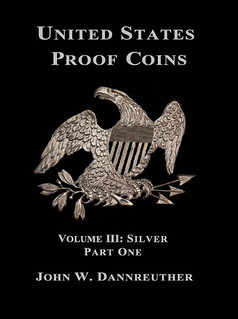

The previously published volumes of John Dannreuther's ongoing series United States Proof Coins have already established it as a landmark reference that will remain the gold standard on this topic for a generation or more. The recently published volumes on silver coins only add to its importance. While the meticulous listings of individual proof issues are what will receive the most attention (and will be consulted again and again by readers), the author's introductory chapters are of importance to anyone with the slightest interest in the history of U.S. coinage. Dannreuther's commentary on master coins and proofs would make for a very good book of its own, and he draws upon a wide variety of resources in researching the subject. Like many, I can't wait to add the copper volumes to my bookshelves!
Also, in the May 2026 issue of The Mint Master from the Utah Numismatic Society, editor Doug Nyholm published this review. -Editor
 I recently received the long awaited Volume III United
States Proof Coins written by John Dannreuther. This is
his third book on the subject of silver proofs, previously
Vol IV on gold proofs and Vol II on nickel proofs have
been released. I suspect the final volume 1 on copper
proofs is in the works and probably will be released in a
year or two.
I recently received the long awaited Volume III United
States Proof Coins written by John Dannreuther. This is
his third book on the subject of silver proofs, previously
Vol IV on gold proofs and Vol II on nickel proofs have
been released. I suspect the final volume 1 on copper
proofs is in the works and probably will be released in a
year or two.
This silver proof Vol. III is so far the largest encompassing two books for a total of 1,253 pages. Part one covers silver 3 cent pieces through quarters and consists of pages 1-684 while Part two covers half dollars thru silver dollars and pages 685-1,253.
The earlier Volume in gold also consisted of two books encompassing 1,031 pages and the Volume on nickel proofs was a single book consisting of 373 pages bringing the grand total to date a massive 2,657 pages. This is definitely one of the largest works in my library.
To describe the contents of Vol III, it first begins with a dedication, acknowledgements, forward, and glossary. Next is a very detailed group of chapters entitled, "Introduction to Proof Coinage," "Why and Where Were Master Coins and Proofs Made" and finally "How were Master Coins and Proofs Made." The above sections consist of 106 pages, truly a book within a book. Following that begins the series of individual dated proofs beginning with three cent silvers thru silver dollars. Virtually every coins description consists of several pages each. Mintage or estimated mintage of each issue is listed plus known survivors and even die characteristics or varieties are listed. Also known significant survivors, grades and auction records are noted. Commentary about each date and in many cases enlarged photos of portions of the coins are shown.
Dates covered, depending on the denomination begin about 1817 and carry through the twenties and thirties long before accurate records were kept by he mint. The individual coins section continues through the early 20th century however modern proofs are not included in his books.
Also of importance is the addition of many branch mint proofs. This area of research has always been clouded with mystery and open to much speculation. Some branch mint proofs are well documented, while other are looked upon with skepticism and doubt. Many have been refuted and have general disagreement within numismatic experts. Some have been certified and graded as proof while others have attained the "Specimen" designation. Danreuther has given this subject great thought and attention but has not included most controversial coins which are not generally accepted to be true proofs.
In conclusion, virtually everything you need to know about proof coins has been included masterfully in Danreuther's book.
This book and his other volumes are printed on high gloss quality paper and contain beautiful full color high resolution images of every coin and details were needed. They are hardbound in black cloth with the 2-Book sets on silver and gold editions contained in similar slipcases. The pre-publication price is no longer available but it can be purchased directly from the author or elsewhere in the internet. List price is $375.
Thanks, everyone. Also, see the "Notes From E-Sylum Readers" article elsewhere in this issue for an update from author John Dannreuther. -Editor
To read the earlier E-Sylum article, see:
NEW BOOK: U.S. PROOF COINS VOL III: SILVER
(https://www.coinbooks.org/v28/esylum_v28n49a06.html)
S&S LIBRARY PEDIGREE SERVICES
E-Sylum sponsor and NBS Board Member Shanna Schmidt published this announcement in her Newsletter #243 on April 24, 2026. -Editor
 Over the past several years, the S&S Library and Newman Portal have collaborated to digitize out-of-copyright reference material for the collector community—a partnership we've valued deeply. The effort has yielded remarkable results: our own numismatic reference holdings now span over six thousand entries, encompassing everything from single publications to multi-volume sets, and the collection continues to grow.
As we've approached true virtual library status, we've recognized an opportunity to redirect our focus toward something increasingly vital to serious collecting: establishing original auction pedigrees. Services like Ex-Numis, CoinCabinet, and the newly launched L5 Provenance research have demonstrated the market appetite for this work. We occupy a singular advantage: the S&S Library houses the largest private catalog archive for ancient coin auctions, with ongoing expansion into U.S. and world coinage categories. Many of our catalogs are annotated—a feature that transforms provenance research from tedious to genuinely rewarding.

To leverage this collection effectively—and eventually deploy AI-assisted search capabilities—we're undertaking a comprehensive cataloging initiative. We've already completed John Spring's essential reference for major coins across categories, and we're partnering with Internet Archives to accelerate digitization of the remainder. With our librarian Jose managing the process, we anticipate rapid progress.
In the interim, we're offering a targeted service: for a modest fee, we'll provide a scanned catalog entry for your coin, including the front matter, your lot's textual description, and plate image. If you're interested, contact Tyler Rossi at tylerrossi@arsclassicacoins.com.
We're currently developing a full-service platform for pedigree discovery. Until that launches, the library remains available for individual research requests, and I'm offering complimentary pedigree scans to customers purchasing coins through my website.
A great service! The S&S Library, housed in Chicago, is jointly owned by Shanna Schmidt Numismatics and a leading, U.S.-based collector in the field of classical and ancient numismatics. The library includes core holdings in all fields of numismatics, with a concentration on literature related to ancient coinage. -Editor
Shanna's website:
https://www.shannaschmidt.com/
To read the earlier E-Sylum article, see:
S&S LIBRARY UPDATE
(https://www.coinbooks.org/v27/esylum_v27n09a08.html)
HERBERT LEWIS KREINDLER (1935-2026)
Ira Rezak and David Hendin submitted this numismatic remembrance of coin dealer and auctioneer Herbert Kreindler. Thank you. -Editor
 Herbert Lewis Kreindler, an internationally renowned
numismatist, passed away on April 25, 2026 in Burlington,
Vermont, after a short illness. He was 91 years old.
Herbert Lewis Kreindler, an internationally renowned
numismatist, passed away on April 25, 2026 in Burlington,
Vermont, after a short illness. He was 91 years old.
Born in Manhattan in 1935, but raised in Liberty, in the Catskill region of New York State, Herb graduated from Carnegie Tech in 1957 with a degree in Engineering. Employed by the Grumman Aircraft Engineering Corporation and recently married he moved to Suffolk County on Long Island, New York where he continued to live with his wife and family until shortly before his death. However, in the early 1970s, he boldly changed careers having decided to become a full-time professional numismatist specializing in ancient coins. From 1974-1983 he joined in partnership with David Hendin as proprietors of Amphora Coins after which he established a highly successful solo practice that remained active until his retirement some two years ago.
Though expert in the full range of classical ancient coinage, and in later years even extended his interest to include medieval bracteate coinage as well as Jewish medals, Herb was particularly interested in coins of the Holy Land. In 1976 he collaborated with David Hendin providing the valuations for Guide to Ancient Jewish Coins, which in subsequent editions became Guide to Biblical Coins. "Herb's knowledge of the value of ancient coins in general, and especially of Biblical coins was unsurpassed," Hendin said.
Committed to research throughout his career, his opinion was widely respected throughout the world both in the commercial realm and as an occasional collaborator of such distinguished numismatists as the late Yaakov Meshorer of the Israel Museum in Jerusalem and Leo Mildenberg of Bank Leu in Zurich.


Herb was a proud and confident individual, scrupulously honest, and trustworthy in his commercial dealings. He was also widely known as "the numismatic auctioneer" in the United States having been invited to call hundreds of auctions by several premier American auction houses. His exceptional numismatic library was auctioned by Kolbe and Fanning in 2014.
Kreindler was a fellow of the American Numismatic Society and a member of the International Association of Professional Numismatists, the New York Numismatic Club, and the American Israel Numismatic Society.
As a private individual Herb enjoyed cars, hunting, fine wines, and world travel, having together with his wife visited some 56 countries. He remained fully active particularly as a committed golfer until very recently.
Herbert Kreindler is survived by his wife of 69 years, the former Barbara Baker, two sons and a daughter, seven grandchildren and three great-grandchildren. Besides family and his many friends, Herb will be greatly missed by appreciative numismatic colleagues and fellow-collectors world-wide.
The second image shows Kreindler calling the 2011 NYINC sale. See Jeff Starck's article at: NYINC auctions top $41 million, setting record for show -Editor
To read his online obituary, see:
Herbert Lewis Kreindler
(https://guttermansinc.com/funeral/herbert-lewis-kreindler/)
ST. LOUIS ANCIENT COIN GROUP: PROBUS PRIMER
The latest addition to the Newman Numismatic Portal is a video of a St. Louis Ancient Coin Study Group presentation. Project Coordinator Len Augsburger provided the following report. -Editor
St. Louis Ancient Coin Study Group Presentations Online
The St. Louis Ancient Coin Study Group meets monthly and features varied topics related to ancient and byzantine numismatics. At the March 19th meeting, David Grant focused on the extensive and highly varied coinage of the Roman emperor Probus (reigned AD 276–282), especially the antoniniani radiates. Grant explained how Probus inherited an empire recently reunified by Aurelian and worked to stabilize its military, economy, and administration while continuing coinage reforms. Much of the talk examines the complexity of Probus coinage: the numerous imperial mints, differing portrait styles, rare legends and titles, military and consular bust types, and the importance of modern scholarship and online databases in attributing and studying these coins. Grant emphasized that the six-year reign produced an enormous variety of coin types, making Probus one of the richest and most rewarding areas of Roman numismatics.

Link to "A Probus Primer":
https://nnp.wustl.edu/library/book/655301
Link to St. Louis Ancient Coin Study Group presentations on Newman Portal:
https://nnp.wustl.edu/library/multimediadetail/552485
VIDEO: E-SYLUM, NUMISMATIC BIBLIOMANIA AND NNP
The David Lisot Video Library on the Newman Numismatic Portal can be found at:
https://nnp.wustl.edu/library/multimediadetail/522852
We highlight one of his videos each week in The E-Sylum. Here's one from 2016 with Yours Truly speaking about The E-Sylum, Numismatic Bibliomania and the launch of the Newman Numismatic Portal. Check it out. -Editor
Wayne Homren, Editor, E-Sylum. Interviewer: David Lisot, CoinTelevision.com.
Wayne Homren is involved in some of the most important numismatic publications and information dissemination sources in the coin hobby. He talks about some of these sources and why they are so important.
To watch the complete video, see:
Wayne Homren Talks E-Sylum, Numismatic Bibliomania, & Newman Portal
(https://youtu.be/Ai4xhpL5vT8)
Wayne Homren Talks E-Sylum, Numismatic Bibliomania, & Newman Portal
(https://nnp.wustl.edu/library/book/548582)

ROBINSON AUCTION AND PHOTOGRAPHY EVOLUTION
Dealer Frank S. Robinson posted the following career retrospective, "My Coin Auction and Photography Evolution," on his blog on April 28. -Garrett
IN THE BEGINNING, all was darkness.
I started collecting coins in 1957; selling them around 1978. Not as a regular thing; just getting rid of excess stuff. But gradually it took over my life.
 Evolution is the process by which organisms adapt to changing environments. The numismatic landscape has changed a lot in nearly half a century.
My first ancient coin price list was in 1982. I felt pictures would help. Not even owning a camera, I put some coins on a xerox. The results were every bit as laughable as you might imagine, and I soon quit that. Then, for ancient coins, in 1985 I decided to try an auction. That went well, with some surprisingly strong prices, so I continued.
On my first auction, someone asked what time on the stated date it would close. I hadn't even thought of that, and replied, "Midnight, I suppose." That continued for years, with many "sniper" bidders waiting till the last minute and keeping me up late. Eventually I moved to a more reasonable closing hour.
 Meantime, pictures were a nagging concern. But soon came the "Lepczyk box," marketed by a major coin auctioneer I knew well. This was a Polaroid camera mounted on a wooden box with built-in lighting. A stage below could accommodate maybe six or ten coins. Very finicky. I'd charge a buck per shot (the cost of the film) for a customer requesting photos.
Next step up, in 1995, was a scanner, which more efficiently made better coin images. I'd print them out and paste up two 8-1/2×11" sheets, to be printed with my auction listings. I'd cram in 100+ coin pictures (out of 500+ in a sale), with no spaces between, and even some overlapping. Yet it felt like "state of the art." For a small timer, anyway.
 So I was still doing just printed catalogs. But technology marches on. In 1996 I had my first website, hosted by another (bigger) coin dealer offering that service. In 2008, I signed up with Earthlink, enabling me to upload anything to the web myself, including my catalogs. With photos of all lots — really expected now by buyers, especially for ancient coins, with so many quality variables (part of the fun).
This called for a digital camera; finding a suitable one was a challenge. I wound up going through several. Meantime I created a photo stage, with a spotlight, and laying the camera on a glass plate above the coins, ten to 25 per shot.
Setting up each group picture, then using Photoshop to "lasso" the individual coin images and adjust the brightness, contrast, sharpness, color hue, etc — trying to capture the look of the actual coin — then pasting the images individually into the text catalog* — is a ton of work. About a week's.
That's after having spent even longer writing the text, researching and properly describing the coins. (I try to inject occasional humor, which customers seem to enjoy.) Not to mention the work of acquiring the coins in the first place. But the whole thing is a labor of love.
My tech evolution continued. I knew smart-phone cameras were getting really good. So I tried my wife's, and sure enough, it outperformed my latest digital camera.

Coin photography is an art. It's amazing how different a coin can look depending on the lighting. After years, I discovered, quite by accident, that many coins actually photograph better without my spotlight. So I started shooting each group twice, with and without the spotlight, then for each coin picking the one looking better. The added work offset by less photoshopping needed.
So my resulting catalog, with text and photos, I'd upload to the web, and e-mail the link to my customers. After decades, I've built up a strong cadre of devoted buyers. (My business philosophy is to treat them right; some coin sellers seem to treat the customer as an enemy.)
There began to be a proliferation of online coin auctions, eventually aggregated on a Swiss website, biddr.com. Their fee was reasonable, so I started listing with them. I merely had to transmit the link to my online catalog, and their software would convert it to their standardized format. Exposing my sales to more bidders.
In addition to conventional advance bidding, biddr.com also offered "live bidding." With each lot coming up in sequence, so people can bid in real time. Something I never wanted to do — sitting at a screen watching bidding on mostly stuff that didn't interest me (mostly because priced too high). I couldn't see the appeal of this. And biddr.com charged a lot more for it. However, when my auctions became the only ones there without live bidding, I capitulated, and tried it.
 Results at first were meh. But after a few sales, it seemed to catch on, and I've been quite surprised at how many folks now do the live bidding — and how high they're often willing to bid. There's a psychology at work. Some seem to feel their ego's on the line, they don't want to be beaten!
My last auction was #131. Here's a link to it. Out of 593 lots, only 6 were unsold.
Now another new thing: lately a few people ask for videos of coins. Sorry, that's a bridge to the future too far for me, and I've begged off. I guess I'm finally becoming an old curmudgeon.
* The sole program with which I could reasonably do this (on my Mac) is OpenOffice. Numismatic catalogs normally illustrate a coin with obverse and reverse side-by-side; OpenOffice puts one above the other. I could never figure out how to change that. Oh well.
To read the complete article, see:
My Coin Auction and Photography Evolution
(https://rationaloptimist.wordpress.com/2026/04/28/my-coin-auction-and-photography-evolution/)
NOTES FROM E-SYLUM READERS: MAY 3, 2026
Dannreuther's United States Proof Coins Volume III: Silver Update
John Dannreuther writes:
"There is a wrong page in my recent silver proof book and I will send the correct one as soon as I get it from the printers.
"Missed it, as they duplicated a page (right page number but the same as another one!). I missed it, as when I approved the pages one by one, it read correctly - it was just the wrong page!
"Also, I have had requests for spiral bound copies. If you can have anyone who is interested in a spiral bound email me ( jdrc@mindspring.com), I will add them to a list when I get them printed."
Great idea! See two reviews of the book elsewhere in this issue. -Editor
To read the earlier E-Sylum article, see:
NEW BOOK: U.S. PROOF COINS VOL III: SILVER
(https://www.coinbooks.org/v28/esylum_v28n49a06.html)
THE BOOK BAZARRE
STOLEN 1709 LIMA 8 ESCUDOS RECOVERED
At the recent Central States show, coordinated efforts by five dealers and a collector led to the recovery of a 1709 Lima, Peru 8 Escudos from the 1715 Treasure Fleet. -Garrett
 Coordinated efforts by five dealers and a specialist collector at the recent Central States Numismatic Society (www.CSNS.org) convention near Chicago led to the recovery of a stolen sunken treasure gold coin and the arrests of two suspects who reportedly offered the coin for sale at the show on April 24, 2026.
The recovered coin is a 1715 Treasure Fleet 1709 Lima, Peru eight Escudos. The 1715 Treasure Fleet refers to the July 31, 1715 sinking of 11 Spanish galleons in a hurricane off the coast of Florida. The ships were sailing from the New World back to Spain, loaded with silver and gold coins and bars.
The rare gold coin recovered at the CSNS convention was part of that famous treasure and later pedigreed to the McGregor Collection. It was sold at auction in November 2025 for $40,500 (including buyer's fee) by Sedwick & Associates in Winter Park, Florida.


"Alleged suspects caught; coin recovered! Dealers working together with the support of local law enforcement helped keep our show and the hobby community safe," declared CSNS President Mitch Ernst.
"Because of dealer awareness and cooperation, and quick response by the Schaumburg, Illinois Police Department, a stolen $40,000 coin was identified and recovered, and two suspects were arrested. It was amazing to watch it all unfold," Ernst stated.
The chain of events at the convention started when the suspects tried to sell the gold coin, according to dealer Tony Gryckiewicz of Cabbage Coins in Lancaster, Pennsylvania.
"The two suspects presented the coin at my table for sale at a suspiciously low price. It is an advanced collector piece, and I asked them where they obtained it. They told me the coin was found among their grandmother's items at her house. I found this very odd," explained Gryckiewicz.
"When I initially agreed to their price, they increased it by $10,000 and said they wanted to get the most possible. I was very irritated with this request, but in retrospect I'm happy that we didn't come to a deal at that time," he said.
When the suspects went elsewhere on the bourse floor to shop the coin, Gryckiewicz productively used the time to conduct research.
"I spoke to a friend, David Huang, a collector who is on the Advisory Board of the 1715 Fleet Society and a specialist in 1715 Fleet gold cobs such as the one presented to me. David informed me that the 1709 is a much better date and rarer coin and encouraged me to further research the coin."
"I found the auction sale for the 1709 Lima 8 Escudos in November 2025 at Dan Sedwick's auction site, and that's when I saw it sold for $40,500," recounted Gryckiewicz.
He then went to Sedwick's table to inform him that the coin had just been offered at nearly half the auction sale price by two people who did not seem like collectors.
According to Gryckiewicz, Sedwick phoned the coin's last known owner, the winning bidder at the November 2025 auction. The owner explained the coin had been missing for some time.
Gryckiewicz and dealer Noah Lehmann-Haupt of Rarity 7 in San Francisco then began searching the bourse floor to see if the suspects and the coin were still there.
"We noticed the two guys, and Noah immediately went to notify security officials. I approached the sellers and asked if they were ready to make a deal. They agreed and followed me back to my table," recalled Gryckiewicz.
For the next 20 minutes, he stalled the suspects to keep them at his table. First, by pretending to call a prospective client who might want to buy the coin. However, that phone call was actually made to fellow dealer Lehmann-Haupt who was with security team members.
 Then he continued to stall by discussing cash versus check versus trade options for the deal, then making a video of the coin for the "prospective client." He also explained in detail why he was valuing a proposed generic gold coin trade to them so high relative to gold spot prices.
While this was happening, the actual owner of the coin was on the phone with Schaumburg Police to file a theft report. Once that was completed, police approached the suspects, asked how they obtained the coin, then arrested them and obtained a statement from Gryckiewicz.
"Tony did a heroic job of stalling the two guys shopping the coin, and the Schaumburg police cuffed them and took them away. Dealers Dan Decker of Peak Rarities in Boynton Beach, Florida, and Nicolas Morabito of Nicolas Morabito Rare Coins in Philadelphia, Pennsylvania, did a great job preventing the guys from running out an open door in the back before the police could cuff them and take them away," stated Lehmann-Haupt.
 CSNS President Ernst said there was a large sign on the bourse floor as part of the organization's Dealer Watch security program. The sign advised: "See Something, Say Something. Thank you for helping to keep our show safe."
"I believe this is a perfect example of how dealers, CSNS show security, and Schaumburg police working together solved a crime that had not been reported earlier. In many cases, dealers play a significant role in identifying suspicious circumstances, such as in this case, which results in arrests and the successful recovery of property," stated Doug Davis, founder and president of the Numismatic Crime Information Center (www.NumismaticCrimes.org).
"The quick actions by the dealer, stalling the suspects, his quick communication with the auction company, and immediate response by show security and Schaumburg police were the key to a successful arrest. I commend the dealers involved, CSNS show personnel, the show security, and Schaumburg police for a job well done. Bridging the gap between the numismatic community and law enforcement is the key to reducing numismatic crime," said Davis.
Additional information about the Central States Numismatic Society is online at www.CSNS.org.
2026 ROCKWELL LECTURE: DR. DONALD A. SLATER
John Ferreri passed along this announcement for the next Boston-area lecture in honor of Thomas P. Rockwell. Thanks. -Editor
Thomas P. Rockwell Memorial Lecture
Tuesday, May 12, 2026 at 7:30 p.m.
Boston Numismatic Society, Currency Club of New England, and Collectors Club of Boston.
We are pleased to announce that this year's speaker is Dr. Donald A. Slater who will be speaking on Paul Revere and the Social Memory of the Pine Tree Shilling in Colonial Massachusetts. This timely topic for the nation's semiquincentennial will explore imagery from 17th century Massachusetts silver coinage and a variety of 18th century Massachusetts currency issues in an attempt to reconstruct the thinking of the local patriot and renaissance man, Paul Revere.
During the 17th and 18th century, colonists mistrusted paper money as an economic vehicle and instead preferred specie coinage for commerce. Due to recurrent shortages of coinage in the colonies, and the need for colonial governments to fund certain activities, the issuance and usage of paper money was often a necessity. Revere would have been well aware of the delicate economic situation at the start of the Revolutionary War and colonists' mistrust of paper currency. Slater thus argues that, as Revere was the primary engraver and printer of Massachusetts paper currency from 1775-1779, he intentionally leveraged historically powerful pine tree visual imagery to help boost the economic legitimacy of paper currency amongst the populace.
 Dr. Slater earned his M.A. and Ph.D. in anthropology/archaeology at Brandeis University and his B.A. from the
University of New Hampshire. Since 2002 he has held a variety of roles at Phillips Academy, Andover at the
Robert S. Peabody Institute of Archaeology and the Department of History and Social Sciences. His primary
research focuses on the study of Colonial New England material culture, as well as the religion, cosmology, and
iconography of the ancient Maya. He has directed archaeological projects at local 17th and 18th century sites in
Massachusetts, and in ceremonial caves in Yucatan, Mexico. An educator at heart, at Phillips Academy, Slater
teaches courses on US and World History, colonial burial grounds, ancient Maya cosmology, and he has led
student expeditionary learning programs to Mesoamerica, Peru, the Arctic, the American Southwest, and
throughout New England. Most recently, Slater launched a new hands-on numismatics course that has
culminated in small exhibits at the Addison Gallery of American Art and the Robert S. Peabody Institute.
Dr. Slater earned his M.A. and Ph.D. in anthropology/archaeology at Brandeis University and his B.A. from the
University of New Hampshire. Since 2002 he has held a variety of roles at Phillips Academy, Andover at the
Robert S. Peabody Institute of Archaeology and the Department of History and Social Sciences. His primary
research focuses on the study of Colonial New England material culture, as well as the religion, cosmology, and
iconography of the ancient Maya. He has directed archaeological projects at local 17th and 18th century sites in
Massachusetts, and in ceremonial caves in Yucatan, Mexico. An educator at heart, at Phillips Academy, Slater
teaches courses on US and World History, colonial burial grounds, ancient Maya cosmology, and he has led
student expeditionary learning programs to Mesoamerica, Peru, the Arctic, the American Southwest, and
throughout New England. Most recently, Slater launched a new hands-on numismatics course that has
culminated in small exhibits at the Addison Gallery of American Art and the Robert S. Peabody Institute.
For as long as Slater remembers, he has been interested in history. He collects a wide array of objects (many of which he uses in his classes), but throughout his life, numismatics has always been his main collecting passion. Slater began collecting coins over 40 years ago when he was about 5 years old. He still owns the first coin that he remembers acquiring – a beat up 1859 first year Indian Head penny that his father bought for him at a local coin shop. As a child, his preferred bedtime reading was often the Red Book where he was always most enamored with the rustic designs of Pine Tree coinage, Massachusetts coppers, and other colonial and early American issues. Today, Slater's primary collecting focus remains colonial Massachusetts coinage and currency. Beyond this, he collects other colonial paper, George Lovett 1860 witch tokens, objects featuring Native American imagery, and any other numismatic odds and ends that tell fascinating historical stories that can be used in the classroom.
Please join us at the New Light Korean Church 730 Main St (Rt.20) Waltham for an informative and enjoyable evening. The program will commence at 7:30 pm, the building will be open to socialize at 6:00 pm. In addition to the church, there should be sufficient on-street parking and across the street at the Waltham Library (after 6 PM). For further information please contact William Harkins at williamharkins@comcast.net.

2026 NLG AWARDS RULES AND SUBMISSION INFO
The Numismatic Literary Guild (NLG) is a separate organization from ours, the Numismatic Bibliomania Society (NBS). But we share a love of the numismatic hobby and numismatic research and writing in particular. Here are this year's Awards Competition Rules and Submission Info, as well as the Awards Competition categories and criteria.
Founded in 1968, the NLG is a nonprofit organization open to any editors, reporters, authors, writers, catalogers, webmasters, bloggers or producers of audio or video involving all forms of money, medals, tokens and other numismatic collectibles. Information about applying for NLG membership is available online at www.NLGonline.org/membership. -Garrett
2026 NLG Awards Rules & Submission Info
Below you will find the entry information, categories and deadlines for the 2026 Numismatic Literary Guild's (NLG) annual contest for numismatic writers, bloggers, authors, editors, podcasters and other content creators who are current NLG members. With the exception of the category for "Best Numismatic News or Feature Article in a Non-Numismatic Publication," the contest is open to NLG members only.
However, if you are interested in joining the NLG, we would love to have you as a member. The membership dues are $15 per year, plus a one-time application fee of $25 in addition to the dues, for a total of $40.
The Numismatic Literary Guild (NLG) is a nonprofit organization composed of editors, authors, writers, bloggers and content producers who cover news and feature stories about all forms of money, medals and tokens as collectibles.
To be eligible for consideration in any of the NLG contest categories, entries must have been published, released or posted on the Internet between May 1, 2025, and April 30, 2026. One copy of each entry must be submitted for consideration and each copy must also be accompanied by a coversheet listing the category and other information specified in the rules. Make sure the actual entrant's name is apparent on the coversheet. Only one entry is allowed per category per submitter.
The coversheet must contain the following information:
CATEGORY TITLE
NAME OF PUBLICATION
TITLE OF SUBMISSION
DATE OF PUBLICATION
NAME, ADDRESS, TELEPHONE NUMBER AND EMAIL ADDRESS OF THE ENTRANT
NAME, ADDRESS, TELEPHONE NUMBER AND EMAIL ADDRESS OF AUTHOR IF DIFFERENT FROM THE ENTRANT
All entries must be received no later than Wednesday, June 17, 2026. The entries should be sent to the contest coordinator at the following address:
CAC
Attention: NLG Awards Submission
1420 US Highway 206
Suite 110
Bedminster, NJ 07921
Winners will be announced and awards presented at the 2025 NLG Awards Luncheon on Thursday, August 27, 2026, at the American Numismatic Association's World's Fair of Money® in Pittsburgh, Pennsylvania.
If you submit an entry and cannot be at the awards ceremony in person, PLEASE indicate on your entry coversheets the name of a designated person who can accept your award and deliver it to you.
Here are the NLG 2026 Awards Competition categories and criteria:
BOOKS:
Best Specialized Books – One printed copy or digital e-book must be submitted for each entry subcategory. E-books may be present via a web link or USB drive.
1 - United States Coins
2 - World Coins
3 - United States Paper Money
4 - World Paper Money
5 - Tokens & Medals
6 - Numismatic Investments
7 - Numismatic History or Personalities
NUMISMATIC COLUMNS OR ARTICLES:
Best column, Article or Series of Articles – Entries may be in print or online from the U.S. and/or published in overseas numismatic media. One copy (photocopies are okay) of the submission is required with the coversheet.
8 - U.S. Coins to 1900
9 - U.S. Coins 1901 to Date
10 - World Coins, 700 BC to 1299 AD
11 - World Coins, 1300 to 1800
12 - World Coins, 1801 to date
13 - U.S. Paper Money
14 - World Paper Money
15 - Tokens & Medals
16 - Numismatic Spot News, Marketplace, or Analysis
17 - Numismatic History or Personalities
18 - Best Numismatic News or Feature Article In a Non-Numismatic Publication
19 - Best Column or Article Combining Numismatics & Collectible Cryptocurrency
20 - Ed Reiter Memorial Award For Best Column – Numismatic Publications – Submit one copy (photocopies are okay) of three different columns published in a numismatic print publication or online.
21 - The Maurice M. Gould Memorial Award for Best Column – Non-Numismatic Publications – Submit one copy (photocopies are okay) of three different columns. Entries may be submitted by the publisher, editor or columnist of any coin column appearing regularly in any non-numismatic newspaper, magazine or website.
22 - James L. Miller Memorial Award – Article of the Year – This category awards the best feature or news article involving coins, paper money, tokens or medals that was published in print and/or online. To enter, submit a copy of the article you believe is deserving of being named the Article of the Year.
PERIODICALS:
23 - Best Investment Newsletter – The criteria include investment analysis of precious metals and/or rare coins, overall reader appeal, the quality of research, writing and graphics, as applicable. Submit one copy or digital links to three different issues of the newsletter for consideration.
24 - Best Professional Periodical – Please submit one copy of two different issues of the for-profit, professional numismatic publication may be submitted by the publisher or editor of any daily, weekly, monthly, quarterly or annual for-profit numismatic publication in the U.S. or overseas. Criteria include overall numismatic appeal, features, departments, graphics, journalistic and editorial excellence as applicable.
25 - Best Club or Not-for-Profit Periodical – This category is open to any local, regional, national or international nonprofit numismatic organization in the U.S. or overseas. Submit one copy of two different issues of the publication.
AUCTION CATALOGS:
One copy of each catalog is required for entry. Criteria include cover design, overall eye appeal, format, graphics and layout, research and quality of description. Entries may be submitted by an auction firm, auctioneer or cataloger. ONLY ONE CATALOG FROM EACH AUCTION FIRM will be considered in each category. Multiple entries will be disqualified.
26 - Best U.S. Coins Auction Catalog
27 - Best World Coins Auction Catalog
28 - Best Paper Money (U.S. or World) Auction Catalog
29 - Best Exonumia/Americana or Numismatic Literature Auction Catalog
WEBSITES:
30 - Best News or Blog Website – Submit link(s) to the website being considered for this category on the entry coversheet. This award recognizes the best interactive blog that effectively communicates information and personal commentaries about the numismatic hobby.
31 - Best Dealer or Industry Website – Submit link(s) to the homepage of the website being considered for this category on the entry coversheet.
32 - Best Non-Trade Website – This category is for websites maintained by coin clubs and other non-commercial organizations and individuals devoted to the coin hobby. One copy of the website home page and all posted items linked to it at the time the copy is made, submitted by the publisher or editor, are required to accompany this submission.
33 - Best Numismatic Social Media Account – This award will be presented for the best numismatic-themed account posted to a social media platform such as Facebook, Instagram, Twitter, TikTok or YouTube. Entries will be judged on the quality of their content and graphics, as well as audience engagement. Please submit link(s) to the account related to the entry.
DIGITAL MEDIA:
34 - David Lisot Memorial Video Award – This award consists of the best video presentation involving numismatics made for educational purposes. Videos should have been recorded and broadcast on YouTube, other similar platforms or hosted on your website. Entry must include one copy of the video as well as visual materials – either a written script or other materials used in the presentation. These entries can be submitted on a flash drive or by including links on the entry coversheet.
35 - Podcast – Submit your three best podcasts involving numismatics by including links to the entries or a flash drive containing digital files of each session.
36 - Software or App – The best presentation of new numismatic-related software or mobile application published in the App Store or any other electronic format or electronic delivery system. For digitally distributed software or apps, one copy must also be provided, and if the entry is distributed on the Android or Apple store, written instructions must be provided about how to locate and download the app. Each entry must be accompanied by a written statement citing date(s) of first use.
SPECIAL AWARDS:
37 - David W. Lange Memorial Book of the Year Award – The printed or electronic media work having the greatest potential impact on numismatics. Criteria include overall reader appeal, research quality, photographic and graphic excellence, cover and typography, where applicable. Books submitted in the specialized categories are automatically considered for Book of the Year, which is determined by the judges.
38 - Lee Martin Founder's Award – Best All-Around Portfolio – This is a collection of writings and/or photographs and related items demonstrating numismatic writing ability and versatility published within the contest year. The emphasis is on quality, not quantity and organization and presentation will count as heavily as volume. One copy of the portfolio entry needs to be submitted and can be sent as a PDF file on a flash or thumb drive. Items included in the portfolio may also be submitted in other relevant categories at the entrant's option.
39 - Clement F. Bailey Memorial Award – This award was endowed by Jim Miller of Miller Magazines in memory of an especially beloved member of the numismatic writing community and NLG founder, Clement F. Bailey. This award recognizes excellence among new writers in numismatics whose first published writings in this field appeared in hobby publications during the previous year. Nominees are supplied solely by numismatic publishers.
40 - The Ribbit – This award recognizes an individual who has achieved prominence in numismatics while maintaining approachability, a sense of humor and essential modesty. The winner is selected by the previous year's recipient.
41 - The Clemy – The winner of this award, the Guild's highest honor, is nominated by the previous year's recipient. The Board will then review and approve the nominee.
2026 COIN WORLD MOST INFLUENTIAL VOTING
Coin World has opened the 2026 version of its poll helping choose the year's "100 Most Influential People in Numismatics". The resulting article will be published in September. Here's their emailed announcement. Follow the link below to cast your votes by May 30. -Editor
 Since 2021, we've polled the numismatic community to determine the Most Influential People in Numismatics.
The buzz and commotion surrounding this big issue returns again for 2026.
We're writing once again to request your opinion: who are the Most Influential People in Numismatics?
Your ballots will influence the selection of giants within the hobby who will be profiled in the upcoming publication Coin World 2026 Most Influential People in Numismatics.
This publication, free to all Coin World magazine subscribers, will be published alongside the September 2026 issue of the monthly magazine. Afterwards, additional copies may be purchased from Coinworld.com, while supplies last.
We thank look forward with great anticipation to see who the community nominates this year!
First, if you're not already a Coin World subscriber, please sign up now. We need to support numismatic reporting, a vital resource for the hobby.
There are 300 names on this ballot. Vote wisely. A good number of names should be familiar to E-Sylum readers. You may choose as many as you wish, and write-in anyone you feel has been missed. -Editor
To cast your ballot, see:
COIN WORLD 2026 Most Influential Ballot
(https://coinworld.com/2026mi)
To subscribe, see:
Coin World Magazine Subscription Offers
(https://subscribe.amosmedia.com/coin/subscriptions-options)
To read the earlier E-Sylum articles, see:
THE MOST INFLUENTIAL PEOPLE IN NUMISMATICS
(https://www.coinbooks.org/v24/esylum_v24n17a22.html)
ON INFLUENCE IN NUMISMATICS
(https://www.coinbooks.org/v24/esylum_v24n18a11.html)
MORE ON INFLUENCE IN NUMISMATICS
(https://www.coinbooks.org/v24/esylum_v24n19a13.html)
COIN WORLD ON INFLUENCE IN NUMISMATICS
(https://www.coinbooks.org/v24/esylum_v24n20a08.html)
HARVEY STACK ON INFLUENCE IN NUMISMATICS
(https://www.coinbooks.org/v24/esylum_v24n21a16.html)
2022 MOST INFLUENTIAL PEOPLE IN NUMISMATICS
(https://www.coinbooks.org/v25/esylum_v25n35a19.html)
2023 COIN WORLD MOST INFLUENTIAL VOTING
(https://www.coinbooks.org/v26/esylum_v26n10a14.html)
VOCABULARY TERM: SIMILAR
Here's another entry from Dick Johnson's Encyclopedia of Coin and Medal Terminology. -Editor
Similar. Nearly the same as; a cataloging term for a medallic item that is slightly different from one that is listed in a published catalog. Because medals are customized and are frequently changed from time to time, many varieties may exist. While it may be impractical to describe each separate item, and call this a variety, numismatists are willing to accept an item like one already published and call it "similar." The changes are more that a different lettering that is inscribed, say, with a recipient's name, date and such. This personalization is to be expected as an inscribed medal is bestowed to each recipient. In fact, medal designers purposely leave a space for this (called a reserve often within a cartouche) in their design.
More often the changes indicated by calling an item similar to a published one is the result of die retooling. This can be a change in a date, or the name of the organization, or the new name of an award (with new raised lettering), or a change in the organization's logo, or some pictorial element. Thus a new die is created (or, maybe, a new stock die is used) creating the new state. In numismatic cataloging, similar is abbreviated: sim. See cataloging.
To read the complete entry on the Newman Numismatic Portal, see:
Similar
(https://nnp.wustl.edu/library/dictionarydetail/516763)

JOHN ABEEL NEXSEN (1821-1909)
E-Sylum Feature Writer and American Numismatic Biographies author Pete Smith submitted this article on numismatist John Nexsen and his writings on the 1804 dollar. Thanks! -Editor
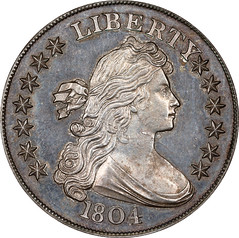 Len Augsburger sent me a note on April 4, 2026, suggesting that I add a listing for John Nexsen
to American Numismatic Biographies.
Len Augsburger sent me a note on April 4, 2026, suggesting that I add a listing for John Nexsen
to American Numismatic Biographies.
Cal Wilson was preparing to publish a list of about 250 biographies in 1988 that included Nexsen. I had not included him in ANB.
Then on Saturday, April 25, 2026, Len and Joel Orosz made an NNP Symposium presentation on The Fantastic 1894 Dollar at the Central States show. They discussed the contributions made by Nexsen to our understanding of 1804 dollars. I offer this biography of Nexsen.
John A. Nexsen was born in New York City on July 31, 1824. He was the son of William Nexsen (1775-1866) and Polsey Carman (1776-1852). John married Caroline Amelia Nexsen (1821-1911) in 1848. The had two sons and two daughters. John and Caroline shared a common great-grandfather.
In 1854, he was elected vice-resident of the Brooklyn Young Men's Christian Association, He was also a member of the Horticulture Society of Brooklyn.
John Nexsen joined the New York Numismatic Society in 1864 and the American Numismatic Society in 1867. The New York Numismatic Society failed to thrive and was dissolved effective July 31, 1866. Nexsen was one of eleven members to sign the resolution to transfer their assets to the ANS. Nexsen served as corresponding secretary at the ANS for one year 1869-70.
Nexsen was heavily involved with the Association for Improving the Condition of the Poor in Brooklyn. He served as secretary during the period of 1868 until his death.
He was employed with the Leather Manufacturers Bank in New York and became cashier of the newly formed Fulton Bank in 1869. The Fulton Bank merged with Mechanics Bank in 1899 and Nexsen retired.
 Edward Cogan conducted an auction sale of "Catalogue of Coins and Medals, the Property of
Jno. A. Nexsen, Esq." on October 5-6, 1871. The sale had 868 lots.
Edward Cogan conducted an auction sale of "Catalogue of Coins and Medals, the Property of
Jno. A. Nexsen, Esq." on October 5-6, 1871. The sale had 868 lots.
Lot 409 was a 1792 Martha Washington Half Disme that realized $11, one of few coins selling for more than $10. The piece was described as from the Gilmore collection. This may have been from the Strobridge sale of December 15, 1863, lot 719. The piece is, unfortunately, untraced.
As a bank cashier, Nexsen could have formed a collection from interesting piece that passed through the bank. However, the 1792 half disme was a significant auction purchase.
Nexsen also consigned coins to a sale held by S.H. & H. Chapman on December 16, 1904. The long title was "Catalogue of the Fine Collection of Ancient Roman, French, Anglo-Saxon, English and Other Coins, the Property pf J. A. Nexsen, Esq., Brooklyn, N. Y. together with Several Other Collections." The catalog was somewhat unusual in listing market value for coins as a guide to bidders stating, "we find from long experience that American collectors do not know their market value…"
John died of acute indigestion at home in Brooklyn on August 17, 1909. He is buried with many family members at Green-Wood cemetery in Greenwood Heights, New York.
John A. Nexsen contributed several articles to the American Journal of Numismatics on the topic of the 1804 dollar. He acquired pressings of some of the pieces and examined others in person.
 AJN April 1887, page 87. Nexsen listed ten known 1804 dollars noting, "The first three pieces
named in the following list are without doubt original Dollars coined in 1804." The third piece
was from the collection of Charles Spiers and was identified later as an electrotype. Items IX and
X were owned by the U. S. Mint. Nexsen did not note differenced in the reverse dies. He did
mention that one of the mint specimens had a plain edge and the other a lettered edge.
AJN April 1887, page 87. Nexsen listed ten known 1804 dollars noting, "The first three pieces
named in the following list are without doubt original Dollars coined in 1804." The third piece
was from the collection of Charles Spiers and was identified later as an electrotype. Items IX and
X were owned by the U. S. Mint. Nexsen did not note differenced in the reverse dies. He did
mention that one of the mint specimens had a plain edge and the other a lettered edge.
AJN April 1888. Page 89. In a brief article, Nexsen added the Linderman Dollar and noted it as a restrike.
AJN April 1891, page 98. In this issue, Nexsen stated, "The term Original is applied to pieces which were struck from the original dies in the year of their date. Of the dollars enumerated in the following list, the first two are universally conceded to be Originals, being the only ones reclaimed from circulation, and without doubt were coined in 1804. The others should be designated as Re-strikes as they were struck from the original dies subsequent to the year 1804."
Nexsen listed twelve pieces. Added to his original list were no, XI, the Linderman Dollar, and no. XII was the Berg Dollar. Nexsen noted that 1804 Dollars were restruck between 1836 and 1840.
AJN July 1893, page 23. In this issue, Nexsen reported that the Spiers piece was composed of tin and copper and plated with silver. He still believed that it was struck from original dies.
AJN April 1894, page 92. Nexsen announced the addition of a thirteenth piece, acquired by Mr. Rosenthal. He also mentioned examination of two new discoveries that had altered dates.
AJN July 1897, page 10. Nexsen notes that no 1804 dollar was reported before 1842.
In their 1962 book on The Fantastic 1804 Dollar, Newman and Bressett state on page 94, "No researcher deserves more praise for courage than John A, Nexsen, for in a final article published in April, 1905, he admits, "No one now believes that they were coined in 1804. I must therefore repudiate all that I said in these articles about originals and restrikes.""
AJN April 1905, page 102. Nexsen mentioned that all 1804 dollars had a beaded edge, a device not used before 1836. He suggested that the Spiers piece was a trial pieces and the first struck from the die. He now noted that two different reverse dies were used and that later restrikes had a plain edge. He never mentioned that one of the Mint dollars was struck over an 1857 Swiss shooting thaler.
Nexsen was apparently unaware of the diplomatic gift story although that had been published as early as 1867. The stories published for Nexsen show the evolution of public knowledge about the coins during that period.
To read the Cogan catalog of the Nexsen collection, see:
CATALOGUE OF COINS AND MEDALS, THE PROPERTY OF JNO. A. NEXSEN, ESQ.
(https://nnp.wustl.edu/library/auctionlots?AucCoId=19&AuctionId=510488)

NUMISMAGRAM MEDAL SELECTIONS: MAY 3, 2026
Numismagram's Jeremy Bostwick sent along these five medals from his most recent upload of new material to his site. For all of the new items, please visit https://www.numismagram.com/inventory. -Garrett

103468 | GREAT BRITAIN. Botanical & Horticultural Society silver Award Medal. Engraved and awarded in 1827 to Lieutenant Henry West, Esq. by the society based in Durham, Northumberland and Newcastle-on-Tyne (48mm, 39.47 g, 12h).
BOTANICAL AND HORTICULTURAL SOCIETY, Flora, reaching toward potted plant to left and grapevine to right, seated right in front of gazebo; decorative potted plant to outer right; gardening tools in foreground; in two lines in exergue, INSTITUTED 1824 / SOCIETY // DURHAM NORTHUMBERLAND AND NEWCASTLE ON TYNE, "PRESENTED / to / LIEUt. WEST R. N. / for the best / DISH OF CHERRIES / 18 Augt 1827" engraved in six lines in various styles of scripts; all within complex floral wreath. Edge: Loop attached at the top, otherwise plain.
BHM –. Mint State. Deep gunmetal gray toning, with some delightful iridescence nearer the edges; some scattered hairlines are noted for completeness.
Lieutenant Henry West entered the Royal Navy in May 1801 as a midshipman. In the ensuing years, he would serve under Horatio Nelson in campaigns against France and Spain, eventually receiving his commission in 1808. Various campaigns in America would follow, with him being recalled to England in 1816. In 1831, he was promoted to the rank of commander. Personally, he married twice—first to his cousin (the only surviving daughter of Rev. Henry Cotes in County Durham) in 1822, and then, in 1828, to the youngest daughter of Samuel Huthwaite of County Northumberland.
To read the complete item description, see:
103468 | GREAT BRITAIN. Botanical & Horticultural Society silver Award Medal.
(https://www.numismagram.com/product-page/103468)

103414 | MEXICO. Maximiliano I white metal Medal. Issued 1867. Memorial to Maximiliano (41mm, 21.81 g, 12h). By August Kleeberg at the Vienna mint.
MAXIMILIAN I. IMPERATOR MEHICORUM, bare head right // * NATUS 6. JULII 1832 * / + 19. JUNII 1867, winged and draped female figure seated left, holding trumpet; behind, tomb with coat-of-arms and weeping tree in background. Edge: A few light marks, otherwise plain.
Grove 139b; Hauser 321; Wurzbach 6140; Forrer III, p. 173. Choice About Uncirculated. Some scattered marks and scuffs that can often plague white metal, but still quite pleasing and brilliant, and lacking any dullness or pestering that is often the case.
Maximiliano was of Austrian descent from the mighty Habsburg ruling family (he was a younger brother of Austro-Hungarian emperor Franz Joseph), and was installed as the Emperor of Mexico under the auspices of the French—the latter hoping to extend their influence in Mexico. The empire was short lived, however, as Maximiliano was dethroned a little after three years, being captured and executed by Republican forces.
To read the complete item description, see:
103414 | MEXICO. Maximiliano I white metal Medal.
(https://www.numismagram.com/product-page/103414)

103507 | GREAT BRITAIN. Sir Moses Montefiore white metal Medal. Issued 1884 for the 100th birthday of the British entrepreneur and Sephardic Jewish philanthropist (41mm, 22.08 g, 12h). By A. D.Loewenstark & Sons in London.
Bust right wearing frock coat; around, Hebrew legend reading "fortunate is the God-fearing [man] who walks in His ways – 5645 years since creation" // HOLY LAND, EGYPT, DAMASCUS, CONSTANTINOPLE, RUSSIA, POLAND, ROME, MOROCCO, A / UNIVERSAL / TRIBUTE / OF / RESPECT & ESTEEM / TO / SIR MOSES MONTEFIORE / BART. PHILANTHROPIST / FROM HIS ADMIRERS & FRIENDS / CENTENARY / 27th OCTOBER 1884 in 13 lines. Edge: Plain.
BHM 3166; Eimer 1707; JMC 1169. Mint State. Quite vibrant and mirrored in the fields, though some scattered friction and a few marks are noted, as well as a few spots of darkening. A scarce and important piece of Judaica.
To read the complete item description, see:
103507 | GREAT BRITAIN. Sir Moses Montefiore white metal Medal.
(https://www.numismagram.com/product-page/103507)

103089 | GERMANY. Ferdinand Adolf Heinrich August Graf von Zeppelin & Dr. Hugo Eckener silver Medal. Issued 1928. The commissioning of the LZ-127 (33mm, 14.58 g, 12h). By the Ludwig Christian Lauer mint in Nürnberg.
FERDINAND GRAF ZEPPELIN 1838-1917 / DR HUGO ECKENER 1868, jugate heads of Zeppelin and Eckener left // DEUTSCHE KRAFT UND DEUTSCHER GEIST / WERK DAS "AUFSTIEG" "FREIHEIT" HEISST!, allegorical figure of Victory standing left, with wings spread, atop the airship; "GRAF ZEPPELIN" / D-LZ 127 / INDIENSTSTELLUNG / 20 SEPT. 1928. Edge: 990.
Hans Kaiser 479. PCGS SP-63. Highly brilliant in the fields, with alluring frosting on the devices and some colorful toning throughout. Surpassed in the PCGS census by just two others.
Zeppelin was a German general and aircraft manufacturer, who later founded the airship company Luftschiffbau Zeppelin. Following Zeppelin's death in 1917, Dr. Hugo Eckener became the head of this company and oversaw post-war fundraising to expand upon its production, even serving as commander for the LZ 127 on numerous occasions. When this airship first entered use, it was the first commercial passenger transatlantic flight service in the world, eventually making 590 flights over nearly a decade. In 1940, she was scrapped for metal for the German efforts in World War II.
To read the complete item description, see:
103089 | GERMANY. Ferdinand Adolf Heinrich August Graf von Zeppelin & Dr. Hugo Eckener silver Medal.
(https://www.numismagram.com/product-page/103089)

103389 | UNITED STATES & MEXICO. Return of El Chamizal silver Medal. Issued 1963. Commemorating the talks to end the dispute (42mm, 12h). By Centro Numismática mint in Mexico City.
1866 INICIACION – CULMINACION 1963 / EL CHAMIZAL, facing busts of John F. Kennedy, Benito Juárez, and Adolfo López Mateos above clasped hands // EQUIDAD JUSTICIA AMISTAD / 29 DE AGOSTO, Mexican and American flags crossed in saltire and set before balanced scale.
Rice K-63-6A; Grove 824a. PCGS MS-62. Deeply toned and highly brilliant, with some frosting and untoned aspects to portions of the devices.
The Treaty of Guadalupe Hidalgo formally ended the Mexican-American War in 1848 and established the border between the two nations. For a portion of this border, the path of the Rio Grande (known as the Río Bravo del Norte in Mexico) served as the point of demarcation. Floods, however, caused the pathway to vary over the years, with a section between El Paso (Texas) and Ciudad Juárez (Chihuahua) shifting south, essentially yielding additional territory to the United States. This area, becoming known as "El Chamizal" on account of the type of saltbush that grew on the plain, was subsequently disputed by both countries, with the U.S. claiming and settling it as an extension of El Paso. A talk was planned in 1909 between then-presidents William Howard Taft and Porfirio Díaz, but the foiling of a would-be assassination attempt on both leaders scuttled the summit. The matter was settled in principal in August 1963 by John F. Kennedy and his counterpart, Adolfo López Mateos, though it was not ultimately formalized until the following year between the latter and Lyndon B. Johnson, Kennedy having been assassinated in Dallas in November 1963.
To read the complete item description, see:
103389 | UNITED STATES & MEXICO. Return of El Chamizal silver Medal.
(https://www.numismagram.com/product-page/103389)

STEPHEN ALBUM RARE COINS AUCTION 55
Stephen Album Rare Coins will hold its Auction 55 from May 14-17, 2026, including 4050 lots of Ancient, Islamic, Indian, Chinese, and general World Coins. -Garrett
Stephen Album Rare Coins will hold its next premier sale Auction 55 from May 14-17, 2026 at their offices in Santa Rosa, California. The auction is made up of 4050 lots of Ancient, Islamic, Indian, Chinese, and general World Coins. The first two days will include in-person bidding as well as online bidding, while the third and fourth days will be online sessions.
The firm's CEO Joseph Lang notes: "The market for numismatics remains exceptionally strong, and we are grateful for the enthusiastic participation of our consignors and bidders in our recent auctions. Our current sale presents a diverse array of items that bidders have come to expect from our firm. It has the potential to be one of our best auctions on record".
- Featured collections in the auction include:
- The Bob "Swamperbob" Gurney Collection of Cap & Rays 8 Reales
- The Ismail al-Imam Collection of Fatimid Glass Weights
- The Kenneth A. Bovenkamp Collection of Ottoman Coins
- The Dr. Dirk Löer Collection of Chinese Coins
- The Syed Rabbi Collection of World Coins
- The 1914 Collection of World Coins
Lot viewing is available by appointment at the firm's offices in Santa Rosa, California.
Some highlights from the sale follow:

LOT 1514
CHINA - Republic, silver dollar (yuan), Tientsin, ND (1914), Y-322, Kann-642, L&M-858, WS-0094, Yuan Shih-kai Founding of Republic, "Tall Hat" Dollar type, with Yuan Shih-kai facing slightly left in military dress uniform and hat with tall plume, exquisitely struck down to the finest details, fantastic luster with just a bit of peripheral toning, in old NGC holder, NGC graded MS64, ex The 1914 Collection
Estimated at $35,000 to $45,000

LOT 51
ISLAMIC - ARAB-SASANIAN: Aslam (Asram) b. 'Anfawa, fl. 686, silver drachm (2.66g), GD (Jayy), AH67, A-F27, standard obverse with the Pahlavi name read as aslm i awpawa, though the patronymic seems more like swphan, with small Pahlavi monogram in ObQ1 // standard reverse with clear mint & date, clipped down to a later standard, VF
Estimated at $25,000 to $35,000

LOT 76
ISLAMIC - UMAYYAD: Ibrahim, 744, gold dinar (4.26g), NM (Dimashq), AH127, A-T140, superb quality, and the 2nd rarest date of the Umayyad gold dinars (only AH77 is rarer); some original luster and one of the finest known examples of this rare date, AU
Estimated at $15,000 to $20,000

LOT 1124
WORLD - MEXICO: Maximiliano, 1864-1867 AD, gold 20 pesos, Mexico City, 1866-Mo, KM-389, Fr-62, Grove-5445, bust of the emperor right // crowned imperial arms on top of crossed swords, flanked by griffins, the only denomination in gold issued by Maximilian, a lovely lustrous mint state example of this extremely popular type, PCGS graded MS63
Estimated at $10,000 to $15,000

LOT 1498
CHINA – Empire: Hsuan Tung, 1909-1911 AD, AE cash, Central Mint, Tientsin, ND (1910), CL-HB.84, CCC-631, cf. KM-Pn267, a lovely brown lustrous specimen quality example of this exceedingly rare pattern type without central hole issued in the final years of the Qing Dynasty, PCGS graded Specimen 63 BN
Estimated at $10,000 to $15,000

LOT 532
INDIA - GUPTA: Skandagupta, 449-467 AD, gold dinar (stater) (8.93g), Kumar-854/859, King & Lakshmi type: at the left, bare-chested king standing, facing right, holding arrow in his akimbo right hand, bow in his left hand, and at the right, Lakshmi standing, wearing a sari, holding a lotus in her left hand, her right hand raised, pointed to Garuda who is pictured atop the staff between the king and Lakshmi // Lakhsmi seated on the lotus, cross-legged, holding a diadem in her right hand, the legend sri skandaguptah to the right; one of the finest examples of this extremely rare type, choice XF, RRR, ex Syed Rabbi Collection
Estimated at $6,000 to $9,000

LOT 771
INDIA: British: Edward VII, 1901-1910 AD, silver rupee, 1901(c), KM-Pn67, S&W-7.2, Prid-1046, pattern by F.K. Wezel; EDUARDUS VII REX ET IMPERATOR around bare head Edward VII wright with star below // ONE RUPEE / INDIA 1901 in outer legend, crown above ornate circle with lion walking left and E.R.I. above, decorative motifs at the bottom, Bombay mint proof restrike, a lovely lustrous example! PCGS graded Proof 63
Estimated at $5,000 to $7,000
The firm is currently accepting consignments for its forthcoming auctions in 2026.
Please see www.stevealbum.com for more information.
STACK'S BOWERS: LOGAN TALKS COLLECTION
Stack's Bowers will be selling the Logan Talks Collection of U.S. Currency as part of the May 14 Premier Collectors Choice Auction. Select items are discussed below. -Garrett


Fr. 60. 1917 $2 Legal Tender Note. PMG Choice Uncirculated 63 EPQ. Radar Serial Number. Already an impressive note by virtue of the grade assigned. This $2 Legal Tender Note issued under the Series of 1917 boasts another rare distinction by virtue of the eight-digit Radar Serial Number which reads "D95000059A." Eight-digit Radar serial numbers are exceptionally among notes of the period.
Estimate: $600 - $800.
Provenance: The Logan Talks Collection.
To read the complete item description, see:
Fr. 60. 1917 $2 Legal Tender Note. PMG Choice Uncirculated 63 EPQ. Radar Serial Number.
(https://auctions.stacksbowers.com/lots/view/3-1SO3OE/fr-60-1917-2-legal-tender-note-pmg-choice-uncirculated-63-epq-radar-serial-number)


Military Payment Certificate. Series 471. 5 Cents. PMG About Uncirculated 50. Serial Number 1. Excessively rare regardless of context. This Military Payment Certificate issued under Series 471 offers a rare distinction by virtue of the serial number which reads "B00000001B." Any Serial Number 1 Military Payment Certificate is going to be remarkable find in numismatic terms as this example is currently believed to be the only known MPC to feature this serial number regardless of series or denomination. Very rare and certainly a generational opportunity for the MPC specialist.
Estimate: $2,000 - $3,000.
Provenance: The Logan Talks Collection.
To read the complete item description, see:
Military Payment Certificate. Series 471. 5 Cents. PMG About Uncirculated 50. Serial Number 1.
(https://auctions.stacksbowers.com/lots/view/3-1SO3PU/military-payment-certificate-series-471-5-cents-pmg-about-uncirculated-50-serial-number-1)


Fr. 1604. 1928D $1 Silver Certificate. PMG Choice Uncirculated 64 EPQ. Radar Serial Number. HB Block. Already a rare reflection of a short-lived series imprint issued during the 1930s owing to the grade assigned. This $1 Silver Certificate issued under the Series of 1928D boasts a Radar Serial Number composed solely of 6s and 7s that reads "H67666676B."
Estimate: $400 - $600.
Provenance: The Logan Talks Collection.
To read the complete item description, see:
Fr. 1604. 1928D $1 Silver Certificate. PMG Choice Uncirculated 64 EPQ. Radar Serial Number.
(https://auctions.stacksbowers.com/lots/view/3-1SO44H/fr-1604-1928d-1-silver-certificate-pmg-choice-uncirculated-64-epq-radar-serial-number)


Fr. 1650. 1934 $5 Silver Certificate. PCGS Currency Gem New 66 PPQ. Super Radar Serial Number. A remarkable "Super Radar" serial number may be observed on this Gem New $5 Silver Certificate issued under the Series of 1934 which reads "B21111112A."
Estimate: $400 - $600.
Provenance: The Logan Talks Collection.
To read the complete item description, see:
Fr. 1650. 1934 $5 Silver Certificate. PCGS Currency Gem New 66 PPQ. Super Radar Serial Number.
(https://auctions.stacksbowers.com/lots/view/3-1SO4BP/fr-1650-1934-5-silver-certificate-pcgs-currency-gem-new-66-ppq-super-radar-serial-number)


Fr. 2402. 1928 $20 Gold Certificate. PMG Choice Extremely Fine 45. Repeater Serial Number. In the words of our consignor this note represents "the best repeater I have ever seen on any small size note." To that end, it would take a crazy new discovery to undermine his words as this lightly circulated $20 Gold Certificate features a Repeater Serial Number which reads "A32003200A."
Estimate: $500 - $700.
Provenance: The Logan Talks Collection.
To read the complete item description, see:
Fr. 2402. 1928 $20 Gold Certificate. PMG Choice Extremely Fine 45. Repeater Serial Number.
(https://auctions.stacksbowers.com/lots/view/3-1SO4S3/fr-2402-1928-20-gold-certificate-pmg-choice-extremely-fine-45-repeater-serial-number)


Remarkable Matching Serial Number Pair A00005000A Lot of (2) Fr. 1500 & 1600. 1928 $1 Legal Tender Note & Silver Certificate. PMG Choice About Uncirculated 58 EPQ to Gem Uncirculated 65 EPQ. Matching Serial Numbers. Serial Number - 00005000. Among the remarkable entries in the Logan Talks Collection, this is perhaps the most significant from a numismatic standpoint. Bidders will have the opportunity to consider a $1 Legal Tender Note and a $1 Silver Certificate from the Series of 1928, both bearing the matching serial number A00005000A.
For collectors drawn to fancy serial numbers, this is nothing short of a generational opportunity, fit for only the most discerning collections. Adding further importance, the $1 Legal Tender Note is understood to be the very last note issued in 1933, with the remaining notes not released until roughly 15 years later in Puerto Rico.
Estimate: $1,000 - $1,500.
Provenance: The Logan Talks Collection.
To read the complete item description, see:
Remarkable Matching Serial Number Pair A00005000A
(https://auctions.stacksbowers.com/lots/view/3-1SO4T6/lot-of-2-fr-1500-1600-1928-1-legal-tender-note-silver-certificate-pmg-choice-about-uncirculated-58-epq-to-gem-uncirculated-65-)

SINCONA: MOORE SWISS SHOOTING MEDALS
On 19 May 2026, the SINCONA auction house in Zurich will offer the first part of the Rod K. Moore Collection, featuring Swiss shooting medals and memorabilia. This field is currently experiencing a worldwide boom. What makes it so fascinating to collectors? Is it because these items bear witness to a medieval tradition that is still alive today? Written by Ursula Kampmann. -Garrett


Basel. 1844 silver medal commemorating the Swiss National Shooting Festival in Basel. Richter 87b. About Mint State. Estimate: CHF 150. From SINCONA Auction 104 (19 May 2026), No. 2037.
The shield is shattered / the sword broken in two / the banner lies in a dying hand. / Triumph! / The fatherland remains free / God bless the fatherland. This is the translation of the verses that adorn the reverse of a medal created by Antoine Bovy to mark the major federal shooting festival in Basel on 16 August 1844. The image on the obverse visualizes the legend: We can see a youthful hero lying on the ground. The broken shield slips from the dying man's hand. With what little strength he has left, he raises the banner bearing the Swiss cross.
This scene evokes the sacrificial deaths of Swiss soldiers at the Battle of St. Jakob an der Birs on 26 August 1444, a date also inscribed on the medal. Older Swiss citizens will immediately be reminded of the patriotic texts of their childhood. They remember being completely engrossed in the story as they read about how 1,500 peaceful Basel citizens took up arms to stop Charles VII's 20,000 Armagnacs, thereby saving Switzerland from being conquered.
Or something like that. For neither the depiction on the medal nor the patriotic narrative has anything to do with reality. Reality was much more lackluster. The people of Zurich wanted to expand their territory at the expense of their neighbors. But the neighbors resisted, so Zurich called on the Habsburgs for help. And the Habsburgs, in return, turned to...
But that is a different story, which we will save for another occasion. Instead, we will examine why Swiss marksmanship experienced such a boom in the 19th century, what role shooting festivals played in the context of new nationalism, and how, following French rule, patriotic themes and mottos were used to forge what we know today as the Swiss nation.

Shooting festival in the 16th century. Marksmen fire from small wooden huts at a target that is not visible in the picture. Detail of a 16th-century Swiss wappenscheibe, a type of stained-glass window depicting a coat of arms. Gotisches Haus / Wörlitz. Photo: KW.
A Militant Land and a Long-Standing Tradition
But let us go right back to the beginning: Switzerland is not yet a nation but rather a conglomerate of diverse organizations, such as cities and the surrounding countryside they control, federations of farmers, monasteries, and local nobility. They all meet at the Diet to discuss their affairs, but they do not act in unison; instead, they mostly act independently. We are at the dawn of the early modern period, sometime around the 15th or 16th century. Switzerland was then an agrarian country where too many sons were born who could not earn a living there.
At the time, Switzerland's top export was not chocolate, but battle-hardened mercenaries. Swiss mercenaries fought for anyone who could pay them. They fought for the Pope, the French king, for Italian cities and occasionally for their own government. Bern, for example, expanded its sphere of influence so much that it encroached upon the territory of the Duke of Burgundy, who was supposedly the most powerful man in Europe at that time. The Swiss sum up what happened next in a rather blunt way: "Charles the Bold lost his estate at Grandson, his courage at Murten, and his life at Nancy."
So please forget about all the myths you may have read about Switzerland's peasant freedom fighters. The people of Zurich, Bern, Geneva and Grisons were well aware of their military strength. Accordingly, the younger generation was trained – as was the case in other Central European cities. Part of this training involved the shooting societies. This is where citizens learned to shoot. After all, in those days, citizens were not only obliged to pay taxes, they were also expected to defend their own city at arms. Many shooting clubs in Switzerland take pride in being able to trace their history back to this era. One such example is the shooting society of the city of Zurich, first mentioned on 16 August 1474 when it was invited by the shooting guild of Lucerne to participate in a shooting competition.

The Lion Monument in Lucerne commemorates the sacrifice of many Swiss Guards who remained loyal to King Louis XVI. The monument was inaugurated in 1821. Photo: KW.
The French Revolution, Napoleon and a Military Disaster
Even today, the Swiss are extremely proud of the unwavering loyalty of the Swiss Guards who defended their sovereign, King Louis XVI, on 10 August 1792. The exact number of those who died heroically is a matter of dispute. However, this does nothing to diminish their loyalty.
However, malicious tongues might claim that their sacrifice is celebrated so fervently in Switzerland because the rest of Switzerland failed to resist the French invasion of 1798. One canton after another capitulated. Proud Bern, for example, had to endure the humiliation of watching the French carry off their heraldic animals as well as the state treasury. There was no major uprising for freedom in Switzerland. Instead, Switzerland soldiers perished for Napoleon in the vast expanses of Russia.
Switzerland also played no significant role in the new beginning that followed the Congress of Vienna. Thus, after 1815, the country was humiliated and torn apart, divided by religious denominations and differing political views. It was the concept of a unified nation that glossed over linguistic, regional and religious differences.
1892 silver medal commemorating the 100th anniversary of the insurrection of 10 August 1792. It depicts the Lion Monument of Lucerne. About Uncirculated. From SINCONA auction 103 (18-19 May 2026), No. 1443.
The Lion Monument in Lucerne, which was funded by public subscription, became part of this new concept. In 1818, an appeal for donations was issued to "all who loved their country". Ultimately, the monument was not financed by the nationalists but by representatives of the Ancien Régime, including the Tsar of Russia, the King of Prussia and, of course, the French royal family.

Receipt for sponsored money financing the award given to the best marksmen in the main target competition. Swiss Shooting Museum, Bern. Photo: KW.
Swiss Marksmanship
In 1824, less than three years later, the first Swiss National Shooting Festival, the Eidgenössisches Schützenfest, took place in Aarau at the initiative of Aargau shooting master Karl Ludwig Schmid-Guiot. This event built upon the tradition of regional shooting festivals, where marksmen from various clubs had long tested their skills. The festival was modest in scale, and medals were not yet produced. However, it set the course, as Schmid-Guiot proposed the establishment of a Swiss Rifle Association to act as an umbrella organization for all local clubs in Switzerland.
This was formally established in 1827 at the next Swiss National Shooting Festival in Basel. The purpose of the association was formulated as follows: "To forge a closer bond between the hearts of the Swiss, to strengthen the power of the fatherland through harmony and closer ties, and to contribute, each according to their means, to the promotion and perfection of the fine art of marksmanship, which is of the utmost importance to the defense of the Confederation. This will be the purpose of the Swiss Rifle Association."


Silver medal for the 1830 Swiss National Shooting Festival in Bern. Richter 180a. Extremely rare. About Mint State. Estimate: CHF 1,000. From SINCONA Auction 104 (19 May 2026), No. 2072.
United in Defending the Fatherland
Many inscriptions and depictions on shooting medals reflect these noble ideals. United in defending the fatherland – this intention was to foster a sense of national identity and help forget the humiliation of defeat against France.
An early example of this mindset is a silver medal minted for the 1830 Swiss National Shooting Festival in Bern. It urges the viewer: Be always ready (= IMMER BEREIT). Its reverse calls for all to strive towards one goal (= ALLE NACH EINEM ZIELE). These mottos are illustrated by the design: rifles arranged to a pyramid, with the Swiss flag at the apex. After all, marksmen proudly claim that they were the first to place the Swiss cross on the common flag, thereby turning it into a national symbol.
The medal also features another symbol of unity. Between the rifles, you will see what the Romans called fasces. At its core, this is a bundle of rods, a motif that often appears on shooting medals. The rods, bound together into a bundle, serve as a reminder that what is fragile on its own can withstand any force when united.


Silver medal for the 1879 Swiss National Shooting Festival in Basel. Richter 104a. Extremely rare. Extremely fine. Estimate: CHF 500. From SINCONA Auction 104 (19 May 2026), 2043.
The following quote, which we associate above all with Alexandre Dumas's novel The Three Musketeers, fits perfectly in this context: all for one and one for all. In fact, this saying is much older. Literary history credits William Shakespeare with coining it.
Switzerland adopted the motto in 1868 when heavy rainfall devastated much of the country. Lago Maggiore rose to its highest level on record. 51 people lost their lives and 18,000 lots their possessions. The Swiss Federal Council's appeal for donations was publicized by the Swiss press under this well-known motto. It has since become widely recognized and can even be seen inscribed on the dome of the Federal Palace in Bern.
Among marksmen, it is said that this phrase had already been used in speeches since 1836 – before Dumas! – during the handover of the flag from the outgoing president to their successor. However, the medal bearing the motto in French was not minted until much later – after 1868 – and namely in 1879. The motto is accompanied by a proud Helvetia, carrying her laurel-wreathed flag and the Swiss coat of arms, ahead of two marksmen. Behind them, the brightly shining sun indicates a bright future.


1890 gold medal for the cantonal shooting festival of Solothurn. Richter 1121. Unique. About Uncirculated. Estimate: CHF 7,500. From SINCONA Auction 104 (19 May 2026), No. 2360.
"One for all" alludes to an individual's willingness to sacrifice themselves, as illustrated by our first example of a shooting medal. The same spirit of sacrifice is celebrated by a gold medal, of which only one specimen was produced, depicting the Solothurn politician Niklaus von Wengi at a pivotal moment in his life.
The devout Catholic was elected head of the municipality of Solothurn in 1533. A Reformed minority attempted to overthrow him, triggering a civil war. The Reformed entrenched themselves in the suburbs to await assistance from Reformed Bern. Inside the city walls, the Catholics retrieved the cannons from the armory. Their plan was to annihilate the Reformed before the Bernese could intervene. The first cannon shot was fired.
In this situation, Niklaus von Wengi positioned himself in front of the muzzle of the second cannon. He wanted to be the first to die if a civil war broke out. It did not come to that. Negotiations were initiated and the Reformed saw that someone who does not wish to wage war is still capable of defending their position consistently in negotiations. Solothurn remains Catholic to this day.
This story was of particular significance in 19th-century Switzerland because the Confederation was still engaged in a religious war as late as 1847. In this war the Reformed, usually liberal cantons fought against the conservative, mostly Catholic cantons. The Federal Constitution of 1848 resulted from the victory of the liberal forces.


Gold medal for the 1893 cantonal shooting festival in Zurich. Richter 1754a. Only 75 specimens struck. About Mint State. Estimate: CHF 3,500. From SINCONA Auction 104 (19 May 2026), No. 2545.
Let us turn to the classic motif found on shooting medals: William Tell, who is depicted on this 1893 Zurich medal in the form of the famous Tell monument in Altdorf. 1893? Anyone who looks up the Tell monument on Wikipedia will be surprised to discover that the monument was not erected in Altdorf's Town Hall Square until 28 August 1895. How, then, could it have been depicted on a Zurich medal from 1893?

The sculptor Richard Kissling works on the Tell monument for Altdorf in his Zurich workshop. Photograph of 1892. Schweizer Illustrierte Zeitschrift 8 (1904), p. 301. cc-by-sa 4.0.
The answer to the riddle is both a competition and an artist who had his workshop in Zurich. In 1892, Richard Kissling clearly won the competition for the Tell monument, in which 30 artists from Switzerland and abroad took part. Richard Kissling created the design in his workshop, and Hugues Bovy – the creator of this medal – used Kissling's design as a model, as can be read in the left field on the medal's reverse.


Silver medal for the 1867 Swiss National Shooting Festival in Schwyz. Richter 1073a. Extremely rare. About Mint State. Estimate: CHF 1,000. From SINCONA Auction 104 (19 May 2026), No. 2346.
We could go on like this forever. The oath of the three Confederates depicted on this medal, which was struck to mark the 1867 Swiss National Shooting Festival in Schwyz, also fits perfectly into this context, as does the inscription DURCH EINTRACHT STARK (strong through unity). However, let us move on to another topic. After all, the medal shows us in detail what the festival grounds at a Swiss National Shooting Festival looked like in the second half of the 19th century.
Shooting Festivals
In the center we can see the pavilion where prizes, trophies and honorary gifts for the winning marksmen were displayed. Above it flies the flag bearing the Swiss cross, as well as the flags of the shooting clubs and associations taking part in the festival. To the right of the pavilion is the marquee where official events took place and refreshments were served during the competition. To the left of this are the grandstand and part of the long gallery where the marksmen stood to shoot at the targets.

Grounds of the Swiss National Shooting Festival, held in La Chaux-de-Fonds in 1863.
We are familiar with many illustrations of the various festival grounds, which depict precisely these elements. One example is a contemporary engraving of the festival grounds for the 1863 Swiss National Shooting Festival in La Chaux-de-Fonds.
Again, the pavilion for the honorary gifts is at the center of the foreground and is decorated with the flags of the participating clubs. To the right of this is the large marquee. The shooting ranges frame the festival grounds on the left.


1898 gold medal for the Swiss National Shooting Festival in Neuchâtel. Richter 970a. Only 19 specimens struck! In original case. About Mint State. Estimate: CHF 6,000. From SINCONA Auction 104 (19 May 2026), No. 2310.
This gold medal, of which only 19 specimens were made, provides a glimpse into what life was like at these shooting ranges. It was produced to commemorate the 1898 Swiss Federal Shooting Festival held in Neuchâtel. It depicts citizens and soldiers standing side by side in harmony as they load, aim and fire their rifles, and celebrate a successful shot. The Neuchâtel artist Fritz Landry, creator of the "Vreneli", designed the medal.
The different outfits worn by the civilians are noteworthy: they wear long flared skirts, civilian attire, or a kind of long cloak. In this way, Landry reflects the diversity of participants at such an event. Since it was decided in 1859 that foreign marksmen could also take part in Swiss National Shooting Festivals, national shooting clubs from friendly nations flocked to these events. The 1863 Swiss Shooting Festival in La Chaux-de-Fonds, for example, whose festival grounds we have seen, attracted participants from Germany, France, Belgium, England, Italy and the USA.


Gold victory medal of the 1890 Swiss National Shooting Competition in Frauenfeld, funded by the Italian government. Richter 1251a. Unique with original loop attached. About Uncirculated. Estimate: CHF 10,000. From SINCONA Auction 104 (19 May 2026), No. 2396.
The significance of these shooting festivals is demonstrated by this prize, which was not funded by a local figure or institution but by the Italian government for the 1890 Swiss National Shooting Festival in Frauenfeld. The unique piece leaves no doubt as to who sent this valuable item. The translation of the Italian legend on the reverse reads, "From the Italians to the Swiss marksmen". The obverse depicts an eagle with outstretched wings. The cross on its chest does not represent Switzerland but the House of Savoy. The crown and plaque held in the eagle's talons also refer to the Italian kings. In Latin, it reads, "For the Fatherland and the King". A remarkable motto for the winner of a Swiss shooting festival.


Gold medal for the 1895 Swiss National Shooting Festival in Winterthur. Richter 1756a. Only 44 specimens struck. In original box. About Mint State. Estimate: CHF 6,500. From SINCONA Auction 104 (19 May 2026), No. 2546.
This brings us to the prizes that are still awarded to shooting champions at the Swiss National Shooting Festival today. A gold medal, of which only 44 specimens were minted for the 1895 Swiss National Shooting Festival in Winterthur, depicts several wreaths at the feet of the city's patron deity. Such wreaths were the most common award given to winners. Anyone who achieved a certain score received a wreath, often along with a wearable wreath badge.
A marksman's trophy is depicted centrally on this medal. Cups and trophies have been traditional gifts or rewards since the early modern period. At that time, they were not decorative items for the parlor; they were made of pure silver and thus represented hard cash. Many people and clubs kept their savings in the form of silver tableware.


Honorary gift for the 1896 cantonal shooting festival of Baden. Funded by the government of the canton of Aargau. Unique. Estimate: CHF 13,000. From SINCONA Auction 104 (19 May 2026), No. 2008.
Cash prizes only replaced material prizes in the 19th century, as illustrated by two honorary gifts offered by SINCONA as part of the Moore Collection.
Neither of these gifts originates from a Swiss National Shooting Competition, but rather from one of the many cantonal shooting festivals, which took place much more frequently than the major national gatherings.
For the 1896 cantonal shooting festival in Baden, the government of the Canton of Aargau donated 500 francs. This was a considerable sum. The loving care with which the 20-franc coins were presented in an elaborately crafted casket in the pavilion is also noteworthy.

Honorary gift for the 1902 cantonal shooting festival of Geneva. Unique. Estimate: CHF 5,000. From SINCONA Auction 104 (19 May 2026), No. 2217.
The same applies to an honorary gift that may have been funded by one or more residents of Geneva for the 1902 cantonal shooting festival. The coins presented in it were worth the sum of 215 francs. Notably, these are exclusively French coins, which were certainly easier to obtain in Geneva, a border city within the Latin Monetary Union, than Swiss coins.
Honorary gifts are extremely rare, as most shooting champions preferred to spend the money they had won, regardless of how attractive the presentation might have been. Only a shooting champion from a wealthy family, whose fortune had been preserved for many generations, could afford to keep these mostly common coins in their casket.


Gold medal for the first federal shooting competition of the Swiss rifle shooting club in New Jersey in 1897. Extremely rare. About Uncirculated. Estimate: CHF 3,000. From SINCONA Auction 104 (19 May 2026), No. 2654.
Swiss Shooting Societies Abroad
Finally, let us take a look at North America, where Swiss shooting traditions also flourished. And not just there. In the second half of the 19th century, Switzerland was an emigration country, with many people leaving to build new lives elsewhere. Naturally, they took their customs and traditions with them. Wherever enough Swiss people settled, a Swiss shooting club was formed to uphold traditional customs.
Our last example recalls the first shooting competition of the Swiss rifle shooting club of veteran shooters of North America, which took place in New Jersey in 1897.
The medal depicts, in a rather simple style, a variety of figures above the combined coats of arms of Switzerland and the United States, each of which has a symbolic meaning: In the center is the Tell monument in Altdorf, with Helvetia bearing the Swiss cross on her chest to its left. She rests her left hand on bundle of rods. On the right is a depiction of the personification of the United States balancing the Liberty Cap on a staff.
This final medal in particular demonstrates that the ideals conveyed by Swiss shooting medals are recognized worldwide. The concept of armed peacefulness, which embodies the motto "all for one and one for all", is one that can still inspire us today.
At a time when we are once again learning that we must prepare for war to preserve peace, shooting medals are an attractive and interesting area for collectors. And the best part? While there are some extremely rare medals in the four- and five-figure range, most shooting medals are still very affordable.

NAC: AUCTIONS 164 AND 165
Numismatica Ars Classica will be hosting Auctions 164 and 165 on May 26. Select items are discussed below. -Garrett

C. Coelius Caldus. Denarius 51, AR 19 mm, 4 .00 g. C·COEL·CALDVS Head of C. Coelius Caldus r.; in l. field, standard inscribed HIS; in r. field, standard in the form of a boar. Rev. Tablet inscribed L·CALDVS/VII·VIR·EPVL, behind which figure prepares epulum; on either side of tablet, a trophy. In outer l. field, C. CALDVS, in outer r. field, IMP·A·X. In exergue, CALDVS·IIIVIR. Babelon Coelia 7. Sydenham 894. RBW 1551. Crawford 437/2a.
Rare and in exceptional condition, possibly the finest specimen in private hands.
Light iridescent tone, almost invisible mark on reverse field,
otherwise virtually as struck and almost Fdc
Ex NAC sale 138, 2023, 585.
The moneyer C. Coelius Caldus, Quaestor 50 B.C., portrays his ancestor C. Caelius Caldus, Cos. 94 B.C.
To read the complete item description, see:
C. Coelius Caldus. Denarius 51, AR 19 mm, 4.00 g.
(https://www.biddr.com/nac/auction?a=6991&l=8582161)

C. Iulius Caesar with M. Mettius. Denarius mid January-early February 44, AR 19 mm, 3.39 g. CAESAR·IMP Wreathed head of Caesar r.; behind, lituus and culullus. Rev. M·METTIVS Venus standing l., holding sceptre and Victory, and resting l. elbow on shield which in turn rests on globe; in l. field, K. Babelon Julia 32 and Mettia 4. C 34. Sydenham 1056. Alföldi, Monarchie, pl. XVII, 87 (this coin). Sear Imperators 100. RBW 1678. Crawford 480/3.
Rare and in exceptional state of preservation, among the finest specimens known.
A wonderful portrait of excellent style perfectly struck and centred on a broad flan and with
a wonderful old cabinet tone. Virtually as struck and almost Fdc
Ex Leu 52, 1991, 145 and Tkalec 28 October 1996, 120 sales. From the A. J. Minchin collection.
This coin featured on the dust cover of Roman Coins and their Values by David Sear, 2000.
Graded AU? Strike 5/5 Surface 5/5, NCG certification number 8559869-002
Once permission had been given by the Senate commencing from 1st January 44 B.C., Mettius was the first moneyer to produce coins with Caesar's portrait. This maybe the closest we shall ever get to a true likeness of Julius Caesar, complete with scrawny neck, sagging skin and prominent Adam's Apple. Caesar is depicted wearing the corona aurea, usually reserved for a triumphator only on the day of his triumph. Pompey had unusually been given the right to wear his on certain limited state occasions, whereas Caesar had been awarded the right to wear it at all times, a right of which he apparently took copious advantage. This particular coin had been in the collection of A.J. Minchin, a Fellow of The Royal Numismatic Society since 1946.
To read the complete item description, see:
C. Iulius Caesar with M. Mettius. Denarius mid January-early February 44, AR 19 mm, 3.39 g.
(https://www.biddr.com/nac/auction?a=6991&l=8582189)

Octavian. Aureus, Gallia Transalpina and Cisalpina 43, AV 21 mm, 8.17 g. C·CAESAR·COS·PONT·AVG Bare and bearded head of Octavian r . Rev. C·CAESAR· DICT·PERP·PONT·MAX Laureate head of Iulius Caesar r. Babelon Julia 64. C 2. Bahrfeldt 28.8 (this coin). Sydenham 1321. Sear Imperators 132. Kent-Hirmer pl. 30, 115. RBW 1714 (this coin). Biaggi 78 (this coin). Crawford 490/2. Calicó 52.
Very rare and in exceptional condition for the issue. Two magnificent portraits of fine style, a die break on obverse, otherwise good extremely fine
Ex Hoffmann 20 February 1888, de Belfort, 78; Naville III, 1922, Evans, 8; Glendining's 19 July 1950, Plat Hall, 636; Leu 22, 1979, 186; Spink 82, 1991, 502 and Triton III, 1999, 825 sales. From the RBW and Biaggi collections.
Graded Ch XF Strike 5/5 Surface 3/5, light scuffs, NCG certification number 8559869-003
This coin dates from Octavian's election as consul together with his uncle Q. Pedius as colleague on 19 August 43 B.C. The coinage was needed to pay his eight legions. The inclusion of a portrait of Caesar would have appealed to the majority of his soldiers who were Caesarian veterans.
Sear suggests that although struck in a military camp outside the city of Rome, the workmanship indicates that an engraver from the Capitoline mint was probably seconded to Octavian, and remained with him.
The first aureus to be issued by Octavian, proudly proclaiming his first consulship, which he extorted from the Senate on 19th August 43 B.C. after he marched his 8 legions to Rome. Possibly the best likeness of Julius Caesar in gold, designed to appeal to his memory among the legions Octavian now commanded. It was clearly meant to demonstrate that Octavian was the rightful heir to Caesar, and now at least the equal of Caesar's fellow consul Marcus Antonius, whom he was about the meet later that year in Northern Italy. Octavian had anticipated this reconciliation by arranging for the repeal of Cicero's law rendering Antony a hostis.
To read the complete item description, see:
Octavian. Aureus, Gallia Transalpina and Cisalpina 43, AV 21 mm, 8.17 g.
(https://www.biddr.com/nac/auction?a=6991&l=8582196)

Cleopatra with Marcus Antonius. Denarius, Eastern mint 34-32, AR 18 mm, 3.50 g. CLEOPATRAE – REGINAE·REGVM·FILIORVM·REGVM Draped and diademed bust of Cleopatra r. Rev. ANTONI· ARMENIA·DEVICTA Head of M. Antonius r.; behind, Armenian tiara. Babelon Antonia 95. C 1. Sydenham 1210. Sear Imperators 345. RBW 1832. Crawford 543/1.
Rare and in exceptional condition for the issue, undoubtedly among the finest specimens in private hands. Two attractive portraits of unusually fine style (especially the one of Cleopatra) struck on a metal of exceptional freshness for the issue. An enchanting old cabinet tone, reverse slightly off-centre, otherwise good extremely fine
Ex Naville II, 1922, Vautier and Collignon, 66; Glendining's 2 April 1952, Ryan, 1930 and Leu 72, 1998, 403 sales.
Attributed by Crawford to a mint moving with M. Antonius in 32 B.C. but by Sear to Alexandria in 34 B.C. Cleopatra's portraiture appearing on the obverse of this coin favours Sear's attribution to its being minted by Cleopatra in Alexandria.
Antony appears as the victor over Armenia after the success of his campaign against Artavasdes.
If one accepts Sear's argument that Cleopatra minted this coin, since she appears on the obverse, then Alexandria is the likely mint. Conversely, Crawford places Antony's head on the obverse, and ascribes its origin to a mint moving with Antony in 32 B.C. It would be amazing if Antony was indeed responsible for issuing this coin, since it was politically inept to place the head of a living female monarch so prominently on a Roman coin.
Sear hypothesises that the coin was issued in connection with the Donations of Alexandria, in which case 34 B.C. would be the more appropriate date.
One of the truly most extraordinary of all Roman coins, in that Cleopatra appears on the obverse, with Marcus Antonius' head being relegated to the reverse. The legend "Queen of Kings and of her Sons who are Kings" might have suited Cleopatra's immediate political interests, but it was almost the death knell to Antony's cause back in Rome. It is hard to imagine that Antony had any say over its issue. It was therefore one of the most influential coins in Roman history.
To read the complete item description, see:
Cleopatra with Marcus Antonius. Denarius, Eastern mint 34-32, AR 18 mm, 3.50 g.
(https://www.biddr.com/nac/auction?a=6991&l=8582229)

Athens.
Tetradrachm of the "Wappenmünzen series" circa 520, AR 26 mm, 17.16 g. Gorgoneion with open mouth and protruding tongue. Rev. Facing head and forepaws of panther within incuse square. Babelon, Taranto Hoard, RN 1912, 13 (this coin). Seltman 318a (this reverse illustrated). Svoronos pl. 1, 73. Jameson 1169c (this coin). Gillet 929 (this coin). Kraay, The Archaic Owls of Athens: classification and chronology, NC 1956, pl. 13, 7 (this coin illustrated). Kraay, Archaic and Classical Greek Coins, 173 (this coin). Nicolet-Pierre, RN 25, 1983, p. 19 and pl. 4, 23 (this coin).
Extremely rare and in exceptional condition for the issue, undoubtedly among the finest
specimens known. An issue of tremendous importance and fascination struck on excellent
metal and with a wonderful iridescent tone. Obverse from a slightly worn die,
otherwise extremely fine / good extremely fine
Ex Leu sale 20, 1978, 88. From the Charles Gillet (1879-1972) and the Jacqueline Morineau Humphris collections.
Sometime between c.525 and c.515 B.C., during the tyranny of Hippias (527-510), the Wappenmünzen coinage was superseded by the Gorgoneion series, of which an example is offered here. Gorgoneion tetradrachms are among the most significant coinages of Athens, if for no other reason than their denomination. Prior to this coinage the Athenians had stuck nothing larger than a didrachm – a coin equal in weight to a Corinthian stater. The introduction of double-weight coins perhaps indicates that the Athenians planned to start using coins for the purpose of large transactions and international trade, rather than principally for local use.
An equally important innovation of this coinage is the fact that its reverse bore an artistic design. With the exception of a truly remarkable Wappenmünzen didrachm struck with a reverse die that incorporates a facing lion or panther head within one of the quadrants of the incuse punch, all Athenian coins struck prior to this issue were essentially uniface. This may be the first instance at any mint in the western world when a full reverse type was employed. This, of course, would have a profound effect on the evolution of Greek coinage.
The use of an obverse and a reverse design made it possible for the Athenians to move ever closer to issuing a true 'state coinage' as opposed to an eclectic coinage on which a variety of personal designs were employed. With the obverse now bearing the facing head of the Gorgon – an emblem, albeit oblique, of the city's patron goddess Athena – any rotation of personal types (in this case just two, the facing heads of a lion or panther, and a bull) could be isolated to the reverse. This provided Athenian coinage with a sense of uniformity that sometime between circa 520 and circa 510 B.C. found its ultimate expression in the replacement of the Gorgoneion tetradrachms with those bearing the familiar Athena-owl design and the ethnic A?E.
To read the complete item description, see:
Tetradrachm of the "Wappenmünzen series" circa 520, AR 26 mm, 17.16 g.
(https://www.biddr.com/nac/auction?a=6992&l=8582400)

Cyrene.
Tetradrachm circa 480-435, AR 27 mm, 16.94 g. Silphium plant with two pairs of leaves and five umbels. Rev. KVPA Pearl-diademed, bearded and horned head of Zeus Ammon r . BMC p. xxxvii, 42 and pl. V, 16 (these dies). Jameson 1350. Weber 8425. Boston, MFA 1310. Traité III, pl. 263, 5. SNG Copenhagen 1174.
Very rare and undoubtedly the finest specimen in private hands. An exceptionally well-preserved and detailed obverse and a portrait of enchanting beauty, the work of a very skilled master-engraver.
Wonderful iridescent tone and good extremely fine
Ex Leu sale 45, 1988, 295.
Cyrene was founded in about 630 B.C. by settlers from the island of Thera led by a certain Aristoteles Battus, and continued to be populated by others, principally Dorian Greeks. The venture was not easy, and the first two efforts failed. However, when the Thereans acquired local Libyan help, an ideal site was found that enjoyed good rainfall and had a freshwater spring.
Other dependent settlements were established before a second round of colonisation occurred in the 6th Century B.C. The initial co-operation between locals and colonists was continually tested as more Greeks arrived.
The dynasty established by Battus remained intact until the region succumbed to Persian rule in 525 B.C., which lasted to one degree or another until c.440 B.C. The locals then established a Republican-style government comprised of members of local families, who about a century later offered their loyalty to Alexander the Great.
Soon thereafter, in c.323 B.C., the Spartan mercenary Thibron temporarily seized power in the Pentapolis, as the region was known because of its five major cities. But the displaced oligarchs fled to Egypt, where they gained the support of Ptolemy I, Alexander's successor in Egypt. Under the leadership of the general Ophellas, Thibron was defeated and the region was annexed by Ptolemy.
Thereafter, various efforts to minimise or shed Ptolemaic rule occurred, even by the Ptolemaic strategoi Ophellas and Magas. A particular effort was made by citizens of Cyrene, who invited the Megalopolitan philosophers Ecdelos and Demophanes to confederate their cities as a republic, but it failed when in 246 B.C. a royal marriage occurred between King Ptolemy III and Magas' daughter Berenice II. As the only marriage of Ptolemy III, it cemented the relationship between Egypt and Cyrene, which remained strong until Cyrene fell into Roman hands in 96 B.C.
To read the complete item description, see:
Tetradrachm circa 480-435, AR 27 mm, 16.94 g.
(https://www.biddr.com/nac/auction?a=6992&l=8582555)

In name of Agrippina Senior, wife of Germanicus and mother of Gaius.
Sestertius 37-41, Æ 37 mm, 30.47 g. AGRIPPINA M F MAT C CAESARIS AVGVSTI Draped bust r., hair falling in long plait behind. Rev. S P Q R / MEMORIAE / AGRIPPINAE Carpentum with ornamented side drawn l. by two mules; the cover supported at the corners by standing figures. C 1. BMC Gaius 85. Kent-Hirmer pl. 47, 164. RIC Gaius 55. CBN Gaius 128.
Very rare and among the finest specimens known. A coin of enchanting beauty with a portrait of great elegance as well as exceptionally detailed and finely engraved reverse composition. Lovely untouched brown-red patina and good extremely fine
Ex Leu 45, 1988, 313; Triton IV, 2000, 458 and NAC 51, 2009, 176 sales. From the William James Conte collection.
Three issues of sestertii were struck in honour of Agrippina Senior, one of the most tragically unfortunate women of Roman history. She began life as a favoured member of the Julio-Claudian family during the reign of her grandfather Augustus, and upon her marriage to Livia's grandson Germanicus, she seemed destined to achieve the highest possible status.
However, upon the death of Augustus and the accession of Tiberius, her life took a turn for the worse: supreme power had shifted from the bloodlines of the Julii to the Claudii. Though her marriage represented and ideal union of Julian and Claudian, it was not destined to survive Tiberius' reign. Germanicus died late in 19 under suspicious circumstances, after which Agrippina devoted the next decade of her life to openly opposing Tiberius until in 29 he deprived her of freedom, and in 33 of life itself.
The sestertii dedicated to Agrippina are easily segregated. The first, produced by her son Caligula, shows on its reverse a carpentum; the second, issued by her brother Claudius, shows SC surrounded by a Claudian inscription, and the third is simply a restoration of the Claudian type by Titus, on which the reverse inscription is instead dedicated to that emperor.
Though both Caligula and Claudius portrayed Agrippina, each did so from their own perspective, based upon the nature of their relationship with her. The inscription on Caligula's coin, AGRIPPINA M F MAT C CAESARIS AVGVSTI, describes her as the daughter of Marcus (Agrippa) and the mother of Gaius (Caligula). While Claudius also identifies her as Agrippa's daughter, his inscription ends GERMANICI CAESARIS, thus stressing her role as the wife of his brother Germanicus. It is also worth noting that on the issue of Caligula Agrippina has a slender profile like that of her son, whereas on Claudius' sestertii her face is more robust, in accordance with his appearance.
The carpentum reverse is not only a superbly executed type, but has a foundation in the recorded events of the day. Suetonius (Gaius 15) describes the measures taken by Caligula to honour his family at the outset of his reign, which included gathering the ashes of his mother and brothers, all victims of persecution during the reign of Tiberius. Upon returning to Rome, Caligula, with his own hands, transferred to an urn his mother's ashes "with the utmost reverence"; he then instituted Circus games in her honour, at which "her image would be paraded in a covered carriage."
There can be little doubt that the carpentum on this sestertius relates to the special practice initiated by Caligula. The inscription, SPQR MEMORIAE AGRIPPINAE, is itself dedicatory from the Senate and the Roman people to the memory of Agrippina.
To read the complete item description, see:
Sestertius 37-41, Æ 37 mm, 30.47 g.
(https://www.biddr.com/nac/auction?a=6992&l=8582602)

Domitius Domitianus, 295 – 296.
Aureus, Alexandria circa 294-296, AV 20 mm, 5.23 g. DOMITIA – NVS AVG Laureate head r. Rev. VICTOI – AV – G Victory advancing l., holding wreath in r. hand and palm branch in l. C 3 = RIC 5 = J. Lallemand, Le Monnayage de Domitius Domitianus in RBN 87, 1 and pl. VI, 11 (these dies). Faces of Power 555 = Calicó 4805 (these dies).
Of the highest rarity, the sixth aureus to be known for this ruler and one of only 3 in private hands.
Undoubtedly one of the rarest and most difficult emperors of the entire imperial series to be
found in gold. A portrait of superb style perfectly struck and centred on a very large flan.
An almost invisible die break on obverse, typical for this die which is one of two known
for this ruler. An obtrusive edge mark at nine o'clock on reverse,
otherwise virtually as struck and almost Fdc
From the collection of Druso and Bartolomeo Franceschi.
Graded Ch AU? Strike 5/5 Surface 4/5, edge marks, NCG certification number 8560059-001
In 296, Egypt erupted in a series of uprisings after Diocletian attempted to align the province's long-standing, distinct tax system with the imperial system imposed on the rest of the Roman Empire. The new Diocletianic system was deeply unpopular in Egypt, which had enjoyed a special status within the empire since the time of Augustus. Not only would the new system impose heavier burdens on the lower strata of Egyptian society, but it would also negatively affect numerous corrupt local administrators who had profited from the old system for centuries.
In an effort to prevent Diocletian's reforms from taking effect and to preserve Egypt's traditional privileges, Domitius Domitianus (possibly the prefect of the province) proclaimed himself emperor in Alexandria in opposition to Diocletian. Few details survive regarding his reign, but his rebellion was serious, as he controlled the Egyptian grain supply to the rest of the empire. The severity of the situation is underscored by the fact that Diocletian left his ongoing war against the Sasanian Persian Empire to personally lead the campaign against the rebel in Egypt.
Fighting dragged on in the Egyptian countryside until December 297, by which time Diocletian had managed to reclaim the Thebaid, and Domitianus was dead. He was immediately succeeded in Alexandria by Aurelius Achilleus, the corrector (governor) of Egypt. After a siege that lasted until March 298, Alexandria fell, and Achilleus was executed. The rebellion was over.
While he lived and led the Egyptian revolt against Diocletian and the Tetrarchy, Domitius Domitianus appears to have initiated reforms aimed at improving the lives of his subjects, which in turn helped maintain the popularity of his brief reign. He seems to have undertaken efforts to restore irrigation systems, long neglected and responsible for leaving land fallow, and to reform the coinage of Egypt's closed monetary system. By the late third century, the Egyptian coinage system had been reduced to a single denomination – the potin tetradrachm – which was too large for everyday transactions. Probably in late 296, Domitianus introduced a bronze didrachm, as well as a potin octadrachm equivalent to the debased antoninianus used elsewhere in the empire. He also issued a bronze follis and an extremely rare gold aureus, which appear to have been intended to make Egyptian currency exchangeable with the reformed denominations introduced by Diocletian across the wider empire beginning in 294.
Unfortunately, despite the prominent depiction of Victory on the reverse of the aureus, this personification – so central to all successful revolts – ultimately eluded Domitius Domitianus and his supporters.
To read the complete item description, see:
Aureus, Alexandria circa 294-296, AV 20 mm, 5.23 g.
(https://www.biddr.com/nac/auction?a=6992&l=8582723)
THE 1635 GOLD SAXONY 10 DUCAT MEDAL
Stack's Bowers Senior Numismatist Henrik Berndt published this article on an interesting 1635 medal from the L.W. Bruun collection. -Editor

L. E. Bruun collected coins and medals from all over the world, but at his death in 1923 only the Scandinavian part of his collection was sealed by the will for 100 years. The rest were sold at auction in 1925, except for the coins of the British Danelaw, which were bequeathed to the Danish National Museum.
Within the Scandinavian collection, which Stack's Bowers Galleries has been entrusted to sell, are a few coins and medals which at first glance seem to break that rule. One is the Saxony 10 Ducat of 1635, a medallic issue struck on the marriage of the daughter of the Saxon Elector John George I (Johan Georg), Magdalene Sibylle. The Scandinavian connection lies in her betrothed, the prince elect of Denmark, Christian, son of Christian IV. This large gold medal, graded a magnificent MS-62, features interesting, historical details:
The obverse bears the arms of the Denmark and Saxony, and in the legend, Christian is given the number 5 (Roman numeral V), as he would have been, had he not died in 1647, a year before his father.
The reverse shows the hands of the couple emerging from clouds (signifying their divine right to rule), meeting in a handshake, rings and blossoms abound, and the word of God in Hebrew letters etched in the sun above.
It is a masterpiece in medallic art. On March 25 this year L. E. Bruun's Saxony 10 Ducat changed hands for the first time in over 100 years, when it sold in Part IV of the L. E. Bruun Collection. Fetching €33.600 (almost $40,000) it shattered our expectations, as did so many of the coins and medals in that sale.
Part V of the L. E. Bruun Collection will be held in Copenhagen, at the Odd Fellow Palace, on October 27-28, 2026. We hope to see you there for yet another amazing sale.
To read the complete article, see:
A Saxon Medal in the L. E. Bruun Collection
(https://stacksbowers.com/a-saxon-medal-in-the-l-e-bruun-collection/)
TO ROB PETER TO PAY PAUL'S OFFICE
An article by Stack's Bowers Galleries Currency Specialist & Lead Currency Cataloger Bradley Charles Trotter takes a look at the effects of bank failures and the redemption of banknotes in mid-19th-ccentury Minnesota. -Editor

The process of cataloging Obsolete bank notes, although time-consuming, can shed light on the minutiae of a state's banking history which, in many cases, was rife with failure and speculation. Minnesota has a rich history on the subject of Obsolete bank notes, discussed in detail by the Hewitt text Minnesota Obsolete Bank Notes & Scrip a must-have in my opinion for collectors who seek to build comprehensive numismatic libraries. Among the banks discussed by Hewitt, the intertwined circumstances of the Nicollet County Bank (St. Peter) and the Peoples Bank reflect the expression "to rob Peter to pay Paul" or at least Paul's office in this context.
In 1859 many banks across Minnesota such as the Nicollet County Bank were owned in-part by the New York-based banking Sewell, Ferris & Co. which failed in October 1859. That failure sent shockwaves across Minnesota sending people scrambling to redeem their notes in specie and prompting bank runs across the state.
The Peoples Bank of St. Peter, which maintained offices in St. Paul, astutely handled the crisis by dispatching an agent to St. Peter who secured nearly the entire specie reserve (about $5,000 in gold coin) from the Nicollet County Bank. This allowed the Peoples Bank to redeem its notes at par during the crisis from its office in St. Paul.
The Nicollet County Bank by comparison wasn't so lucky, and the Minnesota State Auditor's Office redeemed its notes at a steep discount paying holders only 35% of the face value they held. The Peoples Bank managed to linger on through its office in St. Paul and ultimately became the Second National Bank (Charter# 725). That institution remained independent until 1912 when it merged with the First National Bank (Charter# 203) which existed in such a form until the 1980s.
In 2026, notes from these banks are rare and seldom ever encountered outside of advanced collections. Bidders will have an opportunity to consider both an issued note from the Nicollet County Bank and an unsigned Remainder from the Peoples Bank in one of our upcoming auctions centered around the exceptional holdings of the Caine Collection which includes an impressive selection of rare Obsoletes from Minnesota.
To read the complete article, see:
To Rob Peter to Pay Paul's Office
(https://stacksbowers.com/to-rob-peter-to-pay-pauls-office/)
ANOTHER SAN FRANCISCO TREASURE HUNT
Witter Coin's 2026 scavenger hunt isn't the only coin treasure quest keeping San Franciscans busy these days. This one is being staged by two men who put together a similar treasure hunt last year. Here's a New York Times excerpt - see the complete article online. -Editor
 Somewhere in San Francisco, buried one foot underground, rests a treasure chest filled with $1 coins — 10,000 of them, so many that the booty weighs 150 pounds.
In this city of exorbitant wealth, where a modest home can top $2 million, $10,000 is not life-changing. It might pay two or three months of rent. And who really wants to haul that many coins to the bank?
Nevertheless, people armed with shovels and maps fanned out across San Francisco this week determined to find the loot. In this high-tech city, the center of the artificial intelligence boom that could upend society, an old-timey adventure that required getting outside and digging in the dirt proved irresistible.
Baxter Zrob, 16, was sitting in his high school history class when his dad texted him a link to the hunt with two words: "It's on!"
Soon, he had skipped school and was at the old U.S. Mint building at Fifth and Mission Streets, squirreling through a hole in the wrought iron fence and digging in the garden area. But a barefoot woman injecting herself with a hypodermic needle on the steps yelled that he was causing a disturbance, and he reconsidered.
Scrapping the clue about "the mint," he instead landed on the words "heavenly island." Maybe, he said, the chest was buried at Angel Island. He was off to the Ferry Building to catch a boat.
From the gold seekers of 1849 to the dot-com entrepreneurs of the 1990s and 2000s to the A.I. masterminds of today, San Francisco has always been a place where enterprising people seek their riches.
I was pleased to see a reference to the The Chronicle's 1950's Emperor Norton Treasure Hunts. -Editor
And treasure hunts have long been part of the city's lore. Back in 1953, The San Francisco Chronicle launched the Emperor Norton Treasure Hunt — named for an eccentric city resident who, in 1859, declared himself "Norton 1, Emperor of the United States" and saw whimsical San Franciscans embrace him as their leader with a knowing wink.
For several years, the newspaper hosted the hunt, burying a medallion and printing clues until it was found. The medallion could be turned in at The Chronicle's headquarters for $1,000.
To read the complete article, see:
The Race Is On to Find the Treasure Buried in San Francisco
(https://www.nytimes.com/2026/05/02/us/san-francisco-buried-treasure-chest.html)

To read earlier E-Sylum articles, see:
THE 1953 EMPEROR NORTON GOLD MEDAL
(https://www.coinbooks.org/esylum_v17n50a11.html)
THE 1953 EMPEROR NORTON MEDALS
(https://www.coinbooks.org/v23/esylum_v23n14a21.html)
WITTER COIN 2026 SCAVENGER HUNT
(https://www.coinbooks.org/v29/esylum_v29n16a20.html)
CASH REGISTERS AND CHARM PRICING
I hadn't heard the term "charm pricing" before, but we all know what it is - that psychological game of never ending a price in zero. This article from The Hustle dives into the topic after an opening look at the invention of cash registers. Here's an excerpt - see the complete article online. -Editor
 Pay close attention to prices and you'll notice that hardly anything ends in a zero.
- A standard Netflix subscription costs $19.99.
- Target had an online sale on Pokemon Crocs last month for $49.99.
- A variety pack of LMNT electrolytes went for $26.91 on Amazon.
These last-digit choices likely weren't made at random. The practice of intentionally ending a price in something other than a zero is often called charm pricing.
For decades, researchers have found that retail prices ending in precise numbers, often a nine, occur way more often than chance would predict. It's one of the oldest psychological tricks in the capitalism playbook, dating back to the 19th century and enduring today.
In fact, charm pricing has been in the news recently. In 2025, the US stopped producing new pennies, prompting issues among retailers and consumers who lack the needed coins and leading to proposed legislation that would round prices at the register for cash purchases — and allow charm pricing on the shelves to continue.
A simpler solution might be for retailers to stick to prices that can be paid with coins that still exist. But many other countries have also eliminated their lowest denominations, and businesses rarely go that route. The costs of giving up charm pricing seem too great.
How, exactly, did .99 pricing become so powerful? And will the spell of charm pricing continue, as the US penny fades into memory?
The story of charm pricing begins in 1879 with James Ritty, the proprietor of The Empire, a saloon specializing in fine whiskies, wine, and cigars.
Despite an invariably packed bar, Ritty's business was struggling. He believed his bartenders were pocketing cash after pouring drinks, and the suspicion provoked something of a nervous breakdown.
He set sail for Europe to convalesce. On a tour of the ship's engine room, he was riveted by a mechanism automatically recording the movements of the ship's propeller. He thought the same principle could be applied to a machine for counting coins in his store: an "Incorruptible Cashier."
To read the complete article, see:
Why you're more likely to buy something for $4.99 than $5.00
(https://thehustle.co/originals/why-youre-more-likely-to-buy-something-for-499-than-500)
FEATURED WEBSITE: SCRIPOTIME
This week's Featured Website is the scripophily website ScripoTime.com, recently updated to include a marketplace for collectors.
Where history meets finance.
ScripoTime is a dedicated platform for the captivating world of scripophily — the collection and preservation of historical financial certificates: stocks, bonds and rare documents. Explore, trade and expand your knowledge of these unique artifacts alongside collectors and enthusiasts from around the world.
We collect the financial documents that built the modern world.
Every railway across America. The Suez Canal. The first electric grids in Europe. Each was funded by paper certificates engraved like banknotes — and most have been forgotten. ScripoTime is where they come back to life.

https://scripotime.com/
ABOUT THIS ISSUE: MAY 3, 2026
Nothing numismatic to report this week. On Thursday I sent some articles to Garrett to work on, and on Saturday I started this week's issue. While I was at it, I started experimenting with using AI to help format some articles. There was a learning curve, but bit by bit I made some progress.
Here are some interesting non-numismatic articles I came across this week.
The dishwasher's inventor said clumsy servants inspired her idea. (https://historyfacts.com/science-industry/fact/the-dishwashers-inventor-said-clumsy-servants-inspired-her-idea/)
Battery costs have declined by 99% in the last three decades, making electrified transport a reality (https://ourworldindata.org/battery-price-decline)
California adopts new rules allowing manufacturers to test and deploy heavy-duty autonomous vehicles (https://www.reuters.com/legal/government/california-adopts-new-rules-allowing-manufacturers-test-deploy-heavy-duty-2026-04-29/)
Diners in New Jersey Are Struggling to Survive (https://www.nytimes.com/2026/05/02/nyregion/new-jersey-diners-soda-pop-act.html)
A List of Everyone Who Could Be in Trump's ‘Garden of Heroes' (https://www.nytimes.com/2026/05/02/us/politics/trump-garden-of-heroes-national-statues-list.html)
Residents of a small rural town discuss what's really ailing American politics (https://www.washingtonpost.com/nation/2026/05/02/rural-urban-divide-solution/)
-Editor


Editor Wayne Homren, Assistant Editor Garrett Ziss
Wayne Homren
Wayne Homren is the founding editor of The E-Sylum and a consultant for the Newman Numismatic Portal. His collecting interests at various times included U.S. Encased Postage Stamps, merchant counterstamps, Pittsburgh Obsolete paper money, Civil War tokens and scrip, Carnegie Hero Medals, charge coins and numismatic literature. He also collects and has given presentations on the work of Money Artist J.S.G. Boggs. In the non-numismatic world he's worked in artificial intelligence, data science, and as a Program Manager for the U.S. Department of Defense.
Garrett Ziss
Garrett Ziss is a numismatic collector and researcher, with a focus on American paper money and early U.S. silver and copper coins. He is also a part-time U.S. coin cataloger for Heritage Auctions. Garrett assists Editor Wayne Homren by editing and formatting a selection of articles and images each week. When he's not engaged in numismatics, Garrett is pursuing a Master's Degree in Quantitative Economics at the University of Pittsburgh.

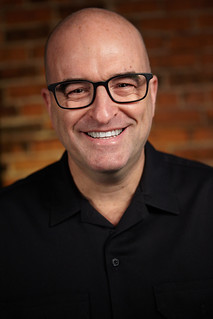
Contributors Pete Smith and Greg Bennick
Pete Smith
Numismatic researcher and author Pete Smith of Minnesota has written about early American coppers, Vermont coinage, numismatic literature, tokens and medals, the history of the U.S. Mint and much more. Author of American Numismatic Biographies, he contributes original articles to The E-Sylum often highlighting interesting figures in American numismatic history.
Greg Bennick
Greg Bennick (www.gregbennick.com) is a keynote speaker and long time coin collector with a focus on major mint error coins and US counterstamps. He is on the board of both CONECA and TAMS and enjoys having in-depth conversations with prominent numismatists from all areas of the hobby. Have ideas for other interviewees? Contact him anytime on the web or via instagram
@minterrors.


Website host John Nebel and webmaster Bruce Perdue
John Nebel
Numismatist, photographer, and ANS Board member and Fellow John Nebel of Boulder, CO helped the ANA and other clubs like NBS get online in the early days of the internet, hosting websites gratis through his Computer Systems Design Co. To this day he hosts some 50 ANA member club sites along with our
coinbooks.org site, making the club and our E-Sylum archive available to collectors and researchers worldwide.
Bruce Perdue
Encased coinage collector (encasedcoins.info) Bruce Perdue of Aurora, Illinois has been the volunteer NBS webmaster from its early days and works each week to add the latest E-Sylum issue to our archive and send out the email announcement.

|
|
The E-Sylum is an electronic publication of the Numismatic Bibliomania Society Copyright © 1998 - 2026 | |