Visit our NBS Sponsors









About UsThe Numismatic Bibliomania Society is a non-profit association devoted to the study and enjoyment of numismatic literature. For more information please see our web site at coinbooks.org SubscriptionsThose wishing to become new E-Sylum subscribers can go to the following web page
Subscribe
MembershipThere is a membership application available on the web site Membership Application To join, print the application and return it with your check to the address printed on the application. Print/Digital membership is $40 to addresses in the U.S., and $60 elsewhere. A digital-only membership is available for $25. For those without web access, write to: Jeff Dickerson, Treasurer AsylumFor Asylum mailing address changes and other membership questions, contact Jeff at this email address: treasurer@coinbooks.org SubmissionsTo submit items for publication in The E-Sylum, write to the Editor at this address: whomren@gmail.com BUY THE BOOK BEFORE THE COINSale Calendar
|
- WAYNE'S WORDS: THE E-SYLUM JULY 19, 2026
- NEW BOOK: COINS AND MONEY IN THE MIDDLE AGES
- NEW BOOK: TARNISHED PROMISES
- BOOK REVIEW: THE BANKER WHO MADE AMERICA
- PERIODICAL: NUMISMATIQUE ASIATIQUE NO. 58
- NNP: 2025 U.S. MINT ANNUAL REPORT
- VIDEO: WHEN THE KIDS TAKE OVER NATIONAL BANKS
- 2026 ANA COLLEGE SCHOLARSHIP RECIPIENTS
- NOTES FROM E-SYLUM READERS: JULY 19, 2026
- VOCABULARY TERM: STARTING DIES
- EDGAR HOLMES ADAMS (1868-1940)
- ERIC JENSEN INTERVIEW, PART TWO
- ARCHIVES INTERNATIONAL SALE 115 SELECTIONS
- HERITAGE: LONDON LECTURE AND BANKNOTE PREVIEW
- HERITAGE: THE FACES OF LARGE SIZE NATIONAL BANKNOTES
- THE ZOO COINAGE OF GALLIENUS
- VIKING COIN HOARD FOUND IN NORWAY
- SILVER BAR RECOVERED FROM THE ATOCHA
- PROOF 1824/1 OVERDATE HALF DOLLAR DISCOVERED
- TRUMP DOLLAR COIN DESIGN REVEALED
- DR. DANIEL GARRISON BRINTON'S MEDAL
- 1770 KING'S COLLEGE LITERARY SOCIETY MEDAL
- THE 2026 MCA CLUB MEDAL
- SATTLER SCRIP OF BUFFALO, NEW YORK
- UKRAINIAN BANKNOTE TYPEFACE TUSSLE
- CHASING COUNTERFEITERS IN COLOMBIA
- LOOSE CHANGE: JULY 19, 2026
- ABOUT THIS ISSUE: JULY 19, 2026
Content presented in The E-Sylum is not necessarily researched or independently fact-checked, and views expressed do not necessarily represent those of the Numismatic Bibliomania Society.
WAYNE'S WORDS: THE E-SYLUM JULY 19, 2026
 Thank you for reading The E-Sylum. If you enjoy it, please send me the email addresses of friends you think may enjoy it as well and I'll send them a subscription. Contact me at whomren@gmail.com anytime regarding your subscription, or questions, comments or suggestions about our content.
This week we open with two new books, a book review, one periodical, updates from the Newman Numismatic Portal, notes from readers, and more.
Other topics this week include money in the middle ages, Indian Peace medals, National Banks, Edgar Adams, Eric Jensen, auction previews, zoo coinage, a new Atocha discovery, the Trump dollar, Sattler scrip, and counterfeiters in Colombia.
To learn more about Thomas Willing and the Bank of North America, the 2025 Mint Report, starting dies, the largest Viking coin hoard find in Norway's history, Dr. Daniel Garrison Brinton's medal, the 2026 MCA Club medal, the lost art of coin rubbings, and the world's largest hunk of bologna, read on. Have a great week, everyone!
Wayne Homren
Editor, The E-Sylum

Image of the week
NEW BOOK: COINS AND MONEY IN THE MIDDLE AGES
The American Numismatic Society has published a new book of studies in honor of Alan Stahl on coins and money in the Middle Ages. -Editor
Coins and Money in the Middle Ages: Studies in Honor of Alan Stahl
Numismatic Studies No. 50
Edited by Merle Eisenberg, Lee Mordechai, and David Yoon
 Alan Stahl's distinguished career in numismatics has encompassed a great many topics in the study of coins, monetary history, and medallic art, from antiquity through the Middle Ages and into the modern era. This volume brings together cutting-edge scholarship from three overlapping groups of scholars: former students from the American Numismatic Society Graduate Summer Seminar whom Stahl taught during the 1980s and 1990s; colleagues and former students at Princeton University, where he has taught since 2005; and collaborators in the Framing the Late Antique and Early Medieval Economy (FLAME) research project, which he has directed since 2014. The broad scope of the articles reveals how widely Stahl has influenced numismatics and numismatists over the last five decades through his research, teaching, and training of generations of students. Some articles focus on specific aspects of coinage, but far more show how thinking with coins, as a medium, transforms how scholars write the histories of the monetary world, economic life, and social relations. Like Stahl himself, the contributors to this volume go beyond technical numismatic details and place coins and money in a broader framework that helps transform our understanding of how people lived in the premodern world.
ISBN: 978-0-89722-439-0 (US) | 978-0-89722-440-6 (Rest of World)
414 pages (vii + 406)
Illustrated, black and white (21 tables, 144 figures, 7 plates)
A4 (8.27" x 11.69"), casebound with dust jacket
Language(s): English
Publication Year: 2026
For more information, or to order in the U.S., see:
Coins and Money in the Middle Ages
Studies in Honor of Alan Stahl
(https://isdistribution.com/work/coins-and-money-in-the-middle-ages/)
For more information, or to order outside the U.S., see:
Coins and Money in the Middle Ages
Studies in Honor of Alan Stahl
(https://www.brepols.net/products/IS-9780897224406-1)
To read the earlier E-Sylum articles, see:
PRINCETON CURATOR DR. ALAN STAHL TO RETIRE
(https://www.coinbooks.org/v29/esylum_v29n04a08.html)
ALAN STAHL RETIRES FROM PRINCETON
(https://www.coinbooks.org/v29/esylum_v29n20a12.html)

NEW BOOK: TARNISHED PROMISES
Sam Redman of the University of Massachusetts Amherst published a new book with the Denver Museum of Nature & Science titled Tarnished Promises: Indian Peace Medals in North America. Here's information from the publisher's site (University Press of Colorado). Thanks to Darryl Atchison for passing along the announcement. -Editor
 Using a collection of medals held at the Denver Museum of Nature & Science, Tarnished Promises presents an updated overview of the history and story of peace medals through an examination of their legacy in the modern world. Accompanying the history and analysis are images of thirteen exemplar peace medals from the DMNS collections and their accompanying object biographies.
Peace medals paradoxically worked as tools of colonialism and also Native American agency, sovereignty, power, resistance, and change in response to growing challenges. Their widespread adoption by Native people in North America both prefigured and coincided with the many ways in which Native Americans and First Nations peoples worked to adapt to the unwelcome and undesirable changes wrought by expanding western colonialism. The unique individual histories behind the medals and the larger peace medal story suggest how material objects can hold several, sometimes contradictory, meanings and be influenced by varied strands of culture and historical memory. Tarnished Promises tells this complex story in two parts, with the first detailing the history of Indian peace medals from 1670 to the present day and the second part exploring their meaning at different points in time and to different peoples.
The first book-length treatment of peace medals using an anticolonialist perspective, Tarnished Promises is significant to scholars and the general public interested in numismatics, American history, Indigenous studies, and museum collections.


Samuel J. Redman is professor of history and director of the Public History Program at the University of Massachusetts Amherst. He is the author of three previous books and has worked at the Science Museum of Minnesota in St. Paul, the Field Museum of Natural History in Chicago, and History Colorado in Denver.
Hardcover ISBN: 978-1-64642-835-9
EISBN: 978-1-64642-836-6
Publication Month: July
Publication Year: 2026
Pages: 198
Illustrations: 22
Hardcover Price: $35.00
Ebook Price: $28.00
30-day ebook rental price: $14.00
For more information, or to order, see:
Tarnished Promises
Indian Peace Medals in North America
(https://upcolorado.com/university-press-of-colorado/tarnished-promises)

BOOK REVIEW: THE BANKER WHO MADE AMERICA
Earlier this year Richard Vague published The Banker Who Made America, Thomas Willing and the Rise of the Financial Aristocracy. I bought a copy, but haven't found time yet to read past the first couple chapters. The Wall Street Journal just published a review. Here's an excerpt - see the complete article online.
I added Wikipedia images of the Bank building and a 1789 Three Pence note. -Editor
 Patriotism, George Washington wrote from Valley Forge in 1778, "must be aided by a prospect of interest or some reward." If Washington represented the patriotic side of the American Revolution, Thomas Willing, America's leading merchant and banker at the time, represented the interested side. A devotion to both impulses has marked America's democratic experiment from the very beginning. But while Washington is remembered as the foremost of the Founding Fathers, Willing (1731-1821) has fallen into obscurity, even among historians.
Richard Vague's "The Banker Who Made America" rescues Willing from oblivion, declaring his subject "the most powerful figure in early American history that you've likely never heard of." As the first president of the Bank of the United States, Willing, Mr. Vague writes, "was the dominant economic force in the country."
Willing was born into a prominent Philadelphia family. He inherited a modest fortune and quickly emerged as the leader of the city's conservative business establishment. He helped organize the colonies' resistance to Britain, but stopped short of supporting independence.
In November 1777, as most patriots fled Philadelphia before its capture by the British, Willing remained and collaborated. He even negotiated a proposed truce with Britain's Gen. William Howe, which granted Americans almost everything they could ask for except their independence. Willing duly forwarded Howe's offer to the Continental Congress. There were shouts of treason, but Gen. Washington intervened on Willing's behalf, calling him a "worthy, well-disposed man." Willing remained on good terms, and profitably in business, with both the British and the patriots.
The Bank of England made the British Empire the mightiest in the world, but the North American colonies remained a financial backwater as they struggled to assert their independence. No banks equivalent to those that proliferated in 18th-century England existed in America, and many hoped a republic of yeomen farmers could do without them.
But Alexander Hamilton, among others, recognized that a national bank, in harnessing private wealth to create public credit, was as vital to independence as a military victory. The challenges of keeping an army fed and armed gradually imposed this insight on even the most obdurate members of the Continental Congress. Thus in 1781 the Bank of North America was born. It was the first commercial bank on the continent.


Seeing the need for a bank is one thing; successfully running one is another. This was the novel task that fell to Willing. He had no practical experience in banking, but then neither did anyone else in America. What he did possess, however, was the confidence of the financial community the bank was meant to harness and serve—confidence the Continental Congress desperately needed.
In 1791, when a much stronger federal government chartered the Bank of the United States, Willing was the obvious choice to run it. The bank was the government's lender, principal depository and financial agent. But it was capitalized primarily by private investors, and it was established to facilitate private as well as public business.

Willing retained the confidence of the elite community that owned and used his bank. By the late 1790s, the bank was responsible for most commercial lending in the country. Willing oversaw its vast operations with a punctilious vigilance that earned him the nickname "the old regulator." He was, Mr. Vague writes, "a colossus presiding over the financial landscape of the new republic."
To read the complete article (subscription required), see:
‘The Banker Who Made America' Review: A Willing Servant
(https://www.wsj.com/arts-culture/books/the-banker-who-made-america-review-a-willing-servant-5387d9d1)
To read the earlier E-Sylum article, see:
NEW BOOK: THE BANKER WHO MADE AMERICA
(https://www.coinbooks.org/v29/esylum_v29n06a07.html)

PERIODICAL: NUMISMATIQUE ASIATIQUE NO. 58
Here are the contents of the latest issue of Numismatique Asiatique. -Garrett
 Numismatique Asiatique
No. 58 | June 2026
ÉDITORIAL
The importance of Russian numismatics
by Valerii V. Gaganov
INDOCHINE : Faux pour servir en Indochine
par Daniel Cariou
INDIA : Altar of Altercation: On the Historico-numismatic Re-examination of Silver Fire-Altar coins of Skandagupta
by Arindam Chaturvedi
ACTES DES VIe RENCONTRES DE NUMISMATIQUE ASIATIQUE TROISIÈME PARTIE
Les monnaies d'Extrême-Orient dans les collections des musées d'Occitanie : état des lieux et nouveautés (Deuxième partie)
par Marie-Laure Le Brazidec et Francis Dieulafait
Essais de métaux pour B?o Ð?i
par Daniel Cariou
La sapèque de B?o Ð?i gravée par René Mercier
par Daniel Cariou
ARCHIVES
Extraits du voyage du Père Huc en Tartarie (1845)
ACTUALITÉS
Appel à communications : VIIes Rencontres de Numismatique Asiatique
IIe Congrès numismatique russe
Série « Monnaies d'Asie »
76 pages en couleurs. Format A4 (21 x 29 cms).
To order, see:
https://sites.google.com/site/societedenumismatiqueasiatique/adhesion
For more information on the the Asian Numismatic Society, see:
https://sites.google.com/site/societedenumismatiqueasiatique/home
NNP: 2025 U.S. MINT ANNUAL REPORT
The latest addition to the Newman Numismatic Portal is the 2025 Annual Report of the U.S. Mint. Project Coordinator Len Augsburger provided the following report. -Editor
United States Mint Releases 2025 Annual Report
 Newman Portal has added the U.S. Mint annual report, courtesy of the FRASER archive. FRASER, the Federal Reserve Bank of St. Louis document repository, archives material from the U.S. Federal Reserve System, in addition to other institutions, including the Mint and the Bureau of Engraving and Printing.
Mint issues of 2025 included the Five Freedoms platinum proofs, American Innovation dollar coins, Marine Corps 250th anniversary commemoratives, and many others. Indeed, the final pages of this report detail 37 distinct issues apart from the regular proof and mint set series.
U.S. Mint Annual Reports on Newman Portal:
https://nnp.wustl.edu/library/publisherdetail/51
Link to FRASER online archive:
https://fraser.stlouisfed.org/
VIDEO: WHEN THE KIDS TAKE OVER NATIONAL BANKS
The David Lisot Video Library on the Newman Numismatic Portal can be found at:
https://nnp.wustl.edu/library/multimediadetail/522852
We highlight one of his videos each week in The E-Sylum. Here's one from the 2016 International Paper Money Show with Steve Carr speaking about family owned and operated national banks. -Editor

Many national banks were family owned and operated. Sometimes the owner's children took over. Some were chips off old Dad's block. Others did as they pleased.
Speaker: Steve Carr. From the 2016 International Paper Money Show.
To watch the complete video, see:
When the Kids Take Over National Banks
(https://youtu.be/bNS6f0BD6zM)
When the Kids Take Over National Banks
(https://nnp.wustl.edu/library/book/540338)

2026 ANA COLLEGE SCHOLARSHIP RECIPIENTS
Ryan Mizeski from Tampa, Florida, and Nathaniel Bayer Hafran from Los Angeles, California will receive the ANA's 2026 College Scholarships. Here is the press release. -Garrett
The American Numismatic Association (ANA) has awarded 2026 scholarships to Ryan Mizeski from Tampa, Florida, and Nathaniel Bayer Hafran from Los Angeles, California. Each winner will receive a $1,000 scholarship to use toward tuition at an institution of their choice.
"The annual scholarship provides the American Numismatic Association the opportunity to recognize young numismatists making an impact in the world," says ANA Education Director Christian Strayhorn, "not only in numismatics, but also in their own fields. By assisting these fine recipients with higher education, it is our hope to see them continue to excel at a high level and share their passion for collecting." The recipients are eligible to receive the scholarship for up to four years.
After discovering a wheat cent on the ground, Ryan Mizeski's interest in other numismatic items was sparked. That was twelve years ago.
 Today, Mizeski is a member of the West Hernando Coin Club and frequently attends coin shows, including shows led by local clubs and the biannual F.U.N. show held in Orlando.
"I love learning about the history and events surrounding each time frame of coinage," he said. "Also, making connections with other like-minded individuals at my coin club and in my community."
Mizeski says his collecting interests include older cents and smaller silver coins, as well as silver eagles, and proof/uncirculated sets. He plans to major in research psychology and has been accepted to attend the University of Florida.
"Thank you to the American Numismatic Association for the generous scholarship," he added. "It will help substantially with college expenses and will allow me to complete by postsecondary education."
 The second 2026 ANA scholarship recipient, Nathaniel Bayer Hafran, began collecting coins around age 12, when his grandmother gifted him a silver Morgan dollar. His fascination with the old coin inspired his interest in collecting.
"I enjoy collecting coins, as well as buying and selling coins as an amateur numismatist," said Bayer Hafran. "I am active in several coin clubs, including the Young Numismatists of America, Early American Coppers, Colonial Coin Collectors Club, California State Numismatic Association, ANA, and I founded my high school's first ever coin club." He has also submitted numismatic articles to various publications, including The California Numismatist.
His collecting focus is primarily on Early American coinage, a full date set of Seated Liberty dimes, and an 1807 type set with one of each coin in a PCGS CAC holder.
Bayer Hafran will attend UC Berkeley as a history major, noting that his favorite part about numismatics is, "the history behind coinage, as well as the connections I make with other numismatists. I like that numismatics allows you to hold and own pieces of history that people hundreds of years ago would have also held."
Applications for the 2027 ANA College Scholarship will be available in January. Recipients are selected based on academic scholarship and numismatic accomplishments. Applicants must be a senior in high school and a member of the ANA.
For additional information, contact ANA Education Director Christian Strayhorn at cstrayhorn@money.org.

NOTES FROM E-SYLUM READERS: JULY 19, 2026
Fundraising for Dennis Boggs (aka Abraham Lincoln)
On Facebook, FUN Show organizer Katie Williams posted:
"Show Love for Dennis, Our Abraham Lincoln
"As most of you know, Dennis Boggs (aka Abraham Lincoln) has been a fixture at FUN shows for many years and has become part of the FUN show family as well as a friend to many of you. At Summer FUN this past week, he had a bit of a health scare and was taken by ambulance to the hospital. In order to quickly care for him they unfortunately had to cut off his 19th century period accurate clothing that he wore as Abraham Lincoln. So I thought it would be a nice gesture to start a fundraiser for him to replace his outfit and help with any other costs he may incur during this time. Let's show Dennis how much we truly love and appreciate him!"

I donated right away, and 48 donations have been received by publication time. Click the link below to participate. -Editor
To donate, see:
Show Love for Dennis, Our Abraham Lincoln
(https://www.gofundme.com/f/show-love-for-dennis-our-abraham-lincoln)
Coin Hoards of the Roman Empire
Kavan Ratnatunga writes:
"Your featured website Coin Hoards of the Roman Empire from the Ashmolean Museum, which I just rediscovered, has grown to be an amazing site and is worth a revisit."

Indeed - check it out at the link below. Thanks. -Editor
To visit the website, see:
https://chre.ashmus.ox.ac.uk/
To read the earlier E-Sylum article, see:
FEATURED WEB SITE: COIN HOARDS OF THE ROMAN EMPIRE
(https://www.coinbooks.org/v22/esylum_v22n31a35.html)
VOCABULARY TERM: STARTING DIES
Here's another entry from Dick Johnson's Encyclopedia of Coin and Medal Terminology. -Editor
Starting Dies. The first die to be used to begin shaping the metal of a particularly difficult design (which requires several sets of dies). It is followed by the use of striking dies which contain the full design. In the medallic field and striking high relief medals in particular, dies containing the full design are used from the beginning; each blow is struck in the same die contain the full design and the piece is softened (annealed) between each strike. Starting dies are also called forming dies and are the first to be used in a set of progressive dies.
To read the complete entry on the Newman Numismatic Portal, see:
Starting Dies
(https://nnp.wustl.edu/library/dictionarydetail/516807)
EDGAR HOLMES ADAMS (1868-1940)
E-Sylum Feature Writer and American Numismatic Biographies author Pete Smith submitted this article on the childhood injury sustained by numismatist Edgar H. Adams. Thanks! -Editor

I am writing an article on Edgar Holmes Adams for TAMS Journal. I asked Julia Casey for help with a mystery and she provided a large volume of reference material. The story of Adams' childhood injury has been told in brief. Details of the story may be found in the Belmont (OH) Chronicle for July 10, 1879, page 1.
Early on Monday morning Harry Boroff, son of John Boroff, the grocer, took his shot gun and started out to the woods alone to find some game.
In his scout he went as far as Wheeling Creek, where he found a number of town boys fishing, bathing, &c., among whom was Edgar Adams, who lives with his grandmother in this place, and is a son of Henry Adams of Wheeling.
 When the time to start home came, Harry told the boys that he
believed he would take to the woods, so that he might find some
game, and Edgar concluded to accompany him, the other boys preferring
to steer for home direct.
When the time to start home came, Harry told the boys that he
believed he would take to the woods, so that he might find some
game, and Edgar concluded to accompany him, the other boys preferring
to steer for home direct.
The two boys had proceeded as far homeward as James Frazier's farm, northeast of town, and together, within a few feet of each other, Edgar in the advance, were looking around in a piece of timber, hoping to spy a squirrel, when Harry tripped and fell forward, the hammer of the gun catching in his clothing, causing the discharge of the piece and the emptying of its contents into the left leg of Edgar, midway between the ankle and knee.
Boroff, almost scared out of his wits, undertook to carry Edgar to Mr. Frazier's house, a half mile distant, but being unable to do so, he ran to the house and apprised him of what had happened, when he went to his assistance and removed him to his residence.
Drs. H. and John E. West, Hewetson and Close were called, and as soon as possible had him removed to the residence of Mrs. Adams, when upon examination it was found that the large bone of the leg was fractured and that the small one had been shattered, and two inches of it entirely carried off.
The shattered portions were removed and the limb was dressed, with some encouragement that it may be saved.
This is a most unfortunate accident to Edgar, and will probably cripple him for life.
His youth—being but 11 years of age—and his grit is in his favor, if amputation can be avoided.
There was a follow-up article on July 10th.

Two years later there was another related article on September 8, 1881.

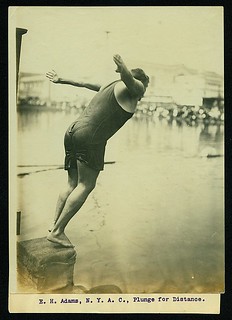 Adams recovered from his disability well enough to win a silver medal at the 1904 Olympics in Saint Louis. He went on the become a prolific writer, a numismatic author and editor of The Numismatist.
To read the earlier E-Sylum articles, see:
EDGAR HOLMES ADAMS (1868-1940)
(https://www.coinbooks.org/v23/
esylum_v23n45a16.html)
EDGAR HOLMES ADAMS
(https://www.coinbooks.org/v24/
esylum_v24n31a20.html)

ERIC JENSEN INTERVIEW, PART TWO
Greg Bennick's latest interview is with Eric Jensen of Canada. Here's the second of three parts, where Eric discusses spinners, pocket mirrors, and the lost art of coin rubbings. -Editor
Keeping the Hobby Alive through Documenting Canadian Exonumia
An interview for The E-Sylum by Greg Bennick
 Well, when Alfred passed away, I got his collection of the Alberta medallions, and it's, of course, the world's best collection of Alberta medallions, because not too many people collect them. I think I'm up over 4200 or so that I've listed. I got into ones that I said I wouldn't. I got into the sports ones, which you can see on that tremendous resource, the Canadian Numismatic Resources website. When they started that I finally had a place where I could put the information, where I didn't have to spend so long in Staples, photocopying, endlessly, putting it all into binders, and then trying to distribute it.
When Alfred had his mail order business, he would mail the listings off. But I had nothing like that. So, the stuff basically just was sitting there, and it was getting tougher and tougher to do books, and that's why I decided to do it electronically. The first thing I did was the Alberta tokens. I collected Alberta tokens, and I knew four others who were really serious about it, so I started to do it too. I would borrow their collections, and said that I was only doing going to create a spreadsheet. I'm said that I wasn't going to do images. It was just too difficult. This was the worst mistake I ever made in this whole exercise, because later, I got little better at taking photos with better cameras. Early on though, the cameras were very low quality. Very low megabytes. I never was happy with them, but that's what I used. Or if need be, I did rubbings, because I was actually pretty good at doing coin rubbings.
Greg Bennick
Creating coin rubbings is truly a lost art.
Eric Jensen
Yes. It's a lost art, and if you look at Don Stewart's book, the rubbings are clearer than any picture I could ever take, but you can't zoom into the real detail. You really can't, though they're great images. Right now, if anything is handed to me, I don't care what it is – whether it's in one of my friend collections or another - I take pictures of it for a catalog. I find a place for it. When I got the Alberta tokens done, it was well-received. The collectors had all printed it out. It was small enough that you could print it out. When I got into shopping cart tokens, people would laugh at me and say, "Why would you catalog those?" I said, "Well, they're good for good for getting a carton. Some of them all actually say 25 cents on it and all kinds of different things." I came up with numbering systems for them.
Greg Bennick
And the domain is the website once again is...
Eric Jensen
The website is, Canadian Numismatics Resources,
CNR-rnc.ca. That is the French version and my specific page for my various cataloguing projects is here:
https://cnr-rnc.ca/jensen_eric/.
For me, it's so important to get the information out there. Many numismatic books that get out there on these subjects, are extremely hard to find. But for the people and collectors, this way the digital information is always there. Do we all like books? Yes, but printing out all of this information – the BC material for example - is over 1250 pages or something like that. That's a lot of printing.
Greg Bennick
Absolutely. It makes sense to go digital with all of this, especially if the goal is easier access for collectors, which I know it is.
 Eric Jensen
I had a friend Len Buth down in London, Ontario. He became my number one mentor. He is the one who encouraged me to do so many things. He was into encased coins, which, you know, the encased and the spinners and their perpetual calendars, and also the pocket mirror cards, were beautiful. They often had advertising on them. Some are fancy. Some are plain. They are celluloid so they some of them crack, and you don't want to light a match to them. They can burn pretty quick.
Greg Bennick
Let's make mention of what spinners are too, because people might not know.
 Eric Jensen
A spinner is usually made of brass, and sometimes other metals. On one side it'll have an arrow pointing in a certain direction, and it usually says something like "you pay or you win." On the other side is advertising of some sort. The idea was, say you're in the bar and you give this thing a spin, whoever it points to buys the next drink. Well, after a few spins, who cares (laughs), but they're a great advertising piece. There are still a few modern ones done, but not like there was. So, Len asked if this stuff was worth cataloging and I said, "Absolutely." He started to send me scans, and I used my standard format, and I started to put the spinners and cases and perpetual calendars in a catalog.
I started this, and then these other collectors decided that this was a not too bad an idea, and thought that maybe I wouldn't mind adding their collections as well. So I did. I started adding them in, and I was extremely fortunate that for those who weren't able to send me scans, which was actually most of them, they would give me their entire collections. It didn't matter how many thousands of dollars this stuff was worth.
I did this with the Alberta tokens and the thing with the Alberta tokens is I had access to probably the five best collections that existed. Right now, I probably couldn't access many of those, because the individuals are gone. They would loan me their collections just in two-by-two boxes, and I would take them out. I'd photograph both sides, or perhaps just a single side if it was uniface, and I would put it in the Alberta token digital version that you can now see on the website.
Greg Bennick
How many pieces total have you catalogued?
Eric Jensen
Oh, gosh. Many thousands. I started doing it for everybody, and that's about the point in time that collections, as people got older, started to change places too. The stuff was starting to disappear, but I had it captured. I love that it inspires interest in people. I did printed copies for certain individuals. Even though it was lot of paper, I knew that they weren't on the computer, so I made paper copies to them. That, to me, was the biggest thing. It was the fact that some of these guys who had boxes just put away and then loaned them to me were seeing things they hadn't seen for years.
Greg Bennick
From their own collections?
Eric Jensen
From their own collections, and all great stuff. This is my way of paying back to the hobby that's been so good to me, just the fun of collecting and the people you meet. I'm not a big-time writer. I write small articles for a few little publications, but it's certainly not to the extent that other guys do. So my goal is to capture images of everything I can before it disappears. I've been extremely fortunate, like I said, with the people that brought it all forward. The big thing to me is to get the information out there.
Greg Bennick
So, my understanding from what you've said is that you collected or still collect Alberta medals?
Eric Jensen
I collect Alberta medallions, and when I got done with the ones that I mentioned including Alberta tokens and cased spinners, pocket mirrors, and perpetual calendars, I had a fellow come to me and say that his daughter had just retired. He was a well-known numismatist, and he was very interested in getting her involved. He got her involved collecting love tokens. He asked me if there was any chance sometime in the future, if I could catalog these.
 About the Interviewer
Greg Bennick (www.gregbennick.com) is a keynote speaker and long time coin collector with a focus on major mint error coins and US counterstamps. He is on the board of both CONECA and TAMS and enjoys having in-depth conversations with prominent numismatists from all areas of the hobby. Have ideas for other interviewees? Contact him anytime
via instagram @minterrors.
He can also be reached by email at
minterrors@gmail.com.
To read the earlier E-Sylum article, see:
ERIC JENSEN INTERVIEW, PART ONE
(https://www.coinbooks.org/v29/esylum_v29n28a12.html)

ARCHIVES INTERNATIONAL SALE 115 SELECTIONS
Here are some selected lots from the July 28 sale by Archives International Auctions. -Garrett


Australia, ND (1939). 10 Shillings, P-25a R12, Issued Banknote, Orange on blue underprint with portrait of King George VI at right, Back is orange with "Manufactures" at center, S/N E/62 199704, PMG graded Choice Uncirculated 64.
To read the complete item description, see:
Australia Commonwealth of Australia ND 1939 Issued Banknote
(https://auction.archivesinternational.com/Australia-Commonwealth-of-Australia-ND-1939-Issued-Banknote_i60576258)


Ottawa, Canada. 1935. Bank of Canada, $2, P-40s, BC-3S, Specimen Banknote, English text, portrait of Queen Mary at left, back with an allegorical figure of Mercury and a harbor/rail scene. S/N A0000000, pp A. PMG graded Gem Uncirculated 65 EPQ. Printer: BABN. Four large even margins, bright colors and sharp corners only add to the appearance of this desirable and rare note, which gives the appearance of a Superb Gem Example. Part of the Bank of Canada's inaugural 1935 issue.
Ottawa, Canada. 1935. Bank of Canada, $5, BC-5S, Specimen Banknote, English text, portrait of the Prince of Wales at left, back with a seated allegorical figure and mountain/hydroelectric landscape. S/N A0000000, pp B. PMG graded Gem Uncirculated 66 EPQ. Printer: BABN. Another outstanding high grade example from this desirable series. At the time of issue the Prince of Wales was heir to the throne; he briefly reigned as King Edward VIII in 1936 before his abdication that December, a small historical footnote tied to this portrait.
Ottawa, Canada. 1935. Bank of Canada, $10, BC-7S, Specimen Banknote, English text, portrait of Princess Mary, the Princess Royal, at left, back with a seated allegorical female figure and harvest imagery. S/N A0000000, pp B. PMG graded Gem Uncirculated 66 EPQ. Printer: BABN.
To read the complete item description, see:
Canada Bank of Canada 1935 2 English Text Specimen Banknote
(https://auction.archivesinternational.com/Canada-Bank-of-Canada-1935-2-English-Text-Specimen-Banknote_i60576270)
Canada Bank of Canada 1935 5 English Text Specimen Banknote
(https://auction.archivesinternational.com/Canada-Bank-of-Canada-1935-5-English-Text-Specimen-Banknote_i60576271)
Canada Bank of Canada 1935 10 English Text Specimen Banknote
(https://auction.archivesinternational.com/Canada-Bank-of-Canada-1935-10-English-Text-Specimen-Banknote_i60576272)


Harbin, China, 1925. 10 Yuan, P-S2572b S/M#P42-64d, Issued Banknote, Blue on m/c underprint with scenic view at center, Back is blue with bank title at top and denomination at left and right, S/N A783449A, PMG graded Very Fine 25 with comment "Annotations." ABNC.
To read the complete item description, see:
China Frontier Bank 1925 10 Yuan Harbin Issued Banknote
(https://auction.archivesinternational.com/China-Frontier-Bank-1925-10-Yuan-Harbin-Issued-Banknote_i60576300)

Granada, Nicaragua. 31 day October 1856. Republic of Nicaragua, Military Script, $50, Pick# S132, Issued in Granada, made payable to E. S. Hardy for "Military Services rendered to the State", hand signed by William Walker as President of the Republic and also signed by the Minister of Hacienda. Printed on thin paper by El Nicaraguense Print, printed in black, with ornate side borders and bold title "FIFTY DOLLARS". This example, serial number 1782, is PMG graded Very Fine 30 with notation of "Tears, Foreign Substance". The signatures, design elements, and embossing remain bold and distinct. This rare fiscal note is directly tied to one of the most turbulent episodes in Central American history. William Walker, an American physician, lawyer, and adventurer from Tennessee, launched a series of "filibustering" expeditions in Latin America during the 1850s. After failed attempts in Mexico, he turned to Nicaragua, where he exploited a civil conflict to seize power in 1856. Declaring himself President of Nicaragua, Walker sought to Americanize the country's institutions, reinstated slavery (abolished years earlier), and attracted settlers and mercenaries from the United States. His regime provoked alarm among surrounding countries and was driven out within a year by a coalition of Central American states, and was executed in Honduras in 1860 after a later expedition failed. Notes of this issue are seldom encountered, and Walker's signed notes and documents are highly prized for their direct connection to the Central America filibuster era and to one of the most controversial figures of 19th-century Central American history.
To read the complete item description, see:
Nicaragua William Walker Military Script 1856 50 Banknote
(https://auction.archivesinternational.com/Nicaragua-William-Walker-Military-Script-1856-50-Banknote_i60576400)

Middlebury, Vermont, May 6, 1865. U.S. Post Office Department Transportation of the Mails draft, No. 496, payable to J. Cobb, Postmaster, Middlebury, Vermont, in the amount of $500.00, to the order of J.D. Page, Agent, Rutland & Burlington R.R. Co., Draft features the classic eagle over rail and maritime transportation vignette. Signed by Alexander N. Zevely (1806-1870), Third Assistant Postmaster General under Presidents Lincoln and Johnson, who oversaw postal finances, stamps, and registered mail while helping advance the Railway Mail Service. Countersigned by J. Milton McGrew, Auditor of the Post Office Department, responsible for auditing and settling postal accounts during the Reconstruction era. Endorsed on the reverse by Justus Cobb, prominent Vermont printer, publisher of the Middlebury Register, and Postmaster of Middlebury. An attractive Civil War-era postal fiscal document combining postal and railroad history with multiple identifiable postal officials' signatures. VF to XF condition with expected folds and endorsements. ABNC.
To read the complete item description, see:
D C U S Post Office Dept Transportation of the Mails Draft May 6 1865 Signed by Zevely McGre
(https://auction.archivesinternational.com/D-C-U-S-Post-Office-Dept-Transportation-of-the-Mails-Draft-May-6-1865-Signed-by-Zevely-McGre_i60576566)


Lynchburg, Virginia. 12th Day of November 1907, $1, Associated Banks of Lynchburg, I/U Clearing House Certificate, black printing on off white paper, back light orange, S/N 5107, "This certifies that The First National Bank, Lynchburg National Bank, Peoples National Bank, National Exchange Bank, American National Bank, and the Lynchburg Trust & Savings Bank, comprising the Lynchburg Clearing House Association....", PCGS graded Very Fine 20, rare Virginia depression scrip. Rare Virginia Panic1907 panic currency.
To read the complete item description, see:
VA The Associated Banks of Lynchburg Virginia 1907 1 Clearing House Certificate
(https://auction.archivesinternational.com/VA-The-Associated-Banks-of-Lynchburg-Virginia-1907-1-Clearing-House-Certificate_i60576604)
HERITAGE: LONDON LECTURE AND BANKNOTE PREVIEW
Heritage published the following article in their latest Currency News email entitled Upcoming London Numismatic Lecture Event and Banknote Preview - July 28 by Olivia Collier. -Garrett
Heritage Auctions London is gearing up for something of a milestone. Our London gallery has hosted all sorts of exhibitions before—from Game of Thrones props and costumes to a preview of the Ruby Slippers. But never, until now, have we held an exhibition including banknotes.
On Tuesday 28th July, I'm thrilled to be bringing highlights from our upcoming October World Paper Money Signature® Auction across from Dallas for a preview evening in London. There's a wonderful selection making the journey, but there are a few I'm especially excited to see up close.
Top of my list is the Republic of Hawaii 1895 $5. This is an issued example, arriving not long after we auctioned a Specimen of the same design with very strong results in our recent June World Paper Money Signature Auction in Hong Kong. The design itself is beautiful: the front depicts the Ali?iolani Hale building in Honolulu, with the statue of Kamehameha the Great standing outside it. Despite being over a century old and circulated, the engraving has remained remarkably clear.


Hawaii Republic Of Hawaii,
Department of Finance
5 Dollars 1895 (ND 1897)
Pick 11a
PMG Very Fine 25
Another note I'm excited to exhibit is the Kwangtung Currency Bureau 10 Dollars. Coming so soon after another example achieved a very successful result at our June Hong Kong auction, it's a pleasure to have a second to showcase in London. The double dragon motif on the front is unmistakable, and it is little wonder this is considered one of the most famous Chinese banknotes of the 20th century, with only eighteen examples currently recorded on the PMG Population Report.


China Kwangtung Currency Bureau
10 Dollars 1907
Pick S2394 S/M#K51
PMG Very Fine 20
Finally, there is the 1916 Zanzibar Government 5 Rupees. I don't think this note needs much introduction. It is the kind of elusive rarity many collectors only dream of owning. With just thirteen examples currently recorded in the PMG Population Report, it will be a privilege to see it in person before it heads to auction.

Zanzibar Zanzibar Government
5 Rupees 1.8.1916
Pick 2
PMG Choice Fine 15.
Doors are open from 6:00 pm to 9:00 pm. Alongside the display of coin and banknote highlights, Zach Beasley, Director of Ancient Coins, will be joining us for a talk on "A Closer Look at the Coinage of the Londinium Mint", exploring coins produced in Roman London—fitting territory for anyone interested in where our own history begins. The evening will be followed by drinks and canapés, with plenty of time to roam the gallery and take in the coins and notes on display.
Heritage Auctions London is also holding a Valuation Day on Monday 27th July. Zach will be on hand to offer specialist insight into ancient coin collections, while I'll be delighted to offer free, friendly valuations and auction advice for banknote collectors. Whether you've been building a collection for decades, inherited a group of notes, or have simply been considering consigning to auction, this is a great opportunity to talk it through with our experts. Appointments are allocated on a first-come, first-served basis. If you're interested in attending our evening preview or Valuation Day, please email UK@HA.com . The preview material will be on view in the gallery all week, from the 27th to the 31st.
These notes have come a long way to be here, and it would be wonderful to see fellow collectors there to greet them.

HERITAGE: THE FACES OF LARGE SIZE NATIONAL BANKNOTES
Heritage published the following article in their latest Currency News email entitled The Faces of Large Size National Banknotes by Marilyn Pace. -Garrett
There are seemingly endless characteristics of Large Size National Bank Notes that continue to captivate collectors. Among the most popular are their beautiful vignettes, the fascinating stories of survival and discovery behind individual notes, and, perhaps most importantly, the towns, banks, and states from which they originated. Unlike many other types of U.S. currency, where the central portrait tends to command the spotlight, the portraits on Large Size National Bank Notes can sometimes be overlooked amid the wealth of other interesting details. Yet these familiar faces provide a unifying thread, linking notes issued by thousands of different banks across the country.
As we celebrate America's 250th Anniversary this month, let's take a closer look at the portraits of the national figures that connect these notes, regardless of where they were issued.

"The Baptism of Pocahontas"

"Embarkation of the Pilgrims"

"De Soto Discovering the Mississippi"
Notably, no individual portraits appear on the Original Series or Series of 1875 issues. Instead, these designs are dominated by elaborate vignettes that depict key moments from what was then a young nation's brief history. Among the most notable are "The Baptism of Pocahontas" on the $20 notes, "Embarkation of the Pilgrims" on the $50, and "De Soto Discovering the Mississippi" on the $10.

Series 1882 $5
The first individual portrait to appear on National Bank Notes emerged during the Second Charter Period, where former President James A. Garfield was featured on the $5 denomination across all three issues. His likeness was selected for the Series of 1882 following his shocking assassination in 1881, making Garfield the only individual portrait used on that series and marking a significant shift in National Bank Note design while still maintaining continuity across the notes. Garfield's death captivated the nation. He had been in office for only six months when he was shot by Charles J. Guiteau, a disgruntled and mentally unstable office seeker who believed he deserved a government appointment, on July 2, 1881. Garfield survived for 80 days before ultimately succumbing to sepsis, and throughout his prolonged ordeal, Americans across the country anxiously awaited updates on the President's condition. The nation's mourning, coupled with the timing of the new note designs, made Garfield a fitting choice for the Series of 1882 $5 note.
Perhaps most intriguing about Garfield's appearance on the note is the irony of his selection. Much like Andrew Jackson before him, Garfield was a staunch opponent of paper currency and a vocal advocate for the gold standard. He consistently emphasized the importance of sound money backed by specie and expressed deep skepticism toward the expansion of paper currency in the American economy beyond wartime necessity. Nevertheless, his portrait found a permanent home on the very medium he questioned, one of numismatics' more delightful ironies.
Moving right along, the Series 1902 $5 note debuted with a portrait of President Benjamin Harrison, the 23rd President of the United States from 1889-1893. Although his presidency is often regarded as relatively unremarkable, his administration is best remembered for the passage of the Sherman Antitrust Act, a landmark law designed to curb monopolies. Harrison's selection for the $5 denomination was largely aided by timing. He died in March 1901, just as the new Series 1902 notes were being designed, making him a natural choice as the nation commemorated his passing.

1902 $10
The 1902 $10 note features a portrait of President William McKinley, who tragically became the third U.S. president to be assassinated. He was fatally shot by anarchist Leon Czolgosz while greeting visitors at the Pan-American Exposition in Buffalo in September 1901. McKinley was a fitting choice for the note, as he was one of the nation's most popular presidents at the time. He led the United States to victory in the Spanish-American War, helping establish the country as a major world power. He also signed the Gold Standard Act into law in 1900, firmly placing the nation's monetary system on the gold standard.

Series 1902 $20
The Series 1902 $20 features Hugh McCulloch, who served as the nation's first Comptroller of the Currency under President Abraham Lincoln from 1863 to 1865. McCulloch played a pivotal role in establishing the national banking system during the Civil War. During his tenure, 868 national banks were chartered without a single recorded bank failure. After just 22 months as Comptroller, he left the office to become Lincoln's Secretary of the Treasury, a position he would later hold again under President Chester A. Arthur.

1902 $50
The 1902 $50 note features none other than Senator John Sherman, a career politician who still holds the record as Ohio's longest-serving U.S. senator, with an impressive 32 years in office. Like many of the figures honored on National Bank Notes, Sherman is best remembered for his role in shaping the nation's financial system during and after the Civil War, particularly his strong support of the gold standard. And, of course, his name lives on through the Sherman Antitrust Act of 1890, one of the most influential pieces of economic legislation in American history.

1902 $100
Rounding out the series, the 1902 $100 note features John Jay Knox, who served as the fourth Comptroller of the Currency from 1872 to 1884. While he may not be as familiar a name today as McKinley or Sherman, Knox played an important role in strengthening the national banking system. During his 12 years in office, he helped secure legislation extending the charters of national banks by another 20 years and ensured that only federally chartered institutions could use the word "National" in their names—changes that helped shape the banking system for decades to come.
Taken together, these portraits do more than identify denominations; they trace a compact history of the nation's political, financial, and institutional development. From martyred presidents to architects of the national banking system, the faces on Large Size National Bank Notes remind us that these issues are not merely products of thousands of individual banks, but part of a larger American story. For collectors, that is part of their enduring appeal: each note carries the identity of a particular place while also reflecting the people and ideas that shaped the country's currency, credit, and economic life.

THE ZOO COINAGE OF GALLIENUS
Mike Markowitz wrote an article in CoinWeek on the Zoo Coinage of Gallienus. Here's an excerpt - see the complete article online. -Garrett

Rome did not fall in 260 CE. However, it came close enough to terrify anyone who could read the signs.
The empire staggered through the Crisis of the Third Century, a brutal half century of civil war, foreign invasion, plague, inflation, and political collapse that ran from 235 to 284 CE . Then disaster struck at the top. The Persian ruler Shapur captured Emperor Valerian after the Battle of Edessa in 260. Ancient writers later added grisly stories about Valerian's captivity, including the famous tale that Shapur used him as a footstool .
That left Valerian's son, Gallienus, with a poisoned crown.
Gallienus ruled alone from 260 until his assassination in September 268 . He faced breakaway provinces, military rivals, frontier chaos, and a money system under severe pressure. Yet from that storm came one of the most charming and collectible coin groups of the Roman Empire.
Collectors call it the Zoo Coinage of Gallienus.
These coins do not merely show animals. They show Rome begging the old gods for help.
A Coin Series Built Like a Prayer
Late in his reign, Gallienus issued a remarkable series of antoniniani that paired protective deities with real and mythical creatures. The reverse legends often end with CONS AVG, short for Conservator Augusti, or "Preserver of the Emperor."
That phrase gives the series its meaning.
Gallienus did not strike a random animal parade. Instead, he placed Diana, Apollo, Sol, Jupiter, Liber Pater, Neptune, Mercury, Hercules, and Juno on the side of the imperial house. The animals served as divine companions, emblems, or mythological clues. Together, they turned pocket change into religious propaganda.
Pegasus, Sol, and the Power of the Sun

Pegasus / Sol – Gallienus BI Antoninianus. Rome, AD 267-268. GALLIENVS AVG, radiate head to right / SOLI CONS AVG, Pegasus springing to right; A in exergue. RIC V.1 283. 3.15g, 21mm
Few mythical creatures travel better on coins than Pegasus. The winged horse appeared often on ancient coinage long before Gallienus .
On the Zoo Series coin, Pegasus belongs to Sol, the Unconquered Sun . The pairing creates an image of light, ascent, and divine motion. It also fits the military atmosphere of the age. Sol appealed strongly to Roman soldiers, and Gallienus needed soldiers more than almost anything else .
Pegasus may also have carried a regimental echo. Four Roman legions used Pegasus as an emblem, including Legio II Adiutrix, a unit associated with Gallienus' military world .
So this coin works on several levels. It shows myth, honors Sol and may also speak to army loyalty.
Neptune's Hippocamp

Hippocamp / Neptune – Gallienus BI Antoninianus. Rome, AD 267-268. GALLIENVS AVG, radiate and cuirassed bust to right / NEPTVNO CONS AVG, hippocamp to right; N in exergue. RIC V.1 245 (sole reign); MIR 743b; RSC 667. 3.74g, 21mm, 12h.
Neptune's creature brings the sea into the series.
The hippocamp has the forepart of a horse and the tail of a sea serpent or fish. It moves through water as Pegasus moves through the air. On Gallienus' coin, it invokes Neptune, god of the sea .
The creature also gives American collectors a surprising connection. Charles Barber placed a hippocamp on the obverse of the 1915 Panama-Pacific gold quarter eagle. There, Columbia rides the sea-horse as a symbol of American power and the Panama Canal era.
So a tiny third-century antoninianus can point forward to a classic United States commemorative gold coin.
To read the complete article, see:
Zoo Coinage Of Gallienus
(https://coinweek.com/zoo-coinage-of-gallienus-coins-from-an-empire-on-the-brink/)

VIKING COIN HOARD FOUND IN NORWAY
Paul Horner and Leon Saryan passed along this story about the largest Viking coin hoard find in Norway's history. Thank you. -Editor

Two hobbyists recently uncovered one of the largest Viking coin hoards ever found — fittingly, in a Nordic country.
The hoard was found in a field near Rena, about 18 miles north of Elverum in southeastern Norway, according to an announcement from the University of Oslo's Museum of Cultural History (KHM).
The cache consists of 2,970 silver coins believed to have been buried around 1047. It marks the largest Viking Age coin hoard discovered in Norway since 1950 — and the biggest in the country's history.
The coins were minted between the 980s and the 1040s and bear the names of rulers including Æthelred II, Otto III, Harald Hardrada and the legendary King Cnut.
Most of the coins were minted in England or Germany, which officials said reflects the strong foreign influence on Norway's economy during the late Viking Age.
"Foreign coinage dominates the circulation of money in Norway up until Harald Hardrada (1046–1066) established a national coinage," KHM professor Svein Gullbekk said in a statement.
"The hoard was deposited right at the beginning of this development."
To read the complete article, see:
Treasure hunters find biggest Viking coin hoard in country's history: 'Without parallel'
(https://www.foxnews.com/travel/treasure-hunters-find-biggest-viking-coin-hoard-countrys-history-without-parallel)
See also:
Treasure hunters find biggest Viking coin hoard in country's history: 'Without parallel'
(https://www.popularmechanics.com/science/archaeology/a71179531/viking-silver-coin-hoard/)
SILVER BAR RECOVERED FROM THE ATOCHA
Aother large silver bar has been recovered from the wreck of the Señora de Atocha, the first since 1999. Here's an excerpt - see the complete article online. -Editor

Treasure hunters in Florida recently uncovered a 22.5-pound silver bar from a legendary shipwreck — the first of its kind recovered in nearly three decades.
Divers with Mel Fisher's Shipwreck Expeditions, working from the salvage vessel DARE, found the silver bar at the wreck site of the Nuestra Señora de Atocha.
Captain Drake Nicholas and the crew recovered the silver bar from about 50 feet of water off Key West, Florida, according to a press release.
The Atocha, a Spanish treasure galleon, sank in a hurricane off the Florida Keys in 1622 while carrying silver, gold and emeralds.
The wreck's famed "Mother Lode" was discovered by treasure hunter Mel Fisher's team in 1985 and continues to yield artifacts more than four decades later.
The team was alerted to the silver bar after detecting a "very strong target" on a metal detector, said Sean Browne, head of investor relations for Mel Fisher's Shipwreck Expeditions.
The silver bar was "heavily encrusted" with marine growth, Browne added, and is currently undergoing conservation to remove the buildup.
Browne noted that, although this is the first silver bar recovered by the expedition from the Atocha since 1999, the crew has recovered hundreds of silver bars from the wreck since the ship's main treasure deposit was discovered in 1985.
Since then, the crew "has continued to recover silver and gold coins, emeralds, swords, keys, pottery, navigational instruments and many other artifacts from the Atocha and Santa Margarita wreck sites," Browne said.
To read the complete article, see:
Treasure hunters recover rare silver bar from legendary shipwreck off Florida Keys
(https://www.foxnews.com/travel/treasure-hunters-recover-rare-silver-bar-from-legendary-shipwreck-off-florida-keys)
PROOF 1824/1 OVERDATE HALF DOLLAR DISCOVERED
The first known proof example of the 1824/1 O-101 half dollar was discovered in the collection of a Scotsman Auction consignor. Here is the press release. -Garrett


"This is an astonishing discovery coin," declared John B. Woodside, Scotsman Vice President.
"This coin is part of the Opa Collection, a large group of rare coins purchased a half century ago by a Midwest collector. His heirs consigned the coins to us ‘raw,' and we then submitted them to Professional Coin Grading Service. The overdate came back certified PCGS PR63 as an Overton 101 variety with the numeral 4 struck over the 1 in the 1824 date," Woodside explained.

The PCGSCoinFacts.com website estimates there are about 750 circulation strike examples known of the 1824/1 overdate, including several Overton varieties. However, until now, no previous proof example was known to either PCGS or Numismatic Guaranty Company or discussed in any known research literature, according to the Scotsman team.
The proof 1824/1 overdate half dollar originally was acquired by an Ohio collector in 1972, more than a decade before today's major third-party authentication, grading and encapsulation services began operations.
Although the collector's heirs want to remain anonymous, they issued a statement: "Our family was deeply honored and humbled to learn that Dad's 1824/1 proof half dollar had been graded as the finest known example, with no higher-graded specimen currently known. He began collecting coins at the age of 14 and spent his life studying American numismatics, always captivated by the history, artistry, and stories preserved within each coin.
The heir's statement continued: "Dad recognized that this coin was something extraordinary, but he never had it formally graded. Discovering its significance after his passing has made the moment both remarkable and bittersweet. Whenever he shared a special coin with us, he would smile and say, ‘Look at this beauty.' Those simple words captured his genuine joy and appreciation for the treasures he spent a lifetime discovering and preserving."
"This proof coin was made from perfect dies with extreme precision strikes which brought out the most minute, threadlike details in Liberty's hair trailing beneath the edge of the Liberty cap," stated James Garcia, who wrote the Scotsman auction lot description. Extreme sharpness like this on an open-collar production could only be achieved by multiple strikes."
"Why would the mint choose to use an overdate obverse die to strike a proof?," Garcia asked. "We know of preceding examples, of course. And why use dies from three years prior, rather than from 1823, or even 1822? There are precedents at the United States Mint. Proofs exist of the 1824 cent, dime (1824/2), quarter (1824/2), and quarter-eagle (1824/1)," he pointed out.
"Circulation strikes exist for the 1824/2 half-cent. Is the discovery of this new half-dollar a predictor of the existence of a proof half-cent?," the auction catalog team asked.
The collector's heirs stated: "We can only imagine how proud and excited Dad would have been to learn the true rarity of this remarkable coin, and knowing Dad, the stories he would have shared about it."
The conservative pre-auction estimate for the coin is $75,000-$90,000. The auction lot (#725) description of the 1824/1 proof Caped Bust half dollar is online at www.scoins.com/lot.aspx?a=39&l=725.
For additional information, contact Scotsman Coin & Jewelry by phone at 314-692-2646 or by email at info@scoins.com.
TRUMP DOLLAR COIN DESIGN REVEALED
Final designs for the controversial "Trump Dollar" coin were announced this week. Here's a decent overview from Politico. -Editor

The U.S. Mint will begin striking one-dollar coins featuring a portrait of President Donald Trump on its face in commemoration of the nation's semiquincentennial anniversary, Treasury Secretary Scott Bessent announced Wednesday morning.
The coin, which on the reverse side depicts the presidential seal with "250" inscribed on the shield, "celebrates the strength of American values, and the promise of a nation dedicated to preserving freedom for all," Bessent wrote in a social media post.
Living people, including presidents, rarely grace American currency thanks to a compilation of laws, though the new coinage appears to skirt around those restrictions.
Trump signed bipartisan legislation in 2020 authorizing the Treasury Secretary to issue dollar coins during the 2026 calendar year carrying designs that are "emblematic of the United States semiquincentennial."
That law states that no person, living or dead, could be included on the reverse side of the coin — but some have argued it appears to allow for Trump's portrait (or other living people) to remain on the coin face.
However, federal law is generally understood to prohibit any living person from appearing on most currency. When Congress created the Presidential $1 Coin Program in 2007, it also dictated that no living presidents, or those who had died in the past two years, would be featured on those coins. And an 1866 law fully prohibits living people from appearing on paper currency, though it doesn't specifically mention coinage.

Initial designs released by the U.S. Treasurer
The final design appears to be a notable scaling back from the ambitious draft design obtained by POLITICO in October. That design featured Trump on both sides of the coin, with the reverse side depicting him holding his fist in the air with the words "FIGHT FIGHT FIGHT" inscribed above him.

On Citizens Coinage Advisory Committee (CCAC) Review
ABC News examined the lack of review by the CCAC. -Editor
"Federal law also stipulates that coin designs be selected by the Treasury secretary after consultation with the Commission of Fine Arts, which recommended the design in January, and review from the bipartisan Citizens Coinage Advisory Committee, an 11-person body established by Congress in 2003 to advise on designs of hard currency.
But the Treasury Department appears to have skipped the latter committee, raising questions about the legality of the coin's production.
Speaking with ABC News on Wednesday, two members of the committee said aside from a few last-minute attempts by the Mint to present the proposed coin to the committee in November and December, the body never had a chance to review the design as required by law.
"We've never seen any design with the portrait of Donald Trump on it," Donald Scarinci, a numismatist and Democrat who's spent over two decades on the committee, told ABC News.
Scarinci said the proposed December meeting ultimately didn't occur because it was impossible to reach a quorum of members on such short notice."
Mint Chief Counsel Greg Weinman has said "I believe the CCAC was given -- at least the chair of the CCAC was given a full opportunity to review this portfolio... The Mint, in my opinion, attempted multiple times to find an opportunity for the CCAC to review the portfolio. The CCAC made a decision not to. At least the chair of the CCAC made the decision not to."
Here's how the Wall Street Journal summarized the situation. -Editor
The federal law that enabled new one-dollar coin designs for the country's 250th birthday requires design review by the bipartisan Citizens Coinage Advisory Committee. That panel has so far refused to consider designs that would feature Trump, in an attempt to slow or prevent the minting of such a coin.
"If they make this coin, it is illegal and Congress should act to stop it," said Donald Scarinci, the longest-serving member of that panel.
He said Congress should confiscate any of these coins or render them void.
Administration officials have said the coin is legal.
Color and Composition
While many will call it a "gold" coin, it's not a bullion piece and contains no gold. The Washington Post calls it "gold-hued". -Editor
Megan Sullivan, the acting chief of the U.S. Mint's office of design management... described the coins as being "a little bit larger than a quarter" and being composed of "manganese brass" and displaying as "golden in color."
The $1 coins are distinct from the 24-karat coins created by the Treasury Department that typically sell for thousands of dollars.
To read the complete articles, see:
US Mint to begin producing $1 coins featuring Trump
(https://www.politico.com/news/2026/07/15/donald-trump-dollar-coin-00998818)
US Mint to begin striking dollar coin featuring Trump
(https://abcnews.com/Politics/us-mint-begin-striking-commemorative-coin-featuring-trump/story?id=134781344)
Trump Dollar ‘Gold Coin' to Go Into Production, Bessent Says
(https://www.wsj.com/politics/policy/trump-dollar-gold-coin-to-go-into-production-bessent-says-3d91fb03)
U.S. Mint to produce $1 coin with Trump's face on it, treasury secretary says
(https://www.washingtonpost.com/politics/2026/07/15/us-mint-produce-1-coin-with-trumps-face-it-bessent-says/)
Thanks also to Paul Horner and others who forwarded articles. -Editor
See also:
Treasury unveils fresh photos of Trump's $1 gold coin
(https://www.axios.com/2026/07/15/trump-gold-coin-image-mint)
Trump's face appears on $1 coin and his signature on the $100 bill as his team challenges the law
(https://www.yahoo.com/news/articles/trump-face-appears-1-coin-184723960.html)
Treasury unveils $1 gold coin with Trump's image on front
(https://www.foxbusiness.com/politics/treasury-unveils-1-gold-coin-trumps-image-front)
Trump coin is an illegal monument to monumental vanity
(https://njtoday.news/2026/07/17/trump-coin-is-an-illegal-monument-to-monumental-vanity/)
To read earlier E-Sylum articles, see:
TRUMP COMMEMORATIVE COIN PROPOSED
(https://www.coinbooks.org/v28/esylum_v28n40a25.html)
WOULD THE 2026 TRUMP COIN BE LEGAL?
(https://www.coinbooks.org/v28/esylum_v28n41a26.html)
WASHINGTON, COOLIDGE, TRUMP, LAW AND TRADITION
(https://www.coinbooks.org/v28/esylum_v28n45a24.html)
NEW TRUMP COIN DESIGNS ANNOUNCED
(https://www.coinbooks.org/v29/esylum_v29n04a19.html)

DR. DANIEL GARRISON BRINTON'S MEDAL
Jim Haas shared this article on Dr. Daniel Garrison Brinton's Medal. Thanks! -Garrett
My friend Michael Keropian is a sculptor of note who will shortly be visiting the Poppenhusen Institute in College Point to examine the MacNeil plasters, some of which need cleaning and others, restoration. He has a Facebook site, Figurative Sculpture in History that has over 16,000 members.
Scrolling through his site the other day, I couldn't help but notice an entry about sculptor John Flanagan, better known as a medalist, who designed a medal honoring Dr. Daniel Garrison Brinton. What caught my eye was the medal he had designed in 1898, may have influenced, however subconsciously, another by Hermon Atkins MacNeil executed in 1918.

Daniel Garrison Brinton

Conrad Poppenhusen
Between 1889 and 1891 Flanagan and MacNeil had studied together in Paris under medalist Henri Chapu and sculptor Alexandre Joseph Falguière. Their friendship was rekindled in the City of Light in 1900 where both had been chosen to decorate the exterior of the American Pavilion for the upcoming Exposition Universelle. Flanagan modeled a huge eagle to surmount the dome of the pavilion; MacNeil, the building's triangular spandrels. Flanagan chose to remain in France for more than a decade before returning to America in 1902. While both men chose to live in New York City, their paths crossed only occasionally. Nevertheless, almost forty years after parting ways, they shared a singularly unique experience; both designed famous twenty-five cent pieces.
MacNeil modeled his medal in 1918 to celebrate the 50th anniversary of the opening of the Conrad Poppenhusen Institute in College Point, Queens, NY in 1868. MacNeil was serving on the Institute's Board of Control at the time and during the ceremony was awarded his own medal in appreciation of the honor his distinction in the world of art had brought to the school. His name was in the paper again with a report that a quarter designed by John Flanagan would soon take the place of MacNeil's. It would be out of character for Hermon to have been anything but happy for the success of his friend and colleague.
Dr. Brinton's medal was awarded in late June 1899 in commemoration of the fifteenth anniversary of his presidency of the Numismatic and Antiquarian Society, and the fortieth anniversary of the society. I researched his medal and learned it has been modeled in Paris in 1898 by John Flanagan, who in 1889/1991 had studied in Paris alongside Hermon Atkins MacNeil under medalist Chapu and sculptor Falguière. Their friendship was rekindled in the City of Light where both were decorating the exterior of the American Pavilion for the upcoming Exposition Universelle. Flanagan modeled a huge eagle to surmount the dome of the pavilion; MacNeil the building's triangular spandrels. Flanagan chose to remain in France for more than a decade before returning to America in 1902. While both men chose to live in New York City, their paths crossed only occasionally. Nevertheless, almost forty years after parting ways, they would share a singularly unique experience; both designed famous twenty-five cent pieces.
MacNeil modeled his medal to celebrate the 50th anniversary of the opening of the Conrad Poppenhusen Institute in College Point, Queens, NY in 1868. MacNeil was serving on the Institute's Board of Control at the time and during the ceremony was actually awarded his own medal in appreciation of the honor his distinction in the world of art had brought to the school. His name was in the paper again with a report that a quarter designed by John Flanagan would soon take the place of MacNeil's. Their friendship having begun in the classroom, it would be out of character for Hermon to have been anything but happy for the success of his long-time friend and colleague.
Dr. Daniel G. Brinton's medal was awarded in late June 1899 in commemoration of the fifteenth anniversary of his presidency of the Numismatic and Antiquarian Society, and the fortieth anniversary of the society itself. According to an 1888 article published in the Philadelphia Inquirer, prior to 1858 there had been no society in America devoted to numismatic research. In that year seven gentlemen from the City of Brotherly interested in coins, met together and determined to form a society of numismatics. In spite of efforts taken by the group, membership had not increased such that in 1865 the name was changed to the Numismatic and Antiquarian Society of Philadelphia. Dr. Brinton, a well-known authority on North American Indian races, was elected president in 1883 and five years later the society, that now met twice a month, had seventy members and an extensive collection of coins on display. On June 25th, 1899, the Philadelphia Times published a lengthy article on the award and career. It also included a woodcut of the medal. Sadly, Brinton, a Civil War veteran, died in Atlantic City two months later and was buried in Media Cemetery in Media, Pennsylvania.

THE BOOK BAZARRE
1770 KING'S COLLEGE LITERARY SOCIETY MEDAL
Spink will be selling a hand-engraved silver Literary Society medal from King's College (now Columbia University). The design is attributed to Elisha Gallaudet and the medal is awarded to James Creighton. An excerpt of the description is below. -Garrett
NGC MS61 | USA, King's College (Columbia University), Literary Society, Silver Hand-Engraved Prize Medal, 1770, attributed to Elisha Gallaudet, awarded to Mr James Creighton (1751-1822), COLLEGII REGALIS NOVI EBORACI IN AMERICA PRÆMIUM LITERARIUM IACOBO CREIGHTON | IN • LUMINE • TUO • • VIDEBIMUS • LUMEN •, college seal designed by Reverend Samuel Johnson, with maternal figure of Alma Mater seated on throne at centre, surrounded by three infants, whom she teaches from book in outstretched hand. Radiant sun rises behind. Scroll reads "God's Light" in Hebrew and "God" in Hebrew in radiant border above. 1ST. PET . II . I . 2, in exergue, signature below, rev. EXIMIO • JUVENI • PROPTER • INSIGNES • IN • ARTIBUS • PROGRESSUS, Minerva standing holding spear, presents medal to a student dressed in academic robes, 1770 A.D. below, 33.56g, 64.5mm (Columbia Medals Collection, 5/227).
Established in 1768, the King's College Literary Society medal is the first civilian medal to have been awarded in America which is extant today. Only four examples are known to have survived from a believed 28 original pieces listed in the society's minutes book. An initial order of 4 was placed on 17 May 1767, followed by another of the same amount on 3 November. Each order at the cost of $8 was placed with the New York silversmith Elisha Gallaudet. Gallaudet is a recognisable name within numismatics for his contribution to the Continental Dollar of 1776, which is widely regarded as the first coin of the United States.
A further batch of 20 silver medals was ordered on 2 June 1769, placed by Mr Charles Evers of the society, to be engraved in London by silversmith Richard Rugg. Apart from the minor differences seen between the New York and London medals, due to their hand engraved nature, the Rugg examples also include the mark R.R. and the mark for sterling silver.
Of the four known medals, just three are engraved to recipients: this medal, awarded to James Creighton (1751-1822), a Loyalist lawyer from a well-established New York family, one to Gouverneur Morris, statesman and Founding Father; and one to Benjamin Moore, Bishop of New York, who administered Holy Communion to Alexander Hamilton on his deathbed. The Creighton medal also represents only the second example currently in private hands, two pieces having been acquired by the Museum of the City of New York and the Columbiana Collection at Columbia University.
 The design of these medals was taken from the college seal, which was created in 1755 by the first college president Samuel Johnson. It shows the maternal figure of Alma Mater seated on a throne, surrounded by three infants, whom she is teaching from a book. The College's motto which translates to 'in thy light, shall we see light', taken from psalm 36:9, is also present. The reverse of the medals show Minerva presenting a medal to a student in academic robes.
The ordering of these medals from New York and from across the Atlantic, may at first seem unusual. Why was a relatively small college society looking as far afield as London? What it in fact reveals is the interconnected nature of Anglo-American life and society at this time. This was still an age when to be born in America was to be considered a British citizen. These young men therefore understood themselves a part of this colonial society and it is into this environment that James Creighton was born and raised.
However, James's life coincided with a period of seismic change for those living in North America. Born into a British colony under the rule of a British king, by the start of his early adult life America had broken with Britain and with the signing of the Declaration of Independence in July 1776 the nation was set on a new course.
The American Revolution altered his life decisively. The Creighton family were Loyalists, remaining faithful to the British Crown during the American Revolution. As a result James found himself on the wrong side of the political transformation. James, like many of his King's contemporaries, did not embrace independence easily, nor did he possess the political adaptability that allowed others to thrive in the new order.
This medal not only tells the story of James Creighton but also that of the foundations and early story of King's College, later Columbia University, and ultimately how both are inextricably linked to the War of Independence.
James Creighton was born in New York in 1751 into a family that had already been established in British North America for more than sixty years. The Creightons were not adventurers or frontiersmen but a professional and mercantile family. Their personal and professional ties therefore saw them linked to the central figures and events of colonial-era America and the early republic. However, like so many Loyalist families their importance within early-America has been sidelined and overlooked.
The family's American origins lay with James Crichton, a native of Scotland who arrived around 1690 and settled in Elizabethtown, New Jersey. A storekeeper by trade, he married an English widow who had come to America in the entourage of Chief Justice Bridget of New Jersey, anchoring the family early within colonial legal circles. Over the next generations the Creightons moved to New York City, intermarrying with Huguenot refugees, New England families, and members of the colonial elite. By the time James was born, the family had become thoroughly embedded in the social fabric of colonial New York. James's upbringing, including his academic education at King's College, reflects the advantages that came with such a position.
A movement began in 1746 to establish a college "for the instruction and education of youth in the learned languages and liberal arts and sciences". There was a widespread sense that too few Americans were educated to degree level, and it remained common for young men from affluent families to be sent to Britain for their schooling. Several notable figures who petitioned for independence and who later signed the Declaration, including Edward Rutledge, Thomas Lynch Jr and Benjamin Rush, were educated in this way.
New York, though a city of fewer than 20,000 inhabitants at the time, was seen as the natural site for such a college. Gouverneur Morris, writing to the Society for the Propagation of the Gospel, declared: "New York is the Center of English America & a Proper Place for a Colledge."
The college was established in 1754 by royal charter granted by George II, making it the first college in the province and one of the earliest in the country. Alongside royal patronage, the Church of England and the Society for the Propagation of the Gospel played a major role in its foundation. This was to the dismay of some who objected to an American institution being so closely tied to the mother country.
To read the complete article, see:
KING'S COLLEGE LITERARY SOCIETY MEDAL
(https://live.spink.com/lots/view/4-M24041/ngc-ms61-usa-kings-college-columbia-university-literary-society-silver-hand-engraved-prize-medal-1770-attributed-to-elisha-gallaudet)
THE 2026 MCA CLUB MEDAL
The Medal Collectors of America has unveiled a lovely new club medal. MCA President Skyler Liechty published the following announcement. -Editor

Colorized photo of the plasters
I am delighted to announce the 2026 MCA Club medal. The Medal Committee has prepared something wonderful and historically important for us.
Designed by leading American medalist and sculptor, Heidi Wastweet, this year's medal displays, on the obverse, a powerful modern interpretation of Benjamin Franklin's famous Libertas Americana medal. The reverse shows the scene of King George III's statue being torn down in lower Manhattan on July 9, 1776. A full description of the medal and photos are included in the attachment.
The medals will be available for purchase by current MCA members on a first come, first served basis. This year the MCA will be striking both bronze and silver examples. The silver is available by subscription only.
Bronze medals can be purchased now via our website (PayPal or check). The price of $250 includes shipping to domestic addresses. We expect to begin shipping the medals as early as September. The bronze will have a limited edition of 76 medals.
Silver medals can also be purchased now via our website. The price is $1,776, including shipping. The subscription period for silver medals will be open until August 15. The actual number of silver medals for which subscriptions are received will determine the size of our order to the mint. We expect to ship the silver medals as early as September.
I hope you are as excited as I am about this stunning and historic work of art, created to honor the semiquincentennial anniversary of our nation's birth. And if you are interested in purchasing a silver example of our medal, please act quickly, as the subscription period will close in less than a month.
Obverse:
The facing bust of the goddess Liberty with unbound, wind-blown hair and wearing an open-neck chemise. Behind her left shoulder a rod (vindicta or festucca ) bearing on its tip the Phrygian Liberty cap (pileus).
Legends: . LIBERTAS AMERICANA .
Medal Collectors of America
Reverse:
Thirteen hands representing the thirteen colonies hold eight ropes attached to the equestrian statue of the British King Georg III, which is toppling from its perch atop a plinth on the corner of which are the words KING GEORGE.
Legends:
. E . PLURIBUS . UNUM .
[OUT OF MANY, ONE; traditional motto of the United States]
UNITED AGAINST TYRANNY
. 1776.2026.
Copper Alloy or Silver
Diam.: 3.00" (76.2 mm)
Artist: Heidi Wastweet
For more information, or to order, see:
https://www.medalcollectors.org/membership/medals
For more information on the Medal Collectors of America, see:
https://www.medalcollectors.org/
SATTLER SCRIP OF BUFFALO, NEW YORK
Loren Gatch published an article on the Society of Paper Money Collectors site about the Sattler Scrip of Buffalo, New York. Found via News & Notes from the Society of Paper Money Collectors (Volume XI, Number 47, May 5, 2026). -Editor

Founded in 1889 as a shoe business by John G. Sattler, after 1926 the store began expanding into clothes and then into many other merchandising lines over the years, including food and home furnishings. Its location at 998 Broadway placed it in a Polish neighborhood on Buffalo's east side, about two miles from the city's downtown.
In 1927, John G. Sattler's son-in-law, Charles Hahn Jr., took over running the business. Hahn in turn hired a young newspaperman named Robert S. Cornelius to manage the store's promotional strategies and advertising campaigns. It was Bob Cornelius who masterminded Sattler's distinctively manic merchandising style. A scrappy discount retailer located at some distance from downtown pedestrian traffic, Sattler's under Cornelius resorted to over-the-top spectacles to draw crowds to its premises. The store brought in elephants and tightrope walkers; hosted a live wedding in its display windows; sponsored visits by television and radio celebrities; and held a guessing contest for the correct weight of the world's largest hunk of bologna.
At around this time, Sattler's also introduced a distinctive form of store credit, Sattler Scrip, which circulated across its counters in one form or another for nearly thirty years.
Frequently mistaken for depression-era local currency, Sattler Scrip was, in fact, anything but that. Whereas the various kinds of emergency monies and clearinghouse notes issued during the 1930s served to address some aspect of the economic crisis of those years, Sattler's merchandise certificates were actually a reflection of post-World War II consumer abundance. Introduced in late 1946, Sattler Scrip functioned as a flexible form of consumer credit before store charge cards and credit cards came into widespread use.
As the store's tutorial advertisements in 1946 instructed the public, shoppers interested in purchasing goods now but desiring to make payment later could do so using Sattler Scrip. Customers wanting supplies of the store's certificates visited the store's budget office where, after providing suitable identification, they set up what amounted to charge accounts. For a one dollar "service fee", paid upfront in cash, a customer received twenty dollars' worth of Sattler Scrip merchandise certificates. These certificates could then be used anywhere in the store the same as regular money. By acquiring Sattler Scrip, the customer committed to a plan whereby that twenty dollar balance (or multiples thereof) would be paid off, on terms as long as six months. If the customer paid the balance owed within thirty days, Sattler's would offer to refund the one-dollar fee.
Sattler Scrip was, in effect, a form of store credit that allowed customers to purchase on time. The terms, as described, seem to have been generous. Sattler's advertising never mentioned any interest charges owed on customer balances other than the initial fee.
Thus, for customer purchasing, say, $100 worth of certificates with a five-dollar fee and paying off the balance over six months, that fee represented a 10% annual interest rate (assuming they did not pay off the balance within thirty days). The plan was easy for the company to manage, since it did not need to calculate interest on variable balances in order to bill its customers. At the same time, Sattler Scrip was flexible enough to resemble a revolving credit line. The language printed on the back of each note explained how that would work. Anybody with a Sattler Scrip account could return their remaining certificates (rather than using them to buy anything) for full credit against their balance due, even receiving back a prorated portion of their original service fee. Conversely, anyone needing more certificates than they currently possessed in order to purchase some expensive item could roll their outstanding certificate balance into a new, larger issue, and receive a discount on the new service fee by applying the prorated refund on their previous fee.
For at least thirty years after its introduction, Sattler Scrip not only enabled customers to buy now and pay later but figured in a number of the store's incessant marketing gambits. Typically, merchandise certificates were handed out as prizes in some offbeat or oddball contest. For example, in 1959, the store gave out Sattler Scrip to selected owners of cars, identified by their license plates, sitting in the store's parking lot. Other promotions involving Sattler Scrip appealed to juvenile audiences. In 1961, Sattler's put on a "Search for Dondi" contest that awarded certificates to that youngster who most resembled the child actor David Kory, who starred as the Italian war orphan "Dondi" in a highly sentimental (and rather forgettable) 1961 film of that same name.
To read the complete article, see:
Sattler Scrip of Buffalo, New York
(https://www.spmc.org/blog/sattler-scrip-buffalo-new-york)
UKRAINIAN BANKNOTE TYPEFACE TUSSLE
A new Ukrainian banknote design drew criticism for a typeface resembling one from Russia. -Editor

The National Bank of Ukraine said on July 15 that it will change the lettering on its planned Hr 2,000 banknote after public backlash that the inscription too closely resembled a Russian typeface.
Following the announcement on July 10 that the new banknote would honor 20th century Ukrainian poet Vasyl Stus, a number of people in the professional design community publicly raised concerns that the denomination inscription proposed by the National Bank's artists too closely resembled an unofficial Cyrillic adaptation of a typeface of Russian origin.
These concerns were heightened by the fact that Stus was a dissident who died in a Russian penal colony in 1985 because of his pro-Ukrainian views.
The new lettering on the banknote will follow the official Cyrillic version of the Bickham Script typeface without any changes or customizations, according to the National Bank.
The redesign will reportedly not delay the banknote's release, since production has not started yet.
The new Hr 2,000 note is still set to enter circulation on Sept. 4, 2026.
To read the complete article, see:
Ukrainian banknote honoring poet killed by Russia faces redesign after Russian-style typeface backlash
(https://kyivindependent.com/ukraines-national-bank-promises-to-change-banknote-lettering-over-russian-typeface-association/)
See also:
Ukrainian banknote honoring poet killed by Russia faces redesign after Russian-style typeface backlash
(https://www.yahoo.com/news/world/articles/ukraines-national-bank-redesign-banknote-141632835.html)
CHASING COUNTERFEITERS IN COLOMBIA
A lengthy article in The New York Times Magazine covers the hunt for U.S. currency counterfeiters in Colombia. Here's an excerpt - see the complete article online. -Editor
 On the day of the raid, a convoy of vehicles with armed troops escorted Prieto's team, which traveled in several pickup trucks. Soldiers on motorbikes led the caravan in the morning twilight, driving along a dirt path to a cannabis farm, the site of the suspected counterfeiting plant. At a large house on the premises, six people still slept — until the motorcycle roars woke them. They tried to escape, Prieto later told me, but five of them were caught right away. The one who fled was never captured.
Inside the house, Prieto and his colleagues found counterfeit currency with a face value of $1.6 million in uncut sheets of $50 bills printed on high-quality paper. Prieto's team seized the printing plates used for the forgery, as well as an inkjet printer, a paper cutter, a bill counter and an assortment of inks. The officers, while videotaping themselves so they would have evidence to present in court, then took a sledgehammer to the lithographic printing press the counterfeiters had been using. Investigators sometimes do this because an offset press, weighing around 1,000 pounds and usually bolted to the floor, can be too difficult to cart away as evidence. "It was left as scrap metal," Prieto says.
In parts of Latin America, producing fake dollars is widely seen as a low-risk, high-reward crime. While some of the counterfeit currency is smuggled into the United States, a larger share ends up circulating in local economies across the region. Ecuador, El Salvador and Panama — Latin American countries where the U.S. dollar is the official currency — are especially attractive destinations. Counterfeit notes function as real money, changing hands for goods and services, until the forgery is detected. Whoever ends up in possession of the note at that moment of discovery, which often happens while someone is trying to make a bank deposit, suffers the loss.
Counterfeiting in Colombia had been significantly curtailed by the early 2010s, after years of efforts by specialized units in the Colombian National Police and the Office of the Attorney General of Colombia that worked with the U.S. Secret Service. But the crime has been proliferating in the country in recent years, driven by technological advances. "Most counterfeit that we see produced in the United States tends to be amateurish — somebody buys a Xerox machine over at Walmart, and then they start Xeroxing $100 bills in their hotel room," Benigno Pereda, a Secret Service agent who was based in Bogotá at the time of the raid, told me. "But the counterfeit down here is very sophisticated." The proceeds sometimes finance other criminal activities like human trafficking, drug smuggling and terrorism.
Counterfeiters have been setting up their operations in jungles and remote areas controlled by Colombian rebel groups, which collect a protection tax from the criminals in return for providing them a haven. These are parts of the country where law enforcement faces considerable risks. As Pereda puts it: "No one wants to get killed over funny money."
For months, Prieto and his team gathered information about the artist known as Ysraeli. They learned that he wasn't from Israel but was a 39-year-old Colombian named Asher Ariayu Rodriguez who had recently embraced Judaism and added Ysraeli to his name. The Office of the Attorney General of Colombia gave the investigators permission to wiretap his phone, which finally enabled them to pinpoint where he lived in Cali. Early one morning in July 2024, well before the sun came up, the officers knocked on his door. Rodriguez was at home, and he let them in without any resistance.
A strong smell of ink permeated the house. Rodriguez willingly showed the investigators his equipment. In the living room, he had a lithographic printing press, an inkjet printer, an assortment of commercial-grade inks and other paraphernalia. Prieto and his officers also discovered more than $900,000 in counterfeit $50 bills.
A bearded, heavyset man, Rodriguez was recovering from an ankle injury that forced him to walk on crutches. He showed the investigators the computer and USB drive on which he kept the digital designs for producing the counterfeit notes. Searching through his computer, investigators saw that Rodriguez was a methodical and meticulous artist.
It was clear that Rodriguez took pride in his work as an artist. "He wanted to make the perfect bill," Prieto said. Trying to design a flawless bank note, he told investigators, was a passion that helped him relax. He said that achieving perfection was, in fact, his primary motive and that the resulting bills were meant to be used only as movie money — the kind used as props on film sets. (That defense is not uncommon among counterfeiters.)
A court rejected those explanations. In 2025, he was sentenced to eight years in prison on charges of counterfeiting currency. He has appealed the verdict.
To read the complete article, see:
The Hunt for the Counterfeiter Trying to Make the Perfect Bill
(https://www.nytimes.com/2026/07/16/magazine/counterfeit-dollars.html)
LOOSE CHANGE: JULY 19, 2026
Here are some additional items in the media that may be of interest. -Editor
We recently discussed the new Museum of American Finance in Boston. While the Museum of Money in Dallas does have a little to do with history and numismatics, it is mainly a fun interactive experience for visitors. Check it out, and let us know what you think. Found via News & Notes from the Society of Paper Money Collectors (Volume XI, Number 50, May 26, 2026). -Editor


Some of it is pure spectacle. There is a booth where dollar bills shower down on whoever steps inside. There is a vault visitors can attempt to break into by dodging a laser grid. There is an 80s investment banker who reads guests' financial futures with great confidence and questionable accuracy.
Other exhibits are quieter and more curious. One small room asks visitors to barter their way to what they need without any money at all. Most adults give up within a couple of minutes and rediscover why people invented currency. Another lines a wall with real and counterfeit bills and asks visitors to pick out the fakes. A third tells the story of Mademoiselle Zélie, a 19th-century French singer who was paid for a Pacific island tour in livestock and produce: three pigs, twenty-three turkeys, five thousand coconuts, and fifteen hundred oranges, among other things.
Tucked between the photo ops are panels on the real history of money. Bronze knife-shaped and spade-shaped Chinese coins from 2,700 years ago. The story of Y'all Street, the Texas stock exchange opening in Dallas. Why gold became valuable in the first place (it doesn't rust, it's rare, and it's easy to shape).
To read the complete article, see:
The Museum of Money
(https://www.atlasobscura.com/places/momoney-the-museum-of-money)
For more information, see:
https://museumofmoney.com/
To read the earlier E-Sylum articles, see:
BOSTON MUSEUM OF AMERICAN FINANCE OPENS
(https://www.coinbooks.org/v28/esylum_v28n15a11.html)
MORE ON BOSTON MUSEUM OF AMERICAN FINANCE
(https://www.coinbooks.org/v28/esylum_v28n16a20.html)
The Greysheet published a remembrance of former Whitman Publishing Co. owner Charles Anderson. Here's an excerpt - see the complete article online. -Editor

A lifelong resident of Florence, Alabama, Mr. Anderson combined the aspects acquired as a youth with lessons learned through life to incorporate into a successful business empire. As a youth, he held numerous jobs that included working at his father's newsstand, delivering newspapers and running a fireworks stand. He graduated from Florence State Teachers College (now University of North Alabama), earning a Bachelor of Science degree with a major in marketing and a minor in economics.
His interest in numismatics began at the age of 9 in 1943 when he was given a 1921 Alabama 2x2 commemorative half dollar. As an adult, he and his brother Joel established ANCO Collector Supplies, a manufacturer of coin tubes and distributor of many accessories for the coin trade. ANCO purchased H.E. Harris Co., adding coin items to the company's stamp business. Under Anderson's leadership, H.E. Harris Co. purchased Whitman Publishing Co. in 2003.
In the numismatic world, he served as president of the Alabama Numismatic Association, was a life member of the American Numismatic Association. He served as a trustee with the American Numismatic Society and received an honorary Life Fellowship from the organization in 2023. In 2024, he was recognized by COINAge as one of the "Numismatists of the Century."
To read the complete article, see:
Remembering Charles C. Anderson — A Pillar of American Numismatics
(https://www.greysheet.com/news/story/remembering-charles-c-anderson-a-pillar-of-american-numismatics)
To read the earlier E-Sylum article, see:
CHARLES CAINE ANDERSON, SR. (1934-2026)
(https://www.coinbooks.org/v29/esylum_v29n27a08.html)
The Great Trappaner of England
 In February 1660 a metalworker was tried at the Old Bailey, London on the charge of producing false foreign coinage. This was a less serious offence than counterfeiting coin of the realm, for which the penalty was death. While the metalworker's evidence cannot be regarded as entirely trustworthy, since he naturally sought to avoid implicating himself, what emerges from these legal proceedings is an unusual glimpse into a criminal underworld. In particular, a scheme by a London goldsmith called Thomas Violet to extort money from certain Jewish merchants. Violet's plan was to entice these traders into buying a great quantity of illicit foreign coins. Then, having informed the authorities, he would catch them red-handed. It was a fiendish trap set by a man with a name ‘too sweet for so foul a carcass'. A trap, what is more, that reaffirmed prejudiced beliefs about Jewish criminality, particularly that Jews were guilty of counterfeiting and clipping coins.
To read the complete article, see:
‘The Great trappaner of England': Thomas Violet (1609?–1662), crypto-Jews and Jews during the English Revolution and at the Restoration of the Stuart monarchy
(https://arielhessayon.substack.com/p/the-great-trappaner-of-england-thomas-638)
In "This Week in Literary History" from the Literary Hub, short story king O. Henry was released from prison. -Editor
Famously, O. Henry (the pen name of William Sydney Porter), author of "The Gift of the Magi," and one of the most celebrated short story writers of his generation, and whose legacy is celebrated every year by the O. Henry Prize for Fiction, got his start in prison, while serving time for embezzling funds from the First National Bank in Austin, Texas, where he had worked as a teller. ?
It's possible that Porter shouldn't have been convicted at all: a 1916 report characterized the bank in question as "carelessly managed," and revealed that "the patrons used to enter, go behind the counter, take out one hundred or two hundred dollars and say a week later, ‘Porter, I took out $200, last week. See if I left a memorandum of it. I meant to.'" The Times report claims that Porter, who by the time he was charged had moved to Houston and taken a job as a columnist with The Daily Post, resigned before one of the "misappropriations with which he was charged," and that if he had simply gone back to Austin when he was summoned to stand trial, he would have been acquitted.
The literary world should be grateful for his poor luck, because it was in prison that Porter "did his first serious literary work," as the Times put it. In order to be able to send money home to support his daughter Margaret, he wrote and published 14 short stories, under pen names, including the one with which he would become famous: O. Henry. ?
Porter was released early for good behavior, on July 24, 1901, and returned to Pittsburgh to live with his daughter and his in-laws, before moving on to New York City.
To read the complete article, see:
https://lithub.com/
As collectors, we all appreciate stories of nice finds. Here's a story about a 19-year-old who discovered a Wilt Chamberlain warm-up jacket from the 1972 NBA finals at a thrift store. -Editor
Quinn has sold nearly 10,000 items over the past four years, and he's learned how to decode things. (The three T-shirts were black, extra-large and looked like they'd been owned by a meticulous heavy metal fan.) But the one mystery he hadn't yet solved was the one everyone wanted to talk about. How had a Wilt Chamberlain warmup jacket from the 1972 NBA finals ended up in a suburban thrift store? And how had a teenager — a young man whose mom wasn't even alive when Chamberlain wore it — snagged something so special?
Quinn might never know the answer to the first question, but the second felt clearer. What seemed to most people like luck had required a mix of time and community, family and another boy's split-second decision.
Sometimes good things slip through a person's fingers. Sometimes someone else — a teenager, perhaps, with a good eye and $3 — might pluck that good thing from the garbage and grab a little bit of history.
To read the complete article, see:
He spotted a sports relic in the thrift store. It's about to make him rich.
(https://www.washingtonpost.com/nation/2026/07/18/he-spotted-sports-relic-thrift-store-its-about-make-him-rich/)
ABOUT THIS ISSUE: JULY 19, 2026
Yeah, last week's issue went out with a return address labeled "S-Sylum" instead of "E-Sylum". Thanks to those who reported the problem - it was just a weekly manual chore where a typo creeped in.
This week I continued working through a backlog of content ideas and submissions that didn't make the cut for earlier issues. So some of these articles aren't so new anymore, but they're still interesting and worth reading.
Pulling up to a pharmacy drive-through window this week I saw I had a co-pay of $4.63 for an eyedrop prescription. I checked my pocket and didn't have exact change. Curious to see if/how my change would be rounded, I handed the woman a $5 bill. Being owed 37 cents change, I expected either 35 or 40 cents. I got 45 - two dimes and a quarter. Maybe they were just out of nickels, but for a fleeting second there it felt like a stick-it-to-the-man victory.
On Friday night I went to see The Odyssey with my daughter and oldest son. Three hours of film and not one ancient coin-spotting to report. But it was a good film played to a packed house. It was nice to see a crowd coming out for a movie. The air outside still smelled of smoke, the forest fire aftermath that's been affecting much of the east coast.
In the that-never-happened-when-I-lived-in-Pittsburgh department, at lunchtime Saturday I pulled into a parking spot at a nearby shopping center and the car parked in front of me was a Rolls Royce.
Here are some interesting non-numismatic articles I came across this week. The first profiles someone I knew early in my career. He has other claims to fame but his long-lasting techno-cultural contribution is the emoticon, the text-based forerunner of emojis.
The second one hits close to home. Interviewing my mother while compiling a family history I learned about the day they brought me home from the hospital. A nurse brought a baby to my mother and she said, "That's not my baby." The nurse replied that of course it's her baby and my weary father said "C'mon, let's go home." Then my mother said, "My baby has blond hair." The baby in the nurse's arms had black hair. The nurse harrumphed and walked out, coming back a while later with a blond baby.
How a Carnegie Mellon professor accidentally paved the way for emojis (https://www.post-gazette.com/business/tech-news/2026/07/17/emoji-communication-text/stories/202607140052)
Men sue hospital after DNA tests showed they were switched at birth 38 years ago (https://apnews.com/article/dna-birth-switch-hospital-lawsuit-41e56f62fd6b8bb0afce8afc479ce7a8)
Italian teenagers discover 1,800-year-old Roman luxury house underneath their high school gym (https://www.livescience.com/archaeology/romans/italian-teenagers-discover-1-800-year-old-roman-luxury-house-underneath-their-high-school-gym)
Making Crazy Horse: The Role of a Lifetime (https://www.nationalreview.com/2026/07/making-crazy-horse-the-role-of-a-lifetime/)
Keeping Cool: The Air Conditioner That Changed America (https://thedailyeconomy.org/article/keeping-cool-the-air-conditioner-that-changed-america/)
audi ZERØ: one sphere and four tubes redefine the electric car through radical geometry (https://www.designboom.com/technology/audi-zero-one-sphere-four-tubes-electric-car-radical-geometry-wini-camacho/)
Behind the Pages: How Your Favorite Newspaper Ends Up On Your Screen (https://blog.newspapers.com/behind-the-pages-how-your-favorite-newspaper-ends-up-on-your-screen/)
The Fossil Words That Exist Only in Idioms (https://wordsmarts.com/fossil-words/)
No one really knows what they're doing (https://www.post-gazette.com/local/city/2026/07/18/lindsey-graham-founding-fathers-churchill/stories/202607170005)
Beyond lithium: how sodium-ion batteries could change the world (https://www.nature.com/articles/d41586-026-02150-y)
Pixel: a biography (https://aeon.co/essays/a-biography-of-the-pixel-the-elementary-particle-of-pictures)
The 25 most influential works of American culture (https://www.washingtonpost.com/style/interactive/2026/07/15/25-most-influential-works-american-culture/)
The Future of Pittsburgh History (https://pittsburghquarterly.com/articles/the-future-of-pittsburgh-history/)
-Editor


Editor Wayne Homren, Assistant Editor Garrett Ziss
Wayne Homren
Wayne Homren is the founding editor of The E-Sylum and a consultant for the Newman Numismatic Portal. His collecting interests at various times included U.S. Encased Postage Stamps, merchant counterstamps, Pittsburgh Obsolete paper money, Civil War tokens and scrip, Carnegie Hero Medals, charge coins and numismatic literature. He also collects and has given presentations on the work of Money Artist J.S.G. Boggs. In the non-numismatic world he's worked in artificial intelligence, data science, and as a Program Manager for the U.S. Department of Defense.
Garrett Ziss
Garrett Ziss is a numismatic collector and researcher, with a focus on American paper money and early U.S. silver and copper coins. He is also a part-time U.S. coin cataloger for Heritage Auctions. Garrett assists Editor Wayne Homren by editing and formatting a selection of articles and images each week. When he's not engaged in numismatics, Garrett is pursuing a Master's Degree in Quantitative Economics at the University of Pittsburgh.

Contributors Pete Smith and Greg Bennick
Pete Smith
Numismatic researcher and author Pete Smith of Minnesota has written about early American coppers, Vermont coinage, numismatic literature, tokens and medals, the history of the U.S. Mint and much more. Author of American Numismatic Biographies, he contributes original articles to The E-Sylum often highlighting interesting figures in American numismatic history.
Greg Bennick
Greg Bennick (www.gregbennick.com) is a keynote speaker and long time coin collector with a focus on major mint error coins and US counterstamps. He is on the board of both CONECA and TAMS and enjoys having in-depth conversations with prominent numismatists from all areas of the hobby. Have ideas for other interviewees? Contact him anytime
via instagram @minterrors.
He can also be reached by email at
minterrors@gmail.com.

Website host John Nebel and webmaster Bruce Perdue
John Nebel
Numismatist, photographer, and ANS Board member and Fellow John Nebel of Boulder, CO helped the ANA and other clubs like NBS get online in the early days of the internet, hosting websites gratis through his Computer Systems Design Co. To this day he hosts some 50 ANA member club sites along with our
coinbooks.org site, making the club and our E-Sylum archive available to collectors and researchers worldwide.
Bruce Perdue
Encased coinage collector (encasedcoins.info) Bruce Perdue of Aurora, Illinois has been the volunteer NBS webmaster from its early days and works each week to add the latest E-Sylum issue to our archive and send out the email announcement.

|
|
The E-Sylum is an electronic publication of the Numismatic Bibliomania Society Copyright © 1998 - 2026 | |