Visit our NBS Sponsors









About UsThe Numismatic Bibliomania Society is a non-profit association devoted to the study and enjoyment of numismatic literature. For more information please see our web site at coinbooks.org SubscriptionsThose wishing to become new E-Sylum subscribers can go to the following web page
Subscribe
MembershipThere is a membership application available on the web site Membership Application To join, print the application and return it with your check to the address printed on the application. Print/Digital membership is $40 to addresses in the U.S., and $60 elsewhere. A digital-only membership is available for $25. For those without web access, write to: Jeff Dickerson, Treasurer AsylumFor Asylum mailing address changes and other membership questions, contact Jeff at this email address: treasurer@coinbooks.org SubmissionsTo submit items for publication in The E-Sylum, write to the Editor at this address: whomren@gmail.com BUY THE BOOK BEFORE THE COINSale Calendar
|
- WAYNE'S WORDS: THE E-SYLUM SEPTEMBER 6, 2026
- THE E-SYLUM TURNS TWENTY-EIGHT
- KOLBE & FANNING SALE 178 ANNOUNCED
- LANG NUMISMATIC LITERATURE AUCTION 13
- MYSTERY METAL RODS FOUND IN BOOK
- VIDEO: ANA LEGACY SERIES: DAVID SUNDMAN
- 2026 NUMISMATIC LITERARY GUILD AWARDS
- 2026 ANA LITERARY AWARD WINNERS
- AIM AFFIRMS PUBLISHING COMMITMENT
- NOTES FROM E-SYLUM READERS: SEPTEMBER 6, 2026
- LIKELY LEWIS & CLARK INDIAN PEACE MEDALS
- ARCHIVEGRID
- THE DUBAI COINS MUSEUM
- VOCABULARY TERM: STRUCK
- EDITOR PROFILE: WAYNE HOMREN
- NUMISMAGRAM MEDAL SELECTIONS: SEPTEMBER 6, 2026
- STACK'S BOWERS: LITMAN COLLECTION U.S. COINS
- STACK'S BOWERS: LITMAN COLLECTION BRITISH COINS
- SOVEREIGN RARITIES AUCTION XXIII: KILMARNOCK COLLECTION
- MORE FROM KUENKER AUCTION SALE 445-446
- GADOURY BLUE OCTOBER 2026
- ROYAL AUSTRALIAN MINT'S NEW 'HOLEY DOLLAR'
- LOOSE CHANGE: SEPTEMBER 6, 2026
- ABOUT THIS ISSUE: SEPTEMBER 6, 2026
Content presented in The E-Sylum is not necessarily researched or independently fact-checked, and views expressed do not necessarily represent those of the Numismatic Bibliomania Society.
WAYNE'S WORDS: THE E-SYLUM SEPTEMBER 6, 2026
 New subscribers this week include:
Robert Visty.
Welcome aboard! We now have 6,370 subscribers.
New subscribers this week include:
Robert Visty.
Welcome aboard! We now have 6,370 subscribers.
Thank you for reading The E-Sylum. If you enjoy it, please send me the email addresses of friends you think may enjoy it as well and I'll send them a subscription. Contact me at whomren@gmail.com anytime regarding your subscription, or questions, comments or suggestions about our content.
Many items didn't make the cut for this week (including the continuation of my ANA Diary), but I hope to catch up a bit next week. Hold tight if you send me something recently.
This week we open with an E-Sylum anniversary, two numismatic literature sales, updates from the Newman Numismatic Portal, NLG and ANA literary awards, and more.
Other topics this week include Lewis & Clark Expedition Indian Peace Medals, the Dubai Coin Museum, fixed price and auction selections, and Australia's new holey dollars.
To learn more about starting The E-Sylum, the Robert A. Schuman, M.D. library, the plated J.M. Henderson sale catalogue, David Sundman and the Littleton Coin Company, Greek Coin Art, the British Trade Dollar, The Redfield Hoard, the Buffalo Bill Center of the West, Archivegrid, the Western Pennsylvania Numismatic Society, the Halley's Comet medal, the Albany Church Penny, the 1644 Triple Unite, read on. Have a great week, everyone!
Wayne Homren
Editor, The E-Sylum

Image of the week
THE E-SYLUM TURNS TWENTY-EIGHT
 The E-Sylum is twenty-eight years old this week.
On September 4, 1998 the first issue of what we now call The E-Sylum was emailed to a list of members and friends of the Numismatic Bibliomania Society. Now archived on our web site as Volume 1, Number 1, that first message started the ball rolling. That email went to 49 people. As the word spread, subscription requests arrived from around the world and by September 15 there were 90 subscribers.
The E-Sylum is twenty-eight years old this week.
On September 4, 1998 the first issue of what we now call The E-Sylum was emailed to a list of members and friends of the Numismatic Bibliomania Society. Now archived on our web site as Volume 1, Number 1, that first message started the ball rolling. That email went to 49 people. As the word spread, subscription requests arrived from around the world and by September 15 there were 90 subscribers.
WHAT'S WITH THE FUNNY NAME? Well, our organization is the Numismatic Bibliomania Society, a group for people who love coin books and are crazy for any and all information about numismatics. Our print journal is The Asylum, so our electronic publication naturally became The E-Sylum. While The E-Sylum is free to all, only paid members of NBS receive The Asylum.
An excerpt from the September 4, 1998 message:
"A number of folks signed up at the meeting in Portland. To that initial group we've added the addresses of other current and former members that the Board is aware of, plus a few numismatic pen pals we thought might be interested.
This is intended to be a moderated, low-volume mailing list, with no more than one message every week or so. Its purpose and use will evolve over time - please send us your comments and suggestions.
In the meantime, please visit our web site, and forward this note to any other email pen-pal you think might have an interest. Remember, the list isn't limited to only NBS members. Don't assume they're already on the list; we're starting small, but with your help we can grow."
And grow and evolve we did. Each issue now contains 25 to 30 (and sometimes more) articles, and our subscription list includes over 6,300 email addresses. Rather than just a vehicle for announcements about the Numismatic Bibliomania Society, we've become a weekly forum where "numismatic bibliophiles, researchers and just plain collectors" congregate to exchange information and ideas about numismatics and numismatic research. Most of the top numismatic authors, curators and collectors around the U.S. and the world are subscribers and contributors.
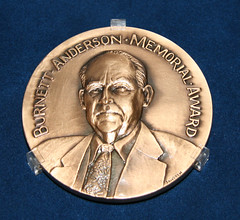 Along the way we've won multiple awards including the Burnett Anderson Memorial Award for Excellence in Numismatic Writing, back-to-back-to-back First Place awards in the electronic category of the American Numismatic Association's Barbara J. Gregory Outstanding Club Publications competition in 2021, 2022 and 2023, second place in 2024 and first place again in 2025.
Despite the work that goes into each issue, it's always fun to put together. Our readers and fine advertisers are what keep me going - you folks are the best any editor could dream for, and we're not done growing and evolving.
Thanks again to all our readers, helpers, contributors and advertisers - we couldn't keep the train on the tracks all these years without your kindness and support. Onward!
For more background on how The E-Sylum came to be and comes together each week, see my Numismatist profile elsewhere in this issue. -Editor
For other reader comments, or to read our online archive, see:
http://e-sylum.org/

KOLBE & FANNING SALE 178 ANNOUNCED
Kolbe & Fanning have announced their 178th numismatic literature sale, featuring the Robert A. Schuman, M.D. library and closing on September 26, 2026. -Editor

 Kolbe & Fanning Numismatic Booksellers are proud to announce that we will be offering the outstanding numismatic library assembled by Robert A. Schuman, M.D., on Saturday, September 26, 2026. The Schuman Library focuses on numismatics of the United States, and includes exceptional photographically illustrated classic auction catalogues (including every plated Chapman catalogue and nearly every plated Elder catalogue), rare periodicals, special editions, association copies, and much else.
Some highlights of the sale include:



Lots 1 and 9
Lot 1: a complete plated example of the 1911 Edgard Adams catalogue of William H. Woodin's collection of United States pattern coins
Lot 9: a handsomely bound, well-preserved copy of Emmanuel Joseph Attinelli's foundational bibliography of U.S. numismatics, the 1876 Numisgraphics


Lots 39 and 47
Lot 39: the Chapman brothers' priced and named reference copy of the plated Mills sale, with additional annotations tracing the sale of lots bought for stock by the Chapmans
Lot 47: John J. Ford, Jr.'s example of the rare plated edition of S.H. Chapman's 1909 catalogue of the Charles Gordon Zug collection, one of only half a dozen copies traced


Lots 61 and 95
Lot 61: the very rare plated J.M. Henderson sale catalogue, held by S.H. Chapman in May 1921, which brought a record $12,000 hammer when it was sold in the fourth Bass sale in 2000
Lot 95: the deluxe leatherbound edition of George H. Clapp's 1931 The United States Cents of the Years 1798–1799, one of only ten copies thus bound

Lot 202
Lot 202: the Schuman set of Lyman H. Low's catalogues, being a complete collection of the numbered series (1882–1924) as enumerated in Adams, housed in custom-made boxes


Lots 132 and 215
Lot 132: Tom Elder's 1911 catalogue of the William H. Woodin collection, one of a few issued with 18 photographic plates, mostly illustrating the fantastic U.S. gold coins offered within
Lot 215: the very rare 1870 second edition of Edward Maris's foundational Varieties of the Copper Issues of the United States Mint in the Year 1794

Lot 219
Lot 219: an exceptional complete set of the catalogues published by the New Netherlands Coin Company, with all mail-bid sales and a complete set of Numisma, in custom boxes.
Register early to bid online
Bids may be placed via post, email, phone, as well as online. Kolbe & Fanning use Auction Mobility as our third-party online bidding platform. Auction Mobility is an app-based platform allowing users the ability to participate in the sale through phones, tablets and computers. To register for the sale, bidders must go to
bid.numislit.com and sign up. Once you have set up an account, you may browse lots, place advance bids, or participate in the live sale online. Those wishing to participate on their devices can download the Kolbe & Fanning app through the Apple or Google Play Store. The sale will also be listed on Biddr and NumisBids.
The printed catalogue is being mailed to all active customers on our mailing list. As international mail speeds have been inconsistent, we encourage our foreign clients to consult the electronic catalogue in case their printed catalogue does not arrive promptly. A PDF of the printed catalogue has been posted to our main website at numislit.com for those who prefer that format. Bids placed via post, email, or phone must be received by September 25, the day before the sale, in order for them to be processed. Advance absentee bids may also be placed at any time online at bid.numislit.com. Internet bidding will be available during the sale itself through the same platform.
Kolbe & Fanning Numismatic Booksellers LLC, is licensed by the State of Ohio Department of Agriculture (license 2025000025) as an auctioneer, and is bonded as required by law in favor of the State of Ohio. For more information, please see the Kolbe & Fanning website at numislit.com or email David Fanning at df@numislit.com. To register for the sale, go to bid.numislit.com. We look forward to your participation.
To bid in the sale, see:
https://bid.numislit.com/

LANG NUMISMATIC LITERATURE AUCTION 13
The 13th numismatic literature auction from Numismatic Antiquarian Bookshop Lang runs September 29 and 30, 2026. -Editor

Dear friends of numismatic literature,
This time it's going to be big—no, even bigger! On September 29 and 30, 2026, our 13th auction of numismatic literature will take place, as usual, on the Auex platform. You read that right: two days with approximately 2,000 lots. There's sure to be something for you!
In addition to the third part of Duplicates from the Library of Neu Numismatik AG, you can look forward to a wide selection of numismatic literature covering various fields, including items from the library of a former coin dealer.
Details:
- Date: September 29 and 30, 2026
- Location: Online on the auction platform Auex.de
- Time: both times from 5:00 p.m. CEST
As usual, you can find the complete range of items and the option to place advance bids at Auex.de. Advance bids can also be placed via the following platforms: Biddr, Sixbid, or NumisBids.
Please remember to register in good time in order to participate in the auction. If you have any questions or are interested in specific literature, we are of course happy to advise you at this stage.
We look forward to your participation and wish you every success!
For more information, or to bid, see:
https://auktionen.numismatisches-antiquariat.de/de-de/auctions/lots?cat_id=175
MYSTERY METAL RODS FOUND IN BOOK
Newman Numismatic Portal Project Coordinator Len Augsburger stumbled upon a book mystery this week. -Editor
Mystery Metal Rods Found in Book on Ancient Art
Recently I ordered a copy of Ancient Art in Bowdoin College, by Kevin Herbert. The book was duly received from an online bookseller. Upon examining the book, a group of metal rods fell out of the spine. Their purpose is unclear to me. Was this book smuggled into a correctional facility? As for the book itself, its numismatic content is a catalog of 51 Roman Imperial bronzes donated by John Max Wulfing to Bowdoin in 1926.

VIDEO: ANA LEGACY SERIES: DAVID SUNDMAN
The David Lisot Video Library on the Newman Numismatic Portal can be found at:
https://nnp.wustl.edu/library/multimediadetail/522852
We highlight one of his videos each week in The E-Sylum. Here's an interview from 2016 with David Sundman of Littleton Coin Company. -Editor
Barbara Gregory interviews David Sundman at the 2016 ANA World's Fair of Money in Anaheim, CA.
To watch the complete video, see:
ANA Legacy Series: David Sundman
(https://youtu.be/6cX5k63KaRo)
ANA Legacy Series: David Sundman
(https://nnp.washu.edu/Documents/Detail/ana-legacy-series-david-sundman/4143856)

2026 NUMISMATIC LITERARY GUILD AWARDS
The Numismatic Literary Guild (NLG) is a separate organization from ours, the Numismatic Bibliomania Society (NBS). But we share a love of the numismatic hobby and numismatic research and writing in particular. Here are this year's Awards Competition results. Congratulations to all of the winners, many of whom are E-Sylum and NBS regulars. NOTE: Category 38 – Lee Martin Founder's Award - was a tie.
We've added images of some of the books which were announced or reviewed in earlier E-Sylum issues. See the links below for more information about adding these award-winners to your numismatic library.
Founded in 1968, the NLG is a nonprofit organization open to any editors, reporters, authors, writers, catalogers, webmasters, bloggers or producers of audio or video involving all forms of money, medals, tokens and other numismatic collectibles. Information about applying for NLG membership is available online at www.NLGonline.org/membership. -Editor


1 – United States Coins
Michael Moran
When Coins Were King
Whitman Publishing
2 – World Coins
Peter Jones
Greek Coin Art
BookBaby Publishing
3 – United States Paper Money
Arthur L. and Ira S. Friedberg
U.S. Paper Money 9th Edition
Whitman Publishing
4 – World Paper Money
Emilio M. Ortiz
Cuba Specialized Banknote Catalogue 1858-1960
Selvi Artes Graficas
5 – Tokens & Medals
James A. "Jimmy" Hayes
Each New Beginning
 6 – Numismatic Investments
Bill Fivaz with David Crenshaw
Helpful Hints for Enjoying Coin Collecting 2nd Edition
Metropolitan Coin Club of Atlanta
7 – Numismatic History or Personalities
Jorge A. Proctor
La Historia Monetaria Del Departmento de Panama
8 – U.S. Coins to 1900
Greg Reynolds
Compendium of 19th Century Dimes
CAC Grading.com
9 – U.S. Coins 1901 to Date
Joshua McMorrow-Hernandez
Double Vision
PCGS Insider
10 – World Coins, 700 BC to 1299 AD
Helena Kagan
Thessalian Coinage: Women's Ball-Playing in Classical Greece
ANS Magazine
11 – World Coins, 1300 to 1800
Nour Ammari
The Islamic Collection At The American Numismatic Society
ANS Magazine
12 – World Coins, 1801 to date
Eric Brothers
The British Trade Dollar: Commercial Coin of the Empire
ANS Magazine
13 – U.S. Paper Money
Edwin Lumus
Notable Notes: Series 1928 Changeover Pair & Historic 1776 Colonial Note
PCGS Insider
14 – World Paper Money
Joseph Boling and Fred Schwan
Uncoupled: Paper Money's Odd Couple
Society of Paper Money Collectors
15 – Tokens & Medals
Roger A. Moore
Queen Elizabeth I Cast Lead Tokens Found In Colonial Jamestown
Journal of Early Numismatics
16 – Numismatic Spot News, Marketplace, or Analysis
Jerry Jordan
U.S. Mint Unveils Texas Innovation Dollar
COINage Magazine
17 – Numismatic History or Personalities
David F. Fanning
Early Years of Numismatic Photography 1849-1869
American Journal of Numismatics
18 – Best Numismatic News or Feature Article In a Non-Numismatic Publication
Lianna Spurrier
Untangled: A Die Study Of Keicho Ichibu
19 – Best Column or Article Combining Numismatics & Collectible Cryptocurrency
James McCartney
Crypto COINage: Physical Bitcoins Coins Come Of Age
COINage Magazine
20 – Ed Reiter Memorial Award For Best Column – Numismatic Publications
Greg Reynolds
CAC Collecting Guides: An Ongoing Analytical Series
CAC Collecting Guide
21 – The Maurice M. Gould Memorial Award for Best Column – Non-Numismatic Publications
No entries this year
22 – James L. Miller Memorial Award – Article of the Year
Jake Utz
Don't Mess With Texas: Lone Star State's Trademark Battle over Its Innaugural Bullion Program
Coin World Magazine
23 – Best Investment Newsletter
Dr. Mike Fuljenz
Mike Fuljenz Metals Market Report
The Dr. Mike Fuljenz Metals Market Report
24 – Best Professional Periodical
Scott A. Travers
COINage - Coins of 1916 and 2026 Book of Lists
COINage Magazine
25 – Best Club or Not-for-Profit Periodical
ANA Staff
The Numismatist
The Numismatist
26 – Best U.S. Coins Auction Catalog
Bob Grellman w/ Photography-Design By Lyle Engleson
Fred H. Borchardt's Hall of Fame Collection of 1793-1814 Cents


27 – Best World Coins Auction Catalog
Heritage Auctions
The PEH Family Collection Part III
28 – Best Paper Money (U.S. or World) Auction Catalog
Stack's Bowers Galleries
The Summer 2025 Rarities Night Catalog-The Shores Collection Pt. II and The McLaughlin Collection of Napier-Thompson Notes
29 – Best Exonumia/Americana or Numismatic Literature Auction Catalog
David Fanning
The George F. Kolbe 50th Anniversary Sale
30 – Best News or Blog Website
American Numismatic Association
Reading Room
31 – Best Dealer or Industry Website
Heritage Auctions - Michael Weems, Brian Shipman, Ryan Sokol, Jim Halperin and Sam Spigel
HA.Com
32 – Best Non-Trade Website
Doug Mudd
The Silk Road(s)
33 – Best Numismatic Social Media Account
Stack's Bowers Galleries
Stack's Bowers Galleries Social Media
34 – David Lisot Memorial Video Award
Stephanie Sabin
The James A. Stack, Sr. Collection
PCGS YouTube
35 – Podcast
John Feigenbaum and Jeff Garrett
Greysheet Podcast
Greysheet YouTube
36 – Software or App
HA.com/live
HeritageLive!
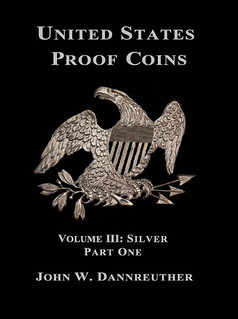

37 – David W. Lange Memorial Book of the Year Award
John West Dannreuther
United States Proof Coins Volume III: Silver
Dannreuther Publishing
38 – Lee Martin Founder's Award – Best All-Around Portfolio
Charles Morgan
Best All-Around Portfolio
Tie
38 – Lee Martin Founder's Award – Best All-Around Portfolio
Greg Reynolds
Best All Around Portfolio
Tie
39 – Clement F. Bailey Memorial Award
Nour Ammari
Clement F. Bailey Award
40 – The Ribbit
Joel Orosz
The Ribbet
41 – The Clemy
Dennis Tucker
The Clemy
To read the earlier E-Sylum articles, see:
NEW BOOK: WHEN COINS WERE KING
(https://www.coinbooks.org/v29/esylum_v29n03a03.html)
NEW BOOK: GREEK COIN ART
(https://www.coinbooks.org/v28/esylum_v28n31a03.html)
NEW BOOK: OFFICIAL INAUGURAL MEDALS AND RIBBONS
(https://www.coinbooks.org/v28/esylum_v28n51a02.html)
NEW BOOK: ENJOYING COIN COLLECTING, 2ND EDITION
(https://www.coinbooks.org/v29/esylum_v29n20a04.html)
NEW BOOK: U.S. PROOF COINS VOL III: SILVER
(https://www.coinbooks.org/v28/esylum_v28n49a06.html)

2026 ANA LITERARY AWARD WINNERS
The American Numismatic Association announced its 2026 Literary Award Winners. Here is the press release. -Garrett
The American Numismatic Association's (ANA) 2026 literary awards – recognizing articles published in the 2025 volume of its official magazine, The Numismatist – were presented during the Member Awards and Donor Celebration at the Pittsburgh World's Fair of Money® on August 27. The Numismatist was launched by ANA founder and first editor Dr. George F. Heath in 1888. This year marks its 139th volume.
The Heath Literary Award, introduced in 1949, acknowledges outstanding articles published in the preceding 12 months.
- First place goes to William Eckberg for "Pattern Enigma" (November 2025). The author will receive $250, an engraved nickel-silver medal, and a certificate.
- Russ Bega earned second place ($100, an engraved bronze medal, and a certificate) for "Counterfeit, He Wrote" (August 2025).
- In third place (engraved bronze medal and a certificate) is David Schenkman for "The Greenduck Story" (February 2025).
The Wayte and Olga Raymond Memorial Literary Award, endowed in 1978 by the late John J. Ford Jr., is presented for articles that display original and comprehensive research in U.S. numismatics.
- William R. Eckberg received first place ($400 and a certificate) for "Silver Center Cents" (January 2025).
- Second place ($200 and certificate) goes to Joel J. Orosz and Lance Humphries for "A Misattribution Rectified" (December 2025).
- Frank W. Garmon Jr. and Dylan Frederick received third place (certificate) for "Pratt's Perspective: The Art of the Indian Head Gold Pieces" (February 2025).
Founded by an anonymous donor, the Catherine Sheehan Literary Award for Paper Money Studies includes $50 and a certificate for first place.
- David D. Gladfelter took the top prize for "Back Talk: Comments Found on the Flip Side of New Jersey Obsolete Notes" (March 2025).
- Second place (certificate) goes to Rick Melamed for "Fractional Imitations" (December 2025).
- Ray Williams received third place (certificate) for "In Search of Ensign Anthony Morris" (April 2025).
The Prue and Arthur Fitts Literary Award for Ancient and Medieval Coinage Studies recognizes literary excellence in those fields.
- Mark Fox received first place ($250 and a plaque) for "For 'New' Ancient Mints" (January 2025).
- Earning second place (certificate) is Benjamin D.R. Hellings for "Total Recall" (March 2025).
- Ken Bressett received third place (certificate) for "Tally Stick Money of Medieval England" (March 2025).
Honorable mentions for this year include "The Redfield Hoard: 50 Years Later" by Jeffrey A. Johnson (November 2025) and "Coinage in Flux: Reconnecting Original & Modern Hobo Nickels" by Jonathan Marker (June 2025).
All feature articles published in The Numismatist automatically are considered for the Heath Literary Award; likewise, all qualifying articles are evaluated for the Raymond, Sheehan, and Fitts Awards. For information about submitting manuscripts for review and possible publication, visit money.org/the-numismatist/submission-guidelines.
2026 Young Numismatist Literary Award Winners The 2026 ANA Young Numismatist (YN) Literary Awards were announced during the ANA's annual Summer Seminar banquets. The three award categories are generously funded by Whitman Publishing and named after authors dedicated to educating the next generation of numismatists.
The Bill Fivaz Young Numismatist Literary Award honors writers who are aged 8 to 12. This year's first place recipient was John Swindling for "The 1975-1976 American Freedom Train and Its Medals." No selections were made for second and third place.
The Q. David Bowers Young Numismatist Literary Award honors writers who are aged 13 to 17. This year's first place recipient was Miles Tichner for "Frauds, Fakes, and Fire: The Incredible Story of the Bank of Weston." Cameron Scheirer placed second with "Beggars' Badges," and Jackson Hancock took third with his paper "The Ottoman Lira: Coinage of a Dying Empire."
The Kenneth E. Bressett Young Numismatist Literary Award is given to writers between the ages of 18 and 22. This year, first place was won by Nate Leonauskas for "The Ancien Régime's Morgan Dollar: The French Écu." Second place was awarded to Rene Alvarenga for "The Young Numismatist: The Next Generation." Mark Edwards received third place for "The Young Collector's Dilemma: Why the Rare Coins Market Needs a New Marketplace, and Why I Built One."
The first-place winners received a $500 cash prize, plus a $500 voucher with which to build a personal library of numismatic books produced by Whitman Publishing. Second- and third-place winners received book vouchers for $200. To learn more about this program, visit money.org/american-numismatic-association-awards.

AIM AFFIRMS PUBLISHING COMMITMENT
Publisher Corinne Zielke of Active Interest Media (AIM) published a note on Friday confirming AIM's commitment to continue publishing their flagship numismatic publications following the recent sale of their core NumisMaster database. -Editor
For more than six decades, Krause Publications, F+W Media, and now Active Interest Media have had the privilege of serving collectors through Numismatic News, World Coin News, Bank Note Reporter, and the NumisMaster database. Throughout that time, our mission has remained the same: to provide collectors with trusted information, reliable market pricing, and engaging editorial coverage that helps them enjoy and grow in the hobby.
As part of our ongoing commitment to that mission, we have sold the NumisMaster pricing database to NGC and PMG, two organizations recognized worldwide for their leadership in coin and paper money authentication, grading, and research. We believe this transition places the database in excellent hands and will allow it to continue to grow and serve collectors for years to come.
I also want to assure our readers that this transaction does not change our commitment to the publications you know and trust. Numismatic News, World Coin News, and Bank Note Reporter will continue to be published by Active Interest Media with the same editorial teams dedicated to delivering the news, feature articles, market analysis, and collecting insights you expect in each issue.
Likewise, the pricing information you rely on will continue to appear in our publications. Numismatic News will continue to publish its quarterly Coin Market pricing, and Bank Note Reporter will continue its monthly Paper Money Market pricing. Our goal remains unchanged: to provide timely, accurate information that helps collectors make informed decisions.
We are proud of the role NumisMaster has played in the collecting community, and we are equally excited about the future of our magazines. Thank you for your continued readership, your enthusiasm for the hobby, and the trust you place in our publications. We look forward to serving you for many years to come.
To read the complete article, see:
A Note from the Publisher of Numismatic News, World Coin News, and Bank Note Reporter
(https://www.numismaticnews.net/a-note-from-the-publisher-of-numismatic-news-world-coin-news-and-bank-note-reporter)
To read the earlier E-Sylum articles, see:
NGC, PMG AND AIM TEAM UP ON PRICING DATA
(https://www.coinbooks.org/v24/esylum_v24n04a15.html)
KM AND PICK CATALOGS ACQUIRED BY CCG
(https://www.coinbooks.org/v29/esylum_v29n27a07.html)

NOTES FROM E-SYLUM READERS: SEPTEMBER 6, 2026
Sale of UK Merchant Countermarked Dollars
Eric Hodge writes:
"Once again thanks for your weekly blog. Mondays would not be the same without it. Also congratulations on reaching retirement. It seems you are already looking back and wondering how you had time to go to work.
"Over the years I have communicated with your readers through your site whenever I needed advice, ideas or help with any research project. Generally the responses have been so positive and helpful that I thought some readers may be interested to know that now I have reached my 80th year I have decided to sell my collection. I wanted to be involved in the sale so now seems the right time. I wanted the catalogue to be more an historical document with provenance and other references. The sale is with Noonans of Mayfair, London on the 29th September 2026 and I believe they have met my brief.
"My research will continue and your blog will remain one of the highlights of the week."
We'll look forward to learning more about the sale! -Editor
Duane Feisel Contact Sought
A website visitor is hoping to reach token dealer Duane Feisel. The email address I have for him is no longer valid. Does anyone have current contact information for him? -Editor
July 1898 Gold Slug Design Coin Spoon Information Sought
Philip Mernick writes:
 "These images are of one of my brother's "coin" spoons. It is sterling silver and clearly based on a US private gold issue but as it is marked July 1898 I wonder if it is a souvenir of the 1898 Nebraska Fair which showcased the development of the West. I haven't found another example on-line but maybe somebody in the E-Sylum universe can confirm this."


Can anyone help? I've never seen one of these. Nice item. -Editor

LIKELY LEWIS & CLARK INDIAN PEACE MEDALS
This press release, also to be published in the Fall 2026 issue of Points West magazine from the Buffalo Bill Center of the West (a Smithsonian Institution Affiliate) discusses rare Indian Peace Medals in their collection. Preliminary analysis of relevant documentation indicates a high likelihood that two of the medals were presented to Native recipients during the expedition. -Editor
Collection includes exceptionally rare Indian peace medals taken with Lewis & Clark on their Corps of Discovery Expedition
 Following a thorough course of testing and analysis
carried out earlier this year, the Buffalo Bill Center of the West has
definitively authenticated a trove of rare and historically significant medals
tied to key periods and events in the history of the American West spanning
more than 100 years.
Following a thorough course of testing and analysis
carried out earlier this year, the Buffalo Bill Center of the West has
definitively authenticated a trove of rare and historically significant medals
tied to key periods and events in the history of the American West spanning
more than 100 years.
Some items in the collections have been hailed by experts as profoundly consequential, and are on view now at the Center in Cody, Wyoming.
Four of the medals, each a different Indian peace medals, are of the type that were handed out to Tribal members as part of treaty negotiations or other contact with U.S. Government representatives. One exceptionally rare such medal is one of only three of its kind taken by Lewis & Clark on their Corps of Discovery Expedition from 1804-1806.
All of the medals have long resided in the Plains Indian Museum's collections, and some had been previously displayed at the Center. But exact details about their origin and authenticity were not fully known until this summer, said Rebecca West, CEO and Executive Director of the Center of the West.


"We did not previously know the full extent of their significance in the cultural history of the American West, but we're always working to learn more about our collections," she said. "Consequently, we have now gained substantially greater understanding of their exceptional nature."
Among the medallions evaluated and authenticated are:
-
 A large Thomas Jefferson Indian peace medal—known as a "shell
medal" made by joining together two outer shells as front and back,
sandwiched over a solid core—which is one of only three such medals
taken on the Corps of Discovery Expedition.
A large Thomas Jefferson Indian peace medal—known as a "shell
medal" made by joining together two outer shells as front and back,
sandwiched over a solid core—which is one of only three such medals
taken on the Corps of Discovery Expedition.
- A small Jefferson Indian peace medal, also a shell medal, which is one of only 16 of its kind taken on the expedition.
- Two other Indian peace medals, one awarded during the administration of Millard Fillmore (1850-53) and one from the Franklin Pierce administration (1853-57). Each is one of fewer than two dozen of its kind known to exist.
- Two so-called fur trader medals modeled after genuine Indian peace medals that were gifted to Natives by fur-trading companies. Each is one of only eight known of its type to exist.
- Additional medals of various kinds dating to as early as 1804 and as late as 1913. related artifacts.
Preliminary analysis of relevant documentation indicates a high likelihood that both Jefferson Indian peace medals were presented to Native recipients during the expedition, and the Center is conducting ongoing research to determine additional details about them and other medals. related artifacts.
Among the 33 medals from the Center's Plains Indian Museum examined and tested this summer, also included were additional other genuine medals similar to (but not the same as) Indian peace medals; genuine collector medals produced by the U.S. Mint; and so-called "fantasy" medals—forged peace medals struck by private individuals in an attempt to deceive recipients. Other medals were also determined to be counterfeits, including forged versions of George Washington oval peace medals, which have historically been highly subject to counterfeiting. related artifacts.
The rare and important genuine medals that were authenticated are "extremely important and add significantly to our history, and change the numismatic world," said Dr. Lawrence Lee, an independent numismatic specialist hired by the Center to evaluate the collection. Lee has curated museum collections and consulted with multiple institutions regarding their numismatic holdings, and is a specialist on Indian peace medals and related artifacts.
Scientific elemental analysis
In addition to Lee's physical inspection of the medals and supporting documentation, Center of the West Chief Conservator Beverly Perkins conducted an X-ray fluorescence (XRF) analysis of them.
XRF is a widely used, non-destructive technique that determines the elemental composition of materials, Perkins said. It allows for a metallurgical comparison of the specific alloys used in the medals to known benchmarks, much the way historical paintings, tapestries or ceramics are often authenticated, she said.
"Each of these genuine Indian peace medals has a unique and hugely significant historical backstory," Lee said. "They have such important provenances that each can stand alone as a momentous artifact from our nation's past."
Based on historical documents, notes and other authentication gathered and maintained with the medals, Lee said: "It might be possible to eventually trace two of the medals to their original recipients, which is quite rare."
Joy of discovery
"Collections are the soul of the Buffalo Bill Center of the West, and one of the greatest joys as a museum director is to discover new knowledge about individual pieces, whose histories are often mysterious," West said.
Plains Indian Museum Curator Hunter Old Elk said: "The Center has been and will continue to conduct extensive research on the history and specific provenance of these medals. As appropriate, we will consult with affiliated Tribes, as we do with all items in the Plains Indian Museum."
"This new discovery in the year of year of America's 250th birthday enriches the medals' historical and cultural significance to American history, and confirms both the physical and symbolic authority of the Plains Indian Museum," she said.
John Pack, executive director of consignments for Stack's Bowers Galleries, one of the leading U.S. numismatic auction houses, said he was glad to see the Center's medals get their moment in the spotlight.
"Indian Peace Medals and the related medals of the fur trade are important historical objects that were part of the complex and fascinating interactions of European and Indigenous cultures across North America," Pack said. "All too often, these objects lurk in the shadows of collections, and as a researcher in this field, I am delighted that the medals of the Plains Indian Museum are being celebrated and better publicized."

Lawrence Lee, Hunter Old Elk, Rusty Rokita
Important symbols
"Indian peace medals are important symbols of trade, diplomacy and nation-building because they represented political alliances and diplomatics efforts," said Plains Indian Museum Curatorial Assistant Danielle L. Carpenter-Chatman, who worked closely with Lee during his analysis at the Center.
Typically, round or oval medallions of varying sizes and metal content, the medals were given out during the colonial era by French, British and Spanish government officials to Tribal leaders, often during negotiations over trade, treaties or other weighty matters. They included a decorative ribbon and were bestowed in a ceremony similar to modern Olympic medal presentations, Lee said.
After the Revolutionary War, the U.S. Government continued the tradition, although the U.S. Mint lacked the machinery to properly stamp a thick medal in the traditional style, Lee said. It relied for a time on private artisans and even British sources.
While serving as the nation's first secretary of state, Thomas Jefferson wrote in a letter that peace medals were "an ancient custom from time immemorial," dating to a European practice of "giving medals or other marks of friendship to the negotiators of treaties, and other diplomatic characters, or visitors of distinction."
Jefferson's own profile appears on the peace medals he sent while president with Lewis and Clark. The tradition continued until the late 1800s, Lee said, although reverse-side images changed over time to depict scenes of agriculture, Christianity and domestic life as U.S. policy toward Tribes focused on cultural assimilation.
Rusty Rokita, a member of the Center's Board of Trustees, has helped research and fund recent analysis of the medals.
"For two centuries, the wider world hasn't really known where many of these medals were, or the stories behind them," Rokita said. "Authenticating them now, after I've heard details about their provenance for decades, is profoundly moving."
To learn more about the Buffalo Bill Center of the West, see:
https://centerofthewest.org/
ARCHIVEGRID
Andrew Pollock writes:
"I just learned about this recently. I note that there is a Walter Breen archive at Cornell. It also appears that there are thousands of collections pertaining to national banks under the search term "national banks".

I was unfamiliar with this resource, which aggregates listings of archival materials in museums, universities and libraries. There do seem to be a number of archives useful for numismatic research. We're all familiar with the American Numismatic Society, National Numismatic Collection and Library of Congress, but there are many other archives that have numismatic content.
There are entries for individual items as well as complete archives. Seals are included as well as coins and medals. Numismatic researchers should bookmark this for future reference. It is also a finding guide for numismatic collections in museums, universities and libraries. Here are some entries that caught my eye, but all are worth reviewing for your personal interests. -Editor
Morris, Robert, 1818-1888
University of Chicago - Special Collections Research Center
Contains descriptions of coins, names of purchasers, and letter copies relating to numismatics
Edward Gans Collection of Materal about Numismatics, 1889-1963
University of California, Los Angeles - Charles E. Young Research Library
Collection consists of 112 items including pamphlets, a small group of mailings from Numismatics forum, a typescript Catalog of Gans' Numismatic Library, and a run of , September 1950-December 1958.
Hills, Jonas Coolidge, 1851-1913
Connecticut Historical Society
J. Coolidge Hills was a noted coin and military medal collector who lived in Hartford, Connecticut. His correspondence was primarily with dealers in numismatics from Japan, London, France, and across the United States. Also includes an Italian certificate that accompanied an award of a medal, handwritten notes, two pages from a diary written while on a trip to Europe (undated), and a notebook listing books on numismatics. Hills originally bequeathed his collection to the Wadsworth Atheneum but the restrictions he placed on the donation made it difficult to manage, so it was transferred to the American Numismatic Society
Albert A. Grinnell scrapbook (1861-1940)
Abraham Lincoln Presidential Library and Museum
The collection consists of about 80 items, including 6 philatelic Civil War covers; published pamphlets; color and black and white prints; color postcards; commercial and home photographs; and several facsimiles of the Bixby letter and other Lincoln writings. One ALS (4 pages) by Elliott Leviness of Detroit to Grinnell describing how his father, James F. Leviness, a fireman on U.S. Revenue Steamer Miami had burned cotton bales during a frantic 1862 battle in the James River while Lincoln and Stanton were on board; and a 1934 letter and blue ribbon for his 1934 numismatics display at Cleveland
Alberto Francisco Pradeau Collection 1551-1980 1910-1979
Arizona State University Libraries
The Alberto Francisco Pradeau Collection houses correspondence, typescripts, transcriptions, translations, photocopies, photostats, and printed matter documenting Pradeau's research on colonial and nineteenth century Mexican history and currency. Although the collection extends from 1551 to 1981, the bulk of the material constitutes the products of Pradeau's research from 1910 to 1979. The collection has been arranged into eight series.
Walter H. Breen papers, 1950-circa 1992
Cornell University - Division of Rare and Manuscript Collections
Correspondence, holograph notes and printed material from Walter H. Breen. The archive includes Breen's address book, approximately 90 pages, with extensive notations (referencing Arthur Clarke, Isaac Asimov, among others); approximately 47 typed manuscript pages with extensive hand-written notations on issues relating to homosexuality; approximately 60 typed pages, with extensive holograph notes, relating to the "Breen Developmental Inventory Questionnaire" and notes on the related "Project OJ"; a thirty-three page holograph manuscript by Breen entitled "Numbers are Fun!"; approximately seventy typed pages of poems and short works by Breen, many with holograph corrections; and an 18 page typed manuscript of a play entitled "Erokles", along with a 1958 letter from Burkhardt of Der Kreis/Le Cercle.
Numismatic Society (Hartford, Conn.).
Connecticut Historical Society
The Hartford Numismatic Society was founded in 1935 to encourage and promote the study of Numismatics through the acquisition of coins, paper money or medals and to spread their history. Their records consist of their constitution and by-laws, minutes of meetings, 1934-1970, annual reports, officer's reports, membership applications and lists, financial records, correspondence, a secretary's subject file, club history, and certificates
Gillingham, Harrold Edgar, 1864-1954
Historical Society of Pennsylvania
Collection, 1730-1950, of materials gathered by Gillingham on early American crafts, instruments and numismatics. Included are photostats of documents on crafts and craft-makers, such as carriage building and on instruments and instrument-makers, particularly time-telling instruments, sich as sundials; a few original documents by individual vraft and instrument makers and scrapbooks and manuscript articles written by Gillingham and his wife on craftmaking and numismatics, including calico and linen printing in Philadelphia. Also included are miscellaneous records of the Port of Philadelphia, 1792-1829, with ship baggage entries and alien passenger lists for 1798; Gillingham family papers and a diary by Edith H. Gillingham from Paris during World War I, 1917-1919, detailing conditions during the last year of the war
Drowne, Henry Russell, 1860-1934
New-York Historical Society
Four Henry Russell Drowne letters, dated between April and June 1893, relating to numismatics and the American Numismatic and Archæological Society; correspondents include John Henry Buck, and William M.R. French, director of the Art Institute of Chicago. One letter, signed George William Curtis, dated 27 Washington Street, December 24, 1859, is an inquiry into whether any Robert Browning plays have been performed in the United States
Stickney, Matthew Adams, 1805-1894
Peabody Essex Museum - Phillips Library
This collection contains the papers of Matthew Adams Stickney along with papers of his father Dudley, his brother Dudley, his daughter Lucy, and other family members. The papers consist mainly of correspondence regarding genealogical research and numismatics. There are also financial and legal papers, copies of registry and church records, diaries, newspaper clippings, an autograph collection, a ciphering book, and a grocery store account book
Anthon, Charles Edward, 1822-1883
New-York Historical Society
Signed letter, dated City College of New York, June 5, 1872. Respecting General De Peyster's pamphlets on the War of the Rebellion. He would like Wood, the American Numismatic Society's librarian, to acknowledge the pamphlets "with some flattering remarks in the name of the Society" as he knows "how sensitive authors are.".
Lind, Eric, 1920-1983
Leo Baeck Institute - Center for Jewish History
The Eric Lind collection documents his involvement with numismatics and philately and his interests in the Holocaust and the fate of the Jews during World War II. Materials collected here cover topics such as Anti-Semitism, Holocaust, Nazis and Neo-Nazis, forgeries during WW II, stamps and currency, and the era of Kaiser Wilhelm II. The collection consists of printed materials, artifacts, paper money and coins, stamps, post cards, envelopes, correspondence, documents, and photographs
New England Numismatic and Archaeological Society Records, 1865-1878
New England Numismatic and Archaeological Society
Peabody Essex Museum - Phillips Library
Constitution, bylaws, correspondence, and book of donations and gifts of this Boston-based organization
Henry Phillips Jr. papers
Johns Hopkins University - Milton S. Eisenhower Library
Henry Phillips, Jr. (1838-1895), was an author, philologist, and numismatist. The collection consists largely of the manuscript writings of the author dating from 1862-1892.
Todd, Richard Cecil, 1914-
South Carolina Historical Society
In this letter, Richard Todd responds to questions Wiley posed in previous correspondence pertaining to the manufacture and use of Confederate coins and the Confederate treasury
Pradeau, Alberto Francisco, 1894-1980
Arizona State University Libraries
Consists of correspondence, typescripts, transcriptions, translations, photocopies, and printed matter describing Dr. Pradeau's research in colonial and nineteenth century Mexican history and currency. Although the collection extends from 1551-1981, the bulk of the collection is comprised of the products of Pradeau's research from 1910-1979. The collection has been arranged into eight series: Fraternal organizations; History of Mexico; History of the mission system and Jesuits in Mexico; Numismatic history of Mexico; Manuscripts, drafts and research notes for publications; Personal correspondence; Miscellaneous files; Personal documents/records
Duke University - David M. Rubenstein Rare Book and Manuscript Library
The Currency Collection contains 4896 pieces, 1746-1982, of which all except a small number of coins and tokens are paper currency. Most of this money is domestic, but there are a limited number of foreign items, some of them quite old and interesting. Approximately two-thirds of the collection dates from the Civil War and one-fourth from the antebellum period.

THE DUBAI COINS MUSEUM
Numismatics is everywhere, and coin museums are to be found all over the world. Here's a review from a recent visitor to the Dubai Coins Museum in the United Arab Emirates. -Editor

The Dubai Coins Museum sits within the Al Fahidi Historical Neighbourhood, the city's oldest surviving residential quarter, where wind-tower architecture and narrow lanes give you a sense of history, culture and place. The museum itself is compact, but the collection is outstanding.
It is free, and you get a tour from a friendly Emirati guide who walks you through the collection personally, answering questions and bringing obvious enthusiasm to the subject.
Despite my decision to visit during summer – in the middle of the day – the museum was surprisingly busy. It was not heaving, but consistently occupied, with several groups moving through at once, each with a tour guide. For a small, free institution in a city where cultural tourism often feels like an afterthought, that was unexpected.
The collection traces the history of currency from ancient trade tokens, such as cowrie shells, pearls and salt, to early Islamic dirhams through to more recent Gulf coinage, with objects sourced from across the Arab world and beyond.
It covers the development of coin design, the spread of Islamic monetary systems, the role of trade routes in shaping currency standards and the gradual formalisation of money as both a practical and a political instrument.
It also traces the evolution of the UAE dirham, from when the Trucial States traded in Indian rupees, through the first Qatar and Dubai riyals, to commemorative coins of recent decades.

The Islamic coins are a particular strength. The collection spans several centuries and multiple dynasties, and the guided tour puts them in proper historical context rather than leaving visitors to read captions alone.
To read the complete article, see:
Museums of the UAE: Thousands of years of money hidden in the heart of old Dubai
(https://www.thenationalnews.com/arts-culture/2026/09/04/dubai-coin-museum-best-attractions-guided-tour-al-fahidi-uae-history/)

VOCABULARY TERM: STRUCK
Here's another entry from Dick Johnson's Encyclopedia of Coin and Medal Terminology. -Editor
Struck. A numismatic or medallic item made by striking with dies in a press for that purpose. The struck piece can have one or two sides; when one-sided it is called uniface. Even uniface pieces are struck with two dies however (just one is blank, called a jack die). Struck pieces are in contrast to other forms of manufacture: cast, repoussé, niello, forged. While ancient coins were diestruck, with hammer and anvil, coins of the middle ages were considered hammered. With the invention of the screw press in 1506, and it's commercial development in 1550, coins and medals were considered truly struck. All coined pieces – those manufactured in a coining press – are struck.
There is a limit to the size a struck piece can be, depending upon the size and strength of the press. This limit has gradually increased as press technology has developed. The first struck coins and medals were under one inch. By the end of the 16th century a 2-inch medal was struck by Vittore Gambello (the largest for its day). With modern presses a coin or medal, for all practical purposes, could be as large as six inches; a piece this size requires a press of 1000-ton or more capacity. Larger medals were – and are – cast.
To read the complete entry on the Newman Numismatic Portal, see:
Struck
(https://nnp.washu.edu/Documents/Detail/struck/4136810)

EDITOR PROFILE: WAYNE HOMREN
The American Numismatic Association published a short profile of Yours Truly by Sydney Stewart in the September 2026 issue of The Numismatist. With permission, we're republishing it here. -Editor
WITH DEGREES IN DISCIPLINES including math, computer science, and business administration, coupled with a career that started in computer science and artificial intelligence and ended at the U.S. Department of Defense, numismatics might seem like a disconnected interest for Wayne Homren. But curiosity is what drives the E-Sylum editor. He is fascinated with how the study of money intersects with fields like geography, history, economics, and metallurgy, and he's learned more about those subjects through the hobby than he did during his many years of education. His work editing The E-Sylum, the digital newsletter of the Numismatic Bibliomania Society (NBS), might be demanding, but for a man thrilled by discovery and new perspectives, it's fulfilling.
Sydney Stewart: What motivated you to create The E-Sylum?
Wayne Homren: Initially, the goal was simply to drive visitors to the new website I had created for the NBS and hopefully attract some new members. I also wanted to promote numismatic literature and education in general, which is why the newsletter was free to all and archived on the website from the start.
It may have been an offhand comment that made me think of expanding the newsletter's scope. While introducing himself at an ANA meeting, a friend said, "My name is Walter Breen, and I collect information." I realized that people collect numismatic literature not just for the books themselves, but for the information they contain. NBS members include a "who's who" of the hobby, from top dealers and collectors to researchers and authors. What they all have in common is a love of numismatic knowledge. So, a wide range of topics became fair game. No one ever complained, and The E-Sylum grew to cover the full range of coins, tokens, medals, and paper money of all eras, ancient to modern.
SS: The newsletter features a wide range of material and updates. What's your process for sorting through everything and deciding what to publish?
WH: I'm glad you asked—there's so much possible material to choose from each week that a lot does not make the cut. Priorities are reflected in the order articles appear, so sections like NBS news, numismatic literature sales, new books, obituaries, and the Newman Numismatic Portal are high on the list, followed by selected hobby news, regular columns, and auction previews. When it comes to hobby news and press releases, I'm more selective. People can find the same information in other numismatic publications. We rarely discuss prices or grading. We leave that to other publications and stick to numismatic history and scholarship. Our auction previews go beyond most press releases and include a large amount of text and imagery from the auction catalogers. It can be a lot to read, but there's much to learn in each issue. I hear all the time from people who thank me for bringing their attention to interesting lots they end up purchasing for their collections.
SS: Which hobbyist has had the greatest impact on you?
WH: No question—my mentor Glenn Mooney and the members of the Western Pennsylvania Numismatic Society (WPNS). In college I read a newspaper article about the coin collection at Pittsburgh's Carnegie Museum of Natural History, and Glenn was interviewed in the article. I looked up his phone number and called him. He invited me to his home and delightedly showed me his collections of coins, tokens, and medals. It was an eye-opening experience. Soon, he invited me to a WPNS meeting, and I became a member. Members researched and spoke about different numismatic subjects at every meeting, and they were all great role models for me. Later, I held every office and became a life member of the club. I guess I've been paying it forward ever since.
For more information, see:
http://e-sylum.org/
NUMISMAGRAM MEDAL SELECTIONS: SEPTEMBER 6, 2026
Numismagram's Jeremy Bostwick sent along these four medals from his most recent upload of new material to his site. For all of the new items, please visit https://www.numismagram.com/inventory. -Garrett

103700 | FRANCE & EGYPT. Napoléon Bonaparte/Conquest of Egypt bronze Medal. Dated 1798 (but issued 1808) for his role as General of the Army of the Orient (40mm, 29.86 g, 12h). By Julien-Marie Jouannin, Nicolas-Guy-Antoine Brenet & Dominique-Vivant Denon at the Paris mint.
Bust facing slightly left, with crown of lotus flowers above in a halo-like fashion // Napoléon, dressed as a Roman emperor, driving biga left pulled by two dromedaries; to left, the column of Pompey and the obelisk of Cleopatra; above, Victory flying right; in two lines in exergue, L'EGYPTE CONQUISE / MDCCXCVIII. Edge: Plain, though an old collector's number 96/34 is noted in black ink.
Hennin 879; Ionnikoff 4; Julius 661-2; d'Essling 766; Zeitz 10; Alexander 16; Fonrobert 5078; Ruedas, Moyen Orient, 11. Choice Mint State. Glossy chocolate brown surfaces, with alluring brilliance among the fields. A rarer type that serves as one of the initial medals (though attributed to 1808 by Alexander) in what would be a rather expansive series propagandizing the exploits of Napoléon. Here, he is rather uncharacteristically presented in a nearly-facing manner, rather than the typical right-facing profile head that graces most of the medals in the series. Compare to a similar example, graded PCGS SP-64—though seemingly slightly inferior to the present piece, which realized a total of $561.20 in Heritage 61614 (28 April 2026), lot 21037.
An intriguing type that features a unique portrait style within the series of Napoleonic medals, the medal features a date (1798) that foreshadows Egypt's conquest, as upper Egypt would not be fully conquered until the following year. While references such as Hennin and Ionnikoff cite the listed year as the year of its manufacture, a later date, such as the 1808 date proposed by Alexander, must be the case, as Denon himself was with Napoléon during the Egypt campaign, and was only appointed director of the Louvre upon the campaign's conclusion. This medal would serve as the first, at least with respect to listed date, which would bear the DENON D (Denon, director) stamp that would grace many others within the series. Alexander also notes that most known examples all feature the same die rust pattern filling a portion of space between the top of Napoléon's head and the central area of the "floating" lotus wreath above—an aspect that can be seen on this piece.
This item was featured in our E-Sylum ad.
To read the complete item description, see:
103700 | FRANCE & EGYPT. Napoléon Bonaparte/Conquest of Egypt bronze Medal.
(https://www.numismagram.com/product-page/103700)

103649 | AUSTRIA. Sigmund Freud bronze Medal. Issued 1906 for the 50th birthday of the founder of psychoanalysis (59mm, 99.75 g, 12h). By Carl Maria Schwerdtner, Jr. at the Vienna mint.
SIEGMVND FREVD WIEN MCMVI, bust right // The Riddle of the Sphinx: nude Oedipus standing left, resting head in hand and holding walking stick; to left, forepart of Sphinx right; to right, ‘OS TA KLEINP' / AINII MAT ‘HI?EI / KAI KPATISTOS ‘HN ANHP (what goes on four feet in the morning, two feet at noon, and three feet in the evening?). Edge: Plain.
Wurzbach 2797; Storer 1127; Optica et Visio in Nummis IV.261 var. (silver). Choice Mint State. Olive-brown surfaces, with some pleasing brilliance in the fields. Compare to a similar example that realized a total of $450 (after the buyer's fee) in Classical Numismatic Group E-535, lot 748.
The father of psychoanalysis, Sigmund Freud was born in Freiberg in 1856, then a part of the Austro-Hungarian Empire. During his extensive and exceptionally influential career, he developed therapeutic techniques, discovered the idea of transference, and established his well-known model of the id, ego, and super-ego. Likely equally well-known is his redefinition of sexuality, including the infantile form, which led to his concept of the Oedipus complex. Appropriately, that served as the inspiration for the reverse of this medal.
To read the complete item description, see:
103649 | AUSTRIA. Sigmund Freud bronze Medal.
(https://www.numismagram.com/product-page/103649)

103475 | GERMANY. Halley's Comet silver Medal. Issued 1910. Commemorating the famous periodic comet (44mm, 12h). By Karl Goetz at the München mint.
JEDE WOLKE–SO SCHWARZ SIE DROHT–DEM HIMMEL ZUGEWANDT= / DOCH IHRE LICHTE SONNENSEITE HAT (each cloud as black as it may threaten, has its light side which is turned towards the sun) / KOMET HALLEY, facing personification of the sun, with smaller sun faces surrounding; below, the comet traveling toward the sun // The constellations Orion and Canis Major pursuing that of Lepus to right; above, the constellations Serpens and Cetus, through which the comet passes; the twelve signs of the zodiac around. Edge: BAYER. HAUPTMÜNZAMT FEINSILBER.
Kienast 71. PCGS UNC Details—Bent. Pleasingly toned, with a charming matte aspect to the surfaces. Regarding the "bent" designation assessed by PCGS, we'll just agree to disagree, as it's been observed raw in-hand, and this circle cannot be squared. As such, we are treating this Choice Uncirculated. Compare to a similar matte specimen, though with the edge type not noted: an NGC MS-65 that realized a total of $5,520 [!] in Heritage 61497 (29 April 2025), lot 25076. A fairly rare and interesting non-satirical type from the hand of Goetz, far more difficult to encounter than the bronze version. The only such example in with the lettered edge in the PCGS census.
Known to ancient astronomers since at least 240 B.C.E., the comet that would come to be known as Halley's was first accurately predicted in 1705 by Edmond Halley, after whom it would be named. Considered a short-period comet as it reappears to us every 75–76 years, it is the only such comet of that kind that is viewable to the naked eye. Further, this relatively short periodicity means that it is the only comet viewable to the naked eye that could reasonably be observed twice in one's lifetime. The comet has a special connection with American author Mark Twain (Samuel Clemens), who joked that "...I came in with Halley's Comet in 1835. It is coming again next year [1910], and I expect to go out with it. It will be the greatest disappointment of my life if I don't go out with Halley's Comet. The Almighty has said, no doubt: 'Now here are these two unaccountable freaks; they came in together, they must go out together.'" Indeed, he was born two weeks after the comet's perihelion in 1835, and died the day after the comet's next perihelion in 1910. The comet's most recent visit allowed for a great deal of scientific research to be conducted, such as its size (15x8km) as well as its composition, which is a mix of some ice and largely other dusty, non-volatile materials. Its next path near Earth will occur in mid-2061 to 2062.
This item was featured in our e-Sylum ad.
To read the complete item description, see:
103475 | GERMANY. Halley's Comet silver Medal.
(https://www.numismagram.com/product-page/103475)

103710 | GERMANY. Reichskanzler Theobald von Bethmann-Hollweg silver Medal. Issued 1914 on the topic of the wartime chancellor and politician (34mm, 12h). By Friedrich Eue for the Otto Oertel mint in Berlin.
v. BETHMANN–HOLLWEG, capped and uniformed bust facing slightly left // Soldier, wearing pickelhaube, advancing left, about to swing rifle; in five lines across field, WER, WIE – WIR, UM DAS / HÖCHSTE – KÄMPFT, / DARF NUR – DARAN / DENKEN – WIE ER SICH / DURCH- – -HAUT. Zetzmann 2052 (R). NGC MS-64. Most attractively toned, with exceptional iridescence and wondrous brilliance spread across both sides. The only example of the type in the NGC census.
After ascending rather adeptly within the German government in the last decade-and-a-half of the 19th century, Theobald von Bethmann Hollweg would later serve as imperial chancellor from 1909 to 1917. His independence and more conciliatory nature were attributes that Wilhelm II saw in him when giving him the position. At the outset of World War I and into its early years, Bethmann Hollweg enjoyed broad support. However, the later stages of the war caused friction between he and other prominent figures, such as Generals Ludendorff and von Hindenburg, with Bethmann Hollweg ultimately resigning from his role in July 1917.
Ex Künker 159 (28 September 2009), lot 3752.
This item was featured in our E-Sylum ad.
To read the complete item description, see:
103710 | GERMANY. Reichskanzler Theobald von Bethmann-Hollweg silver Medal.
(https://www.numismagram.com/product-page/103710)
STACK'S BOWERS: LITMAN COLLECTION U.S. COINS
Stack's Bowers sold the Charles "Cheech" Litman Collection of U.S. Coins from August 31 - September 5. Select items are discussed below. -Garrett


Historic Lord Baltimore Shilling Undated (1659) Lord Baltimore Shilling. Hodder 1-A, W-1080. Rarity-6. Large Bust, MARIÆ. AU-50 (PCGS). A very nice survivor of this important issue, the first silver coin produced abroad exclusively for American circulation. Well struck in general, although we do note typical softness to the detail on Calvert's head and in the opposing area on the reverse, within the shield. Both sides are uncommonly well centered for the type and, although some of the border denticulation is beyond the flan, all peripheral motifs are complete. Overall detail is suitably bold for the assigned grade, in fact, and there are no sizeable marks to distract during in-hand viewing. The surfaces are a bit muted beneath blended russet and mauve-gray color, the combination of these two attributes suggesting retoning over an old, light cleaning. Close inspection with a loupe reveals faint pin scratches over and around Calvert's portrait and along the right obverse border that are also mentioned for accuracy. With PCGS having certified only one Mint State coin, and AU examples elusive regardless of overall quality, this piece is uncommonly strong both technically and aesthetically for this challenging colonial era type.
The terms of Calvert's grant called for him to be guaranteed all rights enjoyed by the Bishop of Durham, who had issued coins in his own name during the Middle Ages. Thus, Calvert had shillings, sixpences, groats (four pence), and copper pennies (or denariums) coined bearing his bust and Arms, and passed local ordinances in Maryland calling for their mandatory circulation. He ran afoul of British authorities, who frowned on him exporting silver from the mother country no matter what the terms of his claim may have been. Despite his legal troubles, coins of every denomination reached Maryland and began circulating there in the early 1660s. Today, most survivors of this denomination are in poor condition, often holed and plugged after use in jewelry, badly polished, well-worn, or a combination of the above. While sixpence often survive in decent grade, thanks in part to a hoard of about 20 pieces located in England two decades ago, the shillings rarely fared so well. While a few high grade pieces exist, more than one of them shows what may be charitably called negative eye appeal. This pleasing PCGS AU-50 is an exception, ranking among the nicer-looking examples from the Hodder 1-A dies that we have ever had the privilege of bringing to auction.
Provenance: From the Charles "Cheech" Litman Collection.
To read the complete item description, see:
Historic Lord Baltimore Shilling
(https://auctions.stacksbowers.com/lots/view/3-1UUFNV/undated-1659-lord-baltimore-shilling-hodder-1-a-w-1080-rarity-6-large-bust-mari-au-50-pcgs)


Remarkable Albany Church Penny Struck on a French Sol Unique Host Undated (1790) Albany Church Penny. W-8500. Rarity-7. D Above CHURCH. Overstruck on a French Copper Sol of Louis XV. VF-30 (PCGS). A most unusual specimen of this important issue, struck over a Louis XV copper sol. The crown atop the French shield on the reverse of the host is seen left of the CHURCH PENNY stamp at center. The last few letters of FRANCIAE and ET are visible outside the punch near 3 o'clock, while on the blank reverse, LU of LUD. and the lower truncation of King Louis' bust are visible. The surfaces are mostly even light brown, somewhat darker olive within the punch. The lettering within the punch is all nice and bold, with just trivial weakness on the right side of H of CHURCH. Some natural striations are noted, along with microscopic granularity in areas, and a single deep dig is noted on the blank reverse. The eye appeal is excellent for one of these, which show often show poorly struck punches or post-minting damage. But for the specialist, neither the aesthetic appeal nor the nice grade is the real attraction, but the opportunity to own something truly unique that actually offers new insight into the circulating medium in upstate New York at the birth of the Republic.
The Albany Church pennies were communion tokens struck during the fallout of the Copper Panic of 1789, when the circulating copper medium became so engorged with counterfeit coppers, worn out pieces (like the host for this one), and miscellaneous lightweight trash that the merchants of New York City began to reject them. The number of coppers it took to equal a dollar swelled, from 90 to a dollar to twice that number. As the New York City copper coin market convulsed, the consumer economy nearby began to feel the effects of the panic as well, extending up the Hudson to Albany, down to Philadelphia, and throughout the region.
While many Albany Church pennies show substantial undertype, up until the discovery of this coin, that undertype had always been an English halfpenny. While different types of British halfpence have been seen, this appears to be unique as a piece struck on an identifiable non-English copper. Only counterfeit George III halfpence were singled out for inclusion in the still-useful Appendix 3 of Dr. Phil Mossman's magnum opus, Money of the American Colonies and Confederation. The Richard August piece was on a very worn William III piece from genuine dies, Syd Martin had a piece boldly overstruck on a counterfeit George III piece, and a piece with a scarce George II undertype was included in our August 2019 ANA sale. This sort of undertype is unique in your cataloger's experience and unpublished in the literature. It's a very special piece, as such.
Provenance: From the Charles "Cheech" Litman Collection.
To read the complete item description, see:
Remarkable Albany Church Penny
(https://auctions.stacksbowers.com/lots/view/3-1UUG2C/undated-1790-albany-church-penny-w-8500-rarity-7-d-above-church-overstruck-on-a-french-copper-sol-of-louis-xv-vf-30-pcgs)


Rare and Appealing 1792 Getz Pattern in Copper Off the Market Since 1978 1792 Washington Getz Pattern. Small Eagle. Musante GW-22, Baker-25A, W-10775. Copper. Plain Edge. VF-30 (PCGS). A well above average specimen of this rarity from the dawn of the United States Mint. Even and appealing medium brown surfaces showcase a wealth of detail on both sides. A glass reveals some fine granularity across the surfaces, and several rim bumps and bruises are seen around the circumference. The most significant of the bruises is beneath the arrow talon on the reverse, but each side shows a couple of notable ones. Two light edge cuts are barely visible atop the obverse, mostly obscured by the holder. The surfaces show scattered marks and fine old scratches, and some hairlines are seen on the cheek, but the overall aesthetic appeal is quite nice for one of these. The population of Getz patterns is heavily weighted at lower grades, with a surprising number of (very expensive) high grade survivors known, but relatively few in the appealing middle circulated grades. Only six of these have been graded in the VF range by PCGS. This piece shows full legends, a bold date, and excellent detail on the central devices of both sides.
In April 1792, the Congress sent off a Mint Act for President Washington's signature. It was essentially the House version of the bill, insisting that American coins depict "an impression emblematic of Liberty." The Senate version of the bill, which never saw the president's desk, was much different, and Washington's opposition to the concepts therein may have helped kill it. By the terms of the Senate version, United States coins would have depicted:
An impression or representation of the head of the President of the United States for the time being, with an inscription which shall express the initial or first letter of his Christian or first name, and his surname at length, the succession of the presidency numerically, and the year of the coinage; and upon the reverse of each of the gold and silver coins, there shall be the figure or representation of an eagle, with this inscription - 'United States of America.' If that design prescription sounds familiar, it is because it is precisely what appears on the Getz patterns, down to the Roman numeral I representing "the succession of the presidency numerically" that follows G. WASHINGTON PRESIDENT.
It appears Getz's dream of work with the United States Mint did not cease when the coinage act's language made his patterns obsolete. These dies may have been put back into use early in 1793, producing small planchet pieces whose weight intended to meet the standard for the new cent coinage. One specimen, in the Lasser Collection at Colonial Williamsburg, is overstruck on a 1794 cent. This portrait punch also created new dies: the 1796-dated die used on the unique silver "Drumheller Dollar," which also used this exact reverse die; as well as the 1797 Getz Washington Masonic medal. These dies look to have made their way into the hands of Philadelphia mechanic John Harper, whose August 1797 estate listing cites "2 Dies of General Washington Heads, 1 [ditto] of the face Masons coat of arms." The nature of Getz's relationship to Harper has yet to be uncovered.
George Fuld's thorough census of Getz patterns, published in 2009, listed this example as his "Number Twenty-Six" out of 53 copper pieces he encountered, 42 of which were plain edge examples. The ornamented edge seen on some specimens points to their intended use as multi-denominational patterns, as the edge imitates that seen on the Spanish colonial silver denominations familiar to Getz and his contemporaries. Though made privately, this piece's historical context is the same as the 1792 half dismes and the rarer patterns of that year, making it a prized survivor of the founding days of our national mint.
Provenance: From the Charles "Cheech" Litman Collection. Earlier from Paramount's sale of August 1974, lot 723; our (Bowers and Ruddy's) 1978 ANA sale of the Robert E. Branigan Estate, August, lot 80.
To read the complete item description, see:
Rare and Appealing 1792 Getz Pattern in Copper
(https://auctions.stacksbowers.com/lots/view/3-1UUG66/1792-washington-getz-pattern-small-eagle-musante-gw-22-baker-25a-w-10775-copper-plain-edge-vf-30-pcgs)


1807 Draped Bust Dime. JR-1. Rarity-1. MS-61 (PCGS). OGH. This attractively toned example is dressed in iridescent champagne-pink that appears to drift toward the borders. The strike is typical of the issue with soft detail here and there around the peripheries, especially along the left reverse border, yet sharper focal features in the centers. The final issue in the Draped Bust dime series, and always in demand to represent the Heraldic Eagle reverse design in type sets, the 1807 is a strong performer in all grades. In Mint State, as here, this issue is scarce to rare, especially relative to the demand that such pieces enjoy among today's quality conscious collectors. The 1807 holds additional appeal to variety specialists, the single die marriage of the year featuring the same reverse that the Mint previously used to strike Capped Bust Right quarter eagles of the 1805, 1806/4, 1806/5 and 1807 deliveries.
Provenance: From the Charles "Cheech" Litman Collection.
To read the complete item description, see:
1807 Draped Bust Dime. JR-1. Rarity-1. MS-61 (PCGS). OGH.
(https://auctions.stacksbowers.com/lots/view/3-1UUI0E/1807-draped-bust-dime-jr-1-rarity-1-ms-61-pcgs-ogh)


1858 Liberty Seated Half Dollar. JD-1. Rarity-5. Proof-63 (PCGS). Gold CAC. OGH. Warm cobalt blue and pinkish-silver undertones backlight soft, gently mottled russet and pearl iridescence. The 1858 is the first Proof Liberty Seated half dollar for which we can realistically estimate an original mintage. Most sources provide a figure of approximately 300 coins struck, but with so many examples melted as unsold, the issue is far rarer in today's market than such an estimated mintage might imply. Indeed, the number of coins extant in all grades is on the order of just 150 to 175 pieces (per John W. Dannreuther, 2025). That offered here is the only certified example to have met with coveted Gold CAC approval - a virtually Choice specimen that will sell for a strong bid.
Provenance: From the Charles "Cheech" Litman Collection.
To read the complete item description, see:
1858 Liberty Seated Half Dollar. JD-1. Rarity-5. Proof-63 (PCGS). Gold CAC. OGH.
(https://auctions.stacksbowers.com/lots/view/3-1UUJHM/1858-liberty-seated-half-dollar-jd-1-rarity-5-proof-63-pcgs-gold-cac-ogh)


1897-S Barber Half Dollar. MS-64 (PCGS). CAC. OGH. A frosty near-Gem with strong underlying luster that supports vivid reddish-gold and cobalt blue iridescence that deepens toward the borders. Nicely struck with just a touch of lightness in the reverse arrow feathers and adjacent claw. An issue that is considerably scarcer across the grading spectrum than its mintage of 933,900 pieces suggests; like most San Francisco Mint half dollars of the era, the 1897-S saw heavy duty in the channels of commerce. It is remarkable, indeed, that Mint State coins of the present quality exist at all!
Provenance: From the Charles "Cheech" Litman Collection.
To read the complete item description, see:
1897-S Barber Half Dollar. MS-64 (PCGS). CAC. OGH.
(https://auctions.stacksbowers.com/lots/view/3-1UUJO4/1897-s-barber-half-dollar-ms-64-pcgs-cac-ogh)


1896 Morgan Silver Dollar. JD-1. Rarity-3. Proof-65 (NGC). Gold CAC. OH. This awe-inspiring specimen really needs to be seen to be fully appreciated. Both sides are wonderfully original in preservation with intense target-like toning in cobalt blue, reddish-rose and orange-copper iridescence. Also expertly preserved, the surfaces are silky smooth in appearance and strongly suggest an even higher Gem Proof grade. The strike is full, and there is bold cameo contrast that goes unmentioned on the Generation 5.0 NGC holder. Whereas Proofs of the 1888 to 1893 era are the most consistently unattractive in the Morgan dollar series (due to lightness of strike in the centers), those delivered between 1896 and 1898 are among the most beautiful. Special care seems to have been taken in the preparation of dies during the latter era, resulting in some of the most striking Proof Morgans available to today's collectors. Even so, this one is far finer than most, and it offers exceptional quality and stunning eye appeal from a mintage of 762 pieces. Sure to sell for a very strong premium.
Provenance: From the Charles "Cheech" Litman Collection.
To read the complete item description, see:
1896 Morgan Silver Dollar. JD-1. Rarity-3. Proof-65 (NGC). Gold CAC. OH.
(https://auctions.stacksbowers.com/lots/view/3-1UULWH/1896-morgan-silver-dollar-jd-1-rarity-3-proof-65-ngc-gold-cac-oh)


1884 Gold Dollar. JD-1. Rarity-4. Proof-64 Cameo (NGC). CAC. Proof gold dollar production soared to previously unheard of levels in 1884 with a mintage of 1,006 pieces. Numismatic scholars have found irrefutable proof that this increased mintage is due to contemporary demand for coins to use in jewelry, "a fad [having] developed circa 1882-3 for use of small gold coins as jewelry (watch fobs, tie pins, cufflinks, etc.), and Mint Superintendent A. Loudon Snowden took advantage of it," as reported by Walter Breen in his Proof coin Encyclopedia. Yearly Proof gold dollar mintages would remain above the 1,000-coin mark through the series' end in 1889. With most examples used in jewelry and subsequently lost, the Proof 1884 is rarer than the mintage might suggest. John W. Dannreuther (2018), in fact, accounts for only 150 to 200 survivors in all grades. At the premium Choice Cameo level, as here, the Proof 1884 is very scarce from a condition standpoint and seldom offered in today's market. This beautiful and vivid piece would do justice to an advanced Proof gold type or date set.
Provenance: From the Charles "Cheech" Litman Collection.
To read the complete item description, see:
1884 Gold Dollar. JD-1. Rarity-4. Proof-64 Cameo (NGC). CAC.
(https://auctions.stacksbowers.com/lots/view/3-1UUN45/1884-gold-dollar-jd-1-rarity-4-proof-64-cameo-ngc-cac)


1879 Three-Dollar Gold Piece. MS-63 (PCGS). OGH. This lovely prooflike example exhibits delightful orange-olive color to both sides. It is sharply struck, nicely preserved, and sure to please advanced three-dollar gold enthusiasts. By the late 1870s the usefulness of the three-dollar gold piece in commerce (such as it ever was) had long since passed and, with only a single exception in 1874, yearly circulation strike deliveries were small. In anticipation of the federal government's mandate that gold coins would once again be exchangeable at par with paper bills on January 1, 1879, the Philadelphia Mint increased its output 1878 with a delivery of 82,304 circulation strikes. Although the market achieved parity on its own on December 17, 1878, by the following year the unpopularity of the three-dollar gold piece had been reaffirmed and mintages once again fell off drastically. The 1879 has a mintage of just 3,000 circulation strikes, achieved mostly to satisfy demand for holiday gifts and similar purposes, as well as to prevent the creation of a Proof-only numismatic rarity. In the end most circulation strikes of this date accumulated in the Philadelphia Mint and were eventually melted, with the result that fewer than 750 coins are believed extant in all grades. This is a scarce Select Uncirculated survivor that would be just right for an advanced collection of this challenging 19th century gold series.
Provenance: From the Charles "Cheech" Litman Collection.
To read the complete item description, see:
1879 Three-Dollar Gold Piece. MS-63 (PCGS). OGH.
(https://auctions.stacksbowers.com/lots/view/3-1UUOQU/1879-three-dollar-gold-piece-ms-63-pcgs-ogh)


1911 Indian Eagle. MS-64 (PCGS). Gold CAC. OGH. As the highest graded of just four circulation strike 1911 Indian eagles to have secured desirable Gold CAC approval, this exquisite near-Gem Mint State example will certainly sell for a very strong bid. It is a beautiful coin whose intensely lustrous, satiny surfaces are dressed in a bold blend of vivid rose-gold and powder blue colors. Fully struck and smooth enough to support at least an MS-65 grade. Outstanding!
Provenance: From the Charles "Cheech" Litman Collection.
To read the complete item description, see:
1911 Indian Eagle. MS-64 (PCGS). Gold CAC. OGH.
(https://auctions.stacksbowers.com/lots/view/3-1UUR4C/1911-indian-eagle-ms-64-pcgs-gold-cac-ogh)


1936-D Cincinnati Music Center. MS-65 (PCGS). Gold CAC. OGH. This breathtakingly beautiful Gem is stunningly toned in blushes of red, orange-gold, cobalt blue and silver-olive iridescence. The most vivid and varied colors have gathered at the peripheries, while the entire package is bathed in full, smooth, softly frosted luster. A coin that will certainly generate strong bidder interest and sell for a remarkable premium.
Provenance: From the Charles "Cheech" Litman Collection.
To read the complete item description, see:
1936-D Cincinnati Music Center. MS-65 (PCGS). Gold CAC. OGH.
(https://auctions.stacksbowers.com/lots/view/3-1UURYA/1936-d-cincinnati-music-center-ms-65-pcgs-gold-cac-ogh)


1936 Columbia, South Carolina Sesquicentennial. MS-66 (PCGS). Gold CAC. OGH. This awe-inspiring Gem really needs to be seen to be fully appreciated, such is the vividness and beauty of the multicolored iridescent toning that adorns both sides. Intense mint luster shines powerfully through the reds, golds, russets and blues that decorate the surfaces. Presenting as pristine in hand, and sure to generate strong competition between toning enthusiasts, old holder collectors, and those pursuing Gold CAC stickers.
Provenance: From the Charles "Cheech" Litman Collection.
To read the complete item description, see:
1936 Columbia, South Carolina Sesquicentennial. MS-66 (PCGS). Gold CAC. OGH.
(https://auctions.stacksbowers.com/lots/view/3-1UURYP/1936-columbia-south-carolina-sesquicentennial-ms-66-pcgs-gold-cac-ogh)


1863 Pattern Postage Currency Dime. Judd-329, Pollock-399. Rarity-6-. Tin. Plain Edge. Proof-55 (PCGS). Obv: Pattern Postage Currency design with an ornamental shield surrounded by an inverted laurel wreath suspended from a ring. A pair of crossed arrows are behind the shield. The inscription EXCHANGED FOR / U.S. NOTES is around the periphery. Rev: The denomination 10 CENTS and date 1863 in the center, with peripheral inscriptions POSTAGE CURRENCY above, ACT JULY 1862 below. Untoned with bright pewter gray surfaces and all design elements sharply rendered and clear. Provenance: From the Charles "Cheech" Litman Collection.
PCGS# 60488. NGC ID: 29FC. Click here for certification details from PCGS.
To read the complete item description, see:
1863 Pattern Postage Currency Dime. Judd-329, Pollock-399. Rarity-6-. Tin. Plain Edge. Proof-55 (PCGS).
(https://auctions.stacksbowers.com/lots/view/3-1UUTAO/1863-pattern-postage-currency-dime-judd-329-pollock-399-rarity-6-tin-plain-edge-proof-55-pcgs)


Undated (1842-1852) August Bechtler $1. K-24. Rarity-3. 27 G. 21 C. Plain Edge. AU-58 (PCGS). OGH. Rich orange-honey gold color covers both sides, with rich luster protected around the legends. One of the more choice examples of the type at the certified AU-58 level we've ever encountered, with just a few wispy handling marks above the digit 27 that requite magnification to discern. The die state is quite late, with significant die rust scattered throughout both sides. The aesthetic appeal is positively superb. One of the most common of all territorial gold issues, the gold dollars of August Bechtler saw wide circulation throughout the South. They also saw widespread damage, both from jewelry use and from polishing in non-numismatic hands. Those with this kind of sharpness and originality bring a strong premium in the marketplace today.
Provenance: From the Charles "Cheech" Litman Collection.
To read the complete item description, see:
Undated (1842-1852) August Bechtler $1. K-24. Rarity-3. 27 G. 21 C. Plain Edge. AU-58 (PCGS). OGH.
(https://auctions.stacksbowers.com/lots/view/3-1UUTO3/undated-1842-1852-august-bechtler-1-k-24-rarity-3-27-g-21-c-plain-edge-au-58-pcgs-ogh)
These lots have concluded, but the Stack's Bowers Summer 2026 Global Showcase Auction continues through September 11, 2026. -Editor
To read the earlier E-Sylum article, see:
STACK'S BOWERS: CHARLES "CHEECH" LITMAN COLLECTION
(https://www.coinbooks.org/v29/esylum_v29n35a11.html)

STACK'S BOWERS: LITMAN COLLECTION BRITISH COINS
Stack's Bowers sold the Charles "Cheech" Litman Collection on September 2. Select British coins are discussed below. -Garrett


Exalted Rose Noble from the First Reign of Edward IV GREAT BRITAIN. Ryal (Rose Noble), ND (1466-68). London Mint; mm: -/Crown. Edward IV. PCGS MS-63. S-1951; Fr-132; N-1549. Light coinage. Weight: 7.74 gms. Presenting an astounding degree of luster and a strike that is rather well executed, this Choice offering glistens with beauty and flair. Not surprisingly the finest of three observed in the PCGS census, and one of just two at the Mint State level, this example provides an immense opportunity for the advanced collectors of British hammered, or medieval gold more broadly.
Estimate: $10,000 - $20,000.
Provenance: From the Charles "Cheech" Litman Collection.
To read the complete item description, see:
Exalted Rose Noble from the First Reign of Edward IV
(https://auctions.stacksbowers.com/lots/view/3-1USIG9/great-britain-ryal-rose-noble-nd-1466-68-london-mint-mm-crown-edward-iv-pcgs-ms-63)


Massive Gold Denomination from England's Civil War Period GREAT BRITAIN. Triple Unite, 1644. Oxford Mint. Charles I. PCGS Genuine--Damage, AU Details. S-2729; Fr-258; KM-338; N-2385. Declaration type. An overall stunning and exceptionally impressive specimen, this large gold denomination features an impressive bust of the monarch, holding both sword and laurel branch. By the decade's end, he would be deposed and executed, indicating just how fraught the period was for this coin's manufacture. Some edge splits, fairly typical of the type, are noted, but rather easily overlooked. Meanwhile, the golden allure is highly attractive and eye-catching, with some deeper orange-red noted observed nearer the peripheries. Undoubtedly deserving of a strong bid and intense focus given its RARE and enchanting status.
Estimate: $30,000 - $50,000.
Provenance: From the Charles "Cheech" Litman Collection.
To read the complete item description, see:
Massive Gold Denomination from England's Civil War Period
(https://auctions.stacksbowers.com/lots/view/3-1USITX/great-britain-triple-unite-1644-oxford-mint-charles-i-pcgs-genuine-damage-au-details)


Captivating 5 Guineas of George II GREAT BRITAIN. 5 Guineas, 1748 Year SECVNDO. London Mint. George II. PCGS MS-61. S-3666; Fr-334; KM-586.2. An exceedingly stunning and provocative large gold denomination, this example radiates with an immense degree of vibrant brilliance and glistening luster. Some very minor friction is evident in the fields, rather consistent with the overall designation, while the hue is an alluring golden-yellow throughout. Overall, a strong and enticing strike dominates, with just some very minor central weakness noted on the obverse. A RARE and mouthwatering representative for the connoisseur demanding an impressive exemplar.
Estimate: $50,000 - $65,000.
Provenance: From the Charles "Cheech" Litman Collection.
To read the complete item description, see:
Captivating 5 Guineas of George II
(https://auctions.stacksbowers.com/lots/view/3-1USJF3/great-britain-5-guineas-1748-year-secvndo-london-mint-george-ii-pcgs-ms-61)


GREAT BRITAIN. Bronzed Copper Penny, 1797. Birmingham (Soho) Mint. George III. PCGS PROOF-66. S-3777; KM-618; P-1109 (R). Late Soho type. The finest of just four observed for the type in the PCGS census, this Superb Gem radiates with an abundance glistening luster and alluring chocolate brown hues. No doubt an important specimen for the advanced collectors of these Soho types.
Estimate: $1,000 - $2,000.
Provenance: From the Charles "Cheech" Litman Collection.
To read the complete item description, see:
GREAT BRITAIN. Bronzed Copper Penny, 1797. Birmingham (Soho) Mint. George III. PCGS PROOF-66.
(https://auctions.stacksbowers.com/lots/view/3-1USJR3/great-britain-bronzed-copper-penny-1797-birmingham-soho-mint-george-iii-pcgs-proof-66)


GREAT BRITAIN. Silver Crown Pattern, ND (1820). George III. PCGS PROOF-63. S-Unlisted; KM-PnB80; ESC-2055 (old 221). By Webb & Mills for Mudie. Emanating from the final year of the king's reign and life, this fanciful pattern issue presents a classically-styled portrait of the aging monarch, with the designers' initials placed in a thin, flowing script belong his neck truncation. Meanwhile, the reverse offers a complex cruciform coat-of-arms surrounding St. George and the Garter chain. Toned a sultry amber hue, this otherwise pale gray example boasts a Choice appearance and a fairly RARE status.
Estimate: $3,000 - $6,000.
Provenance: From the Charles "Cheech" Litman Collection.
To read the complete item description, see:
GREAT BRITAIN. Silver Crown Pattern, ND (1820). George III. PCGS PROOF-63.
(https://auctions.stacksbowers.com/lots/view/3-1USJWT/great-britain-silver-crown-pattern-nd-1820-george-iii-pcgs-proof-63)


Intensely Impressive "Gothic" Florin Pattern GREAT BRITAIN. Silver "Gothic" Florin Pattern, 1848. London Mint. Victoria. NGC PROOF-66. S-3890; KM-745; ESC-2917 (old 799). Plain edge. No doubt one of the more impressive and tantalizing examples of the type that one is ever going to encounter, this pattern striking offers immense quality and preservation paired with majestic and wholly resounding beauty and flair. The devices remain an alluring gunmetal gray in hue, while the fields are mostly awash in wondrous cabinet toning dominated by cobalt blue. For the advanced collector seeking a near-unrivaled specimen, this example will absolutely fill the role. A true RARITY that should generate immense enthusiasm, intrigue, and participation.
Estimate: $20,000 - $30,000.
Provenance: From the Charles "Cheech" Litman Collection.
To read the complete item description, see:
Intensely Impressive "Gothic" Florin Pattern
(https://auctions.stacksbowers.com/lots/view/3-1USKPF/great-britain-silver-gothic-florin-pattern-1848-london-mint-victoria-ngc-proof-66)


GREAT BRITAIN. Silver Crown Pattern, 1887. Victoria. PCGS PROOF-64. S-Unlisted; KMX-59; ESC-2683 (old 346). By Thomas for Spink & Son. Displaying a somewhat side profile view of the queen more reminiscent of her final so-called "Old Head" portrait style, this would-be Crown pattern for the golden jubilee features deep cabinet toning highlighted by an intense cobalt nature. Meanwhile, the highly elaborate coat-of-arms on the reverse is somewhat set apart from the fields thanks to a delightful frosted nature that is especially seen in the lion and unicorn supporters. A RARE and impressive type that does not enter the marketplace often.
Estimate: $3,000 - $6,000.
Provenance: From the Charles "Cheech" Litman Collection.
To read the complete item description, see:
GREAT BRITAIN. Silver Crown Pattern, 1887. Victoria. PCGS PROOF-64.
(https://auctions.stacksbowers.com/lots/view/3-1USKS1/great-britain-silver-crown-pattern-1887-victoria-pcgs-proof-64)
These lots have concluded, but the Stack's Bowers Summer 2026 Global Showcase Auction continues through September 11, 2026. -Editor
To read the earlier E-Sylum article, see:
STACK'S BOWERS: CHARLES "CHEECH" LITMAN COLLECTION
(https://www.coinbooks.org/v29/esylum_v29n35a11.html)
THE BOOK BAZARRE
SOVEREIGN RARITIES AUCTION XXIII: KILMARNOCK COLLECTION
Sovereign Rarities will be hosting the Kilmarnock Collection & Part III of Highcliff Collection on September 22. Select items are discussed below. -Garrett

Bruttium, Kroton, Bruttium, Kroton, Silver 1/3-Stater, c. 300 BC, ??S??[OS], head of the river god Aisaros right, rev. KPO, Pegasus flying right, 1.92g, 12h, 14mm (HN III 2196; SNG ANS 423). Die flaw under truncation, well-centred, good very fine with cabinet tone, very rare.
To read the complete item description, see:
Bruttium, Kroton,
(https://auctions.sovr.co.uk/index.php?
option=com_timed_auction&view=lot_detail
&auction_id=33&lot_id=760788)

† Sicily, Leontinoi, † Sicily, Leontinoi, silver Tetradrachm, c. 450-440 BC, laureate head of Apollo right, rev. LEO-NT-I-NO-N, head of roaring lion right, four barley grains around, 17.27g, 9h (Boehringer, Münzgeschichte, 38; SNG Lloyd 1053; Rizzo-Pl. XXIII, 2 [this obverse die]; SNG ANS-228 [this reverse die]). Toned and struck on a broad flan, good very fine.
To read the complete item description, see:
† Sicily, Leontinoi,
(https://auctions.sovr.co.uk/index.php?
option=com_timed_auction&view=lot_detail
&auction_id=33&lot_id=761007)

Kings of Macedon, Alexander III, The Great (336-323 BC), Among the more imposing denominations of Alexander III's precious-metal coinage is the gold distater, represented here by a lifetime issue attributed to Aegeae, 336–323 BC. Weighing 17.17g, at approximately twice the weight of the standard Attic gold stater, the distater was a substantial denomination and a comparatively uncommon element of Alexander's monetary system.
The obverse bears the head of Athena facing right, wearing a crested Corinthian helmet ornamented with a serpent. This Athena type became one of the defining images of Alexander's gold coinage. The reverse depicts Nike standing left, holding a wreath in her extended hand and a stylis, or naval standard, accompanied by the legend A?E?AN?POY, "of Alexander." A thunderbolt occupies the left field, while a ?O monogram appears beneath Nike's wing, providing the control marks by which the issue may be distinguished within the broader series.
The combination of Athena and Nike was particularly appropriate to Alexander's coinage. Athena embodied martial intelligence and divine protection, while Nike supplied an explicit personification of victory. Together they presented a powerful visual expression of Macedonian military success and authority at a time when Alexander's campaigns were transforming the political geography of the eastern Mediterranean and Near East.
Also noteworthy is the apparent correspondence between the dies of the present specimen and those recorded for Price 191b. Such die relationships are of particular numismatic significance, as they can assist in reconstructing the chronology, organisation and scale of production within an ancient coinage.
As a lifetime issue, the coin belongs to the period before Alexander's death at Babylon in 323 BC. This distinction is significant: Alexander's types continued to be struck extensively after his death, both by his immediate successors and by later authorities. Coins securely attributable to his lifetime therefore occupy a particularly important position within the vast and complex Alexander coinage.
Certified by NGC as XF, Strike 5/5, Surface 2/5, marks, the specimen retains an exceptionally strong strike, while its lower surface assessment records the marks and other surface characteristics acquired during its long history. Beyond its exceptional strike, the coin is notable for its substantial denomination, identifiable die attribution and place within the lifetime gold coinage of Alexander the Great, one of the most historically consequential rulers of the ancient world.
To read the complete item description, see:
Kings of Macedon, Alexander III, The Great (336-323 BC),
(https://auctions.sovr.co.uk/index.php?
option=com_timed_auction&view=lot_detail
&auction_id=33&lot_id=760790)
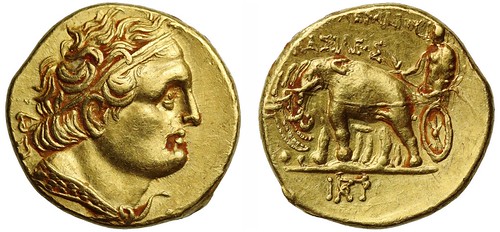
Ptolemaic Kings of Egypt, Ptolemy I (305-285 BC), This rare gold stater was struck in Cyrenaica under Magas during the reign of Ptolemy I Soter (305–285 BC). At 7.14g, it conforms to the reduced gold standard introduced by Ptolemy during the formative years of the monarchy.
The obverse bears the diademed portrait of Ptolemy I, wearing the aegis, an important early expression of personal kingship in Hellenistic coinage. The reverse, inscribed ?????????? ??S???OS ("of King Ptolemy"), depicts the deified Alexander the Great driving an elephant quadriga, imagery recalling his eastern conquests and reinforcing Ptolemy's claim to Alexander's political and military legacy.
Struck under Magas, Ptolemy's governor in Cyrenaica, the type represents an important expression of Ptolemaic authority beyond Egypt and is catalogued as Svoronos 102; CPE 271.
The coin possesses a distinguished provenance extending back to Jacob Hirsch, Auction 54, 5 May 1914, lot 519, and later Hess-Leu, Auction 31, 6 December 1966, lot 563. It is also a Naville plate coin: Les Monnaies d'Or de la Cyrénaïque (1951), no. 243d. This documented history of more than a century adds considerably to its numismatic significance.
The survival of the coin in Choice Extremely Fine condition, certified by NGC as Ch XF, Strike 4/5, Surface 3/5, brushed, is also notable for the absence of serious striking weakness or surface disturbance; the overall state of preservation remains strong and permits the principal elements of Ptolemy's portrait and the elaborate elephant quadriga to be clearly appreciated.
The stater encapsulates the emergence of Ptolemaic kingship, juxtaposing Ptolemy's royal portrait with the deified Alexander and asserting dynastic continuity with his legacy. Its Naville plate attribution and provenance to 1914 further enhance its historical and numismatic significance.
To read the complete item description, see:
Ptolemaic Kings of Egypt, Ptolemy I (305-285 BC),
(https://auctions.sovr.co.uk/index.php?
option=com_timed_auction&view=lot_detail
&auction_id=33&lot_id=760792)

Kings of Thrace, Lysimachos (305-281 BC), Kings of Thrace, Lysimachos (305-281 BC), silver Tetradrachm, uncertain mint, diademed head of Alexander the Great right, deified, with the horn of Ammon, rev. ??S???OS ??S??????, Athena seated left, holding Nike, crowning the king's name, in her right hand, and leaning with her left arm on shield decorated with lion's head, AP monogram in left field, ME monogram under throne, 16.96g, 12h (Müller 434). At some point lightly buffed, now re-toned with dramatic cobalt and russet patina, good very fine.
To read the complete item description, see:
Kings of Thrace, Lysimachos (305-281 BC),
(https://auctions.sovr.co.uk/index.php?
option=com_timed_auction&view=lot_detail
&auction_id=33&lot_id=761276)

Kings of Pontus, Mithradates VI Eupator (c. 120-63 BC), Kings of Pontus, Mithradates VI Eupator (c. 120-63 BC), gold Stater with the name and types of Lysimachus, Tomis, c. 88-86 BC, diademed head of the deified Alexander right, pellet behind, rev. BASI?EOS ?YSIMAXOY, Athena seated left, holding Nike with wreath, and resting arm on shield, TEM, in inner left field, TO below throne, in exergue, trident, 8.45g, 1h (de Callataÿ p. 141-2 [D4/R1]; SNG Copenhagen 1091 this obverse die). Good extremely fine.
To read the complete item description, see:
Kings of Pontus, Mithradates VI Eupator (c. 120-63 BC),
(https://auctions.sovr.co.uk/index.php?
option=com_timed_auction&view=lot_detail
&auction_id=33&lot_id=761234)

Lesbos, Mytilene, Lesbos, Mytilene, electrum Hekte, c. 377-326 BC, head of Dyonisus right, rev. head of satyr wearing wreath of grain leaves, within linear square, 2.55g, 1h (Bodenstedt 87; HGC 6, 1013; SNG von Aulock 1719). Nearly extremely fine.
To read the complete item description, see:
Lesbos, Mytilene,
(https://auctions.sovr.co.uk/index.php?
option=com_timed_auction&view=lot_detail
&auction_id=33&lot_id=761013)

Ionia, Phokaia, Ionia, Phokaia, electrum Hekte, c. 521-478 BC, forepart of griffin left, seal behind, rev. quadripartite incuse square, 2.52g (Bodenstedt 42; SNG von Aulock -). Nearly extremely fine, rare.
To read the complete item description, see:
Ionia, Phokaia,
(https://auctions.sovr.co.uk/index.php?
option=com_timed_auction&view=lot_detail
&auction_id=33&lot_id=761008)

Ionia, Phokaia, Ionia, Phokaia, electrum Hekte, c. 387-326 BC, head of Athena left, rev. quadripartite incuse square, 2.55g (Bodenstedt 111; SNG von Aulock -). Extremely fine.
To read the complete item description, see:
Ionia, Phokaia,
(https://auctions.sovr.co.uk/index.php?
option=com_timed_auction&view=lot_detail
&auction_id=33&lot_id=761011)

Kings of Bithynia, Prusias I (228-185 BC), Kings of Bithynia, Prusias I (228-185 BC), silver Tetdradrachm, Nicomedia, diademed head right, rev. ??S???OS ?POYSIOY, Zeus standing left, holding long sceptre and laurel wreath, thunderbolt and monogram in field, 16.66g, 1h (SNG v. Aulock 6878; HGC 614). Very small flan flaw to obverse, almost extremely fine and boasting a portrait of exceptional Hellenistic style.
To read the complete item description, see:
Kings of Bithynia, Prusias I (228-185 BC),
(https://auctions.sovr.co.uk/index.php?
option=com_timed_auction&view=lot_detail
&auction_id=33&lot_id=761021)

Tetrarchy, Diocletian (AD 286-305 as co-emperor with Maximian), Tetrarchy, Diocletian (AD 286-305 as co-emperor with Maximian), silver Argenteus, Aquileia, c. AD 300, DIOCLETIANVS AVG, laureate head right, rev. XCVI/AQ in two lines within wreath, 3.12g, 12h (RIC VI, 16a). Very fine.
To read the complete item description, see:
Tetrarchy, Diocletian (AD 286-305 as co-emperor with Maximian),
(https://auctions.sovr.co.uk/index.php?
option=com_timed_auction&view=lot_detail
&auction_id=33&lot_id=761205)

Tetrarchy, Maximian (AD 286-305, as co-emperor with Diocletian), Tetrarchy, Maximian (AD 286-305, as co-emperor with Diocletian), silver Argenteus, Treveri, c. AD 300-301, MAXIMIANVS AVG, laureate and cuirassed bust left, rev. VIRTVS MILITVM, the four princes sacrificing over tripod in front of camp gate with six turrets, in exergue, club, 2.22g, 12h (RIC VI, 125). Minor flan crack, about extremely fine, very rare with left facing bust.
To read the complete item description, see:
Tetrarchy, Maximian (AD 286-305, as co-emperor with Diocletian),
(https://auctions.sovr.co.uk/index.php?
option=com_timed_auction&view=lot_detail
&auction_id=33&lot_id=761204)
See www.sovr.co.uk for much more detail about all of these coins, medallions and more!
MORE FROM KUENKER AUCTION SALE 445-446
Taking place from 22 to 25 September 2026, Kuenker's Auction Sale 445-446 presents coins and medals from medieval to modern times. Here are some selections, including many special collections such as the collection of a physicist with coins of the German Empire in fabulous condition. -Garrett
Once again, collectors can look forward to an interesting and diverse auction week. From 22 to 25 September 2026, Künker will auction a colorful selection of coins and medals from medieval to modern times in auctions 445 to 446, featuring many special collections. Catalogs 445 and 446 comprise a total of nearly 2,600 lots with a total estimate of around 5 million euros.
Of particular note are:
• "Argentum Poloniae" – The collection of Polish talers,
• another part of the impressive collection of Kommerzialrat Dr. Herbert Wenzel with Habsburg coins and medals,
• the Erich Götz Collection with a focus on his homeland of the Upper Palatinate,
• the collection of a Rhineland collector and art enthusiast featuring gold coins from around the world,
• and, last but not least, the collection of a physicist with coins of the German Empire in fabulous condition and partly with spectacular patinas.
Coins of the German Empire from the Collection of a Physicist
The final collection we are pleased to present comprises an exceptional series of coins of the German Empire, assembled by a passionate physicist. This offering will thrill collectors who appreciate perfect condition and fascinating patinas. Whatever your budget, you are sure to find some pieces missing from your collection with estimates that fit your budget.
However, be prepared for the fact that coins of this quality are currently attracting great interest worldwide. Accordingly, it is likely that the hammer prices will be significantly higher than the estimates. Many experts also believe that the market potential of coins of the German Empire is far from exhausted.
Two additional collections complement this offering of a kind that can only be found on rare occasions. The exceptional nature of this offering is illustrated by the fact that 62 of the 503 lots are "Top Pop".


Lot 2842. Bavaria. Ludwig III, 1913-1918. 3 marks, 1918. Showpiece. FDC.


Lot 2859. Hesse. Ludwig III, 1848-1877. 2 marks, 1876. Extremely rare in this quality. Splendid patina, Proof. NGC PF 63.


Lot 3175. Reuss, elder line. Henry XXII, 1859-1902. 20 marks, 1875. Very rare. Showpiece. About FDC.


Lot 3203. Saxe-Coburg and Gotha. Ernest II, 1844-1893. 20 marks, 1872. Very rare, especially in this outstanding quality. Probably the best-preserved specimen. First strike, FDC. NGC MS 67 (Top Pop).


Lot 3212. Saxe-Meiningen. George II, 1866-1914. 20 marks, 1872. Very rare, especially in this condition. Showpiece of magnificent quality. About FDC. NGC MS 65 (Top Pop).


Lot 3273. German New Guinea. 10 New Guinean marks, 1895 A. Only 2,000 specimens minted. Showpiece of magnificent quality. FDC. NGC MS 67 (Top Pop).
World Rarities
As always, Künker offers a wide range of world coins and medals including numerous rarities as well as more affordable options. We would like to showcase special pieces to you – but be sure to browse through all the lots to find your favorite.


Lot 129. Kingdom of France. Louis XIV, 1643-1715. 1/2 écu au buste drapé à l'antique, 1687 (year on the die altered from 1686) A, Paris. Extremely rare, especially in this quality. Attractive specimen with beautiful patina, about extremely fine.


Lot 238. Kingdom of Sweden. Gustavus II Adolphus, 1611-1632. 1634 silver medallion (of 5 talers). Showpiece. Splendid patina, about FDC.


Lot 2018. Kingdom of Belgium. Leopold I, 1830-1865. 100 francs, 1853, Brussels. Only 482 specimens minted. Attractive specimen struck from polished dies, about FDC. PCGS MS 63.


Lot 2046. Kingdom of France. Louis XVIII, 1814, 1815-1824. 40 francs, 1815 A. Very rare. Showpiece. FDC. NGC PF 62 Cameo.


Lot 2074. Great Britain. George V, 1910-1936. 5 pounds, 1911, London. Only 2,812 specimens minted. Rare in this quality. Showpiece. Proof. PCGS PR 66.


Lot 2091. Naples and Sicily. Ferdinand IV (I) of Bourbon, 2nd period, 1799-1805 (-1825). Wearable 1799 gold medal. Of the highest rarity. Very fine/extremely fine.
Rarities from the German States
As you know, the German States are our specialty. Once again, we are offering an extensive selection of pieces from the many imperial cities, abbeys and principalities that had the right to mint coins. You can look forward to many coins and medals – some of which are rare, in excellent condition or of great historical significance. Every now and then, you'll come across a piece that combines all three of these characteristics.


Lot 879. Jülich-Cleves-Berg. Joachim Murat, 1806-1808. 1807 taler. Extremely rare in this quality. Beautiful patina, extremely fine-FDC.


Lot 1071. Electorate of Saxony. John George II, 1656-1680. Broad triple reichstaler, 1663, Dresden. Very rare. Very attractive specimen with beautiful patina, extremely fine+.


Lot 1179. Wallenstein. Albrecht, 1623-1634, Duke of Friedland. 1627 reichstaler, Jitschin. Very rare. Beautiful patina, very fine-extremely fine. NGC XF 45.


Lot 2479. Brandenburg-Prussia. Frederick III, 1688-1701. 1692 gold medal of 20 ducats. Extremely rare. Very fine-extremely fine.


Lot 2545. City of Bremen. Gold medal n.d. (1631-1660). Extremely rare, probably the only specimen on the market. Attractive specimen with fine gold toning, extremely fine-FDC. PCGS MS 62.


Lot 2691. Electorate of Saxony. Frederick Augustus I, 1694-1733 (Augustus the Strong). 5 ducats, 1733, Dresden. Attractive specimen, extremely fine/extremely fine-FDC.
To order a catalog contact Künker, Nobbenburger Straße 4a, 49076 Osnabrück; phone: +49 541 / 962020; fax: +49 541 / 9620222; or via e-mail: service@kuenker.de. You can access the auction catalogs online at www.kuenker.de. If you want to submit your bid from your computer at home, please remember to register for this service in good time.

GADOURY BLUE OCTOBER 2026
On October 16 and 17, 2026, Gadoury will auction coins from antiquity to the present day in two separate auctions. The blue catalog contains nine collections: the spectrum ranges from Persian, French, Dutch, and Monegasque coins to an extensive collection of medals and plaques from the Renaissance onward. -Garrett
Every collection is as individual as its collector. The coins reflect the interests and personality of the person who assembled them, and so it is always exciting to look at collections that have grown over many years. You can do this by browsing through the catalog of auction Gadoury bleu, in which nine collections are presented as ensembles. Gadoury has established two different lines in the past: Gadoury noir offers exquisite individual pieces; Gadoury bleu includes collections. Please note that Gadoury noir has its own preview.
The following ensembles can be discovered in the auction catalogue Gadoury bleu 2026:
• A collection of Persian coins from antiquity to the present day (150 lots)
• French coins from the Middle Ages to the Third Republic (80 lots)
• Coins with countermarks (13 lots)
• Coins of the Netherlands (75 lots)
• World coins (195 lots)
• Coins and medals with railway depictions (20 lots and one multiple lot)
• Coins from Monaco (56 lots, including numerous lots)
• Orders & Decorations (30 lots)
• Medals and Plaquettes (100 lots)
• Multiple lots from various collections (23 lots)


4 - Persia. Nasir al-Din Shah. Essay in bronze of 25 dinars, 1281 AH (= 1864 AD), Tehran. Rare. PCGS SPECIMEN 63 BN. Almost FDC. Estimate: 1,000 euros. Diameter 26 mm
Much could be said about the various collections; we will limit ourselves to a few special pieces, including a bronze essay of a 25-dinar coin by Nasir al-Din Shah from the year 1281 AH (= 1864 BCE). It comes from the collection of Persian coins.
Nasir al-Din Shah of the Qajar dynasty enjoyed a long reign of almost half a century, during which time his interest in Western ideas, machinery, and concepts had a lasting impact on his country. In 1877, he implemented a monetary reform, introducing a Western-style monetary system. This sample coin from 1864 demonstrates that the Persian administration had already been working on implementing a new monetary system prior to this.
Connoisseurs will spot in this collection a wide variety of the Tomans issued by Nasir al-Din Shah and his successors after the 1877 reform. The collector collected the gold coins by year and denomination. The era of Mohammed Reza Pahlavi is particularly well represented.


209 - France. Second Empire. Napoleon III. Essay for 5 Francs, 1853, Paris. Very rare. Almost extremely fine. Estimate: 5,000 Euros. Diameter 37 mm
Another essay for a 5-franc coin bearing the portrait of Napoleon III originates from France and is part of the collection of coins from that country, comprising 80 lots and spanning the period from the reign of Philip VI (1328-1350) to the Third Republic (1870-1940). This essay was created in 1853 by Louis-Charles Bouvet and depicts the emperor's head facing left(!), wearing a laurel wreath. Napoleon III had been elected Emperor of France by vote on November 21, 1852, shortly before this essay was created. With 7,824,000 votes to 253,000, the French democratically abolished the Republic. This essay by Bouvet is therefore not only a numismatic but also a significant historical artifact.


246 - Netherlands. Kampen. Goldnoble, Kampen. NGC MS63. Extremely Fine. Estimate: 3,000 Euros. Diameter 33 mm
A collection of Dutch coins comprises 75 lots. It contains interesting issues from the early modern period to the present day. The last ducat included was minted in 2001. Gold coins from the 19th and 20th centuries predominate. Nevertheless, the expert will also discover some siege coins and coins from the Dutch colonies. We would like to highlight a rose Nobel from the city of Kampen, which, although undated, was minted between 1590 and 1593.


602 - Plaquette with Pietà from the Renaissance period. Extremely fine. Estimate: 10,000 euros. Diameter 130 x 186 mm
Anyone who collects high-quality medals needs a keen eye to distinguish the average from the exceptional. The collector who is selling his collection in Gadoury bleu possessed this special discernment. The collection unites medals and plaquettes of a kind rarely seen. The chronological (and artistic) spectrum ranges from the Renaissance through the Baroque period and a large group of French art medals from around 1900 to the present day.
Our first example was created by a 16th-century North Italian master during the final phase of the Renaissance called Mannerism. The plaquette depicts the mourning Virgin Mary with her crucified son against the backdrop of a North Italian city. With the elongated limbs of the dead Christ elegantly filling the space horizontally, and the restrained grief of the Virgin Mary, whose body forms a triangle with that of her son, this is a Mannerist masterpiece that speaks of the unbroken religiosity of this era.


609 - Trinity Medal, masterpiece by Hans Reinhard (1510-1581). Estimate: 8,000 euros. Diameter 102 mm
The crowning highlight of the collection is the Trinity Medal by Hans Reinhard, which is among the great masterpieces of the art of medal engraving. It is a synthesis of minting and goldsmithing, featuring high relief and many exquisite details. It depicts what is known in art history as the "Throne of Grace": a theologically highly charged composition featuring the Holy Spirit, God the Father, and God the Son—who, through his death on the cross, abolished original sin.
These were just a few of the many examples you will find in this catalog. If you are interested in any of the collecting areas listed above, it is essential that you study the catalog carefully.
You can order the catalogue from Gadoury Auctions Sarl, 57, rue Grimaldi, 98000 Monaco; Tel: +377 93 25 12 96; Fax: +377 93 50 13 39; email: contact@gadoury.com.
You can find him online at www.gadouryauctions.com and www.numisbids.com. Of course, live bidding from your home computer is also possible via www.biddr.ch.
ROYAL AUSTRALIAN MINT'S NEW 'HOLEY DOLLAR'
Royal Australian Mint is producing a new 'Holey Dollar' for collectors. -Editor
 The Royal Australian Mint is rolling out a unique new coin that stands out for what's missing: a hole right in the middle.
The new Holey Dollar, to be released to the public on Tuesday (7 September), is a silver coin that honours the unique design and history of Australia's first minted coins in 1812.
The Royal Australian Mint marked the minting of the non-circulating coin by inviting the Mexican Ambassador to Australia, Ernesto Céspedes-Oropeza, to press some of the coins to honour the 60-year diplomatic history between Australia and Mexico.
"A little bit over 200 years ago, the first Australian coin was actually a Spanish silver coin minted in Mexico City," Mr Céspedes-Oropeza said.
"They were used for trade between Spain and Asia. Originally, they were forged in Mexico before being placed on Manila galleons departing the Mexican port of Acapulco for the Philippines.
"A lot of countries would rebrand these coins with their own country's name. The same thing happened in NSW, when their governor (Lachlan Macquarie) imported 40,000 of these Spanish silver dollars."
Royal Australian Mint Chief Executive Officer Emily Martin said it was special to have the Mexican Ambassador to Australia be a part of the coin's launch.
"The Holey Dollar is one of Australia's most recognisable historical coins, yet many people don't realise its story begins with silver dollars, many struck in colonial Mexico," she said.
"This release celebrates 60 years of diplomatic relations between Australia and Mexico while sharing the fascinating story of how our nations became connected more than 200 years earlier.
Here's more from the Royal Australian Mint website. -Editor

For more information, see:
Origins of Australian Coin: the Holey Dollar
(https://www.ramint.gov.au/about-us/whats-new/origins-australian-coin-holey-dollar)
To read the complete article, see:
Royal Australian Mint unveils new 'Holey Dollar' that honours the legacy of the country's first coins
(https://region.com.au/royal-australian-mint-unveils-new-holey-dollar-that-honours-the-legacy-of-the-countrys-first-coins/996164/)
LOOSE CHANGE: SEPTEMBER 6, 2026
Here are some additional items in the media this week that may be of interest. -Editor
A CoinWeek article discusses how backstories provide value in numismatics. While mintage and condition establish basic value, legendary status and enduring market demand are driven by the narrative—such as ties to major historical events, famous figures, shipwrecks, or dramatic ownership battles. Here's an excerpt - see the complete article online. -Editor

Jefferson and the 1792 Half Disme
Rarity and condition can make a coin valuable. However, history, beauty, pedigree, and a remarkable story can turn a coin into a numismatic legend.
That distinction helps explain why some coins attract extraordinary demand while others, despite greater rarity, remain far less famous.
Collectors often focus on mintage, grade, and population reports. Those numbers matter. Still, they do not tell the whole story.
Some of the most desirable coins in American numismatics became famous because they connect directly to presidents, kings, shipwrecks, treasure hunters, courtroom battles, and turning points in American history.
In many cases, the story becomes as important as the coin itself.
To read the complete article, see:
Why Great Coins Need More Than Rarity: The Stories That Create Numismatic Legends
(https://coinweek.com/why-great-coins-need-more-than-rarity-the-stories-that-create-numismatic-legends/)
I was curious about the Mint's 1804 Dollar gold and silver medals after seeing the line of people waiting to purchase them at the ANA. This CoinNews.net article by Mike Unser has illustrations. Both are nicely done. -Editor

CoinNews photos offer a closer look at the United States Mint's 1804 Silver Dollar Gold Coin and Silver Medal Set, the first modern U.S. Mint coinage to recreate the famed 1804 dollar. The images highlight the one-ounce 24-karat gold coin, its distinctive raised lettered edge, companion silver medal and presentation packaging.
Released Aug. 27 for $5,740 and now $5,640, the set marks the first time the famed 1804 silver dollar has been recreated on modern U.S. Mint coinage. Struck in high relief from one troy ounce of 99.99% fine gold, the coin reproduces the historic dollar design, including its distinctive raised lettered edge, while adding a Liberty Bell 250 privy mark for America's Semiquincentennial.

The companion one-ounce, 99.9% fine silver medal incorporates visual references to both the 1804 dollar and the diplomatic mission behind its creation.
Its obverse depicts Liberty with flowing, ribbon-like hair, echoing the ribbon in Liberty's hair on the historic dollar. Clouds appearing above the eagle on the original coin are reinterpreted as a braid encircling Liberty's head, while 13 stars represent the original colonies.
To read the complete article, see:
Photos Show U.S. Mint's 1804 Dollar Gold Coin & Silver Medal Set
(https://www.coinnews.net/2026/09/06/photos-1804-dollar-gold-coin-silver-medal-set/)
For our bibliophiles, here's an article about the changing book scene in Japan. -Editor
Until recently, oh, maybe still now… libraries have been boring and uncool place for most Japanese people.
That changed in 2013, when Tsutaya—a famous Japanese bookstore chain, known for its popular Daikanyama store in Tokyo— opened an innovative public library in Takeo, a small city in Kyushu area.
 Tsutaya was the first place in Japan to put a Starbucks inside a bookstore in Japan, turning shops into a place where people linger. They did the same in Takeo's public library: a Starbucks inside. In addition, they put a bookstore inside the library, so visitors could not only borrow books but also buy them. The bookstore sells some stationery and goods too, so the library made even people who had never been interested in books want to visit.
When the library became famous, visitors started arriving not just from the neighborhood bur from far away. Then, the city has changed little by little. Residents found themselves around books more often, and communities started forming there. It turned out that a library could reshape an entire town, and unique libraries began appearing all over Japan, one after another.
The most important point is: a library is a public place unlike a bookstore.
To read the complete article, see:
Japan's book scene is quietly moving from bookstores to libraries
(https://substack.com/home/post/p-212670557)
ABOUT THIS ISSUE: SEPTEMBER 6, 2026
I got home from the Pittsburgh ANA on Sunday evening, in time to finish up last week's E-Sylum. Monday was a day of catch-up, plowing through chores of unpacking, paying bills, scanning and recording new acquisitions, and cleaning up one pile of crap after another off my desk. But Monday night, my desk was pretty clean again.
Wednesday night I went for a walk and took another sunset photo. Standing in the right place in Ashburn Virginia, you can get a photo that makes the town look like a bleak data center hellscape. But there's more to the town than that, and the neighborhoods are quite nice.

Tuesday morning I got to work training for a 5K run later in September, running a couple laps around our neighborhood - 1.7 miles, about half of a 5K. I also got back into my normal morning routine of stretching, sit-ups, pushups and jumping jacks. Wednesday evening I went for a walk but decided to run without bothering to go back for my running shoes. I got in 2 miles. Thursday I met with my new trainer, learning some different exercises to hopefully help me age more gracefully.
September is birthday month for my wife and sister. At the local Hallmark store I bought a couple birthday cards and paid in cash. The itemized receipt included a three-cent "penny rounding adjustment", although I'm puzzled about the "Senior Citizen" notation. That may be for other discounts. Or a way to say, "Keep your stupid pennies, boomer!"

This week it was reported that Kansas City Chiefs tight end Travis Kelce (Mr. Taylor Swift) bought an historic estate in the Bratenahl residential community about 10 minutes east of downtown Cleveland. Wondering if the property was the one owned by the coin-collecting Ambassador R. Henry Norweb and his wife, Emery May Holden Norweb, I made some web searches (which are basically all AI queries these days). I was told that Kelce purchased the Moyenage estate, an eight-bedroom mansion originally built in 1895. The Norweb home was Breezy Bluff (also known as the Pickands/Cushing Mansion), a separate historic estate located nearby on Lake Shore Boulevard in Bratenahl. So no direct numismatic connection. But neighbors of sorts.
The ANA needed a portrait photo for their profile article of me. Not having one handy, I cropped a recent photo my wife took when we were out having dinner for our 29th wedding anniversary. I'd ordered carrot cake for dessert, having no idea how big the thing would be. We took it home and got 3 or 4 servings out of it. The cropped portrait is a pretty good likeness, so this week I finally got around to installing it as my E-Sylum profit photo.

The profile article mentions my numismatic mentors at the Western Pennsylvania Numismatic Society. I found this photo of my skinny 20-something self with some of them and another massive dessert - I believe this may be from the society's 125th anniversary celebration in 2003. Larry and I are still around and so is the club, which will turn 150 in 2028. See the society's website for the history I wrote on its early days: https://www.wpns1878.org/history.html .

Glenn Mooney, Wayne Homren, Armor Murdoch, Larry Korchnak
Interesting Sunday morning interlude - cleaning up after a red fox marked as its territory a piece of furniture on our back deck, pooping and peeing while my screaming wife watched through the kitchen window.
Seen online:
- Just found out I'm colorblind. This news came out of the purple.
Here are some interesting non-numismatic articles I came across this week.
The 218-Year-Old Metal Bolt in Central Park: Its Significance and Its Secrecy (https://www.westsiderag.com/2026/07/29/the-218-year-old-metal-bolt-in-central-park-its-significance-and-its-secrecy)
The "mechanical miracle" that ruined Mark Twain's life (https://resobscura.substack.com/p/the-mechanical-miracle-that-ruined)
The Oddest Things Found in Historical Wills (https://historyfacts.com/world-history/article/oddest-things-historical-wills/)
How two sisters monopolized the identical-twins business (https://thehustle.co/how-two-sisters-monopolized-the-identical-twins-business)
A Nearly 200-Year-Old Museum Known for Its T. Rex Faces Extinction (https://www.nytimes.com/2026/09/01/us/science-museum-drexel-philadelphia-closing.html)
The first-ever ‘selfie' happened right here in Philadelphia (https://billypenn.com/2026/08/19/first-selfie-philadelphia-firstival-robert-cornelius-daguerreotype-firstival/)
Over A Century of Scooping Ice Cream the Sincere Way (https://opensince.substack.com/p/over-a-century-of-scooping-ice-cream)
Why English Words Have So Many Silent Letters (https://wordsmarts.com/most-silent-letters/)
-Editor

Editor Wayne Homren, Assistant Editor Garrett Ziss
Wayne Homren
Wayne Homren is the founding editor of The E-Sylum and a consultant for the Newman Numismatic Portal. His collecting interests at various times included U.S. Encased Postage Stamps, merchant counterstamps, Pittsburgh Obsolete paper money, Civil War tokens and scrip, Carnegie Hero Medals, charge coins and numismatic literature. He also collects and has given presentations on the work of Money Artist J.S.G. Boggs. In the non-numismatic world he's worked in artificial intelligence, data science, and as a Program Manager for the U.S. Department of Defense.
Garrett Ziss
Garrett Ziss is a numismatic collector and researcher, with a focus on American paper money and early U.S. silver and copper coins. He is also a part-time U.S. coin cataloger for Heritage Auctions. Garrett assists Editor Wayne Homren by editing and formatting a selection of articles and images each week. When he's not engaged in numismatics, Garrett is pursuing a Master's Degree in Quantitative Economics at the University of Pittsburgh.

Contributors Pete Smith and Greg Bennick
Pete Smith
Numismatic researcher and author Pete Smith of Minnesota has written about early American coppers, Vermont coinage, numismatic literature, tokens and medals, the history of the U.S. Mint and much more. Author of American Numismatic Biographies, he contributes original articles to The E-Sylum often highlighting interesting figures in American numismatic history.
Greg Bennick
Greg Bennick (www.gregbennick.com) is a keynote speaker and long time coin collector with a focus on major mint error coins and US counterstamps. He is on the board of both CONECA and TAMS and enjoys having in-depth conversations with prominent numismatists from all areas of the hobby. Have ideas for other interviewees? Contact him anytime
via instagram @minterrors.
He can also be reached by email at
minterrors@gmail.com.


Website host John Nebel and webmaster Bruce Perdue
John Nebel
Numismatist, photographer, and ANS Board member and Fellow John Nebel of Boulder, CO helped the ANA and other clubs like NBS get online in the early days of the internet, hosting websites gratis through his Computer Systems Design Co. To this day he hosts some 50 ANA member club sites along with our
coinbooks.org site, making the club and our E-Sylum archive available to collectors and researchers worldwide.
Bruce Perdue
Encased coinage collector (encasedcoins.info) Bruce Perdue of Aurora, Illinois has been the volunteer NBS webmaster from its early days and works each week to add the latest E-Sylum issue to our archive and send out the email announcement.

|
|
The E-Sylum is an electronic publication of the Numismatic Bibliomania Society Copyright © 1998 - 2026 | |