Visit our NBS Sponsors
Visit our NBS Sponsors











About UsThe Numismatic Bibliomania Society is a non-profit association devoted to the study and enjoyment of numismatic literature. For more information please see our web site at coinbooks.org SubscriptionsThose wishing to become new E-Sylum subscribers can go to the following web page
Subscribe
MembershipThere is a membership application available on the web site Membership Application To join, print the application and return it with your check to the address printed on the application. Print/Digital membership is $40 to addresses in the U.S., and $60 elsewhere. A digital-only membership is available for $25. For those without web access, write to: Jeff Dickerson, Treasurer AsylumFor Asylum mailing address changes and other membership questions, contact Jeff at this email address: treasurer@coinbooks.org SubmissionsTo submit items for publication in The E-Sylum, write to the Editor at this address: whomren@gmail.com BUY THE BOOK BEFORE THE COINSale CalendarWatch here for updates! |
- WAYNE'S WORDS: THE E-SYLUM MAY 3, 2026
- NEW BOOK: THE TEN CASH COMMENTARY, 2ND ED.
- NEW BOOK: ATTRIBUTION OF THE TENPO TSUHO
- BOOK REVIEWS: U.S. PROOF COINS VOL III: SILVER
- S&S LIBRARY PEDIGREE SERVICES
- HERBERT LEWIS KREINDLER (1935-2026)
- ST. LOUIS ANCIENT COIN GROUP: PROBUS PRIMER
- VIDEO: E-SYLUM, NUMISMATIC BIBLIOMANIA AND NNP
- ROBINSON AUCTION AND PHOTOGRAPHY EVOLUTION
- NOTES FROM E-SYLUM READERS: MAY 3, 2026
- STOLEN 1709 LIMA 8 ESCUDOS RECOVERED
- 2026 ROCKWELL LECTURE: DR. DONALD A. SLATER
- 2026 NLG AWARDS RULES AND SUBMISSION INFO
- 2026 COIN WORLD MOST INFLUENTIAL VOTING
- VOCABULARY TERM: SIMILAR
- JOHN ABEEL NEXSEN (1821-1909)
- NUMISMAGRAM MEDAL SELECTIONS: MAY 3, 2026
- STEPHEN ALBUM RARE COINS AUCTION 55
- STACK'S BOWERS: LOGAN TALKS COLLECTION
- SINCONA: MOORE SWISS SHOOTING MEDALS
- NAC: AUCTIONS 164 AND 165
- THE 1635 GOLD SAXONY 10 DUCAT MEDAL
- TO ROB PETER TO PAY PAUL'S OFFICE
- ANOTHER SAN FRANCISCO TREASURE HUNT
- CASH REGISTERS AND CHARM PRICING
- FEATURED WEBSITE: SCRIPOTIME
- ABOUT THIS ISSUE: MAY 3, 2026
Content presented in The E-Sylum is not necessarily researched or independently fact-checked, and views expressed do not necessarily represent those of the Numismatic Bibliomania Society.
WAYNE'S WORDS: THE E-SYLUM MAY 3, 2026
 New subscribers this week include:
Joe Hayden.
Welcome aboard! We now have 6,545 subscribers.
New subscribers this week include:
Joe Hayden.
Welcome aboard! We now have 6,545 subscribers.
Thank you for reading The E-Sylum. If you enjoy it, please send me the email addresses of friends you think may enjoy it as well and I'll send them a subscription. Contact me at whomren@gmail.com anytime regarding your subscription, or questions, comments or suggestions about our content.
This week we open with two new books, a book review, a new pedigree research service, updates from the Newman Numismatic Portal, and more.
Other topics this week include the Roman emperor Probus, coin photography, a dramatic stolen coin recovery, the Rockwell Lecture, NLG awards, John Nexsen, fixed price and auction selections, another San Francisco treasure hunt, and charm pricing.
To learn more about the Ten Cash coins of the Republic Of China, the S&S Library, Herbert Kreindler, Frank Robinson's coin auction and photography evolution, a stolen 1715 Treasure Fleet coin, Pine Tree Shillings, the Most Influential People in Numismatics, Sir Moses Montefiore, the Logan Talks Collection, Swiss shooting medals, Domitius Domitianus, the Lepczyk box, and robbing Peter to pay Paul, read on. Have a great week, everyone!
Wayne Homren
Editor, The E-Sylum



Image of the week
NEW BOOK: THE TEN CASH COMMENTARY, 2ND ED.
Michael Zachary has published a new edition of his book on the Ten Cash coins of the Republic Of China. -Editor
I would like to announce the second edition of my book, "The Ten Cash Commentary: The General Issue Ten Cash Coins of the Republic Of China," which greatly expands on the 2015 first edition. It covers all general issue ten cash and one fen coins of the Republic of China issued before 1949. It is 105 pages long, and available on Amazon at a very low price (less than $20 for American purchasers). This edition's noteworthy features include:
-
 Meticulous descriptions of 182 varieties, as compared to the 49 varieties in the Standard Catalog of World Coins and the 125 varieties in Woodward's guide. (The first edition covered 162 varieties.)
- Detailed step-by-step identification instructions for all coins, with variety-comparison explanations and detailed photographs. Anyone confused by descriptions in the Standard Catalog will find easy methods for distinguishing related varieties in this book. For example, there is a very clear distinction between Y-307 and Y-307.1 that is far easier to see than the Standard Catalog's reference to leaf size and ribbon length.
- Coverage of many collectable varieties not covered by any Standard Catalog listing. For example, Y-301.7 (with the obverse of Y-301.6 and the reverse of Y-301); Y-302.2.1 (obverse of Y-302 and reverse of Y-302.2); Y-302.6 (obverse of Y-302 and reverse of Y-303.4); and Y-306.5 (obverse of Y-306.4 and reverse of Y-306.1).
- Details of the many distinct varieties that fall under each Standard Catalog listing. For example, the seven varieties of Y-301; the eleven varieties of Y-302; the five varieties of Y-303; and the eighteen varieties of Y-306.2. Most of these are not esoteric rarities, but readily available in the market.
- Correction of many mintage dates found in the Standard Catalog. For example, contemporaneous evidence reflects that the coins listed as Y-303, Y-303a, Y-303.1, Y-305, and most of the coins in the Y-306 series, are more correctly dated as "circa 1913-1920."
- Discussion of the major design elements: the flags, the Chia-Ho wreath, and the ancient P'u spade-coin and twelve-ray sun found on later one fen coins.
- Explanation of the different denomination designations found on the many coins currently lumped together as "ten cash" or "one cent" coins.
- An entirely new bonus section on the Qing Dynasty "Hu Poo" ten cash coins, covering seven varieties, as compared to the Standard Catalog's two varieties. Everyone can easily identify coins covered by Y-4.1, but the coins falling by default under the only other Standard Catalog listing, Y-4, can have many distinct designs. My book reorganizes those different varieties into seven listings, Y-4.0 through Y-4.6, with descriptions of the subvarieties encompassed by each of those numbers. This bonus section by itself is worth the price of the book.

NEW BOOK: ATTRIBUTION OF THE TENPO TSUHO
A new book has been published on the Japanese Tenpo Tsuho sen copper cash coinage -Editor
New subscriber Joe Hayden writes:
"I believe I found about you through a link in a post on Numista. There I am known as fairfield.
"My interest is in Japanese numismatics. Been collecting since 1980 when I met my wife who is raised in the Kansai area of Japan. Started doing amateur research in 2007 upon retirement.
"My first work was on using density as a more reliable attribution guide for the Japanese 4 mon namisen in place of the conventional assignment based on coin color. The density work was supported by independent qualitative chemical analysis by XRF. This work was posted on the Numista web site.
"For the last five years I have been translating four Japanese texts on the Tenpo Tsuho coin that, as a set, are distributed evenly in time and represent the state of knowledge over a period of more than 60 years. As the existing texts on Japanese coins only show rubbing images of a limited number of varieties (or in the case of more recent JNDA catalogs images of only the obverse face), I published a small book through Amazon that gives obverse and reverse (and part of the edge too) images of actual coins and attribution guidance on the 20 most common Tenpo Tsuho encountered by the collector."

BOOK REVIEWS: U.S. PROOF COINS VOL III: SILVER
David Fanning submitted this note about Dannreuther's United States Proof Coins Volume III: Silver. -Editor
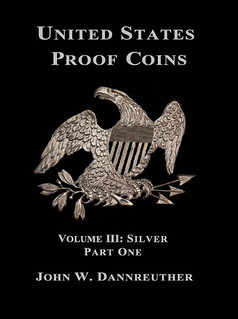

The previously published volumes of John Dannreuther's ongoing series United States Proof Coins have already established it as a landmark reference that will remain the gold standard on this topic for a generation or more. The recently published volumes on silver coins only add to its importance. While the meticulous listings of individual proof issues are what will receive the most attention (and will be consulted again and again by readers), the author's introductory chapters are of importance to anyone with the slightest interest in the history of U.S. coinage. Dannreuther's commentary on master coins and proofs would make for a very good book of its own, and he draws upon a wide variety of resources in researching the subject. Like many, I can't wait to add the copper volumes to my bookshelves!
S&S LIBRARY PEDIGREE SERVICES
E-Sylum sponsor and NBS Board Member Shanna Schmidt published this announcement in her Newsletter #243 on April 24, 2026. -Editor
 Over the past several years, the S&S Library and Newman Portal have collaborated to digitize out-of-copyright reference material for the collector community—a partnership we've valued deeply. The effort has yielded remarkable results: our own numismatic reference holdings now span over six thousand entries, encompassing everything from single publications to multi-volume sets, and the collection continues to grow.
As we've approached true virtual library status, we've recognized an opportunity to redirect our focus toward something increasingly vital to serious collecting: establishing original auction pedigrees. Services like Ex-Numis, CoinCabinet, and the newly launched L5 Provenance research have demonstrated the market appetite for this work. We occupy a singular advantage: the S&S Library houses the largest private catalog archive for ancient coin auctions, with ongoing expansion into U.S. and world coinage categories. Many of our catalogs are annotated—a feature that transforms provenance research from tedious to genuinely rewarding.
HERBERT LEWIS KREINDLER (1935-2026)
Ira Rezak and David Hendin submitted this numismatic remembrance of coin dealer and auctioneer Herbert Kreindler. Thank you. -Editor
 Herbert Lewis Kreindler, an internationally renowned
numismatist, passed away on April 25, 2026 in Burlington,
Vermont, after a short illness. He was 91 years old.
Herbert Lewis Kreindler, an internationally renowned
numismatist, passed away on April 25, 2026 in Burlington,
Vermont, after a short illness. He was 91 years old.
Born in Manhattan in 1935, but raised in Liberty, in the Catskill region of New York State, Herb graduated from Carnegie Tech in 1957 with a degree in Engineering. Employed by the Grumman Aircraft Engineering Corporation and recently married he moved to Suffolk County on Long Island, New York where he continued to live with his wife and family until shortly before his death. However, in the early 1970s, he boldly changed careers having decided to become a full-time professional numismatist specializing in ancient coins. From 1974-1983 he joined in partnership with David Hendin as proprietors of Amphora Coins after which he established a highly successful solo practice that remained active until his retirement some two years ago.
ST. LOUIS ANCIENT COIN GROUP: PROBUS PRIMER
The latest addition to the Newman Numismatic Portal is a video of a St. Louis Ancient Coin Study Group presentation. Project Coordinator Len Augsburger provided the following report. -Editor
St. Louis Ancient Coin Study Group Presentations Online
The St. Louis Ancient Coin Study Group meets monthly and features varied topics related to ancient and byzantine numismatics. At the March 19th meeting, David Grant focused on the extensive and highly varied coinage of the Roman emperor Probus (reigned AD 276–282), especially the antoniniani radiates. Grant explained how Probus inherited an empire recently reunified by Aurelian and worked to stabilize its military, economy, and administration while continuing coinage reforms. Much of the talk examines the complexity of Probus coinage: the numerous imperial mints, differing portrait styles, rare legends and titles, military and consular bust types, and the importance of modern scholarship and online databases in attributing and studying these coins. Grant emphasized that the six-year reign produced an enormous variety of coin types, making Probus one of the richest and most rewarding areas of Roman numismatics.
VIDEO: E-SYLUM, NUMISMATIC BIBLIOMANIA AND NNP
The David Lisot Video Library on the Newman Numismatic Portal can be found at:
https://nnp.wustl.edu/library/multimediadetail/522852
We highlight one of his videos each week in The E-Sylum. Here's one from 2016 with Yours Truly speaking about The E-Sylum, Numismatic Bibliomania and the launch of the Newman Numismatic Portal. Check it out. -Editor

ROBINSON AUCTION AND PHOTOGRAPHY EVOLUTION
Dealer Frank S. Robinson posted the following career retrospective, "My Coin Auction and Photography Evolution," on his blog on April 28. -Garrett
IN THE BEGINNING, all was darkness.
I started collecting coins in 1957; selling them around 1978. Not as a regular thing; just getting rid of excess stuff. But gradually it took over my life.
NOTES FROM E-SYLUM READERS: MAY 3, 2026
Dannreuther's United States Proof Coins Volume III: Silver Update
John Dannreuther writes:
"There is a wrong page in my recent silver proof book and I will send the correct one as soon as I get it from the printers.
"Missed it, as they duplicated a page (right page number but the same as another one!). I missed it, as when I approved the pages one by one, it read correctly - it was just the wrong page!
"Also, I have had requests for spiral bound copies. If you can have anyone who is interested in a spiral bound email me ( jdrc@mindspring.com), I will add them to a list when I get them printed."
Great idea! See two reviews of the book elsewhere in this issue. -Editor
To read the earlier E-Sylum article, see:
NEW BOOK: U.S. PROOF COINS VOL III: SILVER
(https://www.coinbooks.org/v28/esylum_v28n49a06.html)
THE BOOK BAZARRE
STOLEN 1709 LIMA 8 ESCUDOS RECOVERED
At the recent Central States show, coordinated efforts by five dealers and a collector led to the recovery of a 1709 Lima, Peru 8 Escudos from the 1715 Treasure Fleet. -Garrett
 Coordinated efforts by five dealers and a specialist collector at the recent Central States Numismatic Society (www.CSNS.org) convention near Chicago led to the recovery of a stolen sunken treasure gold coin and the arrests of two suspects who reportedly offered the coin for sale at the show on April 24, 2026.
The recovered coin is a 1715 Treasure Fleet 1709 Lima, Peru eight Escudos. The 1715 Treasure Fleet refers to the July 31, 1715 sinking of 11 Spanish galleons in a hurricane off the coast of Florida. The ships were sailing from the New World back to Spain, loaded with silver and gold coins and bars.
The rare gold coin recovered at the CSNS convention was part of that famous treasure and later pedigreed to the McGregor Collection. It was sold at auction in November 2025 for $40,500 (including buyer's fee) by Sedwick & Associates in Winter Park, Florida.
2026 ROCKWELL LECTURE: DR. DONALD A. SLATER
John Ferreri passed along this announcement for the next Boston-area lecture in honor of Thomas P. Rockwell. Thanks. -Editor
Thomas P. Rockwell Memorial Lecture
Tuesday, May 12, 2026 at 7:30 p.m.
Boston Numismatic Society, Currency Club of New England, and Collectors Club of Boston.
We are pleased to announce that this year's speaker is Dr. Donald A. Slater who will be speaking on Paul Revere and the Social Memory of the Pine Tree Shilling in Colonial Massachusetts. This timely topic for the nation's semiquincentennial will explore imagery from 17th century Massachusetts silver coinage and a variety of 18th century Massachusetts currency issues in an attempt to reconstruct the thinking of the local patriot and renaissance man, Paul Revere.

2026 NLG AWARDS RULES AND SUBMISSION INFO
The Numismatic Literary Guild (NLG) is a separate organization from ours, the Numismatic Bibliomania Society (NBS). But we share a love of the numismatic hobby and numismatic research and writing in particular. Here are this year's Awards Competition Rules and Submission Info, as well as the Awards Competition categories and criteria.
Founded in 1968, the NLG is a nonprofit organization open to any editors, reporters, authors, writers, catalogers, webmasters, bloggers or producers of audio or video involving all forms of money, medals, tokens and other numismatic collectibles. Information about applying for NLG membership is available online at www.NLGonline.org/membership. -Garrett
2026 NLG Awards Rules & Submission Info
Below you will find the entry information, categories and deadlines for the 2026 Numismatic Literary Guild's (NLG) annual contest for numismatic writers, bloggers, authors, editors, podcasters and other content creators who are current NLG members. With the exception of the category for "Best Numismatic News or Feature Article in a Non-Numismatic Publication," the contest is open to NLG members only.
However, if you are interested in joining the NLG, we would love to have you as a member. The membership dues are $15 per year, plus a one-time application fee of $25 in addition to the dues, for a total of $40.
2026 COIN WORLD MOST INFLUENTIAL VOTING
Coin World has opened the 2026 version of its poll helping choose the year's "100 Most Influential People in Numismatics". The resulting article will be published in September. Here's their emailed announcement. Follow the link below to cast your votes by May 30. -Editor
 Since 2021, we've polled the numismatic community to determine the Most Influential People in Numismatics.
The buzz and commotion surrounding this big issue returns again for 2026.
We're writing once again to request your opinion: who are the Most Influential People in Numismatics?
VOCABULARY TERM: SIMILAR
Here's another entry from Dick Johnson's Encyclopedia of Coin and Medal Terminology. -Editor
Similar. Nearly the same as; a cataloging term for a medallic item that is slightly different from one that is listed in a published catalog. Because medals are customized and are frequently changed from time to time, many varieties may exist. While it may be impractical to describe each separate item, and call this a variety, numismatists are willing to accept an item like one already published and call it "similar." The changes are more that a different lettering that is inscribed, say, with a recipient's name, date and such. This personalization is to be expected as an inscribed medal is bestowed to each recipient. In fact, medal designers purposely leave a space for this (called a reserve often within a cartouche) in their design.
More often the changes indicated by calling an item similar to a published one is the result of die retooling. This can be a change in a date, or the name of the organization, or the new name of an award (with new raised lettering), or a change in the organization's logo, or some pictorial element. Thus a new die is created (or, maybe, a new stock die is used) creating the new state. In numismatic cataloging, similar is abbreviated: sim. See cataloging.

JOHN ABEEL NEXSEN (1821-1909)
E-Sylum Feature Writer and American Numismatic Biographies author Pete Smith submitted this article on numismatist John Nexsen and his writings on the 1804 dollar. Thanks! -Editor
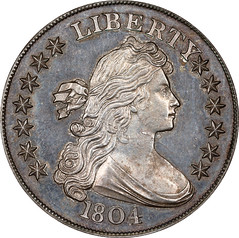 Len Augsburger sent me a note on April 4, 2026, suggesting that I add a listing for John Nexsen
to American Numismatic Biographies.
Len Augsburger sent me a note on April 4, 2026, suggesting that I add a listing for John Nexsen
to American Numismatic Biographies.
Cal Wilson was preparing to publish a list of about 250 biographies in 1988 that included Nexsen. I had not included him in ANB.
Then on Saturday, April 25, 2026, Len and Joel Orosz made an NNP Symposium presentation on The Fantastic 1894 Dollar at the Central States show. They discussed the contributions made by Nexsen to our understanding of 1804 dollars. I offer this biography of Nexsen.

NUMISMAGRAM MEDAL SELECTIONS: MAY 3, 2026
Numismagram's Jeremy Bostwick sent along these five medals from his most recent upload of new material to his site. For all of the new items, please visit https://www.numismagram.com/inventory. -Garrett

103468 | GREAT BRITAIN. Botanical & Horticultural Society silver Award Medal. Engraved and awarded in 1827 to Lieutenant Henry West, Esq. by the society based in Durham, Northumberland and Newcastle-on-Tyne (48mm, 39.47 g, 12h).
BOTANICAL AND HORTICULTURAL SOCIETY, Flora, reaching toward potted plant to left and grapevine to right, seated right in front of gazebo; decorative potted plant to outer right; gardening tools in foreground; in two lines in exergue, INSTITUTED 1824 / SOCIETY // DURHAM NORTHUMBERLAND AND NEWCASTLE ON TYNE, "PRESENTED / to / LIEUt. WEST R. N. / for the best / DISH OF CHERRIES / 18 Augt 1827" engraved in six lines in various styles of scripts; all within complex floral wreath. Edge: Loop attached at the top, otherwise plain.
BHM –. Mint State. Deep gunmetal gray toning, with some delightful iridescence nearer the edges; some scattered hairlines are noted for completeness.

STEPHEN ALBUM RARE COINS AUCTION 55
Stephen Album Rare Coins will hold its Auction 55 from May 14-17, 2026, including 4050 lots of Ancient, Islamic, Indian, Chinese, and general World Coins. -Garrett
Stephen Album Rare Coins will hold its next premier sale Auction 55 from May 14-17, 2026 at their offices in Santa Rosa, California. The auction is made up of 4050 lots of Ancient, Islamic, Indian, Chinese, and general World Coins. The first two days will include in-person bidding as well as online bidding, while the third and fourth days will be online sessions.
The firm's CEO Joseph Lang notes: "The market for numismatics remains exceptionally strong, and we are grateful for the enthusiastic participation of our consignors and bidders in our recent auctions. Our current sale presents a diverse array of items that bidders have come to expect from our firm. It has the potential to be one of our best auctions on record".
STACK'S BOWERS: LOGAN TALKS COLLECTION
Stack's Bowers will be selling the Logan Talks Collection of U.S. Currency as part of the May 14 Premier Collectors Choice Auction. Select items are discussed below. -Garrett


Fr. 60. 1917 $2 Legal Tender Note. PMG Choice Uncirculated 63 EPQ. Radar Serial Number. Already an impressive note by virtue of the grade assigned. This $2 Legal Tender Note issued under the Series of 1917 boasts another rare distinction by virtue of the eight-digit Radar Serial Number which reads "D95000059A." Eight-digit Radar serial numbers are exceptionally among notes of the period.

SINCONA: MOORE SWISS SHOOTING MEDALS
On 19 May 2026, the SINCONA auction house in Zurich will offer the first part of the Rod K. Moore Collection, featuring Swiss shooting medals and memorabilia. This field is currently experiencing a worldwide boom. What makes it so fascinating to collectors? Is it because these items bear witness to a medieval tradition that is still alive today? Written by Ursula Kampmann. -Garrett


Basel. 1844 silver medal commemorating the Swiss National Shooting Festival in Basel. Richter 87b. About Mint State. Estimate: CHF 150. From SINCONA Auction 104 (19 May 2026), No. 2037.
The shield is shattered / the sword broken in two / the banner lies in a dying hand. / Triumph! / The fatherland remains free / God bless the fatherland. This is the translation of the verses that adorn the reverse of a medal created by Antoine Bovy to mark the major federal shooting festival in Basel on 16 August 1844. The image on the obverse visualizes the legend: We can see a youthful hero lying on the ground. The broken shield slips from the dying man's hand. With what little strength he has left, he raises the banner bearing the Swiss cross.

NAC: AUCTIONS 164 AND 165
Numismatica Ars Classica will be hosting Auctions 164 and 165 on May 26. Select items are discussed below. -Garrett

C. Coelius Caldus. Denarius 51, AR 19 mm, 4 .00 g. C·COEL·CALDVS Head of C. Coelius Caldus r.; in l. field, standard inscribed HIS; in r. field, standard in the form of a boar. Rev. Tablet inscribed L·CALDVS/VII·VIR·EPVL, behind which figure prepares epulum; on either side of tablet, a trophy. In outer l. field, C. CALDVS, in outer r. field, IMP·A·X. In exergue, CALDVS·IIIVIR. Babelon Coelia 7. Sydenham 894. RBW 1551. Crawford 437/2a.
Rare and in exceptional condition, possibly the finest specimen in private hands.
Light iridescent tone, almost invisible mark on reverse field,
otherwise virtually as struck and almost Fdc
Ex NAC sale 138, 2023, 585.
THE 1635 GOLD SAXONY 10 DUCAT MEDAL
Stack's Bowers Senior Numismatist Henrik Berndt published this article on an interesting 1635 medal from the L.W. Bruun collection. -Editor

L. E. Bruun collected coins and medals from all over the world, but at his death in 1923 only the Scandinavian part of his collection was sealed by the will for 100 years. The rest were sold at auction in 1925, except for the coins of the British Danelaw, which were bequeathed to the Danish National Museum.
Within the Scandinavian collection, which Stack's Bowers Galleries has been entrusted to sell, are a few coins and medals which at first glance seem to break that rule. One is the Saxony 10 Ducat of 1635, a medallic issue struck on the marriage of the daughter of the Saxon Elector John George I (Johan Georg), Magdalene Sibylle. The Scandinavian connection lies in her betrothed, the prince elect of Denmark, Christian, son of Christian IV. This large gold medal, graded a magnificent MS-62, features interesting, historical details:
TO ROB PETER TO PAY PAUL'S OFFICE
An article by Stack's Bowers Galleries Currency Specialist & Lead Currency Cataloger Bradley Charles Trotter takes a look at the effects of bank failures and the redemption of banknotes in mid-19th-ccentury Minnesota. -Editor

The process of cataloging Obsolete bank notes, although time-consuming, can shed light on the minutiae of a state's banking history which, in many cases, was rife with failure and speculation. Minnesota has a rich history on the subject of Obsolete bank notes, discussed in detail by the Hewitt text Minnesota Obsolete Bank Notes & Scrip a must-have in my opinion for collectors who seek to build comprehensive numismatic libraries. Among the banks discussed by Hewitt, the intertwined circumstances of the Nicollet County Bank (St. Peter) and the Peoples Bank reflect the expression "to rob Peter to pay Paul" or at least Paul's office in this context.
ANOTHER SAN FRANCISCO TREASURE HUNT
Witter Coin's 2026 scavenger hunt isn't the only coin treasure quest keeping San Franciscans busy these days. This one is being staged by two men who put together a similar treasure hunt last year. Here's a New York Times excerpt - see the complete article online. -Editor
 Somewhere in San Francisco, buried one foot underground, rests a treasure chest filled with $1 coins — 10,000 of them, so many that the booty weighs 150 pounds.
In this city of exorbitant wealth, where a modest home can top $2 million, $10,000 is not life-changing. It might pay two or three months of rent. And who really wants to haul that many coins to the bank?
Nevertheless, people armed with shovels and maps fanned out across San Francisco this week determined to find the loot. In this high-tech city, the center of the artificial intelligence boom that could upend society, an old-timey adventure that required getting outside and digging in the dirt proved irresistible.
Baxter Zrob, 16, was sitting in his high school history class when his dad texted him a link to the hunt with two words: "It's on!"
CASH REGISTERS AND CHARM PRICING
I hadn't heard the term "charm pricing" before, but we all know what it is - that psychological game of never ending a price in zero. This article from The Hustle dives into the topic after an opening look at the invention of cash registers. Here's an excerpt - see the complete article online. -Editor
 Pay close attention to prices and you'll notice that hardly anything ends in a zero.
- A standard Netflix subscription costs $19.99.
- Target had an online sale on Pokemon Crocs last month for $49.99.
- A variety pack of LMNT electrolytes went for $26.91 on Amazon.
These last-digit choices likely weren't made at random. The practice of intentionally ending a price in something other than a zero is often called charm pricing.
For decades, researchers have found that retail prices ending in precise numbers, often a nine, occur way more often than chance would predict. It's one of the oldest psychological tricks in the capitalism playbook, dating back to the 19th century and enduring today.
FEATURED WEBSITE: SCRIPOTIME
This week's Featured Website is the scripophily website ScripoTime.com, recently updated to include a marketplace for collectors.
Where history meets finance.
ScripoTime is a dedicated platform for the captivating world of scripophily — the collection and preservation of historical financial certificates: stocks, bonds and rare documents. Explore, trade and expand your knowledge of these unique artifacts alongside collectors and enthusiasts from around the world.
We collect the financial documents that built the modern world.
Every railway across America. The Suez Canal. The first electric grids in Europe. Each was funded by paper certificates engraved like banknotes — and most have been forgotten. ScripoTime is where they come back to life.

https://scripotime.com/
ABOUT THIS ISSUE: MAY 3, 2026
Nothing numismatic to report this week. On Thursday I sent some articles to Garrett to work on, and on Saturday I started this week's issue. While I was at it, I started experimenting with using AI to help format some articles. There was a learning curve, but bit by bit I made some progress.
Here are some interesting non-numismatic articles I came across this week.
The dishwasher's inventor said clumsy servants inspired her idea. (https://historyfacts.com/science-industry/fact/the-dishwashers-inventor-said-clumsy-servants-inspired-her-idea/)
Battery costs have declined by 99% in the last three decades, making electrified transport a reality (https://ourworldindata.org/battery-price-decline)
California adopts new rules allowing manufacturers to test and deploy heavy-duty autonomous vehicles (https://www.reuters.com/legal/government/california-adopts-new-rules-allowing-manufacturers-test-deploy-heavy-duty-2026-04-29/)
Diners in New Jersey Are Struggling to Survive (https://www.nytimes.com/2026/05/02/nyregion/new-jersey-diners-soda-pop-act.html)
A List of Everyone Who Could Be in Trump's ‘Garden of Heroes' (https://www.nytimes.com/2026/05/02/us/politics/trump-garden-of-heroes-national-statues-list.html)
Residents of a small rural town discuss what's really ailing American politics (https://www.washingtonpost.com/nation/2026/05/02/rural-urban-divide-solution/)
-Editor


Editor Wayne Homren, Assistant Editor Garrett Ziss

|
|
| |