Visit our NBS Sponsors











About UsThe Numismatic Bibliomania Society is a non-profit association devoted to the study and enjoyment of numismatic literature. For more information please see our web site at coinbooks.org SubscriptionsThose wishing to become new E-Sylum subscribers can go to the following web page
Subscribe
MembershipThere is a membership application available on the web site Membership Application To join, print the application and return it with your check to the address printed on the application. Print/Digital membership is $40 to addresses in the U.S., and $60 elsewhere. A digital-only membership is available for $25. For those without web access, write to: Jeff Dickerson, Treasurer AsylumFor Asylum mailing address changes and other membership questions, contact Jeff at this email address: treasurer@coinbooks.org SubmissionsTo submit items for publication in The E-Sylum, write to the Editor at this address: whomren@gmail.com BUY THE BOOK BEFORE THE COINSale CalendarWatch here for updates! |
- WAYNE'S WORDS: THE E-SYLUM JUNE 28, 2026
- NEW BOOKS BY ZLATKO VISCEVIC
- THE WARSHAW FAMILY CONSIGNMENT
- VIDEO: GREEK CURRENCY DURING WWII
- JEFF GARRETT MEGA RED INTERVIEW
- 1908 BATTLE OVER BAD HALF DOLLARS
- XRF ANALYSES $5 PER SCAN!
- NOTES FROM E-SYLUM READERS: JUNE 28, 2026
- SUNDMAN LECTURES AT 2026 PITTSBURGH ANA
- EXHIBITS AT AT 2026 PITTSBURGH ANA
- C4: NUMISMATICS IN AMERICA EXHIBIT AT ANA
- PHILIPPINE FORUM AT 2026 PITTSBURGH ANA
- VOCABULARY TERM: SPONSOR
- DONALD MAXWELL MILLER (1913-1995)
- KEN BRESSETT INTERVIEW, PART FIVE
- HERITAGE: JUNE 2026 ERROR COINS SHOWCASE
- NUMISMATIC AUCTIONS SALE 70 SESSION 4
- VIKING PENNIES MADE FROM ISLAMIC DIRHAMS
- COINS OF ESPERANTO INVENTOR L. L. ZAMENHOF
- THE 2026 PITTSBURGH ANA MEDAL
- WHALING VIGNETTES
- NETHERLANDS INDIES CURRENCY
- LOOSE CHANGE: JUNE 28, 2026
- MANHATTAN BANK CHANNELS RENAISSANCE
- FEATURED WEBSITE: ELEANOR PLATT
- ABOUT THIS ISSUE: JUNE 28, 2026
Content presented in The E-Sylum is not necessarily researched or independently fact-checked, and views expressed do not necessarily represent those of the Numismatic Bibliomania Society.
WAYNE'S WORDS: THE E-SYLUM JUNE 28, 2026
 New subscribers this week include:
Ron Fry of the Missouri Numismatic Society, courtesy Jeff Starck;
Kennedy collector Chris Maes, and
Gage.
Welcome aboard! We now have 6,447 subscribers.
New subscribers this week include:
Ron Fry of the Missouri Numismatic Society, courtesy Jeff Starck;
Kennedy collector Chris Maes, and
Gage.
Welcome aboard! We now have 6,447 subscribers.
Thank you for reading The E-Sylum. If you enjoy it, please send me the email addresses of friends you think may enjoy it as well and I'll send them a subscription. Contact me at whomren@gmail.com anytime regarding your subscription, or questions, comments or suggestions about our content.
This week we open with three new books, updates from the Newman Numismatic Portal, contemporary coin counterfeiters, notes from readers, and more.
Other topics this week include Greek currency during WWII, Mega Red, events, lectures and exhibits at the 2026 Pittsburgh World's Fair of Money, Don Miller, Ken Bressett, auction previews, Viking penny silver, Esperanto, whale vignettes, and sculptor Eleanor Platt.
To learn more about Zlatko Višcevic, the coins and banknotes of Croatia, the 1792 Mint Act, XRF analyses, the Park-Bernet Galleries sale of the Treasure of the Spanish Main, Col. E.H.R. Green, Zotz!, Indian Peace Medals, a Jimmy Stewart short snorter, error coins, and the battle over bad half dollars, read on. Have a great week, everyone!
Wayne Homren
Editor, The E-Sylum

Image of the week
NEW BOOKS BY ZLATKO VISCEVIC
Author Zlatko Višcevic recently published three books: Coins of the Republic of Ragusa, Coins of the City of Split, and his new numismatic catalogue of Austro-Hungarian coins, banknotes and ducats. -Editor

Zlatko Višcevic is a Croatian numismatist, author, publisher and editor, active in numismatics for more than three decades and in phaleristics for the past ten years. He began collecting coins as a child in 1989 and has been professionally involved in numismatics since 2008.
He was born in Rijeka, Croatia, in 1982. He attended Andrija Mohorovicic High School in Rijeka and later graduated from the Faculty of Law. After completing his studies, he worked as a legal trainee and later as a legal adviser in the offshore oil industry. In 2012, he founded Monetalis LLC, a company specialized in numismatics and phaleristics, where he continues to work today. In 2017, he established Dupondius, a trade business dedicated to numismatic publishing and consulting, and in 2021 he founded Numex LLC, a company focused exclusively on the numismatic trade.
THE BOOK BAZARRE
THE WARSHAW FAMILY CONSIGNMENT
Newman Numismatic Portal Project Coordinator Len Augsburger provided this report on the results of the Heritage sale of the Warshaw Family consignment. Portions of the sale proceeds will be donated to Washington University in St. Louis, home of NNP. -Editor
National Numismatic Heritage Items Take Center Stage in Dallas
Several items from the Warshaw Family collection, sold this week by Heritage Auctions, served to highlight the upcoming Sesquicentennial. A Continental Dollar in silver, one of four known, drew $1,312,500. The same piece was sold by Heritage in 2021 at $1,140,000. Prior to the sale, two of the other pieces are traced to the Resolute Americana Collection, while the third is in the Tyrant Collection.

VIDEO: GREEK CURRENCY DURING WWII
The David Lisot Video Library on the Newman Numismatic Portal can be found at:
https://nnp.wustl.edu/library/multimediadetail/522852
We highlight one of his videos each week in The E-Sylum. Here's one from 2016 about Greek Currency During WWII. -Editor


JEFF GARRETT MEGA RED INTERVIEW
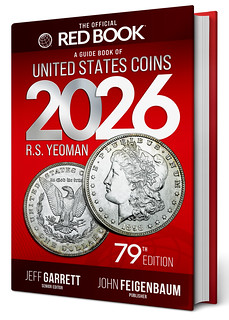
Greg Bennick's latest interview for the Newman Numismatic Portal is with the current Senior Editor of the Redbook (A Guide Book of United States Coins), Jeff Garrett. -Editor
GREG BENNICK
 Hi everybody, it's Greg Bennick, and I am here today with Jeff Garrett. Jeff, of course, is from Mid
American Rare Coin Galleries, and is the senior editor of Red Book. And if you saw the first interview I
did with Jeff, you know it was filled with information and great stories, and I wanted to be back here
today with Jeff to talk about the Red Book and the Mega Red. So, Jeff, thanks for thanks for being here
today. I really appreciate it.
Hi everybody, it's Greg Bennick, and I am here today with Jeff Garrett. Jeff, of course, is from Mid
American Rare Coin Galleries, and is the senior editor of Red Book. And if you saw the first interview I
did with Jeff, you know it was filled with information and great stories, and I wanted to be back here
today with Jeff to talk about the Red Book and the Mega Red. So, Jeff, thanks for thanks for being here
today. I really appreciate it.
JEFF GARRETT
Well, thanks, Greg. Thanks for having me. And it's always fun to talk about the Red Book. It's a big part
of my life, and I enjoy sharing it.
GREG BENNICK
I'm so glad. Well, why don't we start with, why don't you tell me how you got involved with the Red
Book? How did that first come to be?
1908 BATTLE OVER BAD HALF DOLLARS
Jim Haas writes:
"I was looking for information on my great grand uncle Joseph A. Haas. He was a Civil War veteran who fought alongside his father. The J. A. Haas in this article was not my great uncle, I know your readers will enjoy the story."
Jim stumbled across this 1908 account of a Secret Service raid on "the most perfect and largest den of counterfeiters in the history of the country," which took place in Braddock, PA, outside my hometown of Pittsburgh. The scoundrels were making counterfeit half dollars of the kind cataloged by Winston Zack in his book Bad Metal Silver. 50c to S$1 - Circulating Contemporary Counterfeit United States Coins. Thanks! Great story. It was published in the GLEN FALLS, N.Y. MORNING STAR, MARCH 16, 1908. -Editor
Secret Service Sleuths Catch
Counterfeiters at Work
Making Bad Half Dollars
After Battle at Braddock, Pa., in Which One Officer Is Stabbed, Two Men Are Locked Up — East Flooded With False Money
Pittsburg, March 15. — At the point of a gun two men were caught in the act of counterfeiting coins of the United States, and in the roundup the authorities uncovered what they say is the most perfect and largest den of counterfeiters in the history of the country. While only two of the gang of perhaps twenty coin makers were captured and only after a hard fight, fifty molds for making new counterfeit half dollars and almost 600 of the coins already boxed for shipment were captured, with several hundred dollars more ready to be boxed. Joseph A. Haas and John Fuhrman were the men caught in the act of making the coins, and they are in the jail here, having been sent up by the United States authorities after a preliminary hearing charged with counterfeiting.

XRF ANALYSES $5 PER SCAN!
Jonathan Brecher has been reaping the research benefits of a very affordable service offered by author Winston Zack. Others may want to give it a try. -Editor
 Last year's review of the third volume of the Bad Metal series has a one-line comment that the book includes XRF analyses. There's an important extra detail that I haven't seen mentioned in The E-Sylum: That book includes XRF analyses because author Winston Zack bought his own XRF machine.
XRF is a non-destructive method that can measure metallic composition without risk even for valuable objects. It's not a new technology, mentioned in E-Sylum as early as 2012. The main drawback to XRF has been the price. Commercial XRF machines have been available for more than 20 years, but the price has never fallen to the "hobbyist" level. A new machine typically costs $20,000 or more. Some people may know someone with an XRF machine who is willing to run some tests for them as a favor. I don't have that option. Commercial services may charge $150 or more per scan. As a collector of tokens and medals, I have many pieces in my collection where I wondered about their composition. I would have continued wondering, rather than pay those prices.

NOTES FROM E-SYLUM READERS: JUNE 28, 2026
More on Bill Gibbs
 Vic Mason writes:
"I was sorry to hear of the untimely passing of former Coin World editor Bill Gibbs. His love of numismatics shone through every editorial, column and reader response he wrote. I found him to be a perfectionist in his writing. What always impressed me was the importance he and other staff writers for the publication placed on the ethical dimensions of relations between coin dealers and their customers."
1967 Park-Bernet Treasures of the Spanish Main Sale
To read the earlier E-Sylum article, see:
WILLIAM TILDEN GIBBS (1954-2026)
(https://www.coinbooks.org/v29/esylum_v29n24a05.html)
Other topics this week include the 1967 Park-Bernet Treasures of the Spanish Main sale, Col. Green, and the Wisconsin jeweler who thwarted a gold con -Editor

SUNDMAN LECTURES AT 2026 PITTSBURGH ANA
The Maynard Sundman/Littleton Coin Company Lecture Series at the Pittsburgh World's Fair of Money will focus on 250 years of American numismatics, including the secrets, crises, and foreign roots behind U.S. coinage. -Garrett
For two and a half centuries, American coins have been far more than mere currency—they are tangible milestones tracking a nation's ongoing pursuit of freedom and identity. From the revolutionary symbols born in 1776 to the modern designs on today's pocket change, United States money has long mirrored the defining crises, values, and triumphs of the American experience. During the American Numismatic Association's (ANA) World's Fair of Money®, taking place August 25-29 in Pittsburgh, experts will explore how coins, medals, and tokens tell the story of the United States from 1776 to today.
The Maynard Sundman/Littleton Coin Company Lecture Series will be held at the David L. Lawrence Convention Center on Wednesday, August 26, from 10 a.m. to 4:15 p.m. This year's theme is "Striking Independence: 250 Years of American Numismatics." The speakers and their lectures include:
EXHIBITS AT AT 2026 PITTSBURGH ANA
As part of its exhibits at the 2026 World's Fair of Money, the ANA will display never-before-seen coins, sunken treasures, American history, and much more. -Garrett
Discover an extraordinary array of numismatic treasures at the American Numismatic Association's (ANA) 2026 Pittsburgh World's Fair of Money, August 25-29, 2026. The bourse floor at the David L. Lawrence Convention Center will feature an exceptional lineup of exhibits, from iconic favorites—such as the ANA Money Museum's legendary 1913 Liberty Head nickel—to specially curated displays honoring 250 years of American independence.
Examine never-before-seen rarities from the world-renowned Tyrant Collection (the world's most valuable private coin collection), explore remarkable recovered sunken treasures, follow Liberty's evolving image across U.S. coinage, and experience many additional displays designed to inspire, educate, and engage collectors and researchers.
C4: NUMISMATICS IN AMERICA EXHIBIT AT ANA
The Colonial Coin Collectors Club (C4) celebrates America's 250th anniversary with the Special Exhibition "Numismatics in America, 1752–1792: How Money, War, and Taxation Forged an American Nation." -Garrett
Discover the story of America's founding through the coins, medals, and paper money that financed a revolution, reflected political ideals, and helped forge a nation. The Colonial Coin Collectors Club (C4) invites you to experience one of the most transformative periods in American history through the remarkable numismatic treasures that circulated during the nation's birth.
Presented in conjunction with America's 250th Anniversary, this special exhibition will be on display August 25–29, 2026, during the American Numismatic Association World's Fair of Money® in Pittsburgh, Pennsylvania.

PHILIPPINE FORUM AT 2026 PITTSBURGH ANA
The Philippine Collectors Forum will meet at the 2026 ANA World's Fair of Money in Pittsburgh. The keynote speaker will be Jeff Shevlin on "Wilson Dollars," and other presenters include Dennis Tucker, The Honorable Steven M. Bieda, and more. -Garrett

Book reviews and market reports on many aspects of Philippine history and collectibles are part of the annual Forum. (Pictured: Dennis Tucker with recent publications by Eldrich Yap and Janssen Bantugan; Desiree Ann Cua Benipayo; Earl Honeycutt and Sandy Lichauco; Kenneth J.E. Berger; Q. David Bowers; and The CDN Monthly.)
The Philippine Collectors Forum will hold its annual gathering at the American Numismatic Association's summer convention (the World's Fair of Money) on Friday, August 28, 2026, in Pittsburgh. The PCF meeting is free and open to the public. Highlights include custom ANACS-slabbed commemorative coins for the first fifteen attendees, and Philippine money–related door prizes, including bronze and silver coins and Japanese Invasion currency from World War II. Educational features include a keynote lecture, market and auction reports, book reviews, and research updates from experts in the fields of Spanish and American Philippine coins, tokens, medals, and paper money.
VOCABULARY TERM: SPONSOR
Here's another entry from Dick Johnson's Encyclopedia of Coin and Medal Terminology. -Editor
Sponsor, Sponsorship. A firm, organization or individual that underwrites the expense of making and issuing a medal, or medal program, for another entity. Many scienific, medical (and some sports) medallic awards are often underwritten by profit corporations for the benefit of nonprofit organizations, often trade associations. Chevrolet was the sponsor, for example, of the College Football Centennial Medal of 1969. The American Numismatic Society was the sponsor of the New York Charter Day Medal of 1898 for the New York City Chamber of Commerce. The sponsorship of a medal – or a medal award program – is an eleemosynary or philanthropic act.
DONALD MAXWELL MILLER (1913-1995)
E-Sylum Feature Writer and American Numismatic Biographies author Pete Smith submitted this article on token collector and author Don Miller. Thanks! I've used AI to sharpen and enhance the newspaper clipping image. -Editor
I have been writing a column for the TAMS Journal. When I decided that Donald Miller was not appropriate for that column, I decided to write him up for The E-Sylum instead.
Donald M. Miller was born in Indiana, Pennsylvania, on August 1, 1913. He was the son of Lewis Earle Miller (1881-1954) and Mary Elizabeth Fleming (1881-1953). His father was an attorney.
Donald graduated from Juniata College in 1934 with his degree in commerce and finance. He went on to Dickinson School of Law and graduated in 1939. He practiced law with his father briefly until 1942.

KEN BRESSETT INTERVIEW, PART FIVE
Greg Bennick's latest interview for the Newman Numismatic Portal is with "Mr. Redbook". Ken Bressett. Here's the fifth of six parts, where Ken discusses his lifelong friendship with Eric P. Newman, including the New Hampshire copper, their research collaborations, and remarkable moments in the Newman home. -Editor
 GREG BENNICK: For sure. Okay, well switching gears a bit, can you tell me a little bit about meeting Eric Newman?
KEN BRESSETT: Because I was a Hampshire boy, I wanted to collect and to learn all about the only coin made for New Hampshire in the colonial times.
Sure enough, there was a copper coin dated 1776, with a New Hampshire origin. It is listed in the Red Book. I had to learn all I could about that. I learned every owner of those New Hampshire cents and the true history of them all. Eric Newman was one of those people. I wrote to him, and said, "I'm very much interested in the New Hampshire copper coins. I'm trying to learn all I can about them and I've discovered that you own one of them. Would you please tell me what you can about it, because I want to have photographs of all that I can find."
So, Eric wrote back to this young kid that he didn't know. And he said, "I'm sending you the coin so that you can examine it, and here's a few things that I know about it. And would you please return it to me when you're done?"

HERITAGE: JUNE 2026 ERROR COINS SHOWCASE
Heritage Auctions will be hosting their Error Coinage US Coins Showcase Auction on June 29. Select items are discussed below. -Garrett


1944 1C Lincoln Cent -- Struck on 2.9 Gm Steel Planchet -- VF35 PCGS.

NUMISMATIC AUCTIONS SALE 70 SESSION 4
Here's some more information on the Numismatic Auctions LLC Sale 70, which features ancient coinage. -Editor


Lot 865 - Ancient Greek, Lucania, Heraklea, 276-250 BC Silver Stater. 6.51g, 20mm. SNG ANS 90 (same dies); Head of Athena left, wearing a crested Corinthian helmet, "|- A" behind neck, "|-HPAK?EION" above.; Rx: Herakles standing left, holding up an uncertain object with his right hand, a lion skin over his left arm while leaning on a club. "?O[P]" to right. aXF, gunmetal blue and iridescent toning, somewhat flatly struck on the reverse. ($250-350)

VIKING PENNIES MADE FROM ISLAMIC DIRHAMS
Len Augsburger passed along this article about a new study reporting that early Viking pennies were likely made from silver obtained by melting Islamic coins. Thanks - interesting discovery. -Editor

Some of the earliest Viking "pennies" were made with silver that contained melted-down coins from the Islamic world, a new study reports. The finding confirms the relationship between early Viking and Islamic silver, which was likely the result of long-distance trade.
The silver coins make up the Damhus hoard, a trove of 226 Viking Age pennies found near the town of Ribe on Denmark's Jutland Peninsula in 2018. The trove dates to between A.D. 830 and 850, which makes the silver pieces some of the earliest Viking coins ever discovered, according to the study, which was published June 5 in the journal Archaeometry.

COINS OF ESPERANTO INVENTOR L. L. ZAMENHOF
Laurence Edwards writes:
"Thanks for the link to the Harper's article on Esperanto! I published a (shorter) piece in The Shekel, Summer 2025, on LL Zamenhof on "fantasy" coins."
Thank you! Here's an excerpt from the article. -Editor
L.L. Zamenhof is best known as the inventor of the universal language Esperanto. He was born in Bialystok, then part of the Russian Empire in 1859, one of eleven children. (Bialystok is now the tenth largest city in Poland.) He studied medicine in Moscow, Warsaw, and Vienna. He completed his medical training in 1886 and practiced ophthalmology in Warsaw.
In an article on the website of the National Yiddish Book Center, Esther Schor traces Zamenhof's intellectual journey from an attachment to Yiddish and Zionism to the universalism that led him to invent Esperanto. Esperanto was not meant to replace one's native language, but to be a universal second language that would facilitate communication and thus world peace. The Esperanto Association has chapters around the world.
THE 2026 PITTSBURGH ANA MEDAL
Jamie Franki and Heidi Wastweet collaborated on the official 2026 Pittsburgh ANA medal. Here's information from the ANA website. -Editor


The American Numismatic Association has invited celebrated medallic artists Jamie Franki and Heidi Wastweet to collaborate on designing and sculpting the official 2026 World's Fair of Money® convention medal for the annual convention in Pittsburgh, Pennsylvania. This marks the dynamic duo's third major design partnership for the ANA, following their highly successful collaborations for Philadelphia in 2018 and Oklahoma City in 2025.
This year's keepsake honors a monumental turning point in numismatic history while celebrating the industrial spirit of the "Steel City." Following the United States Mint's decision to stop striking the one-cent coin for circulation, the 2026 medal recognizes the legacy of the historic 1943 steel cent, originally struck to conserve copper for military equipment during World War II. The medal masterfully reimagines Victor David Brenner's classic cent composition to showcase quintessential landmarks of Pittsburgh.
WHALING VIGNETTES
Heritage published the following article in their latest Currency News email entitled Whaling Vignettes: An American Industry on Paper Currency by Ryan Tidwell. -Garrett
Obsolete banknotes are a growing market for Paper Money collectors for their history and interesting vignettes. Whaling scenes are among the most popular vignettes, with ten variations known to the author. Because New England, and more specifically Massachusetts, once housed a booming whaling industry from the late 17th century all the way to the 19th century, banknote engravers in America from the 1830s to the 1860s decided to feature these vignettes in their designs to build connections with the communities they served.
NETHERLANDS INDIES CURRENCY
Heritage published the following article in their latest Currency News email entitled Netherlands Indies Currency in An Age of Change by Olivia Collier. -Garrett
Netherlands Indies paper money offers more than a record of colonial finance. Across its portraits, coats of arms, multilingual inscriptions, and carefully composed figures, it traces the shifting authority, identity, and visual culture of a region shaped by commerce, empire, occupation, and revolution. From the Dutch East India Company's early foothold in Java to the final years before Indonesian independence, these notes reveal a world in transition-and the 1933-1939 De Javasche Bank series stands among its most evocative artistic expressions.

LOOSE CHANGE: JUNE 28, 2026
Here are some additional items in the media this week that may be of interest. -Editor
Jamie Franki posted on Facebook about the medal for this year's ANA World's Fair of Money in Pittsburgh. -Editor
Looks great! See the article elsewhere in this issue for more information. -Editor
MANHATTAN BANK CHANNELS RENAISSANCE
We often discuss the transformations of old Mint and bank buildings. The Beaux-Arts former Emigrant Industrial Savings Bank in Manhattan is now the setting for an immersive experience in Renaissance art. The event runs through September 13, 2026. -Editor

New York is no stranger to wild architectural transformations, but watching a landmarked 1912 bank vault morph into a glowing, floor to ceiling canvas of the Italian Renaissance is entirely next level.
Beginning June 23, the city's art scene is getting a massive upgrade when the highly anticipated Renaissance: Da Vinci, Raphael, Michelangelo exhibition officially opens its doors in Tribeca!
FEATURED WEBSITE: ELEANOR PLATT
This week's Featured Website is about sculptress Eleanor Platt, recommended by Jesse Kraft, Resolute Americana Assistant Curator of American Numismatics at the American Numismatic Society. Thank you.
Eleanor Platt was one of the foremost classical American sculptors of the 20th Century. Her works are installed in the Metropolitan Museum of Art, the National Portrait Gallery, the Hall of Great Americans at New York University, the United States Supreme Court, Harvard University, Cal Tech, and many other museums, universities, government buildings, and private collections throughout the country. Eleanor was a portraitist, sculpting busts, reliefs, and commemorative medals of many important historical figures of the 19th and 20th centuries. Her works included many prominent legal, scientific, and intellectual leaders . Throughout her prolific career she sculpted over 30 busts, 16 reliefs, and 32 medals, many of which were reproduced for museums, institutions, and private collectors. She also served in several important positions within the arts community.
Sculpting was Eleanor's primary career. In her early years she supplimented her income with other employment but eventually made a fully independent living from her art. This was especially impressive considering she graduated from art school amid the Great Depression and developed her career in an era when single women were rarely professionally self-employed. She quickly made a name for herself with her early works of Justice Learned Hand, artist John Flanagan, and artist Arthur Lee. Her career spanned almost five decades and included occasional teaching, education, travel, and lectures.
https://www.eleanorplatt.org/
ABOUT THIS ISSUE: JUNE 28, 2026
Nothing to speak of numismatically this week except for my usual efforts on The E-Sylum. Last week's issue didn't include Notes From E-Sylum Readers because an obituary and my Diary article took up a good bit of time. This issue plays catch-up with those notes and some other items that missed the cut last week. But I did order one of the 2026 Pittsburgh ANA Medals by Jamie Franki and Heidi Wastweet. For more information, see the mentions elsewhere in this issue.
In the making-connections department, I alerted a friend at the Pittsburgh History Center of an offering from Heritage of a fascinating original manuscript journal recording frontiersman Christopher Gist's account of George Washington's 1754 mission to the French Forts in the Ohio Valley near Pittsburgh (see LOT #42045).
Thoughts and wisdom from the interwebs:
- He's so dumb, I gave him a penny for his thoughts and got change back.
- Pro tip: Before spreading a loved one's ashes, check the wind direction.
Finally, here are some interesting non-numismatic articles I came across this week.
Manhattan was once ‘traded' for a tiny Indonesian island. (https://historyfacts.com/us-history/fact/manhattan-was-once-traded-for-a-tiny-indonesian-island/)
Benjamin Franklin's Presence at the Creation (https://www.nationalreview.com/2026/06/benjamin-franklins-presence-at-the-creation/)
Ode to the aeronauts (https://michigantoday.umich.edu/2026/06/26/ode-to-the-aeronauts/)
Why Do Shirts Have Collars? (https://historyfacts.com/arts-culture/article/why-do-shirts-have-collars/)
Dan Rodricks: The end approaches for one of Baltimore's oldest businesses (https://baltimorefishbowl.com/stories/dan-rodricks-the-end-approaches-for-one-of-baltimores-oldest-businesses/)
They Were Just Having a Back-to-School Party in an Apartment Rec Room. Little Did They Know They Were Creating Hip-Hop (https://www.smithsonianmag.com/arts-culture/they-were-just-having-back-school-party-apartment-rec-room-little-did-know-creating-hip-hip-180988814/)
Why Are LLMs Smart? (https://kevinkelly.substack.com/p/why-are-llms-smart)
Best Investments Over the Last 100 Years? Almost All Are Tech Companies. (https://www.nytimes.com/2026/06/26/business/apple-nvidia-tesla-spacex-stock-market-winners.html)
Scientists recorded individual neurons in bilingual brains for the first time and found that the brain does not translate words, it does something more sophisticated (https://thesciverse.org/scientists-recorded-individual-neurons-in-bilingual-brains-for-the-first-time-and-found-that-the-brain-does-not-translate-words-it-does-something-more-sophisticated/)
Futurists Don't Have Crystal Balls. They Have Mirrors (https://www.singularityweblog.com/futurist-keynote-speaker/)
-Editor


Editor Wayne Homren, Assistant Editor Garrett Ziss

|
|
| |