Visit our NBS Sponsors










About UsThe Numismatic Bibliomania Society is a non-profit association devoted to the study and enjoyment of numismatic literature. For more information please see our web site at coinbooks.org SubscriptionsThose wishing to become new E-Sylum subscribers can go to the following web page
Subscribe
MembershipThere is a membership application available on the web site Membership Application To join, print the application and return it with your check to the address printed on the application. Print/Digital membership is $40 to addresses in the U.S., and $60 elsewhere. A digital-only membership is available for $25. For those without web access, write to: Jeff Dickerson, Treasurer AsylumFor Asylum mailing address changes and other membership questions, contact Jeff at this email address: treasurer@coinbooks.org SubmissionsTo submit items for publication in The E-Sylum, write to the Editor at this address: whomren@gmail.com BUY THE BOOK BEFORE THE COIN |
- WAYNE'S WORDS: THE E-SYLUM OCTOBER 4, 2026
- WORKMAN'S BOOKS SALE 9
- NEW BOOK: RESTRIKES+NOVODELS+PATTERNS
- NEW BOOK: HADRIAN - COINAGE AND IMPERIAL POLICY
- NEW BOOK: NEWFOUNDLAND NUMISMATICS
- NEW BOOK: PAPER MONEY IN IMPERIAL CHINA
- NEWMAN PORTAL ADDS STEIGERWALT MONGRAPHS
- VIDEO: ELONGATED COINS
- ANS TO BEGIN TOLEDO HEADQUARTERS RENOVATIONS
- LECTURE: HOW THE CIVIL WAR CHANGED OUR MONEY
- JOHN ALBANESE FUNDS NUMISMATIC ORGANIZATIONS
- NOTES FROM E-SYLUM READERS: OCTOBER 4, 2026
- JOHN A. BOLEN'S NUT CARVINGS
- U.S. MINT ARTIST CHRIS POLENTZ
- KEVIN LIPTON OPENS BEVERLY HILLS GALLERY
- VOCABULARY TERM: STUDY COPY
- DAVID RANDOLF DENIS (1923-2026)
- NUMISMAGRAM MEDAL SELECTIONS: OCTOBER 4, 2026
- HERITAGE: U.S. ERROR COINAGE SHOWCASE
- HERITAGE: NEW DISCOVERY COINS IN GACC SALE
- STACK'S BOWERS: CAINE COLLECTION OF OBSOLETES
- GADOURY: AUCTION XXI ROMAN AUREI
- WAYNE'S NUMISMATIC DIARY: 2026 ANA, PART 5
- WAYNE'S NUMISMATIC DIARY: 2026 ANA, PART 6
- THE ODYSSEY ON ANCIENT COINS
- 1715 FLEET SOCIETY: ODDLY SHAPED MEXICAN COBS
- 1835 NORWAY HALF SPECIEDALER STAR TYPE
- HERITAGE: SPANISH CIVIL WAR CURRENCY
- ABOUT THIS ISSUE: OCTOBER 4, 2026
Content presented in The E-Sylum is not necessarily researched or independently fact-checked, and views expressed do not necessarily represent those of the Numismatic Bibliomania Society.
WAYNE'S WORDS: THE E-SYLUM OCTOBER 4, 2026
 New subscribers this week include:
Carmen D.V. and Tom Eden.
Welcome aboard! We now have 6,342 subscribers.
New subscribers this week include:
Carmen D.V. and Tom Eden.
Welcome aboard! We now have 6,342 subscribers.
Thank you for reading The E-Sylum. If you enjoy it, please send me the email addresses of friends you think may enjoy it as well and I'll send them a subscription. Contact me at whomren@gmail.com anytime regarding your subscription, or questions, comments or suggestions about our content.
We have a new sponsor this week - CAC Grading. Thank you for your support! When you're out at coin shows or shopping online and encounter one of our advertisers, please thank them for supporting our weekly effort - we wouldn't be able to deliver our publication at this scale and frequency without their assistance.
This week we open with a numismatic literature sale, four new books, updates from the Newman Numismatic Portal, notes from readers, and more.
Topics this week include U.S. Mint restrikes, novodels and patterns, coins of Hadrian, tokens of Newfoundland, paper money in China, Charles Steigerwalt, elongated coins, the future ANS Toledo headquarters, Civil War numismatics, fixed price and auction previews, more ANA diaries, and Spanish Civil War currency.
To learn more about gold cobs in the State of Florida Collection, Artistic Infusion Program artist Chris Polentz, the oldest ANA member, the Treaty of Travendal medal, error coins, Roman Aurei, Jack's dive bar, oddly shaped Mexican silver reales, and John Bolen's nut carvings, read on. Have a great week, everyone!
Wayne Homren
Editor, The E-Sylum


Image of the week
WORKMAN'S BOOKS SALE 9
Alan Workman has a numismatic literature sale closing November 1, 2026. Here's the announcement. -Editor

Workman's Books is pleased to present its ninth sale, featuring a substantial and carefully curated selection of literary material and related media focused on Spanish and Spanish American, Mexican, United States, Canadian, British, Ancient, and World numismatics, as well as banks and banking history, diving, undersea exploration and salvage, buried and sunken treasure, metal detecting, treasure hunting, underwater archaeology, privateers, buccaneers and piracy. The auction includes a number of rare and desirable works bearing author signatures or inscriptions, with notable names such as David Q Bowers, Capt. Michael Hatcher, Robert Marx, Roland Morris, Russell Rulau, Edward Rowe Snow and David Stick represented. This single-session sale will begin closing at 10:00 AM EST on November 1, 2026, and will offer 850 lots, including rare, vintage, and out-of-print books, post-auction sale catalogs, magazines and journals, postcards, and vintage media formats such as VHS tapes and DVDs.

NEW BOOK: RESTRIKES+NOVODELS+PATTERNS
Researcher Roger Burdette has produced another important work on American numismatic history based on widely scattered and rarely seen original source materials held by the National Archives and Records Administration. Congratulations! -Editor
 Restrikes+Novodels+Patterns is a research summary designed to convey to future
numismatists and historians the present state of knowledge as determined from original research
by the author. It is intended to open a path toward meaningful, objective analysis largely free of
baseless speculation, assumption and exaggeration commonly associated with this subject.
Restrikes+Novodels+Patterns is a research summary designed to convey to future
numismatists and historians the present state of knowledge as determined from original research
by the author. It is intended to open a path toward meaningful, objective analysis largely free of
baseless speculation, assumption and exaggeration commonly associated with this subject.
Herein, the reader will find no collection of moldy anecdotes; no auction lot descriptions concocted to extract exaggerated bids; no cynical whispered insinuations of "midnight minting" conspiracies. The origins of some of these "traditional anecdotes" will, however, become evident to readers. Rather, the author places documented facts within their historical context, and relates them to Philadelphia Mint operations of the same era. It is a study of the subject by motivation, action and results. This book is, then, a dissection of the restriking of American coins and pattern pieces; a revelation of American numismatic intent, purpose; carelessness, generosity, foolishness and preservation contributing to the construction of a more-or-less complete entity which others may explore, expand, and correct.
NEW BOOK: HADRIAN - COINAGE AND IMPERIAL POLICY
In their October 2026 News from the ANS, the American Numismatic Society announced the publication of the two-volume 764 page hardback book Hadrian - Coinage and Imperial Policy by Martin Beckmann, which is now available for pre-order. Here's the book's description. -Editor
Hadrian
Coinage and Imperial Policy
By Martin Beckmann
 Historians have long sought to understand Hadrian's policies, his priorities, and his approach to his imperial role, but the evidence is elusive. The sparse literary sources, written well after his time, are often unreliable, and epigraphy and archaeology, which are based on fragmentary objects, tend to focus on local audiences. Hadrian's coinage, on the other hand, is of the highest authority: it is available in great bulk, it offers both written and visual evidence, and it was directed at an empire-wide audience. Unfortunately, it also tends to lack the imperial titles that often make imperial coinage easy to date.
Hadrian: Coinage and Imperial Policy addresses the difficulty from a new direction by systematically applying the methodology of die analysis, which previously had been used only in isolated cases. Focusing on coins produced in the name of Hadrian and his relatives at the central mint in Rome, the author uses die analysis to help recreate the sequence of the mint's coin production, which clarifies the interrelationship of the different coin types and allows us to clearly identify the complete iconographic repertoire of the coinage at specific points in time.

NEW BOOK: NEWFOUNDLAND NUMISMATICS
Chris Faulkner and three other Canadian researchers have produced a new book of essays on Newfoundland numismatics, drawing on upon new primary source materials and making original contributions to Newfoundland numismatics. Here's the book's Preface.
It's a SPINK imprint, but the press is Pen & Sword, which took over Spink Books. It's 286 pages and Chris notes it is also available from Sveto Kovacevic at Ancient Numismatic Enterprise, 2219 Queen St. E, Toronto, Canada M4E 1EB Email: ane@vcoins.com. Tel: 416 686-8019. -Editor
Newfoundland Numismatics
A Collection of Essays
by Christopher Faulkner, David Bergeron, Paul Berry, and Markus Molenda
Six essays on Newfoundland numismatics trace late eighteenth to late nineteenth-century coins, tokens, and paper scrip.
 The essays collected in this volume came together when it was determined that four of us were independently working on some of the mysteries of the numismatics of Newfoundland across a hundred year period between the late eighteenth and late nineteenth centuries. The research represented by the six essays collected here should be considered groundbreaking because it introduces some completely new monetary issues for Newfoundland and unpacks the mysteries surrounding others.
Heralded in 1905 as an important numismatic discovery related to Canada and later demonized as an utter fraud, Spanish American dollars countermarked GR 5 ORD have known a chequered past. Paul Berry's "The Ordnance Dollars of Newfoundland" identifies the parties responsible for their production, proposes where and when they were distributed, and reveals the dollars' surprising connection to Britain's oldest colony in Canada. It catalogues known examples in their many varieties and using numismatic and non-numismatic references, collection databases, and digital sales records traces their appearance over the last hundred plus years among some of the hobby's most prominent dealers and collectors.


NEW BOOK: PAPER MONEY IN IMPERIAL CHINA
A new book by Richard von Glahn titled "The Rise and Demise of Paper Money in Imperial China" has been published by Cambridge University Press. Here's an article from the Hoover Institution. Found via Helen Wang on the Chinese Money Matters blog. -Editor
This essay is based on the forthcoming book "The Rise and Demise of Paper Money in Imperial China, 1000–1500: Fiscal Innovation, Market Growth, and Monetary Transitions" by Richard von Glahn.
 Over the past two decades, the issue of the "Great Divergence" in economic performance between Europe, where the Industrial Revolution occurred, and China, where it did not, has been a leading subject of debate and research among economics historians. One undisputed finding is that China achieved remarkable economic growth, by premodern standards, by relying on a different set of political and economic institutions from those that emerged in medieval and early modern Europe. A key feature of the Chinese economy was its distinctive monetary system, including the early development of fiat currency in the form of paper bills.

NEWMAN PORTAL ADDS STEIGERWALT MONGRAPHS
The latest additions to the Newman Numismatic Portal are monographs about dealer Charles Steigerwalt. Project Coordinator Len Augsburger provided the following report. -Editor
 Stump for Steigerwalt
Recently added to Newman Portal are two monographs of the 19th century Lancaster, PA dealer Charles Steigerwalt, compiled by Carl Waltz. These two volumes gather primary sources related to Steigerwalt and are conveniently arranged in chronological order. Waltz has searched far and wide for biographical material and the content here ranges from Steigerwalt's ephemeral publications to newspaper clips to contemporary correspondence. Volume 1 covers the year 1858-1907, while Volume 2 covers 1907 to 2022. Waltz has exhibited frequently on this topic and now shares this material with the numismatic community via Newman Portal.
NNP search hint: Search for "Steigerwalt monograph" from the NNP home page.

VIDEO: ELONGATED COINS
The David Lisot Video Library on the Newman Numismatic Portal can be found at:
https://nnp.wustl.edu/library/multimediadetail/522852
We highlight one of his videos each week in The E-Sylum. Here's one from 2016 with Richard Jozefiak speaking about elongated coins. -Editor

Richard Jozefiak speaks at the 2016 ANA World's Fair of Money in Anaheim, CA.
 >
>
ANS TO BEGIN TOLEDO HEADQUARTERS RENOVATIONS
The American Numismatic Society will hold a ceremony on October 5 to mark the start of renovations of their new Toledo headquarters. -Garrett

The American Numismatic Society (ANS) will hold a groundbreaking ceremony Oct. 5 to mark the start of renovations to the Professional Arts Building in Toledo, Ohio, which will become the Society's new museum and headquarters. The ANS plans to relocate from New York City to the renovated building in 2028.
Joining ANS Director Ute Wartenberg Kagan for the 12:00 PM groundbreaking will be Toledo Mayor Wade Kapszukiewicz, U.S. Rep. Marcy Kaptur, TMA Director Adam M. Levine, SSOE Group COO Vince DiPofi, and Roncelli Inc. COO Jereme Poxson.
The move to Toledo will allow the ANS to open a Money Museum with space for rotating exhibitions, expand K-12 and adult educational programming, grow its acclaimed research library, and build partnerships with local institutions.

LECTURE: HOW THE CIVIL WAR CHANGED OUR MONEY
Rick Lank and Rebecca Rush will be presenting a lecture at Shepherd University on October 14, 2026. Readers are invited to attend in-person or on Zoom. Here's the announcement. I'm looking forward to it - the Civil War Era was a time of rapid and long-lasting changes in our money, a favorite numismatic topic of mine. -Editor

How the Civil War Changed our Money
and How Money Changed the War
When: October 14, 2026, 1-2:30 p.m.
Host: SPARK Lecture Series, Shepherd University, Shepherdstown, WV.
(Attend in-person or via ZOOM, $15)

JOHN ALBANESE FUNDS NUMISMATIC ORGANIZATIONS
John Albanese will provide funding to non-profit numismatic organizations via a new initiative called the CACG Charity Label. Here is the press release. -Garrett
 Nonprofit numismatic organizations, from small local clubs to national groups, now have an opportunity to receive monetary donations through a new CAC Grading (www.CACGrading.com) fundraising initiative called the CACG Charity Label.
CACG Founder and CEO John Albanese is signing 20,000 specially created encapsulation insert labels that were offered in a private auction among CACG's authorized modern bulk submission clients. The auction brought a six-figure winning bid, and all the proceeds will be donated in various amounts to non-profit numismatic organizations and charities.
NOTES FROM E-SYLUM READERS: OCTOBER 4, 2026
Another 1958-D Wheat Cent Find
Ken Berger writes:
"I think I can match Jim Haas' story about his finding a 1958-D wheat cent.
 "Every spring & summer gophers invade my yard & dig up the dirt creating mounds of dirt & rocks. This summer, as I was leveling the mounds & removing the rocks, I found a 1958-D wheat cent. The real interesting part, however, is that 1958 was the year my house was built &, since I live in San Diego, the D mint mark is appropriate.. I guess it was a gift from the gopher. Unfortunately, the one I found was not shiny like Jim's."
The wildlife around our house leaves us presents all the time, but sadly, no coins. -Editor
To read the earlier E-Sylum article, see:
NOTES FROM E-SYLUM READERS: SEPTEMBER 27, 2026 : Shiny Penny Find
(https://www.coinbooks.org/v29/esylum_v29n39a10.html)
Other topics this week include Audio Books, the Unabomber, and Columbian Expo material. -Editor

JOHN A. BOLEN'S NUT CARVINGS
 Website visitor Cindy Adler writes:
"I have a carving that I would like to find out about and I am hoping you might be able to help me or put me in the right direction. The overall size is 4 inches."


U.S. MINT ARTIST CHRIS POLENTZ
I enjoy finding articles in local publications about the artists and sculptors who design our coins. The San Diego Tribune published one about Artistic Infusion Program artist Chris Polentz. Here's an excerpt - see the complete article online. -Editor

U.S. Mint Artist Chris Polentz
A San Marcos-based artist and teacher who designs coins for the U.S. Mint took top honors at the recent American Numismatic Association's World's Fair of Money, which drew hundreds of submissions from around the world.
Chris Polentz was named a Coin of the Year champion for his American Liberty High Relief Gold Coin, which was about a year and a half in the making and was minted last year.

KEVIN LIPTON OPENS BEVERLY HILLS GALLERY
Kevin Lipton announced that he is opening a new rare coins, fine art & antiques gallery in Beverly Hills. Here is the press release. -Garrett
Lipton Coins, Fine Art & Antiques (www.LCFAA.com), a new gallery specializing in expert assistance to rare coin and paper money collectors and investors in Southern California and nationwide, has opened at 9478 W. Olympic Blvd. in Beverly Hills, California.
Current displays of rare numismatic items for sale at the new store include a selection of pre-1800 U.S. gold coins, a large array of rare, early $100 denomination notes, and a unique uncut sheet of currency from the Indian Territory.

VOCABULARY TERM: STUDY COPY
Here's another entry from Dick Johnson's Encyclopedia of Coin and Medal Terminology. -Editor
Study Copy. Usually a plaster cast of a numismatic or medallic item intended for artistic or scholarly study. Museums sometimes provide this service – to supplement or in place of a photograph – for someone at a distance to study the three-dimensionality of a specimen in their collection. Such study copies are impermanent (the plaster may easily break), however, large cabinets of these have been formed. Their use beyond the original need for close-up study and comparison with similar specimens is extremely limited. Study copies are a form of private copies and are most often of one side only, thus two separate casts are required of a two-sided object. They have little resale value, but do make excellent objects for framing. See copies and replicas, plaster casting.
DAVID RANDOLF DENIS (1923-2026)
E-Sylum Feature Writer and American Numismatic Biographies author Pete Smith submitted this article on another 100-year-old numismatist. Thanks! -Editor
David Randolf Denis (1923-2026)
This week I got an email from Bob Leonard notifying me of the death of David R. Denis. He was the oldest ANA member and the one with the longest membership.
David R. Denis was born in Chicago on January 17, 1923, the son of Alphonse Derbigny Denis (1891-1982) and Elvira Vognild (1890-1979). Alphonse was an insurance salesman.

NUMISMAGRAM MEDAL SELECTIONS: OCTOBER 4, 2026
Numismagram's Jeremy Bostwick sent along these four medals from his most recent upload of new material to his site. For all of the new items, please visit https://www.numismagram.com/inventory. -Garrett

103634 | SWEDEN, DENMARK & GERMANY. Treaty of Travendal silver Medal. Issued 1700 for the peace treaty that returned Holstein-Gottorp to its duke (37mm, 18.18 g, 12h). Likely by Johann Reinhard Engelhardt in Breslau.
ORIENTES DISSIPAT UMBRAS (while rising, it breaks through the clouds), radiant sun [the sun as a symbol for Karl XII of Sweden] above clouds from which rain descends upon a view of the globe focused upon Northern Europe // SEPTEM IVNGIS TRINVNE TRIONES (Thou, oh Triune Lord, unitest the Northern Constellations), in center, radiant ???? (tetragrammaton); to right, the constellation of Ursa Major, represented by a large bear, moving upward; to left, the constellation of Ursa Minor, represented by a small bear, moving downward; both figures show the various stars of the two constellations in their proper places; in two lines in exergue, PAX SEPTENT / CI?I?CC (the Northern Peace of 1700). Edge: + PAX, PAX, TIBI ET PAX ADIVTORIBVS TVIS. I. PARAL. 13 v. 18 (peace, peace be unto you, and peace unto your helpers, –adapted from I Chronicles 12:18).
Pax in Nummis 396; Hildebrand I, p. 498, 36; Delzanno 52; Erbstein 4393; van Loon IV, p. 306; "Stars and Constellations on Coins" in AJN (Oct. 1892), p. 31, 4. Choice Very Fine. More darkly toned nearer the edges, with some scattered marks noted throughout; typical die flaw near 9h on the obverse. A rare and engaging type featuring two constellations.
Signed in Travdendal in the duchy of Holstein-Gottorp in 1700, the peace established there returned the realm to its rightful duke, Friedrich IV, who was an ally of Karl XII, the king of Sweden. Holstein-Gottorp lies at the base and lower tier of the Jutland Peninsula, and was besieged by the Danes in early 1700. Given alliances through marriage, Sweden was an ally of Holstein-Gottorp, and was able to negotiate a peace and a return of the duchy to its duke. Sweden's attention then turned to Russia, with whom she would battle for naval supremacy, ultimately unsuccessfully, over the next two decades. Interestingly, while Sweden and Holstein-Gottorp were allied at this time, it is that very duchy that would produce a future Russian emperor in the form of Pyotr (Peter) III (born Karl Peter Ulrich von Schleswig-Holstein-Gottorp, a grandson to the aforementioned a Friedrich IV).
THE BOOK BAZARRE
HERITAGE: U.S. ERROR COINAGE SHOWCASE
Heritage Auctions will be hosting their U.S. Error Coinage Showcase Auction on October 5. Select items are discussed below. -Garrett


1918 1C Lincoln Cent -- Double Struck, 2nd Strike 40% Off Center -- VG10 PCGS.(Registry values: N1)

HERITAGE: NEW DISCOVERY COINS IN GACC SALE
Heritage Auctions will be hosting the GACC Signature Sale on October 8-9. Here are two important newly discovered coins -Garrett


1867-S Half Eagle, MS63 PCGS.
1867-S Half Eagle, MS63 PCGS. This recently discovered and certified 1867-S half eagle is the new finest known example of the date by a margin of two full grade points. It is also the finer of just two pieces reported in Mint State. Overall, fewer than 100 1867-S half eagles are believed to exist across all grades.
STACK'S BOWERS: CAINE COLLECTION OF OBSOLETES
Stack's Bowers will be selling The Caine Collection of Obsolete Bank Notes on October 15. Select items are discussed below. -Garrett

Cahawba, Alabama. State of Alabama. Comptroller's Warrant. 1821 $20. PCGS Currency Very Fine 35 Apparent. Cross-Cut Cancelled; Missing Upper Right Corner Tip; Small Edge Tear at Top. No. 3753. Plate A. From the earliest days of Alabama Statehood, this rather unassuming piece was authorized by the State Legislature via the Act of December 15, 1820 and was used to facilitate state payments and the payment of state taxes and other uses. This individual piece was made payable to one Samuel Dale who was among one of the state's earliest settlers and informally known as the "Daniel Boone of Alabama." Dale had previously served under the command of General (later President) Andrew Jackson during sporadic conflicts with the Creek from 1813 to 1814 and later served as a member of the Alabama General Assembly from 1817 to 1829 making this piece contemporary to his service in that position. A rather subtle cancellation is nonetheless evident and noted upon the encapsulation, a trait that hints at the circumstances that led to the unlikely preservation of this piece of history from what was once an untamed frontier along the surveyed boundaries of a young and expanding nation. PCGS Currency comments "Cross-Cut Cancelled; Missing UR Corner Tip; Small Edge Tear at Top."

GADOURY: AUCTION XXI ROMAN AUREI
Gadoury will be hosting their Auction XXI Roman Aurei Selections on October 17. Select items are discussed below. Lot descriptions have been machine-translated to English; see the complete original descriptions online. -Garrett

Titus 79-81 Aureus, 75, Rome, AU 7.35 g. Obverse: T CAESAR IMP VESPASIAN. His laureate head to right. Reverse: PONTIF TR P COS IIII. Victory standing left on an altar between two snakes, holding a palm and a wreath. Ref: Cal. 750, Cohen 163, BMC 173. Ex Vinchon, 09/12/1997, lot 41. Ex Triton, 01/12/1998, lot 855. Grading: NGC Choice XF 5/5, 4/5. Condition: Superb, broad flan and an attractive coin.
WAYNE'S NUMISMATIC DIARY: 2026 ANA, PART 5
This segment discusses my time after the Pittsburgh ANA on Saturday, August 29. The morning began with the wonderful annual breakfast meeting of the Rittenhouse Society. It's always a pleasure to gather with numismatic scholars to catch up on their recent work and personal lives, and learn about upcoming projects.
 I went back to my hotel to check out, but I wasn't leaving Pittsburgh. I was staying until Sunday for the Celebration of Life for my old friend Pat McBride. My hotel wouldn't extend my stay a day without extracting a $400-$600 ransom (the price was different every time I asked). So I made a reservation elsewhere.
Having Saturday afternoon available gave me an opportunity to revisit my old stomping grounds. After driving through all the new housing development in the city's Strip District, I stopped for lunch at Taipei, a favorite Chinese restaurant in Fox Chapel. I had a nice meal and snapped this photo on the way out.
WAYNE'S NUMISMATIC DIARY: 2026 ANA, PART 6
This final segment discuses my time after the Pittsburgh ANA on Sunday, August 30. See other articles this week and next on the convention exhibits.
South Side Stroll
After walking a few blocks to a bagel shop for breakfast, I went back to my room to work a bit on The E-Sylum and pack up my things again. I drove across the river and took a long stroll along Carson Street in Pittsburgh's South Side Flats neighborhood.

South Side Market House
I kept going until I reached 12th street, also known as Bedford Square. I always enjoyed this little corner of the city, where vintage buildings surround the old South Side Market House (today it's a community center). The street had recently been transformed into a movie set for a biography of Milton Hershey, founder of the Hershey candy company/
THE ODYSSEY ON ANCIENT COINS
Mike Markowitz wrote an article in CoinWeek on The Odyssey on Ancient Coins. -Garrett
Christopher Nolan's The Odyssey has brought Homer's ancient world back into popular culture. Yet for coin collectors, Odysseus, Homer, Scylla, the Sirens, and even the hero's faithful dog have never completely disappeared.
They Survive in Metal
The legendary events surrounding the Trojan War belong to the Late Bronze Age. Ancient tradition usually placed the war in the 12th or 13th century BCE. Coinage, however, did not emerge in western Asia Minor until the seventh century BCE. Therefore, centuries separate the supposed age of Odysseus from the first coins.
1715 FLEET SOCIETY: ODDLY SHAPED MEXICAN COBS
The 1715 Fleet Society's October 2026 Treasure of the Month is a pair of oddly shaped Mexican silver cobs, -Editor

Our Treasure of the Month for October are two silver reales from the 1715 Fleet that illustrate bizarre shapes found among coins produced in the Spanish Colonial mint located in Mexico City. Collectors of these coins are familiar with these unusual shapes. The question is: how did they get this way? Was this deliberate? Was it a planned attempt to create a special figure? Actually, it was not either. It was not deliberate or overt. Rather, it was accidental. But how could this be? What is the explanation?
1835 NORWAY HALF SPECIEDALER STAR TYPE
An article by Stack's Bowers Senior Numismatist Henrik Berndt highlights an interesting coin from the L.. E. Bruun Collection -Editor
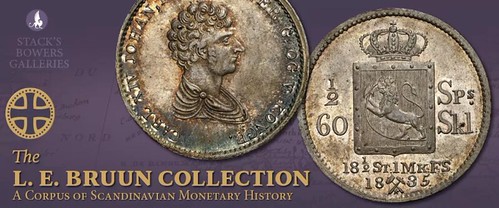
Choosing a coin from the L. E. Bruun Collection to promote should be an easy task; there are so many unique and spectacular pieces in the collection that could easily be chosen. But the overwhelming number of showstoppers can make choosing difficult.
Selecting items to highlight for the October 27-28 Bruun V auction is no exception: the catalog is simply crammed with spectacular coins and medals, some not offered in a public sale for centuries. I must, however, choose, so here I focus on the ‘star' 1835 Norwegian Half Speciedaler.
An exceptionally rare issue, it is believed the star added to the mintmark on the reverse signified that the coin was minted under the auspices of Caspar Hermann Langberg. He was not yet officially the mintmaster but was substituting for Johann Michael Kruse, who had fallen ill. Langberg is believed to have added the star to distinguish his 1835 coinage from Kruse's.
HERITAGE: SPANISH CIVIL WAR CURRENCY
Heritage published the following article in their latest Currency News email entitled Spanish Currency and La Dama de Elche by Olivia Collier. -Garrett
The coup d'état which sparked the Spanish Civil War in July 1936 was followed by widespread violence between the Republicans and Nationalists. By 1938, Spain was two years into a civil war that had completely split the country. By the height of the conflict, the opposing Nationalists and Republicans both produced paper money in the territories they controlled.


Barcelona, the capital of autonomous Catalonia, had already shown a strong pro-Republican sentiment since the restoration of the monarchy in 1874, and was under Republican control in 1938. Fearing for the security of Madrid, the government of the Second Spanish Republic relocated its financial administration to Barcelona, and the Banco de España designed banknotes with Barcelona as the issuing branch by way of an additional precaution.
ABOUT THIS ISSUE: OCTOBER 4, 2026
Not much numismatically this week other than my normal E-Sylum correspondence and editing. Payments with cash and coins went smoothly this week. While having a salad at Chic-fil-a, a young staff member asked about the newspaper I was reading (Wall Street Journal). He told me that when his family came here from Morocco they carried along a newspaper printed in Arabic. "I have it on my bedroom wall!"
I didn't get a chance to tell him that a high school friend back in Pittsburgh was born in Morocco, too. When he had to fill out paperwork calling for his place of birth, he'd put down "Casablana, Morocco" and the teachers would tell him to quit clowning around and put down his real birthplace. But he wasn't clowning - his parents were on a cruise and were docked in Casablanca when his mother gave birth.
Anyhoo, here are some interesting non-numismatic articles I came across this week, with topics all over the map, as usual.
8 Playful Facts About the Game Monopoly (https://interestingfacts.com/monopoly-facts/)
Surprising Facts About Every U.S. President (https://historyfacts.com/famous-figures/article/surprising-facts-us-presidents/)
10 TV Shows Everyone Watched in 1970 (https://historyfacts.com/arts-culture/article/popular-tv-shows-in-1970/)
The frightening economics of haunted houses (https://thehustle.co/the-frightening-economics-of-haunted-houses)
Last call? Not for this 103-year-old bartender. (https://www.washingtonpost.com/dc-md-va/2026/10/04/103-worlds-oldest-bartender-isnt-turning-off-lights-yet/)
The Blaquier-Arrieta Collection (https://www.sothebys.com/en/digital-catalogues/legendary-the-blaquier-arrieta-collection)
How Jimmy Stewart in It's a Wonderful Life Embodies the Best of America (https://lithub.com/how-jimmy-stewart-in-its-a-wonderful-life-embodies-the-best-of-america/)
Why barcodes are about to go extinct (https://thehustle.co/originals/why-barcodes-are-about-to-go-extinct)
So You Think You Could Be An Electrician? (https://asteriskmag.com/issues/15/so-you-think-you-could-be-an-electrician)
A letter to our kids: It's your time (https://www.axios.com/2026/09/26/ai-jim-vandehei-young-people-letter-future)
-Editor

Editor Wayne Homren, Assistant Editor Garrett Ziss

|
|
| |