Visit our NBS Sponsors










About UsThe Numismatic Bibliomania Society is a non-profit association devoted to the study and enjoyment of numismatic literature. For more information please see our web site at coinbooks.org SubscriptionsThose wishing to become new E-Sylum subscribers can go to the following web page
Subscribe
MembershipThere is a membership application available on the web site Membership Application To join, print the application and return it with your check to the address printed on the application. Print/Digital membership is $40 to addresses in the U.S., and $60 elsewhere. A digital-only membership is available for $25. For those without web access, write to: Jeff Dickerson, Treasurer AsylumFor Asylum mailing address changes and other membership questions, contact Jeff at this email address: treasurer@coinbooks.org SubmissionsTo submit items for publication in The E-Sylum, write to the Editor at this address: whomren@gmail.com BUY THE BOOK BEFORE THE COIN |
- WAYNE'S WORDS: THE E-SYLUM OCTOBER 11, 2026
- NEW BOOK: STEEL CENTS TO BELGIAN FRANCS
- PERIODICAL: ORIENTAL NUMISMATIC SOCIETY AUTUMN 2026
- THE EDWARD WORTH LIBRARY EXHIBITION
- NUMISTA ADDS FORRER'S BIOGRAPHICAL DICTIONARY
- NEWMAN PORTAL MIGRATION UPDATE
- VIDEO: WOMEN MEDALLIC SCULPTORS
- ANA HONORS DEISHER AND FIVAZ
- DEISHER ELECTED TO ACEF BOARD
- HOW THE SMITHSONIAN IS USING AI
- NOTES FROM E-SYLUM READERS: OCTOBER 11, 2026
- MORE ON THE ANA'S FEDERAL CHARTER
- WHY WWII JEFFERSON NICKELS LAMINATE
- VOCABULARY TERM: STYLE AND TECHNIQUE
- FRANCIS WENDELL DUVALL
- NUMISMATIC AUTHOR M. SORENSON/SORENSEN
- HERITAGE: BYZANTINE ANCIENT COINS
- NOONANS: SPECIMEN BANKNOTES OF THE WORLD
- GADOURY: AUCTION XXI FRENCH GOLD ROYALES
- SEDWICK AUCTION 40
- HOLABIRD JACK HADDOCK NEVADA TOKENS, PART 1
- COIN OF KING ETHELRED THE UNREADY FOUND
- RARE COIN OF OLAF THE HOLY IDENTIFIED
- KING HAROLD II'S BAYEUX TAPESTRY DEPICTION
- 15TH CENTURY MOSCOW COIN HOARD FOUND
- MORE ON THE BUFFALO BILL CENTER PEACE MEDALS
- WWII PRISONER OF WAR AND OTHER MEDALS
- TRUMP AWARDS 2026 NATIONAL MEDALS
- THE QUANTUM COIN
- LOOSE CHANGE: OCTOBER 11, 2026
- FEATURED WEBSITE: ÆTHELMEARC MONEYERS GUILD
- ABOUT THIS ISSUE: OCTOBER 11, 2026
Content presented in The E-Sylum is not necessarily researched or independently fact-checked, and views expressed do not necessarily represent those of the Numismatic Bibliomania Society.
WAYNE'S WORDS: THE E-SYLUM OCTOBER 11, 2026
 New subscribers this week include:
Carol Hartman, courtesy Richard Lobel;
Patrick Wall, courtesy Roger Burdette; and
Bob Black.
Welcome aboard! We now have 6,336 subscribers.
New subscribers this week include:
Carol Hartman, courtesy Richard Lobel;
Patrick Wall, courtesy Roger Burdette; and
Bob Black.
Welcome aboard! We now have 6,336 subscribers.
Thank you for reading The E-Sylum. If you enjoy it, please send me the email addresses of friends you think may enjoy it as well and I'll send them a subscription. Contact me at whomren@gmail.com anytime regarding your subscription, or questions, comments or suggestions about our content.
This week we open with one new book, a periodical, an online numismatic literature exhibit, updates from the Newman Numismatic Portal, ANA, ACEF, and more.
Other topics this week include WWII Belgian steel francs and Jefferson nickels, the Oriental Numismatic Society, the Edward Worth library, Beth Deisher, Bill Fivaz, the ANA's Federal Charter, auction previews, coin finds, prisoner of war medals, and the National Medals of Science and Technology.
To learn more about numismatic references from the sixteenth, seventeenth and early eighteenth centuries, Forrer's Biographical Dictionary of Medallists, Women Medallic Sculptors in America, William Ashbrook, Frank Duvall, Style and Technique, specimen banknotes, Nevada tokens, the Quantum coin, ferrotypes in Tagua nuts, Ethelred the Unready, Olaf the Holy, "Brenner foot" and "Menconi mouth", read on. Have a great week, everyone!
Wayne Homren
Editor, The E-Sylum

Image of the week
NEW BOOK: STEEL CENTS TO BELGIAN FRANCS
Roger Burdette alerted me to a new book about the production of Belgian Francs at the Philadelphia Mint during WWII. Thanks! -Editor
 From Steel Cents to Belgian Francs: A Collector's Investigation into the 1944 Belgian 2 Franc
by Patrick E Wall
Why was a Belgian coin struck in Philadelphia during World War II?
From Steel Cents to Belgian Francs explores the story of the 1944 Belgian 2 Franc, a coin produced by the United States Mint while Belgium remained under German occupation. Drawing on archival records, historical correspondence, and a study of surviving specimens, this book traces the events that brought Belgian coinage to Philadelphia and examines one of the lesser-known numismatic stories of the Second World War.
PERIODICAL: ORIENTAL NUMISMATIC SOCIETY AUTUMN 2026
The Autumn 2026 issue of the Journal of the Oriental Numismatic Society has been published. -Garrett
 Journal of the Oriental Numismatic Society
265 | Autumn 2026
Editorial
Paula Turner
Record of a coin inscribed with the name Sarimitra from Gandhigram village in Akola, Maharashtra, India
S. D. Misar
Travellers' tales: Implications of a treasure-trove hoard of silver Indo-Sasanian Bhillamala drammas (‘gadhaiyas')
John Deyell
Coins of Sa?karavarman and Gopalavarman: Early rulers of the Utpala dynasty of medieval Kashmir
Gul Rahim Khan

THE EDWARD WORTH LIBRARY EXHIBITION
The Edward Worth Library is a rare books collection at Dr Steevens' Hospital in Dublin, Ireland. Many important numismatic references from the sixteenth, seventeenth and early eighteenth centuries are highlighted in a new online exhibition. -Garrett

The Edward Worth Library is a rare books collection, bequeathed to Dr Steevens' Hospital, Dublin, by Dr Edward Worth (1676–1733), who was one of the Hospital's earliest Trustees. This web exhibition celebrates Worth's extensive collection of numismatic texts and was curated by Dr Elizabethanne Boran, the Librarian of the Edward Worth Library, and Mr David S. Dunlop, Independent Researcher, Bookbinder and Member of the Numismatic Society of Ireland – Northern Branch; with photographic contributions from Mr Antoine Mac Gaoithín (Worth Library staff). It is the twentieth in a series of websites exploring the holdings of the Worth Library. For further details please contact our website: https://edwardworthlibrary.ie/.

NUMISTA ADDS FORRER'S BIOGRAPHICAL DICTIONARY
Dzmitry Huletski passed along this notice of a new resource on the Numista website: Leonard Forrer's Biographical Dictionary of Medallists. Thank you. -Editor
 Leonard Forrer's Biographical Dictionary of Medallists, covering engravers, mint masters and gem-cutters from 500 BC to 1900, remains a fundamental reference in numismatic research. Compiled between 1902 and 1930, it preserves biographical information and historical evidence that might otherwise have been lost.
Numista has digitised the complete work and made it accessible through a dedicated search engine, enabling researchers and collectors to explore its extensive contents more efficiently. The structured data also improves accessibility for modern AI-powered search tools.

NEWMAN PORTAL MIGRATION UPDATE
Newman Numismatic Portal Project Coordinator Len Augsburger provided the following report on its migration to a new technology platform. -Editor

Newman Portal Migration Update
The new Newman Portal is now live and we appreciate the user feedback submitted over the last couple weeks. We resolve some issues quickly while others are more complex. The new site has additional capabilities, one of which I will highlight here. There has been demand to search within auction catalogs of a specific firm, and this is now possible. Taking the Chapman's, for example, I can ask NNP for to search within their catalogs for specific text. Navigating to the Chapman's home page (from the front page, Library -> Auction Catalogs -> Chapman, S.H. & H.), we then enter a search phrase in the "Search Chapman, S.H. & H." box to the right. In this case we'll enter "Libertas Americana" (include the quote marks to search for the entire phrase) and this will pull up a list of Libertas Americana medals appearing in the Chapman sales.

VIDEO: WOMEN MEDALLIC SCULPTORS
The David Lisot Video Library on the Newman Numismatic Portal can be found at:
https://nnp.wustl.edu/library/multimediadetail/522852
We highlight one of his videos each week in The E-Sylum. Here's one from 2016 about Women Medallic Sculptors in America. -Editor


ANA HONORS DEISHER AND FIVAZ
The ANA honored numismatic legends at the Pittsburgh World's Fair of Money. Here is the press release. -Garrett
Two long-time collectors were celebrated during the Pittsburgh World's Fair of Money®, August 25-29, at the David L. Lawrence Convention Center in Pittsburgh, Pennsylvania. Their contributions to the numismatic community have made waves over the years, earning them recognition during the 135th Anniversary Banquet on Friday, August 28.
 The Elvira Clain-Stefanelli Memorial Award for Achievement in Numismatics is presented annually to a woman who has made significant contributions to numismatics through her research, leadership, and/or mentorship, and who has demonstrated a longtime commitment to the betterment of numismatics. This year's recipient is Beth Deisher.
Serving in several editorial roles at Coin World from 1981 to 2012, Deisher has advocated for the hobby and numismatic education. She was the founding editor of several subsidiary publications for Coin World, and she has received more than 200 awards from the Numismatic Literary Guild for her writing and editorial work. She testified before five Congressional committees on numismatic issues, and she served on two commissions to recommend designs for Ohio's state quarter and bicentennial medal.

DEISHER ELECTED TO ACEF BOARD
In related news, Beth Deisher is back working with the Anti-Counterfeiting Educational Foundation. Here's the press release. -Editor
Beth Deisher has been elected to serve as a board member of the Anti-Counterfeiting
Educational Foundation effective Sept. 15. She succeeds Mary Sauvain, who moved
from board member to ACEF Executive Director Aug. 1. Sauvain was elected to the
board in January 2024.
The ACEF Board of Directors welcomes Beth in her new capacity. She stepped down from her role as executive director Aug. 1 to allow more time to pursue other interests. "Her past experience operating within ACEF will be a tremendous asset to our organization and the numismatic community as a whole," ACEF Barry Stuppler said.

HOW THE SMITHSONIAN IS USING AI
I don't believe this effort has come to the National Numismatic Collection yet, but this article discusses how Artificial Intelligence (AI) is helping the Smithsonian discover connections between artifacts from the American Revolution. -Editor
 The distance in the march from the American Revolution to the age of artificial intelligence is almost beyond comprehension. But leaders of the Smithsonian Institution are using AI to bridge the divide.
As the United States celebrates its 250th anniversary of independence, Smithsonian leaders are turning to AI to better understand items in its collection tied to the fight that led to the country's founding.
The goal is to allow the public and scholars to both search the institution's collection and draw connections across the Smithsonian and other organizations, such as the Library of Congress, to gain a deeper sense of how communities formed and functioned at the nation's birth.

NOTES FROM E-SYLUM READERS: OCTOBER 11, 2026
Wikipedia Editing Assistance Complete
Joe Ceravone writes:
 "Just want to send out a huge thank you to the person that made the Wikipedia changes for me on Dorothy Cox. I really appreciate it as she is now getting some proper recognition as a resident of my home town, Cheshire, CT."
Whoever you are out there, thanks! And thanks to all the volunteer Wikipedia contributors and editors out there for dotting the i's and crossing those t's to keep the details accurate. -Editor
To read the Wikipedia entry, see:
https://en.wikipedia.org/wiki/Dorothy_Cox_(archaeologist)
To read the earlier E-Sylum articles, see:
DOROTHY HANNAH COX (1892-1977)
(https://www.coinbooks.org/v29/esylum_v29n25a11.html)
NOTES FROM E-SYLUM READERS: SEPTEMBER 27, 2026 : Wikipedia Editing Assistance Sought
(https://www.coinbooks.org/v29/esylum_v29n39a10.html)
Other topics this week include "Read Aloud" features, Haym Salomon, and Ferrotypes in Tagua Nuts. -Editor

MORE ON THE ANA'S FEDERAL CHARTER
Jeff Reichenberger submitted this interesting how-the-sausage-gets-made view into how the American Numismatic Association obtained its Federal Charter. Thanks! -Editor
 In 2007 I published a monograph concerning the ANA's Federal Charter and its congressional sponsor, William Ashbrook. (Charter Legacy, Numismatic Chronicle from the Diaries of William A. Ashbrook, 1905-1920). Ashbrook was an avid coin enthusiast and board member of the ANA at the time. He kept a daily
diary from which I extracted all the numismatic entries as the subject of the monograph.
In 2007 I published a monograph concerning the ANA's Federal Charter and its congressional sponsor, William Ashbrook. (Charter Legacy, Numismatic Chronicle from the Diaries of William A. Ashbrook, 1905-1920). Ashbrook was an avid coin enthusiast and board member of the ANA at the time. He kept a daily
diary from which I extracted all the numismatic entries as the subject of the monograph.
Fast forward to the present; I received correspondence from a gentleman who is a collector of political memorabilia from a county in Ohio that Ashbrook represented. He caught wind of the monograph and was interested in obtaining a copy, which I happily sent him.

WHY WWII JEFFERSON NICKELS LAMINATE
John Lorenzo writes:
 "I think non-error collectors may also be interested in this article I recently published in Mint Error News Issue # 97 on why WWII Jefferson Nickels laminate.
"Also on the Newman Portal. Readers can enter SEM/EDS in SEARCH in the Portal to see my other research papers.
"People are requested to contact me if they feel this "COMBINED" dual method analysis (XRF & SEM/EDS) can help them in their numismatic inquires.
"Here is the link: https://minterrornews.com/issue97.pdf. The article starts on page 144."
Thanks. A couple weeks back we published an analysis of the Roper New England sixpence which also involved XRF and SEM analysis. The article is very detailed, but here's the abstract. -Editor

VOCABULARY TERM: STYLE AND TECHNIQUE
Here's another entry from Dick Johnson's Encyclopedia of Coin and Medal Terminology. -Editor
Style and Technique. The manner and method of presenting a creative object. Style is the manner in which the object or any part of it is displayed, often done repeatedly on several objects until this becomes a mannerism of the artist. Technique is the method in which some creative action is accomplished. Such style and techniques are very personal, each artist must develop his own; he cannot have another artist hold his pen or brush or chisel or modeling tool, he must create on his own, develop his (or her) own style.
Mannerisms Influence Style
Artists often develop mannerisms – consciously or unconsciously – for any creative act that is repeated. This is evident in the numismatic and medallic field because of the ease of studying numerous pieces by the same artist. A medalist who prepares several dozen portraits, for example, will tend to do some portion of all portraits alike; an aspect of his design or modeling that is satisfactory to him on one portrait will be repeated on subsequent portraits. This is how a mannerism develops, and the repeated use of such mannerisms is said to be the artist's style.

FRANCIS WENDELL DUVALL
E-Sylum Feature Writer and American Numismatic Biographies author Pete Smith submitted this article on Society for U. S. Commemorative Coins founder Frank Duvall. Thank you - interesting subject. -Editor
 Two weeks ago, I noticed that Frank Duvall was born in July of 1926. I wondered if he was the
most recent numiscentenarian. This is a story with some big gaps. To learn more, read on.
Two weeks ago, I noticed that Frank Duvall was born in July of 1926. I wondered if he was the
most recent numiscentenarian. This is a story with some big gaps. To learn more, read on.
I believe Frank W. DuVall was born in Arkansas on July 16, 1926. I believe he graduated from Benton High School. His parents may have been Frank and Irma. Some early records are unreliable. This is the first gap in the story.
Frank was an aviation cadet in the U. S. Army near the end of World War II. He attended the University of Arkansas during 1946 to 1949 and received a B. S. in electrical engineering.

NUMISMATIC AUTHOR M. SORENSON/SORENSEN
Adrián González-Salinas submitted this article on his search for information about a numismatic author. Thank you! -Editor
Identifying a Numismatic Author
A few months ago, I wrote a numismatic article about the Connecticutian Howard Lincoln Elton (1871–1916) who participated in the design of the 1916 Oaxaca $60 pesos gold coin and was executed by Mexican federal troops in Oaxaca, Mexico during the Mexican Revolution.
One of the numismatic references I used was the article "The Oaxaca Coinage of 1915" by M. Sorenson, published in "The Numismatist" in April 1920 (pages 142–145).


HERITAGE: BYZANTINE ANCIENT COINS
Heritage Auctions will be hosting their Byzantine Ancient Coins Showcase Auction on October 12. Select items are discussed below. -Garrett


Phocas (AD 602-610). AV solidus (20mm, 4.50 gm, 7h). NGC MS 5/5 - 4/5. Constantinople, 10th officina, ca. AD 607-610. d N FOCAS-P?RP AVG, draped, cuirassed bust of Phocas facing, wearing crown surmounted by cross, globus cruciger in right hand / VICTORIA-AV?? I, Angel standing facing, grounded staff surmounted by staurogram in right hand, globus cruciger in outstretched left; CONOB in exergue. Sear 620.

NOONANS: SPECIMEN BANKNOTES OF THE WORLD
Noonan's is selling a collection of world specimen banknotes to raise funds for the British Heart Foundation. Here's the press release. Nice notes! -Editor

Lot 24 - Board of Commissioners of Currency Malaya and British Borneo
Almost 160 lots of Specimen Banknotes of the World will be sold on behalf of British Heart Foundation (BHF) at Noonans on Wednesday, October 14, 2026. The collection, which was donated in albums to the BHF store in Edinburgh is expected to fetch in the region of £70,000.
Allison Swaine-Hughes, Chief Commercial Officer at British Heart Foundation, said: "We're hugely grateful to the donor for entrusting this extraordinary collection to British Heart Foundation. While donations of this scale and rarity are unusual, many people choose to donate special items to us knowing they can help make a lasting difference. Through our retail operation and eBay site, our teams are able to connect collectable treasures with passionate collectors who will cherish them for years to come. We're hugely grateful to Noonan's for their support with this particularly rare donation and ensuring the proceeds go towards lifesaving research. "This remarkable collection will help create a legacy that benefits both collectors and the millions of people affected by cardiovascular disease."
GADOURY: AUCTION XXI FRENCH GOLD ROYALES
Gadoury will be hosting their Auction XXI French Gold Royales Selections on October 17. Select items are discussed below. Lot descriptions have been machine-translated to English; see the complete original descriptions online. -Garrett

Henry VI, King of France and England 1422-1453 Angelot d'or for Rouen (initial mark leopard), AU 2.35 g. Obverse: The archangel Gabriel half-length facing, holding the joined shields of France and France-England. Reverse: Plain Latin cross flanked by a fleur-de-lis and a leopard. Ref: Dup. 444, Fr. 300. Ex Silberstein Collection. Grading: PCGS MS 61. Condition: An exceptional coin.
SEDWICK AUCTION 40
Sedwick's Treasure, World Coin and Paper Money Auction 40 is now online. Here is the press release. -Garrett
Our November 5 and 6 sessions will be held on the floor, with live bidding beginning at 9:00 a.m., followed by an online only session on November 7, www.auction.sedwickcoins.com. The sale brings together important rarities and substantial specialized offerings, including superb Chilean gold and silver, an extensive selection of Colombian coinage, and rare banknotes from both countries.
More than 500 shipwreck coins include selections from the J. M. Morse III Collection, whose Atocha artifacts also feature in the sale. Historic gold and silver bars and the Special Collection of Odd Shaped Mexican Cobs add further interest, while several unique coins and numerous examples at the highest certified grades appear throughout the catalog. Many coins also carry important pedigrees from earlier sales and the collections of well known numismatists, with provenance recorded in several sections of the auction.


HOLABIRD JACK HADDOCK NEVADA TOKENS, PART 1
While Fred Holabird has retired and closed his auction business, he left the door open some special private sales from time to time. One of those will take place November 6, 2026 when Holabird offers the Nevada Town token collection of Jack Haddock. The sale announcement is far more than just that - Fred delves into the history of Nevada token collecting, research and rarity as well as new digging and detecting techniques and advanced digital research platforms. It's lengthy and quite useful. Here's the first of four parts. -Editor

Jack started collecting tokens before he could count his toes. I met him in 1976 when I was enthralled by embossed local drugstore bottles. The concept that these could come from remote Nevada ghost towns was one I couldn't get away from. Then the fact that as a mining geologist, I got to go all over Nevada to many of these sites … and get paid for it! Wow! Then Jack says "Wait a minute! There's tokens that go with these places!" I was hooked. Oh yeah – that was fifty years ago.
Jack worked for the First National Bank of Nevada, and he too got to get out and about a bit, as he got involved with bank real estate deals. A jovial character, he found and met many collectors across Nevada, and introduced me to many. I wasn't after tokens at first, but what really got me going later was after a number of years in the mining exploration business, I had been to so many of these crazy, nutty little mining camps that I just had to collect stuff rom them. Paper, tokens, bottles … it didn't matter. Bring it on!

COIN OF KING ETHELRED THE UNREADY FOUND
Jim Haas passed along this one about a coin of King Ethelred the Unready unearthed in the Shetland Islands. Thanks. Weirdly, the article does not include an image of the side of the coin depicting Ethelred. -Editor

Archaeologists in Scotland recently uncovered an Anglo-Saxon coin dating back 1,000 years that was minted under a king known as "the Unready."
The coin was unearthed during an excavation in Nesting, a coastal community in Scotland's eastern Shetland Islands, according to Jam Press.
THE BOOK BAZARRE
RARE COIN OF OLAF THE HOLY IDENTIFIED
A rare coin of Olaf the Holy has been found in the Mørstad Hoard. -Editor

Anne Skogsfjord had initially classified the coin as an English Æthelred II coin.
Since the summer, she has catalogued hundreds of coins from the Mørstad Hoard – Norway's largest coin hoard from the Viking Age, which was discovered by two metal detectorists this spring.
But then she read what was written on it: ONLAF R+ NORMANORV.
"Could I really be holding an Olaf Haraldsson coin in my hands? And it turned out that I actually was!" Skogsfjord says in a press release from the Museum of Cultural History.
KING HAROLD II'S BAYEUX TAPESTRY DEPICTION
Arthur Shippee passed along this British Museum video about King Harold II and one of the most famous years in English history. The Museum is hoping to acquire a coin hoard "discovered in Yorkshire, England, that shows Harold in a different light." -Editor
 You may know King Harold II for one thing: losing the Battle of Hastings in 1066. But is this Harold's whole story?
In 2023 a remarkable coin hoard was discovered in Yorkshire, England, that shows Harold in a different light.
This is the first recorded hoard of coins which can definitely be dated to the year 1066. Containing only coins struck during Harold's brief reign of 282 days, the hoard reveals a king whose authority was recognised across England, and whose government could produce new coins with great speed.

15TH CENTURY MOSCOW COIN HOARD FOUND
Paul Horner passed along this article about a 15th century coin hoard found near Moscow. Thanks. -Editor
 A hoard of over 2,600 silver coins were found during rescue excavations in Kolomna, the Russian Academy of Sciences' Institute of Archaeology announced in a statement late last week, marking it the the largest hoard of silver coins minted in the second and third decades of the 15th century ever found.
Many of the coins are dengi of the Grand Princes Vasily I Dmitriyevich (1389-1425) and Vasily II Vasilyevich "the Blind" (1425-1462), while there is a near-complete absence of coins minted by appanage princes.
MORE ON THE BUFFALO BILL CENTER PEACE MEDALS
This Cowboy State Daily article highlights the Indian peace medals in the Buffalo Bill Center of the West collection that we recently discussed. Thanks to Tim Coil for passing this along. -Editor

Two rare Jefferson peace medals that have been part of the Buffalo Bill Center of the West collection for decades have been confirmed as authentic artifacts from the 1804 Lewis and Clark expedition.
One is a large Thomas Jefferson "shell" medal — a hollow medal assembled from silver outer pieces. It is one of only three of that size carried by the Corps of Discovery from 1804 to 1806. The other is a 2-inch Jefferson shell medal, one of 16 of that size carried by the expedition.
Historical research suggests the large medal might be the one presented to a Mandan chief known as Black Cat during an October 1804 council. The smaller medal could be linked to Cameahwait — Sacagawea's brother — a Shoshone leader the expedition met in 1805.

WWII PRISONER OF WAR AND OTHER MEDALS
Jim Haas submitted this memorable story of two WWII B-24 Bomber crewmembers and a fellow prisoner of war. Every medal has a story behind it. Thanks for this one. -Editor
My friendship with WWII veteran Edwin E. Kamaraininen began in February 2005 when I was doing research on another airman, Herman Bauer, whose roots were in in my hometown, College Point, NY. He was Navigator on the Dorty Treek, a B-24 Bomber shot down on November 26, 1944 over Misburg Germany near Hannover.

Ed Kamaraininen's B-24 Bomber the Dorty Treek

Ed Kamaraininen - top row middle
TRUMP AWARDS 2026 NATIONAL MEDALS
This week President Trump awarded the National Medals of Science and Technology. -Editor
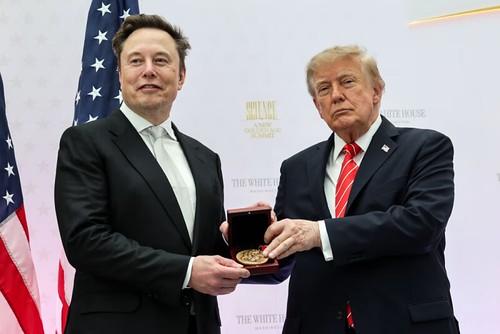
Musk receives the National Medal of Science from Trump
President Donald Trump joined some of America's most powerful tech leaders Thursday at a summit the White House billed as the start of a "golden age" of American science.
Elon Musk, Google co-founder Sergey Brin, Nvidia CEO Jensen Huang, AMD CEO Lisa Su, Microsoft CEO Satya Nadella and Dell founder Michael Dell gathered with Trump and a host of administration officials and scientific luminaries for the Science: A New Golden Age Summit at the U.S. Institute of Peace.
THE QUANTUM COIN
Jason Burton has produced the eighth work in ongoing series of struck art medals exploring ideas from science, mathematics, philosophy and the natural world. -Editor
Jason writes:
"The Quantum Coin brings together two complementary ideas in quantum physics. One side is inspired by Hugh Everett III's Many-Worlds Interpretation, using a branching tree to represent possible realities. The other draws from Richard Feynman's work on quantum pathways and computation, using a circuit structure to represent possible computational paths.
"The medals are struck one at a time from solid metals using antique coin presses in the United States.
"I thought the project might be of interest to E-Sylum readers as a contemporary example of using the medallic form to explore scientific ideas."

LOOSE CHANGE: OCTOBER 11, 2026
Here are some additional items in the media this week that may be of interest. -Editor
In this week's Red Book Podcast, Jeff Garrett and Jeff Shevlin discuss So-Called Dollars. See the earlier article linked below for Jeff's latest book on the topic. -Editor
So-Called Dollars are historically important medals, generally about the size of a silver dollar, that commemorate events in American history. But as Jeff Shevlin explains, these aren't simply ordinary medals—they can feature incredible artwork, famous engravers, fascinating historical stories, extreme rarity, and surprisingly affordable prices.
The conversation covers everything from Augustus Saint-Gaudens and George Morgan to the Erie Canal, World's Fairs, the Columbian Exposition, Fort Sumter, and the Wilson Dollar.
One incredible example is the 1826 gold Erie Canal medal. Only a handful were struck, with just two known in private collections according to the interview, and examples have sold for tens of thousands of dollars—and as much as $200,000.
To read the complete Greysheet article, see:
Red Book Podcast: Rare & Undervalued? Yes! The So-Called Dollars Most Collectors Miss! [Video]
(https://www.greysheet.com/news/story/red-book-podcast-rare-undervalued-yes-the-so-called-dollars-most-collectors-miss-video)
To read the earlier E-Sylum article, see:
NEW BOOK: INSPIRATIONS: SO-CALLED DOLLARS
(https://www.coinbooks.org/v29/esylum_v29n35a03.html)
Other topics this week include the ANS Toledo groundbreaking, old Fji banknotes, and an estate sale find. -Editor
FEATURED WEBSITE: ÆTHELMEARC MONEYERS GUILD
This week's Featured Website is the Æthelmearc Moneyers Guild. I missed their club table at the Pittsburgh ANA and learned about them from Clifford Mishler's Summer Numismatic Travels column in the October 20, 2026 Numismatic News.
The goal of the Æthelmearc Moneyers Guild is to provide a forum for medieval recreationists who have an interest in numismatics and medieval coins. It is our task to provide the monarchs of Æthelmearc with official coins for Their use during Their reign (in whatever manner They see fit). We strive to create replicas that are similar in appearance to actual medieval coins from a specific time and place. We also strive to make recreated medieval currency ubiquitous in the Sylvan Kingdom, and to include as many gentles as possible in the process of coinmaking. In accordance with modern law, we do not create exact replicas of ancient coins.

https://coins.aethelmearc.org/
ABOUT THIS ISSUE: OCTOBER 11, 2026
Here's another penny rounding situation I ran into on Monday. I stopped at our pharmacy to pick up a couple prescriptions. I'd forgotten to bring along any change and proffered a $20 bill. They rounded my change down from 47 cents to 45 - two dimes and a quarter, no pennies. I would have complained, but I'd already given them my two cents worth.

The quarter was a beat-up bicentennial, still bouncing around 50 years later. I'm still waiting to see a semiquincentennial coin in circulation.
Tuesday morning I participated in a Zoom meeting with the Newman Numismatic Portal, and in the afternoon I met with our financial consultant. It was a beautiful fall day, so afterwards I took a stroll around the plaza. Fall was in the air and on display everywhere. I took a photo of this colorful scene.

Autumn in Ashburn
On the way back to my car I passed a male grooming storefront. I'd never heard of this place, but "Hammer and Nails" offers not just a haircut and shave, but manly versions of manicures, pedicures, face & scalp treatments, even eyebrow, ear and nose waxing, whatever that is. Did I mention that beer and wine are included? This was not my Dad's barbershop from the old neighborhood in Pittsburgh. The sign said "Walk-ins accepted". So I walked in and asked, "WTF is this place?" And no, you pervs, I didn't ask about Happy Endings. This is an upscale place.
They tried to sell me on the manly mani-pedi, but I have no fingernails to speak of and was just curious to try a pedicure and get my nasty toenails trimmed. They give first-timers an upgrade, so I got the Signature Pedicure with a "warm soak, nail care, massage, callus resurfacing, sugar scrub, paraffin, and hot towel treatments." Now my feet are smooth as a baby's bottom and I feel like a million bucks. An impressive amount of work went into all that and I was very happy to get it done. It wasn't cheap, but with the upgrade I got my money's worth even though I turned down the booze before learning it was included.
My podiatrist says I've got healthy feet and the pedicurist concurred - she said they were in good shape. So basically, now I'm Homer Simpson with the feet of Adonis. Where are those nice sandals I bought three vacations ago?
I have a PayPal account and sometimes our advertisers use that to pay their invoices. This week I got an email from PayPal saying "Good news! We noticed that you've maintained a consistent sales history and developed great relationships with your customers. That's why we're giving you instant access to $160,400.00 USD in sales per month." Maybe we should raise our prices...
I preordered a medal for the 2026 Pittsburgh ANA and it arrived this week. Very nice. I'll bring it to my Nummis Nova dinner this month.
Part 6 of my ANA Diary last week highlighted my Saturday lodging at Pittsburgh's Mansions on Fifth. This week I found more information about the building in a Facebook post (or did that post find me? You never know how these things work anymore). "Built in 1906–1907 for attorney Willis F. McCook, his wife Mary, and their ten children, the McCook House is one of the great survivors of Pittsburgh's Fifth Avenue "Millionaires' Row." Learn more and check out the photo gallery here:
https://www.facebook.com/groups/pittsburghphotos/
permalink/1411237440503597/
To read the earlier E-Sylum article, see:
WAYNE'S NUMISMATIC DIARY: 2026 ANA, PART 5
.
Found online:
- I do not want to turn on notifications. Stop asking.
- I miss the days when spelling potato wrong was career-ending for politicians.
And here are some non-numismatic articles I came across this week. The first has interesting history of the peanut butter and jelly sandwich, my choice this past Thursday while waiting around for a repairman to show up.
How PB&J Became America's Favorite Lunch (https://historyfacts.com/us-history/article/how-peanut-butter-and-jelly-became-popular/)
The Oldest Soda Shop in St. Louis (https://opensince.substack.com/p/the-oldest-soda-shop-in-st-louis)
1 big thing: Tiny hobby boom (https://www.axios.com/newsletters/axios-finish-line-fcd261d5-f3f0-4070-aa5a-5afbd9ca9e62.html)
This Photo Is an A.I. Fake. Can You Tell? (https://www.nytimes.com/interactive/2026/10/08/technology/ai-generated-image-look-close.html)
The ghetto on the lagoon (https://aeon.co/essays/the-making-of-the-ghetto-on-a-venetian-island-in-1516)
Manhattan's evolution over centuries captured via meticulous animation (https://aeon.co/videos/manhattans-evolution-over-centuries-captured-via-meticulous-animation)
The Start-Up That Wants to Build ‘Microrobots' With A.I. (https://www.nytimes.com/2026/10/07/science/atomic-machines-ai-micro-robots.html)
Why Did Old Airplanes Have Black Noses? (https://historyfacts.com/science-industry/article/why-did-airplanes-have-black-noses/)
Margaret Hamilton, Who Developed Software for First Moon Landing, Dies at 90 (https://www.wsj.com/science/space-astronomy/margaret-hamilton-who-developed-software-for-first-moon-landing-dies-at-90-07b982a1?st=z6FkYJ)
Club Med, a Disney Cruise and an Exploding Starship: SpaceX Used Bystander Videos to Track Falling Debris (https://www.propublica.org/article/spacex-starship-caribbean-explosion-report)
-Editor

Editor Wayne Homren, Assistant Editor Garrett Ziss

|
|
| |