Visit our NBS Sponsors










About UsThe Numismatic Bibliomania Society is a non-profit association devoted to the study and enjoyment of numismatic literature. For more information please see our web site at coinbooks.org SubscriptionsThose wishing to become new E-Sylum subscribers can go to the following web page
Subscribe
MembershipThere is a membership application available on the web site Membership Application To join, print the application and return it with your check to the address printed on the application. Print/Digital membership is $40 to addresses in the U.S., and $60 elsewhere. A digital-only membership is available for $25. For those without web access, write to: Jeff Dickerson, Treasurer AsylumFor Asylum mailing address changes and other membership questions, contact Jeff at this email address: treasurer@coinbooks.org SubmissionsTo submit items for publication in The E-Sylum, write to the Editor at this address: whomren@gmail.com BUY THE BOOK BEFORE THE COINSale CalendarWatch here for updates! |
- WAYNE'S WORDS: THE E-SYLUM NOVEMBER 8, 2026
- NBS PUBLICATIONS COMMITTEE UPDATE
- LANG NUMISMATIC LITERATURE AUCTION 14
- NEW BOOK: THE CONTINENTAL DOLLAR
- HOWARD ALYN MINNERS (1931-2026)
- STEPHEN K. SCHER (1934-2026)
- NORMAND PEPIN (1961-2026)
- NNP ADDS TERRITORIAL GOLD COIN DATABASE
- VIDEO: NUMISMATIC PORTRAITS OF CLEOPATRA
- VIDEO: WHAT WAS IN LINCOLN'S POCKETS?
- MORE ON THE 'GW' PEACE MEDAL
- THE SECOND GW PEACE MEDAL
- COMMENTS ON FLOWLINES
- MORE ON MINT AND FEDERAL RESERVE BAGS
- NOTES FROM E-SYLUM READERS: NOVEMBER 8, 2026
- QUERY: XRF COIN COMPOSITION ANALYSIS
- EXHIBIT AT ANA'S VIRGINIA BEACH SHOW
- VOCABULARY TERM: SURROUND
- 2018 TENNESSEE MASON JAR HOARD DISCOVERY
- ROBERT DOWNING (1826-1909)
- NUMISMAGRAM MEDAL SELECTIONS: NOVEMBER 8, 2026
- HERITAGE: THE STARLUST COLLECTION
- NOONANS: SPRINGHEAD HOARD, PART ONE
- STACK'S BOWERS: COLONIAL COINS
- STACK'S BOWERS: U.S. COINS RARITIES NIGHT
- ARCHIVES INTERNATIONAL SALE 118 SELECTIONS
- WAYNE'S NUMISMATIC DIARY: NOVEMBER 8, 2026
- IRON AGE RULER VERICA WAS FEMALE
- NEW AUSTRALIAN COINS FEATURE NATIVE ANIMALS
- LOOSE CHANGE: NOVEMBER 8, 2026
- ABOUT THIS ISSUE: NOVEMBER 8, 2026
Content presented in The E-Sylum is not necessarily researched or independently fact-checked, and views expressed do not necessarily represent those of the Numismatic Bibliomania Society.
WAYNE'S WORDS: THE E-SYLUM NOVEMBER 8, 2026
 New subscribers this week include:
Terome Mitchell ii.
Welcome aboard! We now have 6,299 subscribers.
Thank you for reading The E-Sylum. If you enjoy it, please send me the email addresses of friends you think may enjoy it as well and I'll send them a subscription. Contact me at whomren@gmail.com anytime regarding your subscription, or questions, comments or suggestions about our content.
This week we open with the NBS Publications Committee, a numismatic literature auction, one new book, three obituaries, updates from the Newman Numismatic Portal, and more.
Other topics this week include the Continental Dollar, territorial gold, portraits of Cleopatra, the 'GW' peace medals, flowlines, XRF analysis, a Tennessee coin hoard, fixed price and auction selections, the National Gallery of Art, and new Australian coins.
To learn more about Dennis Tucker, Robert Downing, X-ray micro-diffraction technology, the origin of the Silver Taler, Portrait Medals of the Renaissance, what was in President Lincoln's pockets, Cherokee Brides, Contemporary Counterfeit Bust Half Dollars, the Bryan Dime, the Springhead Hoard, the Higley Copper, the Amazonian Half Dollar pattern, the Torpedoing of the Tubantia, the Society of the Cincinnati plate, Dubreuil's "Safe Money", privy marks, and Jumbo the Elephant's Coin Collection, read on. Have a great week, everyone!
Wayne Homren
Editor, The E-Sylum

Image of the week
NBS PUBLICATIONS COMMITTEE UPDATE
Numismatic Bibliomania Society President Len Augsburger submitted this report. Great news! -Editor
NBS Publications Committee Update
 At the 2026 NBS board meeting, held in conjunction with the ANA World's Fair of Money in Pittsburgh, the board approved the formation of a Publications Committee, with the goal of encouraging and supporting the publication of worthy numismatic books. The initiative reflects the Society's longstanding commitment to numismatic literature and recognizes the important role that NBS can play in bringing significant research to the collecting community.
Dennis Tucker has graciously agreed to chair the committee, bringing considerable experience in numismatic publishing to the effort. We are now seeking additional NBS members who would be interested in serving on the committee and helping to shape this new initiative. Responsibilities will include reviewing prospective manuscripts, assessing their scholarly and numismatic merit, and developing recommendations to the board regarding potential NBS sponsorship.
LANG NUMISMATIC LITERATURE AUCTION 14
Here's some more information about the 14th numismatic literature auction from Numismatic Antiquarian Bookshop Lang, which closes November 25, 2026. -Editor

We are pleased to announce our 14th auction at Numismatisches Antiquariat Lang, which will take place on November 25, 2026, via the AUEX auction platform. The highlight of this auction is an extensive and diverse selection of 1,364 lots of numismatic literature. In addition to numerous interesting individual works, you can look forward to standard reference works, historical publications, and bibliophile rarities.
Special highlights of our 14th auction include:

NEW BOOK: THE CONTINENTAL DOLLAR
Whitman has published a new book by Rob Rodriguez on the mysteries of the Continental Dollar. Here's the press release. I've added sample page images. Rob will be signing copies at the Whitman Baltimore Expo Thursday afternoon November 12, 2026 at 1:30. I plan to be there. Come say hello, meet the author and get your copy. -Editor
 Was the legendary 1776 Continental Dollar one of America's first coins—or
was it a medal produced elsewhere? Who made it, where was it struck, and what purpose did it
serve?
For 250 years, those questions have surrounded one of the most mysterious artifacts associated with America's founding. Now, as the nation celebrates its 250th anniversary, acclaimed researcher and collector Robert L. Rodriguez reopens the case in The Continental Dollar: A Journey of Discovery, a groundbreaking new book from Whitman Brands.
Dated 1776 and bearing imagery closely associated with Continental Currency and Benjamin Franklin, the Continental Dollar has long occupied a tantalizing place in American numismatics. No known surviving records of the Continental Congress document its creation, leaving generations of collectors and researchers to debate its origin, manufacture, and even whether it should properly be considered a coin.

HOWARD ALYN MINNERS (1931-2026)
On Thursday the American Numismatic Society announced:
 "It is with sadness that we learned of the passing of one of our trustees, Howard Minners, on October 22, 2026. He was 95. Howard was a NASA flight surgeon who monitored the health of the flight crews during both the Mercury and Gemini projects. He was an accomplished collector and researcher in numismatics, and is known for his work in early-dated European coins and early Mexican colonial coinage, among other topics. As a trustee of the Society, he was particularly interested in supporting the Society's fundraising. It is thanks to both his initiative and generosity that ANS has an endowment for the curatorial position in Medieval, Renaissance, and Early Modern Coinage. He attended board committee meetings as recently as a month ago."
Sorry to hear this news. Here's more from his online obituary. -Editor

STEPHEN K. SCHER (1934-2026)
New York Numismatic Club Secretary-Treasurer John Janeczek writes:
 "It is with deep regret that the New York Numismatic Club announces the death of our fellow member Dr. Stephen K. Scher.
"Dr. Scher became a member of the Club in 1998. He received his B.A. from Yale University in 1956 and a Ph.D. in art history from Yale in 1966. After obtaining his Ph.D., he taught art history at Brown University.
"Stephen was an expert collector and scholar in the field of medallic art, having curated three exhibitions on medals over the years, including "The Currency of Fame: Portrait Medals of the Renaissance" (1994), "The Proud Republic: Dutch Medals of the Golden Age" (1997), and "The Pursuit of Immortality: Masterpieces from the Scher Collection of Portrait Medals" (2017).
 "He assembled the most comprehensive and significant private collection of medals over six decades of collecting, and a selection of medals from his donation to the Frick Collection are displayed there in a recently opened second floor gallery.
"Together with his wife Janie, they established The Stephen K. and Janie Woo Scher Center for the Study of Commemorative Medals, through which the Frick provides a lecture series and an annual Scher Fellowship to promote research in the field of medals. His generosity of knowledge, cultivated connoisseurship, and congeniality will be greatly missed."

NORMAND PEPIN (1961-2026)
New York Numismatic Club Secretary-Treasurer John Janeczek writes:
 "It is with deep regret that the New York Numismatic Club announces the passing of our fellow member Normand Pepin.
"Normand was born in 1961 in Montreal. He resided in New York City for many years and joined the Club in 1982. He was a very active member, priding himself on never missing a meeting. Normand served as the Club's Curator for several years and was appointed as the Club's first Curator Emeritus in 2025. He also was the Past President of the Bronx Coin Club.
"Normand's knowledge of Club history and numismatic information was immense. He will be greatly missed by his many friends."

NNP ADDS TERRITORIAL GOLD COIN DATABASE
The latest addition to the Newman Numismatic Portal is a database of U.S. territorial gold coins. Project Coordinator Len Augsburger provided the following report. -Editor
NNP Adds Territorial Gold Coin Database
 Bob Cassling has been carefully tracking auction appearances of U.S. territorial gold coins for some time and has recently shared his data with Newman Portal. The database enumerates approximately 11,000 appearances of territorial pieces in major auctions, including Heritage and Stacks-Bowers. Historic sale catalog series such as the Chapmans are also represented. The recent migration of Newman Portal to the Quartex platform allows for greater customization of filters and sort options, which are available here. Many thanks to Bob for sharing this information via NNP.


VIDEO: NUMISMATIC PORTRAITS OF CLEOPATRA
The David Lisot Video Library on the Newman Numismatic Portal can be found at:
https://nnp.wustl.edu/library/multimediadetail/522852
We highlight one of his videos each week in The E-Sylum. Here's one from the 2016 ANA with Oliver Hoover speaking about the numismatic portraits of Cleopatra & Ptolemaic Queens. -Editor


VIDEO: WHAT WAS IN LINCOLN'S POCKETS?
Civil War numismatic history is a specialty of mine, and I'm glad to see this new video with Dennis Boggs as Abraham Lincoln being interviewed about the coins, tokens, and paper money that shaped his life and his presidency. Well done! Check it out, subscribe, and watch for future videos in the "Ten Tumultuous Years" series. -Editor

In May of 2026 at the Pennsylvania Association of Numismatists (PAN) Coin Show, we introduced "10 Tumultuous Years" as the theme for our new series of numismatic, nautical, and economic civics educational programs. Our 10 Tumultuous Years exhibits there focused on the connections between the California Gold Rush, 1857 Coinage Act, the 1857 sinking of the S.S. Central America, and the massive monetary changes impacting the U.S. Civil War.
MORE ON THE 'GW' PEACE MEDAL


Last week Alan Weinberg wrote:
"I cringed when viewing the mechanically rotating GW Indian Peace medal in the British Museum. Instead of using a mirror to exhibit the uniquely engraved reverse, there are multiple metal prongs "stabilizing" this invaluable medal, the prongs contacting and perhaps impairing the medal's periphery & surfaces on both sides as the medal minutely shifts as it rotates. Even if it doesn't shift, there could be periphery dents and flat surface abrasions from the prongs."
"This brings to mind a very expensive 1792 white metal pattern quarter that suffered large rim dents from a slabbing company's stiff stabilizing plastic prongs."

THE SECOND GW PEACE MEDAL
The Curator's comments on the "GW" peace medal on display at the British Museum note that "The medal is one of two, the other having passed down through Micmac hands...", citing Harald E.L. Prins, 'Two George Washington Medals: Missing Links in the Chain of Friendship Between the United States and the Wabanaki Confederacy', Maine History 28:4 (1989), pp.226-234. The article was "Reprinted by permission from The Medal (British Art Medal Trust, British Museum, London), Winter 1985." Here's a short excerpt - see the complete article online. -Editor

In 1972, a tribal dispute developed between two Indian bands belonging to the Micmac Nation. The controversy centred around the ownership of a rare ‘peace medal,' which features George Washington and his initials on one side, and an Indian sitting at the base of a classical column, crowned by thirteen hands, on the other.
A matching silver medallion, engraved with the same images, is harbored in the collection of the British Museum's Department of Coins and Medals. In 1982, this medal appeared in Jonathan King's book Thunderbird and Lightning. The existence of both extraordinary medals remains largely unknown, and has never been chronicled in professional journals of the United States or Canada. In 1984, while researching Micmac Indian history in Maine, I became aware of the two medals and their curious distribution.

COMMENTS ON FLOWLINES
E-Sylum Feature Writer and American Numismatic Biographies author Pete Smith submitted this article in response to last week's "Surface Displacement" vocabulary term. Thank you. -Editor
The November 1 issue of The E-Sylum had an item on "Vocabulary Term: Surface Displacement" from Dick Johnson's Encyclopedia of Coin and Medal Terminology. It included this description of surface displacement.
"The movement of surface metal mass toward and into die cavities during striking. Generally surface metal flows from the outermost rim inward toward the center of the struck surface to fill the greatest cavity. Sometimes, but not always, striations will form on the surface; these are called flow marks and are always inward from the rim toward the center point like the spokes of a wheel."

MORE ON MINT AND FEDERAL RESERVE BAGS
Inspired by Pete Smith's article, Tom DeLorey submitted these thoughts on U.S. Mint and Federal Reserve Bank coin bags. Thanks. -Editor
Here is a file copy of a letter from the Director of the Mint to the Denver Mint in 1922 informing it as to what size coin bags it could order from the Philadelphia Mint, which made the actual bags. Note that the different size bags are identified by number, including the interesting size 7-1/2. Unfortunately the letter does not identify the actual size of each bag, which presumably the Denver Mint already knew.
It would be logical that the Federal Reserve Banks receiving coins from the various Mints would use the same bag size numbering system for the bags that the FRBs ordered for themselves.
NOTES FROM E-SYLUM READERS: NOVEMBER 8, 2026
More on Blackinton
Regarding the badge and medal maker Blackinton,
Bob Fritsch writes:
"Blackinton has made countless medals in the New England series, counting all six NE states plus NENA (New England Numismatic Association). Robert R. Heath created 7 catalogs for these medals, organizing them by town (date for NENA). Unfortunately, when Bob died 20 years ago, his catalogs were distributed to other New England collectors/dealers but only two were continued, Sam Allen for New Hampshire and myself for NENA, which has been passed on to a new editor. So Blackinton is definitely in these catalogs along with all the other makers of New England Town Medals."
I was aware of the New England medals, but wondered if they made any OTHER medals outside of their law enforcement ones. I was hoping to find a more comprehensive catalog. -Editor
Bob adds:
 "It sure appears they are out of the town medal business after a quick look at their website. I got lots of hits for "New Hampshire" but they appeared to be challenge coins from police/fire. I have no other info."
Thanks. So I guess their core market is for law enforcement badges, and the related markets for law enforcement medals and challenge coins. They may not be making other medals anymore. -Editor
To read the earlier E-Sylum articles, see:
ROBERT HEATH'S NEW ENGLAND MEDAL CATALOGS
(https://www.coinbooks.org/esylum_v17n01a20.html)
MORE ON THE NEW ENGLAND MEDALS BOOK SERIES
(https://www.coinbooks.org/esylum_v17n04a17.html)
HOW BADGE AND MEDAL MAKER BLACKINTON USES AI
(https://www.coinbooks.org/v29/esylum_v29n44a16.html)
Other topics this week include the 1911 American Numismatic Association badge, Cherokee Brides, and Franz Eue Popsicle Tokens. -Editor

QUERY: XRF COIN COMPOSITION ANALYSIS
Website visitor Vitaly Ovchinnikov submitted questions for our readers based on XRF measurements. -Editor
I am an independent researcher investigating anomalous coin compositions. Recently, I analyzed two coins from opposite sides of the Iron Curtain using an XRF spectrometer (Olympus Vanta): a Soviet 10 Kopecks from 1939 and a US 5 Cents "Buffalo".


EXHIBIT AT ANA'S VIRGINIA BEACH SHOW
Paul Hybert (one of the American Numismatic Association's National Exhibit Coordinators) submitted this call for exhibits at the upcoming National Money Show in Virginia Beach. Thanks. Show off your stuff! -Editor
 We have four months until the ANA's National Money Show is held in
Virginia Beach on March 4-6, but members who would like to enter an
exhibit at that show must submit an application by January 21.
Please visit
https://www.money.org/
convention-exhibits/ for an
overview of the Collector Exhibit Area -- this page has links to the
NMS Exhibitor Rules and to the NMS Exhibitor Application (each exhibit
requires its own application form).
VOCABULARY TERM: SURROUND
Here's another entry from Dick Johnson's Encyclopedia of Coin and Medal Terminology. I added the UN logo image. -Editor
Surround. A supplemental part of a medallic design, always a wreath, forming a separate appurtenance that partly encircles a medal or medallic item. A surround does not form a complete circle (as does a bezel for a coin or medal) but is open at top or bottom for artistic purpose. Its most popular form is an open wreath to frame the medallic item. The open top wreath is symbolic of victory, success or achievement, the open bottom wreath is symbolic of death and used as a memorial. The surround can be attached, by solder, to the medallic item to become a permanent part of it. (In contrast a bezel is never soldered to the item it encircles.)
A surround is not customarily in the die and struck at the same time (thus it is not an integral part), but it is made separately and later the two are fabricated together. An example was made in 1971. A medal was created for the Puerto Rico Festival of Arts by native sculptor Jose Buscaglia. He also modeled a separate wreath surround, designed to be open at the top and attached to the 3-inch medal making the overall diameter 4 5/8 inches (132mm).
2018 TENNESSEE MASON JAR HOARD DISCOVERY
AgWeb's Farm Journal published this story of a buried coin discovery in Tennessee. Here's an excerpt - see the complete article online. Is this old news? I don't recall hearing about this before. -Editor

Concealed beneath a fieldstone wall, the five jars of coins in the Tennessee hoard ranged from the late 1800s to the early 1900s and included an abundance of pre-1933 gold. Their discovery, made by the most improbable alignment of erosion, sun, and vantage point, was a formula of coincidence. Or was it? Does a treasure pick its own time to talk?
"I could see almost right away the coins were real," recalls Dunbar, who purchased the hoard. "The smell and patina matched the origin story. A true rarity: Buried treasure."

ROBERT DOWNING (1826-1909)
E-Sylum Feature Writer and American Numismatic Biographies author Pete Smith also submitted this article on the mysterious Robert Downing. Thanks! -Editor
Three weeks ago, I started research for an article on Robert Downing, a coin dealer who issued Civil War Tokens. I was unable to find him listed in a Census so I was unable to identify his parents or age. I have no information from his first thirty years of life.
I found him listed in Cincinnati city directories from 1857 to 1876. During the period of 1857 to 1865, he was selling periodicals from 288 West 6 th street in downtown Cincinnati. His tokens from this era stated that he was a "Publisher of Sheet Songs & Dealer in Old Coins" in Cincinnati without his street address.
THE BOOK BAZARRE
NUMISMAGRAM MEDAL SELECTIONS: NOVEMBER 8, 2026
Numismagram's Jeremy Bostwick sent along these five medals from his most recent upload of new material to his site. For all of the new items, please visit https://www.numismagram.com/inventory. -Garrett

103668 | UNITED STATES. Statue of Liberty/"The World" silver award Medal. Issued 1886 to commemorate the newspaper's record-breaking circulation of over 250,000 (45mm, 31.36 g, 12h). By G. A. Rowe in New York City.
STATUE OF LIBERTY / HEIGHTH OF PEDESTAL 89 FT TOTAL HEIGHTH 306 FT 9 IN, view of the Statue of Liberty facing slightly left // THIS MEDAL / PRESENTED / WITH THE COMPLIMENTS OF / The World / IS COMMEMORATIVE OF THE PASSING OF / THE 250,000 MARK / THE LARGEST CIRCULATION / EVER ATTAINED BY ANY / AMERICAN NEWSPAPER / SEPTEMBER / 1886 in 11 lines. Edge: Reeded.

HERITAGE: THE STARLUST COLLECTION
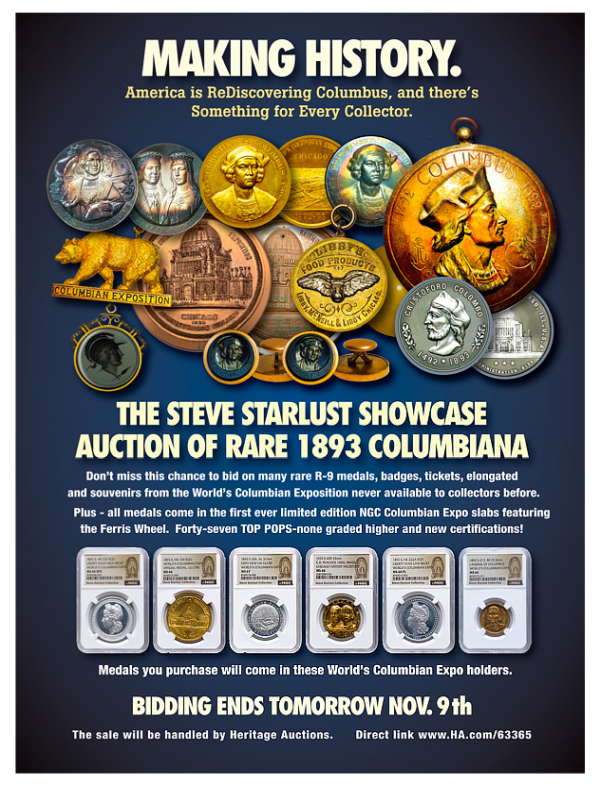
Heritage Auctions will be selling the Starlust Collection of Columbian World Expo Medals on November 9. Select items are discussed below. -Garrett


1893 Medal Mrs. Potter Palmer Brooch, World's Columbian
Exposition, Starlust STND-S64, R.8, Uncertified. 33 x 42mm,
silvered white metal. Palmer was the president of the Board of Lady
Managers for the Exposition, directly linking this brooch to the
Isabella quarters struck by the U.S. Mint.
From The Starlust Collection of 1893 Columbiana.
NOONANS: SPRINGHEAD HOARD, PART ONE
Noonan's is selling the first part of the Springhead Hoard of Late Roman Coins Here's the press release. -Editor

Lot 552 - Gratian
Noonans are to sell the first part of the Springhead Hoard of Late Roman Coins in an auction on Tuesday, November 10, 2026, at 3pm. Discovered by members of the Gravesend Historical Society more than 60 years ago when the A2 in Kent was being widened. The Springhead Hoard will be offered in several parts. Part I, which consists of 114 Siliquae, including many attractive and well-preserved pieces is estimated to fetch up to £15,000 with the proceeds going to support the society which is still in existence today and has recently celebrated its 100th anniversary. The remaining coins will follow in Spring 2027.
As Richard Taylor, Honorary Secretary of the Gravesend Historical Society explains in the foreword of the catalogue: "The Gravesend Historical Society was founded in 1924. Early talks ranged from butterflies to bees, but by 1950 the Society had found its true calling: the Roman site at Springhead, known to the Romans as Vagniacis. Led by Bill Penn, members dug there Sunday after Sunday, summer and winter. They uncovered the temples, shops and roads of one of Roman Britain's most important religious centres, where travellers on Watling Street probably stopped to pray for healing and good fortune."
STACK'S BOWERS: COLONIAL COINS
Stack's Bowers will be hosting their November 2026 Showcase Auction, including Colonial Coins, on November 16. Select items are discussed below. -Garrett


1652 Pine Tree Shilling. Large Planchet. Noe-8, Salmon 7-E, W-740. Rarity-4. Without Pellets at Trunk, Ligatured NE in Legend. AU-58 (PCGS). 71.0 grains. A spectacularly toned Noe-8. On this piece the obverse shows iridescent gold, rose and pale blue while the reverse is a richer combination of iridescent reddish-russet and cobalt blue with softer golden-gray in the field areas. The tree is a little soft at center, but most of the branches can be made out. The peripheral letters are a bit soft at right and (especially) left, being sharpest at top. On the reverse the date and denomination are a little soft, peripheral letters likewise despite the fact that they show no die breakage from an earlier state of the die. Both sides are bright in places and show some original mint frost that is particularly pronounced in the protected areas around and among the design elements. We've handled a number of nice AUs for this Noe number, as well as a few Uncs, and this ex Boyd-Ford specimen features prominently in that group.
STACK'S BOWERS: U.S. COINS RARITIES NIGHT
Stack's Bowers will be hosting their November 2026 Showcase Auction Rarities Night for U.S. Coins on November 17. Select items are discussed below. -Garrett


None Graded Finer by PCGS in the CAM Category 1877 Indian Cent. Snow-PR3. Proof-66 RD Cameo (PCGS). This is an incredible strike and condition rarity that will nicely represent this eagerly sought issue in the Proof Indian cent series. Both sides are wonderfully original with vivid color. The obverse displays even rose-orange and the reverse exhibits a medium orange and olive with hints of silvery tinting. Otherwise highly reflective in finish, a soft satin texture to the devices provides appreciable cameo contrast. The strike is full and the surfaces are silky smooth and virtually pristine.
With a mintage of 852,500 pieces and a low rate of survival in high grades, the circulation strike 1877 is the key date in the Indian cent series. Consequently, survivors of the year's Proof mintage enjoy heightened demand. The United Sates Mint did not begin recording the number of Proof minor coins struck each year until 1878, so there is no way of knowing exactly how many Proof cents were produced in 1877. In his 1977 Encyclopedia of U.S. and Colonial Proof Coins, Walter Breen estimated the mintage of the 1877 at 510+ pieces, but more recent research by R.W. Julian confirmed that Breen's figure represented only the total number of silver and minor coin Proof sets sold. According to Rick Snow (2014), a more accurate estimate for the distribution of this issue is 910 coins, which takes into account the fact that the Mint also sold at least 400 minor coin Proof sets that year. It is thought that upward of 1,500 Proof 1877 cents were actually struck, the unsold pieces destroyed in the Mint.

ARCHIVES INTERNATIONAL SALE 118 SELECTIONS
Here are some selected lots from the November 17-18 sale by Archives International Auctions. -Garrett


Bermuda, 20th October 1952. British Administration, £1, Pick# 20a, Issued Banknote, blue and multicolor, Hamilton harbor view at left, portrait of Queen Elizabeth II at right, back with arms, Wmk: Bank Title, S/N P/1 370667. PMG graded Choice About Unc 58 with comment "Minor Rust." Printer: BWC.

WAYNE'S NUMISMATIC DIARY: NOVEMBER 8, 2026
One thing I'd hoped to do in retirement was visit museums, something my wife has little interest in. So on Thursday morning I set out for downtown Washington, D.C. to visit the National Gallery of Art. First I drove a couple miles to the Ashburn Metro station and caught a Silver Line train to Metro Center. It was a cloudy day but it never rained on me. I walked about 20 minutes to my destination, passing other D.C. landmarks including the Old Post Office and Department of Justice. I snapped a ton of photos, and here's a selection.

IRON AGE RULER VERICA WAS FEMALE
David Pickup forwarded this "gender change" article. Thanks. -Editor


NEW AUSTRALIAN COINS FEATURE NATIVE ANIMALS
Don Cleveland passed along this article about new Australian coins, He adds this context for readers: "The term "gold coins" mentioned here are not gold, but only made of an alloy that looks like gold. All Australian one dollar and two dollar coins look like gold." Thanks. -Editor

The next time you reach for a gold coin, artist Ryhia Dank hopes you'll discover something new about First Nations culture.
The Sunshine Coast-based Gudanji/Wakaja and Kalkadoon artist has illustrated a collection of $1 and $2 coins with six native animals and their names in language.
"I want the kids back home to pick up the coin and say, 'Oh, that's the crocodile that's floating down the river, or the brolgas that are dancing there'," Dank said.
LOOSE CHANGE: NOVEMBER 8, 2026
Here are some additional items in the media this week that may be of interest. -Editor
Numismatic News published an article on Adolph Weinman's work in medals and sculpture. Here's an excerpt - see the complete article online. -Editor
When numismatists hear the name Adolph Weinman, two of his works immediately come to mind: the Winged Liberty dime and the Walking Liberty half dollar. However, those iconic coins represent only a tiny portion of his creative output over the course of many years as a medalist, figurative sculptor, and monumental sculptor. Two elements found upon those coins were representative themes throughout his career: wings and eagles. In this essay, we shall discuss some of his most important works that include those elements.
To read the complete article, see:
Of Wings and Eagles: The Artistry of Adolph Weinman
(https://www.numismaticnews.net/of-wings-and-eagles-the-artistry-of-adolph-weinman)
Other topics this week include Privy Marks. -Editor
ABOUT THIS ISSUE: NOVEMBER 8, 2026
My Numismatic Diary article this week covers my main numismatic adventure. Here's a cool license plate I saw along the way.

U.S. numismatists know the initials VDB as those of sculptor Victor David Brenner, creator of multiple medals and plaques but most famous for his design of the Lincoln Cent. Is the car's owner a numismatist? Or do the letters mean something else entirely? Is there a VDB 1 plate somewhere?
Seen online this week:
- "Man introduced his wife to ChatGPT. She used it to plan his murder."
- "Man, 97, dies dancing at his birthday party, to Staying Alive"
And here are some interesting non-numismatic articles I came across this week.
Where's the only royal palace in the U.S.? (https://interestingfacts.com/fact/theres-only-one-royal-palace-on-u-s-soil/)
The earliest U.S. presidents didn't wear pants. (https://interestingfacts.com/fact/the-earliest-u-s-presidents-didnt-wear-pants/)
Delivering Lincoln's Gettysburg Address in Pa. is ‘one of the greatest honors' (https://www.post-gazette.com/life/goodness/2026/11/04/billy-campbell-abraham-lincoln-gettysburg-address-pa/stories/202611080007)
The Rise and Fall of Variety Shows (https://historyfacts.com/arts-culture/article/the-rise-and-fall-of-variety-shows/)
5 Common Table Manners Invented To Stop Fights (https://historyfacts.com/world-history/article/table-manners-invented-to-stop-fights/)
Snap and crackle but no pop: Rice Krispies reformulated due to lack of rice (https://www.theguardian.com/food/2026/nov/03/kelloggs-rice-krispies-coco-pops-reformulated-rice-shortage)
Same as it ever was: David Byrne on why great ideas sometimes fall asleep (https://www.washingtonpost.com/opinions/2026/11/02/talking-heads-david-byrne-why-great-ideas-sometimes-fall-asleep/)
The world capital of atoms (https://rationaloptimistsociety.substack.com/p/the-world-capital-of-atoms)
The Story Behind Edward Hopper's Iconic Painting, "Nighthawks" (https://lithub.com/the-story-behind-edward-hoppers-iconic-painting-nighthawks/)
Long-Lost Georgia O'Keeffe Landscape Goes to Auction (https://hyperallergic.com/long-lost-georgia-okeeffe-landscape-goes-to-auction/)
-Editor

Editor Wayne Homren, Assistant Editor Garrett Ziss

|
|
| |