Visit our NBS Sponsors











About UsThe Numismatic Bibliomania Society is a non-profit association devoted to the study and enjoyment of numismatic literature. For more information please see our web site at coinbooks.org SubscriptionsThose wishing to become new E-Sylum subscribers can go to the following web page
Subscribe
MembershipThere is a membership application available on the web site Membership Application To join, print the application and return it with your check to the address printed on the application. Print/Digital membership is $40 to addresses in the U.S., and $60 elsewhere. A digital-only membership is available for $25. For those without web access, write to: Jeff Dickerson, Treasurer AsylumFor Asylum mailing address changes and other membership questions, contact Jeff at this email address: treasurer@coinbooks.org SubmissionsTo submit items for publication in The E-Sylum, write to the Editor at this address: whomren@gmail.com BUY THE BOOK BEFORE THE COINSale CalendarWatch here for updates! |
- WAYNE'S WORDS: THE E-SYLUM APRIL 26, 2026
- LANG NUMISMATIC LITERATURE AUCTION 11
- NEW BOOK: STAN AND GUS
- JOEL ISKOWITZ (1946-2026)
- ERROR COIN LEGEND MIKE CHAMBERS
- DIRECTOR HOLLIS SPEAKS AT NNP SYMPOSIUM
- VIDEO: 70 YEARS OF RED BOOK PUBLICATION
- 2026 ANA SUMMER SEMINAR REGISTRATION
- HICKORY BANK SATIRICAL NOTE OFFERED
- THE 1790 T. DEXTER SHILLING
- NOTES FROM E-SYLUM READERS: APRIL 26, 2026
- PNG 2026 AWARD WINNERS ANNOUNCED
- VOCABULARY TERMS: SILVERPLATE, SILVERPLATING
- MILFERD HENRY BOLENDER (1894-1977)
- HERITAGE: CENTRAL STATES WORLD AND ANCIENTS
- HERITAGE: VILA RICA COLLECTION SELECTIONS
- HERITAGE: THE ALAMO COLLECTION
- HERITAGE: CENTRAL STATES U.S. COIN AUCTION
- WAYNE'S NUMISMATIC DIARY: APRIL 26, 2026
- SILPHIUM ON ANCIENT COINS
- AUSTRALIAN WWII SHORT SNORTERS
- 2025 IBNS BANK NOTE OF YEAR
- LOOSE CHANGE: APRIL 26, 2026
- ABOUT THIS ISSUE: APRIL 26, 2026
Content presented in The E-Sylum is not necessarily researched or independently fact-checked, and views expressed do not necessarily represent those of the Numismatic Bibliomania Society.
WAYNE'S WORDS: THE E-SYLUM APRIL 26, 2026
 New subscribers this week include:
Tim Montgomery,
Daniel Londoño,
and
Ryan Dibilio.
Welcome aboard! We now have 6,553 subscribers.
New subscribers this week include:
Tim Montgomery,
Daniel Londoño,
and
Ryan Dibilio.
Welcome aboard! We now have 6,553 subscribers.
Thank you for reading The E-Sylum. If you enjoy it, please send me the email addresses of friends you think may enjoy it as well and I'll send them a subscription. Contact me at whomren@gmail.com anytime regarding your subscription, or questions, comments or suggestions about our content.
This week we open with a numismatic literature sale, one new book, updates from the Newman Numismatic Portal, notes from readers, and more.
Other topics this week include Augustus Saint-Gaudens, Joel Iskowitz, the Red Book, the ANA Summer Seminar, the Hickory Bank satirical note, silverplating, M. H. Bolender, auction sale previews, short snorters, and the IBNS Banknote of the Year.
To learn more about Africa's Journey to Modern Money, the Numismatics of Fairs and Expositions, spindle cancelling, coin usage heuristics, flash plating, the Geoctroyeede West-Indische Compagnie, the 1818 Jola, Spanish double dimes, half pistareens, silphium, and the 1790 Lord Dexter shilling, read on. Have a great week, everyone!
Wayne Homren
Editor, The E-Sylum

Image of the week
LANG NUMISMATIC LITERATURE AUCTION 11
REMINDER: The 11th numismatic literature auction from Numismatic Antiquarian Bookshop Lang closes April 29, 2026. -Editor

Please remember that on April 29, 2026, our 11th auction of numismatic literature will take place on Auex. Don't forget to submit your pre-bids!
Details:
- Date: April 29, 2026
- Location: Auex.de
- Time: Starting at 3:00 p.m. CEST
The auction is divided into two parts:
Part 1 (Lot Nos. 1–485) comprises the second part of the duplicates from the Leu Numismatik AG library. Of particular note are books on ancient numismatics as well as auction catalogs from before 1945.

Once again, Leu Numismatik AG has asked us to set very conservative starting prices. Therefore, don't miss out on these rare and magnificently bound editions, among other items!
Part 2 (Lot Nos. 500–1418) features a vast selection of numismatic literature from numerous libraries. Among other items, this section offers bibliophile editions, a broad range of works on ancient numismatics as well as the medieval and modern periods, and numerous journals and auction catalogs.

You are welcome to submit advance bids via Biddr, Sixbid, and Numisbids. The auction will take place on Auex.de. Please register in good time. Click this link to download our current PDF catalog.
We wish you every success and are happy to answer any questions you may have!
For more information, or to bid, see:
Katalog - Auktion 11
To read the earlier E-Sylum article, see:
LANG NUMISMATIC LITERATURE AUCTION 11
(https://www.coinbooks.org/v29/esylum_v29n16a03.html)

NEW BOOK: STAN AND GUS
At our Nummis Nova meeting this week, John Kraljevich tipped me off to a recently published book the famed sculptor and coin designer Augustus Saint-Gaudens. I ordered a copy and it arrived Friday. -Editor
Stan and Gus: Art, Ardor, and the Friendship That Built the Gilded Age
by Henry Wiencek
 Stanford White was a louche man-about-town and a canny cultural entrepreneur-the creator of landmark buildings that elevated American architecture to new heights. Augustus Saint-Gaudens was the son of an immigrant shoemaker, a moody introvert, and a committed procrastinator whose painstaking work brought emotional depth to American sculpture. They met when Stan was walking down the street and heard Gus whistling Mozart in his studio. They pursued their own careers in Italy and France, then came together again in New York, where they maintained an intimate friendship and partnership that defined the art of the Gilded Age. Over the course of decades, White would help sustain his friend's troubled spirits and vouch for Saint-Gaudens when he failed to complete projects. Meanwhile, Saint-Gaudens would challenge White to take his artistic gifts seriously-and so it went amid brilliant commissions and sordid debaucheries all the way to White's sensational murder by an enraged husband in 1906.
In Stan and Gus, the acclaimed historian Henry Wiencek sets the two men's relationship within the larger story of the American Renaissance, where millionaires' commissions and delusions of grandeur collided with secret upper-class clubs, new aesthetic ideas, and two ambitious young men to yield work of lasting beauty.
For more information, or to order, see:
Stan and Gus: Art, Ardor, and the Friendship That Built the Gilded
(https://www.amazon.com/Stan-Gus-Ardor-Friendship-Gilded/dp/0374162492)
Stan and Gus: Art, Ardor, and the Friendship That Built the Gilded Age
(https://www.mcnallyjackson.com/book/9780374162498)
Here's an excerpt from a New York Times review. There's no shortage of racy passages. -Editor
A bombastic Puck with a cartoonishly large mustache, White (1853-1906) apprenticed as a teenager to the great American revivalist of Romanesque architecture, Henry Hobson Richardson, then became a founding partner in New York's enormously influential firm McKim, Mead & White, where he deployed his cannonball speed and lack of filter, his genius with interiors, surface detail and historical collage.
White could extract something oddly American-feeling from ancient Italy, as he did with the Washington Square Arch; or from ancien régime France, with a Gatsby-grade Rhode Island manor; or from Golden Age Spain, as with the electric-lit pleasure palace of the second Madison Square Garden, on which Wiencek opens and closes his chronicle of decadence.
Through collaborations like this, including a tomb for the former New York governor Edwin D. Morgan (now lost) and the nude Diana weather vane for Madison Square Garden (versions of which live at the Metropolitan Museum in New York and the Philadelphia Museum of Art), White propelled Saint-Gaudens to the top of his craft. He won him commissions and improvised excuses for the crippling perfectionism — what Saint-Gaudens called his "idiotic delicacy" — that delayed their deadlines by years, sometimes past clients' deaths. "Never did an artist have a more devoted agent," Wiencek ventures.
Their friendship was also sexual, though Wiencek, a journalist and historian specializing in the founding era, doesn't trade in sensationalism. Instead, he uses the surviving erotic notes between the two men — "Darling, once more and for the 5,999th time you can kiss me," Saint-Gaudens assured White in one sign-off — to explore their bond. (The partnership so dictates the book that certain groundbreaking solo jobs, like Saint-Gaudens's $20 coin for the U.S. Mint, are breezed over.)
The pair's social circles, too, were like Venn diagrams of bodily and aesthetic freedom: One shared spot was the Sewer Club, which Wiencek diplomatically calls "a safe space for sexual adventuring" with the painter Thomas Dewing, the architect Joseph Wells and other luminaries.
Wives paid a price. The long-suffering Augusta Saint-Gaudens eventually learned about her sculptor husband's illegitimate son by his model for the Diana, Davida Clark. Bessie White got even for Stanford's compulsive dalliances by bedding his lawyer.
To read the complete article, see:
Two Titans of the Gilded Age, Entwined in Art and Life
(https://www.nytimes.com/2025/07/30/books/review/stan-and-gus-henry-wiencek.html)

JOEL ISKOWITZ (1946-2026)
 On Friday, April 24th
David Menchell wrote:
On Friday, April 24th
David Menchell wrote:
"I recently received word that Joel Iskowitz passed away. Joel was an extraordinarily talented graphic artist who designed over 50 coins and medals as a US Mint infusion artist. In addition, he did paintings for the US Navy and Air Force as well as designing over 2000 stamps and other foreign coins and art medals. It was my good fortune to know Joel and work with him to produce commemorative medals for the Bronx and Flushing Coin Clubs. Aside from being a skilled artist, he was a kind and generous person. I am deeply saddened by his passing."
John Janeczek, Secretary-Treasurer of the New York Numismatic Club writes:
"It is with deep regret that the New York Numismatic Club announces the death of our fellow member Mr. Joel Iskowitz.
"Joel Iskowitz passed away on April 23, 2026. He was born in 1946 and became a member of the NYNC in 2009. Joel was a renowned sculptor and illustrator, designing many coins, medals, and stamps for different countries and organizations. These include the 2009 Lincoln Bicentennial cent and the 2011 Fallen Heroes of New York Congressional gold medal. He was also the designer of several of the Club's medals.
"He is survived by his wife Suzanne and children Julia and Adam. A graveside burial will be held at the Woodstock Artists' Cemetery, 12 Mountainview Avenue, Woodstock, NY on Wednesday, April 29, 2026, at 11:00AM. In lieu of flowers, donations may be made to the Woodstock Artists Association and Museum at www.woodstockart.org."

Joel's "Inspiration of the Lincoln Cent"
Here's an excerpt from Joel's online obituary. -Editor

Son of Larry and Belle Iskowitz, Joel was born in the Bronx on August 15, 1946. A talented artist from a young age, he went on to attend New York's High School of Music and Art, Yale University's fine arts program, and eventually graduated from Hunter College with his Bachelor of Fine Arts in 1968. He was inducted into the Hunter College Hall of Fame in 2011.
An internationally renowned American illustrator, painter and stamp, coin and medal designer, Iskowitz designed more than 50 coins and medals for the U.S. mint, including the 2009 Lincoln bicentennial penny and the 2011 Fallen Heroes of NY Congressional gold medal. He created more than 2000 stamps for 40 different countries. Iskowitz received numerous awards for his philatelic and numismatic work, including the International Design Awards Gold Medal, a 2008 silver Medal in Corporate Illustration and a COTY nomination for most artistic coin. During his lifetime, he also served as an artist for NASA and the United States Airforce; his commemorative oil paintings of D-Day and several US space shuttle launch missions reside in the permanent collections of the Historical Association of Carenten in Normandy, France and the NASA Kennedy Space Center. His designs for the U.S. mint remain on display at the U.S. Capitol's Emancipation Hall and in the Smithsonian, Abraham Lincoln Presidential, and New York Historical Society Museums. Known for his commitment to realist styles of portraiture and design, Iskowitz described his artistic process as a method of visual storytelling. He always began with a carefully researched attempt to seek out the personal histories of his subjects.
By his closest friends, Joel will be remembered not just by his art but by the way he lived his life. A consummate conversationalist, Joel brought his intellectual curiosity to our community and became part of the very fabric of Woodstock, long revered as an enclave for artists, musicians and intellectuals. On any given weekend, Joel might be found conversing with like-minded souls at Bread Alone. An avid tennis player, Joel found both love and community on the court. He met his beloved wife, Suzanne, at Black Acres Tennis Club in the 1980s; there and at the Woodstock Tennis Club, he formed friendships that endured throughout his lifetime. To that small circle, Joel was family—loyal and devoted, he graced our table at every holiday celebration and was there with a warm embrace for each loss or hardship. Outside of the work that formed such a core part of his identity and artistic life, Joel could often be found on long walks in the woods with his family and friends or completing the New York Times crossword puzzle in pen. Even illness could not touch Joel's poetic character and unique way of relishing life. For those of us who knew and loved him well, it is the portrait of the artist himself that we will remember, working in his Ohayo Mountain studio, creatively striving, with paints, and his faithful labrador, Sandy at his side.
To read the complete article, see:
Joel Iskowitz
(https://www.keyserfuneralservice.com/obituaries/joel-iskowitz)


2025 World's Fair of Money Commemorative
On Facebook, sculptor, medallist and CCAC member Heidi Wastweet writes:
"The world of coin artists is pretty tight and the majority of us support and lift up each other. Joel was one of those connectors that brought others together with his generous spirit. He will be deeply missed."
To read the complete post, see:
https://www.facebook.com/share/1HGNZfZEmS/
I met Joel on a few occasions and stayed in touch via email. A number of earlier articles referencing his work are linked below. I believe it was at a PAN show banquet that I bought from him a framed print of elephants for my wife, who likes and collects elephants. It's hanging in our hallway, and I can see it from my desk. Joel was a talented and prolific artist, and an all-around nice guy. He will be missed. -Editor
To read his extensive Wikipedia entry, see:
Joel Iskowitz
(https://en.wikipedia.org/wiki/Joel_Iskowitz)


The Great War 1914-1918
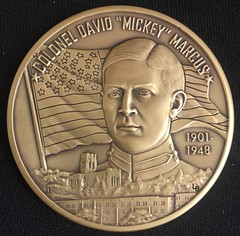
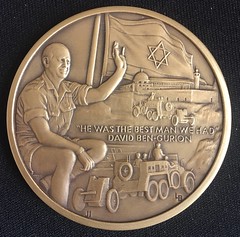
Col. David "Mickey" Marcus medal
To read earlier E-Sylum articles, see:
ART AND VICTOR DAVID BRENNER TAKE ON TIMES SQUARE
(https://www.coinbooks.org/esylum_v15n26a23.html)
FALLEN HEROES MEDAL DESIGN: VAULTED PERSPECTIVE
(https://www.coinbooks.org/esylum_v17n48a13.html)
JOEL ISKOWITZ ON HIS FALLEN HEROES DESIGN
(https://www.coinbooks.org/esylum_v17n51a15.html)
INTERVIEW WITH COIN DESIGNER JOEL ISKOWITZ
(https://www.coinbooks.org/v21/esylum_v21n04a17.html)
ISKOWITZ DESIGNS WWI BRADFORD EXCHANGE SERIES
(https://www.coinbooks.org/v21/esylum_v21n24a28.html)
ISKOWITZ MEDAL DESIGN HONORS MICKEY MARCUS
(https://www.coinbooks.org/v22/esylum_v22n22a31.html)
AINA COL. DAVID "MICKEY" MARCUS MEDAL
(https://www.coinbooks.org/v24/esylum_v24n13a27.html)
FREE WFOM COINS IN OKLAHOMA CITY
(https://www.coinbooks.org/v28/esylum_v28n30a12.html)

ERROR COIN LEGEND MIKE CHAMBERS
Greg Bennick compiled these remembrances about error coin specialist Mike Chambers of California, who passed away recently. -Editor
JON SULLIVAN: (Error coin dealer):
I was sad to hear of the recent passing of Mike Chambers. He was a legend in the error hobby both for his knowledge and his ability to find some of the rarest and most desirable error coins for his collection. Mike always had a story to tell you about a coin he'd owned, or some detailed history of a particular mint error. He taught me a lot over the years.
If you asked Mike a question about a rare mint error, he usually knew not only the answer, but had deep insights into the coin's background, who owned it, when it came to market, what it sold for years ago, and so on. I thoroughly enjoyed talking errors with him when I was out in California visiting shows. Mike would consistently awe me with what he had in his collection, or coins he'd owned in the past.
One of his favorite things to do would be to make a comment such as, "Hey, have you ever seen an 85c piece?" and proceed to hand you some wild double-denomination that the viewer certainly had never seen before. My condolences to his family and friends, and he will be missed in the hobby by those who knew him.
 RICH SCHEMMER:
(Retired error coin dealer):
RICH SCHEMMER:
(Retired error coin dealer):
Mike was an extraordinary collector of error coins. We bought and sold errors from each other many times. I was amazed at some of the coins in his collection and his energetic personality. One of my favorite pieces I purchased from Mike was this 40% Off Center Standing Liberty Quarter. When I had it graded, it came back MS64. Mike was one of the early pioneers of this hobby going back to the 1960's. He will be missed.

 MIKE BYERS
(Error coin dealer):
MIKE BYERS
(Error coin dealer):
Mike Chambers was one of the original old-time collectors of mint errors. He assembled one of the greatest collections of all time. His timing was perfect since most of his purchases were in the 60's, 70's and 80's, before prices and demand exploded in the 90's. Mike attended many coin shows throughout the decades buying and selling mint errors with his favorite dealers and collectors.
One of my fondest memories of a transaction with Mike Chambers occurred in 1975 when he purchased one of the most expensive mint errors from my 1975 catalog. John Devine, aka "Lonesome John," had just published my catalog and Mike immediately contacted me and purchased the unique $20 1851 struck on a Large Cent planchet. I had just purchased this mint error and other mint errors from Fred Weinberg. Fred had just bought the Bolt Collection of mint errors and this $20 Liberty off-metal originated from it.
Mike and I also did several large deals in the early 2000s when I purchased his Walking Liberty Half on a Dime planchet, his double struck Peace Dollar, (3) 1944 Steel Cents, and a large group of proof errors. But the $20 Liberty off-metal was both my favorite and Mike's, and has become one of the most famous and valuable mint errors of all time.
FRED WEINBERG (Retired error coin dealer):
I met Mike at a Long Beach Show in the late 1960's, but really didn't get to know him until I got into the coin business full-time in 1972.
Mike was an incredibly enthusiastic major mint error collector, becoming one of the most serious error collectors. Over the decades, he chased and purchased some of the best error coins which appeared on the market.
He only collected major mechanical errors - Off Centers, Double Strikes, but his main love and focus was on Off Metals/Wrong Planchet errors - he collected all of them by both date and type - and had one of the most extensive collections of these types of coins ever assembled.
Starting in 1972, I saw him at almost every single Long Beach Coin show. Until about five or six years ago, he would drive to shows in California, and hated to fly. I think he only flew to one or maybe at most two ANA Conventions over the decades.
I always looked forward to seeing him, as he would bring a large amount of his errors coins to show, and compare to what I or others had to offer. He was seeing if he needed that date or type, and trying to get a better example. He was always fun to talk to and interact with regarding both mint errors, and what he did outside of the hobby (he was a landlord for his apartment buildings in Modesto, CA).
His old green ‘backpack' would always be with him, packed with his errors, and he would often leave it or forget it, at my table, or someone else's! He would then run back and find it! I don't think he ever lost it at a show for long though, as far as I know.
His sweet wife Rose would come down with him, most of the time, and she would bring me a sweet treat or something: chocolate (she knew I loved dark chocolate!).
Over the past ten years or so, he slowly sold major areas of his collection, but never really stopped buying anything he thought was rare or dramatic. He was always looking for coins he might have still needed.
Although he kept a low profile nationally, he dealt with other error dealers and collectors on a one-to-one basis.
I'll miss him as a friend, a fellow mint error collector/dealer, and as a genuinely nice guy. I wish I got a chance to see him again and talk like we used to, before he passed away.
JIM ESSENCE: (Coin dealer):
I am so sorry to hear this news. Mike has been part of my life since I was about 16 years old. In the early days, Len and I would joke about how Mike would call us at all hours of the day, sometimes multiple times a day, to see if we had errors to sell. Occasionally he would even sell some himself. Later in life I was fortunate to purchase quite a lot from him. He always had a crazy story from his youth or a story about how he purchased some insanely cool error for $600....40 years ago! Since I purchased the store in 2003, we spoke on the phone more, sometimes frequently, sometimes not, although not much over the past couple years due to his health.
He had an encyclopedic knowledge and memory of error coins, and stories that went along with them. These stories ranged from him sometimes getting great deals on error coins, and sometimes getting terrible deals. They covered Mike's sharing of historical and technical aspects of error coin collecting, as well as mystical aspects of error coin collecting. I learned and enjoyed a lot from our friendship and dealings, and for that I am deeply grateful.
My experience with Mike was to me, what coin collecting is all about. Learning of his passing feels like a closing of an era in my life. I'm sad that there will be no more crazy phone calls, and also grateful for all the ones we had.
Thanks, everyone! -Editor

DIRECTOR HOLLIS SPEAKS AT NNP SYMPOSIUM
Newman Numismatic Portal Project Coordinator Len Augsburger provided the following report on this week's NNP Symposium. -Editor
Mint Director Paul Hollis Speaks at NNP Symposium
 Among 21 presenters at this year's NNP Symposium, U.S. Mint Director Paul Hollis took center stage with remarks surrounding the Semiquincentennial coinage programs. Additionally, Hollis responded to numerous questions from attendees, both in the room and online. Local media including the Daily Herald and FOX32 News covered the event. At the conclusion of his talk, Central States Numismatic Society (CSNS) president Mitch Ernst presented Hollis with the 2026 Q. David Bowers award for lifetime service to
numismatics.
Among 21 presenters at this year's NNP Symposium, U.S. Mint Director Paul Hollis took center stage with remarks surrounding the Semiquincentennial coinage programs. Additionally, Hollis responded to numerous questions from attendees, both in the room and online. Local media including the Daily Herald and FOX32 News covered the event. At the conclusion of his talk, Central States Numismatic Society (CSNS) president Mitch Ernst presented Hollis with the 2026 Q. David Bowers award for lifetime service to
numismatics.
Video from all NNP Symposium sessions will be posted in 2-3 weeks. The NNP Symposium is sponsored by the Eric P. Newman Numismatic Education Society and produced by Lianna Spurrier of Numismatic Marketing.
Link to NNP Symposium home page:
https://nnpsymposium.org/
Link to CSNS press release on the Q. David Bowers award:
https://www.csns.org/post/csns-names-mint-director-paul-hollis-as-2026-q-david-bowers-award-recipient
VIDEO: 70 YEARS OF RED BOOK PUBLICATION
The David Lisot Video Library on the Newman Numismatic Portal can be found at:
https://nnp.wustl.edu/library/multimediadetail/522852
We highlight one of his videos each week in The E-Sylum. Here's one from 2016 commemorating the 70th anniversary of the Red Book. -Editor
 Dawn Burbank, Sales Vice President, Whitman Publishing. Interviewer: David Lisot, CoinTelevision.com.
The iconic "Guide Book of US Coins" also known as the 'Red Book' celebrates its 70th year of publication. Dawn Burbank of Whitman Publishing talks about the excitement.
To watch the complete video, see:
Red Book by Whitman Celebrates 70 Years of Publication. VIDEO: 2:33.
(https://www.youtube.com/watch?v=yKtf3m3Mu74)
Red Book by Whitman Celebrates 70 Years of Publication. VIDEO: 2:33.
(https://nnp.wustl.edu/library/book/548581)
2026 ANA SUMMER SEMINAR REGISTRATION
Time to register for the American Numismatic Association's annual Summer Seminar. -Editor

Summer Seminar is a once-a-year opportunity for numismatic learning and camaraderie that offers students a varied selection of week-long courses designed for discovery or continued study. This year's sessions are June 20-25 and June 27-July 2, and take place on the Colorado College campus adjacent to ANA headquarters in Colorado Springs, Colorado.
Detection of Counterfeit World Paper Money
Learn to distinguish genuine paper money from counterfeits by analyzing printing techniques, security devices, and the history of fraudulent replication. Use magnification and specialized lighting to compare authentic notes with vintage and modern counterfeits, with a specific focus on pieces designed to defraud collectors.
Applied Techniques in Numismatic Photography and Image Editing Essentials
Photographers of all levels can learn how to capture and edit high-quality numismatic images for purposes such as online sales, research, and publication. Learn to optimize lighting configurations, manage digital files, and perform essential edits using Adobe Photoshop.
Early American Copper Coinage (Copper 1)
This introduction to Early American Coppers (EAC) covers mint distribution, circulation, and methods for identifying cleaned or altered coins. The student-driven curriculum also teaches grading and attribution techniques, encouraging participants to bring their own loupes and copper coins for hands-on study.
The New Orleans Mint Coinage and its History
Explore the history and coinage of the New Orleans Mint from 1835 to 1909, with highlights on its unique challenges such as the Civil War and tropical climate. Engage in hands-on attribution and grading while studying approximately 40 types of silver and gold coins produced at the facility.
Bank Notes Without Borders
Investigate how modern paper money reflects global history and national identity through its design, security features, and cultural symbolism. Gain practical skills in grading, authentication, and collection management, with guidance tailored for both novice and experienced collectors.
Cowries to Coins: Africa's Journey to Modern Money
Explore the art, history, and commerce of over 50 African nations through their 19th- to 21st-century currencies, analyzing how design and materials reflect the continent's political evolution from colonial rule to independence. Gain practical skills in identification, grading, and cataloging, including learning to read Arabic numerals and mintmarks.
Meet Me at the Fair: Numismatics of Fairs and Expositions
Examine the history of 19th and 20th-century domestic and international fairs, examining their background, major attractions, and the coins, medals, and exonumia they produced. Learn about essential reference materials for studying these unique numismatic series.
Introduction to Ancient Coins
This course introduces beginners to the basics of ancient coin collecting, covering gold, silver, and copper issues from the early Greek period through the late Byzantine era. Learn essential identification techniques and explore the historical significance of these ancient currencies.
World War II Numismatics
Use a case-study approach to explore the diverse military and emergency issues of World War II, including both coins and paper money. Examine specific examples in-depth, such as Allied military currency, Japanese invasion money, and U.S. Military Payment Certificates.
Collecting and Attributing Lettered-Edge Half Dollars
Discover the history of U.S. coinage from 1794 to 1836, with a specific focus on the Capped Bust half dollar. Gain hands-on experience in variety attribution using the Overton system and explore essential topics such as the minting process, grading, and counterfeit detection.
Here are additional details on some of the courses. -Editor
 Explore the art, history, culture, and commerce of more than 50 nations of Africa through the coins and other currencies of the 19th through 21st centuries. Hands-on study, guided discussion, and specimen analysis reveal how design, language, metal, and message reflect Africa's political and economic evolution from colonial power to independence.
The course emphasizes practical skills in identification, grading, and cataloging, including reading Arabic numerals and mintmarks. This class is ideal for collectors, educators, and dealers seeking to increase their knowledge of modern African numismatics.
Instructors: Benjamin Swagerty, media specialist for Oklahoma City Public Schools, international numismatic researcher, master referee for Numista; and Alan Cutler-Pomex, lead numismatist at #1 Money Man & Numismatic Wholesale, creator and host of Numismatic Explorer


With the advent of the Industrial Revolution, it became popular to hold agricultural and industrial fairs and expositions to showcase new inventions, advances in agriculture, and personal achievements in arts and crafts. This class highlights many of the important fairs and expositions of the 19th and 20th centuries, including the Centennial Exposition of 1876, the 1893 Columbian Exposition, the 1904 St. Louis Exposition, and others, as well as foreign expositions, including major expositions held in London, Paris, Brussels, and elsewhere.
We discuss the background of the expositions, major attractions and exhibits, and present many of the award medals, coins, so-called dollars, and other exonumia available to the attendees. We also discuss important references for studying these series.
Instructors: David Menchell; and Jeff Shevlin, past executive director of the ANA, author, owner of So-Called Dollars.


 Explore the art, history, culture, and commerce of the modern world through the study of paper money. This course emphasizes how design, security, and symbolism on bank notes reflect national identity, global events, and the evolution of technology in currency production.
Participants examine common and scarce issues—from everyday notes to artistic masterpieces and special releases. Topics include commemorative and inflationary issues, cherrypicking signatures, watermarks, paper types, engravers, printers, serial varieties, and replacement note identification. Students also learn the basics of grading standards, authentication, and presentation through discussion, workshop activities, and real-world examples.
New collectors are guided in developing a collecting method that fits their interests and goals, while seasoned collectors and dealers can refine systems for cataloging, photography, and presentation. Participants are encouraged to bring favorite bank notes, challenging pieces, and stories from the field to share.
Instructors: Benjamin Swagerty, media specialist for Oklahoma City Public Schools, international numismatic researcher, master referee for Numista; and Alan Cutler-Pomex, lead numismatist for #1 Money Man & Numismatic Wholesale, creator and host of Numismatic Explorer

This class is a firsthand trip through the history of how coins have been made, from their earliest beginnings in the 6th century B.C. through today. Both instructors are private minters with decades of experience in striking coins and making dies using ancient through modern techniques.
 They use video, printed materials, and actual minting and engraving equipment created by Ron Landis and Joe Rust of the Gallery Mint to illustrate and demonstrate how coins have been made over the last 2,600 years, including hand-hammered, rocker, and screw presses.
This class is a unique opportunity to go hands-on with the tools and technology that created the look and feel of the coins we love to collect.
Instructors: Joe Paonessa, owner of Root River Mint; and Timothy Grat, owner of Landis Studio and Gallery Mint
 Counterstamped coins are a window into history. Before Instagram reels and Facebook ads, merchants had to rely on what seems today to be primitive means of getting the word out about their businesses. In the mid-1800s, it was common for merchants to stamp their business name, location, and their own names into the surface of coins with metal punches.
We often hear the line, "If only this coin could tell its story." With counterstamps, the coins actually do tell their stories. We can learn from these coins where they are from and about the people connected to them. History comes alive.
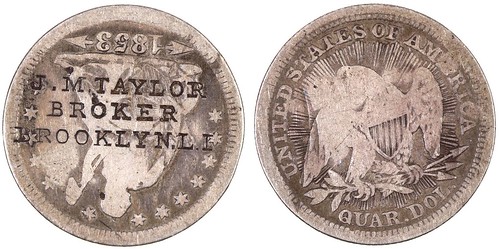
In this class, we examine choice examples of United States counterstamped coins, learn about the people who made them, explore rarity, and hear the incredible tales these coins tell.
Instructor: Greg Bennick, speaker and writer on counterstamps and major mint errors, board member of CONECA and TAMS
This course covers how to form a research topic and scope based on an intended audience prior to publication or presentation. Participants learn how to design research and identify useful sources for information depending on the nature of a research topic.
The instructor works through examples with ANA presentation venues in mind, including convention presentation options such as MoneyTalks; publication options in The Numismatist and The Reading Room; and education presentation options such as the NumismaTalks series. The class also covers options on local, regional, and specialized national scales.
Instructor: Akio Lis, ANA Library Manager
To read the full course catalog, see:
Summer Seminar Course Catalog
(https://www.money.org/summer-seminar/course-catalog/)
For more information, or to register, see:
2026 Summer Seminar
(https://www.money.org/summer-seminar/)

HICKORY BANK SATIRICAL NOTE OFFERED
A website visitor writes:
"In 2023 Ernie Nagy wrote to you asking for info about a Hard Times satirical note from the Hickory Bank of the U.S. One just turned up at auction, and it's apparently the only known example! "
Thanks! Here's the image and description from the upcoming Heritage offering. A added the newspaper clipping Ernie found. -Editor

(Unknown Location)- Hickory Bank of U.S. 50 Mills Hard Times Satirical Note ND (ca. 1837) UNL PMG Choice Fine 15 Net.
Previously unknown and unlisted in United States Tokens 1700-1900 by Russell Rulau, this note is a new entrant in the very complex and historic arena of Panic of 1837 era hard times satirical bank notes. As is almost always the case, this note presents a very allegorical and complex message surrounding Andrew Jackson, his battle against the Bank of the United States, and the fight between hard money and easy money advocates.
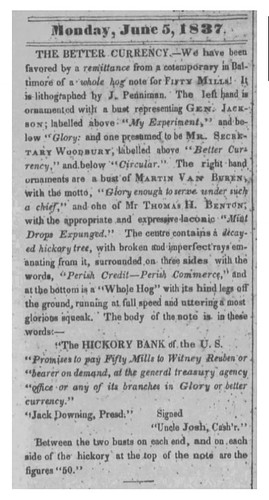 The overall note layout vaguely resembles that of notes from the so-called "Third" Bank of the United States (actually operating under a state charter from the state of Pennsylvania) with end panels containing multiple portraits of important personages. The center vignette depicts a tree with "glorious" rays bursting from behind it with the popular mottos of the day PERISH CREDIT! PERISH COMMERCE!. reflective of the economic hard times that were occurring when this note was issued.
The left end panel has a portrait of Jackson with the words MY EXPERIMENT / GLORY referring to Jackson's successful campaign to not renew the charter of the Bank of the United States and to push a hard money agenda which he believed left the people "happy and prosperous" when he left office in March 1837. The portrait at the bottom is that of Thomas Hart Benton (known as "Old Bullion" Benton) who supported Jackson's "hard money" position and proposed legislation that federal land purchases could only be made in specie. While this legislation was defeated, Andrew Jackson's 1836 executive order (commonly known as the Specie Circular) mirrored its terms and was blamed by some as one of the causes of the Panic of 1837. Note that the words BETTER CURRENCY and CIRCULAR appear around Benton's bust.
The right end panel also contains two busts. The top right bust is of Martin Van Buren boasts the slogan GLORY ENOUGH SERVE UNDER SUCH A CHIEF perhaps referring to working with Jackson while the bottom bust has the motto MINT DROPS EXPUNGED. "Mint Drops" was a derisive reference to coins and hard money advocates such as Benton while "Expunged" refers to Benton's successful 1837 effort to remove Jackson's 1834 censure by the Senate for his refusal to recharter the Bank of the United States (BoUS).
The note has printed signatures of Jack Downing and Uncle Josh both referencing a mythical member of Jackson's kitchen cabinet said to represent the common man. The note promises to pay 50 mills (5¢) to "Whitney Reuben." Reuben Whitney was a former Bank of the United States Director, merchant, and, by 1832, a staunch BoUS opponent and leading advocate of the state Pet Bank scheme in Jackson's kitchen cabinet circle of advisors.
At bottom center is a WHOLE HOG running at full speed vignette, which implies a commitment to a course of action without holding back. This satirical note issue was referred to directly as "Whole Hog" notes in the Republican Banner of Nashville, Tennessee dated June 5, 1837 and indirectly in the Baltimore Patriot of Baltimore, Maryland dated May 20, 1837.
The note has seen time in circulation which has resulted in relatively minor paper damage. This has been stabilized as the note is backed. An important note destined to be a key holding of any collection to which it is added. We are unaware of any previous public appearances and presently believe that the note is unique. This "Whole Hog" note was originally found in a scrapbook that one Ferdinand Coxe (1815-84) of Philadelphia began compiling in 1846.
Ernie Nagy writes:
"I have been working on an article about newspaper reports relevant to Hard Times Token expressions. The Heritage image of the piece is very useful."
To read the complete lot description, see:
(Unknown Location)- Hickory Bank of U.S. 50 Mills Hard Times Satirical Note ND (ca. 1837) UNL PMG Choice Fine 15 Net....
(https://currency.ha.com/itm/obsoletes-by-state/district-of-columbia/-unknown-location-hickory-bank-of-us-50-mills-hard-times-satirical-note-nd-ca-1837-unl-pmg-choice-fine-15-net/a/3601-20067.s)
To read the earlier E-Sylum article, see:
NOTES FROM E-SYLUM READERS: JUNE 11, 2023 : Query: Hickory Bank of the U.S. Hard Times Satirical Note
(https://www.coinbooks.org/v26/esylum_v26n24a13.html)
THE 1790 T. DEXTER SHILLING
Last week we discussed Lord Timothy Dexter (1747-1806), a wealthy eccentric from Newburyport, Massachusetts. Dick Hanscom writes: "See page 82 of the 8th edition of my book "Striking gold in Alaska" for a bit about Lord Tim." I pulled the book from my shelf and read that Dick once struck a coin honoring his hometown celebrity. He kindly passed along the text and images to share with readers. Thank you. -Editor
Being from Newburyport, Mass., I decided that a local eccentric needed to have his own coin. Thus, the 1790 "T. Dexter Shilling" was born. It is struck in sterling silver to the approximate weight of a then current British Shilling. Large and small diameter tokens were struck, similar to the Massachusetts Pine Tree Shilling. These were antiqued by darkening with a sulphur and petroleum jelly mix and then tumbled with rocks.
The obverse bears the legend "T. Dexter, His Shilling" surrounding a glove. Dexter was a leather dresser, and his shop was at the "sign of the glove." The reverse states "Newbury Port, 1790" surrounding "XII" for 12 pence. (Newbury Port because Newburyport did not come into existence until 1764 when it split from Newbury)
Dexter claimed to have 4,000 Pounds Sterling. Now this can be interpreted as pounds by weight, or Pound by currency. Most likely it was Pounds by currency, which was a substantial sum at the time.
Dexter made a fortune speculating in Continental Currency, and this was probably the source of his 4,000 Pounds. He was also a successful merchant, trading with Europe and the Caribbean. (sending coal to Newcastle and bed warming pans to the Caribbean, which were used for molasses)
Go to www.lordtimothydexter.com for more information than you ever wanted to know! His is a truly remarkable story.

Dick adds:
"I remember walking by the Lord Timothy Dexter House. He was still a legend in the 1950s and 60s.
"Visiting Newburyport after I made these, I walked around town dropping them. Never did see a mention of them in the Newburyport Daily News. A few years later I stopped in at the Old Newbury Historical Society (home of the Jacob Perkins printing exhibit) and asked if they had seen a Dexter Shilling. They had. I told them I was responsible for them, and gave them a copy of my book. The person said "they had blamed it on so and so." Didn't recognize the name."
To read the earlier E-Sylum article, see:
CONTINENTAL CURRENCY AND LORD DEXTER
(https://www.coinbooks.org/v29/esylum_v29n16a19.html)
NOTES FROM E-SYLUM READERS: APRIL 26, 2026
Query: Spindle Cancelling
A reader asked what "spindle cancelled" means. The term was used in this Great Collections lot description. -Editor

Fr. MA-280 May 5, 1780 $3 Massachusetts Colonial Note PCGS Banknote Choice Unc 63
Spindle cancelled. With interest paid stamp.
Can anyone help? There is a hole though the "Dec" in "December" that could have been caused by impalement in a spindle. Is that all this is referring to? -Editor
To read the complete lot description, see:
Fr. MA-280 May 5, 1780 $3 Massachusetts Colonial Note PCGS Banknote Choice Unc 63
(https://www.greatcollections.com/Coin/2130132/Fr-MA-280-May-5-1780-3-Massachusetts-Colonial-Note-PCGS-Banknote-Choice-Unc-63)
 Telling Coins Apart By Touch
Chip Howell writes:
"I have been meaning to ask if you have any knowledge of "coin usage heuristics" - I've done some internet skulking, but have not found what I'm looking for, e.g. what is the minimal difference in diameter that humans can usefully distinguish between coins in regular usage? Someone MUST have done studies at some point, but I'm not even sure where it would fall among the sciences. I've done a lot of thinking about this, particularly as it affects the introduction of new denominations, or the replacement of existing coins (like when the British went decimal). Any ideas?"
Wow, not a clue, but great question! Perhaps studies of coins for the blind may have some data. It could make for a fun experiment at a coin show. Thoughts, readers? -Editor
Chip adds:
I particularly enjoyed the quote: "Portugal is smaller than the US, Russia and China combined."
It reminded me of something that dates from the 1960s (I think): "Although the Moon is only 2% of the mass of the Earth, it's much, much further away."
To read the earlier E-Sylum article, see:
ABOUT THIS ISSUE: APRIL 19, 2026
(https://www.coinbooks.org/v29/esylum_v29n16a29.html)
On Safe Deposit Boxes
Saul Teichman writes:
 "Funny that you had an article in the E-Sylum regarding banks and the closing of the safety deposit boxes.
As someone who lives in NYC, I had my coins in my local Chase bank which was close enough to my apartment that I could walk to.
They posted that they were going to eliminate them although they have not set an actual date.
"Funny that you had an article in the E-Sylum regarding banks and the closing of the safety deposit boxes.
As someone who lives in NYC, I had my coins in my local Chase bank which was close enough to my apartment that I could walk to.
They posted that they were going to eliminate them although they have not set an actual date.
"Citibank is also apparently in the process of doing the same thing. I tried the local TD Bank and Dime Savings Bank and they did not have any boxes that were large enough to store slabbed coins (they are called 5x10 boxes). I finally found two at a Ridgewood Savings Bank but now I have to drive there. In any event, if your bank is getting rid of these in your area, you may find it difficult to get these boxes."
Anne Burke of Boston writes:
Thank you for citing the Canadian collector who lost part of his collection at a closed Bank of America branch in Detroit. My library was able to print out the article in the Detroit Free Press. Frightening.
Most of the collectors here in MA at my former clubs seem to have their own safe at home. Since I'm alone and female, I wouldn't do that.
I had a box at a Chase in NYS and the branch which was to be closed sent me two certified mail letters about the box up here in MA. That's responsible of them but I had to scramble in NY looking for other available safe deposit boxes. It is true Chase wants to get out of that service. .
I kind of don't have the value of coins the unfortunate Canadian collector has but still no one likes to lose what they have.
I allege there's something fishy about what he went thru. You can see Chase was very responsible.
Further here in MA if a safe deposit box becomes "abandoned" for non-payment for example, the contents escheat to the state treasury which in turn holds an auction at some time interval. I haven't heard of any shenanigans or loss of box contents here in MA. God forbid. The state used to have an in person auction and with guards and allowed the public to view contents in various cities. Alas, the whole thing is online now and I really don't have the computer skills to buy online! Maybe just as well. Certainly a national audience affords a higher selling price should the box holder reappear.
Having read the Detroit Free Press article, I understand why I read a box may not have more than so many dollars in them. They you know what!! They probably wouldn't even pay a dime!
Whole thing is discomforting.
To read the earlier E-Sylum articles, see:
HISTORY OF THE SAFE DEPOSIT BOX
(https://www.coinbooks.org/v25/esylum_v25n49a31.html)
SAFE-DEPOSIT BOXES CONTINUE TO VANISH
(https://www.coinbooks.org/v27/esylum_v27n46a23.html)
SAFE DEPOSIT HORROR STORY
(https://www.coinbooks.org/v29/esylum_v29n16a27.html)
THE BOOK BAZARRE
PNG 2026 AWARD WINNERS ANNOUNCED
The Professional Numismatists Guild has announced their 2026 Award Winners, including the Abe Kosoff Founders Award, The Harvey G. Stack Lifetime Achievement Award, The Robert Friedberg Award, and more. -Garrett
 The Professional Numismatists Guild (www.PNGdealers.org) has selected Donald Kagin, Ph.D., as the 2026 recipient of the nonprofit organization's highest honor, the Abe Kosoff Founders Award.
The announcement was made at the PNG's annual awards dinner following the April 22, 2026 PNG Dealer Day at the Central States Numismatic Society (www.CSNS.org) convention in the Chicago suburb of Schaumburg, Illinois.
Kagin is President of Kagin's, Inc. of Belvedere Tiburon, California, author of the reference book Private & Pioneer Gold Coins of the United States 1786-1862, and other numismatic works. He has been a PNG member since 1994 and is also a former Vice President of the American Numismatic Association.
The Kosoff Award is presented to a PNG member-dealer who has demonstrated steadfast dedication to the numismatic community and made a significant contribution to the Guild or the numismatic fraternity. The award is named after PNG's Founding President who spearheaded the 1953 launch of the organization.
The PNG's 2026 Harvey G. Stack Lifetime Achievement Award recipient is Richard Kenneth ("Kenny") Duncan, Sr., founder of U.S. Coins and Jewelry in Houston, Texas. The award is presented to a numismatist for his/her extraordinary devotion to numismatics and who, over their lifetime, has significantly contributed to the hobby or profession.
 The winner of the Robert Friedberg Award, presented to an author in recognition of an outstanding book or other literary work, is Thomas DeLorey, author of the reference book, The Enigmatic Lincoln Cents of 1922, published by Whitman.
Former PNG President Jeff Garrett, founder of Mid-American Rare Coin Galleries in Lexington, Kentucky, received the Significant Contribution Award for exceptional, beneficial efforts over the years on behalf of PNG, the profession, and the hobby.
Walt Ankerman, of Carlsbad Village Coins in Carlsbad, California, was named the recipient of the Art Kagin Ambassador Award for his distinguished service as an advocate of numismatic goodwill.
The Sol Kaplan Award, which recognizes efforts and contributions in combatting crimes against the numismatic community, was awarded jointly to four people and a nonprofit organization for investigating and recovering rare banknotes valued at more than $1 million. The notes were reported lost or stolen from a registered mail shipment in August 2025.
The 2026 Kaplan Award recipients are Robert Hart of All Florida Coin & Stamp in Jacksonville, Florida; Peter Treglia of Stack's Bowers Galleries in Costa Mesa, California; Dave Orshowitz of Roswell Gold, Silver & Coins in Roswell, Georgia; and Inspector Chris Nastawa of the Jacksonville, Florida office of the United States Postal Service Office of the Inspector General.
The Kaplan Award was also presented in conjunction with the banknote theft case to the Numismatic Crime Information Center, founded by former Texas Police Chief Doug Davis, which coordinated and facilitated information-sharing in the case.
"This case exemplifies the vital importance of collaboration between the numismatic community and law enforcement. The actions taken by all involved reflect the highest standards of professionalism and serve as a model for effective response to crimes involving rare and valuable numismatic material," stated PNG Executive Director John Feigenbaum.
The nexGen Future Numismatist Award, honoring an outstanding young man or woman who wants to become a professional numismatist, was awarded to Jacob Gonzalez 20, of Weslaco, Texas. A recent criminal justice and legal studies graduate of the University of Texas Rio Grande Valley, he was also selected as one of this year's PNG nexGen scholarship recipients to attend a week-long session of the ANA Summer Seminar classes in Colorado.
The first recipient of a new PNG award category, COINfluencer of the Year, is Christian Hartch, founder of Treasure Town. A Princeton University economics graduate, he started a YouTube channel to provide entertainment and education on numismatics, collectibles, and history. The channel now has over 220,000 subscribers.
The Professional Numismatists Guild is a nonprofit organization composed of many of the top rare coin and paper money dealers in the United States and four other countries. PNG member-dealers must adhere to a strict Code of Ethics (www.PNGdealers.org/ethics) in buying and selling numismatic merchandise.
For additional information about PNG, visit online at www.PNGdealers.org or call (951) 587-8300.

VOCABULARY TERMS: SILVERPLATE, SILVERPLATING
Here's another entry from Dick Johnson's Encyclopedia of Coin and Medal Terminology. -Editor
Silverplate, Silverplating. Depositing a layer of silver on a piece of base metal by the process of electrolysis. Formerly such items that were given a coating of silver by firesilvering before the development of electrolysis in the 1840s. While not as widely used as gold coating or gilding, silver coating was done for the same reason: to reduce cost. An object could be fabricated in base metal then coated with gold or silver. However, since silver, historically, was not that relatively expensive, small objects intended to be silver in color were usually made in solid silver without the need of additional process of silver coating. It was the award industry, particularly for sports medals, that demanded a cheaper silver medal and silverplating filled this need for a low cost silver class of award medals.
Silverplating an object gives it all the characteristics of silver, except for fineness (it is not solid silver). These characteristics most notably are color, hue and texture of silver. There is no difference in patina finishing between a solid silver object and one that has been silverplated. Very small objects, as charms and medalets, are almost never silverplated; it costs less to strike them in silver than the additional expense and care of conducting the silverplating.
Silverplating is a hard, permanent coating on any base metal. It is not the same as SILVERED, which is a less permanent dip coating (in silver cyanide, like the process of silvering mirrors). Silvered medals, for example, will loose their luster and darken in time. Silverplated medals exhibit slightly better wearing qualities than solid silver or sterling and retain their luster (but when damaged they expose their base metal).
History of silverplating. Coating with silver had an ancient origin; like firegilding, firesilvering coated objects by the use of an amalgam of mercury. Even though the process gave off mercury fumes – deadly to those workers who breathed the fumes – the process was in use until the invention and development of electrolysis, despite the shortened lives of such craftsmen.
Firesilvering was a very thin coating of silver on a base metal. For the first third of the 19th century a thicker "plating" was accomplished by soldering thin sheets of silver to the base metal then hammering this to the required thickness. Thus was called close platin (and perhaps could be considered a forerunner of clad, cladding). It ceased with the invention of electroplating, however.
Based on the first discovery of an early form of electroforming by a German, Moritz Jacobi in 1837, two Englishmen, George Richards and Henry Elkington, were able to patent silverplating in England in 1840. The first electrolysis was accomplished with primitive batteries, which continued in use for four decades. With the advent of commercial electricity in the 1880s the process was modernized, cost was reduced and plating by electrolysis became widely available. It spread quickly through the tableware industry, the jewelry industry and to a very small degree, into the medallic field.
Preparing an object for silverplating. The object to be plated must be thoroughly cleaned, then dried and baked. While many metals can be silverplated, a few – notably copper, bronze, brass, nickel – require a precoating to prevent peeling (or lifting), an anomaly where the silver plate does not adhere properly to the base metal surface. The process is called quick-silvering and consists of swabbing the cleaned metal surface with a solution of perchloide of mercury and sodium cyanide. The metal is then placed immediately onto a rack and immersed into the silverplating tank.
Technique of silverplating by electrolysis. Pure silver must be used as the anode. The work to be plated is prepared as the cathode and the anode and cathode are wired to conduct electricity. The two are immersed in a tank filled with a silver electrolyte (a solution in which free silver ions are suspended). When the electricity is turned on a low voltage current runs through the anode of silver, leaching positive charged ions of silver into the liquid electrolyte solution.
These ions are attracted to the cathode because it is negatively charged. As long as the current is on this becomes an on going process: ions exiting the anode, become suspended in the electrolyte, existing ions deposit on the cathode (the work to be plated). The current returns to the rectifier to complete the circuit.
By electrodeposition the silver builds up slowly, a little at a time, on the cathode (the piece to be plated). Under proper conditions of time, temperature, strength and freshness of the chemicals – there are many variables – the proper thickness builds uniformly on the cathode pattern. Flash plating takes place quickly (the silver color becomes evident in two to three minutes); a typical medal could be plated in an hour or so. Heavier silverplating, or the addition of another metal like rhodium for strength, or nickel for hardness, requires additional time and processing, often in a separate plating tank. See electrolysis, electroplating.
Silverplating widely used in jewelry manufacture. The tableware industry did the most to develop silverplate technology, but it was the jewelry industry to make the widest use of it. Objects could be fabricated in copper alloys at low cost, then silverplated; such items could sell for a fraction of the cost of similar items of solid silver or sterling.
Nontarnishing silver was also a development of the jewelry trade. Since much of their silver were objects to be worn, jewelry items were bright plated. This was accomplished by alloying silver with cadmium or a tiny plating of rhodium or palladium to the final surface of the object.
Likewise medals could be struck in copper or bronze and be silverplated to look like solid silver. Modern medals were first silverplated in jewelry factories well before they were silverplated on medallic firms. It should be noted that, generally, national mints do not silverplate any of their medals (and certainly not coins!) preferring instead to issue only solid silver, silver alloy or silver clad compositions. (Mints have silverplated copper pattern coins, however; copper U.S. Trade dollar patterns of 1873 were silverplated to observe their appearance in silver.)
Silverplated markings. Unlike precious metal objects, which are required by law to be marked with a fineness, silverplated objects are not required to be marked in any way. They do not reflect the heritage of hallmarking that developed in the 16th century to identify precious metal items from those that were not – the clad, plated or imitation items. While silverplated items do not have to be identified, some high quality medals will identify the base metal. Thus any item edgelettered "bronze" for example, but in silver color, must be assumed to be silverplated.
Caution should be noted for some items presumed to be plated. Latin American items marked "plata" are not plated, but are indeed silver as this is the Spanish word for silver.
Also some 19th century items were marked with one or more Xs; a single X meant silverplated, XX or XXX meant a heavier silverplate.
Large silver medals – as any silverplated object – are susceptible to test cuts, an attempt to learn of the base metal. Worn silverplated medals may reveal the base metal by the color showing through – bleeding.
Copywriters for private mints in the last quarter of the 20th century gave rise to new language for silverplated medals. These limited editions were described – and even edgelettered – "layered in fine silver" or "layered in pure silver." These all mean silverplated. There is no comparable word for silverplated as there is for goldplated, vermeil.
How to tell silverplate from solid silver. First look for any markings. Some silver medals were marked with hallmarks, particularly those struck in the British Empire.
A silver medal with a hallmark is obviously a solid silver (or sterling) medal and not one that has been silverplated. All precious metal objects must by law identify their fineness (after 1904 in England, 1906 in America). Generally precious metal objects made in other countries follow this same practice.
If the medal is not marked it can be identified by a nitric acid test. The nitric acid cannot be applied to the surface: silverplate will give the same results a solid silver. A test cut must be made and the nitric acid applied to the base metal revealed there. However, the best test is one of specific gravity, where solid silver will reveal a higher number than a silverplated item.
Reverse silverplating can occur by changing the electric current in the electrolysis tank. The work becomes the anode; the silver is stripped off to deposit on the cathode. The stripping can be done right down to the base metal.
Imitation silverplating can be accomplished by a silver tinted lacquer.
To read the complete entry on the Newman Numismatic Portal, see:
Silverplate, Silverplating
(https://nnp.wustl.edu/library/dictionarydetail/516760)
MILFERD HENRY BOLENDER (1894-1977)
E-Sylum Feature Writer and American Numismatic Biographies author Pete Smith submitted this article on dealer and author M. H. Bolender. Thank you. -Editor
 This week I asked Google a question "Who was the first to write a book about American Silver
Dollars? In its infinite wisdom, Google replied, "Leroy C. Van Allen and A. George Mallis are
generally credited with writing the first comprehensive book focused specifically on a major
series of American silver dollars with their 1971 publication, [The Comprehensive Catalog and
Encyclopedia of Morgan and Peace Dollars]." I had someone else in mind.
This week I asked Google a question "Who was the first to write a book about American Silver
Dollars? In its infinite wisdom, Google replied, "Leroy C. Van Allen and A. George Mallis are
generally credited with writing the first comprehensive book focused specifically on a major
series of American silver dollars with their 1971 publication, [The Comprehensive Catalog and
Encyclopedia of Morgan and Peace Dollars]." I had someone else in mind.
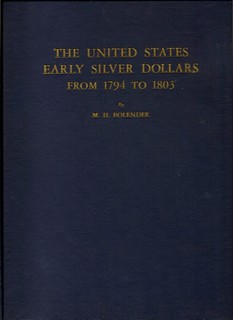
M. H. Bolender wrote The United States Early Silver Dollars 1794 to 1803. It was published in 1950 with reprints in 1970, 1980, 1982 and 1988. This was not the first book on silver dollars, but it did establish Bolender numbers to describe the series.
Milferd Henry Bolender was born in Orangeville, Illinois, on August 23, 1894. He was the son of Stewald Emerson Bolender (1861-1937) and Clara Alma Beaver (1865-1949). His father was a stone mason. (His name appears variously as Milferd and Milford)
Bolender developed an interest in coins at age 12 after his grandfather gave him a bag of 70 coins as a reward for scholastic achievement. This group included an 1822 English gold sovereign. His first numismatic purchase was a coin book. During the summer of 1910, he took a heavy construction job working ten-hour days at $.15 per hour. He spent his spare money on rare coins. In 1910, he could buy 1909-S VDB cents for $3 a roll and 1908-S Indian cents for half that.
 He graduated from Monroe High School in 1913. Bolender was trained as a teacher in the
Stephenson County Teacher Institute and was assigned to teach in their system of one-room
school houses. In 1913, he was assigned to the school in Waddams Center. In 1915 he was at the
Franklin School in Buckeye. In 1919 he was in Rock City. By 1922, he was the principal there.
He retired from teaching in 1932.
He graduated from Monroe High School in 1913. Bolender was trained as a teacher in the
Stephenson County Teacher Institute and was assigned to teach in their system of one-room
school houses. In 1913, he was assigned to the school in Waddams Center. In 1915 he was at the
Franklin School in Buckeye. In 1919 he was in Rock City. By 1922, he was the principal there.
He retired from teaching in 1932.
Bolender served in the United States Army 14th Infantry 19th Division during the First World War.
He was married to Lillian Winifred Hillquist (1903-1980) on September 5, 1937, in Omaha, Nebraska.
He began as a part time dealer after the war. He and his wife left Orangeville in 1939 after they built a house at 1126 Benson Blvd. in Freeport, Illinois. They moved to San Marino, California, in 1952. Later he moved to Spring Valley, California.
In 1924, before he had joined the ANA he advertised in The Numismatist from a P. O. Box in Rock City, Illinois. In November 1924 he was advertising from P. O. Box 34 in Orangeville, Illinois, and reported that he was conducting mail bid sales every month.
M. H. Bolender joined the American Numismatic Association as member 2776 on January 1, 1925. He conducted the first ANA convention sale in 1929.

Bolender began to conduct mail bid sales in 1925. By 1960, he had conducted about 197 sales. His sale 183 of February 23, 1952, included his own collection. His business was continued by his brother Glen Bolender (1892-1988) as Liberty Coin Co.
The Freeport Journal-Standard reported in their issue of June 4, 1959: "M. H. Bolender, one of the top ten numismatists of the world, was guest speaker at the Freeport Coin Club meeting Wednesday evening at the Junior High School. Mr. Bolender, who lived in Freeport until 1952, is now the longest established coin dealer still active in the business in the United States." He contributed a column "M. H. Bolender Writes" to Numismatic News during 1961 to 1963.
Bolender was known as the "Dean of American Numismatics." He died on November 15, 1977, and is interred at Glen Abbey Memorial Park in San Diego.
On my research journey, I discovered some interesting items in the newspapers.
The Orangeville Courier had an item in their issue of August 26, 1905. This announced that Milferd Bolender celebrated his eleventh birthday on Wednesday. Ice cream and cake were served. In all my years of doing biographical research this is the only time I have seen an eleventh birthday announced in the local paper. There was no announcement for his tenth, twelfth or any other birthday,
The Freeport Journal Standard carried a story on August 11, 1913. Milferd Bollender and two young ladies were involved in an accident on Saturday evening. While driving a buggy in a heavy rainstorm, the buggy went off the road and rolled into a ditch. The horse was uninjured and the passenger were wet with minor injuries.
He was involved in another accident on February 12, 1915, according to The Durand Gazette. While riding with the Orangeville orchestra, their bobsled slipped off an icy road and into a ditch. The riders and their instruments got soaked in an icy ditch.
In May of 1935, the Orangeville Courier reported that Milferd Bolender caught 35 pounds of fish over the weekend. This story was so momentous that it was repeated in The Davis Leader and the Durand Gazette on May 30.
The Stephenson Farmer (Lena, IL) had a story on June 25, 1936. One of Orangeville's well-known citizens, Milferd Bolender, dealer in rare coins, left Thursday for a tour of Europe in search of rarities. He was accompanied by another numismatist, Elias Rasmussen of Minneapolis. He met his future wife on that trip.
Smarty-Pants question of the week: What is the numismatic claim-to-fame for Elias Rasmussen?
This story says nothing about numismatics but says something about the character of the man. He told this story for the Freeport Journal-Standard for March 19, 1960.
"The greatest storm in my life began on April 16, 1921. That was on Friday night. I was in the Brewster Hotel in Freeport. It snowed all night and all day Saturday, and blew so hard that drifts blocked all highways as well as railroads.
I was teaching school at Rock City. In order to be there for Monday morning's classes, I spent most of Sunday walking to Rock City (13 miles). I had to walk extra miles getting around many of the too-deep snowdrifts. I wore a heavy overcoat, 4-buckle overshoes with pants legs tucked in, carried a big suitcase of clothes in one hand, and a long pole in the other, to measure the depth of drifts. I arrived in time for supper, and there was nothing wrong with my appetite, my landlady said.
Monday morning the school directors ordered no school. But Tuesday we had school again, The children had much fun walking on snowdrifts over the tops of fences that bordered the school grounds and fields."
To read earlier E-Sylum articles, see:
M. H. BOLENDER'S COIN CHATTER
(https://coinbooks.org/esylum_v14n28a06.html)
M. H. BOLENDER AUCTION SALE CATALOGS
(https://www.coinbooks.org/esylum_v19n51a06.html)
MILFORD HENRY BOLENDER (1894-1977)
(https://www.coinbooks.org/v24/esylum_v24n04a25.html)

HERITAGE: CENTRAL STATES WORLD AND ANCIENTS
Heritage Auctions will be selling a number of very important coins as part of its CSNS World & Ancient Coins Auction. -Garrett
An exceedingly rare Russian 10 Roubles coin will land in a new collection when it is offered in Heritage's CSNS World & Ancient Coins Platinum Session and Signature® Auction April 29-30. An exceedingly rare Russian 10 Roubles coin will land in a new collection when it is offered in Heritage's CSNS World & Ancient Coins Platinum Session and Signature® Auction April 29-30.


Nicholas II gold Specimen Imperial of 10 Roubles 1896-A? SP61 PCGS
The Nicholas II gold Specimen Imperial of 10 Roubles 1896-A? SP61 PCGS is an extraordinary coin in a high grade, even rarer than originally believed.
"This is a magnificent coin, one that immediately assumes a prominent place in any collection," says Cris Bierrenbach, Vice President of International Numismatics at Heritage Auctions. "Both Krause and Bitkin reported an original mintage of just 125 pieces, but the combined census populations at PCGS and NGC include only a handful of certified pieces. That could mean the original population was smaller than initially reported, or perhaps several specimens were lost, melted or otherwise disposed of. But the definite conclusion here is that this auction represents a rare opportunity to acquire an absolute trophy among Russian coins."


Philip II gold Cruzado (400 Reais) ND (1598-1621) L-B XF45 NGC
Also offered is one of only four known examples of a rare Philip II gold Cruzado (400 Reais) ND (1598-1621) L-B XF45 NGC. Between the angles of the crosses are five dots — it is more common to find just one — making its reverse an unlisted die variety. The Cruzado denomination is one of the many that fell subject to reevaluation during its time in circulation. During the reign of King João III, the cruzado increased from 400 Reais to 500 Reais, but eventually reverted back to the base value in 1584 under King Philip I, under whom the production of the two and four cruzados began. The reverse design of the cruzado also changed, with the cross of Christ becoming the cross of St. George, which is what is presented on the specimen offered in this auction.


Elizabeth II gold Proof Sovereign 1957 PR65 NGC
Part of the intrigue surrounding an Elizabeth II gold Proof Sovereign 1957 PR65 NGC centers on the fact that it was produced for just one year. Due to post-war austerity measures, no gold coins were included in the Queen's Coronation set released to the public, with only a small number of 1953 Coronation gold coins presented to high-ranking officials and institutions to mark the occasion. Sovereign 1957 Proofs are incredibly rare, with estimates ranging from 11 to 20 known pieces.


Victoria Proof "Gothic" Crown 1847 PR63 Ultra Cameo NGC
A Victoria Proof "Gothic" Crown 1847 PR63 Ultra Cameo NGC comes from a type already coveted by serious collectors, but the example offered in this auction is part of a limited subvariety, struck in pure silver with a plain (unlettered) edge.
HERITAGE: VILA RICA COLLECTION SELECTIONS
Heritage Auctions will be selling the Vila Rica Collection Selections of Brazilian Coins, Part I on April 29. Select items are discussed below. -Garrett
The Vila Rica Collection of Brazilian Coins, Part I It is with great pleasure that we present The Vila Rica Collection, Part I, the opening chapter of a remarkable cabinet more than three decades in the making. Built through over 30 years of dedicated and passionate collecting, the Vila Rica Collection was assembled with the ambitious goal of forming a comprehensive record of Brazilian gold, silver, and copper coinage. While rooted in this traditional pursuit of completeness, the collector was notably ahead of his time in prioritizing exceptional quality and eye appeal above all else-an approach that is evident throughout the coins offered here.
Following the successful sale of the silver portion of the collection in May 2021, Heritage Auctions is proud to present the gold coinage in a three-part offering. This first installment, presented at CSNS 2026, begins with early Dutch-Brazil siege coinage and continues through the first official mint emissions of Brazil beginning in 1695, extending through the final issues of João V. These coins represent the formative period of Brazilian numismatics, capturing both the earliest colonial coinages and the emergence of a sophisticated minting tradition in the New World. To further enhance the scope and continuity of the offering, a small number of complementary pieces from outside the Vila Rica cabinet have also been included, helping to provide an even more complete representation of the series.
Future selections from this extraordinary cabinet will continue at ANA 2026 and NYINC 2027, where additional gold rarities will be offered. Complementing these sales, select copper issues from the collection will be presented in partnership with Vila Rica Moedas in June 2026. Together, these offerings represent the culmination of a collector's decades-long pursuit of excellence and historical completeness.
The Vila Rica Collection stands as a testament to dedication, discernment, and a profound appreciation for Brazilian numismatic heritage. Each coin offered within these pages reflects both the rich history of Brazil's colonial and imperial coinage and the careful eye of a collector who sought only the finest examples. We invite you to explore this exceptional collection and wish you the very best of success in your bidding.


Pernambuco. Dutch Colony - Geoctroyeede West-Indische Compagnie (GWC) gold Klippe 3 Guilders (Florins) 1646 AU55 NGC, KM5.3, LMB-2, Angelini/Lucio-7.1A (this coin), Scholten-1450b (RRR). 1.81gm. The scarcest denomination and scarcest date of this elusive issue with 15 known examples, the present offering displaying wholly original surfaces graced by an amber patina. One can fully appreciate the West Indies monogram, under the III denomination, and ANNO BRASIL 1646, from the first coins ever struck in the Brazilian territory. We note that this piece is one of the few survivors that made it through time and was not salvaged from the Utrecht shipwreck in the 1980's, a find that shifted this extremely rare series (with less than a handful known of each denomination) to a more attainable status, though there are still only a few dozen available to the market outside museum collections. Truly an opportunity for the advanced Brazil type collector and for any trophy hunter.
During the period of Dutch colonization of Brazil (1630-1654), three gold Klippe denominations--of 3, 6, and 12 Guilders--were minted in the Captaincy of Pernambuco for use within Brazil, beginning in October 1645 under the supervision of mint-master Pieter Janssen Bas. However, these issues were not legal tender in the Netherlands, and thus any such pieces that made their way to Europe were exchanged for Dutch Guilders and subsequently melted. Additionally, any such pieces remaining in Brazil after 1654, when the Dutch were finally ousted from South America, would have been melted, as after this period any Portuguese or Brazilian found with a Dutch coin ran the risk of being considered a traitor and hanged. As a consequence, the survival of such pieces at all is extremely uncommon, marking a special opportunity not to be missed by collectors of the Dutch colonial and Brazilian series alike.
Ex. Heritage Auction #3012 (January 2011, Lot 23137); Jacques Schulman (November 1970)
To read the complete item description, see:
Pernambuco. Dutch Colony - Geoctroyeede West-Indische Compagnie
(GWC) gold Klippe 3 Guilders (Florins) 1646 AU55 NGC,
(https://coins.ha.com/itm/brazil/brazil-pernambuco-dutch-colony-geoctroyeede-west-indische-compagnie-gwc-gold-klippe-3-guilders-florins-1646-au55-ngc-/a/3132-30001.s?ic4=ListView-ShortDescription-071515)


Pedro II gold 4000 Reis 1696-(B) AU Details (Harshly Cleaned) NGC, Bahia mint, KM89, LMB-24. Second type, narrow crown. A chiseled survivor exhibiting fully-rendered surfaces.
To read the complete item description, see:
Pedro II gold 4000 Reis 1696-(B) AU Details (Harshly Cleaned)
NGC,
(https://coins.ha.com/itm/brazil/brazil-pedro-ii-gold-4000-reis-1696-b-au-details-harshly-cleaned-ngc-/a/3132-30009.s?ic4=ListView-ShortDescription-071515)


João V gold 6400 Reis (Peça) 1736-B MS62 NGC, Bahia mint, KM151, LMB-136. A prime selection of this early Bahia date, here presenting chiseled motifs on lustrous and somewhat glossy fields.
To read the complete item description, see:
João V gold 6400 Reis (Peça) 1736-B MS62 NGC,
(https://coins.ha.com/itm/brazil/brazil-joao-v-gold-6400-reis-peca-1736-b-ms62-ngc-/a/3132-30063.s?ic4=ListView-ShortDescription-071515)


João V gold 400 Reis 1730-R MS62 NGC, Rio de Janeiro mint, KM144, LMB-153, Guimaraes-1.1, Gomes-J5.86.01 (Rare). Unveiling a true numismatic marvel, this exquisite offering rightfully stands in a league of its own. Distinguished as extremely rare, the census data from both NCG and PCGS reveal that this is the highest graded and only certified Mint State piece known. Its allure is made even more profound by a beautiful champagne-lemon luster that imbues the coin with a mesmerizing glow to the crisp surfaces. Every aspect benefits from a well-executed strike and centering, showcasing the craftmanship's precision of its time. By marrying rarity with its superior grade and stunning visuals, this praiseworthy coin represents a landmark of numismatic excellence.
Ex. Heritage Auction #3110 (November 2023, Lot 30032)
To read the complete item description, see:
João V gold 400 Reis 1730-R MS62 NGC,
(https://coins.ha.com/itm/brazil/brazil-joao-v-gold-400-reis-1730-r-ms62-ngc-/a/3132-30080.s?ic4=ListView-ShortDescription-071515)


João V gold 4000 Reis 1722-R MS62 NGC, Rio de Janeiro mint, KM102, LMB-174a. Inverted reverse variety. A breathtaking survivor of this seldom-seen variety, here offering satin lustrous fields with soundly-struck motifs.
To read the complete item description, see:
João V gold 4000 Reis 1722-R MS62 NGC,
(https://coins.ha.com/itm/brazil/brazil-joao-v-gold-4000-reis-1722-r-ms62-ngc-/a/3132-30101.s?ic4=ListView-ShortDescription-071515)


João V gold 12800 Reis (Dobra) 1731/0-R MS62 NGC, Rio de Janeiro mint, KM140, cf. LMB-197 (unlisted overdate). First type, oval shield. Fleur-de-Lis over diagonal edge. An absolutely stellar piece with ample cartwheel luster and somewhat glossy outer-peripheries. The devices, impressively engraved for the issue, were rendered from new dies, only adding to this piece's eye-appeal. Unsurprisingly, the sole finest and only Mint State piece recorded by NGC.
The law of November 29th, 1732 prescribed that the minting of milled edge issues should cease, establishing the new fleur-de-Lis edge. These measures came about not only as a result of the widespread circulation of clipped/tampered coins, but also due to the great number of counterfeits then seen in exchange. The coins were to be re-melted (with larger denominations such as the Dobras getting the new edge applied over the old diagonal one), removing the milled edge issues from circulation and uniformizing the new fleur-de-Lis types around the colony. According to the the 1732 Law, whoever was found carrying these old-edge issues would be considered a counterfeiter, suffering the severe sanctions of 4 years of exile in Africa, as well a fine on top of having the unlawful coins confiscated. The very few that survived this period are likely pieces that found themselves away from circulation, perhaps hidden in hoards, taken out of Brazil or lost at sea.
According to consignor, this piece is pedigreed to the Antonio Joaquim da Costa Collection
Metal: Gold
Diameter: 36mm
AGW: 0.8455oz
Melt Value: $4,049.94
Gold Spot: $4,790/oz (04-18-2026 10:53AM CT)
To read the complete item description, see:
João V gold 12800 Reis (Dobra) 1731/0-R MS62 NGC,
(https://coins.ha.com/itm/brazil/brazil-joao-v-gold-12800-reis-dobra-1731-0-r-ms62-ngc-/a/3132-30119.s?ic4=ListView-ShortDescription-071515)


João V gold 400 Reis (Cruzadinho) 1734-R UNC Details (Cleaned) NGC, Rio de Janeiro mint, KM152, LMB-198. One-year type. Despite the grade qualifier, this piece showcases lots of residual luster to the needle-point motifs. Considering RLM's a Fine Details and Eliasberg's a VF details, this is surely a solid survivor.
To read the complete item description, see:
João V gold 400 Reis (Cruzadinho) 1734-R UNC Details (Cleaned)
NGC,
(https://coins.ha.com/itm/brazil/brazil-joao-v-gold-400-reis-cruzadinho-1734-r-unc-details-cleaned-ngc-/a/3132-30120.s?ic4=ListView-ShortDescription-071515)


João V gold 4000 Reis 1749-(L) AU55 NGC, Lisbon mint, KM164, LMB-292. One-year type struck in Lisbon for the Maranhão province. Softly struck, yet sharp, all dressed in amber hues.
To read the complete item description, see:
João V gold 4000 Reis 1749-(L) AU55 NGC,
(https://coins.ha.com/itm/brazil/brazil-joao-v-gold-4000-reis-1749-l-au55-ngc-/a/3132-30188.s?ic4=ListView-ShortDescription-071515)
HERITAGE: THE ALAMO COLLECTION
Heritage Auctions will be selling the Alamo Collection of Colonial Coins on April 30. Select items are discussed below. -Garrett
The Alamo Collection of U.S. Colonial Issues This diverse 314-lot Colonials collection is featured in its own standalone catalog and Floor Session 2. This collection spans the full gamut of American Colonial coinage, rare varieties, high-end condition rarities, and seldom-seen types. These coins demonstrate the highest level of numismatic scholarship and discipline to comprise one of the greatest single offerings of important Colonial coinage in modern times.


1662 Oak Tree Twopence, Small 2, Noe-30, W-240, Salmon 1-A, R.4, AU55 PCGS. 13.9 grains. A pleasing Choice AU example with lilac, sea-green, and powder-blue toning. Noe-30 was struck from misaligned dies, and surviving pieces have the appearance of an off-center strike toward 7 o'clock. Designated as Garrett on the PCGS insert, though the present coin was neither lot 1212 or 1213 in the October 1980 Bowers and Ruddy catalog, and a Garrett pedigree is disavowed in its 2003 Stack's catalog appearance. Listed on page 8 of the 2026 Guide Book.
Ex: Cumberland Investment Corporation, 1/1988; Hain Family
Collection (Stack's, 1/2002), lot 78; Red Bank Collection (Stack's,
12/2003), lot 330.
To read the complete item description, see:
1662 Oak Tree Twopence, Small 2, Noe-30, W-240, Salmon 1-A, R.4,
AU55 PCGS.
(https://coins.ha.com/itm/colonials/1662-oak-tree-twopence-small-2-noe-30-w-240-salmon-1-a-r4-au55-pcgs-pcgs-915751-/a/1393-3264.s?ic4=ListView-ShortDescription-071515)


1652 Pine Tree Shilling, Large Planchet, Pellets at Trunk, AU55 NGC. Noe-1, W-690, Salmon 1-A, R.2. 71.5 grains. The Noe-1 Pine Tree shillings are plentiful in all grades and they are ideally suited to represent the Pine Tree type in a colonial type collection. Indeed it is the opinion of many that this is the best variety to choose as a representative of colonial America. Light wear defines the grade of this pleasing blue-steel and cinnamon-brown shilling that is housed in an earlier generation NGC holder. Listed on page 9 of the 2026 Guide Book.
To read the complete item description, see:
1652 Pine Tree Shilling, Large Planchet, Pellets at Trunk, AU55
NGC. Noe-1, W-690, Salmon 1-A, R.2.
(https://coins.ha.com/itm/colonials/1652-pine-tree-shilling-large-planchet-pellets-at-trunk-au55-ngc-noe-1-w-690-salmon-1-a-r2-pcgs-800852-/a/1393-3265.s?ic4=ListView-ShortDescription-071515)


(1659) Lord Baltimore Shilling, H. 1-A, W-1080, R.6, XF40 PCGS. A partly lustrous light silver-gray example with moderate waviness to the planchet. There are a couple of ancient hairline scratches on the obverse that are not a particular distraction. The centering is excellent. Clash marks of denticles are present beneath the II, as usually encountered on survivors of this rare issue. The Lord Baltimore Shilling was struck at the Tower Mint in London circa 1659, under the authority of the second Lord Baltimore, Cecil Calvert (1606-1675). The pieces were eventually exported to the Maryland colony, where they were expected to remain since they were underweight. However, they had largely disappeared from circulation by 1700, unlike the contemporary Massachusetts pieces struck locally in greater quantity. Listed on page 10 of the 2026 Guide Book.
Ex: Atlanta Signature (Heritage, 8/2001), lot 5016; Steve Glenn Collection/Central States Signature (Heritage, 4/2006), lot 7.
To read the complete item description, see:
(1659) Lord Baltimore Shilling, H. 1-A, W-1080, R.6, XF40
PCGS.
(https://coins.ha.com/itm/colonials/-1659-lord-baltimore-shilling-h-1-a-w-1080-r6-xf40-pcgs-pcgs-931464-/a/1393-3270.s?ic4=ListView-ShortDescription-071515)


1723 2PENCE Rosa Americana Twopence, Martin 3.14-E.14, W-1334, R.8, MS64 PCGS. William Wood purchased a coinage patent from King George I and struck a number of issues for Ireland and the American colonies. These included Rosa Americana halfpennies, pennies, and twopence, as well as Hibernia farthings and halfpennies. Ireland largely rejected the Wood coinage, and the patent was abandoned in 1725.
When Sydney F. Martin compiled The Rosa Americana Coinage of William Wood that was published through the Colonial Coin Collectors Club (C4) in 2011, he included a table of varieties in known collections. However, he was unaware of any examples of this variety other than the Ford Collection coin that was cataloged as lot 147 in the May 2005 auction of that collection. A satiny and sharply struck near-Gem with consistent medium brown toning. The fields and devices are refreshingly unabraded. In addition to its rarity as a variety, this example is the sole finest of its type that PCGS has certified (2/26). Listed on page 13 of the 2026 Guide Book.
Ex: Lorin G. Parmelee (New York Coin and Stamp, 6/1890), lot 538; John G. Mills (S.H. & H. Chapman, 4/1904), lot 73; George H. Earle (Henry Chapman, 6/1912), lot 1977; F.C.C. Boyd Estate; John J. Ford, Jr. (Stack's, 5/2005), lot 147; Milwaukee ANA Signature (Heritage, 8/2007), lot 1514; Liberty Collection of American Colonial Coinage/Long Beach Signature (Heritage, 5/2008), lot 1844.
To read the complete item description, see:
1723 2PENCE Rosa Americana Twopence, Martin 3.14-E.14, W-1334,
R.8, MS64 PCGS.
(https://coins.ha.com/itm/colonials/1723-2pence-rosa-americana-twopence-martin-314-e14-w-1334-r8-ms64-pcgs-pcgs-128-/a/1393-3298.s?ic4=ListView-ShortDescription-071515)


1722 Hibernia Farthing, M. 1.1-A.1, W-12200, R.5, MS63 Brown PCGS. 56.6 grains, per the Garrett description. Traces of original red reside on the glossy brown surfaces of this pleasing Select Mint State example that is well centered with strong design details. Slight planchet roughness is as made. The 1722 farthing with the D:G: REX legend is considered a rarity in the series, although Sydney Martin assigns an R.5 rating, suggesting that the variety is more available today than when Breen estimated 8-10 known in 1988. We have handled less than 10 of these over more than three decades of tracking auction appearances. Listed on page 15 of the 2026 Guide Book.
Ex: Waldo C. Newcomer; Wayte Raymond, 9/1921; John Work Garrett; Garrett Collection, Part 3 (Bowers and Ruddy, 10/1980), lot 1257; Liberty Collection of American Colonial Coinage/Long Beach Signature (Heritage, 5/2008), lot 1845.
To read the complete item description, see:
1722 Hibernia Farthing, M. 1.1-A.1, W-12200, R.5, MS63 Brown
PCGS.
(https://coins.ha.com/itm/colonials/1722-hibernia-farthing-m-11-a1-w-12200-r5-ms63-brown-pcgs-pcgs-921455-/a/1393-3299.s?ic4=ListView-ShortDescription-071515)


1787 COPPER Immunis Columbia, Eagle Reverse, MS62 Brown PCGS. W-5680, High R.4. These copper pieces are often cataloged as pattern coins with the intent of securing a coinage contract, although enough survive in circulated grades to suggest they may have served as a private commercial coinage. These and related pieces are listed in the Guide Book as "speculative issues, tokens, and patterns." This lovely example features splendid chocolate and olive-brown surfaces with slight central weakness as usual. Trivial marks limit the grade. PCGS Population: 4 in 62, 9 finer (2/26). Listed on page 25 of the 2026 Guide Book.
To read the complete item description, see:
1787 COPPER Immunis Columbia, Eagle Reverse, MS62 Brown
PCGS.
(https://coins.ha.com/itm/colonials/1787-copper-immunis-columbia-eagle-reverse-ms62-brown-pcgs-w-5680-high-r4-pcgs-841-/a/1393-3393.s?ic4=ListView-ShortDescription-071515)


1799 MEDAL Gold Funeral Urn Medal AU55 NGC. Baker-166, Fuld Dies 1-B, GW-70. Plain edge. 29.3 mm. 206.5 grains. George Washington was a favorite subject of medalists over the years, and a wide series of death medals were produced. The Funeral Urn medals were part of a series of gold, silver, and tin medals produced by Newburyport, Massachusetts engraver Jacob Perkins. This example is from the comprehensive John Ford Collection, which contained nearly two dozen such pieces in various dies and medals.
The obverse features a profile of Washington within a closed wreath, around, the inscription HE IS IN GLORY, THE WORLD IN TEARS. The reverse has a large funeral urn with script GW. The abbreviated reverse legend lists milestone events in Washington's life. He was born on February 11, 1732, was General of the American Army from 1775 to 1783, President of the United States of America from 1789 to 1796, General of the Army of the United States in 1798, and died December 14, 1799.
This is a pleasing example with reflective bright yellow-gold surfaces. The fields near the major devices exhibit a few pinscratches, most prominent near the profile. It is holed at the top as issued (19 of 22 funeral medals in the Ford Collection were holed). A minor planchet depression is visible at the right end of the pedestal below the urn.
Ex: F.C.C. Boyd Estate; John J. Ford, Jr. (Stack's, 5/2004), lot 170; Columbus Central States Signature (Heritage, 4/2006), lot 198; Milwaukee ANA Signature (Heritage, 8/2007), lot 1535; FUN Signature (Heritage, 1/2008), lot 2649; Liberty Collection of American Colonial Coinage/Long Beach Signature (Heritage, 5/2008), lot 2070.
To read the complete item description, see:
1799 MEDAL Gold Funeral Urn Medal AU55 NGC.
(https://coins.ha.com/itm/colonials/1799-medal-gold-funeral-urn-medal-au55-ngc-baker-166-fuld-dies-1-b-gw-70-pcgs-505010-/a/1393-3539.s?ic4=ListView-ShortDescription-071515)


1787 1C Fugio Cent, STATES UNITED, 4 Cinquefoils, Pointed Rays, N. 13-X, W-6855, R.2, MS65 Brown PCGS. CAC. Newman 13-X is undoubtedly the most plentiful Fugio cent variety today, thanks to the New York Hoard that contained 726 examples of this combination (44% of the entire hoard). It is probably the case that many of those coins, discovered in the 1850s, still survive in or near Mint State, providing collectors with an opportunity to obtain a high quality example. In United States Fugio Copper Coinage of 1787 [Ypsilanti, MI: Jon Lusk, 2008], Eric P. Newman comments on the hoard: "Today, while Mint State Fugio coppers are seen as a glorious addition to a numismatist's cabinet, their very existence underlines their failure as a circulating medium." This lovely copper has highly lustrous surfaces and deep chocolate color that is blended with considerable original mint red, nearly enough to qualify for a "RB" designation. PCGS Population for the type (multiple varieties): 22 in 65 (2 in 65+), 5 finer (2/26). Listed on page 52 of the 2026 Guide Book.
Ex: Long Beach Signature (Heritage, 9/2008), lot 58.
To read the complete item description, see:
1787 1C Fugio Cent, STATES UNITED, 4 Cinquefoils, Pointed Rays,
N. 13-X, W-6855, R.2, MS65 Brown PCGS. CAC.
(https://coins.ha.com/itm/federal-contract-coinage/1787-1c-fugio-cent-states-united-4-cinquefoils-pointed-rays-n-13-x-w-6855-r2-ms65-brown-pcgs-cac-pcgs-/a/1393-3565.s?ic4=ListView-ShortDescription-071515)

HERITAGE: CENTRAL STATES U.S. COIN AUCTION
Heritage Auctions will be hosting their Central States Signature auction of U.S. coins from April 29 to May 2. Select items from the Curators' Picks are discussed below. -Garrett


1880 $4 Flowing Hair, Judd-1657, Pollock-1857, JD-1, R.6, PR65 NGC. CAC. One cannot deny the worthiness of the 1879 and 1880 Coiled Hair stellas in this auction to be included in a list of favorite lots. They are rare, beautiful, and in all things captivating. However, I find myself increasingly appreciative of the CAC-endorsed Gem 1880 Flowing Hair coin in lot 3167. In my opinion, the 1880 Flowing Hair is significantly underrated, largely due to the shadow-casting fame of the two Coiled Hair issues. In reality, the 1880 Flowing Hair is nearly as rare as the 1879 Coiled Hair; just 18 examples are traced, and they appear at auction just as infrequently as the 1879 Coiled Hair specimens. If I had to guess, I'd say this issue is restrained in terms of collector appreciation due to it sharing its design type with the widely available 1879 Flowing Hair stella. But in my opinion, this is a travesty. The 1880 Flowing Hair is a major rarity, and this is a stunning example.
To read the complete item description, see:
1880 $4 Flowing Hair, Judd-1657, Pollock-1857, JD-1, R.6, PR65
NGC. CAC.
(https://coins.ha.com/itm/proof-four-dollar-gold-pieces/1880-4-flowing-hair-judd-1657-pollock-1857-jd-1-r6-pr65-ngc-cac/a/1393-3167.s?ctrack=200071&type=bodylink-4+-coinus-picks-1393-CSNS-tem042326)


1860-O 50C Half Dollar -- Indented by Half Dime Planchet, Mated Pair -- MS63 PCGS. What can be said about this incredible mated pair error that hasn't already been spoken? Whether it is the Coin World article, the countless online forum posts surrounding the discovery, its first auction appearance in our CSNS Platinum Session® -- this 1860-O half dollar mated pair has become quite the sensation for error collectors. Either one of the two pieces alone would be significant from that era, but the two remaining together after more than one and a half centuries is seemingly impossible: yet, here they are. The deep toning speaks to the originality of the pair and is what I expect of a coin from this period that had been stored inside paper and never messed with. And the visual aspect of the error itself is like none other I have seen on 19th century coinage.
To read the complete item description, see:
1860-O 50C Half Dollar -- Indented by Half Dime Planchet, Mated
Pair -- MS63 PCGS.
(https://coins.ha.com/itm/errors/1860-o-50c-half-dollar-indented-by-half-dime-planchet-mated-pair-ms63-pcgs/a/1393-3097.s?ctrack=200071&type=bodylink-4+-coinus-picks-1393-CSNS-tem042326)


1916 25C Standing Liberty Quarter, Judd-1989, Pollock-2050, R.8, PR61 NGC. If you know me, you knew this SLQ pattern was going to be one of my top picks for this auction. Being a student of the Standing Liberty series, discovering this coin in 2018 has been one of my favorite memories as a collector and professional numismatist. But personal sentiment aside, this Judd-1989 is also numismatically significant. There are only two examples of this pattern known, and only three privately held pattern SLQs across both pattern issues. Both of the other privately held patterns, including the other Judd-1989 example, are tightly owned off the market. This piece appearing for only its second time in history represents what is perhaps a once-in-a-lifetime opportunity for the advanced specialist.
To read the complete item description, see:
1916 25C Standing Liberty Quarter, Judd-1989, Pollock-2050, R.8,
PR61 NGC.
(https://coins.ha.com/itm/standing-liberty-quarters/1916-25c-standing-liberty-quarter-judd-1989-pollock-2050-r8-pr61-ngc/a/1393-3061.s?ctrack=200071&type=bodylink-4+-coinus-picks-1393-CSNS-tem042326)


1927-S 25C MS65+ Full Head PCGS. CAC. I'll let this coin stand as representative of my admiration for many of the Standing Liberty quarters in this auction. The CSNS offering of this series spans several consignments, but especially two Featured Collections: The Big Sky Collection, Part II, and The Pizza Collection. Between the two of these, we are offering a significant number of the coins from the former Just Having Fun Registry Set, as well as other Registry-grade pieces that have been off the market for years or even decades. I could create an entire picks list from just these two collections. The 1927-S in MS65+ Full Head PCGS CAC in discussion here is from The Pizza Collection offering, and it has been off the market for 16 years. Its exceptional strike, luster, and eye appeal are reminiscent of what one might see on a 1929-S or 1930-S Gem Full Head. This eye appeal on a 1927-S is almost unheard of.
To read the complete item description, see:
1927-S 25C MS65+ Full Head PCGS. CAC.
(https://coins.ha.com/itm/standing-liberty-quarters/1927-s-25c-ms65-full-head-pcgs-cac/a/1393-3089.s?ctrack=200071&type=bodylink-4+-coinus-picks-1393-CSNS-tem042326)


1854 $20 Kellogg Twenty Dollar Copper Die Trial MS64 Brown PCGS. K-1. If you'll allow me two more picks, I'll be quick. First, the Kagin-1 Kellogg twenty dollar copper die trial, formerly of the Virgil Brand pedigree. It is one of only three pieces we have been able to trace, and it is the second finest of those. The finer piece has not appeared at auction in 25 years. This one has not appeared since 2012.
To read the complete item description, see:
1854 $20 Kellogg Twenty Dollar Copper Die Trial MS64 Brown PCGS.
K-1.
(https://coins.ha.com/itm/territorial-gold/1854-20-kellogg-twenty-dollar-copper-die-trial-ms64-brown-pcgs-k-1/a/1393-3253.s?ctrack=200071&type=bodylink-4+-coinus-picks-1393-CSNS-tem042326)


1872-CC 10C F-101, Low R.4 -- Struck Through Obverse -- XF45 PCGS. Second, the 1872-CC Seated Liberty dime in XF45 PCGS. PCGS notes the obverse is struck through. Much of OF AMERICA is struck through grease or some other debris (a filled die error). We have seen one other example with this same strike-through feature. I highlight this coin because, for an 1872-CC, it is outstanding. I cannot recall the last time I saw such excellent color and strong detail in combination on an XF coin. This piece came to us raw, and I remember the day one of the graders here at Heritage brought it to me for an opinion on its strike-through feature. After examination, I gave the opinion that it was a problem-free coin struck through, and I was able to find the other example with the same feature. We sent it for grading, and PCGS agreed. For collectors seeking a nice 1872-CC, this is a very handsome coin.
To read the complete item description, see:
1872-CC 10C F-101, Low R.4 -- Struck Through Obverse -- XF45
PCGS.
(https://coins.ha.com/itm/seated-dimes/1872-cc-10c-f-101-low-r4-struck-through-obverse-xf45-pcgs/a/1393-3676.s?ctrack=200071&type=bodylink-4+-coinus-picks-1393-CSNS-tem042326)


1818 1/2 RL New Spain (Texas) Jola Half Real, Large Planchet XF40 NGC. W-8542, R.6. "I wasn't born in Texas, but I got here as fast as I could" is a fairly common bumper sticker one sees on roadways of this great state. It describes me. I'm not a native, but I've lived here most of my life, I married a Texas girl, and I have two Texas babies, so the Texan in me runs deep, hence my love for this issue. It appeals to my interest in numismatics and Texas history. It's also rare. The person holding one of these in their hands is transported to New Spain - pre-Texas Republic and pre-statehood.
To read the complete item description, see:
1818 1/2 RL New Spain (Texas) Jola Half Real, Large Planchet
XF40 NGC. W-8542, R.6.
(https://coins.ha.com/itm/colonials/1818-1-2-rl-new-spain-texas-jola-half-real-large-planchet-xf40-ngc-w-8542-r6/a/1393-3493.s?ctrack=200071&type=bodylink-4+-coinus-picks-1393-CSNS-tem042326)


1862 H10C PR68+? Cameo NGC. CAC. Half dimes tend to be too small for my taste, but this one is grandiose in its own way! Loved from the day it was made, this coin has all the third-party accolades; 68 Cameo is tied for the highest graded with just one other coin, plus, star, and CAC. I don't have to see the other 68 Cameo to know I'd rather own this one. There is a beautiful ROYGBIV progression from the denticles inward on both sides with some of the original silver peeking out on the devices in the center. This lot takes a back seat to no proof half dime.
To read the complete item description, see:
1862 H10C PR68+? Cameo NGC. CAC.
(https://coins.ha.com/itm/proof-seated-half-dimes/1862-h10c-pr68-and-9733-cameo-ngc-cac/a/1393-3038.s?ctrack=200071&type=bodylink-4+-coinus-picks-1393-CSNS-tem042326)


1933 $10 MS65 PCGS. CAC. When reflecting on Augustus Saint-Gaudens' designs most folks would probably first mention the twenty-dollar issue with Liberty hoisting the torch. In this humble numismatist's opinion, the $10 Indian is a prettier, more dramatic design. This Gem graded specimen has a nice strike resulting in the Saint-Gaudens trademark relief on the head dress on the obverse and the eagle on the reverse. If one were to be so ambitious as to collect type rarities, this 1933 $10 would be a feather in the cap - bad Dad pun intended.
To read the complete item description, see:
1933 $10 MS65 PCGS. CAC.
(https://coins.ha.com/itm/indian-eagles/1933-10-ms65-pcgs-cac/a/1393-3205.s?ctrack=200071&type=bodylink-4+-coinus-picks-1393-CSNS-tem042326)


1882 5C MS67+ PCGS. CAC. This example of the penultimate year of the Shield Nickel series is a stunning coin, one with remarkable toning and numerous appealing die cracks. With the Civil War ending in mid-1865, the Shield nickel's debut in 1866 marked it as the first new design in an actively re-unifying United States. To own this late series example of such a historically significant coin in MS67+ CAC is a rare opportunity.
To read the complete item description, see:
1882 5C MS67+ PCGS. CAC.
(https://coins.ha.com/itm/shield-nickels/1882-5c-ms67-pcgs-cac/a/1393-3030.s?ctrack=200071&type=bodylink-4+-coinus-picks-1393-CSNS-tem042326)


1914-D 1C MS65 Red and Brown PCGS. CAC. The Lincoln cent series is not one that usually garners too much excitement from me, but this 1914-D in MS65 Red and Brown CAC is an exception. This coin exhibits incredible, natural color, with a warm golden-brown obverse and minimal marks. 1914-Ds are seldom seen in such condition, especially paired with a CAC endorsement.
To read the complete item description, see:
1914-D 1C MS65 Red and Brown PCGS. CAC.
(https://coins.ha.com/itm/lincoln-cents/1914-d-1c-ms65-red-and-brown-pcgs-cac/a/1393-3608.s?ctrack=200071&type=bodylink-4+-coinus-picks-1393-CSNS-tem042326)


1922 $1 Modified High Relief Production Trial, Judd-2020, MS65 PCGS. CAC. Subtype 2-A. With "3200" adorning the obverse of this "medium relief" Peace dollar, it is obvious that this coin has a story to tell. My favorite coins are ones accompanied by captivating stories, and the history of the 1922 Peace dollar is anything but boring. After continual die failures, experimental modified high relief Peace dollars were struck, with this example being the final of 3,200 coins. This is a true numismatic rarity, and a very cool piece of numismatic history.
To read the complete item description, see:
1922 $1 Modified High Relief Production Trial, Judd-2020, MS65
PCGS. CAC. Subtype 2-A.
(https://coins.ha.com/itm/peace-dollars/1922-1-modified-high-relief-production-trial-judd-2020-ms65-pcgs-cac-subtype-2-a/a/1393-3130.s?ctrack=200071&type=bodylink-4+-coinus-picks-1393-CSNS-tem042326)


1787 1/2 C Massachusetts Half Cent, R. 4-C, W-5940, R.2, MS65 Brown PCGS. This looks to be an extremely pleasing specimen. The Brown designation belies a coin with ample subtle red undertones. I owned a pleasing AU piece years ago, and the fact that Joseph Callender was the possible engraver always held appeal!
To read the complete item description, see:
1787 1/2 C Massachusetts Half Cent, R. 4-C, W-5940, R.2, MS65
Brown PCGS.
(https://coins.ha.com/itm/colonials/1787-1-2-c-massachusetts-half-cent-r-4-c-w-5940-r2-ms65-brown-pcgs/a/1393-3344.s?ctrack=200071&type=bodylink-4+-coinus-picks-1393-CSNS-tem042326)


1919-D 50C AU58 PCGS. CAC. As one of the keys to the early set of Walkers, this coin stands out nicely. Pleasing originality and minimal marks designate this as a great put-away coin. Very well struck for a 1919-D!
To read the complete item description, see:
1919-D 50C AU58 PCGS. CAC.
(https://coins.ha.com/itm/walking-liberty-half-dollars/1919-d-50c-au58-pcgs-cac/a/1393-3838.s?ctrack=200071&type=bodylink-4+-coinus-picks-1393-CSNS-tem042326)


1885 $3 AU53 PCGS. This coin is a good example of why I've always liked the three dollar series as a doable set, other than the unique 1870-S. The piece has a scant mintage of only 800 pieces, but is still relatively affordable. Seems like good value and a lot of fun!
To read the complete item description, see:
1885 $3 AU53 PCGS.
(https://coins.ha.com/itm/three-dollar-gold-pieces/1885-3-au53-pcgs/a/1393-4106.s?ctrack=200071&type=bodylink-4+-coinus-picks-1393-CSNS-tem042326)
Heritage has been busy! Lots of great auction material to consider. I enjoy the previews, with lots of rarities to learn about. -Editor

WAYNE'S NUMISMATIC DIARY: APRIL 26, 2026
Tuesday April 21, 2026 was the meeting night of my Northern Virginia numismatic social group, Nummis Nova. Mike Markowitz and Robert Hoppensteadt were our co-hosts. Robert and various regulars were unable to attend this month, and we had a more intimate group consisting of me, Mike, Tom Kays, Dave Schenkman, John "JK" Kraljevich, Julian Leidman, and Erik Douglas. Our venue was a repeat performance from last month - Southside 815 in Alexandria.


My exhibits consisted of a group of recent numismatic periodicals and a couple of non-numismatic books. I recently completed "The Infinity Machine: Demis Hassabis, DeepMind, and the Quest for Superintelligence" by Sebastian Mallaby, and just started the new book by Richard Vague, "The Banker Who Made America: Thomas Willing and the Rise of the American Financial Aristocracy, 1731-1821."
Although it was a smaller than usual group, the numismatic exhibits and conversation were as fulfilling as ever. JK and I talked about the 8th Regiment U.S. Colored Troops medal discussed by Matt Robinson last week, and the new book on British Evasion Coppers by Tim Montgomery. Since JK is currently cataloging Richard August's evasion coppers for Stack's Bowers Galleries, Montgomery's book release is timely. And since JK missed last month's dinner I brought along my slabbed 1850 dime recovered from the S.S. Central America. We agreed it's a nice one.


Wayne's S.S. Central America Dime

Erik and Julian Perusing the Periodicals

Tom Kays
And speaking of Tom, here's his thoughtful take on the meeting and great photos of material passed around.
Nummis Nova April 2026 – Tom's Take
The April 2026 meeting of Nummis Nova returned to our cozy Southside 815 venue with a smaller crew than last month, but we had double the enthusiasm. From the left are Julian, Dave, John, Tom, Wayne, Mike, and Erik.

The first thing I noticed in swarms of things going by every which way were some no doubt scarce, notes and tokens for old patent medicine cures (be assured these were no quack remedies) for what was known back then as the social disease, the great social evil, the great scourge, or French disease. Remedies from ‘Con-Cure,' ‘Doctor Crooks' (perhaps aptly named?), Doctor L. C. Rose, and Doctor Andrews were on offer to poor sufferers.


Eric and Julian at Bonanza Coins in Maryland had a very nice 19th century proof set cross their coin shop counter recently and they decided to adopt it. From the denominations shown in reverse, can you guess the year of issue, or at least the possible date range for this denomination configuration of proof sets? Hint, the Morgan Dollar is missing. Look for the answer at the end of this section.


19th Century Proof Set coins
A nice bunch of ancient gold coins went by including Byzantine, Roman, and Persian coins. Here are two from this golden hoard.


Byzantine Gold Semissis of Phillipicus (AD 711 – 713) from the Constantinople Mint
Phillipicus is wearing a loros with globus cruciger and eagle tipped scepter. The reverse shows the Christian cross on top of globe.


Roman gold Tremissis of Aelia Eudocia Augusta (AD 423 – 460) wearing pearl diadem and earrings from the Constantinople Mint, struck under Roman Emperor Theodosius II
 A frame of coins went by intending to show how the Spanish Dollar and Spanish Pistareen
were cut to make sharp silver change. Typically, folks simply draw lines across a modern
copy of a Spanish Milled Dollar to indicate how bits were guillotined, but such a simple
drawing does not tell the whole story. Spanish colonial dollars, Spanish double dimes
(pistareens) and half pistareens (basis for the dime) were all cut to make many fractions that
would have been instantly recognizable to colonial merchants but often remain a mystery
today. Whole coins are on the left and their cut equivalent sharp silver on the right. For
instance, if you needed a half dime in change you could look for a half dime or quarter
pistareen, but finding none, then cut a half pistareen in half, or a full pistareen into quarters.
A frame of coins went by intending to show how the Spanish Dollar and Spanish Pistareen
were cut to make sharp silver change. Typically, folks simply draw lines across a modern
copy of a Spanish Milled Dollar to indicate how bits were guillotined, but such a simple
drawing does not tell the whole story. Spanish colonial dollars, Spanish double dimes
(pistareens) and half pistareens (basis for the dime) were all cut to make many fractions that
would have been instantly recognizable to colonial merchants but often remain a mystery
today. Whole coins are on the left and their cut equivalent sharp silver on the right. For
instance, if you needed a half dime in change you could look for a half dime or quarter
pistareen, but finding none, then cut a half pistareen in half, or a full pistareen into quarters.
Additional oddments included two shaving tokens (5 Cents at Cecil's Barber Shop in Florida), (One Shave – Hill) from Cincinnati, a T. W. Newman Steam-Powered Carousel token ‘Good for One Ride,' 5 Riyals in Saudi Arabian currency found at a shopping center, and a 2026 Heritage Auctions "Eid Mar" pin all have their own stories to tell.
In what years did the US Mint make Trade Dollars, Shield Nickels, and Three Cent Nickels (as well as halves, quarters, dimes, and cents)? Shield Nickels (without stars and bars) were made from 1867 to 1883. Trade dollars were made from 1873 to 1885. Three Cent Nickels were made from 1851 to 1889. No Two Cent Piece is present to rule out 1873. With no Morgan Dollar you might think the set dates between 1874 and 1877 but the hint was that it is missing. So 1878 – 1883 should have been your possible date range.


People gradually peeled away until it was just Tom and I. We talked about my impending retirement from my day job, Tom's advice and my plans (not much yet, other than continuing to edit The E-Sylum without having to cram all the work into my weekends).
It was another great evening of numismatic fellowship, but it wasn't my last outing for the week. Since many of our readers are history and colonial buffs, here's a report.
A Reading of "Common Sense" by Thomas Paine
 In the late autumn of 1775, Thomas Paine wrote his famed Common Sense to influence swaying public opinion on the 13 American colonies potential independency. The recently arrived Englishman's passionate yet clear-cut arguments were in print in a cheap paperback version released in Philadelphia on January 10, 1776. It arrived in Loudoun County, Virginia just nine days later—which says something about its relevant urgency!
Shared from person to person, often read aloud in taverns, ordinaries, and other public houses, that it caught on this way—as was intended—gives us a sense of how its pithy arguments were able to influence public opinion. After it was read or heard, conversations (and likely arguments) inevitably followed. That American public opinion shifted towards independence between January and July of 1776 is one of the great, speedy crystallizations of public thought in history.
The Loudoun VA250 Committee, established in 2022 to promote interest and programming for America's Semiquincentennial during 2023-2033, is teaming with the Loudoun Preservation Society to offer a public reading of Common Sense on the evening of April 23. Presented as "an antiphonal reading," the public reading will be held at the historic Goose Creek Friends Meeting in the village of Lincoln (formerly Goose Creek) just south of Purcellville. Just across the street from this current 1817 meetinghouse lies the 1765 original meetinghouse, where central western Loudoun Friends—"Quakers"—attended at the time of the excitement over Common Sense.
Ironically, Goose Creek Quakers, who did not believe in war, were suspected by some of Loyalist rather than Patriot sympathies. But it was a lovely event, and the drive there was like time travel in itself. Although I live in the belly of the internet/AI beast, the data center capital of Ashburn, VA, one need only drive 15 minutes in the right direction to be in farm country. Lincoln is about half an hour away, and not long after leaving the highway my handy GPS led me down winding country roads past farms and fields. The last stretch of several miles was a gravel road and my car kicked up a sizable cloud of dust. It was a beautiful evening for a scenic ride and I wish I could have taken some photos of several classic farm houses, barns, and a log cabin.
 As I approached my destination I spotted the old stone meetinghouse at the top of a hill and pulled into an adjacent parking lot which I pictured being filled with horsecarts and buggies 250 years ago. I took a few photos, then crossed the street to enter the 1817 meetinghouse where I was warmly greeted. A good crowd was already there and I took a seat in one of the wooden pews. About 80 people were in attendance. The costumed woman next to me was one of the readers. She and her husband grew up nearby and live down the road in an house built in the 1760s, already standing at the publication of Common Sense in 1776.
Attendees were asked to put away their cellphones and "encouraged to participate as 18th century listeners, responding to each of 32 arguments with their voiced sentiments as did our forebears." I got into it with footstomps and the occasional "hear, hear!" and "huzzah!" I stopped myself before shouting "No Kings!", because that phrase has a loaded meaning today. Navigating contemporary politics is a timeless problem.

The 1765 Goose Creek Friends Meetinghouse
Paine's words were powerful and poignant, and one reading brought me to tears, knowing how the words reverberate through the centuries and remain totally relevant today.
Afterwards snacks and drinks (water and lemonade) were served. Huzzah for the ginger snaps! I put cash in the collection box and picked up a copy of a nice pamphlet titled "A Guide to Loudoun in the American Revolution" by the county's Semiquincentennial committee. It was dusk when I left. Many thanks to the Loudoun Preservation Society and the Real (friendly) Quakers of Loudoun County.
For more information, see:
A Public Reading of Common Sense in an Historic Loudoun Venue
(https://www.loudounnow.com/getoutloudoun/a-public-reading-of-common-sense-in-an-historic-loudoun-venue/article_82bb435f-bb4f-4a38-993e-74e5ff050ed7.html)
Keep the Change, Boomer
Today my lunch came to $17.47. As one of the few, the proud, who sometimes pay in cash, I handed over 47 cents in coins and a $20 bill. The cashier handed me back three dollars and the two cents. The cash register rounded my payment down to $17.45. Maybe I should have kept the receipt for my numismatic ephemera collection - one more nail in the penny's coffin.

To read the earlier E-Sylum articles, see:
THE PENNY'S FUNERAL
(https://www.coinbooks.org/v28/esylum_v28n51a08.html)
QUERY: 1863 U.S.COLORED TROOPS MEDAL
(https://www.coinbooks.org/v26/esylum_v26n08a08.html)
8TH REGIMENT U.S. COLORED TROOPS MEDAL, PART 2
(https://www.coinbooks.org/v29/esylum_v29n16a15.html)
SILPHIUM ON ANCIENT COINS
The numismatic aspect is tangential to this recent article about the extinct plant silphium. The coin image is courtesy of the Australian Centre for Ancient Numismatic Studies. -Editor
 Roman leader Julius Caesar is said to have kept a stock of it in the treasury. Ancient writer Pliny the Elder says Rome's Emperor Nero owned the last stalk of it.
And some have suggested rampant extramarital sex in elite Roman circles led to demand outstripping supply, and it dying out altogether.
What is it?
Silphium: an extinct plant that once grew wild in modern-day Libya.
Used for contraception and abortion, medicine, food seasoning, perfume and as a livestock improver, its special properties made this herb one of the most precious commodities in Graeco-Roman antiquity.
Then, one day, it went extinct.
Silphium is often described these days as an aphrodisiac, despite no ancient source confirming this.
Some of the earliest depictions of silphium are of the plant's heart-shaped seedpod, which may be the source of this association.
Resin was extracted from the plant's stems and roots and preserved in flour, which allowed it to make the journey from Libya to further shores.
The Romans called this resin laser or laserpicium. The best laserpicium was extracted from the root, but an inferior type could also come from the stem.
And before the Romans, the Greeks also used silphium; it was so central to some regional economies that it was a frequently depicted motif on coins.
To read the complete article, see:
Ancient Romans were obsessed with a plant said to be contraception and aphrodisiac. Then one day, it went extinct
(https://theconversation.com/ancient-romans-were-obsessed-with-a-plant-said-to-be-contraception-and-aphrodisiac-then-one-day-it-went-extinct-260506)
To read a Mike Markowitz article on the topic, see:
Coinage of Kyrene: A Greek City in Libya
(https://coinweek.com/coinage-kyrene-greek-city-libya/)

AUSTRALIAN WWII SHORT SNORTERS
Don Cleveland passed along this article about short snorters from Australia. -Editor

Australian War Memorial Curator Andy Muir
Andy Muir's eyes widen as he pulls a 4-metre roll of banknotes out of a collection.
Each creased and scribbled turn reveals notes from a new corner of the world — Africa, the Caribbean, Europe, North America, the Pacific and Australia.
The black, hand-drawn signatures on the notes are part of a military tradition of collecting "short snorters".
It was popular during World War II when service members would get comrades, allies and people they met to sign their bank notes as a show of camaraderie.
"There's a lot of downtime in the military, and we see these kinds of little traditions popping up in different ways to allow people to stay in touch," Mr Muir said.
Even 80 years after the currency was graffitied, each scrawl remains a symbol of mateship.
The practice disappeared in the 50s, but a similar tradition of exchanging challenge coins continues.

For historians, each short snorter is a rich list of characters, names, and research leads.
"There's not that many around, but when they do pop up, they're pretty exciting," Mr Muir said.
Surviving examples are rare and are often single banknotes.
So Australian War Memorial curators in Canberra were surprised when the 4-metre-long "short snorter" was donated in 2025.
It belonged to RAAF Flight Lieutenant William Gordon, who was a wireless operator and air gunner during World War II.
"When I first was assessing, it was kind of like, 'What is this thing?'" Mr Muir said.
Don adds:
"I have heard of taped-together short snorters being a yard long, but this one is double that length."
To read the complete article, see:
Australian War Memorial curator amazed to find 4 metres of WWII 'short snorter' banknotes
(https://www.abc.net.au/news/2026-04-21/australian-war-memorial-curator-finds-4-metre-wwii-short-snorter/106576724)

2025 IBNS BANK NOTE OF YEAR
The International Bank Note Society (IBNS) has awarded the 2025 Bank Note of Year award to Curaçao and Sint Maarten. -Garrett


The International Bank Note Society (IBNS) announces that its voting membership has for the first time selected the Central Bank of Curacao and Sint Maarten to receive its annual prestigious "Bank Note of the Year Award" for 2025.
With almost 100 new banknotes released worldwide during 2025, only 17 were deemed of sufficiently new design to be member nominated. From the onset of voting the Curacao and Sint Maarten 200 Gulden note was the overwhelming favorite.
The 200 Gulden is part of a new series launched by the Central Bank with 5 denominations, all drawing inspiration from the "World Under the Sea." The face of each note is horizontally orientated and features marine life native to the islands while the reverse is vertically orientated with historical and cultural landmarks. The winning note is the largest denomination of the set and is predominantly purple and features long snout seahorses and a giant tun shell in blue-to-green OVI on the face. The back of the note showcases the iconic Queen Emma Bridge.
This series of notes are printed on paper by Crane Currency and integrated with many security features: a compass rose watermark with letters XCG, a 3D moving stripe, high-relief printing, color-changing ink, security threads that create an illusion of moving waves, iridescent color, and a see-through register. The tactile markings along the short edges of each banknote help the visually impaired to easily identify the note which is signed by Richard A. Doornbosch (President) and Leila A. Matroos-Lasten (Directory Secretary of the Central Bank).
Curacao and Sint Maarten 200-Dollar Note (Back) The current exchange value of the new Curacao and Sint Maarten bill equals $111 USD, €95 Euros or £83 British Pounds as of the date of this announcement. The 200 Gulden note is 147 x 66 mm, similar in height but slightly shorter than U.S. greenbacks.
Winners of recent IBNS Banknote of the Year competitions are all miniature works of art that represent their nation's popular themes. These winners ideally help provide a superb template as countries consider how they eventually design and promote their own new banknotes. Polymer banknotes continue to be popular IBNS favorites and have become perennial award winners, although this year is an exception. Vertical orientation seems favored with 8 of the last 10 winners being vertically formatted. This year's winner is a hybrid horizontal front and vertical back.
From all significant newly designed and widely circulated banknotes released in 2025, the IBNS membership nominated notes from 17 different countries to place on the ballot. Nominees represented 3 different continents (Africa, Asia, Europe), Central America, the Middle East, and 5 island nations. The first runner-up was Fiji's 5 Dollar note which features a kulawai bird and sea turtle. The second runner-up was Zambia's 100 Kwacha note which features an eagle and giraffes. Rounding out the top five vote getters were Falkland Islands' 5 Pound note (King Charles III), and Papua New Guinea's 50 Kina note (bird of paradise).
Past "Bank Note of the Year" winners include Bermuda (2024), East Caribbean States (2023), Philippines (2022), Mexico (2021 & 2020), Aruba (2019), Canada (2018), Switzerland (2017 & 2016), New Zealand (2015), Trinidad & Tobago (2014), Kazakhstan (2013, 2012 & 2011), Uganda (2010), Bermuda (2009), Samoa (2008), Bank of Scotland (2007), Comoros (2006), Faeroe Islands (2005) and Canada (2004).
Thanks to Kavan Ratnatunga for passing this along. -Editor
LOOSE CHANGE: APRIL 26, 2026
Here are some additional items in the media this week that may be of interest. -Editor
Should be an easy one. Did you get it right? -Editor

There's only one spot outside the nation's capital that you'll see featured on some of the seven U.S. banknotes currently in circulation. The $5 bill features the Lincoln Memorial, while the $10 features the Treasury Building — fitting, since Alexander Hamilton, whose visage adorns the obverse, served as the Treasury Department's first secretary. The $20 and $50 bills finish the architectural tour of Washington with the White House and Capitol, respectively. The $1 is notably absent from this list, as the only building-like structure on its reverse side is a pyramid with a floating eye — and no such pyramid exists in the U.S. (or the world).
To read the complete article, see:
Only one building outside Washington, D.C., is featured on U.S. banknotes.
(https://interestingfacts.com/fact/only-one-building-outside-washington-d-c-is-featured-on-u-s-banknotes/)
While the UK is moving away from images of people on their banknotes, the EU could be moving toward them. -Editor
Spanish writer Miguel de Cervantes, best known as the author of Don Quixote, has been linked to discussions around the possible redesign of euro banknotes, according to the European Central Bank his name has been proposed in connection with the €50 note, which is the most widely used denomination across the eurozone in everyday transactions.
The suggestion places one of Spain's most recognisable literary figures at the centre of debate about how European cultural identity could be reflected on currency used daily in shops, businesses and ATMs. At this stage, the reference to Cervantes remains part of a proposal under consideration rather than a confirmed design choice. No final decisions on specific individuals appearing on euro banknotes have been announced.
Euro banknotes have historically avoided depicting real people. Since their introduction in 2002, their designs have focused on abstract architectural elements such as windows, bridges and gateways, intended to represent cooperation and openness across the eurozone without highlighting any single country.
The discussion now emerging suggests a potential shift in approach, with cultural figures being considered as part of broader design ideas. In this context, Cervantes has been mentioned alongside other European historical and cultural personalities in media reporting. However, the inclusion of individuals would represent a significant departure from the euro's original design principles, and any such change would require formal approval within the European Central Bank's design process.
To read the complete article, see:
Euro banknotes new design plan features Don Quixote author Cervantes in proposal
(https://euroweeklynews.com/2026/04/25/euro-banknotes-new-design-plan-features-don-quixote-author-cervantes-in-proposal/)
On Monday April 20, the FlashBack newsletter that highlights historical events from that day in history included this photo with something of interest to numismatists. -Editor
Here's what Abraham Lincoln had in his pockets the night he was assassinated, 1865

Closeup
To read the complete article (login required), see:
Pasteur / Gold Standard / Starship / Annie Hall
(https://flashback.day/p/pasteur-gold-standard-starship-annie-hall)
ABOUT THIS ISSUE: APRIL 26, 2026
My Diary says it all this week - it's been a fun and interesting one, and I think many of you will agree that this has been a particularly interesting issue. Lots of neat topics.
This week's perplexing internet observation: "If Cinderella's shoe fit perfectly, why did it fall off?"
Finally, here are some interesting non-numismatic articles I came across this week.
Chicago just built the largest magic venue in the world—take a peek inside (https://www.fastcompany.com/91529348/the-hand-the-eye-worlds-largest-magic-venue)
Your AI can't read an invoice (https://www.fastcompany.com/91526152/your-ai-cant-read-an-invoice-that-should-worry-you-more-than-whether-it-can-pass-a-math-exam-technology-ai-leadership)
What Do I Know? Stanley Druckenmiller (https://pittsburghquarterly.com/articles/what-do-i-know-stanley-druckenmiller/)
Shall We Play a Game? (History of Wargames) (https://asteriskmag.com/issues/14/shall-we-play-a-game)
A Young Black Girl Was the First to Desegregate a Maryland Carousel in the 1960s. Now, the Historic Merry-Go-Round Will Entertain Visitors on the National Mall (https://www.smithsonianmag.com/smithsonian-institution/a-young-black-girl-was-the-first-to-desegregate-a-maryland-carousel-in-the-1960s-now-the-historic-merry-go-round-will-entertain-visitors-on-the-national-mall-180988596/)
The Simon Abundance Index 2026 (https://humanprogress.org/the-simon-abundance-index-2026/)
-Editor


Editor Wayne Homren, Assistant Editor Garrett Ziss
Wayne Homren
Wayne Homren is the founding editor of The E-Sylum and a consultant for the Newman Numismatic Portal. His collecting interests at various times included U.S. Encased Postage Stamps, merchant counterstamps, Pittsburgh Obsolete paper money, Civil War tokens and scrip, Carnegie Hero Medals, charge coins and numismatic literature. He also collects and has given presentations on the work of Money Artist J.S.G. Boggs. In the non-numismatic world he's worked in artificial intelligence, data science, and as a Program Manager for the U.S. Department of Defense.
Garrett Ziss
Garrett Ziss is a numismatic collector and researcher, with a focus on American paper money and early U.S. silver and copper coins. He is also a part-time U.S. coin cataloger for Heritage Auctions. Garrett assists Editor Wayne Homren by editing and formatting a selection of articles and images each week. When he's not engaged in numismatics, Garrett is pursuing a Master's Degree in Quantitative Economics at the University of Pittsburgh.

Contributors Pete Smith and Greg Bennick
Pete Smith
Numismatic researcher and author Pete Smith of Minnesota has written about early American coppers, Vermont coinage, numismatic literature, tokens and medals, the history of the U.S. Mint and much more. Author of American Numismatic Biographies, he contributes original articles to The E-Sylum often highlighting interesting figures in American numismatic history.
Greg Bennick
Greg Bennick (www.gregbennick.com) is a keynote speaker and long time coin collector with a focus on major mint error coins and US counterstamps. He is on the board of both CONECA and TAMS and enjoys having in-depth conversations with prominent numismatists from all areas of the hobby. Have ideas for other interviewees? Contact him anytime on the web or via instagram
@minterrors.


Website host John Nebel and webmaster Bruce Perdue
John Nebel
Numismatist, photographer, and ANS Board member and Fellow John Nebel of Boulder, CO helped the ANA and other clubs like NBS get online in the early days of the internet, hosting websites gratis through his Computer Systems Design Co. To this day he hosts some 50 ANA member club sites along with our
coinbooks.org site, making the club and our E-Sylum archive available to collectors and researchers worldwide.
Bruce Perdue
Encased coinage collector (encasedcoins.info) Bruce Perdue of Aurora, Illinois has been the volunteer NBS webmaster from its early days and works each week to add the latest E-Sylum issue to our archive and send out the email announcement.

|
|
The E-Sylum is an electronic publication of the Numismatic Bibliomania Society Copyright © 1998 - 2026 | |