Visit our NBS Sponsors











About UsThe Numismatic Bibliomania Society is a non-profit association devoted to the study and enjoyment of numismatic literature. For more information please see our web site at coinbooks.org SubscriptionsThose wishing to become new E-Sylum subscribers can go to the following web page
Subscribe
MembershipThere is a membership application available on the web site Membership Application To join, print the application and return it with your check to the address printed on the application. Print/Digital membership is $40 to addresses in the U.S., and $60 elsewhere. A digital-only membership is available for $25. For those without web access, write to: Jeff Dickerson, Treasurer AsylumFor Asylum mailing address changes and other membership questions, contact Jeff at this email address: treasurer@coinbooks.org SubmissionsTo submit items for publication in The E-Sylum, write to the Editor at this address: whomren@gmail.com BUY THE BOOK BEFORE THE COINSale Calendar
|
- WAYNE'S WORDS: THE E-SYLUM MAY 31, 2026
- MICHAEL MITCHINER BOOKS AVAILABLE
- KOLBE & FANNING SALE 177 HIGHLIGHTS
- IAPN 2026 BOOK PRIZES ANNOUNCED
- BYERS WORLD'S GREATEST ERRORS BOOK AVAILABLE
- RON DUTTON (1935-2026)
- KENT MORRIS FROSETH (1936-2026)
- DAVID E. HENKLE (1937-2026)
- NEWMAN PORTAL ADDS KEN BRESSETT INTERVIEW
- KRESS AUCTION SALE CATALOGS ON NEWMAN PORTAL
- VIDEO: JOHN HIGHFILL, PART 3 OF 3
- NOTES FROM E-SYLUM READERS: MAY 31, 2026
- AMERICA 250 AT THE HIGGINS MUSEUM
- VOCABULARY TERM: SPACE METAL
- THE CLEMENS FAMILY
- TREASURE TALK WITH BOB EVANS, EPISODE 14.1
- KEN BRESSETT INTERVIEW, PART ONE
- HERITAGE: INDIA SHOWCASE AUCTION
- STACK'S BOWERS: THE L. E. BRUUN COLLECTION
- WAYNE'S NUMISMATIC DIARY: MAY 31, 2026
- TINNAHS: THE CHIEF'S COPPER
- REVOLUTIONARY WAR FRENCH ENCAMPMENT FOUND
- THE CARD MONEY OF FRENCH CANADA
- TRUMP $250 BANKNOTE PUSHED AT BEP
- RAID SEIZES CIA OFFICIAL'S GOLD BAR STASH
- LOOSE CHANGE: MAY 31, 2026
- ABOUT THIS ISSUE: MAY 31, 2026
Content presented in The E-Sylum is not necessarily researched or independently fact-checked, and views expressed do not necessarily represent those of the Numismatic Bibliomania Society.
WAYNE'S WORDS: THE E-SYLUM MAY 31, 2026
 New subscribers this week include:
Jonathan Deller and
Richard Tritz.
Welcome aboard! We now have 6,477 subscribers.
New subscribers this week include:
Jonathan Deller and
Richard Tritz.
Welcome aboard! We now have 6,477 subscribers.
Thank you for reading The E-Sylum. If you enjoy it, please send me the email addresses of friends you think may enjoy it as well and I'll send them a subscription. Contact me at whomren@gmail.com anytime regarding your subscription, or questions, comments or suggestions about our content.
This week we open with a new offering from numismatic literature dealer Charlie Davis, more Kolbe & Fanning sale selections, the IAPN book prizes, three obituaries, updates from the Newman Numismatic Portal, and more.
Other topics this week include error coins, the Higgins Museum, space metal, the Clemens family of collectors, SS Central America wreck inhabitants, Ken Bressett, auction previews, the May 2026 PAN show, Tinnahs, card money, and that $250 Trump banknote.
To learn more about Michael Mitchiner, Oriental coins in the British Museum, Pope Pius IX medals, life-saving gold coins, Latin American tokens, Karl Kress, the Quezon-Roosevelt Peso, A.M. Tracey Woodward, the United Steamship Company, Encased Postage Stamps, Great American Coin Hoards, and Lt. Dixon's Lucky Double Eagle, read on. Have a great week, everyone!
Wayne Homren
Editor, The E-Sylum

Image of the week
MICHAEL MITCHINER BOOKS AVAILABLE
 Numismatic literature dealer Charles Davis writes:
"We recently purchased the stock and remaining inventory of titles written/published by Michael Mitchiner, prolific author and cataloguer. Titles include the nine volumes of Indo-Greek & Indo- Scythian Coins, three volumes in his Jetons series and others relating to Early Indian and Asian coinage. For the next month they will be offered on our website - Numisbook.com at roughly 50% of their normal retail price."
A great opportunity! -Editor



To visit Charlie's website, see:
https://www.numisbook.com/
KOLBE & FANNING SALE 177 HIGHLIGHTS
Here are some more highlights from Kolbe & Fanning's upcoming June 13 numismatic literature sale. -Editor
 Kolbe & Fanning Numismatic Booksellers are holding our 177th auction sale on Saturday, June 13, 2026. The sale features a variety of rare and out-of-print works on ancient, world and U.S. numismatics, accompanied by the extraordinary library on orders and decorations formed by James C. Risk.
Some highlights of the sale include:

Lot 45
Lot 45: a set of the Roman Provincial Coinage series, being fourteen volumes total comprising Parts 1, 2, 3, 4.4, 7.1, 7.2, 9 and the first supplement


Lots 119 and 126
Lot 119: a nearly complete first edition set of Stanley Lane-Poole's Catalogue of Oriental Coins in the British Museum, being eight of the ten volumes published between 1875 and 1890
Lot 126: a well-preserved copy of José Toribio Medina's classic work on European medals struck for the Americas, Medallas europeas relativas a América (1924)

Lot 167
Lot 167: Elias Ashmole's beautifully illustrated 1672 folio The Institution, Laws & Ceremonies of the Most Noble Order of the Garter, the foundational study of the Order

Lot 231
Lot 231: five documents, each of them signed by Queen Victoria, regarding honors bestowed upon one individual, including the Knight Grand Commander of the Order of the Star of India

Lot 251
Lot 251: the finely bound, four-volume folio edition of Jaromir Hirtenfeld's 1857 study of the Military Order of Maria Theresa, the highest military decoration under the Habsburg monarchy


Lots 144 and 402
Lot 144: a bound volume of eleven Sotheby's sales held in 1848 and 1849, most of them priced and with the buyers' names recorded
Lot 402: a substantial collection of 136 auction catalogues issued by Lyman H. Low, spanning most of his career from 1822 to 1923


Lots 409 and 422
Lot 409: a hand-priced copy of the New York Coin & Stamp Company's 1890 catalogue of the Lorin G. Parmelee collection, with 13 fine tinted photographically printed plates
Lot 422: a comprehensive collection of Stack's catalogues from the firm's first auction in 1935 through the end of 1970, comprising some 246 catalogues.
Register early to bid online
Bids may be placed via post, email, phone, as well as online. Kolbe & Fanning use Auction Mobility as our third-party online bidding platform. Auction Mobility is an app-based platform allowing users the ability to participate in the sale through phones, tablets and computers. To register for the sale, bidders must go to
bid.numislit.com and sign up. Once you have set up an account, you may browse lots, place advance bids, or participate in the live sale online. Those wishing to participate on their devices can download the Kolbe & Fanning app through the Apple or Google Play Store. The sale will also be listed on Biddr and NumisBids.
The printed catalogue has been mailed to all active customers on our mailing list. As international mail speeds have been inconsistent, we encourage our foreign clients to consult the electronic catalogue in case their printed catalogue does not arrive promptly. A PDF of the printed catalogue has been posted to our main website at numislit.com for those who prefer that format. Bids placed via post, email, or phone must be received by June 12, the day before the sale, in order for them to be processed. Advance absentee bids may also be placed at any time online at bid.numislit.com. Internet bidding will be available during the sale itself through the same platform.
To bid in the sale, see:
https://bid.numislit.com/
To read the earlier E-Sylum article, see:
KOLBE & FANNING SALE 177 ANNOUNCED
(https://www.coinbooks.org/v29/esylum_v29n21a03.html)
IAPN 2026 BOOK PRIZES ANNOUNCED
Peter Preston-Morley of the Executive Committee of the International Association of Professional Numismatists (IAPN) submitted this announcement of the winners of this year's IAPN Book Prizes. Thank you, and congratulations to the winners. -Editor
Here are the results of the IAPN 2026 Book Prize, decided by vote of the membership at its 75th General Assembly in Rome on Sunday 24 May. This year 27 books were entered for the Prize, 4 from Asia, 16 from Europe and 7 from North America.

The clear winner, with 92 points, was Stefano Bertuzzi, for his 3-volume magnum opus, Corpus Numismatum Omnium Romanorum Pontificum: Pio IX nelle medaglie, nelle croci capitolari e nella faleristica [Corpus Numismatum Omnium Romanorum Pontificum: Pius IX in medals, capitular crosses and phaleristics], published by Edizioni D'Andrea in Rome.


In second place, with 41 points, was Daniel Sedwick, for Arce's Doubloons: A die study of the Colombian gold cob coinage of assayer Arce in the name of Charles II, 1692-1714, published by Sedwick & Associates, Winter Park, FL. In third place, with 39 points, was Sir Mark Jones, for William Wyon, published by Spink in London.
Signor Bertuzzi, an architect by profession living in Rome, received the applause of delegates at the General Assembly's gala dinner. He will be presented with his Prize, CHF 1,000, a named medal and a diploma, at a ceremony to be held in Rome later this year.
Here are the complete citations and ordering information. -Editor
BERTUZZI, Stefano. Corpus Numismatum Omnium Romanorum Pontificum: Pio IX nelle medaglie, nelle croci capitolari e nella faleristica
3 vols. Edizioni D'Andrea, Rome, 2025
ISBN 979-1-28207-242-7
Price: €300. Order from www.liberdomus.it
SEDWICK, Daniel. Arce's Doubloons: A Die Study of the Colombian Gold Cob Coinage of Assayer Arce in the name of Charles II, 1692-1714
Sedwick & Associates, Winter Park, USA, 2025
ISBN 979-8-99373-901-4
Price: Softback $49.95, hardback $89.95. Order from www.sedwickcoins.com
JONES, Mark. William Wyon
Spink, London, 2025
ISBN 978-1-91171-807-9
Price: GBP 180. Order from www.pen-and-sword.co.uk
It was a banner year for numismatic publications, with many highly worthy books in the nomination field. See the earlier article for the complete list and ordering information. -Editor
To learn more about IAPN, see:
https://www.iapn-coins.org/
To read the earlier E-Sylum article, see:
2026 IAPN BOOK PRIZE NOMINATIONS
(https://www.coinbooks.org/v29/esylum_v29n20a05.html)

BYERS WORLD'S GREATEST ERRORS BOOK AVAILABLE


Mike Byers writes:
"My World's Greatest Mint Errors book won the 2009 NLG Best World Coin Book award. It's out of print and sold out so I posted an online version for anyone to read it."
Thank you! Here's the link and and some sample pages. -Editor


To read the complete book, see:
World's Greatest Mint Errors
(https://minterrornews.com/features-2-23-26-worlds-greatest-mint-errors-nlg-award-best-world-coin-book-an-inside-look.html)
To read the earlier E-Sylum articles, see:
BOOK REVIEW: WORLD'S GREATEST ERRORS BY MIKE BYERS
(https://www.coinbooks.org/esylum_v12n14a03.html)
REVIEW FOLLOWUP: WORLD'S GREATEST MINT ERRORS BY MIKE BYERS
(https://www.coinbooks.org/esylum_v12n23a09.html)
RON DUTTON (1935-2026)
A Facebook post by George Cuhaj alerted me to the passing of British Art Medal Society founder Ron Dutton. Here is some information from the artMedal.net site. -Editor
 Founder member and a Vice President of BAMS and of the International Art Medal Federation. Exhibited extensively in solo and group exhibitions in the UK and abroad. A major retrospective was held at the Royal Coin Cabinet of Sweden in 2004.
Work is in many international public and private collections and commissioned medals undertaken for private and public clients including The Royal Mint and The British Museum.
Many articles written by Dutton have appeared in The Medal, the journal of the British Art Medal Society and critiques and comment on his work have been included in many other journals.
Particularly comprehensive publications have been:
- The Art of the Medal, Mark Jones, British Museum Publications, 1980
- Circles in Bronze, A survey of work 1964 -1992, Wolverhampton Art Gallery 1992
- Ron Dutton, A life making marks, Frances Simmons, Simmons Gallery, London 1999
- Ron Dutton - From Landscape to Lunarscape, Marie-Astrid Voisin, The Royal Coin Cabinet, Sweden, 2004
To read the complete article, see:
Ron Dutton: Great Britain
(https://artmedal.net/bio.php?artist=ron_dutton)
Here's information and a description of one of his medals from the Victoria and Albert Museum in London. -Editor
Ron Dutton (b. 1935) is widely regarded as a pioneer of the art medal form. He is a contemporary sculptor and medallist from Nantwich, Cheshire. After years of working mainly in sculpture, Dutton began producing medallic art in 1974. Of the medal, he states, ‘I see the medal as a small sculpture that offers creative opportunities beyond its traditional use, the two sides offering the opportunity to explore themes and ideas and the qualities of shape, colour, rhythm' (Marcy Leavitt Bourne, ‘From Landscape to Lunarscape'). Dutton was instrumental in founding the British Art Medal Society (BAMS) in 1982. He has since served the society as both Secretary and President. He is currently listed as Vice President on the BAMS website. Dutton was also the British delegate for the Fédération Internationale de la Médaille d'Art (FIDEM), the foremost international medal foundation. He has been a key figure in revolutionizing the contemporary practice of medallic art.
Common themes in Dutton's work include nature, landscapes, birds, flight, space travel, architecture, fantasy, memory, and poetry. He often refers to his own surroundings, specifically the British landscape, when considering new subject matter to explore. Dutton's medals are unique in their exploration of nature and landscape, a subject ‘which has seldom been tackled by medallists, perhaps because it is so difficult to render light and atmosphere in bronze.' Yet, his manipulation of the bronze's patina and careful means of contrasting textures allows for ‘a sensation of space and place extraordinary in so small a work' (Mark Jones, The Art of the Medal).
The Choice is Ours was originally put forth as a design for a conservation themed medal in a competition organised and funded by the Royal Mint. Dutton won the competition in 1990, and this specific medal was struck in 2004 as part of a limited-edition set (The Medal, no. 17, 1990). Dutton often uses his medals as a space to show concern for the environment and advocate for the protection of nature. On the obverse of The Choice is Ours, a tree is in danger of being swallowed by a sea of cardboard boxes. The reverse depicts a fish swimming in a sea polluted with the detritus of mankind, turning its shiny scales to mere ribs. Above the fish reads, ‘The Choice is Ours'. Dutton's medal asks the viewer to choose what kind of world they want to live in, and to act upon that choice.
 To read the complete article, see:
The Choice is Ours
(https://collections.vam.ac.uk/item/O1772112/the-choice-is-ours-medal-ron-dutton/)
George Cuhaj writes:
Long associated with Wolverhampton College, as a teacher he changed his style over the forty years I've known him meeting first at the 1987 Colorado Springs event.
He also shared his technique with several articles in the British Art Medal Society's publication, The Medal.
In this image from the 2012 FIDEM in Glasgow, he wears the neck badge of the Royal Order of Chiquita as created by James MaloneBeach.
To read the complete Facebook post, see:
https://www.facebook.com/share/1DLG44PBqA/

KENT MORRIS FROSETH (1936-2026)
Jeff Zarit alerted me to the recent passing of his friend and longtime dealer Kent Froseth. He was born March 25, 1936 and died May 15, 2026. Here are excerpts from his online obituary and tributes. -Editor
 Kent Morris Froseth, age 90, of Bloomington, passed away on May 15th, 2026. He was preceded in death by his parents, Charles and Norah Froseth, his wife, Nancy and his brother, Dan.
Kent was the owner of KM Froseth Inc., a respected coin company he led for nearly 40 years. He was a member of the Professional Numismatists Guild (PNG) since 1988 and the International Association of Professional Numismatics (IAPN). His work took him around the world attending coin shows, and he often brought his family along to share in the experience and create lasting memories.
An avid traveler, Kent enjoyed exploring the world for both business and pleasure. He especially cherished trips up north to the cabin and winters in Florida, often fishing alongside his brother Jerry. Kent had a gift for bringing people together-he loved hosting family and friends for dinners filled with laughter, stories, and his signature sense of humor. A natural storyteller with a generous spirit, he left a lasting impression on everyone he met.
Kent was a devoted husband, father, and grandfather, and a friend to many.
In a note to IAPN members, Ron Milcarek writes:
"Our colleague Kent Froseth from Minnesota attended thousands of numismatic events in his career and knew many of you. He was a superb numismatist and a superb coin dealer. With his knowledge, charm, honesty and his patience.. he could put together the most fantastic deals. His laugh was large. His joy of life was great. He would remind us that...your martinis should only be made with Bombay Sapphire. He was missed after his retirement from the business five years ago. His death on May 15 is sad."

Fighting Kent Froseth. Image courtesy Ron Milcarek
Great photo - that's a photo of boxer John L. Sullivan on the wall. -Editor
Marnie Davisson writes:
"Kent was the charismatic personality described in his obituary — always fun to be around. One of my favorite memories is the time we visited Kent and Nancy at their very Norwegian cabin near Bemidji on Grace lake, white lace curtains and bright red tiles in the kitchen, for the 4th of July!
Our son Charlie was little, maybe six or so. Kent was so excited to show him the new summer blockbuster, "Jurassic Park!" His enthusiasm was infectious. He and Nancy loved little kids and were very generous. Kent put together a Fisher-Price trike at our log cabin on Kabetogama Lake when Charlie turned three. And he bought him a tiny metal Eiffel Tower as we were leaving Paris after an IAPN Convention.
That trip we shared a flat together as we often did on international conventions, this time in Paris, and were amused to observe Kent washing his underwear in the sink every night. He apparently had packed no extras.
He relished life, enjoyed food and music, knew a lot about many things, was always generous, a terrific friend and travelling companion to my husband and me. In Bangkok he introduced us to his favorite tailor.
He and Nancy are greatly missed, and have left a hole that will never be filled."
Bob Steinberg writes:
"Kent was one of my favorite people in our industry. total straight shooter with a ton of numismatic knowledge across many areas of numismatics. One of my favorite memories was when Kent and I met up at the first international coin fair held in Oslo back in the day--the local newspaper did a story about the two of us attending the show--as it was unusual to see two Americans attending the Norwegian coin show back then!
"I have many happy memories of dinners with Kent and his two sons at various shows. He was well liked by everyone who knew him and he will be missed!"
Steve Davis writes:
"Though I did not know Kent on a personal level, he was always an excellent bidder and buyer in the auctions going all the way back to the Lepczyk days when he was active. I remember him always being highly knowledgeable, soft spoken and well liked by everyone. He traveled and shared tables with a close friend of mine who had the deepest respect for Kent and was good friends with him. He will be missed by many."
Larry Hanks writes:
I first met Kent sometime in the 70's. I immediately got the first impression of his genuine kindness. I tried to drop by his booth at every show (wherever in the world) that we both attended, take a break to just talk about so many varied subjects. Because of my interest in the Scandinavian way of life, good food, and travel, our discussions frequently turned to do a deeper dive into those subjects.
I always remembering asking him so many questions, every time we spoke. He was by nature patient, and I learned something new every time we spoke.
One story I can share was around 1990, the trust department of a bank in El Paso, Texas, contacted me about the possibility of acting as an agent for a Norwegian lady who had a Norwegian gold coin collection. The lady was 85 years old and needed to liquate the collection.
After meeting her at the bank, I asked her how she had so many of these specific Scandinavian coins. She replied by saying that she and her husband, who were Jewish, had barely survived WWII. After a warning, one afternoon, they were forced to flee in the middle of the night after the Nazis invaded Norway. They literally had about 12 hours head start before the Nazis entered their town. She told me that in 1933, shortly after their marriage, her husband had a bad feeling about Hitler, and began buying gold coins from a local bank every time they had extra money. He had become a successful entrepreneur running a small food market and shoe business in their community.
She added that the coins I saw were only half of the original amount, because they had spent six months hiding and on the run, but all the while working their way towards Lisbon to get transport to America. The other half of the gold coins had been spent to save their family's life during that harrowing journey.
After closely inspecting the remaining collection which consisted of about 300 Danish, Swedish, and Norwegian Mint State gold coins from the early 20th century, I wanted to try my best to buy it or broker the collection.
Yet after five years of trying, because of the understandably strong emotional attachment, I found myself still dealing with the toughest Norwegian 85-year-old I've ever encountered. She just would not commit. Then, I thought of my friend Kent. I called Kent and explained the situation, and he flew down to Texas.
I made another appointment with the lady, went to her bank, and Kent met her, and then inspected the coins. Within an hour, she and Kent were discussing Norway, their life stories, and with Kent in his always calm and charming demeanor she had a new best friend.
She told me if Kent could buy the coins and I said sure, that we would work together on her collection. That closed the deal. To the end she remained tough. While we only made a small profit, it still remains one of the one of my favorite memories in the coin world.
Kent was indeed what we should all aspire to, he lived by the golden rule, and I'll sure miss him. One of the best!
Thanks, everyone! -Editor
To read the complete articles, see:
Kent Morris Froseth
(https://www.legacy.com/us/obituaries/name/kent-froseth-obituary?id=61513084)
Kent Morris Froseth
(https://www.washburn-mcreavy.com/obituaries/kent-froseth/#!/TributeWall)
THE BOOK BAZARRE
DAVID E. HENKLE (1937-2026)
Bob Leonard alerted me to the passing of collector David Henkle. Sorry to hear this news. -Editor
 David Eldred Henkle passed away after suffering cardiac arrest on May 12, 2026 at St. Joseph Regional Medical Center in Mishawaka, IN. He was born in Urbana, IL on June 19, 1937 to Herman Henry Henkle and Genevieve Evelyn Henkle.
A 1955 graduate of Highland Park High School in Illinois, David retired in 1975, at the rank of Master Sergeant, after twenty years in the U.S. Army as a ballistic missile specialist. He served several tours in Germany, Korea, Okinawa and other U.S. Army Nike Bases.
A coin collector starting when he was 10 years old, David spent the last decades of his life as an avid collector of tokens of Africa, Latin America and the West Indies.
Bob writes:
I bought several coins from exotic countries in Southeast Asia, etc., from him in the 1980s. He lived in the Chicago area and was for a time Ben Odesser's assistant at the Chicago Coin Bourse. Dave was reticent and unassuming.
He became a specialist in Latin American tokens. He told me that he visited the Smithsonian Institution to look at their Latin American tokens, and discovered an unrecognized 1/2 real Texas Jola (1817 or 1818) among them!
He appears to have also been a member of the (now defunct) Morton Grove Coin Club and editor of their newsletter. On September 9, 1987, Dave spoke to the Chicago Coin Club on "information sources for the study of Latin American coins and tokens."
Dave's brother Douglas H. Henkle built a website of his research on Latin American tokens. This seems extremely comprehensive (and current). This is the life's work of a true expert, and though never properly published due to lack of funds. Typically Latin American token research is published by country (Mexico, Paraguay, Colombia, etc.), so is fragmented, but Dave was interested in all the plantation, etc. tokens and no doubt noticed commonalities among them.
For Henkle's research on Latin American tokens, see:
David E. Henkle: Token Collector, Author
"Tokens of Africa, Latin America and the West Indies"
(https://www.folklib.net/fdc/bibliog/henkle-david-e.shtml)
To read the complete obituary articles, see:
David E. Henkle
(https://www.palmerfuneralhomes.com/obituary/David-Henkle)
David Henkle Obituary
(https://www.legacy.com/us/obituaries/name/david-henkle-obituary?id=61467886)
NEWMAN PORTAL ADDS KEN BRESSETT INTERVIEW
The latest addition to the Newman Numismatic Portal is Greg Bennick's interview with Ken Bressett. Project Coordinator Len Augsburger provided the following report. -Editor
Ken Bressett, Interviewed by Greg Bennick
In this oral history interview, legendary numismatist Ken Bressett reflects on a lifetime in coin collecting that began in the 1930s with Indian cents, B. Max Mehl catalogs, and Ovaltine promotional coins. He recounts his relationships with many of the most important figures in numismatic history, including R.S. Yeoman, Eric P. Newman, Q. David Bowers, Walter Breen, William Sheldon, John Ford, and B. Max Mehl. Bressett explains how his corrections to Yeoman's Red Book eventually led to a professional partnership, discusses his passion for ancient Greek silver coins, and shares remarkable anecdotes about the development of the hobby, including his role in popularizing the term "doubled die" for the famous 1955 Lincoln cent variety. The interview also highlights Bressett's contributions as an author, editor, ANA Hall of Fame member, Assay Commissioner, educator, photographer, and researcher whose influence shaped generations of collectors.
The conversation illuminates the culture of twentieth-century numismatics. Bressett describes diving with Mel Fisher at the Atocha treasure site, dining with Eric Newman using silverware made by Paul Revere and Ephraim Brasher, and watching Walter Breen perform on the piano at the 1948 ANA convention. He also shares lesser-known stories about Penn Jillette's numismatic family background, John Ford's abrasive personality and counterfeit operations, and his own mistaken obituary published by the Royal Numismatic Society after he allowed his membership to lapse. Bressett emphasizes lifelong curiosity, scholarship, ethical conduct, and friendship within the hobby, presenting a portrait not only of his own career but also of the personalities and institutions that defined modern American numismatics.
The first installment of the transcribed interview appears elsewhere in this issue. -Editor
Link to Greg Bennick's Interview of Ken Bressett:
https://youtu.be/emQlt4zLTxU
Link to Greg Bennick's numismatic interviews on YouTube:
https://www.youtube.com/playlist?list=PLDk2lseZ-iyrsliZhvhqz1ilIqoUeeEcw
KRESS AUCTION SALE CATALOGS ON NEWMAN PORTAL
Other new additions to the Newman Numismatic Portal are the auction catalogs of Karl Kress. Project Coordinator Len Augsburger provided the following report. -Editor
Kress Auction Sale Catalogs on Newman Portal
 In viewing the scanning queue at the American Numismatic Society, a recently digitized run of Karl Kress auction sale catalogs caught my eye. Kress, based in Salzburg, was the successor to Otto Helbing (sale nos. 1-88), and numbering in the Kress series begins with no. 89 in 1944. (As an aside, I've always been curious how numismatic sales managed to continue in a war-torn continent – another subject for another day.)
Ted Buttrey's Numismatic Auction Catalogues and Fixed Price Lists details over 55,000 auction sale catalogs and fixed price lists in the Fitzwilliam Museum at Cambridge University and is the first place to look for related bibliographic information. Buttrey notes sales no. 89 – 191, from 1944 to 1986, and nos. 89-157 are now available. John Spring's Ancient Coin Auction Catalogues identifies four of these sales (nos. 106, 110, 112, and 116) as significant for ancient numismatics. Many thanks to Lara Jacobs, who performs scanning and metadata processing at American Numismatic Society, under sponsorship of Newman Numismatic Portal.
Link to Karl Kress auction sale catalogs:
https://archive.org/details/newmannumismatic?tab=collection&query=kress&page=2&sort=-publicdate
Link to Ted Buttrey's Numismatic Auction Catalogues and Fixed Price Lists:
https://archive.org/details/buttreylists

VIDEO: JOHN HIGHFILL, PART 3 OF 3
The David Lisot Video Library on the Newman Numismatic Portal can be found at:
https://nnp.wustl.edu/library/multimediadetail/522852
We highlight one of his videos each week in The E-Sylum. Here's one from 2016 with David interviewing National Silver Dollar Roundtable founder John Highfill. -Editor

John Highfill talks about how he started in coins and became known for silver dollars. He tells stories about your coin business and dealers Mike Bob and Martin Paul, his involvement in the Carson City coin market, the story about the first modern coin grade MS70 by PCGS, David Hall and the Elvis Presley jacket, the story of the $50 Humbert, stories about the National Silver Dollar Roundtable Banquets, Harlan White's $500 bill story, Leon Hendrickson and the Continental-Illinois silver dollar bag deal out of Chicago that broke at NSDR Convention in 1982, how he wrote the Silver Dollar Encyclopedia, VAM Silver Dollars and Leroy Van Allen, his biggest silver dollar deal, and the biggest check he took that bounced. John concludes with some thoughts about his life.
Featuring John Wayne Highfill, Founder, National Silver Dollar Roundtable, David Lisot, Interviewer, CoinTelevision.com. Publication date 2016.
To watch the complete video, see:
Numismatic Personality: John Highfill, King of Silver Dollars (part 3 of 3)
(https://youtu.be/oQndkNIxr0w)
Numismatic Personality: John Highfill, King of Silver Dollars (part 3 of 3)
(https://nnp.wustl.edu/library/book/595531)
To read the earlier E-Sylum articles, see:
VIDEO: JOHN HIGHFILL, PART 1 OF 3
(https://www.coinbooks.org/v29/esylum_v29n20a08.html)
VIDEO: JOHN HIGHFILL, PART 2 OF 3
(https://www.coinbooks.org/v29/esylum_v29n21a07.html)
NOTES FROM E-SYLUM READERS: MAY 31, 2026
The 1936 Quezon-Roosevelt Peso
Doug Andrews writes:
"Quoting from the earlier E-Sylum article, "The Washington-Coolidge half-dollar is the only American coin to feature a sitting president." This statement is inaccurate. Ten years after appearance of the Washington-Coolidge pieces, in 1936, the United States branch mint in Manila issued one peso circulation coins bearing portraits of two sitting presidents, Manuel L. Quezon of the Philippines and Franklin Delano Roosevelt.
"These pesos, legal tender convertible to 50 cents in US dollars, were issued by a mint operated by the United States, in a United States territory, and bearing the legend, United States of America. The so-called "Trump coin," if it reaches fruition while he is still in the White House, would be at least the third American coin bearing a likeness of a sitting US president. "


Good point - thanks for the images, too. -Editor
To read the earlier E-Sylum articles, see:
WASHINGTON, COOLIDGE, TRUMP, LAW AND TRADITION
(https://www.coinbooks.org/v28/esylum_v28n45a24.html)
TRUMP GOLD COIN DELAYED
(https://www.coinbooks.org/v29/esylum_v29n21a24.html)
Where Are the Earlier HMS Victory Mast Coins?
 Joseph Zaffern asks whether there are records of coins found beneath the HMS Victory masts during earlier restorations... and where those coins are today.
Can anyone help?
-Editor
Joseph Zaffern asks whether there are records of coins found beneath the HMS Victory masts during earlier restorations... and where those coins are today.
Can anyone help?
-Editor
To read the earlier E-Sylum article, see:
COINS FOUND BENEATH HMS VICTORY MAST
(https://www.coinbooks.org/v29/esylum_v29n21a18.html)
A.M. Tracey Woodward
Michael Zachary writes:
While preparing the second edition of my book on the general issue ten cash coins of the Republic of China, "The Ten Cash Commentary," I realized that May 2026 is the 100th anniversary of A.M. Tracey Woodward's first article in "The China Journal" on the imperial and republican ten cash coins of China. That article and the later 16 articles were eventually compiled into Woodward's 1936 book, "The Minted Ten-Cash Coins of China," which remains the most complete English-language guide on those coins (my book is limited to general issue coins of the Republic, while Woodward also covered nearly all imperial and republican-era provincial ten cash coins). I thought Woodward's biography might be of interest to some of your readers. The following information was gathered from internet sources, which I hope is mostly accurate.
 Woodward was born on Reunion Island in 1876. In 1879, his family moved to Japan where he began collecting stamps as a teenager. In 1916, he moved to China, where he lived until 1930. A letter from Woodward to the American Numismatic Society, dated March 5, 1931 and found at archive.org, states that he was "leaving China permanently," but does not specify when he left. Woodward collected many types of Chinese coins, but is best known for his massive collection of minted 10 cash coins. A 2008 Baldwin's auction catalog states that he hired a vast number of workers to sort through copper coins to find all the types and die-varieties that existed, and that he ultimately assembled a collection of 20,000 or more different pieces.
His "China Journal" articles were published between May 1926 and December 1935, and covered all then-known ten cash varieties from all provinces except Kirin and all then-known general issue varieties (which my book updates). In 1936, the articles were printed together in book form, which is considered the first systematic catalog of these coins in a single volume in either English or Chinese. The book was reprinted in 1971 in soft-cover form (and I think Chinese-language versions now exist).
Woodward died in France in 1938. After the Second World War, Woodward's widow brought his collection to New York, where it was acquired jointly by Hans Schulman and Capitol Coins. Some time in the early 1950's, Norman Jacobs, then working for Bob Friedberg of Capitol Coins, bought (for 10 cents a piece) approximately 750 coins, which became the core of his Chinese copper collection. He later bought back other coins that Hans Schulman had sold, resulting in the collection of approximately 900 copper and brass pieces sold by Baldwin's in the 2008 auction. I was lucky enough to pick up a few coins in that auction.
Woodward also is known (perhaps better known) for his expertise in the area of Japanese stamps. He won several prestigious awards for his books on that subject (which are noted on Wikipedia and the website, japanstamps.org).
The 1971 edition of Woodward's book can be found online; I often consult my copy for provincial varieties. Although Chinese-language guides describe varieties that do not appear in Woodward's book, his book remains more complete in various respects, and is helpful for understanding some of the Chinese-language listings when online translation tools provide bizarre results.
Woodward's book has some weaknesses; the photographs are sometimes unhelpful, some of his variety descriptions are inscrutable, and many new varieties have been discovered in the intervening years. These problems were the main reasons I wrote my book.
Thank you! I added the photo of Woodward. -Editor
To read the earlier E-Sylum article, see:
Leroy W. Christenson–A.M. Tracey Woodward Collection of Japan
(https://postalmuseum.si.edu/exhibition/collecting-history-exhibition-highlights/leroy-w-christenson%E2%80%93am-tracey-woodward)
Medieval Mediterranean Coinage Registration Extended
 Alan Stahl writes:
"Registration for the online course on medieval Mediterranean coinage has just been extended until June 17."
For more information, see:
“Medieval Mediterranean Coinage: An Introduction”
Mediterranean Studies Summer Skills Seminar
22—25 June 2026
( https://www.mediterraneanseminar.org/overview-medieval-mediterranean-coinage-an-introduction-2026 )
To read the earlier E-Sylum article, see:
MEDIEVAL MEDITERRANEAN COINAGE SEMINAR
(https://coinbooks.org/v28/
esylum_v28n12a09.html)
Cut Up 1789 Engraved Silver US Indian Peace Medal
Julia Casey writes:
"I saw this posted on Reddit and thought I would pass it along so that it is documented in the numismatic world. This appears to be a circular cut-out section of an engraved silver 1789 George Washington Indian Peace Medal. It retains the silversmith's marks. I don't know if any others are known with the maker's marks. The poster on Reddit indicated that the silversmith is John Butler. I wasn't able to confirm that, and noticed several "I B" marks associated with colonial-era silversmiths. Maybe a reader can confirm the maker's mark?
"I made a photo comparison with the example held at the ANS (1916.999.197) of the same design, though it appears to be by a different engraver's hand."

Very interesting - thank you. Can anyone help with this? -Editor
To read the complete item descriptions, see:
Can you help me identify this 1789 artifact?
(https://www.reddit.com/r/Artifacts/comments/1tkldbc/
can_you_help_me_identify_this_1789_artifact/)
Silver Medal of Washington, George, United States, 1789–1789. 1916.999.197
(https://numismatics.org/collection/1916.999.197)
Stablecoins: Obsolete Currency Redux
Gerry Tebben writes:
"I don't think much about cryptocurrency. I don't understand it at all.
"However, a recent Wall Street Journal article provided a new (to me) way to look at it. It's the 21st century equivalent of obsolete currency.
"The Journal draws the parallel: "During the free banking era from 1837 to 1863, banks could issue their own currency. But the system was inefficient, with currency values that fluctuated against each other."
"If anything, that gives me less confidence in crypto, but at least it gives me a framework to understand it."
To read the earlier E-Sylum article, see:
Stablecoins Are Private Money. That's Why They're a Risk to the Economy.
(https://www.wsj.com/finance/currencies/stablecoins-are-private-money-thats-why-theyre-a-risk-to-the-economy-d3498171)
AMERICA 250 AT THE HIGGINS MUSEUM
To celebrate America's 250th Anniversary, The Higgins Museum of National Bank Notes has created a special display of 31 currency issues of the Revolutionary War era. -Garrett

The Higgins Museum of National Bank Notes has mounted a special display of 31 currency issues of the Revolutionary War era.
This special exhibition is on loan from the collection of a museum board member and includes issues of the American Colonies when under British rule, early Statehood days as well as notes authorized by the Continental Congress.


Many of the notes feature distinctive designs, such as an issue of Pennsylvania which features a ring of thirteen interlocked rings a design attributed to Benjamin Franklin, and an issue of Massachusetts featuring a cod fish.

The exhibit will be available during regular operating hours throughout the summer. Admission is free, but free-will offerings are encouraged.
The Higgins Museum is a member of the Lakes Area Museum Alliance, come in a get your punch card stamped. This exhibit renovation was assisted in part with a matching grant from the Spirit of Okoboji Foundation in addition to the Central States Numismatic Society, the Professional Currency Dealers Association and the Society of Paper Money Collectors.
The Higgins Museum is located at 1507 Sanborn Avenue, Okoboji, Open Tuesday thru Sunday, 11 to 5:30 PM, now thru Labor Day.
Higgins Curator George Cuhaj adds:
"I registered the display on the Iowa 250 website late last week. I was informed that the Des Moines Register picked up the listing from that site. This week, it has been highlighted on Iowa Governor Kim Reynolds website."
Very cool. -Editor

VOCABULARY TERM: SPACE METAL
Here's another entry from Dick Johnson's Encyclopedia of Coin and Medal Terminology. -Editor
Space Metal. A new metal alloy formulated in space, outside the gravity restrictions of the earth. While we can only speculate on the physical characteristics of space metals now in the 21st century, it is inevitable that new alloys will be formed in space shortly. Gold, as heavy as it is, cannot be alloyed with light-weight aluminum on earth. And despite the term nickel-silver (actually a bronze alloy) nickel and silver are not a compatible alloy – they cannot be alloyed on earth. (Such mixtures are called noncompatible alloys.) Another is lead and zinc. Could these alloys be formulated in space, and if so, what metallurgical characteristics would these and other new alloys posses? It is obvious a medal could be fabricated in any of these alloys no matter what physical properties they posses. (In the article on medallic object the author predicts that the organization that produces the first medal of space metal will reap a fortune.) But metallurgists might find uses for a space alloy what could be beyond our expectations. Say, a new coinage alloy from space perhaps.
To read the complete entry on the Newman Numismatic Portal, see:
Space Metal
(https://nnp.wustl.edu/library/dictionarydetail/516782)

THE CLEMENS FAMILY
E-Sylum Feature Writer and American Numismatic Biographies author Pete Smith submitted this article on the Clemens family of St. Louis. Thanks! -Editor
To appreciate the coin collection of James Biddle Clemens, it may help to learn a little about his family, beginning with a wealthy grandfather.
John Mullanphy was born in Northern Ireland in 1758. He joined the Irish Brigade in the French Army at age twenty. He returned to Ireland in 1789 and married a woman half his age, sixteen- year-old Elizabeth Browne (1770-1843). He moved to Philadelphia with his wife and child in 1792, perhaps in search of a half disme. He was successful as a merchant. He moved west to Frankfort, Kentucky, in 1799 and built a house of brick. He returned to Philadelphia and Baltimore to acquire inventory for his store.
He saw St. Louis as a place with good prospects and moved there in 1804, shortly after the Louisiana Purchase. At the time it was a town of about a thousand people, mostly French Canadians. There he served as a justice of the peace. He was a cotton merchant before the war and was in New Orleans in 1815 when general Andrew Jackson seized his cotton bales to build breastworks for defense. At the end of the war, Mullanphy made a great profit selling cotton when the market reopened.
He returned to St. Louis and invested in real estate. He was a philanthropist who contributed land for the first hospital in St. Louis and brought in the Sisters of Charity to serve the sick. He donated land for the Sisters of the Sacred Heart to build a school for orphans.
He and his wife had fifteen children. His son, Judge Bryan Mullanphy (1809-1853) was Mayor of St. Louis for one year 1847-48. He set up a charity for the relief of immigrants.
His daughter Anne (1800-1846) married Major Thomas Biddle (1790-1831), brother of Nicholas Biddle who was the last president of the Second Bank of the United States. Thomas died following a duel with Senator Spencer Pettis (1802-1831).
Another daughter, Elizabeth Frances Browne Mullanphy (1812-1853) married St. Louis merchant James Clemens, Jr.
Mullanphy died on August 29, 1833. He was called the first millionaire in St, Louis and the wealthiest man in the Mississippi Valley.
James Clemens was born in Danville, Kentucky, on October 29, 1791. He went into business with his uncle, James Clemens Sr. (1775-1814). He moved to Sparta, Tennessee, in 1811. During the War of 1812, He and his uncle sold saltpeter to the government to make gunpowder. He moved to St, Louis in 1816. He had a successful dry goods store until retirement in 1846.
In 1832, he was elected a director of the Bank of the United States in St, Louis.
James married Elizabeth Frances Browne Mullanphy (1812-1853) on January 10, 1833. At 20, she was half his age. Upon the death of her father in 1833, she brought a large inheritance into their marriage. They had twelve children with six living to survive him.

The Clemens Mansion
In 1859-60, Clemens built a thirty-room Greek Revival mansion in St. Louis noted for the use of ornamental iron. The ironwork included a death mask of his late wife. The building was on the National Register of Historic Places but was destroyed by fire in 2017.
James died on January 12, 1878, and is buried with many family members at Calvary Cemetery and Mausoleum in St, Louis.
The settlement of his estate was complicated and controversial. An eleven-year-old will was mailed to the court from an unknown source. In that will he disinherited two daughters for "disobedient and disrespectful conduct" and a son for "extravagant and improper conduct" and provided for his estate to be divided among his three other children. Since that will was written, some children had died and James Biddle Clemens died six weeks after his father. Newspapers reported the value of the estate to exceed $5,000,000. It was probably less than that amount.
The remaining heirs met and proposed a settlement that the court accepted. The estate was divided and distributed in five equal parts to the four surviving children including the two disrespectful daughters, and to Eliza A. W. Clemens, the widow of James B. Clemens.
James B. Clemens was born in St, Louis on January 18, 1836, the son of James Clemens, Jr and Elizabeth Mullanphy Clemens.
He married Eliza Amelia Wilhelmina von Schrader (1843-1920) on May 27, 1868, in Belleville, Illinois. They had no children.
He followed his grandfather and father in the real estate business. He served on the Mullanphy Board of Relief, set up by his uncle Bryan Mullanphy.
 He died on February 27, 1878, and is buried at Calvary Cemetery and Mausolem in St. Louis.
His March 7, 1878, obituary in The Osceola Sun stated, "Mr. Clemens had a taste for
numismatics. and had the largest collection of ancient moneys in the West.
He died on February 27, 1878, and is buried at Calvary Cemetery and Mausolem in St. Louis.
His March 7, 1878, obituary in The Osceola Sun stated, "Mr. Clemens had a taste for
numismatics. and had the largest collection of ancient moneys in the West.
His collection was sold at auction by Edward Cogan on October 22-25, 1878. The sale included 13 Greek coins and 31 Roman coins. That is not an impressive collection.
James Biddle Clemens and Samuel Langhorn Clemens were third cousins. Apparently Samuel had some fame beyond numismatics. You can look him up.
As prosperous merchants, father and son could have gone through the daily receipts and set aside interesting coins for a collection. As new coins were issued, they could have set aside uncirculated examples. With his banking connections, James Clemens, Jr. may have had access to much of the foreign coinage processed through foreign exchanges in St. Louis.
They collected at a time when there were no local con clubs, no local coin dealers and little competition for their collecting interests.
High denomination gold coins did not circulate much through American commerce. They would have been available through banks. World gold coins were available at the current exchange rate. Collectable pioneering and territorial gold coin and California gold pieces were probably available near their bullion value. Either Clemens could easily afford them.
The Clemens medals and tokens were more of an accumulation rather than a systematic collection. Without coin dealers at the time in St. Louis, Clemens found them in the market somewhere. One lot that impressed me was a boxed set of six wooden medals from the 1876 Philadelphia Exposition.
The Clemens Collection is important as a collection formed on the western frontier in the first century of the United States. It was formed without the benefit of local dealers, investment advisors or telemarketers. Clemens may have supplemented his collection with mail orders from eastern dealers but that is not documented.
To read the earlier E-Sylum article, see:
JAMES BIDDLE CLEMENS (1836-1878)
(https://www.coinbooks.org/v29/esylum_v29n21a12.html)
TREASURE TALK WITH BOB EVANS, EPISODE 14.1
In January 2025, our good friend Bob Evans began publishing a series of blog articles on the Finest Known website detailing his experience as co-discoverer and curator of the treasures recovered from the wreck of the S.S. Central America. Subject of the book "Ship of Gold", many exhibits, countless interviews and articles, books and auction catalogs feature the legendary haul of gold coins, bars, nuggets, gold dust and more from the 1857 shipwreck. Here's another excerpt - see the complete article online. -Editor

When we did find the S.S. Central America shipwreck, we were met with a previously hidden community and their world. A hundred years before us, the instruments used during the voyages of the Blake had penetrated deep below the waves and discovered the lay of the land, and the general form of some of the animals living there. But no living thing dredged up from the great depths arrived alive at the surface, probably succumbing more to the temperature difference than the pressure.
Renowned American biologist Alexander Agassiz, of Harvard's Museum of Comparative Zoology served as the principal scientist for those expeditions. In his comprehensive two-volume report (1888), he laments, "We can scarcely hope ever to watch the habits of the deep-sea dwellers, and see them in their natural attitudes, and we must be satisfied to imagine what these are by analogy with their shallow-water allies."
The SSCA Project gave us a chance to fill in some of those blanks, a century after Agassiz expressed his frustrations. As we arrived on the shipwreck in 1988, we were greeted by the sight of those deep-sea dwellers, and because we returned day after day, and year after year (for 4 summer seasons, 1988 – 1991,) we were able to see them in their natural attitudes. We also found that some of those habits differed from the shallow water allies.
The S.S. Central America shipwreck teems with life. When found, a portion of the exposed treasure was covered with a rich community of invertebrates. For our peer-reviewed monograph about our scientific efforts we selected this image for the cover.

Growing on top of the top of a pile of gold bars, there sat the deep-sea equivalent of a coral reef, a virtual forest of corals and sponges crawling with strange denizens like feather stars (crinoids,) sea cucumbers, starfish, barnacles, and mollusks.
Why so much life? Isn't a shipwreck "dead" place?
Hundreds of miles to the north, off Greenland and the shores of Canada, in the seas of the near-midnight sun, long dusks and dawns are separately only by brief darkness. The extended hours of light permit algae and phytoplankton to bloom in riotous abundance, infusing the surface waters with oxygen, and nutrients foundational to the food chain. These northern waters and their annual burst of productivity draw all parts of the aquatic community to the feast: fish and whales and birds and seaborn humans.
This high-latitude water becomes heavier as it cools, denser than the warm Gulf Stream waters flowing into the area from the south. So, the cold, oxygen and nutrient rich water sinks and flows southward, as a countercurrent to the Gulf Stream, a flow known to oceanographers as the Western Boundary Undercurrent. It is this water that washes continually over the SSCA shipwreck, bringing life as it also nourishes the organisms that are consuming the wood and corroding the iron.
Nemo worked within an interesting neighborhood, and our cameras allowed us to see a wild array of seldom or never-seen animals, while we worked on the treasure and explored other parts of the shipwreck. Here are some of my favorites, and some highlight memories.
Brisingid Starfish: When we first saw the shipwreck in September of 1988, we were greeted by a host of strange 14-armed starfish arrayed on the corroding frames of the paddlewheels.

These are "Brisingid" starfish, (genus Brisingia) also sometimes called basket stars. The echinoderms, the group of animals that includes starfish, brittle stars, sea urchins, crinoids, sea cucumbers and their relatives, do very well at the shipwreck site.
Corals: These feathery corals, Chrysogorgia, seen here growing on top of a corroding iron water tank, were another filter feeder found almost everywhere on the site.

Here is a detail of the Ohio Journal of Science cover image, showing a colony attached to a gold ingot in the commercial shipment deposit. Chrysogorgia means "Golden Coral." The stems of these "plumes" have a golden or brassy sheen.
The family they belong to are known as gorgonian (from the multi-headed gorgon) or soft corals, possessing a stem with multiple branches and heads. A Smithsonian biologist studying these animals with us said it was the first instance he knew of Golden Coral growing on blocks of gold.
To read the complete article, see:
Treasure Talk 14 Part 1: The Treasure Inhabitants
(https://finestknown.com/treasure-talk-14-part-1-the-treasure-inhabitants/)
For the complete series, see:
Category Archives: Treasure Talk with Bob Evans
(https://finestknown.com/treasure-talk-with-bob-evans/)
To read the earlier E-Sylum article, see:
TREASURE TALK WITH BOB EVANS, EPISODE 13
(https://www.coinbooks.org/v29/esylum_v29n15a16.html)

KEN BRESSETT INTERVIEW, PART ONE
Greg Bennick's latest interview for the Newman Numismatic Portal is with "Mr. Redbook". Ken Bressett. Here's the first of six parts, where Ken discusses early collecting years, his childhood discoveries, Ovaltine foreign coins, and his first encounters with numismatic literature and R.S. Yeoman. -Editor
This is Greg Bennick with the Newman Numismatic Portal. I have the honor today of interviewing Ken Bressett. Ken is a numismatic author, researcher, hero, legend, and incredibly nice person. It is an honor to have this opportunity to interview Ken and help to share more of his history and experiences with the numismatic community.
KEN BRESSETT: I'm here. I'm ready to roll.
GREG BENNICK: Let's just start with how you got into coins. Where did it all begin for Ken back in the day?
 KEN BRESSETT: I think it began around 1934. I don't know why, but I just
took a liking to collecting old coins. Now at that time, youngsters, we
collected everything from bugs to matchsticks, anything that we could
collect and trade with each other and just have fun. I was like that,
but I just happened to like coins. And, I remember getting—I don't know
where I found it—one of those catalogs from B. Max Mehl. I was just
fascinated because that had so much information in it about coins. I
started to do most of my trading with others for Indian cents and things
like that. They were very popular back then. I could find Indian cents
in change or ask people if they had any because I was collecting them,
or thinking I was. (laughs) I was a kid, but I thought I was a good
collector. And that's sort of how I got started.
KEN BRESSETT: I think it began around 1934. I don't know why, but I just
took a liking to collecting old coins. Now at that time, youngsters, we
collected everything from bugs to matchsticks, anything that we could
collect and trade with each other and just have fun. I was like that,
but I just happened to like coins. And, I remember getting—I don't know
where I found it—one of those catalogs from B. Max Mehl. I was just
fascinated because that had so much information in it about coins. I
started to do most of my trading with others for Indian cents and things
like that. They were very popular back then. I could find Indian cents
in change or ask people if they had any because I was collecting them,
or thinking I was. (laughs) I was a kid, but I thought I was a good
collector. And that's sort of how I got started.
In 1936, the Ovaltine company, which was a food supplement, was sponsoring Little Orphan Annie, and they were running a promotion. In 1936, if you sent in box tops from these cans of Ovaltine, you could get a foreign coin. I think there were maybe eight different countries. I made sure I got all of them. And I still have them. And that's sort of how I began collecting.
GREG BENNICK: So, you have coins from back when you first started collecting still in your collection?
KEN BRESSETT: Yep! Yep. Of course, over the years I've bought and sold many things. Not as a real dealer, but because that's what you do if you don't have enough money to own everything. You buy something, you own it, you enjoy it, and then you sell it and use the money to buy something else.
GREG BENNICK: Exactly. Well, here's the thing about interviewing you that's different than many other people. Many other people have a specialty. They have one area where they've shined. You have so many areas where you shine. So it's like on one hand I want to ask you about coin collecting, on the other hand I want to ask you about books and how you got into coin books. So maybe if it seems like I go in a number of different directions, it's only because you're so widely diverse. But what were your first coin books? How did your connection to coin and numismatic literature come about?

KEN BRESSETT: Well, as I said, the B. Max Mehl catalog was probably the first. And then there were two or three others. There were some collector books. There were some articles that I was able to read, and I early on got a subscription to Numismatic Scrapbook magazine. Got a lot of information out of that. And these were the days before the Red Book was made.
GREG BENNICK: Sure.
 KEN BRESSETT: So it was very difficult to get a hold on these things.
But early on I got the first edition of the Red Book. And I thought that
was just marvelous. I couldn't stop reading that from beginning to end.
But before that, there was the Blue Book, you know, the dealer buying
prices. So I took this thing seriously and just wanted to know about all
kinds of coins and money.
KEN BRESSETT: So it was very difficult to get a hold on these things.
But early on I got the first edition of the Red Book. And I thought that
was just marvelous. I couldn't stop reading that from beginning to end.
But before that, there was the Blue Book, you know, the dealer buying
prices. So I took this thing seriously and just wanted to know about all
kinds of coins and money.
And I still do today. This latest ANA Summer Seminar, I thought was wonderful. The quality of the teachers and the students I think surpassed anything previous. I was learning every day something new in a new class, because people specialize today and, where I cover such a broad field—I really, really do, from A to Z—I have an interest. I just maintained that thirst for knowledge throughout all these years.
GREG BENNICK: I love it. Is there any particular area that you gravitate to in coins more than others after all these years?
KEN BRESSETT: Yes. I'll tell you the reasons why, but the short answer is ancient Greek silver coins. That's my great love and has been for many years. You might think that United States coins should be my main interest because I had to learn over the years everything that I could about United States coins. But working with R.S. Yeoman, the author of The Red Book, we had a pact that because we were setting the prices of these coins, we would not collect United States coins. I followed that dictum ever since.
GREG BENNICK: I absolutely would have expected that you would have said, "Oh yeah, Standing Liberty quarters," or "Oh, sure, Barber dimes." But that makes sense in a way because it would have been a conflict of interest.
KEN BRESSETT: Exactly. And while we never would have made it a conflict of interest, just the appearance—we did not want to have that appearance that it might be a conflict.
GREG BENNICK: That makes sense. And so just because you mentioned Yeoman, what could you tell me about him? Of course, I know the name, but I never met the man. What could you tell me about him and what your first encounter was with him?
KEN BRESSETT: Well, because I was an early reader of The Red Book and The Blue Book, I was anxious to meet him. When I was old enough in my teens and a driver, I could go to conventions, local coin shows and conventions and things like that. So at one meeting, I happened to run into R.S. Yeoman. I thought that was just wonderful. And we chatted for a while and I said, "Yes, I really like your books. However, you've got a few mistakes in there. Do you know that?" I was really quite almost embarrassed to say that, but he said, "Well, tell me about it!" And I said, "I tell you what I'll do. I'll go home and I'll write up my findings and some things I think aren't genuine or are misplaced or not correct and I'll send that to you." And he said, "Yes, please do that."
So I discussed this with my wife, and as I was preparing this at home, I said, "You know what? If I just send that to him, he's going to appreciate it and all that. But he's asked me for it. I think I'm going to charge him something for it—for the work. In fact, I think I'm going to charge him $100." And my wife said, "You nuts or something? He's never going to pay you $100." I said, "He won't respect it if I don't do that." And that's just what happened. I got my $100 and he asked me to do it again the next year for the next edition, which I did. About the third time around, he said, "Why don't you come to work for me?" And that was how we got started.
He's been a wonderful person to know and to have worked with. He was an absolute marketing genius. He knew where the market was, how to run things, what to do next, what not to do. A gentleman all the way, all the time. I just thoroughly enjoyed him the many, many years that I worked for him and knew him.
GREG BENNICK: I love this story. I love it. It makes me want to find mistakes in books and write to the authors and editors and offer to correct their mistakes for $100 and see if I can start a whole new career.
KEN BRESSETT: (Laughs) Yep!
GREG BENNICK: So, you mentioned Max Mehl and his catalogs. Did you ever meet him personally?
KEN BRESSETT: Yes, I did. He was a fascinating character. Very short, almost gruff-looking, but a real gentleman and very courteous and likable. I don't think he was much of a numismatist. I mean, he was a businessman, but I never thought that he knew an awful lot about coins. We had several conversations. If we met at a coin show, we always sat and talked for a little bit. I think we just were good, good friends.
GREG BENNICK: So his marketing genius around the 1913 Liberty Nickel and putting out his advertisement saying, "I'll pay $X for this coin," knowing that he wasn't going to get one, but that he would get other coins instead. Your suggestion is that this was more business-motivated than it was numismatically motivated for the love of the coins themselves or the aesthetics about them. He was just, he was a clever and creative businessman.
KEN BRESSETT: Absolutely. Yeah.
GREG BENNICK: It's really interesting. So, okay, so that puts us, you know, jumping all over the map a little bit. When did you join the ANA and when did you join the ANS? Because I know that you've been longtime members of both organizations.
KEN BRESSETT: I joined the ANA in 1947. And then the ANS, I joined in 1954. So I've been members for a long time. In fact, I think I'm probably the longest active member in each of those—ANA and the ANS—and in the Canadian Numismatic Association. I joined them in 1950 and I'm the longest active member there also.
GREG BENNICK: Wow, that's wonderful.
KEN BRESSETT: And there are older people than I in each of those organizations, but I've been there and active for longer than anybody else.
GREG BENNICK: That's wonderful.
KEN BRESSETT: I got to meet all of the people that you've known along the way. I've known and associated with them.
GREG BENNICK: It's brilliant. And it's interesting now knowing your affinity for ancient Greek silver coins, why the ANS connection is so strong for you.
KEN BRESSETT: Oh, yes. Yes. But I've always been involved with a lot of other branches too. I know that you're interested in error coins. I have been also, as a matter of fact, involved in the Numismatic Error Collectors?
GREG BENNICK: Yes, CONECA. Previously CONE and NECA. They combined.
KEN BRESSETT: Yeah. I'm honorary member number 18.
GREG BENNICK: Wow. That's fantastic!
KEN BRESSETT: (Laughs) I thought that might spark your interest.
GREG BENNICK: Absolutely. Well, that's wonderful. I didn't realize you had that connection to the error hobby. It makes me very happy to hear because errors certainly have been my joy for the last four decades. So I'm very happy always to hear about people interested in them.
 About the Interviewer
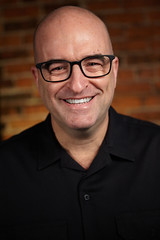
Greg Bennick (www.gregbennick.com) is a keynote speaker and long time coin collector with a focus on major mint error coins and US counterstamps. He is on the board of both CONECA and TAMS and enjoys having in-depth conversations with prominent numismatists from all areas of the hobby. Have ideas for other interviewees? Contact him anytime
via instagram @minterrors.
He can also be reached by email at
minterrors@gmail.com.
To watch the complete video, see:
Ken Bressett, Interviewed by Greg Bennick
(https://www.youtube.com/watch?v=emQlt4zLTxU&t=1s)

HERITAGE: INDIA SHOWCASE AUCTION
Heritage Auctions will be hosting their June 1 Spotlight: India World and Ancient Coins Showcase Auction. Select items are discussed below. -Garrett


INDO-GREEK KINGDOMS. Bactria. Menander I Soter (ca. 165/155-130 BC). AR Indic drachm (16mm, 2.49 gm, 11h). NGC MS 5/5 - 3/5. Indian standard. Uncertain mint in the Paropamisadai or Gandhara. BASI?EOS SOTHPOS / MENAN?POY, diademed, draped bust of Menander right, seen from front, wearing broad-brimmed, crested Boeotian helmet with bull horn and ear / Maharajasa tratasara Menamdrasa (Kharosthi), Athena advancing left, seen from behind, aegis shield on left arm, brandishing thunderbolt with right; PKA monogram in lower right field. Bopearachchi 16C. HGC 12, 193.
To read the complete item description, see:
INDO-GREEK KINGDOMS. Bactria. Menander I Soter (ca. 165/155-130
BC). AR Indic drachm (16mm, 2.49 gm, 11h). NGC MS 5/5 - 3/5.
(https://coins.ha.com/itm/ancients/ancient-india/ancients-indo-greek-kingdoms-bactria-menander-i-soter-ca-165-155-130-bc-ar-indic-drachm-16mm-249-gm-11h-ngc-ms-5-5-3-5/a/61647-21001.s?ic4=GalleryView-ShortDescription-071515)


INDIA. Kushan Empire. Kanishka II (ca. AD 230-247). AV dinar (24mm, 8.02 gm, 11h). NGC Choice AU 5/5 - 5/5. Kushan standard, Bactria, late phase. KANHÞAO KOÞANO ÞAONANOÞAO (blundered), Vasudeva I standing facing, nimbate head left, wearing diadem with ribbons to right, jeweled triangular helmet with forehead crescent, clad in full armor with long-sleeved knee-length tunic, coils covering arms, top as chain mail, shirt of plate mail, worn over trousers and high boots, sacrificing with right hand over altar at left, grounded trident in left hand, flames emanating from right shoulder; filleted trident to left, nandipada below seven pellets in a rosette pattern to right, annulet on altar / OhÞO, Ithyphallic Siva standing facing with two arms and single head, hair in topknot with curls outlining face, wearing ankle-length dhoti with symmetrical folds, erect lingammmm, diadem in right hand, trident with annulet on shaft in left; the bull Nandi standing left in background, tamgha to upper left, tetraskelion below bull's head, dotted border. ANS Kushan 1695 (Kushano-Sasanian Imitations in the names of Vasudeva I and Kanishka II). Mitchiner 3396 (Peshawar). Sunrise -. Göbl, MK 664/4.
Ex Historical Scholar Collection (Heritage Auctions, Auction 61292, 4 December 2022), lot 98075.
To read the complete item description, see:
INDIA. Kushan Empire. Kanishka II (ca. AD 230-247). AV dinar
(24mm, 8.02 gm, 11h). NGC Choice AU 5/5 - 5/5.
(https://coins.ha.com/itm/ancients/ancient-india/ancient-india-india-kushan-empire-kanishka-ii-ca-ad-230-247-av-dinar-24mm-802-gm-11h-ngc-choice-au-5-5-/a/61647-21013.s?ctrack=200071&type=featured-2-coinus-news-tem052626)


INDIA. Gupta Empire. Samudragupta (ca. AD 344-378). AV dinar (20mm, 7.49 gm, 1h). ANACS VF 35. Javelin Type. Samarasatavitatavijayo jitaripurajito divam jayati (Brahmi), Samudragupta, standing facing, nimbate head left, javelin in left hand, dropping incense with right hand over lit altar to left; Garuda on standard to left, Samudra to right / Parakramah (Brahmi), Laksmi seated in the paralambapasana posture on throne, resting feet on scattered piles of coins, diadem in right hand, cornucopia in left; tamgha in left field. TOTGE 2024, p. 248, Class II, Variety A.
Ex Heritage Auctions, Auction 3099 (6 May 2022), lot 31280.
The second Gupta Emperor, Samudragupta introduced many unique gold coin types during his long reign and litany of conquests, the most standard of which is the javelin type. The obverse legend reads, "The unconquered one who has conquered his enemies and has continuously attained victories in a hundred battles, wins heaven", and on the reverse "Parakrama". The Allahabad Pillar inscription, which contains a panegyric of Samudragupta written by the Gupta courtier Harisena, provides a pertinent supplement to this javelin type coin: "Of him who was skillfully engaged in hundreds of different battles, whose only ally was valor (parakrama) through the might of his own arm, thus has the epithet Parakrama; and his body was most charming, being covered over with the plenteous beauty of the marks of hundreds of promiscuous scars, caused by battle-axes, arrows, spikes, spears, barbed darts, swords, iron clubs, javelins for throwing, barbed arrows, span-long arrows and many other weapons."
To read the complete item description, see:
INDIA. Gupta Empire. Samudragupta (ca. AD 344-378). AV dinar
(20mm, 7.49 gm, 1h). ANACS VF 35.
(https://coins.ha.com/itm/ancients/ancient-india/ancient-india-india-gupta-empire-samudragupta-ca-ad-344-378-av-dinar-20mm-749-gm-1h-anacs-vf-35/a/61647-21034.s?ctrack=200071&type=featured-1-coinus-news-tem052626)


INDIA. Kushan Empire. Huvishka (ca. AD 151-190). AV dinar (22mm, 7.94, 11h). Choice AU. Kushan standard, Bactria, main mint (probably Balkh), late phase. ÞAONANOÞAO OO-HÞKI KOÞANO, nimbate half-length bust of Huvishka left, on mountain top, wearing mustache, and prominent wart on cheek, round helmet with pointed jeweled earflap, forehead medallion, crest ornament, and circular side ornament, diadem with triangular tie and ladder-like ribbons over both shoulders, kaftan open at top and bottom, clasped at chest, with rolled lapels and ornamented with jewels, worn over collared tunic, transverse filleted scepter in left hand over shoulder / AP???ÞO, Ardoxsho standing facing, turned right, head right with buns at crown and back, heavy ankle-length shawl wrapped around waist with end folds draping to right from left arm, worn over long-sleeved under-garment that falls in folds to the ground, cornucopia upright in both hands; tamgha with crossbar before, dotted border. ANS Kushan 749 or 751.
Ex Classical Numismatic Group, Triton XVIII (6 January 2015), lot 282.
To read the complete item description, see:
INDIA. Kushan Empire. Huvishka (ca. AD 151-190). AV dinar (22mm,
7.94, 11h). Choice AU.
(https://coins.ha.com/itm/ancients/ancient-india/ancient-india-india-kushan-empire-huvishka-ca-ad-151-190-av-dinar-22mm-794-11h-choice-au/a/61647-21005.s?ctrack=200071&type=featured-3-coinus-news-tem052626)


Kadambas of Goa. Shivachitta Vajradeva gold Pagoda (Stater) ND (1193-1202) MS62 ANACS, cf. Zeno-272992 (later date), Mitch-Unl. Lion to left; uncertain cyclic year date in front // Five line legend citing Sivachitta. A ruler not listed in major sources, and seldom handled. An incredibly well preserved example of this endearing type.
Part of the Kadamba Dynasty ruling over regions in southern India, the Kadambas of Goa were in power for nearly four centuries. The family of hereditary governors were primarily feudatories of the Chalukyas, but acted as vassals for the Hoysalas and Yadavas in later years before establishing a Goan kingdom.
To read the complete item description, see:
Kadambas of Goa. Shivachitta Vajradeva gold Pagoda (Stater) ND
(1193-1202) MS62 ANACS,
(https://coins.ha.com/itm/india/india-kadambas-of-goa-shivachitta-vajradeva-gold-pagoda-stater-nd-1193-1202-ms62-anacs-/a/61647-21039.s?ctrack=200071&type=featured-4-coinus-news-tem052626)


Sultans of Juanpur. Nasir al-Din Mahmud gold Tanka ND (AH 844-861 / AD 1440-1457) MS62 NGC, G&G-J10. Never before handled by our firm. Bested by just three examples on the NGC Census, this glowing near-Choice emission is among the highest preserved available.
To read the complete item description, see:
Sultans of Juanpur. Nasir al-Din Mahmud gold Tanka ND (AH
844-861 / AD 1440-1457) MS62 NGC,
(https://coins.ha.com/itm/india/india-sultans-of-juanpur-nasir-al-din-mahmud-gold-tanka-nd-ah-844-861-ad-1440-1457-ms62-ngc-/a/61647-21055.s?ctrack=200071&type=featured-5-coinus-news-tem052626)


Mysore. Tipu Sultan 2 Rupees AH 1199 Year 3 (1787/1788) MS62 PCGS, KM127, Mitch-991 (Patan mint). Bold calligraphy captivates the viewer, presenting nearly as struck centuries ago. Dark indigo and chocolate hues melt across these Mint State devices.
Ex. Heritage Auction 3030 (January 2014, Lot 24512)
To read the complete item description, see:
Mysore. Tipu Sultan 2 Rupees AH 1199 Year 3 (1787/1788) MS62
PCGS,
(https://coins.ha.com/itm/india/india-mysore-tipu-sultan-2-rupees-ah-1199-year-3-1787-1788-ms62-pcgs-/a/61647-21103.s?ic4=GalleryView-Thumbnail-071515)

STACK'S BOWERS: THE L. E. BRUUN COLLECTION
Stack's Bowers will be selling part of the L. E. Bruun Collection during their June 2026 Premier Collectors Choice Auction from June 9-10. Select items are discussed below. -Garrett


DENMARK. Speciedaler, 1609. Copenhagen Mint. Christian IV. NGC EF Details--Cleaned. Dav-3513; KM-43; Hede-53A; Sieg-102.1; Schou-4; Bruun-4810. Weight: 28.34 gms. Beautiful example of this two-year type displaying a mighty portrait of the king. Some iridescent toning in the obverse legend.
The reverse displays the shields of all Danish territories under the crown, symbolizing the unity of the kingdom. From 1624, the crown evolved to a closed shape, further emphasizing the idea of unity under God. Estimate: €1,800 - €2,500.
Ex: Joh. G. Guildal Collection (Private Sale - 1918); later published by the Danish Numismatic Society.
To read the complete item description, see:
DENMARK. Speciedaler, 1609. Copenhagen Mint. Christian IV. NGC EF Details--Cleaned.
(https://auctions.stacksbowers.com/lots/view/3-1SZZF2/denmark-speciedaler-1609-copenhagen-mint-christian-iv-ngc-ef-details-cleaned)


DENMARK. 2 Rigsdaler, 1868-HC-RH. Copenhagen Mint. Christian IX. NGC MS-65. KM-772.1; Hede-4A; Sieg-5.1; Schou-1; Bruun-8286. Weight: 28.84 gms. Unsurpassed in the NGC Population census with two coins registered in this grade. Magnificent example of this double Rigsdaler with razor-sharp devices. Lightly toned and almost mirror-like surfaces. Attractive coin with an outstanding portrait of the king.
Estimate: €2,500 - €3,000.
To read the complete item description, see:
DENMARK. 2 Rigsdaler, 1868-HC-RH. Copenhagen Mint. Christian IX. NGC MS-65.
(https://auctions.stacksbowers.com/lots/view/3-1T0051/denmark-2-rigsdaler-1868-hc-rh-copenhagen-mint-christian-ix-ngc-ms-65)


SWEDEN. Pomerania. Taler, 1657-VB. Stettin Mint. Karl X Gustav. NGC AU Details--Mount Removed. KM-217.2; SB-37; Delzanno-115; Bruun-12107. Weight: 28.83 gms. Rare type. Variation reading "POMER" in the legends. Nice reddish toning especially in the obverse legend.
Estimate: €2,500 - €3,000.
Ex: Countship of Brahesminde Collection (Private Sale - 1922); Leopold Welzl von Wellenheim Collection (Vienna - 1846) Lot #6800.
To read the complete item description, see:
SWEDEN. Pomerania. Taler, 1657-VB. Stettin Mint. Karl X Gustav. NGC AU Details--Mount Removed.
(https://auctions.stacksbowers.com/lots/view/3-1T00RI/sweden-pomerania-taler-1657-vb-stettin-mint-karl-x-gustav-ngc-au-details-mount-removed)


SWEDEN. 2 Ducat, 1843/33-AG. Stockholm Mint. Karl XIV Johan. NGC AU-55. Fr-86; KM-629; SM-12; Bruun-13421. Weight: 6.95 gms. An attractive example of this overdate variety.
Estimate: €1,800 - €2,200.
Ex: Countship of Brahesminde Collection (Private Sale - 1922).
To read the complete item description, see:
SWEDEN. 2 Ducat, 1843/33-AG. Stockholm Mint. Karl XIV Johan. NGC AU-55.
(https://auctions.stacksbowers.com/lots/view/3-1T01SW/sweden-2-ducat-184333-ag-stockholm-mint-karl-xiv-johan-ngc-au-55)


SWEDEN. Krona, 1912-W. Stockholm Mint. Gustav V. NGC MS-67. KM-786; SM-36; Bruun-13790. Weight: 7.50 gms. Razor-sharp superb gem of incredible beauty.
Estimate: €300 - €400.
Provenance: From the L.E. Bruun Collection. Ex: Countship of Brahesminde Collection (Private Sale - 1922).
To read the complete item description, see:
SWEDEN. Krona, 1912-W. Stockholm Mint. Gustav V. NGC MS-67.
(https://auctions.stacksbowers.com/lots/view/3-1T01ZW/sweden-krona-1912-w-stockholm-mint-gustav-v-ngc-ms-67)


GERMANY. Schleswig-Holstein-Gottorp. Taler, 1612-MP. Steinbeck Mint. Johann Adolf. NGC AU Details--Cleaned. Dav-3688; KM-33; Sieg-9.20; Lange-272d; Bruun-14138. Weight: 28.66 gms. Pleasant well-struck example with minimal circulation wear.
Estimate: €400 - €600.
Provenance: From the L.E. Bruun Collection. Ex: Countship of Brahesminde Collection (Private Sale - 1922).
To read the complete item description, see:
GERMANY. Schleswig-Holstein-Gottorp. Taler, 1612-MP. Steinbeck Mint. Johann Adolf. NGC AU Details--Cleaned.
(https://auctions.stacksbowers.com/lots/view/3-1T026S/germany-schleswig-holstein-gottorp-taler-1612-mp-steinbeck-mint-johann-adolf-ngc-au-details-cleaned)


GERMANY. Schleswig-Holstein-Gottorp. Taler, 1624-ST. Schleswig Mint. Friedrich III. NGC AU Details--Tooled. Dav-3698; KM-64; Sieg-11.5; Lange-322a; Bruun-14202. Weight: 28.05 gms. Example with all details visible despite a cleaned and tooled planchet.
Estimate: €200 - €300.
Provenance: From the L.E. Bruun Collection. Ex: Countship of Brahesminde Collection (Private Sale - 1922).
To read the complete item description, see:
GERMANY. Schleswig-Holstein-Gottorp. Taler, 1624-ST. Schleswig Mint. Friedrich III. NGC AU Details--Tooled.
(https://auctions.stacksbowers.com/lots/view/3-1T028F/germany-schleswig-holstein-gottorp-taler-1624-st-schleswig-mint-friedrich-iii-ngc-au-details-tooled)


DENMARK. United Steamship Company 25th Anniversary Silver Medal, 1891. Christian IX. NGC MS-62. Bergsøe-1173; Bruun-16458. Diameter: 70 mm. Weight: 120 gms. By Hubert Meyer and Antoine Fisch. Soft, golden toning highlights the many figures and the marvelous miniature map with only light hairlines.
The United Steamship Company (DFDS) still exists as a shipping and logistics company employing around 14,000 people. Estimate: €300 - €400.
Provenance: Purchased February 22, 1916, for 20kr.
To read the complete item description, see:
DENMARK. United Steamship Company 25th Anniversary Silver Medal, 1891. Christian IX. NGC MS-62.
(https://auctions.stacksbowers.com/lots/view/3-1T034Q/denmark-united-steamship-company-25th-anniversary-silver-medal-1891-christian-ix-ngc-ms-62)


DENMARK. Count Valdemar Løvendal Silver Medal, 1754. Frederik V. NGC MS-63. Galster-444 JS-826; Bruun-16908. Diameter: 52 mm. Weight: 97 gms. By Magnus Gustav Arbien (ARBIEN / A). Excessively rare medal, only six struck. Obverse with dark toning in fields, leaving the luster in a delightful way to highlight the legend and the portrait; the reverse is softly toned.
Count Valdemar Løvendal (1700-1755) was the great-great-grandson of King Frederik III and a professional soldier. At age 14, he entered the Saxon army. Serving in the Saxon, Polish, Russian, and French armies, he rose to the rank of Marshall. Estimate: €1,000 - €1,500.
To read the complete item description, see:
DENMARK. Count Valdemar Løvendal Silver Medal, 1754. Frederik V. NGC MS-63.
(https://auctions.stacksbowers.com/lots/view/3-1T04KK/denmark-count-valdemar-lvendal-silver-medal-1754-frederik-v-ngc-ms-63)


SWEDEN. King's Visit at Sala Silver Mine Silver Medal, 1688. Karl XI. NGC MS-61. Hild-103; Delzanno-148a; Bruun-17620. Diameter: 54mm; Weight: 68. By Arvid Karlsteen. A spectacular reverse showing the king's visit into the mine and showing off the skills of the engraver. Golden hues highlight the uncirculated reverse.
Estimate: €2,500 - €3,000.
Provenance: From the L.E. Bruun Collection.
To read the complete item description, see:
SWEDEN. King's Visit at Sala Silver Mine Silver Medal, 1688. Karl XI. NGC MS-61.
(https://auctions.stacksbowers.com/lots/view/3-1T0562/sweden-kings-visit-at-sala-silver-mine-silver-medal-1688-karl-xi-ngc-ms-61)


SWEDEN. Riots in Hamburg Quelled Rhombic Silver Medal, 1708. Karl XII. NGC MS-61. Hild-134; Delzanno-205; Gaedechens-1704; Bruun-17730. Dimensions: 34x34 mm. Weight: 22 gms. Scarce City View medal with golden toning and much luster remaining.
Estimate: €500 - €800.
Provenance: From the L.E. Bruun Collection.
To read the complete item description, see:
SWEDEN. Riots in Hamburg Quelled Rhombic Silver Medal, 1708. Karl XII. NGC MS-61.
(https://auctions.stacksbowers.com/lots/view/3-1T058F/sweden-riots-in-hamburg-quelled-rhombic-silver-medal-1708-karl-xii-ngc-ms-61)
WAYNE'S NUMISMATIC DIARY: MAY 31, 2026

Wednesday morning I woke up early (happenstance, not choice) and decided to get ready for the day, grabbing my backpack and suitcase for a trip to Pittsburgh for the Pennsylvania Association of Numismatists (PAN) show. It was a miserable rainy drive with a traffic jam and detour off the highway. But things got better later in the morning, with the sun peeking through and Spotify deciding to play Johnny Nash's "I Can See Clearly Now [the rain is gone...]"
Arriving in time for lunch I tried for the first time the Caliente Pizza & Draft House down the road from the convention hotel, the Hampton Inn in Monroeville. It's a friendly neighborhood local chain and my baked Italian sub was wonderful. I checked in to my hotel, worked on The E-Sylum a bit, then took a nap before heading out again to meet my sister for dinner and a movie - "The Devil Wears Prada 2". We enjoyed it and I'd recommend it to readers. So not much numismatics on Day One.
I went downstairs for the hotel's breakfast Thursday morning and saw some familiar dealer faces and heard the voice of SS Central America Chief Scientist Bob Evans conversing at his table. Reading news on my phone I saw the Washington Post's article on the Trump administration's push to put his portrait on a $250 note. See an excerpt of the article elsewhere in this issue.
I've been on a stairwalking kick, so except when I'm lugging luggage I skip the elevator and take the stairs. After breakfast I walked up to my room on the 5th floor. And since walking down is harder on the knees than going up, when leaving my room I'd walk up the the top floor (9th) before taking the elevator down to the lobby.
I spent the morning working on email and The E-Sylum, taking a walk and grabbing another lunch at Caliente (a calzone this time). Their URL is decidedly unmodest (worldsbestpizza.com), but my food was indeed darn good.
Education
The show opened at noon and I luckily found a spot as someone pulled out of a space in the crowded lot. My first stop was to see E-Sylum supporter Dave Kahn at his table right in front. I was tempted by an off-center 1829 half dollar he showed me, but I decided to pass. It was well worth the asking price, but beyond my budget.
Next I made a beeline to the education room, where I found Bob Evans finishing his setup. I just had to take a look at the 3-D photos of gold coins and bars resting on the ocean floor. I'd seen them before, but told Bob, "that never gets old."

Bob's SS Central America Setup
Next door was Rick Lank and Becky Rush's Civil War Showcase, a visual delight of postered numismatic images.


On Friday I gave a talk on Encased Postage Stamps, and Greg Bennick took these shots. Thanks. I forget what was funny, but included the second one because way too many photos catch me not smiling.


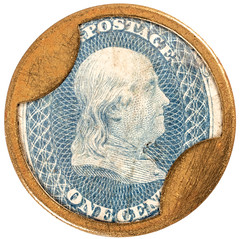 Kathy Freeland and Simcha Kuritzky were also in the audience, and I fielded some very interesting questions. Here's one I'll put to our readers - does anyone know whether John Gault folded the corners of the postage stamps he inserted into his encasements? I never opened one or spoke to anyone who had, so I didn't have an answer for Simcha's "rectangular peg in a round hole" question.
The U.S. Mint

The U.S. Mint had a small booth and steady traffic. After the second random person asked me if I had change for a twenty, I finally realized why. The Mint had vending machines dispensing new semiquincentennial coins, and they accepted only ones and fives. By Friday they'd already sold out of the new quarters. Garrett Ziss hit me up for change for a five to buy some new dimes. Later I got some for myself and I'll begin spending them.

Garrett Ziss Hits the Jackpot
To watch Garrett's video of his purchase, see:
https://youtube.com/shorts/egtgqxVHFuA?si=EJocZIkykrPe9-eT
Books
The supply dealer had a small selection of new books for sale.

Nathan Elkins manned the American Numismatic Society table.


A pamphlet about the ANS move to Toledo
Exhibits
The exhibit section was smaller than I've seen at PAN before, but still quite impressive. Here are some photos I took. These are not comprehensive, but I did try to get at least one photo of each exhibit. Sorry about the ceiling light reflections.


Around 3:30 Thursday I left the show to go back to my hotel. I worked a bit on The E-Sylum and dressed up a bit for the PAN Banquet. The bus made multiple stops around Monroeville before heading downtown to the Grand Concourse restaurant. I sat with Kathy Freeland of Michigan and gave her some commentary on the Pittsburgh scenery we passed. The restaurant is in a magnificently restored 1900 railroad terminal building with massive stonework and stained glass skylights. Garrett Ziss and I sat at Carlos Kearns' table and had great conversation with him, former Pittsburgh mayor Tom Murphy and Nathan Eklins of the ANS.
Lt. George Dixon's Lucky Double Eagle
 Before leaving the show Friday I stopped to chat with Ben Costello and Bob Evans. Ben was waiting to meet a young numismatist and give them a tour around the show. He showed us a coin he was going to gift them. I didn't know these existed, but I recognized it at once - it was a base metal souvenir reproduction of the engraved $20 gold piece found with the remains of commander Lt. George Dixon in the wreck of the Confederate submarine H.L. Hunley.
In hindsight, this was an amazing conversation. Here were two of the world's experts on coins recovered from shipwrecks talking about a particularly famous such coin. Ben is president of the 1715 Fleet Society, and Bob is the Chief Scientist of the SS Central America recovery project. Both told me about the times they individually visited the museum where the Hunley wreck was being restored.
The replicas are online and in the gift shop of the Hunley museum in North Charleston, SC. I ordered one!

To order your own replica Dixon coin, see:
LT. Dixon's Gold Coin Replica
(https://hunleystore.mybigcommerce.com/lt-dixons-gold-coin-replica/)
To read earlier E-Sylum articles, see:
ANOTHER COIN FOUND IN WRECK OF CONFEDERATE SUBMARINE HUNLEY
(https://www.coinbooks.org/esylum_v10n12a28.html)
150TH ANNIVERSARY OF THE SINKING OF THE HUNLEY
(https://www.coinbooks.org/esylum_v17n08a14.html)
THE H.L. HUNLEY LOOKS LIKE A SUBMARINE AGAIN
(https://www.coinbooks.org/esylum_v18n38a26.html)
HOW LUCKY COIN SUBMARINE HUNLEY WORKED
(https://www.coinbooks.org/v20/esylum_v20n24a15.html)
Throughout the show I'd been meeting up with Greg Bennick and Garrett Ziss to discuss various E-Sylum efforts. I also ended up buying a nice error coin from Greg on my way out the door. More on that in a future Diary.
Planning to Meet in the Irish Pub
After leaving the show I stopped for lunch, then followed GPS directions to my old friend Pat McBride's house in McKeesport, PA. I've known Pat for 40 years or more. The Pennsylvania Association of Numismatists was still young and Pat worked hard as editor of the club's newsletters. He and PAN cofounder and Chairman of the Board Don Carlucci became like older brothers to me in the hobby, and I volunteered alongside them to help build the organization. I continued helping where I could once I got married and we began having kids. Then we moved down to Virginia and I rarely got to visit the shows let alone help set them up.
But Pat soldiered on through it all, eventually taking over organizing and marketing the club's shows, making sure the contracts got signed, speakers arranged, signs and advertising readied, tables set up, lights and cases placed, and social media alerted. He brought in Dennis Boggs to embody Abraham Lincoln, and later morphed himself into a remarkable Ben Franklin. As his alter ego Ben, he not only promoted PAN and numismatics across the country, he performed for innumerable classrooms across Pennsylvania, all while being treated for cancer.
While his treatments had his cancer in remission, it recently returned with a vengeance. Pat had hoped to attend the PAN Banquet, but was unable to. He entered hospice care at home this weekend. I had a nice visit with him and his wife Dawn. I gave him my copy of the banquet program and insert. We talked about the show and the club, my work with The E-Sylum and my latest coin purchase. He was worried about things falling apart at PAN without him, and I tried to reassure him that people will find a way to make it through. The PAN show is a juggernaut with a life of its own at this point. Now one of the largest regional shows in the country, Pat was there from the days when we had to pass the hat to make ends meet.
As a truck arrived to deliver hospital equipment, it was time for me to say goodbye. He didn't think he'd be here when I come back for the Pittsburgh ANA this summer. "I'll see you on the other side," he said, as we held hands. It told him, "When I meet St. Peter, I'll say I'm here to have a pint with Patrick McBride." Pat said, "He'll say you can find me in the Irish pub."
My GPS guided me to the highway, and as I got up to speed on the PA turnpike, Spotify decided to play the Nitty Ditty Dirt Band's "Will the Circle Be Unbroken."
Will the circle be unbroken
By and by Lord, by and by
There's a better home awaiting
In the sky Lord, in the sky.
TINNAHS: THE CHIEF'S COPPER
The following article discusses Tinnah's, of Chief's Copper, used by Alaska Natives. Republished with permission from the June issue of Dick Hanscom's Alaskan Token Collector & Polar Numismatist. -Garrett
Daily Alaska Empire, Juneau, September 19, 1941.
 COPPER "CURRENCY" OF ALASKA NATIVES IS MUSEUM EXHIBIT
Proof that Alaska Indians, before the advent of the white men, operated their finances strictly on a copper standard is shown in a new exhibit which made its appearance at the Territorial Museum this week.
Called a Tinneh, or Chief's Copper, it is a huge copper shield with hand-hammered decorations, once used for money among the Thlinget and other Southeast Alaska Tribes.
Loaned to the museum from the private collection of Edward L. Keithahn, curator, the piece is said to increased in value each time it changed hands. Some of these copper plates, Keithahn declares, were once traded for thousands of blankets.
Daily Alaska Empire, Juneau, August 20, 1948.
TERR. MUSEUM RECEIVES COIN WEIGHING 17 LBS.
 If you think the silver dollars that are used in Alaska
today are designed to tear holes in you pockets, you
can thank your lucky stars that you weren't around
during the early days. The Territorial Museum recently
received a piece of Thlinget currency weighing over
17 pounds. The coin, which is made of hammered copper, is carved with a totemic design.
If you think the silver dollars that are used in Alaska
today are designed to tear holes in you pockets, you
can thank your lucky stars that you weren't around
during the early days. The Territorial Museum recently
received a piece of Thlinget currency weighing over
17 pounds. The coin, which is made of hammered copper, is carved with a totemic design.
The coin, which was called a tinneh, was valued highly. The Thlingets generally computed the value of it in slaves, while the Haidas figured its worth in sea otter skins. The tinneh on display at the Museum was found near Sitka several years ago.
The Tinnah referenced in the August 20, 1948 article can be seen on the Alaska State Museum website: museums.alaska.gov. It is item number II-B-1112.
We requested permission to use these photos, but the fee was $30 per photo and we would have used three. We declined.
REVOLUTIONARY WAR FRENCH ENCAMPMENT FOUND
This Washington Post article discusses a find of coins from a Revolutionary War French encampment. Thank you. -Editor

Relic hunters scouring a farm field south of Fredericksburg, Virginia, were turning up the usual Civil War artifacts when their metal detectors hit something strange. Eleven little buttons emerged from the ground near a creek, with odd mounts on the back and delicate numbers on the front.
Lafayette "Scotty" Crabtree Jr. and Greg Lagasse ran an online image search, and the results were unlike anything they had encountered in a lifetime of hunting for treasure in Virginia.
The buttons were 244 years old, and French.
"What? French?" Crabtree, 71, said through a haze of Pall Mall cigarette smoke, recalling the moment from more than a year ago. Near the buttons, they also discovered Spanish and English coins from the early 1700s.
Crabtree and Lagasse had stumbled onto a find rarer than any Union bullet or Confederate belt buckle: evidence of a French encampment from the Revolutionary War. On this sloping cornfield that has changed little since 1782, French soldiers who helped defeat the British at Yorktown rested on their way to rejoin Gen. George Washington in New York.
"I had to quickly do as much research as I could, pull all the things we had off our shelves and start studying it," said Mike Clem, a regional archaeologist for the Virginia Department of Historic Resources who helped authenticate the site. "This is amazing," added Jonathan Connolly, a state project review archaeologist, who worked at Yorktown earlier in his career.
 While the archaeologists lament that Crabtree and Lagasse essentially picked the site clean before it could be studied and surveyed, Clem hopes the discovery of this French encampment holds the key to something even bigger: Finding more of them.
When historians learned about the finds, they quickly connected the site to long-neglected documents at the Library of Congress. The French had meticulously diagrammed individual camp sites but not in a way that lets modern researchers pinpoint them on the broader map. The Virginia discovery solves that problem.
State officials descended on the farm last month to examine the artifacts and search for more.
The French were crucial to the American victory over the British at Yorktown on Oct. 19, 1781 — the last major battle of the war for independence. After the surrender, the French army wintered at Williamsburg before heading back north, uncertain whether the war was really over.
De Rode added that the army operated on borrowed money, so it makes sense that slivers of Spanish coins — known as "pieces of eight" — turned up at the encampment.
I've written before that it's a shame that the U.S. doesn't have a treasure law like the Portable Antiquities Scheme in the U.K. It would encourage metal detectorists to immediately notify authorities. Unfortunately these coins and other artifacts were unearthed without proper documentation, and the exact location of the find remains a mystery. -Editor
To read the complete article, see:
They searched for Civil War artifacts. What they found was older and rarer.
(https://www.washingtonpost.com/dc-md-va/2026/05/25/encampment-french-allies-revolutionary-war-discovered-virginia/)
THE CARD MONEY OF FRENCH CANADA
Stack's Bowers Director of Consignments & Senior Numismatist Dennis Hengeveld published a nice article on Canadian card money. -Editor

In the 17th century, New France was trying to find its footing in the Americas. The French had been active in North America as early as 1534, when Jacques Cartier first explored the Gulf of Saint Lawrence. Over the next two centuries, the extent of French possessions in North America grew until it achieved its largest territorial reach in 1712. While its territories extended as far as modern day Louisiana, its most important colony was Canada, which extended south of the Great Lakes to the Gulf of St. Lawrence. With its capital at Quebec City, the legacy of the French in Canada endures to this day, including in the United States, where French town names can be found across the East and Midwest. Its numismatic importance, however, is seen in the rare surviving pieces of card money that were issued in the colony.
Card money was the brainchild of Jacques de Meulles, the chief administrator of the colony from 1682 to 1686, who was chronically short of small change. Because New France had to import much of what it used from the mother country, specie naturally flowed back to France, and coin shortages were common. De Meulles' most urgent concern was payments to soldiers, which could not be delayed. To remedy the problem, he decided to cut up packs of playing cards, sign them, and issue them as money. The cards were readily accepted by local merchants, and over time, the use of card money grew. Specific quantities were issued, and they were redeemed after a pre-determined period.
While the cards solved a temporary problem, other problems soon arose. The cards were relatively easy to counterfeit, and this occurred soon after they were issued. With the cards in circulation, coins were hoarded, further impacting the economy. This led to more cards being issued, and inflationary pressures were soon felt. The issuance of card money, however, continued, until in 1717 they were redeemed at 50% of their value. The coin shortage problem, however, was not solved, and while experiments with copper coins solely meant for the colonies took place in 1722, this offered little relief. As such, King Louis XV re-authorized the use of card money for New France in 1727.
From then until the fall of New France, large quantities of card money were issued. Playing cards were no longer used, but instead specially made cards were utilized, with several signatures, (embossed) seals, and serial numbers providing authenticity. Problems continued to plague the card money, however. With the cards now circulating on par with gold and silver coinage, the cards were hoarded as well; problems with inflation and the French government struggling to fund its American colony continued. After the British were victorious in the Seven Years' War, many cards ended up in the hands of the British. After three years of painstaking negotiations the French eventually agreed to reimburse holders of card money at 25% of their original value, and most cards were redeemed.
Today, genuine card money from French Canada is rare and seldom offered for sale. Those from the first period, printed on actual playing cards prior to 1717, are not known to exist, although imitations are known. Those made after 1729 are sometimes seen, although individual varieties are rare, and offerings are infrequent. In our online archive you will find a handful of examples of card money we previously sold, including this 1729 12 Livres and this 1733 24 Livres.
Card money is not uniquely Canadian. The other European colony famous for them is Suriname, or Dutch Guiana, on the northern coast of South America. While those that use actual playing cards are unknown from French Canada, they do exist for Suriname, even into the 19th century. Additionally, playing cards have also been used in France as money, and similar cards were used in other French colonies, including French Louisiana. All of these are rare. If you have any card money you wish to consign, don't hesitate to contact Dennis Hengeveld at Dennis@stacksbowers.com or call 800-458-4646.
Here's more information from the lot descriptions of the two referenced pieces. -Editor
CANADA. Card Money. 12 Livres, 1729. P-S107. A highly prized piece of early currency that circulated nearly 30 years with this piece showing the first year of issuance. The note is signed by Beauharnois and Hocquart with the aforementioned signature being quite bold and the latter only slightly faded. Three stamped seals are seen which attribute themselves to the signing officials. This denomination was cut at the corners creating an eight-sided truncated rectangle which was meant to more quickly identify the denomination. One of the more pleasing of the scant few we have handled and surely a piece which will likely be carefully watched by expert collectors.
To read the complete lot description, see:
CANADA. Card Money. 12 Livres, 1729. P-S107.
(https://auctions.stacksbowers.com/lots/view/3-5YJFR/canada-card-money-12-livres-1729-p-s107)

CANADA. French Administration. 24 Livres, 1733. P-S108. PMG Very Fine 25.
An exceptionally rare piece of card money, dated 1733 at upper right. 24 Livres was the highest denomination of card money and is known as having been issued in 1729, 1730, 1733, 1735, 1742, and 1749. All card money is rare, and the present issue is no exception, with opportunities to acquire examples presenting itself extremely infrequently. While listed in the Pick specialized catalog they were government issued and they should have been listed in Volume 1. The Charlton catalog lists this issue on page 2, and states "all card money is very rare," making reference to a 2019 sale of a 1729 dated 24 Livres for $38,675 Canadian.
To read the complete lot description, see:
CANADA. French Administration. 24 Livres, 1733. P-S108. PMG Very Fine 25.
(https://auctions.stacksbowers.com/lots/view/3-1G426X/canada-french-administration-24-livres-1733-p-s108-pmg-very-fine-25)
To read the complete article, see:
The Card Money of French Canada: Small Change for a Fledgling Colony
(https://stacksbowers.com/the-card-money-of-french-canada-small-change-for-a-fledgling-colony/)
TRUMP $250 BANKNOTE PUSHED AT BEP
The The Washington Post reported this week on a push by Trump administration officials to put the President's portrait on a $250 commemorative note. Here's an excerpt - see the complete article online. Thanks to Paul Horner, Jeff Pritchard and others for passing this along. -Editor

A mock-up design of a proposed $250 bill
Trump administration officials have pressed the office responsible for printing the nation's money to design a $250 bill featuring the president's portrait, according to four current and former employees, in what would be the first appearance of a living person on U.S. currency in more than 150 years.
Starting last year, two political appointees at the Treasury Department — U.S. Treasurer Brandon Beach and his senior adviser, Mike Brown — repeatedly urged staff at the agency's Bureau of Engraving and Printing to prepare prototypes of the note, according to the employees, who said the move raised concerns because federal law currently allows only deceased people to appear on bills.
The artist who said he designed the mock-up told The Post that he had spoken with Trump about it.
British painter Iain Alexander said Trump endorsed changes to his original design, such as adding the colors of the American flag and a logo commemorating the 250th anniversary of the nation's founding.
No living person has appeared on U.S. currency since 1866, when it was outlawed after the image of a mid-level Treasury bureaucrat showed up on a 5-cent note. Legislation that would allow Trump to appear on a $250 bill was introduced in Congress last year to commemorate the nation's 250th anniversary but has languished.
The director of the printing bureau, Patricia "Patty" Solimene, and other staff repeatedly explained to Beach and Brown that there were legal and procedural obstacles to producing the note and that it would take years longer than they envisioned, the four employees said.
"She had told them we're not authorized to do this. We can't progress any further, and all the stakeholders have not even met to discuss the next steps," said one of the employees. "Currency often takes six to eight years to produce a new bill, particularly one of such high value."
Solimene said she was abruptly reassigned from her post by Treasury management on April 27...
The Treasury statement said Beach has "never asked staff to print the bill before congressional passage." The agency declined to comment on Solimene's reassignment. The White House did not respond to requests for comment.
Solimene and her staff had consented to another administration request: to print $100 bills featuring Trump's signature, according to the four employees. They said those bills — the first in American history to bear a sitting president's signature — are currently being printed at the bureau's downtown Washington facility.
"These guys think you can just print something overnight and it's going to work in an ATM. It's just crazy," said one of the employees. "It takes years and years and years to produce these notes so they are reliable for the public."
To read the complete articles, see:
Trump appointees push $250 banknote with his portrait
(https://www.washingtonpost.com/investigations/2026/05/28/trump-250-bill-pushed-by-treasury-appointees/)
It's All About the Donalds
(https://www.wsj.com/opinion/its-all-about-the-donalds-2b2ba71f)
To read the earlier E-Sylum article, see:
TRUMP $250 BILL RIDICULED IN CHINA
(https://www.coinbooks.org/v28/esylum_v28n09a35.html)
NOTES FROM E-SYLUM READERS: MARCH 9, 2025 : Trump Money
(https://www.coinbooks.org/v28/esylum_v28n10a11.html)
U.S. TREASURER TALKS UP TRUMP $250 BILL
(https://www.coinbooks.org/v29/esylum_v29n02a25.html)
RAID SEIZES CIA OFFICIAL'S GOLD BAR STASH
I'll soon retire from the government job. But mind you, it's not one of THESE jobs. Paul Horner passed along this article about a former CIA officer accused of stealing 300 gold bars. -Editor
A former CIA senior officer with top secret-level clearance has been accused of secretly stashing millions of dollars in gold bars in his home that he said he needed for "work-related expenses," according to court documents and two people familiar with his employment history.
David Rush, who held a management position, was charged with criminal theft of public money in a complaint filed last week in the Eastern District of Virginia. His lawyer didn't respond to a request for comment.
The case raises questions about the effectiveness of the federal government's security vetting, which is supposed to ensure intelligence officers or other government employees don't betray the public trust or spy for foreign countries.
The U.S. government conducts background investigations on every prospective employee at the CIA and other agencies granted access to sensitive and secret information. And after employees are hired, the government continues to monitor their financial activities, travel, credit records and other information through automated checks to ensure they aren't vulnerable to blackmail.
The Defense Counterintelligence and Security Agency, which falls under the authority of the Office of the Director of National Intelligence, oversees the background check program, known as "continuous vetting." When the program flags a potential problem or anomaly in an employee's records, officials investigate further.
It wasn't clear how the investigation into Rush began, and it also wasn't clear when he left the CIA. His home was raided just last week.
From November through March, Rush made several requests for funds, including for foreign currency and tens of millions of dollars in gold bars, according to an affidavit filed in federal court by an FBI agent investigating the case.
In a storage space near his office, investigators found only a portion of the funds. On May 18, federal agents searched Rush's home and seized roughly 300 gold bars worth more than $40 million, court documents said. Agents also seized about $2 million in U.S. currency and 35 luxury watches, mostly Rolexes, according to the affidavit.
To read the complete article, see:
Former CIA officer accused of stealing 300 gold bars, sources say
(https://www.nbcnews.com/politics/rcna347177)
To read other articles, see:
Prosecutors say ex-CIA official stole $40 million in gold bars from agency
(https://www.washingtonpost.com/national-security/2026/05/28/former-cia-official-arrested-embezzlement-hoarding-more-than-40-million-gold-bars/)
F.B.I. Arrests C.I.A. Official With $40 Million in Gold Bars in His Home
(https://www.nytimes.com/2026/05/27/us/politics/fbi-arrest-cia-official-gold-bars.html)
LOOSE CHANGE: MAY 31, 2026
Here are some additional items in the media this week that may be of interest. -Editor
Pablo Hoffman passed along this BBC article about a coin hoard found back in 1866. Thanks. -Editor
One of the most remarkable, and least widely known, Anglo-Saxon treasure discoveries in Sussex began with a group of farm labourers clearing a hedge on Chancton Farm in 1866.
As they worked, the men uncovered an old earthenware pot and, upon breaking it open, discovered 3,000 silver coins.
Initially accepted as payment at a local pub, the coins were later transferred to the British Museum after being declared treasure trove.
The hoard consisted of Anglo-Saxon silver pennies from the reigns of Edward the Confessor and Harold II, with none minted after the Battle of Hastings in 1066.
To read the complete article, see:
The hedge that hid 3,000 ancient silver coins
(https://www.bbc.com/news/articles/c9we07g1w75o)
Here's the first of two from Numismatic News. Chris Bulfinch has a nice article on a new release from the Pressburg Mint. I like the design, particularly the obverse. -Editor
 For the first time in its 11-year history, the Slovakian-based Pressburg Mint is offering a copper product, 1-ounce bullion rounds in its flagship Chronos series. Available in 20-, 100-, and 500-round quantities, the rounds are measured in troy ounces rather than the avoirdupois ounces traditionally used for copper rounds. The addition of a copper offering and the weight selected reflect a growing interest in copper as the red metal's price hits record highs, according to the Pressburg Mint's promotional materials.
The rounds' obverse design is a clock face with a textured inner circle surrounding gears. A stylized border circles the clock face. The date appears to the right of the gears, and a Latin motto, "EX CURPO ARGENTUM, EX ARGENTUM AURUM," which translates to "FROM COPPER, SILVER, FROM SILVER, GOLD."
So, with rising commodity prices, is copper the new silver - a more-affordable-than-gold bullion product? -Editor
To read the complete article, see:
Coin Profile: Pressburg Mint Produces First Copper Product
(https://www.numismaticnews.net/coin-profile-pressburg-mint-produces-first-copper-product)
The other Numismatic News article is from Mark Hotz on National Bank Notes from the Western Pennsylvania town of Wilmerding, near Pittsburgh. -Editor

Wilmerding, Pennsylvania, is a small borough in Allegheny County, roughly 12 miles southeast of Pittsburgh. The Westinghouse Air Brake Company (WABCO) founded the community as a model company town. Organized in 1869, WABCO produced a new style air brake that improved performance and increased speed on the nation's railways. Later, the company expanded into Westinghouse Electric Corporation with facilities around the country. My father spent over 30 years of his career in management at the Westinghouse plant next to Baltimore's BWI Airport.
George Westinghouse purchased land in the Turtle Creek Valley of Allegheny County in 1887 and 1888 as a site for his Westinghouse Air Brake Company and related facilities. Westinghouse then sold the land to the East Pittsburgh Improvement Company, incorporated in December 1888 to develop the site, and it began the sale of lots in June 1889, when the town of Wilmerding was founded. The community was named for Joanna Wilmerding Negley, wife of William B. Negley, a local landowner from whom much of the land for the town was purchased.
Naturally, a growing community tied to such a successful corporation would be an ideal site for a national bank or two. Accordingly, the East Pittsburg National Bank of Wilmerding was chartered in 1895 and received charter #5000. At the time of its founding, the official spelling of the nearby city was Pittsburg, the result of a national effort to standardize geographical spellings in the United States. This spelling was in use from 1890 to 1911, when the "h" was restored to the end of Pittsburgh. As such, early notes of this bank utilize the "h"-less spelling.
To read the complete article, see:
Hotz off the Press: Castle Views and Bank News in Wilmerding
(https://www.numismaticnews.net/hotz-off-the-press-castle-views-and-bank-news-in-wilmerding)
And speaking of National Bank Notes, here's a video about NBN Title Blocks. -Editor
To watch the complete video, see:
What are National Bank Note Bank Title Blocks?!
(https://www.youtube.com/watch?v=rrUQ6NBK8CI)
ABOUT THIS ISSUE: MAY 31, 2026
See my Diary article elsewhere in this issue for my numismatic exploits. Money-wise I had to deal with shutting down a much-used credit card following several fraudulent charges. I'd been lucky for a very long time, but hackers are coming for all of us, so be on your financial toes.
Found online: "Did the guy who coined the term "one hit wonder" come up with any other terms?"
Finally, here are some interesting non-numismatic articles I came across this week. Down at the end, for those planning ahead for the ANA World's Fair of Money, are articles on top restaurants in Pittsburgh, and a throwback pharmacy lunch counter, open since 1959.
What Did People Use for IDs Before Photos? (https://historyfacts.com/science-industry/article/what-did-people-use-for-ids-before-photos/)
Ona Judge Escaped From Slavery While George Washington Was Busy Eating Dinner Inside. (https://www.smithsonianmag.com/smart-news/ona-judge-escaped-from-slavery-while-george-washington-was-eating-dinner-inside-now-new-mural-honors-her-legacy-180988851/)
Brazil Lost 80 Percent of Its National Museum Collection in One Night. Here's How It's Fighting to Rebuild (https://www.smithsonianmag.com/science-nature/brazil-lost-80-percent-of-its-national-museum-collection-in-one-night-heres-how-its-fighting-to-rebuild-180988796/)
Why inherited wealth rarely survives the grandchildren (https://www.thetimes.com/money/family-finances/article/why-inherited-wealth-rarely-survives-the-grandchildren-nxcgsmztw)
The Hidden History of Bermuda Is Reshaping the Way We Think About Colonial America (https://www.smithsonianmag.com/history/hidden-history-bermuda-reshaping-way-think-colonial-america-180985439/)
Go Ape for a Day: How Fox turned five Planet of the Apes movies into a nine hour theater event (https://www.retroist.com/p/go-ape-for-a-day)
5 stories that show the genius behind Apple's innovation (https://www.fastcompany.com/91544386/5-stories-that-show-the-genius-behind-apples-innovation)
Thank God For Data Centers (https://www.notboring.co/p/thank-god-for-data-centers)
Hyperliquid, a blockchain and crypto trading exchange, the most profitable startup per employee on earth. (https://colossus.com/article/beyond-the-sky-jeffrey-yan-hyperliquid/)
10 of the Creepiest Things Ever Displayed in Museums (https://www.mentalfloss.com/culture/museums/creepiest-things-displayed-in-museums)
These Are the 25 Best Restaurants in Pittsburgh for 2026 (https://www.pittsburghmagazine.com/the-25-best-restaurants-in-pittsburgh-for-2026/)
Pull up a stool at the last pharmacy lunch counter in Pittsburgh (https://www.post-gazette.com/life/food/2026/05/27/adzema-pharmacy-mccandless-lunch-counter/stories/202605310014)
-Editor


Editor Wayne Homren, Assistant Editor Garrett Ziss
Wayne Homren
Wayne Homren is the founding editor of The E-Sylum and a consultant for the Newman Numismatic Portal. His collecting interests at various times included U.S. Encased Postage Stamps, merchant counterstamps, Pittsburgh Obsolete paper money, Civil War tokens and scrip, Carnegie Hero Medals, charge coins and numismatic literature. He also collects and has given presentations on the work of Money Artist J.S.G. Boggs. In the non-numismatic world he's worked in artificial intelligence, data science, and as a Program Manager for the U.S. Department of Defense.
Garrett Ziss
Garrett Ziss is a numismatic collector and researcher, with a focus on American paper money and early U.S. silver and copper coins. He is also a part-time U.S. coin cataloger for Heritage Auctions. Garrett assists Editor Wayne Homren by editing and formatting a selection of articles and images each week. When he's not engaged in numismatics, Garrett is pursuing a Master's Degree in Quantitative Economics at the University of Pittsburgh.

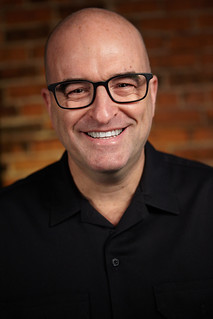
Contributors Pete Smith and Greg Bennick
Pete Smith
Numismatic researcher and author Pete Smith of Minnesota has written about early American coppers, Vermont coinage, numismatic literature, tokens and medals, the history of the U.S. Mint and much more. Author of American Numismatic Biographies, he contributes original articles to The E-Sylum often highlighting interesting figures in American numismatic history.
Greg Bennick
Greg Bennick (www.gregbennick.com) is a keynote speaker and long time coin collector with a focus on major mint error coins and US counterstamps. He is on the board of both CONECA and TAMS and enjoys having in-depth conversations with prominent numismatists from all areas of the hobby. Have ideas for other interviewees? Contact him anytime
via instagram @minterrors.
He can also be reached by email at
minterrors@gmail.com.

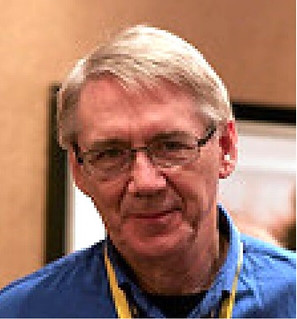
Website host John Nebel and webmaster Bruce Perdue
John Nebel
Numismatist, photographer, and ANS Board member and Fellow John Nebel of Boulder, CO helped the ANA and other clubs like NBS get online in the early days of the internet, hosting websites gratis through his Computer Systems Design Co. To this day he hosts some 50 ANA member club sites along with our
coinbooks.org site, making the club and our E-Sylum archive available to collectors and researchers worldwide.
Bruce Perdue
Encased coinage collector (encasedcoins.info) Bruce Perdue of Aurora, Illinois has been the volunteer NBS webmaster from its early days and works each week to add the latest E-Sylum issue to our archive and send out the email announcement.

|
|
The E-Sylum is an electronic publication of the Numismatic Bibliomania Society Copyright © 1998 - 2026 | |