Visit our NBS Sponsors











About UsThe Numismatic Bibliomania Society is a non-profit association devoted to the study and enjoyment of numismatic literature. For more information please see our web site at coinbooks.org SubscriptionsThose wishing to become new E-Sylum subscribers can go to the following web page
Subscribe
MembershipThere is a membership application available on the web site Membership Application To join, print the application and return it with your check to the address printed on the application. Print/Digital membership is $40 to addresses in the U.S., and $60 elsewhere. A digital-only membership is available for $25. For those without web access, write to: Jeff Dickerson, Treasurer AsylumFor Asylum mailing address changes and other membership questions, contact Jeff at this email address: treasurer@coinbooks.org SubmissionsTo submit items for publication in The E-Sylum, write to the Editor at this address: whomren@gmail.com BUY THE BOOK BEFORE THE COINSale Calendar
|
- WAYNE'S WORDS: THE E-SYLUM JUNE 7, 2026
- KOLBE & FANNING SALE 177 HIGHLIGHTS
- PATRICK E. MCBRIDE (1952-2026)
- VIDEO: THE WORLD OF RARE COIN BOOKS
- VIDEO: ANCIENT COIN COLLECTING THEMES
- VIDEO: EARLY AMERICAN COPPERS
- JUSTIN HINH'S DANSCO LIBRARY
- MOVIE: THE NUMISMATIST
- NOTES FROM E-SYLUM READERS: JUNE 7, 2026
- VISIT TO DENVER MINT IN 1915 LETTER
- CHARLES FRANCIS ADAMS, NUMISMATIST
- ERROR 1834: THE COIN SANG BACK
- BRITISH ANNUAL TOKEN CONGRESS 2026
- EXHIBIT: IDENTITY IN ANCIENT GREEK COINS
- VOCABULARY TERM: SPALLING
- NORTHWEST COAST INDIAN CHIEF'S COPPERS
- TREASURE TALK WITH BOB EVANS, EPISODE 14.2
- KEN BRESSETT INTERVIEW, PART TWO
- STACK'S BOWERS: THE MARGOLIS COLLECTION
- ST. JAMES AUCTION 123: RICHARD PRINCE COLLECTION
- STACK'S BOWERS: NUMISMATIC AMERICANA
- KUENKER: HUMBOLDT'S COSMOS ON A MEDAL
- THRYMSAS: FIRST ANGLO-SAXON GOLD COINS
- ABRAHAM LINCOLN ON U.S. PAPER MONEY
- LOOSE CHANGE: JUNE 7, 2026
- ABOUT THIS ISSUE: JUNE 7, 2026
Content presented in The E-Sylum is not necessarily researched or independently fact-checked, and views expressed do not necessarily represent those of the Numismatic Bibliomania Society.
WAYNE'S WORDS: THE E-SYLUM JUNE 7, 2026
 New subscribers this week include:
Steve Bieda and Carrie Motowski, courtesy Kathy Freeland;
Tim Coil, courtesy Kolbe & Fanning;
RJ McManamy, courtesy Steve Starlust; and
Douglas H. Henkle.
Welcome aboard! We now have 6,471 subscribers.
New subscribers this week include:
Steve Bieda and Carrie Motowski, courtesy Kathy Freeland;
Tim Coil, courtesy Kolbe & Fanning;
RJ McManamy, courtesy Steve Starlust; and
Douglas H. Henkle.
Welcome aboard! We now have 6,471 subscribers.
Thank you for reading The E-Sylum. If you enjoy it, please send me the email addresses of friends you think may enjoy it as well and I'll send them a subscription. Contact me at whomren@gmail.com anytime regarding your subscription, or questions, comments or suggestions about our content.
This week we open with more Kolbe & Fanning literature highlights, an obituary, updates from the Newman Numismatic Portal, notes from readers and more.
Other topics this week include videos on rare coin books, ancient coins and Early American coppers, Justin Hinh's new Dansco library, a 1915 visit to the Denver Mint, the 2026 British Token Congress, auction selections, the first Anglo-Saxon gold coins, and Lincoln on U.S. paper money.
To learn more about the Roman Imperial Coinage series, Pat McBride, digitization & the Newman Portal, coin postcards, tri-metallic coins, spalling, Potlatch Copper, Squat Lobsters, the 1955 Doubled Die cent, Alexander von Humboldt's Cosmos and lust, revenge and murder, oh my!, read on. Have a great week, everyone!
Wayne Homren
Editor, The E-Sylum

Image of the week
KOLBE & FANNING SALE 177 HIGHLIGHTS
Here are some more highlights from Kolbe & Fanning's upcoming June 13 numismatic literature sale. -Editor
 On Saturday, June 13, 2026, Kolbe & Fanning Numismatic Booksellers will be holding our 177th auction sale, offering a wide variety of rare and out-of-print works on ancient, world and U.S. numismatics. The auction also features the extraordinary library on orders and decorations formed over the course of half a century by the late James C. Risk.
Some highlights of the sale include:


Lot 43
Lot 43: a set of the Roman Imperial Coinage series, being ten volumes total as issued in fourteen (all volumes issued through 2007)
 Lot 131: a 16-volume set of C. Hearn Nunn's The Numismatic Magazine(1886–1901), an early British influence on the development of George Heath's The Numismatist in the U.S.


Lots 141 and 143
Lot 141: the 1819 Society of Arts report on preventing the forgery of bank notes, one of the landmark works on counterfeit prevention, with exceptional engraved plates
Lot 143: a bound volume of ten Sotheby's sales held between 1834 and 1847, all of them priced and with the buyers' names recorded

Lot 164
Lot 164: John Anstis's beautifully illustrated 1724 two-volume folio The Register of the Most Noble Order of the Garter..., from the library of the Garter Principal King of Arms


Lots 197 and 352
Lot 197: Sarah Sophia Banks's copy of Justus Christoph Dithmar's 1729 Commentatio de honoratissimo Ordine Militari de Balneo, a rare early work on the Order of the Bath
Lot 352: a plated copy of S.H. Chapman's 1923 catalogue of the Dr. Henry W. Beckwith collection, featuring some of the best photographic plates of large cents ever produced

Lot 288
Lot 288: John Pine's extraordinary 1730 elephant folio on the inaugural installation of the Order of the Bath, in a contemporary binding and with exceptional engravings


Lots 356 and 362
Lot 356: a substantial set of Edward Cogan catalogues, being 51 different catalogues ranging from 1859 to 1879, spanning the career of this early American coin dealer
Lot 362: an original 1875 copy of Sylvester S. Crosby's foundational classic The Early Coins of America, in the Nova Constellatio binding reserved for copies prepared for the author.
Register early to bid online
Bids may be placed via post, email, phone, as well as online. Kolbe & Fanning use Auction Mobility as our third-party online bidding platform. Auction Mobility is an app-based platform allowing users the ability to participate in the sale through phones, tablets and computers. To register for the sale, bidders must go to
bid.numislit.com and sign up. Once you have set up an account, you may browse lots, place advance bids, or participate in the live sale online. Those wishing to participate on their devices can download the Kolbe & Fanning app through the Apple or Google Play Store. The sale will also be listed on Biddr and NumisBids.
The printed catalogue has been mailed to all active customers on our mailing list. As international mail speeds have been inconsistent, we encourage our foreign clients to consult the electronic catalogue in case their printed catalogue does not arrive promptly. A PDF of the printed catalogue has been posted to our main website at numislit.com for those who prefer that format. Bids placed via post, email, or phone must be received by June 12, the day before the sale, in order for them to be processed. Advance absentee bids may also be placed at any time online at bid.numislit.com. Internet bidding will be available during the sale itself through the same platform.
To bid in the sale, see:
https://bid.numislit.com/
To read the earlier E-Sylum article, see:
KOLBE & FANNING SALE 177 ANNOUNCED
(https://www.coinbooks.org/v29/esylum_v29n21a03.html)
KOLBE & FANNING SALE 177 HIGHLIGHTS
(https://www.coinbooks.org/v29/esylum_v29n22a03.html)
PATRICK E. MCBRIDE (1952-2026)
Our good friend Pat McBride died Tuesday morning. Sandy Pearl pulled together this article with assistance from the ANA and the E-Sylum archives. Thank you. I still can't quite believe he's gone. -Editor

1952-2026
Patrick McBride, an avid numismatist, a long-time wonderful Ben Franklin re-enactor, and a staunch supporter of PAN (Pennsylvania Association of Numismatists), was born in McKeesport, Pennsylvania, on November 9, 1952. He passed away on June 2, 2026, after a heroic battle with cancer.
He and his wife, Dawn, opened their home at the end and over 120 friends visited over several days. A memorial service is planned for Pat at the end of the August 2026 World's Fair of Money in Pittsburgh.
Pat was an accomplished collector. He was an award-winning exhibitor, including his first-place awards in 1989 at the National Money Show for his Military Payment Certificates and in 2019 at the National Money Show for his Byzantine coin display.
He joined the American Numismatic Association (ANA) in 1984 and was honored by the ANA with their Presidential Award in 2015, the Glenn Smedley Memorial Award in 2019, Adna G. Wilde, Jr. Memorial Award for Exemplary Service on August 2022 and the Medal of Merit in 2025. In 2019 he was host chair for the Pittsburgh ANA National Money Show and received the ANA Goodfellow Award. Pat was a charter member of the recently created George F. Heath Society. He chaired the ANA Fund Development Committee. He contributed the rare early issues of The Numismatist to help complete the ANA's digital archive.
Pat was a member of the Western Pennsylvania Numismatic Society, one of the oldest numismatic societies in the country. He created a beautiful, non-competitive exhibit of the society's history to commemorate the society's 100-year anniversary as an ANA club. Pat was a member of Roundtable Trading, Society of Paper Money Collectors, Florida United Numismatists, Central States Numismatic Society, and the 1715 Fleet Society.
When numismatic literature dealer John Burns died unexpectedly in 2014, McBride stepped in as executor to manage the disposition of his estate. Patrick founded the John Burns Memorial Reference Library that has traveled to past ANA Conventions, Central States Convention, and PAN Conventions.
Pat was a well-known Ben Franklin re-enactor. He was the rare re-enactor who was extremely well-versed in Franklin's life history, the times when he became a highly respected leader, as well as the coins, currency, and exonumia of those times. Pat attended numerous coin shows and schools around the country helping to educate people on Franklin and his times.
Pat joined the Pennsylvania Association of Numismatists (PAN) in 1984 and was the association secretary, President, PAN Coin Show and convention coordinator, social media director, and PAN website administrator. He was also editor of the PAN eNews. In the words of Wayne Homren, E-Sylum editor,
"I've known Pat since my early days with the Pennsylvania Association of Numismatists in the mid-1980s. He has always been there to help out the club and promote numismatics, putting in countless hours of volunteer time. People like Pat are the backbone of our clubs and the hobby in general. He's al- ways seeking to try new ideas and learn, just like old Ben."
Pat was a long-time resident of McKeesport, Pennsylvania. He attended Slippery Rock University during 1970 to 1973. In 1973 he began work as a professional wallpaper hanger. Pat married Dawn Rogers and they had two sons and a daughter.
Greg Burns writes:
"So sorry to hear about Pat. Wonderfully generous man who's contributed so much to the numismatic cultural scene."
Len Augsburger writes:
"He will be missed."
Jeff Rock writes:
"Oddly enough, I didn't hear of his passing from anyone in coins, but rather a friend from a Carole King group who lives in Pittsburgh and knew him! Small world indeed."
Chris Sutter writes:
"I had met Pat at several shows over the past few years. He was always very enjoyable to speak with. At the recent Central States Show we spent at least an hour together since it was a slow show for him and he was very willing to discuss Ben Franklin and the reactions he got from show attendees. He said that most people tried to "stump" him with a Franklin question. I took that as an invitation so I asked him if he resented being older than the other founding fathers and so was never President. This led to an interesting discussion. His answer was "no"."
 Maria and David Fanning write:
"We are saddened to hear of the death of Pat McBride. We had so much fun talking with him at various numismatic events like ANA, EAC and Central States. We remember how much he helped settling the estate of numismatic book dealer John Burns and his kindness in taking on such a difficult task. We learned a lot about Benjamin Franklin from our conversations and also enjoyed just getting to know Pat personally. We will miss him greatly at the Pittsburgh ANA convention and at future shows."
Maria passed along these great photos. Thank you! Above right is Maria with Pat's alter ego at the Central States show earlier this year. -Editor

Abe Lincoln (Dennis Boggs) and Ben Franklin (Pat McBride) Get a Shoeshine

Abe Lincoln, David Fanning and Ben Franklin

Abe Lincoln, Ben Franklin, Sam and Maria Fanning
For photos and videos of Pat as Ben Franklin, see:
https://franklinalive.com/


Left: A younger Pat in 1991, channeling Chuck Norris.
Right: A photo of Pat McBride, U.S. Mint Director David Ryder and myself at the 2019 Pittsburgh ANA National Money Show Welcome Banquet.

Patrick McBride at home in McKeesport
To read the complete article, see:
To access specialty care, McKeesport residents brace for exhaustion
(https://www.wesanews.org/health-science-tech/2026-01-26/mckeesport-specialty-care)
Sandy Pearl adds:
"Pat left this world with a smile ear to ear on its face for his involvement."
I'll close with the note I included in my Diary article last week. -Editor
Planning to Meet in the Irish Pub
After leaving the show I stopped for lunch, then followed GPS directions to my old friend Pat McBride's house in McKeesport, PA. I've known Pat for 40 years or more. The Pennsylvania Association of Numismatists was still young and Pat worked hard as editor of the club's newsletters. He and PAN cofounder and Chairman of the Board Don Carlucci became like older brothers to me in the hobby, and I volunteered alongside them to help build the organization. I continued helping where I could once I got married and we began having kids. Then we moved down to Virginia and I rarely got to visit the shows let alone help set them up.
But Pat soldiered on through it all, eventually taking over organizing and marketing the club's shows, making sure the contracts got signed, speakers arranged, signs and advertising readied, tables set up, lights and cases placed, and social media alerted. He brought in Dennis Boggs to embody Abraham Lincoln, and later morphed himself into a remarkable Ben Franklin. As his alter ego Ben, he not only promoted PAN and numismatics across the country, he performed for innumerable classrooms across Pennsylvania, all while being treated for cancer.
While his treatments had his cancer in remission, it recently returned with a vengeance. Pat had hoped to attend the PAN Banquet, but was unable to. He entered hospice care at home this weekend. I had a nice visit with him and his wife Dawn. I gave him my copy of the banquet program and insert. We talked about the show and the club, my work with The E-Sylum and my latest coin purchase. He was worried about things falling apart at PAN without him, and I tried to reassure him that people will find a way to make it through. The PAN show is a juggernaut with a life of its own at this point. Now one of the largest regional shows in the country, Pat was there from the days when we had to pass the hat to make ends meet.
As a truck arrived to deliver hospital equipment, it was time for me to say goodbye. He didn't think he'd be here when I come back for the Pittsburgh ANA this summer. "I'll see you on the other side," he said, as we held hands. I told him, "When I meet St. Peter, I'll say I'm here to have a pint with Patrick McBride." Pat said, "He'll say you can find me in the Irish pub."
My GPS guided me to the highway, and as I got up to speed on the PA turnpike, Spotify decided to play the Nitty Ditty Dirt Band's "Will the Circle Be Unbroken."
Will the circle be unbroken
By and by Lord, by and by
There's a better home awaiting
In the sky Lord, in the sky.
See you on the other side, my friend. -Editor

Ben Franklin having an ale at the Rosemont Crowne Plaza bar at the 2019 ANA
To read the earlier E-Sylum article, see:
WAYNE'S NUMISMATIC DIARY: MAY 31, 2026
(https://www.coinbooks.org/v29/esylum_v29n22a20.html)
Here's a 2022 David Lisot interview with Pat as Ben Franklin. -Editor
To read other E-Sylum articles, see:
PAT MCBRIDE AKA BEN FRANKLIN
(https://www.coinbooks.org/v24/esylum_v24n40a17.html)
VIDEO: BENJAMIN FRANKLIN
(https://www.coinbooks.org/v25/esylum_v25n30a08.html)
WAYNE'S NUMISMATIC DIARY: MARCH 31, 2016: PART 3:
(https://www.coinbooks.org/esylum_v19n14a23.html)
WAYNE'S NUMISMATIC DIARY: APRIL 7, 2019
(https://www.coinbooks.org/v22/esylum_v22n14a21.html)
BURNS MEMORIAL REFERENCE LIBRARY DONATION
(https://www.coinbooks.org/v21/esylum_v21n09a12.html)
WAYNE'S 2019 ANA DIARY: PART I
(https://www.coinbooks.org/v22/esylum_v22n33a16.html)

VIDEO: THE WORLD OF RARE COIN BOOKS
Jeff Garrett interviewed David Fanning on the Red Book Podcast. -Editor
In this fascinating episode of the Red Book Podcast, Jeff Garrett sits down with legendary numismatic literature expert David Fanning of Kolbe & Fanning Numismatic Booksellers — the world's longest-running rare numismatic literature firm.
From $14,000 coin books and annotated auction catalogs to the origins of die varieties, provenance research, and the evolution of coin photography, this episode dives deep into the hidden backbone of coin collecting: knowledge.
Topics Covered:
- How David Fanning got started in numismatics
- The history of Kolbe & Fanning
- Why "Buy the Book Before the Coin" still matters
- The most important U.S. numismatic books ever written
- Rare book collecting vs. coin collecting
- Provenance, auction catalogs & annotated copies
- Ancient coin libraries and research
- The impact of digitization & the Newman Portal
- Legendary collectors like Armand Champa, Virgil Brand & Harry Bass
- How numismatic books changed coin collecting forever
To watch the complete video, see:
The Secret World of Rare Coin Books w/ David Fanning | Red Book Podcast
(https://www.youtube.com/watch?v=OGin0p3Jg0E)
VIDEO: ANCIENT COIN COLLECTING THEMES
The latest addition to the Newman Numismatic Portal is a video of the February 2026 meeting of the St. Louis Ancient Coin Study Group. Project Coordinator Len Augsburger provided the following report. -Editor
St. Louis Ancient Coin Study Group Meeting Video
The St. Louis Ancient Coin study group is dedicated to education regarding ancient and medieval numismatics. The group meets monthly in the St Louis, MO area, with meetings simulcast on Zoom. Meeting video for the St. Louis Ancient Coin Study Group is posted on their Facebook page and is also archived on Newman Portal.
Doug Tomney's presentation from their February 19, 2026 meeting, "Ancient Coin Collecting Themes and Strategies" provides a useful overview of the subject and offers a collecting framework for those not necessarily familiar with ancient numismatics. Collections might be organized around history, geography, rulers, denominations, or even metallic composition. By illustrating the many paths available to collectors, the presentation demonstrates how ancient coins can serve as an entry point into the broader study of history and material culture.
Link to the meeting video on Facebook:
https://www.facebook.com/share/v/1A5M338NMk/
Link to St. Louis Ancient Coin Study Group meetings on Newman Portal:
https://nnp.wustl.edu/library/multimediadetail/552485
Link to St. Louis Ancient Coin Study Group on Facebook:
https://www.facebook.com/groups/1429818327056327

VIDEO: EARLY AMERICAN COPPERS
The David Lisot Video Library on the Newman Numismatic Portal can be found at:
https://nnp.wustl.edu/library/multimediadetail/522852
We highlight one of his videos each week in The E-Sylum. Here's one with Steve Carr speaking about Early American Coppers. -Editor

The early American copper coins from beginning in 1793 are in a collecting realm all their own. Steve Carr explains these coin's fascination, how to collect them, and why they are so significant. From the Texas Numismatic Association convention, June 5, 2016.
To watch the complete video, see:
Early American Coppers
(https://youtu.be/RErl2fiSBPQ)
Early American Coppers
(https://nnp.wustl.edu/library/book/578952)
JUSTIN HINH'S DANSCO LIBRARY
"Dansco Dude" Justin Hinh kindly provided this overview of his new library. Thanks - looks wonderful! -Editor

I thought readers would enjoy this update on my Dansco library and preservation project. When I moved to Los Angeles last summer, I was lucky enough to convert a garage into my new coin album library. It took many months of design and renovation, but the library of 1,000+ coin albums & folders is complete.

 With all the extra space afforded by the converted garage, I've also managed to add to my library in other ways:
- I expanded my coin album preservation project to cover other album manufacturers, including Whitman, Mehrig, Library of Coins, & Warman's.
- The coin boards in the background all came from David Lange's personal collection when I ran the Coin Board Hoard Sale in late 2024. Some of them are the finest known examples.
- The frames on the top-right side of the room are from my visit to their manufacturing plant last summer. It shows their process from stock paper to an album.
- Lastly, a 3D printing station to help me continue building my AI coin-sorting robot

Manufacturing Progression Set
While building out my library, I faced two interesting challenges:
- How can I save my collection in case of a fire?
- What is the ideal humidity to store coin albums?
Regarding how to save my collection from a fire, I posted this question on the PCGS forums and received great advice from a forum member with 48 years in the fire service. These were his thoughts:
Worst to first:
- Dry chemical. Is very corrosive and a mess to clean up.
- Halon and its various off shoots are very expensive to buy and refill. Displaces oxygen. No O2, no fire but can be dangerous to use in a small space.
- Pressurized water can will work on Class A ( wood, paper, etc. ) fires only. Can be a little messy to clean up.
- My recommendation is C02. Pressurized carbon dioxide. Works by lowering the temperature. Very little cleanup. Inexpensive to refill.
 Based on his recommendation, I ordered this Amerex 20-lb carbon dioxide fire extinguisher for $170. It also has the added benefit of not damaging any electronics.
For the ideal humidity for my library, I saw a lot of mixed answers online. Luckily, I stumbled upon the answer when the National Archives stopped in Los Angeles during their Freedom Plane National Tour of our nation's founding documents [Constitution, Bill of Rights, etc]. The curator told me that the documents are kept at 50%. I figured, if that's good enough for the Constitution, then it's good for coin albums!
To read the earlier E-Sylum articles, see:
COIN BOARD HOARD UPDATE AND INTERVIEW
(https://www.coinbooks.org/v27/esylum_v27n24a06.html)
NUMI V3: AI COIN SORTING PROTOTYPE DEMO
(https://www.coinbooks.org/v28/esylum_v28n29a15.html)
VISITING DANSCO'S MANUFACTURING PLANT
(https://www.coinbooks.org/v28/esylum_v28n38a18.html)

MOVIE: THE NUMISMATIST
Lust, revenge and murder aren't what come to mind (for most people anyway) when you hear the words "the numismatist". But the Internet Movie Database blurb for the 2018 UK movie I came across this week is "Personal history and ancient legend interweave in a complex narrative of lust, revenge and murder." It's a 21-minute horror short titled "The Numismatist." -Editor
Storyline
 When a ghostly legend and a horrifying reality become entwined, what steps would you take to save your own sanity? Haunted by a painful mistake, Robert struggles to come to terms with the aggressive witch hunt building up around him. At the height of his desperate escape he uncovers a strange ancient coin that comes with a disturbing and confused warning. A ghostly apparition and the nightmares of his own past weave together as Robert urgently tries to unearth the truth behind a devastating ghost story and to confront his own fears. The Numismatist is a modern interpretation of the classic ghost story paradigm.
A User Review
"The fine job of Jim Byrne is the basic motif to see this new version of classic ghost stories. A simple portrait of frustrations, a coin and the past of it, a museum and a field and not ordinary scarecrow. A decent film, nice twist and reasonable answers."
Has anyone seen or heard of this before? -Editor
To read the complete article, see:
The Numismatist
(https://www.imdb.com/title/tt9340734/)
For the production company's Facebook page, see:
https://www.facebook.com/AfterMidnightProductionsUK/
THE BOOK BAZARRE
NOTES FROM E-SYLUM READERS: JUNE 7, 2026
Ordering Corpus Numismatum Omnium Romanorum Pontificum: Pio IX
 Kevin Beaulieu writes:
"Love your newsletter. Thank you for all you do to send it out. I was reading the last issue and was very interested in ordering Corpus Numismatum Omnium Romanorum Pontificum: Pio IX. I tried reaching out to Lieberdomus.it but can't get order it on the site or get the contact form on the site to work. Do you have an email contact for them or is there someone else who selling it?"
Kevin's in Massachusetts. I checked around, and David Fanning reports that Kolbe & Fanning will stock some copies for buyers in the U.S. -Editor
To read the earlier E-Sylum article, see:
IAPN 2026 BOOK PRIZES ANNOUNCED
(https://www.coinbooks.org/v29/esylum_v29n22a04.html)
The Numismatist's Guide Available
Author Patrick O'Connor writes:
"I have completed outreach for The Numismatist's Guide. I originally set aside several press copies to share with news outlets. While some were received by reviewers, a few went unsent. As a result, the last handful of copies of the 1st Edition are now available for purchase while they last. Info and link to the final sales can be found here: https://www.thenumismatistsguide.com/the-book.html.
Once these few are gone, none will remain."
Thanks for the update. See the earlier articles for more information about this useful title. -Editor

 In his earlier review, Dr. Lawrence J. Lee wrote:
"Patrick O'Connor has written what can accurately be described as a textbook of numismatic knowledge. His book, The Numismatist's Guide: Standard Reference for the Study of Coins and Paper Money (hereafter, the Guide) not only lives up to its name, but provides a process so that the book can continue to grow and improve as new information is gathered and inserted.
"And to be honest, the numismatic community has needed a systematic approach to the study of coins for decades."
To read the earlier E-Sylum articles, see:
NEW BOOK: THE NUMISMATIST'S GUIDE
(https://www.coinbooks.org/v28/esylum_v28n36a03.html)
BOOK REVIEW: THE NUMISMATIST'S GUIDE
(https://www.coinbooks.org/v28/esylum_v28n44a06.html)
 An Album Of Numismatic Postcards
A few years ago, Sally T Davies of the UK shared with us images of an album of coin postcards in her possession. She let me know the album is now up for sale on eBay. Thank you. For those interested in these cards, this is a great opportunity to acquire a large set. See the earlier articles for more information. -Editor
45 embossed postcards depicting coins of many nations. These cards can be commonly found individually although some are rare and complete sets are quite hard to find. This set has been catalogued in the Newman Numismatic Library portal in image collections / coins of all nations


To read the complete lot description, see:
The World's Coins, An Album Of Numismatic Postcards,45 Cards,with leaflet
(https://www.ebay.co.uk/itm/157971700363)
To read the earlier E-Sylum articles, see:
A COIN POSTCARD ALBUM
(https://www.coinbooks.org/v26/esylum_v26n09a13.html)
MORE ON COIN POSTCARD ALBUMS
(https://www.coinbooks.org/v26/esylum_v26n10a06.html)
Tri-Metallic Coins
Wayne Pearson writes:
"I typed in 'trimetal coins tri-metallic coins' into Google and found this listed under Canadian coins and currency. Pretty cool."


Bi-metallic coins are plentiful, but tri-metallic? not so much. Here's an excerpt of the coin description. -Editor
The Design:
The reverse features a central core image of Challenger superimposed over Earth. The realistic design of the space shuttle is surrounded by concentric circles representing different sections of Earth's atmosphere. The inner core represents the troposphere where the shuttle launched, the inner ring is the thermosphere where the shuttle orbited, and the outer ring is outer space. The 35 maple leaves which adorn the outer ring represent the commemorated 35 years, also identified with the "1984–2019" as printed on the coin along with "CANADA." The obverse features the effigy of Her Majesty Queen Elizabeth II by Susanna Blunt, also surrounded by 35 maple leaves.
The Astronaut: Marc Garneau, first Canadian in space:
"October 5, 1984. I remember it as if it were yesterday. What an exhilarating and humbling moment! Witnessing Earth from space, one understands how infinitely small we are and yet, how capable we are of immense innovations. I remain forever grateful to have been selected for this historic flight. This homage is a true honour and a splendid token to share an unforgettable moment with my fellow Canadians."
For more information, see:
2019 25-Cent First Canadian In Space - Tri-Metallic Coin
(https://cdncoin.com/en-us/products/2019-25c-1st-cdn-in-space)
Madison County Coin Club Challenge Coin
Harold Fears writes:
"The Madison County Coin Club (MCCC) of Huntsville, Alabama, is pleased to announce the release of a newly designed challenge coin, available to club members and friends of the club. Designed by club member Stephen D'Angelo, the piece is a tribute to Huntsville's storied history and the club's enduring mission.
"The obverse design reads MADISON COUNTY COIN CLUB / MEMBER and features the iconic Saturn V rocket designed in Huntsville, Alabama along with the American flag and a magnifying glass examining three popular U.S. coins. The reverse design is inspired by Hermon Atkins MacNeil's beloved Standing Liberty quarter with the club's founding year of 2001, motto of EDUCATION, PUBLIC SERVICE, and FELLOWSHIP, and the core club interests of COINS, BANK NOTES, and HISTORY. The medals are 1.75" (44.45 mm) in diameter.
"For more information about the club and this challenge coin, visit the club's website at http://mccc.anaclubs.org/ or send an email to newsletter@mccc.anaclubs.org. The coin is free to all members of the club."
Very nicely done - I like it. -Editor
Sears Statue of Liberty Relic Medals
Jeff Starck writes:
"The May 24th issue reports about a relic medal honoring the American anniversary this year, and using copper from the Statue of Liberty's restoration in the 1980s.
"This is not the first relic medal issue for the SOL.
In 1986, Sears offered medalets (so designated because of their 23mm size) marking the centennial of both the Statue and the company.
https://en.numista.com/25402
"These are abundant and nearly ubiquitous — I've hardly attended a coin show without finding one or more of these in dealer "junk boxes" or low cost tokens and medal offerings."


Thought so - I was sure there had been an earlier relic medal. Thank you! -Editor
To read the earlier E-Sylum article, see:
STATUE OF LIBERTY 250 RELIC MEDAL
(https://www.coinbooks.org/v29/esylum_v29n21a23.html)
Medieval Mediterranean Coinage Registration Link Corrected
As noted last week, Registration for the online course on medieval Mediterranean coinage has just been extended until June 17. But the link in the item was outdated. Sorry - here is the correct link. -Editor
For more information, see:
"Medieval Mediterranean Coinage: An Introduction"
Mediterranean Studies Summer Skills Seminar
22—25 June 2026
( https://www.mediterraneanseminar.org/overview-medieval-mediterranean-coinage-an-introduction-2026 )
To read the earlier E-Sylum article, see:
NOTES FROM E-SYLUM READERS: MAY 31, 2026 : Medieval Mediterranean Coinage Registration Extended
(https://www.coinbooks.org/v29/esylum_v29n22a12.html)
VISIT TO DENVER MINT IN 1915 LETTER
Roman Golebiowski submitted the following article about a letter written in 1915 by a woman named Margaret about her visit to the Denver Mint, including a significant description of the minting process. -Garrett

I came across this interesting letter written in 1915 by a woman named Margaret to Mr. Charles King of Kansas City Missouri. It documents her experiences of a trip she made with a woman named Floy to Denver, Colorado. In her letter, Margaret describes in great detail their visit to the Denver Mint. Of particular interest is the way in which she describes her initial impressions of the Mint upon arrival, as well as the coin minting process that they learned during what seems to be a tour.
 Detailing her arrival at the Denver Mint with Floy, Margaret writes:
"We went to the Mint. It was interesting and instructive. They have a beautiful white stone building. As you enter the lobby there is a great gold American Eagle medallion set in the floor. We stepped on it. I think of walking on gold just as though it were common flooring. Every so often they have to put new gold on the eagle as it wore off."
Her account continues:
"The first room is the place where they melt the stuff and make it into bars 12x 2 ½ x ½ inches. Then it goes into a room where it is pressed to the thickness of the coin. Where that is done the strips are fed into a machine which punches the coins out. They were making pennies today. Floy said she didn't see why it couldn't have been a $20.00 gold piece. The coins are taken into the next room where a man has a box with sections length wise just the length of the coin. He shakes the loose coins around in the box until they are stacked and feeds them into a pipe on a machine which mills them (puts on the grooves of the edge)."
There is, however, a slight inaccuracy in the last part of her description here. She states:
"He shakes the loose coins around in the box until they are stacked and feeds them into a pipe on a machine which mills them (puts on the grooves of the edge)."
We must note that in this part of the process the edges of the coins are "upset" or raised slightly to aid in the striking process thus turning a blank into a planchet. This process is not a milling process; it's essentially turning a type 1 planchet into a type 2 planchet (or, more precisely, a "blank" into a "workable "planchet").
Margaret continues:
"Then they [the coins] are put into hoppers and the impressions are made on the sides of the coin (or faces green it is). Next, they are put in a machine which feeds them onto a moving band and as they move past a man and woman examine them for any deficiencies or imperfections there may be. Next, they are weighed and last a man shakes the coins over a board with grooves for coins. When the grooves are full there is $10 worth of pennies on the board and he dumps them in a sack marked $10.00. Neat way of counting all right. I hope you can see the mint someday it is certainly most interesting and instructive."
The letter consists of six pages in total. Pages 1-3 focus on Margaret and Floy's visit to the Denver Mint including Margaret's own sketches of a "pipe" and a "board" used in the coin production process. The final 3 pages detail their travel experiences throughout the Denver area to such places as: The Library, State Capitol Building, State Museum, and Post Office. Margaret also mentions a future to Moffat, Colorado.
Through Margaret's detailed account, we get a glimpse of her natural curiosity and of the joy that this trip brings her. Her Denver observations detail her wonder at things such as: the price of a stamp, people riding bicycles instead of Ford cars, and getting a letter at the "General Delivery Window" from her "mama" telling Margaret and Floy "not to go out at all at night". Interestingly, she even mentions hearing a player piano playing "full tilt" next door to where she and Floy were staying at the time, identifying the four songs that were playing. Her letter shares a genuine excitement for traveling and learning new things.
Through her firsthand account, Margaret seems to mail this letter to us all, inviting us to journey with her to a 1915 world as seen through her eyes.
To view the complete image collection, visit:
Visit to Denver Mint in 1915 Letter
(https://flic.kr/s/aHBqjCW5gc)

CHARLES FRANCIS ADAMS, NUMISMATIST
Brian Reed has a question inspired by the article, Friedlaender, Marc. "Charles Francis Adams, Numismatist, Brought to the Bar: Groux v. Adams." Proceedings of the Massachusetts Historical Society, vol. 86, 1974, pp. 3–27. JSTOR, http://www.jstor.org/stable/25080756. -Editor
 I've been reading and researching about the numismatic pursuits of the famous Adams family, namely John Adams, John Quincy Adams, and Charles Francis Adams. Apparently John was not a huge coin collector, but received some coins as gifts. However, John Quincy and Charles Francis were avid coin collectors. I found the link below specifically talking about Charles Francis. It's an excerpt from a research paper:
http://jstor.org/stable/25080756
.
I've been reading and researching about the numismatic pursuits of the famous Adams family, namely John Adams, John Quincy Adams, and Charles Francis Adams. Apparently John was not a huge coin collector, but received some coins as gifts. However, John Quincy and Charles Francis were avid coin collectors. I found the link below specifically talking about Charles Francis. It's an excerpt from a research paper:
http://jstor.org/stable/25080756
.
Charles Francis inherited a collection of coins from his father, John Quincy. This further sparked his interest in coins and he dove deeply into learning about numismatics through books. He avidly collected coins the rest of his life. His coins eventually were donated to the Massachusetts Historical Society and then sold at auction many years later.
Regarding his numismatic literature, I didn't realize this until now, but apparently all of these books are still together as a collection! According to the link above, they are in a section of the "Stone Library", where thousands of books belonging to the Adams family are on display. It makes me wonder, what books are part of this collection? How many books are there? Has anybody catalogued them before? I actually already had an interest in visiting the Adams National Historical Park someday, but even more so now!
Great question! Can anyone help? Has this collection been researched before? -Editor
ERROR 1834: THE COIN SANG BACK
A. Ikraam of IA STUDIO submitted this overview of his latest project - a soundscape celebration of numismatic investigation. -Editor
 Following the earlier Project 001 discussion, I wanted to share a small AI-assisted cultural work connected to the 1834 William IV sixpence investigation.
The piece is titled ERROR 1834 — The Coin Sang Back. It is a cinematic sound work created as an artistic interpretation of themes emerging from the project: industrial machine failure, material evidence, and human-supervised AI-assisted reasoning.
The work was created using the same human-directed, AI-assisted philosophy reflected in the IA STUDIO framework, while remaining separate from the evidential research record.
I have been thinking of it as a form of "sci-fi archaeology" — not evidential material, but a cultural translation of the project's themes into sound.
 A related manuscript on the coin's laboratory investigation is currently under revision following peer review.
I thought it may be of interest given the previous E-Sylum discussion around AI-assisted interpretation and numismatic research.
It may or may not be suitable for the average E-Sylum soundtrack collection, but I thought you might appreciate the experiment.
Ikraam adds:
"the short-form public release for ERROR 1834 — The Coin Sang Back has now passed 250,000 combined views on TikTok"
For the TikTok release, see:
https://www.tiktok.com/@coinsoundarchive/video/7644649086573874454
For the YouTube video, see:
ERROR 1834 — The Coin Sang Back | Cinematic AI Soundtrack
(https://www.youtube.com/watch?v=VeZS4YdFtrM)
For more on IA Studio and Project 001 and the 1834 William IV Sixpence, see:
https://iastudio.org/
Project 001 – The 1834 William IV Sixpence
(https://iastudio.org/project-001-the-1834-william-iv-sixpence/)
To read the earlier E-Sylum article, see:
NOTES FROM E-SYLUM READERS: DECEMBER 28, 2025 :
On Distinguishing Lab-Based and Other Evidence
(https://www.coinbooks.org/v28/esylum_v28n52a10.html)
BRITISH ANNUAL TOKEN CONGRESS 2026
Jeff Rock passed along this announcement for the 2026 British Annual Token Congress, written by this year's organizer, Brian Brighouse. Thank you! I added some photos of previous Congresses. -Editor
 I attended my first Annual Token Congress in Warwick in October 2017. I have to admit that I
wasn't easily persuaded, having been a regular at our local Numismatic Society for several years
(until a clash with our snooker league) I was worried that I would be easily bored. I still vividly
remember some talks in our society, the guy that simply showed us the obverse of virtually every
shilling from James II to Queen Elizabeth II will probably haunt me for the rest of my days.
I attended my first Annual Token Congress in Warwick in October 2017. I have to admit that I
wasn't easily persuaded, having been a regular at our local Numismatic Society for several years
(until a clash with our snooker league) I was worried that I would be easily bored. I still vividly
remember some talks in our society, the guy that simply showed us the obverse of virtually every
shilling from James II to Queen Elizabeth II will probably haunt me for the rest of my days.
It was Merfyn Williams that convinced me to go, he told me that once I'd been once my name would be quickly on the list for the next year. It didn't take me too long to understand how right he was.
I turned up at the Hilton Hotel on time (15:00), as a lifelong Civil Servant being on time was something drilled into me on my first day in 1977. When I walked through the door I wondered if I was on time, there was a sea of people chatting and looking at tokens. It was the first time in the marketplace for many of those tokens and I had missed out; never again would I be there so late as to be "on time!"

I knew very few people personally when I first walked through that door, but it wasn't long before some of the seasoned tokeners took me under their wings. After a couple of beers we moved on to the evening meal and, again this provided me a chance to chat with people I had never met before, though some of their names rang bells from either dealers I had dealt with or others who were authors of some of the key books in a Tokeners' library' - legends in their own lifetime such as Michael Dicksinson, Paul Withers, Mulholland Ignatious Cobwright and J. Gavin Scott.
After the meal it's auction time, plenty of lots to view and bid on, and of course you can only bid if you're there – its another chance to pick up a nice piece for your collection, usually at far less than what you would pay in a London token auction, or on eBay.
After a filling breakfast its off to the Saturday talks, the range and breadth of people's knowledge astounded me. Yet more food on Saturday lunchtime, be careful not to eat too much there are more interesting talks to listen to – though in case you do start to doze off a bit, there are also a couple tea and coffee breaks to get you caffeinated and ready for more.
 Come Saturday night it's the gala dinner and yes, even more food! That's followed by a bourse with
many popular token dealers selling their wares to a packed room. I've seldom left without adding
several things to my collection which, had I not attended, I would have likely never seen.
Come Saturday night it's the gala dinner and yes, even more food! That's followed by a bourse with
many popular token dealers selling their wares to a packed room. I've seldom left without adding
several things to my collection which, had I not attended, I would have likely never seen.
Through all of this time there is another popular destination, the cask beers that are provided through sponsorship are on sale just outside our function rooms – as well as providing an inexpensive pint of beer it's a place for yet more token chat.
By Sunday I'm feeling pretty full, plenty of food and plenty of beer, and yet somehow I manage breakfast before attending the Sunday morning talks. It's all quite disappointing when you get to lunchtime and realize that Token Congress is over for another year – yet I know what to do: book for the following year of course.
I have been into coins for most of my life, originally collecting British Hammered and Milled, what got me into tokens was walking into a coin shop in Whitcomb Street, London, This was a regular haunt when I was based there every fourth week. One day I was in and a guy had a tray of these strange things, which looked quite nice, but it's when I spotted Halsall on one I thought I must have that. To find out why, sign up now for this year's congress! It's between 2 nd and 4th October in Northampton
Token Congress is in my opinion is one of, if not the best, Numismatic events of the year. There is a fantastic atmosphere and wonderful camaraderie, dealers and collectors that have a love for our wonderful hobby merge into one. It is impossible to attend and not learn something new – and, really, isn't that what all collectors really want? More knowledge will always make you a wiser collector, and the opportunity to meet so many others (there are usually around 100 attendees) who share your interests is something that is absent from larger coin shows,
The programs for this event are magnificent, and contain articles that have not been published anywhere else; you can only guarantee obtaining one if you attend. While each year has a different roster of talks, they are usually on tokens from the 17th , 18th , 19th , and early 20th centuries, most of which are of tokens from the UK, though there are often talks on US tokens, as well as elsewhere in Europe.
What does it all cost:
- Single person, £350 all-inclusive in a double room
- Couples £595 all-inclusive in double room
- £185 non-resident rate – you have your lodgings and breakfasts elsewhere, but can attend all the Token Congress events and lunch and dinners.
This is an incredible value, as it's £280 just for two nights for a single person, bed & breakfast when you book at the Sheraton Northampton hotel! As has been the case the last several years, this is our host hotel, and Northampton is just an easy, direct one-hour train ride out of London. The dates for this year's Token Congress are Friday Oct 2 – Sunday Oct 4. The auction house of Noonan's will have a sale of tokens in London two days earlier than Congress, and many of our American friends who come over for the event plan their schedule to include lot viewing and bidding in person. Some even make it a longer holiday, as it is very easy – and quite inexpensive! – to get from London to anywhere in Europe.
PLEASE BOOK EARLY TO AVOID DISAPPOINTMENT
Please visit https://thetokensociety.org.uk/ if you want any more details about Token Congress (Brian Brighouse brighouses@aol.com – British Token Congress organiser 2026)
To read the earlier E-Sylum articles, see:
2019 TOKEN CONGRESS REPORT
(https://www.coinbooks.org/v22/esylum_v22n43a08.html)
2024 BRITISH TOKEN CONGRESS REPORT
(https://www.coinbooks.org/v27/esylum_v27n42a10.html)

EXHIBIT: IDENTITY IN ANCIENT GREEK COINS
John Nebel of Boulder, CO kindly provides the servers that host the NBS website and The E-Sylum. He is also a collector of ancient coins and an accomplished coin photographer. He loaned coins for a class and exhibit at the University of Colorado Boulder. Check out the photo galleries! -Editor
 Coins convey powerful messages through their symbolic imagery. These tiny objects reveal how the ancient Greeks conceived of themselves and their relationships to their communities, histories, and beliefs, both religious and political. They bear information about geographies, power and propaganda, artistic techniques and more. The coins in this installation illustrate these many dimensions of ancient Greek culture, giving researchers and visitors a tangible connection to the past.
This exhibit was created in association with a class on Ancient Greek Numismatics taught in Fall 2025 by Elspeth Dusinberre. Participants were Ellen Alles, Julia Bowers, James Chanfrau, Caleb Curtis, Joseph Dias, Chancellor Fortenberry, Celia Frankenheimer, Jordan Garcia, Lindsay Howard, Ryan Johnson, Isabella Praslin, Grace Saunders, Camerynn Teuta, Emma Trotter, and Hejing Zhang, as well as Classics Department friends Mary McClanahan and John Nebel, and CUAM Director Hope Saska. Special thanks go to research assistant Phoebe Mock for creating the online component of the exhibit. Without the generosity and expert participation of John Nebel, neither class nor exhibit would have been possible.
Expressions of Identity in Ancient Greek Coins
The exhibition Expressions of Identity in Ancient Greek Coins is currently on view at the University of Colorado Art Museum in Boulder, Colorado. This exhibition explores the powerful messages that coins convey through symbolic representations. The visual imagery of these tiny objects demonstrates how the ancient Greeks conceived of themselves and their relationships to their communities, histories, and beliefs, both religious and political. They bear information about geographies, power and propaganda, artistic techniques, local economic resources, and more. The coins on display in the exhibition comprise a selection of the CU Art Museum's ancient Greek and Roman coins (see also CUAM Ancient & Classical Collection), and those generously on loan to the Museum by John Nebel (see also ancientmoney.org).
Explore the coins on display in the exhibition
Explore 150+ selected coins of John Nebel's collection
Explore the coins in the CU Art Museum's collection
The coins depicted and described on these pages were incorporated into the syllabus for the Fall 2025 Numismatics Seminar. Some of these coins are currently on view in the exhibit Expressions of Identity in Ancient Greek Coins. CU Boulder faculty and students are welcome to work with the CU Art Museum's coins in the Ancient & Classical Collection in the Collection Study Center by appointment. Coins from Nebel's collection that are not on view in the exhibition are not available for research appointments.
Website Overview
This website is a supplementary resource to the physical installation of the exhibition at the CU Art Museum. It includes more information about ancient Greek and Roman coinage around the Mediterranean world, as well as digital resources, teaching tools, and 150+ coins of John Nebel's collection that were selected for the participants of the Fall 2025 Numismatics Seminar to study as part of Professor Elspeth Dusinberre's object-based pedagogy. The website features high resolution photographs of Nebel's coins, which are open access and free to the public.
John adds:
"Here's an image of the class. The woman holding the Carthaginian Tanit head is Elspeth Dusinberre. One of the students, Joe Diaz, recently was hired by the ANA.
"Doug Mudd, Peter van Alfen, and Andy Meadows among others gave presentations to the class, Doug in person."

That's John in the front row, fourth from the left. Great event! -Editor
To read the complete article, see:
Expressions of Identity in Ancient Greek Coins
(https://www.colorado.edu/cuartmuseum/exhibitions/currently-view/expressions-identity-ancient-greek-coins)
VOCABULARY TERM: SPALLING
Here's another entry from Dick Johnson's Encyclopedia of Coin and Medal Terminology. -Editor
Spalling. Minute chips of metal driven off the face of a die by stress during continued striking. Dies with a brittle surface are more likely to chip with small, thin flakes than those with a good tempering. Coins struck from such a die will either exhibit irregular raised areas, usually near the edge, or within detailed parts of the design where the die is weakest.
Working dies are subject to significant mechanical stress during constant striking. This amplifies minute discontinuities with metal crystal defects until the die cracks or deforms. The most common die defects not related to damage were spalling, cracking, chipping, and collapse. Cracks in dies are commonplace resulting from a combination of imperfect annealing and tempering of the steel plus excess mechanical stress on the weakest parts of a die.
Dies that were excessively brittle at the surface were more likely to spall than those with a good tempering. Chipping refers to thin flakes or millimeter-size pieces of the die surface that fall out of a working die. Coins struck from a chipped die will either have irregular raised areas, usually within detailed parts of the design where the die is weakest, or rough elliptical raised areas.
To read the complete entry on the Newman Numismatic Portal, see:
Spalling
(https://nnp.wustl.edu/library/dictionarydetail/516782)
NORTHWEST COAST INDIAN CHIEF'S COPPERS
E-Sylum Feature Writer and American Numismatic Biographies author Pete Smith submitted this article on Northwest Coast Indian Chief's Coppers. Thanks! -Editor
 My item this week is not an article, it is a rant! I continue to be annoyed by ignorant
interpretations of the Northwest Coast Indian Chief's Coppers that have persisted for more than a
hundred years. I wish to make what I hope is a clear and unambiguous statement. The copper
shields of the Northwest Coast Indians are not coins, not currency, not primitive money and
never were.
My item this week is not an article, it is a rant! I continue to be annoyed by ignorant
interpretations of the Northwest Coast Indian Chief's Coppers that have persisted for more than a
hundred years. I wish to make what I hope is a clear and unambiguous statement. The copper
shields of the Northwest Coast Indians are not coins, not currency, not primitive money and
never were.
Coins are produced as legal tender by authority of a sovereign nation. In the case of United States coins, their value is established by Act of Congress. The Chief's Coppers had no legal tender status among the Northwest Coast Indians.
Currency is a standardized, tangible medium of exchange for goods and services such as coins, banknotes and electronic bank balances. Chief's Coppers were not standardized and could not be exchanged for goods or services.
Literature on the Chief's Coppers may state that they represented great wealth. I can accept that. The same could be said of a Rolex or Lamborghini. I would call them a status symbol. I think back to a recent article I wrote about Loye Lark Lauder Laytham and her 110-foot yacht. A statement that something representing great wealth does not make that item a form of money, No one uses their Rolex to pay rent or buy groceries.
I like the term "Potlatch Copper." They can be understood only in the context of the fascinating Potlatch culture. Each copper was unique with a name and a history. Their value changed with each new chapter of their story. Their status or value within the Potlatch did not extend to purchasing power in the community.
Most accounts of a Potlatch were told after Russian and European contact and after European trade goods became common in the Potlatch. I am not sure that a trade blanket should be considered as money, but blankets became the money of account in describing a Potlatch.
A valuable Chief's Copper might be described as worth 9000 blankets. The mistake is made in describing that copper as money.
The Chief's Copper lacks the requirements to be called money. Their value is not set as legal tender. They did not circulate. They were not exchanged for goods or services. Their value exists only within the context of the Potlatch.
An extensive description of the Potlatch was included in Social Organization and Social Societies of the Kwakiutl Indians by Franz Boas and George M. Hunt, published in 1897. It is available on Internet Archive. This may be the source used by later writers.
"These coppers have the same functions which banknotes of high denominations have with us. The actual value of the piece of copper is small, but it is made to represent a large number of blankets and can always be sold for blankets. The value is not arbitrarily set, but depends upon the amount of property given away in the festival at which the copper is sold. On the whole, the oftener a copper is sold the higher its value, as every new buyer tries to invest more blankets in it. Therefore, the purchase of a copper also brings distinction, because it proves that the buyer is able to bring together a vast amount of property."
The May 31 issue of The E-Sylum included an article from the Daily Alaska Empire, Juneau, September 19, 1941.
COPPER "CURRENCY" [1] OF ALASKA NATIVES IS MUSEUM EXHIBIT
Proof [2] that Alaska Indians, before the advent of the white men, operated their finances strictly on a copper standard [3] is shown in a new exhibit which made its appearance at the Territorial Museum this week. Called a Tinneh, or Chief's Copper, it is a huge copper shield with hand-hammered decorations, once used for money [4] among the Thlinget and other Southeast Alaska Tribes.
I would disagree with some of the statements.
[1] As mentioned earlier, they were not currency.
[2] The suggestion that one large copper ceremonial object proves the exclusive use of copper as a monetary standard is ignorant and foolish.
[3]. It may be true that Indians traded lumps of raw copper and small objects made from processed copper. They also used ermine skins as trade items. The most standardized primitive money was strings of dentalium shells. Much of the economy was supported by barter of fish, furs, leather goods and fabricated items.
[4] A Potlatch Copper had a value only within the Potlatch and had no trade value in the local economy.
The Alaska Museum currently shows a photo of the object with no explanation of its cultural significance. That disappoints me.
I cannot let the story pass in the E-Sylum without a challenge. Readers should know that the 1941 article is based on a false concept of money.
To read the earlier E-Sylum article, see:
TINNAHS: THE CHIEF'S COPPER
(https://www.coinbooks.org/v29/esylum_v29n22a21.html)

TREASURE TALK WITH BOB EVANS, EPISODE 14.2
In January 2025, our good friend Bob Evans began publishing a series of blog articles on the Finest Known website detailing his experience as co-discoverer and curator of the treasures recovered from the wreck of the S.S. Central America. Subject of the book "Ship of Gold", many exhibits, countless interviews and articles, books and auction catalogs feature the legendary haul of gold coins, bars, nuggets, gold dust and more from the 1857 shipwreck. Here's another excerpt - see the complete article online. -Editor

The water is very cold at the SSCA site, just a few degrees above freezing. It stands to reason that animals living in such a place conserve their energy whenever possible. So far, I have discussed organisms that barely move, filter feeders, and the clams that slowly burrow through the wood. But there are other animals that crawl and swim through this neighborhood. There is a complicated Food Web (a network more complicated than a simple Food Chain) that has developed around the SSCA shipwreck, as a host of species have found a way to make a living and raise future generations using this giant wooden resource resting in nutritious waters. Let's look at a few important highlights among those who "get around" the shipwreck.
Galatheid Crabs: (common name: Squat Lobsters)
When we first saw the paddlewheels and the extraordinary congress of starfish that had gathered there, we noticed another conspicuous inhabitant.

The little crustaceans shining bright white in our lights are galatheid crabs, also known a Squat Lobsters. They are about the size of the crayfish (vernacular "crawdad") that used to steal my worms while I fished in Big Walnut Creek as a boy. We would encounter them all over the shipwreck, a couple of these white varieties as well as some other pinkish or brownish types. Some of them would show real attitude, a 4-inch crab facing down a 6-ton robot.
We baited two minnow traps and deployed them in a designated "Science Station 3," to see what we might catch. One was baited with lobster tail, the other with prime rib. (Project management and Chef Mickey King saw to it that we ate very well on the research vessel.) We set the traps down and picked them up on a subsequent dive, once we had observed that crabs had entered the wire mesh traps.
We had trapped 5 crabs of 3 different species (interesting diversity for a small experiment in a limited area,) as well as a couple of starfish who had crawled in. There were 4 crabs in the trap baited with prime rib and only one with the lobster. This caused me to quip that they obviously do not get beef very often.
Here's our collection from the traps, gathered in a clear bucket. You can see the diversity.

It seems that every shipwreck of significant size has an octopus, which means there must be at least two, or else they get around. If it's not resting in a hostile environment, a shipwreck provides plenty of nooks and crannies for dens or emergency escape from predators for these soft-bodied, intelligent animals. Even a collapsed or partially buried shipwreck usually has voids suitable for octopod occupancy.

Here is the octopus swimming past an array of our recovery tools, acting like a docent, pointing out features of our operations. On the left you can see the modified plastic tool caddies and storage boxes we would fill with gold bars, coins or other artifacts. A broken washbasin sits in Box #202.
An Enormous Fish
We discovered the shipwreck's ultimate climax predator 7 hours and 5 minutes into the bait deployment. We had Nemo sitting by the experiment for a few hours watching this important science unfold, but it was time to shift back to treasure recovery and broader survey. The treasure was nearby, and we planned monitor further activity at the bait with one of the cameras. Mike Milosh the pilot lifted Nemo up off the bottom, and I lifted myself from my seat, to stretch and visit the head.
I had just exited the control room when I heard shouting back inside. "HOLY SHIT! Get the guys! Get Bob!"
In the passageway outside, I weighed my options. I really needed to go. But something important was obviously happening. Something exciting. I stumbled back into the darkened control room to see a huge shadowy form cruising under our down-looking black & white video camera mounted under the vehicle.
"Oh, that's just Spike." I said, using the nickname we had for the deep cod with the long dorsal spine.
"No, it isn't! No, it isn't!" Mike blurted. "This thing is HUGE."
My perspective shifted to accept the reality. I watch an enormous fish pass through the scene again, and I joined in, "Well, Holy Shit!"
It was a Greenland Shark, (Somniosus microcephalus) and it was 6 meters long, somewhere between 19 and 20 feet. Nemo had left a footprint by the experiment station, and this gave us a yardstick to measure this remarkable giant.

At the time this happened, our footage comprised the deepest images ever taken of a living shark. Observing "the habits of the deep-sea dwellers, and see(ing) them in their natural attitudes, fulfilling the hopes Alexander Agassiz's expressed in 1888.
Sharks had been caught on lines set deeper, and cameras have since captured footage of sharks swimming at greater depth. But this was a surprise, and it taught the world of science something more about a truly unusual animal.
We found a well-developed, diverse and populous community of organisms inhabiting the Ship of Gold, a small number of which I have told you about here.
More next time…
To read the complete article, see:
Treasure Talk 14 Part 2: The Inhabitants that move
(https://finestknown.com/treasure-talk-14-part-2-the-inhabitants-that-move/)
For the complete series, see:
Category Archives: Treasure Talk with Bob Evans
(https://finestknown.com/treasure-talk-with-bob-evans/)
To read the earlier E-Sylum article, see:
TREASURE TALK WITH BOB EVANS, EPISODE 14.1
(https://www.coinbooks.org/v29/esylum_v29n22a16.html)
KEN BRESSETT INTERVIEW, PART TWO
Greg Bennick's latest interview for the Newman Numismatic Portal is with "Mr. Redbook". Ken Bressett. Here's the second of six parts, where Ken discusses the full story behind the 1955 Doubled Die cent — including his coining of the term. -Editor
 KEN BRESSETT: Yes, well, I am. And I don't know if I—you know, we've had
some conversations—but I don't remember. Did I tell you about the 1955
double die coins?
KEN BRESSETT: Yes, well, I am. And I don't know if I—you know, we've had
some conversations—but I don't remember. Did I tell you about the 1955
double die coins?
GREG BENNICK: No, but I would absolutely love to hear the story. You made reference to the fact that there was a story, but I did not hear the story. So please tell me everything that you'd like about them.
KEN BRESSETT: (Laughs) Well, I'd be happy to do that. I'll try to make it as brief as I can.
GREG BENNICK: Oh, take all the time you like. I love this.
KEN BRESSETT: All right, let's set the clock back to 1955. My birthplace is in Keene, New Hampshire, almost on the Massachusetts line in southern New Hampshire. I was quite active in coins back in 1955 and thought that I knew a lot about them. In fact, I did know quite a bit. I would go to coin shows and got to meet a lot of people and see a lot of things.
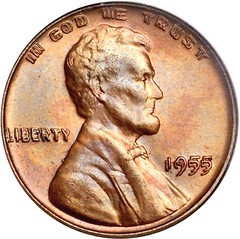
But in one coin club in southern Massachusetts—I would go there quite often—at one time somebody was showing around a brand new penny, 1955. Pardon me if I call them pennies. I know they're cents.
GREG BENNICK: I'm certainly not a stickler. Call them whatever you like.
 KEN BRESSETT: (Laughs) Well, the mint does, so I guess I can! Anyway,
somebody had one. It was a double-struck coin—or that's what he told me.
I looked at it and said, "Yeah, that's got good doubling all around it.
Very nice. Nice find." So I thought, "I've got to go looking for one of
those."
KEN BRESSETT: (Laughs) Well, the mint does, so I guess I can! Anyway,
somebody had one. It was a double-struck coin—or that's what he told me.
I looked at it and said, "Yeah, that's got good doubling all around it.
Very nice. Nice find." So I thought, "I've got to go looking for one of
those."
And he said, "Well, we've got a club member here—I know he's got a few of them. I think he's selling them for 25 cents apiece."
GREG BENNICK: Wow.
KEN BRESSETT: That really sparked my interest. The club member's name was Emil Dwella.
GREG BENNICK: Okay.
KEN BRESSETT: I looked at one of his coins and thought, "Yeah, it's pretty good, but I'm not going to pay you 25 cents for that!" (Both laugh) I went home and thought about it and said, "I guess it's kind of curious to have a double-struck coin. I know there are lots of different double-struck coins. Guess I'll buy one at the next club meeting."
Well, I went and asked him, and he said, "Well, yeah, but the price— everybody wants one—the price is 50 cents each now."
So then I'm thinking, "Well, I'm smarter than this guy. I'll find one in change myself or I'll go to my bank and buy some pennies and see if I can find one." Smart move. No, not really! (Laughter)
By the end of the year, just before the new coins would come out in 1956, I figured, "I'm just not going to get one of these. And besides that, something's been bothering me." Now I had a chance to look at one. They were not double-struck, because if they were double-struck, they would be doubled on both sides. They'd have a double image on both sides. Has to be. And I hadn't realized that before because I hadn't really looked at one.
So I said, "I'm going to get one." The price by then was $10.
GREG BENNICK: Ooh!
KEN BRESSETT: So I said, "No, no, no, don't you do that!" Then I understood exactly, because by then I had looked at one, examined it carefully, and knew what was going on—something I did not have in my entire collection.
Now, poor old Emil Dwella had somehow lucked into several rolls of these brilliant uncirculated 1955 doubled die coins. And he sold most of them for, I think, no more than $10 apiece. The poor guy. It really affected him. He could do nothing but think about the fact that he sold all of those coins. He could be a millionaire by now if he'd saved them. He gave up collecting. He gave up everything, and we never heard from him again.
GREG BENNICK: Hmm…
KEN BRESSETT: Yeah, it was a sad thing about him. Now, there was another part to this story. As these coins became a little more well-known, Q. David Bowers—who was on top of everything, as you know—found out that a lot of those cents were sold to vending machine companies. They were buying up cents because cigarettes in vending machines cost thirty-seven cents.
GREG BENNICK: Okay.
KEN BRESSETT: And you had to put in forty cents in change to get your cigarettes to come out. And three cents would be wrapped up in cellophane around the package of cigarettes.
GREG BENNICK: Okay.
KEN BRESSETT: So Bowers sent out agents and went around and bought up all those packages of cigarettes that he could find. And he did very well selling those later on as doubled die coins.
GREG BENNICK: Wow!
KEN BRESSETT: (Laughs) So that's not even the end of the story.
GREG BENNICK: I love this. I absolutely love this.
KEN BRESSETT: (Laughs) Well, by about 1958, people began to want to have these coins and wanted to buy these coins. They were costing around $100 apiece by then. The pressure was on as the editor of the Red Book and manufacturer of coin albums. People were writing to me saying, "When are you going to list these in the Red Book? And when are you going to make a space for them in the coin albums?"
So I ran a survey, asking dealers. It was a public notice in Coin World: "Do you have an idea or a suggestion of what we should do with this? Let us know. As a publisher, we'll listen to everybody's view." Which I did, and ran a nice survey.
It occurred to both Yeoman and myself that, "Yeah, we've got to do something about these. We'd better recognize them as legitimate collector coins." And so then it was up to me to decide what to call them. They were not double-struck. They were doubled die coins. I coined that term, and I take credit for that. So I was the guy that gave them the name and sent them on their way.
GREG BENNICK: So you never owned one?
KEN BRESSETT: One. I did own one. I finally bought one. Yeah.
GREG BENNICK: I had no idea that you coined the term "doubled die."
KEN BRESSETT: Yeah. I did.
GREG BENNICK: That is incredible! Were there other names that you were considering other than "doubled die" that didn't make the cut?
KEN BRESSETT: Well, everybody else was calling them double-struck. And I had to get away from that.
GREG BENNICK: Sure.
KEN BRESSETT: I never had any other suggestions, I think beyond that.
GREG BENNICK: Wow. That is absolutely unbelievable. Thank you so much for sharing that story. I love it.
KEN BRESSETT: (Laughs) Good!
 About the Interviewer
Greg Bennick (www.gregbennick.com) is a keynote speaker and long time coin collector with a focus on major mint error coins and US counterstamps. He is on the board of both CONECA and TAMS and enjoys having in-depth conversations with prominent numismatists from all areas of the hobby. Have ideas for other interviewees? Contact him anytime
via instagram @minterrors.
He can also be reached by email at
minterrors@gmail.com.
To watch the complete video, see:
Ken Bressett, Interviewed by Greg Bennick
(https://www.youtube.com/watch?v=emQlt4zLTxU&t=1s)
To read the earlier E-Sylum article, see:
KEN BRESSETT INTERVIEW, PART ONE
(https://www.coinbooks.org/v29/esylum_v29n22a17.html)

STACK'S BOWERS: THE MARGOLIS COLLECTION
Stack's Bowers will be selling the Richard Margolis Collection of World Coins and Paper Money on June 11. Select items are discussed below. -Garrett


FRANCE. Kingdom. Brass Louis d'Or Contemporary Counterfeit, 1787-W. Imitating Lille Mint. Louis XVI. EXTREMELY FINE Details. Scratches, Bent. cf. Fr-475 (for regular issue); cf. KM-591.15 (same); cf. Gad-361 (same). Weight: 5.93 gms. Despite the noted issues, an intriguing imitation of good style. SOLD AS IS/NO RETURNS.
Estimate: $100 - $200.
Provenance: Acquired from Hans Schulman.
To read the complete item description, see:
FRANCE. Kingdom. Brass Louis d'Or Contemporary Counterfeit, 1787-W. Imitating Lille Mint. Louis XVI. EXTREMELY FINE Details. Scratches, Bent.
(https://auctions.stacksbowers.com/lots/view/3-1T67R0/france-kingdom-brass-louis-dor-contemporary-counterfeit-1787-w-imitating-lille-mint-louis-xvi-extremely-fine-details-scratches-)


FRANCE. Kingdom. White Metal Obverse Cliche or Trial for Ecu aux Branches d'Olivier, ND (1774)-?. Paris Mint. Louis XVI. PCGS MS-62. cf. KM-564.1 (for regular issue); cf. Gad-356 (same). By Pierre-Simon-Benjamin Duvivier. Amber-gray in tone, this example presents a great portrait of the monarch.
Estimate: $1,000 - $2,000.
Provenance: Acquired from Florange on 24 December 1957.
To read the complete item description, see:
FRANCE. Kingdom. White Metal Obverse Cliche or Trial for Ecu aux Branches d'Olivier, ND (1774)-?. Paris Mint. Louis XVI. PCGS MS-62.
(https://auctions.stacksbowers.com/lots/view/3-1T67RG/france-kingdom-white-metal-obverse-cliche-or-trial-for-ecu-aux-branches-dolivier-nd-1774-paris-mint-louis-xvi-pcgs-ms-62)


FRANCE. Constitution. Copper Ecu de 6 Livres Essai (Pattern), Year 2/1791. Paris Mint. Louis XVI. PCGS SPECIMEN-62 Brown. Maz-69 (R3); Gad-49.(a). Plain edge. Weight: 28.41 gms. By Augustin Dupre. VERY RARE and extremely well struck, this off-metal pattern issue in copper features deep olive-brown coloring and some lighter tan hints, all while some pleasing brilliance emerges from the fields.
Estimate: $1,000 - $2,000.
Provenance: Acquired from the Farouk Collection in March 1954. Ex: Palace Collections of Egypt [King Farouk] (Sotheby's - 3/1954) Lot # 2173 (part of).
Ex: Virgil M. Brand Collection (as "Ferrari-Brand" in Chicago Coin Club's typescript catalog [likely via Schulman], ca. 1932) Lot # 3185.
Ex: Baron Phillipe de Ferrari la Renotière Collection.
Click here for certification details from PCGS. Image with the PCGS TrueView logo is obtained from and is subject to a license agreement with Collectors Universe, Inc. and its divisions PCGS and PSA.
To read the complete item description, see:
FRANCE. Constitution. Copper Ecu de 6 Livres Essai (Pattern), Year 2/1791. Paris Mint. Louis XVI. PCGS SPECIMEN-62 Brown.
(https://auctions.stacksbowers.com/lots/view/3-1T680P/france-constitution-copper-ecu-de-6-livres-essai-pattern-year-21791-paris-mint-louis-xvi-pcgs-specimen-62-brown)


FRANCE. Constitution. Ecu, 1793-BB/Year 5. Strasbourg Mint. Louis XVI. PCGS VF-30. KM-616; Gad-54. A VERY RARE type that is seldom encountered, this wonderful crown displays an even degree of handling and wear across its surfaces, all while remaining exceptionally wholesome and original. Given its pedigree, an even more astounding and important specimen for collections of the period.
Estimate: $2,000 - $4,000.
Provenance: Acquired from Lepczyk in 1977 for $220. Ex: George Sobin Collection (Joseph Lepczyk - 3/1977) Lot # 235.
To read the complete item description, see:
FRANCE. Constitution. Ecu, 1793-BB/Year 5. Strasbourg Mint. Louis XVI. PCGS VF-30.
(https://auctions.stacksbowers.com/lots/view/3-1T6849/france-constitution-ecu-1793-bbyear-5-strasbourg-mint-louis-xvi-pcgs-vf-30)


Extremely Rare Published Isle de France Issue ISLE DE FRANCE (MAURITIUS). Bronze 5 Sols Essai (Pattern), Year III/1792. Birmingham (Soho) Mint. PCGS MS-64 Brown. Lec-8A (this coin cited & illustrated); Margolis (1988), pl. 31, 6 (same). Struck for Isle de France (Mauritius). An EXTREMELY RARE and unusual type, this specimen would, upon first glance, appear to be a fairly common emission from Boulton's vast monnaies des confiance output. However, Margolis writes about the type in his 1988 article in the British Numismatic Journal, entitled "Matthew Bouton's French Ventures of 1791 and 1792; Tokens for the Monneron Frères of Paris and Isle de France," stating that "...as none of the standard works or major auction or fixed price catalogues devoted to the Revolution have described any tokens for Isle de France, it might have been reasonably concluded that these proposals for a colonial token issue never went beyond the talking stage. However, this is not so. Essays were actually prepared..." and that "two different obverse types were paired with a reverse which was struck from a badly broken die. The nature of these die-breaks indicates, I believe, that the flaws occurred during the annealing process, rather than in striking." The other example in Margolis's collection (year IV, also graded PCGS MS-64 Brown) realized a total of $38,400 in our December 2025 CCO auction (Lot # 74166), while an inferior year III, with slightly lower relief, lacking the MB initials, and merely grading UNC Details, realized a total of $19,200 in our August 2025 Global Showcase Auction (Lot # 42394). Additionally, Margolis notes that "...this is most likely the specimen listed by Jef. Dillon (Brussels) in his (circa 1938) FPL # 113."
Estimate: $20,000 - $40,000.
Provenance: Acquired from Jeffrey Young [via Bill Goetz] on 7 September 1985 for $550.
To read the complete item description, see:
Extremely Rare Published Isle de France Issue
(https://auctions.stacksbowers.com/lots/view/3-1T68OW/isle-de-france-mauritius-bronze-5-sols-essai-pattern-year-iii1792-birmingham-soho-mint-pcgs-ms-64-brown)


FRANCE. Constitution. Bronze 5 Sols Token, Year IV/1792. Birmingham (Soho) Mint. PCGS SPECIMEN-65. KM-Tn28; Maz-150. A stunning Gem, this example offers a strong strike and exceptional color, with ample glossy brilliance scattered about.
Estimate: $500 - $750.
Provenance: Acquired from Jacques Schulman on 21 February 1968 in Amsterdam for $3.75.
To read the complete item description, see:
FRANCE. Constitution. Bronze 5 Sols Token, Year IV/1792. Birmingham (Soho) Mint. PCGS SPECIMEN-65.
(https://auctions.stacksbowers.com/lots/view/3-1T68QX/france-constitution-bronze-5-sols-token-year-iv1792-birmingham-soho-mint-pcgs-specimen-65)


FRANCE. Constitution. Bronze 5 Sols Token, Year IV/1792. Birmingham (Soho) Mint. PCGS MS-63. KM-Tn35; Maz-163. The popular Hercules type, this Choice specimen exudes vibrant color and exceptional surface quality.
Estimate: $200 - $400.
Provenance: Acquired from Bourgey in 1957.
To read the complete item description, see:
FRANCE. Constitution. Bronze 5 Sols Token, Year IV/1792. Birmingham (Soho) Mint. PCGS MS-63.
(https://auctions.stacksbowers.com/lots/view/3-1T68VC/france-constitution-bronze-5-sols-token-year-iv1792-birmingham-soho-mint-pcgs-ms-63)


FRANCE. National Convention. Gilt Lead 24 Livres Contemporary Counterfeit, "Year II/1793-A". Imitating Paris Mint. ABOUT UNCIRCULATED Details. Bent. cf. Fr-478 (same); cf. KM-626.1 (same); cf. Gad-62 (same). Weight: 6.18 gms. Some of the gilding is wearing through, but this replica otherwise offers a pleasing appearance and great pedigree. SOLD AS IS/NO RETURNS.
Estimate: $100 - $200.
Provenance: Acquired from Münzen und Medaillen in 1962 for $4.50. Ex: Collection R.K. [Raoul Kraft] (Munzen und Medaillen - 11/1962) Lot # 431.
To read the complete item description, see:
FRANCE. National Convention. Gilt Lead 24 Livres Contemporary Counterfeit, "Year II/1793-A". Imitating Paris Mint. ABOUT UNCIRCULATED Details. Bent.
(https://auctions.stacksbowers.com/lots/view/3-1T6990/france-national-convention-gilt-lead-24-livres-contemporary-counterfeit-year-ii1793-a-imitating-paris-mint-about-uncirculated-de)


FRANCE. Consulate. Silver 2 Decimes Essai (Pattern), Year 8-A (1799/1800). Paris Mint. PCGS SPECIMEN-63. Maz-586a; Gad-301.(a). By Pierre-Joseph Lorthior. A SCARCE and alluring type, this pattern issue is tied with just four others for the top spot in the PCGS census.
Estimate: $600 - $900.
Provenance: Acquired from Winandy in 1958 for $2.75. Ex: Charles Winandy FPL (11/1958) Lot # 142.
To read the complete item description, see:
FRANCE. Consulate. Silver 2 Decimes Essai (Pattern), Year 8-A (1799/1800). Paris Mint. PCGS SPECIMEN-63.
(https://auctions.stacksbowers.com/lots/view/3-1T69TV/france-consulate-silver-2-decimes-essai-pattern-year-8-a-17991800-paris-mint-pcgs-specimen-63)


FRANCE. Consulate. White Metal Obverse Cliche or Trial for 5 Francs Module, ND (1802). Paris Mint. Napoleon (as First Consul). PCGS MS-62. cf. Maz-629 (for full strikings in gold & silver); cf. Gad-578e (for full striking); T&T-1701.a.4. By Pierre-Joseph Tiolier. An example of this RARE type featuring Tiolier's bareheaded bust of Napoleon, with this type being intended as a mint visit striking.
Estimate: $1,000 - $2,000.
Provenance: Acquired from Randolph Zander in 1956.
To read the complete item description, see:
FRANCE. Consulate. White Metal Obverse Cliche or Trial for 5 Francs Module, ND (1802). Paris Mint. Napoleon (as First Consul). PCGS MS-62.
(https://auctions.stacksbowers.com/lots/view/3-1T69ZP/france-consulate-white-metal-obverse-cliche-or-trial-for-5-francs-module-nd-1802-paris-mint-napoleon-as-first-consul-pcgs-ms-62)


FRANCE. Empire. Franc, Year 13-A (1804/5). Paris Mint. Napoleon I. PCGS AU-58. KM-656.1; Gad-443. Displaying a fairly clear overdate, this near-Mint minor offers tremendous brilliance and an enticing golden-gunmetal gray hue across both sides.
Estimate: $200 - $400.
Provenance: Acquired from Bernard Southgate on 17 August 1973.
To read the complete item description, see:
FRANCE. Empire. Franc, Year 13-A (1804/5). Paris Mint. Napoleon I. PCGS AU-58.
(https://auctions.stacksbowers.com/lots/view/3-1T6AA7/france-empire-franc-year-13-a-18045-paris-mint-napoleon-i-pcgs-au-58)


FRANCE. Empire. Demi Franc (1/2 Franc), 1807-A. Paris Mint. Napoleon I. PCGS AU-55. KM-679; Gad-397. "African Head" type. A RARE one-year type that features a fairly insensitive moniker, this lightly circulated minor presents alluring gunmetal gray toning.
Estimate: $200 - $400.
Provenance: Acquired from Florange on 5 October 1965 for $9.
To read the complete item description, see:
FRANCE. Empire. Demi Franc (1/2 Franc), 1807-A. Paris Mint. Napoleon I. PCGS AU-55.
(https://auctions.stacksbowers.com/lots/view/3-1T6AG6/france-empire-demi-franc-12-franc-1807-a-paris-mint-napoleon-i-pcgs-au-55)

ST. JAMES AUCTION 123: RICHARD PRINCE COLLECTION
St. James Auctions will be holding its Auction 123 on June 10, featuring the Richard Prince Collection. Select items are discussed below. -Garrett

Oliver Cromwell (1656-1658), crown, 1658 8 over 7, by Thomas Simon, laureate, draped bust left, OLIVAR.D G.R.P.ANG.SCO. ET.HIB&PRO, rev. crowned shield of the Protectorate, date above, PAX.QVAERITVR.BELLO, edge +.HAS.NISI. PERITVRVS.HISI.ADIMAT.NEMO.,(L&S 1; ESC 10; Bull 240 S.3226) with late die flaw, a magnificent example, beautifully toned with reflective fields, practically as struck, an exceptional example, certified and graded by NGC as Mint State 63+
*ex. St. James's Auction 9, 18 June 2008, lot 331
To read the complete item description, see:
Oliver Cromwell (1656-1658)
(https://bsjauctions.auctionmobility.com/lots/view/1-CPH3YJ/the-richard-prince-collection)

Charles II (1660-1685), Proof Crown, 1664, by Roettier, a more finely engraved variety of the second laureate draped bust right, CAROLVS. II. DEI. GRATIA. rev. crowned cruciform shields of England, Scotland France and Ireland, interlinked C's in angles, ten strings to harp, MAG. BR FRA. ET. HIB. REX. 1664. edge XVI, 29.92g., (L&S 10; ESC 29; Bull 363; S.3355, well defined strike, on a broad flan, unevenly toned, good extremely fine, and of the highest rarity, believed two known, certified and graded by NGC as Mint State 62
*ex. Glendining, 8 June 1966, lot 107.
V C Vecchi, London, FPL 11 (1970) # 244
NGSC, Geneva, 20th Anniversary sale, auction 5, 2 December 2008, lot 602
Baldwins FPL Summer 2009; purchased Sovereign Rarities, 9 May 2018.
The Geoffrey Cope example sold by NAC in May 2024 realised 116,000 Swiss francs.
To read the complete item description, see:
Charles II (1660-1685)
(https://bsjauctions.auctionmobility.com/lots/view/1-CPH3YP/the-richard-prince-collection)

George III (1760-1820), proof guinea,1813, by Lewis Pingo after Marchant's model, ‘Military' seventh head right, rev. BRITANNIARUM REX FIDEI DEFENSOR shield in Garter, crown above, date below, wt. 8.39gms. (WR 114 [R4]; Montagu 528; Murdoch 158; Nobleman 15; Douglas-Morris 117; S.3730), very rare, brilliant, frosted, practically FDC, certified and graded by NGC as Proof 62 Cameo, erroneously identified as W&R 115 by NGC – as the illustration in W&R is incorrect
Purchased, M Rasmussen, FPL 11 , Winter 2006, #141.
To read the complete item description, see:
George III (1760-1820)
(https://bsjauctions.auctionmobility.com/lots/view/1-CPH415/the-richard-prince-collection)

George IV (1820-1830), proof crown, 1826, by W. Wyon after Chantry's model, bare head left, date below, rev. crowned shield of arms within ermine mantel, edge, SEPTIMO, (L&S 28; ESC 257 [R]; Bull 2336 [R] S.3806), attractively toned, practically FDC, certified and graded by NGC as Proof 64
To read the complete item description, see:
George IV (1820-1830)
(https://bsjauctions.auctionmobility.com/lots/view/1-CPH43T/the-richard-prince-collection)

Victoria (1837-1901) proof five pounds, 1887, Jubilee bust left, rev. St. George and dragon (S.3864; EGC 1308; WR 285) practically FDC, certified and graded by NGC as Proof 62 Ultra Cameo
To read the complete item description, see:
Victoria (1837-1901)
(https://bsjauctions.auctionmobility.com/lots/view/1-CPH45N/the-richard-prince-collection)

Victoria (1837-1901), VIP proof crown, 1847, ‘Gothic', struck in "fine silver" crowned bust left, rev. crowned cruciform shields, emblems in angles, edge plain (ESC 291A[ R6]; Bull 2580 [R6]; S.3883), a superb example, lightly toned, brilliant fields and frosted, of the highest rarity, believed 3 known, practically FDC, certified and graded by NGC as Proof 62 Ultra Cameo, with alloy shells
Purchased R Richardson 28 May 2008
NGC have certified this as S.2578A, but the current cataloguer believe it to be the frosted issue ESC 291A
To read the complete item description, see:
Victoria (1837-1901)
(https://bsjauctions.auctionmobility.com/lots/view/1-CPH477/the-richard-prince-collection)

Victoria (1837-1901), pattern florin, 1848, by W Wyon, type c/Biv, young head left with plain fillet, VICTORIA REGINA, date below, rev. Royal cypher, VR interlinked with rose, thistle and shamrock, Prince of Wales's plumes below, ONE DECADE above, ONE TENTH OF A POUND below, edge plain (ESC 903[R2]; Davies 712; Bull 2935 [R2]), very rare, attractively toned, practically FDC, certified and graded by NGC as Proof 64+Cameo
*ex, Spink Auction 201, 26 November 2009, lot 505.
To read the complete item description, see:
Victoria (1837-1901)
(https://bsjauctions.auctionmobility.com/lots/view/1-CPH49L/the-richard-prince-collection)

Victoria (1837-1901), pattern florin, 1848, type c/Cvi, by W. Wyon, young head left with plain fillet, VICTORIA REGINA, date below rev. ONE DECADE, trident below, within wreath, 100 MILLES above and ONE TENTH OF A POUND below, edge plain (ESC 909[R2]; Davies 714; Bull 2941 [R2]) , very rare, attractively toned, practically FDC, certified and graded by NGC as Proof 66
*ex, Spink Auction 201, 26 November 2009, lot 506.
To read the complete item description, see:
Victoria (1837-1901)
(https://bsjauctions.auctionmobility.com/lots/view/1-CPH49N/the-richard-prince-collection)
STACK'S BOWERS: NUMISMATIC AMERICANA
Stack's Bowers will be hosting their June 2026 Showcase Auction, including Session 1 which is comprised of Numismatic Americana, Colonial & Pre-Federal Coins, on June 15. Select items are discussed below. -Garrett


"1799" (ca. 1800) Washington Funeral Urn Medal. Musante GW-70, Baker-166A, Fuld Dies 1-B. Silver. AU-53 (PCGS). 29.5 mm. 138.8 grains. Pierced for suspension at 12 o'clock, as typical. A desirable example of this prized medal in silver, showing evidence of a light handling, yet still remarkably sharp save for the often seen softness at the upper area of the urn. The obverse is mottled with dark bluish-gray toning intermingled with fairly light gray silver. The reverse is lighter overall, with gentle golden-brown and blue iridescence. A good bit of reflectivity remains on both sides, with more on the reverse. Some light handling marks, hairlines and small nicks are noted, while a couple of thin scratches are seen on the reverse. This piece is quite a bit nicer than most seen for the type. It is a most satisfying example of an immensely popular medal, one of a class "perhaps the most valued of all the earlier Washington pieces," to use Baker's own words. He continued, "The time and purpose of their issue and their legends, give to each an interest beyond all others."
Provenance: Ex William Spohn Baker Collection, to the Historical Society of Pennsylvania by bequest, November 15, 1897; our sale of Washingtoniana from the Collections of the Historical Society of Pennsylvania featuring the Collection of William Spohn Baker, November 2019 Baltimore Auction, lot 20055.
To read the complete item description, see:
"1799" (ca. 1800) Washington Funeral Urn Medal. Musante GW-70, Baker-166A, Fuld Dies 1-B. Silver. AU-53 (PCGS).
(https://auctions.stacksbowers.com/lots/view/3-1T23VR/1799-ca-1800-washington-funeral-urn-medal-musante-gw-70-baker-166a-fuld-dies-1-b-silver-au-53-pcgs)


1817 James Madison Presidential Medal. Julian PR-3, Neuzil-43. White Metal. MS-62 (PCGS). 63.8 mm, 4.4 mm to 4.7 mm thick. Nice, even medium silver gray color. The fields are bright and somewhat reflective. Overall, superior quality for this rare medal, nicer than most examples that we have offered in recent decades. The obverse, by Moritz Furst, shows Madison's bust facing right with his presidential dates inscribed around. The reverse, by an unknown engraver, refers to what contemporaries called ''Mr. Madison's War'' (the War of 1812). As Neuzil convincingly argues, Furst's obverse was married to the reverse after the latter had been cut down to match sometime after 1817. This medal always comes in white metal; the unique silver specimen is in the ANS Collection.
Provenance: From the Medicus Collection of Presidential Inaugural and Related Medals. Earlier ex Wayte Raymond estate; John J. Ford, Jr.; our (Stack's) sale of the John J. Ford, Jr. Collection, Part IX, May 2005, lot 7, where it realized $16,100.
To read the complete item description, see:
1817 James Madison Presidential Medal. Julian PR-3, Neuzil-43. White Metal. MS-62 (PCGS).
(https://auctions.stacksbowers.com/lots/view/3-1T23Y2/1817-james-madison-presidential-medal-julian-pr-3-neuzil-43-white-metal-ms-62-pcgs)


Extremely Rare 1921 Harding Inaugural Medal in Silver Fewer Than 10 Known 1921 Warren G. Harding and Calvin Coolidge Official Inaugural Medal. Dusterberg HIM-S70, MacNeil-WGH 1921-2, Levine-WGH 1921-2. Silver. MS-62 (PCGS). 70.0 mm. 98.4 grams. With rich, mottled, steel and olive patina on a base of pewter gray, the surfaces faintly reflective when viewed with the aid of strong lighting. Sharply defined and presenting as uncommonly smooth during in-hand viewing despite the presence of faint hairlines that explain the MS-62 grade from PCGS.
The Republican victory over Democratic contenders James M. Cox and Franklin Delano Roosevelt in November 1920 was to have been celebrated with "the most dazzling celebration in the memory of the present generation." This event was to be directed by Washington Post publisher Edward "Ned" McLean and his heiress spouse Evalyn. Campaign denunciations of Woodrow Wilson's supposed governmental extravagance, surviving asceticism from the First World War, and the sudden lurch of the nation's economy into a vicious post-war Depression derailed the planned extravaganza. Nevertheless, the McCleans offered their own lavish private hospitality, which extended to the striking of this Inaugural medal in very small quantities by R. Harris & Co. of Washington.
While not as famous as the 1905 Roosevelt Inaugural medal by Augustus Saint-Gaudens, the medals of Warren G. Harding's 1921 inauguration are exponentially more rare and each appearance is a significant numismatic event. Fewer than 10 are thought to survive in silver and most are held tightly in private collections. We recently handled a silver example in 2019, when we sold the specimen of Edmund W. Dreyfuss (brother of David W. Dreyfuss) as lot 108 in our November Baltimore Auction. Certified Specimen-63 by PCGS at the time of sale, that piece realized $31,200. More recently, we offered a silver example certified Specimen-55 by PCGS which brought $48,000 in our August 2024 Global Showcase Auction. Additionally, a bronze example in our November 2021 Baltimore Auction realized $38,400 in a PCGS Specimen-62 holder. We certainly expect equally strong interest in the silver example offered here.
To read the complete item description, see:
Extremely Rare 1921 Harding Inaugural Medal in Silver
(https://auctions.stacksbowers.com/lots/view/3-1T245G/1921-warren-g-harding-and-calvin-coolidge-official-inaugural-medal-dusterberg-him-s70-macneil-wgh-1921-2-levine-wgh-1921-2-silver-)


Incredible Gold Franklin Delano Roosevelt Fourth Inaugural Medal Unique in Private Hands Only 10 Struck for Special Distribution to Government Officials and World Leaders The Specimen Presented to King Ibn Saud of Saudi Arabia 1945 Franklin Delano Roosevelt Official Fourth Inaugural Medal. Dusterberg-OIM 11G45, MacNeil-FDR 1945-1, Levine-FDR 1945-1. Gold. Unc Details--Damaged (NGC). 45.0 mm. 95.3 grams, 1,470 grains, .999 fine, 3.06 troy ounces AGW. In the presidential election of November 7, 1944, Democrat Franklin Delano Roosevelt was elected to an unprecedented fourth term in a strong victory over Republican candidate Thomas E. Dewey. Out of 531 votes in the Electoral College, the president secured 432 votes against Dewey's 99. Roosevelt carried 36 out of the 48 states in the Union, and received 25,612,916 popular votes as opposed to 22,017,929 for Dewey. With World War II going well for the Allies at the time, Roosevelt remained popular despite rumors of ill health and Dewey's campaigning against the New Deal.
Yet when it came to the actual inauguration on January 20, 1945, the president recognized the need for austerity. The nation was still heavily engaged in and preoccupied with World War II, and the military situation had changed since the election in November. On inauguration day the German Ardennes Offensive (the Battle of the Bulge) and supporting attack in the Rhineland-Palatinate, Alsace and Lorraine (Operation Nordwind) had still not been defeated. Although both battles would soon end in Allied defensive victories, the German offensives had come as a shock to American and British leaders and dashed Allied hopes for an end to the war in Europe in 1944. On the other side of the world, the Battle of Leyte Gulf in October 1944 had seen the first organized Japanese kamikaze attacks against U.S. warships, Manila was still in Japanese hands at the end of January 1945, and final liberation of the Philippines was a long way off. Clearly much hard fighting still lay ahead in both the European and Pacific theaters.
Wartime austerity measures, the public mood, and the shortage of copper and bronze due to war demands were some of the many reasons that cast doubt on whether an official medal would be produced for Roosevelt's fourth inauguration. The Mint was also heavily engaged in wartime production with no time or resources to devote to matters other than those related to getting desperately needed coinage into circulation. Nevertheless, Mint Director Nellie Tayloe Ross took the initiative to avoid the Mint being caught unawares and having to work under intense pressure, as it had to in 1941, after the decision to produce Roosevelt's third inaugural medal came so late. She brought the matter to the attention of her immediate superior, Undersecretary of the Treasury Daniel W. Bell, who in turn informed his boss, Secretary of the Treasury Henry Morgenthau, Jr. By December 12, 1944, Ross received the reply from Bell that the president did, indeed, want a fourth inaugural medal.
Two days after Roosevelt returned to the capital on December 20 after a brief period of rest at Warm Springs, Georgia, a small group convened at the White House as the Inaugural Planning Committee. It decided that the inauguration would be an austere and sparse event held at the White House. Under normal circumstances, the production and distribution of the presidential inaugural medal was the responsibility of an Inaugural Committee, a citizens' committee that conducted the "unofficial" aspects of the celebration. Given the austerity of the planned inauguration, however, there was neither the need nor an inclination to establish an Inaugural Committee. Yet even so, there was still the question of how to handle the inaugural medal that the president wanted. Fortunately, one of the members of the Inaugural Planning Committee was Joseph E. Davies, who had served as chairman of the 1941 Inaugural Committee.
Davies had a long a distinguished career as a lawyer and diplomat. From 1936 to 1938 he had served as the United States Ambassador to the Soviet Union, followed by brief stints as the country's ambassador to Belgium and Luxembourg, 1938 to 1939. After these postings, Davies was special assistant to Secretary of State Cordell Hull from 1939 to 1941, in charge of War Emergency Problems and Policies. From 1942 to 1946 he was chairman of the president's War Relief Control Board. Later in the war, Davies would be special advisor to President Harry Truman and Secretary of State James F. Byrnes with rank of Ambassador at the Potsdam Conference, July 17 to August 2, 1945. In December 1944, President Roosevelt asked Ambassador Davies if he would take on the responsibility for the inaugural medal, to which task he readily agreed.
Upon learning of his appointment, Mint Director Ross wrote to Ambassador Davies, "I regard you a committee of one appointed by President Roosevelt to determine all matters relating to that medal." This was a major undertaking. In other years the Inaugural Committee would finance production of the medals, with its medal committee repaying the required advances through sales. With no Inaugural Committee for Roosevelt's fourth inauguration, however, there were no public funds available, and also no staff to handle production and sale of the medals. Writing in his reference The President's Medal: 1789-1977, Neil MacNeil observes:
Davies resolved all these problems at once. He agreed himself to pay for all the medals, and he offered his private staff to handle the distribution. He would be reimbursed as the medals were sold. Davies set up an Inaugural Medal Committee comprised of himself as chairman, Mint Director Ross, and two of his colleagues, attorney Melvin D. Hildreth as vice-chairman, and Alfons Landa; they had all served together on the 1941 Inaugural Committee. To design the medal, Davies' Inaugural Medal Committee turned once again to Jo Davidson, the artist who had designed Roosevelt's third inaugural medal. As part of her initiative earlier in the month, the mint director had already approached Davidson about his possible involvement.
The president agreed to sit for Davidson, and in late December the artist came to the White House for that purpose. As related by MacNeil:
"Those were busy days for him," Davidson later wrote in his memoirs, "and I had to wait around while he found a few precious minutes for me." Davidson took full advantage of his opportunities. He modelled an extraordinarily sensitive portrait, in right profile. To suggest the President's wartime role as Commander-in-Chief, Davidson cloaked him in a Navy cape. Roosevelt had always regarded himself as a naval man. While I was working on his profile, Davidson wrote, he suggested that the reverse of the medal should carry the U.S.S. Constitution in full sail, with the inscription, "Thou too sail on, O Ship of State, Sail on Union strong and great." The President had a painting of the Constitution which he had brought down and sent to the Willard Hotel, where I sat up all night working on it.
Sometime during the brief production process, Davidson prepared a 76.5 mm pattern with a different bust of the president than that which appears on the final product. The portrait is surrounded by an inner border, outside of which is the peripheral legend FRANKLIN DELANO ROOSEVELT / 31ST PRESIDENT OF THE UNITED STATES OF AMERICA. It was offered in Collectors' Auctions' May 1989 catalog, as lot 94, and referenced in the June 1989 edition (Volume 6, Number 1) of The Medalist.
Meanwhile, Ambassador Davies and Mint Director Ross decided on a 45 mm format for the medal, slightly larger than that of the 1941 inaugural, and settled with the Mint for production of 3,000 bronze examples. These were paid for by Ambassador Davies, as were the additional 500 bronze pieces he approved later to meet actual demand. On January 9, Mint Director Ross received the first trial strike, after which she expressed to Davidson, "It is a splendid product of your skill." The first bronze medal arrived in Washington, D.C. on January 12, and was dispatched by White House mail pouch to Roosevelt, who was at his home in Hyde Park at the time. The remainder of the initial 3,000 bronze examples were all in Washington by January 19, in time for the inauguration the following day.
As customary, one gold medal was prepared for the president, which was paid for by the Inaugural Medal Committee, the four members of which (Davies, Ross, Hildreth, and Landa) were joined by artist Jo Davidson in presenting it to Roosevelt when he returned to the White House from Hyde Park on January 18. Also present that day was General Edwin "Pa" Watson, the president's military aide. As related by MacNeil:
The President was to leave shortly after the inauguration for a summit conference at Yalta. After that, he planned to sail to the Middle East, there to confer with the Arab leaders. Remembering this now, Roosevelt turned to "Pa" Watson. "What does Ibn Saud want for a present?" he asked, about the King of Saudi Arabia.
To read the complete item description, see:
Incredible Gold Franklin Delano Roosevelt Fourth Inaugural Medal Unique in Private Hands
(https://auctions.stacksbowers.com/lots/view/3-1T248M/1945-franklin-delano-roosevelt-official-fourth-inaugural-medal-dusterberg-oim-11g45-macneil-fdr-1945-1-levine-fdr-1945-1-gold-unc-d)


Exceedingly Rare Presidential Inaugural Gold Charm Bracelet Complete for All Charm Issues, 1953-1969 One of Only Two Known Bracelet Containing (5) Official Presidential Inaugural Medal Charms, 1953-1969. Gold. 136.6 grams (4.39 ounces) total weight, bracelet 18 karat, bezels 14 karat. These gold charms are the rarest and most eagerly sought of the official presidential inaugural committee medals. They were initially produced by Medallic Art Company for the inaugurations from 1953 through 1969, in each case in extremely limited numbers. None were struck in 1973 and 1977, when the contract to produce the inaugural medals was held by the Franklin Mint. When Medallic Art Company took up the contract again in 1981, it resumed production of these gold charms, and continued to do so through the 2005 inauguration.
For the early series, 1953 to 1969, only two complete sets are known, both in bracelets, one of which is being offered here; the other, the Honorable and Mrs. Gilbert Hawn, Jr. specimen, is plated on page 119 of Neil MacNeil's reference The President's Medal: 1789-1977. The following charms are included:
1953 Dwight D. Eisenhower. Dusterberg-OIM 13G21, MacNeil-DDE 1953-5, Levine-DDE 1953-6. 21.0 mm. Mintage: 18. Apart from the present specimen, only four of these have appeared for sale since 1976.
1957 Dwight D. Eisenhower. Dusterberg-OIM 14G27, MacNeil-DDE 1957-5, Levine-DDE 1957-5. 27.0 mm. Mintage: 6. One of these was presented to Mrs. Eisenhower; only one other has been sold at auction, in PCAC's sale of December 5, 1976.
1961 John F. Kennedy. Dusterberg-OIM 15G27, MacNeil-JFK 1961-4, Levine-JFK 1961-4. 27.0 mm. Mintage 5. Four of the five charms were received by Mrs. Kennedy, Mrs. Paul Manship, Mrs. Gilbert Hawn (in the other bracelet), and the original owner of the present bracelet; the recipient of the fifth charm is unknown, and it is untraced.
1965 Lyndon Baines Johnson. Dusterberg-OIM 16G27, MaNeil-LBJ 1965-6, Levine-LBJ 1965-6. 27.0 mm. Mintage: 9. One of these is in the Crain Collection at George Washington University; that offered here is the only one that has appeared for sale.
1969 Richard M. Nixon. Dusterberg-OIM 17G29, MacNeil-RMN 1969-11, Levine-RMN 1969-11. 29.0 mm. Mintage: 5. In addition to the two examples in the bracelets, one is part of the Crain Collection at George Washington University, while a fourth appeared in PCAC's 36th Sale (1983); the fifth is presumed to have been presented to Mrs. Nixon and is untraced.
Each of the charms shows signs of moderate handling, "indicating that the bracelet was worn often and with pride," as Joe Levine put it so eloquently in 2004.
The foregoing information about the extreme rarity of these charms and the paucity of their market appearances is attributed to Jimmy Hayes' forthcoming reference Each New Beginning, Volume III: 1889-2001. Clearly our offering of this bracelet is a fleeting opportunity - perhaps the only one in a lifetime for the advanced collector to acquire an example of each of these types. This bracelet is the centerpiece in the extensive collection of Presidential and Inaugural medals that figures so prominently in this sale, and it will surely see spirited bidding and command a strong price as it transitions into another advanced cabinet.
Provenance: From the Medicus Collection of Presidential Inaugural and Related Medals. Earlier ex our (Bowers and Merena') sale of the David W. Dreyfuss Collection, April 1986, lots 5845 through 5850, unsold; Presidential Coin and Antique Co., Inc.'s sale of the David W. Dreyfuss Family Collection, December 2004 Auction #73, lot 473; Jimmy Hayes.
To read the complete item description, see:
Exceedingly Rare Presidential Inaugural Gold Charm Bracelet
(https://auctions.stacksbowers.com/lots/view/3-1T249A/bracelet-containing-5-official-presidential-inaugural-medal-charms-1953-1969-gold)


1783 John Chalmers Shilling. W-1785. Rarity-4+. Birds, Short Worm. AU-50 (PCGS). An inviting example of the type, both sides offer good centering with fully denticulated borders that thin just a bit along the right obverse and reverse. The borders frame otherwise bold motifs that are minimally affected by minor softness isolated within the left portion of the wreath on the obverse and at the beading below the left bird on the reverse. All major design elements, however, are more or less appreciable. The surfaces are devoid of troublesome marks or other blemishes, and handsomely toned in light pewter gray with hints of underlying gold and blue iridescence. The most often seen Chalmers coins are shillings of the bird type, the short worm variant offered here perhaps slightly scarcer than its long worm counterpart. With the quality of strike and superior surface preservation offered here, both types are equally scarce in an absolute sense, and rare from a market availability standpoint. This one is sure to sell for a nice premium.
To read the complete item description, see:
1783 John Chalmers Shilling. W-1785. Rarity-4+. Birds, Short Worm. AU-50 (PCGS).
(https://auctions.stacksbowers.com/lots/view/3-1T258O/1783-john-chalmers-shilling-w-1785-rarity-4-birds-short-worm-au-50-pcgs)


1776 Machin's Mills Halfpenny. Vlack 6-76A, W-7790. Rarity-4. GEORGIVS III, Group I, Large Date. EF-40 (PCGS). Believed to have been struck in 1785 at Samuel Atlee's brewery mint in New York City, as opposed to at Machin's Mills, this variety is one of only two contemporary counterfeit British halfpence of American origin that displays the magical 1776 date. The Vlack 6-76A typically comes with poor central definition, due to the obverse device punch being pressed too deeply into the die, a situation compounded by the moderate to heavy wear seen on most examples. The present example shows the usual central softness, most notably on the effigy's head and within the lower half of the seated figure, but it is less heavily worn than the usually encountered Vlack 6-76A. Surface quality is also well above average with only tiny, singularly inconspicuous handling marks and no planchet flaws or roughness. Some old dirt is nestled within the protected areas around some of the obverse devices, reverse with a trace of light crimson scale behind the head, none of which features are of major concern. The reverse is well centered, obverse border at upper right into the tops of the digits in the Roman numeral III, date sharp, overall design bold and fully appreciable. An even endowment of warm medium brown patina rounds out an impressive list of attributes for this desirable copper.
To read the complete item description, see:
1776 Machin's Mills Halfpenny. Vlack 6-76A, W-7790. Rarity-4. GEORGIVS III, Group I, Large Date. EF-40 (PCGS).
(https://auctions.stacksbowers.com/lots/view/3-1T25HG/1776-machins-mills-halfpenny-vlack-6-76a-w-7790-rarity-4-georgivs-iii-group-i-large-date-ef-40-pcgs)


1786 New Jersey Copper. Maris 15-T, W-4825. Rarity-3. Straight Plow Beam, Leaning Head. AU-55 (PCGS). 140.8 grains. Both sides are a uniform medium brown in color. The surfaces appear rough and somewhat granular, particularly on the obverse. Well centered on both sides, if a trifle tight on the flan, especially on the reverse. No significant flaws or signs of mishandling requiring specific mention. Struck from the intermediate state of the obverse, the die broken through the tops of the last two letters in the legend, the break running through the top of the plow beam but not yet extending to the date below; the reverse die broken from tip of shield up left toward the first star in the legend. Far nicer than anything we have offered for this Maris number in more than a decade, the E Pluribus Unum Collection had several, but none were finer than PCGS AU-53, while Syd Martin's was in a PCGS VF Details holder due to cleaning. The Eliasberg-Partrick coin in NGC MS-63 RB is tied for CC#1, although the present example would also do justice to one of the finest New Jersey copper sets currently being formed.
Provenance: From the Paul Karanfilian Collection. Earlier ex Henry Chapman's sale of the George M. Parsons Collection, June 1914, lot 228; Hillyer C. Ryder; F.C.C. Boyd estate; John J. Ford, Jr,; our (Stack's) sale of the John J. Ford, Jr. Collection, Part I, October 2003, lot 91.
To read the complete item description, see:
1786 New Jersey Copper. Maris 15-T, W-4825. Rarity-3. Straight Plow Beam, Leaning Head. AU-55 (PCGS).
(https://auctions.stacksbowers.com/lots/view/3-1T25K3/1786-new-jersey-copper-maris-15-t-w-4825-rarity-3-straight-plow-beam-leaning-head-au-55-pcgs)


Fascinating Brockage of RR-2 Reverse Rare Major Minting Error 1785 Vermont Copper. Landscape. RR-2, Bressett 1-A, W-2005. Rarity-3. VERMONTS. Reverse Brockage. VF-30 (PCGS). This is one of the most dramatic, significant Vermont copper errors that we can ever recall offering. The reverse (mounted as the obverse in the PCGS holder), is properly struck, albeit somewhat off center to 3 o'clock and soft at the upper right and lower peripheries. Wear is moderate, although otherwise even, with all central design elements bold, most peripheral lettering clear. The Landscape obverse is nowhere to be seen, its place instead taken by a sharp early brockage of the reverse design that is crisp throughout the all-seeing eye, rays, stars, and letters in QUARTA and STELLA. The left periphery is soft with little trace of an incuse DECIMA. There is a shallow, straight planchet clip just past 6 o'clock relative to the reverse. Handsome olive-copper and medium brown patina overall, the surfaces lightly granular, yet free of significant marks. This is a true specialist's coin, whether they are a Vermont copper enthusiast or more expansive collector of major mint errors, and it will surely see spirited bidding.
To read the complete item description, see:
Fascinating Brockage of RR-2 Reverse
(https://auctions.stacksbowers.com/lots/view/3-1T25VU/1785-vermont-copper-landscape-rr-2-bressett-1-a-w-2005-rarity-3-vermonts-reverse-brockage-vf-30-pcgs)


Outstanding RR-3 Vermont Copper Among the Finest Known 1785 Vermont Copper. Landscape. RR-3, Bressett 2-B, W-2010. Rarity-5-. VERMONTS. AU-55 (PCGS). Medallic alignment. This piece rivals the finest certified that we can recall offering for this RR number, the Garrett I:553 specimen which more recently appeared as lot 320 in our March 2019 sale of the Greenway Collection. Certified AU-55 by PCGS at that time, we cataloged the Garrett-Greenway coin as "Probably Finest Known" for the RR-3 dies. This one, also struck on an unusual planchet, has a more balanced appearance, presents better overall, and has equally strong - if not stronger - claim to the coveted "Finest Known" title. The planchet is generally round, a bit ragged just past 6 o'clock relative to the obverse, reverse with prominent cutter mark inside the border from 9 o'clock to 12 o'clock. The strike is well centered and remarkably sharp overall, obverse trivially soft at letters PUB in PUBLICA, whose tops are engaged by the border, areas of minor planchet roughness remain at plow and date area on the obverse, opposite area on lower reverse after DECIMA. Most design elements are boldly rendered and crisp, and all are at least discernible, if with patience. Smooth in the absence of troublesome post-production blemishes, original toning with wisps of olive to dominant autumn-orange brown further enhance the awesome eye appeal.
Writing in the 1993 reference The Copper Coins of Vermont, Tony Carlotto states of RR-3:
Appearances of this variety seem to go in spurts. A few nice specimens exist, most notably the Taylor coin in AU condition. The Cole example was XF and Dr. Smith's in the Ingle sale was VF. It was missing from Norweb, Picker, Roper, and the Four Landmark sale by Bowers and Merena. The chances of having the luxury to be picky are very slim.
To read the complete item description, see:
Outstanding RR-3 Vermont Copper
(https://auctions.stacksbowers.com/lots/view/3-1T25X2/1785-vermont-copper-landscape-rr-3-bressett-2-b-w-2010-rarity-5-vermonts-au-55-pcgs)


Classic 1788 RR-30 Vermont Copper Backward C in AUCTORI Variety 1788 Vermont Copper. RR-30, Bressett 23-S, W-2225. Rarity-6-. Bust Right, Backward C in AUCTORI. VG-8 (PCGS). An unusual example of this distinct variety, one with significant positives to offset one particularly notable detraction. Among the former, we note pleasing color in warm, original, golden-brown and tobacco on surfaces that present as smooth during in-hand viewing. There is some nice gloss, as well, no significant flan flaws, and only minor planchet pitting that requires magnification to discern. Closer inspection also reveals numerous fine scratches, but these are not all that worrisome for an RR-30 at the certified VG level. The most significant detraction here is actually the strike, more specifically that on the obverse, which is off center to 3 o'clock with the entire word AUCTORI beyond the flan, including the all-important backward C. Effigy typically soft for the variety, but VERMON and the following star are bold and framed by an arc of crisp border denticulation at left. The reverse shows better, although still not perfect centering, border into the tops of the letters in ET LIB, INDE bold, seated figure fairly well outlined if overall soft, date area smooth.
RR-30 offers the only use of this obverse die (Bressett 23) in the Vermont copper series. Fewer than 30 specimens of RR-30 are known, many of which are impounded in institutional collections: ANS, Bennington Museum, ANA, Vermont Historical Society, and others. With most of the privately owned specimens in strong hands, any opportunity to acquire a relatively pleasing example such as this deserves serious bidder consideration.
To read the complete item description, see:
Classic 1788 RR-30 Vermont Copper
(https://auctions.stacksbowers.com/lots/view/3-1T265E/1788-vermont-copper-rr-30-bressett-23-s-w-2225-rarity-6-bust-right-backward-c-in-auctori-vg-8-pcgs)


1787 Fugio Cent. Pointed Rays. Newman 8-X, W-6750. Rarity-3. STATES UNITED, 4 Cinquefoils. MS-64 BN (NGC). Newman Obverse State D, the middle state listed, usual Reverse State C. While the obverse break on this piece has obscured the letter N in BUSINESS, the Y in YOUR is clear, and the detail on both sides is otherwise sharp apart from a touch to softness to the rings at lower reverse. Frosty surfaces retain plenty of vivid rose-red mint color that shines forth nicely from the protected areas around the design elements. Otherwise toned in iridescent gray-brown, both sides show only partial border denticulation, but the centering is good for the type. One of the more popular die marriages of the Fugio cent for type purposes, as 189 examples of Newman 8-X remained in the Bank of New York hoard in 1948.
Provenance: From the Paul Karanfilian Collection. Earlier ex William T. Anton, Jr., May 2, 2008.
To read the complete item description, see:
1787 Fugio Cent. Pointed Rays. Newman 8-X, W-6750. Rarity-3. STATES UNITED, 4 Cinquefoils. MS-64 BN (NGC).
(https://auctions.stacksbowers.com/lots/view/3-1T26D4/1787-fugio-cent-pointed-rays-newman-8-x-w-6750-rarity-3-states-united-4-cinquefoils-ms-64-bn-ngc)
KUENKER: HUMBOLDT'S COSMOS ON A MEDAL
On 23 June 2026, Künker will offer the Imperial Collection in their Auction 442 — numismatic treasures from the possession of the Prussian kings and German emperors of the House of Hohenzollern. This important collection contains numerous rarities in gold and silver. The unique combination of exceptional provenance, outstanding condition, and great rarity makes this collection something truly special. One of the most significant pieces in this auction from the perspective of the history of science is an extremely rare gold medal struck in honour of Alexander von Humboldt and his epoch-making work Kosmos — a piece that has not appeared on the market since 1860, to which the following article by Ursula Kampmann is dedicated. -Garrett
HUMBOLDT'S COSMOS ON A MEDAL
 In 1845 and 1847, the first two volumes of Kosmos. Entwurf einer physischen Weltbeschreibung (Cosmos: A Sketch of a Physical Description of the Universe) by the Prussian world traveller and scholar Alexander von Humboldt (1769–1859) appeared. On the occasion of this event he was honoured with this medal, for which Peter Cornelius (1783–1867) produced the design and which was executed by Karl Fischer (1802–1862).
The medal was struck at the Berlin Mint by order of the Prussian king and on the commission of the Director General of the Royal Museums, Ignaz von Olfers (1793–1872). The first striking order specified one gold medal, ten examples in silver, and 50 examples in copper." ¹
We know, however, that Alexander von Humboldt himself possessed a gold example of the medal that is not identical to the example in the Berlin Coin Cabinet. We also know that Humboldt's example — described in the catalogue as "a gift of H.M. King Frederick William IV" — was sold as No. 356 in an auction conducted by the royal auctioneer Theodor Müller on 17 September 1860 in Humboldt's apartments. ²


The Imperial Collection holds an example of this rare medal in gold (Lot 154). It belonged to the medal collection of Emperor William I and passed from his estate into the Hohenzollern Museum. Frederick William IV also owned an example. The Kosmos Medals in gold are, however, of the greatest rarity. Fewer than a handful of these pieces exist, and to our knowledge not one has come onto the market since 1860.
Alexander von Humboldt at the Berlin Court
Alexander von Humboldt needs no introduction. The German explorer is one of the most celebrated natural scientists of the nineteenth century. Remarkable is his holistic approach: when we speak today of ecosystems, Humboldt had already anticipated this thinking through his comprehensive descriptions of the lands he explored.
As the son of the chamberlain of a Prussian princess, Alexander von Humboldt had, so to speak, a close relationship with the Prussian royal court from birth. Frederick William II was his godfather. After Humboldt as a young man had become financially independent through a substantial inheritance, he was drawn out into the wider world, where he undertook the research expeditions that were to make him famous.
These at the same time ruined him financially, so that in 1805 he agreed to return to Berlin. In recognition of this, Frederick William III granted him an annual pension of 2,500 thalers and appointed him Royal Chamberlain. No specific obligations were attached to this position, but it was expected that the celebrated guest would shine at royal receptions, read to court society from his latest works, occasionally undertake a diplomatic mission, and serve as a guide for the king when occasion permitted — for instance when Frederick William III, attending a congress in Verona in 1822, also visited Venice and Rome.
Humboldt preferred the stimulating metropolises of Paris and London to the still somewhat provincial Berlin, but when he returned there permanently in 1827, he did so also in order to write Kosmos — a comprehensive survey of his scientific research.
What Work of Humboldt's Lies Behind the Title "Kosmos"?
The word Kosmos is borrowed from the Greek, where it describes the order of the world. Humboldt adopted it as the title for lectures he delivered in Berlin from the autumn of 1827 to the spring of 1828. He spoke freely and without a manuscript, allowing his audiences an unencumbered access to the understanding of nature. To prevent the unauthorised publication of transcripts of the lecture — which had been received with great enthusiasm in Berlin — Humboldt decided to write a work of his own under this title. Two volumes were planned, to appear in December 1829.
Humboldt was unable to keep to the ambitious schedule. The first volume, which was of course dedicated to King Frederick William IV, appeared in 1845. Two years later the second volume was published — this being the specific occasion for the Kosmos Medal.
At this point Humboldt was well aware that his work was far from complete. Further volumes followed. Their completion became a race between the ageing scholar and time itself, and his approaching end. Rarely did he go to bed before three o'clock in the morning. Death took the pen from his hand in 1859. The fifth volume of Kosmos remained a fragment.
The Kosmos Medal
The reverse of the Kosmos Medal is remarkable not least because it draws upon ancient models while at the same time giving artistic expression to Alexander von Humboldt's new understanding of nature. On the reverse, a winged genius sits amidst a mountainous landscape. In his left hand he holds a large telescope with which to gaze into the heavens. A plumb line is attached to it, with which depths can be measured.
With his right hand he draws back the veil from a cult statue of Artemis Ephesia, which is easily recognisable by her many breasts and the clearly visible relief plaques with animal heads on her lower body. Artemis Ephesia developed in the nineteenth century into a personification of nature.
Between the genius and Artemis the Sphinx is depicted. The young Oedipus solved her riddle with the answer "Man." In the lower segment of the circle, the sea is suggested through a classicising motif in which dolphins swim — their depiction also recalling ancient models. Around this winds a luxuriant wreath of more or less exotic plants, embedded in the zodiac and constellations. Through his imagery, Peter Cornelius encapsulated the essential areas of Humboldt's research: earth, oceans, mankind, plants, and animals, united with the surrounding universe into what the scholar understood as the Kosmos.
Humboldt greatly valued this imagery. A framed preparatory drawing hung in his apartment. As an inscription cited in the auction catalogue of Humboldt's estate informs us, ³ this drawing originated not only from Peter Cornelius — named on the medal as its sole creator — but also from the considerably less well-known Heinrich Asmus. The picture, set in a magnificent wooden frame, was a personal gift from King Frederick William IV to Humboldt.
There can scarcely be a medal of greater significance for the history of research in the nineteenth century. It honours the outstanding achievements of the most celebrated natural scientist of that era, whose publications continue to shape our thinking to this day.
For catalogue orders, please contact Künker, Nobbenburger Straße 4a, 49076 Osnabrück; Tel: +49 541 962020; Fax: +49 541 9620222; or by email: service@kuenker.de. The auction catalogues can also be viewed online at www.kuenker.de. Those who wish to bid live from home can do so conveniently via kuenker.auex.de — prior registration is required. Anyone wishing to take advantage of the unique opportunity to experience these numismatic rarities in the special atmosphere of a live auction is warmly encouraged to attend in person in Osnabrück. The pieces from the Imperial Collection as well as from the Summer Auction catalogues 443 and 444 can be viewed at Künker in Osnabrück from now on, by prior appointment.
Footnotes
¹ See https://ikmk.smb.museum/object?id=18205202, accessed 30 March 2026.
² Katharina Lepekhina and Christian Stoess, Alexander von Humboldt und seine Münzen und Medaillen. In: Geldgeschichtliche Nachrichten 307 (January 2020), p. 400 with n. 49.
³ Ibid., p. 396 with n. 14.
THRYMSAS: FIRST ANGLO-SAXON GOLD COINS
Mike Markowitz wrote an article in CoinWeek on Thrymsas: The Tiny Gold Coins That Launched Anglo-Saxon England's Money. Here's an excerpt - see the complete article online. -Garrett
After Rome's power faded in western Europe, gold still spoke.
Small gold coins moved through the ports, markets, and royal courts of the early Middle Ages. They crossed the Channel from Francia. They passed through Kent, London, York, and other centers of power. Then, around 600 CE, Anglo-Saxon England began to make its own versions.
Today, collectors call these coins thrymsas. Their users probably called them scillingas, or shillings.
That difference matters. "Thrymsa" came from the Latin name tremissis, or triens. The word appears in Anglo-Saxon written sources. However, most specialists believe the people who spent these coins used another name.
Even so, "thrymsa" remains the standard numismatic term. It describes one of the most important coinages in early English history.
These tiny coins weigh about half as much as a modern U.S. dime. Yet they carry a huge story. They mark England's return to coinage after the end of Roman Britain. They also reveal a world of trade, imitation, religion, and political ambition.
Three Phases of Anglo-Saxon Gold
During the seventh century, Anglo-Saxon gold coinage changed fast.
Numismatists divide the series into three broad stages. First came the Substantive Gold phase, also called the Crondall phase. These coins retained relatively strong gold content.
Next came the Pale Gold phase. The coins looked lighter and more silvery because moneyers added more silver and base metal.
Finally came the Transitional phase. By then, gold had almost disappeared from the coinage. Around 680, silver sceattas replaced thrymsas.
That shift from gold to silver changed English money. It also prepared the way for the later penny system.
Eadbald: The First English King Named on a Coin

Eadbald. King of Kent, 616-640. Gold Thrymsa – Shilling (11mm, 1.27 g,). London mint. AVD[VABLD RE]GE(S) (S retrograde), diademed and draped bust right; cross to right / + TINVII(R)AZZOEHV(S) (R inverted, retrograde; S retrograde), cross on globe within beaded circle. North 29
Eadbald ruled Kent from 616 to 640. Kent sat in the southeast corner of England, close to Frankish Gaul and the Channel trade routes.
His father, Æthelberht, became the first Anglo-Saxon ruler to convert to Christianity. His mother, Bertha, came from the Merovingian royal house. She was the daughter of King Charibert.
That background gave Eadbald a powerful position. It also placed Kent at the center of England's early Christian and commercial networks.
Eadbald holds a special numismatic distinction. He became the first English ruler named on a coin.
About eight examples of his thrymsa survive. Most remain in museums. All known examples share the same obverse die. However, different reverse dies exist. That variety suggests a meaningful issue, not a one-off experiment.
The gold fineness varies from about 74% to 64%. That range also fits the early stage of Anglo-Saxon gold.
Concordia: A Roman Idea Reborn

ANGLO-SAXON, Pale Gold Phase. Circa 650-675. AV Thrymsa (12mm, 1.29 g, 9h). Type II.i (‘Concordia' or ‘Clasped hands'). Radiate bust right / Clasped hands; NIB (B retrograde) above, A below. North 16; SCBC 765. One of only four known, one of two in private hands.
The "Concordia" type belongs to the Pale Gold phase, about 650–675. Only about four examples survive.
The obverse shows a right-facing head with a radiate crown. The reverse shows clasped hands, the ancient symbol of friendship and agreement.
The design looks back to Roman coinage. More specifically, it copies a type associated with Carausius, the Roman usurper who ruled a breakaway empire in Britain from 286 to 293.
That makes the coin remarkable. Near the end of the Pale Gold phase, an Anglo-Saxon moneyer copied a design roughly 382 years old.
This is the "wow" moment of the series. A seventh-century die cutter reached back into the Roman past and turned imperial propaganda into Anglo-Saxon gold.
Transitional Thrymsas: Gold Fades into Silver

ANGLO-SAXON, Transitional Phase. Circa 675-680. Pale AV Thrymsa – Shilling (12mm, 1.31 g,). Mint in Kent. Helmeted bust right; CHZIO upwards to right, (retrograde C)T? upwards to left / (Runic letters)T TIA(retrograde E), standard inscribed TT/o/XX.North 32; Near EF, a few marks. Struck on a broad flan, showing the full crest of the helmet. Very rare thus. – ANGLO-SAXON, Transitional Phase. Circa 675-680. Pale AV Thrymsa – Shilling (12mm, 1.31 g,). Mint in Kent. Helmeted bust right; CHZIO upwards to right, (retrograde C)T? upwards to left / (Runic letters)T TIA(retrograde E), standard inscribed TT/o/XX.North 32; Near EF, a few marks. Struck on a broad flan, showing the full crest of the helmet. Very rare thus.
By about 675–680, British thrymsas contained 15% gold or less. Soon, silver replaced them.
The new silver coins kept similar sizes and related designs. Numismatists call them sceattas, from an Anglo-Saxon word for "treasure." However, contemporary users probably called them penningas, or pennies.
The last thrymsas with detectable gold belong to the Transitional phase. They often show a helmeted head on the obverse. The reverse usually carries a crude Roman-style military standard, or labarum.
That final stage closes the gold chapter. At the same time, it opens the silver age of English coinage.
To read the complete article, see:
Thrymsas: First Anglo-Saxon Gold Coins
(https://coinweek.com/thrymsas-the-tiny-gold-coins-that-launched-anglo-saxon-englands-money/)
ABRAHAM LINCOLN ON U.S. PAPER MONEY
Stack's Bowers Currency Specialist & Lead Currency Cataloger Bradley Charles Trotter published this concise history of Abraham Lincoln's image on U.S. paper money. -Editor

One of the most recognizable men in American history, Abraham Lincoln has, since the early 1860s, been a consistent subject on various state-chartered and Federal banknotes. The earliest depiction of Lincoln on paper money was in the early 1860s on the $10 Demand Notes produced by the American Banknote Company. These featured a portrait engraved by Charles Burt adapted from a photograph taken by Springfield-based C.S. German shortly before Lincoln was officially inaugurated President in February 1861. That depiction of Lincoln would be used by various non-Federal institutions as well; it lingered on both the $10 Legal Tender Note and $20 Interest Bearing Notes (Compound Interest Treasury Notes included) through the late 1860s when the Series of 1869 $10 was introduced featuring a portrait of Daniel Webster.
Lincoln was relegated to the $100 and this note used a new portrait. It was adapted from an 1864 photograph taken by Anthony Berger who worked for Mathew Brady's studio during the 1860s and is responsible for some of the most iconic photographs of Lincoln taken during his presidential tenure. A slightly different portrait took root on the Fourth Issue 50 Cent Fractional notes first issued in 1869, which had a left-facing portrait that was engraved by Charles Burt and was supposedly adapted from the work of Anthony Berger (per Bowers). In the years and decades that followed, Lincoln's portrait was found on various types and denominations. In 1870, it was added to the $500 Gold Certificates issued under the Series of 1870 and continued on the type and denomination with the Series of 1875. Later designs issued under the Series of 1882 and Series of 1922 showed a forward-facing view of the Lincoln, like that on modern $5 Federal Reserve Notes. That portrait was dropped in favor of William McKinley in the late 1920s following the introduction of small size Gold Certificates issued under the Series of 1928.
In the late 1890s a smaller version of the Berger portrait was introduced on the redesigned $1 Silver Certificate issued under the Series of 1899, alongside a portrait of Ulysses S. Grant below the vignette known as The Eagle of the Capitol. It was discarded once the Series of 1923 was introduced in that year amidst a glut of period redesigns. Come 1914, the Berger portrait was reused for the new $5 Federal Reserve Notes (after the $100 Legal Tender Notes had been discontinued during the early 1900s) and would be used until the Series of 1996 entered circulation. The Series of 1996 favored a different perspective involving a closeup of Lincoln similar to that used on the $500 Gold Certificates starting with the Series of 1882. It remains the Lincoln portrait used for $5 Federal Reserve Notes to this day in 2026.
To read the complete article, see:
The Many Paper Faces of Abraham Lincoln
(https://stacksbowers.com/the-many-paper-faces-of-abraham-lincoln/)
LOOSE CHANGE: JUNE 7, 2026
Here are some additional items in the media this week that may be of interest. -Editor
Michael Garofalo published a nice Greysheet article on U.S. Proof Sets. -Editor

Proof coins for collectors slowly grew as a hobby during the remainder of the 19th century as more people discovered the collecting hobby. When the "Renaissance of American coinage" started in 1907, striking Proof coins became more difficult as the fields were no longer uniformly flat. As the designs had greater depth to them, the fields were concave so that a matte Proof finish, which originated at the Paris Mint was perfected in Philadelphia. These new artistic designs posed numerous problems for the Mint and, by 1916, Proof coin production had ceased.
During the 1920s, coin collecting grew and, as the 1930s arrived, coin collecting became a very popular hobby. On April 28, 1936, Secretary of the Treasury Henry Morgenthau, Jr. authorized the Mint to strike Proof coins once again. Louis McHenry Howe, the personal secretary to President Franklin D. Roosevelt, had encouraged Morgenthau to strike Proof coins for all current circulating issues. The current denominations, the Lincoln cent, the Buffalo nickel, the Mercury dime, the Washington quarter, and the Walking Liberty half dollar were struck in Proof format and were offered to collectors in sets as well as individually. Single coin prices were $.16 for Proof cents, $.20 for Proof nickels and dimes, $.50 for quarters and $.75 for a Proof half dollar.
To read the complete article, see:
Proof Sets Through History
(https://www.greysheet.com/news/story/proof-sets-through-history)
Eric Brothers published a Greysheet article on the rarity of the 1893-S Morgan Dollar. Here's an excerpt - see the complete article online. -Editor

David Hall writes, "The 1893-S is the true 'King' of the Morgan dollar series…. In Mint State condition, the 1893-S is absolutely the rarest Morgan dollar." Hall reports that the PCGS Coinfacts estimated the survival for all grades is 9,948. However, since PCGS Coinfacts does not date its entries, we don't know the year of that estimate. Bowers has estimated that there are between 6,000 and 12,000 surviving pieces of the 1893-S. Nonetheless, research suggests there are many more survivors, perhaps about 25,000—which would dispel the notion that the 1893-S is a great rarity. Before examining the evidence, we shall discuss the mintage and distribution of this famous coin.
Why a Mintage of Only 100,000?
It was the Sherman Silver Purchase Act of 1890 that forced the Treasury to purchase 4.5 million ounces of silver bullion each and every month, and turn a significant amount of it into silver dollars. That was in addition to the Bland-Allison Act of 1878 that compelled the Treasury to buy at least $2 million worth of silver bullion each month and produce silver dollars with all of it. Thus, the literal non-stop production of silver dollars from 1878 to 1892 resulted in the vaults of the U.S. Mints being packed to the rafters. Relatively few Morgan dollars circulated. They simply were not needed in the economy.
January 12, 1893, saw Mint Director Edward O. Leech send a telegram to the superintendent of the San Francisco Mint: "As the needs of the Treasury do not require the further coinage of silver dollars at your mint, the same will be suspended for the present, after the close of this month." It is important to note that this was before the Panic of 1893 that began in May and the later repeal in October of the Sherman Silver Purchase Act.
To read the complete article, see:
The 1893-S Morgan Dollar: Common or Rare?
(https://www.greysheet.com/news/story/the-1893-s-morgan-dollar-common-or-rare)
Hetty Green was an American businesswoman and financier known as the Witch of Wall Street. This article is based on the book "The Richest Woman in America: Hetty Green in the Gilded Age" by Janet Wallach. Here's a section on how she profited by buying up U.S. paper money ("Greenbacks") at a discount. This was also a strategy of Massachusetts eccentric Timothy Dexter, who gained wealth buying up Continental currency. See the linked article for more about him. Hetty's son was Col. E.H.R. Green, whose massive coin collection included all five 1913 Liberty nickels. -Editor
In my opinion, Hetty Green's greatest edge as an investor was her willingness to go against the crowd. She always kept a stack of cash ready to take on opportunities created by prices going down due to fear. As a matter of fact, in an era where speculative frenzies regularly swept through Wall Street, ruining countless of investors who bought at the top of the market crazy and who panicked at the bottom, Green understood that following the herd was a certain way to lose capital. Instead, she built a contrarian investment philosophy and she possessed the discipline to execute it to perfection.
Her contrarian strategy in investing was honed early on, particularly during the economic turmoil following the Civil War. Wallach writes that "The devastation of the South, the high debt caused by the war, and the disarray of the Union created a stormy picture. Many people viewed the country's economy as doubtful. Seeing chaos around the corner, they worried about the stability of the government and refused to pay face value for its greenbacks. Instead, they rushed to gold. The rules of the marketplace state that for every seller there must be a buyer. The more the public discounted paper money, pushing it down as low as fifty cents on the dollar, the more Hetty bought."
To read the complete article, see:
#168 What I Learned From Hetty Green
(https://www.biographynuts.com/p/168-what-i-learned-from-hetty-green)
To read the earlier E-Sylum article, see:
CONTINENTAL CURRENCY AND LORD DEXTER
(https://www.coinbooks.org/v29/esylum_v29n16a19.html)
ABOUT THIS ISSUE: JUNE 7, 2026
This week I began spending and giving out some of the dimes I got from the Mint's vending machine at last week's PAN show. People were happy to see them, but the novelty factor means few will be respent. One cashier I regularly deal with giddily put it in her purse, destined for a coin jar at home.
While having lunch Saturday I got a nice call from fellow bibliophile and former NBS officer Dave Hirt. He told me about a book purchased on a trip he and his wife took to Budapest, and let me know he'll be attending the Pittsburgh ANA in August to pick up his 50-year membership pin. Wow! We made plans to sit together at the awards luncheon.
Seen on the interwebs: "No difference. Potato-tomato."
And here are some interesting non-numismatic articles I came across this week.
Reinventing the Wheel: The Ferris Wheel as Symbol of Urban Prosperity (https://themetropole.blog/2026/05/12/reinventing-the-wheel-the-ferris-wheel-as-symbol-of-urban-prosperity/)
How Ernest Hemingway's Love of Boxing Changed the Salad Dressing Industry Forever (https://www.saturdayeveningpost.com/2026/05/how-ernest-hemingways-love-of-boxing-changed-the-salad-dressing-industry-forever/)
Handy Mnemonics The Five-Fingered Memory Machine (https://publicdomainreview.org/essay/handy-mnemonics/)
How Google Maps actually works (https://3quarksdaily.com/3quarksdaily/2026/06/how-google-maps-actually-works.html)
Trump says his uncle was a ‘super genius.' D-Day proves his point. (https://www.washingtonpost.com/opinions/2026/06/04/john-trump-mit-engineer-who-altered-history-d-day/)
Do these words make you sound smarter? The bias is spreading. (https://www.washingtonpost.com/opinions/2026/06/02/what-ai-chatbots-bias-romance-languages-tell-us-about-humanity/)
Thanks largely to robots, Ukraine is now talking about winning, not just surviving (https://www.defenseone.com/technology/2026/06/ukraine-robots-winning/413902/)
Russia Wants Back In Before It Answers (https://professorbonk.substack.com/p/russia-wants-back-in-before-it-answers)
Neighbors Hope a New Park in Dallas Can Heal an Old Divide (https://www.nytimes.com/2026/06/06/us/dallas-halperin-park-oak-cliff-interstate-35e.html)
-Editor


Editor Wayne Homren, Assistant Editor Garrett Ziss
Wayne Homren
Wayne Homren is the founding editor of The E-Sylum and a consultant for the Newman Numismatic Portal. His collecting interests at various times included U.S. Encased Postage Stamps, merchant counterstamps, Pittsburgh Obsolete paper money, Civil War tokens and scrip, Carnegie Hero Medals, charge coins and numismatic literature. He also collects and has given presentations on the work of Money Artist J.S.G. Boggs. In the non-numismatic world he's worked in artificial intelligence, data science, and as a Program Manager for the U.S. Department of Defense.
Garrett Ziss
Garrett Ziss is a numismatic collector and researcher, with a focus on American paper money and early U.S. silver and copper coins. He is also a part-time U.S. coin cataloger for Heritage Auctions. Garrett assists Editor Wayne Homren by editing and formatting a selection of articles and images each week. When he's not engaged in numismatics, Garrett is pursuing a Master's Degree in Quantitative Economics at the University of Pittsburgh.

Contributors Pete Smith and Greg Bennick
Pete Smith
Numismatic researcher and author Pete Smith of Minnesota has written about early American coppers, Vermont coinage, numismatic literature, tokens and medals, the history of the U.S. Mint and much more. Author of American Numismatic Biographies, he contributes original articles to The E-Sylum often highlighting interesting figures in American numismatic history.
Greg Bennick
Greg Bennick (www.gregbennick.com) is a keynote speaker and long time coin collector with a focus on major mint error coins and US counterstamps. He is on the board of both CONECA and TAMS and enjoys having in-depth conversations with prominent numismatists from all areas of the hobby. Have ideas for other interviewees? Contact him anytime
via instagram @minterrors.
He can also be reached by email at
minterrors@gmail.com.

Website host John Nebel and webmaster Bruce Perdue
John Nebel
Numismatist, photographer, and ANS Board member and Fellow John Nebel of Boulder, CO helped the ANA and other clubs like NBS get online in the early days of the internet, hosting websites gratis through his Computer Systems Design Co. To this day he hosts some 50 ANA member club sites along with our
coinbooks.org site, making the club and our E-Sylum archive available to collectors and researchers worldwide.
Bruce Perdue
Encased coinage collector (encasedcoins.info) Bruce Perdue of Aurora, Illinois has been the volunteer NBS webmaster from its early days and works each week to add the latest E-Sylum issue to our archive and send out the email announcement.

|
|
The E-Sylum is an electronic publication of the Numismatic Bibliomania Society Copyright © 1998 - 2026 | |