Visit our NBS Sponsors











About UsThe Numismatic Bibliomania Society is a non-profit association devoted to the study and enjoyment of numismatic literature. For more information please see our web site at coinbooks.org SubscriptionsThose wishing to become new E-Sylum subscribers can go to the following web page
Subscribe
MembershipThere is a membership application available on the web site Membership Application To join, print the application and return it with your check to the address printed on the application. Print/Digital membership is $40 to addresses in the U.S., and $60 elsewhere. A digital-only membership is available for $25. For those without web access, write to: Jeff Dickerson, Treasurer AsylumFor Asylum mailing address changes and other membership questions, contact Jeff at this email address: treasurer@coinbooks.org SubmissionsTo submit items for publication in The E-Sylum, write to the Editor at this address: whomren@gmail.com BUY THE BOOK BEFORE THE COINSale Calendar
|
- WAYNE'S WORDS: THE E-SYLUM JUNE 14, 2026
- NEW BOOK: MEDALS OF MEXICO, VOLUME 2 (1821-1971)
- NEW BOOK: BANKNOTES SALVAGED, 2026
- ERMANNO A. ARSLAN (1940-2026)
- WILLIAM TILDEN GIBBS (1954-2026)
- NEWMAN PORTAL MOVES TO QUARTEX
- VIDEO: WWII ALLIED PRISONER OF WAR SCRIP
- MUSEUM OF AMERICAN FINANCE OPENS IN BOSTON
- 2026 HIGGINS MUSEUM SEMINAR
- NOTES FROM E-SYLUM READERS: JUNE 14, 2026
- DENNIS TUCKER JOINS CSNS BOARD
- VOCABULARY TERM: SPLASH STRIKING
- FRANK ELMER ELLIS (1861-1937)
- KEN BRESSETT INTERVIEW, PART THREE
- HERITAGE: NORTH STAR COLLECTION OF HALF EAGLES
- HERITAGE: SWITZERLAND SHOWCASE
- HERITAGE: HKINF WORLD & ANCIENTS
- STACK'S BOWERS: MEDICUS PRESIDENTIAL INAUGURAL MEDALS
- 1715 FLEET: SILVER REALE PROVENANCE SEARCH
- THE ROMANO-WARSHAW SILVER CONTINENTAL DOLLAR
- THE 1863 PATTERN POSTAGE CURRENCY DIME
- WHY DO COINS HAVE RIDGES?
- THE ANS SEMIQUINCENTENNIAL PURSUIT OF HAPPINESS MEDAL
- MICHIGAN DEALER THWARTS GOLD CON
- LOOSE CHANGE: JUNE 14, 2026
- FEATURED WEBSITE: BLACK MONEY EXHIBIT
- ABOUT THIS ISSUE: JUNE 14, 2026
Content presented in The E-Sylum is not necessarily researched or independently fact-checked, and views expressed do not necessarily represent those of the Numismatic Bibliomania Society.
WAYNE'S WORDS: THE E-SYLUM JUNE 14, 2026
 New subscribers this week include:
Nikolaos Laskaris, and
Brad Spontak.
Welcome aboard! We now have 6,459 subscribers.
New subscribers this week include:
Nikolaos Laskaris, and
Brad Spontak.
Welcome aboard! We now have 6,459 subscribers.
Thank you for reading The E-Sylum. If you enjoy it, please send me the email addresses of friends you think may enjoy it as well and I'll send them a subscription. Contact me at whomren@gmail.com anytime regarding your subscription, or questions, comments or suggestions about our content.
This week we open with two new books, two obituaries, updates from the Newman Numismatic Portal, exhibits, seminars and more.
Other topics this week include medals of Mexico, the Museum of American Finance, the Higgins Museum, splash strikings, dealer Frank Ellis, auction previews, the silver Continental dollars, why coins have ridges, and the Black Money exhibit.
To learn more about banknotes lost in transit, WWII Allied Prisoner of War Scrip, National Bank Notes, Tinnahs as a symbol of wealth, the Zotz amulet, uncashed U.S. Treasury Checks, Dr. Sheldon, the Pure Silver Cake 1 Tael, Presidential Inaugural Medals, Postage Currency pattern dime, and the Pursuit of Happiness medal, read on. Have a great week, everyone!
Wayne Homren
Editor, The E-Sylum

Image of the week
NEW BOOK: MEDALS OF MEXICO, VOLUME 2 (1821-1971)
Publisher Matthew Ruttley submitted this announcement of the 2nd volume in his project to bring Frank Grove's Medals of Mexico back into print. Thank you - great news. -Editor
GROVE'S MEDALS OF MEXICO, VOLUME 2 (1821-1971)
 Back in print after more than 40 years, in hardcover, with the permission of the Grove family and the support of Professional Coin Grading Service (PCGS)
- Volume 2 available now, covering the medals of Mexico struck from independence in 1821 through 1971, across the 19th and 20th centuries
- Includes the complete Iturbide and Maximilian imperial medals, two of the most prized areas of the series
- A foreword by PCGS President Stephanie Sabin
- A PCGS catalog number printed alongside every medal entry, for direct cross-reference with PCGS.com, the PCGS Set Registry, auction archives and dealer listings
- Close to 2,000 medals updated, with new full-colour plates wherever an example has surfaced at auction; the rarest pieces, unseen since the 1970s, are still shown using the original photographs and sketches
- The standard reference used by grading companies and major auction houses
- A companion to the colonial-era Volume 1, already available, with further volumes planned
Order by emailing:
sales@ifobjects.com
Format: Hardcover, 489 pages, 8.5 x 11 inches, colour glossy plates where
possible, silk ribbon bookmark
Price: $89 including shipping within the USA
ISBN: 979-8-9888531-3-8
Publication date: June 2026
 Frank Grove's lifetime work cataloguing the medals of Mexico has remained the standard reference for collectors, auctioneers and graders for more than four decades. Out of print since the 1980s, the original volumes have become hard to find and costly to buy, often changing hands for many times the price of this edition when copies surface at all. This new edition of Volume 2 brings the catalogue up to date with hundreds of high-resolution colour images drawn from recent auctions. Where a medal has not surfaced since Grove's day, the entry keeps his original photograph or the earlier sketches by Medina and Herrera, so the record stays complete.
The edition is published with the support of PCGS. Every entry carries its PCGS catalog number, tying each medal directly to current population figures, price-guide values and auction results on PCGS.com and across the wider market.
For more information and other publications, see International Fine Objects: https://www.ifobjects.com/article/coin-books-for-sale

NEW BOOK: BANKNOTES SALVAGED, 2026
Roland Rollins has published an update to his book on banknotes salvaged, looted, or lost in transit. Here's his announcement. Congratulations! This is an expansion of scope - previous editions focused on shipwrecks only. -Editor
 In early March this year, several paper money collectors alerted me to the crash of a Lockheed C-130
Hercules in Bolivia with a consignment of 10, 20, & 50 Bolivianos on board. A frenzy of about 20,000
people attempted to cart off some of some the 60,000+ banknotes spewed about La Paz airport wreck site.
In early March this year, several paper money collectors alerted me to the crash of a Lockheed C-130
Hercules in Bolivia with a consignment of 10, 20, & 50 Bolivianos on board. A frenzy of about 20,000
people attempted to cart off some of some the 60,000+ banknotes spewed about La Paz airport wreck site.
The question universally asked was "Do you want to add this to "Banknotes Salvaged, Looted, or Lost by Shipwreck"? The fascinating story of the Bolivian loss was too much and I jumped down the rabbit hole! The number of losses logged had now grown from 36 in 2022 to now 57 and it was time to release a updated book with an updated title to include any form of transit.


Here's some of the pertinent information:
- 104 pages (52 in the 2022 edition)
- 123 different banknotes (74 in the 2022 edition)
- 57 ships & aircraft (36 in 2022 edition)
- Date ranges 1779 to 2026 (1882 to 1979 in 2022 edition)
- 80# coated paper with Perfect Binding

The cost is $20 + shipping, $5 for domestic, $16 for international. It's available on Ebay or contact me at my new website here: https://currency-den.com/
To read the earlier E-Sylum articles, see:
LOOSE CHANGE: MARCH 1, 2026 : Cargo Plane Carrying Banknotes Crashes
(https://www.coinbooks.org/v29/esylum_v29n09a26.html)
NEW BOOK: BANKNOTES FROM SHIPWRECKS, 2024
(https://www.coinbooks.org/v27/esylum_v27n29a08.html)
ERMANNO A. ARSLAN (1940-2026)
Georges Depeyrot notified me of the passing of late Roman and early medieval coinage expert Ermanno Arslan. Here's a Google-translated obituary. -Editor
 Within the complex framework of ancient Italian studies, Ermanno A. Arslan (Verona, August 15, 1940 – Milan, May 31, 2026) represents the Northern perspective, characterized by close connections with other European archaeologies and a strong multidisciplinary approach. His education was fundamentally influenced by the Universities of Milan, Pavia, and Turin, where he studied under the guidance of fellow Lincean scholars Guido Achille Mansuelli and Giorgio Gullini, and later under the historian Mario Attilio Levi at the CeSdIR in Milan.
His intense cultural promotion and scientific research activities have flourished within Lombardy's most important museums, first at the Roman Museum in Brescia, then as Director of the Civic Numismatic Collections and the Civic Art Collections in Milan, and finally in the demanding role of Superintendent of the Sforza Castle from 1999 to 2005. In more recent years, he has served as Director of the Bagatti Valsecchi Museum in Milan, one of Europe's most extraordinary house-museums, which houses prestigious art collections while maintaining its character as a high-class residence. In this field, E. Arslan has achieved outstanding results in organizing countless exhibitions and scientific conferences, attested by over 500 publications.
In the field of Classical Studies, his contribution to numismatic research is fundamental, where he has assumed an international role as a member of numerous Academies (since 2003, a member of the Accademia dei Lincei) and as a teacher at the École Pratique in Paris, Today University in Tokyo, IULM, the Università Statale and the Università Cattolica in Milan, and finally at Sapienza University in Rome. He represented Italy for eleven years on the Commission Internationale de Numismatique , of which he was Vice President until 1997.
His special expertise in late Roman and Barbaric coinage has seen him play a leading role in the creation of the Repertory of Celtic Coin Finds in Italy and the Repertory of Early Medieval Coin Finds in Italy, as well as in the publication projects of the Catalogue of Lombard Coins from the Royal Collection of Rome, of coins from the excavations of Milan Cathedral and San Vincenzo al Volturno, as well as of the complex of "Gnostic" amulet tokens from the Synagogue of Capernaum (Israel). His contribution to the volume "Milan. Piazza Duomo before the Duomo" was fundamental, in which, through coin finds, the millennia-old history of the Milanese episcopal complex consisting of the cathedrals of Santa Tecla and Santa Maria Maggiore, and the baptisteries of San Giovanni alle Fonti and Santo Stefano alle Fonti are reconstructed.
E. Arslan combined his tireless and ongoing study of antiquity with uncommon qualities of sober humanity in leading international research groups, with constant attention and sensitivity to the diverse social and cultural contexts in which archaeologists operate, and with an ever-present ability to engage younger generations.
Georges adds:
"He was a good friend and colleague working in late Roman and early medieval coinages.
"He was particularly competent and kind; I invited him to be a thesis jury member in Paris and we met several times in Milan where his family of Armenian origin had settled."
To read the complete article, see:
The Fellow Ermanno Arslan, a distinguished archaeologist and numismatist specializing in late Roman and barbarian coinage, passed away on 31 May
(https://www.lincei.it/en/notizie/fellow-ermanno-arslan-distinguished-archaeologist-and-numismatist-specializing-late-roman)
See also:
Addio al prof. Ermanno Arslan, un linceo italo-armeno da non dimenticare
(https://www.incittagiovinazzo.it/2026/06/07/addio-al-prof-ermanno-arslan-un-linceo-italo-armeno-da-non-dimenticare/)
THE BOOK BAZARRE
WILLIAM TILDEN GIBBS (1954-2026)
Former Coin World Managing Editor Bill Gibbs has passed. Coin World Senior Editor Paul Gilkes provided this information for our readers. -Editor
 Retired Coin World Managing Editor William Tilden "Bill" Gibbs, who dedicated his entire 47-year
professional journalistic career to the publication, passed away June 9 at age 72 in Upper Valley
Medical, Center in Troy, Ohio.
Retired Coin World Managing Editor William Tilden "Bill" Gibbs, who dedicated his entire 47-year
professional journalistic career to the publication, passed away June 9 at age 72 in Upper Valley
Medical, Center in Troy, Ohio.
Gibbs left his personal imprint on each of the publications issued by Amos Media and its predecessor iterations, including the weekly print newspaper, topical magazines, and all eight editions of the Coin World Almanac, among others.
Amos Media Chairman Rick Amos, said of Gibbs: "He joined Coin World in 1976, fresh out of Bowling Green State University with a journalism degree and a lifelong love of coins. He'd been a Coin World subscriber as a teenager and dreamed of working here. He did, for nearly 50 years — eventually serving as managing editor until his retirement in December 2023.
"In that time, Bill touched almost everything this magazine produced. He was its chief copy editor, its institutional memory, its editorial conscience. He set a standard that shaped how we do our work, and he did it all with a quiet steadiness and genuine love for the craft.
"For those of us who worked alongside him, he was more than a colleague. He was the kind of person who made this place feel like it stood for something."
Coin World's Human Resources Department noted that during his nearly five-decades long tenure, Gibbs worked first in Coin World Collector's Clearinghouse, with stints as as assistant news editor, staff writer, senior staff writer, news editor, news editor, assistant supervisor, and managing editor before retirement on Dec. 12, 2023.

Bill Gibbs, Ace Reporter circa 1982
The numismatic community recognized him for his contributions, with the Numismatic Literary Guild citing him numerous times for written works as well as in editing capacity. The NLG recognized Gibbs with its highest award for numismatic excellence for contributions to the hobby, the Clement F. Bailey Award, simply referred to as "The Clemy."
Retired Coin World Editor Beth Deisher, for whom Gibbs worked for for most of his Coin World tenure, wrote the 2015 article published in Coin World announcing Gibbs as the recipient of The Clemy. Excerpted from what she wrote before presenting the award to Gibbs:
"A native of Castalia, Ohio, he began collecting coins at the age of 10 after his father gave him a leather pouch containing two worn large cents and some German coins he had acquired while serving in the U.S. Army in Germany after World War II.
"In his search for coins and information about coins, our recipient discovered Coin World and became a subscriber in 1969.
"Coin World's Collector's Clearinghouse column quickly became his favorite weekly reading and launched his life-long interest in error coins and varieties. ...
"His interest and knowledge of errors and varieties helped him to land a job with Coin World in October of 1976, where his first assignment was to assist then Clearinghouse Editor Tom DeLorey in identifying and attributing coins submitted by readers.
"His responsibilities included writing to readers to identify the coins they had submitted. At that point in time, Clearinghouse received more than 100 letters per week, often containing more than one coin.
"Readers sought not only identification of their coins, but also an explanation of how the error or variety had been created.
"Under DeLorey's tutelage he became an expert and was offered the Clearinghouse editorship when DeLorey joined ANACS in Colorado Springs. He chose instead to become a reporter ... .
"During his years withCoin World, Bill has written thousands of stories, copy-edited many more thousands of stories, and written thousands upon thousands of headlines and photo captions. He has also authored dozens of books and copy-edited dozens more. Although his volume of work is staggering, the most important aspect to know about and appreciate is Bill's reverence for and insistence upon accuracy.
"Prior to 1985, Coin World had never had a written stylebook. His knowledge and reputation as a stickler for style led to his appointment as project coordinator forCoin World's first written stylebook, which was compiled in 1986. Bill has continued to serve as coordinator for subsequent editions.
Original research
"During his years with Coin World, Bill has published original research including that proving Winged Liberty is the correct name for Adolph Weinman's dime design produced from 1916 through 1945," Deisher wrote.
"He also proved conclusively the existence of bronze-clad steel 1974 Lincoln cent experimental strikes, despite the U.S. Mint's denial.
"He has reported on some of the hobby's most high-profile stories such as recovery of stolen rarities coins from the Willis H. DuPont Collection and the science behind Robert Evans' "curation" of the gold salvaged from the S.S. Central America by the Columbus-America Discovery Group.
"He has covered first-strike ceremonies at every U.S. Mint facility, reported on printing techniques and changes at both Bureau of Engraving printing facilities, and covered hearings conducted by the U.S. House of Representatives and the U.S. Senate. He has also traveled throughout the United States and foreign countries reporting on coin shows and numismatic events."
"Two of his personal collections are unequalled. His collection of Admiral George Dewey medals, badges, and store cards is believed to be the most comprehensive and finest known.
"His personal collection of Coin World medals and tokens serves as the publication's reference collection and is the only known complete collection ever publicly exhibited.
"Bill holds another record: He is the longest continuously serving member of the Coin World staff.
Family legacy
Bill Gibbs was the oldest of three sons of William D. and Mary (Grantham) Gibbs of Castalia, Ohio.
Bill is survived, in Ohio, by his nieces, Alison (Scott) Tomlison of Chillicothe, Adrienne Gibbs of Huron, and Stephanie (Keith) Killingsworth of Castalia, as well as nephews, Anthony (Jessica) Gibbs of Sandusky and Brian (Heather Lenhart) Gibbs of Castalia. He is also survived by sister in law, Theresa Gibbs of Bellevue; his former wife, Joyce Gibbs of Dayton; and brother, Bruce Gibbs of Castalia. His cat, Lacey, will miss him most.
In addition to his parents, he was preceded in death by his brother, youngest brother, David Gibbs. At Bill's request, cremation will take place. A private family service will take place.
The family suggests that memorial contributions be made to the Numismatic Literary Guild [https://nlgonline.org/, NLG, Box 314, Plainview, NY 11803] Back to the Wild [4504 Bardshar Rd, Castalia, OH 44824, phone: (419) 684-9539], an animal rehabilitation facility in Castalia, Ohio, or the Shelby County Animal Shelter [610 Gearhart Rd, Sidney, OH 45365, phone: (937) 498-7201]
Arrangements have been entrusted to Fisher-Cheney Funeral Home [ https://www.fisher-cheneyfuneralhome.com/, [1124 W Main St, Troy, OH, 45373, phone: (937) 335-6161.
To read the complete Coin World article, see:
Remembering Bill Gibbs' Legacy
(https://www.coinworld.com/news/us-coins/remembering-bill-gibbs--legacy)


Former Coin World Columnist Larry Jewett writes:
"While I was only able to work with Bill Gibbs for a short period of time, his legacy with Coin World was well established. His concurrent commitment to journalism and the hobby that he had embraced from a young age was evident. He cherished the experiences gained from a job well done and served as a consistent guiding light in remembering why we do what we do."
Steve Roach, Editor in Chief, Coin World (2012–2015) writes:
Bill Gibbs was more than just a terrific writer and editor — he was a friend, a mentor, and the heart and soul of Coin World across six decades in Sidney, Ohio. Bill didn't simply uphold accuracy and integrity; he made sure every story and feature was as engaging and accessible as possible. His keen editorial eye, thoughtful suggestions, and clarifying questions made us all better writers, and working with him was brightened by his quick wit and positive attitude.
Professionally, his record speaks for itself: editorials, thousands of articles, insightful editorials, fascinating features, multiple editions of the Coin World Almanac, his Numismatic Literary Guild Clemy Award, and a half-century of institutional memory and conscience at Coin World.
On a personal note, I feel deeply grateful to have worked alongside Bill for nearly two decades. What always struck me was his thoughtfulness and his sense of responsibility to encourage integrity in our field. Bill took pride not just in sharing familiar stories but in sparking curiosity and excitement in others. Bill's contributions to numismatic journalism were truly epic, but for those of us lucky enough to be mentored by him, his personal legacy means even more. Bill's standards were high, but his guidance was always patient and generous, and his kindness left a lasting impression on everyone he met.
We were lucky to have him.

Bill Gibbs in a lighter moment, circa 1982.
Former Coin World Editor Beth Deisher writes:
Bill Gibbs was the consummate team member. He worked until the job was done, no matter how long it took. And never a complaint.
A talented writer and careful researcher, Bill was also a top-notch copy editor who valued accuracy above all else. He had a vast knowledge of U.S. numismatics that proved to be invaluable to Coin World and also to fellow staff members.
Shortly after I became Coin World editor in 1985, the need for a comprehensive stylebook surfaced in our conversations. Bill enthusiastically embraced the assignment of researching and developing the Coin World stylebook, which he did in addition to his regular work. Every style choice was shared with staff members in a series of monthly meetings until consensus was reached. Once finalized, the stylebook was quickly put into use and within a year or so was adopted by various writers and editors throughout the numismatic community. The clarity of consistent numismatic terminology in publishing is one of Bill's greatest legacies.
To many, Bill seemed quiet and shy. But as his co-workers know, he found joy in reading, learning, and collecting. Nothing excited him more than a new find or acquisition for his wide collecting interests.
Bill will be sorely missed by those who had the privilege of knowing and working with him.
Here's a bio from Pete Smith's American Numismatic Biographies. -Editor
 Born in Sandusky, Ohio. Graduate of Bowling Green State University in 1976. Married Joyce E. Fahnestock September 8, 1984.
Employed by Coin World after October 1976. He began as an assistant editor for the "Collectors' Clearinghouse" 1976 to June 1978, staff writer 1978 to August 1985, senior staff writer 1985 to October 1986, and news editor 1986 to 2015 and managing editor after 2015. His articles appear regularly in Coin World. Some have been reprinted in Penny-Wise, in the Rare Coin Review and one in translation for an Italian numismatic publication.
Gibbs collects numismatic items and memorabilia relating to Admiral George Dewey. He now owns the collection of Dewey items formed by George and Melvin Fuld. He had the only known complete collection of medals issued by Coin World.
Contributed "Numismatic Nomenclature" column to Coin World after January 1, 1986. Author of Coin World Guide to U. S. Coins, Prices & Value Trends. He was co-editor of the 4th and 5th editions of the Coin World Almanac and editor of several editions of Basic Knowledge for the Coin Collector. He has won four awards from the Numismatic Literary Guild including the 1989 "Book of the Year" for the Coin World Guide.
To read the complete Pete Smith bio on NNP, see:
William Tilden Gibbs
(https://nnp.wustl.edu/Library/PersonDetail/814)
To read the Coin World articles, see:
Changes for editors at Coin World
(https://www.coinworld.com/insights/changes-for-editors-at-coin-world.html)

NEWMAN PORTAL MOVES TO QUARTEX
Newman Numismatic Portal is Project Coordinator Len Augsburger submitted the following report. -Editor
Newman Portal Moves to AM Quartex Digital Repository
 Originally built on proprietary software, Newman Portal has been migrating content since last fall onto AM Quartex, a digital asset management and collection publishing platform supported by Adam Matthew AM, a UK-based firm. Quartex is used widely by libraries, archives, museums, and other institutions to host, present, and preserve digital assets.
Most of the NNP collection has already been migrated to the new platform, and we envision a soft launch on August 1. The new and old sites will run in parallel for one to two months, at which point the current URLs (NewmanPortal.org, nnp.wustl.edu) will be reconfigured to point to the new site. The user interface to the site will be familiar to current users, while the underlying repository will be completely new. Further announcements will be made as we approach the soft launch date.
Newman Portal will be presenting at the ANA convention in the Money Talks forum, Friday, August 28 at 10 A.M. This event will be recorded and made available on NNP in due course.
Link to Quartex home page:
https://www.amdigital.co.uk/am-quartex
Link to Newman Numismatic Portal:
https://nnp.wustl.edu/

VIDEO: WWII ALLIED PRISONER OF WAR SCRIP
The David Lisot Video Library on the Newman Numismatic Portal can be found at:
https://nnp.wustl.edu/library/multimediadetail/522852
We highlight one of his videos each week in The E-Sylum. Here's one from the 2016 International Paper Money Show with Dave Frank speaking about WWII Allied Prisoner of War Scrip. -Editor

See the scrip issued in Allied Prisoner of War camps and learn how it was used. Speaker: Dave Frank. From the 2016 International Paper Money Show.
To watch the complete video, see:
Allied Prisoner of War Scrip of World War II
(https://youtu.be/Ds5blYx9VFs)
Allied Prisoner of War Scrip of World War II
(https://nnp.wustl.edu/library/book/540326)

MUSEUM OF AMERICAN FINANCE OPENS IN BOSTON
The Museum of American Finance opens its doors at its new location it Boston on the eve of the semiquincentennial. Who will be the first reader to visit and report back on the exhibits? -Editor
 The Museum of American Finance will open to the public in its new exhibit headquarters on Commonwealth Pier in the Boston Seaport on Friday, July 3. Admission to the 5,400 sq ft Museum is free of charge, reflecting its core mission of making financial education accessible to all. The Museum, an affiliate of the Smithsonian Institution, will feature seven inaugural exhibits in Boston:
- "America in Circulation," an interactive currency exhibit featuring hundreds of the most beautiful and interesting examples of American money, on loan from the collection of Mark R. Shenkman
- "Alexander Hamilton Experience," featuring a multilingual AI-generated Hamilton, developed in partnership with the Fidelity Center for Applied Technology
- "A Financial Revolution," bringing to life the founding of the US financial system, to mark the nation's 250th anniversary
- "Investing in US Financial History," a six-station interactive timeline enabling visitors to take a deeper dive into the history of the US financial markets, from the 18th century through today
- "Hub of Innovation," on the role Massachusetts has played in the nation's financial development, sponsored by MassMutual
- "The Future of Finance," on the worlds of blockchain, crypto, tokenization and the evolution of financial technology, sponsored by Bitwise
- "Personal Finance," a hands-on exploration of the tools needed to achieve and maintain a healthy financial life, presented by the Personal Finance Institute
The exhibits were guest curated by some of the nation's leading experts in finance, economics and numismatic history, including Rahul Arora, Ric Edelman, Mark Higgins and Richard Sylla.
The Museum's opening in Boston marks the first time it will have a permanent exhibit headquarters since it left its former home at 48 Wall Street in New York City in 2018. Its new location is on Commonwealth Pier—the vibrant waterfront destination being developed by Pembroke—which features a dynamic mix of new restaurants and shopping, a new waterfront plaza, an enhanced Harborwalk and year-round programming.

To read the complete article, see:
Museum of American Finance to Open Free Community Museum on Boston's Commonwealth Pier on July 3
(https://www.moaf.org/news/announcements/2026-05-22-museum-of-american-finance-to-open-free-community-museum-on-boston-commonwealth-pier-on-july-3)
For more information, see:
https://www.moaf.org/
To read the earlier E-Sylum articles, see:
BOSTON MUSEUM OF AMERICAN FINANCE OPENS
(https://www.coinbooks.org/v28/esylum_v28n15a11.html)
MORE ON BOSTON MUSEUM OF AMERICAN FINANCE
(https://www.coinbooks.org/v28/esylum_v28n16a20.html)

2026 HIGGINS MUSEUM SEMINAR
Higgins Museum Curator George Cuhaj submitted this announcement of their August seminar. Thank you. Nice lineup. -Editor
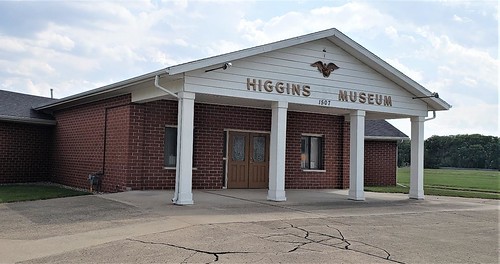
Higgins Museum Seminar, 2026
The Higgins Museum of National Bank Notes will host a seminar on August 12-13 , 2026.
The event will start with a welcoming reception at the museum on the late afternoon of August 12th, followed by a by a speaker's dinner. The program for Thursday August 13th will begin at 8:30. The speakers (alphabetically) will be:
Joseph Boling
20th Century National Bank Note Counterfeits.
George Cuhaj
Out and about with the National Banks in Dickinson County.
Mark Drengson
Highlights of the Higgins Minnesota & South Dakota NBN Collections.
Cody Regennitter
State of the National Bank Note Census, 2026.
Steve Sweeney
The Iowa National Bank Note Census.
Cost for the event will be $100.00 (or $90.00 if a member of CSNS, PCDA or SPMC). The fee includes the reception on Wednesday afternoon, a light continental breakfast, light lunch and attendance for the talks. Please confirm your registration by calling 715-332-5859, or email: curator@thehigginsmuseum.org, before August 5th.
Hotel reservations need to be made independently. Quite a few are available in the area.
Checks can be mailed to the Higgins Museum, P.O. Box 258, Okoboji, IA 51355
For more information on the museum, see:
https://thehigginsmuseum.org/
NOTES FROM E-SYLUM READERS: JUNE 14, 2026
More QR Codes on Coins
Jeff Starck writes:
 "In the May 24 edition, you report about a new coin from the Philippines with a QR code.
In a stroke of good timing, the March 2026 issue of World Coin News features a story about QR codes on coins.
The Netherlands issued the first coins to include a QR code back in 2011.
"In the May 24 edition, you report about a new coin from the Philippines with a QR code.
In a stroke of good timing, the March 2026 issue of World Coin News features a story about QR codes on coins.
The Netherlands issued the first coins to include a QR code back in 2011.
"The full story is available to subscribers to World Coin News, or Numismaster.com."
Thanks. Sorry for the delay in posting this - I've been working through a backlog of email. -Editor
To read the earlier E-Sylum article, see:
2026 PHILIPPINES 10 PISO ASEAN COIN
(https://www.coinbooks.org/v29/esylum_v29n21a20.html)
D-Day Coin Sand Art
Another delayed note came in from David Pickup, who passed along this BBC article about the Royal Mint's 2024 D-Day commemorative coin. -Editor

A new coin is set to be released to mark 80 years since the D-Day landings during World War Two.
The 50p coin was unveiled by the Royal Mint, in Llantrisant, Rhondda Cynon Taf, ahead of the 6 June anniversary.
On that day, in 1944, Allied forces landed across five beaches in northern France, with the attacks given the codenames Utah, Omaha, Gold, Juno and Sword.
The landings were a pivotal moment that marked the start of the campaign to free north-west Europe from the Nazis.
The coin depicts Allied soldiers disembarking a landing craft, with the portrait of King Charles III on the other side.
To celebrate the unveiling, the coin's design was recreated in the sand on Gold beach, in France, where troops landed in 1944.
At 35 metres (115ft) across, the sand art took more than five hours to create.

Thank you - great work! -Editor
To read the earlier E-Sylum article, see:
New coin marks 80 years since D-Day landings
(https://www.bbc.com/news/articles/cn00j7pvqvwo)
Steve Hill Remembers Pat McBride
Sovereign Rarities Ltd Head Numismatist Steve Hill
writes:
 My deepest sympathy and condolences on the passing of dear Pat McBride also known to all of us for many a convention now as Benjamin Franklin.
I was so sorry to read of the return of his illness in last weeks Esylum and alas he was right in that he will not be at the ANA Worlds Fair of Money.
So sorry to read of his sad passing in last nights edition. I know he was a dear friend of yours and I had got to know him as a convention buddy over the last ten years or so. He would always take great delight in character of speaking to me of Ben Franklin's London influences back in the day and about how much he was looking forward to visiting his house on Craven Street in London again. A house I knew of as it is a Ben Franklin historic site and museum which is open almost daily and is situated near Baldwins on the Strand where I used to work of course.
He was such a nice man and would spend hours in character with so many people at each convention – probably irreplaceable!
My sympathies again to you!"
Thank you. A celebration of life will take place following the ANA World's Fair of Money on Sunday, August 30, 2026 from 1:00 p.m. until 4:00 p.m. at The Priory Hotel, 614 Pressley Street, Pittsburgh, PA 15212. Music, bagpipes (a special kind of music for the uninitiated), stories (anyone can offer a story), and a shared love of Himself. Plus food, and refreshments. -Editor
To read his online obituary, see:
Patrick Emmett McBride
(strifflerfuneralhomes.com/obituaries/patrick-mcbride)
To read the earlier E-Sylum article, see:
PATRICK E. MCBRIDE (1952-2026)
(https://www.coinbooks.org/v29/esylum_v29n23a03.html)
Tinnahs as a Symbol of Wealth
Dick Hanscom writes:
 "I enjoyed Peter Smith's "rant" about Tinnahs. He is correct. The tinnahs were not truly money, but a symbol of wealth. But the articles quoted in my newsletter reflect the thinking of the time. He must consider the time frame in which these news items were written.
"In my book, Tinnahs & Seal Skins, Gold Dust & Bingles, there are several articles about tinnahs. A few of the articles are reprinted with permission from The Numismatist. Most articles before 1950 reflect the common idea that they were money."
Thank you. Always happy to set the numismatic record straight. -Editor
To read the earlier E-Sylum article, see:
NORTHWEST COAST INDIAN CHIEF'S COPPERS
(https://www.coinbooks.org/v29/esylum_v29n23a16.html)
"The Numismatist" on YouTube
Last week I asked about the short film titled "The Numismatist." -Editor
Pabitra Saha writes:
"This movie was/is available on YouTube for free."
Thank you! It's only 21 minutes long - check it out if you like. Thanks also to Zach Filis for passing this along. -Editor
To watch the film on YouTube, see:
The Numismatist - A Ghost Story - Short Film
(https://www.youtube.com/watch?v=_q3nOwYQod8)
To read the earlier E-Sylum article, see:
MOVIE: THE NUMISMATIST
(https://www.coinbooks.org/v29/esylum_v29n23a08.html)
Movie: Zotz
Joe Onishchuk writes:
"I was reading the article about the movie The Numismatist, when I remembered another coin movie from the past: "Zotz" starring Tom Poston. It was in Black and White and I think it came out in the 60s. (1962) Tom Poston (a university professor, I think) get an ancient coin that gives him special powers. He says "Zotz" and time stands still. There are three levels to the magic, I remember the last one as being sort of terrible.
"I think I still have a digital copy of it somewhere in my archives. I'll have to watch it again."

Thanks. Joe provided this still and short description from IMDB.com. Never heard of this one! -Editor

Jonathan Jones, a professor of ancient languages, comes into possession of an ancient coin. He translates its inscription, which gives him three powers: to inflict pain, slow down time or kill. Soon, he's pursued by enemy spies who have learned about the magic coin.
 Wikipedia describes the object not as a coin but as "an amulet." It also states, "During the initial theatrical run, theater patrons received a full-size plastic replica of the amulet as a promotional item. In color, size and design, the replicas were essentially identical to the film amulet, with the additional feature of a small hole drilled at the top, for a key chain." So if anyone can locate one of these promotional items (or a good still image from the film) we'll know better what it looked like.
Guess what I found by Googling "zotz amulet"? Next time someone annoys me at a coin show, I'll point at them and say "Zotz!" -Editor
See:
https://en.wikipedia.org/wiki/Zotz!
Zotz!, a Magic Amulet Right Out of Weird Fiction
(https://coastconfan.blogspot.com/2015/01/zotz-magic-amulet-right-out-of-weird.html)
To read the earlier E-Sylum article, see:
MOVIE: THE NUMISMATIST
(https://www.coinbooks.org/v29/esylum_v29n23a08.html)
Information Sought: Thomason Manufactory Engravers
Zach Filis writes:
"I am seeking assistance from anyone that has information on the engravers (medalists) employed at the Thomason Manufactory in Birmingham England from 1809 through 1825. I am specifically looking for information about George Mills, but also information on the other engravers as well as work conditions, pay, correspondence about the engravers or other related information. Any assistance will be deeply appreciated."
Can anyone help? -Editor
Another Uncashed U.S. Treasury Check
I met Kavan Ratnatunga when we both lived in Pittsburgh. At the time he was working at Carnegie-Mellon University. He since returned home to Sri Lanka. Having paid U.S. taxes, he filed a tax return and was entitled to a refund. He asked for $12 of his refund to be issued as a check which he intended to keep in his collection rather than cash. He has been entertaining us with how the government keeps insisting on sending him replacements for the uncashed check and adding to his collection. -Editor
Kavan writes:
"Following up on this story on 2026 June 03, I went to pick up from the post office a registered letter they have been unable to deliver, and to my surprise, it was the 4th check for US$12.01 dated 04-17-26 that I have received as a refund in 2021, 2022, 2024, and now in 2026. So I am so getting a check now every two years, and a reminder that I have not chased the check in the intervening years, like in 2023 and 2025. I had requested US$12.34 the first time, and they subtracted the postage 33-cents and sent me US$12.01. They have not subtracted anything after that. A glitch of automation that Elon Musk did not seem to have caught :-)"
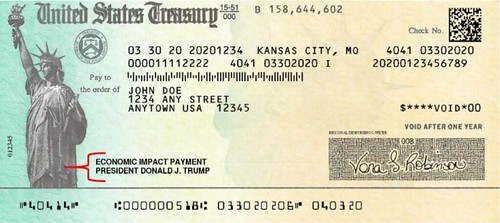
Thanks for the update! For illustration purposes, here's a generic image of a U.S. Treasury check. -Editor
To read the earlier E-Sylum article, see:
NOTES FROM E-SYLUM READERS: MAY 26, 2024 :
Collecting Uncashed U.S. Treasury Checks
(https://www.coinbooks.org/v27/esylum_v27n21a11.html)
Slab Collectors Society Forms
David Schwager (The Slab Man) writes:
"The ANA's World Fair of Money in Pittsburgh will include another slab collector meetup. Tenth in a series that started in 2016, this will be an informal meeting of enthusiasts talking about our mutual interest. There is always some show and tell and trading, so feel free to bring slabs to show or sell.
"New for 2026, we are on the convention program as the first meeting of the new Slab Collectors Society. I created this official ANA club so we receive a room and are included in convention materials. For now, plans for the club are limited to the annual ANA meetup. Everyone remains welcome to the meeting.
"In the David Lawrence Convention Center, room 325. Friday, August 28, 4:00 - 6:00 pm.
"Respond to this Facebook event to stay informed. Or send the link to other coin holder enthusiasts. https://www.facebook.com/events/1646484513099359/"
Good luck with the event! -Editor
DENNIS TUCKER JOINS CSNS BOARD
Award-winning numismatist Dennis Tucker has joined the Central States Numismatic Society (CSNS) Board of Governors, succeeding Carrie Meyer. -Garrett
 Award-winning numismatist Dennis Tucker has joined the Central States Numismatic Society (www.CSNS.org) Board of Governors. He succeeds Carrie Meyer, who stepped down from the board voluntarily due to the increased demands of her expanded responsibilities as a college professor and administrator.
?Meyer is a former curator of the famous Byron Reed Collection at The Durham Museum in Omaha, Nebraska. She is now an Associate Professor and Associate Dean of the Department of Special Collections and Archives of the Health Sciences Library at the University of Nebraska Medical Center in Omaha.
"On behalf of the Central States Numismatic Society, I extend our sincere thanks to Carrie Meyer for her service on the Board of Governors. During her tenure, Carrie generously shared her time, talents, and perspective in support of the Society and its mission. Her contributions helped strengthen CSNS and will have a lasting impact on the organization. We are grateful for her dedication and wish her continued success in all her future endeavors," stated CSNS President Mitch Ernst.


In addition to elected members of the CSNS Board, there are two appointed seats for individuals with professional and nonprofit leadership experience whose expertise can provide valuable support to CSNS and its members. Tucker has accepted the appointment to replace Meyer.
"As president of Central States, I am pleased to welcome Dennis Tucker to our Board of Governors. Dennis brings not only an unparalleled record of service and achievement in numismatics but also valuable nonprofit leadership experience that will help guide the Society into the future," Ernst stated.
A collector since the age of seven, Tucker is an award-winning author, researcher, and member of many national and international numismatic organizations, including two terms (2016-2024) on the Citizens Coinage Advisory Committee. He served for two decades as the publisher of Whitman Publishing, overseeing the annual A Guide Book of United States Coins ("the Red Book") and many other titles.
In his new role on the CSNS Board, Tucker believes it is important to focus on four vital areas: education, communications/community, young collectors, and good governance.
"I respect that the Society devotes a good amount of resources to education. The Newman Numismatic Portal Symposium is a brilliant feather in the Central States' cap. I like the current CSNS commitment to showcase each member state in the Society. This is a wonderful opportunity to shine a light on each state, as well as a unique way to publicize the annual convention," Tucker wrote in a brief statement about the mission of CSNS.
"The Central States' activities, giveaways, and programming for young collectors are top-notch. When it comes to encouraging new hobbyists, I don't limit my approach to ‘kids are the future of the hobby!' because new collectors in their forties and fifties are just as important to cultivate. But I do think young people with curiosity and intelligence are an important audience. The American Numismatic Association and Central States are leaders in this area," he explained.
?Regarding good governance, Tucker stated: "Mitch (Ernst) and I have had a lot of conversations, and we're ‘in harness,' as Dave Bowers says, when it comes to the importance of solid, professional governance in the nonprofit world. Since I retired, I've been able to concentrate on volunteer work, and I like what I see at Central States."
For additional information about the Central States Numismatic Society, visit www.CSNS.org.
Dennis adds:
"I'm very impressed with what I've seen of Central States in recent years. One of my favorite shows, a wonderful quarterly magazine, and a great management team. I'm excited to get more involved!"

VOCABULARY TERM: SPLASH STRIKING
Here's another entry from Dick Johnson's Encyclopedia of Coin and Medal Terminology. -Editor
Splash Striking. Striking medallic items in a press with no collar to restrain the outward flow of metal between the dies. In one case a somewhat oversize blank is used and when struck the extruded metal from between the dies merges with metal of the perimeter of the blank that often forms a slightly buckled border. In another case a blank with a purposely irregular shape is used to form an indistinct, irregularly shaped, slightly raised border as intended. Normally such extruded material when struck without a collar -- called flash -- is later removed by trimming.
In America splash striking applies only to the use of coinage dies without the collar to strike such pieces. In England splash striking has a wider meaning. It is a term for all striking with open face dies. Not only is the term different but open face dies are called box dies in England.
To read the complete entry on the Newman Numismatic Portal, see:
Splash Striking
(https://nnp.wustl.edu/library/dictionarydetail/516791)
FRANK ELMER ELLIS (1861-1937)
E-Sylum Feature Writer and American Numismatic Biographies author Pete Smith submitted this article on St. Louis coin dealer Frank Ellis and his successor Burdette Johnson. Thank you. Great hobby history. -Editor
I recently wrote about the Clemens collection. formed in St. Louis before there was any coin dealer in town. I wonder who was the first coin dealer in town. It may have been Frank Elmer Ellis.
Frank was born in Pennsylvania on September 5, 1861, the son of John Ellis and Henrietta Corley.
Ellis was a stamp dealer working out of his home at 817 Sixth Avenue in Cedar Rapids, Iowa. He advertised as a coin dealer in the February 1897 issue of The Philatelic West. He eventually established a full-page ad inside the front cover of The Philatelic West.
He opened the St, Louis Stamp and Coin Co. in 1897 at 1240 Franklin Avenue in St. Louis. The following year he moved to 312 North 4th Street. He then moved to 1003 Pine Street in 1901.
Frank was married in St. Louis to Anna Magdalena Seim (1877-1939) on November 28, 1901. They had a daughter, Ruth Magdalena Ellis (1902-1975).
Ellis began mail bid auction sales in 1902 with St. Louis Stamp & Coin Co. from his address at 1003 Pine Street. Their sixteenth sale was their first public auction sale held on April 13-14 1906. He then returned to mail bid sales.
 He ran advertisements to buy guns, swords and pistols. He also advertised frequently in German
language newspapers.
He ran advertisements to buy guns, swords and pistols. He also advertised frequently in German
language newspapers.
In 1904, he hired Burdette Johnson to work as an assistant at his store, then located at 115 North 11th Street. In July of 1907, he sold the company to Burdette G. Johnson and his cousin, David A. Sutherland for $6500.
After sale of the coin company, he moved to 30 Elm Place in Webster Grove, Missouri. and worked as an antique dealer.
The date of death for Ellis is listed as February 1, 1937. His obituary describes his cause of death.
He was buried at Saint Paul Churchyard in Affton, Missouri. His wife outlived him by 26 months and is buried in the same cemetery.
Burdette Johnson was the successor to Ellis as owner of the St. Louis Stamp & Coin Co. He took a small local operation and built it into one of the most important national dealerships. He is also noted for his mentorship of young collector Eric Newman.
Johnson was born in Desoto, Missouri, on January 2. 1885. He was the son of William Johnson (1849-1931) and Lou Ella Conway (1859-1914). The family moved to St. Louis when Burdette was 12.
He was self-educated and did not complete the ninth grade. After learning to read, Burdette claimed to read a book every day. His numismatic memory was as good as any encyclopedia.
He worked as a cashier for Prudential before 1902.
Johnson was admitted to ANA membership in February 1903 as member 473 from his address at 1814 Oregon Avenue in St Louis.
Johnson and Sutherland bought the St. Louis Stamp and Coin Company from F. E. Ellis on July 7, 1907, for $6500. Johnson managed the store for a weekly salary of $25. He then bought out Sutherland on September 21, 1908, for $2750. He continued to run mail bid sales and auctions until 1915. In 1912, Johnson sailed to Europe on a buying trip. He would make another twenty trips to Europe to acquire inventory he could resell at a profit.
Johnson was a suitor for Stella Hall (1894-1950) and he proposed marriage in 1910. She married Charles Henry Cowan, III (1890-1969). and they had a child, Mary, in 1912, On a visit, Johnson saw that Mary was living in poor conditions with parents who had substance abuse problems.
Johnson arranged with the parents to take Mary to St. Louis and to raise her there. Although she was not adopted, he treated her as a daughter and supported her until her marriage to Winston Vance Cruzon (1912-1993) in 1939.
In 1932, Johnson was hired for the laborious process of appraising the estate of Virgil Brand as it was divided between two disagreeable brothers. Johnson handled sale of some items from the Brand estate.
In 1940, Eric Newman was able to acquire a small group of banknotes from the estate of Colonel E. H. R. Green. Newman and Johnson then formed a partnership. Johnson would provide the funds and Newman would arrange for the purchases. Then each would select coins from the group and the remainders would be sold with the profits shared equally.
In 1941, Newman arranged to buy the set of five 1913 Liberty nickels from the Green estate for $3000. They bought an additional group of three 1913 Buffalo Nickels for $1000.
Johnson never married. He died on a street car on the way to his office in St. Louis on February 24, 1947. His funeral was held at his residence at 712 Audubon Drive in Clayton, Missouri. He is buried at Valhalla Cemetery in St. Louis.
Eric Newman and another attorney were co-executors of the estate. The estate was valued at $212,700 to be shared equally by his unadopted daughter, Mrs. Mary Cowen Cruzan (1912- 1996) and a cousin, Mrs. Mary Hedgecock Sheffield. The heirs did not want Johnson's library and gave it to Newman for a small amount.
To read the earlier E-Sylum article, see:
THE CLEMENS FAMILY
(https://www.coinbooks.org/v29/esylum_v29n22a15.html)

KEN BRESSETT INTERVIEW, PART THREE
Greg Bennick's latest interview for the Newman Numismatic Portal is with "Mr. Redbook". Ken Bressett. Here's the third of six parts, where Ken discusses his interactions with Walter Breen, William Sheldon, Dorothy Paschal, and his work photographing coins for Penny Whimsy. -Editor
GREG BENNICK: So, around the same era, I know that you had an interaction in 1948 with Walter Breen, who was playing piano, I think, at an ANA convention?
 KEN BRESSETT: I didn't really interact with him, but that was where I
first met him. I joined the ANA in 1947, and my first ANA show was in
Boston in 1948, that following year. That was the same for Walter Breen.
He joined the same time, and that was his first convention. I didn't
interact with him really. He was like the star of the convention. He was
a brilliant pianist, and he'd sit in a conspicuous place and play the
piano and everybody was saying, "What a prodigy this is, and he's going
to make a great collector and all that." I just think that was an
interesting thing to see, and later in life to know how he turned out,
which was not very well.
KEN BRESSETT: I didn't really interact with him, but that was where I
first met him. I joined the ANA in 1947, and my first ANA show was in
Boston in 1948, that following year. That was the same for Walter Breen.
He joined the same time, and that was his first convention. I didn't
interact with him really. He was like the star of the convention. He was
a brilliant pianist, and he'd sit in a conspicuous place and play the
piano and everybody was saying, "What a prodigy this is, and he's going
to make a great collector and all that." I just think that was an
interesting thing to see, and later in life to know how he turned out,
which was not very well.
GREG BENNICK: Sure. Absolutely. Well, it's interesting that you met him in a different context, or that you first interacted with him in a very different context.
KEN BRESSETT: Yes. And we remained what you call friends over the years. We always had good conversations about coins and different opinions about different things. I knew him in that regard.
GREG BENNICK: Also, through my connection with William Sheldon. You know, Dr. Sheldon who did Penny Whimsy and...
GREG BENNICK: Yes! I was going to ask if you met and knew him. I think you mentioned at one point that you did.
KEN BRESSETT: Yes, I did, quite well, as well as I wanted to. He was not a nice person.
GREG BENNICK: Okay.
KEN BRESSETT: But I did meet him.
GREG BENNICK: What were your interactions with him like? What did you learn from him?
KEN BRESSETT: At that time, that was in the 1950s, before my Whitman editor—my Red Book days—I collected large cents. I was a serious collector of large cents by variety. I learned how to grade from William Sheldon himself. He allowed me to look at his entire collection of large cents and all the different varieties, and he taught me how to grade them. I don't think anybody else can claim that connection.
So I did learn a lot from Sheldon and Paschal and Breen, and I don't know if I said that my Early American Coppers Club membership is Honorary #151. So I was really into large cents and large cent varieties.
GREG BENNICK: Did you live near Dr. Sheldon?
KEN BRESSETT: Oh, not at all. Not at all. But one time—I walked on so many avenues it's hard to keep them all straight—at that time I was learning how to photograph coins.
GREG BENNICK: Okay.
KEN BRESSETT: I had built my own darkroom. I processed film. I rolled my own film. I did everything. I had a darkroom and I was taking photographs of coins, and I did all of this so that I could photograph coins that I couldn't afford. I still do that. I have photographs of just about every United States coin, every variety, every type.
GREG BENNICK: You have photos of every coin, every variety, every type?
KEN BRESSETT: I think just about.
GREG BENNICK: That's incredible.

KEN BRESSETT: Yeah. I had to know that if I was supposed to know about American coins. So Sheldon said, "Will you photograph some coins for the next edition of Penny Whimsy?" And I said, "Yeah, sure." And I did indeed. But to see his coins, he lived in New York and I lived in New Hampshire. He had Dorothy Paschal pack up his coins and bring them to me and let me photograph them at my home.
And you'll see in that book—I'm not making up this story—my name is right in there as photographer for these coins.
GREG BENNICK: I'm going to have to look as soon as we're off the phone. I'm looking across the room at my copy of the book right now.
KEN BRESSETT: (Laughs) Yeah. So anyway, that's just another adventure.
 About the Interviewer
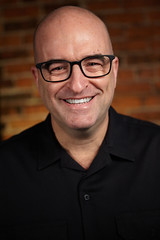
Greg Bennick (www.gregbennick.com) is a keynote speaker and long time coin collector with a focus on major mint error coins and US counterstamps. He is on the board of both CONECA and TAMS and enjoys having in-depth conversations with prominent numismatists from all areas of the hobby. Have ideas for other interviewees? Contact him anytime
via instagram @minterrors.
He can also be reached by email at
minterrors@gmail.com.
To watch the complete video, see:
Ken Bressett, Interviewed by Greg Bennick
(https://www.youtube.com/watch?v=emQlt4zLTxU&t=1s)
To read the earlier E-Sylum article, see:
KEN BRESSETT INTERVIEW, PART ONE
(https://www.coinbooks.org/v29/esylum_v29n22a17.html)
KEN BRESSETT INTERVIEW, PART TWO
(https://www.coinbooks.org/v29/esylum_v29n23a18.html)

HERITAGE: NORTH STAR COLLECTION OF HALF EAGLES
Heritage Auctions will be selling The North Star Collection of $5 Gold US Coins on June 15. Select items are discussed below. -Garrett


1809/8 $5 BD-1, High R.3, AU55 PCGS. Bass-Dannreuther Die
State b/b. BD-1 is the sole 1809 variety, traditionally described
an overdate, although researchers are divided about the underdigit.
Some suggest an 8, while others believe it is a misplaced 9, and
still others are unconvinced either way. This is a Choice About
Uncirculated example, sharply defined, with still-vibrant
greenish-gold color. Marks are minimal, while plentiful mint luster
remains.
Ex: Dallas Signature (Heritage, 12/2019), lot 3292; Long Beach
Signature (Heritage, 6/2020), lot 3197.
From The North Star Collection of $5 Gold.
To read the complete item description, see:
1809/8 $5 BD-1, High R.3, AU55 PCGS.
(https://coins.ha.com/itm/early-half-eagles/1809-8-5-bd-1-high-r3-au55-pcgs-bass-dannreuther-die-state-b-b-bd-1-is-the-sole-1809-variety-traditionally-des/a/63355-92003.s?ctrack=200071&type=featured-2-coinus-news-tem060926)


1810 $5 Large Date, Large 5, BD-4, R.2, MS62 PCGS.
Bass-Dannreuther Die State a/a. The BD-4 variety is the most
prolific of the early Capped Bust half eagles with an estimated
total mintage from John Dannreuther of 90,000 coins compared to the
total mintage of 100,287 coins in all varieties. While the mintage
was drastic in comparison to the other varieties its survivorship
is miniscule in comparison, with 500-750 known examples or less
than 1% of its initial mintage. This example displays attractive
deep tawny-gold luster with just a note of deepening patina on its
reverse. The strike is excellent with no readily apparent signs of
weakness, and the coin has only a minute mark before Liberty's nose
that is non-debilitating. While the survivorship is less than a
fraction of its initial mintage, the variety has a decent
survivorship in Mint State making this one of the more available
issues for collectors seeking an early date half eagle.
Ex: Heintzelman Collection / Rarities Night (Stack's Bowers,
11/2019), lot 3162.
From The North Star Collection of $5 Gold.
To read the complete item description, see:
1810 $5 Large Date, Large 5, BD-4, R.2, MS62 PCGS.
(https://coins.ha.com/itm/early-half-eagles/1810-5-large-date-large-5-bd-4-r2-ms62-pcgs/a/63355-92004.s?ctrack=200071&type=featured-3-coinus-news-tem060926)


1839-C $5 AU53 PCGS. Winter-1. The 1839-C half eagle is
prized for its status a transitional issue in several respects. It
serves as a one-year half eagle design type, featuring Christian
Gobrecht's intended Liberty Head design change with its delicately
curved bust truncation and obverse mintmark replacing the Classic
Head William Kneass design. Gobrecht's work would itself be refined
in 1840 to establish the long-running Liberty Head motif that
served many gold denominations for decades. A small 17,205-piece
1839-C mintage was struck from a single die pair. As few as 150 to
200 pieces survive today in all grades combined. This nearly Choice
About Uncirculated example is a sharply struck orange-gold coin
with only nominal circulation wear and a peppering of tiny marks.
Plentiful mint luster remains throughout both sides. PCGS
Population: 11 in 53, 23 finer (4/26).(Registry values: P5)
From The North Star Collection of $5 Gold.
To read the complete item description, see:
1839-C $5 AU53 PCGS. Winter-1.
(https://coins.ha.com/itm/liberty-half-eagles/1839-c-5-au53-pcgs-winter-1-the-1839-c-half-eagle-is-prized-for-its-status-a-transitional-issue-in-several-respect/a/63355-92008.s?ctrack=200071&type=featured-4-coinus-news-tem060926)


1841-C $5 MS61 PCGS. Winter 1. The 1841 issue of half
eagles is among the more accessible dates for Charlotte Mint
pieces, but most remain in lower grades and finding a Mint State
example is exceptionally more difficult. This piece displays
remarkably rich tawny-gold luster surrounded by encroaching smokey
patina which wafts into the reflective fields. There are some minor
abrasions, though they are largely negligible with an exception
above the eagle's crown. The strike is immensely appealing with
exceptional depth throughout Liberty's hair, eagle's plumage, and
along the first stars. Between both PCGS and NGC only eight
examples have been reported in MS61 with only five seen numerically
finer than the present coin (4/26). This Charlotte Mint piece will
be a scarce opportunity for Registry collectors as we have only had
the opportunity to offer three (including the present coin) so fine
in 12 years.
Ex: Pre Long Beach Coin and Currency (Goldbergs, 10/2006), lot
1975.(Registry values: P4)
From The North Star Collection of $5 Gold.
To read the complete item description, see:
1841-C $5 MS61 PCGS.
(https://coins.ha.com/itm/liberty-half-eagles/1841-c-5-ms61-pcgs-winter-1/a/63355-92015.s?ctrack=200071&type=featured-5-coinus-news-tem060926)


1847-O $5 AU55 PCGS. Winter-1. The 1847-O is the
rarest half eagle from the New Orleans Mint and just three coins
have been observed in Mint State between both PCGS and NGC. The
issue's rarity is further enhanced by its estimated survivorship:
50-60 pieces according to PCGS, 60 to 70 per Doug Winter. Those
estimates suggest the 98 coins reported by the aforementioned
grading services consist of a litany of duplications. This example
displays soft sandy-gold luster with deeper orange-gold rims. The
strike is excellent with some minor circulation wear within the
fletching and within the hair. This New Orleans issue is seldom
seen finer with just nine such examples reported, and this Choice
AU piece will be an excellent addition for Registry collectors
(4/26).
Ex: Long Beach Signature (Heritage, 6/1999), lot
6525.(Registry values: P8)
From The North Star Collection of $5 Gold.
To read the complete item description, see:
1847-O $5 AU55 PCGS.
(https://coins.ha.com/itm/liberty-half-eagles/1847-o-5-au55-pcgs-winter-1-pcgs-8235-/a/63355-92037.s?ctrack=200071&type=https%3a%2f%2fcoins.ha.com%2fitm%2fliberty-half-eagles%2f1847-o-5-au55-pcgs-winter-1-pcgs-8235-%2fa%2f63355-92037.s-coinus-news-tem060926)


1856-O $5 AU58 PCGS. Winter-2. The 1856-O boasts the lowest
mintage of the Liberty No Motto half eagles produced at the New
Orleans branch mint at just 10,000 strikes. The issue is also tied
with the 1892-O for lowest mintage honors of the New Orleans half
eagle series. As the majority of the issue saw heavy commercial
use, all grades of the 1856-O are conditionally scarce. Obtaining a
Mint State piece is not likely, as PCGS reports only a single half
eagle in MS60 and two examples in MS61, with none finer (4/26).
This 1856-O displays well-struck
devices on bright green-gold surfaces, although typical softness is
seen on the first through third stars and the eagle's neck.
Glimmers of orange and powder-blue luster contrast beautifully with
vestiges of prooflike flash. Liberty and the eagle are remarkably
unabraded, and the fields show only trivial marks and light wear
that account for the grade. This attractive near-Mint half eagle
from the Southern branch mint has only three pieces reported
numerically finer at PCGS (4/26).(Registry values: P7)
From The North Star Collection of $5 Gold.
To read the complete item description, see:
1856-O $5 AU58 PCGS. Winter-2.
(https://coins.ha.com/itm/liberty-half-eagles/1856-o-5-au58-pcgs-winter-2-the-1856-o-boasts-the-lowest-mintage-of-the-liberty-no-motto-half-eagles-produced-at-t/a/63355-92069.s?ctrack=200071&type=featured-6-coinus-news-tem060926)


1864 $5 AU50 PCGS. CAC. Gold and silver mintages declined
dramatically throughout the Civil War, due in large part to
hoarding and melting that was prevalent at the time. The 1864
Liberty half eagle is one in a string of low-mintage P-mint issues
from 1862 to 1872, and was reduced to a production of just 4,170
business-strikes. Most surviving half eagles range from XF45 to
AU55, and PCGS estimates only 60 to 75 surviving coins and reports
only two examples in Mint State (4/26).
The lightly abraded orange-gold
surfaces of this attractive AU50 exhibit only light wear on the
well-struck motifs. Subtle shades of lustrous peach and apricot
remain in the recesses and protected spaces. Most of the devices
remain intact, and while star 12 and the eagle's wingtips are
slightly soft, the remainder of the legends and stars are sharp.
Faint die clashing is seen on the obverse, and more prominent
clashing is evident over the eagle's wings. Marks are light,
scattered and blended with none significant. The high quality
within the grade is confirmed by CAC.
Ex: November Baltimore / Rarities Night (Stack's Bowers,
11/2021), lot 4118.(Registry values: P7)
From The North Star Collection of $5 Gold.
To read the complete item description, see:
1864 $5 AU50 PCGS. CAC.
(https://coins.ha.com/itm/liberty-half-eagles/1864-5-au50-pcgs-cac-gold-and-silver-mintages-declined-dramatically-throughout-the-civil-war-due-in-large-part-to-hoarding-and-melting/a/63355-92094.s?ctrack=200071&type=https%3a%2f%2fcoins.ha.com%2fitm%2fliberty-half-eagles%2f1864-5-au50-pcgs-cac-gold-and-silver-mintages-declined-dramatically-throughout-the-civil-war-due-in-large-part-to-hoarding-and-melting%2fa%2f63355-92094.s-coinus-news-tem060926)


1890-CC $5 MS63+ PCGS. CAC. Winter 1-A. The 1890-CC mintage
of 53,800 half eagles is challenging in Mint State, becoming
conditionally scarce in MS64 and almost unattainable any finer.
Vibrant green-gold surfaces of this Select half eagle are layered
in frosty peach luster that complements the coruscating fields for
exceptional eye appeal, earning Plus-grade designation. The strike
is slightly soft on Liberty's curls and the eagle's neck feathers,
but elsewhere the devices are sharp. Aside from a nick on the
bottom of Liberty's neck, marks are trivial and not bothersome. CAC
endorsement adds to the appeal of this attractive piece.
Ex: August 2023 Global Showcase (Stack's Bowers, 8/2023), lot
6590.(Registry values: P2)
From The North Star Collection of $5 Gold.
To read the complete item description, see:
1890-CC $5 MS63+ PCGS. CAC. Winter 1-A.
(https://coins.ha.com/itm/liberty-half-eagles/1890-cc-5-ms63-pcgs-cac-winter-1-a-the-1890-cc-mintage-of-53-800-half-eagles-is-challenging-in-mint-state-becoming-conditionally/a/63355-92156.s?ctrack=200071&type=https%3a%2f%2fcoins.ha.com%2fitm%2fliberty-half-eagles%2f1890-cc-5-ms63-pcgs-cac-winter-1-a-the-1890-cc-mintage-of-53-800-half-eagles-is-challenging-in-mint-state-becoming-conditionally%2fa%2f63355-92156.s-coinus-news-tem060926)

HERITAGE: SWITZERLAND SHOWCASE
Heritage Auctions will be hosting their Switzerland World Coins Showcase Auction on June 15. Select items are discussed below. -Garrett


Basel. City silver Medallic "Hen" 1/4 Taler ND (1650) MS63 NGC, Friedlander-1167. An elusive and contested medallic type, known colloquially as the "Hen Medal". Many slight variations exist, this one pairing the highly popular imagery of an obverse city view with a protective mother hen watching over her chicks. This imagery of the hen guarding her chicks was representative of the city's Grand Council seeing to the protection of the citizens.
To read the complete item description, see:
Basel. City silver Medallic "Hen" 1/4 Taler ND (1650) MS63
NGC,
(https://coins.ha.com/itm/switzerland/switzerland-basel-city-silver-medallic-hen-1-4-taler-nd-1650-ms63-ngc-/a/61630-21010.s?ctrack=200071&type=featured-1-coinus-news-tem060926)


Basel. City "City View" Taler 1785-H MS61 NGC, KM179, Dav-1755. One of the most iconic pieces of 18th-century Swiss coinage, the "City View" talers remain desirable and it is clear to see why, with eye-pleasing surfaces abundant with crisp artistic details depicted with impressive clarity on both facets and the obverse's picturesque view. This is an excellent representative, in Mint State condition and located within the upper echelons of the certified population, infrequently found any finer.
To read the complete item description, see:
Basel. City "City View" Taler 1785-H MS61 NGC,
(https://coins.ha.com/itm/switzerland/basel/switzerland-basel-city-city-view-taler-1785-h-ms61-ngc-/a/61630-21012.s?ctrack=200071&type=featured-2-coinus-news-tem060926)

Graubunden. Canton 10 Batzen 1825-N MS64 PCGS, KM12, HMZ-2-603a. Reeded edge. One of the more challenging members of the series, due to its low mintage of 2,000. An elusive issue with an attractive appearance. Witnessed here with a dark dove patina and a subtle yet enticing glitter. Located in the upper echelons of its type, with the second highest grade available among the certified population.
To read the complete item description, see:
Graubunden. Canton 10 Batzen 1825-N MS64 PCGS,
(https://coins.ha.com/itm/switzerland/graubunden/switzerland-graubunden-canton-10-batzen-1825-n-ms64-pcgs-/a/61630-21033.s?ctrack=200071&type=featured-3-coinus-news-tem060926)

Zurich. Canton gold 1/4 Ducat 1761/58 MS64+ PCGS, KM138, Fr-405. Overdate variety. A golden treasure deserving of its plus superlative with a pleasing amount of luster. None grade higher at PCGS.
To read the complete item description, see:
Zurich. Canton gold 1/4 Ducat 1761/58 MS64+ PCGS,
(https://coins.ha.com/itm/switzerland/zurich/switzerland-zurich-canton-gold-1-4-ducat-1761-58-ms64-pcgs-/a/61630-21054.s?ctrack=200071&type=featured-4-coinus-news-tem060926)


Zurich. Canton gold "Zwingli" Ducat 1719 MS62 PCGS, KM-XM1, Fr-489, HMZ-2-1161k. Issued to commemorate the 200th anniversary of Zwingli's first preaching in Zurich. An incredibly attractive offering that remains desirable, broadcasting marigold, almost fully mirrored surfaces.
To read the complete item description, see:
Zurich. Canton gold "Zwingli" Ducat 1719 MS62 PCGS,
(https://coins.ha.com/itm/switzerland/zurich/switzerland-zurich-canton-gold-zwingli-ducat-1719-ms62-pcgs-/a/61630-21070.s?ctrack=200071&type=featured-5-coinus-news-tem060926)


Confederation "Basel Shooting Festival" 5 Francs 1879 MS66 PCGS, Bern mint, KM-XS14, Richter-92a. Swirling luster and eye-catching, bold design motifs on this attractive representative that is rarely found in this high of a state of preservation, with only one graded higher. Housed in a vintage green PCGS holder.
To read the complete item description, see:
Confederation "Basel Shooting Festival" 5 Francs 1879 MS66
PCGS,
(https://coins.ha.com/itm/switzerland/switzerland-confederation-basel-shooting-festival-5-francs-1879-ms66-pcgs-/a/61630-21136.s?ctrack=200071&type=featured-6-coinus-news-tem060926)


"History of the Roman Republic - Scipio Africanus" bronze Medal 1748-Dated MS64 Brown NGC, Eisler-297. 31.5mm. By Jean Dassier and his sons.
Metal: Bronze
Diameter: 31.5mm
To read the complete item description, see:
"History of the Roman Republic - Scipio Africanus" bronze Medal
1748-Dated MS64 Brown NGC,
(https://coins.ha.com/itm/switzerland/geneva/switzerland-history-of-the-roman-republic-scipio-africanus-bronze-medal-1748-dated-ms64-brown-ngc-/a/61630-21030.s)

HERITAGE: HKINF WORLD & ANCIENTS
Heritage Auctions will be hosting their HKINF World & Ancient Coins Platinum Auction from June 17-19. The Curators' Picks are discussed below. -Garrett


There is perhaps nothing more fascinating than working with material that is both beautiful, historically rich, and numismatically rare. This remarkable pattern Tael immediately captured my attention, as it undoubtedly has for many collectors and scholars, and is further distinguished by the controversy surrounding its creation. Produced at a pivotal moment in Chinese history, only a few years after the conclusion of the Second Opium War, the inclusion of Queen Victoria's effigy made the design particularly sensitive and politically charged. The pattern was reportedly rejected a number of times before finally being accepted, and its ultimate production was exceedingly limited. If this wasn't all enough the overall preservation is extremely impressive, standing as a testament to the care this highly-desirable selection has received over the decades. Truly a piece that has inspired me with absolute awe, and continue to grip the numismatic audience with both its history and rarity.
Ex. Irving Goodman Collection (Superior Galleries, May 1995, Lot 738); purchased privately from Douglas Liddle of Spinks in the 1960s.
To read the complete item description, see:
British Colony. Victoria Proof Pattern Tael 1867 PR64 PCGS,
(https://coins.ha.com/itm/hong-kong/british-colony/hong-kong-british-colony-victoria-proof-pattern-tael-1867-pr64-pcgs-/a/3134-33148.s?ctrack=200071&type=bodylink-1b-coinworld-picks-3134-HKINF-tem060826)


Kuang-hsü silver Restrike Specimen Pattern Tael CD 1906 SP63 PCGS, Just one glance at this show-stopper could fill any viewer with intrigue. Before working for Heritage Auctions, I spent many hours pouring over a number of different cultures, particularly Chinese cultures in the 20th Century. As someone with a deep appreciation for history, I find this piece particularly compelling, especially when I consider that this Restrike Specimen falls into a very formative period in the nation's development. Examining the design and its expertly executed details only deepens my appreciation for the piece, but nothing could prepare you for the beautiful coloration that accentuates every element.
Ex. Mas Fera Collection
To read the complete item description, see:
Kuang-hsü silver Restrike Specimen Pattern Tael CD 1906 SP63
PCGS,
(https://coins.ha.com/itm/china/china-kuang-hsu-silver-restrike-specimen-pattern-tael-cd-1906-sp63-pcgs-/a/3134-33015.s?ctrack=200071&type=bodylink-1b-coinworld-picks-3134-HKINF-tem060826)


Republic Yuan Shih-kai gold Proof Pattern "Plumed Hat" Dollar ND (1916) PR61 Cameo NGC, It is very easy to love a "Plumed Hat" Dollar but to find one in gold while also bearing the elusive "Flying Dragon" motif, certainly caught my attention. What is so compelling about this piece is the sheer lack of presence in the market. Unsurprisingly, examples are seldom encountered. Only two specimens from this die are known in silver, and this coin stands as the only Proof example struck in gold. I loved having the opportunity to admire this gold Varietal Dollar but it is just one incredible piece from the Platinum session, and one that would make a great trophy for the more elite collections.
Ex. Ta Han Collection
To read the complete item description, see:
Republic Yuan Shih-kai gold Proof Pattern "Plumed Hat" Dollar ND
(1916) PR61 Cameo NGC,
(https://coins.ha.com/itm/china/china-republic-yuan-shih-kai-gold-proof-pattern-plumed-hat-dollar-nd-1916-pr61-cameo-ngc-/a/3134-33081.s?ctrack=200071&type=bodylink-1b-coinworld-picks-3134-HKINF-tem060826)


Kiangsu - Shanghai. Yu Shen Sheng Zuwen Yingbing ("Pure Silver Cake") of 1 Tael Year 6 (1856)-? AU55 PCGS, This intriguing Yu Shen Sheng "Zuwen Yingbing" or "Pure Silver Cake" 1 Tael of Xianfeng Year 6 (1856) is a historically significant relic of Shanghai's mid-19th-century monetary crisis. Produced during the upheaval of the Taiping Rebellion, when silver shortages, hoarding, and reliance on foreign trade dollars strained local commerce, these silver cakes represented an early attempt to create a standardized Chinese silver medium for use in the Shanghai market. Because the experiment lasted only briefly and was curtailed by limited production and counterfeiting, genuine surviving examples are rare. This well-struck 1856 silver cake is thus valuable as a numismatic rarity, a rich source of historical context, and as a tangible witness to China's struggle to adapt its traditional bullion-based economy to the pressures of rebellion, foreign trade, and modern monetary reform.
To read the complete item description, see:
Kiangsu - Shanghai. Yu Shen Sheng Zuwen Yingbing ("Pure Silver
Cake") of 1 Tael Year 6 (1856)-? AU55 PCGS,
(https://coins.ha.com/itm/china/kiangsu/china-kiangsu-shanghai-yu-shen-sheng-zuwen-yingbing-pure-silver-cake-of-1-tael-year-6-1856-au55-pcgs-/a/3134-34056.s?ctrack=200071&type=bodylink-1b-coinworld-picks-3134-HKINF-tem060826)


Qing Dynasty. Wen Zong (Xian Feng) Engraved Master 5 Cash ND (1854-1857) Certified 88 by Gong Bo Grading, This exceptional and rare Wen Zong (Xian Feng) Engraved Master 5 Cash from the Qing Dynasty represents the first of this denomination Heritage has ever seen, and it is truly an exciting event. With bold, clear characters and sharply finished fields, the appearances match the historical importance in superior quality. A piece that rewards extended looking and maintains a connection to the fiscal crisis of the Taiping Rebellion, any collector will be ecstatic to obtain this treasure.
From the Peh Family Collection
To read the complete item description, see:
Qing Dynasty. Wen Zong (Xian Feng) Engraved Master 5 Cash ND
(1854-1857) Certified 88 by Gong Bo Grading,
(https://coins.ha.com/itm/china/china-qing-dynasty-wen-zong-xian-feng-engraved-master-5-cash-nd-1854-1857-certified-88-by-gong-bo-grading-/a/3134-34012.s?ctrack=200071&type=bodylink-1b-coinworld-picks-3134-HKINF-tem060826)


Taiwan. Tao Kuang "Old Man" Dollar ND (1838-1850) AU Details (Chop Mark) PCGS, I can't quite pick what intrigues me most about this coin, its elusiveness, historical context, or the charming and rich design elements. Another example rich with intricate details, this significant "Old Man" Dollar is seldom offered on the market, so it is a treat to witness it in this auction. This Qing-era piece is from Taiwan's Daoguang reign, minted to support Qing forces against the Zhang Wen rebellion. I'm always happy to see any symbols alluding to longevity, and the motif of God of Longevity, colloquially referred to as the "Old Man", certainly provides that.
Ex. Chang Foundation Collection
From the Peh Family Collection
To read the complete item description, see:
Taiwan. Tao Kuang "Old Man" Dollar ND (1838-1850) AU Details
(Chop Mark) PCGS,
(https://coins.ha.com/itm/china/taiwan/china-taiwan-tao-kuang-old-man-dollar-nd-1838-1850-au-details-chop-mark-pcgs-/a/3134-34080.s?ctrack=200071&type=bodylink-1b-coinworld-picks-3134-HKINF-tem060826)


USA Administration Proof Peso 1905 PR67+ PCGS, Throughout my time of being in the realm of numismatics, I have found myself drawn to those pieces of unique and vibrant tone regardless of the rarity. But what we have here is a coin that is a perfect storm of rarity and beauty. Nearly at the peak of the PCGS census and covered in patination that more closely resembles art than anything, its explosion of color immediately had me head over heels in awe. Coming from such a scant mintage, do not miss this opportunity to acquire one of the most beautiful and sought after pieces in this entire collection.
From the Mahal Collection of Spanish and US Philippines Coins, Part XIII
To read the complete item description, see:
USA Administration Proof Peso 1905 PR67+ PCGS,
(https://coins.ha.com/itm/philippines/philippines-usa-administration-proof-peso-1905-pr67-pcgs-/a/3134-35057.s?ctrack=200071&type=bodylink-1b-coinworld-picks-3134-HKINF-tem060826)


Spanish Colony. Isabel II 20 Centavos 1868 MS66 PCGS, Now this piece has made me truly excited. Coming off a historic result for a similarly graded example in December, I for one am exhilarated by the prospects of such a wonderful coin at auction. While I am usually drawn for a polychromatic tone, I find myself particularly compelled by this piece. Its soft gray hue and luster that dance around the fields draws you in and holds attention. The obverse has this dark and brooding cloudy effect, imitating the precursor to a great storm. And certainly, age has only enhanced its beauty, as it has survived over 150 years and still nearly looks like it would the day it was minted. What phenomenal addition to any cabinet!
From the Mahal Collection of Spanish and US Philippines Coins, Part XIII
To read the complete item description, see:
Spanish Colony. Isabel II 20 Centavos 1868 MS66 PCGS,
(https://coins.ha.com/itm/philippines/philippines-spanish-colony-isabel-ii-20-centavos-1868-ms66-pcgs-/a/3134-35007.s?ctrack=200071&type=bodylink-1b-coinworld-picks-3134-HKINF-tem060826)


USA Administration Proof Peso 1906 PR68 PCGS, Now this might be my favorite piece in all the collection. In hand it displays a deep charcoal tone that is evident on both obverse and the reverse. But, when held in the right light, this specimen's personality radiates outward. Blessed with a plethora of bursting colors, I was truly in awe the first time I laid eyes on this coin. At PR68, sharing the top spot on the PCGS census, this conditional rarity is a sight to behold and truly worth a premium bid.
From the Mahal Collection of Spanish and US Philippines Coins, Part XIII
To read the complete item description, see:
USA Administration Proof Peso 1906 PR68 PCGS,
(https://coins.ha.com/itm/philippines/philippines-usa-administration-proof-peso-1906-pr68-pcgs-/a/3134-35058.s?ctrack=200071&type=bodylink-1b-coinworld-picks-3134-HKINF-tem060826)
STACK'S BOWERS: MEDICUS PRESIDENTIAL INAUGURAL MEDALS
Stack's Bowers will be selling the Medicus Collection of Presidential Inaugural Medals as part of their June 2026 Showcase Auction, held from June 15-22. Select items are discussed below. -Garrett


Undated (ca. 1872) Ulysses S. Grant Presidential Medal. Julian PR-14. Silver. MS-63 (PCGS). 45.6 mm. 650.7 grains. Both sides are deep gray in color with lovely iridescent blue and rose toning. Extremely rare: Carl Carlson's research suggests only eight were struck in this metallic composition. We can only recall handling two since the turn of the 21st century, the primary Ford specimen, reoffered here, and Mr. Ford's second example that reappeared in our March 2021 Auction, where it realized $5,040 in a PCGS Specimen-64 holder.
Provenance: From the Medicus Collection of Presidential Inaugural and Related Medals. Earlier ex Wayte Raymond estate; John J. Ford, Jr.; our (Stack's) sale of the John J. Ford, Jr. Collection, Part IX, May 2005, lot 19.
To read the complete item description, see:
Undated (ca. 1872) Ulysses S. Grant Presidential Medal. Julian PR-14. Silver. MS-63 (PCGS).
(https://auctions.stacksbowers.com/lots/view/3-1T240W/undated-ca-1872-ulysses-s-grant-presidential-medal-julian-pr-14-silver-ms-63-pcgs)


Classic Theodore Roosevelt Inaugural Medal by Saint-Gaudens Ex Neil MacNeil MCMV (1905) Theodore Roosevelt Official Inaugural Medal. By Augustus Saint-Gaudens. Dusterberg-OIM 2B74, MacNeil-TR 1905-2, Levine-TR 1905-2, Baxter-78, Dryfhout-197. Bronze, Cast. Tiffany Edge Mark. MS-61 (PCGS). With Letter from Neil MacNeil. 74.0 mm. This classic piece is one of the most prized of the Inaugural medals, not only for its subject matter and rarity, but just as much for the artist who designed it, the firm that cast it, and its influence on American coinage. It inspired Theodore Roosevelt's hopes for a more sculptural and classical coinage and directly influenced the design of the reverse of the Indian ten-dollar gold eagle introduced in 1907, also by Saint-Gaudens. This is an incredibly important American medal, and Stack's Bowers Galleries is pleased to once again have the honor of presenting an example for the consideration of our bidders.
This lovely specimen is uncommonly well preserved for the assigned grade with handsome deep brown patina and intermingled sandy-gold highlights to both sides. Striking detail is bold for the type, closer inspection revealing fine granularity to the finish, also typical. The in-hand appearance is fairly smooth, although we do note several light, well scattered spots that serve to limit the grade, and not much else. This is a highly attractive piece, one that is sure to see spirited bidding among specialists in Inaugural medals and collectors with a more narrow focus on Theodore Roosevelt.
Most examples of this medal bear the Tiffany mark on the edge, as here, but not all. It is believed that some medals that were not considered completely up to the standards of the maker did not receive the mark, although some of the unmarked medals appear just as nice as the marked ones. The special large size PCGS holder in which this piece is an edge view type that allows viewing of the Tiffany mark at 6 o'clock.
Just 150 examples of this medal were authorized to be produced by Tiffany in bronze. Today, Saint-Gaudens' Roosevelt inaugural medal is recognized as one of the most historic of all American medals. Though much of the actual design and modeling work was accomplished by Saint-Gaudens' famous assistant Adolph Alexander Weinman, Saint-Gaudens used his position at the forefront of American sculpture to not only lead this project, but capture the imagination of President Roosevelt. Their relationship has been well documented and led to the creation of Saint-Gaudens' classic double eagle and eagle designs. Ranked number 27 in the popular book 100 Greatest American Medals and Tokens (2007), this is the highest ranked 20th century medal in that reference. Today, it is a numismatic landmark.
This lot includes a letter dated August 10, 2004, from Neil MacNeil to Dr. Matthew D. Rifkin, confirming that this medal was once part of the former's collection. Neil MacNeil, of course, is well known as the author of one of the standard references on this series, The President's Medal: 1789-1977 (1977). (Total: 1 medal; 1 letter)
Provenance: From the Medicus Collection of Presidential Inaugural and Related Medals. Earlier ex Neil MacNeil.
To read the complete item description, see:
Classic Theodore Roosevelt Inaugural Medal by Saint-Gaudens
(https://auctions.stacksbowers.com/lots/view/3-1T243H/mcmv-1905-theodore-roosevelt-official-inaugural-medal-by-augustus-saint-gaudens-dusterberg-oim-2b74-macneil-tr-1905-2-levine-tr-19)


Exceedingly Rare 1913 Wilson Presidential Medal Only One or Two Known 1913 Woodrow Wilson First Term Presidential Medal. By George T. Morgan. Failor-Hayden Unlisted. Bronze. MS-65 (PCGS). With Original Box. 77.3 mm. Obv: Bust of the president left with name WOODROW WILSON around periphery. This bust was also used on the Assay Commission medals of this presidency. Rev: Inaugural legend surrounds a figure of Liberty depositing her ballot in an urn. Handsome olive-tan patina. This exciting medal belongs to a little-studied category, "Mint List" medals that are wholly different from medals sold by the Mint today, displaying designs discontinued decades ago. Such elusive medals have been published in Coin World's "Research Desk" column for Presidents Harding, Coolidge, Franklin D. Roosevelt and Harry S. Truman, but this Wilson medal is essentially unknown to modern collectors. Not surprising, since the Mint does not appear to have actually released an official medal for Wilson's first presidential term. It apparently had plans to do so at some point, however, since one or two examples are known; this is the only one we have ever handled. The original cardboard box has a few torn edge flaps on both the lid and base, but is complete. (Total: 1 medal; 1 box)
Provenance: From the Medicus Collection of Presidential Inaugural and Related Medals. Earlier from our (Stack's) Rich Uhrich Collection sale, February 2008, lot 3595.
To read the complete item description, see:
Exceedingly Rare 1913 Wilson Presidential Medal
(https://auctions.stacksbowers.com/lots/view/3-1T244Q/1913-woodrow-wilson-first-term-presidential-medal-by-george-t-morgan-failor-hayden-unlisted-bronze-ms-65-pcgs-with-original-box)


Choice Calvin Coolidge Inaugural Medal A Key to the Series 1925 Calvin Coolidge Official Inaugural Medal. Dusterberg CIM-B70, MacNeil CC-1925-3, Levine-CC 1925-3. Bronze. MS-64 (PCGS). 70.0 mm. This is an exceptionally attractive specimen with light golden-bronze patina to both sides. The surfaces show a soft satiny texture overall from a fine-grain matte finish, with myriad tiny facets evident under close examination. Sharply struck and free of significant blemishes, the in-hand appearance is smooth enough to evoke thoughts of a full Gem Mint State grade. Both the quality and eye appeal are well above average in a survivor from this elusive issue.
While the classic 1905 Theodore Roosevelt inaugural medal designed by Augustus Saint-Gaudens is certainly the most famous and popular medal of the series, it is by no means the rarest. Those who seek these historic medals know very well how challenging the Coolidge medal is. In fact, it is the second rarest of the entire 20th century series of bronze Inaugural medals, following closely behind that issued for Warren G. Harding in 1921.
Just 75 Coolidge medals were struck in bronze, along with two in silver and three in gold. This bronze mintage is 50 pieces fewer than were produced of the Roosevelt medal, although the nature of the Roosevelt presidency and his great popularity may have caused his medals to be better cared for by their owners. Coolidge did not enjoy such popularity and it is likely that a larger portion of his medals have been lost.
Many years can pass between offerings of Coolidge inaugurals, though we have had the good fortune to be able to present eight (!) of these rarities over the past decade (including the present specimen). We last offered an example in our August 2024 Global Showcase Auction, a PCGS Specimen-62 that brought $7,200. Shortly before that, in our Spring 2024 Auction, a handsome Mint State piece realized $11,400. A piece of comparable quality to the latter brought $16,800 in our Spring 2022 Auction. The specimen in our August 2021 ANA Auction was also similar in quality, although it sold for less at $10,800. Prior to that, a medal certified Specimen-63 by PCGS brought $9,600 in our March 2020 Auction, and the example in our March 2016 Baltimore Auction brought $7,637 with a grade of Choice AU. Two years earlier, our March 2014 sale of the Charles A. Wharton Collection included a Choice Mint State example that earned $16,450. We are delighted to be offering the present example as a highlight of our current Showcase Auction, and we expect that the most advanced collectors of this series will be paying careful attention.
Provenance: From the Medicus Collection of Presidential Inaugural and Related Medals.
To read the complete item description, see:
Choice Calvin Coolidge Inaugural Medal
(https://auctions.stacksbowers.com/lots/view/3-1T246E/1925-calvin-coolidge-official-inaugural-medal-dusterberg-cim-b70-macneil-cc-1925-3-levine-cc-1925-3-bronze-ms-64-pcgs)


1981 Ronald Reagan Official First Inaugural Committee Charm. Levine-RR 1981-3. Gold. Mint State. 17.5 mm. 4.8 grams, 14 karat, 0.089 troy ounces AGW. Looped for suspension. Only 10 of these were produced and distributed to members of the Inaugural Medals Committee in 1981.
Provenance: From the Medicus Collection of Presidential Inaugural and Related Medals. Earlier from Presidential Coin and Antique Co., Inc.'s sale of the Dan Hansen Collection of Official Presidential Inaugural Medals, November 2002, lot 84; our (Coin Galleries') sale of March 2008, lot 4536.
To read the complete item description, see:
1981 Ronald Reagan Official First Inaugural Committee Charm. Levine-RR 1981-3. Gold. Mint State.
(https://auctions.stacksbowers.com/lots/view/3-1T24HS/1981-ronald-reagan-official-first-inaugural-committee-charm-levine-rr-1981-3-gold-mint-state)


1993 Bill Clinton Official First Inaugural Medal. Silver. No. 013. Gem Mint State. With Original Case. 70.0 mm. 200.0 grams, .999 fine, 6.43 troy ounces ASW. Housed in the original wooden case, approximately 6.0 inches x 6.0 inches x 1.5 inches. Due to the size and nature of this lot, additional shipping charges apply. Please call 800-458-4646 for more information. (Total: 1 medal; 1 case)
Provenance: From the Medicus Collection of Presidential Inaugural and Related Medals.
To read the complete item description, see:
1993 Bill Clinton Official First Inaugural Medal. Silver. No. 013. Gem Mint State. With Original Case.
(https://auctions.stacksbowers.com/lots/view/3-1T2KK2/1993-bill-clinton-official-first-inaugural-medal-silver-no-013-gem-mint-state-with-original-case)
1715 FLEET: SILVER REALE PROVENANCE SEARCH
The 1715 Fleet Society is a non-profit organization that is "dedicated to researching the history of the 1715 Fleet, its loss, rediscovery, and recovery." The 1715 fleet was part of the Spanish New World Treasure Fleets that funded Spain's activities as a world leader.
Each month the group highlights a "Treasure of the Month". This month's piece is a 1715-dated 8 reale and the article details a provenance search that bibliophiles and numismatic researchers will appreciate. Here's an excerpt - see the complete article online for much more. -Editor

Our Treasure of the Month for June was recently featured as Lot #364 in the Sedwick & Associates, LLC Auction #39 earlier this month. This 25.8 gram silver reale from the Spanish colonial mint at Mexico City has a broad, squarish flan with no corrosion and a bold "15" date.

It came to our attention because of its desirable provenance. This coin was sold along with an original Henry Christensen auction envelope. The lot description in the Sedwick auction catalog describes the coin as "linked to the Real Eight finds of the 1960's." There were several Christensen auctions during that period, which featured silver coins from the Real Eight Company. (NOTE: The silver coins referred to in this article are also known as "reales". This was a unit of currency used in Spain from the mid-14th century until the late 19th century. This coin came in denominations of 8, 4, 2, 1, and half reales.) Interestingly enough, the source of the coins (Real Eight Company) was never mentioned. More about that later.
If, as the lot description indicates, our Treasure of the Month is one of those early coins, it would be historically beneficial if we could pedigree it to a specific 1960's Christensen auction. Regrettably, the Henry Christensen auction envelope, which was sold with the coin, does not identify the auction in which this coin was sold. Why is this important? Because pedigree is everything when dealing with 1715 Fleet coins. Pedigree establishes the history of the coin and also adds value. So, we decided to analyze the early Christensen auctions in an effort to establish, if possible, exactly which auction our Treasure of the Month was featured in. We will be focusing on eight reales coins from the Mexico City mint bearing a date of 1715, which coincides with our treasure.
The Real Eight Company made its first major recovery of silver reales coins in January 1961. This was at a Fleet wreck site located near Sebastian, which the company often referred to as the "Cabin Wreck". The wreck site was given this name due to its proximity to a small cottage owned by Kip Wagner, President of the company. It is notable that the vast majority of silver coins from the Cabin wreck were from the Mexico City mint. The Real Eight Company continued salvaging these coins and, by 1962, had amassed thousands. That was the good news. The bad news was that they had no idea what these coins were worth on the open market. The members of the Real Eight Company would sell their silver coins to individuals on a limited basis. They would charge what they thought the coins were worth. It is surmised that they wanted to see what their coins would actually sell for at auction. If the auction prices realized were below what the members of the Company were already selling their coins for, it could negatively impact their efforts to sell coins in the future. They had to know what their coins would sell for at auction without being identified as the source. Conversely, if the auction prices were higher, then the company could raise the prices on its individual coin sales.
 The Real Eight Company decided to auction its coins using Henry Christensen. Robert Nesmith likely referred Kip Wagner to Henry Christensen, who was a friend of Nesmith's. It was decided that the Real Eight Company would consign a few coins for auction in order to get an idea of the value of the coins they had found. However, it was agreed that while the coins would be identified as coming from the 1715 Fleet, the source was to remain anonymous for reasons previously stated.
On May 12, 1962, an auction took place in New York. Six Mexico City silver coins (reales) were listed for sale. They consisted of one 1712 dated eight reales, three 1715 dated eight reales, and two 1715 dated four reales. Of the three 1715 dated reales (Lots #283, #284, and #285), only one is plated (or, in plain language, pictured in the auction catalog) as Lot #283.

Lots #282 and #283 as featured in the Christensen Catalog, May 12, 1962.
To read the complete article, see:
June 2026 — Treasure of the Month
(https://1715fleetsociety.com/june-2026-treasure-of-the-month/)
THE ROMANO-WARSHAW SILVER CONTINENTAL DOLLAR
The origin of the 1776-dated Continental Dollars continues to be debated. The latest interpretation of the evidence will appear in Rob Rodriguez's forthcoming book from Whitman Publishing, The Continental Dollar, A Journey of Discovery. While we await the official publication announcement, the lot description of a Continental Dollar in silver in Heritage's June 25th Liberty & Legacy sale provides a preview. Here's an excerpt - see the complete lot description online. -Editor


1776 $1 Continental Dollar, CURENCY, Silver, Newman 1-C, Breen-1091, Hodder 1-A.3, W-8450, R.8, VF35 NGC. CAC. 373.3 grains. Four silver Continental Currency coins are known, and those four coins were struck from two die combinations attributed as Newman 1-C and 3-D. Numismatic author Q. David Bowers identifies these pieces as W-8450 and W-8470 in the Whitman Encyclopedia of Colonial and Early American Coins, 2nd Edition. Two examples are known from each die combination. Each of the silver Continental Currency coins was struck over a Spanish 8 reales coin from the Mexico City Mint.
Our Enigmatic First Dollar Coins
The Continental Currency coins have been the subject of much speculation over the years, with talented numismatists reaching very different conclusions. These disagreements primarily center on the origins of these pieces: were they intended to be coins or medals? If coins, were they authorized or should they be considered private issues? Where were they made and by whom? Ultimately, the evidence we are left to sift is that which we can glean from the coins themselves and the scant literary record.
John Kleeberg, in the December 2018 issue of the Journal of Early American Numismatics, provided an overview of the controversies and the specific areas of disagreement. Kleeberg's own conclusions, which are examined in detail in his article, are summarized here:
- The Continental Currency dollars have security edges, which serve no useful purpose on a medal and are hence rarely encountered upon them.
- The hand-cut dies stylistically resemble the work of an engraver more than that of a die sinker, and the various idiosyncrasies found upon them reaffirm Eric P. Newman's identification of the engraver as Elisha Gallaudet, working mostly in New York.
- If the Continental Currency coinage was produced in New York the summer of 1776, shortly before its capture by the English, virtually the entire issue would have ended up in English hands, explaining why Americans outside of New York were unaware of its existence and why so many of them ended up in England.
- A newspaper article exists from June 1776 reporting on plans to establish a 'Continental copper coin' and another from December 1776 reports that large size copper and silver coins have been struck."
Q. David Bowers, in the second edition of his Whitman Encyclopedia of Early American Coins, summarizes the questions raised and theories proposed about these intriguing pieces, and concludes that "it is the present author's opinions that these are coins," while acknowledging that many questions remain unanswered concerning them. However, collectors of early American coins are used to unsolved mysteries surrounding the coins they cherish, and the appeal of the Continental Currency dollars is perhaps stronger now than it has ever been.
Robert L. Rodriguez, owner of the Resolute Americana Continental Dollar Collection, in an email to the cataloger, discusses ground-breaking research involving his two examples, the present piece from the Henry Warshaw Collection (historically known as the Romano specimen), and the fourth that is held in Dan O'Dowd's Tyrant Collection:
The Warshaw Silver Continental Dollar
Robert L. Rodriguez, April 16, 2026
Henry Warshaw's silver Continental Dollar, Newman 1-C, possesses additional prestige as the genesis of the most significant scientific numismatic investigation ever conducted, the six-year Continental Dollar Project. While reviewing the description for lot 24 of the June 1987 Stack's auction of the newly discovered Corrado Romano specimen in January 2020 (now the Warshaw Specimen), I was intrigued by two statements made by the cataloger: "...the present coin is overstruck on a Spanish milled dollar of the type manufactured in many Latin American mints in the 1740's to 1750's..." and, "(The use of Spanish milled dollars as planchets for the silver Continental Dollars was first discovered by John J. Ford, Jr.)"
These assertions shocked and intrigued me. Over the years, Mr. Ford's claim was seen as unreliable and unprovable, but through the application of a new scientific technique to numismatics, we discovered that he was correct. For the first time ever, all four silver Continental Dollars were systematically examined at the Argonne National Laboratory's Advanced Photon Source synchrotron through the use of X-ray micro-diffraction (µ-XRD). These scans, encompassing 437 hours, took place over a two-year period. We were successful in recovering images of all the undertypes. After five scans totaling 80 hours, we proved that the Warshaw Specimen was struck upon a 1748 Spanish 8 Reales from the Mexico City Mint. Numismatic research is a first for this technique, and Dr. Wenjun Liu of the Argonne is to be congratulated for his scientific success.
These discoveries and others will be explored in my forthcoming book from Whitman Publishing, The Continental Dollar, A Journey of Discovery. As a result of these silver Continental Dollar revelations, the Continental Dollar Project was able to develop new insights and conclusions predicated upon groundbreaking scientific, statistical and observational analyses and reverse engineering studies. Previous Continental Dollar research has centered upon the pewter Continental Dollars since the silver examples have been unavailable for examination. Because of this shortcoming, the alternative views developed from these studies suffer from inadequate information and, in my opinion, are based upon hearsay and speculation.
I will provide an autographed copy of my book to the fortunate new owner of the Warshaw Specimen and look forward to its review by the numismatic community. It is the hope of the research team that included Mark Borckardt, Dr. Robert L. Fagaly, Maureen Levine, and Anthony J. Lopez, that this pioneering study will provide a foundation for new investigations in the field of numismatics.
A portion of the proceeds of the sale will be donated to Washington University where Mr. Warshaw and Eric P. Newman's son, Andy Newman serve as trustees. Washington University is the home of the Eric P. Newman numismatic portal which aims to be the world's largest freely accessible online archive of numismatic information, extending the legacy of Eric P. Newman's decades of scholarly research.
To read the complete lot description, see:
1776 $1 Continental Dollar, CURENCY, Silver, Newman 1-C, Breen-1091, Hodder 1-A.3, W-8450, R.8, VF35 NGC. CAC....
(https://coins.ha.com/itm/medals-and-tokens/1776-1-continental-dollar-curency-silver-newman-1-c-breen-1091-hodder-1-a3-w-8450-r8-vf35-ngc-cac/a/6332-47015.s)
To read some earlier E-Sylum articles, see:
SARAH SOPHIA BANKS AND THE ‘CONTINENTAL DOLLAR' OF 1776
(https://www.coinbooks.org/esylum_v18n24a06.html)
ROB RODRIGUEZ ON THE CONTINENTAL DOLLARS
(https://www.coinbooks.org/v20/esylum_v20n44a13.html)
GOLDSTEIN AND MCCARTHY ON THE CONTINENTAL DOLLAR
(https://www.coinbooks.org/v21/esylum_v21n21a21.html)
THE 1863 PATTERN POSTAGE CURRENCY DIME
Elliot Eng of Stack's Bowers published an article on their upcoming sale of the Eliasberg-Cassel specimen of the extremely rare Postage Currency pattern dime. -Editor

We are pleased to present the Eliasberg-Cassel specimen of the extremely rare Judd 331 pattern dime in lot 2297 of our June 2026 Showcase Rarities Night session. One of only five known 1863 Pattern Postage Currency dimes, this coin is sure to be an integral part of any advanced cabinet. The early 1860s were dominated by the Civil War, which went hand in hand with a coin shortage of small change along the eastern seaboard, as uncertainty because of the war, economic conditions, and inflationary paper currency led the public to hoard silver coinage. Because silver was scarce in commerce, the Philadelphia Mint managed a paltry mintage of only 11,000 dimes in 1863, down from over 12 million a decade prior. Additionally, the New Orleans Mint was appropriated by the state of Louisiana and utilized by the CSA in April and May of 1861 before being shuttered. It would reopen in 1879.
The state of California outlawed the use of paper money early in the Civil War and, while the Legal Tender Act of 1862 authorized the federal government to issue $150 million in "greenbacks," Californians refused to use paper money until 1870, when the Currency Act of July 12, 1870 allowed special National Gold Banks to issue paper notes directly redeemable in gold coin. As such, the San Francisco Mint continued to run at its pre-war capacity since conditions remained largely unchanged. Nevertheless, the eastern seaboard was home to most of the banking and economic centers in the country. Something was needed to help stabilize the economy and facilitate everyday commerce.
Treasury Secretary Salmon Chase wrote Congress to address the problem in July 1862, proposing two potential solutions: redesign and resize the coinage or legalize the use of postage stamps as money. The second was cheaper and was able to be implemented more quickly. Just three days after Secretary Chase wrote Congress, the Law of July 17, 1862, was signed by President Abraham Lincoln, which authorized the use of postage in transactions under $5. An adjacent law was passed on March 3, 1863, legalizing the use of the already issued Fractional Currency and authorizing the production of a Second Issue, which could be redeemed for postage or used in the place of it in commerce.
These developments, including the withdrawal of silver coinage in the East and Midwest, caused the Mint to experiment with tokens to circulate in the place of silver coinage. In May 1863, U.S. Mint officials illicitly struck a few Postage Currency patterns in various compositions, which were to be sent to Secretary Salmon Chase for consideration. Additional patterns were struck and the series has been cataloged in United States Pattern Coins (10th Edition) as Judd 325-332 and Judd 640-646, with some struck in multiple compositions. Secretary Chase rejected the proposals, not only because the intrinsic value of the ten cent pieces made them unlikely to circulate, but also because the patterns were remarkably fragile.
The present coin is the Judd 331 variety, of which only five are known. The obverse is undated, adjusted by James B. Longacre in 1858, but otherwise identical to Christian Gobrecht's Seated Liberty design. The diagnostic mark for this specific die is the diagonal die scratch running from the right field, through Liberty's foot area, toward where the date would typically be on Seated Liberty dimes. This die was also used on the 1868-dated Judd 641, which David Cassel believes was also struck in 1863, although some believe both Judd 331 and Judd 641 were struck in 1869. Either way, Judd 331 was certainly struck before the Judd 641 patterns as a die gouge develops at the top of the "O" in "OF AMERICA" during the obverse's use in striking Judd 641 patterns, but is not seen on any of the recorded Judd 331 specimens.
To read the complete article, see:
Rare Pattern Postage Currency Dime Stars in June 2026 Rarities Night
(https://stacksbowers.com/rare-pattern-postage-currency-dime-stars-in-june-2026-rarities-night/)
WHY DO COINS HAVE RIDGES?
When I speak to young numismatists, I often ask "Why are coins round?" A similar back-to-basics question is "Why Do Coins Have Ridges?" This week I came across a 2011 Mental Floss article that's a great explainer on the topic. Here's an excerpt - see the complete article online. -Editor
 The stylish rims you might have noticed on U.S. dimes, quarters, half dollars and some dollar coins are called reeded edges. They've been on American currency almost since day one as a way of keeping people honest.
Reeded edges served a two-fold security purpose for silver coins. One, they added an additional, intricate element to the coins that made them more difficult to counterfeit. Two, they prevented fraud.
For as long as coins have been made from precious metal, a fairly common way to make a quick, ill-gotten buck was coin clipping. Clippers would shave off a tiny amount of metal all the way around the rims of a bunch of coins, collect the shavings, then sell them. Working carefully, a coin clipper could trim enough off of coins to make a nice profit, but not so much as to make them noticeably lighter or smaller. A clipper could then still go out and spend his devalued coins as if they were unaltered. Reeded edges ruined this scheme, since a shaved edge would be immediately obvious and alert anyone who received one that something was wrong.
Why don't nickels and pennies have reeded edges? Nickels and pennies are mainly composed of inexpensive metals, so the chances that they would be tampered with are low.
Before their adoption by the U.S. Mint, reeded edges were also used in the UK. When the physicist Isaac Newton became warden of the Royal Mint in 1696, he used reeded edges, among other means, to combat clippers and counterfeiters. Other European coins from as far back as the early 1500s also feature reeded edges.
The article includes a discussion of the different number and size of reeds, noting that 1871-74 Carson City dimes have "89 broad, widely spaced reeds" while the dimes made in Philadelphia in the same years have "113 thin, tightly-spaced reeds." It takes a dedicated numismatist to sit and count the reeding. Have the counts for all reeded U.S. coins been published anywhere? I'm curious, but not so curious that I'd count myself. Kudos to everyone who has. -Editor
To read the complete article, see:
Why Do Coins Have Ridges?
(https://www.mentalfloss.com/article/28044/how-many-ridges-are-quarter-and-why-are-they-there-first-place)
THE ANS SEMIQUINCENTENNIAL PURSUIT OF HAPPINESS MEDAL
Bronze and silver versions of the Semiquincentennial Medal commissioned by the ANS are available for ordering. Nice concept. Thanks to Jon Radel for passing this along. -Editor


The American Numismatic Society has commissioned a medal to celebrate the 250th anniversary of our nation's independence. The Pursuit of Happiness Through Enterprise by Chris Kunk, features an allegorical representation of Liberty in pursuit of the enterprise that built this country on the obverse, while the reverse represents the unbridled spirit that drives America. It is the newest edition to the list of over 60 medals commissioned by the ANS throughout its 167 year history.
The medals will be sold on a first come, first serve basis, with priority given to ANS members. They will be produced by Medalcraft Mint, with the goal of delivery in fall 2026.
For more information, or to order, see:
Semiquincentennial Medal
(https://numismatics.org/semiquincentennial-medal/)
MICHIGAN DEALER THWARTS GOLD CON
Len Augsburger passed along this story from Michigan about a dealer who stepped in to save a woman's $700,000 savings. He notes, "Score one for the good guys." Indeed. Thanks. -Editor
 A 79-year-old widow in Michigan received a sudden phone call informing her that her Social Security funds were being misused to support terrorism, and to stop that, she was asked to buy $700,000 in gold and give it to a person they would send. An old script to polish off one's savings but here entered Ben Soldaat, the owner of Grand Rapids Coins, from whom the widow wanted to purchase the gold.
Soldaat knew it was a scam and alerted the authorities. When the man who was supposed to rescue the woman from the 'terrorism scam' arrived to collect the money, he got a bag of chocolate gold coins and eventually a pair of 20-year felonies.
The incident took place in May and according to reports, the young man is 20-year-old Yug B Chauhan, with an address in Illinois. Chauhan is locked up in the Kent County jail with a $100,000 bond and a hold from ICE.
Soldaat said the woman said she wanted to buy the gold as an investment for her children but she showed minimal interest in the product. Soldaat said the woman appeared confused and she was also rushing to get the gold. The woman sent the money to Soldaat but Soldaat dragged his feet and saw the woman get antsy about the delay.
"I got the feeling she was really being pushed to come up with a substantial amount of gold fast, and not for the reason that she initially mentioned," Soldaat said. "Somebody was pushing her in a direction she didn't want to go."
Soldaat said he contacted the police just to be on the safe side. After Soldaat told the cops about the woman, the cops went to her house. The woman told them that she had been contacted by a Social Security agent. She also narrated what he said. Even when the detectives were at her home, the caller who identified himself as Eric called the woman and asked whether she had gotten the gold.
The cops decided to send an undercover agent to the courier. The agent dressed up like an old woman and took a bag of gold chocolates to deliver and Yug got arrested.
To read the complete article, see:
(https://timesofindia.indiatimes.com/world/us/indian-fraudster-caught-by-alert-store-owner-in-michigan-gets-golden-chocolate-coins-instead-of-700k-gold/articleshow/131684590.cms)
LOOSE CHANGE: JUNE 14, 2026
Here are some additional items in the media this week that may be of interest. -Editor
In other reflecting pool news, the latest batch of coins has been removed from the World Celebration reflecting pool at Disney World's EPCOT park. -Editor

The reflecting pool floor covered with coins
Disney has removed the coins from a World Celebration reflecting pool that was recently drained.
Previously, the concrete floor of the pool was littered with coins, small works, and other small debris.
Coins from Cinderella's Wishing Well at Magic Kingdom and other fountains and waterways throughout Walt Disney World—including this one—are collected periodically and donated to Make-A-Wish and Give Kids The World Village.
To read the complete article, see:
Coins Removed From World Celebration Reflecting Pool at EPCOT
(https://wdwnt.com/2026/06/coins-removed-from-world-celebration-reflecting-pool-at-epcot/)
In the department-of-government-efficiency department, Canada sends letter demanding return of a 20-cent overpayment. -Editor
Liane Doumbia says her "stomach dropped" when she opened a letter from Service Canada in December stating she had a repayment to make.
She says she went on to read that she owed 20 cents — about a cent for each month she had been receiving the payments.
That letter directed Doumbia to repay the amount by cheque or money order. It indicated that if payment was not received, Service Canada "will recover this amount by deducting 25% from [her] monthly payment starting in March 2026, until the full overpayment amount has been paid back."
After making a freedom of information request, Radio-Canada learned Employment and Social Development Canada sent 3,491 letters alerting Canada Pension Plan, Employment Insurance and Old Age Security recipients they were overpaid $2 or less. These letters were "generated through automated systems."
To read the complete article, see:
Winnipeg woman gets 'ridiculous' federal letter seeking 20-cent repayment
(https://www.cbc.ca/news/canada/manitoba/winnipeg-repayment-letter-20-cents-9.7230577)
Sierra Holt of Numismatic News interviewed Dr. Harcourt Fuller about his Black Money Exhibit. Here's an excerpt - see the complete article online. -Editor
 Around 2015, I had a massive collection of bank notes from all over the world, and also around that time, there were discussions about putting a Black woman on a (U.S.) bank note, Harriet Tubman. I decided I was going to create an exhibition which highlights people of African descent, Black people, Africans on bank notes.
When it left the museum, I brought it home, and ever since, I've been writing grants and working on getting funding to redesign the exhibition and have it in another space.
We had over 300 pieces of currencies in the exhibitions, 10 categories and each category had about 30 bank notes. Each one of those bank notes had an image where (we wrote) a narrative.
I teach world history, what you call black history: African American, African diasporic, African. I wanted as a historian to use the currency to tell a story or history of Africans and people of African descent from ancient times to the present. There is this thing that we, as historians, talk about that our history did not begin from the transatlantic slave trade because Africa had great kingdoms and empires and rulers.
To read the complete article, see:
Interview with Dr. Harcourt Fuller on the Black Money Exhibit
(https://www.numismaticnews.net/interview-with-dr-harcourt-fuller-on-the-black-money-exhibit)
FEATURED WEBSITE: BLACK MONEY EXHIBIT
This week's Featured Website is Dr. Harcourt Fuller's Black Money Exhibit.

The Black Money Exhibit is an engaging "forest of money trees" laden with over 300 rare, obsolete, and currently circulating banknotes (paper money). The brainchild of Dr. Harcourt Fuller, this traveling exhibit includes currencies and related objects from more than 80 countries in Africa, Europe, and the Americas, and illustrates 10,000 years of Black history. Each note is beautifully designed – its own work of art.
Dr. Fuller conceived the Black Money Exhibit as a way to expose audiences to the importance of money – not just as something to spend, but also as a visual source of knowledge about world histories and cultures. A 1,000 Dinars Algerian banknote, for example, has images of prehistoric rock art dating to at least 8,000 BCE and shows thriving African civilizations in a fertile Sahara Desert. The oldest banknotes in the exhibit were issued by U.S. southern states in the 1850's before the Confederacy. Most recently, a $10 bill issued by the Bank of Canada in 2018 features a successful Black businessperson and civil rights activist as the first Canadian woman to appear on a regularly circulating bank note.
https://www.blackmoneyexhibit.com/
ABOUT THIS ISSUE: JUNE 14, 2026
On Friday I stepped out of the office to have nice lunch with Jim Haas, author of Hermon Atkins MacNeil: American Sculptor in the Broad, Bright Daylight, about the creator of the Standing Liberty Quarter and multiple medals. We shared a small table for two at a place called The Hideaway, hidden away in a corner of Maryland. We discussed a number of topics, including my impending day-job retirement.
Here's the cover of his book, and the covers of three others in my current reading queue.


Seen on the interwebs:
- "He's like a bowl in a china shop."
- "Do not use your eyebrow trimmer if you've been drinking."
Finally, here are some interesting non-numismatic articles I came across this week.
Historian John Steele Gordon on America's economic values (https://wng.org/articles/a-free-market-empire-1780040961)
Places disappear. Their stories don't have to. (https://www.lastseen.city/)
Love Language: The undying dream of Esperanto (https://harpers.org/archive/2026/06/love-language-katie-thornton-esperanto/)
Drink Like a Founder: 7 Bars That Are as Old as America (https://www.nytimes.com/2026/06/10/travel/american-revolution-bars-places-to-drink.html)
There's a Wave of Historic Landmarks Reopening Across the US—Here's Why (https://www.newsweek.com/theres-a-wave-of-historic-landmarks-reopening-across-the-usheres-why-12047483)
Cleve Moler, Who Unlocked the Power of Computing for Millions, Dies at 86 (https://www.nytimes.com/2026/06/11/science/cleve-moler-dead.html)
Collector Scours Flea Markets for Vintage Photos of Women in Trees (https://petapixel.com/2026/06/09/collector-scours-flea-markets-for-vintage-photos-of-women-in-trees/)
Man fleeing DWI stop attacked by alligator after jumping into swamp, state police say (https://www.wwltv.com/article/news/crime/man-fleeing-dwi-stop-attacked-by-alligator-after-jumping-into-swamp-state-police-say/289-fe3297f4-5996-4f8c-9be9-d159e0df8c3e)
-Editor


Editor Wayne Homren, Assistant Editor Garrett Ziss
Wayne Homren
Wayne Homren is the founding editor of The E-Sylum and a consultant for the Newman Numismatic Portal. His collecting interests at various times included U.S. Encased Postage Stamps, merchant counterstamps, Pittsburgh Obsolete paper money, Civil War tokens and scrip, Carnegie Hero Medals, charge coins and numismatic literature. He also collects and has given presentations on the work of Money Artist J.S.G. Boggs. In the non-numismatic world he's worked in artificial intelligence, data science, and as a Program Manager for the U.S. Department of Defense.
Garrett Ziss
Garrett Ziss is a numismatic collector and researcher, with a focus on American paper money and early U.S. silver and copper coins. He is also a part-time U.S. coin cataloger for Heritage Auctions. Garrett assists Editor Wayne Homren by editing and formatting a selection of articles and images each week. When he's not engaged in numismatics, Garrett is pursuing a Master's Degree in Quantitative Economics at the University of Pittsburgh.

Contributors Pete Smith and Greg Bennick
Pete Smith
Numismatic researcher and author Pete Smith of Minnesota has written about early American coppers, Vermont coinage, numismatic literature, tokens and medals, the history of the U.S. Mint and much more. Author of American Numismatic Biographies, he contributes original articles to The E-Sylum often highlighting interesting figures in American numismatic history.
Greg Bennick
Greg Bennick (www.gregbennick.com) is a keynote speaker and long time coin collector with a focus on major mint error coins and US counterstamps. He is on the board of both CONECA and TAMS and enjoys having in-depth conversations with prominent numismatists from all areas of the hobby. Have ideas for other interviewees? Contact him anytime
via instagram @minterrors.
He can also be reached by email at
minterrors@gmail.com.

Website host John Nebel and webmaster Bruce Perdue
John Nebel
Numismatist, photographer, and ANS Board member and Fellow John Nebel of Boulder, CO helped the ANA and other clubs like NBS get online in the early days of the internet, hosting websites gratis through his Computer Systems Design Co. To this day he hosts some 50 ANA member club sites along with our
coinbooks.org site, making the club and our E-Sylum archive available to collectors and researchers worldwide.
Bruce Perdue
Encased coinage collector (encasedcoins.info) Bruce Perdue of Aurora, Illinois has been the volunteer NBS webmaster from its early days and works each week to add the latest E-Sylum issue to our archive and send out the email announcement.

|
|
The E-Sylum is an electronic publication of the Numismatic Bibliomania Society Copyright © 1998 - 2026 | |