Visit our NBS Sponsors









About UsThe Numismatic Bibliomania Society is a non-profit association devoted to the study and enjoyment of numismatic literature. For more information please see our web site at coinbooks.org SubscriptionsThose wishing to become new E-Sylum subscribers can go to the following web page
Subscribe
MembershipThere is a membership application available on the web site Membership Application To join, print the application and return it with your check to the address printed on the application. Print/Digital membership is $40 to addresses in the U.S., and $60 elsewhere. A digital-only membership is available for $25. For those without web access, write to: Jeff Dickerson, Treasurer AsylumFor Asylum mailing address changes and other membership questions, contact Jeff at this email address: treasurer@coinbooks.org SubmissionsTo submit items for publication in The E-Sylum, write to the Editor at this address: whomren@gmail.com BUY THE BOOK BEFORE THE COIN |
- WAYNE'S WORDS: THE E-SYLUM AUGUST 9, 2026
- REMINDER: NBS ACTIVITIES AT THE ANA CONVENTION
- 2026 ANA WFOM NUMISMATIC LITERATURE EXHIBITS
- EBOOK SALE: ILLEGAL TENDER
- NEW BOOK: NUMISMATIC TIMELINE OF THE PTOLEMAIC EMPIRE
- NEW BOOK: A CHRONICLE OF HUNDRED STORIES
- PERIODICAL: MCA ADVISORY SUMMER 2026
- JOHN LOUIS MARION (1933-2026)
- RICHARD FALKINER (1936-2026)
- WULFING COLLECTION AT WASHINGTON UNIVERSITY
- VIDEO: 2015 PCDA SHOW
- 2026 ANA WFOM COLLECTOR EXHIBITS
- NOTES FROM E-SYLUM READERS: AUGUST 9, 2026
- MINNESOTA INNOVATION DOLLAR FIRST RELEASE
- TREASURY SECRETARY PUSHING TO HONOR ROGER PENSKE
- VOCABULARY TERM: STORECARD
- ADRIAN PEREZ INTERVIEW, PART TWO
- THE OTHER BIBLIOMANIA OF DAN FREIDUS
- HALF DOME 20TH CENTURY GOLD COLLECTION
- NUMISMAGRAM MEDAL SELECTIONS: AUGUST 9, 2026
- ATLAS NUMISMATICS SELECTIONS: AUGUST 9, 2026
- HERITAGE AUGUST 2026 SHIPWRECK AUCTION
- ROBINSON'S 132ND MAIL AND INTERNET AUCTION
- LOOSE CHANGE: AUGUST 9, 2026
- ABOUT THIS ISSUE: AUGUST 9, 2026
Content presented in The E-Sylum is not necessarily researched or independently fact-checked, and views expressed do not necessarily represent those of the Numismatic Bibliomania Society.
WAYNE'S WORDS: THE E-SYLUM AUGUST 9, 2026
 New subscribers this week include:
Welcome aboard! We now have 6,409 subscribers.
New subscribers this week include:
Welcome aboard! We now have 6,409 subscribers.
Thank you for reading The E-Sylum. If you enjoy it, please send me the email addresses of friends you think may enjoy it as well and I'll send them a subscription. Contact me at whomren@gmail.com anytime regarding your subscription, or questions, comments or suggestions about our content.
This week we open with a reminder of NBS activities and numismatic literature exhibits at the upcoming ANA in Pittsburgh, two new books, a periodical issue, two obituaries, updates from the Newman Numismatic Portal, and more.
Other topics this week include the 1933 double eagle, coins of the Ptolemaic Empire, the Wulfing collection, Minnesota's new Innovation Dollar, storecards, and fixed price and auction lots previews, including a shipwreck sale.
To learn more about the history of the book, Charles T. Steigerwalt, Richard Falkiner, Dan Freidus, the radioactive origins of the ATM, the Libertas Americana medal, the Bunker and William Herbert Hunt collection, medals of the Hall of Fame for Great Americans, the Small Change Panic, the Rooswijk silver bar, and the only black-tie sale of coins ever held, read on. Have a great week, everyone!
Wayne Homren
Editor, The E-Sylum

Image of the week
REMINDER: NBS ACTIVITIES AT THE ANA CONVENTION
As a reminder, here's a repeat of Numismatic Bibliomania Society President Len Augsburger earlier preview of NBS events at the upcoming American Numismatic Association World's Fair of Money. We should have more details on the Charity Auction next week. -Editor
 The annual ANA convention beckons, with this year's installment taking place in Pittsburgh, August 25-29. As usual, the NBS will host a club table on the bourse floor, in addition to our symposium and general meetings.
The NBS Symposium will be held Thursday, August 27, at 1pm in room 324. Cassie Brand, Rare Books Curator at Washington University in St. Louis, will be our featured speaker, on the topic Book Matters: A Brief History of the Object. Cassie shares an overview:
"The book is a not passive carrier of text, but an active participant in shaping how text is read. This presentation will touch on the history of printing, typography, binding, and illustration, with a focus on how the look of the book changes in response to technological advances. Throughout history, text has been shaped by the technologies available to transmit it, making it impossible to separate the text from the object that carries it. In short, the book matters."
Friday, August 28, the NBS general meeting will take place at 11:30am in room 325. In addition to the presentation of literary awards, we will conduct our annual Charity Auction.
Link to previous NBS Charity Auction catalogs:
https://nnp.wustl.edu/library/auctioncompanydetail/512295
Link to video of previous NBS meetings:
https://nnp.wustl.edu/library/multimediadetail/515004
To read the earlier E-Sylum article, see:
NBS ACTIVITIES AT THE ANA CONVENTION
(https://www.coinbooks.org/v29/esylum_v29n28a02.html)

2026 ANA WFOM NUMISMATIC LITERATURE EXHIBITS
Decades ago the Numismatic Bibliomania Society raised funds to endow the Numismatic Literature exhibit category at the annual summer convention of the American Numismatic Association. There are three exhibits entered in the category this year. Be sure to stop and see them if you're at the show in Pittsburgh later this month. -Editor

Printed and manuscript (published or unpublished) literature
dealing with any numismatic subject.
A Library of the Works of David R. Sear
For over 60 years, collectors of ancient coins have looked to British Numismatist David R. Sear for education and guidance in building their collections. Sear's books on Roman, Greek, and Byzantine coins have made what was once a "hobby of kings" accessible to commoners. A key feature in his work is the way in which enriches the basic numismatic information he provides by placing each coin in its historical and cultural context.
This exhibit is intended as a tribute to Sear and his work, and displays a copy of each numismatic book he has written or co-aujthoried.
A Selected Numismatic Literature Collection
The United States Government first produced paper money for just a brief time near the end of the Revolutionary War. After we won, large unsatisfied debts remained owed and government paper money was not trusted. The huge expenses of the Civil War required that the government again issue large amounts paper money. This exhibit shows some of the more interesting and unusual examples, from the Private Paper Money Market, of "The Literature causing paper money or the paper money causing Literature to be written" during the years between the wars.
Monograph of Charles T. Steigerwalt
This exhibit shows Mr. Steigerwalt as a numismatist. He was a dealer, publisher of various papers and booklets, and also an auctioneer. He was also a researcher and the authenticator of coins for the American Numismatic Association.
There is also an exhibit of U.S. Mint archival correspondence in Class 1 — United States coins. -Editor
Letters From 1909 Sent by Mint Headquarters to Miscellaneous Recipients
In 1909 The Director of the United States mint issued responses by letter to miscellaneous recipients from the office at the Bureau of the Mint Headquarters in Washington DC, all of which are preserved in the National Archives. This presentation walks the viewer through the numismatic history of the United States in the early 20th century through a selection of informative, prescient, and sometimes amusing letters extracted from the over one-thousand responses issued in the year 1909.
Bibliophiles and lovers of literature and art may enjoy these exhibits in Class 18 — General, specialized and topical. -Editor
Coins: A Link to Historic Literature
This exhibit shows coins featuring several mythological and historical people and their relationship to significant literature.
When Art and Numismatics Collide
This exhibit demonstrates that art and numismatics are related. It shows local Pittsburgh artist Andy Warhol with his famous two dollar bill as well as artist Peter Max working to save the Statue of Liberty. As well celebrate 250.
And a topic we've discussed in The E-Sylum is covered in Class 21 — Single-Case -Editor
Coins in Film and Television
This exhibit walks the viewer through the use of coins in film and television through the years, with emphasis on coins that serve to advance the plot or which have served as plot devices in and of themselves.
See also the article elsewhere in this issue about all the other great exhibits at the show. -Editor
For more information, see:
Exhibits at the 2026 ANA World's Fair of Money — Sorted by Exhibit Class —
(http://www.chicagocoinclub.org/events/2026/ana/ex/all_by_cl.html)
World's Fair of Money Collector Exhibits
(https://www.money.org/wfm-exhibits/)
EBOOK SALE: ILLEGAL TENDER
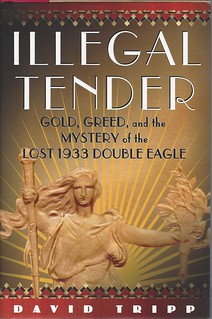
Speaking of ANA exhibits, the U.S. Mint will be exhibiting its eleven illegal-to-own 1933 double eagles. Author David Tripp reports that for the month of August his publisher Simon and Schuster will be running a $2.99 special on the ebook version of Illegal Tender. Here's the Amazon description. -Editor
 It is one of America's treasures -- the most valuable ounce of gold in the world, the celebrated, the fabled, the infamous 1933 double eagle. It shouldn't even exist but it does, and its astonishing, true adventures read like "a composite of The Lord of the Rings and The Maltese Falcon" (The New York Times). Illegal to own and coveted all the more, it has been sought with passion by men of wealth and with steely persistence by the United States government for more than a half century.
In 1905, at the height of the exuberant Gilded Age, President Theodore Roosevelt commissioned America's greatest sculptor, Augustus Saint- Gaudens -- as he battled in vain for his life -- to create what became America's most beautiful coin. In 1933 the hopes of America dimmed in the darkness of the Great Depression, and gold -- the nation's lifeblood -- hemorrhaged from the financial system. As the economy teetered on the brink of total collapse, Franklin Delano Roosevelt, in his first act as president, assumed wartime powers while the nation was at peace and in a "swift, staccato action" unprecedented in United States history recalled all gold and banned its private ownership.
But the United States Mint continued, quite legally, to strike nearly a half million 1933 double eagles that were never issued and were deemed illegal to own. In 1937, along with countless millions of other gold coins, they were melted down into faceless gold bars and sent to Fort Knox. The government thought they had destroyed them all -- but they were wrong.
A few escaped, purloined in a crime -- an inside job -- that wasn't discovered until 1944. Then, the fugitive 1933 double eagles became the focus of a relentless Secret Service investigation spearheaded by the man who had put away Al Capone. All the coins that could be found were seized and destroyed. But one was beyond their reach, in a king's collection in Egypt, where it survived a world war, a revolution, and a coup, only to be lost again.
In 1996, more than forty years later, in a dramatic sting operation set up by a Secret Service informant at the Waldorf-Astoria, an English and an American coin dealer were arrested with a 1933 double eagle which, after years of litigation, was sold in July 2002 to an anonymous buyer for more than $7.5 million in a record-shattering auction. But was it the only one? The lost one?
Illegal Tender, revealing information available for the first time, tells a riveting tale of American history, liberally spiced with greed, intrigue, deception, and controversy as it follows the once secret odyssey of this fabulous golden object through the decades. With its cast of kings, presidents, government agents, shadowy dealers, and crooks, Illegal Tender will keep readers guessing about this incomparable disk of gold -- the coin that shouldn't be and almost wasn't -- until the very end.
For more information, or to order, see:
Illegal Tender: Gold, Greed, and the Mystery of the Lost 1933 Double Eagle
(https://www.amazon.com/Illegal-Tender-Greed-Mystery-Double/dp/0743245741/ref=sr_1_1)

NEW BOOK: NUMISMATIC TIMELINE OF THE PTOLEMAIC EMPIRE
Long-time NBS member Bill Daehn has authored his fourth book on ancient Greek numismatics. Congratulations! Here's the announcement. -Editor
 Historical and Numismatic Timeline of the Ptolemaic Empire
William E. Daehn
This book is intended to assist the collector of ancient Ptolemaic coins to more easily grasp the complex history of this Egyptian-based empire and to tie the coinage more closely to that history. A section is devoted to the reign of each king or queen. Each ruler's dates of birth, reign, and death are given at the top. Significant events of the reign are arranged chronologically, segregated into three broad categories: (1) politics and war, (2) religious, personal and cultural events, and (3) the coinage. The timelines are presented in an easy-to-use columnar table format.
Minneapolis, 2026; softcover, spiral bound, 46 pp., map.
Bill adds:
"Charles Davis will have the book available at his table at the ANA convention in Pittsburgh. If you won't be attending the show, contact Charles or check with your favorite literature dealer and ask them to stock the book."

NEW BOOK: A CHRONICLE OF HUNDRED STORIES
Author Mudassir Iqbal Shaikh passed along this information about his upcoming book. Thank you. -Editor
I am a professional numismatist from Lahore, Pakistan, and Joint Secretary of the Lahore International Numismatic Society. I have completed a forthcoming book titled A Chronicle of Hundred Stories: Forgotten Moments of the Numismatic World—100 key numismatic events, each presented in a tight 100-word narrative with high-resolution archival images.
Before publication, the project has already attracted formal interest and image permissions from several institutions:
- The British Museum (Dr. Thomas Hockenhull has requested a copy for the museum's library)
- Monnaie de Paris (granted high-resolution images and requested a library copy)
- NatWest Group Archives and Barclays Group Archives (granted archival images with formal citation references)
- The World Money Fair Berlin (reviewed and fact-checked their entry, granted logo use)
I will be exhibiting the manuscript at the Kuala Lumpur International Numismatic Fair (KLINF) in October 2026.
Here are some sample pages. Three of these discuss numismatic topics I wasn't aware of. For example, the story on the radioactive origins of the Automatic Teller Machine notes that for authentication, the world's first ATM used specialized paper vouchers treated with a trace amount of Carbon-14, a radioactive isotope. -Editor


To read earlier E-Sylum articles, see:
HAPPY BIRTHDAY TO THE AUTOMATED TELLER MACHINE
(https://www.coinbooks.org/esylum_v10n29a20.html)
A VENDING MACHINE FOR MONEY
(https://www.coinbooks.org/v27/esylum_v27n26a24.html)
PERIODICAL: MCA ADVISORY SUMMER 2026
The Summer 2026 issue of The MCA Advisory has been published by the Medal Collectors of America. If you have even the slightest interest in the topic, you need to be a member. See the link below for more information. -Editor
TABLE OF CONTENTS
 President's Message
Editor's Message
Letters to the Editor
MCA and Hobby News
- From the Desk of Rob Penn, Auction Correspondent
- New MCA Facebook Group
- The MCA Advisory Places Second
- MCA Members Can Make Nominations for MCA Awards
- MCA Speakers Selected for 2026 Pittsburgh WFOM
- June 2026: MCA Members Promote International Numismatic Congress
In Memory of Gerry Muhl
A Tribute from Alex Shagin, Sculptor
Libertas Americana: An Anniversary Medal:
The Medal Collectors of America 2026 Annual Medal
by Stephen K. Scher
Introducing a New Original Series:
From William Pitt to Counterfeit
by Doug McIndoe
Coins and Medals of the Khazars – Numismatic Perspectives on Identity
by Ira Rezak
The First Olympic Medals
by Roberto Menchaca García
Marcos Moreno from Cuba and the Gold Medal of the Royal Effigy (1798)
Dr. Ángel O. Navarro Zayas


Here's Skyler Liechty's "President's Message" column where he discusses the 250th anniversary of American Independence and the evolving journey of collecting, selling, and beginning new medal collections. -Editor
This year being the 250th anniversary of the founding of America, our medal committee has been even more hard at work than normal. They have something prepared that will take your breath away. This is very special, and I can hardly wait to have an example in hand.
While summer has been progressing nicely, it is easy to let collecting fall to the side in favor of things like taking trips and spending time with family. These are the times that I find I miss bidding on exceptional pieces. At the same time many of the major auction houses have made it easier with tracking and reminding me what is up for auction. I believe this benefits not only the consignor but collectors as well.
Something collectors spend quite a bit of time thinking about is when the right time is to sell a piece of a collection, or the entire collection. And, once that decision is made, what is the next area of interest? As collectors, we understand that the need to collect can be consuming. This has recently affected me personally, as I made the major decision to sell one of my most passionately collected sets, my Indian Peace medals. I feel that I am not alone in this, as I am sure many of our members have likely experienced the same thoughts and questions about what was next.
One of the things I love about medal collecting is that you can often sell a collection and start a new one, without missing a step. You can go very specific or start a very broad collection. Some collections are assembled based on a book, some are based on what you like, and others have themes or events that have not been written about specifically. The latter provides an opportunity for the collector to be the one to write about all that has been discovered, whether that is in a journal like this or in a book. The knowledge is worthy to be shared. Share it!


Here's Doug McIndoe's "Editor's Message" column where he discusses the upcoming MCA annual medal, the 250th anniversary of American Independence, and the strong medal market heading into late 2026. -Editor
With the 250th anniversary of American Independence upon us, 2026 is a great time to be immersed in the field of medal collecting. Not only are there incredible early American medals to collect, but there are also fabulous stories to go along with them. Additionally, MCA is adding a new medal to the catalogue in the coming weeks. Thanks to the efforts of the medal committee and returning artist, Heidi Wastweet, this year's MCA medal pays tribute to an outside cause: the American Revolution. We are all excited to reveal it.
In this issue, you will find a number of other important announcements, such as the particulars of the MCA meeting at the World's Fair of Money this August and our new Facebook page. We also have interesting articles, including a tribute piece on the late, beloved MCA member, Gery Muhl, written by Alex Shagin.
While we cannot hope for another late summer and autumn of Betts medal auctions with the intensity and diversity we saw last year (many pieces from the John W. Adams and John J. Ford, Jr. collections were up for sale), the strong medal market is sure to bring out a number of great finds, nonetheless. So, sit back and enjoy this issue as we gear up for an exciting second half of 2026. If you do not want to sit back and relax, send me an article for the Autumn or Winter issue! The due dates are September 1st and November 15th, respectively.
For more information on the Medal Collectors of America, see:
https://www.medalcollectors.org/
JOHN LOUIS MARION (1933-2026)
Sotheby's fabled auctioneer John Marion (born November 27, 1933) passed away May 6, 2026. -Editor

Mr. Marion in 1984
John Marion, who was the public face of the global auction house Sotheby's for more than three decades and was long considered the country's greatest art auctioneer — the man with the golden gavel, who oversaw multiple record-breaking sales — died on May 6 in the La Jolla neighborhood of San Diego. He was 92.
Mr. Marion presided over the era in the late 20th century when the auction of fine art grew from a rarefied pursuit to a glamorous, if frenzied, spectator sport — and when art itself evolved from an object of passion or an emblem of upward social mobility to a veritable asset class.
He sold not just fine art, like Vincent van Gogh's "Irises," but other objects of desire, including Andy Warhol's collection of cookie jars and a diamond that Richard Burton later gave to Elizabeth Taylor. (At nearly 70 carats, it sold in 1969 for a million dollars, a record at the time.)
Mr. Marion was suave but not snooty, an elegant 6-foot-2 figure who favored Savile Row suits and aviator glasses. At the podium, he had a brisk, jocular manner, and a preternatural ability to "pull bids" — to use the term of art for keeping buyers in the game.
Tobias Meyer, the private art dealer and former head of contemporary art at Sotheby's, who succeeded Mr. Marion as chief auctioneer, said in an interview: "He was the god of auctioneers in America. He was beloved. He could make people bid by sheer force of his personality."
And "he spoke the language of wealth at the time," Mr. Meyer added, noting that the 1980s — the Reagan years — were Mr. Marion's heyday. "He was not only good at his job, but he was part of that world, the perfect gentleman in the middle of it all."
That was not surprising, as he had grown up in the business. His father, Louis Marion, was head auctioneer at Parke-Bernet Galleries, the genteel carriage-trade auction house on Madison Avenue that in 1964 was bought by Sotheby's, the British concern started in 1744 to sell rare books.
The younger Mr. Marion began as a trainee in 1960, counting teapots in the basement. By 1972, when he was 38, he was the company's president as well as its chief auctioneer. At that point, he had already presided over the sale of $200 million worth of art and other collectibles. By 1975, he had become chairman.

Marion calling the first session of the
Bunker and William Herbert Hunt collection in June 1990
To read the complete article, see:
John Marion, the ‘God of Auctioneers in America,' Dies at 92
(https://www.nytimes.com/2026/05/23/arts/john-marion-dead.html)
The last photo caught the eye of Sotheby's numismatic consultant David Tripp, who adds this remembrance of John Marion and that landmark coin sale. Thank you! -Editor
Sotheby's felt the coins were of such spectacular quality that it took the decision to sell the coins as art, and hoped to create interest among its clients in other collecting areas. The first session included both the antiquities and the best of the fabulous Greek and Roman coins.
 The auction was also, in keeping with the then-standard for highly important evening sales (Impressionist pictures, for example), a black-tie affair. The auctioneer (John Marion, then Sotheby's Chairman) and all the experts and staff similarly attired. To the best of my knowledge it was (and remains, I imagine) the only black-tie sale of coins ever held!
The 110 lots of Greek and Roman coins realized more than $8,500,000 (or a then-record $78,000 per lot). The sale's results even made an item on the front page of the New York Times.
At right is a photo of the sale in progress, left to right: Stacy Goodman (of Sotheby's antiquities department); Diana D. Brooks, CEO of Sotheby's; James Morton (Sotheby's London coin department), Tom Eden (Sotheby's London coin department, who catalogued the Greek coins) [today, of course, they are the proprietors of the Morton and Eden auction house]; David Tripp (Special Consultant to Sotheby's who catalogued the Roman coins).
As you may intuit from the obit John Marion was a giant in many ways. Amazing man.
RICHARD FALKINER (1936-2026)
On July 22nd, dealer Charles Riley made this post on Facebook. -Editor
 "I have just heard that Richard Falkiner died yesterday. Perhaps not widely known these days among the younger generation of numismatists, he is certainly well-known among British numismatists of my generation and above. He began his career in 1956 at Glendining & Co, central London auctioneers, before moving to Christie's in 1958 to set up their own coin department. From 1972 he was an independent dealer and numismatic writer, becoming a weekly columnist for the Antiques Trade Gazette (until 2014).
In 1992 he wrote a history of Glendining's (unfortunately never published although I have one of three extant bound photocopies). An ardent "European" in the political sense, in 1991 he struck a series of unofficial ECU (European Currency Unit) coins in his name. The ECU was a trial forerunner of the Euro.
 The photograph of Richard was taken after a jolly lunch in 2008 hosted by Peter Mitchell, formerly of Baldwin's. He often attended the London Coin Fair, including just last month, making the lengthy journey from his home near Evesham - a determined effort indeed."
To read the complete post, see:
https://www.facebook.com/100057411251350/posts/
richard-falkiner-1936-2026-i-have-just-heard-that-richard-falkiner-died
-yesterda/1584367710153589/

Timeline Auctions published this note. -Editor

(1936 - 2026)
Richard Falkiner, one of the most respected and influential figures in British numismatics and antiquities, has passed away after a remarkable career spanning more than seven decades in the world of ancient art and collecting. Richard was a vetter and consultant for TimeLine Auctions for 16 years, and more recently headed the vetting meetings as our senior consultant.
Richard built a distinguished career at two of London's leading auction houses, where he headed the Antiquities, Medieval, Renaissance and Islamic Coins, and Medals departments at various times. He was a leading authority on coins, medals and engraved gems (glyptics) from prehistoric times onward. Between 1956 and 1972 alone, he compiled or edited over three hundred auction catalogues, several of which remain standard references in the field today.
From 1972 he worked independently, a decision he never regretted. For over 50 years he sat, often as chairman, on the vetting committees of London's major art fairs - including Grosvenor House, Masterpiece, Olympia, BADA and the Frieze Fairs - covering ancient, Medieval and coin categories. He went on to advise museums, private collectors, dealers and auctioneers all over the world, and served on the British Museum's Treasure Valuation Panel from 1996.
His passing is felt at TimeLine not only as the loss of an exceptional specialist but as the loss of a friend and mentor. Richard's contribution to numismatics and the wider antiquities community has been immense, and his wisdom, professionalism, and kindness will be greatly missed.
To read the complete article, see:
Richard Falkiner, FSA
(1936 - 2026)
(https://timelineauctions.com/news-press/richard-falkiner-FSA-1936-2026/182/)
David Tripp writes:
"Richard Falkiner (1936-2026) was highly respected in numismatic and antiquities circles. He was on and frequently chaired vetting committees for numerous London art fairs, including Grosvenor House, Masterpiece, BADA, etc.
Richard was in the trade starting in 1956 and while at Christie's in 1964 he catalogued the Lord St. Oswald collection (and couldn't have been more helpful when I peppered him with questions about it while I was working on my research for the article regarding Sir William Strickland). He later became an independent consultant and was also the numismatic columnist for the Antiques Trade Gazette for decades."

WULFING COLLECTION AT WASHINGTON UNIVERSITY
Newman Numismatic Portal Project Coordinator Len Augsburger provided the following updates. -Editor
The John Max Wulfing Collection at Washington University
 We have several announcements this week related to the Wulfing Collection at Washington University in St. Louis. First, the exhibit "John Max Wulfing's Passport to the Past" is now open in the Newman Tower within Olin Library on the WashU campus. Curated by Jeremy Haag, the six cases trace Wulfing's life through the lenses of collecting and travel. Various themes naturally incorporate selections from the Wulfing Collection. Haag will speak on the exhibit on August 20, at 6:30pm in Room 142 of Olin Library. All are welcome to attend. This presentation is in conjunction with the regular monthly meeting of the St. Louis Ancient Coin Study Group.
Next, Elena Baldi, Associate Professional Specialist at the Princeton University Library, has recently published the article "A Hoard of Hyperpera of Manuel I from the John Max Wulfing Collection, Washington University in St. Louis," this, as part of the Alan Stahl festschrift published by the American Numismatic Society as Numismatic Studies 50. The article analyzes a hoard of 75 gold coins acquired by Wulfing in Athens in 1925. This group is perhaps the most visually arresting group of coins in the Wulfing cabinet, and Elena's research is most welcome. She previously served as a curatorial postdoc working with the Wulfing collection at Washington University.
Finally, Will Bubelis, Associate Professor of Classics at Washington University and Curator of the Wulfing Collection, will be presenting on the ANS Long Table Forum on August 28, on the topic of "Epeiros and Beyond: New Perspectives on the Numismatics of Western Greece." Bubelis served as Visiting Scholar at the recently concluded 2026 Eric P. Newman Graduate Summer Seminar at ANS.
Image: "Unearthing Ancient America," one of six cases in the Wulfing exhibition
Link to "John Max Wulfing's Passport to the Past" exhibit home page:
https://library.washu.edu/exhibitions/wulfings-passport/
Link to order Coins and Money in the Middle Ages: Studies in Honor of Alan Stahl (Numismatic Studies 50):
https://numismatics.org/store/coins-and-money-in-the-middle-ages-studies-in-honor-of-alan-stahl-numismatic-studies-50/
Link to ANS Long Table 286 with William Bubelis, "Epeiros and Beyond: New Perspectives on the Numismatics of Western Greece":
https://numismatics.org/lt286/

VIDEO: 2015 PCDA SHOW
The David Lisot Video Library on the Newman Numismatic Portal can be found at:
https://nnp.wustl.edu/library/multimediadetail/522852
We highlight one of his videos each week in The E-Sylum. Here's one from the 2015 Professional Currency Dealers Association (PCDA) show, held at the Crowne Plaza Chicago O'Hare in Rosemont. IL. -Editor

Interviewer: David Lisot, CoinTelevision.com with Meredith Hilton, Kagin's, 1869 $50 Rainbow PCGS VF20, 1905 $20 Technicolor Gold Note PMG66, Dustin Johnston, Heritage Auctions, 1861 $1000 Confederate Montgomery T-1 PCGS VF30, Peter Treglia, Stack's Bowers, Palestine Currency Board 5 Pound PMG VF30, and Costa Roupas, 1928 $1000 Gold Certificate PMG VF35.
To watch the complete video, see:
Cool Coins Currency & Collectibles at PCDA 2015
(https://youtu.be/8-SjW2V0Vk0)
Cool Coins Currency & Collectibles at PCDA 2015
(https://nnp.wustl.edu/library/book/548585)
Cool Coins Currency & Collectibles at PCDA 2015. VIDEO: 7:17.
(https://nnp.washu.edu/Documents/Detail/cool-coins-currency-collectibles-at-pcda-2015.-video-717./4143850)

2026 ANA WFOM COLLECTOR EXHIBITS
Paul Hybert provided details of the Collector Exhibit Area at the upcoming ANA convention in Pittsburgh. Thanks - this is one of my favorite parts of any coin show. -Editor
Recent E-Sylum issues have covered many aspects of the upcoming World's Fair of Money -- here are details on a traditional and popular feature, the Collector Exhibit Area.
An online guide to the Collector Exhibit Area at the August 25-29
World's Fair of Money will be updated during the show, to list only the
present exhibits. It is available at:
http://www.chicagocoinclub.org/events/2026/ana/ex/all_by_cl.html
(This groups the exhibits by Exhibit Class.)
The Collector Exhibits are no longer listed in the Show Guide. The ANA
website has an ungrouped listing of exhibits at:
https://www.money.org/wfm-exhibits/
(This lists all exhibits for which an application was received.)
 Visit a page before you arrive at the convention center to determine
your must-see exhibits, or visit a page to help you remember that
exhibit you want to see again! The online guide will be updated during
the convention, to list just the exhibits which are present, and to
reflect if an exhibit has been changed to a different Class.
Visit a page before you arrive at the convention center to determine
your must-see exhibits, or visit a page to help you remember that
exhibit you want to see again! The online guide will be updated during
the convention, to list just the exhibits which are present, and to
reflect if an exhibit has been changed to a different Class.
There are three exhibits in the Numismatic Literature class, and we expect 69 exhibits covering a wide range of material. Look for your favorite topics, or look for something new to collect.
For this WFoM, the Collector Exhibit Area is located far to the left as you enter the bourse hall (near the Short Snorter Project table and the SS Central America exhibit). On Wednesday through Saturday mornings, you can enter the Collector Exhibit Area as soon as you can enter the bourse hall. Refer to the schedule for the staggered opening times for: dealers, ANA members, and the public.
Here are some selected exhibits to provide a flavor of the variety in store for convention attendees. Don't forget to block out time to visit! -Editor
A Monumental Change in American Silver Coinage
To exhibit selected specimens of US Pattern Coins from the 1964 to 1965 transition change in American silver coinage to finally using nickel-clad planchets. Many rare experimental pieces are shown from the 3 finalists in producing planchets: International Nickel, E. I. Du Pont, and the US Mint. Also the official government-issued final experiments report book and a contemporary coin operated vending machine coin acceptor/rejector. Plus metal bars and other related specimens.
U-Boats in America: Karl Goetz's K-185 Medal
This exhibit explores Germany's dramatic 1916 U-boat visit to Newport, Rhode Island, and the attacks on Allied shipping that followed. Centered on a satirical medal by German artist Karl Goetz, it examines the visit itself, the American and German reactions, shifting public opinion, and the growing strain placed on US neutrality during World War I.
Medals of the Hall of Fame for Great Americans at New York University
This exhibit demonstrates the New York University's recognition of great Americans in Medallic Art.
Remembering the Gentleman in the Blue Blazer
This exhibit remembers the gentleman Ray Dillard. It explains a brief history of Mr. Dillard's life and his accomplishments in the numismatic community.
A Selection of Ancient Minting Errors, Oddities, and Curiosities
The viewer will learn about the various types of errors that occurred during the ancient minting process. There are examples of brockages (both obverse and reverse), dramatic double strikes, flip over strikes, blank obverse or reverse, etc. While all of these may have happened accidentally, there are a few pieces that defy logic and may have been aided by the mint workers. This is an ongoing project first started in 1983, with close to a dozen coins having been added since 2024.
The Anatomy of US Error Notes: A BEP Production-Stage Collection
This exhibit explains how US paper money errors originate by following the Bureau of Engraving and Printing's production sequence from raw substrate through final cutting. Each production stage introduces specific mechanical and procedural risks that can generate distinct, diagnosable error types.
By arranging error notes according to the stage in which each flaw occurred, the exhibit shows why particular failures happen, how to identify them correctly, and what they reveal about BEP processes. Through representative examples across all six major production stages, the exhibit aims to educate viewers about both the technical foundations and the numismatic significance of US error notes.
Celebrating Clifford Mishler: 70 Years As an ANA Member
This exhibit features a collection of items relating to Clifford Mishler, to celebrate his 70th year as a member of the Association.
See also the article elsewhere in this issue about the Numismatic Literature exhibits at the show. -Editor
NOTES FROM E-SYLUM READERS: AUGUST 9, 2026
That Marble Plate on the Cash Register
Ray Williams writes:
 "The cash register picture in last week's E-Sylum brought back memories. I started working at Perdue Radio Co. in New Jersey in May of 1967. There was a modern cash register and an antique as you had pictured. They were both used for different purposes. I remember Charles Perdue (founder and born in the 1880's) telling me during an idle moment, that all the old cash registers had that marble plate above the cash drawer. He said any suspect coins would be dropped on it and if they didn't sound right, they were rejected. I thought I'd share the memory."
Thanks! I don't think I've heard that technique described in relationship to a cash register before, but it's very plausible. -Editor
To read the earlier E-Sylum article, see:
ABOUT THIS ISSUE: AUGUST 2, 2026 : Dog Money
(https://www.coinbooks.org/v29/esylum_v29n31a25.html)
 Reaching Numismatic Bookseller Jeff Starck
Last week numismatic bookseller Jeff Starck announced the availability of a new book on classic U.S. silver commemoratives. -Editor
Jeff writes:
"A few people have told me that they've emailed me and I've never responded. If that's the case, it's because I never received the email. If people trying to order the book are encountering issues, I'd like to advise them to contact me at starckreality@gmail.com."
To read the earlier E-Sylum article, see:
NEW BOOK: HALF A DOLLAR OF HISTORY
(https://www.coinbooks.org/v29/esylum_v29n31a02.html)
The Standing Liberty Cosgrove Airways Token
Jim Haas writes:
"My friend Daniel Leininger, a descendant of Hermon Atkins MacNeil, is webmaster of https://hermonatkinsmacneil.com. Among his many posts was one on the "Cosgrove Airways" medal that he had purchased. Cosgrove Airways was never a commercial passenger airline, but rather a historical aviation curiosity from 1928, primarily known as the name stamped on a series of commemorative tokens that used a slightly enlarged image of the obverse of Hermon Atkins MacNeil's 1916 Quarter.
"The tokens were created in 1928 by Cornelius Burton Cosgrove, (1906-1999) more familiarly known in aviation history as C. B. (Burt) Cosgrove, an early aviation pioneer. Cosgrove made his first solo flight at the age of 15 in a Curtiss "Jenny" (JN-4D) bi-plane that he had assembled himself. Starting in 1928 he managed the Davis-Monthan Airport in Tucson where he worked with Col. Charles Lindbergh setting up the nation's first transcontinental airline route.
"The exact purpose of the tokens remains a bit of a mystery, but it may have simply been an expression of the man's sense of humor. Among his many achievements he piloted the experimental B-17 bomber. In 1941 he helped set up a bomber squadron to protect the American Commonwealth of the Philippines and was at Clark Field when it was bombed on Pearl Harbor Day.
"More information about this fascinating individual can be found at https://airandspace.si.edu/support/wall-of-honor/col-c-b-burt-cosgrove-jr.
"Fascinating story."
Indeed. I've never seen one of these. Do any of our readers have one? -Editor
The Bookstores of Hobart, NY
Regarding the small town of Hobart where one of the issuers of the Civil War cardboard scrip of McCune & Peters lived,
Paul Bosco writes:
 "The story mentions that Peters was associated with Hobart, NY. My sister moved there a few years ago, after living in Manhattan for half a century. She describes it as a town of 400 people with five bookstores. It has nothing to do with Hobart College.
"The bookstores are fairly good, so it must be that people pass thru the town."
Well, bookstores these days (at least used and rare bookstores) sell a lot of inventory online and could be located anywhere. But bookstores are a great reason to go visit a quaint small town. -Editor
To read the earlier E-Sylum article, see:
NOTES FROM E-SYLUM READERS: AUGUST 2, 2026 : More on the McCune & Peters Cardboard Chits
(https://www.coinbooks.org/v29/esylum_v29n31a10.html)
The 1862 Small Change Panic
In a related Civil War emergency money topic,
Becky Rush writes:
"As I was plowing through a couple older Civil War Token Society publications I found a great link to a Newspapers.com clipping. It was a Fall 2020 article by Cole Hendrickson titled "John Gault and his New Metallic Currency."

The "Small Change Panic" as it was called at the time was at its height in the summer of 1862. Everyone hoarded specie, and scrip notes and other money substitutes of all kinds were pressed into service. The clipping is from the Brooklyn Evening Star of Brooklyn, NY. July 19, 1862. Thanks! That's wonderful. -Editor
Japan's National Printing Bureau
Howard Berlin passed along this video of the National Printing Bureau in Tokyo, where Japan's banknotes are made. Thanks! -Editor

To watch the complete video, see:
The Banknote Printing Factory
(https://www3.nhk.or.jp/nhkworld/en/shows/5143002/)
Query: Cartoons on Numismatic and Monetary Issues
Vic Agha writes:
"I'm looking for an old-time political cartoon. The cartoon showed a dour-faced schoolmarm pointing to a blackboard and making a political commentary on the removal of the VDB from the penny in 1909. Do you know where I can find it?
"I'm asking because I think you published it at one point or another in the E-Sylum, but I couldn't find it and apologize if this wasn't something you did at some point.
"On a similar note, do you know of any one archive that has aggregated the various 19th and 20th century cartoons commenting on monetary issues?"
I wasn't able to locate a cartoon like that in our article or image archives. Is anyone familiar with it? How about a cartoon archive? That would be fun to peruse.
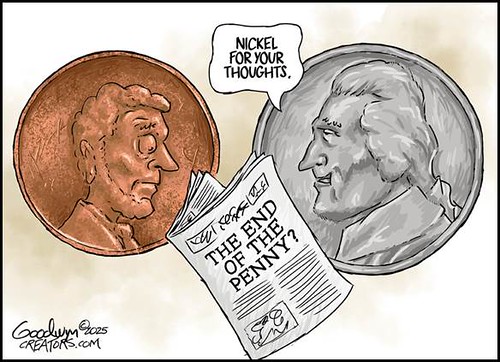
Here's a cartoon from the END of the Lincoln Cent, rather than the beginning. -Editor

MINNESOTA INNOVATION DOLLAR FIRST RELEASE
Pete Smith wrote an article on the Minnesota Innovation Dollar First Release Ceremony for the August 2026 issue of the Northwest Angle, the newsletter of the Northwest Coin Club. We're republishing it here with permission. Thanks. everyone! -Editor
By Pete Smith
On Tuesday, July 28, the Northwest Coin Club hosted a First Release ceremony for the Minnesota Innovation Dollar. Held at the Minnesota History Center in St. Paul, 116 enthusiastic attendees swapped $1 for one of the new dollar coins especially encased for the event. An additional seven pieces were presented to the event's speakers, staff from the History Center, and TV reporters.


In addition to our club, sponsors of the event were Greg Allen Coins LLC, Minted Assets, Gary Adkins & Associates, Mill City Numismatics LLC, Great Lakes Coins & Collectables, Grove Coin LLC, and Chewies Coins and Collectibles.
 Club president John Jost welcomed visitors and introduced the speakers. St. Paul Mayor Kaohly Her talked about the Minnesota culture that encouraged innovation in many fields. Then, Felix Okoth, a product development engineer for Thermo King, told us some of the history of Frederick McKinley Jones who invented the mobile refrigeration unit to keep products cold during transport. Jones was the co-founder of the U.S. Thermo Control Company which became Thermo King. Trucks using his refrigeration device transported food and drugs for the troops during World War II.
Next to speak was David Kelliher, Vice President of Public Policy and Government Relations at the Minnesota Historical Society. He discussed the process for reviewing Minnesota innovations, selecting the subject, and providing resources for the artist.


The designer of the coin's reverse, Beth Zaiken, spoke next. With Minnesota being her home state, she felt honored that her proposed design was selected for the coin. She was selected for the Mint Artist Infusion Program in 2019 and is already credited with twenty-one coin designs with more yet to be announced.
She explained that the truck shown on the coin looks like a truck from the 1940s but was not supposed to be any specific model. Her job was to prepare a two-dimensional image of the design. A team of eight sculptor-engravers at the mint then converted her design onto the working dies.
Following the program, visitors lined up to exchange a paper dollar for one of the Minnesota Innovation dollars and to obtain the designer's autograph on one of the cards prepared for the event.


The United States Mint does not conduct first release events for the Innovation Dollars. Previous events were conducted by local organizations in Michigan on April 8, 2025, and for Texas on July 29, 2025. The Minnesota event was made possible by cooperation between the collector and dealer community. NWCC President John Jost described the process:
"Greg Allen contacted me as president of the Northwest Coin Club to see if we would be interested in participating in a release event similar to those held in Michigan and Texas. Greg sent me links to the videos of those events on YouTube. I said that our club would like to be involved and then Greg put together a couple of conference calls with Judge Steven Bieda (a leader of the Michigan event), himself, and I to begin planning the event.
Then, Greg and I worked with Chang Bullock who has connections to the Minnesota Historical Society. From there, I, Greg, Chang, and Leah Williams and David Kelliher from the Historical Society, held video meetings to plan the details. The Historical Society and Chang worked to connect with Thermo King and the coin's designer. Greg and Chang worked with the U.S. Mint. I worked with the Mayor of St Paul's husband and invited her to participate. The Historical Society notified the governor's office. Unfortunately, the governor was not able to attend."

A 5 x 7 inch card was prepared for the event with information about the coin designer, Beth Zaiken. She signed the card for visitors who bought the coin. The card will be a scarce piece of numismatic ephemera and would be a great item to include with a numismatic exhibit. This image of the card in The Northwest Angle may be the only way most people will ever see it.
The event was promoted to the local numismatic community through our club, the St. Paul Liberty Coin Club, and the Great River Regional Coin Club of St. Cloud. It was not promoted to the general public. The event was reported on KSTP-5 and KARE-11 television news that evening.
Legislation authorizing the Innovation Dollar series was signed into law by President Trump on July 18, 2018. This called for 57 coins with four varieties of each. Uncirculated coins are struck with a P or D mintmark. Proof and reverse proof coins are struck with the S mintmark. A complete set would include 228 coins. The date, the mintmark and the motto E PLURIBUS UNUM are impressed on the edge.
The obverse of the Minnesota Innovation Dollar is the standard Statue of Liberty design seen on all coins in the series. The reverse is a tribute to mobile refrigeration invented by Frederick McKinley Jones (1893-1961) and a 1940s era refrigeration truck. The initials BZ are for the designer, Beth Zaiken. The initials JN are for Joseph V. Noorigian, the sculptor/engraver.
The coin's composition is 88.5% copper, 6% zinc, 3.5% manganese and 2% nickel. The coins will not be released into circulation—they can only be purchased through the mint's website. A 25-coin roll is offered at $61 while a 100-coin bag is $154.50.

TREASURY SECRETARY PUSHING TO HONOR ROGER PENSKE
Treasury Secretary Scott Bessent is pushing to honor Roger Penske and IndyCar with a national medal. -Garrett
 Most U.S. coins and medals are authorized by specific coinage acts written and passed by
Congress. In recent years the Treasury Department has used its own authority to create certain
national medals for the American public to collect and enjoy. Like other coins and medals, these
are official products of the United States, designed and produced by the nation's Mint. But they
don't require individual acts of Congress, because the U.S. Code (31 U.S.C. § 5111(a)(2)) gives
the Secretary of the Treasury freedom and flexibility to dream them up and create them.
Most U.S. coins and medals are authorized by specific coinage acts written and passed by
Congress. In recent years the Treasury Department has used its own authority to create certain
national medals for the American public to collect and enjoy. Like other coins and medals, these
are official products of the United States, designed and produced by the nation's Mint. But they
don't require individual acts of Congress, because the U.S. Code (31 U.S.C. § 5111(a)(2)) gives
the Secretary of the Treasury freedom and flexibility to dream them up and create them.
One example is the American Liberty silver medal series, launched in 2016 (along with related gold coins) to celebrate modern interpretations of the idea of American liberty. This has grown into a remarkably innovative program, showcasing creative artists and using new technology to manufacture its coins and medals in impressive high relief.
Another example is the program of .999 fine silver national medals honoring American presidents. This series started with George Washington in 2018, and has produced four medals each year since 2019.
A third collection debuted in 2021, creating new silver medals for each branch of the U.S. military. These were issued in two sizes: one-ounce and larger 2.5-ounce, each made of .999 fine silver.
These medal programs embody themes that are historically important and national in their scope—themes like the leadership of the presidency, the strength and traditions of our armed forces, and the very concept of American liberty.
Now, Treasury Secretary Scott Bessent has proposed a national medal of an apparently more commercialized and less historic nature. It would commemorate a street-circuit race of the NTT IndyCar Series held in Washington, D.C., and feature a portrait honoring Roger Penske, founder and chairman of Penske Corporation.
The medal is planned at the size of a half dollar (1.205 inches in diameter)—about 25 percent smaller than the silver medals mentioned above, and likely thinner. Its proposed designs were reviewed and tweaked by executives of the Penske Corporation.
What Does the Medal Commemorate?
There seems to be some confusion among the Treasury Department, the Citizens Coinage Advisory Committee, and the Penske Corporation about what, exactly, the medal is supposed to accomplish.
According to the U.S. Mint website, "The Freedom 250 Grand Prix National Medal commemorates the Freedom 250 Grand Prix Indy-car racing event in Washington, DC, which will occur on August 22–23, 2026." The website mentions no connection to the Semiquincentennial of American independence.
However, according to the IndyCar website, "The Freedom 250 Grand Prix of Washington D.C. will recognize the historic milestone of America's independence and celebrate the unparalleled tradition and legacy of America's motorsports industry." It describes the two-day event as including a race that will run 1.7 miles through the streets of Washington, DC—a distance of 249.9 miles in 147 laps.
The medal, then, appears to mark the Semiquincentennial in a roundabout way, because the race it commemorates is part of a two-day Grand Prix event that both "recognizes" the history of American independence and "celebrates" America's motorsports industry.

Penske Corporation executives Jonathan Gibson (left) and Larry Bluth during the August 6, 2026, CCAC meeting. (Images courtesy of the United States Mint)
Jonathan Gibson, Penske Corporation's Executive Vice President of Marketing and Business Development, spoke on behalf of Roger Penske at an August 6 meeting of the Citizens Coinage Advisory Committee.
According to the TeamPenske website, Mr. Gibson leads all marketing, brand, and business development initiatives for Penske Corporation: "In his role, Gibson also oversees corporate communications processes and messaging, digital innovation, and several short and long-term strategic initiatives across Penske Corporation and its subsidiary brands, including Penske Automotive Group (PAG), Penske Transportation Solutions (PTS), and Penske Entertainment."
It's unclear what the 89-year-old Roger Penske was promised or led to believe about this national medal. But a remark from Mr. Gibson to the committee is telling: "It's my privilege to be here and speak on behalf of Roger Penske this afternoon as we consider him for this distinguished special ceremonial medal from the United States Mint." And further: "He is very humbled and very proud to be considered for this humbling opportunity. We are very proud as you consider recognizing someone whose life work reflects the very best of the American spirit. Thank you again for this amazing opportunity."

President Donald Trump standing at attention during the citation reading for Presidential Medal of Freedom recipient Roger Penske, Thursday, October 24, 2019, in the Oval Office of the White House. (Official White House photo by Shealah Craighead)
The tone of those comments suggests that Roger Penske has been led to think of this medal as an honorific piece, like a Congressional Gold Medal, or akin to the Presidential Medal of Freedom (the nation's highest civilian honor) given to him by President Donald Trump in 2019—but with a much more personal design and distributed nationwide as an official product of the United States Mint.
Review by the Citizens Coinage Advisory Committee


The Citizens Coinage Advisory Committee met Thursday afternoon, August 6, 2026, to review design proposals for the national medal. The CCAC is a congressionally established body of eleven members representing the general public, as well as specialists in American history, numismatics, medallic sculpture, and curatorship. Its main function is to advise the Secretary of the Treasury on themes and design proposals for circulating coinage, bullion, Congressional Gold Medals, commemorative coins, and national medals. Per the Treasury, "The CCAC serves as an informed, experienced, and impartial resource to the Secretary and represents the interests of American citizens and collectors."
The CCAC meeting was announced in the Federal Register about 48 hours before its start, and the final design portfolio was released to the media after the meeting. Public participation was scant: The Mint's YouTube channel has more than 21,000 subscribers, but only 30 to 40 people were tuned in through most of the public meeting, which was conducted virtually. More than half of those appear to have been CCAC members and Treasury staff.
A small portfolio was reviewed, consisting of two obverse design candidates and two reverse candidates. CCAC members received this portfolio on August 4, giving them two days to review it before their public meeting.
Mint officials noted that "Obverse 4 is the preference of the representatives for Penske. They recommend that the inscription on the central Indy car be edited to remove ‘250' from the car, and the remaining inscription ‘USA' be centered on it in its place." They further noted that "Reverse 3 is the preference of the representatives of Penske."
There was discussion of various aesthetic factors—for example, whether the racing motion shown in Obverse 4 was preferable to the larger view of the Capitol in Obverse 5, and which Penske portrait was better.
History professor Dr. Christopher Capozolla was skeptical of the mission success of the medal's designs. "Overall," he said, "I believe . . . that none of these designs meet the historical, aesthetic, and professional standards of the U.S. Mint at a level sufficient for respectfully commemorating either the Semiquincentennial or the road race that will be convened as part of the [Freedom 250] celebrations later this summer, and I advocate that those seeking to honor the achievements of Roger Penske pursue through Congress the issuance of a Congressional Gold Medal."
The Committee's numismatic specialist, Sam Gelberd, also advised that the reverse designs would serve better as the obverse for a Congressional Gold Medal honoring Roger Penske. (This was a rhetorical observation; no such award has yet been pursued by Congress to honor Penske.)
Kellen Hoard, a representative of the general public, observed this about the Penske portrait reverse design candidates: "I believe the Committee should recommend against both designs, for a number of reasons. First, they're not cleanly related to the medal's stated theme. Their designs and texts are divorced from the Grand Prix. If you didn't see the obverse, you would have no clue what this medal is about. In fact, these reverse designs read as a Penske medal, promoting him as a motorsport pioneer. He is a pioneer, but this isn't a medal celebrating him. It's about the Grand Prix. It'd be kind of like our Batman coins [from the Mint's recent ‘Comic Art' collection] having Warner Bros CEO David Zaslav on the reverse."
John Saunders, who holds the CCAC position recommended by the House Minority Leader in 2022, had sympathy with Hoard's assessment: "By itself, you wouldn't know that it's a race commemorative; you might think it's a Penske commemorative."
Donald Scarinci, senior member of the CCAC, who was recommended to his most recent post by the Senate Majority Leader in 2024, noted: "Roger Penske is alive. He is a living American. He is a billionaire with a net worth of $8.3 billion as of October 5th. He ranks 446th worldwide among the billionaire class. Having said that, the Secretary of the Treasury has the authority to make gold coins and medals. It is for the lawyers to opine whether a portrait of a living person can appear on a United States medal without an Act of Congress. Since these things are above my pay grade, I do not offer an opinion on the reverse design and I will not be casting a vote on it."
Obverse or Reverse?
CCAC members and Mint chief engraver Joseph Menna discussed if the reverse design, with Roger Penske's portrait, was actually the obverse of the medal.
Kellen Hoard said this about the Penske portrait: "I believe we should recommend against both designs and encourage the Mint to consider reverse designs which are actually reverse designs and tied to the Grand Prix itself."
Menna defended the idea of the portrait design being the reverse of the medal. He said that a medal's obverse, going back to the Renaissance, was traditionally the "what" or the "who" of its subject matter, and the reverse was the "why." The obverse would traditionally feature the Pope or the Medici or emperor being honored, and the reverse would show his achievements. But modern coinage, said Menna, has evolved and can flip that script. He gave an example of the recent American Women quarters, which feature their main subjects on the reverse. For the Freedom 250 Grand Prix medal, Menna said, "The story is the race"—the "what" of the medal— and Roger Penske is the "why." Committee members didn't seem convinced by this reasoning.
Donald Scarinci objected: "For twenty years, [Mint legal counsel] has told us, unequivocally, that a living person could not be depicted on the obverse of a medal or coin without an act of Congress." Scarinci insisted that "the attempt to claim that the portrait is the reverse rather than the obverse . . . gives the lawyers something to say when Congress eventually holds hearings about things like this." Chief Engraver Menna persisted, making a distinction between "a tight portrait" (which wouldn't be acceptable) and "a bust" (which would be), with Reverse 3 being an acceptable example of the latter.
The Committee's Recommendation
After discussion, each CCAC member voted to assign zero, one, two, or three points to each candidate design. With nine members voting, each design could score a potential 27 points. Scoring was as follows:
Obverse Design 4: 10/27.
Obverse Design 5: 17/27.
Reverse Design 2: 9/27.
Reverse Design 3: 7/27.
A motion was made to recommend Design 5 for the obverse along with the edit recommended by the Penske executives (removing "250" from the racecar). This passed unanimously.
There was no motion or committee recommendation regarding the reverse.
The transcript and minutes of the CCAC meeting, and an official letter from Acting Chairman Arthur Bernstein, will be presented to Treasury Secretary Bessent. The Secretary has final decision-making on the medal's designs.
Personal Observations
The optics of this project range from awkward to ill-advised for all parties involved. For Roger Penske and the Penske Corporation, it looks like a vanity project that misuses public resources. For the Treasury Department, it raises questions of who is making decisions for such proposals to get this far in the first place.
I served as the numismatic specialist on the Citizens Coinage Advisory Committee for two terms, under three presidential administrations, from 2016 to 2024. To my knowledge, the authority of the Treasury Secretary has never (before this Freedom 250 Grand Prix national medal) been used to honor a living person on a national medal.
Accompanying Penske Corporation Vice President Jonathan Gibson was Larry Bluth, the company's Executive Vice President and General Counsel. Mr. Bluth was inducted into the Team Penske Hall of Fame in 2022. According to a press release, he joined the team in 1981 and since 1986 has "overseen all organizational legal matters, while managing legal policy and strategy . . . including the overall structure of the company's motorsports business. "His executive biography notes that he has "crafted and executed Team Penske's sponsorship [and other] agreements."
Mr. Bluth made no comment during the meeting other than to thank the Committee.
At least once during the meeting, a Treasury official referred to the Penske Corporation executives as the medal program's "stakeholders."
The intimate involvement of Penske Corporation in this national medal strains the definition of what's acceptable in our nation's coinage and medals. The United States Mint is being pressed into service to commemorate a specific auto race with a national medal featuring a portrait of a private businessman, using imagery tied to his business interests.
Questions abound. If the medal is meant to honor the legacy of America's motorsports industry, why are NASCAR and the IMSA SportsCar Championship not included? Why is the NTT IndyCar Series singled out for publicity?
If the medal is part of the national Semiquincentennial celebrations, why is Roger Penske included in the Mint's lineup? Why do Presidents Teddy Roosevelt, Dwight D. Eisenhower, and Ronald Reagan not deserve the same honor? And military heroes like Nathanael Green, Ulysses S. Grant, John "Black Jack" Pershing, and Douglas MacArthur? Among America's great businessmen and sports heroes, why is Mr. Penske singled out for national celebration?
Why are American motorsports honored this way, but not American science, medicine, technology, engineering, and other achievements? Why are motorsports elevated above other business and sports entertainment successes?
And if the 250th year of American independence is the medal's theme, how does removing "250" from the car on the obverse make that clear? It seems to confirm that the medal is more about the NTT IndyCar Series and Penske than about the Semiquincentennial.
In addition to Roger Penske and IndyCar, Freedom 250 is prominently advertised on the medal. Freedom 250 is a public-private partnership created in 2025 to manage Semiquincentennial events led by the White House. This medal is not a proposal of America250, which is the official, congressionally mandated bipartisan Semiquincentennial commission created in 2016.
Questions of legality are, as CCAC senior member Donald Scarinci pointed out, a matter for the government's lawyers. 31 U.S.C. § 5111(a)(2) gives the Treasury Secretary authority for preparation of national medal dies and striking of national medals. This authority requires that the medals don't "interfere with regular minting operations," and it specifies that the Mint "may not prepare private medal dies." It doesn't define what constitutes a "private" medal, but this Grand Prix proposal at least comes close to any reasonably held definition.
The rushed nature of the program also raises questions. The CCAC meeting was publicized just two days in advance. The CCAC's review took place two and a half weeks before the Freedom 250 Grand Prix race. Events honoring the national Semiquincentennial have been in planning for ten years. Why is this medal so suddenly a priority of the Treasury Department?
If this medal proposal comes to fruition, nobody in the Treasury Department or in the Penske Corporation will emerge looking good. It will appear to be a private company's misuse of public institutions. It will be a stain on the integrity of our national numismatic traditions and will open the Treasury Department to even more questionable programs.
VOCABULARY TERM: STORECARD
Here's another entry from Dick Johnson's Encyclopedia of Coin and Medal Terminology. -Editor
Storecard. An advertising piece; a token or medal issued by a store in which its address and sometimes its services or merchandise is listed on the piece; a numismatic card. Storecards were a product of the 19th century in America. They became popular following the issuance of hard time tokens (1832-45). Merchants issued these to promote their store. When America reduced the size of the cent, in 1859, storecards imitated the size (and composition) of this coin. Storecards were also similar to Civil War cents, issued because of the shortage of cents in certain areas of the United States and actually circulated for small change for a time.
Diesinkers found storecards a profitable business for a decade or two, because of the coin shortage and this unusual form of merchant advertising. Designs were often pedestrian; most were all lettering, the dies of which could be made in a short time using stock punches. These could be struck with small presses owned by the diesinker, or, by companies like Scovill of Waterbury that struck more of these than any other producer over a longer period of time.
Storecards cross the boundary between tokens and medals. They are tokens if the item bears a denomination, or if was exchanged for goods or services (good for a drink, or a loaf of bread, called by collectors good fors). It was a medal if it bore no value (despite the fact it may have circulated for an unexpressed denomination).
To read the complete entry on the Newman Numismatic Portal, see:
Storecard
(https://nnp.wustl.edu/library/dictionarydetail/516827)
Storecard
(https://nnp.washu.edu/Documents/Detail/storecard/4362328)
ADRIAN PEREZ INTERVIEW, PART TWO
Greg Bennick's latest interview for the Newman Numismatic Portal is with Adrian Perez, Vice President of the Young Numismatists of America. Here's the second part, where Perez talks about his research and favorite coins from the Rhode Island School of Design collection. -Garrett
Vice President of the Young Numismatists of America
An interview for The E-Sylum by Greg Bennick
 Greg Bennick
This is fantastic. Would it be possible for you to share your screen and show us some of your research — and tell us about maybe your favorite coins from the group, or ones that differentiated themselves from the others?
Adrian Perez
Absolutely, let me do that right now. Are you picking up everything?
Greg Bennick
Yeah, I'm seeing it right here.
Adrian Perez
Awesome. Okay — we'll start at the top, and I'll run through how everything works. First, these are the images that were already on the website — if you'd searched "coin" two years ago and scrolled down, these are the same images you'd have seen. We haven't gotten to rephotographing yet, but I hope to do that eventually. This column here is the object number. "60" is the year of acquisition — 1960; "48" is part of the accession number — I believe this was the 48th accession they had that year; and then the object number, of course, is first, second, third in that batch.
Culture: Roman, and some are Byzantine as you go later. Title, the way they do it in the RISD database, is the ruler — the emperor featured on the coin. Coin type: these are all gold solidi — I believe there's also a tremissis, which is a third of a solidus, the slightly smaller gold denomination. For date of work, I entered the year if I could narrow the coin down to a confirmed mint year; otherwise, the years of the emperor's reign. Next is the mint. Roman gold coins — especially the early ones — carry a mintmark on the reverse, and I'll show you examples in a moment; most Byzantine coins are almost exclusively from the mint of Constantinople. Material: these are all gold.
And here's where we get into the interesting part — the description. This is the bulk of my work: a description of the obverse and reverse, featuring how the legend is written on the coin — not a translation. As history went on, the Byzantine Empire became progressively Greek, but interestingly, the coinage remained in Latin for an extremely long time. When I got to the Greek coins, my work got a little trickier — Greek is a little harder than Latin for me — but I figured it out. The dimensions are what they had originally; typically for Roman coinage you'd want millimeters, but in 1960 they were done in centimeters. I didn't get to redo that, but maybe we'll get it done sooner or later.
Marks or inscriptions cover any wear you might see on the coin — these were in very good shape; I don't remember any. Condition is self-explanatory. Notes — that came from the original note cards; that's the auctioneer they were acquired from, in Basel, Switzerland. Interestingly, Basel is spelled with "-el" at the end, but on the note card it was "-le," so I had to copy that — maybe that's how they spelled it then. I thought that was very interesting. Publications, self-explanatory; and exhibitions — as I mentioned, there was that exhibit in 1960, and 1961 for some of them as well. Then there's what was included in the original descriptions — which in some cases I had to update or correct, and I'll show an example in a moment — and finally the RIC and Dumbarton Oaks identifications.
Greg Bennick
Amazing. Now, you mentioned publications was self-explanatory. Does that mean publications the coin appeared in, or publications you used as references for your work on the coin?
Adrian Perez
My understanding is that, just as we have RIC today for identification, what was listed under publications on the note cards was their identification at the time — after going through it, I believe it was Cohen, which was essentially their version of RIC back in 1960. I was only able to find one volume of it online, on archive.org, but I confirmed it, and it is accurate. Of course, since 1960 a lot of that information has been updated and things have changed, but I thought it was appropriate to include it.
Greg Bennick
Yeah, it's great.
 Adrian Perez
I'll start with the first one — a little bit of a story. When I started with this collection and had to scroll and look through everything, the first coin I came upon was this one of Emperor Valentinian — but on the original note cards it was listed as Emperor Valentinian III, who ruled about sixty years later. So that was one of the corrections I had to make. It's very important to preserve all this information — as I mentioned, there was that exhibit back in 1960 and '61 — so here's the original description, where the title was listed as Valentinian — Valentinianus in Latin — the third, which was inaccurate. That was one of the corrections that was made. I'll show a highlight from another one I thought was very interesting as well. This collection starts in the late Roman period, in the fourth century. A little quick history: the solidus was introduced by Emperor Constantine as part of his reforms, and as history progressed, the coins became progressively more Christian. Constantine famously legalized Christianity in the Roman Empire, but interestingly, his coins, and those of his immediate successors, still featured heavy pagan imagery. Eventually the two began fusing together into something of a hybrid, and by about the seventh or eighth century you begin seeing hyper-Christian imagery — Jesus Christ on the obverse of the coin. I'll show you a very good example of this: Emperor Basil II. Here's the obverse of the coin — I'll zoom in a little more.
Greg Bennick
Great.
Adrian Perez
This is number 25. Traditionally, in Roman times, the emperor was the center of attention on the coin — he was on the obverse, with all his titles and triumphs listed in the legend. But by the 11th century, it was actually Jesus Christ featured prominently on the obverse, and the emperor was on the reverse instead — which I find fascinating. Another highlight I'll show you: number 22, Emperor Theophilos. Theophilos ruled the Byzantine Empire in the ninth century, and this coin features him on the obverse; the reverse legend reads "Constantine and Michael." Constantine was one of Theophilos's sons, who would die before he could become emperor. But there's a bit of a dispute about who Michael is, because Theophilos's father and his other son were both named Michael: it could be either Michael II the Amorian, his father, or Michael III — called "the Drunkard," and not well written up in the history books — his son. Here's the coin: Emperor Theophilos on the obverse, featuring the patriarchal cross. And as I mentioned earlier, the legends by now are mostly medieval Greek — if you were to go to Greece and speak this language, they probably wouldn't understand you, because it has evolved so much. On the reverse are Constantine and Michael. The original accession sheet said Michael II, his father — but there's a scholarly dispute here, and I believe it's much more likely this is Michael III, because both figures appear younger than Theophilos. So even though the accession note said Michael II, this is most likely his son, Michael III.
Greg Bennick
This is so cool.
Adrian Perez
Going through all these coins, there were so many little stories like that. The original notes were a very good baseline to start from, but there's definitely a lot more research to be done on these coins.
Greg Bennick
And clearly you did a lot of research on each and every one of these coins, which places them more confidently — more accurately — in the RISD collection. Basically, you did the curation, research, and historical and numismatic work that lets them know what they have in their collection. It's pretty brilliant.
Adrian Perez
Yeah, absolutely. From my perspective, it's just so amazing that they let me come in and do this. As you were saying, this is really one of the great things about the numismatic community — that ability to uplift young numismatists to do this kind of work. They didn't hold my hand. They said, "Here's the collection — go crazy." And that freedom was actually the greatest gift they could have given me. I'm so proud of this work, because when I started, the spreadsheet just had the images and the empty columns, and I had to fill everything out. Over those three months it was honestly a blast — every now and then I'd say, okay, let's do another one — and I was able to acquire a few of the physical RIC volumes, which was very helpful. It was just great.
Greg Bennick
That's so cool. And I want to make a note that it wasn't just that you're a young numismatist that got you invited in — you're a knowledgeable numismatist, and that's why they invited you in. Being a young numismatist maybe helped open the door to that first meeting, but once they realized you knew what you were talking about, it was, "Of course — come on in, let's go." I'm just so happy they chose you.
Adrian Perez
Yeah — as soon as they started showing me the coins, we started talking about all the history behind everything, and it was just amazing.
Greg Bennick
That's so cool. Is there anything else on the screen share you wanted to show us? You're welcome to, or you can close the screen share if you like — either way, we'd be happy to hear more stories if there are extras.
Adrian Perez
I'll close the screen share for now, but I will definitely share the link to this, and to the other document I had up earlier, because they're both visible to the public.
Greg Bennick
Great — and people don't have to search "coin" to find them anymore, because of you. So with that said: is this the kind of work you'd want to do more of in the future? Would you be fascinated to do this for other hidden collections — or other prominent collections, for that matter?
See also:
Rhode Island School of Design Coin Catalogue Spreadsheets
(https://tinyurl.com/perezspreadsheet)
Rhode Island School of Design Coin Collection Links and Descriptions
(https://tinyurl.com/RISDancients)
 About the Interviewer
Greg Bennick (www.gregbennick.com) is a keynote speaker and long time coin collector with a focus on major mint error coins and US counterstamps. He is on the board of both CONECA and TAMS and enjoys having in-depth conversations with prominent numismatists from all areas of the hobby. Have ideas for other interviewees? Contact him anytime on the web or via instagram @minterrors. He can also be reached by email at www.gregbennick.com.
To read the earlier E-Sylum article, see:
ADRIAN PEREZ INTERVIEW, PART ONE
(https://www.coinbooks.org/v29/esylum_v29n31a07.html)
THE OTHER BIBLIOMANIA OF DAN FREIDUS
Dan Freidus is a longtime numismatic bibliophile and member of the Numismatic Bibliomania Society. Len Augsbeuger passed along this recent profile of him featuring another one of his book pursuits - Jewish Community Cookbooks. -Editor
 When Dan Freidus walks into Bookstock, Metro Detroit's beloved used book and media sale, he is not just browsing for something interesting to read. He is hunting for history, often tucked between stained pages, spiral bindings and recipes for kugel, brisket or "Aunt Rose's mandelbread."
For Dan, a longtime collector with deep roots in the world of books, Jewish community cookbooks are more than kitchen guides. They are records of Jewish life: where people lived, what they ate, how they adapted, what organizations they built and how communities preserved memory through food.
As a child, Dan's father collected books, opening a door to a world Dan might otherwise never have encountered. "I met librarians and book dealers through him that I never would have met," he explained, "so I got a peek into that world when I was pretty young."
That early exposure eventually grew into a wide-ranging passion for books and ephemera, and, over time, cookbooks. Today, one of his most meaningful projects is finding and donating Jewish community cookbooks to the New York Public Library, which holds the most extensive Jewish cookbook collection in the U.S.
The effort began during the pandemic, when Dan read an Atlas Obscura article about Roberta Saltzman, a collector who donated more than 800 Jewish cookbooks to the NYPL before her death. Curious, Dan looked at his own shelves and realized he had five or six Jewish cookbooks the library did not own. He contacted the head of the Jewish collection to ask whether the books were utilized and whether the library wanted to continue developing the collection. The answers to both were yes.
That was about three years ago. The following spring, Dan went to Bookstock and found 50 more that were not yet a part of the collection.
Since then, he has donated more than 300 Jewish cookbooks to the NYPL, whose collection now numbers more than 3,000. The library, he said, has "virtually every Jewish cookbook with an ISBN," meaning commercially published cookbooks are usually already represented. Its greatest weakness is community cookbooks, the kind put out by synagogues, sisterhoods, Hadassah chapters, Jewish schools and other local organizations. Those books often lack ISBNs and were printed in small numbers for local fundraising or community use. As a result, Dan explained, many never entered library systems at all.
That is exactly what makes them valuable. A synagogue cookbook from Detroit, Cleveland, Manila or Johannesburg may not be rare in the traditional antiquarian sense, but it can be historically significant if no library holds it. Dan has learned to "think like a librarian," checking catalogs carefully and paying attention to details such as the title page, publication date and sponsoring organization.
Among his most memorable Bookstock finds was a 2019 discovery: a Hadassah cookbook from Hibbing, Minnesota, containing a fudge bar recipe from Beatty Zimmerman, Bob Dylan's mother.

For Dan, the work also has a personal dimension. It connects him to the legacy of Abraham Freidus, a pioneering NYPL librarian and bibliographer in his family history, who served as the first director of NYPL's Jewish Division, and as a way to continue a Jewish commitment to collecting, organizing and sharing knowledge.
Ultimately, the cookbooks are about more than recipes. They are about people: the committees who assembled them, the families who contributed to them and the communities that left behind traces of themselves in flour, onions, schmaltz and memory. Dan's efforts to preserve Jewish community cookbooks both connect him to his own family history and leave a legacy of knowledge connecting current and future generations to the foods and people described in their pages.
To read the complete article, see:
Metro Detroit Collector Preserves Jewish Community Cookbooks One Recipe at a Time
(https://www.thejewishnews.com/community/metro-detroit-collector-preserves-jewish-community-cookbooks-one-recipe-at-a-time/article_d80ce01c-0d5a-4abd-9ead-c2cd93579a61.html)

HALF DOME 20TH CENTURY GOLD COLLECTION
Legend Numismatics reveals The Half Dome Collection, a Wall Street Executive's Greatest Ever 20th Century Gold Collection. The Indian $10, $5, and $2.50s are now listed by CAC as the top-rated sets of their kind, and $20 Saints are a whisper away. Here is the press release. -Garrett
A Wall Street executive has assembled "the finest ever collection of United States 20th-century gold Indian Head Eagles, Half Eagles and Quarter Eagles, and is on the verge of also having the finest set of Saint-Gaudens Double Eagles," according to Legend Numismatics (www.LegendNumismatics.com). The collection now includes the exceptional, finest certified 1911-D Eagle, graded PCGS MS66 CAC, that was acquired for a record-setting $1.8 million in a Stack's Bowers Galleries auction this past January.
 yy15
yy15

Known as the Half Dome Collection, it was meticulously built over the past decade and a half with the expert assistance of Legend Numismatics Co-Founders Laura Sperber and George Huang.
"He has the greatest $5 and $10 Indian sets ever assembled. The quality will never be matched anywhere. The $10 set is being included this year in the prestigious PCGS Set Registry Hall of Fame," stated Sperber. "The Half Dome collector, who is only in his early 50s, does not consider his sets finished, and this is not his only numismatic endeavor."
With one exception, the 1927-D Double Eagle graded PCGS MS66, all the coins have been certified with coveted CAC stickers by Certified Acceptance Corporation (www.CACGrading.com). The three complete sets of Indian Head design gold coins are now listed in the CAC Registry (www.CACGrading.com/registry) as the finest of their kind. The complete Saint-Gaudens Double Eagles collection, which includes a 1907 Ultra High Relief, is currently a very close second, and the set is still being built.
"The thrill of building these sets is at the pinnacle of anything I have ever done. I don't get to admire these coins much in hand, but when I do, I am amazed at just how incredible every coin is in the Half Dome Collection," stated Sperber, who was named 2026 Dealer of the Year by the American Numismatic Association and also was recently inducted into the Professional Coin Grading Service CoinFacts Coin Dealer Hall of Fame. "The collection's owner is a huge fan of CAC and appreciates the tough job they are doing."

CAC Founder John Albanese stated: "Even if funds were unlimited, anyone would have better odds of climbing Mount Everest than duplicating this remarkable set."
Creation of the Half Dome Collection began 14 years ago.
"A Wall Street fund manager came to us as a total numismatic neophyte back in 2012. His father was a coin collector, and as a youngster, our client collected coins he got from the bank and watched his dad build sets of gem-quality Walking Liberty half dollars and beautiful Mint State red Indian cents. A decade ago, we became his exclusive rare coin dealer and helped him carefully build his superb collection of complete gold sets," explained Sperber.
She expertly guided the collector in acquiring superb examples of Indian Head design gold coins struck between 1907 and 1933.
"He has the finest ever 20th-century gold collection, including a 1907 Ultra High Relief Saint-Gaudens Double Eagle," Sperber declared. "He has the greatest $10 Indian set ever assembled."
The four sets in the Half Dome Collection are complete with a combined total of more than 100 Indian Head and Saint-Gaudens gold coins.
Among the many rarities are a 1911-D Quarter Eagle ($2.50 denomination gold coin) graded PCGS MS66+ CAC; 1909-O Half Eagle ($5 denomination) PCGS MS65+ CAC; 1911-D Eagle ($10 denomination) PCGS MS66 CAC that set a new auction record on February 3, 2026 for any circulation strike Indian $10; 1920-S Eagle PCGS MS67+ CAC; and a 1927-D Double Eagle ($20 denomination) graded PCGS MS66.
These are the four Half Dome Collection sets listed in the CAC Grading Set Registry.
Indian Head Quarter Eagles, $2.50 denomination gold - Traditional Set (1908-1929) Business Strikes: Currently ranked #1 and 100% complete with a set score of 67.74. (www.cacgrading.com/registry/410/set/290/leaderboard/476652).
Indian Head Half Eagles, $5 denomination gold - Traditional Set (1908-1929) Business Strikes: Ranked #1 and 100% complete with a set score of 67.43. (www.cacgrading.com/registry/444/set/2747/leaderboard/893835).
Indian Head Eagles, $10 denomination gold - Traditional Set (1907-1933) Business Strikes: Ranked #1 and 100% complete with a set score of 68.59. (www.cacgrading.com/registry/430/set/805/leaderboard/895576).
Saint-Gaudens Double Eagles, $20 denomination gold - Traditional Set (1907-1932) Business Strikes: Currently ranked #2 and 100% complete with a set score of 67.41. (www.cacgrading.com/registry/420/set/2522/leaderboard/357714).
Sperber said a few of the Half Dome Collection coins may be publicly displayed at a future American Numismatic Association World's Fair of Money® convention.
"The collector is very passionate about owning absolutely the very best coins. He is a huge gold bug, so this is a natural extension," explained Sperber.
"He did not start out to build the finest 20th-century gold set, but about halfway into it, he really got bitten by the collecting bug. So, he pressed on, and now he has built a remarkable collection that is impossible to replicate. And he is not done!." she emphasized.
Sperber is planning to create a "coffee table" book with high-resolution images and information about the history and significance of coins in the Half Dome Collection.
The collection is named after a famous, distinctively shaped rock formation in Yosemite National Park, California, that has fascinated the Wall Street executive. According to the National Park Service, "Rising nearly 5,000 feet above Yosemite Valley and 8,800 feet above sea level, Half Dome is a Yosemite icon and a great challenge to many hikers."
CAC stickers are affixed to encapsulation holders of coins graded by Professional Coin Grading Service (www.PCGS.com) and Numismatic Guaranty Company (www.NGCcoin.com) that are deemed high-end for their grades.
Legend Numismatics is one of the largest rare coin dealers in the United States. For additional information, visit www.LegendNumismatic.com, email Legend@LegendCoin.com, or call 800-743-2646. For additional information about CAC certification and grading, visit www.CACGrading.com, email help@CACGrading.com, or call 888-537-3798.
THE BOOK BAZARRE
NUMISMAGRAM MEDAL SELECTIONS: AUGUST 9, 2026
Numismagram's Jeremy Bostwick sent along these four medals from his most recent upload of new material to his site. For all of the new items, please visit https://www.numismagram.com/inventory. -Garrett

103650 | GREAT BRITAIN. Victoria white metal Medal. Issued 1862 for the International Exhibition held in London (52mm, 3h). By George Dowler.
H. M. G. MAJESTY VICTORIA, crowned and mantled "gothic" style bust left // THE BUILDING FOR THE INTERNATIONAL EXHIBITION / (SOUTH FRONT VIEW) / OPENED MAY 1ST / 1862, perspective view of the exhibition hall; in seven lines in exergue, COVERS A SPACE OF 26 ACRES. LENGTH 1200 Ft / WIDTH 700 Ft, HEIGHT 100 Ft, NAVE 85 Ft WIDE. / THE BUILDING IS OF BRICK. THE DOMES / ARE OF IRON & GLASS, HEIGHT 250 Ft / AND 160 Ft DIAM: AT BASE. / (THE LARGEST DOMES EVER ERECTED) / COST £300,000.
BHM 2724 (R); Eimer –; Allen SK-B075 (RR); Taylor 182d. PCGS SP-62. Extremely lustrous and prooflike, with some scattered marks typical of the metal type, but nevertheless highly enchanting, all while featuring a bust type made popular by the 1847 "gothic" crown and subsequent related florins.
The Great London Exposition was held in the South Kensington area of London from 1 May–1 November 1862, and featured exhibitors from 36 countries covering areas of industry, technology, and the arts. Queen Victoria, still in mourning for the loss of her husband the previous December, was not in attendance for the opening of the event which would see over six million attendants throughout its six months. Works of note on display were a refrigerator capable of producing ice, the Bessemer process for the manufacture of steel, and Charles Babbage's analytical engine–an early form of a computer.
To read the complete item description, see:
103650 | GREAT BRITAIN. Victoria white metal Medal.
(https://www.numismagram.com/product-page/103650)

103646 | GERMANY. Georg Hirth cast bronze Medal. Issued 1910 to celebrate the writer and influential publisher (111mm, 364.70 g, 12h). By Ludwig Dasio for Carl Poellath in Schrobenhausen.
• GEORG • HIRTH • MVENCHEN • ANNO • DOMINI • MCMX, head right // • APHRODITE • DV • HOLDE • DIR • SEI • HEIL • VND • SIEG (oh Aphrodite, you lovely one, may you be safe and victorious), nude Aphrodite standing facing, removing tunic; LVDW - DASIO across field. Edge: «hallmark» C. POELLATH SCHROBENHAUSEN «hallmark».
Heidemann 238. Mint State. Warm brown surfaces, with a light matte nature and some scattered spots, most notably at the nape of his neck. Very rare and provocative.
Born in in 1841 in modern-day Thuringia, Georg Hirth had a career in journalism at Münchner Neueste Nachrichten before founding Jugend in 1896. This influential magazine focused upon German arts and crafts, and was known for its "...shockingly brilliant covers and radical editorial tone." So influential was it that the magazine's very name came to influence the corresponding Art Nouveau movement in Germany and Austria.
To read the complete item description, see:
103646 | GERMANY. Georg Hirth cast bronze Medal.
(https://www.numismagram.com/product-page/103646)

103516 | FRANCE. Electrical Construction Union bronze Award Medal. Issued circa 1925-1935, and engraved and awarded to Mr. Louis Retel (68mm, 150.23 g, 12h). By Charles Pillet at the Paris mint.
Female personification of Electricity, nude except for billowing drapery, soaring left among the clouds and hurling thunderbolt // SYNDICAT · GENERAL · DE LA · CONSTRUCTION · ELECTRIQUE ·, view of hydroelectric power plant, with mountain scape in background; below, shield with panel engraved "M. LOUIS RETEL". Edge: «cornucopia» BRONZE.
MdP –; Maier –; Silich –; cf. Musée d'Orsay RF MO MEDOR 2018 2 (for obv.). Choice Mint State. Tan-brown surfaces. An enticing design.
Ex: Richard Jewell Collection.
The Syndicat Général de la Construction Électrique awarded medals like these to employees following years of service, usually in the amount of 25 or 30 years, with the silver issues being the more prestigious with respect to time served to the company. Pillet's classic design is the earlier of the two Art Deco renderings for this award (with the latter being that of Pelletier).
To read the complete item description, see:
103516 | FRANCE. Electrical Construction Union bronze Award Medal.
(https://www.numismagram.com/product-page/103516)

103194 | GERMANY. Zeppelin, Eckener & Dürr silver Medal. Issued 1929. Commemorating the world tour of the LZ-127 Graf Zeppelin (36mm, 24.91 g, 12h). By Oskar Glöckler at the Berlin mint.
• ZEPPELIN DER SCHÖPFER • ECKENER DER FÜHRER / • DÜRR DER ERBAUER •, busts left of Zeppelin, Eckener, and Dürr // I WELTFAHRT DES LUFTSCHIFFS »GRAF ZEPPELIN«, view of the Earth centered upon the North Pole, with the airship's flight path outlined throughout. Edge: PREUSS. STAATSMÜNZE • SILBER 900 FEIN.
Hans Kaiser 511; Button 243; Müller 2249. PCGS SP-66. Highly brilliant and prooflike, with some deeper iridescence nearer the peripheries.
Ferdinand Adolf Heinrich August Graf von Zeppelin was a German general and aircraft manufacturer, who later founded the airship company Luftschiffbau Zeppelin. Following Zeppelin's death in 1917, Dr. Hugo Eckener became the head of this company and oversaw post-war fundraising to expand upon its production, even serving as commander for the LZ-127 on numerous occasions. When this airship first entered use, it was the first commercial passenger transatlantic flight service in the world, eventually making 590 flights over nearly a decade. In 1940, she was scrapped for metal for the German efforts in World War II. Meanwhile, Ludwig Dürr served an important role next to Zeppelin in the early years of the company, assisting in the construction of the first airship and pioneering many of the parts. He often flew on board to oversee the flight and served the company until its dissolution in 1945.
To read the complete item description, see:
103194 | GERMANY. Zeppelin, Eckener & Dürr silver Medal.
(https://www.numismagram.com/product-page/103194)
ATLAS NUMISMATICS SELECTIONS: AUGUST 9, 2026
Atlas Numismatics has updated their website with 390 new coins, medals, and tokens at fixed prices. Select items are discussed below. -Garrett

1085816 | AUSTRIA. Franz Joseph I. MDCCCLIV (1854)-A AR Gulden. PCGS MS65. Vienna. 12.9mm. 12.96gm. FRANCISC·IOS·I·D·G·AVSTRIAE IMP·ET ELISABETHA MAX·IN·BAVAR·DVCIS FIL·. Conjoined heads right Wedding vows. KM X-M1; Jaeger 299.
Struck to commemorate the wedding of Emperor Franz Joseph.
Please use this link to verify the PCGS certification number 54718588
To read the complete item description, see:
1085816 | AUSTRIA. Franz Joseph I. MDCCCLIV (1854)-A AR Gulden. PCGS MS65.
(https://atlasnumismatics.com/1085816)

1087564 | FRANCE. Constitution. (1791-1793). 1791. AR Pattern Constitutional Ecu. NGC MS64. By F. Vasselon. Edge: Plain. LOUIS XVI • ROY – DES FRANCOIS •. Bust, left; date below REGNE – DE LA LOT •. Standing Genius writing Constitution; rooster to left and capped faces to right; signed lower left and incription in exergue/ 2 • D • L • LIB •. Mazard 84; Gad.-53 (1989).
Currently the finest known at NGC as of June 2026
Please use this link to verify the NGC certification number 8378895006
To read the complete item description, see:
1087564 | FRANCE.
(https://atlasnumismatics.com/1087564)

1087205 | GERMAN STATES. Nürnberg. Leopold I. (Emperor, 1658–1705). MDCCIII (1703) G.F.N. (G. F. Nürnberger) AV 3 Ducat. PCGS MS61. 10.44gm. MONETA - AVREA REIP - NORIMB. Three shields of arms in ribbons PACEM DA NOBIS CHRISTE BENIGNE., H. Facing paschal lamb holding banner (PAX), on globe; date in chronogram. KM 262; Kellner 46; Fr.-1880.
Please use this link to verify the PCGS certification number 56406425
To read the complete item description, see:
1087205 | GERMAN STATES. Nürnberg.
(https://atlasnumismatics.com/1087205)

1087574 | GREAT BRITAIN. 1588 AR Medal. PCGS MS62. 51.2mm. 45.30gm. The Spanish Armada in battle; the radiant name of Jehovah above A church upon a rock in a stormy sea; crowed shield of arms below. Eimer-57, MI-145/112; van Loon I, 386,1; Saunders/Vanhoudt 1588-13.
Commemorating the defeat of the Spanish Armada in the English Channel. Unsigned.
Housed in an oversized holder.
Please use this link to verify the PCGS certification number 54971057
To read the complete item description, see:
1087574 | GREAT BRITAIN.
(https://atlasnumismatics.com/1087574)

1087419 | GREAT BRITAIN. Elizabeth II. (Queen, 1953-2022). (c.1953) ND Platinum Medal of 28 Ducats Weight. PCGS PR64 Cameo. By T. H. Paget (Obv.) and Walter Leonhard (Rev.). Munich. Edge: Incuse letting, BAYER . STAATSMÜNZE PLATIN 357. 50mm. 99.88gm. Crowned bust, right AMOR POPULI PRAESIDIUM REGINAE •// PLATIN/ 1000/000/ 100 gr. Cruciform of rose, thistle, lily and cloverleaves; composition and fineness within small central circle. Fuchs 329; W&E# 8398 var.
In commemoration of the Queens coronation. From a reported mintage of 3,000 pieces but seemingly exceedingly rare and the first example we have encountered in platinum.
Housed in an oversized holder.
To read the complete item description, see:
1087419 | GREAT BRITAIN. Elizabeth II. (Queen, 1953-2022). (c.1953) ND Platinum Medal of 28 Ducats Weight. PCGS PR64 Cameo.
(https://atlasnumismatics.com/1087419)

1086891 | PERU. 1756-LM JM AV 8 Escudos. PCGS MS61. Lima. 27.01gm. FERDIND · VI · ... Small bust of Ferdinand VI, right NOMINA MAGNA SEQUOR. Crowned arms in order chain. KM 59.1; Calico 771; Cal. Onza 584.
Milled Coinage. Dot above "L" in mint mark.
Please use this link to verify the PCGS certification number 56406427
To read the complete item description, see:
1086891 | PERU.
(https://atlasnumismatics.com/1086891)
Updates to their online inventory are issued monthly.
For more information and to sign up for the firm's monthly newsletter, visit:
atlasnumismatics.com.
HERITAGE AUGUST 2026 SHIPWRECK AUCTION
Heritage Auctions will be hosting their Shipwreck & Treasures Showcase Auction on August 9. Select items are discussed below. -Garrett

Charles & Johanna "Golden Fleece Shipwreck" silver Splash ingot of 567gm ND (c. 1550), 190x141x2mm. 566.99gm. XRF scan: 99%. A gorgeous Splash ingot, shimmering and possessing an interesting shape.
The crude splash ingots were made by pouring the molten silver directly to a depression made in sand. Often, on one side, these bars show protrusions due to the silver cooling down by the end of the pour.
According to consignor, salvaged from the Golden Fleece
shipwreck
The Golden Fleece shipwreck is a vessel in the northern
Caribbean nicknamed for a royal stamping, known as Golden Fleece,
that was found on several of the gold 'finger' ingots and coins. A
few dozen of these gold and silver ingots were salvaged with
varying purities, reminiscent of the famous "tumbaga" bars.
Significantly, it is believed that the Golden Fleece ingots are the
only known examples made in the colonies between the "tumbaga" era
of the 1520s and the ones found on the 1554 Padre Island Fleet.
Almost all the recovered coins are Mexican Carlos-Juana silver
pieces (all assayers prior to S) apart from some extremely rare
Santo Domingo pieces. Notably, three examples of the very first 8
Reales ever struck in the New World were found - the Rincón "Early
Series" 8 Reales of 1538.
Due to the crudeness of these ingots, the XRF analysis is an average result from the several scans done in different areas of the item
To read the complete item description, see:
Charles & Johanna "Golden Fleece Shipwreck" silver Splash ingot
of 567gm ND (c. 1550),
(https://coins.ha.com/itm/mexico/mexico-charles-and-johanna-golden-fleece-shipwreck-silver-splash-ingot-of-567gm-nd-c-1550-/a/61643-25038.s?ctrack=200071&type=featured-1-coinus-news-tem080426)


Utrecht. Provincial "Hollandia" Lion Daalder 1617 VF Details (Saltwater Damage) NGC, KM15, Dav-4863. Accompanied by COA #0541. Salvaged from the "Hollandia" (sunk in 1627 off the Bay of All Saints, Brazil). This piece is sure to appeal to collectors who value historical significance as highly as rarity. This selection was recovered from the "earlier" Hollandia, commanded by Admiral Piet Pieterszoon Hein, one of the Netherlands' most celebrated naval heroes. This consists of a solid representative of this seldom-seen Brazil-origin shipwreck.
Piet Pietersen Heyn (1577-1629) remains one of the Netherlands' greatest naval heroes, celebrated for his daring leadership during the Dutch struggle against Spain and Portugal in the Eighty Years' War. A Dutch admiral and privateer for the Dutch Republic, he is best known for capturing the Spanish Silver Fleet in 1628-a victory that provided the Dutch Republic with immense financial resources-Heyn also played a pivotal role in Dutch operations along the Brazilian coast. Part of the Dutch West India Company, the Hollandia was the flagship of a fleet of 12 ships. During the Battle of the Bay of All Saints near Brazil in 1627, Piet Heyn attacked a fleet in the bay, capturing nearly all 22-25 of them, along with their cargo of cotton, sugar, and tobacco. The Hollandia ran aground during this battle and took fire, allowing the rest of Hein's fleet to make their escape.
To read the complete item description, see:
Utrecht. Provincial "Hollandia" Lion Daalder 1617 VF Details
(Saltwater Damage) NGC,
(https://coins.ha.com/itm/netherlands/utrecht/netherlands-utrecht-provincial-hollandia-lion-daalder-1617-vf-details-saltwater-damage-ngc-/a/61643-25097.s?ctrack=200071&type=featured-2-coinus-news-tem080426)


Republic gold "S.S. Brother Jonathan" 20 Dollars 1861-S AU50 PCGS, San Francisco mint, KM74.1. Inventory recovery number #129, Series #70, Coin #32. Liberty Head / Double Eagle type. Salvaged from the S.S. Brother Jonathan (sunk in 1865 off the coast of Crescent City, California). An extremely desirable example recovered from the deadliest shipwreck up to that time on the Pacific Coast of the United States.
On the morning of July 13th, 1865, the S.S. Brother Jonathan, carrying over 200 passengers and a large amount of gold, set sail in stormy conditions. Upon realizing the intensity of the situation, the captain attempted to return pack to port, however not long after the ship struck a rock, tearing a large hole in the hull. Despite the captain's order to abandon the ship only eleven lives were saved. The cargo consisted of jewelry, gold coins, and gold bars, yet remarkably little has been recovered despite more than a century of salvage efforts. Discovered in 1993 and successfully salvaged beginning in 1996, the S.S. Brother Jonathan yielded just 1,207 gold coins, the vast majority being $20 Liberty Double Eagles.
To read the complete item description, see:
Republic gold "S.S. Brother Jonathan" 20 Dollars 1861-S AU50
PCGS,
(https://coins.ha.com/itm/united-states/united-states-republic-gold-ss-brother-jonathan-20-dollars-1861-s-au50-pcgs-/a/61643-25134.s?ctrack=200071&type=featured-3-coinus-news-tem080426)


Philip III gold Escudo 1608-C MS62 NGC, Segovia mint, KM29, Fr-194, Cal-61. Two-year type. Obverse lettering PHILIP9. Gorgeously-preserved gold Escudo and one of the first issues of Spain that was struck using modern minting methods. This Near-Choice example bears the intriguing PHILIP9 legend, only struck in 1607 and 1608. This is certainly a piece for the discerning collector.
To read the complete item description, see:
Philip III gold Escudo 1608-C MS62 NGC,
(https://coins.ha.com/itm/spain/spain-philip-iii-gold-escudo-1608-c-ms62-ngc-/a/61643-25116.s?ctrack=200071&type=featured-4-coinus-news-tem080426)
 Dutch Colony. United East India Company "Rooswijk" silver bar of
1973gm ND (1700's), 161x38x31mm. 1973.13gm. XRF scan: 95%.
Salvaged from the "Rooswijk" (sunk in 1739 off the Goodwin Sands,
Southeast England). With three stamps, the VOC monogram with A
(Chamber of Amsterdam) above, and billy goat (assayer/foundry mark)
below, assayer's bite on corner. A well-preserved silver ingot,
displaying bold, clear stamps that make this piece a fascinating
artifact of maritime history.
Dutch Colony. United East India Company "Rooswijk" silver bar of
1973gm ND (1700's), 161x38x31mm. 1973.13gm. XRF scan: 95%.
Salvaged from the "Rooswijk" (sunk in 1739 off the Goodwin Sands,
Southeast England). With three stamps, the VOC monogram with A
(Chamber of Amsterdam) above, and billy goat (assayer/foundry mark)
below, assayer's bite on corner. A well-preserved silver ingot,
displaying bold, clear stamps that make this piece a fascinating
artifact of maritime history.
The Rooswijk was an 850-ton cargo ship that set sail from Holland with the Dutch East India Company's Christmas Fleet on January 8, 1739. This was supposed to be its second voyage to the Dutch Indies under Captain Dan Ronzieres, but it was caught by a storm only one day into its voyage. The Rooswijk was hammered into a shallow sand bar and thus lost by the Dutch for over 265 years. In 2004, a Cambridgeshire carpenter was diving on Goodwin Sands and spotted an old wooden wreck complete with intact crates. In the crates, he proceeded to uncover Mexican silver coins, V.O.C ingots, and other historical artifacts. Throughout the next year, an archeological salvage team recovered and identified the lost treasure of the Rooswijk. An estimated 20,000 silver and gold coins, rare Pillar Dollars of Mexico City (1720s-1730s), Cob "Pieces of Eight" (8 Reales), Klippes (1733-1734), silver bars, and other artifacts were successfully salvaged from the site. Today, the Rooswijk is now a protected historical wreck site under United Kingdom, Netherlands, and Dutch legislation that has prevented further salvaging from occurring.
These silver bars originate from a fascinating era of global
commerce when Dutch demand for Asian goods was exceptionally
strong. However, the Dutch had relatively few products that Asian
markets desired in return. What was consistently in demand,
however, was precious metal-particularly gold and silver.
Throughout the 18th century, the VOC (Dutch East India Company)
conducted regular voyages between Europe and Asia, transporting
silver eastward to facilitate trade and returning to Amsterdam with
valuable commodities acquired across the region for sale in
European markets.
From the Randy & Nancy Best Collection
To read the complete item description, see:
Dutch Colony. United East India Company "Rooswijk" silver bar of
1973gm ND (1700's),
(https://coins.ha.com/itm/netherlands-east-indies/netherlands-east-indies-dutch-colony-united-east-india-company-rooswijk-silver-bar-of-1973gm-nd-1700-s-/a/61643-25104.s?ctrack=200071&type=featured-5-coinus-news-tem080426)


Philip V gold "1715 Fleet" Cob 8 Escudos ND (1714) Mo-J MS62 NGC, Mexico City mint, KM57.3, Cal-2212, Fr-6. 26.75gm. Date on Reverse type. Salvaged from the "1715 Fleet" shipwrecks (sunk off Florida's Treasure Coast). A piece that stuns in terms of preservation and historical intrigue. The reverse bears a specific design confirm that this is the desirable and short-lived "date on reverse" type. However this piece is propelled further by its enchanting MS62 grade, which can easily be confirmed after one glance of this sharply struck designs and notable sheen.
On July 30th, 1715, a Spanish treasure fleet, which would later be famously known as the 1715 Fleet, encountered a hurricane that claimed a sizable portion of its galleons and crew. A reported 1,000 lives and 14 million pesos were lost, including an equal amount of treasure in contraband. It's hard to estimate the value lost when measured in today's currency, but one can imagine the extensive caliber of cargo when considering the convoy was a combination of two different fleets: the Nueva España Fleet, which got stuck in Veracruz for two years before it could join the Tierra Firme Fleet. After more delays in Havana, a 12-13 ship convoy left with an enormous amount of accumulated cargo, never to reach Spain. The Spaniards salvaged the wreck for a few years afterwards, recovering nearly half of the official cargo from shallow-water wreck sites. Modern salvaging began when Florida resident Kip Wagner found a "piece of eight" at a beach after a hurricane and was intrigued by its origins. With old maps, metal detectors, a small plane, and a permit from the state of Florida, Wagner located wreck sites and artifacts, ultimately putting together a team of archeologists, divers, and investors. This was the beginning of the Real Eight Company. As the Real Eight team combed the seabed with suction machines, they found jewels, emeralds, Chinese porcelain, silverware, and gold & silver ingots. Furthermore, they found as many as 10,000 gold Cobs and over 100,000 silver Cobs. These huge discoveries uncovered yet-unknown numismatic pieces and ultimately made rare gold Cobs "common" (though still very high-end for collectors). The salvaged coins were mainly from Mexico, Colombia, Peru, and Bolivia, minted primarily between 1711 and 1715, although numerous earlier pieces from the 1600's were also recovered. As modern salvaging continues in these underwater sites, we expect many more exciting discoveries to be made, including the recovery of the last five or six ships that have yet to be found.
To read the complete item description, see:
Philip V gold "1715 Fleet" Cob 8 Escudos ND (1714) Mo-J MS62
NGC,
(https://coins.ha.com/itm/mexico/mexico-philip-v-gold-1715-fleet-cob-8-escudos-nd-1714-mo-j-ms62-ngc-/a/61643-25074.s?ctrack=200071&type=featured-6-coinus-news-tem080426)
ROBINSON'S 132ND MAIL AND INTERNET AUCTION
Dealer Frank S. Robinson's 132nd mail and internet auction of Ancient and Early Coins will include 635 lots, low starting bids, and no buyer fee. Live Bidding will take place beginning at 11 AM Eastern Time September 6 on the biddr.com website. -Garrett
Greek coins include two nice Armenian Tigranes II Tetradrachm; a classic Athenian "Owl" tetradrachm in choice quality; a Nice EF Baktrian Tetradrachm of Menander; a Choice EF/AEF Tetradrachm of Pergamene King Eumenes I; and an excellent run of Parthian coins.
Notable among Roman coins are a nice F+ Aes Grave Quadrans; an AEF Sestertius of Caligula; one of Domitian in VF+; a nice F-VF gold Aureus of Hadrian; an EF Maximus Denarius; and a Choice EF Antoninianus of Macrianus.
The sale also includes Byzantine and other early coinages, with a good group of German State coins with many Thalers; many group lots; literature, and a section of items offered at fixed prices.
Robinson holds about three auctions annually, and tries to offer a broad range of material for advanced collectors as well as bargain hunters. Catalogs are free; contact Robinson at Box 8600A, Albany, NY 12208; phone 518-482-2639; e-mail frank@fsrcoin.com.


Lot 16


Lot 102


Lot 117
Frank adds:
"Though there's some very good stuff here, mine are humble little sales, not one of those big fancy auctions. They get thousands of bidders; mine only a couple hundred. Which means there's much less bidding competition, hence far better opportunity for you to succeed in buying at reasonable prices!
"If you're not accustomed to buying coins through auctions, please give it a try, many people love it. Feel free to ask me any questions."
To view the catalog, see:
132nd Mail And Internet Auction Catalog
(www.fsrcoin.com/bb%201.html)
132nd Mail And Internet Auction Catalog
(https://www.biddr.com/fsrcoin/auction?a=7297)
LOOSE CHANGE: AUGUST 9, 2026
Here are some additional items in the media this week that may be of interest. -Editor
Don Cleveland passed along this article about a new commemorative coin from the Royal Australian Mint. Thank you. -Editor

A new 50-cent coin has been released into circulation, marking two defining moments in First Nations land rights.
The coin depicts the 1966 Wave Hill walk-off, where Gurindji man Vincent Lingiari led about 200 Aboriginal stockmen, workers and families in strike action.
What began as a protest over poor wages and conditions at Wave Hill station in the Northern Territory became a lightning rod for the national land rights movement.
Nine years later, then-prime minister Gough Whitlam ceremonially returned a small portion of Gurindji land and poured a handful of soil into Lingiari's hand.
The photo — taken by Mervyn Bishop, a renowned First Nations photojournalist — became a defining image in Australian history.
The following year, the landmark Aboriginal Land Rights (Northern Territory) Act 1976 was passed, the first Australian law that allowed traditional owners to make a title claim.
To read the complete article, see:
Royal Australian Mint releases new coin commemorating First Nations land rights
(https://www.abc.net.au/news/2026-08-06/new-coin-commemorating-indigenous-land-rights/107001896)
If you cringe when seeing an Olympic athlete bite their medal, brace yourself for this one. -Editor
 Alice Tai is currently one of England's top Paralympic swimmers. At 27, she's already achieved remarkable international success at the Paralympic Games, European and World Championships, and the Commonwealth Games.
She recently topped it off by winning gold in the women's 100m backstroke S9 at the Glasgow 2026 Commonwealth Games.
Aside from being a decorated swimmer, Tai is also a guitarist, a multi-instrumentalist (leave some talent for the rest of us!), and a member of the alternative rock band BLUSH!
In a video she posted on social media, Tai notes that her newest addition to her arsenal of gold medals looks like a guitar pick.
"I just won gold at the Commonwealth Games, and my medal looks like a guitar pick," she says before launching into Megadeth's Symphony of Destruction – from the band's fifth studio album, 1992's Countdown to Extinction – on her Fender Telecaster Deluxe.
To read the complete article, see:
"My medal looks like a guitar pick": Elite swimmer wins Commonwealth Games gold – then uses medal to play Megadeth
(https://www.guitarworld.com/artists/guitarists/swimmer-alice-tai-uses-medal-to-play-megadeth)
On Facebook August 4th, the Bank of Canada Museum posted this image of an interesting colonial note. -Editor

2 shillings and 6 pence, Island of Saint John, 1790
[On this date] in 1769, Prince Edward Island became a separate colony from Nova Scotia! Back then, it was known as the Island of Saint John, only becoming PEI in 1799. This early note is a treasury bill issued by the government of PEI for 2 shillings and 6 pence. It circulated as legal tender to pay for any debts or fees owed to the government.
To read the complete post, see:
https://www.facebook.com/BoCMuseum/posts/
pfbid02vNB4y3BbpnFDjymLWtmBPBGCMeJriURj9GP
uYJqcSuWq4cruc5m7wh5mAjv4n7Dxl
Live-auction app Whatnot is in the news again with another couple Wall Street Journal articles. One is about its addictive qualities, and another is on the $545 million it just raised from investors, giving the firm a valuation of $20 billion. -Editor


Coins and bills to be auctioned on Whatnot
Sean Harding downloaded Whatnot, a live-shopping app, after rekindling his childhood baseball-card collecting hobby.
Within four months, the 45-year-old accountant had spent almost $1.4 million—from his savings, personal loans, money borrowed from a friend and finally from his employer's company credit card. When his wife discovered the full tally, she filed for divorce.
"I just kept telling myself one more time, then I'd sell it all and make all my money back," Harding said. "But it was so easy to just swipe right. You don't even remember how many times you've done it."
Seven-year-old Whatnot is one of the fastest-growing shopping platforms in America. It allows people to bid, around the clock, on trading cards, squishy toys, designer fashion and instant ramen, auctioned live in high-energy shows within the app.
To read the complete articles (subscription required), see:
The Live Shopping App Where Some People Bid Until They're Broke
(https://www.wsj.com/business/retail/whatnot-live-shopping-app-48b67987)
Shopping App Whatnot Valued at $20 Billion in New Funding
(https://www.wsj.com/business/retail/the-hottest-app-in-retail-is-now-worth-20-billion-c98f0897)
To read the earlier E-Sylum article, see:
NEBRASKA DEALER SELLING COINS ON WHATNOT
(https://www.coinbooks.org/v29/esylum_v29n27a25.html)
ABOUT THIS ISSUE: AUGUST 9, 2026
My non-E-Sylum numismatic activity this week consisted of buying some obsolete scrip notes found on eBay and a reference group of contemporary counterfeit U.S. coins. More in my next Numismatic Diary.
While not numismatic, one recent chore involving gold was when I went to a local jewelry store and had them cut off my wedding band. I hadn't been able to get it off for the last ten or fifteen years. Smarter people than me (like my wife) get their rings resized once in a while. I just thought, "Oh, I'll lose weight and it'll come off again." Right - a doctor told me the problem was arthritis and recommended the jeweler. So there I was, letting someone use a glorified can opener to slice the thing open and get it off my poor finger. I was told to wait a month to let the finger recover - it still has an impression from the wedding band. So after the ANA convention I'll get the ring restored and resized. I'll be walking around the show barehanded, but sorry ladies - I'm still taken.
Finally, here are some interesting non-numismatic articles I came across this week. With the Pittsburgh ANA coming up, the first one is somewhat timely - it features a house half a block from my old home there. King Avenue was a hotbed of numismatic literature in those days, with two large numismatic libraries within a couple blocks - my own, and that of my good friend E. Tomlinson "Tom" Fort, former editor of The Asylum. With our different interests (U.S. for me, medieval coinage for Tom), there was little overlap.
This Highland Park Home Has Its Own Block (https://www.pittsburghmagazine.com/hot-property-5454-wellesley-ave-highland-park/)
The Man Who Brings [Ventriloquist] Dummies to Life (https://www.nytimes.com/2026/08/08/arts/ventriloquist-dummies-austin-phillips.html)
The little robot that could … fix America's sidewalks? (https://san.com/cc/the-little-robot-that-could-fix-americas-sidewalks/)
People used to believe left-handedness could be cured. (https://historyfacts.com/world-history/fact/left-handedness-cured/)
Edgy Vanity Plates Test Limits of Free Speech (https://www.nytimes.com/2026/08/06/us/politics/the-docket-vanity-plates-speech.html)
Paul Simon's joyful ‘Graceland' is turning 40. Does it deserve an asterisk? (https://www.washingtonpost.com/opinions/2026/08/05/graceland-40-paul-simons-masterwork-is-better-controversy/)
Tacky, Rude and Beloved: Is an I-95 Landmark [South of the Border] Worth Saving? (https://www.nytimes.com/2026/08/08/us/south-of-the-border-carolina.html)
The wizard behind the names of billion-dollar companies (https://thehustle.co/originals/the-wizard-behind-the-names-of-billion-dollar-companies)
Abraham Lincoln imposes first federal income tax (https://www.history.com/this-day-in-history/august-5/lincoln-imposes-first-federal-income-tax)
How One Man's Cure for Loneliness Started a Movement (https://www.wsj.com/us-news/how-one-mans-cure-for-loneliness-started-a-movement-b4d386dd)
-Editor


Editor Wayne Homren, Assistant Editor Garrett Ziss
Wayne Homren
Wayne Homren is the founding editor of The E-Sylum and a consultant for the Newman Numismatic Portal. His collecting interests at various times included U.S. Encased Postage Stamps, merchant counterstamps, Pittsburgh Obsolete paper money, Civil War tokens and scrip, Carnegie Hero Medals, charge coins and numismatic literature. He also collects and has given presentations on the work of Money Artist J.S.G. Boggs. In the non-numismatic world he's worked in artificial intelligence, data science, and as a Program Manager for the U.S. Department of Defense.
Garrett Ziss
Garrett Ziss is a numismatic collector and researcher, with a focus on American paper money and early U.S. silver and copper coins. He is also a part-time U.S. coin cataloger for Heritage Auctions. Garrett assists Editor Wayne Homren by editing and formatting a selection of articles and images each week. When he's not engaged in numismatics, Garrett is pursuing a Master's Degree in Quantitative Economics at the University of Pittsburgh.

Contributors Pete Smith and Greg Bennick
Pete Smith
Numismatic researcher and author Pete Smith of Minnesota has written about early American coppers, Vermont coinage, numismatic literature, tokens and medals, the history of the U.S. Mint and much more. Author of American Numismatic Biographies, he contributes original articles to The E-Sylum often highlighting interesting figures in American numismatic history.
Greg Bennick
Greg Bennick (www.gregbennick.com) is a keynote speaker and long time coin collector with a focus on major mint error coins and US counterstamps. He is on the board of both CONECA and TAMS and enjoys having in-depth conversations with prominent numismatists from all areas of the hobby. Have ideas for other interviewees? Contact him anytime
via instagram @minterrors.
He can also be reached by email at
minterrors@gmail.com.

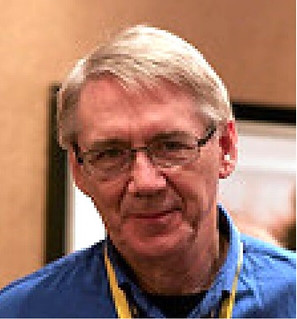
Website host John Nebel and webmaster Bruce Perdue
John Nebel
Numismatist, photographer, and ANS Board member and Fellow John Nebel of Boulder, CO helped the ANA and other clubs like NBS get online in the early days of the internet, hosting websites gratis through his Computer Systems Design Co. To this day he hosts some 50 ANA member club sites along with our
coinbooks.org site, making the club and our E-Sylum archive available to collectors and researchers worldwide.
Bruce Perdue
Encased coinage collector (encasedcoins.info) Bruce Perdue of Aurora, Illinois has been the volunteer NBS webmaster from its early days and works each week to add the latest E-Sylum issue to our archive and send out the email announcement.

|
|
The E-Sylum is an electronic publication of the Numismatic Bibliomania Society Copyright © 1998 - 2026 | |