Visit our NBS Sponsors









About UsThe Numismatic Bibliomania Society is a non-profit association devoted to the study and enjoyment of numismatic literature. For more information please see our web site at coinbooks.org SubscriptionsThose wishing to become new E-Sylum subscribers can go to the following web page
Subscribe
MembershipThere is a membership application available on the web site Membership Application To join, print the application and return it with your check to the address printed on the application. Print/Digital membership is $40 to addresses in the U.S., and $60 elsewhere. A digital-only membership is available for $25. For those without web access, write to: Jeff Dickerson, Treasurer AsylumFor Asylum mailing address changes and other membership questions, contact Jeff at this email address: treasurer@coinbooks.org SubmissionsTo submit items for publication in The E-Sylum, write to the Editor at this address: whomren@gmail.com BUY THE BOOK BEFORE THE COIN |
- WAYNE'S WORDS: THE E-SYLUM AUGUST 9, 2026
- REMINDER: NBS ACTIVITIES AT THE ANA CONVENTION
- 2026 ANA WFOM NUMISMATIC LITERATURE EXHIBITS
- EBOOK SALE: ILLEGAL TENDER
- NEW BOOK: NUMISMATIC TIMELINE OF THE PTOLEMAIC EMPIRE
- NEW BOOK: A CHRONICLE OF HUNDRED STORIES
- PERIODICAL: MCA ADVISORY SUMMER 2026
- JOHN LOUIS MARION (1933-2026)
- RICHARD FALKINER (1936-2026)
- WULFING COLLECTION AT WASHINGTON UNIVERSITY
- VIDEO: 2015 PCDA SHOW
- 2026 ANA WFOM COLLECTOR EXHIBITS
- NOTES FROM E-SYLUM READERS: AUGUST 9, 2026
- MINNESOTA INNOVATION DOLLAR FIRST RELEASE
- TREASURY SECRETARY PUSHING TO HONOR ROGER PENSKE
- VOCABULARY TERM: STORECARD
- ADRIAN PEREZ INTERVIEW, PART TWO
- THE OTHER BIBLIOMANIA OF DAN FREIDUS
- HALF DOME 20TH CENTURY GOLD COLLECTION
- NUMISMAGRAM MEDAL SELECTIONS: AUGUST 9, 2026
- ATLAS NUMISMATICS SELECTIONS: AUGUST 9, 2026
- HERITAGE AUGUST 2026 SHIPWRECK AUCTION
- ROBINSON'S 132ND MAIL AND INTERNET AUCTION
- LOOSE CHANGE: AUGUST 9, 2026
- ABOUT THIS ISSUE: AUGUST 9, 2026
Content presented in The E-Sylum is not necessarily researched or independently fact-checked, and views expressed do not necessarily represent those of the Numismatic Bibliomania Society.
WAYNE'S WORDS: THE E-SYLUM AUGUST 9, 2026
 New subscribers this week include:
Welcome aboard! We now have 6,409 subscribers.
New subscribers this week include:
Welcome aboard! We now have 6,409 subscribers.
Thank you for reading The E-Sylum. If you enjoy it, please send me the email addresses of friends you think may enjoy it as well and I'll send them a subscription. Contact me at whomren@gmail.com anytime regarding your subscription, or questions, comments or suggestions about our content.
This week we open with a reminder of NBS activities and numismatic literature exhibits at the upcoming ANA in Pittsburgh, two new books, a periodical issue, two obituaries, updates from the Newman Numismatic Portal, and more.
Other topics this week include the 1933 double eagle, coins of the Ptolemaic Empire, the Wulfing collection, Minnesota's new Innovation Dollar, storecards, and fixed price and auction lots previews, including a shipwreck sale.
To learn more about the history of the book, Charles T. Steigerwalt, Richard Falkiner, Dan Freidus, the radioactive origins of the ATM, the Libertas Americana medal, the Bunker and William Herbert Hunt collection, medals of the Hall of Fame for Great Americans, the Small Change Panic, the Rooswijk silver bar, and the only black-tie sale of coins ever held, read on. Have a great week, everyone!
Wayne Homren
Editor, The E-Sylum

Image of the week
REMINDER: NBS ACTIVITIES AT THE ANA CONVENTION
As a reminder, here's a repeat of Numismatic Bibliomania Society President Len Augsburger earlier preview of NBS events at the upcoming American Numismatic Association World's Fair of Money. We should have more details on the Charity Auction next week. -Editor
 The annual ANA convention beckons, with this year's installment taking place in Pittsburgh, August 25-29. As usual, the NBS will host a club table on the bourse floor, in addition to our symposium and general meetings.
The NBS Symposium will be held Thursday, August 27, at 1pm in room 324. Cassie Brand, Rare Books Curator at Washington University in St. Louis, will be our featured speaker, on the topic Book Matters: A Brief History of the Object. Cassie shares an overview:
"The book is a not passive carrier of text, but an active participant in shaping how text is read. This presentation will touch on the history of printing, typography, binding, and illustration, with a focus on how the look of the book changes in response to technological advances. Throughout history, text has been shaped by the technologies available to transmit it, making it impossible to separate the text from the object that carries it. In short, the book matters."

2026 ANA WFOM NUMISMATIC LITERATURE EXHIBITS
Decades ago the Numismatic Bibliomania Society raised funds to endow the Numismatic Literature exhibit category at the annual summer convention of the American Numismatic Association. There are three exhibits entered in the category this year. Be sure to stop and see them if you're at the show in Pittsburgh later this month. -Editor

Printed and manuscript (published or unpublished) literature
dealing with any numismatic subject.
A Library of the Works of David R. Sear
For over 60 years, collectors of ancient coins have looked to British Numismatist David R. Sear for education and guidance in building their collections. Sear's books on Roman, Greek, and Byzantine coins have made what was once a "hobby of kings" accessible to commoners. A key feature in his work is the way in which enriches the basic numismatic information he provides by placing each coin in its historical and cultural context.
This exhibit is intended as a tribute to Sear and his work, and displays a copy of each numismatic book he has written or co-aujthoried.
EBOOK SALE: ILLEGAL TENDER
Speaking of ANA exhibits, the U.S. Mint will be exhibiting its eleven illegal-to-own 1933 double eagles. Author David Tripp reports that for the month of August his publisher Simon and Schuster will be running a $2.99 special on the ebook version of Illegal Tender. Here's the Amazon description. -Editor
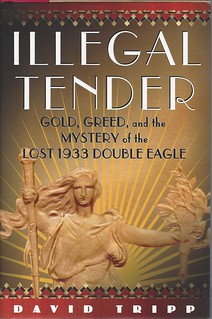 It is one of America's treasures -- the most valuable ounce of gold in the world, the celebrated, the fabled, the infamous 1933 double eagle. It shouldn't even exist but it does, and its astonishing, true adventures read like "a composite of The Lord of the Rings and The Maltese Falcon" (The New York Times). Illegal to own and coveted all the more, it has been sought with passion by men of wealth and with steely persistence by the United States government for more than a half century.
In 1905, at the height of the exuberant Gilded Age, President Theodore Roosevelt commissioned America's greatest sculptor, Augustus Saint- Gaudens -- as he battled in vain for his life -- to create what became America's most beautiful coin. In 1933 the hopes of America dimmed in the darkness of the Great Depression, and gold -- the nation's lifeblood -- hemorrhaged from the financial system. As the economy teetered on the brink of total collapse, Franklin Delano Roosevelt, in his first act as president, assumed wartime powers while the nation was at peace and in a "swift, staccato action" unprecedented in United States history recalled all gold and banned its private ownership.

NEW BOOK: NUMISMATIC TIMELINE OF THE PTOLEMAIC EMPIRE
Long-time NBS member Bill Daehn has authored his fourth book on ancient Greek numismatics. Congratulations! Here's the announcement. -Editor
 Historical and Numismatic Timeline of the Ptolemaic Empire
William E. Daehn
This book is intended to assist the collector of ancient Ptolemaic coins to more easily grasp the complex history of this Egyptian-based empire and to tie the coinage more closely to that history. A section is devoted to the reign of each king or queen. Each ruler's dates of birth, reign, and death are given at the top. Significant events of the reign are arranged chronologically, segregated into three broad categories: (1) politics and war, (2) religious, personal and cultural events, and (3) the coinage. The timelines are presented in an easy-to-use columnar table format.
Minneapolis, 2026; softcover, spiral bound, 46 pp., map.

NEW BOOK: A CHRONICLE OF HUNDRED STORIES
Author Mudassir Iqbal Shaikh passed along this information about his upcoming book. Thank you. -Editor
I am a professional numismatist from Lahore, Pakistan, and Joint Secretary of the Lahore International Numismatic Society. I have completed a forthcoming book titled A Chronicle of Hundred Stories: Forgotten Moments of the Numismatic World—100 key numismatic events, each presented in a tight 100-word narrative with high-resolution archival images.
Before publication, the project has already attracted formal interest and image permissions from several institutions:
- The British Museum (Dr. Thomas Hockenhull has requested a copy for the museum's library)
- Monnaie de Paris (granted high-resolution images and requested a library copy)
- NatWest Group Archives and Barclays Group Archives (granted archival images with formal citation references)
- The World Money Fair Berlin (reviewed and fact-checked their entry, granted logo use)
I will be exhibiting the manuscript at the Kuala Lumpur International Numismatic Fair (KLINF) in October 2026.
PERIODICAL: MCA ADVISORY SUMMER 2026
The Summer 2026 issue of The MCA Advisory has been published by the Medal Collectors of America. If you have even the slightest interest in the topic, you need to be a member. See the link below for more information. -Editor
TABLE OF CONTENTS
 President's Message
Editor's Message
Letters to the Editor
MCA and Hobby News
- From the Desk of Rob Penn, Auction Correspondent
- New MCA Facebook Group
- The MCA Advisory Places Second
- MCA Members Can Make Nominations for MCA Awards
- MCA Speakers Selected for 2026 Pittsburgh WFOM
- June 2026: MCA Members Promote International Numismatic Congress
In Memory of Gerry Muhl
A Tribute from Alex Shagin, Sculptor
JOHN LOUIS MARION (1933-2026)
Sotheby's fabled auctioneer John Marion (born November 27, 1933) passed away May 6, 2026. -Editor

Mr. Marion in 1984
John Marion, who was the public face of the global auction house Sotheby's for more than three decades and was long considered the country's greatest art auctioneer — the man with the golden gavel, who oversaw multiple record-breaking sales — died on May 6 in the La Jolla neighborhood of San Diego. He was 92.
Mr. Marion presided over the era in the late 20th century when the auction of fine art grew from a rarefied pursuit to a glamorous, if frenzied, spectator sport — and when art itself evolved from an object of passion or an emblem of upward social mobility to a veritable asset class.
He sold not just fine art, like Vincent van Gogh's "Irises," but other objects of desire, including Andy Warhol's collection of cookie jars and a diamond that Richard Burton later gave to Elizabeth Taylor. (At nearly 70 carats, it sold in 1969 for a million dollars, a record at the time.)
Mr. Marion was suave but not snooty, an elegant 6-foot-2 figure who favored Savile Row suits and aviator glasses. At the podium, he had a brisk, jocular manner, and a preternatural ability to "pull bids" — to use the term of art for keeping buyers in the game.
Tobias Meyer, the private art dealer and former head of contemporary art at Sotheby's, who succeeded Mr. Marion as chief auctioneer, said in an interview: "He was the god of auctioneers in America. He was beloved. He could make people bid by sheer force of his personality."
RICHARD FALKINER (1936-2026)
On July 22nd, dealer Charles Riley made this post on Facebook. -Editor
 "I have just heard that Richard Falkiner died yesterday. Perhaps not widely known these days among the younger generation of numismatists, he is certainly well-known among British numismatists of my generation and above. He began his career in 1956 at Glendining & Co, central London auctioneers, before moving to Christie's in 1958 to set up their own coin department. From 1972 he was an independent dealer and numismatic writer, becoming a weekly columnist for the Antiques Trade Gazette (until 2014).
In 1992 he wrote a history of Glendining's (unfortunately never published although I have one of three extant bound photocopies). An ardent "European" in the political sense, in 1991 he struck a series of unofficial ECU (European Currency Unit) coins in his name. The ECU was a trial forerunner of the Euro.
 The photograph of Richard was taken after a jolly lunch in 2008 hosted by Peter Mitchell, formerly of Baldwin's. He often attended the London Coin Fair, including just last month, making the lengthy journey from his home near Evesham - a determined effort indeed."
To read the complete post, see:
https://www.facebook.com/100057411251350/posts/
richard-falkiner-1936-2026-i-have-just-heard-that-richard-falkiner-died
-yesterda/1584367710153589/


WULFING COLLECTION AT WASHINGTON UNIVERSITY
Newman Numismatic Portal Project Coordinator Len Augsburger provided the following updates. -Editor
The John Max Wulfing Collection at Washington University
 We have several announcements this week related to the Wulfing Collection at Washington University in St. Louis. First, the exhibit "John Max Wulfing's Passport to the Past" is now open in the Newman Tower within Olin Library on the WashU campus. Curated by Jeremy Haag, the six cases trace Wulfing's life through the lenses of collecting and travel. Various themes naturally incorporate selections from the Wulfing Collection. Haag will speak on the exhibit on August 20, at 6:30pm in Room 142 of Olin Library. All are welcome to attend. This presentation is in conjunction with the regular monthly meeting of the St. Louis Ancient Coin Study Group.
Next, Elena Baldi, Associate Professional Specialist at the Princeton University Library, has recently published the article "A Hoard of Hyperpera of Manuel I from the John Max Wulfing Collection, Washington University in St. Louis," this, as part of the Alan Stahl festschrift published by the American Numismatic Society as Numismatic Studies 50. The article analyzes a hoard of 75 gold coins acquired by Wulfing in Athens in 1925. This group is perhaps the most visually arresting group of coins in the Wulfing cabinet, and Elena's research is most welcome. She previously served as a curatorial postdoc working with the Wulfing collection at Washington University.

VIDEO: 2015 PCDA SHOW
The David Lisot Video Library on the Newman Numismatic Portal can be found at:
https://nnp.wustl.edu/library/multimediadetail/522852
We highlight one of his videos each week in The E-Sylum. Here's one from the 2015 Professional Currency Dealers Association (PCDA) show, held at the Crowne Plaza Chicago O'Hare in Rosemont. IL. -Editor


2026 ANA WFOM COLLECTOR EXHIBITS
Paul Hybert provided details of the Collector Exhibit Area at the upcoming ANA convention in Pittsburgh. Thanks - this is one of my favorite parts of any coin show. -Editor
Recent E-Sylum issues have covered many aspects of the upcoming World's Fair of Money -- here are details on a traditional and popular feature, the Collector Exhibit Area.
An online guide to the Collector Exhibit Area at the August 25-29
World's Fair of Money will be updated during the show, to list only the
present exhibits. It is available at:
http://www.chicagocoinclub.org/events/2026/ana/ex/all_by_cl.html
(This groups the exhibits by Exhibit Class.)
The Collector Exhibits are no longer listed in the Show Guide. The ANA
website has an ungrouped listing of exhibits at:
https://www.money.org/wfm-exhibits/
(This lists all exhibits for which an application was received.)
NOTES FROM E-SYLUM READERS: AUGUST 9, 2026
That Marble Plate on the Cash Register
Ray Williams writes:
 "The cash register picture in last week's E-Sylum brought back memories. I started working at Perdue Radio Co. in New Jersey in May of 1967. There was a modern cash register and an antique as you had pictured. They were both used for different purposes. I remember Charles Perdue (founder and born in the 1880's) telling me during an idle moment, that all the old cash registers had that marble plate above the cash drawer. He said any suspect coins would be dropped on it and if they didn't sound right, they were rejected. I thought I'd share the memory."
Thanks! I don't think I've heard that technique described in relationship to a cash register before, but it's very plausible. -Editor
To read the earlier E-Sylum article, see:
ABOUT THIS ISSUE: AUGUST 2, 2026 : Dog Money
(https://www.coinbooks.org/v29/esylum_v29n31a25.html)
Other topics this week include the Cosgrove Airways token, the 1862 Small Change Panic, and Japan's National Printing Bureau. -Editor

MINNESOTA INNOVATION DOLLAR FIRST RELEASE
Pete Smith wrote an article on the Minnesota Innovation Dollar First Release Ceremony for the August 2026 issue of the Northwest Angle, the newsletter of the Northwest Coin Club. We're republishing it here with permission. Thanks. everyone! -Editor
By Pete Smith
On Tuesday, July 28, the Northwest Coin Club hosted a First Release ceremony for the Minnesota Innovation Dollar. Held at the Minnesota History Center in St. Paul, 116 enthusiastic attendees swapped $1 for one of the new dollar coins especially encased for the event. An additional seven pieces were presented to the event's speakers, staff from the History Center, and TV reporters.


TREASURY SECRETARY PUSHING TO HONOR ROGER PENSKE
Treasury Secretary Scott Bessent is pushing to honor Roger Penske and IndyCar with a national medal. -Garrett
 Most U.S. coins and medals are authorized by specific coinage acts written and passed by
Congress. In recent years the Treasury Department has used its own authority to create certain
national medals for the American public to collect and enjoy. Like other coins and medals, these
are official products of the United States, designed and produced by the nation's Mint. But they
don't require individual acts of Congress, because the U.S. Code (31 U.S.C. § 5111(a)(2)) gives
the Secretary of the Treasury freedom and flexibility to dream them up and create them.
Most U.S. coins and medals are authorized by specific coinage acts written and passed by
Congress. In recent years the Treasury Department has used its own authority to create certain
national medals for the American public to collect and enjoy. Like other coins and medals, these
are official products of the United States, designed and produced by the nation's Mint. But they
don't require individual acts of Congress, because the U.S. Code (31 U.S.C. § 5111(a)(2)) gives
the Secretary of the Treasury freedom and flexibility to dream them up and create them.
One example is the American Liberty silver medal series, launched in 2016 (along with related gold coins) to celebrate modern interpretations of the idea of American liberty. This has grown into a remarkably innovative program, showcasing creative artists and using new technology to manufacture its coins and medals in impressive high relief.
VOCABULARY TERM: STORECARD
Here's another entry from Dick Johnson's Encyclopedia of Coin and Medal Terminology. -Editor
Storecard. An advertising piece; a token or medal issued by a store in which its address and sometimes its services or merchandise is listed on the piece; a numismatic card. Storecards were a product of the 19th century in America. They became popular following the issuance of hard time tokens (1832-45). Merchants issued these to promote their store. When America reduced the size of the cent, in 1859, storecards imitated the size (and composition) of this coin. Storecards were also similar to Civil War cents, issued because of the shortage of cents in certain areas of the United States and actually circulated for small change for a time.
ADRIAN PEREZ INTERVIEW, PART TWO
Greg Bennick's latest interview for the Newman Numismatic Portal is with Adrian Perez, Vice President of the Young Numismatists of America. Here's the second part, where Perez talks about his research and favorite coins from the Rhode Island School of Design collection. -Garrett
Vice President of the Young Numismatists of America
An interview for The E-Sylum by Greg Bennick
 Greg Bennick
This is fantastic. Would it be possible for you to share your screen and show us some of your research — and tell us about maybe your favorite coins from the group, or ones that differentiated themselves from the others?
Adrian Perez
Absolutely, let me do that right now. Are you picking up everything?
Greg Bennick
Yeah, I'm seeing it right here.
Adrian Perez
Awesome. Okay — we'll start at the top, and I'll run through how everything works. First, these are the images that were already on the website — if you'd searched "coin" two years ago and scrolled down, these are the same images you'd have seen. We haven't gotten to rephotographing yet, but I hope to do that eventually. This column here is the object number. "60" is the year of acquisition — 1960; "48" is part of the accession number — I believe this was the 48th accession they had that year; and then the object number, of course, is first, second, third in that batch.
THE OTHER BIBLIOMANIA OF DAN FREIDUS
Dan Freidus is a longtime numismatic bibliophile and member of the Numismatic Bibliomania Society. Len Augsbeuger passed along this recent profile of him featuring another one of his book pursuits - Jewish Community Cookbooks. -Editor
 When Dan Freidus walks into Bookstock, Metro Detroit's beloved used book and media sale, he is not just browsing for something interesting to read. He is hunting for history, often tucked between stained pages, spiral bindings and recipes for kugel, brisket or "Aunt Rose's mandelbread."
For Dan, a longtime collector with deep roots in the world of books, Jewish community cookbooks are more than kitchen guides. They are records of Jewish life: where people lived, what they ate, how they adapted, what organizations they built and how communities preserved memory through food.
As a child, Dan's father collected books, opening a door to a world Dan might otherwise never have encountered. "I met librarians and book dealers through him that I never would have met," he explained, "so I got a peek into that world when I was pretty young."
That early exposure eventually grew into a wide-ranging passion for books and ephemera, and, over time, cookbooks. Today, one of his most meaningful projects is finding and donating Jewish community cookbooks to the New York Public Library, which holds the most extensive Jewish cookbook collection in the U.S.

HALF DOME 20TH CENTURY GOLD COLLECTION
Legend Numismatics reveals The Half Dome Collection, a Wall Street Executive's Greatest Ever 20th Century Gold Collection. The Indian $10, $5, and $2.50s are now listed by CAC as the top-rated sets of their kind, and $20 Saints are a whisper away. Here is the press release. -Garrett
A Wall Street executive has assembled "the finest ever collection of United States 20th-century gold Indian Head Eagles, Half Eagles and Quarter Eagles, and is on the verge of also having the finest set of Saint-Gaudens Double Eagles," according to Legend Numismatics (www.LegendNumismatics.com). The collection now includes the exceptional, finest certified 1911-D Eagle, graded PCGS MS66 CAC, that was acquired for a record-setting $1.8 million in a Stack's Bowers Galleries auction this past January.
 yy15
yy15

THE BOOK BAZARRE
NUMISMAGRAM MEDAL SELECTIONS: AUGUST 9, 2026
Numismagram's Jeremy Bostwick sent along these four medals from his most recent upload of new material to his site. For all of the new items, please visit https://www.numismagram.com/inventory. -Garrett

103650 | GREAT BRITAIN. Victoria white metal Medal. Issued 1862 for the International Exhibition held in London (52mm, 3h). By George Dowler.
H. M. G. MAJESTY VICTORIA, crowned and mantled "gothic" style bust left // THE BUILDING FOR THE INTERNATIONAL EXHIBITION / (SOUTH FRONT VIEW) / OPENED MAY 1ST / 1862, perspective view of the exhibition hall; in seven lines in exergue, COVERS A SPACE OF 26 ACRES. LENGTH 1200 Ft / WIDTH 700 Ft, HEIGHT 100 Ft, NAVE 85 Ft WIDE. / THE BUILDING IS OF BRICK. THE DOMES / ARE OF IRON & GLASS, HEIGHT 250 Ft / AND 160 Ft DIAM: AT BASE. / (THE LARGEST DOMES EVER ERECTED) / COST £300,000.
BHM 2724 (R); Eimer –; Allen SK-B075 (RR); Taylor 182d. PCGS SP-62. Extremely lustrous and prooflike, with some scattered marks typical of the metal type, but nevertheless highly enchanting, all while featuring a bust type made popular by the 1847 "gothic" crown and subsequent related florins.
The Great London Exposition was held in the South Kensington area of London from 1 May–1 November 1862, and featured exhibitors from 36 countries covering areas of industry, technology, and the arts. Queen Victoria, still in mourning for the loss of her husband the previous December, was not in attendance for the opening of the event which would see over six million attendants throughout its six months. Works of note on display were a refrigerator capable of producing ice, the Bessemer process for the manufacture of steel, and Charles Babbage's analytical engine–an early form of a computer.
ATLAS NUMISMATICS SELECTIONS: AUGUST 9, 2026
Atlas Numismatics has updated their website with 390 new coins, medals, and tokens at fixed prices. Select items are discussed below. -Garrett

1085816 | AUSTRIA. Franz Joseph I. MDCCCLIV (1854)-A AR Gulden. PCGS MS65. Vienna. 12.9mm. 12.96gm. FRANCISC·IOS·I·D·G·AVSTRIAE IMP·ET ELISABETHA MAX·IN·BAVAR·DVCIS FIL·. Conjoined heads right Wedding vows. KM X-M1; Jaeger 299.
Struck to commemorate the wedding of Emperor Franz Joseph.
Please use this link to verify the PCGS certification number 54718588
HERITAGE AUGUST 2026 SHIPWRECK AUCTION
Heritage Auctions will be hosting their Shipwreck & Treasures Showcase Auction on August 9. Select items are discussed below. -Garrett

Charles & Johanna "Golden Fleece Shipwreck" silver Splash ingot of 567gm ND (c. 1550), 190x141x2mm. 566.99gm. XRF scan: 99%. A gorgeous Splash ingot, shimmering and possessing an interesting shape.
The crude splash ingots were made by pouring the molten silver directly to a depression made in sand. Often, on one side, these bars show protrusions due to the silver cooling down by the end of the pour.
According to consignor, salvaged from the Golden Fleece
shipwreck
The Golden Fleece shipwreck is a vessel in the northern
Caribbean nicknamed for a royal stamping, known as Golden Fleece,
that was found on several of the gold 'finger' ingots and coins. A
few dozen of these gold and silver ingots were salvaged with
varying purities, reminiscent of the famous "tumbaga" bars.
Significantly, it is believed that the Golden Fleece ingots are the
only known examples made in the colonies between the "tumbaga" era
of the 1520s and the ones found on the 1554 Padre Island Fleet.
Almost all the recovered coins are Mexican Carlos-Juana silver
pieces (all assayers prior to S) apart from some extremely rare
Santo Domingo pieces. Notably, three examples of the very first 8
Reales ever struck in the New World were found - the Rincón "Early
Series" 8 Reales of 1538.
ROBINSON'S 132ND MAIL AND INTERNET AUCTION
Dealer Frank S. Robinson's 132nd mail and internet auction of Ancient and Early Coins will include 635 lots, low starting bids, and no buyer fee. Live Bidding will take place beginning at 11 AM Eastern Time September 6 on the biddr.com website. -Garrett
Greek coins include two nice Armenian Tigranes II Tetradrachm; a classic Athenian "Owl" tetradrachm in choice quality; a Nice EF Baktrian Tetradrachm of Menander; a Choice EF/AEF Tetradrachm of Pergamene King Eumenes I; and an excellent run of Parthian coins.
Notable among Roman coins are a nice F+ Aes Grave Quadrans; an AEF Sestertius of Caligula; one of Domitian in VF+; a nice F-VF gold Aureus of Hadrian; an EF Maximus Denarius; and a Choice EF Antoninianus of Macrianus.
LOOSE CHANGE: AUGUST 9, 2026
Here are some additional items in the media this week that may be of interest. -Editor
Don Cleveland passed along this article about a new commemorative coin from the Royal Australian Mint. Thank you. -Editor

A new 50-cent coin has been released into circulation, marking two defining moments in First Nations land rights.
The coin depicts the 1966 Wave Hill walk-off, where Gurindji man Vincent Lingiari led about 200 Aboriginal stockmen, workers and families in strike action.
What began as a protest over poor wages and conditions at Wave Hill station in the Northern Territory became a lightning rod for the national land rights movement.
Nine years later, then-prime minister Gough Whitlam ceremonially returned a small portion of Gurindji land and poured a handful of soil into Lingiari's hand.
The photo — taken by Mervyn Bishop, a renowned First Nations photojournalist — became a defining image in Australian history.
The following year, the landmark Aboriginal Land Rights (Northern Territory) Act 1976 was passed, the first Australian law that allowed traditional owners to make a title claim.
To read the complete article, see:
Royal Australian Mint releases new coin commemorating First Nations land rights
(https://www.abc.net.au/news/2026-08-06/new-coin-commemorating-indigenous-land-rights/107001896)
Other topics this week include using a Paralympic medal as a guitar pick, an Island of Saint John Colonial Note, and Whatnot. -Editor
ABOUT THIS ISSUE: AUGUST 9, 2026
My non-E-Sylum numismatic activity this week consisted of buying some obsolete scrip notes found on eBay and a reference group of contemporary counterfeit U.S. coins. More in my next Numismatic Diary.
While not numismatic, one recent chore involving gold was when I went to a local jewelry store and had them cut off my wedding band. I hadn't been able to get it off for the last ten or fifteen years. Smarter people than me (like my wife) get their rings resized once in a while. I just thought, "Oh, I'll lose weight and it'll come off again." Right - a doctor told me the problem was arthritis and recommended the jeweler. So there I was, letting someone use a glorified can opener to slice the thing open and get it off my poor finger. I was told to wait a month to let the finger recover - it still has an impression from the wedding band. So after the ANA convention I'll get the ring restored and resized. I'll be walking around the show barehanded, but sorry ladies - I'm still taken.
Finally, here are some interesting non-numismatic articles I came across this week. With the Pittsburgh ANA coming up, the first one is somewhat timely - it features a house half a block from my old home there. King Avenue was a hotbed of numismatic literature in those days, with two large numismatic libraries within a couple blocks - my own, and that of my good friend E. Tomlinson "Tom" Fort, former editor of The Asylum. With our different interests (U.S. for me, medieval coinage for Tom), there was little overlap.
This Highland Park Home Has Its Own Block (https://www.pittsburghmagazine.com/hot-property-5454-wellesley-ave-highland-park/)
The Man Who Brings [Ventriloquist] Dummies to Life (https://www.nytimes.com/2026/08/08/arts/ventriloquist-dummies-austin-phillips.html)
The little robot that could … fix America's sidewalks? (https://san.com/cc/the-little-robot-that-could-fix-americas-sidewalks/)
People used to believe left-handedness could be cured. (https://historyfacts.com/world-history/fact/left-handedness-cured/)
Edgy Vanity Plates Test Limits of Free Speech (https://www.nytimes.com/2026/08/06/us/politics/the-docket-vanity-plates-speech.html)
Paul Simon's joyful ‘Graceland' is turning 40. Does it deserve an asterisk? (https://www.washingtonpost.com/opinions/2026/08/05/graceland-40-paul-simons-masterwork-is-better-controversy/)
Tacky, Rude and Beloved: Is an I-95 Landmark [South of the Border] Worth Saving? (https://www.nytimes.com/2026/08/08/us/south-of-the-border-carolina.html)
The wizard behind the names of billion-dollar companies (https://thehustle.co/originals/the-wizard-behind-the-names-of-billion-dollar-companies)
Abraham Lincoln imposes first federal income tax (https://www.history.com/this-day-in-history/august-5/lincoln-imposes-first-federal-income-tax)
How One Man's Cure for Loneliness Started a Movement (https://www.wsj.com/us-news/how-one-mans-cure-for-loneliness-started-a-movement-b4d386dd)
-Editor


Editor Wayne Homren, Assistant Editor Garrett Ziss

|
|
| |