Visit our NBS Sponsors









About UsThe Numismatic Bibliomania Society is a non-profit association devoted to the study and enjoyment of numismatic literature. For more information please see our web site at coinbooks.org SubscriptionsThose wishing to become new E-Sylum subscribers can go to the following web page
Subscribe
MembershipThere is a membership application available on the web site Membership Application To join, print the application and return it with your check to the address printed on the application. Print/Digital membership is $40 to addresses in the U.S., and $60 elsewhere. A digital-only membership is available for $25. For those without web access, write to: Jeff Dickerson, Treasurer AsylumFor Asylum mailing address changes and other membership questions, contact Jeff at this email address: treasurer@coinbooks.org SubmissionsTo submit items for publication in The E-Sylum, write to the Editor at this address: whomren@gmail.com BUY THE BOOK BEFORE THE COIN |
- WAYNE'S WORDS: THE E-SYLUM OCTOBER 18, 2026
- WORKMAN'S BOOKS SALE 9 SELECTIONS
- THE W.J. NOBLE NUMISMATIC LIBRARY OFFERED
- NEW BOOK: COINAGE OF BRUNSWICK-CALENBERG-HANNOVER
- NEW BOOK: BANKNOTES OF THE LEVANT
- NEW BOOK: ARKANSAS WAR BONDS
- PERIODICAL: NUMISMATIQUE ASIATIQUE NO. 59
- 2026 ANA WFOM NUMISMATIC LITERATURE EXHIBITS
- NNP ADDS BAD METAL NEWS
- VIDEO: PAPER CURRENCY DOCTORING
- GEORGE HUBBARD CLAPP LECTURE
- NOTES FROM E-SYLUM READERS: OCTOBER 18, 2026
- ANA HONORS EXCELLENCE IN NUMISMATIC ART AND WRITING
- ANS BREAKS GROUND ON TOLEDO HEADQUARTERS
- VOCABULARY TERM: SUNKEN DIE
- HEAD OF COPPER, FEET OF CLAY
- HERITAGE: BUST COINAGE SHOWCASE
- STACK'S BOWERS: WORLD PAPER MONEY AUCTION
- HOLABIRD JACK HADDOCK COLLECTION SELECTIONS
- HOLABIRD JACK HADDOCK NEVADA TOKENS, PART 2
- KUENKER AUCTION SALE 447
- MATTHEW SCHAFER'S 2026 PITTSBURGH ANA DIARY
- WAYNE'S NUMISMATIC DIARY: SAWHILL COLLECTION
- WAYNE'S NUMISMATIC DIARY: CIVIL WAR MONEY
- TRUMP DOLLAR ERROR
- GETTYSBURG ADDRESS QUARTER LAUNCH CEREMONY
- THE 1897 CUBAN SOUVENIR PESO
- LOOSE CHANGE: OCTOBER 18, 2026
- ABOUT THIS ISSUE: OCTOBER 18, 2026
Content presented in The E-Sylum is not necessarily researched or independently fact-checked, and views expressed do not necessarily represent those of the Numismatic Bibliomania Society.
WAYNE'S WORDS: THE E-SYLUM OCTOBER 18, 2026
 New subscribers this week include:
Russ West, courtesy Al Raddi; and
Agostino Ricucci.
Welcome aboard! We now have 6,323 subscribers.
Thank you for reading The E-Sylum. If you enjoy it, please send me the email addresses of friends you think may enjoy it as well and I'll send them a subscription. Contact me at whomren@gmail.com anytime regarding your subscription, or questions, comments or suggestions about our content.
We have another new sponsor this week - Boardwalk Numismatics. Thank you for your support! When you're out at coin shows or shopping online and encounter one of our advertisers, please thank them for supporting our weekly effort - we wouldn't be able to deliver our publication at this scale and frequency without their assistance.
This week we open with more selections from the Workman's Books sale, the W. J. Noble library, three new books and a periodical, updates from the Newman Numismatic Portal, and more.
Other topics this week include Arkansas War Bonds, banknotes of the Levant, George Clapp, notes from readers, updates from the ANA and ANS, sunken dies, Nevada tokens, auction previews, Gettysburg quarters, Trump dollars, and Cuban souvenir pesos.
To learn more about coin collection of Pablo Gerber Moser, coinage of the House of Brunswick-Calenberg-Hannover, the Buddhist amulets of Cambodia, award-winning numismatic literature exhibits, paper currency doctoring, highly oxidized manganese ingots, mystery "ANA" pins, Dr. William H. Sheldon, Walter Breen, Francis Worcester Doughty, Fred's Bar, the Sawhill and John Quincy Adams collections, and the Other Washington Gold Medal, read on. Have a great week, everyone!
Wayne Homren
Editor, The E-Sylum

Image of the week
WORKMAN'S BOOKS SALE 9 SELECTIONS
Here are more selections from Alan Workman's numismatic literature sale closing November 1, 2026. -Editor

Workman's Books would like to remind collectors that our ninth bid sale closes in approximately two weeks, beginning at 10:00 AM Eastern Time on Sunday, November 1, 2026. This single-session sale features 850 lots of rare, vintage, and out-of-print books, auction catalogs, magazines and journals, postcards, VHS tapes, DVDs, and related material covering Spanish and Spanish American, Mexican, United States, Canadian, British, Ancient, and World numismatics; banks and banking history; diving and undersea exploration; buried and sunken treasure; metal detecting; underwater archaeology; and privateers, buccaneers, and piracy.
Among the offerings are numerous scarce and desirable works, including signed or inscribed examples associated with David Q. Bowers, Capt. Michael Hatcher, Robert Marx, Roland Morris, Russell Rulau, Edward Rowe Snow, and David Stick.


Lots 78 and 159
Lot 78: Brau, E. Ramirez. COFRESI - HISTORIA Y GENEALOGIA DE UN PIRATA 1791-1825. Impreso en Casa Baldrich, San Juan. 1945. 8vo. (8), 126, (2) pages. original printed card covers. First Edition. Many unopened pages. B&w photos. Spanish text. Ex Charles B. Driscoll Library; Ex Dick Holt Library. general wear, spine worn, head and tail chipped, Good to Very Good. This book is a foundational historical and biographical study that investigates the real-life origins of Roberto Cofresi, Puerto Rico's most famous and heavily romanticized pirate. Written by his descendant, journalist and genealogist Enrique Ramirez Brau, the book meticulously separates Caribbean folklore from factual reality. It relies heavily on family records, local sacramental archives, and official documents to outline the pirate's authentic family lineage, childhood, early maritime career, and the eventual anti-piracy campaigns that led to his capture and execution. Lot weight: 0 lbs 8oz.
Lot 159: Crile, Jane & Barney Crile. TREASURE-DIVING HOLIDAYS - AN AMERICAN FAMILY'S ADVENTURES ON THE FLOORS OF THREE SEAS. Viking Press, New York. 1954. 12mo. xvi, 263, (5) pages. original blue cloth over sea green boards, gilt, protected jacket. Inscribed by the authors. First Edition. Map. B&w photos. English text. Ex Handley Library. cover edges worn, missing last free endpage, Very Good. This book is a mid-century travel memoir detailing the true adventures of Cleveland surgeon Dr. Barney Crile, his wife Jane, and their four children as they explore the burgeoning world of amateur skin and scuba diving. Written with a lighthearted family focus, the book chronicles their underwater excursions through the Mediterranean, the Caribbean, and the Red Sea as they search for lost shipwrecks, interact with marine life, and pioneer early recreational diving techniques. Lot weight: 1 lbs 4oz. Subject(s): Sunken Treasure.


Lots 248 and 280
Lot 248: Gerber Moser, Pablo. MONEDAS MEXICANAS - COLECCION PRIVADA PABLO GERBER MOSER. Pablo Gerber Moser, Mexico City. 1987. 4to. vi, 154 pages. original green cloth, gilt, jacket. First Edition. B&w coin photos throughout. Spanish text. Fine. This book is a detailed, highly regarded numismatic reference catalog documenting the legendary private coin collection of Pablo Gerber Moser. It features comprehensive photographic plates and descriptions structurally organized by major chronological groups of Mexican currency. The catalog covers everything from Early Colonial issues (such as Carlos and Juana, Pillar, and Macuquina coinage) and the Mexican War of Independence up through the First and Second Empires, the Revolution, and 20th-century proofs. Lot weight: 1 lbs 15oz.
Lot 280: Heiss, Aloiss. MONEDAS HISPANO-CRISTIANAS. TOMOS I, II & III. Juan R. Cayon, Madrid. 1975. 4to. Matching green leatherette, gilt. some cracking along the front cover edges of the spine of each volume (as is typical of this publication), else Fine. This lot includes the following volumes:
(1) Heiss, Aloiss. Monedas Hispano-Cristianas. Tomo Primero. Juan R. Cayon, Madrid. 1975. vii, (6), 433, (2) Pages. 4to. Green leatherette, gilt. Facsimilie reprint of the 1865 edition. Madrid. Tables. Documents. Nos.1-70, A-E b&w line-drawn coin plates.
(2) Heiss, Aloiss. Monedas Hispano-Cristianas. Tomo Segundo. Aragon. Juan R. Cayon, Madrid. 1975. (8), 502, (2) Pages. 4to. Green leatherette, gilt. Facsimilie reprint of the 1867 edition. Madrid. Tables. Nos. 71-143 b&w line-drawn coin plates.
(3) Heiss, Aloiss. Monedas Hispano-Cristianas. Tomo Tercero. Navarra. Juan R. Cayon, Madrid. 1975. 298, (2) Pages. 4to. Green leatherette, gilt. Facsimilie reprint of the 1869 edition. Madrid. Tables. Nos. 144-203 b&w line-drawn coin plates.
The old standard reference on post-Islamic Spain. The coin descriptions include full legends, and there are wonderful line drawings of the coins. A great reference that has not been replaced by more modern references like Cayon and Castan. Lot weight: 13 lbs 4oz.


Lots 404 and 423
Lot 404: Marx, Robert F. ALWAYS ANOTHER ADVENTURE. Tower Publications, Inc., New York. 1967. 16mo. 172, (4) pages. original pictorial card covers. Inscribed by the author. First Paperback Edition. English text. priced, scuffed cover, some minor internal stains, Very Good. This book is an autobiographical chronicle of the early career of Robert F. Marx, a legendary American deep-sea diver, explorer, and pioneer of marine archaeology. The narrative follows his high-stakes underwater expeditions navigating the globe to discover sunken Spanish galleons, uncharted Mayan ruins, and long-lost historical shipwrecks. Marx details the gritty reality of early scuba exploration, charting the incredible dangers of the deep sea alongside the thrill of uncovering priceless artifacts and lost segments of maritime history. Lot weight: 0 lbs 4oz.
Lot 423: Mel Fisher Maritime Heritage Society. REPORTS OF GOLD - THE FIRST ANNUAL REPORT OF THE MEL FISHER MARITIME HERITAGE SOCIETY. Mel Fisher Maritime Heritage Society, Key West. 1986. Large 4to. 22, viii pages. original card covers, pictoral device. First Edition. Tables. Graphs. Color photos. English text. Fine. This book documents the inaugural operations, archeological curation, and preservation efforts of the Mel Fisher Maritime Heritage Society. Published right after the monumental 1985 recovery of the Nuestra Senora de Atocha Spanish galleon, the text details the massive haul of gold bars, silver bullion, weapons, and rare artifacts brought up from the ocean floor. Presented on textured premium stock by Neenah Paper, the publication serves as both a formal financial retrospective and a beautifully illustrated historical log of the team's early deep-sea salvage triumphs. Lot weight: 0 lbs 7oz.


Lots 736 and 738
Lot 736: Christie's - East. THE DRISCOLL PIRACY COLLECTION SOLD TO BENEFIT THE WICHITA PUBLIC LIBRARY. December 12, 2000. 4to. 1-206 Lots. Original pictorial card covers. Public Auction Sale. Sale No. 8475. New York. 73 Pages. color photos throughout. PRL. English text. Fine. This auction sale catalog includes pirate and treasure related literature, documents, broadsides, and maps that are from the collection of author Charles E. Driscoll. In 1951, a respectable newspaperman from Wichita passed away and sold his collection of books to the Wichita Public Library for the sum of $10,000. His name was Charles B. Driscoll, and he was a popular Midwestern columnist, who later corresponded from New York, in the expansively syndicated column 'New York By Day'. Driscoll's contribution to the library in Wichita was one of the more impressive libraries on the subject of pirates ever amassed. This sale includes 206 rare printed books, manuscripts, prints and drawings from this collection, one of the largest ever put together. Lot weight: 0 lbs 11oz.
Lot 738: Christie's - London. SPANISH ART I: TREASURE FROM THE 'MARAVILLAS' AND OTHER WORKS OF ART. May 28, 1992. 4to. 1-260 Lots. original pictorial card covers. Public Auction Sale. Auction Number 4765. London. color and b&w plates throughout. PRL. English text. light pen notations along top of cover, Very Good. This auction catalog contains 86 lots of silver cobs, 30 lots of gold cobs, 12 lots of silver ingots, 15 lots of gold ingots, a bronze signal cannon, a few silver artifacts, and 2 lots of jewelry from the "Maravillas", which sank in 1656 on Little Bahamas Bank. The catalog also includes 4 pages describing Spanish ships and the "Maravillas" salvage. Lot weight: 1 lbs 0oz.


Lots 739 and 796
Lot 739: Christie's - London. COINS, BANKNOTES, COMMEMORATIVE MEDALS AND TREASURE FROM SPANISH SHIPWRECKS. April 28, 1993. 4to. 1-704 Lots. Original pictorial card covers. Public Auction Sale. Auction No. 4960. London. 90 Pages. 8 color plates, 16 b&w plates, and b&w photos. English text. small corner section of pages 21-22 was removed, else Fine. This auction sale catalog includes numismatic material from Ancient Greece, Rome, and the Byzantine Empire, Latin America, Europe, and other foreign countries with the main focus on coins, ingots, and artifacts recovered from the wrecks 'Maravillas', 'San Fernando', and the 1733 Fleet. The sale includes 43 lots of Tumbaga bars, 34 lots of gold and silver cobs from the 'Maravillas' (sank 1656), 3 lots of gold bars from the 'Maravillas', and 13 lots of rosaries and gold jewelry from the 'San Fernando' (1733 Fleet). Lot weight: 0 lbs 13oz.
Lot 796: Seaby, B.A., Ltd. SEABYS COIN AND MEDAL BULLETIN. BOUND VOLUMES 1947 THROUGH 1983. Seaby, B.A., Ltd. 1947-1983. 12mo. Thirty-Six Volumes, 1947-1983. Missing years: 1965, 1970, 1973, 1974, 1976, 1977, 1980, 1981. Duplicate years: 1950, 1952, 1953, 1954, 1955. 8vo, red cloth, gilt (34 vols), brown printed boards (2 vols). Ex Money Tree 22nd Sale, lots 122, 123 & 124. Fine copies. A solid run of this useful publication with short but significant articles and commentary on ancient, medieval and modern (mostly British) coins, tokens and medals, as well as Seaby's illustrated Listings of coins for sale at fixed prices. Lot weight: 50lb 8oz.
This bid sale is being held through the online venue iCollector, and all registrations, approvals, and bids will be handled there. For this bid sale the lots will be closing on a timed interval with extensions of 1 minute for any bids placed within 1 minute of closing. If you already have an iCollector account, you still must "GET APPROVED" to bid for each sale by entering and confirming your information for this bid sale, like reviewing your shipping information and choosing your preferred way of payment. Remember, tie bids go to the earliest bidders, so don't wait for the lots to close to bid on anything for which you have a strict number in mind.
Now is the perfect time to register for the bid sale, as any registration issues can certainly be accommodated more easily in advance. Do not wait to register the last day. Registration and bidding online are always FREE (no extra fees or percentages for bidding online). Once you are registered and automatically approved, first be sure to bookmark the items that interest you.
To read the complete catalog, see:
Sale 9
A Collection of Numismatic
and Treasure Books, Auction
Catalogs and Magazines
(https://workmansbooks.com/downloads/
WB%20Auction%20009%20catalog.pdf)
For more information, see:
https://workmansbooks.square.site/

THE W.J. NOBLE NUMISMATIC LIBRARY OFFERED
Here's a great opportunity for numismatic bibliophiles and dealers - the entire W.J. Noble Numismatic Library is being offered intact from Australia. Here's the press release. -Editor
INTERNATIONAL EXPRESSIONS OF INTEREST INVITED
Entire Collection Offered as One Lot
Collection Overview
 The W.J. Noble Numismatic Library comprises an extensive collection of reference books, journals and catalogues covering ancient Greek, Roman, Byzantine, Celtic, medieval and Islamic coinage, together with British, European, Latin American, North American, Southeast Asian, Chinese, Japanese, Indian and Australasian coins, medals and tokens.
The British token references and catalogues, particularly those relating to the Conder series, are considered among the most comprehensive encountered, as are the references relating to Presbyterian Communion Tokens.
The library includes multiple copies of certain books and catalogues, together with duplicate stock. These holdings provide an opportunity for the purchaser to progressively resell individual publications over an extended period.
Selected Collection Highlights
- The Numismatic Chronicle – London. Complete from commencement.
- Revue Numismatique – Paris. Complete from commencement.
- Revue Belge de Numismatique – Brussels. Complete from commencement.
- Crosby – Early American Coins.
- Spink & Son, Numismatic Circular – Complete from commencement.
- British Numismatic Journal – London. Complete from commencement.
- T. Sharp – Sir George Chetwynd Collection.
- J.G. Murdoch Collection – London, 1903. Family copy.
- Mazzini – Five volumes on Roman coins, Milan, 1946.
- Corpus Nummorum Italicorum – Rome. Original complete set, including Volume 20.
- G.F. Hill – Renaissance Medal, London.
- Milford Haven – Three volumes, London.
- Babelon – Traité, original edition, ex-Le Rider.
- Zeitschrift für Numismatik – Berlin, Volumes 1–20.
- Habich – Four volumes on Renaissance medals, Berlin.


Basis of Sale
The W.J. Noble Numismatic Library is being offered for sale in its entirety as one lot.
Expressions of Interest are invited for the complete collection only.
Expressions of Interest Closing Date: Friday, 20 November 2026 at 5:00 PM AEDT (Sydney Time)

For further information, photographs and inspection arrangements, please contact:
O'MARAS
Valuers | Auctioneers | Asset Management
www.omaras.com.au
Note: Collection details are based on information supplied. Prospective purchasers should satisfy themselves as to the contents, condition and completeness of the collection prior to submitting an Expression of Interest.

NEW BOOK: COINAGE OF BRUNSWICK-CALENBERG-HANNOVER
Here's a book we haven't mentioned before. Found via the 2026 IAPN Book Prize Nominations. -Editor
The Coinage of the House of Brunswick-Calenberg-Hannover during the period 1714–1837
By Richard Smith
 More than ten years ago, Richard Smith published the book "The Coinage of the Anglo-Hanoverian Personal Union 1714–1837." In it, he addressed the politics of the succession to George I on the British throne and the history of the ruling family. He also listed all the coins issued between 1714 and 1837. The book's publication significantly stimulated interest in this numismatic period. New discoveries and types came to light, new issue years were identified, and several numismatic mysteries were solved.
Richard Smith decided to publish a further book dedicated solely to coinage; however, he passed away in 2021 and was unable to complete his work. The Frankfurt Coin Shop is now publishing his second work on the royal coinage of the Duchy of Brunswick-Lüneburg during the personal union with Great Britain, based on Smith's extensive notes and his collection of coins and medals.
- Hardback edition
- Release date January 14, 2025
- Images Full-color illustrations throughout
- Publisher Battenberg
- Pages 472
- Dimensions (L/W/H) 29.9/21.5/3.5 cm
- Weight 2280 g
- Edition 2025
- Language German
- ISBN 978-3-86646-261-8
For more information, or to order, see:
The Coinage of the House of Brunswick-Calenberg-Hannover during the period 1714–1837
(https://www.thalia.de/shop/home/artikeldetails/A1073898354)

NEW BOOK: BANKNOTES OF THE LEVANT
Here's another book found via the 2026 IAPN Book Prize Nominations. -Editor
The Banknotes of the Levant: Lebanon and Syria
 This lavishly illustrated 396 page book is a spectacular showcase of the Lebanese and Syrian Banknote Collections put together by Ibrahim Salem. The remarkable collection, spanning over 100 years of Levantine history, is certainly one of the finest ever assembled, and the book has illustrations of both sides of every note, in addition to providing a wealth of information on the notes and the wider history of the region.
Distributed by Noonans Mayfair on behalf of Ibrahim Salem, this book is certain to be a prize addition to any numismatic library.
For more information, or to order, see:
The Banknotes of the Levant: Lebanon and Syria
(https://www.noonans.co.uk/features/ibrahim-salem-collection/)

NEW BOOK: ARKANSAS WAR BONDS
Charles Derby has published a new book on Arkansas War Bonds and Treasury Warrants. -Editor
History of Their Origins and a New Catalog of Types
 The currency issued by the state of Arkansas during the Civil War, called War Bonds (WBs) and
Treasury Warrants (TWs), has confounded collectors due to its vast diversity. Several numismatists have
cataloged them including most recently Grover Criswell in his 1980 book Confederate and Southern States
Bonds and Hugh Shull in his 2007 book A Guide Book of Southern States Currency. However, even their
catalogs are unwieldy and unsatisfying in giving order to and an understanding of the diversity of this
currency.
To make sense of their diversity, I have analyzed Arkansas TWs and WBs in three ways. First was to create a database with over 1,500 TWs and over 360 WBs. Second was to consider this information in light of actions of Arkansas's legislature and treasury and the ordinances that led to the production of and changes to this currency, and events during the war that caused these changes. Third was to study the men behind the money: engravers and printers who produced unissued TWs and WBs, treasury employees who signed and issued currency, and receivers of the currency. This analysis yields a clear narrative on the production of and relationship among these WBs and TWs and the Auditor's Warrants (AWs) on which they were issued, and how they were used to support Arkansas's war efforts. The product of this research is a new book, Arkansas War Bonds and Treasury Warrants: History of Their Origins and a New Catalog of Types, which allows numismatists and historians to better understand this currency including new ways to collect it.
Arkansas's Currency Before the Civil War. To provide currency and other financial resources to fuel Arkansas's growth once it became a state in 1836, Arkansas's legislature approved the formation of two banks, both of which issued currency: The Real Estate Bank of the State of Arkansas and The Bank of the State of Arkansas. These state-supported banks did not last long, both collapsing under the weight of corruption and greed in the 1840s and 1850s. This resulted in Arkansas's legislature passing laws that placed severe regulations on banking in the state, which helped manage the corruption but still left the state with a severe lack of currency. The only state-authorized and issued money that circulated in Arkansas during the 1850s and pre-war 1860s was Swamp Land Scrip.

Type 1 Arkansas War Bond

Type 2 Arkansas War Bond
Arkansas Authorizes War Bonds and Treasury Warrants During the Civil War. Arkansas seceded from the Union on May 6, 1861, and was admitted into the Confederacy 12 days later. Arkansas's budget was tight, with revenues barely meeting expenditures. If Arkansas were to meet its financial burden in fighting a war on top of its normal expenditures, new sources of revenue were needed. Consequently, Arkansas's Secession Convention passed two ordinances on May 11, 1861, which provided new revenue in several ways including levying a new tax of 0.25% on all assessed property values and issuing WBs and TWs. These WBs and TWs were receivable in payment for all state debts, which were typically made to creditors who held AWs issued to them by the state auditor authorizing the state treasurer to pay state funds to the creditors for their services. About 4,000 AWs were issued over the course of the war, though none are known to exist today.

Type 3 Arkansas War Bond
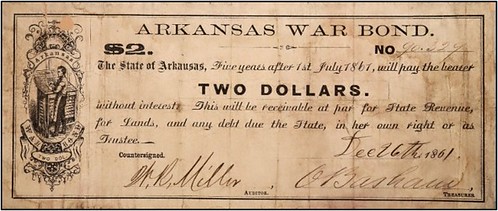
Type 4 Arkansas War Bond
War Bonds. The ordinances of May 1861 authorized the sale of $2 million in coupon-bearing WBs. These WBs were to mature five years after July 1861, and in the interim interest was to be paid on them at 8% per year. Payment and redemption of these bonds were largely backed by the faith of the State of Arkansas. WBs were typically issued to individuals who were military officers, quartermasters, commissaries and their agents, surgeons, or government employees responsible for paying soldiers or for purchasing weapons, supplies, food, medicines, and other wartime needs. In total, over 103,000 WBs were issued from June 1861 to January 1862. All were given sequential serial numbers (SNs).
Four types of WBs were produced. Type 1 WBs were issued over two weeks from late June to mid-July. Type 2 were issued over three months from late July to late October. Type 3 were issued over three months from mid-October to late January 1862. Types 2 and 3 had sub-types and varieties. Type 4 were a strange issue, hardly WBs at all as they earned no interest and were issued in December 1861 between Type 3a and 3b.

Type 1 Arkansas Treasury Warrant
Treasury Warrants. The May 1861 ordinances authorized the treasury to issue 8% interest-earning TWs. These Type 1 TWs, with examples shown in Figure 3, were first issued in early November 1861 with denominations of $1, $2, $3, $5, $10, and fractionals ($x.xx). Early Type 1 TWs have two subtypes, 1a and 1b, which differ in their vignette: 1a has an Indian Woman vignette, and 1b has an Indian Man vignette. Type 1s also come in two subtypes according to their function as indicated by text on them, either "ON WAR BOND" or "ON AUDITOR'S WARRANT." This text is bordered by two numbers. The left number is the TW's SN, and the right number is the SN of the WB (for TWs with "ON WAR BOND") or the SN of the AW (for TWs with "ON AUDITOR'S WARRANT") on which this TW was issued. Thus, TWs with "ON WAR BOND" were issued to individuals for payment of interest on WBs that they held, and TWs with "ON AUDITOR'S WARRANT" were issued to individuals for payment of the AWs that they held.
The May 1861 ordinances placed several limits on WBs and TWs, which had the effect of curtailing their circulation. To overcome this problem, Arkansas's legislature passed acts on November 14 and 18, 1861, which eliminated these restrictions and penalized creditors who refused to accept them. This new legislation led the treasury to issue new TWs, called Type 2. The legislation promoted its TWs and WBs by prohibiting the use of privately issued paper currencies of denominations less than a few dollars. Banks were also prohibited from issuing such notes. But the law allowed for exchange companies formed by local merchants to issue and redeem jointly their low denomination notes. Scrip from such exchange companies is known from Arkansas locations including Washington, Arkadelphia, Helena, Columbia, Fort Smith, and Chicot County. Even if illegal, some merchants and private business issued small denomination currency, Scrip from these Arkansan exchange companies and merchants are highly collectible.
Features: 228 pages, soft cover, perfect binding, 8½ x 11 inches. All books are signed by the author.
Cost: $35.00 + postage ($7 domestic)
Ordering: Electronic: Venmo @Charles-Derby-1, Zelle charlesderbyga@yahoo.com
Check by Mail: Charles Derby, 204 Sycamore Ridge Dr., Decatur, GA 30030
Information: Charles Derby: charlesderbyga@yahoo.com, 678-778-8806

PERIODICAL: NUMISMATIQUE ASIATIQUE NO. 59
Here are the contents of the latest issue of Numismatique Asiatique. -Editor
 Numismatique Asiatique
No. 59 | September 2026
The coin-shaped amulets of Cambodia
CENTRAL ASIA: A Study on the Origin of the Inscription
"Xu Xing": The Construction of Political Culture in Early Qara Khitai and a New Investigation into the Mintage Period
of Xu Xing yuan bao
by Liu Jingyi
RUSSIA: A Juchid dirham with Tibetan legend
by V. A. Belyaev, I.V. Evstratov
CAMBODIA: On the Origin of Buddhist amulets of Cambodia
by Valerii V. Gaganov
CAMBODIA: Catalog of Buddhist coin-shaped amulets of Cambodia with an ascetic
by Valerii V. Gaganov, Alain Escabasse
CAMBODGE : Note sur le nom ???????? (bra? ta?pa?)
figurant sur les monnaies au garuda de Battambang
par Olivier de Bernon
TONKIN: The 1905 Tonkin 1/600 Piastre: An Unidentified Group and Its Implications for Classification
by Nguy?n Van Duy
74 pages
In color
Format A4 (21 x 29 cms)
To order, see:
https://sites.google.com/site/societedenumismatiqueasiatique/adhesion
For more information on the the Asian Numismatic Society, see:
https://sites.google.com/site/societedenumismatiqueasiatique/revue

2026 ANA WFOM NUMISMATIC LITERATURE EXHIBITS
While at the American Numismatic Association's World's Fair of Money™ in Pittsburgh a month or so ago, I took these photos of the exhibits in the Numismatic Literature category. The winner names have since been reported by the ANA in the October Numismatist. Many thanks to the exhibitors - these were all nice exhibits. Apologies for the glare from the overhead lights. -Editor

First Place: A Selected Numismatic Literature Collection & Anti-Counterfeiting (Erwin Brauer)


Here's a closeup. Great exhibit - wonderful material. -Editor

Second Place: A Library of the Works of David R. Sear (Michael Shutterly)


Third Place: Monograph of Charles T. Steigerwalt (Carl Waltz)


To read the earlier E-Sylum article, see:
NEWMAN PORTAL ADDS STEIGERWALT MONGRAPHS
(https://www.coinbooks.org/v29/esylum_v29n40a07.html)

NNP ADDS BAD METAL NEWS
The latest addition to the Newman Numismatic Portal is Winston Zack's Bad Metal News. Project Coordinator Len Augsburger provided the following report. -Editor
NNP Adds Bad Metal News
 With permission of Winston Zack, Newman Portal now includes Winston's Bad Metal News. This newsletter is devoted to the study and collecting of contemporary counterfeit coins, particularly counterfeit United States coinage of the eighteenth, nineteenth, and early twentieth centuries. The publication reports newly discovered counterfeit varieties, die marriages, manufacturing techniques, and unusual specimens, with particular emphasis on Capped Bust half dollars and other early American denominations.
Illustrated articles document counterfeit coins, counterfeiting technology, and ongoing attribution research, often incorporating discoveries and contributions from fellow collectors. Additional content includes updates on the Bad Metal reference book series, research projects, numismatic events, and newly available collectible material.
Link to Bad Metal News on Newman Portal:
https://nnp.washu.edu/periodicals-list/list/periodicals-subcollections/57955

VIDEO: PAPER CURRENCY DOCTORING
The David Lisot Video Library on the Newman Numismatic Portal can be found at:
https://nnp.wustl.edu/library/multimediadetail/522852
We highlight one of his videos each week in The E-Sylum. Here's one from 2016 with Jeffrey Paunicka speaking about Paper Currency Doctoring. -Editor

Jeffrey Paunicka speaks at the 2016 ANA World's Fair of Money in Anaheim, CA.
To watch the complete video, see:
How to Detect Paper Currency Doctoring
(https://youtu.be/SfewhJTHIKo)
How to Detect Paper Currency Doctoring
(https://archive.org/details/ANA16023HowtoDetect-_1)

GEORGE HUBBARD CLAPP LECTURE
The University of Pittsburgh Nationality Rooms and Intercultural Exchange Programs have announced a free lecture on the life of George Hubbard Clapp, well known to numismatists as an author and collector of early U.S. Large Cents. The event takes place Saturday, October 24th, the same weekend as the upcoming PAN Show. -Editor
A Life of Curiosity, Collecting, and Contributions
Cathedral of Learning, Room 332
 George Hubbard Clapp, longtime Board Member of the University of Pittsburgh, supporter of the school through its transition to Oakland, was a Renaissance-man who endowed public collections with his wide-ranging interests in mollusk shells, coins, art, and the preservation of history. The commemorative lecture will highlight George Hubbard Clapp's many contributions to the liberal arts and sciences in Pittsburgh and reveal a man whose drive was one of abundant curiosity and support.
George Hubbard Clapp donated the Early American Room to the University of Pittsburgh in the late 1930's. Mr. Hubbard Clapp also gave funding support to each of the Nationality and Heritage Rooms that were being constructed during that time period.
At 2:00 pm, Michael Walter, Manager of Education Programs for the Nationality Rooms and Intercultural Exchange Programs, will share details on the life and contributions of George Hubbard Clapp.
Following the lecture, representatives of the Pittsburgh Chapter of the Pennsylvania Society Sons of the American Revolution will recognize George Hubbard Clapp posthumously with the PSSAR Silver Good Citizenship Award as a recognition of his outstanding and unusual patriotic achievement and service to the Pittsburgh region.
Private, small group tours will be led in the Early American Room during the Q&A section of the lecture.
A reception will be held in the Braun Room on the 12th floor of the Cathedral of Learning immediately following the talk.
The co-sponsors are: Sons of the American Revolution, PA Chapter; Sons of the American Revolution; Daughters of the American Revolution ; and the Nationality Society of the Colonial Dames of America – The Commonwealth of Pennsylvania.
The lecture will touch on Clapp's numismatic accomplishments. He donated a group of early U.S. coins which are still on display in the Cathedral's Early American Room. The room is rarely open for tours, so be sure to take advantage of this opportunity. -Editor
To read the complete article, see:
America 250: George Hubbard Clapp: A Life of Curiosity, Collecting, and Contributions
(https://www.nationalityrooms.pitt.edu/events/america-250-george-hubbard-clapp-life-curiosity-collecting-and-contributions)

NOTES FROM E-SYLUM READERS: OCTOBER 18, 2026
More on Why WWII Nickels Laminate
Here's a response to last week's discussion of why WWII Jefferson Nickels laminate. Vocabulary note: 'warnix' = War Nickels. -Editor
Tom DeLorey writes:
While I was at Coin World's Collectors Clearinghouse in the mid 1970's, I was updating a chart with the weights, diameters, thicknesses, contents and Specific Gravities for all U.S. Coins that had been created by my mentor there, Ed Fleischmann. We found it very handy when identifying wrong planchet coin errors, and counterfeits. Versions of this chart have appeared in many places over the years.
Most values were given expected numbers, but the S.G. for the warnix was given as a range that Ed had observed over the years via testing specimens. He attributed this to the laminations so commonly seen on warnix.
I was curious as to what the expected S.G. should be, so I wrote to Dr. Goldman at the Mint Lab in Washington, D.C. Over the years he had always been very helpful in responding to our inquiries, unlike the current Mint administration. I also asked him why so many warnix were found laminated.
He gave me an expected figure, but said that the range we used was probably more accurate because of the lamination problems. As to the cause of the laminations, he said basically this:
 'I was working at the Philadelphia Mint during the War. We were so busy striking coins for domestic and foreign use that ingots of non-precious metals were stored outdoors in the open courtyard of the building, where they were exposed to the elements. The manganese ingots especially became highly oxidized. We should have scaled them (i.e., scoured them with coarse wire brushes-TD) before using them, but we were just too busy. The manganese oxide went into the melts, where it did not bond well.'
So, sometimes an easy answer is the correct one.
Thank you! Interesting history. -Editor
To read the earlier E-Sylum article, see:
WHY WWII JEFFERSON NICKELS LAMINATE
(https://www.coinbooks.org/v29/esylum_v29n41a13.html)
More on Indian Peace Medals
Alan Weinberg passed along these notes and images inspired by last week's piece on the Indian Peace medals in the Buffalo Bill Center of the West collection. -Editor
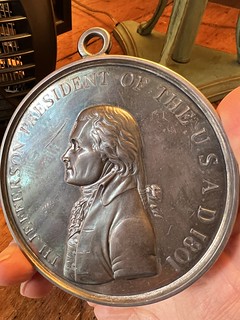

Original 105 mm largest size "hollow shells" silver Thomas Jefferson IPM in mint state. Weinberg collection. Struck at US Mint.
Most shell Thomas Jefferson medals exhibit evidence of prying open the shells to see what is inside (wood).
Known only in silver early "original dies" bronze specimens (diagnosed by a large diebreak on the reverse) struck by the Mint are scarce and eagerly sought due to the extreme rarity of silver shell originals.


The so-called "bootleg" fur trade medals are exceedingly rare, rarer than Jefferson Indian Peace Medals.
A white metal version just sold in a StacksBowers auction. Also known in silver (Don Partrick, Heritage auction) and copper (Ford-Weinberg collection).
To read the complete lot description, see:
(C. 1832) John Jacob Astor American Fur Company Prucha-61, Belden-65, AU55 NGC. ...
(https://coins.ha.com/itm/indian-peace-medals/-c-1832-john-jacob-astor-american-fur-company-prucha-61-belden-65-au55-ngc/a/1329-3058.s)
To read the earlier E-Sylum article, see:
MORE ON THE BUFFALO BILL CENTER PEACE MEDALS
(https://www.coinbooks.org/v29/esylum_v29n41a26.html)
On the Coin Photo Rorschach Test
 Wayne Pearson writes:
"I see scratches-from wear and tear. Maybe an Alien dropped it from Mars and reentry was tough on it."
To read the earlier E-Sylum articles, see:
NOTES FROM E-SYLUM READERS: SEPTEMBER 27, 2026 : Shiny Penny Find
(https://www.coinbooks.org/v29/esylum_v29n39a10.html)
NOTES FROM E-SYLUM READERS: OCTOBER 11, 2026 : Coin Photo Rorschach Test
(https://www.coinbooks.org/v29/esylum_v29n41a11.html)
Audiobook: The Banker Who Made America
On his Delancey Place email list, author Richard Vague writes:
 "My new book, The Banker Who Made America, is now out as an audiobook. If you are the audiobook type (and lots of my friends have been chiding me to get the audiobook version out), you can get it at Audible or Apple Books.
"I'm now hard at work on a book on the tumultuous founding of the Bank of England in 1694, which I view as the beginning of the modern era—but that is such a tortuous project that it will be a couple of years before it will be ready for publication.
"In the meantime, I hope you enjoy The Banker Who Made America!"
To read the earlier E-Sylum articles, see:
NEW BOOK: THE BANKER WHO MADE AMERICA
(https://www.coinbooks.org/v29/esylum_v29n06a07.html)
BOOK REVIEW: THE BANKER WHO MADE AMERICA
(https://www.coinbooks.org/v29/esylum_v29n29a04.html)
NOTES FROM E-SYLUM READERS: OCTOBER 4, 2026 : Audio Books
(https://www.coinbooks.org/v29/esylum_v29n40a12.html)
Query: Mystery "ANA" Pins
Nick Graver writes:
 "I have eight sterling silver pins with screw post backs.
They are beautiful but small (11 mm in diameter).
They feature the historic Lamp on a book, large "A N A" and 'de profundus'
"I was told that it is NOT from the American Numismatic Association but another society with similar initials.
I'd love to hear from anyone who knows about them. I'd sure like to see them go to someone who might get them to collectors who find them quaint. Otherwise, I'll take the melt value from a coin dealer at the upcoming Rochester Numismatic Association show on October 31st."
 I'm not familiar with all the ANA jewelry items produced over the years. I ran an image search hoping to find another example of Nick's pins, but only got back a confident response from Google's AI that these are American Numismatic Association medals. Now that's a fine guess and may well be true, but it did not locate any exact matches for these pins.
The classic lamp-of-knowledge design and the Latin motto "De Profundis" (meaning "Of the depths") could well have been adopted independently by other organizations, schools or universities. This particular piece seems of lower quality than typically seen with "our" ANA's medals. It doesn't look right to me, and I'm inclined to agree that it must be something else. But what? I reached out to school medal collector John Sallay whose response is below.
Does anyone have information on these? Can anyone help Nick keep them from the melting pot with an offer? -Editor
John Sallay writes:
"The lamp-of-knowledge sitting on a book is one of the more common devices used on school award medals. It is perhaps most prominently featured on the American Legion School Award medals, of which over one million have been awarded over the last 100+ years. It is not inconceivable that there is or was somewhere a "Something Something Academy" with the initials ANA that used this device and same De Profundis motto as the American Numismatic Association.
"However, I am not aware of anything relevant and my own Google AI search came up with, "There is no prominent real-world educational academy with the initials A.N.A. that officially uses "De Profundis" as its institution-wide motto." And to me, the design similarity, initials, and motto seem way too coincidental to be unrelated.
"Even without knowing what this is, I think it would be a shame to melt it. The melt value (plus postage) seems like a small cost for a fun research project and, who knows, a potentially rare and valuable addition to someone's collection of ANA memorabilia (or school award medals)!"
AI Plagiarism & Impact on Numismatic Research
Justin Hinh writes:
"I wanted to share a recent news story that may matter to numismatic researchers.
 "In September, OpenAI
announced
that its AI had solved a version of the Navier–Stokes problem, one of math's famous Millennium Prize problems. NYU math professor Tristan Buckmaster
pushed back. He and a colleague had spent a year on the same uncommon approach, and they kept all their drafts in OpenAI's own Codex tool. OpenAI started its effort only after word of their progress reached the company. When Buckmaster asked whether OpenAI used his work to train its models, it didn't give a clear answer. OpenAI later said it "cannot rule out" that data from his usage helped improve its models.
"The lesson for our community is that most AI chatbots train on your conversations by default unless you opt out. Numismatic researchers who work with AI models like ChatGPT, Claude, and Gemini may be feeding unpublished findings into a future model without realizing it. Turning this off is free and takes a minute, and this Engadget guide walks through it for each major company."
Good advice. Some years ago the Newman Numismatic Portal had a feature that showed recent user queries. I enjoyed seeing these and learned a lot, sometimes making new E-Sylum articles. I thought it was a great idea, but one researcher pushed back and the feature was removed. -Editor
Query: Coin Provenance Assistance Sought
Eric Schena writes:
"Have a wee coin mystery I'd like to see if any of the E-Sylum folks may be able to assist with. I recently bought a decent Kushan tetradrachm of Wima Takto. It's a variety I didn't have but what really intrigued me was the inventory card that came with it. It's a decent sized card typed in German with a few handwritten notes here and there, plus a pasted photo of the same coin on the reverse. The reference to the Whitehead reference seems to point it being catalogued before Mitchiner's Ancient and Classical World tome came out in the 1970s. Considering the level of detail on the card, this makes me think it came from a known collector/scholar of Central Asian coins. Do you or anyone recognize this catalog card? I would like to preserve the provenance as much as I can for this coin."


Can anyone help? -Editor

ANA HONORS EXCELLENCE IN NUMISMATIC ART AND WRITING
Here's the ANA press release announcing the recent Medallic Art and Burnett Anderson Memorial awards. Congratulations to both winners! -Editor
Celebrated at World's Fair of Money® in Pittsburgh
 During the 2026 American Numismatic Association's (ANA) World's Fair of Money, hosted in Pittsburgh, members who have contributed to the hobby in profound ways were recognized. The Numismatic Art Award for Excellence in Medallic Sculpture and the Burnett Anderson Memorial Award for Excellence in Numismatic Writing were presented during the 135th Anniversary Awards Banquet.
The ANA's Numismatic Art Award for Excellence in Medallic Sculpture is an annual honor given to an artist whose lifetime work in the field rises above all others. The 2026 recipient is Latvian sculptor and graphic designer Janis Strupulis, who has helped shape Latvia's national identity through his currency art. Born in 1949, Strupulis graduated from the Art Academy of Latvia in 1973. He is a member of several artistic organizations, including the Artists' Union of Latvia and FIDEM, and serves as president of the Latvian Arts Medal Club.
Strupulis is best known for designing modern Latvian coins, including the 1999 bimetallic 2-lat coin and several 1-lat coin designs from 1999 and 2001. His work also includes medals, drawings, and commemorative plaques honoring historical figures in Riga. Over the course of his career, he has received numerous international honors, including the Baltic Triennial Medal Art Prize and the Dante Biennale Gold Medal.
 The Burnett Anderson Memorial Award for Excellence in Numismatic Writing is presented annually to a researcher, author, or journalist in recognition of their body of work. David Hill is the 2026 recipient.
The New York native has served as the librarian for the American Numismatic Society (ANS) since 2014, following two decades of experience as an archivist and librarian for various organizations. A prolific author, Hill has penned countless articles for the society's quarterly periodical, ANS Magazine, using primary-source materials from the ANS archives.
"My subjects seem to present themselves, practically insisting on being written about," says Hill. "My job involves dipping into all the rare and wonderful historical materials I'm fortunate to be surrounded by."
He devotes hours of intense research to crafting captivating stories with engaging characters and interesting facts. "My long-term goal has always been to leave something behind that is well documented, so that other people can use and build upon the information I've uncovered."

ANS BREAKS GROUND ON TOLEDO HEADQUARTERS
On October 5, the ANS broke ground on their new headquarters in Toledo, OH. Here is the press release. -Garrett

On October 5, we were delighted to hold a groundbreaking ceremony at our future headquarters building in Toledo, Ohio. Renovations have now begun at the Professional Arts Building, which will become the Society's new museum and headquarters, with the project led by Roncelli Inc.
Dr. Ute Wartenberg Kagan, Sydney F. Martin Executive Director, was joined for the ceremony by the Honorable Wade Kapszukiewicz, Mayor of Toledo; the Honorable Marcy Kaptur, U.S. Representative of Ohio's 9th District; Dr. Adam M. Levine, Edward Drummond and Florence Scott Libbey President, Director and CEO of the Toledo Museum of Art; Vince DiPofi, President & CEO of SSOE Group; and Jereme Poxson, Chief Operating Officer of Roncelli Inc.
We are grateful to all our speakers and for those who were able to join us for the ceremony and reception, as covered by several media outlets:
- WTOL: Groundbreaking marks new era for historic Toledo building
- The Toledo Blade: American Numismatic Society plans 2028 opening of Money Museum
- Roncelli Inc.: Roncelli Joins American Numismatic Society for Toledo Groundbreaking
We look forward to sharing more updates with you in the coming months on our progress. Finally, our sincerest thanks to all who have donated to our campaign so far! To those who haven't yet made their gift, we welcome the opportunity to speak to you about how you can help build our new home.

VOCABULARY TERM: SUNKEN DIE
Here's another entry from Dick Johnson's Encyclopedia of Coin and Medal Terminology. -Editor
Sunken Die. A die deteriorated by a portion of its striking surface being compacted and recessed. The sinking is due to long use, poor quality steel and improper hardening. It is never known in advance when a die will sink, if it will sink, or how severe the form of sinking will be. It is a very gradual process and usually occurs in dies after long time, particularly over intermittent periods of use. It is characteristic of an old die.
Pieces struck from a sunken die obviously will exhibit the sunken condition. The effect is quite slight in the beginning of the die's deterioration, gradually worsening with continued use. If the sinking is greatest in the center and grading to the edge the sunken condition of the die will result in a domed effect on the struck piece. The dome increases with subsequent strikes as the continued force of striking takes its toll on the impaired die. All relief and detail is affected rising from the domed table or field of the struck piece. More likely the sinking is not uniform and the effect is more wavy or buckled, as a portion of the die's surface sinks faster than an adjacent area.
Sunken dies are rare in modern times – from using higher quality steel from which the dies are cut, better heat treating methods and there are fewer instances of dies being used over long periods of time. No die, however, is immune from potential sinking but better tool steel is worth the extra cost to prevent this.
Sunken coins. A vivid example of sunken coin dies exists in some early coins struck by the fledgling U.S. Mint. The cents and half cents of 1793, the first struck from dies made by Henry Voigt who was inexperienced in heat treating the dies to prohibit this condition. Thus fresh dies deteriorated rapidly by sinking and cracking before long runs could be struck. Die life significantly improved once Adam Eckfeldt was hired as the Die Forger and Turner in 1795, first on contract, then as a position. Dies continue to sink and crack today, although the problem is much reduced with new alloy steels.
Sunken medals. Historically one series of medals exhibits sinking moreso than any other. Papal medals have been issued over hundreds of years. Two and three-hundred year-old dies were still employed to strike medals – as long as they had not broken – because there was sustained demand for early papal medals. The original steel from which the dies were made was not the best, storage conditions may not have been the ideal, and intermittent use took its toll. The dies became sunken over the years as evident in the deficient medals with uneven and buckled surfaces we observe today.
To read the complete entry on the Newman Numismatic Portal, see:
Sunken Die
(https://nnp.washu.edu/Documents/Detail/sunken-die/4362372)

HEAD OF COPPER, FEET OF CLAY
E-Sylum Feature Writer and American Numismatic Biographies author Pete Smith submitted this article on a common theme among three numismatic authors. Thank you. -Editor
Several stories with a common theme


1. Walter Breen submitted an article to the November 15, 1984, issue of Penny-Wise titled, "HEAD OF COPPER, FEET OF CLAY, referring to Dr. William H. Sheldon. Walter considered Sheldon as a mentor, both for the study of coins and for the study of human physiology.
Sheldon wrote the standard reference on the early date (1793-1814) large cent series in Early American Cents and the revised Penny Whimsy. He developed the "science of cent values" and the 70-point grading scale.
Breen correctly observed that Sheldon's methods for valuing coins did not work while Sheldon continued to try to modify his methods to fit the data.
Dr. Sheldon also developed a science for evaluating human physiology based on a study of nude photos of college students as a predictor of temperament and personality. Breen pointed out that also did not work while Sheldon would not admit the flaws of his theories. Breen called Sheldon anti-Semitic and a racist.
The New York Times published "The Great Ivy League Nude Posture Photo Scandal" in their issue of January 1995. By then, the studies of Sheldon had been discredited.
Dr. Sheldon was also accused of exchanging 129 cents from his collection for better examples at the American Numismatic Society. A lawsuit resulted in many examples being returned.
2. Walter Breen took on a revision of Penny Whimsy which was eventually published as Walter Breen's Encyclopedia of Early United States Cents 1793-1814. Breen was generally respected as the eccentric writer of hundreds of articles.
Breen was also respected in the NAMbLA community as the author, under a pseudonym, of Greek Love (1964).
In 1954, Walter was charged for an incident under the boardwalk in Atlantic City. The Press of Atlantic City had a headline "Coin Expert Penalized in Morals Case" on June 23, 1954. He was fined $200.
Breen regularly attended science fiction conventions. Attempts were made to ban him from Pacificon II in 1964 in a scandal that has come to be known as "Breendoggle."
Breen was convicted of child molestation in 1990 and put on probation. He was charged again in 1991 and sent to prison. He died in prison on April 27, 1993.
3. Breen and Sheldon collaborated to compile "Profiles of Old Time Collectors and Dealers" published in United States Large Cents 1793-1857 (1975). This was their description of Francis Worcester Doughty:
"Francis Worcester Doughty, who published under his own name Proskey's revised serial from Coin Collector's Journal as the Cents of the United States in New York in 1890, was best known as (1) a collector of coins, medals and tokens with elephants on them and (2) a hack writer of fiction for boys."
This characterization was repeated in Walter Breen's Encyclopedia of United States Half cents 1793-1857 (1983).
 Francis Doughty was born in Brooklyn on November 5, 1850, the son of Charles John Doughty
(1820-1896) and Sarah Parsons Worcester (1821-1884).
Doughty was married to Elizabeth Splint (1857-1921) in Manhattan on February 24, 1885. They had four children.
Doughty was a prolific writer during the "Dime Novel" era with a writing career that spanned about 1885 to 1915. He is credited with 1500 books requiring production of about one per week during the period. Extended series included the characters Old King Brady and Nick Carter.
He also wrote under the pseudonyms of Benton Bertrew, Albert J. Booth, Allyn Draper, Gaston Game, Richard R. Montgomery, and Percy St. John.
Unlike Breen, Jess Nevins wrote: "Doughty was probably the best-known writer of dime novels, and next to Frederic Van Rensselaer Dey the best dime novel writer. Although Doughty's work suffered from being written on a deadline, it is generally far more intelligent and imaginative than the work of other dime novel writers."
The Encyclopedia of Science Fiction states "US numismatist, scholar, screenwriter and author whose well written. ingenious and original dime novels have often been considered the finest examples of the category."
Doughty compiled Cents of the United States that was published in 1890. It included material written by David Proskey and serialized in the Coin Collector's Journal from 1879 to 1883. The series ended when the periodical ended production in 1888. The book covered die varieties of the cents of 1793 to 1814 as described by earlier authors.
The INTRODUCTORY text ends with the title, "CENTS OF THE UNITED STATES." This is a literary device frequently used in his novels where the book title is repeated in the last sentence.
Cents of the United States was reprinted in a hardbound edition by Rollo Gilmore in 1933 and another by Holland A. Davis in 1934.
The Francis W. Doughty collection of Coins, Medals and Books was sold at auction by The New York Stamp and Coin Co. on April 14-16, 1891. The sale included 1539 lots. Cent varieties were not identified by Doughty numbers but the 1794's were identified by Maris numbers. He had a long list of patterns that sold at ridiculously low prices. Overall, the collection was respectable indicating that Doughty was a serious collector.
Doughty joined the American Numismatic Society as a corresponding member on May 20, 1895. He was an active member of the Brooklyn Institute of Arts and Sciences.
More of the Doughty collection was sold at auction by Thomas Elder in his 27th sale of April 5, 1909, the 28th sale of April 9, 1909, and the 29th sale of April 30, 1909. An additional Elder sale was conducted on September 28, 1916.
The auctions included an extensive library. Doughty had historical books, maps and newspaper clippings that were used as references for his stories.
A specialized collection of Doughty's Elephant Coins and Medals was conducted by the U. S. Coin Company on January 22, 1914. The first 170 lots included the elephant items.
Later in life he wrote movie scripts including "The Twenty Million Dollar Mystery."
He died at home in Cresskill, New Jersey, on October 30, 1917, and was buried at Cypress Hills Cemetery in Brooklyn.
Doughty wrote Evidences of Man in the Drift: A Description of Certain Archaeological Objects Recently Discovered in Massachusetts, Connecticut, New York, Pennsylvania and New Jersey. (1892). He believed that rocks found in the glacial drift included primitive art dating back to the Tertiary Period. This is an obsolete term representing 66 million to 2.6 million years ago.
He agreed in concept with Ignatius L. Donnelly (1831-1901) who served in the Minnesota Senate. In his 1883 book, Ragnarok, Donnelly speculated that a huge comet struck the Earth thirty-thousand years ago, wiped out an earlier civilization and threw up the gravel found in the drift.
Doughty read a paper before the American Numismatic and Archeological Society announcing his discoveries on March 28, 1892. He exhibited many of the discoveries he claimed originated before the last ice age.
Some of items were carved from purple slate in the forms of animals and the human head. Others were tablets made of baked clay, carved and painted. Thus his theory was built on a foundation of New Jersey clay.
Actual scientists debunked the book as pseudoscience. Archaeologist A. F. Berlin wrote that the book made "absurd and ridiculous statements, assertions a true archaeologist would not for moment give a thought, and much less print." Geologist William John McGee wrote that it was a "bundle of absurdities worthy of notice only because it is representative of the vain imaginings so prevalent among unscientific collectors."
Doughty, Sheldon and Breen had much in common. Each wrote a book on the early cents. Each received acclaim for their early works. Each also wrote about theories that have come to be rejected by most readers. Each could be considered an example of "Head of copper, feet of clay."

HERITAGE: BUST COINAGE SHOWCASE
Heritage Auctions will be hosting their Bust Coinage Showcase Auction on October 26. Select items are discussed below. -Garrett


1805 25C B-4, Low R.4, Fine 12 PCGS. CAC.
To read the complete item description, see:
1805 25C B-4, Low R.4, Fine 12 PCGS. CAC.
(https://coins.ha.com/itm/early-quarters/1805-25c-b-4-low-r4-fine-12-pcgs-cac-pcgs-population-4-in-12-8-finer-7-26-cdn-1-100-whsle-bid-for-ngc-pc/a/60576-50032.s?ctrack=200071&type=bodylink-7b-coinus-picks-60576-Bust-tem101426)


1825/4/(2) 25C B-2, FS-302, R.2, Good 6 PCGS.
To read the complete item description, see:
1825/4/(2) 25C B-2, FS-302, R.2, Good 6 PCGS.
(https://coins.ha.com/itm/bust-quarters/1825-4-2-25c-b-2-fs-302-r2-good-6-pcgs-cdn-165-whsle-bid-for-ngc-pcgs-good-6/a/60576-50052.s?ctrack=200071&type=bodylink-7b-coinus-picks-60576-Bust-tem101426)


1825 50C O-101, R.1, MS65 NGC. Soft mint luster glows beneath gunmetal-gray toning revealing subtle lavender and rose accents on virtually unmarked surfaces. The needle-sharp strike stands out throughout both sides. Although the 1825 O-101 variety is readily available, it is scarce in Gem Uncirculated or finer grades. This example is tied at the low end of the Condition Census for the die pair based on Steven Herrman's Spring 2026 listing.
To read the complete item description, see:
1825 50C O-101, R.1, MS65 NGC.
(https://coins.ha.com/itm/bust-half-dollars/1825-50c-o-101-r1-ms65-ngc-soft-mint-luster-glows-beneath-gunmetal-gray-toning-revealing-subtle-lavender-and-rose/a/60576-50279.s?ctrack=200071&type=bodylink-7b-coinus-picks-60576-Bust-tem101426)


1798 $1 Large Eagle, Pointed 9, Wide Date, 4 Lines, B-23, BB-105, R.3, Fine 15 PCGS. CAC.
To read the complete item description, see:
1798 $1 Large Eagle, Pointed 9, Wide Date, 4 Lines, B-23,
BB-105, R.3, Fine 15 PCGS. CAC.
(https://coins.ha.com/itm/early-dollars/1798-1-large-eagle-pointed-9-wide-date-4-lines-b-23-bb-105-r3-fine-15-pcgs-cac-cdn-2-400-whsle-bid-for/a/60576-50415.s?ctrack=200071&type=bodylink-8b-coinus-picks-60576-Bust-tem101426)
High-grade coins get most of the attention, but some of these are respectable, original, evenly-worn circulated pieces and fine candidates for collections. -Editor
STACK'S BOWERS: WORLD PAPER MONEY AUCTION
Stack's Bowers will be hosting their November 2026 Premier Collectors Choice Auction of World Paper Money on November 2. Select items are discussed below. -Garrett

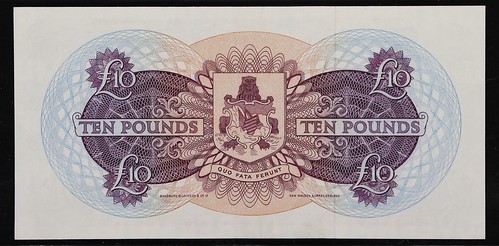
BERMUDA. Bermuda Government. 10 Pounds, 28.7.1964. P-22. PCGS Banknote Choice About Uncirculated 58. Just a touch of circulation is seen on the highest denomination from the predecimal series of Bermuda. Scarce at this grade level and popular.
To read the complete item description, see:
BERMUDA. Bermuda Government. 10 Pounds, 28.7.1964. P-22. PCGS Banknote Choice About Uncirculated 58.
(https://auctions.stacksbowers.com/lots/view/3-1X80RX/bermuda-bermuda-government-10-pounds-2871964-p-22-pcgs-banknote-choice-about-uncirculated-58)


CANADA--BANK OF CANADA. Bank of Canada. 20 Dollars, 1935. BC-9b. English Text. PMG Very Fine 30. Osborne - Towers signature combination. Small seal. Attractive mid-grade example of this perennially popular type.
To read the complete item description, see:
CANADA--BANK OF CANADA. Bank of Canada. 20 Dollars, 1935. BC-9b. English Text. PMG Very Fine 30.
(https://auctions.stacksbowers.com/lots/view/3-1X80UG/canada-bank-of-canada-bank-of-canada-20-dollars-1935-bc-9b-english-text-pmg-very-fine-30)


EGYPT. National Bank of Egypt. 100 Pounds, 1951. P-27b. PCGS Banknote Extremely Fine 40. Scarce problem-free example of this popular type with the portrait of King Farouk at right. Not easy to find as such, and a premium example. Also seen with intense color and a cornerstone type for any advanced collection.
To read the complete item description, see:
EGYPT. National Bank of Egypt. 100 Pounds, 1951. P-27b. PCGS Banknote Extremely Fine 40.
(https://auctions.stacksbowers.com/lots/view/3-1X81G1/egypt-national-bank-of-egypt-100-pounds-1951-p-27b-pcgs-banknote-extremely-fine-40)


HAITI. Republique d'Haiti. 5 Gourdes, 22.1.1915. P-129a. PMG About Uncirculated 53. Lightly circulated example of this rare type from Haiti. The only example of this type in the PMG population report. Despite a small tear still with good color and eye appeal, and a note that is unlikely to have spent considerable time in circulation. PMG Comments "Small Tear."
To read the complete item description, see:
HAITI. Republique d'Haiti. 5 Gourdes, 22.1.1915. P-129a. PMG About Uncirculated 53.
(https://auctions.stacksbowers.com/lots/view/3-1X81LP/haiti-republique-dhaiti-5-gourdes-2211915-p-129a-pmg-about-uncirculated-53)


IRELAND. Central Bank of Ireland. 50 Pounds, 4.4.1977. P-68c. LTN66. PMG Choice Extremely Fine 45 EPQ.
To read the complete item description, see:
IRELAND. Central Bank of Ireland. 50 Pounds, 4.4.1977. P-68c. LTN66. PMG Choice Extremely Fine 45 EPQ.
(https://auctions.stacksbowers.com/lots/view/3-1X81Q4/ireland-central-bank-of-ireland-50-pounds-441977-p-68c-ltn66-pmg-choice-extremely-fine-45-epq)


KUWAIT. Kuwait Currency Board. 5 Dinars, 1960 (ND 1961). P-4. PMG Gem Uncirculated 66 EPQ. Key denomination from the first series of Kuwait. Scarce at this grade level and very popular as such, and difficult to find in better grades.
To read the complete item description, see:
KUWAIT. Kuwait Currency Board. 5 Dinars, 1960 (ND 1961). P-4. PMG Gem Uncirculated 66 EPQ.
(https://auctions.stacksbowers.com/lots/view/3-1X81SR/kuwait-kuwait-currency-board-5-dinars-1960-nd-1961-p-4-pmg-gem-uncirculated-66-epq)


NETHERLANDS. Nederlandsche Bank. 1000 Gulden, 30.3.1972. P-94. PMG Superb Gem Uncirculated 67 EPQ. Lovely Superb Gem Uncirculated example of this high-denomination type that remained in circulation until the introduction of the Euro. Tremendous purchasing power when it was in circulation.
To read the complete item description, see:
NETHERLANDS. Nederlandsche Bank. 1000 Gulden, 30.3.1972. P-94. PMG Superb Gem Uncirculated 67 EPQ.
(https://auctions.stacksbowers.com/lots/view/3-1X81YK/netherlands-nederlandsche-bank-1000-gulden-3031972-p-94-pmg-superb-gem-uncirculated-67-epq)


PUERTO RICO. Banco de Puerto Rico. 5 Dollars, 1.7.1909. P-47a. PMG Very Fine 20. Surpassed in the PMG population report by just two finer examples. A very scarce type with the portrait of Christopher Columbus at left. Put into circulation after Puerto Rico became a territory of the United States. A type that, for all intents and purposes, should be included in every serious American collection. PMG Comments "Restoration, Rust."
To read the complete item description, see:
PUERTO RICO. Banco de Puerto Rico. 5 Dollars, 1.7.1909. P-47a. PMG Very Fine 20.
(https://auctions.stacksbowers.com/lots/view/3-1X82FY/puerto-rico-banco-de-puerto-rico-5-dollars-171909-p-47a-pmg-very-fine-20)
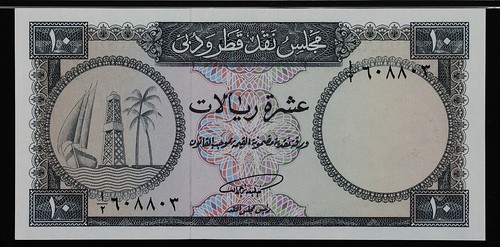

QATAR & DUBAI. Qatar & Dubai Currency Board. 10 Riyals, ND (1966). P-3a. PMG Gem Uncirculated 66 EPQ. Fantastic Gem Uncirculated example of his better type from the only series of notes issued by the Qatar & Dubai Currency Board. Only a handful of notes grade finer in the PMG population report as of the time of cataloging. Destined for an advanced Middle Eastern type set.
To read the complete item description, see:
QATAR & DUBAI. Qatar & Dubai Currency Board. 10 Riyals, ND (1966). P-3a. PMG Gem Uncirculated 66 EPQ.
(https://auctions.stacksbowers.com/lots/view/3-1X82GC/qatar-dubai-qatar-dubai-currency-board-10-riyals-nd-1966-p-3a-pmg-gem-uncirculated-66-epq)


VENEZUELA. Leproserias Nacionales. 2 Bolivares, ND (1951-58). P-S369. PMG Choice Very Fine 35. Leper Colony issue. Surpassed by just two finer examples in the PMG population report. In attractive problem-free condition and scarce as such.
To read the complete item description, see:
VENEZUELA. Leproserias Nacionales. 2 Bolivares, ND (1951-58). P-S369. PMG Choice Very Fine 35.
(https://auctions.stacksbowers.com/lots/view/3-1X82VI/venezuela-leproserias-nacionales-2-bolivares-nd-1951-58-p-s369-pmg-choice-very-fine-35)
HOLABIRD JACK HADDOCK COLLECTION SELECTIONS
Here are some selected lots from the Jack Haddock Nevada Town Token Collection Auction by Holabird Americana. -Garrett

Mineral Hill was a heck of a mining and milling community. In the 1860s, ores owned by the Manhattan Silver Mining Co. were mined and processed there. Early records of the mining camp are scarce, but a saloon known as Walker's Saloon ran from about 1880-1886, then became Thompson's Saloon, c 1886-1890, when a dead period hit the camp until about 1906 when a saloon again poured the magic liquid by R. Johnson. By 1912, the saloon had changed hands to Frank Pacini and Ross Plummer, then shortly after to Victor Venturino as proprietor, part of a long time eastern Nevada family. In mid-1912, Victor had the region's voting polling place at his house. In July that year, he bought the mineral rights of the Mineral Hill Consol. M.C. for $250. This is a great token from a very important 19th century Nevada mining camp. Pop in 1990: 6.
Obverse: Victor Venturino/ Mineral Hill,/ Nev.
Reverse: gf 12 1/2c it
Shape/Metal: rd, br
Town: Mineral Hill, Nevada
To read the complete item description, see:
Victor Venturino Mineral Hill Nevada Trade Token
(https://holabirdamericana.liveauctiongroup.com/Victor-Venturino-Mineral-Hill-Nevada-Trade-Token_i61288118?t=JH2)

E. Van Alstine was a pioneer merchant of Hawthorne, opening a store and possible bar in April, 1883. He advertised in the Walker Lake Bulletin heavily. Five years later, in April, 1888, he sold his store and goods to Robert Wright, who also used a token found in this sale. Pop in 1990: 2. Crazy rare.
Obverse: GF/ 12 1/2c/E./ Van Alstine/ Hawthorne, Nevada/ in/ trade
Reverse: BBC, pic pool table
Shape/Metal: rd, br
Town: Hawthorne, Nevada
To read the complete item description, see:
E Van Alstine Hawthorne Nevada Trade Token
(https://holabirdamericana.liveauctiongroup.com/E-Van-Alstine-Hawthorne-Nevada-Trade-Token_i61288071?t=JH2)

Giles (possibly James, could be Ed, a mining engineer) started a water service in Goldfield perhaps as easily as 1903, then in 1905 took on a partner Fayhin. The venture was important, as no water service was established until about July, 1906, which put the pair out of business. There are two variants of this exceptionally rare token, with a pop in 1990 of 2.
Obverse: Giles/ phone/ 3625/ Goldfield, Nev.
Reverse: gf 1 bucket of water
Shape/Metal: oval, br
Town: Goldfield, Nevada
To read the complete item description, see:
Giles One Bucket of Water Goldfield Nevada Trade Token
(https://holabirdamericana.liveauctiongroup.com/Giles-One-Bucket-of-Water-Goldfield-Nevada-Trade-Token_i61288059?t=JH2)

Please see the entry for Coddington above. Pop in 1990: 9. Good luck getting one. These two tokens are highly prized by beer collectors. In fact, one of Reno Brewing products is a cone top Royal Flush Beer can, which today is worth well in excess of $5,000.
Obverse: C.M. Coddington/ Agent/ Yerington, Nev.
Reverse: gf 1 glass Sierra beer
Shape/Metal: rec, br
Town: Yerington, Nevada
To read the complete item description, see:
C M Coddington Yerington Nevada Trade Token
(https://holabirdamericana.liveauctiongroup.com/C-M-Coddington-Yerington-Nevada-Trade-Token_i61288213?t=JH2)

Some saloon owners are so well known and iconic, that the saloon doesn't need a name like "Owl" or "Palace." The proprietor's name is plenty good enough. In this case, Frank Dickinson, who was a Comstock 1859 pioneer and sixty-plus year resident of Washoe County, was a name big enough to draw anybody. Dickinson was among the first to the Comstock. He and a partner staked a clam "within a stone's throw" of Riley & McLaughlin, but up higher on the hill. Davidson, whom the mountain there was named for, had a claim and was busy washing black sand, but gave it up. Dickinson and partner moved in, sent a sample to San Francisco, assayed at $8 per ton. FD said Riley & McLaughlin couldn't write, so he and his partner got Manny Penrod to come up from Carson to "fix their filing papers." About 1875, he was foreman of a jury for a case where a man got caught milking a cow he didn't own in the middle of the night and the cow owner sought prosecution for the "theft." Dickinson declared "we find the defendant guilty of milking a cow in the second degree." By 1900, Dickinson had a big ranch at Red Rock Valley, about 12-15 miles northeast of Chilcoot. He kept that ranch through at least 1916. During this time, he was an inveterate prospector, acquiring the Last Chance Mine in Plumas with partners John Sparks (NV Governor), and H. Butters (VC mining man). Dickinson moved up to Leadville (near Gerlach) about 1914. By 1917 he was the owner of a saloon in Leadville (Leadville was not canvassed by Polk in 1912 or 1914), when he was over 80 years old! He was out of Leadville before March of 1919, moving to Reno, where he died November, 1919. This token probably dates to 1916-1917, and is a remarkable piece of history. Pop in 1990: 2. It is the only self identified token from Leadville, a silver-lead mining camp named after the Colorado monster silver camp.
Obverse: Frank Dickinson/ Bar/ Leadville,/ Nevada
Reverse: GF one dr or cigar
Shape/Metal: rd, al
Town: Leadville, Nevada
To read the complete item description, see:
Frank Dickinson Bar Leadville Nevada Trade Token
(https://holabirdamericana.liveauctiongroup.com/Frank-Dickinson-Bar-Leadville-Nevada-Trade-Token_i61288090?t=JH2)

Only known token from this Lyon County town. No saloon listings for Smith in 1907-08, 1912-13, or 1914-15 Polk directories, nor any Smith residents with that first name in any of those three directories. No listings for Fred's Bar found on newspapers.com. This one remains a mystery, but also a NV token rarity! Smith, Nevada, is an agricultural community in Lyon County's Smith Valley that was first settled in 1859 by herdsmen Timothy, R.B., and Cyrus "Adobe" Smith, who were drawn to the area's rich meadowlands along the West Walker River. Unlike neighboring Nevada towns born from mining booms, Smith grew steadily around a ranching rest stop called Smith's Station and established its official post office in 1892, followed by historic landmarks like the 1895 Methodist Church and the 1926 Central Bar & Mercantile. The community was briefly connected to wider western markets via the Nevada Copper Belt Railroad from 1911 until the 1940s, and today it remains a quiet rural hub where many of the original 19th-century pioneer ranches are still actively operated. Pop in 1990: 5.
Obverse: Fred's Bar/ Smith, Nevada
Reverse: GF 10c IT
Shape/Metal: rd, al
Town: Smith, Nevada
To read the complete item description, see:
Fred s Bar Smith Nevada Trade Token
(https://holabirdamericana.liveauctiongroup.com/Fred-s-Bar-Smith-Nevada-Trade-Token_i61288172?t=JH2)

The only reference found for Mr. Pappas is in 1918-1919. By 1914 there were three saloons in Wabuska, one by Mr. Feeny and the other two owned by Dewitt Beach and Robert McKenzine. The latter pair had a partnership in a single saloon prior to 1912, but split the partnership up, each ending up with his own saloon, names not known. One of them may have sold to Pappas. Beach was quite the saloon and mining man. He had mining interests all around Yerington, and had opened a saloon in Granite in 1913, but also worked at Rand, Schurz, etc. In 1915, Beach got caught on the Schurz Reservation with whiskey. This tiny token may be from the late period, c 1916-1917. Pop in 1990: 1, thought to be unique. More research needed. The "red metal" means copper, typical of the Yerington-Wabuska area, which also hosted the Nevada Copperbelt railroad servicing the copper mines.
Obverse: Red Metal/ Saloon/ A. Pappas/ Prop/ Wabuska, Nevada
Reverse: gf 10c it
Shape/Metal: oct, al
Town: Wabuska, Nevada
To read the complete item description, see:
Red Metal Saloon Wabuska Nevada Trade Token
(https://holabirdamericana.liveauctiongroup.com/Red-Metal-Saloon-Wabuska-Nevada-Trade-Token_i61288196?t=JH2)

Known as the "Rawhide Rabbit," this is extremely sought-after by Nevada token collectors! This establishment was robbed in June 1908 at 3 o'clock in the morning. They took the cash register from the bar as well as the roulette wheel ($300 total). Hawkins is listed in the 1912-13 Polk as one of 4 saloon owners in Rawhide and in the 1914-15 Polk as one of two saloon owners. He was granted a saloon license in March 1914. Pop in 1990: 4.
Obverse: Hotel Rawhide/ GF/ 12.5c/ IT/ W.C. Hawkins, Prop.
Reverse: (rabbit pictorial)
Shape/Metal: 4scal, wm
Town: Rawhide, Nevada
To read the complete item description, see:
Hotel Rawhide WC Hawkins Rawhide Nevada Trade Token
(https://holabirdamericana.liveauctiongroup.com/Hotel-Rawhide-WC-Hawkins-Rawhide-Nevada-Trade-Token_i61288141?t=JH2)

HOLABIRD JACK HADDOCK NEVADA TOKENS, PART 2
While Fred Holabird has retired and closed his auction business, he left the door open some special private sales from time to time. One of those will take place November 6, 2026 when Holabird offers the Nevada Town token collection of Jack Haddock. The sale announcement is far more than just that - Fred delves into the history of Nevada token collecting, research and rarity as well as new digging and detecting techniques and advanced digital research platforms. It's lengthy and quite useful. Here's the second of four parts. -Editor

The authors of the Nevada Token Book each had specific collections: John Schilling, collected Reno. Hal Dunn, Sheriff of Carson City, collected Carson and everything Carson City Mint. Len Hoskins collected Elko and surrounds. Jack Haddock collected towns. Another advanced collector, Bill Wright, collected everything Nevada.
As the years went on, Jack put together five versions and revisions of The Nevada Token Book from 2011 to 2022. Each step of the way, he added new material and recorded as many sales as found in the public record, helping to develop hundreds of new collectors.
No one has ever put together a complete collection of Nevada tokens. There are simply too many unique pieces.
If you are after collecting from some of the big token towns, try this:
- Goldfield: 167 different as of 1990
- Tonopah: 124 different as of 1990
- Reno: 264 different as of 1990
- Nevada Token Populations and Rarity
Rarity of Nevada tokens is very difficult to determine.Individual token "populations" are stated here in this catalog from the 1990 Nevada Token Book. This is an important attribute here. The populations listed in the 1990 Book are a direct result of the cataloging of dozens of collections at the time. Each collector painstakingly listed each piece, kept up to date by John Schilling on index cards. This is important because each collector was piece specific. The group tallied the collections of 75 different people. We cannot do this today. There are too many collectors. There are too many token shows and private treaty deals where tokens are traded or sold back and forth, often several times per year for the same piece. Tracking becomes an impossibility.
The advent of the publishing of the Nevada Token Book caused a rise in collecting. It spurred collectors to go out and find stuff, and they did. So this book is not the "be-all, end-all" guide. It is simply a relative guide of what might be out there. Perhaps in the 36 years since I published the Nevada Token Book, individual token populations have gone upward proportionally. Good luck with that one – it's too tough to call.
For the purpose of this sale, 43% of the tokens listed here have a 1990 rarity of two known specimens or less (102 tokens)! This is thus a remarkable collection of rarities.
Advanced metal detecting techniques have changed the hobby. Collectors are now more apt than ever to go out and look for coins in the old mining camps, where once upon a time, collecting was limited to digging old dumps and finding things in coin collections. In my own case, I first encountered this activity about 1980 when I was assigned the duty of looking at the Mary Mine site, and stumbled upon the old townsite on top of the ridge, which I never expected and did not know about. Here, out in the open, were small piles of sifted material and holes where folks sifted for tokens while digging for old bottles. Somebody or some group had been really thorough. Yet the result is abundantly clear, as Mary Mine tokens are still incredibly rare. They must not have found many.
The new digging and detecting techniques took on a whole new concept when casual diggers and collectors discovered modern machinery. Perhaps fifteen years ago, some of the guys must have seen shaker and sizing screens at commercial aggregate plants. They built small models of these gas-powered screens, hooked them up to a truck, loaded with a bobcat (minibackhoe/excavator) and off to the dumps they went - Goldfield, Tonopah, Leadville, and many more. Thousands of yards were processed. Lots of coins and tokens and a few bottles. The "Nutting Machine" has become the tool of the future. But the end result was that many of these giant dumps had already been hit so hard by diggers from the 1960s-80s, that not much was left.
Over the years, some "hoards" of tokens were found. As part of this collecting and dealing community, as well as constant travels throughout the state's mining camps, I had access to many collectors, old timers, dump diggers and more. Many of the hoards came from slot machine route companies or individuals. Only one of them was a token collector – Jack and Christine Harkey of Carrizozo, New Mexico. They had a slot and vending machine route in New Mexico, and stories to tell! I got to see in person the massive coins and tokens they accumulated over the years, allowed to sell most later. The first "virgin" token hoard I found were the Big Casino tokens from Tonopah. One of the mining guys led me to that, and he also told me about bags of tokens he threw down one of the main mine shafts when he was in charge of a slot route, and threw them all away in the 1930s. I ran into the same thing in several of the Nevada camps, including Virginia City – down the shaft they went!
In modern times, dump diggers found bags full of tokens thrown out in the 1920s or 1930s. One of these was found in Ely and bought by my friend Bob Campbell in Salt lake City and brought to Jack and I in the early 1980s. As I recall, it was a five gallon bucket full of tokens – several thousand tokens, mostly all eastern Nevada. The Utah pieces had probably all been picked out by that point, but I'm sure there were some Modena and a few others still in there. The most common by far were the Dewey Trade Checks from Ely. These are still important tokens because they represent a saloon named after a famous and very collectible today slot machine – the Dewey. Jack got all the killer tokens out of there, and there were quite a few. Some other guys found a giant bag or two out near Tracy, California years later, and after they had picked it clean, sold me the rest, easily a thousand or more pieces. Metal detectorists have found many little bags or cans full of tokens. It can be a dozen or two dozen, sometimes more.
While I probably know of most of them, it isn't necessarily in anyone's best interest to talk about them. A few have found up to a hundred of certain pieces, obviously discarded all at once into a hole nobody thought would ever be found. One of the fun ones from years ago – classic treasure hunting – were the Camp Independence, V. Beaudry, tokens of the 1860s. There were maybe 50 coins in that group. I sold one of each to Ron Lerch, and the others went out over time. There were a number of denominations. There are so many stories!
For more information on the sale, or to bid, see:
Jack Haddock Nevada Town Token Collection Auction(Session 1)
(https://holabirdamericana.liveauctiongroup.com/auctionlist.aspx?t=JH1)
To read the earlier E-Sylum article, see:
HOLABIRD JACK HADDOCK NEVADA TOKENS, PART 1
(https://www.coinbooks.org/v29/esylum_v29n41a21.html)

KUENKER AUCTION SALE 447
Künker will hold three auction sales featuring exclusively coins from the ancient world in early November 2026. On November 2 and 3, 2026, the floor auction sale will take place in Osnabrück, featuring more than 1,300 lots from various collections. -Garrett
Auction 447: Coins of the Ancient World
November 2–3, 2026 (Floor Auction Sales)
1,300 lots of coins from the ancient world will be offered during the Künker floor auction sale from November 2 to 3, 2026. The auction sale covers the entire spectrum of ancient numismatics: from Celtic, Greek, and Roman coins to those of the Byzantine era. The selection is rounded out by several pieces from the Migration Period and Islamic numismatics.
No fewer than five significant specialized collections will be sold as part of the auction sale, namely:
• the Walter Louwet Collection
• the Antissa Collection
• a private collection from southern Germany
• a collection of ancient coins spanning two generations
• the collection of a Hanseatic lover of Roman antiquity
These collections complement each other perfectly. Whether you're interested in refined Greek style, Roman history, ancient provenance, or rarities, this auction has something for every lover of ancient coins.
Following a selection of coins from the Celtic tribes is an extensive offering of Greek coins, featuring a rich selection of issues from Syracuse. You can also look forward to numerous archaic coins as well as a series of electrum coins from Mytilene. Particularly unusual is the extensive selection of North African coins.
Collectors of coins from the Roman Republic are spoiled for choice: you'll find not only major rarities but also coins in excellent condition, especially from the period of the civil wars. Now you have the opportunity to acquire coins featuring the portraits of all the major figures of this exciting era. Or are you looking for a specific legion in the series of Marcus Antonius's legionary denarii? The selection is vast. And if you don't succeed in Auction Sale 447, an almost complete series of legionary denarii is also being offered in the Schumm Collection.
Among the coins from the Roman Imperial period, you'll discover an exciting mix of gold, silver, and bronze.


Lot 5. Gallia. Parisii. Stater, um 60 v. Chr. Sehr selten, besonders in dieser Erhaltung. Fast vorzüglich.


Lot 74. Griechenland. Lucania. Metapont. Didrachme, 400/340 v. Chr. Prachtexemplar. Von großer Seltenheit, besonders in dieser Erhaltung. Dionysoskopf von feinstem Stil, feine Tönung, breiter Schrötling, vorzüglich. Exemplar der Auktion Jacob Hirsch VIII, München 1903, Nr. 792


Lot 218. Griechenland. Sicilia. Syrakus. 100 Litren 405/400 v. Chr. Eines der schönsten bekannten Stücke dieses interessanten Münztyps. Sehr selten. Prachtexemplar. Vorzüglich. Erworben 2005.


Lot 223. Griechenland. Sicilia. Syrakus. Dekadrachme um 400/390 v. Chr., unsigniert. Herrliche Patina, vorzüglich. Erworben 2005 bei der Firma Vinchon, Paris.


Lot 391. Griechenland. Attica. Athen. Tetradrachme 500/480 v. Chr. Mit so perfekt zentriertem Avers von größter Seltenheit. Perfekt auf breitem Schrötling zentrierter Avers, gutes sehr schön.


Lot 440. Griechenland. Creta. Lyttos. Stater, 330/300 v. Chr. Selten. Feine Tönung, min. Prägeschwächen, knapp vorzüglich. Exemplar der Sammlung „Antike Münzen aus zwei Generationen – eine gemeinsame Sammelleidenschaft". Erworben im Januar 2005 beim Münzkabinett Funk, Neukeferloh.


Lot 475. Griechenland. Mysia. Kyzikos. Pharnabazos, Satrap, 413-373 v. Chr. Tetradrachme 394/393 v. Chr. Sehr selten. Min. korrodiert und gereinigt, sehr schön. Exemplar der Auktion Naumann 88, Wien 2020, Nr. 159.


Lot 711. Griechenland. Aegyptus. Ptolemaios II., 285-246 v. Chr. für Arsinoë II. Oktodrachme 253/246 v. Chr., Paphos. Von allergrößter Seltenheit. Sehr schön-vorzüglich. Exemplar der Sammlung Alexandre Silberstein.


Lot 728. Griechenland. Cyrenaica. Kyrene. Stater 331/322 v. Chr. Sehr selten. Sehr schön. Exemplar der Auktion NFA XIV, New York 1984, Nr. 220.


Lot 740. Griechenland. Zeugitania. Karthago. Trihemistater um 260 v. Chr. Selten. Attraktives Exemplar, vorzüglich. Exemplar der Sammlung R. B. Lewis und Mentor, Auktion Vinchon, Paris 6. Dezember 2023, Nr. 30.


Lot 769. Römische Republik. Denar 108/107 v. Chr., Rom. Vorzüglich-Stempelglanz. Exemplar der Auktion Tkalec, Zürich 29.


Lot 813. Römische Republik. Denar 43 v. Chr., Rom. Sehr selten. Feine Tönung, kl. Kratzer, sehr schön. Exemplar der Sammlung Ernst Justus Haeberlin (1847-1925), Auktion Cahn-Hess, Frankfurt am Main 17. Juli 1933, Nr. 2980.


Lot 817. Römische Republik. Denar 42 v. Chr., Rom. Ausdrucksstarker Herculeskopf. Herrliche Tönung, vorzüglich. Aus einer süddeutschen Privatsammlung. Erworben im Januar 1959.


Lot 880. Römische Kaiserzeit. Marcus Antonius, † 30 v. Chr. Denar 37/35 v. Chr., peloponnesische Münzstätte. Selten. Herrliche Tönung, vorzüglich. Exemplar der Auktion Bertolami Fine Arts ACR 44, Prag 2018, Nr. 332.


Lot 958. Römische Kaiserzeit. Augustus, 30 v.-14 n. Chr. Denar 17 v. Chr., Rom. Feine Tönung, kl. Schrötlingsriss, Sammlerpunze (?) auf dem Avers, gutes sehr schön. Exemplar der Sammlung „Antike Münzen aus zwei Generationen – eine gemeinsame Sammelleidenschaft". Exemplar der Auktion Morton & Eden 83, London 2016, Nr. 415


Lot 1024. Römische Kaiserzeit. Otho, 69. Aureus, Rom. Selten. Gutes sehr schön. Exemplar der Auktion NAC 34, Zürich 2006, Nr. 12.


Lot 1031. Römische Kaiserzeit. Vespasianus, 69-79. Sesterz 71, Rom. Prachtexemplar. Vorzüglich. Exemplar der Auktion Jacquier 43, Kehl am Rhein 2017, Nr. 156.


Lot 1111. Römische Kaiserzeit. Lucius Verus, 161-169 für Lucilla. Aureus, Rom. Selten. Vorzüglich-fast Stempelglanz. Exemplar der Auktion Kunst und Münzen 2, Lugano 1969, Nr. 202.


Lot 1118. Römische Kaiserzeit. Pertinax, 193. Aureus, Rom. Sehr selten. Prachtexemplar. Vorzüglich. Exemplar der Sammlung Archer Milton Huntington (* 10. März 1870, New York; † 11. Dezember 1955, Bethel; Inventar-Nr. ANS 1001.1.30032).


Lot 1124. Römische Kaiserzeit. Septimius Severus, 193-211 mit Julia Domna, Caracalla und Geta. Aureus, 202, Rom. Sehr selten. Winz. Kratzer auf dem Avers, knapp vorzüglich. Exemplar der Auktion Pecunem 1, München 2013, Nr. 193.


Lot 1156. Römische Kaiserzeit. Regalianus, 260 für Dryantilla. Antoninian, Carnuntum. Von großer Seltenheit. Gutes sehr schön. Das Stück ist überprägt auf einen Denar des Severus Alexander.


Lot 1167. Römische Kaiserzeit. Maximianus I., 285-305. Quinar 294/297, Treveri. Von allergrößter Seltenheit. Dunkle Patina, sehr schön.


Lot 1238. Römische Kaiserzeit. Constantius III., 421. Solidus, Ravenna. Von großer Seltenheit. Sehr schön/gutes sehr schön.


Lot 1269. Römische Kaiserzeit. Maiorianus, 457-461. Solidus, Arelate. Sehr selten. Fast vorzüglich. Exemplar der Auktion Fritz Rudolf Künker 326, Osnabrück 2019, Nr. 1709.
To order a catalog contact Künker, Nobbenburger Straße 4a, 49076 Osnabrück; phone: +49 541 / 962020; fax: +49 541 / 9620222; or via e-mail: service@kuenker.de. You can access the auction catalogs online at www.kuenker.de. If you want to submit your bid from your computer at home, please remember to register for this service in good time.
THE BOOK BAZARRE
MATTHEW SCHAFER'S 2026 PITTSBURGH ANA DIARY
Matthew Schafer writes:
"I appreciated Wayne's recent informative comments about touring Pittsburgh after the ANA Show. I was born in Bethel Park but raised in the Minneapolis area where I am an ANA Member of the NorthWest Coin Club. My trip to Pittsburgh included the ANA show and visiting cousins and cemeteries chronicling family ancestry.
There is so much to do at The World's Fair of Money: Seeing the eleven 1933 double eagles at the US Mint booth, The Tyrant Collection, 1857 SS Central America shipwreck display, hearing club member Bill Daehn speak, and getting exhibit ideas as I am our club's chair for displaying exhibits at our twice-annual Money Show.
No trip to the area is complete without a stop at scenic Mount Washington. A surprise destination was going to the VDB-designed fountain in Schenley Park near Pitt after receiving the copper medal at the show from Minted Assets. See you in Chicago at next year's World's Fair of Money! Thank you for the issues of the E-Sylum."
Thanks! Here are Matthew's photos. -Editor

Eleven 1933 double eagles at the US Mint booth

The Tyrant Collection exhibit

The 1857 SS Central America shipwreck display

Bill Daehn speaking

2026 Pittsburgh ANA exhibit

View from Pittsburgh's Mt. Washington

Matthew Schafer at the 2026 Pittsburgh ANA

Matthew Schafer with his cousin at the VDB-designed fountain in Pittsburgh's Schenley Park
To read the earlier E-Sylum article, see:
WAYNE'S NUMISMATIC DIARY: 2026 ANA, PART 5
(https://www.coinbooks.org/v29/esylum_v29n40a23.html)

WAYNE'S NUMISMATIC DIARY: SAWHILL COLLECTION
On September 8, 2026 I attended the monthly meeting of the Fairfax Coin Club. From the meeting announcement:
We have special guest speakers. Dr. Jason Forsyth (Curator of Coins for the Madison Art Collection) and Ms. Virginia "Ginny" Soenksen (Director of the Madison Art Collection) will present on the Sawhill Collection of Ancient Coins at James Madison University. Donated in 1976, the collection of Dr. John Sawhill is a numismatic treasure of over 400 ancient Greek and Roman coins collected with provenances back to the 1920s and pieces from notable collections such as President John Quincy Adams and Descendants and Lestranges Collection (1909).
While remaining idle since the mid-90s, the collection has seen renewed interest over the last three years with modern numismatic research to re-attribute the collection, 3D modeling to facilitate exhibits and outreach, and artificial intelligence tools to automatically recover lost provenance. The presenters will display a selection of coins and will discuss avenues in which collectors and members of the public may contribute to these efforts.
Additional details of their work can be found at: https://www.recoveringsawhill.com/
Here are my photos from the event.

Dr. Jason Forsyth opening the presentation


Coins from the Sawhill collection exhibited at the meeting
I spoke briefly with Dr. Forsyth at the meeting and we continued a conversation afterwards via email. The University has Dr. Sawhill's annotated coin auction catalogs and has been investigating coin provenances, including using AI to locate prior auction appearances.

James Madison University is in Harrisonburg, VA, just a couple hours south of my house. Our daughter is a senior in the nursing school. I hope to visit sometime to get a closer look at the coins, catalogs and their provenance research.
See the American Numismatic Association's article by Mike Markowitz for more information on The John Quincy Adams Collection of Ancient Coins (https://readingroom.money.org/the-john-quincy-adams-collection-of-ancient-coins/)

WAYNE'S NUMISMATIC DIARY: CIVIL WAR MONEY
 On October 14, 2026 I attended the lecture given by Rick Lank and Rebecca Rush at Shepherdstown University. Here's an excerpt from the earlier announcement.
How the Civil War Changed our Money
and How Money Changed the War
The program will examine how the Ten Tumultuous Years™ (1857- 1866) – the Civil War Era – changed our money and our banking more than any other period. Foreign money (which was previously legal tender and circulated freely) was outlawed by the Coinage Act of 1857; the first paper money (nicknamed "Greenbacks," and not backed by silver or gold) was authorized by the Legal Tender Act of 1862. The National Bank Act of 1863 created a unified banking system. The phrase "In God We Trust" first appeared on coinage in 1864. And rampant counterfeiting gave rise to the Secret Service in 1865. Huge gold and silver strikes out West -- a boon to the North – caused authorization of three new U.S. Branch Mints (Colorado, Nevada and Oregon). The Civil War also gave birth to "emergency money", fractional currency, the IRS and to women working in both the U.S. and Confederate Treasury Departments.
Presenters:
Rick Lank and Rebecca Rush (Hagerstown, MD, representing the new
"10 Tumultuous Years" educational non-profit project are both life-long
learners, genealogy hobbyists, researchers, presenters, and storytellers
connecting the numismatics hobby with historical events, shipwrecks,
and the humanities. They have presented programs for American
Numismatic Association (ANA), the Pennsylvania Association of
Numismatists (PAN), San Francisco Historical Society (‘Uncle Billy
Was a Banker"), the Washington County Free Library McCauley Lecture
Series (The Furious Flight of the Confederate Treasure Train), and Civil
War Round Tables.
 I've mentioned before that where I live in Ashburn, VA, while it's the high tech data center capital of the world, driving 15 minutes in the right direction puts you back in another world of farms and dirt roads. This trip put me on Route 9 through western Loudoun County and into West Virginia. Looking at the map, it's nothing but blank green space all around.
Much of the trip is on a two lane blacktop road lined with farms and farmers markets, old stone walls and long split rail fences. I passed a couple old log houses as well as wineries and some clusters of newer mega mansions. Passing through the old town of Hillsboro, tall stone 18th-century houses lined the road. George Washington passed through here on his way to Fort Duquesne (in what is now Pittsburgh) to fight in the French and Indian War in 1755.
I passed tired old barns with sagging moss-covered roofs, gravel roads and driveways. At the crest of a hill I entered West Virginia and the route became a four lane highway. Political campaign signs promoted mostly women candidates for office. I passed through part of Charles Town, near Harper's Ferry. There was new housing going up on the Shepherdsville outskirts. I navigated small town streets to my destination, Parking Lot A next to the Byrd Center with its Public Parking sign. I happily pulled into one of the last open spots, but got a dose of reality walking from the lot and noticing another sign saying that during the day it was only for commuter students with permits.
The nearby street was posted Residents Parking Only. This may be a sleepy college town, but like every college town, parking is scarce. I drove back out of the lot not knowing where I might find a space. The streets were lined with meters. Luckily at the top of the hill there was one last open space, and I pulled in.
 The meters had "Pay on your phone" stickers, and I dreaded the anticipated experience. I'm no Luddite and use my phone a lot, but downloading some janky app, creating an account, and entering credit card details while pecking at a tiny screen isn't my idea of fun. But I got out and walked around to the meter to read the instructions and could barely believe my eyes - the meter also accepted coins! Quarters to be exact. Now, once upon a time I kept a stack of quarters in my console for just such occasions, but those days are long gone. I checked my pocket and found two quarters, worth 30 minutes apiece - they bought me time to grab lunch and scrounge around for more quarters.
I'd noted a nearby Greek restaurant while looking up the directions and was thinking of having a Gyro. It was right around the corner. When I got there the door sign said it opened at 11am every weekday. But it was closed and dark. I walked to the next block and saw a big Mexican restaurant with another sign saying it opened at 11. Nope - it was closed, too. Did I mention this was a sleepy little town?
I tried the other side of the street and found a little Mom and Pop taco shop. I ordered a burrito, chips and soft drink. The checkout had one of those touchless credit card readers. Uh-oh - "do you take cash?" Luckily they did, and they also happily gave me a couple dollars in quarters for the meter.
I walked around the Byrd Center buildings until found the entrance to the one with the auditorium. I quickly ran into Becky Rush and knew I was in the right place. I took a seat in the audience and Rick introduced my to a couple who were using lidar images hoping to locate the site of an historic Civil War campsite.


 I counted about 14 attendees in the room, with more online on Zoom.
Here's the opening introductions. Rick spoke first, then Becky. Here are some photos and slides from the presentation (courtesy of Becky).


That about sums up the affair - War is Expensive as Hell, and that's what drove all the changes in money and finance through and after the Civil War.

Max Bonzano and William Wood of the Secret Service were two names new to me.


I wasn't aware of this satirical cartoon from Harper's Weekly.


Becky took over for the section on women at the Treasury and the small change panic.
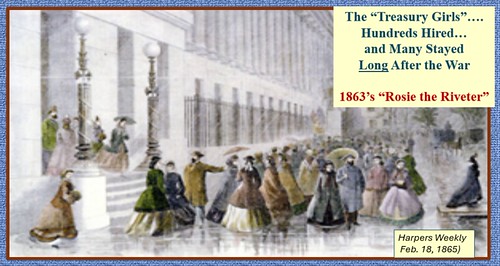

Love that article.

I knew about The Dulles, but not the brewery. Check it our if you're ever in the area.
I was a great event, and only an hour away from my house - shorter than my old commute to the office. It took a little longer to get home, but I made it in plenty of time for dinner with my family. A fun excursion. Look for the video online in future weeks.
To read the earlier E-Sylum article, see:
LECTURE: HOW THE CIVIL WAR CHANGED OUR MONEY
(https://www.coinbooks.org/v29/esylum_v29n40a10.html)
TRUMP DOLLAR ERROR
An error of the Trump Dollar has been certified, with the obverse missing the clad layer. Here's an excerpt - see the complete article online. -Garrett

A new Trump dollar error gives collectors two sharply different views of the same coin. The portrait side shows exposed copper. Turn it over, however, and the Presidential Seal retains the dollar's usual golden color.
The difference comes from an entire missing outer metal layer. MintErrorNews reports that NGC authenticated the 1776–2026 dollar, graded it MS 65, and awarded its Advance Releases™ designation.
Mike Byers Inc. quotes a $25,000 asking price in its sale description. Meanwhile, the reported weight provides another striking detail: this dollar weighs 6.1 grams, nearly one-quarter less than a normal example.

Why This Trump Dollar Error Shows Two Colors
The dollar's golden appearance starts with its metal construction. Two outer layers of manganese brass surround a pure copper core. Together, those three layers form the material that normally becomes a finished coin.
On this example, the obverse lacks its outer layer. As a result, the exposed copper forms the visible surface beneath Trump's portrait. The reverse still carries its normal manganese-brass layer and golden color.
The weight reflects that missing metal. An intact Trump dollar weighs 8.1 grams. By comparison, the discovery weighs 6.1 grams, a difference of 2.0 grams, or approximately 24.7%.
That shortfall gives collectors more to consider than color alone. It also explains why the coin's appearance and strike require an understanding of its unusual manufacture.
To read the complete article, see:
New Trump Dollar Error Discovery Has a Copper Face and a $25,000 Asking Price
(https://coinweek.com/new-trump-dollar-error-discovery-has-a-copper-face-and-a-25000-asking-price/)
GETTYSBURG ADDRESS QUARTER LAUNCH CEREMONY
The launch ceremony for the new Gettysburg Address Quarter will take place Wednesday at the Gettysburg National Military Park. Great opportunity to participate in numismatic history on hallowed ground. I'm scheduled to travel elsewhere that day or I'd be there myself. Here's the press release from the National Park Service. -Editor

On Oct. 21, 2026, Gettysburg National Military Park, in partnership with the United States Mint and the Gettysburg Foundation, will host a public ceremony at the Gettysburg Museum and Visitor Center at 11 a.m. to celebrate the release of the Gettysburg Address Quarter as part of the nation's 250th anniversary commemoration.
The event will feature remarks by U.S. Treasurer Brandon Beach, U.S. Mint Director Paul Hollis, Gettysburg National Military Park Superintendent Stephanie Stephens, and Gettysburg Foundation Acting President Barbara Sardella.
The ceremony will also include a Civil War-era brass band performance and a ceremonial coin pour into a reproduction black stove-pipe hat, similar to the famous hat President Abraham Lincoln was fond of wearing. Following the ceremony, the United States Mint will distribute free Gettysburg Address quarters in commemorative coin boards.
ACNB Bank will coordinate the on-site public coin exchange inside the Museum and Visitor Center at the conclusion of the ceremony. ACNB Bank will only accept cash during the coin exchange event. Please plan accordingly as there is no ATM at the Museum and Visitor Center. All events are free and open to the public.
To read the complete article, see:
United States Mint to Release Special 250th Anniversary Gettysburg Address Quarter on October 21
(https://www.nps.gov/gett/learn/news/usmint-gettysburgaddressquarter.htm)
See also:
Quarters honoring Gettysburg Address speech being distributed during public event
(https://www.abc27.com/gettysburg/quarters-honoring-gettysburg-address-speech-being-distributed-during-public-event/amp/)
THE 1897 CUBAN SOUVENIR PESO
Stack's Bowers Senior Numismatist Justin Katz published an article about the 1897 Cuba Souvenir Peso. Interesting - I wasn't aware of this piece. -Editor

In 1897, Cuban revolutionaries based in New York City sought to raise funds to support that island's struggle for independence from Spain. To accomplish this, they arranged for a commemorative coin to be produced and sold. As the United States maintained diplomatic relations with Spain at the time, the coin was produced by a private company rather than the U.S. Mint (which has historically produced coins for foreign countries as well as the United States). The coin's inscription reads "Souvenir" instead of "Peso," and collectors commonly refer to it today as the 1897 Cuba Souvenir Peso.
The coin was designed by Philip Martiny. The obverse features a personification of Liberty, while the reverse displays the Cuban coat of arms. The Gorham Manufacturing Company was contracted to produce 10,000 souvenir pieces and manufactured the dies used in their production. Three varieties of the 1897 Souvenir Peso are recognized:
- Type I — Wide Date, with a reported mintage of 828 pieces.
- Type II — Star Below the Baseline of 97: With a reported mintage of 4,286 pieces.
- Type III — Star Above the Baseline of 97: With a reported mintage of 4,856 pieces.
Currently on display at Stack's Bowers Galleries in Miami is a Type III example featuring the star above the baseline of 97, graded Mint State 61 by Numismatic Guaranty Company (NGC).
To read the complete article, see:
1897 Cuban Souvenir "Peso"
(https://stacksbowers.com/1897-cuban-souvenir-peso/)
LOOSE CHANGE: OCTOBER 18, 2026
Here are some additional items in the media this week that may be of interest. -Editor
Eric Hodge passed along this British Numismatic Society Research Blog article about the history of coin edge imaging, including the latest parabolic mirror techniques. Thank you! I've seen other discussions of the topic, but forget where - can anyone point us to other articles or monographs on the subject? -Editor
High-resolution images of the obverse and reverse of most coins are now widely available, either online
or in printed catalogues. Images of the edges of the coins, in contrast, are either absent or show only a
limited section.
For coins with a grained or plain edge, this is of little consequence. But where an edge inscription is present, the lack of photographs showing the entire circumference in a single view is a major obstacle to the researcher and collector.
This post reviews and compares currently available techniques for coin edge imaging at minimal cost.
Before the advent of digital photography, the solution was to roll the edge of the coin in a length of plasticine, producing a mirror-image of the inscription. This could then be cast in plaster to produce a right-reading model.
This appears to be the technique used by Linecar and Stone in English Proof and Pattern Crown-Size Pieces 1658–1960 (London: Spink & Son, 1968) to reproduce the edges of the Petition and Reddite crowns (see next page). This gives a satisfactory result in the case of the four-word inscription on the Reddite crown, but the 34 words arranged in two lines on the Petition crown are scarcely legible.
To read the complete article, see:
The forgotten die: experiments in coin edge imaging
(https://britnumsoc.blog/wp-content/uploads/2026/10/the-forgotten-die-experiments-in-coin-edge-imaging-1.pdf)
This video of an American Numismatic Society Long Table presentation by Scott Miller discusses a little-known gold medal presented to Martha Washington. Fascinating story. -Editor

Most numismatists would consider a "Washington Medal" as being one of several awarded to George Washington, or one of the many that depict the father of our country. However, America's first president was not the only Washington to receive a gold medal, and it is a much lesser-known fact that one was presented to Martha Washington by the city of Williamsburg towards the end of the Revolution. Join Scott Miller (ANS Fellow) as he traces the fascinating history of this medal from its presentation to Martha Washington, its travels to South America and Simón Bolívar, and its ultimate return to the United States.
To watch the complete video, see:
The Other Washington Gold Medal. LT276
(https://www.youtube.com/watch?v=lyKvA3cKBFk)
Bibliophiles should appreciate this essay on four classic scientific works offered by Sotheby's helped create the world we know today. -Editor
 The antidote for blithely accepting that mankind was predestined to stream podcasts on Netflix is to trace the scientific epiphanies that happened first. Exploring the Reason and Revolution auction at Sotheby's provides us with a chance to revel in the vibrancy of history as it reverberates in the present. Engaging directly with first editions from giants like Isaac Newton and Galileo Galilei amplifies their inestimable influence on those who later stood on their shoulders.
To hold in one's hands these landmark works in their original form is to be flung back through time into an advanced society being born. It collapses centuries of distance between the moment of discovery and the moment at hand, making concrete and un-ignorable the fact that these were indeed real people who unlocked mindblowing breakthroughs at a hinge point for humanity. The more time spent lingering on their crucial contributions, the harder it is to avoid seeing their fingerprints on every aspect of How We Live Now.
Let's examine a typical day in the third decade of the 21st century: Running errands requires the use of Google Maps to plan a route. In the split-second before the app spews out immaculate directions, we should probably thank Nicolaus Copernicus.
In what would be an epochal 1543 text, De revolutionibus orbium coelestium—or On the Revolutions of the Heavenly Spheres—Copernicus unveiled his heliocentric theory, explaining that Earth is not the stationary center of the universe but rather a planet that rotates on its axis while orbiting the sun. This was more than a reset for our ideas about outer space. It gave scientists a radically different way to think about Earth itself—not as a main stage on which the grand cosmic ballet plays out, but as just one twirling dancer among many.
That paradigm shift opened the door to a new era of increasingly precise calculations about where Earth is at any given moment, how it moves, and where other objects in the solar system should be. Over the centuries that followed, those calculations became the foundation for orbital mechanics, eventually allowing NASA to send rockets and satellites into space—and for us to use those satellites to find our way around Earth.
To read the complete article, see:
How Four Centuries-Old Books Changed Our World
(https://www.sothebys.com/en/articles/editorial-how-four-centuries-old-books-changed-our-world)
Also for bibliophiles, a new book from Oxford University Press highlights the "obsessive and majestic collecting of George John Spencer, 2nd Earl Spencer (1758-1834), the greatest of the Regency bibliomanes." and where many of the books came from. -Editor
 In 1790, the London bookseller Thomas Payne sold a copy of the Gutenberg Bible, the earliest printed book, to George John, 2nd Earl Spencer. He charged him £370 – an enormous sum at the time, roughly equivalent to £878,000 today – as part of a package deal which included two other early theological works. As part of the deal, Payne had the old book rebound in sumptuous midnight blue goatskin. In the process, signs of earlier provenance (ownership annotations, stamps or other marks which might have revealed the Bible's history) were carefully removed.
Nearly 230 years later, multispectral imaging (a process which captures multiple images across different wavelengths, including ultraviolet and infrared) has allowed historians to recover those lost inscriptions. My research has revealed that the Bible had belonged to the Augustinian friars of Colmar in northeastern France – a community whose library was being dismantled during the French revolution.
This discovery forms part of the research for my new book, Portrait of an Obsession: How England's Greatest Private Library was Built from the Ruins of Europe's Monasteries. It offers a window onto how Britain's wealthiest collectors acquired rare books as Europe's monasteries were being dissolved, looted and destroyed. Priceless intellectual heritage was erased almost overnight.
English booksellers and book collectors used agents on the ground in France, Germany and Italy to buy books from threatened libraries, coerce their owners into sale, or, if everything else failed, simply steal the desired items. They did so secure in the knowledge that the homes of these books would soon be broken up anyhow.
The moment popularised the term "bibliomania", as some of the richest men and women in England competed against each other to pay eye-watering prices for Europe's oldest and rarest books.
And in time, America's wealthiest collectors acquired rare books and artwork from Europe. And today, I don't know about rare books, but a lot of artwork sold today ends up in Asia, sold yet again to the highest bidders. -Editor
To read the complete article, see:
When Europe's monastic libraries were looted, Britain's richest book collectors went hunting
(https://theconversation.com/when-europes-monastic-libraries-were-looted-britains-richest-book-collectors-went-hunting-290690)
ABOUT THIS ISSUE: OCTOBER 18, 2026
In the cash-is-back-in department, more and more businesses are tacking on percentage-based fees for accepting credit cards. My wife and I both are finding that our doctors are now charging these fees for copays paid with credit cards. This practice was once pretty rare. I refused to go back to one restaurant once they surprised me with a fee. We're a little more understanding of a favorite local Mom-and-Pop restaurant and I try to have cash ready when we go there. But it gets ugly when the car dealership springs this fee on you for a four-figure repair, which happened to my wife a couple weeks ago. They'll happily tell you that "for convenience" they'll accept debit cards or cash, and neither option is the least bit convenient. Quick - do you know exactly how much of your current checking account balance is unaccounted for? Luckily I had time to go home and check and move some funds to ensure a debit transaction wouldn't lead to multiple other failed transactions. And where is an open branch of your bank when you need one? ATMs have daily withdrawal limits, so even if you have enough funds in your account, getting a larger amount of cash in a hurry is problematic.
This week one of my doctors' offices sprung this fee on me, and said they could alternately take an debit card or cash. I giddily opened my wallet and took out the $100 bill I keep handy for that restaurant. So then they tell me they can't make change. Now I count up the rest of the bills and fall short. I was pissed and paid with a debit card under protest.
As it happened, I had to go back to the same office for a different appointment later in the afternoon. At lunch I was delighted that (a different) restaurant was willing to take my hundred and give me change. On my way out of the appointment I learned that my charge was more than I'd expected - $100. I madly counted up the bills in my wallet and again came up short. One more debit card transaction to deal with.
Now I was actually quite happy with my experience otherwise - I'd gotten a fresh hearing test and had my hearing aids adjusted to a much better level. I was delighted, actually. But that nuisance credit card fee left a bad taste in my mouth.
Speaking of my mouth, I've gotten a new one since retiring. The overall process took many months, but I replaced two missing molars with dental implants. With my new bionic teeth, I can chew through prison bars.
I've had the opportunity to see more films since retiring. I always look for numismatic scenes and connections, but don't always find one. Saturday I attended a screening of a new documentary - Occupational Hazard: The First Coral Reefers, about the early members of Jimmy Buffett's Coral Reefer Band. I'm no Parrot Head, but went with neighbors to a Buffet concert in August 2022, just a year before Buffett died. We had a great time, and as a history buff I was curious to see the film. It was interesting, with archival footage and interviews with band members, managers and friends who were there when it all happened. Not a single numismatic connection, but plenty of fun nonetheless. See https://occupationalhazardfilm.com/ .
Finally, here are a few interesting non-numismatic articles I came across this week.
8 Things Invented by People You Never Would've Guessed (https://interestingfacts.com/things-invented-by-famous-people-you-wouldnt-expect/)
He reached the Americas centuries before Columbus. Why doesn't he get more credit? (https://www.washingtonpost.com/world/2026/10/12/leif-erikson-reached-americas-before-columbus-why-doesnt-he-get-more-credit/)
Boomers Didn't Always Have It So Easy (https://www.nytimes.com/2026/10/10/opinion/millennial-boomer-young-adult.html)
-Editor

Editor Wayne Homren, Assistant Editor Garrett Ziss
Wayne Homren
Wayne Homren is the founding editor of The E-Sylum and a consultant for the Newman Numismatic Portal. His collecting interests at various times included U.S. Encased Postage Stamps, merchant counterstamps, Pittsburgh Obsolete paper money, Civil War tokens and scrip, Carnegie Hero Medals, charge coins and numismatic literature. He also collects and has given presentations on the work of Money Artist J.S.G. Boggs. In the non-numismatic world he's worked in artificial intelligence, data science, and as a Program Manager for the U.S. Department of Defense.
Garrett Ziss
Garrett Ziss is a numismatic collector and researcher, with a focus on American paper money and early U.S. silver and copper coins. He is also a part-time U.S. coin cataloger for Heritage Auctions. Garrett assists Editor Wayne Homren by editing and formatting a selection of articles and images each week. When he's not engaged in numismatics, Garrett is pursuing a Master's Degree in Quantitative Economics at the University of Pittsburgh.

Contributors Pete Smith and Greg Bennick
Pete Smith
Numismatic researcher and author Pete Smith of Minnesota has written about early American coppers, Vermont coinage, numismatic literature, tokens and medals, the history of the U.S. Mint and much more. Author of American Numismatic Biographies, he contributes original articles to The E-Sylum often highlighting interesting figures in American numismatic history.
Greg Bennick
Greg Bennick (www.gregbennick.com) is a keynote speaker and long time coin collector with a focus on major mint error coins and US counterstamps. He is on the board of both CONECA and TAMS and enjoys having in-depth conversations with prominent numismatists from all areas of the hobby. Have ideas for other interviewees? Contact him anytime
via instagram @minterrors.
He can also be reached by email at
minterrors@gmail.com.

Website host John Nebel and webmaster Bruce Perdue
John Nebel
Numismatist, photographer, and ANS Board member and Fellow John Nebel of Boulder, CO helped the ANA and other clubs like NBS get online in the early days of the internet, hosting websites gratis through his Computer Systems Design Co. To this day he hosts some 50 ANA member club sites along with our
coinbooks.org site, making the club and our E-Sylum archive available to collectors and researchers worldwide.
Bruce Perdue
Encased coinage collector (encasedcoins.info) Bruce Perdue of Aurora, Illinois has been the volunteer NBS webmaster from its early days and works each week to add the latest E-Sylum issue to our archive and send out the email announcement.

|
|
The E-Sylum is an electronic publication of the Numismatic Bibliomania Society Copyright © 1998 - 2026 | |