Visit our NBS Sponsors









About UsThe Numismatic Bibliomania Society is a non-profit association devoted to the study and enjoyment of numismatic literature. For more information please see our web site at coinbooks.org SubscriptionsThose wishing to become new E-Sylum subscribers can go to the following web page
Subscribe
MembershipThere is a membership application available on the web site Membership Application To join, print the application and return it with your check to the address printed on the application. Print/Digital membership is $40 to addresses in the U.S., and $60 elsewhere. A digital-only membership is available for $25. For those without web access, write to: Jeff Dickerson, Treasurer AsylumFor Asylum mailing address changes and other membership questions, contact Jeff at this email address: treasurer@coinbooks.org SubmissionsTo submit items for publication in The E-Sylum, write to the Editor at this address: whomren@gmail.com BUY THE BOOK BEFORE THE COIN |
- WAYNE'S WORDS: THE E-SYLUM OCTOBER 25, 2026
- KOLBE & FANNING WEB SALE NUMBER 7
- NEW BOOK: CLASSICAL AND HELLENISTIC EQUINE CURRENCY
- NEW BOOK: COINAGE OF HAIDAR ALI AND TIPU SULTAN
- NEW BOOK: UMAYYAD POST-REFORM GOLD COINAGE
- NEW BOOK: THE COINAGE OF COLONIAL AFRICA
- NEW BOOK: INDEPENDENT STATE OF CROATIA BANKNOTES
- NNP ADDS BARNSLEY SCRAPBOOKS ON NEW JERSEY COINAGE
- VIDEO: HOWARD FRANKLIN BOWKER
- EXHIBIT: DECLARING INDEPENDENCE USA 250
- IAPN BEST NUMISMATIC PUBLICATION CEREMONY
- NOTES FROM E-SYLUM READERS: OCTOBER 25, 2026
- DANSCO, FRANKLIN MINT AND NORMAN ROCKWELL
- MACQUARIE UNIVERSITY'S ANCIENT COIN COLLECTION
- QUEENS COLLEGE ANCIENT COIN LAB
- VOCABULARY TERM: SUPPORT POINTS
- COMMENTS ON ILLUSTRATIONS
- NUMISMAGRAM MEDAL SELECTIONS: OCTOBER 25, 2026
- HOLABIRD JACK HADDOCK NEVADA TOKENS, PART 3
- KUENKER AUCTION SALE 448
- NAC NOVEMBER AUCTIONS 169, 170, 171
- WAYNE'S NUMISMATIC DIARY: OCTOBER 25, 2026
- ANCIENT CARIA: WHERE EMPIRES COLLIDED
- CELTIC QUINARII UNEARTHED IN GERMANY
- SBG: BENITO JUAREZ'S STORY THROUGH COINS
- ARGENTINE CHACHOS QUASI-CURRENCY RETURNS
- FIRST WELSH SIGNATURE ON UK BANKNOTES
- LOOSE CHANGE: OCTOBER 25, 2026
- ABOUT THIS ISSUE: OCTOBER 25, 2026
Content presented in The E-Sylum is not necessarily researched or independently fact-checked, and views expressed do not necessarily represent those of the Numismatic Bibliomania Society.
WAYNE'S WORDS: THE E-SYLUM OCTOBER 25, 2026
 New subscribers this week include:
Vincenzo Fazeli,
Scott Dittus, and
Michael Hallihan.
Welcome aboard! We now have 6,316 subscribers.
Thank you for reading The E-Sylum. If you enjoy it, please send me the email addresses of friends you think may enjoy it as well and I'll send them a subscription. Contact me at whomren@gmail.com anytime regarding your subscription, or questions, comments or suggestions about our content.
This week we open with a numismatic literature sale, five new books, updates from the Newman Numismatic Portal, the George Washington Indian Peace medal, and more.
Other topics this week include equine currency, coinage of colonial Africa and banknotes of the Independent State of Croatia, updates from the Newman Portal, IAPN, Macquarie University and Queens College, fixed price and auction selections, Celtic quinarii and Argentine Chachos.
To learn more about Hispano-Arab numismatics, award medals issued by the Russian state, Howard Franklin Bowker, the Heeren Brothers, new $100 bills in Sri Lanka, Dansco and Norman Rockwell, support points, the Plague of Locusts silver medal, Nevada tokens, my numismatic diary, John Roots Bitters, SS Republic half dollars, the PAN Banquet, Ancient Caria, Benito Juárez, a 1660 Irish Marriage Locket, the Wabanaki Confederacy and a reverse "Castaing machine" for edge images, read on. Have a great week, everyone!
Wayne Homren
Editor, The E-Sylum

Image of the week
KOLBE & FANNING WEB SALE NUMBER 7
Numismatic Booksellers Kolbe & Fanning will hold a new web sale on Wednesday, November 4, 2026. Here's the announcement. -Editor

We will be holding Web Sale #7 of Numismatic Books on Wednesday, November 4, starting at 12:00 PM Eastern. This sale focuses on inexpensive but useful books, catalogues and other publications on coins from all times and places. It will take place live online and all lots in the Web Sale will begin at a very low $10 opening bid.
The sale is notable for including many books on Islamic and Russian numismatics from the respective libraries of Michael Bates and Igor Shneyderov.
Bidders may register for the sale, browse lots, and place absentee bids beginning immediately at bid.numislit.com.


The 1928 Ars Classica sale including material from the Attatini & Churchill collections.
The 1974 Kunstfreundes sale by Bank Leu & Münzen und Medaillen.
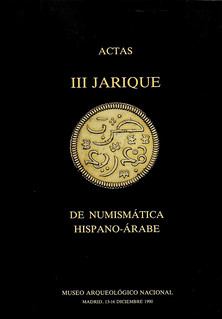

The proceedings of the third colloquium on Hispano-Arab numismatics.
Bittar on the evolution of inscriptions on Islamic coins.


Burn's 1853 study of London tokens, inscribed by the author in the year of publication.
Chepurnov on award medals issued by the Russian state.


Glendining's 1972 sale of Russian coins from the collection of Michele Baranowsky.
David Akers's catalogues of the John Jay Pittman American coins.
 Bob Julian's signed contributor copy of the 1984 Red Book, one of a number of signed Red Books in the sale.
Register early to bid online
Kolbe & Fanning use Auction Mobility as our third-party online bidding platform, which is separate from our retail site. Auction Mobility is an app-based platform allowing users the ability to participate in the sale through phones, tablets and computers. To register for the sale, bidders must go to
bid.numislit.com and sign up. Once you have set up an account, you may browse lots, place advance bids, or participate in the live sale online. Those wishing to participate on their devices can download the Kolbe & Fanning app through the Apple or Google Play Store.

NEW BOOK: CLASSICAL AND HELLENISTIC EQUINE CURRENCY
Rosanagh Mack's new book Equine Currency: Thessalian Coinage and the Horse in the Classical and Hellenistic Periods, published by Archaeopress, is available. Here's information from the publisher's site. -Garrett
 Equine Currency reinterprets the coinage of ancient Thessaly and Perrhaibia through the region's famed horse culture. By analysing coin imagery, production and context, it explores the political, economic and cultural importance of horses, while revealing Thessaly's connections with the wider ancient Mediterranean world.
Equine Currency presents a fresh approach to Thessalian coinage, considering the political, cultural and economic context for the production of coinage in Thessaly and Perrhaibia. In antiquity, the Thessalians were renowned for their horses and horsemanship, and their cavalry was much sought after by their allies. The centrality of the horse to Thessalian life is reflected by the use of the horse for the majority of their coin types.
The study takes a chronological and thematic approach. An analysis of why the land of Thessaly was so well suited to the equine is followed by an examination of the first issues of Larisa, the bull wrestling coinage, the purported issues ‘of the Thessalians', the pastoral coinage which relates to horse production, images of the male horse and finally, the horse and rider, in the cavalry, hunting and daily life. Examination of the coins' iconography reveals how the horse and the rider are presented, previous interpretations are revised, and attention is drawn to rare evidence for equipment not seen in other visual media. Thessalian engagement with artistic trends elsewhere is illuminated, demonstrating that Thessaly was part of a connected network, with Makedon to the north, Sicily to the west, Asia Minor and Persia to the east, and Athens and Korinth to the south.
Rosanagh Mack received her PhD in Classics from the University of Reading in 2022, where she is currently a Research Associate in the Department of Classics, continuing her research in the coinage and history of Thessaly. She is also the General Editor of the journal KOINON: The International Journal of Classical Numismatic Studies.
For more information, or to order, see:
Equine Currency: Thessalian Coinage and the Horse in the Classical and Hellenistic Periods
(https://www.archaeopress.com/Archaeopress/Products/9781805833628)

NEW BOOK: COINAGE OF HAIDAR ALI AND TIPU SULTAN
The new book Coinage of Haidar Ali and Tipu Sultan by Purnanand B. Sanket, Heinz Bons, and Mohit Kapoor, is available. Here's information from the publisher's site. Found via Journal of the Oriental Numismatic Society 264 Summer 2026. -Garrett
About the Book
 The coinage of Haidar Ali and Tipu Sultan represents a unique confluence of political assertion, military ambition, and monetary innovation. These coins are more than metal; they are chronicles of a transitional moment in South Indian history when the Mysore Kingdom rose to resist colonial expansion and asserted its sovereignty not just through battlefields, but through mints, symbols, and script. For over a century, the most referenced guide to this numismatic legacy was J R Henderson's The Coins of Haidar Ali and Tipu Sultan, published in 1921. Henderson's work was pioneering for its time, and its clarity and structure have served as a foundation for collectors and scholars alike. However, much has changed in the field since then.
In the last few decades, new discoveries, enhanced access to archival material, digitized museum records, and an increasingly active collector community have brought to light a wide array of coins not documented in Henderson's catalogue. Additional mints, both official and vassal, have been identified. New typologies have surfaced. Inscriptions once dismissed as blundered have been re-read, weights re-verified, and dates realigned using both Hijri and Mauludi calendrical systems. The understanding of the political context in which these coins were struck, across regions like Cuddapah, Dindigul, Chitradurga, and Gooty, has deepened significantly. It was with this backdrop that the need for a new, comprehensive, and updated catalogue became clear. This book aims to be that modern reference. It presents an expansive catalogue of the coinage issued during the reigns of Haidar Ali and Tipu Sultan.
About the Authors
Purnanand B. Sanket, born in Mysore, India, developed a deep interest in numismatics early in life, particularly focusing on the coinage of Ancient Karnataka and Mysore. He pursued a Bachelor's degree in Pharmacy and later completed a Master's in Numismatics and Archaeology from Mumbai University in 2015. His passion for historical research led him to earn a Post Graduate Diploma in Manuscriptology and Palaeography from the Indira Gandhi National Centre for the Arts (IGNCA) in 2020. In recognition of his dedication to Mysore coinage, Sanket was awarded the prestigious Nicholas Lowick Fellowship by the Royal Numismatic Society (UK) in 2014, which enabled him to study important collections across British and European museums. He continues to contribute to the numismatic field as a cofounder of the Centre of Indian Numismatic Studies (COINS) and holds life memberships in the Numismatic Society of India, the Mumbai Coin Society, and the Karnataka Numismatics Society. His articles and research papers have been published in leading numismatic journals, including the Numismatic Digest, the Oriental Numismatic Society, and the South Indian Numismatic Society. Sanket's meticulous scholarship and passion for Mysore coinage bring academic depth and precision to this volume on the coinage of Haidar Ali and Tipu Sultan.
Heinz Bons, from Kevelaer, Germany, is an IT consultant with a distinguished career in software quality assurance and systems consulting. Alongside his professional pursuits, Heinz nurtured a lifelong fascination with coins, which began with his first acquisition as a young man. Over the years, his numismatic interests steadily deepened, particularly in the coinage of Southeast Asia and India. From the beginning Mysore was one of his favourite coins areas for collection. A long-standing member of the Oriental Numismatic Society, Heinz has actively shared his expertise with the global numismatic community, including delivering a lecture on Mysore coinage at the 1992 ONS meeting in Leiden. His approach combines technical precision with a passion for historical detail, and through his work on this book, he brings a structured, analytical lens to the study and cataloguing of Haidar Ali and Tipu Sultan's coinage.
Mohit Kapoor, born and raised in Mumbai, India, was introduced to the world of numismatics at a young age by his father, Shri Rameet Kapoor, an avid collector. Captivated by the history and artistry of coins, Mohit soon developed a collection of his own, which has grown to include coins from the Vijayanagar Empire, Mughal rulers, princely states, British India, and global coinages. He holds a Master's degree in Numismatics and Archaeology from Mumbai University and has made significant contributions to the field as a researcher, auctioneer, and author. He co-authored the well-regarded book The Nawabs and Kings of Awadh and their Coinage in 2018, a richly illustrated volume that has been widely referenced. In Coinage of Haidar Ali and Tipu Sultan, Mohit provided valuable inputs throughout the research and cataloguing process, contributing to the structure and clarity of the work. His keen eye for detail and practical understanding of coinage have helped refine the catalogue and enhance the overall presentation. As the Director of Imperial Auctions, he has played a key role in shaping the numismatic auction landscape in India. Mohit is also the Regional Secretary for South Asia of the Oriental Numismatic Society and the founder of the Centre of Indian Numismatic Studies (COINS), an NGO dedicated to promoting numismatic knowledge across India. His active involvement in numismatic exhibitions, lectures, and collaborative research continues to enrich the numismatic community.
Kuleshov, V. (2026) Umayyad Post-Reform Gold Coinage: A die corpus, AH 77–132 Tallinn, Triactor Publishing, 511 pages, €125, ISBN 978-9916438329
For more information, or to order, see:
Coinage of Haidar Ali and Tipu Sultan
(https://royalasiaticsociety.org/event/coinage-of-haidar-ali-and-tipu-sultan-book-launch/)

NEW BOOK: UMAYYAD POST-REFORM GOLD COINAGE
Viacheslav Kuleshov's new book Umayyad Post-Reform Gold Coinage is available. Here's information from the publisher's site. Found via Journal of the Oriental Numismatic Society 264 Summer 2026. -Garrett
 The first comprehensive die corpus of Umayyad post-reform gold coinage, AH 77–132. Based on 3,114 coins, it identifies 1,905 obverse and 1,984 reverse dies — an essential reference for collectors, researchers, and auction houses specialising in Islamic numismatics.
The first comprehensive die corpus of Umayyad post-reform gold coinage — an essential reference work in Islamic numismatics.
This volume documents all known gold dinars of the Umayyad Caliphate from AH 77 to AH 132 (696/697–749/750 AD), based on a dataset of 3,114 coins. The study identifies 1,905 obverse dies and 1,984 reverse dies through large-scale die-link analysis. The reconstruction of die chains and die relationships refines chronological sequences and contributes to a more precise understanding of production patterns within the Umayyad monetary system.
The volume includes a complete die corpus arranged by date, identification and mapping of die links and die chains, analysis of epigraphic formulas and their variations, high-quality illustrations supporting die comparison, and an apparatus facilitating cross-reference and citation. Intended for collectors, researchers, libraries, museums, universities, and auction houses specialising in Islamic numismatics.
Kuleshov, V. (2026) Umayyad Post-Reform Gold Coinage: A die corpus, AH 77–132 Tallinn, Triactor Publishing, 511 pages, €125, ISBN 978-9916438329
For more information, or to order, see:
Umayyad Post-Reform Gold Coinage
(https://isdistribution.com/work/umayyad-post-reform-gold-coinage/)

NEW BOOK: THE COINAGE OF COLONIAL AFRICA
Professor Frederik Tielens of the Free University of Brussels has published a new book on the coinage of colonial Africa. Here's the announcement. -Editor
 Frederik Tielens brings together the history of European colonial expansion and the coins that circulated across the African continent.
The Coinage of Colonial Africa: An Historical Overview is a new English-language reference work by Belgian author Frederik Tielens. Moving beyond the format of a conventional coin catalogue, the book places official colonial coinage within the political, commercial and monetary history of Africa.
Its geographical and chronological scope is unusually broad. Beginning with Portuguese expansion in the fifteenth century and extending through the era of decolonization, the volume explores the monetary legacies of Portuguese, Spanish, Dutch, Scandinavian, French, British, Belgian, German and Italian involvement in Africa.
Alongside major colonial issues, Tielens examines less familiar monetary histories, including the rupee of German East Africa, the coins of the Congo Free State and Belgian Congo, and the distinctive coinages of Italian territories.
The book also discusses African states that remained independent, the widespread circulation of the Maria Theresa thaler, and earlier forms of exchange such as cowrie shells, manillas and Katanga crosses. Its combination of historical narrative and numismatic detail is intended for collectors, researchers and readers interested in African history.
Developed from more than a decade of research and earlier numismatic publications, the volume offers a continent-wide perspective on how coins reflect colonial administration, trade and changing political authority.
Scope and approach
The chapters are organized principally by colonial power and broadly by the chronology of European
expansion. They introduce the relevant territorial history, political developments and monetary arrangements
before discussing colonial coinage. The coverage includes powers whose African presence predated the late
nineteenth-century Scramble for Africa, as well as the major imperial administrations that emerged thereafter.
The principal focus is official coinage directly associated with European colonial rule. The author deliberately excludes specialist coverage of tokens, patterns and varieties. Certain independent or partially independent territories are considered where their monetary history was closely linked to European influence. Separate thematic chapters address the Maria Theresa thaler and selected forms of traditional African money.
Readers and reference value
The book is aimed at numismatists, collectors of world and colonial coinage, historians, museum and library
collections, and readers interested in African history. Its distinctive contribution is to bring together many
colonial powers and territories in a single historical narrative, while keeping coins and monetary
developments at the centre of the account.
The volume includes a bibliography, an appendix on former African territories and colonies, and indexes of geographical names and currencies. These reference tools support readers who wish to follow a particular territory, currency or colonial administration across the wider historical account.
BOOK DETAILS
- TITLE: The Coinage of Colonial Africa: An Historical Overview
- AUTHOR: Frederik Tielens ·
- YEAR:2026
- LANGUAGE: English
- PAGES: 340
- ISBN 979-8246532935 (Paperback)
- ISBN 979-8250004534 (Hardcover)
- AUTHOR WEBSITE: www.frederiktielens.com
For more information, or to order, see:
The Coinage of Colonial Africa: An Historical Overview
(https://www.amazon.com/dp/B0GQM2S3SP)
he Coinage of Colonial Africa: An Historical Overview
(https://www.amazon.com/Coinage-Colonial-Africa-Historical-Overview/dp/B0GMV22B5W/)

NEW BOOK: INDEPENDENT STATE OF CROATIA BANKNOTES
Dusty Dragicevic writes:
"An interesting new book has been published and I thought that E-Sylum readers would be interested. It is written in Croatian, with an abstract written in English. A scrupulously researched topic on the numismatic history of the short lived Nazi puppet state of the Independent State of Croatia during World War II."
Thank you for letting us know. Dusty also provided this summary with information on where to purchase a copy. -Editor
Novcanice NDH: Neispricane price
Banknotes of the Independent State of Croatia: Untold Stories
By Vedran Krušelj
 Novcanice NDH: Neispricane price explores the banknotes issued or planned by the Independent State of Croatia during the Second World War, revealing the stories behind their design, production and circulation.
Combining numismatic research with historical context, it examines the designers, people, clothing and cultural imagery represented on the notes.
The book documents 20 issued or planned banknotes, with detailed coverage of paper, dimensions, printing techniques, numbering systems, watermarks, replacement notes, varieties and errors. Archival records, printing contracts, contemporary newspaper reports and extensive references support the research, taking the reader beyond basic identification and into the development of each issue.


Notable subjects include the proposed 10,000-kuna banknote dated 1943 and a digital reconstruction of the 50,000-kuna design dated 1945, preserved only as an artist's sketch. The book also investigates the identities of individuals depicted on the notes and the lives of the artists responsible for their designs.
Published in Zagreb in 2026, this 391-page, full-colour A4 hardcover is written in Croatian with an English abstract. It offers collectors and researchers a detailed historical and technical reference rather than a catalogue of market prices.


Contact the author directly at:
https://www.facebook.com/share/p/19s3CKXJHG/
or by email at
notaphilia.neglecta@gmail.com
To order online, see:
Knjiga Novcanice NDH: Neispricane price
(https://kolekcionar.hr/item/174957-knjiga-novcanice-ndh-neispricane-price)

NNP ADDS BARNSLEY SCRAPBOOKS ON NEW JERSEY COINAGE
The latest additions to the Newman Numismatic Portal are Ned Barnsley's scrapbooks on New Jersey Coinage. Project Coordinator Len Augsburger provided the following report. -Editor


NNP Adds Ned Barnsley Scrapbooks on New Jersey Coinage
Courtesy of Ray Williams, the Ned Barnsley scrapbooks on New Jersey colonial coinage are now available on Newman Portal. The two volumes represent a compilation of memoranda, correspondence, and photocopied clips from periodicals and auction catalogs. Data includes pedigree information for individual examples, notes on die varieties, and a host of documentation on other topics, such as Barnsley's 1959 inquiry to the U.S. Copyright Office on the status of the Maris (1881) volume, A Historic Sketch of the Coins of New Jersey.
Photocopies of these scrapbooks have circulated among the New Jersey colonial cognoscenti for some time, with a finely bound copy appearing in the Syd Martin library sale (Kolbe & Fanning 163, April 30, 2022), which realized $1,900. This content is complemented by the Newman-Barnsley correspondence already available on NNP, over 300 pages and covering the period 1958-1977.
Link to Ned Barnsley Scrapbooks on NNP:
https://nnp.washu.edu/numismatics-archives-list/list/archives-subcollection/58381
Link to Newman-Barnsley Correspondence on NNP:
https://nnp.washu.edu/Documents/Detail/edward-barnsley-correspondence/6616124

VIDEO: HOWARD FRANKLIN BOWKER
The David Lisot Video Library on the Newman Numismatic Portal can be found at:
https://nnp.wustl.edu/library/multimediadetail/522852
We highlight one of his videos each week in The E-Sylum. Here's one from 2016 where Howard Franklin Bowker receives the Nicholas P. Brown Lifetime Achievement Award. -Editor

Howard Franklin Bowker receives the Nicholas P. Brown Lifetime Achievement Award at the 2016 ANA World's Fair of Money in Anaheim, CA.
To watch the complete video, see:
Nicholas P. Brown Lifetime Achievement Award
(https://youtu.be/MPfRIc3LEIE)
Nicholas P. Brown Lifetime Achievement Award
(https://archive.org/details/ANA16025NickBrown_1)

EXHIBIT: DECLARING INDEPENDENCE USA 250
Not sure how I missed this, but the British Museum has a nice exhibit honoring the semiquincentennial of the U.S., and the headline artifact is a medal I was unaware of. Hand engraved, it shows a crude portrait of George Washington ("GW"), and on the reverse is a crude American Indian warrior and a column displaying thirteen hands, representing the colonies. Here's the exhibit description. It runs through November 29th. -Editor

250 years ago, on 4 July 1776, the Thirteen British Colonies in North America adopted the Declaration of Independence, breaking away from the British Crown and founding the United States of America.
Introduced through the story of the Washington Peace Medal, the display highlights material traditions of allegiance and treaty-making that shaped this pivotal moment in history. Made in Boston in 1777, the medal was presented by the Revolutionaries to members of the Wabanaki Confederacy as part of a treaty of friendship and alliance against the British. Soon after, British forces confiscated the medal under threat of military force and presented it to King George III as a war trophy. Passing through the hands of all three groups, the medal reveals the competing diplomatic and political interests at the heart of the conflict.
Indigenous Peoples played a vital role throughout the War of Independence, forming alliances with both sides while navigating the human consequences of shifting political powers. Through treaties, diplomatic gifts and acts of resistance, the exhibition uncovers the global and deeply interconnected histories behind the founding of the United States.
This powerful display features a rare handwritten manuscript copy of the Declaration of Independence and ceremonial gifts exchanged between Indigenous Nations, the British and the Revolutionaries. A wampum belt and pipe tomahawk show how objects were used to negotiate diplomacy, loyalty, and land rights.
For more information, see:
Declaring independence USA 250
(https://www.britishmuseum.org/exhibitions/declaring-independence-usa-250)
Blogger Annette Laing recently visited the museum. Here's an excerpt from her account - see the complete article online. -Editor
While the Bayeux Tapestry was allocated the spacious and prestigious Sainsbury gallery, Declaring independence is crammed into a tiny nook off the Museum's main entrance, a space that bears the non-prestigious name of, um, Room 3.
The Bayeux Tapestry exhibit includes a gift shop full of exclusive merch, including a lavishly-illustrated and eye-wateringly expensive hardback souvenir guidebook. The exhibit is announced by huge colorful banners throughout the British Museum, including on the famous forecourt.
By contrast, Declaring independence: USA 250 offers a free leaflet and no exclusive merch, and is only advertised by these three teeny, drab, and wrinkly posters.


Here are my best efforts to photograph the star attraction, a very small silver medal, as it slowly revolved on a stick in its glass case:


This medal, I learned, was presented to the Wabanaki Confederacy by the American Revolutionaries, which is why the face on the front is George Washington's, not King George III. It's the only one of the three gifts that was actually presented during the War for Independence.
This wasn't some condescending pat on the head from General Washington to the Wabanaki Confederacy. You don't give custom-made bling to people who don't matter, and especially not during a massive war.
The British Museum is telling us that Native peoples were NOT helpless bystanders or victims before, during, or after the War for American Independence. Indigenous military support was valued by both sides—and for good reason.
Let me shout this: Both the British-American Revolutionaries and the British Government in London took Native nations seriously. Indians were major power players, and everyone knew it, including Native people themselves.
In the small print, we learn that the medal was crafted by colonial America's most wealthy and famous silversmith, Paul Revere of Boston, suggesting that it was sufficiently important that the contract was given to a distinguished craftsman. It was then formally presented as a gift to the Wabanaki Confederacy, during negotiations for Wabanaki military support against Britain. It was not mailed to them, or informally handed out. This was a significant gift, and in more ways than one: The Wabanaki Confederacy turned out not to be its only recipient.
As the war raged, things changed. The Revolutionary Army had a setback in Maine. Sure, the Wabanaki remained consistent in their policies: They were concerned for their own interests in the outcome of the War. But now that circumstances had altered, they exercised their independence. They signed a treaty with the British, who demanded this silver medal as part of the deal.
So the medal was now sent across the Atlantic to London, where it was presented as a gift to King George III. I can only guess that the King was amused, outraged, or both, by a medal bearing the crude image of Upstart George, not his own picture.
The medal was gifted again. Five years after the King's death, his son and successor, King George IV, donated the medal to the British Museum. It's been there ever since, I assume, stashed away in the Museum stores, and seldom or never on display—until now.
This medal is a symbol of diplomacy between Native and non-Native governments, of shifting loyalties in a dynamic situation (think of any war you know well, and you will likely see the same thing happening, Ukraine, cough),
Native Nations weren't being nice or obliging or easily bribed when they threw their support behind one side or the other. They were, we should not be surprised to realize, doing whatever it took to protect their peoples, their lands, and their own independence from attack. Wouldn't you do the same if that were you?
To read the complete article, see:
Bayeux, Bayeux, Missed American Ties
(https://annettelaing.substack.com/p/bayeux-bayeux-missed-american-ties)
The Newman Numismatic Portal helped me locate an article about this medal in the 1992 Proceedings of the Coinage of the Americas Conference No. 7: Money of Pre-Federal America. It's illustrated on page 171 in Alan Stahl's article, "American Indian Peace Medals of the Colonial Period." Stahl called the attribution of the medal to Paul Revere "an attractive but as yet unproven hypothesis." -Editor


IAPN BEST NUMISMATIC PUBLICATION CEREMONY
IAPN held their Best Numismatic Publication Award Ceremony at the Curia Julia in the Roman Forum. Here is the press release. -Garrett
 On 14 October 2026, the International Association of Professional Numismatists (IAPN) awarded its annual prize for the best numismatic book of the previous year at a ceremony conducted at the Curia Julia (the Senate House) in the Roman Forum. The awardee was Stefano Bertuzzi, for his 3-volume magnum opus, Corpus Numismatum Omnium Romanorum Pontificum: Pio IX nelle medaglie, nelle croci capitolari e nella faleristica [Corpus Numismatum Omnium Romanorum Pontificum: Pius IX in medals, capitular crosses and phaleristics], published by Edizioni D'Andrea in Rome.
Umberto Moruzzi and Moruzzi Numismatics organized the event as a follow-up to a successful IAPN Congress held in Rome at which Mr. Bertuzzi's work was voted the winner of this year's prize.
Mr. Moruzzi reflected on the event as follows:
The setting was magnificent — just think, that extraordinary hall was once the meeting place of the Roman Senate! In addition to the 50–60 people attending in person, the conference was streamed live by the Ministry of Culture, giving it a much, much wider reach.
The regional television news program, TG3 Lazio, filmed extensively, and I believe we may receive television coverage.
A number of speakers took part, and their contributions were substantial and thought-provoking. Particularly important were the remarks by Professor Arnaldo Morace Pinelli, who also spoke via video at the IAPN Congress, and above all those of the Director-General of the Ministry of Culture, who spoke strongly in favor of private collecting and a more liberal approach to the numismatic market. Peter Preston-Morley, the Chairman of the IAPN Publication Committee, also gave an excellent speech, available here: IAPN Book Prize 2026 award speech.pdf.
The Book Prize ceremony was a deeply felt occasion, and the winner was visibly moved at times. Afterwards, everyone spoke of what an exceptional event it was, praising both the contributions I have mentioned and the prize-winning book. I believe it was a wonderful opportunity to promote the IAPN and numismatics as a whole.
Since 1982, IAPN has annually conducted its book prize award honoring numismatic authors for what the organization considers "the best numismatic publication of the year". This year 27 books were entered for the Prize, four from Asia, 16 from Europe and seven from North America.
This year's second and third place winners received their awards in conjunction with numismatic events held in the United States and United Kingdom. Daniel Sedwick received his second-place award for Arce's Doubloons: A die study of the Colombian gold cob coinage of assayer Arce in the name of Charles II, 1692-1714. That award was given on August 26, 2026, at the IAPN Cocktail Party held in conjunction with the American Numismatic Association's World's Fair of Money in Pittsburgh, Pennsylvania. See https://www.iapn-coins.org/general-news/13686240. The third-place winner, Sir Mark Jones, received his award for William Wyon, published by Spink at the British Numismatic Society's Summer Meeting, which this year was held in Edinburgh, Scotland, on June 27, 2026.
To read the complete article, see:
IAPN Best Numismatic Publication Award Ceremony at the Curia Julia in the Roman Forum
(https://www.iapn-coins.org/general-news/13752749)
To read the earlier E-Sylum article, see:
IAPN 2026 BOOK PRIZES ANNOUNCED
(https://www.coinbooks.org/v29/esylum_v29n22a04.html)

NOTES FROM E-SYLUM READERS: OCTOBER 25, 2026
The 1911 ANA Association Medal
Regarding Nick Graver's pins resembling the American Numismatic Association logo,
Pete Smith writes:
"The October 1911 issue of The Numismatist had a photo of the new membership pin. In addition to the lamp, book and motto, the pin had a magnifying glass. These are the same elements seen on Nick Graver's pins.
"I am inclined to believe his pins were actually associated with the American Numismatic Association at one time."

Thank you! Interesting possibility. I didn't realize that was a magnifying glass - I thought it was part of the lamp. -Editor
To read the earlier E-Sylum article, see:
NOTES FROM E-SYLUM READERS: OCTOBER 18, 2026 : Query: Mystery "ANA" Pins
(https://www.coinbooks.org/v29/esylum_v29n42a12.html)
Trump Error Dollar Coloring Questioned
A puzzled James O'Connell III:
"Guess I am a little confused. In the photo attached to the article, it shows a silver-colored reverse, as well as in the edge view, yet the coin as shown by the U.S. Mint photos is golden on both sides.
"I understand that the copper core will leave the obverse copper-colored, but what makes the reverse appear silver?"

I reached out to Mike Byers, the owner of the piece profiled in CoinWeek. -Editor
Mike writes:
"The photo was poorly lit and did not fully capture the bright copper obverse color or the regular manganese reverse color."
The story got some traction online, appearing on Coin World, Yahoo Finance, AOL, Moneywise and other outlets. Mike's working on a better photo. -Editor
To read the earlier E-Sylum article, see:
TRUMP DOLLAR ERROR
(https://www.coinbooks.org/v29/esylum_v29n42a25.html)
TAMS Presentation on the Heeren Brothers
Joe Ceravone writes:
 "I am usually 3-6 months behind all my coin magazine reading so I was pleasantly surprised to read in the July-Aug issue of TAMS Journal that you were giving a presentation on the medallic history of Heeren Brothers. I started to collect Heeren Brothers medals but quickly abandoned that project. I still have two Heeren Brothers medals in my collection and would love to hear what you had to say about this topic. Is there any way I can get a copy of your presentation? Here is a picture of one of my favorite medals in my collection."
Thanks. The medal commemorates the sesquicentennial of Pittsburgh's founding in 1758. I sent Joe a copy of my presentation slides. Here's a link to my earlier Numismatic Diary article from that day of the convention. -Editor
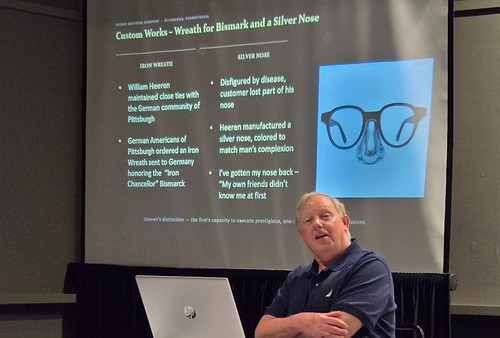
I couldn't resist including the story of the Silver Nose
To read the earlier E-Sylum article, see:
WAYNE'S NUMISMATIC DIARY: 2026 ANA, PART 2 : Token and Medal Society
(https://www.coinbooks.org/v29/esylum_v29n37a20.html)
More on Photographing Coin Edges
David Carpenter writes:
 "I really enjoyed reading the article Eric Hodge forwarded about techniques for photographing coin edges, and how those efforts use a completely different method than what I tried. I went the route of using a little motor-controlled cart to roll a coin along a flatbed scanner as the scanning head moves along, keeping the coin rolling at just the right speed to get an "unrolled" image of the coin. My early attempts were published in my local club newsletter, the South Wellington Coin Society's "Wellington Circular" December 2021 issue (NNP
https://nnp.washu.edu/Documents/Detail/the-wellington-circular/7471441?item=7594316 page 5 ).
I'm now working on a version that doesn't use any Lego and keeps the scans nice and straight: Mr. Hodge pointed out a "sinusoidal wobble", and my technique can suffer from the same problem if the rollers don't roll exactly true. Here are some more recent images I've taken."


Fascinating method - sort of a reverse "Castaing machine" for edge images. -Editor
To read the earlier E-Sylum article, see:
LOOSE CHANGE: OCTOBER 18, 2026 : The History of Coin Edge Imaging
(https://www.coinbooks.org/v29/esylum_v29n42a28.html)
Another Supermarket Wheat Cent Find
Jim Haas writes:
"I was at the same supermarket yesterday and in the change I got was another wheatie, this one from 1946. I showed it to the young lad at the cash register and then chatted with him about the coin about which he did not know anything.
"Next time I shop there you know I'll be hoping to hit a trifecta."
Happy Hunting! -Editor
To read the earlier E-Sylum article, see:
NOTES FROM E-SYLUM READERS: SEPTEMBER 27, 2026 : Shiny Penny Find
(https://www.coinbooks.org/v29/esylum_v29n39a10.html)
Trump Signature $100 Bill Found in Sri Lanka

Kavan Ratnatunga writes:
Do you have Trump signed US$100 note from circulation?
 Fascinating real-world evidence of global dollar circulation: According to Federal Reserve data, over 2/3 of all U.S. $100 bills circulate outside the United States. The specific note (Serial RB 42144102 A) proves how rapid that international pipeline is. When one was reported in Melbourne, Australia, on the IBNS Chat group about 10 days ago , I asked my money changer to find one for me, and he found this mixed into a random stack of over 200 older bills. After its official July 5th rollout, marking an incredibly fast journey from the BEP printing facilities, to Sri Lanka less than 100 days.
I checked colnect.com and found that it was still not added so I added mine
https://colnect.com/en/banknotes/banknote/183483-100_Dollar-2025_Federal_Reserve_Series-United_States_of_America.
I have many of my Sri Lanka notes listed, never expected to list one from USA. While living in the USA for 18 years, I saw US$100 notes only at Numismatic shows. In Sri Lanka I only see US$100 notes.
Thanks. I had to check my wallet - I've got a hundred, but it's not one of these. I'll have to look the next time I get one from the bank. -Editor
To read the earlier E-Sylum articles, see:
TRUMP TO PUT SIGNATURE ON U.S. CURRENCY
(https://www.coinbooks.org/v29/esylum_v29n13a25.html)
IMAGE OF $100 BILL WITH TRUMP SIGNATURE
(https://www.coinbooks.org/v29/esylum_v29n27a24.html)

DANSCO, FRANKLIN MINT AND NORMAN ROCKWELL
Justin Hinh submitted these notes on a connection between Dansco, The Franklin Mint and artist Norman Rockwell. Thank you! -Editor
Here's a bit of newly learned Dansco history I think readers will enjoy.
I had attended a coin club presentation in Portland on the intersection of numismatics and art. One of the works he discussed was Norman Rockwell's 1971 painting The Collector. When I saw it, the album in the painting looked familiar...


It turns out the Franklin Mint commissioned the painting to promote its new album, The Genius of Michelangelo, which holds 60 sterling silver medals depicting Michelangelo's work.


Looking at the album closely, I recognized the construction Dansco used for other Franklin Mint albums of the same era. What stands out is that the slides on these albums move vertically, not horizontally like a traditional Dansco album.
So Dansco has a connection to one of the 20th century's best-known American painters. It makes me wonder whether Rockwell painted coin albums anywhere else in his work. Perhaps a reader knows.

MACQUARIE UNIVERSITY'S ANCIENT COIN COLLECTION
The ancient coin collection at Macquarie University's ACANS are stepping into the digital world and can help reshape how history is seen, studied and shared. -Garrett

There is something instinctive that happens when we hold a coin in our hands.
First comes the movement, the way it balances between thumb and forefinger, turning over almost absent-mindedly as we examine its surface. Then comes the heat, as the round metal settles into the fold of our palm and slowly absorbs our warmth. In that moment, a small object becomes symbolic of a much larger history carried across generations, empires and continents.
It is a sensation that we experience less often. In an increasingly cashless society and digitised world, the physical presence of coins is slowly fading from everyday life.
At Macquarie University's Australian Centre for Ancient Numismatic Studies (ACANS), however, that connection is exactly what the institution exists to preserve, home to one of Australia's most significant collections of ancient coins.
Inside its vault and across its long worktables is a space designed for careful handling, study and collaboration - where each object is treated not simply as an artefact, but as a fragment of a much larger story.
More recently, the preservation of these stories has taken on a new form. ACANS has begun the meticulous process of digitising its entire collection, creating detailed records that will allow the coins to be studied, shared and explored far beyond the walls of the vault itself.
Associate Professor Peter Edwell, recently appointed as Director of ACANS, is overseeing the project. It was the brainchild of the centre's now retired former director, Ken Sheedy. Edwell hopes the digitised collection will make it easier to explore individual coins and themes in detail.
"In having around 6,000- 7,000 coins in this collection, we want to be able to access those in in a way that is accessible beyond just visiting the centre in person," says Edwell.
"But we need that data to be accurate, consistent and also searchable. Which then allows you to go into the collection and search for specific images like a horse, for example, or a particular ruler, like Emperor Marcus Aurelius.
"It also allows us to feed into that broader numismatic community. Even though we are well regarded internationally, it will help us connect more closely with organisations such as the American Numismatic Society."
But this process is no easy feat. Each coin must first be photographed, catalogued and accurately identified - a challenging process when dealing with objects that have survived for centuries and travelled thousands of kilometres from their place of origin.
As Edwell explains, parts of the collection reveal just how interconnected the ancient world was. Roman gold coinage has been unearthed in Vietnam, Roman silver in India and Athenian silver coinage in Arabia.

Photographing the ACANS coin collection
Alongside Roman imperial portraits and Greek mythological designs, the collection includes some of the most recognisable ancient coins, from Athenian "owl" tetradrachms to Corinthian Pegasus staters, as well as a diverse collection of Roman Republican coinage.
Others, coated in fingerprints as much as they are in history, include the enigmatic lion coins struck in ancient Thrace by an unidentified mint - small silver pieces dating back more than 2,000 years that continue to baffle historians, their origins still widely debated.
"Coins are very important as historical sources," explains Edwell.
"One of the reasons for that is they're contemporary. The rulers have chosen the images and design very carefully and deliberately as part of the way to legitimate their own power, positions and communicate information out to the populations that they're in control of."
To read the complete article, see:
How a priceless collection of ancient coins reveal the changing face of history
(https://lighthouse.mq.edu.au/article/2026/june-2026/how-a-priceless-collection-of-ancient-coins-reveal-the-changing-face-of-history)

QUEENS COLLEGE ANCIENT COIN LAB
David Menchell is at it again - this time, donating ancient coins to Queens College, NY. Here's his report from a recent student "coin lab." Thanks, and congratulations on your great efforts to promote numismatics. -Editor

I had previously sent you photos of the history students at UMass Lowell and their working with coins I had donated to the school. In the same vein, I contacted a professor of ancient history at Queens College, which is near my home. The professor, Joel Allen, is a graduate of one of the ANS Summer Seminars and teaches Ancient Roman History. I donated over 100 coins to the school, mainly Roman, but also including some ancient Greek coins. He sent me some photos from his first day arranging for the students to study the coins. In his words:
"I attach pictures from our first "Coin Lab", which was on Wednesday. We had a good crowd. Reviewed the basic terminology for numismatics, along with a brief overview of production techniques in antiquity. As with any large group of students, there are varying levels of interest in the material, but I'm pleased to say that a significant number are eager to work on the assignment."


I have been having a lot of fun helping build teaching collections at these schools and see how numismatics can enhance the educational experience of these students. I encourage every collector to get involved with a local school, give a talk to the students, bring items for them to examine, and possibly donate material that can stimulate their interest and potentially create new collectors for generations to come.

Great idea - please consider it. -Editor
To read the earlier E-Sylum articles, see:
ANCIENT COINS DONATED TO UNIVERSITY
(https://www.coinbooks.org/v28/esylum_v28n42a18.html)
UMASS LOWELL DAVID MENCHELL COIN DONATION EVENT
(https://www.coinbooks.org/v29/esylum_v29n20a13.html)

VOCABULARY TERM: SUPPORT POINTS
Here's another entry from Dick Johnson's Encyclopedia of Coin and Medal Terminology. -Editor
Support Points. Support Points. Three or more high points on the reverse of a medallic design intended to support the weight of the medal while resting on a flat surface. These high points would wear first as they protect the remainder of the design below the points of contact. Astute medal designers hide these elements in their design as they are conscious of a medal's total existence. Example: several tree limbs on two stumps in reverse design of 1928 Olympic medal. Support points are most obvious after some use, the three contact marks exhibit that wear. Generally they are not included in coin designs, as the rim supports the coin and all relief is below the rim line.
To read the complete entry on the Newman Numismatic Portal, see:
Support Points
(https://nnp.washu.edu/Documents/Detail/support-points/4362377)

COMMENTS ON ILLUSTRATIONS
E-Sylum Feature Writer and American Numismatic Biographies author Pete Smith submitted this article about evaluating, creating, and crediting images in numismatic research. Thanks - great topic. -Editor
Each week when I submit a biography to The E-Sylum, I try to include a photo of the subject of the article. Last week the results were interesting.


The September 17, 1892, issue of The (Brooklyn) Daily Standard Union had an engraving of Francis W. Doughty, identified here as Image 1. The story was about his book, Evidences of Man in the Drift. I am guessing that the engraving was made from a photo because it was easier for the newspaper to print the engraving. This is the image I chose to submit to The E-Sylum.
The June 7, 1891, issue of the Brooklyn Daily Eagle included an engraving of Francis W. Doughty, identified here as Image 2. The story was about Reverend Francis Doughty, an early settler and grandfather of Charles Doughty who has a street named after him in Brooklyn. The article does not mention Francis, the author, or establish his ancestry back to Francis, the preacher.
Image 1 and Image 2 are very similar but not identical. Perhaps it takes someone who studies die varieties to even see the difference. They are too similar to be different engravings made from the same photo. I suspect one was copied from the other or both were copied from the same previous engraving.
That's when the story gets interesting. the Newtown Historical Society (Queens, New York) published an article on "Rev. Francis Doughty – Maspeth's Puritan Founder." This was written by Christina Wilkinson, president of the society, and published on June 24, 2017. This article was illustrated with Image 2, taken from the Brooklyn Daily Eagle of June 7, 1891. This image is identified as the Reverend Doughty.
Reverend Doughty is a bit of a mystery. FindaGrave gives his date of birth as November 4, 1605, and date of death as March 2, 1683. FamilySearch gives his life dates as (1604 to 1669). Wikipedia gives his life dates as (1616 to c. 1670). None provide a link across the generations to Francis the writer.
 I doubt if there was ever a photo taken of Reverend Doughty. He died about two centuries too
soon. However, there is a lovely color image of him identified here as image 3. This is used to
identify Reverend Doughty on the FamilySearch site. The Google image search tool identifies
this as Wyatt Earp. I suspect someone used photo manipulation to create the color image from
the Doughty engraving.
Back in the days of print journalism, it might be expected to credit an illustration to its source. Now with the internet, any illustration can be pulled from anywhere and used without credit. An illustration can be used to illustrate someone other than the original subject. Photo manipulation and Artificial Intelligence can create new illustrations that are totally fake and not credited as such.
I have made modifications to illustrations I submit. I crop them from newspapers and clean up the borders. I remove the background from coin and medal pictures. I have used AI creations. What are the ethics for the current state of publishing? Should an image be credited to the source? Should an AI image be identified as such? This article is about portraits, but there are similar problems with coin illustrations.
Great questions - I'm curious to see what our readers think.
Minor modifications to illustrations such as cropping, rotating, and removing backgrounds are a standard part of publishing and aren't generally acknowledged. More significant alterations and enhancements like removing people, warts, double chins and airbrushing youth onto an aging celebrity probably should be acknowledged but usually aren't. AI is just the latest technology in a long line of tools for image editing and enhancement. Since it's new, people are sensitive and more aware of it.
For the E-Sylum, we often crop images without acknowledgement, such as when we crop out slabs encasing paper money. We provide links back to the sources so people can always click through and see the complete original. We do this because we prefer to focus on the numismatic item itself, not its grade or price; this also lets us display a larger, more readable image of the item. I consider it one of our value-adds as editors, and no one has ever questioned or complained about that.
As for enhancing images, we rarely attempt to adjust photograph lighting or focus, but that's mostly just to save time given the large number of images we deal with every week. Recently I have used AI to sharpen newspaper article images and extract the text; it's much better than any other tool I've used for that, and it's lightning fast. I've acknowledged this is earlier articles, but I suspect that once this becomes commonplace for me I'll just do it without bothering to comment.
As for crediting the source of images, despite the easy availability of images online, it is still important to credit sources. We do this to the extent possible, but don't enforce any rules on our contributors. We're not a journal of record with a team of fact-checkers, just an online forum for communication among collectors and researchers. We don't ask for detailed article footnotes or end notes, but will publish them if provided.
Copyright is a whole 'nother issue, and again, just because something is published openly online doesn't mean copyrights no longer hold. Fair Use laws in the U.S. give us the ability to excerpt and republish a certain amount of content, and we're mindful of crediting the original source. Articles excerpted from other numismatic or mainstream publications are kept brief and always include links to the complete article. Dealers and auction houses generally welcome such reuse with credit and links as ways of promoting their sales, so we republish that content more freely. In fact, some dealers explicitly open their sites to allow us to gather content while blocking other access.
What do readers think about these issues? -Editor
To read the earlier E-Sylum article, see:
HEAD OF COPPER, FEET OF CLAY : Francis Worcester Doughty (1850-1917)
(https://www.coinbooks.org/v29/esylum_v29n42a16.html)

NUMISMAGRAM MEDAL SELECTIONS: OCTOBER 25, 2026
Numismagram's Jeremy Bostwick sent along these five medals from his most recent upload of new material to his site. For all of the new items, please visit https://www.numismagram.com/inventory. -Garrett

102526 | NETHERLANDS. Amsterdam. Master Surgeon's Guild cast brass Toegangspenning (Admission Token). Issued 1654, and used for admission to the medicinal garden (botanic gardens) by physicians, surgeons, master pharmacists, and their students (44mm, 27.31 g, 12h).
Skeleton (Grim Reaper) standing facing, holding scythe and resting hand upon hourglass on base to right; flowers at feet // Civic coat-of-arms of Amsterdam; below, field left blank for engraving; all set upon decorative cartouche, with skull at the bottom. Edge: A few light marks as made, otherwise plain.
Cf. Storer 3865 (for an engraved example); Brettauer 5201; Neumann 35244; Koning p. 46, 6.2; Dirks I.5.7. Choice Very Fine. Red-brown surfaces. A rare and interesting medicina in nummis type. Compare to a similar example (also unengraved) that realized a total of $2,640 in the Stack's Bowers October 2021 CCO (lot 72539).
The obverse of this type—featuring a figure of Death along with an hourglass—is an allusion to the transient nature of life and, as such, a memento mori. It was used in Amsterdam as a token of one's membership into the guild of surgeons. Meanwhile, the reverse refers to the city herself, which was home to a medicinal garden—the so-called hortus medicus—which housed various flora that could be used medicinally. Following the fallout of the plagues that had gripped Europe, along with portions of the rest of the world, the understanding and cultivation of plant-based remedies began to take form, with this garden serving in that role. The bearer of such a token would also have access to these grounds to make use of the plants grown.
To read the complete item description, see:
102526 | NETHERLANDS. Amsterdam. Master Surgeon's Guild cast brass Toegangspenning (Admission Token).
(https://www.numismagram.com/product-page/102526)

103698 | GERMANY & POLAND. Silesia (Slask). Plague of Locusts silver Medal. Issued 1748 for the swarms of locusts of subsequent agricultural damage done by locusts (22mm, 3.60 g, 1h). By Georg Wilhelm Kittel in Wroclaw.
EIN UNGEBETNER GAST (an uninvited guest...), locust left; in two lines in exergue, AVSFREMDEN / LANDEN (...from foreign lands...) // KOMMT FELD UND WALD ZUR LAST (...becomes a burden to field and forest), swarm of locusts descending left upon a tree-lined horizon. Edge: Plain.
Pestilentia in Nummis 100; Storer –; Brettauer 1893; Friedensburg & Seger 4336; GPH 1193. PCGS AU-58. Pleasingly toned, with some brilliance remaining among the fields. A particularly haunting type alluding to the wrath brought about by one of the Biblical plagues.
The years of 1748 and 1749 saw great swarms of locusts plaguing parts of Europe, such as Bohemia and Northern Germany, with the pests noted as far as the British Isles. Noted throughout antiquity and even famously referenced in the Bible as one of the plagues of Egypt, the insect's ability to reproduce abundantly and form massive migratory swarms has made it ceaselessly feared, as the agricultural damage left in their wake is often catastrophic.
To read the complete item description, see:
103698 | GERMANY & POLAND. Silesia (Slask). Plague of Locusts silver Medal.
(https://www.numismagram.com/product-page/103698)

102386 | GERMANY. Johann Friedrich Blumenbach bronze Medal. Issued circa 1825-1845. Commemorating the Jubilee of the Anthropologist's Doctorate (50mm, 12h). By Heinrich Gube for Gottfried Bernhard Loos in Berlin.
I FR BLUMENBACH NATO GOTHAE D 11 MAII 1752 DOCT CREATO GOTTINGAE D 19 SEPT 1775, bust left // NATURAE INTERPRETI OSSA LOQUI IUBENTI PHYSIOSOPHILI GERMANICI D 19 SEPT 1825, three human skulls, as classified by Blumenbach: Caucasian, Ethiopian, and Mongolian. Storer 398; Brettauer 125. PCGS MS-63. Rich red-brown surfaces, with intense brilliance in the fields. An ever-interesting and haunting type. Compare to an inferior example with numerous scattered marks and friction, which realized a total of $1,320 (after the buyer's fee) in Sedwick 38 (13 November 2025), lot 1345. Of note, while SP is designated on the holder, MS is indicated on the PCGS website for this specimen. This is largely irrelevant, as the distinction between MS/SP/PR striking styles is a non-issue for exonumia.
Blumenbach was an anthropologist from the University of Göttingen and specialized in the study and classification of human skulls from around the world—later known as craniometry. At the time of his death, he owned 245 whole skulls and fragments, along with two mummies. The term ‘caucasian' as a descriptor of race was also derived from him, as his influential use of it in 1795 quickly caught on in scientific circles. For more information on Blumenbach and a modern analysis of his career—as well as a reference to this medallic issue—visit Nell Irvin Painter's "Why White People Are Called ‘Caucasian?'."
This medal would have likely been commissioned by close family, friends, and/or colleagues of Blumenbach in celebration of the jubilee of his doctorate, as such practice was very much en vogue. Rather than commissioning a portrait, for example, which would exist singularly and in a fixed position, a medal, in contrast, could be made in a small quantity across various metal types to be given not just to the honoree, but to others as well in the form of a keepsake. Furthermore, the size of the medal allowed for easy transport, and for one to carry it with one's self in remembrance. As the Loos mint was an enterprising establishment, examples of this medal (across medal types such as gold, silver, bronze, gilt bronze, and even iron) could continue to be ordered per the firm's product brochure in 1842 (though cast iron, known for this type as well as others among the oeuvre of Loos, is curiously not mentioned in the brochure). While this cataloger has handled numerous in bronze (easily more than anyone else on the planet), just a few in silver and iron have been offered, with none even seen in gilt bronze or especially gold.
This item was featured in our e-Sylum ad.
To read the complete item description, see:
102386 | GERMANY. Johann Friedrich Blumenbach bronze Medal.
(https://www.numismagram.com/product-page/102386)

103409 | GERMANY. Samuel Thomas Sömmering bronze Medal. Issued circa 1827-1845. Commemorating the 50th anniversary of his doctorate, and used as the prize medal for the Senckenbergische Naturforschende Gesellschaft of Frankfurt (50mm, 77.05 g, 12h). By Christoph Pfeuffer for the Loos workshop in Berlin.
S TH A SOEMMERRING NAT THORUNI D XXVIII IAN MDCCLV DOCT CREAT GOTTINGAE D VII APR MDCCLXXVIII, bare head right; serpent-entwined staff to right // ANATOMICORUM PRINCIPI ANIMAE ORGANA QUI APERUIT ARTIS VIRIQUE CULTORES D VII APR MDCCCXXVIII, view of a human brain from the top. Edge: Plain.
Storer 3389; Brettauer 1159; Sommer P-19; Joseph & Fellner 1030. Choice Mint State. Glossy chocolate brown surfaces, with great brilliance in the fields; a minor spot is noted at the truncation of the neck. Highly interesting and haunting anatomical type.
One of the most important German anatomists, Samuel Thomas Sömmering received his doctorate from the University of Göttingen in 1778, for which he described the organization of the cranial nerves. During his career, he investigated the brain and nervous system, as well as sensory organs and the lungs. Of particular note, he discovered the macula in the retina of the human eye. Given this intense focus on the nervous system as a whole, the choice of a human brain on this doctorate celebratory medal is quite appropriate.
As the Loos mint was an enterprising establishment, examples of this medal (similar to the Blumenbach medal) could continue to be ordered per the firm's product brochure in 1842, so a the date of production listed here is a range given that it would be difficult to know specifically when it was produced over the two-or-so decades in the mid-19th century.
To read the complete item description, see:
103409 | GERMANY. Samuel Thomas Sömmering bronze Medal.
(https://www.numismagram.com/product-page/103409)

103418 | GERMANY. Witches' Night uniface cast bronze Medal. Issued 1907. Commemorating the feast of Saint Walpurga and the "European Halloween" (65mm, 42.28 g). By Hans Schwegerle for Carl Poellath in Schrobenhausen.
Nude witch, with head turned left and holding stick, riding broom right; to right, owl flying right; WALPURGIS / NACHT (Walpurgis Night) in two lines below // Blank. Edge: Plain.
Cf. Heidemann 1295 (reverse with legend in four lines between stars); cf. Datow 10 (same); cf. Hasselmann 14a (same). Essentially as Cast. Dark brown surfaces, with some lighter hints upon the higher points. A very rare and interesting type, especially here as a uniface issue, for which this is the only such example that this cataloger could locate.
Walpurgisnacht, also known as "Burning of the Witches Night," is a Northern and Central European holiday celebrated on the eve of May. Named for St. Walpurga, an 8th century abbess in Francia, it has long been associated with invocations against pests and diseases, as well as witchcraft, with bonfires being lit at night in order to ward off the latter. In a sense, it serves as somewhat of a springtime analog to Halloween in Europe.
To read the complete item description, see:
103418 | GERMANY. Witches' Night uniface cast bronze Medal.
(https://www.numismagram.com/product-page/103418)

HOLABIRD JACK HADDOCK NEVADA TOKENS, PART 3
While Fred Holabird has retired and closed his auction business, he left the door open some special private sales from time to time. One of those will take place November 6, 2026 when Holabird offers the Nevada Town token collection of Jack Haddock. The sale announcement is far more than just that - Fred delves into the history of Nevada token collecting, research and rarity as well as new digging and detecting techniques and advanced digital research platforms. It's lengthy and quite useful. Here's the third of four parts. -Editor

As a practicing scientist for over five decades, we are trained to look for data. The greater number of data points, the closer you get to an answer of whatever your question is. In the case of this catalog, I've applied scientific principals to history, digging deeply for data points to answer historical questions. During this process, it becomes necessary to investigate and attack a number of distinctly different historical disciplines. Here are thirteen specific examples:
a. Want to know how important a single mining camp was? Look at the money. Needed reference: Mines Handbook
b. Want to know why a town is located where it is? Needed ref: Geology and Mineral resources of …
c. Want to know the approximate dates of major activity quickly? Needed ref: Post offices of Nevada
d. Want to know about the merchants? Needed refs: directories and gazetteers
e. Want to know the strength of the business? Needed ref: commercial business guides such as Dun, Bradstreet, Fulton-Pickens
f. Want to know the source of the town/mining camp name? needed ref: Place Names of Nevada
g. Want to know the rarity of a token or if it might exist? Nevada Token book – either the old one (Dun et al) or the new post-2000 suite (Haddock)
h. Want to know how the mining camp stacked up versus others in terms of monetary production? Needed ref: Nevadas Metal and Mineral Production
i. Want to know stories about the towns themselves? Needed refs: Paher- Nevada Ghost Towns; Shamburger's series on Nevada mining camps; Western Places series on Nevada mining camps; Shawn Hall's similar series.
j. Want to know general histories and key people? Needed refs: various History of Nevada – Wren, or Davis or Angel
k. Want to know what a merchant was licensed for? Needed ref: annual County license records
l. Want to know what kinds of property the merchant owned? Needed refs: County Recorder's Office records
m. Want to know stories of the merchants current to their time in Nevada? Needed refs: Newspapers.com; Chronicling America, digitized newspapers; California digitized newspapers.
This gives you a taste of what you are about to read in this catalog. It is written informally. A scholarly work would take hundreds of pages, and if I or we quoted every reference used for each token, there would be an addendum of footnotes over 1500 long.
In the past for token collectors, regional or local "directories" or "gazetteers" were the sole source of information. But here in Nevada, these companies that were doing the "canvasing" of all the tiny and out of the way mining camps missed tons of them. Additionally, if you were a business, with perhaps a sign in the window, and the door was locked when the directory company came around, you were not listed, assumed as "out of business."
If you have not yet used the various free internet newspaper services, there are at least four independent sources, of which I'll recommend: newspapers.com and Chronicling America (Library of Congress), along with California Digital Newspapers (UC Riverside). The other sources generally must be accessed from a major subscription source such as a major university.
These sources are by no means complete. Western states, such as Nevada, had hundreds of tiny mining camp newspapers, and most of these have yet to be digitized. So the looking – or research- is not, and cannot be, complete until this massive project is completed. Don't hold your breath. But it gets better every month. Trust me on that. You can also "filter" your search and limit the parameters which speeds things up tremendously.
For the purpose of this catalog, we (90% me) have used so many references, you'd laugh. But I'll try to give you a sample of the mess around my desk right now – oops, I mean the "carefully placed" research books sitting nearby…. For each and every token listed in this catalog, I'll bet the average number of references physically handled, not including internet or newspaper searches, is at least 5 volumes.
And a few more counties I didn't take the time to list. This is just the stuff within arm's reach – not the stuff I already put away.
For more information on the sale, or to bid, see:
Jack Haddock Nevada Town Token Collection Auction(Session 1)
(https://holabirdamericana.liveauctiongroup.com/auctionlist.aspx?t=JH1)
To read the earlier E-Sylum article, see:
HOLABIRD JACK HADDOCK NEVADA TOKENS, PART 1
(https://www.coinbooks.org/v29/esylum_v29n41a21.html)
HOLABIRD JACK HADDOCK NEVADA TOKENS, PART 2
(https://www.coinbooks.org/v29/esylum_v29n42a20.html)
KUENKER AUCTION SALE 448
Künker will hold three auction sales featuring exclusively coins from the ancient world in early November 2026. This second is the Dr. Rolf W. Schumm Collection, an eLive Premium Auction on November 9 and 10, 2026, featuring more than 1,100 lots. -Garrett
eLive Premium Auction 448: Antike Münzen der Sammlung Schumm
9.-10. November 2026 auf www.kuenker.auex.de
Many coin collectors who enjoy attending auction sales will have met Rolf W. Schumm in person. This dedicated member of the Württemberg Numismatic Society was a regular guest at coin fairs and auctions. He discovered his enthusiasm for classical antiquity at a very early age and shared his passion with his wife, Ursula Schumm.
Now, in eLive Premium Auction 448, his collection is coming to market—a collection that clearly reflects the couple's enthusiasm for history. Connoisseurs will notice it immediately: The coins were not selected based on investment criteria, but rather on the expressive power of their images. If you're interested in history, you'll discover motifs in this collection that you've always wanted for your own collection.
Of course, the Schumm collection also includes coins in excellent condition and of superb provenance. It was assembled over six decades, a period that offered many opportunities for some truly exciting purchases!
So look forward to a multifaceted ensemble from Celtic, Greek, and Roman numismatics, selected by someone who loves history!


Lot 2531. Griechenland. Sicilia. Punier. Tetradrachme 410/390 v. Chr., Lagermünzstätte oder Karthago. Gutes sehr schön. Exemplar der Auktion Bank Leu 2, Zürich 1972, Nr. 124.


Lot 2662. Griechenland. Aegyptus. Ptolemaios I., 323-305-283 v. Chr. Tetradrachme 306/303 v. Chr., Alexandria. Herrliche Patina, vorzüglich. Exemplar der Auktion Bank Leu 53, Zürich 1991, Nr. 164.


Lot 2704. Römische Republik. 60 Asse nach 211 v. Chr., Rom. Fast vorzüglich. Exemplar des Auktion CNG 23, London 1992, Nr. 290 (zuvor 1952 von Edward Gans erworben).


Lot 2745. Römische Republik. Denar um 89 v. Chr., Bovianum. Sehr selten. Herrliche Patina, vorzüglich. Exemplar der Auktion Hess-Leu 41, Luzern 1969, Nr. 29.


Lot 2834. Römische Republik. Denar 48 v. Chr., Rom. Sehr selten. Attraktive Tönung, vorzüglich. Exemplar der Auktion Sternberg VI, Zürich 1976, Nr. 758.


Lot 2958. Marcus Antonius, † 30 v. Chr. und Kleopatra. Denar 34 v. Chr., Alexandria. Sehr selten. Feine Tönung, min. Prägeschwäche, gutes sehr schön. Exemplar der Liste Rodolfo Ratto IX, Milano 1933, Nr. 1144.


Lot 2960. Octavianus. Aureus 43 v. Chr., Rom. Sehr selten. Winz. Schrötlingsfehler, Reste von Prägeglanz, vorzüglich. Exemplar der Auktion NAC 5, Zürich 1992, Nr. 367.


Lot 3023. Römische Kaiserzeit. Augustus, 30 v.-14 n. Chr. Aureus 19/18 v. Chr., Ephesos (Ionia). Von großer Seltenheit. Min. Sehr schön. Exemplar der Auktion NFA XVI, New York 1985, Nr. 332.


Lot 3025. Römische Kaiserzeit. Augustus, 30 v.-14 n. Chr. Denar 19/18 v. Chr., Pergamon. Sehr selten. Vorzüglich. Exemplar der Auktion InAsta 56, Dogana 2014, Nr. 357.


Lot 3200. Römische Kaiserzeit. Nero, 54-68. Aureus 64/65, Rom. Unregelmäßiger Schrötling, vorzüglich. Exemplar der Sammlung Walter Niggeler, Auktion Bank Leu/Münzen und Medaillen AG, Basel 2.-4. November 1967, Nr. 1120.


Lot 3227. Römische Kaiserzeit. Bürgerkrieg, 68-69. Denar 69, gallische Münzstätte. Sehr selten. Sehr schön. Exemplar der Auktion NAC 84, Zürich 2015, Nr. 1800.


Lot 3289. Römische Kaiserzeit. Domitianus, 81-96. Sesterz 87, Rom. Grüne Patina, min. Doppelschlag, Felder leicht geglättet, vorzüglich/sehr schön-vorzüglich. Exemplar der Sammlung M. Paul Vautier und Prof. Maxime Collignon, Auktion Ars Classica II, Luzern 1922, Nr. 561.


Lot 3401. Römische Kaiserzeit. Hadrianus, 117-138. Sesterz 130/133, Rom. Selten. Überdurchschnittlich erhalten. Hübsche Patina, leichte Prägeschwächen, gutes sehr schön. Exemplar der Auktion Leu 57, Zürich 1993, Nr. 270.


Lot 3557. Römische Kaiserzeit. Gordianus III., 238-244. Medaillon, Rom. Von großer Seltenheit. Leicht korrodiert, sehr schön. Exemplar der Sammlung Fürst Waldeck, Auktion Münzhandlung Basel 3, Basel 1935, Nr. 832.
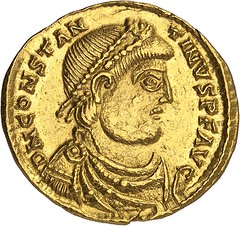

Lot 3642. Römische Kaiserzeit. Constantinus III., 407-411. Solidus 408/411, Treveri. Sehr selten. Geprägt mit rostigen Stempeln, winz. Prüfstelle am Rand, knapp vorzüglich. Exemplar der Auktion Schenk-Behrens Nachf. 77, Essen 1999, Nr. 611.
To order a catalog contact Künker, Nobbenburger Straße 4a, 49076 Osnabrück; phone: +49 541 / 962020; fax: +49 541 / 9620222; or via e-mail: service@kuenker.de. You can access the auction catalogs online at www.kuenker.de. If you want to submit your bid from your computer at home, please remember to register for this service in good time.

NAC NOVEMBER AUCTIONS 169, 170, 171
Numismatica Ars Classica will be hosting their November Auctions 169, 170, 171. Select items are discussed below. -Garrett

Sicily, Agrigentum.
Didrachm circa 413-406, AR 24 mm, 8.66 g. [AKPAGANTINON] Eagle standing l., with wings spread, attacking a coiled serpent held in its talons; behind, STPA[TON]. Rev. Crab; above, a vine-leaf, and below, a fish l. Rizzo, pl. III, 2 (these dies). K. Schefold, Meisterwerke Griechische Kunst, 467 (this coin). Cahn, Kunstwerke der Antike, F53 (this coin). Jameson 512 (these dies) and 2416 (these dies). Kraay-Hirmer pl. 65, 182 (these dies). Gillet 357. AMB 262 (these dies). Gulbenkian 165 (these dies). SNG ANS 1001 (these dies). Westermark 602.3 (this coin).
Extremely rare, only ten specimens known, of which only four are in private hands.
An issue of exquisite style, the work of a very talented master engraver.
Wonderful old cabinet tone and extremely fine
Ex Hess/Leu 3, 1956, 65; Sotheby's 4 December 1990, Hunt (1926-2014), 22; New York XXVII, 2012, Prospero (1910-2001), 121 and NAC 116, 2019, Man in Love with Art part I, 40 sales. From the Käppeli collection.
While Agrigentum had managed to remain neutral during the Sicilian Expedition of the Athenian fleet in 415-413 BC, in the aftermath of its failure a serious new threat began to emerge in the form of the Carthaginians. In 409 BC, a great Punic force attacked the neighbouring city of Selinous. Always ready to dispose of rivals, Agrigentum provided no military aid, but instead accepted its refugees, thereby adding to its population. Three years later, in 406 BC, the Carthaginians advanced to Agrigentum and besieged the city for eight long months, before it finally fell. The city was given over to plunder and all the inhabitants (who had not escaped to Gela and Leontinoi) were slaughtered in the streets. After spending the winter in the conquered city, the Carthaginian general Himilco ordered the destruction of Agrigentum. Nevertheless, under the terms of the Peace of Himilco that concluded the Punic advance in Sicily in 405 BC, Agrigentine refugees were permitted to return and rebuild their city as tributary subjects of Carthage. This didrachm may have been struck in order to finance the defence of Agrigentum by strengthening fortifications and hiring mercenaries.
To read the complete item description, see:
(https://www.biddr.com/nac/auction?a=7580&l=9280663)

Sicily, Syracuse.
Stater struck under Pyrrhus circa 278-276, AV 20 mm, 8.54 g. Head of Athena r., wearing triple-crested Corinthian helmet, bowl decorated with pegasus, triple-pendant earring and pearl necklace; behind, owl and beneath neck truncation, A. Rev. BASI?EOS – ?YPPOY Nike alighting l., holding oak wreath in her r. hand and a trophy in her l.; at her feet, on l., bucranium. BMC 1 and pl. XX, 7 (these dies). Jameson 1124 (these dies). Gulbenkian 910 (this obverse die). Kraay-Hirmer pl. 151, 475 (these dies). AMB 522 (this coin). Buttrey, NC 1973, pl. 2, 42 (these dies). HGC 3.1, 259.
Extremely rare and among the finest specimens in private hands. An interesting and fascinating issue with a lovely portrait of excellent style and a finely engraved reverse composition. Wonderful reddish tone, absolutely unobtrusive marks on reverse field, otherwise extremely fine
Ex NAC 13, 1998, formerly exhibited at the Antikenmuseum Basel, 522 and Heritage 3089, 2021, 31012 sales. From the Athos (1907-1993) and Dina Moretti, and Penn collections.
Graded Ch AU Strike 5/5 Surface 3/5, Fine Style, marks, NCG certificate number 4241981-004 (previously graded and no longer in holder)
In 280 BC, Pyrrhus of Epirus accepted the request of Tarentum to defend it and the other cities of Magna Graecia from the expanding power of Rome. The Epirote king defeated the Romans at both Herakleia (280 BC) and at Asculum (279 BC), but at such high cost that it became clear his army would soon be destroyed. In 278 BC, while considering his options, the Syracusans begged him to come and fight the Carthaginians who had always been at war with the Greek cities for control of Sicily. As a break from the problematic Roman war, Pyrrhus accepted this diversion and was so successful that by 277 BC he had all but driven the Carthaginians from the island and claimed the title King of Sicily. All that remained was to expel the Punic garrison from Lilybaeum, but because of its location, the only means was through a naval blockade. To obtain the necessary ships, Pyrrhus required money from the Greek cities to build and man a proper fleet. When they balked at this, Pyrrhus imposed his own garrisons. This development immediately destroyed the king's previous popularity in Sicily and the Greek cities began negotiating with the Carthaginians against him. Realising that Sicily would be nothing but trouble to rule, Pyrrhus inflicted one further defeat on a new Punic army and then returned to Italy for a second round against the Romans.
This stunning gold stater was struck at Syracuse in the context of Pyrrhus' wars against the Carthaginians. It is a true work of art, having taken the standard Athena and Nike types introduced by Alexander the Great in c. 334 BC, and run with the high Hellenistic sculptural style and the manipulation of the details specific to Pyrrhus.
To read the complete item description, see:
(https://www.biddr.com/nac/auction?a=7580&l=9280689)

Macedonia, Dicaia.
Tetradrachm circa 480, AR 32 mm, 16.85 g. Cow standing l., head r., licking hoof of raised l. hindleg; above, sea swallow l; in exergue, [eight-pointed star]. Rev. Octopus within incuse square. Asyut 255 var. (cow r.). Boston, MFA 542 var. = AMNG III pl. XIII, 24 var. (cow r.)
An apparently unique variety of an exceedingly rare type. A very fascinating issue of superb late Archaic style perfectly centred on a full flan and with a delightful old cabinet tone. Two minor marks on reverse field, otherwise extremely fine / about extremely fine
Ex Leu 28, 1981, 66 and Sotheby's 4 April 1991, 40 sales. From the Viscount Ivor Fox-Strangways Guest (1939-1993) collection.
Dikaia (literally "City of Justice") was a coastal settlement established by Euboean Greek colonists from Eretria in the northeastern Chalcidian Peninsula of Macedonia. It is sometimes confused with the homonymous Greek city of Dikaia founded in the territory of the Bistonian Thracians further to the east. The circumstances that led to the name of these settlements are, unfortunately, entirely unknown, although one suspects that something "unjust" took place in the home cities of the colonists, prompting them to leave and seek justice in new cities. The coinage of Dikaia in Macedonia makes it abundantly clear that the city's founders came from Eretria on the island of Euboea. Not only does this wonderful tetradrachm employ the Euboic weight standard used on that island, but it also features types closely copied from the contemporary coinage of Eretria.
To read the complete item description, see:
(https://www.biddr.com/nac/auction?a=7580&l=9280703)

Kings of Cappadocia, Orophernes usurper circa 160 – 156.
Tetradrachm, Priene circa 160-156, AR 32 mm, 16.53 g. Diademed head r. Rev. ??S???OS – ???F????? Nike standing l., crowning royal name with r. hand and holding palm branch in her l.; in inner l. field, owl standing three-quarters l. on altar above monogram. In exergue, ????F????. Regling, Priene, pp. 8-10, 44-45. Richter fig. 1939. Simonetta 1 (this obverse die). Mørkholm, Some Cappadocian problems, NC 1962, pl. XX, 3 (this obverse die). H. Salvesen, "The tetradrachm of Orophernes," in Nomismatika Khronika 21 (2000), pp. 8-16. Kraay-Hirmer, pl. 209, 768 (this die). EHC 655 (this obverse die).
Extremely rare, only very few specimens known of which this is the finest in private hands. A realistic portrait of superb style, work of a very talented master engraver. Undoubtedly one of finest Hellenistic portraits on a Greek coin. Struck in high relief and with a wonderful old cabinet tone, extremely fine
Ex Hess-Leu 27 March 1956, 320; Leu 20, 1978, 152; NFA 25, 1990, 178 and NAC 106, 2018, 331 sales. From a Distinguished Northern Californian Collector and from the Priene hoard of 1870 (IGCH 1323). From the Harald Salvesen (1928-2016) collection.
Desperate to retain her status as queen of Cappadocia, the apparently infertile Antiochis presented her husband, King Ariarathes IV, with two false sons, named Ariarathes and Orophernes. These were to be heirs to the Cappadocian throne, but then something unexpected happened. Antiochis conceived and gave birth to two daughters and a son by her husband. Having produced a proper heir (the future Ariarathes V), Antiochis revealed the truth to Ariarathes IV and sent her false sons far away from Cappadocia in order to prevent them from challenging the rights of her true son. The young Ariarathes was sent off to Rome while Orophernes was dispatched to the Ionian city of Priene. Although he lived in luxury at Priene, Orophernes remained desirous of what he had lost. In 163 B.C., Ariarathes IV died and Ariarathes V became king in Cappadocia and soon provided Orophernes with his chance to claim the throne for himself. Concerned to keep his kingdom on the good side of the Romans, Ariarathes V refused a marriage alliance with the Seleukid king, Demetrios I, who ruled in Syria without the sanction of the Senate. Offended by the refusal, Demetrios I plotted to overthrow Ariarathes V and establish Orophernes as Cappadocian king. In 158 B.C., Orophernes invaded Cappadocia at the head of a Seleucid army and forced Ariarathes V to flee.
This coin represents the pinnacle of Hellenistic portrait coinage. Not only is it an extremely rare piece depicting an obscure and dramatic royal personage, but the artistry of the portrait itself is superlative. Looking upon the image of Orophernes here, it is hardly a wonder that the modern Alexandrian poet, C. P. Cavafy (1866-1933), found himself moved to write a poem about the life and adventures of the Cappadocian pretender in response to the coin portrait. The reverse type, depicting Nike crowning Orophernes' name, is a grand and oft repeated Hellenistic cliché that can be traced all the way back to the coins of Lysimachos (323-281 B.C.), which feature Athena holding a Nike who crowns the king's name. Here, Nike also serves to visually express Orophernes' title Nikephoros ("Victory-bearer") but gives no hint that the Cappadocian pretender was about to drop it. Adding further to the already great interest of this particular coin is the fact that it actually belongs to the 400 talents that Orophernes left with the Prieneans for safekeeping. It is one of only six specimens that were found beneath the pedestal of a statue of Athena Polias during the early excavations at Priene in 1870. Evidently Ariarathes V and Attalos II had not managed to find everything that Orophernes had spirited away. The owl and altar mint mark combined with the treatment of the flan and the high quality of the engraving and composition all suggest that not only did Orophernes deposit his ill-gotten gains at Priene, but he had it coined there too.
To read the complete item description, see:
(https://www.biddr.com/nac/auction?a=7580&l=9280801)

Galba, 68 – 69.
Aureus 68-69, AV 20 mm, 7.33 g. IMP SER GALBA CAESAR AVG Laureate and draped bust r. Rev. VIR – TVS Virtus nude, standing, facing, holding parazonium in r. hand and spear in l. C 345. BMC p. 316 and pl. 52, 25 (this coin illustrated). RIC 222. Calicó 518 (this coin). Biaggi 268 (this coin).
Extremely rare and probably the finest specimen known of this issue and among the finest aurei of Galba in private hands. A bold portrait struck on an exceptionally large flan and an interesting reverse representation. Virtually as struck and almost FdcGraded Ch AU*, Strike: 5/5, Surface: 4/5, NGC photo certificate number 6711261-002
Ex Bourgey 16-18 December 1913, Vidal Quadras (1818-1894), 109; Glendining 1951, Ryan, 1670; Rauch 102, 2016, 46 and NGSA 20, 2024, 1036 sales.
Servius Sulpicius Galba had served in various capacities under Caligula and Claudius and was virtually retired for most of Nero's reign until he received command of the province of Hispania Tarraconensis in AD 59 or 60. When Nero committed suicide on 9 June AD 68, Galba assumed the imperial title and marched on Rome in October. There, he established himself as the first emperor of the bloody Year of the Four Emperors (AD 69) despite his advanced age. Unfortunately, he lacked wide popularity with the army, and on 1 January 69, the German legions refused to swear their loyalty to him and instead chose Aulus Vitellius as a rival emperor. The reverse of this gold aureus features Virtus, the Roman personification of valor, in an effort to project an illusory air of legitimacy.
To read the complete item description, see:
(https://www.biddr.com/nac/auction?a=7583&l=9282014)

Hadrian augustus, 117 – 138.
Sestertius, Roma 130-133, Æ 32 mm, 26.50 g. HADRIANVS – AVG COS III P P Bare head r. Rev. [EX]ERC BRITANNI/[CV]S Hadrian standing r. on low platform, holding scroll and raising hand; before him, three soldiers with standards. In field, S – C. C 555 var. (bare head and cuirassed). BMC 1673. RIC 1918. L. D'Orazi, La collezione Numismatica di Prospero Sarti e il Mistero del Ripostiglio di Bolsena, in Quaderni di Studio XV, 2020, p. 146 (this coin illustrated). SCBC 637 (this coin illustrated).
Extremely rare and by far the finest of very few specimens known. An issue of tremendous fascination and historical importance with a portrait of enchanting beauty, the work of a very talented engraver, and a finely engraved reverse composition, with a miniature portrait of the Emperor showcasing great craftsmanship. Undoubtedly one of the most desirable sestertii to have survived from antiquity. Wonderful brown tone and good extremely fineGraded AU*, Strike: 5/5, Surface: 5/5 - Fine style, NGC photo certificate number 8235162-002
Ex Sangiorgi 7 May 1906, Sarti, 428; Leu 25, 1980, 305 and NAC-CNG-NGSA 144, 2024, Cope, 1064 sales.
Although Hadrian is only known for certain to have personally visited the province of Britannia in 122, this remarkable sestertius and other related issues suggest a second visit at some time between 130 and 137. The reverse type appears to celebrate an appearance made by Hadrian before the military forces present in Britannia since the exergue legend identifies the EXERCITVS BRITANNICVS. The scene is of the typical adlocutio type, in which the emperor is shown on a podium addressing the troops. In this particular case, the listeners are legionary standard bearers wearing their full armour. The two closest to Hadrian even wear animal skins on their heads – a means of increasing their visibility to the soldiers who followed them into battle – but it is unclear whether they are intended as lion, panther, or bear skins. All three are known to have been worn by Roman standard bearers. The standard bearer closest to Hadrian is an aquilifer, the soldier responsible for carrying the aquila, or eagle, standard of the legion while the soldier behind him is the signifer, who carries the signum standard of a Roman cohort. It is easily distinguished by its composition of ornamental disks topped by an open hand emblematic of the oath of loyalty sworn by the legionary to the emperor. Holding a transverse standard behind the signifer is the vexillarius, the soldier responsible for carrying the vexillum banner of a Roman maniple. Together the movements of these men and their standards combined with shouted orders allowed the legion and its parts to fight with great skill and overcome great enemies.
To read the complete item description, see:
(https://www.biddr.com/nac/auction?a=7583&l=9282034)

Commodus augustus, 177 – 192.
Aureus 191-192, AV 21 mm, 7.17 g. L AEL AVREL COMM AVG P FEL Head r., wearing lion skin headdress. Rev. HER – CVL / RO – MAN / AV – GV at sides of club. All within wreath. C 188. BMC 339 note. RIC 251. Calicò 2259.
Extremely rare and in exceptional condition for the issue, possibly the finest specimen in
private hands. A very impressive portrait of superb style struck in high relief.
Virtually as struck and amost FdcGraded AU*, Strike: 5/5, Surface: 4/5, NGC photo certificate number 8494937-002
Ex Künker sale 419, 2025, 493.
Few Roman coins excite as much commentary as those of Commodus which show him possessed of Hercules. Not only do they present an extraordinary image, but they offer incontrovertible support to the literary record. The reports of Commodus' megalomania and infatuation with Hercules are so alarming and fanciful that if the numismatic record was not there to confirm, modern historians would almost certainly regard the literary record as an absurd version of affairs, much in the way reports of Tiberius' depraved behaviour on Capri are considered to be callous exaggerations.
To read the complete item description, see:
(https://www.biddr.com/nac/auction?a=7583&l=9282040)

Postumus, 259 – 268.
Aureus, Cologne January-June 266, AV 21 mm, 6.63 g. POSTVMVS PIVS FELIX AVG Jugate busts of Postumus and Hercules r. Rev. FELICITAS AVG Jugate busts r. of Victory, holding wreath and palm, and Pax, holding olive branch. C 45. Elmer 452. RIC 329.15 (this coin). Jameson 271. Schulte 109b (this coin). Calicó 3720.
Extremely rare. A coin of great beauty with two impressive jugate portraits of excellent style struck on a very broad flan. Almost invisible marks, otherwise extremely fineGraded AU*, Strike: 5/5, Surface: 4/5, Fine Style, NGC photo certificate number 8494937-003
Ex Rollin & Feuardent 14-26 May 1988, de Quelen, 1750; Rollin & Feuardent 20-26 April 1896, Montagu, 656; Sotheby's 10 November 1972, Metropolitan, 188 and Künker 419, 2025, 535 sales.
As the extravagant appearance of this aureus would suggest, it was struck at a moment of relative security in the western provinces ruled by the rebel Postumus. Its reverse trumpets the happiness of the emperor (FELICITAS AVG) and, in essence, depicts victory and peace in union, something rarely found on other ancient coins. Postumus had good grounds to make such claims, for he had ruled over the impoverished and vulnerable West more effectively than the ordained emperors Valerian and Gallienus, who were constantly distracted by crises elsewhere.
To read the complete item description, see:
(https://www.biddr.com/nac/auction?a=7583&l=9282064)

Duchy of Bayern. Albrecht V, 1550-1579.
Medal (25 Ducats) undated (c. 1575), AV 73 mm, 86.67 g.
ALBERT9 D G COMES PALATIN9 RHENI VTRI9 Q BAVARÆ DVX MONARCH CO HIRS SVABECRI / ANNA D G DVCIS BAVAR VNGAR BOHEMIÆ REGINA ARCHID AVSTRIÆ COMIT TIROLIS Hip-length portraits of the late Duke and Duchess Anna of Austria, facing each other. The Duke armoured, bareheaded, with shouldered sword and chain of the Order of the Golden Fleece, the Duchess with a decorated bodice and cap on her head; the shields of of arms of Bavaria and Habsburg surrounded by the chain of the Golden Fleece above, surmounted by two angels with wreaths supporting the duke's coronet. multifoil border around the field. Rev. LVDOVICVS IIII - ROM IMPERATOR - AVGVSTVS P F - GERMAN REX / DVX BAVARIÆ - COMES HOLANDI-Æ SELANDIÆ - FRISIÆ Double-headed eagle with Bavarian shield of arms on its breast, the legend is interrupted by four shields of arms: At the top, the quartered Bavarian, at the bottom, the single-headed eagle, on the left, the two leopards of Friesland; on the right, the four lions of Zeeland. Beierlein 393 (AR); Habich p 470, illus. 485 (AR).
Unique and from the Wittelsbach family's collection. An exquisite struck medal
and a true masterpiece from the late German Renaissance.
Minor marks, otherwise about extremely fine
Ex Waldo Newcomer Collection - privately purchased from J. Schulman 13.12.1936. Ex Leo Hamburger, Frankfurt sale 7.4.1924, 501 (result 7'150.- Rentenmark =1'700 USD). From the collection of the former Kings of Bavaria.
To read the complete item description, see:
(https://www.biddr.com/nac/auction?a=7584&l=9282192)

City of Hamburg.
2 Portugalöser (20 Ducats) undated (1574/1577), mint master Andreas Metzner, AV 41 mm, 70.05 g.
MONETA NOVA AVREA CIVITATIS HAMBVRGENS / NACH PORTVGALIS SCHROT VND KORN City fortifications, in the gate a nettle leaf. At the beginning of the outer legend, the mint master's mark. Rev. IN XPO CRVCIFIXO PENDET SALVS NRA Decorated cross of the Portuguese Order of Christ. F. -; Gaedechens II, p. 213 no.1; Bahrfeldt, Portugalöser 2a; Geschichte in Gold -.
Of the greatest degree of rarity. The second specimen known and the only one
in private hands. The heaviest German gold coin of 16th century and
of outstanding numismatic importance.
Several marks, very fine
Ex Glendining, London sale 26.10.1938, 147 ('of the highest rarity')
Probably before 1560, but no earlier than 1553, the city of Hamburg began minting large gold coins. These were probably intended primarily as representative pieces and only secondarily as trade coins. The Portuguese 10 cruzado coins, which had been minted since 1498, served as a model. Portugal had considerable gold reserves through its colonies, which were then distributed in coin form, mainly via Flanders. The city of Hamburg was the first German mint to produce these Portugalöser coins weighing 10 ducats, initially in small numbers, probably mainly for representative purposes, as is suggested by the very scarce double Portugalöser coins weighing 20 ducats, minted only at the very beginning of Portuguese coinage up to 1577. Of these double Portugalöser, only four are known to date; three of the type minted between 1553 and 1566 are held in the public collections of Copenhagen, St. Petersburg and Hamburg (cf. for this type the single Portuguese coin in the Traveller Collection, NAC sale 162, 6 November 2025, 1148). Of the type presented here, struck between 1574 and 1577, only the specimen in the collection of the Museum für Hamburgische Geschichte remains.
To read the complete item description, see:
(https://www.biddr.com/nac/auction?a=7584&l=9282300)

Polish–Lithuanian Commonwealth. Zygmunt III Waza, 1587-1632, 1592/1599 King of Sweden.
70 Ducats 1621, Bydgoszcz (Bromberg) mint, mint master Jacob Jacobson van Emden, AV 69 mm, 243 g.
Dies by Samuel Ammon. SIGISMVNDVS III D G POLONIÆ ET SVECIÆ REX Armoured and draped bust right, wearing ruff and collar of the Order of the Golden Fleece, the year 1621 in very small numerals behind his bust. Rev. MAGNVS DVX LITVAN RVSS - PRVSS MAS SAM LIVON ZC Crowned ornate coat of arms within collar of the Order of the Golden Fleece, between the shield of arms and the collar the initials of the mint master II - VE and the die cutter S - A, the year 16-21 in small numerals obove. On both sides oak wreath border. Value '70' punched on edge. F. - (not this weight, cf. 74, 60 ducats and 73a, 80 ducats); Kopicki 1444 (R8); Dutkowski 96.
Of the highest rarity.Possibly the only specimen in private hands and of three known.
With an expressive portrait and excepionally well struck.
Tiny marks, with some lustre, extremely fine
Ex Waldo Newcomer Collection - privately purchased from J. Schulman 13.12.1936. Ex Eugen Merzbacher, München sale 7.1.1896, 202.
For further information on this ceremonial coin of exceptional historical and numismatic significance, see the entry on the 100-ducat coin struck from the same dies in the Traveller Collection, NAC sale 162, 1398. Weighing 70 ducats, this coin is even rarer than the 100-ducat coin; it is probably the third known specimen at this weight.
To read the complete item description, see:
(https://www.biddr.com/nac/auction?a=7584&l=9282557)
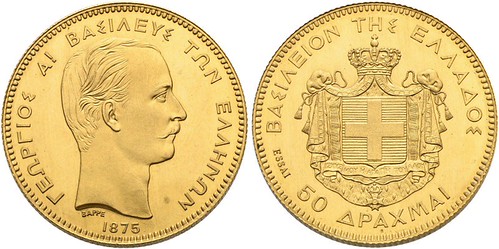
Georgios I (Ge??????), 1863-1913.
50 Drachmai 1875, Paris mint, AV 28 mm, 16.09 g.
Pattern. Dies by Albert-Désiré Barre. G?O?G??S ?! ??S????S ?O? ?????O? / 1875 Head right, BAPPE and the year 1875 below. Rev. ??S?????? ??S ??????S Crowned shield of arms of the Kingdom of Greece, 50 ??????? below, ESSAI in tiny letters in the lower left field. F. -; Divo P72. Karamitsos T.59; El Greco coll. 157; Schlumberger 9.2 (3 ex. known, LP).
One of the very greatest rarities in modern Greek numismatics
in the finest state of preservation. Fdc
NGC PF 64 Ultra Cameo Top Pop (2188230-009)
To read the complete item description, see:
(https://www.biddr.com/nac/auction?a=7584&l=9282641)
THE BOOK BAZARRE
WAYNE'S NUMISMATIC DIARY: OCTOBER 25, 2026
Nummis Nova
Tuesday October 20th was the monthly meeting of Nummis Nova, my Northern Virginia numismatic social group. Daryl Haynor was our host at the Kob Kun Thai restaurant in Oakton. Here's a group shot missing later arrivals Julian Leidman and Steve Bishop.

Clockwise from left: Dave Schenkman, Mike Markowitz, Robert Hoppensteadt, Roger Burdette, Daryl Haynor, Lorne Lavertu, guest Jim Sims, Jon Radel, Wayne Homren, and Mike Packard

Julian Leidman and Dave Schenkman
I brought my copy of Jonathan Brecher's new book on the 18mm medalets of the U.S. Mint, a new purchase on New Jersey coppers, my own medal for running a local 5K race last month, and my medal from the August Pittsburgh ANA show by medallic artists Jamie Franki and Heidi Wastweet. Finally, I also brought a nice companion piece, a high-quality presentation by Tom Uram for the Sphinx Society, the Pittsburgh club I modeled Nummis Nova on.


Wayne's 2026 Ashburn VFD Harvest Blaze Medal


2026 Pittsburgh ANA World's Fair of Money® Convention Medal

One last thing I brought was a repeat. The interesting thing about it was how I rediscovered it. Tuesday afternoon I read a new ANA "Collecting Friends" article by Dennis Tucker and Steve Roach. The topic was things (particularly money and other numismatic things) people have found in books. About the same time I was reading a story about artificial intelligence and reached for one of my books to check a reference. Tucked into the front of the book was a Saudi Arabian Five Riyals note that back in April I'd found sitting in a supermarket shopping cart. I was reading Sebastian Mallaby's "The Infinity Machine" at the time, and had left the note inside.


To read the earlier E-Sylum articles, see:
ABOUT THIS ISSUE: APRIL 19, 2026
(https://www.coinbooks.org/v29/esylum_v29n16a29.html)
NEW BOOK: 18MM MEDALETS OF THE US MINT
(https://www.coinbooks.org/v29/esylum_v29n38a03.html)
To read the complete Collecting Friends article, see:
Collecting Friends: Money in Books, Part 2
(https://blog.money.org/coin-collecting/collecting-friends-money-in-books-part-2)
John Roots Bitters Advertising Notes
Dave Schenkman had with him a copy of Jeff Shevlin's new book, and gave me three nice Pittsburgh Steelers schedule tokens.
He also brought along these advertising notes.


John Roots Bitters $1 Advertising Note
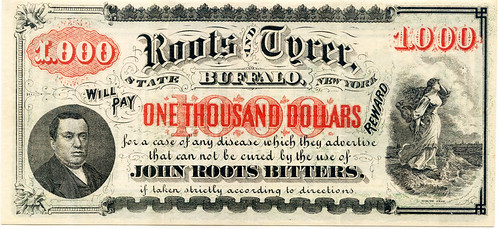

Steve's Beauties and Uglies
Steve Bishop often brings along prettily toned U.S. type coins. He had some 19th-century beauties this month along with a great group of modern error coins. A few of those were downright ugly, but that's what makes them fascinating. These mistakes of the minting process illuminate the harsh realities of the physical manufacturing process so we can all better understand how our coins are made.
The first two are conserved "shipwreck effect" half dollars salvaged from the SS Republic. The first one exhibits a bag impression from years spent on the sea floor resting right up against the cloth bag it was contained in. Nice coins with a great history.

1858-O Seated Liberty Half Dollar SS Republic Bag Impression

1860-O Seated Liberty Half Dollar SS Rebublic

1880-S Morgan Dollar DMPL

Undated Lincoln Memorial Cent Obverse Struck Through Capped Die

1970 Lincoln Cent Obverse Struck Through Capped Die

1998 Lincoln Cent Broadstruck Close Overlap Double Struck

1999 Lincoln Cent Struck Through Obverse and Broadstruck

1999 Lincoln Cent Deep Cup Obverse Die Cap

1999 P Roosevelt Dime Obverse Struck Thru Late Capped Die

2001 Lincoln Cent Obverse Struck Thru Capped Die
It was another nice evening of great food, conversation and numismatic fellowship. 'Til next time!
PAN Banquet
On Wednesday my wife Dee and I headed up to Pittsburgh for dinner with my sister. On Thursday afternoon we had a meeting on behalf of Dee's mother. That evening at 5pm we boarded the bus at our hotel heading to the banquet for the Fall 2026 Pennsylvania Association of Numismatists (PAN) banquet at the La Mont Restaurant atop Mount Washington, across the river from downtown Pittsburgh. We were guests of "Mr. 1715 Fleet Society" Ben Costello. Others at our table included
Dreama and Bob Hurst of Florida United Numismatists (FUN), Bob Evans of the SS Central America project, Russell Augustin of AU Capital, and Dennis Boggs in his Abe Lincoln outfit. Great company and conversation.
Tom Uram introduced a number of visiting hobby leaders including Kathy Freeland of MSNS, Bob Hurst of FUN, and Dave Heinrich and Mark Lighterman of the ANA (who administered the Oath of Office to new PAN Officers). Andy Masich of the Senator John Heinz Pittsburgh History Center gave a short talk about young George Washington's first visit to the area as a young surveyor, pointing out the window to the three rivers and the site of Washington's near-fatal crossing of the Allegheny in 1753.
While running around between meal courses and the program, I spoke briefly with Tom Uram, Frank Tominac, Brad Spak, Larry Korchnak and others. Sorry - no photos of the event. I was in the moment and having a grand time.
Bedford Springs Resort
Nothing more numismatic to report -
Friday morning after breakfast we headed out of town again. Our destination was the Omni Bedford Springs Resort. Neither of us had ever been there before, so it was a nice getaway.
We'd signed up for the Couples Birch Back Massage "enhanced with rosemary mint arnica oil" and Springs Eternal Facials. I guess my recent manly pedicure was just the gateway drug. Now I'm 68 and fabulous.


1766 Lobby Clock and Staircase


Circa 1889 39-Star Flag behind front desk

At 6pm we had dinner at the resort's Crystal Dining Room. The next morning at ten we took the Historic Hotel Tour.
 I kept my ears open for possible numismatic connections, but came up empty except for Treasury officials who stayed there. I don't know if the resort ever issued tokens, scrip or medals. Is anyone aware of any? The closest item I could find online is a baggage check from the Mt. Dallas to Bedford Springs railroad.


ANCIENT CARIA: WHERE EMPIRES COLLIDED
Steve Benner wrote an article in CoinWeek on Ancient Caria: Where Empires Collided and Greek Cities Minted Their Own Identity. Here's an excerpt - see the complete article online. -Garrett
From tiny silver fractions to magnificent tetradrachms, the coins of ancient Caria reveal a remarkable story of commerce, conquest, mythology, and artistic independence.
Ancient Caria: A Crossroads of Empires, Trade, and Culture
On the southwestern coast of Asia Minor, between the Aegean Sea and the rugged mountains of Anatolia, an extraordinary collection of ancient cities developed one of the most fascinating coinages of the Greek world. This was Caria, a land where native traditions met Greek culture and where the ambitions of great empires shaped everyday life.

For centuries, the Carians lived at the crossroads of competing civilizations. Lydian kings, Persian satraps, Greek city-states, Macedonian conquerors, and eventually Roman officials all sought influence over this strategically important region. Yet Caria's cities retained distinctive local traditions, and nowhere does that individuality appear more clearly than on their coins.
A winged goddess, a sacred stone, a lion, a scorpion, or a boy clinging to a dolphin might seem like an unusual collection of images. However, each had meaning to the people who struck and used these coins. Some celebrated local gods and legends. Others reflected economic activity, political alliances, or the authority of the officials who supervised their production.
Today, these small works of art offer collectors a remarkable opportunity to explore the history of a region that helped connect the Greek and Near Eastern worlds.
This article continues my series on the ancient history and coinage of Asia Minor. My goal remains the same: to examine interesting examples of ancient coinage while giving readers an appreciation for the artistry of both Greek and native engravers.
I will concentrate primarily on silver coinage from Caria's mainland cities. I previously covered Halicarnassus and Cnidus in my article on Doris, so I will leave those cities aside. Likewise, the offshore islands deserve their own treatment because of their extensive coinages.
Alabanda: The City That Celebrated Victory
Alabanda stood inland along the Marsyas River, where routes through the Carian countryside connected communities with the Maeander Valley. Its name traditionally combines two Carian words: ala, meaning horse, and banda, meaning victory.
The city had a long history before the Hellenistic period. Persian officials held authority there during the fifth century BCE. Later, Alabanda became part of the Chrysaorian League, a regional confederation that linked several Carian communities.
Alabanda faced repeated political upheavals during the wars among the Hellenistic kingdoms. Philip V of Macedon campaigned in Caria around 201 BCE. Subsequently, Antiochus III of the Seleucid Empire brought Alabanda under his influence, and the city adopted the name Antiochia of the Chrysaorians.
However, Antiochus suffered defeat at Magnesia in 190 BCE. The Treaty of Apamea followed in 188 BCE and placed much of Caria under Rhodian control. In the 160s BCE, political changes restored greater freedom to Carian communities, including Alabanda.
The city's coinage reflects this turbulent period. Alabanda produced silver and bronze issues, including remarkable tetradrachms that combined artistic quality with civic symbolism.
Figure 2a shows a silver tetradrachm dating to approximately 167–166 BCE. Apollo appears on the obverse, while Pegasos, the winged horse of Greek mythology, occupies the reverse. The inscription ????????O? identifies the issuing city.
Figure 2b presents a tridrachm from the same period. Again, Apollo and Pegasos dominate the designs. However, the reverse also contains a laurel wreath, a filleted thyrsus, and a control mark. These details distinguish the issue from its larger companion.

FIGURE 2: CARIA, Alabanda: a) Circa 167/6 BCE, AR Tetradrachm, 34mm, 16.97 g., Apollo/Pegasos; b) Circa 167/6 BCE, AR Tridrachm, 28mm, 11.70 g., Apollo/Pegasos.
Alabanda also struck tetradrachms in the name and types of Alexander the Great. The obverse portrays Herakles wearing the skin of the Nemean lion. Meanwhile, Zeus Aetophoros sits on the reverse, holding an eagle and scepter. A small Pegasos helps identify the mint.
Collectors should note that these coins appeared generations after Alexander's death. Their familiar designs helped connect local currency with an established monetary tradition.
The city's bronze coinage offers even greater variety. Apollo often appears on the obverse, while reverses feature lyres, bulls, Demeter, Pegasos, and other figures, including Capricorn-like creatures.
Alabanda therefore provides an excellent example of how a city could combine regional identity with designs familiar throughout the Greek world.
To read the complete article, see:
Ancient Caria: Where Empires Collided
(https://coinweek.com/ancient-caria-where-empires-collided-and-greek-cities-minted-their-own-identity/)
CELTIC QUINARII UNEARTHED IN GERMANY
Jim Haas passed along this story of a small group of Celtic coins recently unearthed in Germany. Thanks. -Editor

A trove of ancient coins has been unearthed at a construction site in Germany — after remaining hidden for more than 2,000 years.
The discovery, made at Singer Berg in the central German state of Thuringia, was announced recently by the Thuringian State Office for Monument Preservation and Archaeology (TLDA).
In a translated news release, officials said excavation director Ronny Krause discovered the coins while archaeologists were investigating a former sports field ahead of the construction of a new fire station.
The hoard represented the largest known Celtic coin hoard from that period ever found in Thuringia.

The 11 coins, dating back to the first century B.C., were identified as a type of ancient Celtic currency known as Prague-type quinarii.
"Until now, only about 80 examples of these quinarii had been identified throughout Thuringia, underscoring the significance of the Singen hoard," the translated statement said.
"The mint responsible for producing the coins is believed to have been located in the Gotha region, to the northwest."
The coins were originally buried together in a container made of organic material that has since decomposed, archaeologists believe. The coins were found scattered across an area measuring roughly 19 feet by 5 feet — likely a result of plowing.
To read the complete article, see:
2,000-year-old treasure discovered beneath former sports field, breaking regional record
(https://www.foxnews.com/travel/2000-year-old-treasure-discovered-beneath-former-sports-field-breaking-regional-record)
SBG: BENITO JUAREZ'S STORY THROUGH COINS
Stack's Bowers recently published Benito Juárez's Journey Told Through Rare Coins by Chris Ortega. Here is the article. -Garrett
Benito Juárez has one of the most incredible rags to riches stories in political history. He grew up poor in a small village in the Oaxaca mountains, was orphaned young, and didn't speak Spanish until he was about twelve. He worked his way up through Oaxaca's legal and political ranks, and eventually became president of Mexico.
The presidency he inherited was immediately tested in dramatic fashion. Mexico was deeply in debt, and when Juárez suspended payments to foreign creditors, France, Britain, and Spain intervened militarily. Britain and Spain withdrew once their financial claims were addressed, but France, under Napoleon III, used the opportunity to attempt an outright conquest, eventually installing the Austrian archduke Maximilian as emperor of Mexico. This triggered the French Intervention, during which Juárez led a government in exile, moving from city to city.
The Mexican resistance against the French occupation is where Juárez earned the reputation that defines him. The Battle of Puebla on May 5, 1862, commemorated as Cinco de Mayo, was an early and symbolically important Mexican victory, though the French ultimately did occupy Mexico City.
The tide turned by the late 1860s, helped significantly by the end of the American Civil War, which freed the United States to pressure France diplomatically and allow arms support for the Juaristas. French troops withdrew in 1867, and Maximilian was captured and executed on Juárez's order, a decision that was controversial even among his allies but which Juárez defended as necessary to demonstrate that Mexico would not tolerate imposed foreign rule.
Juárez was reelected president in 1867 and again in 1871, governing until his death from a heart attack in 1872. His legacy lives on in Mexico today, as seen on the coins below, all coming up in our November 2026 Latin America Collectors Choice Online Auction.


Lot 72466 – MEXICO. Centennial of the Death of Benito Juarez Gold Medal, 1972-Mo. Mexico City Mint. PCGS MS-67.
View all lots in the November 2026 World Premier Collectors Choice Auction at StacksBowers.com.

ARGENTINE CHACHOS QUASI-CURRENCY RETURNS
The governor of La Rioja, Argentina announced a new issue of quasi-currency to fund upcoming wage increases. Found via News & Notes from the Society of Paper Money Collectors (Volume XI, Number 52, June 9, 2026). -Garrett
 La Rioja Governor Ricardo Quintela announced that his administration will once again issue quasi-currency to fund upcoming wage increases. The news comes as the provincial economy remains in default with international markets and faces a squeeze in federal revenue transfers.
In 2024, La Rioja issued quasi-currency for the first time in more than 20 years. The bonds were officially called Debt Cancellation Bonds (in Spanish, BOCADE) but were quickly nicknamed Chachos, a reference to Ángel Vicente "Chacho" Peñaloza, the 19th-century Riojan leader whose image appears on the bill.
Quintela acknowledged on Wednesday that the province is having "difficulties" raising the funds to pay the year-end bonus but insisted that they would pay it. Asked by reporters, he confirmed that "the Chachos were back" and that they could be used starting in August to pay July salaries.
The govenor, however, clarified that the quasi-currency won't be used to cover the year-end bonus. "Maybe they could be used for an increase," he said.
Despite the stir caused at the time, the "Chachos" circulated for only six months — from mid-2024 to December of that year.
For more information, or to order, see:
The Chachos are back: La Rioja to reissue quasi-currency again after two years
(https://buenosairesherald.com/economics/the-chachos-are-back-la-rioja-to-reissue-quasi-currency-again-after-two-years)
To read the earlier E-Sylum article, see:
ARGENTINE PROVINCE LAUNCHES OWN CURRENCY
(https://www.coinbooks.org/v27/esylum_v27n37a30.html)
FIRST WELSH SIGNATURE ON UK BANKNOTES
Rhys Phillips will take over the role of Chief Cashier of the Bank of England, making him the first Welsh person to have his signature appear on every UK banknote. Found via News & Notes from the Society of Paper Money Collectors (Volume XII, Number 18, October 13, 2026). Here's an excerpt - see the complete article online. -Garrett
For the first time in history there will be a Welsh person's signature on UK bank notes.
On October 19, Rhys Phillips will take over the role of Chief Cashier of the Bank of England.
Rhys was born in Neath, and grew up in Baglan near Port Talbot. As such he will be the first Welsh Chief Cashier in the Bank's history, and will be taking on one of its most recognisable public roles.
As well as having his signature on every banknote, he will oversee the production and distribution of the next generation of banknotes, following the announcement that wildlife will replace historic figures on banknotes.
The theme of Wildlife is representative of the UK, but it will also allow these new notes to feature cutting edge security as we step up the fight against counterfeiting.
The Atlantic puffin, barn owl, buff-tailed bumblebee and European hedgehog will represent UK wildlife and feature as the central images on the next series of UK banknotes.
The decision comes after nearly 500,000 people responded to a public consultation asking which native wildlife they would like to see on the banknotes. They chose from a shortlist of 18 options across three categories – mammals; birds; and amphibians, insects and fish – developed in collaboration with a panel of UK wildlife experts.
The Bank used the feedback from the consultation to decide on the four animals, one for each denomination of banknote. The selected animals meet the Bank's objectives for a distinctive set of banknotes that can support counterfeit resilience and are representative of the UK.
The barn owl (Tyto alba), buff-tailed bumblebee (Bombus terrestris) and European hedgehog (Erinaceus europaeus) were the most popular animals in their respective categories. The Atlantic puffin (Fratercula arctica) was selected because it was the most popular marine animal. The inclusion of a marine animal will add variety to the series, making the denominations easier to distinguish and will provide an opportunity to celebrate the British coastline.
To read the complete article, see:
First Welsh person in history to have signature appear on every UK banknote
(https://nation.cymru/news/first-welsh-person-in-history-to-have-signature-appear-on-every-uk-banknote/)
LOOSE CHANGE: OCTOBER 25, 2026
Here are some additional items in the media this week that may be of interest. -Editor
A Numismatic News article by Sierra Holt discusses a rare silver locket encasing a gold coin. The piece was likely made in 1660 to commemorate a marriage in County Cork, Ireland. -Editor
 Love was lost for centuries when a silver locket went missing. The silver locket was likely made in 1660 to commemorate the new marriage between Robert Coppinger and his wife Margarett, Catholic landowners residing in County Cork, Ireland. Coppinger's oval-shaped locket is adorned with an engraving of the Nativity on the front and the reverse showing the Adoration of the Magi and the text "ROBT COPPINGER & MARGARETT COPPINGER als. ROCHE."
The ornateness continues in the locket with an engraving of the Crucifixion and a 1619-struck gold 2 doppia from Parma and Piacenza during the reign of Duke Ranuccio I Farnese placed inside. As Roseberys notes in its press release, the issue would have carried a special resonance for the Catholic landowning family as at the time, high-value coins were carried as jewelry. Doppia circulated as a trade gold and was often in the possession of wealthy Europeans.
It isn't known when exactly the locket was lost or why, but it was rediscovered around 1850 under the castle of Mashanaglass in County Cork by a farm laborer. The locket was then taken to the rector of the parish, restored, and given to a Coppinger descendant. "Very few objects survive with such a vivid sense of the people and place to which they belonged," explains Anna Evans, Head of Works of Art at Roseberys.
When the coin reached the Roseberys' Fine & Decorative auction on October 1, the token of love was paired with a copy of The Cork Historical and Archaeological Society Journal from 1895 that reported on the discovery. Also accompanying it was a handwritten 1892 letter from the British Museum's Keeper of Coins that identified the coin.
To read the complete article, see:
Auction: A Coin Encased with Love
(https://www.numismaticnews.net/auction-a-coin-encased-with-love)
The latest Greysheet Podcast features John Feigenbaum speaking with Ursula Kampmann and David Vagi about ancient coins. -Editor
In this episode of the Greysheet Podcast, host John Feigenbaum sits down with world-renowned ancient coin expert David Vagi of NGC and numismatic authority Ursula Kampmann for a fascinating discussion about ancient coins, coin authentication, grading, and the evolution of the global coin market.
David Vagi explains how NGC Ancients developed its unique grading system, evaluating strike quality, surface quality, and wear rather than relying solely on a traditional numerical grade. He also discusses counterfeit detection, the challenges of authenticating ancient coins, and how third-party grading has made ancient coin collecting more accessible to new collectors.
The conversation also explores how the internet, digital photography, and online auctions have transformed the rare coin market, along with the differences between American and European approaches to trust, certification, and collecting.
To read the complete article, see:
Greysheet Podcast: The World's Expert on Ancient Coins Talks to John and Ursula about this Incredible Collectible [Video]
(https://www.greysheet.com/news/story/greysheet-podcast-the-world-s-expert-on-ancient-coins-talks-to-john-and-ursula-about-this-incredible-collectible-video)
In the you-can-pair-this-with-your-Clinton-quarter department, here's a not-safe-for-work coin that Florida Gov. Ron DeSantis gifted the President. -Editor

Florida Gov. Ron DeSantis (R) greeted President Trump as he arrived in Florida on Friday afternoon with a gift: a gold coin with an image of Trump holding up a middle finger.
The coin bears Trump's face and the inscription, "YOU MISSED B-----S." Trump showed reporters the gift after receiving it.
It is not clear what the inscription refers to, but Trump has survived multiple assassination attempts, the most notable of which was an extremely close call at a rally in Butler, Pa., during the 2024 presidential campaign.
To read the complete articles, see:
DeSantis gifts Trump gold coin with engraved image of him ‘flipping the bird'
(https://www.yahoo.com/news/politics/articles/desantis-gifts-trump-gold-coin-193400581.html)
Ron DeSantis gifts Trump engraved gold coin in cringy display of MAGA loyalty: "You missed b*****s!"
(https://www.tag24.com/en/news/politics/politicians/donald-trump/ron-desantis-gifts-trump-special-coin-to-show-his-maga-loyalty-you-missed-b-s-3542637)
ABOUT THIS ISSUE: OCTOBER 25, 2026
Well, I've been on the road most of this week, and my Diary article has the deets. I started early on this issue to get as much done as I could before my trip. Garrett also came through as usual with a number of prepared articles. Somehow, these issues always manage to come together in time for Sunday night.
That Damon Douglas book on New Jersey coinage came to me from a Texas seller on Abebooks. It arrived in good condition, which was a miracle given that it was packaged in just a thin plastic envelope with no packing material whatsoever. These people have a lot of nerve calling themselves booksellers - that was a really dumb ham-handed way to treat a book.
Here are some non-numismatic articles I came across this week. For bibliophiles, the first one is an interesting account of one book dealer's adventure buying a large library.
How I Bought 6,000 Books, and What I Did with Them (https://downtownbrown.substack.com/p/the-maurice-neville-collection)
I've seen the future . . . [some questions, some without answers] (https://benjamindreyer.substack.com/p/ive-seen-the-future)
The Tragedy of Mrs. Dr. Seuss (https://downtownbrown.substack.com/p/the-tragedy-of-mrs-dr-seuss)
The Many Failures of Larry David (https://colossus.com/article/many-failures-larry-david-profile/)
Ann Hornaday, longtime Washington Post film critic, dies at 66 (https://www.washingtonpost.com/obituaries/2026/10/19/ann-hornaday-longtime-washington-post-film-critic-dies-66/)
-Editor

Editor Wayne Homren, Assistant Editor Garrett Ziss
Wayne Homren
Wayne Homren is the founding editor of The E-Sylum and a consultant for the Newman Numismatic Portal. His collecting interests at various times included U.S. Encased Postage Stamps, merchant counterstamps, Pittsburgh Obsolete paper money, Civil War tokens and scrip, Carnegie Hero Medals, charge coins and numismatic literature. He also collects and has given presentations on the work of Money Artist J.S.G. Boggs. In the non-numismatic world he's worked in artificial intelligence, data science, and as a Program Manager for the U.S. Department of Defense.
Garrett Ziss
Garrett Ziss is a numismatic collector and researcher, with a focus on American paper money and early U.S. silver and copper coins. He is also a part-time U.S. coin cataloger for Heritage Auctions. Garrett assists Editor Wayne Homren by editing and formatting a selection of articles and images each week. When he's not engaged in numismatics, Garrett is pursuing a Master's Degree in Quantitative Economics at the University of Pittsburgh.

Contributors Pete Smith and Greg Bennick
Pete Smith
Numismatic researcher and author Pete Smith of Minnesota has written about early American coppers, Vermont coinage, numismatic literature, tokens and medals, the history of the U.S. Mint and much more. Author of American Numismatic Biographies, he contributes original articles to The E-Sylum often highlighting interesting figures in American numismatic history.
Greg Bennick
Greg Bennick (www.gregbennick.com) is a keynote speaker and long time coin collector with a focus on major mint error coins and US counterstamps. He is on the board of both CONECA and TAMS and enjoys having in-depth conversations with prominent numismatists from all areas of the hobby. Have ideas for other interviewees? Contact him anytime
via instagram @minterrors.
He can also be reached by email at
minterrors@gmail.com.

Website host John Nebel and webmaster Bruce Perdue
John Nebel
Numismatist, photographer, and ANS Board member and Fellow John Nebel of Boulder, CO helped the ANA and other clubs like NBS get online in the early days of the internet, hosting websites gratis through his Computer Systems Design Co. To this day he hosts some 50 ANA member club sites along with our
coinbooks.org site, making the club and our E-Sylum archive available to collectors and researchers worldwide.
Bruce Perdue
Encased coinage collector (encasedcoins.info) Bruce Perdue of Aurora, Illinois has been the volunteer NBS webmaster from its early days and works each week to add the latest E-Sylum issue to our archive and send out the email announcement.

|
|
The E-Sylum is an electronic publication of the Numismatic Bibliomania Society Copyright © 1998 - 2026 | |