Visit our NBS Sponsors









About UsThe Numismatic Bibliomania Society is a non-profit association devoted to the study and enjoyment of numismatic literature. For more information please see our web site at coinbooks.org SubscriptionsThose wishing to become new E-Sylum subscribers can go to the following web page
Subscribe
MembershipThere is a membership application available on the web site Membership Application To join, print the application and return it with your check to the address printed on the application. Print/Digital membership is $40 to addresses in the U.S., and $60 elsewhere. A digital-only membership is available for $25. For those without web access, write to: Jeff Dickerson, Treasurer AsylumFor Asylum mailing address changes and other membership questions, contact Jeff at this email address: treasurer@coinbooks.org SubmissionsTo submit items for publication in The E-Sylum, write to the Editor at this address: whomren@gmail.com BUY THE BOOK BEFORE THE COINSale CalendarWatch here for updates! |
- WAYNE'S WORDS: THE E-SYLUM NOVEMBER 1, 2026
- LANG NUMISMATIC LITERATURE AUCTION 14
- NEW BOOK: SILVER COINAGE OF THE LOW COUNTRIES
- NEW BOOK: LOLA'S BUFFALO NICKEL
- NEW BOOK: THE RUSH
- CREEPY COIN COLORS
- VIDEO: WOMEN IN THE U.S. TREASURY DEPARTMENT
- THE EARLY ANA PIN AND THE FIRST ANA SEAL
- NOTES FROM E-SYLUM READERS: NOVEMBER 1, 2026
- KINZER COINS COLLECTOR'S ACADEMY
- VOCABULARY TERM: SURFACE DISPLACEMENT
- UNUSUAL MONEY BAGS
- TREASURE TALK WITH BOB EVANS, EPISODE 16
- WILHELM FRIEDRICH "FRANZ" EUE (1888-1937)
- THE WASHINGTON QUARTER CONTEST OF 1931
- HOW BADGE AND MEDAL MAKER BLACKINTON USES AI
- RYAN REYNOLDS, COIN COLLECTOR
- ATLAS NUMISMATICS SELECTIONS: NOVEMBER 1, 2026
- SEDWICK AUCTION 40 SELECTIONS
- HERITAGE: WORLD AND ANCIENT COINS AUCTION
- HOLABIRD JACK HADDOCK NEVADA TOKENS, PART 4
- JOEL SHAFER AUCTION #1 SELECTIONS
- KUENKER AUCTION SALE 449
- EARLY AMERICAN HISTORY NOVEMBER 14 SALE
- DAVISSON'S E-AUCTION 54
- IBERCOIN 2026 INTERNATIONAL BANKNOTE WEEK
- NAC NOVEMBER AUCTIONS 172, 173, 174
- LOOSE CHANGE: NOVEMBER 1, 2026
- ABOUT THIS ISSUE: NOVEMBER 1, 2026
Content presented in The E-Sylum is not necessarily researched or independently fact-checked, and views expressed do not necessarily represent those of the Numismatic Bibliomania Society.
WAYNE'S WORDS: THE E-SYLUM NOVEMBER 1, 2026
 New subscribers this week include:
Michael Kovac. Welcome aboard! We now have 6,304 subscribers.
Thank you for reading The E-Sylum. If you enjoy it, please send me the email addresses of friends you think may enjoy it as well and I'll send them a subscription. Contact me at whomren@gmail.com anytime regarding your subscription, or questions, comments or suggestions about our content.
We have two new advertisers this week: Noonan's of Mayfair, and Ibercoin, the Madrid-based numismatic auction house. Thank you for your support! When you're out at coin shows or shopping online and encounter one of our advertisers, please thank them for supporting our weekly effort - we wouldn't be able to deliver our publication at this scale and frequency without their assistance.
This week we open with a numismatic literature sale, three new books, updates from the Newman Numismatic Portal, note from readers, and more.
Other topics this week include silver coins of the Low Countries, the gold rush, surface displacement, Federal Reserve coin bags, German-American engraver and medalist Franz Eue, the Washington Bicentennial Quarter design contest, badge and medal maker Blankinton, a celebrity coin collector, and many auction previews.
To learn more about Lola's Buffalo Nickel, women in the U.S. Treasury Department, the First ANA Seal, Freedomland Amusement Park, and the difference between a bag and a sack, read on. Have a great week, everyone!
Wayne Homren
Editor, The E-Sylum

Image of the week
LANG NUMISMATIC LITERATURE AUCTION 14
The 14th numismatic literature auction from Numismatic Antiquarian Bookshop Lang closes November 25, 2026. Here's the announcement. -Editor
Dear friends of numismatic literature,
Our next auction has been rescheduled for November 25, 2026, starting at 5:00 p.m. CET. Look forward to the next installment of the Jordan Library, as well as a wide range of ancient, medieval, and modern numismatic literature, journals, and auction catalogs from before 1945 — primarily from Helbing, Hess, and Hamburger.
As usual, the auction will take place on the Auex.de platform. As soon as the auction goes live, we'll notify you via our newsletter as usual. Can't wait? Feel free to check out our website, www.numismatisches-antiquariat.de, in advance!
Details:
- Date: November 25, 2026
- Location: Online on the auction platform Auex.de
- Time: from 5:00 p.m. CET
We look forward to welcoming you to our 14th auction!

NEW BOOK: SILVER COINAGE OF THE LOW COUNTRIES
Hugo Vanhoudt and John Sanders have published a new book on the silver coinage of Belgium, Luxembourg and The Netherlands for the period of about 1500 until the end of the French occupation (1815). To complete the overview of the silver coinage of the Low Countries, the silver coinage of the Dutch Overseas Territories is included. -Editor
The Silver Coinage of the Low Countries
by Hugo Vanhoudt and John Saunders.
 In 1967, Mr A. Delmonte wrote in the foreword to his book The Silver Benelux that since
the end of the 15th century, silver was available in larger quantities primarily thanks to
discoveries in the Americas. This led to the production of heavier silver coins all over the
world. His book and the overview of the heavy silver coins of the Benelux was intended
to support the knowledge of the collectors.
The book The Silver Coinage of the Low Countries covers the period from the 16th century until the end of the French period and describes all the types related to the Low countries. More than 300 years of silver coinage delivers a precious, artistic and attractive historical document to everyone's eye. Especially for local history, these silver coins can represent a story of wars, international contacts and exceptional economic prosperity as well as hard times.
This book is designed for collectors and dealers. It gives an overview of all types of silver coins that have been produced in the Low Countries and the Overseas territories over the period from about 1500 until 1815. The demarcation of the scope and the material has led to the title The Silver Coinage of the Low Countries. The borders of countries and regions have undergone major changes during this period, as a result of which the inclusion or exclusion of certain coins has sometimes been arbitrary. The Low Countries refer to the historical areas that were under the influence of the local rulers mainly on the current territory of the Benelux (Belgium, The Netherlands and Luxembourg) and some in the northern part of France. On the other hand, the Overseas territories are also included to complete the overview.


The most important information is given for each type of coin or silver strike: the province or issuing authority, denomination, mint, a picture or line drawing of the coin, a brief description of the obverse and the reverse design, the complete legends of the coin pictured, dates known, rarity, and price estimates. Collecting the images of some prestigious coins and of the beautiful but extremely rare oU-metal strikes in silver was quite a challenge on its own.
- 610 pages , A4 format (29,7 x 21,0 cm)
- 3232 coin types, fully illustrated in color hardboard cover
- ISBN 978-1-7356598-3-1


Price: 100 euro, excluding shipment
- Packaging and shipment within Belgium: 15 euro
- EEC: 25 euro
- Other countries: on demand
To order, please send E-mail to Hugo Vanhoudt at : vanhoudt.hugo@gmail.com
To read the earlier E-Sylum article, see:
NEW BOOK: GOLD COINAGE OF THE LOW COUNTRIES
(https://www.coinbooks.org/v27/esylum_v27n17a03.html)

NEW BOOK: LOLA'S BUFFALO NICKEL
A new biographical novel was inspired by a 1913 Buffalo nickel. Here's the Amazon description. -Editor
Lola's Buffalo Nickel: Katherine's Special Family Heirloom Edition
by John Allen Kelly
 Naco, Arizona, 1913. Bullets are flying across the border, and an eight-year-old girl is selling meat pies to the soldiers.
One of them, a smiling Buffalo Soldier of the 9th Cavalry named George, rides up to buy a meat pie. He pays with a brand-new Buffalo nickel, one of the first ever struck, handed to an Indian chief at Fort Wadsworth months before and spent on its way west. Lola keeps it for the rest of her life.
From that dusty border town, Lola's story runs straight through the American century: tent revivals with Sister Aimee Semple McPherson, girlhood days when she and her friend Verdie were nicknamed the Sin Twisters, a teenage marriage, and wartime San Diego, where she riveted airplanes and raised her children on her own. She became a coin collector, chasing the nickels and dimes that marked her years.
Through all of it, Lola had one gift above every other: she made people feel loved.
Based on family letters, memories and history, this is the story of a girl, a nickel, and the long life she carried it through.
I reached out to the author for more information. He confirmed that the cover image was AI generated and provided a photo of Lola's actual coins. Thank you! Great story.
Here's an excerpt from the book's Note on the Telling section. -Editor
This book is about my grandmother, Lola May Fischer, born Lola May Gibson on June 11, 1904, in Carlsbad, in what was then New Mexico Territory. She died in Eugene, Oregon, on December 9, 1992. In between she walked behind a wagon, fed soldiers through a war on the Mexican border, was promised at fourteen and married at fifteen, raised four children, set rivets on bombers through the night, and rode more city buses than anybody I have ever known. She could make a person feel loved inside of a minute. Most of us never figured out how she did it.
This is a biographical novel. It blends real family history with imagined scenes.
 The history comes from three places. First, Lola's own writing: the
life story she wrote by hand because her oldest son asked her to,
along with her letters, her diaries and her poems. When her words
appear in these pages, set apart or inside quotation marks, they are
hers, with her spelling and her missing commas left alone. Second,
family memory: what my mother, Evie, saw and told; what my
cousins remember; what I remember myself, the bear hugs, the
secret half dollars, the yodeling. Third, the records: census pages,
draft cards, a birth certificate, a gravestone.
The rest I imagined. Where nobody wrote down what was said at a dance in Phoenix or on a night shift in San Diego, I have written the scene the way I believe it could have gone, from what I know of these people and of their times. I have told those scenes straight, as story, without stopping to apologize in the middle of them. The dialogue is mine, too, except where Lola set it down herself.
The history around the family is real, and I have tried hard to get it right: the battles at Naco, Sister Aimee's road trip through Arizona, the coins and when they were struck, the war plants and the ration books. Where the records and the family disagree, I have usually followed the family, because the family was there. One thing I have kept strictly as family legend: Lola believed she was part Cherokee, through her great-grandmother Julia Ann Lankford, and the family always said that a Confederate soldier marrying an Indian wife was common back then. The census takers wrote the Lankfords down as white. I have set down both, the legend as the family told it and the paper as it reads, and left the reader to hold them side by side, the way we always have.
For more information, or to order, see:
Lola's Buffalo Nickel: Katherine's Special Family Heirloom Edition
(https://www.amazon.com/dp/B0HN9BRF68)

NEW BOOK: THE RUSH
While not numismatic, any book about the California Gold Rush and its effects on history will have something of interest to numismatists - there is a through line from Sutter's Mill in 1848 to the SS Central America in 1857 and breathtaking changes in U.S. coins and paper money during and after the Civil War. Here's the Amazon description. -Editor
The Rush: California Gold, the Civil War, and the Making of the Modern World
by Nathaniel Philbrick
 National Book Award winner and Pulitzer Prize finalist Nathaniel Philbrick, author of In the Heart of the Sea and Mayflower, reveals how California's Gold Rush forged the modern United States—and lit the long fuse to civil war
In January 1848, a carpenter spotted flecks of gold in a shallow stream at Sutter's Mill in California, triggering the greatest voluntary migration in U.S. history, as hundreds of thousands raced west in pursuit of sudden wealth, reinvention, and power. From the feverish gold-mining camps of the Sierra Nevada mountains to the wharves and vigilance committees of San Francisco, Nathaniel Philbrick renders a combustible, all-world society: Chilean brothers reinventing themselves to outrun prejudice; Native communities navigating dispossession and violence; the merchant-showman Samuel Brannan, drawn into the center of early vigilantism; and the politicians vying for control of California's future—the ambitious Free-Soil political boss David Broderick, who squared off against William Gwin, the Southern power broker intent on tilting the state toward slavery and the Confederacy.
In The Rush, Nathaniel Philbrick transforms the Gold Rush from a tale of sudden riches into the origin story of America's modern contradictions—capital consolidated at dizzying speed, democracy in thrall to private power, xenophobia weaponized in the name of liberty—and a stubborn belief in the American experiment that refuses to die. This is the story of a nation tearing at the seams and a republic tested by its own ideals. Not until a year after the outbreak of the Civil War, when President Lincoln signed legislation that would unite the nation east to west by building a transcontinental railroad, was California's loyalty secured.
Philbrick follows the gold as it moves from riverbed to countinghouse to the halls of power, revealing how vigilantism hardened into law and how debates over slavery in the West tipped the balance in Washington. The result is a clear, human story of how a scramble for wealth reshaped ideas of freedom, labor, and belonging—and how California's rise helped push a fractured nation toward war. The Rush is alive with characters whose choices still reverberate: a searing, panoramic epic that captures both the fury and the promise of America.
For more information, or to order, see:
The Rush: California Gold, the Civil War, and the Making of the Modern World
(https://www.amazon.com/Rush-California-Civil-Making-Modern/dp/0525562230/ref=sr_1_1)
Here's an excerpt from a Washington Post review article, with interesting parallels to today. -Editor
Despite the anguish and mudslinging of this year's midterms, "The Rush" provides a strong counterpoint to claims that American politics has never been uglier.
"We're always on the edge of catastrophe," Philbrick says. "Yes, it's awful right now. We're in a situation that I've never experienced, and I grew up in the '60s, which was not fun a lot of the time." But the present, in a way, is no different. "We've been to the edge of the precipice before, and somehow, we've found a way to go forward," he adds. So, too, today. "How that will happen? Who knows?"
Philbrick doesn't editorialize. His characters are figures from the past, and the story he tells has already unfolded. Still, it is difficult not to draw parallels between the Gold Rush of the 1850s and the artificial-intelligence boom of the 2020s. Philbrick hints at this in the final paragraphs of the book.
"I think it's a direct line," he tells me. The explosions in wealth and technological advancement happened in San Francisco almost 200 years apart, yet "the discovery of gold in California created the outlook that we are all living in today." He elaborates: "The ethic of the gold mines was you go in there as hard as you can. You don't care about the consequences of what you're doing, whether it's to other peoples or the environment." It's nearly impossible, Philbrick suggests, to separate the acts of causing chaos and striking gold. "You may fail initially but keep going because if you break through, the consequences could be enormous," he says. "And that's kind of what's happening in Silicon Valley."
There are immigration parallels, too. The influx of entrepreneurs and ambitious foreigners from all over the world helps make California distinct. It did the same at the height of the rush. Hostility toward outsiders was a defining feature of that era's politics, but there is no doubt that the wealth and innovation that sprang out of the 1850s couldn't have been developed without them.
"This is the great paradox of America," Philbrick says. "Violence" and "prejudice" are part of us, but so are "great opportunity and creativity." Money plays a role. "You could call it greed," he says, but you could also call it "wanting to get ahead."
To read the complete article, see:
California is striking gold again. Its history offers lessons.
(https://www.washingtonpost.com/opinions/2026/10/28/nathaniel-philbrick-lessons-california-gold-rush/)

CREEPY COIN COLORS
Newman Numismatic Portal Project Coordinator Len Augsburger provided this timely seasonal report. Thanks. -Editor

Creepy Coin Colors
A quick search of NNP located this listing of a 1909-S Indian cent in the Bowers & Merena September 1984 sale of the Danny Arnold and Romisa collections: "Virtually flawless surfaces. Cleaned, now colored a garish Halloween orange." This lot sold for $170.50. We find no other mention of "Halloween orange" anywhere else on NNP and can only imagine an overworked cataloger scheming whether the term might slip past the editorial hand of Q. David Bowers. They were successful!
This coin understandably wasn't imaged in the catalog, so we've done our best to recreate how it might have appeared.
Link to Bowers & Merena auction sale catalogs on Newman Portal:
Bowers & Merena
(https://nnp.washu.edu/auction-catalogs-list/list/auction-companies/6223)

VIDEO: WOMEN IN THE U.S. TREASURY DEPARTMENT
The David Lisot Video Library on the Newman Numismatic Portal can be found at:
https://nnp.wustl.edu/library/multimediadetail/522852
We highlight one of his videos each week in The E-Sylum. Here's one from 2016 with Walt Ostromecki speaking about women in the U.S. Treasury Department. -Editor
Walter A. Ostromecki, Jr., Ph.D, speaks at the 2016 ANA World's Fair of Money in Anaheim, CA.
To watch the complete video, see:
Numismatic Contributions of Women in the Treasury Department
(https://youtu.be/kUVeV3jMdv0)
Numismatic Contributions of Women in the Treasury Department
(https://archive.org/details/ANA16026NumismaticContribution_1)

THE EARLY ANA PIN AND THE FIRST ANA SEAL
Doug Ward submitted this discussion on the first ANA seal and its possible connection to the similarly-designed pins that Nick Graver asked about in an early issue. Thank you! Great topic. -Editor
 I read with high interest Pete's reference to Nick Graver's pins and the ANA membership medal. I'm definitely interested and hope he doesn't liquify them. I recently wrote an article on the first medal issued by the ANA in early 1911 – The Heath Memorial Medal. It's been submitted to The Numismatist for consideration.
The membership medal referenced by Pete was issued in late 1911 and has the same reverse as the Heath medal. The membership medal is pictured in The Numismatist, but not the pin, which is instead described as "of like design, about the size of a dime, with exception of the words "De Profundis." This design originated with the first ANA seal proposed in 1892 by Joseph Hooper.
 Nick's pin displays the ANA's first motto, De Profundis, and is not the pin described in 1911. Still, it is very similar to the design of the Heath medal's reverse depicting the ANA seal. Undoubtedly, this pin was inspired by and adapted from the ANA seal.
The pin also seems to portray similar inscriptions on the book, although being too small and crude for any detail. From its 1892 proposal – "A volume of Ancient History underneath the Numisma Student lamp; meaning that Science takes first place as a truthful historical record and is above written history. The rays of light thrown out from the flame signify the light thrown on ancient history by our science."
 In January of 1903, The Numismatist printed an open letter from B. P Wright calling for members "to submit their ideas on the subject to ex-President A. G. Heaton, who has kindly consented to act as chairman of the medal committee." This call for an Association medal failed, but likely inspired designs, including adaptation of the original seal and could have led to Nick's pin.
By its crude nature, I'd say Nick's pin was the clandestine work of an ANA member and definitely pre-dates the Heath medal. Although similar, the inscription on the book is lost, while the shape of the lamp's handle is retained. This suggests that it inspired the reverse of the Heath medal and was therefore known to its designer.
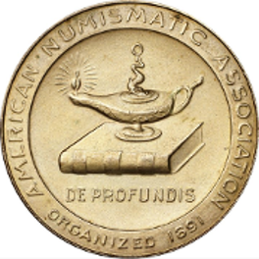

1910 – New York Numismatic Club – American Numismatic Association Convention Medal. Edge: CONV. N.Y. 1910. Bronze. 38.5mm diameter. NYNC seal by Victor D. Brenner. Courtesy of Stack's Bowers Galleries.
However, the first actual appearance of this reverse was on the ANA's New York Convention medal, which was actually designed and issued by the New York Numismatic Club in 1910. The obverse is the NYNC seal, which was designed by Victor D. Brenner. It also, more prominently depicts a magnifying glass. The implication is that Nick's pin was known to the NYNC and became its inspiration, perhaps in more ways than one.
What exactly is portrayed above the lamp's center was also originally described in 1892 – "The aid of Education is shown by the hand pouring, from an ancient vial, oil into the lamp." This symbolism was later lost in translation, particularly between the pin's designer and the designer of the 1910 convention medal. The new symbolism seems to show a magnifying glass materializing as a vaporous apparition, perhaps after the lamp was rubbed?
The Heath medal was actually first proposed at the September 1st, 1910 meeting of the NYNC by Albert Frey. He declared that many NYNC members were also ANA members who "now proposed to issue a medal for Dr. Heath with the seal of the ANA as the reverse."
This makes it conceivable that Nick's pin may be the product of the NYNC or one of its members. However, it is too crude, in my opinion, for such an origin. The NYNC was far more sophisticated and well-funded in its undertakings. Most members were very prominent in numismatics – consider their Club seal was designed by Victor Brenner, a NYNC member who also happened to design the Lincoln cent in 1909. Other members of the time were, Edgar H. Adams, Thomas L. Elder and William H. Woodin.
Further intrigue is supplied by the 1910 ANA Year Book that stated the Heath Memorial medal was proposed two years earlier by Farran Zerbe, who had prepared drawings for its design. He is still credited today by the ANA for its design. I have not been successful in locating any such drawings by Mr. Zerbe. Perhaps E-Sylum readers know something?
Nonetheless, this makes Mr. Zerbe a possible origin of Nick's pins or at least its design. He could have done so between 1907 & 1908, during his ANA presidency and while considering the Heath Medal. More likely, the initial adaptation of the ANA seal would have come earlier, maybe as a result of the ANA's 1903 call for designs. From his work with the World Expositions of 1904 & 1905, he was known and derided for perhaps less sophisticated designs, which were produced as charms, jewelry, tokens and other ephemera, much to the chagrin of the NYNC elite.
To read the earlier E-Sylum articles, see:
NOTES FROM E-SYLUM READERS: OCTOBER 18, 2026 : Query: Mystery "ANA" Pins
(https://www.coinbooks.org/v29/esylum_v29n42a12.html)
NOTES FROM E-SYLUM READERS: OCTOBER 25, 2026 :
The 1911 ANA Association Medal
(https://www.coinbooks.org/v29/esylum_v29n43a12.html)


NOTES FROM E-SYLUM READERS: NOVEMBER 1, 2026
The Perils of Prongs in Coin Displays


 "I cringed when viewing the mechanically rotating GW medal Indian Peace medal in the British Museum. Instead of using a mirror to exhibit the
uniquely engraved reverse, there are multiple metal prongs "stabilizing" this invaluable medal, the prongs contacting and perhaps impairing the medal's periphery & surfaces on both sides as the medal minutely shifts as it rotates. Even if it doesn't shift, there could be periphery dents and flat surface abrasions from the prongs.
"This brings to mind a very expensive 1792 white metal pattern quarter that suffered large rim dents from a slabbing company's stiff stabilizing plastic prongs."
I wondered about the myself, assuming there must be some unseen soft padding between the piece and the prongs. I'll ask the museum for comments. -Editor
To read the earlier E-Sylum article, see:
EXHIBIT: DECLARING INDEPENDENCE USA 250
(https://www.coinbooks.org/v29/esylum_v29n43a10.html)
Scripophily September 2026 Issue Published
Editor Max Hensley writes:
 "Scripophily no. 130 has recently been released. Major contents in this issue are articles on British Royal Loans, Gold Rush San Francisco bonds, Dutch loans with homes as prizes, Canada Power and Pulp, and the growing role of antique stocks and bonds on the new Whatnot platform, plus 20 pages of worldwide scripophily news, including the 2027 show in Washington, D.C. Full color throughout with high quality images on paper. Subscribe to the International Bond and Share Society at
www.scripophily.org ($35 US) to get future issues."
See the IBNS ad elsewhere in this issue for more information on the upcoming January show. -Editor
Strike It Rich With Pocket Change Hits 20th Anniversary
Ken Potter NLG & Dr. Brian Allen write:
 I especially want to extend a hand of thanks to my dear friend, Randy Thern, who championed the book and pushed to get Krause Publications to publish the first edition and those that followed under their leadership, and for the aggressive marketing of the current publisher Penguin Random House who made it the second best selling numismatic book in the world only after the Red Book (admittedly way behind RB).
I also want to thank the late J.T. Stanton for suggesting that Dr. Brian Allen and I get together to create this book. We were so far into the project that J.T. had galley proofs published under our original title "Treasures In Your Pocket Change" in 1999 and was ready to go to press. Sadly, he had to end his involvement due to cancer.
A special thanks goes out to all who contributed to the book's success with photos, coins, suggestions and for buying it and recommending it to your friends!
Congratulations! -Editor
To read the earlier E-Sylum article, see:
NEW BOOK: STRIKE IT RICH WITH POCKET CHANGE, 5TH ED.
(https://www.coinbooks.org/v24/esylum_v24n24a05.html)
Encyclopedia of Encased Postage Delivery in Berlin
Stephen Album Rare Coins writes:
 Paul Montz, Director of World Numismatics at SARC, recently published his long-awaited work, The Encyclopedia of Encased Postage. This 350-page book, illustrated throughout in color, is the first comprehensive work in English on encased postage stamps of the world.
How to Purchase:
- Standard Shipping: Kolbe & Fanning Numismatic Booksellers is the sole distributor.
- Hand-Delivery at Numismata Berlin (November 14–15, 2026): We are accepting advance orders to be picked up directly at our booth (Box F).
-
Berlin Pre-Order Details:
Price: 125 USD / 115 EUR - Deadline: Orders must be finalized by November 6
- To Order: Reply directly to this email
- Numismata Berlin Show Information
Please note: Due to international transport constraints, hand-delivery orders are strictly for guaranteed pickup at the show. If your attendance plans are uncertain, please order directly through Kolbe & Fanning to have your copy shipped instead.
Some more information about the book:
THE ENCYCLOPEDIA OF ENCASED POSTAGE
Montz, Paul
Description:
This 350-page book, illustrated in throughout in color, is the first comprehensive work in English on encased postage stamps of the world.
While the use of encased postage stamps as a currency substitute during the American Civil War is well known, their use in Europe, particularly in the difficult days following the First World War, is much less familiar to most collectors.
This volume is designed to change all that, with 4,587 listings from around the world. Montz's book introduces these intriguing tokens, discusses their historical background, and provides a catalogue of all known types. The extensive issues of France and Germany are discussed in considerable detail, as are the classic U.S. issues of the 1860s. Lesser-known encased postage stamps are also included, ranging from Norway to New Caledonia and from Algeria to Argentina.
Never before has so much information on this topic been brought together in one place.
To read the earlier E-Sylum articles, see:
NEW BOOK: ENCYCLOPEDIA OF ENCASED POSTAGE
(https://www.coinbooks.org/v29/esylum_v29n25a03.html)
MORE ON THE ENCYCLOPEDIA OF ENCASED POSTAGE
(https://www.coinbooks.org/v29/esylum_v29n27a06.html)
Query: Freedomland Amusement Park Piece
David Luftig writes:
"I recently picked this up at dealers junkbox (mainly because I went to the long defunct Freedomland amusement park which was open from 1960-1964, as a child). I could find no information on this on the internet, and was hoping one of your readers might have some information. The park was in Bronx, New York. It is now Co-Op City, a large housing development."


I'm not familiar with these. Can anyone help? -Editor

KINZER COINS COLLECTOR'S ACADEMY
Dean Kinzer of Kinzer Coins in Springfield, Missouri offers several resources for collectors of ancient coins. He submitted this overview. Thank you. -Editor
 Although we operate as an ancient coin dealership, a substantial part of what we're building is a free educational resource designed to help people discover, understand, and eventually participate in ancient coin collecting.
We've developed several interconnected resources:
Collector's Academy: A growing educational section covering how to begin collecting ancient coins, denominations, terminology, authenticity, collecting practices, and other fundamentals. The goal is to give someone with no previous numismatic experience a practical starting point.
Roman Coin Legend Translator: A free tool designed to help collectors interpret the abbreviated Latin inscriptions found on Roman coins. Legends can be one of the most intimidating aspects of identifying ancient coins, particularly for beginners who don't understand imperial titles or Roman naming conventions.

 Historical Articles and Research: We've published an extensive collection of articles connecting ancient coinage to Roman history, rulers, political events, religion, and everyday life. We try to demonstrate that a coin is more than an artifact or collectible. It's a surviving historical document.
Numismatic Organizations and Community Resources: We've also developed educational material introducing collectors to organizations and resources throughout the hobby, including the American Numismatic Society (ANS), the Ancient Coin Collectors Guild (ACCG), coin clubs, collecting groups, and other institutions. One of our goals is to help new collectors discover the larger numismatic community rather than treating collecting as an activity limited to buying and selling coins.
Roman Coin Reference Guide: We've published seven free volumes covering major periods of Roman imperial coinage. Although these include market information, the larger project also organizes rulers, historical periods, denominations, and related reference material.
Kinzer Ancient Coin Guide and Identifier: We've built a free companion application bringing together ruler information, coin references, and collecting resources. We're also actively developing a photographic identification system intended to help users narrow down possible identifications through portraits, legends, and reverse designs. That portion remains a work in progress, and we're placing considerable emphasis on improving accuracy.

Underlying all of this is a fairly simple idea: there are people who love ancient history who have never considered collecting ancient coins because they don't realize how accessible the hobby can be.
We're trying to bridge that gap while encouraging people to learn from established numismatic scholarship, institutions, and experienced collectors.
You can explore the resources at:
https://kinzercoins.com
https://guide.kinzercoins.com

VOCABULARY TERM: SURFACE DISPLACEMENT
Here's another entry from Dick Johnson's Encyclopedia of Coin and Medal Terminology. -Editor
Surface Displacement. The movement of surface metal mass toward and into die cavities during striking. Generally surface metal flows from the outermost rim inward toward the center of the struck surface to fill the greatest cavity. Sometimes, but not always, striations will form on the surface; these are called flow marks and are always inward from the rim toward the center point like the spokes of a wheel. (Flow marks are the cause of cartwheel effect – an optical illusion of light reflecting off the flow marks.) Metal must fill every die cavity during striking or the struck piece will not be fully struck up (it will look like an uncirculated worn coin).
Increasing the pressure of the coining press will generally increase the amount of metal displaced until every portion of the die cavity is filled. Metals ranking high in coinability provide this surface displacement readily. Obviously, harder alloys rank lower in the ease of surface displacement than softer alloys. Those low in coinability may not even fill die cavities. Also certain alloys – white metal in particular – have an unusual property of work hardening the area of surface displacement – which remains bright while the remainder of the surface will tone forming a reverse "shadow" of brightness (see white metal).
To read the complete entry on the Newman Numismatic Portal, see:
Surface Displacement
(https://nnp.washu.edu/Documents/Detail/surface-displacement/4362388)

UNUSUAL MONEY BAGS
E-Sylum Feature Writer and American Numismatic Biographies author Pete Smith submitted this article on Federal Reserve Bank sacks. Thank you - interesting topic. -Editor
I compiled a photo gallery and list of Federal Reserve Bank bags published on the Newman Numismatic Portal as The Incomplete Guide to Federal Reserve Bank Coin Bags. A week ago the guide listed 228 different bags and had 118 photos. This week a reader sent me images of a couple of interesting unlisted bags.


Both were issued by the Kansas City Federal Reserve Bank and both are marked, "RETURN THIS SACK." What, you may ask, is the difference between a bag and a sack?
One of the sacks is prominently marked "$100 / SILVER." The standard value for a Federal Reserve Bank bag was $1000. This suggests that a sack is smaller than a bag. However, the sack is marked "C" which would be about 9 x 15 inches for a standard bag.
Federal Reserve Bank bags are not marked with the coin denomination and were not marked as Silver. This suggests that a sack marked silver was used after 1964 when coins stopped being 90 percent silver.
What would be the value of a $100 sack of silver? Now that the bullion value of coins exceeded the face value, I doubt if the FRB would sell them for face value.
The other bag is marked "4" and other FRB bags marked "4" are 8 x 14.25 inches. However, these are not standard sizes. Some No. 4 bags are as much as 9 x 17 inches.
I can recall attending coin shows in the mid 60's when dealers were buying up huge quantities of silver certificates. These could be redeemed for silver granules up until June 24, 1968. The Kansas City Federal Reserve bank was not a redemption center so the $100 silver sacks would not have been used for redemption of silver certificates.
I know that the Treasury stopped selling silver dollars on March 26, 1964. I am familiar with the GSA sale of silver dollars in 1972 to 1974. What did the banks do with bags of silver coins with a melt value that exceeded the face value? I understand much of the remaining coins were melted to recover the silver. Did they ever sell them to the public at a premium? Is this an explanation for the Kansas City silver sacks?
I believe that United States Mint coin bags and Federal Reserve Bank coin bags have a place in numismatic history. I suspect the Kansas City FRB silver sacks are part of that history. I am sorry that I can't tell their story.
Can any E-Sylum reader tell the story? Are there other Federal Reserve Bank sacks out there waiting to be reported?
Great question - can anyone help? -Editor
To read Pete's bag books on the Newman Numismatic Portal, see:
The incomplete guide to Federal Reserve Bank coin bags
(https://nnp.washu.edu/Documents/Detail/the-incomplete-guide-to-federal-reserve-bank-coin-bags/1329261)
The incomplete guide to United States Mint coin bags
(https://nnp.washu.edu/Documents/Detail/the-incomplete-guide-to-united-states-mint-coin-bags/1340847)
To read the earlier E-Sylum articles, see:
NEW BOOK: U.S. MINT COIN BAG GUIDE
(https://www.coinbooks.org/v26/esylum_v26n13a06.html)
NEWMAN PORTAL ADDS U.S. MINT COIN BAG GUIDE
(https://www.coinbooks.org/v26/esylum_v26n13a15.html)

TREASURE TALK WITH BOB EVANS, EPISODE 16
In January 2025, our good friend Bob Evans began publishing a series of blog articles on the Finest Known website detailing his experience as co-discoverer and curator of the treasures recovered from the wreck of the S.S. Central America. Subject of the book "Ship of Gold", many exhibits, countless interviews and articles, books and auction catalogs feature the legendary haul of gold coins, bars, nuggets, gold dust and more from the 1857 shipwreck. Here's another excerpt - see the complete article online. -Editor

The Ship of Gold Exhibit thrilled visitors at Numismatic conventions and museums wherever it appeared.
It was fascinating to watch reactions to the wonderful treasure on display. I was present at every venue, telling stories, answering questions. Most questions are softballs for me anymore. The stories and facts have been percolating in my mind for decades, ready to pour out. But every now and then, someone asks a question that seems simple but defies an easy answer. In this case, in 2010 at Long Beach, I was approached by a teenager, a young man almost as tall as me (5'4",) in glasses and a Los Angeles (Anaheim) Angels ballcap with blonde hair poking out. He was wearing shorts and a t-shirt I remember as vaguely scientific, I forget why… probably space or math related. His parents stood nearby, watching as he walked up and posed a question beyond the usual lines of history or beauty or value.
"If you melted down all the gold, how big would it be?"
Initially, this made me laugh, but I congratulated him for a question I had never been asked. Of course, melting down this great treasure is an absurd hypothetical notion. And hearing such a proposition at a venue full of coin enthusiasts thrilled with seeing spectacular gem mint-state coins from the 19th century… well, it sounded like someone had proposed committing a capital offense. Then I started to discuss the unique nature of gold with my questioner, particularly how heavy it is. He excitedly interrupted my pedagogy, "It's 19 times heavier than water!"
"That's right." I replied, smiling and realizing that this kid had read a science book or two. Then I told him I didn't know the answer, but I took a stab at it, and I told him I thought it would fit inside a sphere two feet in diameter. I gave the young man my business card and told him to email me. I would find the correct answer. He thanked me and walked back to his smiling parents, happy that he had stumped the expert. (Unfortunately, he never wrote to me. If you are out there reading this, your answer is here.)
19.3 grams per cubic centimeter. That is how heavy pure gold is. Its density is legendary, and it's one of the factors that humans find so attractive.
To read the complete article, see:
Treasure Talk 16: Heavy Metal
(https://finestknown.com/treasure-talk-17-heavy-metal/)
For the complete series, see:
Category Archives: Treasure Talk with Bob Evans
(https://finestknown.com/treasure-talk-with-bob-evans/)
To read the earlier E-Sylum article, see:
TREASURE TALK WITH BOB EVANS, EPISODE 15
(https://www.coinbooks.org/v29/esylum_v29n28a18.html)

WILHELM FRIEDRICH "FRANZ" EUE (1888-1937)
Jim Haas submitted these notes on German-American engraver and medalist Franz Eue. Thank you! -Editor
While looking for articles on the WPA (Works Progress Administration) I came upon a photo and article in which it was mentioned.
The photo was particularly interesting because the caption says she had been the model for Miss Liberty, "on the quarter in your pocket", which she was not. In the accompanying article her father, Wilhelm Friedrich Eue, referred to as Franz Eue, was mentioned and because his was not a familiar name, I did some research.
German-born medalist Franz Eue, pronounced "yoo-ee", was born on December 5, 1888, in Rathenow, Germany near Berlin. In the early 1910s, he worked as an engraver in Strasbourg, where he married Berta Matilde Roller. The marriage producing two daughters, Gerda born in 1914, and Helga, the young woman in the photo, in 1919. It is unknown whether Berta died or the marriage ended in divorce.

King Ludwig III of Bavaria


Frederick II


Count Ferdinand Graf von Zeppelin
Bombing of London's Tower Bridge
During the war years, 1914-1918, he created more than 30 medals, including an extensive series of patriotic pieces honoring high-ranking German military and naval officers. His medals were crafted from materials such as silver, bronze, and cast iron, and produced in various sizes. Some were designed with an attached loop, allowing them to be worn on a lapel—a common way to demonstrate patriotism and solidarity before and during the First World War. From a modern perspective, many of Eue's medals can also be classified as propaganda media from the First World War.
 When the war ended, his primary income source ended such that in 1925 he began placing this advertisement appeared in the Deutsches Graveur-Journal und Stempel-Journal, the German Engraver's Journal and Stamp Journal.
Apparently, the ad did not achieve the desired result and on November 17, 1926, Franz, his new wife, and seven-year-old Helga, emigrated to New York where his work soon transitioned from documenting military figures of the First World War. From 1929 on he worked as a freelancer for various companies, including Whitehead & Hoag and the Medallic Art Company. During this period, Eue produced over 70 works that include play money for Cracker Jack, Charms Candy, and Little Duchess Laundry. He also modeled reliefs and emblems featuring notable figures depicting U.S. Presidents Medals, film icons, companies, cities, chambers of commerce, the New York Athletic Club even and Saint Christopher medals.


Eue Presidential Medals
Here are images of a few Franz Eue Popsicle tokens in the collection of the American Numismatic Society (from an earlier E-Sylum article). -Editor

obverses

reverses
Here's an image of a nice Pennsylvania Railroad medal by Eue (contributed by Harry Waterson). Thanks. -Editor
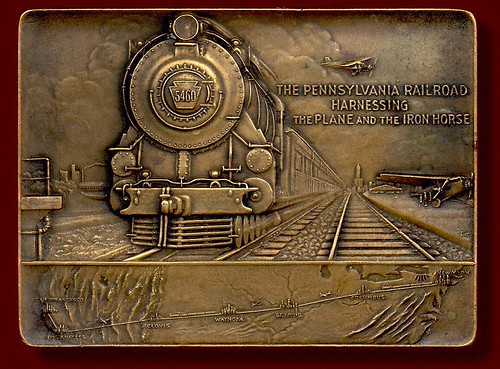
Franz Eue died unexpectedly of a heart attack on June 1, 1937, at the age of 48. An obituary appeared in a German trade journal, but I have been unsuccessful finding a stateside one. Upon his death in 1937, he left behind a prominent legacy of medallic artwork spanning both Germany and the United States.

Thanks, Jim - interesting story. For more about that "bicentennial quarter", see the next article in this issue. -Editor
To read the earlier E-Sylum article, see:
POPSICLE TOKENS
(https://www.coinbooks.org/v21/esylum_v21n11a15.html)

THE WASHINGTON QUARTER CONTEST OF 1931
In the previous article in this issue, Jim Haas told the story of German-American engraver and medalist Franz Eue and his daughter Helga, which a newspaper article claimed she "posed for Miss Liberty on a bicentennial quarter by her father for Uncle Sam..." Well, Franz Eue did not design a circulating coin for the U.S. Mint. He did however contribute a design for consideration for what became the 1932 Washington Quarter, a commemorative honoring the bicentennial of Washington's birth in 1732.
Many thanks to Harry Waterson, Steve Roach and Roger Burdette who helped me track down and confirm the story. As Roger notes, "The daughter was clearly mistaken about posing for Liberty --- but she might have been posing for Washington head shape and hair."
First, Harry Waterson provided these newspaper articles announcing the design contest. Thank you. The articles are from the Sauk Centre Herald, Sauk Centre, Minn. (April 16, 1931) and Bienville Democrat Ringgold Record, Arcadia, LA (June 9, 1932). -Editor


Here's excerpt from Steve's 2024 Coin World article about the design content and some of the submitted designs. -Editor

The year 1932 marked the bicentennial of George Washington's birth and the U.S. Mint planned for a new silver quarter dollar with a portrait of the nation's first president on the obverse, alongside an eagle on the reverse. Several artists participated in a 1931 competition to design this new issue, and ultimately, sculptor John Flanagan was victorious.
Stack's Bowers Galleries offered a selection of various artist's models that were submitted to that competition in its August auctions. The models show how different artists interpreted the project's challenge to adapt a bust by French sculptor Jean-Antoine Houdon into coin form.
The Commission of Fine Arts twice declared Laura Gardin Fraser the winner. Fraser's design was not chosen by that contest's final judge, Treasury Secretary Andrew W. Mellon, but was revived for the $5 commemorative gold coin issued in 1999 to honor the bicentennial of Washington's death. It was again honored when chosen in 2022 for use as the common obverse for the Washington, American Women circulating quarter dollar series.

John Flanagan designs for 1932 Washington quarter
Roger Burdette was able to confirm for me that Franz Eue indeed submitted a design to the contest based on evidence he located at the National Archives. Thank you!! -Editor
Roger writes:
"I recently found individual letters to artists who submitted entries to the Washington quarter design competition. Attached is the letter sent to Mr. Eue acknowledging receipt of his models.
"I've also attached a copy of the design concept; the Nov 12, 1931 entrant status; and some interesting correspondence.
"I don't recall seeing a full or partial list of all the entrants, or a list matching entrant names to the numbers the Mint added to each set of models. However, I could have easily missed these among the paper folders."

October 12, 1931 letter acknowledging the Mint's reciept of Eue's design
Thanks, everyone!
Roger's attachments are a trove of great source material on the 1931 contest. We'll stop with the Eue letter, but the remaining material would be an excellent start for anyone writing an article, monograph or book chapter on the topic. These files were scanned very recently and have not yet been posted to the Newman Numismatic Portal. In the meantime, Roger is willing to email them to interested researchers.
To read the complete Coin World article, see:
Winners and losers among 1932 Washington quarter dollar designs
(https://www.coinworld.com/news/us-coins/winners-and-losers-among-1932-washington-quarter-dollar-designs)

HOW BADGE AND MEDAL MAKER BLACKINTON USES AI
We haven't discussed New England badge and medal maker Blackinton before, with just a couple indirect mentions in past issues. -Editor

From the company website:
"Blackinton® is a family-owned company and the largest manufacturer of public safety badges and uniform insignia in the United States. For more than 170 years, we've crafted the badges worn by the nation's leading police, sheriff, fire, security, and government departments, every one made in-house at our Attleboro Falls, Massachusetts factory, the same town where we started in 1852.
Staying in one place this long is no accident. We've watched countless competitors close their doors or move production overseas. We chose to stay, to keep the craft here at home, and to keep improving it. The result is a badge that pairs old-world craftsmanship with modern manufacturing, one built to be worn with pride for an entire career."

There are some references in the Newman Numismatic Portal to club medals made by Blackinton. Have these ever been cataloged? What medals, tokens or other numismatic products have the company made over the years?
I came across Blackinton this week when I saw this article from Anthropic about how Blackinton is using their Claude artificial intelligence tool. Here's an excerpt - see the complete article online. -Editor
 Established in 1852, VH Blackinton & Co is a Massachusetts-based manufacturer that handcrafts the badges, medals, and lapel pins worn by police, fire, EMS, and corrections officers across the country. Blackinton employs about 200 people, and is moving into its third generation with the Roque family who bought it in 1974. Today, they're using Claude to help build tools that keep their business on track without changing the craft behind their process.
Between 8,000 and 12,000 orders sit on Blackinton's factory floor at a given time—each one custom-made and personalized. While a responder's pants, boots, and belts get replaced as they wear out, badges are designed to last for an entire career. They get pinned onto uniforms and worn for decades; some come back thirty years later to be embedded in acrylic as a retirement gift an officer can pass down. Blackinton also makes badges for causes the community wants to support, like the Firefighter Cancer Support Network, which helps firefighters and their families through a cancer diagnosis. "It's very much an old-world process," says Dave Elliott, the director of sales. "The polishing and enameling and plating, these aren't skills that are churning out of trade schools."
Andrew Roque, whose grandfather bought Blackinton and whose father is CEO, started at the company at 16 and now supports HR and international sales. "It's a balancing act," he says of modernizing a business this old. "You can check something out, you can try something…it doesn't mean you have to let go of what you've been doing."
Two years ago, though, that balancing act was growing unsteady. Blackinton's lead times had stretched to six to ten weeks—even up to fourteen in some cases. The dealer network that sells to municipal agencies had started calling the company slow: about $2.7 million in orders were stuck in production.
Part of the problem sat within the factory's infrastructure. Blackinton's operations run on a 40-year-old system built on Cobol, a programming language from the 1950s. It creates orders and stores records, but was never designed to explain what was happening on the floor, making it difficult for employees to access the information they needed. Around COVID, a wave of retirements compounded the problem, taking institutional knowledge with it. "We lost over 300 years of experience across these eight people that retired," Dave says. "A long-term vision would be to have systems so that the fidelity of the information persists through time in ways that will be so much more powerful decades to come."
Hiring Edgar Soto, a production planning manager, was a step toward that vision. Edgar came in to think about sequencing across departments, and has built new planning and reporting tools on top of the Cobol system with Claude—turning what used to depend on institutional knowledge into something the whole floor can see. Tablet-based applications are now stationed around the factory, and every morning they push a prioritization list to each department, so the whole floor is working on the right orders to achieve the same delivery dates.
Beyond the factory-wide tools, Edgar also uses Claude to solve new problems as he comes across them. One afternoon, working with the marketing team to catalog a paper book full of design case cutouts, he stopped and asked himself why he wasn't just building an application for that. So he did, with Claude.
The team now uses Claude to track events like department and city anniversaries that create sales opportunities, manage the roughly 200 open projects each business development manager carries, and turn data into reporting views they can put directly in front of dealers.
Of the roughly 200 people Blackinton employs, about 150 work the factory floor. Every badge is still hand-polished, hand-enameled, engraved, and lacquered. Steel dies get pressed into raw brass four or five times to bring up the detail, with a stop between presses in an oven at 1,600 degrees to soften the metal. "The people who make the badges are the most important people we have," Dave says.
What has changed is upstream of the floor, in the sales office and in planning, where a small team is now building the kind of tools it used to have to do without.
To read the complete article, see:
How does a badge-maker shorten lead times but keep an old-world process alive?
(https://claude.com/customers/blackinton)
To visit the company website, see:
https://www2.blackinton.com/

RYAN REYNOLDS, COIN COLLECTOR
The Royal Canadian Mint has released Deadpool and Wolverine coins, but that's not what caught my eye with this article. Turns out the Deadpool star is also a coin collector. -Editor


Canadian actor Ryan Reynolds can now collect another piece of his Hollywood history, thanks to the Royal Canadian Mint.
The mint has announced a new Deadpool pure silver coin, a Wolverine silver coin, and a pure gold Deadpool and Wolverine coin.
"Marvel's Deadpool loves exactly one person, and it's him," the mint said on its website.
This one ounce silver collectible coin minted by the Royal Canadian Mint is 99.99 per cent pure silver and released by Agoro. It sells for $259.95.
The collector's box has the saying "I Heart Me" front and centre.
The Deadpool character most recently appeared in Marvel Studios' "Deadpool & Wolverine" movie, released in 2024.
That is why the other side of the coin has Wolverine's extended claw with Deadpool's hand beside it.
So far, actor Ryan Reynolds — who plays Deadpool in the Marvel films — has not shared comments about the pieces.
But in a story shared with uk.movies.yahoo.com, Reynolds said he is a coin collector, thanks to his late father James Reynolds.
"Every year he sent away to the Canadian mint and he would buy the packet of coins," Reynolds said in the piece. "It was probably $15 and it wasn't very extravagant, but every year, all my brothers, we all have from the year we're born to the last time he did it.
"It was his thing, and it is the only thing I have left of him still, those coins, and his handwriting too — the way he wrote my name," Reynolds said in a Canadian History Ehx podcast from 2025.
The coin purchase is a tradition Reynolds has kept with his own family. He even visited the Canadian mint in Ottawa.
"I was telling my daughter about it, Betty, she's five, and she was fascinated and wanted to go," Reynolds said in the podcast. "She came with me, and we did a tour of the Canadian mint.
"We walked around that place like, just kids in a candy store. I got to go down and see where they were melting gold (and how it) is poured, and I bought them some coins and left — I got her some coins and I got the other kids some, they don't even know I've been getting them coins every year."
To read the complete article, see:
Canada's Ryan Reynolds' coin-collecting tradition connects to new Deadpool silver coin release
(https://www.insidehalton.com/news/deadpool-wolverine-coin-collection-canada/article_89082fea-d243-557c-9c30-50b31727693d.html)

ATLAS NUMISMATICS SELECTIONS: NOVEMBER 1, 2026
Atlas Numismatics has updated their website with 393 new coins, medals, and tokens at fixed prices. Select items are discussed below. -Garrett

1087897 | GREEK. SICILY. Syracuse. Agathocles (Agathokles). (Tyrant, 317-289 BC). Struck 317-289 BC. AV Stater (or Double-Decadrachm). NGC MS✭ (Mint State ✭) Strike 5/5 Surface 4/5 Fine Style. 16mm. 5.71gm. Head of Athena right, wearing crested Corinthian helmet, bowl decorated with griffin AΓAΘOKΛEOΣ/ [B]AΣIΛEOΣ/ T. Thunderbolt. HGC 2, 1535. Gulbenkian 339 (this coin). BAR issue 29. Cf. SNG ANS 702 (different reverse symbol).
Struck as King of Sicily (295-289 BC).
Ex Spink Auction 175 (2005) Lot 43; Ex NGSA Auction 4 (11 December 2006) Lot 53; Ex Chaponnière & Firmenich Auction 8 (2017) Lot 9; and Ex Heritage Auction #3061 (2018) Lot 32008. Includes NGC Photo Certificate.
To read the complete item description, see:
1087897 | GREEK. SICILY. Syracuse. Agathocles (Agathokles). (Tyrant, 317-289 BC). Struck 317-289 BC. AV Stater (or Double-Decadrachm). NGC MS? (Mint State ?) Strike 5/5 Surface 4/5 Fine Style.
(https://atlasnumismatics.com/1087897/)

1086606 | ROMAN REPUBLICAN. Marc Antony and Octavian. (Imperators and Triumvirs (43-33 BC). Struck circa 41 BC. M. Barbatius Pollio, quaestor pro praetore AR Denarius. NGC Ch. XF (Choice Extremely Fine) Strike 4/5 Surface 4/5. Ephesus. 20mm. 3.78gm. M•ANT•IMP•AVG•III•VIR•R•P•C•M•BARBAT•Q•P (MP and AV ligate). Bare head of Marc Antony, right CAESAR•IMP•PONT•III•VIR•R•P•C•. Bare head of Octavian right with touseled hair and long sideburn. Crawford 517/2; CRI 243; Sydenham 1181; RSC 8a; BMCRR East 100; Kestner 3793-5; RBW 1798.
Beautifully toned.
To read the complete item description, see:
1086606 | ROMAN REPUBLICAN.
(https://atlasnumismatics.com/1086606/)

1088432 | CENTRAL AMERICAN REPUBLIC. 1842/0-NG MA AR 8 Reales. PCGS MS65+. Guatemala City. Five mountains, sun has large, full face Tree divides denomination. KM 4.
To read the complete item description, see:
1088432 | CENTRAL AMERICAN REPUBLIC.
(https://atlasnumismatics.com/1088432/)

1088463 | GREAT BRITAIN. England. Elizabeth I. (Queen, 1558-1603). (1584-86) ND-(Escallop) AV Sovereign. PCGS MS62. London (Tower) mint. 15.21gm. ELIZABETH: D'. G'. ANG'. - FRA'. ET. HIB'. REGINA. Queen enthroned, tressure not broken by throne; portcullis below A. DNO. FACTV. EST. ISTVD. ET. EST. MIRAB: IN. OCVLIS. NRS. Square-topped quartered shield of arms on rose. SCBC-2529.
Sharply struck and lustrous.
Ex MDC Auction 14 (3 May 2024) Lot 906.
To read the complete item description, see:
1088463 | GREAT BRITAIN. England.
(https://atlasnumismatics.com/1088463/)

1088022 | GREAT BRITAIN. Victoria. (Queen, 1837-1901). 1858-Dated AR Medal. PCGS SP65. By F. W. Kullrich. Edge: Plain. 50.87mm. 65.76gm. FRIEDR WILH PR v PR - VICTORIA PR R v GR BR u I. Conjugate busts, right Kneeling bridal couple exchanging rings before a standing angel; Prussian and English coats of arms with a scroll below. BHM 2624; W&E 751.1; Marienburg 6491; Sommer K 22; Mues/Olding 770; Unlisted in Eimer.
Struck to commemorate the marriage of King Wilhelm IV of Prussia's nephew, the future Emperor Frederick III, to Victoria, Princess of Great Britain.
Ex Imperial Collection of the Hohenzollern Museum, Monbijou Palace, Berlin collection (HM 1032, MKB 845). From the estate of Kaiser Wilhelm I. Housed in an oversized holder.
Please use this link to verify the PCGS certification number 55375017
"The collection was in possession of the House of Hohenzollern, a dynasty that shaped Prussia and Germany for centuries. Prominent figures such as King Friedrich Wilhelm IV of Prussia and Emperor Wilhelm I played a key role in expanding the ensemble.
Initially housed in the Hohenzollern Museum at Monbijou Palace in Berlin, the collection was moved to the Berlin City Palace towards the end of the Second World War. After the war, it was taken to the Soviet Union as looted art, and returned to East Berlin in 1958. For decades, it remained largely hidden from the public and was kept at the Bode Museum.
Negotiations with public authorities regarding the fate of the collection had been going on for years when an agreement was reached in 2025. As a result, many items will remain as permanent loans in German museums. Other pieces have passed into the ownership of the House of Hohenzollern." (Text courtesy of F.R. Kuenker).
To read the complete item description, see:
1088022 | GREAT BRITAIN.
(https://atlasnumismatics.com/1088022/)

1088477 | NETHERLANDS. Wilhelmina I. (Queen, 1890-1948). (1892) ND AV Pattern or Trial Strike Rijksdaaler of 2-1/2 Guldens. NGC PR65 Cameo. By Carel Joseph Begeer (after a design by Jünger). Edge: Plain. 30.47gm. WILHELMINA KONINGIN DER NEDERLANDEN. Young head portrait, left with long hair and necklace WILHELMINA KONINGIN DER NEDERLANDEN *. Young head portrait, left, with long hair within beaded cicrle. Unlisted in KM; cf. Schulman 679e; cf. Scholten 794a; cf. Zwierzina 1032 & 1033; cf. KB-181 & 182.
Exceedingly rare in gold. We note that another example in gold was sold by Schulman (Auction 377, 19 October 2023, lot 742) and noted as follows: "a gold example had not been published until now; as a whole, most likely unique!". Currently the finest known at NGC as of October 2026
To read the complete item description, see:
1088477 | NETHERLANDS.
(https://atlasnumismatics.com/1088477/)
Updates to their online inventory are issued monthly.
For more information and to sign up for the firm's monthly newsletter, visit:
atlasnumismatics.com.
SEDWICK AUCTION 40 SELECTIONS
Here are some selected treasure, world coin and paper money items in Sedwick & Associates, LLC's upcoming Auction 40. -Garrett


PERU, Lima, gold cob 8 escudos, 1711 M, PCGS AU55 (1715 Plate Fleet), ex-Sotheby's. S-L28; Cal-2119; KM-38.2; Fr-7. 26.88 grams. Full but off-center pillars with full crown and bold REXANO (the "NO" appearing twice due to doubling only there) in lieu of a second date like was seen in 1710 and for dates after 1711 (no one knows why), great full cross-castles-lions (also a bit off center), light luster all over. From the 1715 Fleet, pedigreed to the Sotheby's (New York) auction of December 1997, with original lot-sticker 131.
To read the complete item description, see:
PERU Lima gold cob 8 escudos 1711 M PCGS AU55 1715 Plate Fleet ex Sotheby s
(https://auction.sedwickcoins.com/PERU-Lima-gold-cob-8-escudos-1711-M-PCGS-AU55-1715-Plate-Fleet-ex-Sotheby-s_i61280701?mc_cid=2c6ce5f3f9&mc_eid=119ff47984)

Gold "finger" bar 13, 22 oz troy (684 grams), marked with fineness XXIII: (23.5K) and weight 148-6 (castellanos-tomines), ex-Atocha (1622), pre-"Mother Lode," ex-Morse. 4¾" x 1" x ½". This gold bar, impressively high in intrinsic value, was among at least fourteen of its kind found in one cache on the Atocha in 1982, which turned out to be a very interesting grouping of ingots that all lack tax stamps or any other marks except fineness and weight, both of which were simply carved into the surface and not stamped. Significantly, both numbers are quite accurate, the fineness confirmed by XRF (23.5K gold, with about 2% silver and traces of platinum, copper, and iron only) and the weight calculated as 148 castellanos of 4.6 grams each plus 6 tomines at 0.575 gram each, hence 684 grams or 22 oz troy (certificate says 22.09). At first it was postulated that these had to be "church" bars, as the wealth of the Catholic Church would not have been taxed, and since the bars were not for commerce, no record of an assay was needed either. We have seen a similar situation with gold ingots belonging to South American missions among the salvaged items from the Luz wreck of 1752. The contravening theory that these Atocha bars were contraband instead seems less plausible when you consider that most contraband lacked any markings at all. We may never know the whole story behind these ingots, but what is incontrovertible is that they are among the purest and most intrinsically valuable gold items from the Atocha.
Like the others of this type, this specific ingot is well molded, with smooth sides and bottom (stamped with its Treasure Salvors number 13A) and with the top a bit sunken from casting, traces of coral in small bubble-pits and in the markings. From the Atocha (1622), with original Fisher color photo-certificate A13-82 dated June 6, 1984, pedigreed to the J.M. Morse III Collection.
To read the complete item description, see:
Gold finger bar 13 22 oz troy 684 grams marked with fineness XXIII 23 5K and weight 148 6
(https://auction.sedwickcoins.com/Gold-finger-bar-13-22-oz-troy-684-grams-marked-with-fineness-XXIII-23-5K-and-weight-148-6_i61280725?mc_cid=2c6ce5f3f9&mc_eid=119ff47984)

Large silver bar 585 from Oruro, 67 lb 0.48 oz troy (25 kg), marked with fineness IIUCCCLXXX (2380/2400), manifest number LXXIX (79), owner/shipper marks and tax stamps, Class Factor 0.9, ex-Atocha (1622), ex-Morse. 15¾" long, up to 5" wide, 2½" tall. A typically large "loaf" of silver but with particularly sloping sides hiding a shallow cylindrical assayer's "bite" at one end, the top showing fineness marking in center and manifest number above and to right of that, with large owner/shipper "siglas" near both ends, including several that were marked out (canceled) in their time, ship's silvermaster mark V (dr Vreder) in one corner. From the Atocha (1622), with original Fisher photo-certificate 85A-S585, pedigreed to the J.M. Morse III Collection.
To read the complete item description, see:
Large silver bar 585 from Oruro 67 lb 0 48 oz troy 25 kg marked with fineness IIUCCCLXXX 2380 2
(https://auction.sedwickcoins.com/Large-silver-bar-585-from-Oruro-67-lb-0-48-oz-troy-25-kg-marked-with-fineness-IIUCCCLXXX-2380-2_i61280735?mc_cid=2c6ce5f3f9&mc_eid=119ff47984)
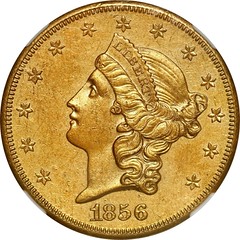

UNITED STATES, San Francisco mint, gold Coronet Liberty Head double eagle ($20), 1856-S, NGC UNC details / sea salvaged (Shipwreck Brown Label). KM-74.1. Sharp Mint State details with only lightly sandwashed surfaces retaining considerable luster under rich, dark gold toning, desirably pedigreed to the "Gordy-Ashley gold" find (but note that the NGC shipwreck label does not specify), somewhat rare as such. Pedigreed to Sedwick Auction 13, with original lot-tag 306 and photo-certificate. Recovered from: "Fort Capron Treasure," lost in 1857 off Fort Pierce (east coast of Florida)
To read the complete item description, see:
UNITED STATES San Francisco mint gold Coronet Liberty Head double eagle 20 1856 S NGC UNC det
(https://auction.sedwickcoins.com/UNITED-STATES-San-Francisco-mint-gold-Coronet-Liberty-Head-double-eagle-20-1856-S-NGC-UNC-det_i61281122?mc_cid=2c6ce5f3f9&mc_eid=119ff47984)

MEXICO, Mexico City, cob 8 reales, Charles II, assayer L, narrow barrel shape with long "horn" protruding from one end, ex-Long. S-M21; KM-46; Cal-Type 108. 26.54 grams. Bold full oML, king's ordinal II visible outside of most of shield, majority of the cross in evidence as well, Fine with toning in crevices, several old marks. With collector tag M-S4-15 ("Rhino"). Pedigreed to the Richard A. Long auction of August 1984 (lot 33).
To read the complete item description, see:
MEXICO Mexico City cob 8 reales Charles II assayer L narrow barrel shape with long horn protr
(https://auction.sedwickcoins.com/MEXICO-Mexico-City-cob-8-reales-Charles-II-assayer-L-narrow-barrel-shape-with-long-horn-protr_i61281290?mc_cid=2c6ce5f3f9&mc_eid=119ff47984)


BOLIVIA, Potosí, cob 8 reales, 1651 O, with crowned-script-Z countermark on shield, rare, NGC VF 35, c/s XF standard, "top pop." S-P35; KM-19b; Cal-1489. 26.76 grams. Remarkably full countermark at very edge above choice full shield with complete •P•O• and •8•O•, bold king's ordinal IIII in legend, also with 100% full and bold date outside of complete cross, great old toning, tied with just one other for finest known in the NGC census, a super non-salvage example with a rare countermark.
To read the complete item description, see:
BOLIVIA Potos cob 8 reales 1651 O with crowned script Z countermark on shield rare NGC VF 35
(https://auction.sedwickcoins.com/BOLIVIA-Potos-cob-8-reales-1651-O-with-crowned-script-Z-countermark-on-shield-rare-NGC-VF-35_i61281410?mc_cid=2c6ce5f3f9&mc_eid=119ff47984)


BOLIVIA, Potosí, cob 8 reales, 1652 E, Transitional Type III/A, rare, NGC XF 40. S-P37; KM-A20.3; Cal-unl. 26.77 grams. Choice, Royal-like interior details (complete and minimally doubled) plus lots of legend, but with clearly non-Royal edge (non-round and with small cracks), yet rather broad, extending past the outer border on the slightly off-center full shield side (also slightly doubled), enabling a complete king's name and ordinal PHILIPPVS IIII, variety with three dots above F-8-III and two dots below the 8, full date in legend, particularly rare as non-salvage (shows as "top pop" in NGC but only because it is not fully attributed as "3 line E.E" as it should be).
To read the complete item description, see:
BOLIVIA Potos cob 8 reales 1652 E Transitional Type III A rare NGC XF 40
(https://auction.sedwickcoins.com/BOLIVIA-Potos-cob-8-reales-1652-E-Transitional-Type-III-A-rare-NGC-XF-40_i61281432?mc_cid=2c6ce5f3f9&mc_eid=119ff47984)


ANCIENT GREEK, Kings of Macedon, AV stater, Philip III Arrhidaeus, 323-317 BC, year 14 (320/19 BC), Sidon mint, NGC Ch XF / strike 4/5, surface 3/5. Price P171. 8.62 grams. Head of Athena right, hair flowing loosely below, wearing pendant earring, necklace, and triple-crested Corinthian helmet pushed back on head, long intersecting crest ends, bowl decorated with coiled serpent right / Nike standing facing, head left, wreath in outstretched right hand, stylis cradled in left arm; AT monogram above torch in left field; Φ?Λ?ΠΠOY right. Well centered with strong details.
To read the complete item description, see:
ANCIENT GREEK Kings of Macedon AV stater Philip III Arrhidaeus 323 317 BC year 14 320 19 BC
(https://auction.sedwickcoins.com/ANCIENT-GREEK-Kings-of-Macedon-AV-stater-Philip-III-Arrhidaeus-323-317-BC-year-14-320-19-BC_i61281487?mc_cid=2c6ce5f3f9&mc_eid=119ff47984)


ARGENTINA (River Plate Provinces), Potosí mint, ½ sol, 1815 FL, NGC MS 65, finest known in NGC census. Janson-18.1.1; KM-10. Bold strike with incredible luster, parts of rims weak or missing due to slightly off-center strike, still incomparable quality for this smallest sunface issue.
To read the complete item description, see:
ARGENTINA River Plate Provinces Potos mint sol 1815 FL NGC MS 65 finest known in NGC censu
(https://auction.sedwickcoins.com/ARGENTINA-River-Plate-Provinces-Potos-mint-sol-1815-FL-NGC-MS-65-finest-known-in-NGC-censu_i61281502?mc_cid=2c6ce5f3f9&mc_eid=119ff47984)


COLOMBIA, Bogotá, gold bust 8 escudos, Charles III ("rat nose" bust), 1766 JV, rare, PCGS AU58, finest and only example in PCGS census, ex-Eldorado, ex-Diaz Lascano. Restrepo-71.8a; Cal-2085; KM-41. Choice, well-centered, and well-detailed strike with complete rims, sharp full details in the distinctive early "rat nose" portrait of Charles III, rich gold color with tinges of red, considerable remaining mint luster in the protected areas, light even friction on the highest points and only minor scattered contact marks, the finest at PCGS and bettered by only two at NGC in low MS grades, also nicely pedigreed. Pedigreed to the Federico Diaz Lascano Collection (Schulman auction of May 1969, lot 168) and to the Eldorado Collection (Stack's Bowers auction of January 2018, lot 11163).
To read the complete item description, see:
COLOMBIA Bogot gold bust 8 escudos Charles III rat nose bust 1766 JV rare PCGS AU58 fine
(https://auction.sedwickcoins.com/COLOMBIA-Bogot-gold-bust-8-escudos-Charles-III-rat-nose-bust-1766-JV-rare-PCGS-AU58-fine_i61281661?mc_cid=2c6ce5f3f9&mc_eid=119ff47984)


DOMINICAN REPUBLIC, Santo Domingo, 4 reales, Charles-Joanna, assayer F to left, denomination o-IIII to right, mintmark P to left and S to right, very rare, PCGS VF details / saltwater damage, only example in PCGS census, ex-Rudman (stated on label), Calicó Plate (2008). Downing-Rudman-4R.12; S-SD1; Cal-140; KM-32 var. 12.43 grams. One of only five known of this type, struck on a broad flan with full legends (king and queen stated on both sides, followed by REGIS on the pillars side and R on the shield side) bearing cloverleaf ornaments and all-Latin lettering, choice full pillars with mintmark P-S, also with strong assayer F and denomination on shield side (proper castles and lions) despite some corrosion on that side, deeply toned all over, with hairline edge crack.
As a group, Santo Domingo coins minted under Charles and Joanna are the rarest coins from the Spanish Colonial New World mints, probably because the mint operated for a only short period of time, from 1542 to 1552. Their design is similar to the coins struck at the Mexico City mint, which began slightly earlier, in 1536. There was only one Santo Domingo assayer for this series, Francisco Rodríguez (assayer F). Santo Domingo coins frequently show anomalies, like transposed castles and lions, mintmark P-S instead of S-P, and misspellings in the legend (the current piece, for example, shows YOHANA for the queen's name on one side). Execution was generally crude, with some exceptions, the current piece being one.
Santo Domingo silver coins of Charles-Joanna rarely come up for sale; this is an opportunity not to be missed. Pedigreed to the Rudman Collection (Cayón auction of December 2003, lot 87), plated on page 123 of the 2008 edition of Calicó's Numismática española.
To read the complete item description, see:
DOMINICAN REPUBLIC Santo Domingo 4 reales Charles Joanna assayer F to left denomination o IIII
(https://auction.sedwickcoins.com/DOMINICAN-REPUBLIC-Santo-Domingo-4-reales-Charles-Joanna-assayer-F-to-left-denomination-o-IIII_i61281817?mc_cid=2c6ce5f3f9&mc_eid=119ff47984)


UNITED STATES, Philadelphia mint, proof Barber quarter, 1910, PCGS PR65 Cameo. Mintage of only 551 coins in proof. Absolutely gorgeous proof with rich golden hues in the centers of both sides surrounded by vibrant purple toning around the rims. The frosty Liberty bust and eagle stand out against the mirror fields, providing ample cameo contrast for the designation.
To read the complete item description, see:
UNITED STATES Philadelphia mint proof Barber quarter 1910 PCGS PR65 Cameo
(https://auction.sedwickcoins.com/UNITED-STATES-Philadelphia-mint-proof-Barber-quarter-1910-PCGS-PR65-Cameo_i61282095?mc_cid=2c6ce5f3f9&mc_eid=119ff47984)
HERITAGE: WORLD AND ANCIENT COINS AUCTION
Heritage Auctions will be hosting their World & Ancient Coins Auction on November 5. Select Curators' Picks are discussed below. -Garrett

IONIA. Uncertain mint. Ca. 540-500 BC. EL stater (22mm, 14.02 gm). NGC Choice VF 5/5 - 4/5. Recumbent bull right, head reverted, on dotted groundline; lotus above / Rectangular incuse punch between two square incuse punches, all with geometric patterned surfaces. Weidauer-. BMC-. SNG Kayhan-. Kraay-Hirmer-. Traité-. Rosen-, cf. 148 for similar obverse type. Linzalone-, cf. 1174 for similar type with lion. Seemingly unpublished and unfound in sales archives. An immaculate, unique specimen on a broad, sunny flan.
This fascinating example appears to be a transitional type between Rosen 148 (obverse type) and Linzalone 1174 (recumbent lion and lotus with three incuse reverse). The Rosen example similarly features a recumbent bull with lotus, but it is a single punch reverse. Alternatively, the Linzalone example features a recumbent lion with lotus above, and three individually struck punches. These similarities suggest that, along with Rosen 149, they were likely struck at the same mint as part of a series of coinage featuring lotus flowers. However, as Wartenberg notes in White Gold (2020), the lotus flower is a common motif across Hellenistic coinage, so it cannot be linked to one specific mint.
To read the complete item description, see:
IONIA. Uncertain mint. Ca. 540-500 BC. EL stater (22mm, 14.02
gm). NGC Choice VF 5/5 - 4/5.
(https://coins.ha.com/itm/ancients/greek/greek-ionia-uncertain-mint-ca-540-500-bc-el-stater-22mm-1402-gm-ngc-choice-vf-5-5-4-5/a/3136-30014.s?ctrack=200071&type=bodylink-1b-coinworld-picks-3136-Platinum-tem102626)

IONIA. Uncertain mint. Ca. 540-500 BC. EL stater (21mm, 13.98 gm). NGC VF 5/5 - 4/5. Conjoined foreparts of bull left and roaring lion right / Rectangular incuse punch between two square incuse punches, all with geometric patterned surfaces. White Gold, pp. 569-640, 1-2 (this obverse die). Linzalone-. Kraay-Hirmer 590 (Croesus). Weidauer 133 var. (lion left, bull right). Very rare specimen with only two other examples in sales archives. Wonderfully animated dies on a nicely oval flan.
Scholarship on electrum coinage over the last century places this coin as a prototype of Croesus's bimetallic coinage based on the assumption that electrum coinage ceased to be produced once silver coinage was introduced. However, recent research from Wartenberg published in White Gold (2020) has concluded that electrum coinage continued to be made even until the death of Alexander the Great in 323 BC, that electrum was an intentionally made alloy through the introduction of silver to almost-pure gold, and that the coins circulated even as far as Egypt. Thus, this specific type cannot be definitively attributed to any one mint. Based on hoard data of this series and of similar types, it can be comfortably placed in the late 6th century BC.
Scholars such as Barclay Head, Robinson, Kraay, Weidauer, and Konuk have put forth many theories about dating and symbolism for this series of coins - both the type with the bull protome left and lion protome right, and the inverse. Robinson even suggests that "Both branches of the Lydian royal house traced their origin to a native solar deity...and the royal badge is also a solar symbol. Then the ox is perhaps a lunar one. Is it too fantastic to carry the symbolism one stage further? Lion = sun = gold: ox = moon = silver. In the issue of gold and silver alloy, lion and ox are shown still joined together, back to back. In the parallel issues of the later coinage in pure gold and silver they are not only separated but opposed." This theory, while impossible to validate, holds true even if this series was minted later than Robinson proposed.
To read the complete item description, see:
IONIA. Uncertain mint. Ca. 540-500 BC. EL stater (21mm, 13.98
gm). NGC VF 5/5 - 4/5.
(https://coins.ha.com/itm/ancients/greek/greek-ionia-uncertain-mint-ca-540-500-bc-el-stater-21mm-1398-gm-ngc-vf-5-5-4-5/a/3136-30015.s?ctrack=200071&type=bodylink-2b-coinworld-picks-3136-Platinum-tem102626)


Vespasian (AD 69-79). AV aureus (19mm, 7.34 gm, 5h). NGC Choice VF 5/5 - 2/5, ex-jewelry, scuffs. Judaea Capta issue, Rome, ca. 21 December AD 69-early AD 70. IMP CAESAR VESPASIANVS AVG, laureate head of Vespasian right / IVDAEA, Judaea, seated right on ground before palm tree, hands tied behind her. Calicó 644a. RIC II.1, 3. GBC 6, 6493. Very rare, only a few examples in sales archives. Mirror-like flashes.
Ex Áureo & Calicó, Auction 313 (5 July 2018), lot 19.
Descended from a family of small-time entrepreneurs and tax farmers in the Sabine hill country north of Rome, Flavius Vespasianus was born in AD 9 and rose to prominence in the Roman Army. He gained distinction during Claudius' invasion of Britain in AD 43-44 and won a Consulship in AD 51, but fell from imperial favor when he dozed off during one of Nero's musical performances. When a Jewish faction in the province of Judaea rebelled and massacred the local Roman garrison in AD 66, Nero sent Vespasian at the head of three legions to crush the revolt. Through his able son Titus, Vespasian gained the friendship and support of Mucianus, governor of Syria, who had another three legions at his disposal. When the collapse of Nero's regime in AD 68 led to a free-for-all for the throne, with Galba, Otho, and Vitellius following in quick succession, Vespasian realized he had the means and ability to make his own try for supreme power.
On 1 July AD 69, the legions of Alexandria, Egypt declared Vespasian as emperor. He decided on a policy of blockade and attrition to defeat Vitellius, but the sudden declaration of support by the Danubian legions and their invasion of Italy in the fall of AD 69 brought a much quicker victory. Vitellius was executed on 20 December, and the Senate proclaimed Vespasian emperor two days later. Arriving in Rome the following October, Vespasian celebrated a magnificent triumph for the Judaean campaign before launching an austerity program to put the Empire's finances on sound footing. His decade of rule was largely untroubled by revolts and conspiracies. Upon his death due to a sudden illness in AD 79 he was widely and sincerely mourned, and power passed smoothly to his son Titus.
To read the complete item description, see:
Vespasian (AD 69-79). AV aureus (19mm, 7.34 gm, 5h). NGC Choice
VF 5/5 - 2/5, ex-jewelry, scuffs.
(https://coins.ha.com/itm/ancients/roman-imperial/roman-imperial-vespasian-ad-69-79-av-aureus-19mm-734-gm-5h-ngc-choice-vf-5-5-2-5-ex-jewelry-scuffs/a/3136-30021.s?ctrack=200071&type=bodylink-3b-coinworld-picks-3136-Platinum-tem102626)


Nicholas I platinum 6 Roubles 1829-C?? AU55 PCGS, St. Petersburg mint, KM-C178, Bitkin-55 (R2), Sev-596, Uzd-0386. Struck in 1829, the very same year Nicholas I ascended to the Russian throne, the platinum specimen offered here is an artifact from the outset of his historic reign. This fantastic 6 Roubles is second highest denomination of the platinum pieces struck under Nicholas I, and one this cataloger is ecstatic to handle. Although the outermost peripheries exhibit some disturbance, and chatter across the fields ultimately limits the grade, the crispness of the obverse design is particularly praiseworthy, with its sharply rendered elements projecting boldly against the distinctive platinum backdrop. Hailing from a production of just 828 pieces, this near-Mint State representative presents an enticing opportunity for the collector whose interests lie in the rarities of Imperial Russian coinage.
Metal: Platinum
Weight: 20.71g
Mintage: 828
To read the complete item description, see:
Nicholas I platinum 6 Roubles 1829-C?? AU55 PCGS,
(https://coins.ha.com/itm/russia/russia-nicholas-i-platinum-6-roubles-1829-cand-1055-and-1041-au55-pcgs-/a/3136-30101.s?ctrack=200071&type=bodylink-1b-coinworld-picks-3136-Platinum-tem102626)


Philip V gold Cob Escudo 1715 Mo-J MS65 NGC, Mexico City mint, cf. KM51.2 (1715 unlisted, without flowers on reverse), Cal-1740. 3.36gm. Struck with royal dies. A piece that is easy to cherish. Presented here is a prime gold Escudo, not only displaying the full date, Mint, and assayer marks, but in a level of clarity that is breathtaking.
Metal: Gold
To read the complete item description, see:
Philip V gold Cob Escudo 1715 Mo-J MS65 NGC,
(https://coins.ha.com/itm/mexico/mexico-philip-v-gold-cob-escudo-1715-mo-j-ms65-ngc-/a/3136-31277.s?ctrack=200071&type=bodylink-2b-coinworld-picks-3136-Platinum-tem102626)


Eggenberg. Johann Anton Taler 1644 MS62 NGC, Krumau mint, KM27, Dav-3389, Donebauer-3312. An impeccable specimen, reigning superior in its quality and displaying a notable visual appeal. Acting as another indication of the careful aura of preservation, the remaining brilliance cascades across the flan with a simple whirl, appearing almost prooflike in hand. This Taler type was only struck in the 1644 and 1649 dates, with this 1644 example struck just two years after the opening of the Krumau mint in 1642. This representative will undoubtedly inspire competition upon its offering, as it is uncertain when another high-quality piece of this type will present itself again on the auction block.
Metal: Silver
To read the complete item description, see:
Eggenberg. Johann Anton Taler 1644 MS62 NGC,
(https://coins.ha.com/itm/austria/eggenberg/austria-eggenberg-johann-anton-taler-1644-ms62-ngc-/a/3136-30028.s?ctrack=200071&type=bodylink-3b-coinworld-picks-3136-Platinum-tem102626)


Kutch. Khengarji III silver Pattern 10 Kori VS 1998 (1942) MS64 NGC, KM-XM6 (Rare). Small portrait. Edge: lettered. A fabulous Pattern 10 Kori, and the highest denomination of the Pattern series produced in Kutch. Particularly desirable due to its scarcity and preservation, as there were no other examples that appeared at market, let alone with a elevated near-Gem grade. The closest example to the type was a pattern 5 Kori with the same design (large portrait type) realizing $29,710 in 2025 (Numismatica Genevensis SA Auction 23, November 2025, Lot 1066). Krause Mishler's Unusual World Coins reference notes, "in the last years of its coinage history, Kutch struck some non-circulating coins which state de-nomination. At least one was a pattern which wasn't approved for circulation strikes and the others were probably presentation pieces." A fascinating rendition and one of the exceedingly few portrait issues ever produced by Kutch. The lone example certified by NGC and considerably rare as such.
Metal: Silver
Weight: 11.8g
To read the complete item description, see:
Kutch. Khengarji III silver Pattern 10 Kori VS 1998 (1942) MS64
NGC,
(https://coins.ha.com/itm/india/kutch/india-kutch-khengarji-iii-silver-pattern-10-kori-vs-1998-1942-ms64-ngc-/a/3136-30079.s?ctrack=200071&type=bodylink-1b-coinworld-picks-3136-Platinum-tem102626)


Charles I gold Unite (20 Shillings) 1643 AU53 NGC, Oxford mint, KM254, S-2734, N-2389 (R), Brooker-851 (same dies). 9.01gm. Plume mm. Declaration in continuous scroll that connects with outer legend. Truly a very handsome rendition of this beloved type from the English Civil War, which while showing some minor irregularities in the dies, still demonstrates a superb craftsmanship and remarkable fullness of expression. Whereas the issue usually comes on heavily wavy flans with an uneven strike, that is not the case for this fantastic example.
Metal: Gold
Weight: 9g
AGW: 0.2653oz
To read the complete item description, see:
Charles I gold Unite (20 Shillings) 1643 AU53 NGC,
(https://coins.ha.com/itm/great-britain/great-britain-charles-i-gold-unite-20-shillings-1643-au53-ngc-/a/3136-30066.s?ctrack=200071&type=bodylink-2b-coinworld-picks-3136-Platinum-tem102626)


Oliver Cromwell "Dutch Copy" 6 Pence 1658 MS62 NGC, S-3229a, ESC-263 (prev. 1506; R4). Edge: Plain. Dutch copy by Tanner. An incredibly curious issue, with an estimate of less than 50 pieces extant. Bull notes that "only four genuine Cromwell sixpences are believed to exist, although rather more of the copies were executed in the Low Countries by Tanner c. 1738." A type last offered by Heritage in 2010, this piece sits just one point below the highest available certified, making it quite the prize for the Cromwellian specialist.
Metal: Silver
Diameter: 27mm
To read the complete item description, see:
Oliver Cromwell "Dutch Copy" 6 Pence 1658 MS62 NGC,
(https://coins.ha.com/itm/great-britain/great-britain-oliver-cromwell-dutch-copy-6-pence-1658-ms62-ngc-/a/3136-30067.s?ctrack=200071&type=bodylink-3b-coinworld-picks-3136-Platinum-tem102626)

HOLABIRD JACK HADDOCK NEVADA TOKENS, PART 4
While Fred Holabird has retired and closed his auction business, he left the door open some special private sales from time to time. One of those will take place November 6, 2026 when Holabird offers the Nevada Town token collection of Jack Haddock. The sale announcement is far more than just that - Fred delves into the history of Nevada token collecting, research and rarity as well as new digging and detecting techniques and advanced digital research platforms. It's lengthy and quite useful. Here's the last of four parts. -Editor

During the process of informational discovery, absolute treasures were found. That's right – treasures! Information is just as important as gold, and there's plenty here. That's what makes token collecting so fun. It opens the eyes to unseen history – to stories that have never been told. And you've got it right here.
In most cases, it was not a simple "look up in the Gazetteer." All too often the directory canvasser missed businesses. The same holds true for newspaper searches – only different. The merchants often never advertised. If it was a small mining camp, then so what? There was no need to advertise, even if it was in a nearby town newspaper. Also, these businesses were not made from the money tree, and most were stressed to the bottom of the wallet, so there was no money to advertise. One needs to think laterally – into a myriad of possibilities, such as proprietor names, who bought what, when, and so forth. Maybe you have to back into it – look at the entire spectrum of time the saloon was in business. The number of permutations is huge. I tried to explore them all. But still … there are at least two tokens for which I could find nothing. Research is not an easy task. The rewards are terrific. Pure "gold." I hope you find some.
There are a couple of tokens in this collection, and some in your own collection, that may have been misattributed in the past. Richard Greever has done a fantastic job of trying to keep track of all the American tokens with tokencatalog.com, and now the task is handed to TAMS, the Token and Medal Society. And you can help. Become a member.
For those tokens which may have been misattributed in the Haddock Collection, I have sufficient discussion to identify the piece, in general.
Token collecting in the American West has gone on since the 1850s. With demand, comes higher prices. Higher prices invite fraud. There are what appear to be many fakes of Nevada tokens. These are not counterfeit – they are not copies of existing pieces. They are fantasies – things made up from the imagination. Until we, as a collecting universe, positively know who has made these things, we cannot absolutely state they are fake. At one time, I thought we could. But no, I've seen way too may genuine pieces made by lousy, inexperienced die makers to make the assumption that every poorly made piece is a fake.
A list was published in the 1990 Nevada Token Book. There are more. Most of these pieces have very specific attributes in common. As an example, look at the reverses. Each and every one is non-standard, not seen in this form anywhere else. But was there a legitimate lousy die sinker out there in the c1900- 1910 period? Maybe time will tell. After all, the Bigfoot story finally came out …
We have a significant collection of Jack's "spurious tokens" that are thought to be fakes, but can't guarantee fake or real. If interested, please inquire.
This is a special sale. The old company is not in business. I am retired. We stated last year, there would be some special private sales from time to time, including the Tom Westervelt mining artifact and American mining stock collection, now slated for 2027. We, and I, am not open for random consignments. I will consider very special collections as time allows. Virtually every single one of the folks that were a part of my Holabird Americana team is very thankful to all of you. We had a great run, had a ton of fun, and made collecting fun for tens of thousands of people, as well as one of my key objectives: education. Thank You!
For more information on the sale, or to bid, see:
Jack Haddock Nevada Town Token Collection Auction(Session 1)
(https://holabirdamericana.liveauctiongroup.com/auctionlist.aspx?t=JH1)
To read the earlier E-Sylum article, see:
HOLABIRD JACK HADDOCK NEVADA TOKENS, PART 1
(https://www.coinbooks.org/v29/esylum_v29n41a21.html)
HOLABIRD JACK HADDOCK NEVADA TOKENS, PART 2
(https://www.coinbooks.org/v29/esylum_v29n42a20.html)
HOLABIRD JACK HADDOCK NEVADA TOKENS, PART 3
(https://www.coinbooks.org/v29/esylum_v29n43a19.html)
THE BOOK BAZARRE
JOEL SHAFER AUCTION #1 SELECTIONS
Joel Shafer has a new firm - Joel Shafer Auctions will focus on world paper money. Their first sale closes November 9, 2026. Here are some nice lots that caught my eye. -Editor


Lot #5: Albania S148b, 1 Franc, 1918
Shqiperie Vetqeveritare. Exceptional Paper Quality ink stamp. Serial: A 13705. ONLY example on the population report. Grade: PMG 64 Ch. UNC.
To read the complete lot description, or to bid see:
Albania S148b, 1 Franc, 1918
(https://joelshaferauctions.com/item/536/albania-s148b-1-franc-1918/)
Lot #15: Aruba 26a, 500 Florin, 2009
Central Bank of Aruba. Serial: 0908209773. Popular type. Wonderful design. Grade: UNC.
I agree - a wonderful design. Visually, this is my favorite of the group. -Editor
To read the complete lot description, or to bid see:
Aruba 26a, 500 Florin, 2009
(https://joelshaferauctions.com/item/561/aruba-26a-500-florin-2009/)

Lot #25: Austria 046, 50 Kronen, 4.10.1920
Austro-Hungarian Bank. Exceptional Paper Quality. Overprint. Serial: 1099 105245. Grade: PMG 65 Gem UNC.
To read the complete lot description, or to bid see:
Austria 046, 50 Kronen, 4.10.1920
(https://joelshaferauctions.com/item/578/austria-046-50-kronen-4101920/)


Lot #43: Belgian Congo 13Aa, 5 Francs, 10.1.1943
Banque du Congo Belge. Wonderful original. Serial: J 969421. Grade: UNC.
To read the complete lot description, or to bid see:
Belgian Congo 13Aa, 5 Francs, 10.1.1943
(https://joelshaferauctions.com/item/628/belgian-congo-13aa-5-francs-1011943/)

Lot #52: Bermuda 03b, 5 Shillings, ND (1935)
Government of Bermuda. Serial: B/1 53493. Wonderful early type. Signature title of Colonial Treasurer. Far better than most show. Grade: PMG 35 Ch. VF.
To read the complete lot description, or to bid see:
Bermuda 03b, 5 Shillings, ND (1935)
(https://joelshaferauctions.com/item/655/bermuda-03b-5-shillings-nd-1935/)

Lot #72: British North Borneo 22, 10 Dollars, 1.1.1927
British North Borneo Company. Pleasing full margins. Slits. Serial: D 141675. Last signature combination for this type. Wonderful full and largely unscathed margins. Very difficult to find any date for this denomination. Grade: Fine.
To read the complete lot description, or to bid see:
British North Borneo 22, 10 Dollars, 1.1.1927
(https://joelshaferauctions.com/item/704/british-north-borneo-22-10-dollars-111927/)
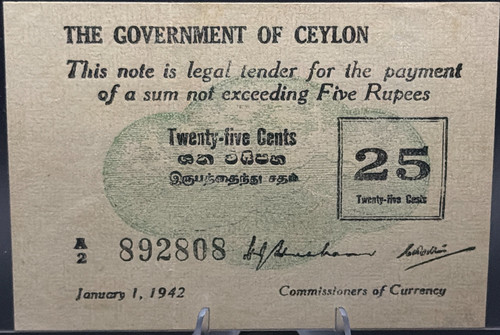
Lot #90: Ceylon 40, 25 Cents, 1.1.1942
Government of Ceylon. Original World War II type. Serial: 892808. Grade: Ch. XF/AU.
To read the complete lot description, or to bid see:
Ceylon 40, 25 Cents, 1.1.1942
(https://joelshaferauctions.com/item/752/ceylon-40-25-cents-111942/)

Lot #138: East Africa 36, 100 Shillings=5 Pounds, 1.1.1955
East African Currency Board. Challenging highest Queen Elizabeth II denomination. Attractive original. Serial: K4 35761. Grade: Ch. VF/XF.
To read the complete lot description, or to bid see:
East Africa 36, 100 Shilllings=5 Pounds, 1.1.1955
(https://joelshaferauctions.com/item/848/east-africa-36-100-shilllings5-pounds-111955/)
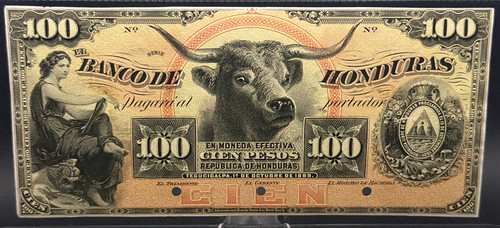
Lot #203: Honduras 24fp; 24bp, 100 Pesos, 1.10.1889
Banco de Honduras. Wonderful bull design. Light residue back; pinhole. Serial: None. Grade: WBG 53 AU.
To read the complete lot description, or to bid see:
Honduras 24fp; 24bp, 100 Pesos, 1.10.1889
(https://joelshaferauctions.com/item/983/honduras-24fp-24bp-100-pesos-1101889/)


Lot #387: Philippines 124b, 500 Pesos, ND (1949)
Central Bank of the Philippines. Highest denomination of series; Legazpi. Bold CENTRAL BANK overprint on back; sensational overall color. Serial: F00029711. Foxing. Grade: AU.
To read the complete lot description, or to bid see:
Philippines 124b, 500 Pesos, ND (1949)
(https://joelshaferauctions.com/item/1350/philippines-124b-500-pesos-nd-1949/)
To visit the Joel Shafer Auctions website, see:
https://joelshaferauctions.com/

KUENKER AUCTION SALE 449
Künker will hold three auction sales featuring exclusively coins from the ancient world in early November 2026. The series will conclude with an eLive Premium Auction containing two special collections: coins from Syracuse from the collection of Dr. Hartmut Kreutzer, and the 11th installment of the Dr. W. R. collection, featuring coins ranging from the first tetrarchy to the fall of the Western Roman Empire. -Garrett
eLive Premium Auction 449: Sammlung Dr. Hartmut Kreutzer, Teil 1
11. November 2026 auf www.kuenker.auex.de
When people hear the name Dr. Hartmut Kreutzer, they immediately think of his important book on the Syracusan drachmas and small silver coins from the period of the signatory artists. Now the first part of his collection is coming to market. It comprises around 100 lots of—not surprisingly—coins from Syracuse, including extremely rare small coins as well as comparative specimens of Syracusan and Sicilian coinage.
The pieces were selected with a deep understanding of the artistic quality and rarity of certain dies. Thus, not only will those who would like to own a coin from the city of Syracuse find something of interest, but so will the experienced specialist collector. For the collection offers types that are rarely seen.


Lot 4026. Griechenland. Sicilia. Syrakus. Tetradrachme 415/405 v. Chr., beidseitig signiert von Euainetos. Selten. Herrliche Patina, min. Prägeschwäche, sehr schön +. Exemplar der Auktion NAC L, Zürich 2001, Nr. 1224.


Lot 4036. Griechenland. Sicilia. Syrakus. Hemidrachme 410/405 v. Chr. Feine Tönung, min. korrodiert, sehr schön-vorzüglich. Exemplar der E-Sale Roma Numismatics 28, London 2016, Nr. 38.


Lot 4045. Griechenland. Sicilia. Syrakus. Litra 415/405 v. Chr. Feine Patina, sehr schön-vorzüglich. Exemplar der Auktion Vecchi 14, London 1999, Nr. 316.


Lot 4059. Griechenland. Sicilia. Syrakus. Drachme 410/405 v. Chr. Hübsche Tönung, min. korrodiert, gutes sehr schön. Exemplar der Auktion Roma Numismatics II, London 2011, Nr. 114.


Lot 4065. Griechenland. Sicilia. Syrakus. 50 Litren 405/400 v. Chr. Geprägt mit leicht rostigem Aversstempel, sehr schön-vorzüglich/vorzüglich. Exemplar der Auktion Leu Numismatik AG 61, Zürich 1995, Nr. 72.


Lot 4076. Griechenland. Sicilia. Syrakus. Hieron II., 274-216 v. Chr. Drachme 269/263 v. Chr. Winz. Prüfstelle am Rand, sonst vorzüglich. Exemplar der Sammlung Gustave Burel, Auktion Rollin & Feuardent, Paris 11.-14. Juni 1913, Nr. 111.
eLive Premium Auction 449: Sammlung Dr. W. R., Teil 11
11. November 2026 auf www.kuenker.auex.de
As part of the eLive Premium Auction 449, the 11th installment of the Dr. W. R. Collection is being sold. Connoisseurs now know what to expect: select rarities of outstanding quality in all three metals—gold, silver, and bronze.
Part 11 features coins from the numismatically significant period spanning the beginning of the First Tetrarchy to the fall of the Western Roman Empire. Specialty collectors have much to look forward to, as they will discover many rare emperors—among whom we mention here only Alexander of Carthage and Martinianus. But the collection also includes historically interesting rarities featuring some of the better-known rulers.
The selection is thus extensive. Nevertheless, we recommend taking a closer look at the thoughtfully curated lots, which contain coins—some of which are in perfect condition.


Lot 4503. Römische Kaiserzeit. Carausius, 287-291. Antoninian, unbestimmte Münzstätte. Von großer Seltenheit. Min. Prägeschwäche am Rand, vorzüglich. Exemplar der Auktion Hauck & Aufhäuser 20, München 2007, Nr. 544.


Lot 4506. Römische Kaiserzeit. Diocletianus, 284-305. Aureus 294, Rom. Selten. Sehr attraktives Exemplar, vorzüglich-Stempelglanz. Exemplar der Auktion Rauch 107, Wien 2018, Nr. 425.


Lot 4513. Römische Kaiserzeit. Maximianus I., 285-305. Aureus 286, Antiochia. Sehr selten. Winz. Schrötlingsfehler am Rand, vorzüglich. Exemplar der Auktion Münzen und Medaillen AG 85, Basel 1997, Nr, 234.


Lot 4524. Römische Kaiserzeit. Constantius I., 293-306. Argenteus 300/301, Rom, 6. Emission. Selten. Exemplar mit feiner Patina, fast vorzüglich. Exemplar der Auktion Lanz 138, München 2007, Nr. 916.


Lot 4537. Römische Kaiserzeit. Maximinus II. Daia, 305-313. Aureus 306/307, Nicomedia. Selten. Fast vorzüglich. Exemplar der Auktion Münzen und Medaillen AG 86, Basel 1998, Nr. 201.


Lot 4549. Römische Kaiserzeit. Alexander von Karthago, 308-309. Follis, Karthago. Sehr selten. Breiter Schrötling, kl. Doppelschlag, gutes sehr schön. Exemplar der Auktion NAC 29, Zürich 2005, Nr. 631.


Lot 4553. Römische Kaiserzeit. Licinius I., 308-324. Follis 308/313, Nicomedia, 3. Offizin. Dunkle Patina, vorzüglich. Exemplar der Auktion Helios 1, München 2008, Nr. 581.


Lot 4558. Römische Kaiserzeit. Martinianus, 324. Follis, Nicomedia, 2. Offizin. Von großer Seltenheit. Dunkle Patina, min. korrodiert, fast sehr schön. Erworben im Dezember 1997.


Lot 4584. Römische Kaiserzeit. Constantinus I., 306-337. Follis 327, Constantinopolis. Von großer Seltenheit. Feine Tönung mit etwas Silbersud, min. korrodiert, sehr schön-vorzüglich. Exemplar der Auktion CNG 129, Lancaster 2025, Nr. 573.
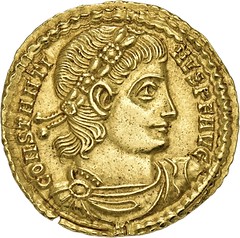

Lot 4606. Römische Kaiserzeit. Constantinus II., 337-340. Solidus 337/340, Siscia. Von großer Seltenheit. Leichter Doppelschlag, vorzüglich. Exemplar der Auktion Hess-Divo 332, Zürich 2017, Nr. 121.


Lot 4698. Römische Kaiserzeit. Johannes, 423-425. Solidus, Ravenna. Von großer Seltenheit. Winz. Druckstelle im Feld des Avers, sehr schön. Exemplar der Auktion NAC Autumn Sale 95, Zürich 1995, Nr. 686.


Lot 4717. Römische Kaiserzeit. Valentinianus III., 425-455, für Justa Grata Honoria. Solidus 430/445, Ravenna. Von großer Seltenheit. Winz. Kratzer, fast vorzüglich. Exemplar der Auktion Giessener Münzhandlung 107, München 2001, Nr. 642.
To order a catalog contact Künker, Nobbenburger Straße 4a, 49076 Osnabrück; phone: +49 541 / 962020; fax: +49 541 / 9620222; or via e-mail: service@kuenker.de. You can access the auction catalogs online at www.kuenker.de. If you want to submit your bid from your computer at home, please remember to register for this service in good time.
EARLY AMERICAN HISTORY NOVEMBER 14 SALE
Here are several selections from the upcoming Early American History Auctions sale. -Garrett


ELIAS BOUDINOT (1740-1821). 10th President of the Continental Congress (1782-1783); a Founding Father; Member of the Continental Congres who served in the First Congress of 1789; Signed the "Treaty of Paris" with Great Britain ending the Revolutionary War; Member of the Committee on Correspondence; New Jersey Provincial Congress; Commissary-General of Prisoners; in 1795 Appointed Third Director of the United States Mint by George Washington; founded the American Bible Society and began "Thanksgiving" in America as a National Holiday.
December 16, 1790, Newark (New Jersey) First Presbyterian Church in Newark, Signed "E Boudinot" as Church president, Private Four Pence Small Change Note, Newman page 266, Wait 1410, PCGS graded Very Fine-25. This Church money series was printed by Kollock and is clearly Signed in brown ink by Elias Boudinot. This note is quite superior in its eye appeal to most we have seen and the signature is strong. The holder notes edges trimmed (all are... this one in a wavy fashion). Worthy of a premium being an excellent representative of the series with a very clear strong signature.
An American Revolutionary War era Statesman, Elias Boudinot was a close friend of George Washington, and was a tireless supporter of the Revolution and the fledgling Federal government. Despite not signing the Declaration of Independence, the Constitution or the Articles of Confederation, he is one of the more important political figures from the American Revolutionary Era.
Elias Boudinot was a member of the New Jersey Committee on Correspondence (1774-1775) and the New Jersey Provincial Congress (1775).
In 1777 during the Revolutionary War he was appointed Commissary-General of Prisoners. He was a Member of the Continental Congress (1777-1788 and 1781-1784) and its President (1782-1783). Boudinot Signed the "Treaty of Paris" with Great Britain to end the Revolutionary War.
He served in first Congress of 1789; and in 1795 was made the Third Director of the United States Mint. From 1816 to 1821 served as the First President of the American Bible Society.
To read the complete item description, see:
Elias Boudinot Signed as President of the First Presbyterian Church of Newark, NJ December 16, 1790 Four Pence Note
(https://earlyamerican.com/pages/page-single.php?r=314216x496526&lot=4&auction=2026-11-14)


March 1, 1770, Maryland, Half Dollar, Second Finest PMG Certified on the Population Report, PMG graded About Uncirculated-53.
Fr. MD-53. The second Finest PMG Certified Maryland $1/2 note on this issue. Printer's initials "A. C. and W. Green" on the back who was "Anne Catherine Green" the widow of Jonas Green, and this is one of the few female printer issues known on early American Colonial paper currency. This note is boldly signed and lightly circulated noted on its holder as previously mounted and has a small hole which are faint trivial traces at the extreme corner tips and a natural tiny worm hole. The face is boldly printed having four full even margins with nice centering. The 2008 5th Edition of Newman lists a value in Extremely Fine of $700 and no listed values higher due to its rarity in higher grades.
To read the complete item description, see:
Maryland March 1, 1770 $1/2 PMG About Uncirculated-53the Second Finest PMG Certified Only (1) Higher at AU-55
(https://earlyamerican.com/pages/page-single.php?r=741625x905927&lot=61&auction=2026-11-14)


August 18, 1775, Paul Revere Engraved Massachusetts Colonial Currency, Six Shillings, "Sword In Hand" Issue, PCGS graded Fine-15.
Fr. MA-163. An attractive Revolutionary War issued circulated Paul Revere Engraved "Sword in Hand" issue note with PCGS holder stating apparent center split repaired, small edge splits. The PMG population report lists only three examples certified, with their highest graded being Very Fine-20, just one grade higher. This evenly circulated note appears solid and has full margins on both its face and back with all text and devices being clear, including the historic Minuteman holding his Sword in his right hand while carrying a copy of the MAGNA CHARTA in his other. It displays well with light even overall tone and the blue ink signature of J. Wheeler is clearly readable. A very popular highly collectable note for those who desire an authentic Paul Revere engraving.
To read the complete item description, see:
Paul Revere Engraved "Sword In Hand" Note PCGS Fine-15
(https://earlyamerican.com/pages/page-single.php?r=168057x664849&lot=63&auction=2026-11-14)


December 31, 1763, New Jersey Colonial Currency, Six Pounds, Red and Blue Printed Face, in a PMG Comment Free holder graded Very Fine-25.
Fr. NJ-160. This colorful 1763 French & Indian War period £6 note with a Red and Blue printed face is the highest denomination on the issue, with only a mere 500 notes printed in 1763. In fact, this issue was to be redeemed back into the treasury by December 31, 1782, after which time is was invalid. This example has deep red and blue printed text and designs all being clearly readable on its well centered face side. Remarkably for a note of this rarity and age PMG found no detractions and it is a rare comment free holdered note. It is clean and even in overall circulation and a nice example for display. The Friedberg reference lists a Fine at $1,500 and displays a "dash" in Very Fine, whereas the 2008 5th edition of Newman has a $2,000 in Very Fine.
To read the complete item description, see:
December 31, 1763 Six Pound Note Only 500 Authorized
(https://earlyamerican.com/pages/page-single.php?r=741625x905927&lot=66&auction=2026-11-14)

April 21, 1760, New York, Two Pounds, rated the Third Finest Certified, PCGS graded Very Fine-25.
Fr. NY-149. This well printed French and Indian War period note has nice eye appeal for the discriminating New York currency collectors. Of only 17 notes listed from both services in the Track & Price census, this example is the Third Finest Certified. It also bears the lowest Serial Number 99, recorded. The two higher graded notes are both PCGS graded as Apparent VF-30. This attractive note received the apparent designation for repaired splits which is reinforcement of the vertical centerfold seen only on its blank reverse. Boldly signed in rich brown ink by; John Bogert, Jr., Robert G. Livingston, and Elias Des Brosses. Overall, the reverse is clean and free from all typical notations, the bottom right corner is rounded, yet the eye appeal is well above average. Friedberg calls this note "Extremely Rare."
To read the complete item description, see:
New York April 21, 1760 £2 The Third Finest Certified as Genuine PCGS graded Very Fine-25 Friedberg "Ext. Rare"
(https://earlyamerican.com/pages/page-single.php?r=741625x905927&lot=69&auction=2026-11-14)

October 20, 1777 Act, Treasury of Virginia Colonial Currency, Handwritten Date, Eight Dollars, Choice Crisp Extremely Fine.
Fr. VA-129. This boldly printed quality 1777 Revolutionary War note is superior to most. It has excellent centering, and the "B. Dickson" and "Ja(mes) Wray" signatures and red serial number add to its eye appeal. The blank reverse is perfectly clean. The heavy rag period paper is crisp and extremely clean, only lightly circulated made with a thin blue thread in the paper as made. A desirable high quality note.
To read the complete item description, see:
Choice October 20, 1777 Virginia $8 Handwritten Date
(https://earlyamerican.com/pages/page-single.php?r=741625x905927&lot=83&auction=2026-11-14)


1862 Civil War Encased Postage Stamp Emergency Currency, EP-68, HB-69, S-40, Reed-BU05, Five Cents, F. BUHL & CO., Detroit, Extremely Fine.
Rarity-8 (5 to 10 known) according to Fred Reed. F. Buhl & Company was the only Detroit-based firm to utilize John Gault's encased postage. This example being one of the finest known, and it appears finer in quality than the Hodder-Bowers plate specimen illustrated on page 72 of THE STANDARD CATALOGUE reference. The mica remains very clear and unbroken with one very slight natural craze atop the left moon. The perfectly centered stamp remains a deep, bold deep rich brown, a faint insertion crease in the stamp near center only seen viewed at an angle. Overall, virtually like the day it was printed. The detail is extremely sharp, with no detractions to the legends on the perfect, natural medium chestnut-brown reverse surfaces. Extremely rare as a major Merchant type in this quality, having particularly pleasing eye appeal. (VF Scott Cat. $2,250) Provenance ex: Collection of Robert Bauer.
In 1833, brothers Frederick and Christian Buhl launched F. Buhl & Company, focusing on the sale of hats and furs. Their commitment to quality and fair dealings quickly earned them a reputation, and their business flourished. Frederick served as Detroit's Mayor in 1848; Christian served as Mayor from 1860 to 1861.
To read the complete item description, see:
Rarity-8 Five Cents "F. BUHL & Co." Detroit (5-10 known)
(https://earlyamerican.com/pages/page-single.php?r=211067x297124&lot=179&auction=2026-11-14)
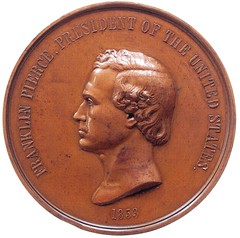

(1853-Dated) Franklin Pierce Indian Peace Medal, 76 mm, First and Largest Size, Original, Julian IP-32, Belden-48, Struck at the United States Mint in Bronze, Choice Mint State.
Julian IP-32. Belden-48. 76 mm. This genuine first and largest size Franklin Pierce Indian Peace Medal was struck in bronze at the United States Mint in Philadelphia. This is the "Large Date" variety mentioned in Julian's catalog of U.S. Mint Medals. One tiny hard to see partial hole made in the center rim at 3:00 likely for prior display mounting is unseen from the face or back. Julian states that this "Large Date" variety medal was struck from the original dies starting about 1855. This beautiful medal appears Choice Mint State having smooth lovely natural medium brown surfaces and sharply detailed highpoints.
To read the complete item description, see:
Franklin Pierce Bronze Indian Peace Medal Julian IP-32
(https://earlyamerican.com/pages/page-single.php?r=651913x319643&lot=225&auction=2026-11-14)

ORVILLE WRIGHT, (1871-1948). Orville Wright had as much influence in the creation of the first airplane as his brother Wilber and was, in fact, the first to fly the Wright's Airplane and have a successful lift-off, traveling 120 feet. It was during the years between 1900 and 1903 that the Wright Brothers developed the first working airplane.
"Orville Wright" Signed, 1932-Dated Printed Check issued from The Winters National Bank & Trust Co. in Dayton, Ohio, with typical small punch cancels, Choice Crisp About Uncirculated. This choice quality tan paper check with black text is nicely penned in blue ink with a red ink meter payment amount. Date stamped on the reverse. His full signature, "Orville Wright" is also in easily readable pencil, measuring about 2.5" long. Wright was born in Dayton, Ohio, and it was there that he and his brother, Wilbur, conceived and developed the idea of the airplane.
Orville Wright (1871-1948). Orville Wright was born in 1871 in Dayton, Ohio. He is less well known than his older brother, Wilbur, but had as much influence in the creation of the first airplane as did his brother. Orville was in fact, the first to fly the Wright's airplane and have a successful lift-off, traveling 120 feet. It was during the years between 1900 and 1903 that the Wright Brothers developed the first working airplane.
They made the first controlled, sustained flight of an engine-powered, heavier-than-air aircraft with the Wright Flyer on December 17, 1903, four miles (6 km) south of Kitty Hawk, North Carolina, at what is now known as Kill Devil Hills.
In 1904 the Wright brothers developed the Wright Flyer II, which made longer-duration flights including the first circle, followed in 1905 by the first truly practical fixed-wing aircraft, the Wright Flyer III.
Their first two gliders had not worked as designed, and the Wrights were beginning a critical shift that would enable them to discover the reason. "The Wright Brothers Aeroplane" appeared in Century magazine in 1908, after Wilbur had made his flights in France.
The Wright brothers always presented a unified image to the public, sharing equally in the credit for their invention. Biographers note that Wilbur took the initiative in 1899 and 1900, writing of "my" machine and "my" plans before Orville became deeply involved when the first person singular became the plural "we" and "our".
Author James Tobin asserts, "it is impossible to imagine Orville, bright as he was, supplying the driving force that started their work and kept it going from the back room of a store in Ohio to conferences with capitalists, presidents, and kings. Will did that. He was the leader, from the beginning to the end."
To read the complete item description, see:
Choice "Orville Wright" Original Signed Printed Check
(https://earlyamerican.com/pages/page-single.php?r=314216x496526&lot=46&auction=2026-11-14)

DAVISSON'S E-AUCTION 54
Davissons is holding their E-Auction 54 on November 18. Here's an overview from Allan, Marnie, & Lief Davisson. -Editor
 E-Auction 54, closing Wednesday, November 18th 2026, is online now! Print copies were mailed last week. If you are not on our mailing list and would like a copy, please let us know.
Two of the collections in this catalog reflect the time, effort, and expense of seriously collecting a specific series. The Peter Bartlett collection of ancient Greek coins with remarkable coverage of the earliest coinage at one end of the spectrum. And the collection representing 2300 years of English coinage, Celts to Windsors, that can be found in the British section of the sale represents an economical but effective approach.
The Bartlett Collection shows the time, the expertise, the focus, and the financial strength needed to assemble a world-class collection. The collection stands as nearly definitive for the earliest coins issued, in the 7th Century B.C. in Asia Minor.
The English history collection was put together on a budget by purchasing examples with a problem or two, (or more, in the case of the Alfred the Great penny), smaller denominations like pennies for the two Richards (II and III), individual Maundy pieces, worn milled pieces, and an occasional splurge like the PAX penny of Harold II. The collector's approach was creative and thoughtful, and the 2300 years of history are well represented.
The ancient section is extensive featuring many early issues from the Peter Bartlett Collection, an interesting and broad range of Greek silver and bronze issues from Magna Graecia, and also Baktria. The Roman section includes some appealing and collectible Roman Republican, along with select denarii and a small high grade collection of the Consecratio issues of Trajan Decius, featuring some of his notable predecessors.
The British Isles are well represented by a number of early Celtic and British hammered, and a strong section of D&H tokens with a number of high grade (MS64 and up) tokens consigned by two different collectors.
The auction ends with a select mix of European and United States coins.
We often wonder what we will end up with when we start thinking about our catalogs a few months before actually assembling and writing. By the time the process is over and the catalog is sent out we've had a bit of a numismatic adventure with consignments coming in, complemented by material we have from previous acquisitions, and we realize that creating an interesting catalog is a new growth process every time we complete this effort.
Thank you for your interest. Best wishes for the coming holiday seasons.
Allan, Marnie, and Lief
For more information, or to bid, see:
E-Auction 54
(https://auctions.davcoin.com/auction/e-auction-54-1003)

IBERCOIN 2026 INTERNATIONAL BANKNOTE WEEK
The Ibercoin International Banknote Week will consist of three auctions held November 17-19, 2026. Here's the announcement. -Editor

Ibercoin, the Madrid-based numismatic auction house, will hold the Ibercoin International Banknote Week from 17 to 19 November 2026: three consecutive auctions dedicated to collectible banknotes, held in Madrid with live online bidding open to collectors worldwide, bringing together close to 5,000 lots from five continents, from a Danish Treasury note of 1713 to the most recent issues.
Tuesday 17 November, 15:00 CET - Asturica Collection Worldwide (#139)
A world banknote collection formed with discernment over many years. Its 1,374 lots span more than two hundred countries and territories, from Afghanistan to Zimbabwe, with historical series from Africa, Asia and Eastern Europe, PMG-certified pieces, and a good number of colonial issues and issues from states that no longer exist.
https://www.ibercoin.com/en/numismatic-auctions/123
Wednesday 18 November, 15:00 CET - Cifuentes Collection South America (#140)
One of the most complete collections of Latin American banknotes to come to market in recent years, with 1,548 lots. It is especially strong in Guatemala, Paraguay, Argentina, Brazil and Bolivia, alongside Cuba, Peru and Uruguay, and includes proofs, remainders and highly interesting 19th-century issues, such as those of the Argentine Caja de Conversion.
https://www.ibercoin.com/en/numismatic-auctions/122
Thursday 19 November, 11:00 CET - World Banknotes Online Auction (#141)
A general auction with 2,067 lots from around the world. The sections for France, the United States, Germany, Portugal and China stand out, with numerous high-grade PMG examples, some of them Top Pop, and pieces for every level of collector.
https://www.ibercoin.com/en/numismatic-auctions/126
HIGHLIGHTS

Asturica Collection Worldwide (#139) - 17 November


- Lot 3130 - BELGIUM. 5000 Francs. 8 April 1975 and replacement. Banque Nationale. (Pick: 137). Extremely rare, to give idea of just how rare it is, only four have been certified by PMG, and this note is the second-best, together with another banknote. PMG58. Starting bid EUR 300.
To read the complete lot description, see:
https://www.ibercoin.com/en/numismatic-auctions/123-Asturica-Worldwide-Banknote-Collection-17-11-2026/lot-3130-BELGIUM


- Lot 3177 - BOSNIA AND HERZEGOVINA. 1 Marka. (1998ca). Numeration low (A0000293). Central Bank. (Pick: 60a). Very rare, especially in this quality and numeration. PMG67EPQ. Starting bid EUR 450.
To read the complete lot description, see:
https://www.ibercoin.com/en/numismatic-auctions/123-Asturica-Worldwide-Banknote-Collection-17-11-2026/lot-3177-BOSNIA-AND-HERZEGOVINA


- Lot 3203 - BULGARIA. 1000 Leva. 1948. National Bank. (Pick: 78a). Very rare, especially in this quality. PMG65EPQ. Starting bid EUR 500.
To read the complete lot description, see:
https://www.ibercoin.com/en/numismatic-auctions/123-Asturica-Worldwide-Banknote-Collection-17-11-2026/lot-3203-BULGARIA


- Lot 3353 - CZECH REPUBLIC. 5000 Korun. 1993. National Bank. (Pick: 9). Very rare in this quality. PMG65EPQ. Starting bid EUR 500.
To read the complete lot description, see:
https://www.ibercoin.com/en/numismatic-auctions/123-Asturica-Worldwide-Banknote-Collection-17-11-2026/lot-3353-CZECH-REPUBLIC


- Lot 3364 - CZECHOSLOVAKIA. 50 Korun. 1919. Republic. (Pick: 10). Extremely rare, especially without any repairs. PMG35 (tears). Starting bid EUR 700.
To read the complete lot description, see:
https://www.ibercoin.com/en/numismatic-auctions/123-Asturica-Worldwide-Banknote-Collection-17-11-2026/lot-3364-CZECHOSLOVAKIA

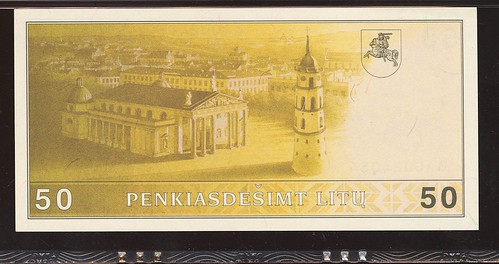
- Lot 3775 - LITHUANIA. 50 Litu. 1991. Bank of Lithuania and low numeration. (Pick: 49a). Extremely rare. PMG63EPQ. Starting bid EUR 400.
To read the complete lot description, see:
https://www.ibercoin.com/en/numismatic-auctions/123-Asturica-Worldwide-Banknote-Collection-17-11-2026/lot-3775-LITHUANIA


- Lot 4071 - ROMANIA. 100 Lei. 1 December 2018. In the official folder. Banca Nationala. (Pick: 124). Uncirculated. Starting bid EUR 275.
To read the complete lot description, see:
https://www.ibercoin.com/en/numismatic-auctions/123-Asturica-Worldwide-Banknote-Collection-17-11-2026/lot-4071-ROMANIA


- Lot 4336 - VIET NAM. 5000 Dong. (1951ca). National Bank. (Pick: 66a). Extremely rare, especially in this quality and this very high denomination. PMG66EPQ. Starting bid EUR 450.
To read the complete lot description, see:
https://www.ibercoin.com/en/numismatic-auctions/123-Asturica-Worldwide-Banknote-Collection-17-11-2026/lot-4336-VIET-NAM


- Lot 4367 - YUGOSLAVIA. 500 Dinara. 1 March 1990. SPECIMEN and numeration AA0000000. Banque Nationale. (Pick: 106As). Extremely rare. PMG65EPQ (according to the PMG population report, it is the Top Pop banknote as of 15 September 2026). Starting bid EUR 500.
To read the complete lot description, see:
https://www.ibercoin.com/en/numismatic-auctions/123-Asturica-Worldwide-Banknote-Collection-17-11-2026/lot-4367-YUGOSLAVIA

Cifuentes Collection South America (#140) - 18 November

- Lot 5091 - ARGENTINA. 100 Pesos. 5 November 1881. Banco de la Provincia de Buenos Aires. (Pick: S567p1). PMG53 (printer's annotation). Starting bid EUR 900.
To read the complete lot description, see:
https://www.ibercoin.com/en/numismatic-auctions/122-Cifuentes-South-American-Banknote-Collection-18-11-2026/lot-5091-ARGENTINA
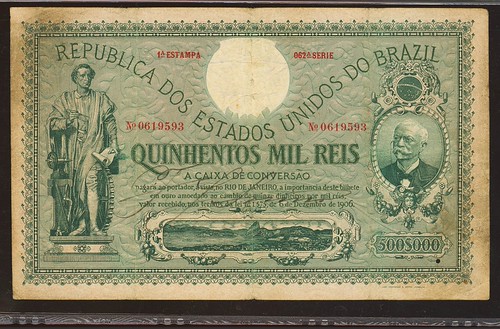

- Lot 5406 - BRAZIL. 500000 Reis. 6 December 1906. Caixa de Conversao. (Pick: 99). PMG25 (small hole). Starting bid EUR 1,000.
To read the complete lot description, see:
https://www.ibercoin.com/en/numismatic-auctions/122-Cifuentes-South-American-Banknote-Collection-18-11-2026/lot-5406-BRAZIL


- Lot 5598 - COLOMBIA. 50 Pesos. 4 March 1895. Banco Nacional. (Pick: 238). PMG30EPQ. Starting bid EUR 900.
To read the complete lot description, see:
https://www.ibercoin.com/en/numismatic-auctions/122-Cifuentes-South-American-Banknote-Collection-18-11-2026/lot-5598-COLOMBIA


- Lot 5610 - COLOMBIA. 1 Peso Oro. 6 August 1938. Banco de la Republica. (Pick: 385a). PMG55. Starting bid EUR 800.
To read the complete lot description, see:
https://www.ibercoin.com/en/numismatic-auctions/122-Cifuentes-South-American-Banknote-Collection-18-11-2026/lot-5610-COLOMBIA


- Lot 5667 - CUBA. 1000 Pesos. 6 September 1869. Republica de Cuba. (Pick: 60). Very rare. PMG45. Starting bid EUR 2,000.
To read the complete lot description, see:
https://www.ibercoin.com/en/numismatic-auctions/122-Cifuentes-South-American-Banknote-Collection-18-11-2026/lot-5667-CUBA


- Lot 5819 - GUATEMALA. 5 Quetzales. 29 January 1945. Banco Central de Guatemala. (Pick: 16b). PMG35. Starting bid EUR 700.
To read the complete lot description, see:
https://www.ibercoin.com/en/numismatic-auctions/122-Cifuentes-South-American-Banknote-Collection-18-11-2026/lot-5819-GUATEMALA

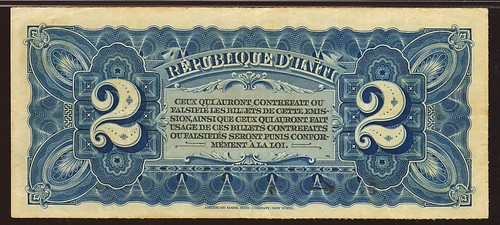
- Lot 6047 - HAITI. 2 Gourdes. 29 September 1892. Republique d'Haiti. (Pick: 102a). PMG25EPQ. Starting bid EUR 600.
To read the complete lot description, see:
https://www.ibercoin.com/en/numismatic-auctions/122-Cifuentes-South-American-Banknote-Collection-18-11-2026/lot-6047-HAITI

World Banknotes Online Auction (#141) - 19 November

- Lot 7122 - BAHAMAS. Complete set of 1/2 Dollar, 1 Dollar, 3 Dollars, 5 Dollars, 10 Dollars, 20 Dollars, 50 Dollars and 100 Dollars. 1970. SPECIMEN and numeration 000000. Bahamas Monetary Authority. (Pick: 26/33s). Extremely rare set, especially in the original folder from the Bank of the Bahamas. Uncirculated / About Uncirculated. Starting bid EUR 750.
To read the complete lot description, see:
https://www.ibercoin.com/en/numismatic-auctions/126-World-Banknotes-Online-Auction-19-11-2026/lot-7122-BAHAMAS
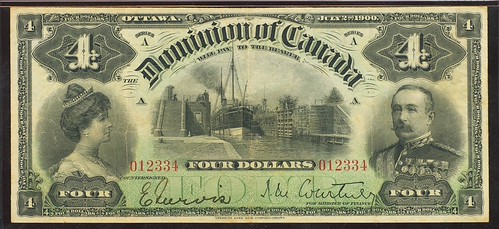

- Lot 7279 - CANADA. 4 Dollars. 1900. Dominion of Canada. (DC: 16). Extremely rare, especially since it is the first date of issue. PMG25. Starting bid EUR 2,000.
To read the complete lot description, see:
https://www.ibercoin.com/en/numismatic-auctions/126-World-Banknotes-Online-Auction-19-11-2026/lot-7279-CANADA

- Lot 8945 - UNITED STATES (NEW YORK). 500 Dollars. 1934. Federal Reserve Note. (FR: 2202-B). Extremely rare. PMG20.
To read the complete lot description, see:
https://www.ibercoin.com/en/numismatic-auctions/126-World-Banknotes-Online-Auction-19-11-2026/lot-8945-UNITED-STATES-NEW-YORK

- Lot 7512 - DENMARK. 1 Een. 8 April 1713. Treasury. (Pick: A17). Extremely rare and a highly specialized collector's item, especially in this quality. More than Extremely Fine. Starting bid EUR 2,250.
To read the complete lot description, see:
https://www.ibercoin.com/en/numismatic-auctions/126-World-Banknotes-Online-Auction-19-11-2026/lot-7512-DENMARK

- Lot 8763 - SWEDEN. 10 Kronor. 1874. Sveriges Riksbank. (Pick: 3a). Extremely rare, no more than three or four have been auctioned since 1999. PMG25 (according to the PMG population report, it is the Top Pop banknote as of 1 September 2026). Starting bid EUR 1,500.
To read the complete lot description, see:
https://www.ibercoin.com/en/numismatic-auctions/126-World-Banknotes-Online-Auction-19-11-2026/lot-8763-SWEDEN


- Lot 8804 - TRINIDAD AND TOBAGO. 5 Dollars. 2 January 1920. Royal Bank of Canada. (Pick: S151a). Extremely rare and very interesting, as it was printed in Canada. PMG20 (pinholes, minor ink). Starting bid EUR 2,000.
To read the complete lot description, see:
https://www.ibercoin.com/en/numismatic-auctions/126-World-Banknotes-Online-Auction-19-11-2026/lot-8804-TRINIDAD-AND-TOBAGO


- Lot 8873 - UNITED STATES. 2 Dollars. 14 January 1779. Continental Currency. (FR: CC-88). Extremely rare, especially in this exceptional quality. PMG63 (hinged) (to give an idea of how rare it is, as of 1 April 2026, this note is the fourth highest-graded alongside another note at PMG). Starting bid EUR 1,250.
To read the complete lot description, see:
https://www.ibercoin.com/en/numismatic-auctions/126-World-Banknotes-Online-Auction-19-11-2026/lot-8873-UNITED-STATES
"This week holds special significance for Ibercoin," said Diego Gutiérrez Carranza, Banknote Specialist at Ibercoin. "With more than twenty years of experience in numismatic auctions, we aim to establish ourselves as a leading house for international banknotes. We have prepared each catalogue with the utmost rigour, with detailed descriptions, Pick references and high-quality photographs, so that collectors can bid with complete confidence."
All lots can be viewed and bid on at www.ibercoin.com, with live bidding at https://live.ibercoin.com. New clients are kindly asked to register at least 48 hours before each auction.
About Ibercoin
Ibercoin is the numismatic auction house of a group of professionals who, together with its sister company Iberphil (www.iberphil.com), have been organising international auctions of numismatics (coins and banknotes) and philately for more than 20 years. Ibercoin holds regular auctions for collectors worldwide.
Driven by a passion for numismatics, Ibercoin is committed to the satisfaction of its clients, offering expert advice on both buying and selling collections and on valuing their numismatic material, always at the fairest market price. Its motto is that client satisfaction is the best guarantee that clients will work with Ibercoin again and recommend it to others.
Combining youth and experience, Ibercoin keeps pace with the technological evolution of the sector, using the most modern tools both in developing its own software (website, online auctions...) and in producing its numismatic catalogues. Its auctions are advertised, and can also be bid on, through the leading international websites in the sector.
NAC NOVEMBER AUCTIONS 172, 173, 174
Ars Classica will be hosting their NAC November Auctions 172, 173, 174. Select items are discussed below. -Garrett

Edward VIII, 1936. AE Pattern Penny, 1937, by T. H. Paget & C. W. Coombes.
Bare head left, HP below, EDWARDVS VIII D: G: BR: OMN: REX F: D: IND: IMP., rev. ONE PENNY, Britannia seated right, lighthouse behind, date in exergue.
Gordiano P3a and p. 253 – this coin; Freeman 216; Peck 2367; S.4063.
Of the highest rarity. Lightly toned with considerable blazing red lustre.
Much as struck and the sole example of a Penny
of this king available to commerce.
NGC PF 63+ RB TOP POP (4861781-001)
Ex Showpiece fractional sale in partnership with Baldwin's 2022 (4000 shares sold at £50 per share); Waterbird (Spink 264, 24 September 2019), lot 63; M. Rasmussen, FPL 5, Summer 2003, no. 398; Bowers & Ruddy Galleries, ANA Auction, Houston, 21-26 August 1978, lot 2929; R. Lobel [Coincraft], June 1977.
This coin originally formed part of a complete set of the thirteen denominations of the projected coinage for the new king. Only six of these sets were made at the Royal Mint in anticipation of a wider release of proof sets to coincide with Edward's planned coronation on 12 May 1937, and the general currency issue that would have ensued. Full-scale production of the new coinage was scheduled to commence at 8 a.m. on 1 January 1937, but the Abdication brought these plans to an abrupt end. Today, the other five known Pennies remain housed in their original sets: three of these sets are at the Royal Mint Museum, one of which was previously on loan to the British Museum; a fourth set is in the Royal Collection at Windsor Castle; and the fifth set is in the Tyrant Collection, California, USA. Consequently, this Penny is the only example of the type available to collectors as an individual coin.
To read the complete item description, see:
(https://www.biddr.com/nac/auction?a=7585&l=9285121)
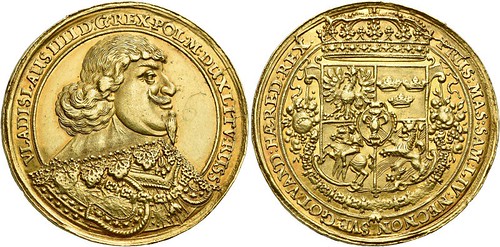
Poland, Kingdom, Wladislaw IV Waza, 1633-1648. AV Donative of 6 Ducats, undated, Bydgoszcz (Bromberg).
VLADISLAUS IIII D G REX POL M DUX LITV RUSS bareheaded draped bust with the collar of the Golden Fleece right, rev. PRUS MAS SAM LIV NEC NON SVE GOT VAND HÆRED REX quartered coat of arms (Poland/Sweden/Lithunia/Folkung Lion) with the Vasa coat of arms as inescutcheon, surrounded by floral decorations and the collar of the Golden Fleece. 20.94 g.
F. - (cf. 84, 10 Ducats and 84a, 7 Ducats; these 'very rare'); Kopicki - (cf. 1466, 10 Ducats, this R*); Dutkowski - (cf. 146, 10 Ducats, this R8); Parchimowicz - (cf. 1837, 10 Ducats); Kunker 233, 1004.
Mark of value '6' lightly scratched in obverse field. A few light nicks on edge.
Otherwise with a deep orange tone and much brilliance.
EF. A beautiful donative of great rarity:
unrecorded in the standard references.
From the collection of Druso and Bartolomeo Franceschi.
To read the complete item description, see:
(https://www.biddr.com/nac/auction?a=7585&l=9285135)

Romania, Principality, Carol I of Hohenzollern-Sigmaringen, 1866-1914, from 1881 King. AV Pattern 20 Lei, 1868. Berlin.
Dies by Friedrich Wilhelm Kullrich. Bare head left, rev. value and date in oak wreath, edge: plain. 6.34 g.
F. 1; Rauta 1; Schäffer/Stambuliu 010.1.1 (Paris mint) and Annex III (Berlin mint); Schlumberger 2.
Some very light hairlines otherwise brilliant and much as made.
The incunabulum of Romanian gold coinage, extremely rare,
particularly so in this outstanding condition.
NGC PF 62 Ultra Cameo (8910539-002)
From the collection of Druso and Bartolomeo Franceschi.
The 20 Lei of 1868 occupies a vital place in the political and monetary history of modern Romania. Struck while the Principality remained under Ottoman suzerainty, at a time when its right to issue national coinage was conditional upon the inclusion of an Ottoman emblem, the portrait of Carol I and the legend CAROL I DOMNULU ROMÂNILORU represented a conspicuous assertion of Romanian sovereignty. As the country had no mint of its own, the coins were commissioned to be struck in Berlin. Only a very small number were produced, and the issue was not released into circulation. Of the reported 100 coins struck, half were distributed to dignitaries, whilst the remainder are traditionally said to have been deposited beneath the foundations of Pele? Castle at Sinaia in 1875.
To read the complete item description, see:
(https://www.biddr.com/nac/auction?a=7585&l=9285147)

Spain, Fernando and Isabel, 1474-1504. AV 10 Excelentes, Segovia, assayer F, im. cross potent. Struck after 1497.
FERNANDUS[three dots vertical] ET[three dots vertical] HELISABET: D: G: REX: ET: REGINA: CAST: L: crowned and draped busts vis-à-vis, value X between, cross of five pellets behind king, F behind queen, aqueduct above, rev. :SVB: VNBRA: ALARVM: TVARVM: PROTEGE: NOM: DOMINE: crowned shield of arms over eagle. Annulet stops. 35.15 g.
Museo Arqueológico Nacional 104732 – same dies; HAS 8512 – this coin; A.C. type 197, no. 779 – this coin illustrated.
Some double striking on reverse. Minor marks. Otherwise richly toned and better than VF. Excellent detail to portraits. A most impressive multiple of the highest rarity and great numismatic importance.
Ex Selección de Monedas del Colleción Archer M. Huntington (J. Vico, 26 June 2012), lot 438. Hispanic Society of America collection.
The 10 excelente belongs to one of the most transformative periods in Spanish history. Following the conquest of Granada in 1492 and the arrival of Columbus in the New World, the power and international ambitions of the Catholic Monarchs were expanding rapidly. The monetary reform promulgated at Medina del Campo in 1497 sought to modernise Castilian coinage, establishing the excelente de la Granada on the weight and fineness of the Venetian ducat, then the principal gold coin of international commerce. The type of this new coin, bearing the facing busts of the king and queen on the obverse and the quartered shield of Castile-Leon and the territories of the Crown of Catalonia-Aragon above the emblem of the Kingdom of Granada on the reverse, provided a potent visual affirmation of the unity of the Spanish realms.
The reform also provided for multiples of the excelente, including the exceptional 10, 20 and 50 excelente pieces. Large gold multiples had been issued by earlier Spanish monarchs, but the production of these extraordinary pieces represents an Iberian genesis of what would become a wider European development towards increasingly substantial gold denominations, exemplified by Manuel I's 10-cruzado português of Portugal, issued at about the same time. The largest Spanish multiples appear to have been confined to the mints of Segovia and Seville, with the 10-excelente represented only at Segovia. The possible presence of such multiples within the royal treasury is documented by an inventory of the Cámara of Ferdinand at Madrid in 1510, which records ‘un excelente de diez excelentes'.
To read the complete item description, see:
(https://www.biddr.com/nac/auction?a=7585&l=9285148)
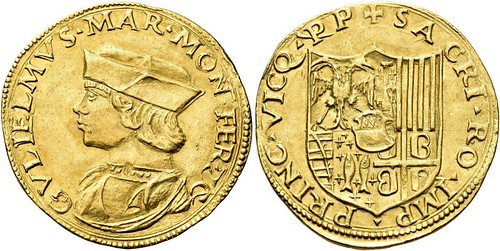
Casale.
Guglielmo IX Paleologus, 1494–1518. First period: 1499/1505 – circa 1509. Double ducat, AV 6.89 g. ø 29 mm. GVLIELMVS MAR MONT FER 7 C' Armoured and draped youthful bust l., wearing cap. Rev. SACRI RO IMP PRINC VICQ P P Quartered coat of arms with the small shield of Montferrat in heart. CNI –. Bernareggi 31. Ravegnani Morosini 3 (this coin illustrated). MIR 177. Friedberg 165a.
Extremely rare and in exceptional condition for the issue, possibly the finest of very few specimens known in private hands. A portrait of excellent style and a lovely reddish tone. Extremely fine
Son of Marquis Boniface III and Maria Brankovic, he succeeded his father upon the latter's death. William protected the French army during its retreat from Milan in 1513 and, to avoid reprisals by Massimiliano Sforza, was forced to pay him 30,000 scudi. The agreements with Massimiliano were not respected, and his troops entered Montferrat, bringing death and destruction. At the same time, having learned of the attempt by his distant relative Oddone, Marquis of Incisa, to have himself crowned Marquis of Montferrat, William marched against his kinsman and occupied the town of Incisa in 1514, annexing the territories of the marquisate and sentencing Oddone and his son Badone to death. However, this execution drew the wrath of the Empire upon William, which, while decreeing the annexation of the territory of Incisa, ordered Paleologus to stand trial. The subsequent bureaucratic proceedings ended in William's favour.
The portrait of the marquis, shown in profile and rendered with crisp, incisive modelling, displays a remarkable Renaissance character, reflecting a taste directly derived from the tradition of Italian medallic art of the fifteenth and early sixteenth centuries. Particularly refined is the treatment of the hair, neatly emerging from beneath the headdress, while the latter, broad and slightly inclined, helps to define the contours of the bust. The clothing, with the rich folds of the garment and the detailed rendering of the shoulder, is treated in a manner reminiscent of Renaissance commemorative portraiture.Enclosed by the legend and set against a relatively broad field, the effigy acquires a particular monumentality, characteristic of the visual culture of the period. Taken as a whole, this magnificent coin becomes a veritable portrait in miniature, conveying the prestige and elegance of the die engraving.
To read the complete item description, see:
(https://www.biddr.com/nac/auction?a=7586&l=9282758)
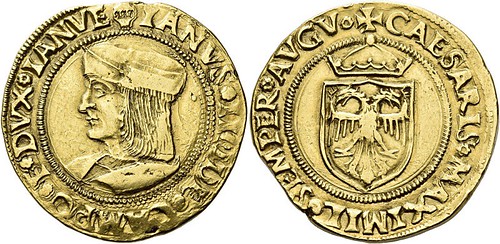
Genova.
Republic, 1139 – 1339. Second period: Life-Tenured Doges and Foreign Dominations, 1339-1528. Giano II di Campofregoso, 1512-1513. 10 scudi, AV 34.42 g. ø 37 mm. Campofregoso coat of arms IANVS II DE CAMPO F DVX IANVE Male bust l., wearing cap (Maximilian I or Giano II?). Rev. + CAESARIS MAXIMIL SEMPER AVGV Crowned coat of arms, charged in centre with double-headed eagle. L. Travaini-B. Prokisch, QT XXXIX, 2010, p. 417, pl. I, 1 (this coin illustrated). MEC 12, p. 300. Friedberg 395a (this coin illustrated).
Apparently unique and a numismatic riddle of the greatest historical interest. An issue of tremendous importance and fascination with a very interesting portrait of the Emperor of fine style struck on a very broad flan. About extremely fine
From the collection of the City of Leipzig deaccessioned in 1840 to a Viennese dealer and eventually sold to William Albert, Prince of Montenuovo. Ex Dura-Sambon 6th December 1880 and ff. days, Rossi 1529 (erroneously attributed to Giano I) and Stack's 7th March, session I, 2006, 834 (also erroneously attributed to Giano I) sales.
To read the complete item description, see:
(https://www.biddr.com/nac/auction?a=7586&l=9282764)

Milano.
Gian Galeazzo Maria Sforza, regency of his mother Bona of Savoy, 1476-1480. Double ducat 1479–1480, AV 6.93 g. ø 24 mm. Small head of St. Ambrose BONA'DVCI – SA'MLI'7C' Veiled bust of Bona r. Rev. Small head of St. Ambrose IO'G3 M SF VI – CECO DVX M SX Armoured bust of Gian Galeazzo r. Bernareggi 91. Ravegnani Morosini 2. Crippa 1. MIR 217/1. MEC 12, unlisted. Friedberg 690.
Extremely rare and in exceptional condition for the issue, possibly the finest specimen in private hands. Two very elegant portraits of fine style perfectly centred on a full flan. Good extremely fine
Ex Leu sale 68, 1996, 360
Bona of Savoy assumed the regency of the duchy in 1477, following the recognition of her son Gian Galeazzo Maria as the VI Duke of Milan. Following the assassination of her husband, the V Duke Galeazzo Maria, the regent had to navigate numerous pitfalls, and thanks to the great mediation work conducted by the ducal councillor Francesco "Cicco" Simonetta, she managed to have her regency recognized. In 1481, under pressure from the ambitious and cunning uncle of the young duke, Ludovico Maria, the duchess was exiled to the castle of Pavia and the government was assumed by Il Moro. During the regency of Bona, doppio ducati and testoni were issued, all of which are today extremely rare; in particular, the gold denominations display remarkable artistic quality. For example, the subtle rendering of the string of pearls falling along the duchess's head expresses the high, almost painterly execution of the work. Regarding the author of these beautiful dies, Ravegnani hypothesizes that it might be Ambrogio di Matteo da Clivate, who had already worked for Galeazzo Maria Sforza, creating his doppio ducato (cf. lot 192). Finally, this coin is among the few of the Renaissance to feature a female portrait.
To read the complete item description, see:
(https://www.biddr.com/nac/auction?a=7586&l=9282775)

Venezia.
Alvise IV Mocenigo, 1763-1778. Tallero for the Levant 1768 of 10 zecchini, AV 34.75 g. ø 41 mm. ALOYSIO MOCENICO DUCE Winged and nimbate lion, seated and facing r., holding open book in front paws; on exergual line, A – S (Antonio Schabel, engraver) and, below, 1768. Rev. RESPUBLICA – VENETA Bust of Venice r. Paolucci II –.
An apparently unique and unrecorded date of an extremely rare type.
A coin of great beauty in exceptional condition,
virtually as struck and almost Fdc
NGC MS 61 (8910539-003).
The tallero for the Levant belongs to the final series of Venetian trade coinage intended for circulation in the eastern Mediterranean during the dogeship of Alvise IV Mocenigo (1763–1778). Talleri of this type were normally struck in silver and formed part of Venice's long-established monetary relationship with the Levant.
The present specimen is of exceptional interest as an 10-zecchini gold striking of the tallero type, rather than the customary silver issue. Apparently unique and unrecorded in the published literature, it represents an extraordinary adaptation of a denomination normally associated with silver to a high-value gold format. Its combination of rarity, unusual metal and denomination makes it a particularly remarkable product of the Venetian mint in the final decades of the Republic.
To read the complete item description, see:
(https://www.biddr.com/nac/auction?a=7586&l=9282804)

AUGUSTALE of FREDERICK II
Augustale of first type, Brindisi? c. 1231-1232, AV 5.19 g. o IMP ROM – CESAR AVG Crowned and draped bust r. Rev. + FRIDE – RICVS• Eagle with wings spread, head l. MEC XIV, see pages 172-173. Spahr 105. MIR 60 (R5, Messina).
Of the highest rarity, the fourth specimen known and the only one in private hands.
Probably the most important coin of the entire Hohenstaufen coinage and an issue of tremendous importance and fascination. A portrait of superb style inspired by Roman numismatic portraiture, absolutely extraordinary for the period when this coin was produced, Light reddish tone and good very fine / about extremely fine
WJC: There are four known specimens of the type (Vienna, Rome, Dresden, this). This coin is an obverse die duplicate of the coin in Vienna. The reverse die is unknown.
This coin takes its inspiration from late Roman aurei. The flan shape and size, the weight, and the high relief design are all typical of Tetrarchic aurei. The obverse portrait and the eagle on the reverse are every bit as artistically accomplished as the best of those late third and early fourth century Roman models. Only the draped obverse bust but wearing a crown of a clearly medieval type, rather than a laurel wreath, separates this coin from a Roman aureus. Indeed this coin and the other three examples all in museum collections might be regarded as either the last Roman aurei or the earliest true Renaissance portrait coins.
To read the complete item description, see:
(https://www.biddr.com/nac/auction?a=7587&l=9284799)

AUGUSTALE of FREDERICK II
Augustale normal type, Brindisi 1232-1250, AV 5.32 g. •IMP ROM• – •CESAR AVG• Laureate and draped bust r. Rev. • + FRIDE – RICVS • Eagle with spread wings, facing ¾ l., head r. Kowalski 149, dies E35/B4. MEC XIV, 516. Spahr 100 (Brindisi e Messina). MIR 266 (this coin).
Rare and in exceptional condition for the issue, one of the finest augustali in private hands.
A coin of incredible beauty, the work of a very skilled master-engraver.
Virtually as struck and almost Fdc
Ex NAC/Spink-Taisei 52, 1994, 918.
WJC: The finest "regular" augustale that I have seen. Exceptional style and condition.
To read the complete item description, see:
(https://www.biddr.com/nac/auction?a=7587&l=9284800)

COINS of CHARLES I of ANJOU before the Vespri siciliani (30th March 1282)
Reale, Messina 1266-1278, AV 5.29 g. + •KAROL' – DEI:GR? Crowned and draped bust r.; behind, lis. Rev. + R – EX: SI – CILI – E Shield of ten lis surmounted by label. Kowalski 148 (obverse, L4/-). MEC XIV, 624 var. (with symbol). Spahr 1. MIR 143/1 (misdescribed as 138/1). Friedberg 653 for the type.
Rare and in exceptional condition for the issue, among the finest specimens in private hands. A portrait of masterly style, the work of an extremely talented master engraver. Perfectly struck in high relief on a very large flan, almost invisible mark on the King's cheek, otherwise good extremely fine
Ex Spink-Taisei sale 43, 1992, 119.
WJC: The finest portrait I have seen on these coins. Exhibited at Metropolitan Museum of Art from May, 2006 to March, 2013.
To read the complete item description, see:
(https://www.biddr.com/nac/auction?a=7587&l=9284887)

COINS of CHARLES I of ANJOU before the Vespri siciliani (30th March 1282)
Tarì or cavallino, Messina 1266-1278, AV 8.65 g. +•K•DEI•GRACIA°o° Mounted King riding r. holding sword; the horse's harness decorated with lis. Rosette below. Rev. + •R•SICILIE°o° Long cross between IC – XC/NI – K? below omega suspension marks and three pellets below at each side of the foot of the cross. MEC XIV see page 200, A1. Spahr 15 (this coin). MIR 329 (Brindisi, R4, this coin). Friedberg 653a.
Extremely rare and undoubtedly the finest specimen known. One of the finest
representations of the medieval period perfectly struck and exceptionally complete.
Good extremely fine
Ex Bank Leu/M&M sale 11 March 1987, Spahr 206 and NAC/Spink Taisei sale 52, 1994, 1053.
WJC: By far the finest specimen known and perhaps the only coin of the type with complete legends.
After the victory in the Battle of Benevento, Charles I of Anjou took control of the Kingdom, keeping the mint of Messina active, a strategic center for Mediterranean trade and a key hub in commercial networks between the West and the East. The issue, attributable to the early phase of Angevin rule in Sicily (1266–1282), is traditionally known as the "cavallino" due to the distinctive depiction of the sovereign on horseback—an iconography of clear chivalric origin, intended to exalt royal power and dynastic legitimacy.
To read the complete item description, see:
(https://www.biddr.com/nac/auction?a=7587&l=9284895)
LOOSE CHANGE: NOVEMBER 1, 2026
Here are some additional items in the media this week that may be of interest. -Editor
Pompeii Cupboard Yields Coins
Jim Haas writes:
"Coins are mentioned just twice, but the story is interesting and I thought readers would enjoy it. My wife Lynne and I visited Pompeii the last time we went to Europe on a Viking cruise. Too brief it was, but fascinating."

A necklace of at least 24 tiny charms, given to Roman children as a protective amulet, was among the finds from a wooden cupboard sealed for almost 2,000 years in Pompeii.
The cupboard, reconstructed by archaeologists from traces found in a house on Via dell'Abbondanza, one of the busiest streets of ancient Pompeii, has produced an intimate picture of one resident's life before the city's destruction.
In a statement, the site said the objects ranged from make-up utensils and perfume to coins, cooking pots and childhood amulets.
Lead weights in a wooden box suggested that someone in the house was involved in trade, and a small woven container held 38 bronze coins.
The fact that both money and objects with apparent sentimental value remained behind suggests the owners had no time to retrieve them after Vesuvius erupted.
Thanks. Apropos of nothing, since seeing the Coral Reefers documentary a couple weeks ago, these lyrics have been haunting my head: "I don't know where I'm a-gonna go when the volcano blows." -Editor
To read the complete article, see:
A cupboard sealed for 2,000 years reveals the secrets of Pompeii before deadly volcano
(https://www.independent.co.uk/news/science/archaeology/pompeii-vesuvious-eruption-naples-excavation-b3075592.html)
In this episode of the Red Book Podcast, Jeff Garrett interviews Mike Moran, and Todd Imhof. -Editor
In this fascinating episode of the Red Book Podcast, we take a deep dive into the history of American coinage with numismatic researcher and award-winning author Mike Moran, alongside Todd Imhoff of Heritage Auctions.
Discussing Moran's book When Coins Were King, this episode explores how gold and silver shaped America's financial system, influenced political power, and helped create some of the most iconic coins in U.S. history.
Discover the incredible stories behind the Comstock Lode silver discovery, the gold-versus-silver political battles of the 19th century, and the corruption and financial scandals that rocked the early American Mint system.
We also uncover how President Theodore Roosevelt worked with legendary sculptor Augustus Saint-Gaudens to transform American coin designs, including the famous $20 Saint-Gaudens Double Eagle and the $10 Indian Head Gold Eagle.
Plus, learn how the Panic of 1907, the Morgan and Peace dollars, and the fascinating history behind America's monetary system continue to influence coin collecting today.
To read the complete Greysheet article, see:
Red Book Podcast: The Hidden History of U.S. Coins: Gold, Corruption & Theodore Roosevelt's Rare Coin Legacy! [Video]
(https://www.greysheet.com/news/story/red-book-podcast-the-hidden-history-of-u-s-coins-gold-corruption-theodore-roosevelt-s-rare-coin-legacy-video)
In the but-we-already-knew-that department, bibliophiles can take heart in a new UK study about the health effects of bookstore browsing. -Editor

Nine out of 10 people who have visited a physical bookshop in the last six months say the experience improved their mood, says a new poll from the Booksellers Association.
More than three-quarters of those polled added that bookshops helped them switch off from social media and screens, and a similar number said that visiting a bookshop or attending a bookshop event helped them feel better during difficult times.
The findings come ahead of the UK's Bookshop Day and World Mental Health Day on October 10.
To read the complete article, see:
Bookshop Browsing Raises Wellbeing Reveals New Survey
(https://www.finebooksmagazine.com/news/bookshop-browsing-raises-wellbeing-reveals-new-survey)
ABOUT THIS ISSUE: NOVEMBER 1, 2026
When I got some cash at the ATM this week, I asked for a $100 bill. I checked it - no Trump signature. But I did find and set aside a 1940 Jefferson Nickel.
This week I planned my trip to the Whitman Baltimore Expo this month - I'll be there Thursday afternoon to speak with some of our advertisers and meet with Len Augsburger about NBS and Newman Portal topics. I look forward to seeing a number of readers at the show as well - stop me and say hello!
I also planned a trip downtown next week to visit the National Gallery of Art, attend a book lecture, and have dinner with Garrett Ziss. It should be a fun couple of weeks.
I got a somewhat early start on the issue this week to leave time on Saturday to attend a celebration for a neighbor's birthday. I got some walking in to resume my usual pace after being away last week (see last week's Diary article). Wednesday night I took this photo of the full moon over our neighborhood.

And here's a Halloween scene I encountered Thursday night.

That evening as we handed out candy to neighborhood trick-or-treaters, we sat around a firepit with neighbors. As the traffic dwindled we watched the silly Adam Sandler "Hubie Halloween" movie. It was a fun evening. And it being a neighbor's 50th birthday, the next day the same crew spent an afternoon at Bear Chase Brewery in the Blue Ridge Mountain foothills. These skinny gentlemen were there to greet us.

I didn't see anyone chasing bears, but I did see this cute fella.

It was a great afternoon to enjoy the view.

Seen in an email signature this week: "Misspelled with Autocorrect"
Seen online:
- "I was messaging a prospective landlady asking if I could view the room on a certain day ‘if you'd like.' After two days and no reply, I checked my message, which auto-correct had written as ‘if you'd love me.'"
- I have never seen a moose, neither in the wild nor at a zoo. I think it's a big practical joke Canada is playing on the world.
Finally, here are some interesting non-numismatic articles I came across this week. The first one has some Halloween history and the second connects current events with history and the 1860s version of watching a drone feed.
Jack-o'-lanterns come from an Irish legend. (https://historyfacts.com/world-history/fact/jack-o-lantern-irish-legend/)
Abraham Lincoln Had a Starlink Problem Too (https://www.wesodonnell.com/p/abraham-lincoln-had-a-starlink-problem)
There were three U.S. presidents in one year — twice. (https://historyfacts.com/us-history/fact/three-presidents-in-one-year-twice/)
Rare letter reveals Washington family's struggle with a daughter's epilepsy (https://www.washingtonpost.com/dc-md-va/2026/10/28/rare-letter-reveals-washington-familys-struggle-with-daughters-epilepsy/)
Women's Work: The Women Who Painted America's Fruit (https://www.saturdayeveningpost.com/2026/09/womens-work-the-women-who-painted-americas-fruit/)
A few of my favorite things: words . . . that delight you (https://benjamindreyer.substack.com/p/a-few-of-my-favorite-things)
Two places in the world use exclamation marks in their names. (https://interestingfacts.com/fact/two-places-in-the-world-use-exclamation-marks-in-their-names/)
Feed Me: An Oral History of Little Shop of Horrors (https://www.vanityfair.com/story/little-shop-of-horrors-movie-oral-history)
Why Were People Tied to Train Tracks in Old Movies? (https://historyfacts.com/arts-culture/article/old-movies-people-tied-to-train-tracks/)
Paul Simon's seven favourite Paul Simon songs, ranked by Far Out (https://faroutmagazine.co.uk/paul-simons-seven-favourite-paul-simon-songs-ranked/)
Patrick Stewart, Master of Shakespeare, ‘Star Trek' and More, Has Died (https://www.nytimes.com/2026/10/29/arts/television/patrick-stewart-dead.html)
The physics of getting fired (https://aeon.co/essays/how-to-use-physics-to-make-sense-of-the-messiness-of-life)
Airplane! inspiration missing from the manifest (https://alistweekly.substack.com/p/airplane-inspiration-missing-from)
The $300-Million Con Man (https://macleans.ca/longforms/the-300-million-con-man/)
Evolution's Tomfoolery (https://www.delanceyplace.com/view-archives.php?p=5415)
In 1934, a doctor brought a dog back to life. He tried to do the same with humans. (https://www.popsci.com/science/reviving-dead-dog-experiment-robert-cornish/)Google's first data center satellite is online and writing poetry (https://techcrunch.com/2026/10/30/googles-first-data-center-satellite-is-online-and-writing-poetry/)
The black box virus detector America needs (https://rationaloptimistsociety.substack.com/p/introducing-the-first-biology-prime)
-Editor

Editor Wayne Homren, Assistant Editor Garrett Ziss
Wayne Homren
Wayne Homren is the founding editor of The E-Sylum and a consultant for the Newman Numismatic Portal. His collecting interests at various times included U.S. Encased Postage Stamps, merchant counterstamps, Pittsburgh Obsolete paper money, Civil War tokens and scrip, Carnegie Hero Medals, charge coins and numismatic literature. He also collects and has given presentations on the work of Money Artist J.S.G. Boggs. In the non-numismatic world he's worked in artificial intelligence, data science, and as a Program Manager for the U.S. Department of Defense.
Garrett Ziss
Garrett Ziss is a numismatic collector and researcher, with a focus on American paper money and early U.S. silver and copper coins. He is also a part-time U.S. coin cataloger for Heritage Auctions. Garrett assists Editor Wayne Homren by editing and formatting a selection of articles and images each week. When he's not engaged in numismatics, Garrett is pursuing a Master's Degree in Quantitative Economics at the University of Pittsburgh.

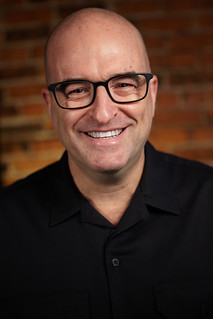
Contributors Pete Smith and Greg Bennick
Pete Smith
Numismatic researcher and author Pete Smith of Minnesota has written about early American coppers, Vermont coinage, numismatic literature, tokens and medals, the history of the U.S. Mint and much more. Author of American Numismatic Biographies, he contributes original articles to The E-Sylum often highlighting interesting figures in American numismatic history.
Greg Bennick
Greg Bennick (www.gregbennick.com) is a keynote speaker and long time coin collector with a focus on major mint error coins and US counterstamps. He is on the board of both CONECA and TAMS and enjoys having in-depth conversations with prominent numismatists from all areas of the hobby. Have ideas for other interviewees? Contact him anytime
via instagram @minterrors.
He can also be reached by email at
minterrors@gmail.com.

Website host John Nebel and webmaster Bruce Perdue
John Nebel
Numismatist, photographer, and ANS Board member and Fellow John Nebel of Boulder, CO helped the ANA and other clubs like NBS get online in the early days of the internet, hosting websites gratis through his Computer Systems Design Co. To this day he hosts some 50 ANA member club sites along with our
coinbooks.org site, making the club and our E-Sylum archive available to collectors and researchers worldwide.
Bruce Perdue
Encased coinage collector (encasedcoins.info) Bruce Perdue of Aurora, Illinois has been the volunteer NBS webmaster from its early days and works each week to add the latest E-Sylum issue to our archive and send out the email announcement.

|
|
The E-Sylum is an electronic publication of the Numismatic Bibliomania Society Copyright © 1998 - 2026 | |