Visit our NBS Sponsors











About UsThe Numismatic Bibliomania Society is a non-profit association devoted to the study and enjoyment of numismatic literature. For more information please see our web site at coinbooks.org SubscriptionsThose wishing to become new E-Sylum subscribers can go to the following web page
Subscribe
MembershipThere is a membership application available on the web site Membership Application To join, print the application and return it with your check to the address printed on the application. Print/Digital membership is $40 to addresses in the U.S., and $60 elsewhere. A digital-only membership is available for $25. For those without web access, write to: Jeff Dickerson, Treasurer AsylumFor Asylum mailing address changes and other membership questions, contact Jeff at this email address: treasurer@coinbooks.org SubmissionsTo submit items for publication in The E-Sylum, write to the Editor at this address: whomren@gmail.com 
BUY THE BOOK BEFORE THE COINSale CalendarWatch here for updates! |
- WAYNE'S WORDS: THE E-SYLUM DECEMBER 21, 2025
- NEW BOOK: OFFICIAL INAUGURAL MEDALS AND RIBBONS
- NEW BOOK: COINS OF PRE-ISLAMIC ASIA
- NEW BOOK: EMERGENCY MONEY IN GERMANY IN 1945
- NEW BOOK: BANKNOTES OF BHUTAN
- PERIODICAL: MCA ADVISORY AUTUMN 2025
- BOOK REVIEW: THE HISTORY OF MONEY
- THE PENNY'S FUNERAL
- CHOCOLATE HANUKKAH GELT
- VIDEO: CHINESE COINS STRUCK DURING TIANANMEN
- PAUL HOLLIS CONFIRMED AS MINT DIRECTOR
- GILBERT STUART WASHINGTON PORTRAIT FOR SALE
- NOTES FROM E-SYLUM READERS: DECEMBER 21, 2025
- ANS LONG TABLE: ERIC BROTHERS ON THE MORGAN DOLLAR
- VOCABULARY TERM: SCREW PRESS
- WILLIAM WOODIN ASSOCIATION ITEMS
- TREASURE TALK WITH BOB EVANS, EPISODE 10.1
- NUMISMAGRAM MEDAL SELECTIONS: DECEMBER 21, 2025
- HERITAGE: HARVEY JACOBSON EARLY HALF EAGLES
- ANCIENT COINS IN FRANK ROBINSON AUCTION 130
- KUENKER AUCTION SALE 437, PART ONE
- MODERN US OLYMPIC COINAGE
- THE PENNY PRESS IS HERE TO STAY
- PENNY HERE, PENNY THERE, REALLY ADDS UP
- THE TWELVE DAYS OF CHRISTMAS, COIN EDITION
- GIFTS FOR COIN COLLECTORS
- 'TWAS THE NIGHT BEFORE BOOK HUNT
- JIM LICARETZ WINS JUDAICA ART MEDAL AWARD
- FEATURED WEBSITE: NOTGELD.COM
- ABOUT THIS ISSUE: DECEMBER 21, 2025
Content presented in The E-Sylum is not necessarily researched or independently fact-checked, and views expressed do not necessarily represent those of the Numismatic Bibliomania Society.
WAYNE'S WORDS: THE E-SYLUM DECEMBER 21, 2025
 New subscribers this week include:
Kathleen O'Neil, courtesy Ingrid O'Neil.
Welcome aboard! We now have 6,703 subscribers.
New subscribers this week include:
Kathleen O'Neil, courtesy Ingrid O'Neil.
Welcome aboard! We now have 6,703 subscribers.
Thank you for reading The E-Sylum. If you enjoy it, please send me the email addresses of friends you think may enjoy it as well and I'll send them a subscription. Contact me at whomren@gmail.com anytime regarding your subscription, or questions, comments or suggestions about our content.
Welcome to our newest Sponsor - GreatCollections! Thank you for your support!
This week we open with four new books, a periodical issue, a book review, the Penny's Funeral, updates from the Newman Numismatic Portal, and more.
Other topics this week include the new U.S. Mint Director, a Gilbert Stuart Washington portrait, the screw press, William Woodin, Bob Evans, fixed price and auction selections, modern Olympic coinage, Judaica Art Medals, notgeld, and the Twelve Days of Christmas in coins.
To learn more about Inaugural medals and ribbons, the coins of pre-Islamic Central Asia, the banknotes of Bhutan, emancipation in D.C., Abraham Lincoln's second cousin, six times removed, Hanukkah gelt, a pledge-week prank gone wrong, made-up citations and Mint rarities, "Great disgust" at the Morgan dollar, Little Wooden Willie, early half eagles, and the Night Before the Numismatic Book Hunt, read on. Have a great week, everyone!
Wayne Homren
Editor, The E-Sylum

Image of the week
NEW BOOK: OFFICIAL INAUGURAL MEDALS AND RIBBONS
A press release from the National Coin & Bullion Association (NCBA) announced a new three-volume book on Inaugural medals and ribbons by Jimmy Hayes. -Editor
 Jimmy Hayes, general counsel for the National Coin &
Bullion Association (NCBA), has announced that 100 percent of the profits from sales of his
forthcoming three-volume reference series, Each New Beginning: An Illustrated History of
Official Inaugural Medals and Ribbons, will be donated to NCBA in support of its mission to
advocate on behalf of the numismatic and precious-metals bullion community.
Jimmy Hayes, general counsel for the National Coin &
Bullion Association (NCBA), has announced that 100 percent of the profits from sales of his
forthcoming three-volume reference series, Each New Beginning: An Illustrated History of
Official Inaugural Medals and Ribbons, will be donated to NCBA in support of its mission to
advocate on behalf of the numismatic and precious-metals bullion community.
Planned for publication in the first quarter of 2026, Each New Beginning is a comprehensive, richly illustrated history of US presidential inaugurations, as told through the medals, ribbons, and documents created to commemorate them. The set will be offered at $375 plus shipping, with all profits designated as a philanthropic gift to NCBA.
"Supporting NCBA through this project was a natural extension of both my professional life and my passion for preserving history," Hayes said. "This work became a history book illustrated by contemporaneous medals, ribbons, and documents. There is something of interest for both historians and numismatists—a numismatic reader will be caught by the pictures and drawn into their stories, where a political science reader may focus more on the stories, illustrated by contemporary images."
The project's origins are rooted in Hayes's belief that numismatic objects deserve to be presented with the political and human stories they were meant to preserve. As he writes in the dedication, the goal was to move beyond merely cataloging designs to reveal "the marriage between politics, medals, and ribbons associated with the Presidential Inaugurations," preserving stories that might otherwise be lost to time.
The reference series spans three volumes and 760 pages, with a planned initial printing of 200 hardcover copies, including a limited number of leather-bound editions. As first reported by Coin World in its March 31, 2025, article, "Inspiring Inaugural Medal Collection," the series draws upon what many consider one of the most complete collections of official presidential inaugural and related medals ever assembled.
Among the highlights are
- More than 1,500 high-quality images,
- Over 30 previously unlisted or unique medals—some with no prior auction appearances,
- Approximately 20 unique inaugural ribbons,
- Dozens of historical documents never before published, and
- Newly recorded stories drawn from archival research and firsthand accounts.
The volumes are organized as follows:
- Volume I (1789–1885): Ribbons and medals predating the issuance of official inaugural medals.
- Volume II: The 1889 Washington Centennial Celebration, the first national holiday and the genesis of the official inaugural medal and badge tradition.
- Volume III (1889–2001): Official medals and ribbons from the Harrison inauguration through the dawn of the 21st century.
A proof set of the books will be available for public viewing at the Florida United Numismatists (FUN) Convention, January 8–9, 2026 (Thursday and Friday), at the NCBA booth, #1202. A small display of inaugural medals, along with ribbons and original documents will accompany the proofs, and author Jimmy Hayes will be available to meet with attendees.
Hayes hopes the series will both enrich numismatic and historical scholarship and provide lasting support to NCBA through this philanthropic commitment.
"Each inauguration marks a new beginning in the unbroken transfer of power that defines our constitutional republic," Hayes said. "If this work helps preserve that story—and supports NCBA in the process—then it has fulfilled its purpose."
Image: The 1889 Official Inaugural Medal—held by the Benjamin Harrison family for more than 125 years and acquired directly from a descendant. For decades, historians debated whether the 1889 ribbon badges identifying inaugural committees were produced under official authorization. Each New Beginning definitively resolves the question, including reproduction of the manufacturer's patent application, bringing clarity at last to this long-standing controversy.
The National Coin & Bullion Association (NCBA) is the leading industry trade group dedicated to protecting and promoting the interests of coin and bullion dealers, collectors, and investors. Founded in 1983, NCBA provides education, advocacy, and support for the numismatic community nationwide.
Jimmy showed one of the proof volumes to some of us gathered around Charlie Davis's table at the recent Whitman Baltimore Expo. It looked great, and we'll look forward to the finished product. -Editor
To learn more about the National Coin & Bullion Association, please visit https://www.ncbassoc.org/.

NEW BOOK: COINS OF PRE-ISLAMIC ASIA
A new book in Russian and English on the coins of pre-Islamic Central Asia was announced recently. Check out the full image gallery - looks like a great book. -Editor


Coins of Pre-Islamic Central Asia
Author(s): Shagalov V. D.
Place of issue: Tashkent
Date: 2025
Number of pages: 432
Language: Russian & English
Where to buy: vld1968@gmail.com


To read the complete Facebook post, see:
https://www.facebook.com/share/p/1D7Lr1vTzW/
NEW BOOK: EMERGENCY MONEY IN GERMANY IN 1945
Here's a Google-translated article from Geldscheine Online by Dr. Sven Gerhard about a new book by Michael Schöne on 1945 emergency paper money in Germany. See also this week's Featured Web Site for more on notgeld. -Editor
 Caught between the front lines. Emergency paper money in Germany in 1945.
By Michael H. Schöne.
Reprint with additions and corrections.
2025. Self-published by the author.
Softcover, spiral binding. 80 + XI pages, 29.7 x 21.5 cm, full color throughout.
Price 24 EUR plus postage, to order from the author: michael@schoene-pirna.de
The German emergency money issues from 1914 to 1923 are still the subject of intensive research and comprehensively cataloged. In contrast, the emergency money issues within the territory of the German Reich in April 1945 are likely unknown to many collectors.
Michael H. Schöne's 2015 catalogue, now reprinted with additions, sheds light on this particular area of ??collecting. It builds upon the 1979 catalogue by Albert Pick and Carl Siemsen on emergency money during World War II, published by Battenberg Verlag in Munich, and his own catalogue "Paper Money in Occupied Germany 1945 to 1949," published by Gietl Verlag in 1994, both of which are now out of print.
Even before the outbreak of war in August 1939, the responsible authorities foresaw a situation in which parts of the Reich territory might be evacuated by German troops and cut off from the Reichsbank's cash supply. Fundamental considerations for issuing municipal emergency currency were developed for this eventuality. In the autumn of 1944, the situation became critical: In a secret circular dated September 14, 1944, the German Reichsbank issued its first guidelines for issuing emergency currency in the event that German territories were evacuated by German troops and the German administration, and the demand for cash could no longer be met.
While Pick and Siemsen cataloged only 21 issuing points for emergency money with a 1945 issue date in 1979, Schöne's expanded catalog now lists 40 issuing locations. In some cases, emergency money issues were only planned and were not implemented before the Allied troops marched in; in other locations, notes had already been designed or printed and were never issued. Some issues were only in circulation for a few days before their circulation was prohibited by the Allies. The longest-lasting issue was probably the 20 Reichsmark note issued by the Saxon State Bank on April 26, 1945, which remained in circulation until the currency reform in the Soviet Occupation Zone in June 1948.
The cataloging was done alphabetically by issuing location. Emergency banknotes were issued in April 1945, primarily in northern and northwestern Germany, Württemberg, and Saxony. All known banknotes are shown in color, with both the front and back. Collectors receive comprehensive information on variants and print runs. Where known, issue and exchange figures have also been published to allow for an assessment of rarity. Appraisals for condition grades I and II are also provided, where issues actually existed.
What makes Schöne's catalogue so valuable is not merely its cataloging of known editions. The detailed information provided regarding printers, print runs, and circulation figures—to the extent that it could be ascertained—is remarkable and of paramount importance from a historical perspective. The author's research thus extends back to the early 1980s. Decades of archival and correspondence work have gone into this publication. In some cases, it was possible to draw on known collections and eyewitness accounts, many of whom have long since passed away. Without Schöne's records, this knowledge would have been lost. The work is further enriched by numerous original documents and maps depicting the front lines in Western Europe in the spring of 1945, allowing the reader to understand the dynamics of these historical events.
This applies to this work, as to all works edited by Michael H. Schöne: The author presents a well-founded and meticulously researched compendium that places the emergency money issues in their historical context and provides a wealth of background information on the individual banknotes. The well-written research findings often read like a detective novel.
Anyone interested in German monetary history will find this catalog essential reading. Local history collectors will discover fascinating information within its pages. It is indispensable as a reference work for the emergency issues of 1945. Buy it now before the new edition sells out.
To read the complete article, see:
Zwischen den Fronten. Papiernotgeld 1945 in Deutschland.
(https://www.geldscheine-online.com/post/zwischen-den-fronten-papiernotgeld-1945-in-deutschland)

NEW BOOK: BANKNOTES OF BHUTAN
 Author Anil Bohora writes:
"I am releasing a free PDF copy of my book "Banknotes of Bhutan" published in 2009. Please note that it has NOT been updated since 2009."
Thank you! I don't think we discussed the book at the time, so it's "NEW" to us. -Editor
Banknotes of Bhutan
By Anil R. Bohora & Gylfi K. Snorrason
First Edition: 2009
ISBN 978-81-7525-881-5
Monetary reform commenced in 1974, during the reign of the King, Druk Gyalpo Jigme Singye Wang- chuck, with the issue by the Ministry of Finance of the first bank notes on April 6, 1974 coinciding with His Majesty's Coronation on 2 June 1974.
The unit of currency was standardized with 100 Chhetrum being equal to 1 Ngultrum.


The ISO 4217 Code for Bhutanese Ngultrum is "BTN".
In 1982 Royal Monetary Authority of Bhutan (RMA) was established to act as the central bank of Bhutan. The RMA commenced its operations in 1983, when it assumed liability for all notes and coins previously issued by the Ministry of Finance.
Banknotes were issued by the Royal Government of Bhutan until October 31, 1983 and by Royal Monetary Authority of Bhutan beginning on November 1, 1983 as a result of Royal Monetary Authority of Bhutan Act of August 1982.


To read the complete book, see:
Banknotes of Bhutan
(https://foxly.link/BanknotesOfBhutan)
PERIODICAL: MCA ADVISORY AUTUMN 2025
The Autumn 2025 issue of the MCA Advisory from the Medal Collectors of America has been published. Looks like another great issue. -Editor
 Table of Contents
President's Message
Editor's Message
Letters to the Editor
MCA and Hobby News
A Conversation with Harry & Lev, Finale
Edited by Doug McIndoe
Joseph Francis Lifesaving Medal
by Roger W. Burdette
The Portrait of Brother Gideon (Freemason) and the Numismatics of Ponce, Puerto Rico (1882)
Dr. Ángel O. Navarro Zayas, Ponce, Puerto Rico



Emancipation in the District of Columbia: An Unexpected Story
By John Pack
Cuba's Red Cross Order
by Roberto Menchaca García
An Elusive Silver Appleton: A True Story of Chrysanthemums, Medals, and a Flame Thrower
By Doug McIndoe
Capture of Besancon: An Unexpected Overstrike
By Edward H. Hollister


MCA members can view all issues in their My Account section.
For more information or to join the Medal Collectors of America (MCA), see:
https://www.medalcollectors.org/
BOOK REVIEW: THE HISTORY OF MONEY
Here's a new Wall Street Journal review of The History of Money: A Story of Humanity by David McWilliams. -Editor
 Now here is a book. It instructs and provokes and entertains. Even its mistakes are worthwhile. The secret of "The History of Money" is in the subtitle: "a story of humanity."
For David McWilliams, an Irish economist, podcaster and chastened former central banker, monetary economics is a branch of humane letters. For every nod to John Maynard Keynes he makes 2 1/2 to James Joyce, Dante, Martin Luther or Johannes Gutenberg. As for Friedrich Hayek and Ludwig von Mises, two of Keynes's foremost monetary sparring partners, he makes none. Regrettable omission.
What, then, is money? It is, according to Mr. McWilliams, "a store of wealth that motivates and excites us. It amplifies human behavior, bringing into focus attributes such as enthusiasm, hope and optimism, as well as greed, envy and pride." Also: It is "a living thing, and like the adoption of a new word, phrase or idiom, each innovation made money more useful; the more useful it was, the more used it became."
These are not conventional definitions—no technical terms like "M-1" or "M-2" for the unconventional Mr. McWilliams, the founder of Kilkenomics, "the world's only economic and stand-up comedy festival," held annually in Kilkenny, Ireland. Most economists "do not really understand money," he asserts, and not because so many economists have so little of it. The dismal scientists rather lack the imagination to see money for what it really is. "Money is power," Mr. McWilliams contends, "it is domination, but it can also be liberation. Money buys independence."
The author carries his readers from antiquity to medieval times to Renaissance Florence to the Age of Revolutions (American and French) to the 19th century and on to the present day and beyond. He dotes on "M-Pesa," a 2007 Kenyan innovation that turns mobile-phone credit into money. He gives the rough side of his tongue to crypto, asking: "What problem did it solve?" And answering: "None."
In Mr. McWilliams's fast-moving narrative (short chapters thematically clustered), credit rates equal billing with money. Credit is the promise to pay money, an IOU. It is therefore a creature of confidence, he writes. In the words of Daniel Webster: "man's trust in man."
For Mr. McWilliams, next to nothing is irrelevant to the story of man and money, including the first bicycle craze, ca. 1900, the simultaneous exploitation of the Congo (by King Leopold II of Belgium, for the rubber with which to satisfy the unquenchable demand for pneumatic bicycle tires), the nature of a social network, the cigarette-money of World War II prisoner-of-war camps.
Progress is Mr. McWilliams's North Star. Mankind advances by tossing aside the trammels of yesteryear, be they religious or monetary. Thus, to the "tyranny"—to the "dead hand"—of gold, he says good riddance. What prodigies of wealth and abundance has the world achieved on the pure paper standard!
"Fiat money," reads one of many such panegyrics, "is the most significant innovation in money since the Lydians minted their first coin. For the first sustained period, countries, and of course their citizens, were truly free from the brace of the precious metal." To which he appends, "give people money and, in economic terms, magic happens."
To read the complete article (subscription required), see:
‘The History of Money' Review: What Made the World Go 'Round
(https://www.wsj.com/arts-culture/books/the-history-of-money-review-what-made-the-world-go-round-fbfeeb31)
To read the earlier E-Sylum articles, see:
NEW BOOK: THE HISTORY OF MONEY
(https://www.coinbooks.org/v28/esylum_v28n46a05.html)
BOOK REVIEW: THE HISTORY OF MONEY
(https://www.coinbooks.org/v28/esylum_v28n46a06.html)

THE PENNY'S FUNERAL
I missed this "Celebration of Life" event, but got to watch a live stream Saturday afternoon (along with a whopping 19 other people). Lincoln impersonators, a hearse, and a casket full of pennies - what's not to like? -Editor
This weekend, Washington, D.C. residents will gather to bid farewell to the penny, just over a month after the U.S. Mint stopped producing the 1-cent coin.
The "very serious funeral" honoring the penny's legacy will take place at the Lincoln Memorial on Saturday, Dec. 20, at 1:01 p.m., according to a flyer for the event on Partiful.
Funeralgoers are encouraged to BYOP— "bring your own penny"— to give the copper coin a proper sendoff. Mourners can also expect to hear from guest speakers, including a "real Lincoln family descendant," a coin appraiser and a noted penny economist, among others.
As for dress code, organizers ask guests to dress in funeral garb, with a "heavy emphasis on Victorian clothing." Abraham Lincoln costumes are also welcome.


I wish I'd heard about this beforehand - I live outside Washington, D.C., and might have arranged to be there. Off-beat history in the making. Mourners and tourists alike filed past the casket, dropping in pennies (and taking photos and selfies). Long live the cent! Check out the video linked below.
It was sponsored by the Fintech company Ramp, an expense management platform. Marketing rep Amber was interviewed, saying that they wanted to bring attention to "an antiquated form of currency." Crowds were also lined up to sign the guest book, and there was another line to press a penny with a commemorative design for the event. -Editor

Happy Mourner Amber
To watch the videos, see:
An official funeral service for the US...
(https://www.youtube.com/shorts/LMfwKmabPIw)
LIVE: Funeral service for the penny at the Lincoln Memorial
(https://www.youtube.com/watch?v=TbGQEf7Qw3c)
The Washington Post published an article Saturday evening. Here's an excerpt - see the complete article online. -Editor

Hundreds gathered at the base of the Lincoln Memorial on Saturday afternoon to mark the end of an era for the penny, after the U.S. Mint pressed the final coins last month.
Jarell Mique, a co-producer and field producer for the event, said he was hired to "create a silly moment." He gathered actors and comedians from D.C., New York City, Utah, Texas and North Carolina.
One by one, they gave remarks at the event, including interpretations of a jealous Mary Todd Lincoln, a pompous George Washington and a frightened Thomas Jefferson, who was scared that the nickel with his face on it might be the next to get axed.
A Ramp employee who said he is Abraham Lincoln's second cousin, six times removed, offered words of comfort to the grieving crowd.
The funeral also featured a guest book, a glass bowl with water where attendees could throw in pennies to make a wish, and a penny press branded to mark the occasion.
At one point, an announcer wanted to know who had the oldest penny. The winner, he said, would get a $75 gift card from Ramp.
Two men held up their coins, both from 1904 and five years before Lincoln's face was added to the coin, making it the first to feature a real person.
The winner was decided with a coin toss.
Caroline Warren, 26, stood on the lower steps of the memorial, holding a large cardboard penny with a hole in the middle for her face. She's been collecting pennies since childhood, and her mother keeps a five-gallon jar full of them at home, she said.
To read the complete articles, see:
A Funeral Service For The Penny Is Being Held This Weekend At The Lincoln Memorial To Mourn The Discontinued Currency
(https://secretdc.com/dc-funeral-for-the-penny/)
Funeral for the penny
(https://partiful.com/e/2j0nVDfab33uLAPEwXVz)
‘Rest in pence': Penny funeral held at Lincoln Memorial in DC
(https://www.dcnewsnow.com/news/local-news/washington-dc/rest-in-pence-penny-funeral-held-at-lincoln-memorial-in-dc/)
A funeral for the penny
(https://www.wusa9.com/video/money/funeral-for-the-penny/65-5b6fd96d-06c2-4415-afc5-3c8e2e3129ce)
A funeral for the penny draws Lincoln impersonators and Victorian garb
(https://www.washingtonpost.com/dc-md-va/2025/12/20/penny-funeral-dc/)

CHOCOLATE HANUKKAH GELT
Newman Numismatic Portal Project Coordinator Len Augsburger submitted this note on chocolate Hanukkah gelt. Thanks. -Editor
Mmmm, Chocolate
 We are nearing the end of the annual celebration of Hanukkah, which this year runs from December 14-22. A modern Hanukkah tradition is the presentation of chocolate gelt (a German or Yiddish word for "money"), which typically comes wrapped in gold or silver foil, although purists prefer unwrapped versions covered with gold or silver dust.
A check of Amazon reveals well over a hundred offerings, although many of these appear to represent "normal issue" chocolate coins simply rehoused in Hanukkah-themed packaging. We suggest that more apt "Hanukkah gelt" pieces bear designs related to the actual event. Careful searching reveals examples with menorahs, or Hebrew text indicating "Happy Hanukkah / A great miracle." We located one vendor that offers Hanukkah gelt "molded to replicate an actual Judean coin dating back to the 4th decade BCE." These may be the best for the numismatist!
Image: A typical example of foil-wrapped, chocolate Hanukkah gelt.
Link to Mel Wacks' Handbook of Biblical Numismatics on NNP:
https://nnp.wustl.edu/library/book/600117
Link to The Shekel on NNP:
https://nnp.wustl.edu/library/publisherdetail/511938
Link to "Hanukkah Chocolate Coins" from The E-Sylum, December 14, 2014:
https://www.coinbooks.org/esylum_v17n51a29.html

VIDEO: CHINESE COINS STRUCK DURING TIANANMEN
The David Lisot Video Library on the Newman Numismatic Portal can be found at:
https://nnp.wustl.edu/library/multimediadetail/522852
We highlight one of his videos each week in The E-Sylum. Here's one from 2016 with Fred Weinberg speaking about Chinese coins struck during the Tiananmen Square events in 1989. -Editor

Fred Weinberg was in China during the turbulent time in Tiananmen in 1989. He has never before seen video footage of the unrest there as well as images of coins being struck. Speaker: Fred Weinberg.
To watch the complete video, see:
Chinese Coins Struck During Tiananmen in 1989
(https://youtu.be/d8HC1svQyEA)
Chinese Coins Struck During Tiananmen in 1989
(https://nnp.wustl.edu/library/book/549019)
PAUL HOLLIS CONFIRMED AS MINT DIRECTOR
His hometown New Orleans Times-Picayune was among the news outlets reporting on the confirmation of Paul Hollis as the 41st Director of the U.S. Mint. Congratulations, and best of luck in the position! -Editor
 ... Paul Hollis cleared the final hurdle to become director of the U.S. Mint when the U.S. Senate approved 97 nominees at one time Thursday night.
The Senate voted 53-43 to confirm President Donald Trump's nominees shortly before closing down for 2025. The Senate returns to Capitol Hill in January after the holidays.
The Senate used a special procedure that expedites confirmation by taking a single vote on a large number of nominees, said Carl Tobias, a University of Richmond law professor who closely follows judicial nominations. Thursday night's group had 97 nominees, another group in September had 48 and more than 90 were included in a group approved in October.
A lifelong coin collector, Hollis, of Covington, represents St. Tammany Parish and parts of Jefferson and Orleans parishes on the Board of Elementary and Secondary Education. He was a Republican member of the state House of Representatives between 2012 and 2024.
A bureau in the U.S. Treasury, the U.S. Mint makes nickels, dimes, quarters, and half dollars — but no longer pennies — at four facilities around the nation. Hollis also now becomes responsible for the nation's gold reserves held in Fort Knox.
He is the son of the late state Sen. Ken Hollis, R-Covington.
Hollis recalls that as a 7-year-old, his grandmother gave him a coin she had saved since the Great Depression in the 1930s. He keeps the coin in his pocket for major life milestones and brought it to Washington when he testified before U.S. Senate Committee on Banking, Housing and Urban Affairs in October.
"Our nation's coinage is far more than just metal; our coins encapsulate America's history. Every coin carries with it a thoughtfully crafted design that is rooted in our shared heritage," Hollis said. "Over the past 30 years, I have built a respected career in numismatics, served 14 years in elected public office, and published a book on the history of U.S. coinage."
To read the complete article, see:
Trump nominees David Courcelle and Paul Hollis confirmed by Senate
(https://www.nola.com/news/politics/national_politics/trump-nominees-david-courcelle-and-paul-hollis-confirmed/article_97850fe1-2b59-4641-93e4-10d6731ac7b0.html)
To read the earlier E-Sylum articles, see:
PAUL HOLLIS NOMINATED FOR U.S. MINT DIRECTOR
(https://www.coinbooks.org/v28/esylum_v28n29a18.html)
MINT'S DIRECTOR NOMINEE PAUL HOLLIS TESTIFIES
(https://www.coinbooks.org/v28/esylum_v28n44a14.html)

GILBERT STUART WASHINGTON PORTRAIT FOR SALE
In the that-would-look-really-nice-hanging-in-my-office department, an iconic painting of George Washington is up for sale. -Editor
 The image is so familiar that it often goes unnoticed: the powdered hair, the ruffled shirt, the stoic smile.
George Washington's rendering on the $1 bill may be the most widely distributed portrait in U.S. history. And now one of the original painted portraits that inspired the U.S. Mint's engraving can be yours, if you have 500,000 to 1 million Washingtons to spare.
On Jan. 23 in New York, the auction house Christie's will put up for bidding an 1804 oil portrait of Washington by Gilbert Stuart. The painting, commissioned by James Madison, has a storied history passing through the hands of the Founding Father and a gold rush tycoon.
Stuart churned out more than 100 paintings of Washington that later served as the model for the image on the dollar bill, including the piece on offer.
The image isn't just "deeply ingrained" in the American psyche, said Carrie Rebora Barratt, who co-curated a Stuart retrospective for the Metropolitan Museum of Art in New York. It is also "the kind of magnificent story of America that collectors of American art want."
Having survived a long chain of custodians, from Gilbert Stuart to James Madison to a trio of fun-seeking frat boys, the painting is now poised to change hands yet again. It will be on view at Christie's in New York from Jan. 16 to 22 and auctioned Jan. 23.
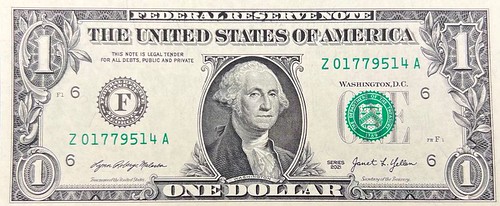
But, no, the portrait on the dollar is not the U.S. Mint's engraving work - paper money is produced by the Bureau of Engraving and Printing. Anyway, the article includes a fascinating timeline of events in the portrait's history - see the complete article online. -Editor
To read the complete article, see:
George Washington portrait that helped inspire $1 bill will go to highest bidder
(https://www.washingtonpost.com/nation/interactive/2025/washington-madison-stuart-portrait-auction/)
Numismatic bibliophiles and researchers will appreciate the detective work that went into confirming the painting's provenance. This Artnet article was passed along by Alan Luedeking, who adds, "This'll require a veritable torrent of spondulix to acquire, no doubt!" -Editor
No one painted Washington as prolifically as Stuart. "Washington was famously not fond of sitting for artists," Martha Willoughby, a consultant specialist in Christie's Americana department, told me over the phone. Yes, he was humble, but the process was terribly boring, too.
Willoughby was "very suspicious" when Clarkson University, who consigned the iteration in next month's sale, claimed Madison had commissioned it. Stuart scholars rely on definitive volumes from the 1920s and 1930s to document his work. This example appears in those books—without any Madison mention.
First, Willoughby's team found a catalog that American magnate William Henry Aspinwall, who owned this work in the 1850s, had compiled for his collection. It confirmed the work's Madison origins. Then a note from Madison's secretary turned up, sealing the deal. "He writes that he's the one that convinced Stuart to fulfill it in 1811 after it had been commissioned and paid for in 1804," Willoughby said. Elsewhere, she found accounts where visitors spotted the work in Madison's home during 1806. With Stuart, the record's rarely simple.
Madison definitely requested his own portrait alongside the Washington commission, though he displayed Washington's more prominently. It eventually went to Madison's wife, then his son, then Aspinwall—followed by industrialist James W. Ellsworth, art collector William K. Bixby, and Richard L. Clarkson, whose family founded Clarkson University. There, three frat boys stole the painting as part of a prank—and landed in jail.
To read the complete article, see:
Historic George Washington Portrait Behind the $1 Bill Heads to Auction
(https://news.artnet.com/market/george-washington-dollar-portrait-gilbert-stuart-auction-2731865)
The Washington Post article had more background on the prank. -Editor
A trio from the Theta Xi fraternity were split between stealing a pedestal ashtray and what they thought was a reproduction portrait of Washington from Clarkson University. The two pledges and a brother, all from the Rochester Institute of Technology, were planning a pledge-week prank.
"We, in our brilliance, chose the painting," said Stephen Pazian, one of those pledges. The 76-year-old retiree still wishes they'd gone for the ashtray. The group took the art back to their campus and quickly learned — either from a newspaper article or from the nightly news, Pazian says — that it was an American treasure insured for $125,000.
"We had the ‘Oh, s---' moment," he recalled.
NOTES FROM E-SYLUM READERS: DECEMBER 21, 2025
More Colorized Versions of the 2026 Liberty Dime
Edwin Johnston writes:
"In regards to your Image of the Week in the last issue, I submit both my colorized version of the 2026 Liberty dime portrait and the artificial intelligence version from that."


The first one's a beauty. Very nice. AI version? Not so much. Here's Wayne Pearson's colorized version from last week. -Editor


To read the earlier E-Sylum article, see:
U.S. MINT SEMIQUINCENTENNIAL COIN LAUNCH
(https://www.coinbooks.org/v28/esylum_v28n50a23.html)
The Unique and Different in Numismatics
David Derrick of Madison, MS writes:
"I'm still getting your posts and still enjoy reading and looking. To your credit, it has been a long run and I know it takes time and effort. I love the unique and different in numismatics… that's your forte and you're good at it. At 78 now, I thought it time to let you know."
Thank you! These issues are always fun to put together, and knowing readers appreciate it is what keeps me going. -Editor
Made-up Citations and Mint Rarities
Max Hensley,
Chief Editor of Scripophily for the
International Bond & Share Society writes:
"I enjoyed the AI article about made-up citations. While AI may not be a devil's spawn created to finance more Silicon Valley mansions, it can still be a flytrap. At the risk of shameless promotion, our next issue of Scripophily will have an article on an IBSS member's experiment instructing free ChatGPT to design some fantasy stock certificates for the non-existent Two Butte & Cimarron Railway Company. The program managed to misspell one or more words in every one it created. Sic transit gloria mundi.
I was about $71,000 short of buying one of those average "last penny" sets but not really disappointed. What I really wanted was a set where each "coin" was a mint error. I'd have taken anything - but a double strike, brockage and capped die would have been best."
That wouldn't be unprecedented. "Manufacturing great numismatic rarities off the books since 1834" would be a fine U.S. Mint slogan. -Editor
To read the earlier E-Sylum articles, see:
SECRET BOOKS MADE UP BY AI
(https://www.coinbooks.org/v28/esylum_v28n50a29.html)
THE LAST "OMEGA" CENTS HAVE SOLD
(https://www.coinbooks.org/v28/esylum_v28n50a22.html)
Cents Laments
A penny puzzler seen online this week: "Why do you have to "put your two cents in" when it's only a "penny for your thoughts" - where's that extra penny going to?"
Here's a cartoon found by Larry Dziubek in the Pittsburgh Post-Gazette. Thanks. -Editor

Felix H. Lenard (1922-2005)
Past NBS President Marc Ricard writes:
"In reference to the Monday, December 14th E-Sylum article that Pete Smith wrote, I have some updated information on two of those mentioned as 75-year members that may still be living:
"It appears that the ANA may have made an error when they recognized Mr. Felix H. Lenard as a 75-year member in 2024. Records that I located have Mr. Lenard as passing away on 12/19/2005 at the age of 83, which would have made him a 56-year member at the time of his death. He is buried in Our Lady of Hope Cemetery in Brownstown Township, Wayne County, Michigan.
"As for Mr. Edmund DeLaurentis, I could not locate any Death Records or Obituaries confirming his passing in any searches in the Pennsylvania Vital Records office. Also, an address in Havertown, PA indicates that he is the property owner.
"Another possible clue can be found in the Saints Peter and Paul Cemetery in Springfield, PA, where there is that headstone on the gravesite of his mother, Nicoletta DeLaurentis who was born in 1896 and passed away in 2004 at the age of 108. Also listed on the headstone are Edmund's sister, Estella, who was born in 1927, and Edmund who was born in 1925. Neither of the two dates of death are engraved on the headstone for Estella or Edmund. If this evidence, though circumstantial, is correct, Mr. DeLaurentis just turned 100 in December 5, 2025.
Unfortunately, I could not uncover any records on Mr. David R. Denis."
Thank you. I've passed these notes on to Pete. -Editor
To read the earlier E-Sylum articles, see:
100-YEAR-OLD NUMISMATISTS
(https://www.coinbooks.org/v28/esylum_v28n50a14.html)
QUERY: EDMUND DELAURENTIS
(https://www.coinbooks.org/v28/esylum_v28n50a15.html)
Why the Extra
13775?

"I have a have a question after reading the A VIRGINIA TYPE 2 NATIONAL BANK NOTE RARITY piece in the latest E-Sylum."
 "The article points out the "13775" printed on the same line as the Serial
Number, and mentions that the "extra" printing makes the note special.
But nowhere in the article is there an explanation for why the "13775"
would be printed on Series 1929 notes during 1934 and 1935.
The article mentions that most
surviving examples of notes with the "extra" 13775 are from two banks,
one in Chicago and one in San Francisco.
"The article points out the "13775" printed on the same line as the Serial
Number, and mentions that the "extra" printing makes the note special.
But nowhere in the article is there an explanation for why the "13775"
would be printed on Series 1929 notes during 1934 and 1935.
The article mentions that most
surviving examples of notes with the "extra" 13775 are from two banks,
one in Chicago and one in San Francisco.
"What is the reason for the extra "13775?"
Good question. Can anyone help? -Editor
To read the earlier E-Sylum article, see:
(https://www.coinbooks.org/v28/esylum_v28n50a27.html)
Wayne's Mood
Pete Smith writes:
"As I was looking for my Woodin material this week, I came across an interesting 45 RPM record. The title on one side is "Wayne's Mood," recorded by The Rockway's just over fifty years ago in November 1975. It is instrumental and described as garage rock. Smarty Pants question of the week. What song is on the other side?"

Tough question. Any musicologists in the house? I thought this looked like a positively ancient artifact until I realized, wait - I was in high school in 1975, and we played stacks of 45s like this at parties and other gatherings. But I don't remember this one (or being particularly moody). -Editor
 Good Old Classic British Humour
Ron Guth writes:
"Yes, this is coin related."
Never doubt Ron Guth. Check out the short video. -Editor
To watch the YouTube Short, see:
Good Old Classic British Humour
(https://www.youtube.com/shorts/IFddo023Z4o)

ANS LONG TABLE: ERIC BROTHERS ON THE MORGAN DOLLAR
Eric Brothers Presents Morgan Dollar Research
Numismatic author Eric Brothers recently made a video presentation on the Morgan Dollar. It was produced as part of the American Numismatic Society's Long Table series of lectures. His talk can be found on YouTube under the title, "Long Table 247. The Morgan Dollar: An Artistic Failure." This presentation is based on his article in Numismatic News, ""Pelican Bat of the Wilderness": Creation and Reception of the Morgan Dollar" (September 9, 2025).
The Morgan dollar is arguably the most popular collectible United States coin. However, the artistry of this silver dollar was severely criticized upon its debut in 1878. This criticism continued well into the 20th century. Employing primary sources, Brothers discusses the critical reception that the Morgan dollar received. Among the criticism Morgan's dollar received was published in the Carson City Morning Appeal (April 17, 1878): "Great disgust was expressed at the general appearance of the [design]. All that has been said as to the wretched workmanship of the Philadelphia dollar, will be equally true of the Carson dollar …. The [reverse design] represents the same wide, flat, pelican-bat of the wilderness …."
Brothers has been a numismatic author for over twenty years. His work has been published in Palm Beach Coin News, Coins, Numismatic News, CDN Greysheet Monthly, and The Numismatist. He currently writes for ANS Magazine, Financial History, CDN Greysheet Monthly, and Numismatic News. Brothers is also a freelance numismatic copywriter.
To watch the complete video, see:
Long Table 247. The Morgan Dollar: An Artistic Failure
(https://www.youtube.com/watch?v=TLeT4GvkBQ8)

VOCABULARY TERM: SCREW PRESS
Here's another entry from Dick Johnson's Encyclopedia of Coin and Medal Terminology. -Editor
Screw Press. A striking press whose force is derived from a spindle with steep-pitched threads; an early press that remained in use for nearly four centuries before being replaced by modern presses. The first screw presses derived their power from men, working in teams – pushing on opposite ends of a long balance beam and walking around the press – later by horses or by water power; thus their capability was limited to striking coins and medals of limited diameter (certainly less than 40 millimeters, but more often less than 25mm). Not only was the screw press used for striking, see illustration by Benvenuto Cellini who used one in 1530, but was also used for hubbing and adapted for blanking.
Prior to the screw press, coins were made with a blow from a sledge to a punch (containing one design) on a blank laid on a die in the lower position called the pile (containing the opposite design). This coinage is known collectively as hammered and produced by a moneyer. With the development of the screw press, coins and medals truly became struck (see striking).
The process of striking in a screw press was called mill and screw, or simply, milled or mill coinage. The development of the rolling mill not only gave this coinage their name but also gave coins more uniformity in their thickness. After the invention of the collar (in 1555) struck coins had an edge, unlike hammered coins. Striking with a collar formed an edge that could be either smooth or have reeding. Infrequently this reeding was called milled edge, but this was an incorrect term. The screw press formed the edge, but when it was operated by man the coins were usually of small diameter and had shallow relief.
Source of power changed. To strike larger coins (or deeper relief) more pressure was required of the press. The balance beam became longer, weights were added to the end to effect more pressure, and the number of men increased or horses used. This style of the screw press was called a fly-press, because of the momentum of its spindle advancing down and up, and the beams rapidly flying around the press. (Hand-operated fly presses of varying sizes are still in use in some modern metalworking plants. They can be used to try out new equipment before it is installed in a power press.)
Later the power came from water power, and by the end of the 18th century, by steam power. Although the knuckle-joint press was invented in 1817 by Diedrich Uhlhorn in Germany, it did not immediately replace the screw press. It was learned that it was easier to electrify a knuckle-joint press by electric motors than to electrify a screw press. Thus the screw press was only phased out of production with the rise of electricity and electric motors (following 1890).
Even so, screw presses were still used for striking medals well into the 20th century (even at the Paris Mint). Screw presses finally were replaced when hydraulic presses (developed during World War I) became widely available thereafter. See presses and pressroom practice.
"A coining machine [screw press] resembles in a massive way the old-fashioned press used for copying letters or embossing a seal on papers. The dies were inserted near floor level and the lower fixed to the foundations; the upper die to the base of a vertical column [spindle] with a spiral engaged to the housings. Two arms, each 6 feet long, loaded at the tip with 300 pounds of lead and furnished with two ropes, projected from the top of the column at about waist-height.
"Normally four labourers, hauling on these ropes with the utmost violence of which they were capable, sent the column and die spinning down on a blank; as it rebounded it was [brought] back by a lighter rope to prevent double- striking, and wound up for a fresh blow. A [pressman or coin setter], seated in a pit before the opening, flicked the struck coin away with his middle finger and with index and thumb set a fresh blank on the lower die.
"The ponderous machines worked at the astonishing pace of a blow every two seconds. The toil was exhausting; a crew of seven was assigned to a press, of whom three rested while the four worked a twenty-minute spell. They were reckoned to labour at the press for five hours only of the working day of ten; the rest of the day was spent in fetching and carrying and odd jobs."
–John Craig, The Mint
How the screw press was used. Three (or more) men were required to operate a screw press. One sat facing the press and manually fed the blanks and removed the coins after they were struck. Sometimes he sat in a pit that allowed him to get closer to the striking. He was called the coin setter. (Automatic feeding and delivery was installed on screw presses following 1790.)
Two or four men above him – called the spinners – pressed the balance beam at opposite ends pressing in opposite directions. As the men pushed against the beam the spindle on the press moved downward the housing containing the die. It was easy at first until the die met the blank, then it required great strength to press even harder to advance the die into the blank forming the design. With practice the team of men could get their rhythm synchronized until the momentum drove the spindle down and back in rapid succession.
Longer arms of the beam and heavier weights at the end gave them greater leverage to increase the pressure for the final squeeze forcing the dies into the blank as far as necessary. To achieve even greater pressure it required more men on each end of the beam. The larger the diameter of the coin the greater the pressure was needed. A crown size coin could require as many as eight men, four on each beam. (The use of a horse could replace as many as four or six men.)
After they pressed the coin with as great a force as they could apply, the spinners reversed themselves and pressed on the beam in the opposite direction to raise the die housing on the spindle. Sometimes they attached leather straps to the beam to pull the beam back, if they preferred to do that, since raising the die housing did not require great strength to return it to open position.
History of the screw press. The concept of screw press had been used in mid 1400s for both printing and squeezing fruits and olives. The first screw press for striking numismatic items was developed by an Italian, Donato Bramante (1444-1514) in 1506 for striking lead seals for Pope Julius II (1503-13). This principle was described and illustrated by Benvenuto Cellini in his work on goldsmithing and he used a screw press in 1530 for striking his own lead seals for Pope Clemente VII (1523- 34).
In Augsburg, Germany in 1550, Max (or Marx) Schwab improved on the screw press and attempted to sell this to the mint in Venice. Unsuccessful there he did exhibit his "engines" (a term used for screw presses, hubbing presses and rolling mills) to a French ambassador leading to the purchase by King Henry II, for the royal mint in Paris (delivered in January 1551). Later Spanish emissaries visited Schwab to learn of his techniques and machines.
The screw press was installed at the Paris Mint. An employee there, Eloye Mestrel, learned its operation very well, but became dissatisfied with the lack of acceptance of the new press by moneyers who feared their hammer technique would be replaced. Mestrel fled, in 1561, to England and set up a screw press at the London Mint. Following this early use in Italy, Germany, France and England, use of the screw press spread to other mints throughout Europe. Despite an attempt to use roller dies to impress blank strip, later to be cut out (the process known as taschenwerke), the screw press thrived and was widely used for striking.
No major improvements occurred until 1786 when an Italian engineer, Francesco Comelli, at the Bologna Mint invented a collar and ejection system to be used with the screw press. This would strike coins and shape the edge with one pressing. A few years later, two engineers at the Paris Mint devised a way to feed the blanks, drop the blank in the collar, strike and eject the piece, then remove it in one cycle while the press was manually operated. Jean-Pierre Droz and Philippe Gengembre were these innovators.
It was for Boulton and Watt, who hired Droz away from the Paris Mint in 1789, to devise a way to incorporate all these innovations and run the press by their steam powered engines. This was an outstanding undertaking and a landmark in the history of coining!
Boulton and Watt made full use of the screw press, with Comelli's collar and Droz's automatic feed and delivery systems, with the power of their steam engines. Not only did they manufacturing screw presses for their own private mint in Birmingham, and by custom striking with these presses, but also to manufacturing these presses for other mints.
Thus the screw press struck coins for nearly 400 years (1505-1898), medals were struck by the screw press well into the 20th century (1530-1914). The press was also utilized to do blanking, and even hubbing until the end of the 19th century. The invention of the Uhlhorn knuckle-joint press, in 1817 in Germany, and its improvement, by Thonnelier in 1836 in France, did not entirely replace the screw press.
It was two events that greatly reduced the usefulness of the screw press: (1) it was learned that a knuckle-joint press with a large fly wheel could be electrified easier than a screw press when electricity became commercially available (after 1883), and (2) improvements to the hydraulic press which proved far more useful for hubbing (and for striking large medals). Screw presses are still in use in tool and die shops for pressing where only a moderate pressure is required, even into the 21st century.
To read the complete entry on the Newman Numismatic Portal, see:
Screw Press
(https://nnp.wustl.edu/library/dictionarydetail/516712)

WILLIAM WOODIN ASSOCIATION ITEMS
E-Sylum Feature Writer and American Numismatic Biographies author Pete Smith submitted this article on collectible items associated with numismatist, numismatic author and Secretary of the Treasury William Woodin. Thanks! -Editor
 William Woodin was mentioned in The E-Sylum last week. I won't bother to write his biography.
Instead, I will use him to introduce my collection of association items for American
numismatists.
William Woodin was mentioned in The E-Sylum last week. I won't bother to write his biography.
Instead, I will use him to introduce my collection of association items for American
numismatists.
I don't have a clear idea of what qualifies as an association item. I collect autographs and I collect business cards. I think a business card qualifies but an autograph does not. The difference is probably not important.
I have a copy of the sheet music for "Franklin D. Roosevelt March," composed by William H. Woodin with words by Irving Caesar and introduced in 1933. It was published by Miller Music, Inc. There is a note "The Profits from the sales of this composition donated to Warm Springs Foundation."


I also have sheet music for "Spring is in My Heart Again" with words by John Mercer, music by William Woodin and published by Miller Music Corporation, copyright 1932. Actually, I have three different copies with different covers. If you asked me why I have three different copies, I would say "I collect Woodin sheet music by die variety."
Another title is "Eight Compositions by William H. Woodin" published by Miller Music. As the title suggests, it included eight different songs, copyright MCMXXXI. For those who don't know Roman numerals, that was 1931.


William H. Woodin had an unsuccessful run for Congress as a Republican candidate in 1898. I have a campaign card and campaign ribbon for the campaign. I also have a pinback button that does not photograph well.
Time Magazine for March 20, 1933, had a cover engraving of Woodin. Stories inside covered activities of the new Roosevelt administration.
Woodin was President of the American Car and Foundry Corporation in 1916. They were one of the largest producers of railroad cars during the First World War. Woodin commissioned medals to be presented to workers for their service during the war.


The medals were struck by the Gorham Company from a design by Chester A. Beach and modelling by Julio Kilenyi. Mintage for the 63.5 mm piece was 7500 in bronze and other metals. This can be collected as a medal and as an association item. I like the medal for its historical context and artistic imagery. I also like it for the association with Woodin.
 Now we get to the fun stuff. William Woodin was friends with Johnny Gruelle, the writer and
creator of Raggedy Ann and Andy. They shared a love for children. Woodin composed songs that
he sang to his children. Under the name Will Woodin, he wrote the music for the songbook,
Raggedy Ann's Sunny Songs, with sixteen songs.
Now we get to the fun stuff. William Woodin was friends with Johnny Gruelle, the writer and
creator of Raggedy Ann and Andy. They shared a love for children. Woodin composed songs that
he sang to his children. Under the name Will Woodin, he wrote the music for the songbook,
Raggedy Ann's Sunny Songs, with sixteen songs.
The booklet included instructions for playing the ukulele. In the introduction, it was stated, "The melodies are appealing though simple and at no time exceed the compass of the child's voice… The piano accompaniments are always simple and easy to play."
One of Gruelle's characters was Little Wooden Willie as a tribute to his friend. The songbook includes "Little Wooden Willie." The words go like this:
 Little Wooden Willie,
People thought him silly
‘Cause he had a knot hole
In the middle of his head.
So he put a hat on
And since he has that on
Folks who thought him silly
Think he's very wise instead.
I have always been amused by the thought that Roosevelt's Secretary of the Treasury was known as Little Wooden Willie.
I have a copy of United States Pattern, Trial and Experimental Pieces by Edgar H. Adams and William H. Woodin. I don't consider that an association item. I also don't consider the United States Mint medal produced for Woodin as Secretary of the Treasury. (USM 213) For those, their connection as collectible items is too direct.
As with any obscure collectible field, each collector may decide what they wish to collect.
Thanks, Pete! Very interesting background on an important person in U.S. numismatic history. -Editor
To read earlier E-Sylum articles, see:
WILLIAM H. WOODIN'S 1898 CONGRESSIONAL CAMPAIGN
(https://www.coinbooks.org/esylum_v10n50a22.html)
WILLIAM H. WOODIN'S POLITICAL JOURNEY AND MUSICAL TALENT
(https://www.coinbooks.org/esylum_v10n51a16.html)
NOTES FROM E-SYLUM READERS: DECEMBER 14, 2025 : Who Wrote the Franklin D. Roosevelt March?
(https://www.coinbooks.org/v28/esylum_v28n50a12.html)
TREASURE TALK WITH BOB EVANS, EPISODE 10.1
In January, our good friend Bob Evans began publishing a series of blog articles on the Finest Known website detailing his experience as co-discoverer and curator of the treasures recovered from the wreck of the S.S. Central America. Subject of the book "Ship of Gold", many exhibits, countless interviews and articles, books and auction catalogs feature the legendary haul of gold coins, bars, nuggets, gold dust and more from the 1857 shipwreck. Here's another excerpt - see the complete article online. -Editor

Last time, in Treasure Talk Episode 9, I discussed how I had become convinced we would find gold dust on the S.S. Central America shipwreck site. Contemporary survivor accounts related stories of despondent men pouring out bags and belts full of gold dust onto the decks as the ship was about to go down, realizing that gold was worse than worthless in their impending situation.
Before the SSCA Project I had no experience of gold dust. Zero. Sure. I studied geology and mineralogy at the Ohio State University. And so, as a geologist, 29-year-old Bob might be expected to know a bit more about the science of gold, a mineral, than the average Joe. But Columbus is not exactly the hotbed of gold mining. Resting on thousands of feet of Paleozoic sedimentary rocks, OSU was a great place to study fossils, and that is what I did.
On one side of the classroom there was a locked cabinet, with the "valuable" specimens, pieces that the department did not want to walk out the door. You needed to ask an attending TA (teaching associates – grad students) to unlock it for access. Hours for the TAs were known, so you had to be there at those times if you wanted to learn from the good stuff.
It was there, on the second floor of Watts/MacQuigg Hall, studying for Geology & Mineralogy 221, that I saw my first native gold. The locked cabinet had several metallic ore specimens, some with beautiful crystals, works of nature's art. It also held a couple rather unremarkable pieces of gold ore; unremarkable except for the flash and color of the glimmer of tiny flecks emanating from the matrix. I will never forget the color.
The only gold ever found in Ohio (exceeding rare) is found in rocks that the glaciers brought down from what is now Canada. I have never found gold in Ohio. But I have found "black sand," dark metallic ore particles, some of which are made of the mineral magnetite, also originating only in the igneous and metamorphic rocks of Canada. As you might guess, magnetite is magnetic, and it is also heavier than average sand minerals. So, you can concentrate it through gravity separation, with a gold pan. Finding magnetic sand, or the lack of magnetic sand, using a gold pan, is a method for determining the edge of the glacial coverage in Ohio.
When we tooled up for 1988, and found the real S.S. Central America, we included a suction dredge to serve as a vacuum cleaner to clear debris around coins and ingots. We also provided for large sediment traps to catch anything heavy that would be sucked up by the dredge we used to clear our way through the murk and mud to expose treasure. Again, of course, I had a couple gold pans.
I am thrilled that I have had the opportunity to work closely with such a great treasure. But I would like to discuss the "problems" with finding a large amount of gold dust. Clearly, I acknowledge, these are the kind of "problems" many would like to have.
First, let everyone understand that when we found it, it was not MY gold dust, it was the Project's, the Company's. It WAS my responsibility. I was trusted, and I could be trusted. But I wanted to forestall any uncomfortable questions. So, at my insistence, my actions with the gold were ALWAYS either videotaped or witnessed. ALWAYS. My home office assistant, Debbie Willaman, and I often referred to this policy as our "Get Out of Jail Free" card.
When CGMG acquired most of the treasure, at the end of 1999, I left Tommy Thompson's company and went to work for Dwight Manley. I will flatter myself and say that I was like an all-star traded to a new team. Or at least a decent utility shortstop.
 But CGMG had no gold dust when I went to work for them. The gold dust, along with all the other native gold nuggets, had been selected by the claimant underwriters as the second of their seven allotted divisions out of ninety. At the Sotheby's auction of the underwriters' portion, in June of 2001, Manley bought some large lots of gold dust on behalf of CGMG.
I fully acknowledge and accept that there must be meticulous record-keeping and accountability. There are reasons for rules, at least for good rules. Often, it relates to what I mentioned before, the metaphorical "Get Out of Jail Free" card. Following the rules keeps you clean. So, the system has rules, and I have rules as well.
Of course, once the court took control in 2013, there were additional layers of bureaucracy. The Receiver, Ira Kane and I had a great working relationship and quickly developed a mutual respect. My first job for him was a complete accounting of the treasure we had recovered. A major concern had been whether Tommy Thompson had absconded with original treasure, 1857 treasure, in addition to the "missing" 500 relic-commemorative Kellogg $50 re-strikes (1250 ounces worth) he allegedly took.
He had not.
No original treasure was missing from the accounting, and my department's meticulous record-keeping throughout the process, from seabed to distribution, proved this to the satisfaction of the very tough attorneys representing those men who sued Thompson.
Ira Kane learned that the integrity of the treasure was of paramount importance to me. Although it was arduous to re-assemble the full provenance and movements of every piece, while under my control a couple decades before, I was happy to do so, clearing up any remaining issues about unreported treasure.
Ira contracted with me to resume my role as Chief Scientist and Historian for a return expedition in 2014. That role came with new rules about reporting, and gold dust recovered at sea presents some interesting issues.
To read the complete article, see:
Treasure Talk: Episode 10 – Part 1
"So, this is gold dust"
(https://finestknown.com/treasure-talk-episode-10-part-1so-this-is-gold-dust/)
For the complete series, see:
Category Archives: Treasure Talk with Bob Evans
(https://finestknown.com/treasure-talk-with-bob-evans/)
To read the earlier E-Sylum article, see:
TREASURE TALK WITH BOB EVANS, EPISODE 1
(https://www.coinbooks.org/v28/esylum_v28n12a12.html)
TREASURE TALK WITH BOB EVANS, EPISODE 2.1
(https://www.coinbooks.org/v28/esylum_v28n13a17.html)
TREASURE TALK WITH BOB EVANS, EPISODE 2.2
(https://www.coinbooks.org/v28/esylum_v28n14a15.html)
TREASURE TALK WITH BOB EVANS, EPISODE 3.1
(https://www.coinbooks.org/v28/esylum_v28n15a16.html)
TREASURE TALK WITH BOB EVANS, EPISODE 3.2
(https://www.coinbooks.org/v28/esylum_v28n17a16.html)
TREASURE TALK WITH BOB EVANS, EPISODE 4.1
(https://www.coinbooks.org/v28/esylum_v28n18a13.html)
TREASURE TALK WITH BOB EVANS, EPISODE 4.2
(https://www.coinbooks.org/v28/esylum_v28n19a20.html)
TREASURE TALK WITH BOB EVANS, EPISODE 5.1
(https://www.coinbooks.org/v28/esylum_v28n22a13.html)
TREASURE TALK WITH BOB EVANS, EPISODE 5.2
(https://www.coinbooks.org/v28/esylum_v28n23a16.html)
TREASURE TALK WITH BOB EVANS, EPISODE 6.1
(https://www.coinbooks.org/v28/esylum_v28n27a14.html)
TREASURE TALK WITH BOB EVANS, EPISODE 6.2
(https://www.coinbooks.org/v28/esylum_v28n30a21.html)
TREASURE TALK WITH BOB EVANS, EPISODE 7.1
(https://www.coinbooks.org/v28/esylum_v28n32a16.html)
TREASURE TALK WITH BOB EVANS, EPISODE 7.2
(https://www.coinbooks.org/v28/esylum_v28n40a15.html)
TREASURE TALK WITH BOB EVANS, EPISODE 8
(https://www.coinbooks.org/v28/esylum_v28n42a21.html)
TREASURE TALK WITH BOB EVANS, EPISODE 9
(https://www.coinbooks.org/v28/esylum_v28n49a19.html)
NUMISMAGRAM MEDAL SELECTIONS: DECEMBER 21, 2025
Numismagram's Jeremy Bostwick sent along these five medals, mainly holiday-themed, from his most recent upload of new material to his site. For all of the new items, please visit https://www.numismagram.com/inventory. -Garrett

103281 | GREAT BRITAIN. The Adoration of the Wise Men white metal Medal. Issued circa 1830. Medallic Illustrations of the Holy Scriptures series: the Adoration of the Wise Men (73mm, 117.91 g, 12h). By Sir Edward Thomasen in Birmingham.
THE ADORATION OF THE WISE MEN, the three magi, or wise men, left, presenting their gifts of gold, frankincense, and myrrh to the infant Christ to left, held by the Virgin Mary and surrounded by Joseph; radiant star of Bethlehem in sky above // THE GENERATIONS FROM ABRA- / HAM TO DAVID WERE 14, FROM DAVID / TO THE CARRYING AWAY INTO BABYLON 14, / AND FROM THAT TIME TO CHRIST 14, / IN THE REIGN OF HEROD KING OF JUDEA LI- / VED THE PRIEST ZACHARIAS AND HIS WIFE ELIZ- / ABETH BOTH OF THE TRIBE OF LEVI WITHOUT ISSUE, / WHILST ZACHARIAS WAS EFFICIATING THE ANGEL GA- / BRIEL INFORMD HIM THAT GOD INTENDED TO BLESS / THEM WITH A SON FORETELLING AT THE SAME-TIME / THAT HE SHOULD PREACH THE BAPTISM ON REPENTANCE / FOR THE REMISSION OE SINS.TIE ANCEL GABRIEL WAS / ALSO SENT UPON AN ERRAND TO A VIRGIN NAMED MARY / A COUSIN OF ELIZABETH IN NAZARETH SHE WAS ESPOUSED / TO JOSEPH BOTH OF THE HOUSE OE DAVID. HE SALUTES HER / BLESS'D ART THOU AMONG WOMEN FOR GOD HATH DECREED / YOU TO BE THE MOTHER OF THE SAVIOUR OF THE WORLD. / AN ANGEL INFORMED JOSEPH THAT THAT WHICH WAS / CONCEIVED IN MARY WAS OF THE HOLY GHOST, AND / THAT SHE SHOULD BRING FORTH A SON WHOSE NAME / SHOULD BE CALLED JESUS. AT THAT TIME AUGUST / US CÆSAR ISSUED A DECREE TO TAKE AN ACCOU- / NT OF ALL THE ESTATES AND PEOPLE SUBJECT TO / THE ROMAN EMPIRE. MARY AND JOSEPH WERE / OBLIGED TO REPAIR TO BETHLEHEM TO BE / ENROLL'D, WHERE THE SACRED VIRGIN / BROUGHT FORTH HER FIRST BORN / IN A STABLE OF THE INN in 28 lines; winged head of cherub above and below. Edge: Plain.
BHM 1468.53; Eimer 1238. Choice Mint State. Highly brilliant and lustrous; excellent quality for the metal type, which is normally encountered very pestered and full of issues.
Part of a series of 60 medals that attempted to tell various important tales from the Bible in medallic form, this medal is usually encountered in white metal, with the white metal itself generally faring rather poorly.
To read the complete item description, see:
103281 | GREAT BRITAIN. The Adoration of the Wise Men white metal Medal.
(https://www.numismagram.com/product-page/103281)

103247 | GERMANY. Catholicism bronze Medal. Issued 1897 for the 44th General Assembly of German Catholics in Landshut (42mm, 34.77 g, 12h). By Drentwett in Augsburg.
Draped bust of Christ left within wreath of palm fronds // 44 GENERALVERSAMMLUNG / DER KATHOLIKEN DEUTSCHLANDS / LANDSHUT 1897, crowned and garnished coat-of-arms; in ten lines across and below, CARTELLVERB / KATH / STUDENTEN– / VEREINE / CÄCILIEN– / VEREIN / VOLKSVER F D / KATH DEUTSCHL - CARTELLVERB / KATH / STUDENTEN– /VERBINDUNGEN / ALLEMANNIA / & NORMANNIA / KATH / JURISTENVEREIN; in two lines in exergue, KATH LENRERVEREINE / KATH ARBEITERVEREINE. Edge: Plain.
Gem Mint State. Glossy brown surfaces, with rich, intense brilliance. Rare and highly alluring.
To read the complete item description, see:
103247 | GERMANY. Catholicism bronze Medal.
(https://www.numismagram.com/product-page/103247)

103432 | UNITED STATES. Victorian Couple/"Oh, Genevieve" silver Love Token (24mm, 5.46 g, 12h).
1877 Seated Liberty quarter, with engraving upon reverse: Couple (man to left, woman to right) standing facing one another, clasping hands; the man wears mustache, double-breasted frock coat, and kepi, while the woman wears a styled dress and bonnet; all upon a slightly curved panel mimicking a photograph, with shaded geometric pattern around; below, banner reading "OH GENEVIEVE." Edge: Reeded.
Cf. KM A98 (for host coin). Engraving: Extremely Fine. Host: Choice Fine. Lightly toned.
Being borrowed from the early 18th century practice in Great Britain, and being related to even earlier forms of engraving on European coinage, "love tokens" were an extremely popular form of sentimental art that saw their high point in the United States in the mid-to-late-19th century, whereby coinage was smoothed down on one or both sides, and some form of initials, a message, and/or imagery was engraved so that it may be presented to a loved one.
In the case of this piece, the intended recipient was likely "Genevieve" and, given the attire of the gentleman—especially with his Civil War-era kepi, this piece was possibly done by a soldier longing for his beau, the aforementioned Genevieve.
The most commonly encountered 'canvas' in the United States was the dime, and usually one from the Seated Liberty series. At their height, the U.S. Mint blamed an alleged shortage of dimes—a staple of most late-19th century transactions—on this craze. Rising again in the early-mid 20th century during the depths of despair that were the world wars, this form of coin art, usually referred to in this context as "trench art," would see another revival, offering soldiers a brief chance at escapism through sentimental creativity.
To read the complete item description, see:
103432 | UNITED STATES. Victorian Couple/"Oh, Genevieve" silver Love Token
(https://www.numismagram.com/product-page/103432)

103310 | RUSSIA. Saints Florus and Laurus wooden Monumental Icon. Made circa 1850-1870. (61.6cm x 78.7cm [24-1/4" x 31"], 7.62 kg [16.8 lbs]).
Nimbate saints Florus, bearded and wearing blue jeweled tunic with off-white undergarment and red cape, and Laurus, clean-shaven and wearing jeweled pink undergarment and green cloak, standing facing one another, each holding patriarchal cross; foggy mountainscape in lower background, with the Veil of Veronica (facing nimbate head of Jesus Christ upon a white veil) at the top; the saints are largely set against an orange backdrop with a thin red border, wider mango border, and thinner off-white border; in red and above Florus reads (in stylized Orthodox Cyrillic) CT F??P? M???? (St. Florus the martyr), and above Laurus reads CT ?AVP? M???? (St. Laurus the martyr), and in purple above Christ reads I?C XC (Jesus Christ)—all of which is painted in tempera atop two wooden panels (doski) that have been joined from the back (hence a central crease and light bowing as would be typical), with a good deal of golden shimmering throughout, and especially among the orange central backdrop. Back and sides: Wood exposed, with some scattered scuffs and marks; two slates (shponki) near the top and bottom for resistance; wire hinge affixed to the top shponka for use in suspension on a wall.
Extremely Fine. Some minor fraying of wood at the edge is noted, along some subsequent chipping of the tempera near those areas; a more noticeable chip of both wood and tempera can be seen at the upper right corner; some light rub near the central crease where the two panels (doski) were joined is seen, with some minor scuffs to the tempera throughout; overall, however, the condition, especially given its monumental and weighty size, is quite pleasing and the coloring in general is rather bold. Very minor warping of the two panels (doski) is observed, and as can often be the case, though with the shponki providing their support.
Please refer to the in-hand video in order to get a more accurate sense of the size of this icon, which is quite massive and also rather heavy. A rather impressive and imposing piece for one's wall.
Following the conversion of the peoples of the Ancient Rus' (those in the eastern and northern portions of Europe) to Orthodox Christianity in the late 10th century, queues were taken from Byzantine art and iconography. As time progressed, and given the lack of more personal representations of religion, the practice in the emerging tsardom of Russia began to emulate the artistic traditions in western Europe within the Protestant and Catholic spheres. Thus, the Russian icon was born—a representation of one's religion and hopes, all in the form of a small-scale, craft-oriented image, usually done on wood and with the ability to venerate in one's house. The imagery would usually focus upon Christ or the Theotokos (the Virgin Mary), but could vary widely to other lesser-encountered saints and passages, even to those more native to the Orthodox church in the Russian dominion. The various images would generally be painted in tempera, a type of paint mixed with egg, and featured a gilt-infused background in order to elevate the flair and magnificence.
Saints Florus and Laurus were twin brothers and Christian martyrs from the 2nd century CE, having worked as stonemasons and cured the son of a local pagan priest in Illyricum. After having a nearby pagan temple converted to Christianity, they found themselves at odds with local authorities, who put many of the Christians there, including Florus and Laurus, to death. Later, when their alleged incorruptible relics were translated to Constantinople for veneration, it is said that a severe plague among horses ceased, so making the twin brothers the patron saints of horses, with their feast day being 18 August.
To read the complete item description, see:
103310 | RUSSIA. Saints Florus and Laurus wooden Monumental Icon.
(https://www.numismagram.com/product-page/103310)

103269 | UNITED STATES, ITALY & GERMANY. Christopher Columbus/"The Journey" aluminum Medal. Issued 1892 for the 400th anniversary of the discovery of America and the Italian-American Exposition in Genova (50mm, 13.10 g, 12h). By Mayer & Wilhelm in Stuttgart.
CHRISTOFORO COLOMBO / NATO 1456 MORTO 1506, half-length bust of Columbus facing slightly left, holding charts; all within wreath // RICORDO DELL' ESPOSIZIONE ITALO–AMERICANA, GENOVA / 1892, two female allegories (Italia and America) to right, one seated and one standing, pointing at a distance to left over the expo ground; Nina, Pinta, and Santa Maria on horizon to left with rising sun; above, crowned Genoese coat-of-arms with two griffins as supporters; in two lines in exergue, 1492–1892 / IV. CENTENNIAL. Edge: Plain.
Eglit 273; Starlust ST-eg-273; cf. Rulau B5 (for a larger module issue by Mayer & Wilhelm for the Italian-American Expo) & B6 (for the similar corresponding issue for the Columbian Expo); cf. Bernd Kaiser V, 127 (bronze). PCGS SP-65. Blast white surfaces, with intense mirroring in the fields.
During the lead-up to the quadricentennial of Columbus's initial contact with the New World, numerous medals were designed and struck, both in the United States—in conjunction with the 1893 Columbian Exposition in Chicago—and abroad—sometimes for this event or for similar others. In this case, "The Journey" medal was produced commemorating the quatercentenary in Germany by the Stuttgart-based manufacturer, Mayer & Wilhelm, with the obverse depiction of Columbus sometimes being referred to as "elf-like," and with this overall design for the 1892 Italian-American Exposition in Genoa serving as the prototype for the following year's English version for the Columbian Exposition in Chicago. Of note, while this type is listed in the references as "white metal," which can be a bit of a catch-all for certain "white" metals, this example is undoubtedly aluminum, as its extremely low weight (13.10 g) in comparison to diameter (50mm) conveys.
To read the complete item description, see:
103269 | UNITED STATES, ITALY & GERMANY. Christopher Columbus/"The Journey" aluminum Medal.
(https://www.numismagram.com/product-page/103269)
HERITAGE: HARVEY JACOBSON EARLY HALF EAGLES
Heritage Auctions will be selling the Harvey B. Jacobson Jr. Collection of Early Half Eagles as part of its FUN Special Sessions Auctions on January 8. Here is the press release. -Garrett
An extraordinary collection of the rarest and most important varieties in the entire early half eagle series will take flight in Heritage's U.S. Coins Signature Auction - FUN Special Sessions: Ellsworth & Jacobson Jan. 8.
The Harvey B. Jacobson, Jr. Collection of Early Half Eagles stands as a 68-lot tribute to Jacobson's desire to acquire the rarest of the rare, a mission that ended with his acquisition of every early gold variety that eluded Harry W. Bass, Jr., with the exception of two unique 1797 varieties that are housed in the Smithsonian Institution.
"Like many of the savviest numismatists, Harvey Jacobson pursued the major rarities in this series first, and that immediate commitment to elite coins stood as the foundation for what became a magnificent collection of the rarest and most important varieties in the early half eagle series," says Todd Imhof, Executive Vice President at Heritage Auctions. "Any list of the most notable early half eagles would include most of the lots that are available in this collection. The collection he assembled is inarguably one of the finest in numismatic history and will be referenced for generations in the same context as the Harry Bass Collection."


1795 BD-13 Heraldic Eagle Five, MS62 PCGS HBJ-207
Among the highlights in the collection is a 1795 BD-13 Heraldic Eagle Five, MS62 PCGS HBJ-207. This unique half eagle was featured alongside several other important varieties in the article "Elusive Half Eagle Varieties, A Collection of Early Examples," which was penned by Jacobson and Heritage Senior Numismatist Mark R. Borckardt for the August 2019 issue of The Numismatist. Doug Winter called it "one of the very few early gold varieties that is unique and the fact that such early researchers and collectors as Edgar Adams, Waldo Newcomer, Walter Breen, and Harry Bass never found one is a true testament to the numismatic significance of the Jacobson Collection."


1797 BD-4 Half Eagle, AU58+ PCGS. HBJ-209
Also in play is a 1797 BD-4 Half Eagle, AU58+ PCGS. HBJ-209 that is pictured on PCGS CoinFacts and is the plate coin in Early U.S. Gold Coin Varieties, A Study of Die States 1795-1834 by John Dannreuther. This coin first surfaced in the George D. Woodside Collection, and has appeared in several important pattern collections since. The winning bidder will become just the sixth owner of the coin since the 1860s.


1819 "BD-3" Half Eagle, AU Details HBJ-252
An 1819 "BD-3" Half Eagle, AU Details HBJ-252 is a magnificent recent discovery last offered at Heritage in 2014, not recorded in the Bass-Dannreuther reference. Heritage's Borckardt is credited with the March 2014 identification of the variety, although Edgar Adams cited a third variety in his notes, suggesting he might have discovered it. But his mid-1930s articles on the half eagles stopped with 1800 varieties and access to his notebooks is not readily available.


1825/4/1 Half Eagle, BD-3, MS61 NGC. HBJ-259
Also offered is an 1825/4/1 Half Eagle, BD-3, MS61 NGC. HBJ-259 that Winter called a "probably unique variety" that "is among Harvey's favorite coins in the set." This discovery coin for the variety also is the only example known to the experts at Heritage — the world's leading numismatics auctioneer. The BD-1 and BD-2 overdate varieties have different obverse dies, but share a common reverse, with the BD-2 in a later die state. The newly discovered BD-3 variety shares the same obverse die with the BD-1, but the reverse die shows the middle arrow pointing to the center of the R in AMERICA, while the BD-1 reverse has this arrow pointing to the right foot of the R. The BD-3 reverse was used previously to coin the 1820 BD-4, BD-5 and BD-7 varieties, and used again to strike the 1826 BD-1 variety. Researchers, including Dannreuther, have previously noted how strange it was that the Mint apparently did not use this reverse die in coining the fairly large emission of half eagles in 1825, since the use of serviceable reverse dies from one year to the next was common practice in the early 19th century. The discovery of this coin confirms that the Mint actually did follow this accepted practice, for at least a limited production run that year.


1834 BD-4 Half Eagle, MS64+ PCGS. CAC HBJ-268
An 1834 BD-4 Half Eagle, MS64+ PCGS. CAC HBJ-268, dubbed the "King of Fat Head Fives," is a magnificent example and another unique variety in the Harvey B. Jacobson Jr. Collection. It also is tied with one other submission for the finest 1834 Capped Bust half eagle ever submitted to PCGS. Only six ever have been graded CAC; of those, two were MS63 coins and four were MS64. The coin offered in this auction is the only MS64+ example. Its provenance as the unique BD-4, which includes description and illustration in Rare Coin Review No. 30 as well as stints in the Irving and Joan Greenwald Collection and the Harry W. Bass, Jr. Collection, doubles as the condition census.
Images and information about all lots in the collection, and in the auction, can be found at HA.com/1389.

ANCIENT COINS IN FRANK ROBINSON AUCTION 130
Here is a press release detailing the ancient coins that will be included in Frank Robinson's Auction 130. -Garrett
Dealer Frank S. Robinson's 130th mail and internet auction of Ancient and Early Coins will include 590 lots, low starting bids, and no buyer fee. LIVE BIDDING will take place beginning at 11 AM Eastern Time January 18 on the biddr.com website.


Judaea Capta Sestertius of Vespasian
Included in this sale is a further segment of a major collection of Judaean and Judaic related material, highlighted by rare variety Judaea Capta Sestertius of Vespasian in nice VF.


Elymais Tetradrachm of Kamnaskires III and Anzaze
Greek coins include two nice Armenian Tigranes II Tetradrachm; a classic Athenian "Owl" tetradrachm in choice quality; a choice EF Elymais Tetradrachm of Kamnaskires III and Anzaze; and an excellent run of Parthian coins.
Notable among Roman coins are an EF Tiberius "Tribute Penny" Denarius; high grade sestertii of Nero Claudius Drusus and Claudius; an EF/AEF Titus Sestertius; and an AEF Theodosius II gold Solidus.
The sale also includes early choice Irish coins from the dealer's personal collection; Chinese cash coins, Byzantine and other early coinages, group lots, literature, and a section of items offered at fixed prices.
Robinson holds about three auctions annually, and tries to offer a broad range of material for advanced collectors as well as bargain hunters. Catalogs are free; contact Robinson at Box 8600A, Albany, NY 12208; phone 518-482-2639; e-mail frank@fsrcoin.com. The full catalog is at his website, www.fsrcoin.com.
To view the complete auction, see:
Frank Robinson Auction 130
(https://www.biddr.com/auctions/fsrcoin/browse?a=6609&l=8121605)
KUENKER AUCTION SALE 437, PART ONE
In 2026, Künker will once again kick off the year with a bang. The long-established Osnabrück-based auction house will be holding an auction of superlatives in the context of the World Money Fair. Rarities from Brandenburg-Prussia, the Habsburg Empire and the German States are the focal point of the 437th auction.
No matter what field of modern numismatics you are interested in: If you are looking for a great rarity in perfect condition with an impressive provenance, Künker's Berlin auction on 28 January 2026 is the ideal opportunity for you. The catalog is filled with exceptional pieces, and this auction preview will present the most interesting ones. Although it is probably enough to note that the 694 lots have a total estimate of 6 million euros. Connoisseurs will recognize that this figure indicates numismatic treasures of the highest caliber.
Rarities from Brandenburg-Prussia
The auction opens with a selection of coins and medals from Brandenburg-Prussia – a fitting start given that the sale is taking place in Berlin. A large part of the pieces come from the collections of two renowned Berlin collectors.
Gunther Hahn is a familiar name to Künker's long-standing customers. His collection was auctioned off in Berlin as part of Künker's 300th auction. At the time, Mr. Hahn was not ready to part with all of his pieces. Now he will return those he kept to the cycle of collecting. Volker Schwartz is well known to all those who are interested in the Hohenzollern family. Since 1990, he has edited the prestigious journal "Beiträge zur Brandenburgisch/Preußischen Numismatik" (Contributions to Brandenburg-Prussian Numismatics), which is brought to life by scholars AND collectors. At auction 437, the first part of his extensive collection will come under the hammer. The second part will be offered at eLive Auction 91 in March 2026. The selection comprises 81 lots. It contains coins and medals with a time frame spanning the period from a 1543 taler of Elector Joachim II Hector to the vereinsmünze pieces (German monetary union coins) of William I from 1866. Without exception, the pieces are either of spectacular quality or extremely rare. Most of them are both.
Lovers of Renaissance art will be delighted by the portrait that Margrave John of Küstrin had immortalized on a 21-gram gold medal. Those interested in economic history are sure to be amazed by the 1686 and 1690 Guinea ducats of fabulous quality. Fans of Frederick the Great will find a wonderful selection of single and double Friedrich d'ors. Particularly noteworthy are the talers that Frederick II specifically had made for trade as they illustrate the enormous ambitions of the Prussian king. The piaster was produced for China, the Albertus taler for trade in the Baltic Sea, and the Levant taler for the Levant.
All the heavy gold medals that were used as awards and prizes in the 19th century are also quite remarkable. A good example of this is a gold medal of 30 ducats. It was awarded to the Prussian court supplier Hensel und Schumann. This is fitting, as Hensel und Schumann was a gold and silver manufacturer that was one of the most technologically advanced companies in the world at the time. The Brandenburg Royal Academy used only chemically pure gold and silver from Hensel und Schumann for scientific analysis. The best-selling product was Lyon gold and silver. This fabric surrounded by metal wires was an indispensable part of any impressive uniform in the 19th century. By the way, there is a second gold medal of 25 ducats from the Hahn Collection, which was also awarded to this company. It is also extremely rare. Only 69 specimens were produced.


No. 2: Brandenburg. Margrave John of Küstrin, 1535-1571. Gold cast medal, 1569. From the Gunther Hahn Collection. Extremely rare. Minor trace of mounting. Fields finely chased. Extremely fine. Estimate: 20,000 euros


No. 3: Brandenburg. Margrave John of Küstrin, 1535-1571. 1578 reichstaler, Berlin. From the Volker Schwartz Collection. Very rare. Extremely fine. Estimate: 12,500 euros


No. 26: Brandenburg-Prussia. Frederick William, 1640-1688. 2 ducats, 1654, Berlin. Probably the only specimen on the market. Very fine +. Estimate: 25,000 euros


No. 35: Brandenburg-Prussia. Frederick William, 1640-1688, commemorating the death of Elisabeth Henriette, his daughter-in-law. 2 ducats, 1683. Extremely rare. Extremely fine. Estimate: 25,000 euros


No. 37: Brandenburg-Prussia. Frederick III, 1688-1701. Guinea ducat, 1690, Berlin. From the Gunther Hahn Collection. Extremely rare. Extremely fine. Estimate: 20,000 euros


No. 58: Brandenburg-Prussia. Frederick II, 1740-1786. 1766 albertustaler, Magdeburg. From the Gunther Hahn Collection. Extremely rare year. About FDC. Estimate: 10,000 euros


No. 70: Brandenburg-Prussia. Frederick William III, 1797-1840. Gold award medal of 30 ducats n.d. (1821), engraved with 1827 for the silver and gold manufacturer Hensel und Schumann. From the Gunther Hahn Collection. 2nd known specimen. Extremely fine. Estimate: 10,000 euros


No. 78: Brandenburg-Prussia. William I, 1861-1888. 1/2 vereinskrone 1866. From the Volker Schwartz Collection. Extremely fine. Estimate: 2,000 euros
Showpieces from the Habsburg Empire
Will the historic rivalry between Prussia and the Habsburgs resurface during the auction? Will collectors from Vienna and Berlin compete to see whether an Austrian or a Prussian coin will realize the highest result? It will be exciting to see, especially because the 99 lots with Habsburg issues – including Austrian bishoprics and princes – are quite spectacular.
Most of the rarities originate from the renowned collection of Kommerzialrat Dr. Herbert Wenzel, which took around 60 years to compile and is regarded as one of the most important coin collections in Austria. Dr. Wenzel was one of the figures who helped to revive the Austrian economy after the war. From 1951 until his retirement, he was Director General of the Radio-Austria A.G., a communication service specializing in the transmission of telegrams and telexes. Dr. Wenzel successfully restructured the company and transferred the majority of shares from English to Austrian state ownership. He received several awards for this, including the Austrian honorary title of Kommerzialrat. Since his childhood, Dr. Wenzel had devoted much time to building up a coin collection. He successfully acquired numerous extremely rare pieces, some of which have been part of his collection for more than half a century.
A good example of this is a spectacular representative issue of Maximilian I with the year of 1509 and a weight of five gulden. Another impressive specimen is the broad 1.5-fold reichstaler of the "Three Emperor Issue" type, which was probably created under Ferdinand II, Archduke of Tyrol, between 1564 and 1580.
The coin with the highest estimate in auction 437 – an impressive 200,000 euros – was minted under Leopold I. It is a diplomatic gift (ehrenpfennig) of 20 ducats from Hall, commemorating the final annexation of Tyrol to the Habsburg hereditary lands in 1666. In 1716, Dr. Wenzel acquired another rarity: a gold medal created under Charles VI to commemorate the laying of the foundation stone of St. Charles' Church in Vienna in 1716. The unique piece is of extremely fine quality.


No. 336: HRE. Maximilian I, 1490-1519. Quintuple representative guldiner, 1509, minted in Antwerp in 1517. From the collection of Kommerzialrat Dr. Herbert Wenzel, Vienna. Purchased in 1947 from Kralik. Extremely rare. Very fine +. Estimate: 25,000 euros


No. 342: HRE. Ferdinand, 1564-1595. Three emperors issue, broad 1.5-fold reichstaler n.d. (ca. 1565-1580), Hall. From the collection of Kommerzialrat Dr. Herbert Wenzel, Vienna. Purchased in November 1951. Extremely rare. Extremely fine. Estimate: 20,000 euros


No. 362: HRE. Ferdinand II, 1592-1618-1637. 5 ducats, 1628, Breslau. Very rare. Extremely fine +. Estimate: 20,000 euros


No. 376: HRE. Leopold I, 1657-1705. 20 ducats n.d. (after 1666), Hall, by M. König. Extremely rare. About extremely fine. Estimate: 200,000 euros


No. 391: HRE. Charles VI, 1711-1740. Gold medal of 20 ducats, 1716, commemorating the laying of the foundation stone of St. Charles' Church in Vienna. Probably unique. From the collection of Kommerzialrat Dr. Herbert Wenzel, Vienna. Purchased at Dorotheum in 1962. Extremely fine. Estimate: 20,000 euros


No. 423: Salzburg. Johann Ernst von Thun und Hohenstein, 1687-1709. 20 ducats 1687. NGC AU58. Extremely rare. Extremely fine. Estimate: 125,000 euros
To order a catalog contact Künker, Nobbenburger Straße 4a, 49076 Osnabrück; phone: +49 541 / 962020; fax: +49 541 / 9620222; or via e-mail: service@kuenker.de. You can access the auction catalogs online at www.kuenker.de. If you want to submit your bid from your computer at home, please remember to register for this service in good time.
THE BOOK BAZARRE
MODERN US OLYMPIC COINAGE
Michael Garofalo published a nice Greyseet article on modern US Olympic coinage. Here's an excerpt - see the complete article online. -Editor
The Olympics as a competition began in Greece in roughly 776 BC and were celebrated every four years as is traditionally done today. These celebrations were political, artistic, religious, and athletic in nature and occasionally coins were struck commemorating these events. One early coin that commemorated these Olympic Games was struck in the 460s BC and depicts an eagle flying to the left on the obverse, and a depiction of the Greek Goddess, Nike, who represents victory, on the reverse. She is depicted as running while holding a wreath, presumably to crown an Olympic victor.

Greek, 460s BC, Silver Stater.
But the rise of Christianity overcame the strength of a pagan celebration as far as the Olympic Games were considered. Around 400 AD, the Olympic games of Ancient Greece ended. For the next 1,500 years, no Olympic Games were held. But in 1896, the Olympic Games were, once again, revived and a number of the original games and traditions were reinstituted.
The first Olympic Games in the United States were held in 1904 in St. Louis, during the World's Fair for the celebration of the centennial of the Louisiana Purchase. It was the last time that the Olympics were held in conjunction with a World's Fair. The next Olympics held in the United States didn't occur until 1932, when the Summer Olympics were held in Los Angeles and the Winter Olympics were at Lake Placid, New York.
It took until 1952 for the first modern Olympic coin to be struck. Finland struck a 500 Markkaa silver coin to sell them as a souvenir and raise funds to diffuse the costs of hosting the Winter Olympics in Helsinki.

1952 Finland, 500 Markkaa Olympic Coin, Silver
While not struck by the United States Mint, Olympic coins were struck by the Royal Canadian Mint in 1976 for the Winter Olympics. The RCM had put together a very ambitious series of coins for collectors to enjoy. Between 1974 and 1976, the RCM sold a series of twenty-eight .925 Sterling silver coins and two gold coins, one of 14 karat fineness and one in 22 karats. Due to our close proximity, these coins were very popular in the United States.
The year 1984 marked an important year in United States Olympic coinage history. The Summer Olympics were occurring once again in Los Angeles. The United States Congress authorized legislation that created three different coins: 1983 and 1984-dated silver dollars and a gold five-dollar coin.
How did I miss this one? I don't remember seeing this nice 1992 design. See the complete article online for more. -Editor
The 1992 Olympics, both Summer and Winter versions, were the XXV ‘modern' Olympics and they were held outside of the United States, in Barcelona, Spain and Albertville, France, respectively. The United States Mint created a clad half dollar, a silver dollar, and a $5 gold coin to commemorate the Olympiad and to raise funds for use by the U.S. Olympic Committee.
The obverse of the clad half dollar features a female gymnast in motion on a field of the American flag and the Olympic rings. It was designed by artists William Cousins. Steven Bieda designed the reverse which depicts the Olympic Torch crossing with an olive branch.

1992 Olympiad $0.50 Clad Half Dollar, Gymnast and Olympic Torch
To read the complete article, see:
Modern US Olympic Coinage
(https://www.greysheet.com/news/story/modern-us-olympic-coinage)
THE PENNY PRESS IS HERE TO STAY
As seen in an earlier article in this issue, pressed pennies commemorated this week's Washington, D.C. funeral for the penny. This USA Today piece discusses the fate of pressed penny machines now that the coins will no longer be minted for circulation. -Editor
 Robert Hoff was amazed the first time he saw a coin press machine in action in the 1970s. Hoff was in his twenties when a person passed him while carrying the machine and watched as they pressed pennies for a quarter a piece.
That moment created a lifelong collecting hobby for Hoff and his family, shared by people around the country and the world who love to feed their pennies into a slot, choose a unique design that mirrors whatever attraction they are at, and crank an arm around and around until a flattened, bronze coin is spit out.
It is a pastime that could be impacted by the recent U.S. government decision earlier this year to stop producing pennies. The U.S. Mint stopped making the coin after President Donald Trump ordered the Treasury Department in February to stop minting the one-cent coin because it costs more to mint than it's worth. Each penny costs 3.69 cents to make, according to the U.S. Mint's annual report.
The end of production leaves an air of uncertainty for the penny and its future, including how it is spent by customers. Despite some stores already seeing shortages in the penny, coin collectors and penny press machine manufacturers alike both say there's no need to worry about the nostalgic souvenir activity disappearing.
"There are millions of machines around the world," Hoff, who now runs an online penny press community website, told USA TODAY. "They're very popular in other countries and all parts of the country. Here, some of them run on pennies, but there's also coin press machines that press nickels, dimes, quarters."
While some posts of concern regarding the future of the penny press have circulated on social media and community forums, manufacturers of the machines insist the method will not disappear anytime soon. With pennies still in circulation and other ways to press available, there's no need to worry, they say.
Brian Peters and his father, Joe, have run The Penny Press Machine Company in Minnesota for almost eight years, and both share a similar sentiment to Hoff. There are alternative methods to keep the hobby alive, they say, and some are already in use in the U.S. within their machines.
Some of the most popular alternative methods include using other types of coins for pressings, including nickels and dimes. The company also has machines that come stocked with copper "tokens" that are stored inside the press, are distributed when the customer pays, and act as the penny during a pressing, Brian Peters said. This can be used when a customer has no coins at all, as well.
While he is not worried, Fleming added that the antiquated nature of the penny press could play a role if it were to diminish in popularity. It's a very "analog thing in a very digital world," he said, but that also is what keeps it interesting to customers.
"I think that the appeal is either because its retro, in a sense the same way that perhaps a photo booth is retro or interesting," Fleming said. "The other thing, and this perhaps points to the lifespan of the penny press, is I think millennial parents will sort of point to them and say, "Oh I used one of them when I was a kid."
To read the complete article, see:
The penny press is here to stay coin collectors, manufacturers say
(https://www.usatoday.com/story/news/nation/2025/12/20/penny-press-coins-production/87776196007/)
PENNY HERE, PENNY THERE, REALLY ADDS UP
In the it's-complicated department, American Public Media's Marketplace show had a segment about the cost to businesses of rounding in the wake of the cent's demise. -Editor
 It's been a little over a month since the U.S. Mint produced its last penny.
Businesses are starting to run out of the one-cent coin, and they're trying to figure out how to make change — especially because rounding up or down five cents can have a serious impact on a business's bottom line.
Steve Kenneally with the American Bankers Association said banks are telling him that they had penny inventory on hand, although it was "shrinking perilously low."
Now he expects banks to start having difficult discussions with their customers, he said. Among banks' customers? Retailers.
Cash makes up roughly 50% of transactions at convenience stores, said Jeff Lenard of the National Association of Convenience Stores.
A lot of them are rounding in favor of the customer. Meaning?
"Rounding down to the nearest nickel in terms of the price and rounding up in the change that you give customers," Lenard said.
He said a penny here, and penny there adds up — big time.
"In convenience stores alone, that costs the industry about a million dollars a day if every store were to do that," Lenard said.
They can't just switch to all digital payments, he said — those come with processing fees. And some customers just like paying in cash.
It's a similar story in restaurants.
"To round in the customer's favor consistently could cost the industry between $13 and $14 million a month," said Sean Kennedy with the National Restaurant Association.
Kennedy said without a national rounding standard, things can get confusing.
If you round up in a customer's favor, for someone who's paying in cash, but then make people paying with credit cards pay the exact amount, no rounding, "you could have nuisance lawsuits that come up," Kennedy said.
The federal government could clear things up, said Danny Soques, an economics professor at the University of North Carolina Wilmington.
"Either some guidance from the Treasury, the executive branch, or directly from Congress through law," he said.
To read the complete article, see:
A penny here or there can really impact the bottom line
(https://www.marketplace.org/story/2025/12/15/how-will-businesses-round-cash-payments-without-pennies)
THE TWELVE DAYS OF CHRISTMAS, COIN EDITION
David Pickup submitted this coin-themed take on the Twelve Days of Christmas. Thanks! Can readers identify all the coins? -Garrett

Twelve drummers drumming

Eleven pipers piping

Ten lords a-leaping

Nine ladies dancing

Eight maids a-milking

Seven swans a-swimming

Six geese a-laying

Five gold rings

Four calling birds

Three French hens

Two turtle doves

And a partridge in a pear tree
GIFTS FOR COIN COLLECTORS
David Pickup also has these suggested gifts for fellow coin collectors. -Editor
The Christmas season can become a coin-free zone because other things get in the way. What sort of gifts would suit a numismatist? Perhaps there are some ideas here and you can drop some hints to people stuck for ideas…
A glass
I do not mean a drinking glass, but a magnifying glass although a tumbler is always
useful if regularly filled with something cheering. Have you noticed that coins seem
to be getting smaller? I probably need a stand and light as well so I can look at a
book and type or write at same time. I do not have enough hands.
A Mat
I need somewhere to put coins when I am writing about them or examining them. It
needs a rim so I do not lose them and they do not get damaged.
Paper envelopes
I have been trying to get acid free paper envelopes for a collecting friend for a while
now. Not many suppliers produce them at reasonable prices.
Storage
No matter how many cabinets, trays and boxes I have there is never enough space.
If I have a clear out I just get more coins.
Scales
I have managed to collect coins for more years than I care to admit without scales to
weigh coins, but perhaps I should think about this . A correct weight is often key to
telling if the item is genuine or not.
Books
There are so many great books on coins from it is difficult to pick one. I have been
busy this year trying to cut down on books and disperse a collectors' library. There is
so much information on line will books on coins still be used? Hope so.
'TWAS THE NIGHT BEFORE BOOK HUNT
Apparently someone asked ChatGPT to generate some Christmas cheer for the numismatic bibliophiles, too. Even Kolbe & Fanning gets a shout out! -Editor
A Parody for Numismatic Bibliophiles

'Twas the night before book hunt, when all through the stacks,
Not a catalog rustled in leather-bound racks;
The want list was perched on my desk with great care,
In hopes that a plated Elder soon would be there.
The collectors were nestled, each dreaming in kind,
Of Mehl circulars rare and the treasures they'd find;
And I with my loupe (for spotting plate flaws),
Had settled with Chapman sales bound in morocco-emboss.
When out in the hallway there rose such a clatter,
I sprang from my reading to see what was the matter;
Away to the doorway I flew with a start—
Perhaps a new mailing from Kolbe & Fanning, sweet art!
The moon on the gilt of my catalog rows
Gave a shimmer like proofs struck in long-vanished shows;
When what to my bibliophilic joy should appear,
But a parcel of reprints I'd forgotten was near.
With dog-eared old indices soft-worn and tight,
I knew in a moment these tomes were just right;
More rapid than bidders at Bangs in full flight,
I murmured each title I craved at first sight.
"Now Attinelli! Maris! Now Strobridge and Clapp!
On Gobrecht engravings! On Maris's rare map!
To the top of the want list! The top of the pile!
Now shelve away, shelve away—grin all the while!"
JIM LICARETZ WINS JUDAICA ART MEDAL AWARD
Jim Licaretz won the Mel Wacks Judaica Art Medal Award for his innovative medal Autoritratto di Fantasia at XXXVIII FIDEM Munich. Here is the press release. -Garrett
Jim Licaretz's innovative medal Autoritratto di Fantasia not only won the coveted Gran Prix award at the XXXVIII FIDEM MÜNICH 2025 (Fédération Internationale de la Médaille d'Art), but has additionally won the Mel Wacks Judaica Art Medal award. Wacks congratulated Licaretz on his "well executed, exceptionally imaginative self portrait," depicting the medallist thinking about three of his recent medals, two of which depict Jewish subjects – conductor/composer Leonard Bernstein and British neurologist/author Oliver Sacks. Information about acquiring the Autoritratto di Fantasia medal, the Leonard Bernstein medal or the Oliver Sacks medal is available from Licaretz by emailing jimlicaretz@gmail.com or calling (310) 686-0920. Jim Licaretz worked at the U.S. Mint as a Sculptor-Engraver from September 1986 to March 1989, and then he returned as a Medallic Sculptor in late 2006, working there until his retirement in 2016. In 2008, Jim Licaretz was the recipient of the American Numismatic Association's prestigious Numismatic Art Award for Excellence in Medallic Sculpture, and he won the American Medallic Sculptors Association's 2023 American Medal of the Year Award for his medal honoring Ukrainian President Volodymyr Zelensky (with all profits going to Ukrainian charities).

Autoritratto di Fantasia

Leonard Bernstein medal

Oliver Sacks medal
Mel Wacks founded the Jewish-American Hall of Fame in 1969, and has coordinated its annual art medals ever since. Today, it is America's longest continuing art medal series. Jim Licaretz created the 2005 JAHF medal honoring World War II Flying Ace Robert "Rosie" Rosenthal, and Jim has hand-cast Jewish-American Hall of Fame medals starting in 2024. All of the Jewish-American Hall of Fame medals can be viewed at www.amuseum.org/jahf.
The Mel Wacks Judaica Art Medal Award was first presented to Otakar Dušek at the 2018 XXXV FIDEM Art Medal Congress in Ottawa. Other winners have been Ewa Olszewska-Borys (2021) and Hanna Jelonek (2023).
FEATURED WEBSITE: NOTGELD.COM
This week's Featured Website is Notgeld.com. Found via News & Notes from the Society of Paper Money Collectors (Volume XI, Number 26, December 9, 2025).
During and after WWI, money, especially small change, was in short supply and this was down to several reasons. There had been an expansion of the German occupied territories and too much 'real money' had flowed to those new areas. Nickel coins were gradually withdrawn from circulation so that the metal could be used in the war efforts and people's natural tendency to hold onto something of value. (i.e.) coins and banknotes, furthered the shortage.
The value and price of silver had also risen dramatically so all the silver coins vanished from circulation, as their intrinsic value was higher than their face value. There had been a lack of small face-value regular change since 1916 and this was felt throughout the entire country. The striking of 50pf coins had taken far too long, it was stated by the national bank possibly due to lack of workers because of the war. The coinage was now being made from zinc and iron and then aluminium ...... .....and today, there are still many metal notgeld coins from around 1917 that can be found by the collector.

https://notgeld.com/
ABOUT THIS ISSUE: DECEMBER 21, 2025
Well, Christmas is upon us, and it's impossible not to notice here in our neighborhood, where a house on the cul-de-sac around the corner won ABC's "Great Christmas Light Fight" this year. It's brought sightseers from all over. When I go out for my evening walks I have a lot of company. Our neighbor posted a Facebook reel last night - check it out. Think "Clark Griswold with computer-synchronized LEDs and music (and a $50,000 bonus check)".
https://www.facebook.com/reel/1998310367410866


To watch the Great Christmas Light Fight episode (Horn Family), see:
S13E4 Holiday Igloomination : The Martin, Horn and Vistalli families compete in hopes of earning the $50,000 grand prize.
(https://abc.com/episode/dcaeb625-7ecb-47c3-be51-7dd68511745b/playlist/PL553044961)
Finally, here's another non-numismatic Christmas display item I came across this week.
At home known for holiday lights, a dad decorates for possibly the last time
(https://www.washingtonpost.com/dc-md-va/2025/12/20/holiday-christmas-lights-last-time/)
-Editor


Editor Wayne Homren, Assistant Editor Garrett Ziss
Wayne Homren
Wayne Homren is the founding editor of The E-Sylum and a consultant for the Newman Numismatic Portal. His collecting interests at various times included U.S. Encased Postage Stamps, merchant counterstamps, Pittsburgh Obsolete paper money, Civil War tokens and scrip, Carnegie Hero Medals, charge coins and numismatic literature. He also collects and has given presentations on the work of Money Artist J.S.G. Boggs. In the non-numismatic world he's worked in artificial intelligence, data science, and as a Program Manager for the U.S. Department of Defense.
Garrett Ziss
Garrett Ziss is a numismatic collector and researcher, with a focus on American paper money and early U.S. silver and copper coins. He is also a part-time U.S. coin cataloger for Heritage Auctions. Garrett assists Editor Wayne Homren by editing and formatting a selection of articles and images each week. When he's not engaged in numismatics, Garrett is pursuing a Master's Degree in Quantitative Economics at the University of Pittsburgh.

Contributors Pete Smith and Greg Bennick
Pete Smith
Numismatic researcher and author Pete Smith of Minnesota has written about early American coppers, Vermont coinage, numismatic literature, tokens and medals, the history of the U.S. Mint and much more. Author of American Numismatic Biographies, he contributes original articles to The E-Sylum often highlighting interesting figures in American numismatic history.
Greg Bennick
Greg Bennick (www.gregbennick.com) is a keynote speaker and long time coin collector with a focus on major mint error coins and US counterstamps. He is on the board of both CONECA and TAMS and enjoys having in-depth conversations with prominent numismatists from all areas of the hobby. Have ideas for other interviewees? Contact him anytime on the web or via instagram
@minterrors.


Website host John Nebel and webmaster Bruce Perdue
John Nebel
Numismatist, photographer, and ANS Board member and Fellow John Nebel of Boulder, CO helped the ANA and other clubs like NBS get online in the early days of the internet, hosting websites gratis through his Computer Systems Design Co. To this day he hosts some 50 ANA member club sites along with our
coinbooks.org site, making the club and our E-Sylum archive available to collectors and researchers worldwide.
Bruce Perdue
Encased coinage collector (encasedcoins.info) Bruce Perdue of Aurora, Illinois has been the volunteer NBS webmaster from its early days and works each week to add the latest E-Sylum issue to our archive and send out the email announcement

|
|
The E-Sylum is an electronic publication of the Numismatic Bibliomania Society Copyright © 1998 - 2025 | |