Visit our NBS Sponsors










About UsThe Numismatic Bibliomania Society is a non-profit association devoted to the study and enjoyment of numismatic literature. For more information please see our web site at coinbooks.org SubscriptionsThose wishing to become new E-Sylum subscribers can go to the following web page
Subscribe
MembershipThere is a membership application available on the web site Membership Application To join, print the application and return it with your check to the address printed on the application. Print/Digital membership is $40 to addresses in the U.S., and $60 elsewhere. A digital-only membership is available for $25. For those without web access, write to: Jeff Dickerson, Treasurer AsylumFor Asylum mailing address changes and other membership questions, contact Jeff at this email address: treasurer@coinbooks.org SubmissionsTo submit items for publication in The E-Sylum, write to the Editor at this address: whomren@gmail.com BUY THE BOOK BEFORE THE COINSale CalendarWatch here for updates! |
- WAYNE'S WORDS: THE E-SYLUM NOVEMBER 22, 2026
- BRYCE BROWN SALE OF DICK JOHNSON RESEARCH FILES
- REMINDER: LANG NUMISMATIC LITERATURE AUCTION 14
- NEW BOOK: HADRIAN - COINAGE AND IMPERIAL POLICY
- NEW BOOK: THE TOURNOIS GROSCHEN
- NEW BOOK: DUTCH EAST INDIES PLANTATION TOKENS
- MOLL'S GUIDE TO VINTAGE COIN FOLDERS AND ALBUMS
- PERIODICAL: TAMS JOURNAL NOVEMBER-DECEMBER 2026
- JOHN CHRISTOPHER LAVENDER (1968–2026)
- ISAAC SELIGMAN'S ANS MEMBER SURVEY
- VIDEO: OLYMPIC GAMES
- ANA PHILANTHROPY AWARDS FOR HALPERIN, SHIVA
- 2027 ANS GALA TO HONOR BCD
- NUMISMATIC LITERATURE ON ABEBOOKS
- BOOK PRICING SITE COMPARISON
- CHATGPT'S TAKE ON THE E-SYLUM
- NOTES FROM E-SYLUM READERS: NOVEMBER 22, 2026
- CAPT. HERNDON AND THE AMAZON VALLEY
- 2026 ARTS OF MONEY: THE FRASERS
- VOCABULARY TERM: TABLE MEDAL
- MORE ON FLOWLINES
- STACK'S BOWERS: RON ABLER CENTENNIAL MEDALS
- ROBINSON'S 133RD AUCTION
- WAYNE'S NUMISMATIC DIARY: NOVEMBER 22, 2026
- LEACH'S ACCOUNT OF 1906 SAN FRANCISCO MINT FIRE
- THE 1911 PATTERN BUFFALO 'CENT'
- THE CENT IS OFFICIALLY DEAD
- FEATURED WEBSITE: ANCIENT COINS
- ABOUT THIS ISSUE: NOVEMBER 22, 2026
Content presented in The E-Sylum is not necessarily researched or independently fact-checked, and views expressed do not necessarily represent those of the Numismatic Bibliomania Society.
WAYNE'S WORDS: THE E-SYLUM NOVEMBER 22, 2026
 New subscribers this week include: Seidwa.
Welcome aboard!
Thank you for reading The E-Sylum. If you enjoy it, please send me the email addresses of friends you think may enjoy it as well and I'll send them a subscription. Contact me at whomren@gmail.com anytime regarding your subscription, or questions, comments or suggestions about our content.
We have a new advertiser this week: Van Acker Coin Auctions. Thank you for your support! When you're out at coin shows or shopping online and encounter one of our advertisers, please thank them for supporting our weekly effort - we wouldn't be able to deliver our publication at this scale and frequency without their assistance.
This week we open with two numismatic literature sales, three new books (and one old one), a periodical, updates from the Newman Numismatic Portal, and more.
Other topics this week include the coinage of Hadrian, Dutch East Indies plantation tokens, coin folders and albums, ANA and ANS honors, finding and pricing numismatic literature, the Frasers, table medals, auction previews, and the Whitman Baltimore Expo.
To learn more about electroforming, the Circle of Friends of the Medallion, medieval imitations of the French gros tournois, John Christopher Lavender, Isaac Seligman, Andrew Shiva, Ron Abler, Live Auctioneers, 1895 Dollars, the Maastricht Bank Note Fair, Synagogue Coin Hoards, silver Continental Dollars, and the most valuable 1964 Red Book, read on. Have a great week, everyone!
Wayne Homren
Editor, The E-Sylum


Image of the week
BRYCE BROWN SALE OF DICK JOHNSON RESEARCH FILES
Bryce Brown is auctioning the Dick Johnson research files on eBay. Here's the announcement. -Editor

Dick Johnson with his research files
Dick Johnson's research files are decades-long accumulations of information, publications, ephemera, photographs, and his writings (mostly unpublished). The majority of these groups consist of materials that would be difficult or impossible to recompile.
These lots are now open for bidding on eBay, under seller name numismatic-reference-library. All lots will close Wednesday evening, November 25, 2026.
Link: https://www.ebay.com/usr/numismatic-reference-library

REMINDER: LANG NUMISMATIC LITERATURE AUCTION 14
Here's a final reminder of the 14th numismatic literature auction from Numismatic Antiquarian Bookshop Lang, which closes November 25, 2026. -Editor

Our 14th auction at Numismatisches Antiquariat Lang, which will take place on November 25, 2026, via the AUEX auction platform. The highlight of this auction is an extensive and diverse selection of 1,364 lots of numismatic literature. In addition to numerous interesting individual works, you can look forward to standard reference works, historical publications, and bibliophile rarities.
Special highlights of our 14th auction include:
NEW BOOK: HADRIAN - COINAGE AND IMPERIAL POLICY
In their October 2026 News from the ANS, the American Numismatic Society announced the publication of the two-volume 764 page hardback book Hadrian - Coinage and Imperial Policy by Martin Beckmann was available for pre-order. Well, copies are now in stock and available to purchase. ANS members will receive a 30% discount. Here's the book's description. -Editor


Hadrian
Coinage and Imperial Policy
By Martin Beckmann
Historians have long sought to understand Hadrian’s policies, his priorities, and his approach to his imperial role, but the evidence is elusive. The sparse literary sources, written well after his time, are often unreliable, and epigraphy and archaeology, which are based on fragmentary objects, tend to focus on local audiences. Hadrian’s coinage, on the other hand, is of the highest authority: it is available in great bulk, it offers both written and visual evidence, and it was directed at an empire-wide audience. Unfortunately, it also tends to lack the imperial titles that often make imperial coinage easy to date.
Hadrian: Coinage and Imperial Policy addresses the difficulty from a new direction by systematically applying the methodology of die analysis, which previously had been used only in isolated cases. Focusing on coins produced in the name of Hadrian and his relatives at the central mint in Rome, the author uses die analysis to help recreate the sequence of the mint’s coin production, which clarifies the interrelationship of the different coin types and allows us to clearly identify the complete iconographic repertoire of the coinage at specific points in time.

NEW BOOK: THE TOURNOIS GROSCHEN
A new book has been published in German about the medieval imitations of the French gros tournois, particularly those issued in territories corresponding to present-day Germany, the Netherlands, Belgium and Luxembourg. Here's a Google-translated description from the publisher's site. -Editor
Der Turnosengroschen
Marc Steputat
 "The Tournois Groschen" is a comprehensive numismatic reference work on the restrikes of the French Gros Tournois outside of France. It focuses on the castle-type coins minted in what are now the Netherlands, Belgium, Luxembourg, and Germany.
The work covers approximately 50 principalities and more than 80 issuing authorities, documenting over 300 coin types and variants. More than 265 coin illustrations allow for a direct comparison of the different mintings, legends, and mint marks. The catalog is supplemented by brief historical chronologies of the respective principalities and issuing authorities, as well as information on minting locations, minting rights, and historical context.

NEW BOOK: DUTCH EAST INDIES PLANTATION TOKENS
The 7th edition of Adrian Lansen's book on plantation tokens of the Dutch East Indies has been published. -Editor
 Plantation Tokens of the Dutch East Indies
7th edition November 2026
Author : A.J. Lansen
This 7th edition is a compilation of all my previous publications on the Dutch East Indies Tokens. The first edition was published in 2001, the other six in the period 2017-2024. I also had the opportunity to collect a lot of new information on the North Borneo plantation tokens which resulted in a completely new release about these tokens in December 2025.


MOLL'S GUIDE TO VINTAGE COIN FOLDERS AND ALBUMS
A few weeks back I caught Justin Hinh's Instagram post about a book I wasn't aware of. Do any of our other readers have a copy of this one? Great find. -Editor


This was the very first book published [that I'm aware of] that focuses exclusively on coin folders & albums. It was written by Thomas Moll and printed in 2007. While David Lange and Donald Kocken's books focus on the history of folders & albums, Thomas Moll focused exclusively on their utility as coin storage.
There is basically no info about him online. The only search result I came across was a review by David Lange about this book, and even he was scratching his head on Moll's exclusive focus on utility.
PERIODICAL: TAMS JOURNAL NOVEMBER-DECEMBER 2026
The November-December 2026 issue of The TAMS Journal has been published. TAMS is a great organization with a top-notch periodical. If you've never been a member, or your membership has lapsed, now's a great time to sign up. -Editor
The TAMS Journal
V66, N6 | November-December 2026
Articles
 Anthony Nicholas Brady Memorial Medal 1914
Harry Waterson
The Goodman’s Fields Brewhouse Token
John Duff
The Delayed Gold Medal of a Free Black Colonel in Spanish Peru in the late 18th Century
Dr. Ángel O. Navarro Zayas
The 1910 San Francisco Bakery, Cookery, Confectionery, and Pure Food Exhibition
Michael Wehner
New So-Called Dollar Discovery Referencing the 1906 Oklahoma Enabling Act
Roman Golebiowski
An Unusual 1895 Centennial Medal
David E. Schenkman

JOHN CHRISTOPHER LAVENDER (1968–2026)
Bob Leonard alerted me to this post from Leu Numismatik announcing the passing of John Christopher Lavender. Thank you. -Editor

It is with great sadness that we share the news of the passing of our dear colleague and friend John Christopher Lavender, who died unexpectedly on 26 October 2026, at the age of 58.
John was a passionate numismatist, a gifted cataloguer, and, above all, a wonderful person whose knowledge, kindness, and unmistakably dry sense of humor will be deeply missed by all of us at Leu Numismatik.

ISAAC SELIGMAN'S ANS MEMBER SURVEY
The latest addition to the Newman Numismatic Portal is a circa 1890 membership survey from ANS member Isaac Seligman. Project Coordinator Len Augsburger provided the following report. -Editor

Extract of Edouard Frossard location change survey
Vintage ANS Member Survey Appears in the Wild
Sometime around 1890, the American Numismatic Society conducted two surveys of its membership, for the purposes of collecting biographical information and secondly to consider a location change. A total of 86 members responded to the biographical survey, while 38 completed the location change questionnaire. Membership at this time was approximately 200 people. Newman Portal scanned these surveys at the ANS library in 2021.
At the recent Baltimore show, a location change survey was located in the stock of Charles Davis. Completed by Isaac N. Seligman, the form was apparently filled out but never submitted. Seligman opined that ANS should move closer to Central Park; at this time the ANS was meeting in New York University space on 20th Street. This item was acquired and forwarded to the ANS for their collection.

VIDEO: OLYMPIC GAMES
The David Lisot Video Library on the Newman Numismatic Portal can be found at:
https://nnp.wustl.edu/library/multimediadetail/522852
We highlight one of his videos each week in The E-Sylum. Here's one from 2016 with ANA Curator Douglas Mudd speaking about the numismatics of the Olympic Games. -Editor


ANA PHILANTHROPY AWARDS FOR HALPERIN, SHIVA
The ANA announced its latest Philanthropy Awards. Here is the press release. -Editor
The American Numismatic Association's (ANA) Philanthropy Award publicly honors those who have made significant contributions to the Association that further its strategic mission to expand, enhance, and sustain the hobby of coin collecting. This year, the ANA recognizes James L. Halperin and Andrew Shiva.

2027 ANS GALA TO HONOR BCD
Here is the press release for the upcoming ANS Gala, a highlight of the numismatic year for many. -Editor

ANS to Honor the Collector BCD at Its 2027 Gala
The Board of Trustees of the American Numismatic Society (ANS) is pleased to announce that the 2027 Trustees’ Award will be presented to BCD, one of the most renowned collectors in numismatics. The award will be presented at the ANS Annual Gala on January 14, 2027, at the Harvard Club of New York City.
Behind the letters BCD stands one of the greatest collections of ancient Greek coins ever assembled. It focused on coins of the Peloponnese, central Greece, and especially Thessaly, from 500 BC to the third century AD. In 2001, BCD began to sell his coins in regular auctions, of which the last one appeared in 2012. These catalogues, undertaken by different auction houses, have become standard references in their own right. Yet what makes the man behind the letters remarkable is his desire to learn everything about the coins he collected, a passion that gave rise to one of the great numismatic libraries. Based in Athens until a few years ago, the library welcomed researchers, collectors, and students alike.

NUMISMATIC LITERATURE ON ABEBOOKS
Dale Batko is a freelance writer based in Michigan. Following up on his earlier article on finding numismatic literature on HaithiTrust, Dale submitted this item on using AbeBooks. Thank you. -Editor
Introduction
 Are you having difficulty locating unusual or older numismatic publications? AbeBooks.com has millions of books and other materials available online from thousands of sellers worldwide.
Searching can be done anonymously. Accounts are free to create though and do not require an upfront commitment to purchase. A standard search includes options for Author, Title, Keyword, and ISBN. An advanced search includes additional fields for Publisher, Date, Price, Type, Condition, Binding, Language, Attributes, and Seller. If you are not ready to do a detailed search, you can Browse Collections, which includes Art & Collectibles, Fiction, and Non-Fiction.

BOOK PRICING SITE COMPARISON
Checking online for pricing information on that rare or out of print numismatic book you're thinking of buying? Book dealer Scott Brown recently published a (non-numismatic) comparison of typical searches across multiple sites. Here's an excerpt - see the complete article online. -Editor
 American Book Prices Current had no competitor for almost fifty years.2 In 2002, the collector Bruce McKinney launched Rare Book Hub (then Americana Exchange), a subscription-based online record of auction sales. ABPC had auction data going back a century, but it was locked up in printed volumes for each year.
Rare Book Hub was open to everyone equally. It lacked depth at first, a problem McKinney addressed by scanning old auction catalogs, dealer lists, and bibliographies at an aggressive pace. RBH abandoned ABPC’s curatorial approach, replacing it with a messier but more robust full-text search of auction house descriptions. Rare Book Hub also published results within days or weeks of the auctions. If a first edition of To Kill a Mockingbird set a new record, subscribers to Rare Book Hub learned almost immediately. Devotees of ABPC learned about it the following year, when the new volume came out.
CHATGPT'S TAKE ON THE E-SYLUM
I was intrigued to read in the previous article in this issue that booksellers are finding ChatGPT to be an increasingly useful source for rare book prices. So I thought I'd ask it a question about a topic I know a lot about. If you're so smart ChatGPT, tell me "Why is the E-Sylum gaining advertisers recently?" Here's its verbatim response. -Editor
The most likely reason The E-Sylum is becoming more attractive to advertisers is that it has established itself as a highly targeted advertising vehicle for the numismatic industry. Its value isn't necessarily the size of its readership; it's the quality and specialization of that readership.
There are several reasons this makes commercial sense.

NOTES FROM E-SYLUM READERS: NOVEMBER 22, 2026
E-Sylum Kudos
 Jim Haas writes:
"Is it my imagination or was last week’s issue a tad longer than usual?"
It was indeed a big one. I used to call a larger issue a "whopper", but they just kept getting even bigger. Like fast food soft drinks, we don't have a small size anymore - just large and larger. -Editor
Steve Hill of Sovereign Rarities writes:
"There were so many interesting things to digest this week, everything from memories of Normand Pepin, to Bob Evans treasure talk which is always so informative, to the XRF comments on composition analysis and the questioning of the gold Anglo-Saxon thrymsa. A great read all in all and took most of my commute to London!
"Thanks for all your efforts as always, it is much appreciated."
John Sallay writes:
"I just read this week's E-Sylum and saw the most recent discovery by Doug Ward! Even beyond the various input you've published over the last few weeks — and the excellent article this week by Pete Smith on the evolution of the ANA seal — this pretty much nails it.
"The E-Sylum is completely amazing and you do an absolutely terrific job! Even in just this one issue, there was not only this ANA seal pin conclusion, but also important new discussions on XRF testing, Blackinton and other medalists, flow lines, and other topics, not to mention the ongoing stream of news on people, new books, and upcoming auctions.
"Thank you, and please keep up the great work!"
Thanks everyone. Last week's issue took a while to put together, but the work was worth it. Thanks to everyone for their great contributions. -Editor
To read the earlier issue, see:
https://www.coinbooks.org/v29/esylum_v29n46.html
Other topics this week include Collecting Coins in New Jersey, 1895 Dollars, the Brink's-Mat gold heist, and Synagogue Coin Hoards. -Editor
THE BOOK BAZARRE
CAPT. HERNDON AND THE AMAZON VALLEY
Cary Bown submitted these observations on the opening of the Amazon Valley to steam navigation. Interesting topic. Thank you. -Editor
 Regarding "Treasure Talk with Bob Evans", a series I have greatly enjoyed, in episode 17, Mr. Evans states:
In 1851, he (Captain Wm. Herndon) was exploring the Andes and the Amazon on behalf of the United States, gathering data to see if there was a more efficient way to get South American silver to the world than shipping it over the mountains to the Pacific. This hypothetical new route proved impractical as a commercial enterprise, but his studies revealed the upper Amazon to the world.
2026 ARTS OF MONEY: THE FRASERS
Carlos Kearns posted a note on LinkedIn about the recent Arts of Money event about the work of James Earle Fraser and his wife Laura Gardin Fraser. Below right: Carlos Kearns, Tom Uram, and Chang Bullock. -Editor

 Tom Uram and I hosted our fourth series of the Arts of Money presentation and exhibits last week at the National Arts Club in New York. We had an excellent discussion of the works of two extraordinary artists, James Earle Fraser and Laura Gardin Fraser. Theirs was a partnership responsible for the Buffalo Nickel, the Oregon Trail Half Dollar, and numerous medals, plaques and statues bearing tribute to their life's work. Alex Krapf, President of the American Numismatic Society, delivered this story with great enthusiasm and appreciation. We had a sense of who they were as people and as artists. Their work continues to this day and we had an excellent presentation by Dr. Larry Brown on modern US coinage which used their iconic designs. With the gracious help of the American Numismatic Society and collectors Tom Uram, Chang Bullock and myself, attendees had the chance to see both the coins and other examples of the Fraser's beautiful work.
VOCABULARY TERM: TABLE MEDAL
Here's another entry from Dick Johnson's Encyclopedia of Coin and Medal Terminology. -Editor
Table Medal. A medal not intended to be worn, as is a decoration, pin or badge, and therefore "lie on the table." Table medals, obviously, do not have loops for suspension or any device for attaching to a garment. By extension a table medal could be any medal, awarded or not, that has no suspension and cannot be worn (this could include many kinds of medals – historical, commemorative, commercial, even art medals – so table medal is not a precise term).
MORE ON FLOWLINES
E-Sylum Feature Writer and American Numismatic Biographies author Pete Smith submitted these additional remarks on flowlines. Thank you. -Editor
I want to respond to Craig Sholley and his comments in the November 15 issue of The E-Sylum. He said that "I would like to correct one point in Pete’s discussion – the dies themselves do not show flowlines."
I have made mistakes in items submitted to The E-Sylum and I try to admit them and correct them. If I believe I am right, I will defend my position.

STACK'S BOWERS: RON ABLER CENTENNIAL MEDALS
Stack's Bowers will be selling the second half of the Ron Abler collection Centennial Medals on December 4, 2026. Ron was a regular member of my Northern Virginia numismatic social group, Nummis Nova. He was a knowledgeable collector, and is greatly missed. Here's the SGB collection summary, followed by several selected lots. -Editor

While 2026 is being celebrated all over the world as the semiquincentennial of American independence, it also represents the sesquicentennial of the 1876 Centennial Exposition and related centennial celebrations all over the United States. Ronald Abler of Maryland devoted a lifetime of collecting energy and scholarly inquiry into medals and related items celebrating the 1876 U.S. Centennial, culminating in his 2013 A Cabinet of Centennial Medals, published online at www.CentennialMedals.com and on the Newman Numismatic Portal. With abundant information on mulings, die varieties, composition, and more, it stands as the greatest contribution made to the Centennial Medal field. While Hibler and Kappen cataloged the "so-called dollars" well, and Arlie Slabaugh's monogram is still useful for Centennial storecard tokens, Abler was the first to see all Centennial associated numismatic items as parts of the same story.
The title of his book was well chosen, as the Abler Collection was kept in a literal medal cabinet, organized by drawer. We're proud to offer the contents of those drawers, organized as he did and cataloged by Abler number. The vast majority of the pieces in the collection are the plate pieces in the Abler book, adding special significance to each of the interesting items to be offered from this fascinating collection.

ROBINSON'S 133RD AUCTION
Dealer Frank S. Robinson’s 133rd mail and internet auction of Ancient and Early Coins will include 630 lots, low starting bids, and no buyer fee. LIVE BIDDING will take place beginning at 11 AM Eastern Time December 13 on the biddr.com website. Here is the press release. -Editor


Lot 24
Greek coins include two nice Armenian Tigranes II Tetradrachm; a classic Athenian "Owl" tetradrachm in choice quality; an unusually nice F-VF Cleopatra portrait bronze; an EF Sybaris stater; and an excellent run of Parthian coins.
Notable among Roman coins are an EF Claudius Sestertius wth arch reverse; a Choice EF Nerva sestertius; a high grade Paulina denarius; and a Choice EF Antoninianus of Macrianus.
WAYNE'S NUMISMATIC DIARY: NOVEMBER 22, 2026
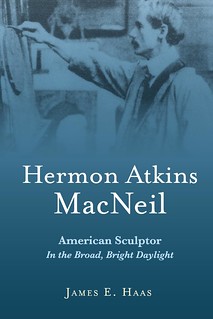 First, a little catch-up. Here's my account of a visit to the Whitman Baltimore Expo last Thursday, November 12th. I had an uneventful drive north on a cool and grey day. After parking at the Hyatt I walked past the convention center to meet Jim Haas across the street from the Pratt Street Ale House where we had a nice lunch. A history buff, Jim is author of the book on Standing Liberty quarter designer Harmon MacNeil and an E-Sylum subscriber and contributor.
He lives in Maryland and accompanied me on an earlier Baltimore visit to the George Peabody Library and Evergreen Museum & Library at Johns Hopkins University.
Once at the show we were met by Whitman's Michael Pfeiffer, who directed us through a streamlined registration process that had us on our way to the bourse in the blink of an eye. We first walked to the table of longtime E-Sylum sponsor Doug Winter and his wife Irma. I introduced Jim to Doug, who immediately asked about getting a copy of Jim's MacNeil book. We'll follow up and get one to him. After talking about Doug and Irma's recent vacation in Thailand, I joked with Doug that Irma is sitting on the right side of the table - spouses on the aisle side will say, "You SPENT HOW MUCH on that coin???", while spouses on the other side can say, "You MADE HOW MUCH on that coin??? I'm going shopping."

LEACH'S ACCOUNT OF 1906 SAN FRANCISCO MINT FIRE
Roger Burdette provided a transcription of an April 22, 1906 letter from San Francisco Mint Superintendent Frank Leach to Mint Director George Roberts the day after the city was struck with raging fires unleashed by a massive earthquake. Leach and Mint personnel fought valiantly, and with much of the city destroyed, the Mint stood damaged, but intact. Here's a lengthy excerpt. A fascinating, scary account. -Editor
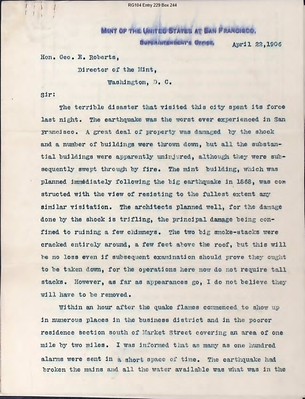 The terrible disaster that visited this city spent its force last night. The earthquake was the worst
ever experienced in San Francisco. A great deal of property was damaged by the shock and a
number of buildings were thrown down, but all the substantial buildings were apparently
uninjured, although they were subsequently swept through by fire. The mint building, which was
planned immediately following the big earthquake in 1868, was constructed with the view of
resisting to the fullest extent any similar visitation. The architects planned well, for the damage
done by the shock is trifling, the principal damage being confined to ruining a few chimneys.
Within an hour after the quake flames commenced to show up in numerous places in the business district and in the poorer residence section south of Market Street covering an area of one mile by two miles. I was informed that as many as one hundred alarms were sent in a short space of time. The earthquake had broken the mains and all the water available was what was in the pipes. The department succeeded in putting out some of the fires, but they were too numerous, and in a little while the fire was beyond the control of any human agency, and spread in all directions. It burned down to the eastern water-front and was stopped there with the aid of apparatus stationed along the wharves, the wide spaces there helping also to check its progress. Westward the fire took its course, being stubbornly fought by dynamiters and the crippled fire department, but no success followed their efforts for thirty-six hours, when a wide street, Van Ness Avenue, was reached. Here by dynamiting, back-firing and with the aid of the department, the fire was controlled and a large residence section saved. From Van Ness and Market another arm of the fire continued over into the S. W. part of the city, where it was headed off about a mile and a half further out. Over this area a very large residence and manufacturing district was burned out. The entire business part of the city was swept by the flames. I can learn of only two large business houses which escaped; one was near the water-front, and the other near the railroad. With the renewal of the wooden parts and windows, several of the modern buildings will be made as good as new. I hear that the stock of goods in one of these large buildings consisting of hardware and machinery was uninjured, although the lower stories were gutted, and that the large office building at the corner of Market and California Streets with its contents was safe.
THE 1911 PATTERN BUFFALO 'CENT'
Here's an interesting piece from the Stack's Bowers Summer 2026 Global Showcase Auction that we didn't get a chance to highlight before. I wasn't aware of this one. -Editor
Unusual Uniface Reverse Electrotrial of Fraser's Buffalo Design Cent-Size, Dated 1911 Exceedingly Rare 1911 Pattern Buffalo "Cent." Uniface Reverse Electrotrial. Design by James Earle Fraser. (Uncertified). 18.2 mm x 18.5 mm. 3.32 grams. This intriguing piece is mentioned in an article titled "The James Fraser Lincoln Cent - 1911" written by Roger W. Burdette and published by Coin World on November 14, 2025. The author discusses the considerable controversy surrounding the recently introduced Lincoln cent and outlines the little-known efforts of artist James Earle Fraser to not only redesign the nickel five-cent piece, but also provide a more suitable portrait of Lincoln for the cent. Among the correspondence between Fraser and Treasury Department officials quoted by Burdette is a letter dated June 13, 1911 from the artist to Mint Director George Evan Roberts that states:
THE CENT IS OFFICIALLY DEAD
Len Augsburger passed along this New York Times article about legislation putting the final nail in the coffin of the U.S. cent. Thanks. Here's an excerpt - see the complete article online. -Editor
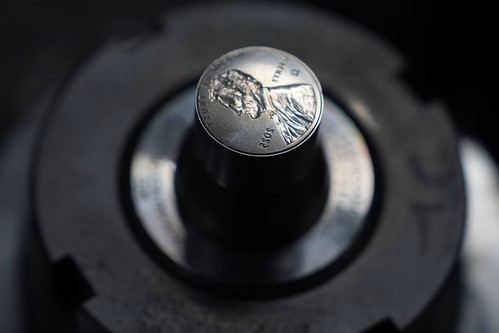
Though the humble penny’s demise was declared a year ago, after President Trump sought an end to its run as a unit of U.S. currency, it was never quite legally laid to rest — until now.
On Friday, Mr. Trump signed into law the Common Cents Act, officially ending production of the one-cent coin that cost nearly four cents to mint. The act passed in September with no opposition in either the House or Senate.
FEATURED WEBSITE: ANCIENT COINS
This week's Featured Website was suggested by website visitor Andrew Talbot. Thank you - this one looks very useful.
Ancient Coins is the clear guide above Numista, CoinArchives, OCRE, CRRO, museum databases, and auction archives: it helps you choose which source to use, when to trust it, and what to check next. Start with the full ancient coin database directory, then move into the research page that matches the evidence you have.

https://ancient-coins.org/
ABOUT THIS ISSUE: NOVEMBER 22, 2026
Nothing much numismatic this week outside of what's in my Diary article. I had dinner with a neighbor and part of the conversation focused on Money Artist J.S.G Boggs. Another day a package arrived from Kolbe & Fanning with a lot I'd won in their recent web sale - a brand new dust-jacketed copy of the Quarterman reprint of Attinelli's Numisgraphics. Couldn't resist the urge.
Seen online:
- I once tested my hot pepper limit during a trip to Thailand. I couldn’t leave the country until my head grew back and my face matched my passport again.
- Headline: AI is a normal technolgoy
Finally, here are some interesting non-numismatic articles I came across this week.
The first cross-country U.S. road trip in a car took 63.5 days. (https://interestingfacts.com/fact/the-first-cross-country-road-trip-in-a-car-took-63-5-days/)
Archaeologists uncover possible 19th-century castaway camp on island 'at the end of the world' (https://phys.org/news/2026-11-archaeologists-uncover-19th-century-castaway.html)
The Confessions of an AI Fraud Kingpin (https://www.404media.co/the-confessions-of-an-ai-fraud-kingpin-onlyfake-owner-nazarenko/)
Hardware Is Software (https://unchartedterritories.tomaspueyo.com/p/hardware-is-software)
The 19th-Century Secret Society Preserving the History of the West (https://www.atlasobscura.com/articles/e-clampus-vitus-secret-society)
Waterford Foundation Nears End of John Wesley Church Restoration (https://www.loudounnow.com/news/waterford-foundation-nears-end-of-john-wesley-church-restoration/article_328acb90-b288-4353-8781-e49f96099973.html)
-Editor

Editor Wayne Homren, Assistant Editor Garrett Ziss

|
|
| |