Visit our NBS Sponsors









About UsThe Numismatic Bibliomania Society is a non-profit association devoted to the study and enjoyment of numismatic literature. For more information please see our web site at coinbooks.org SubscriptionsThose wishing to become new E-Sylum subscribers can go to the following web page
Subscribe
MembershipThere is a membership application available on the web site Membership Application To join, print the application and return it with your check to the address printed on the application. Print/Digital membership is $40 to addresses in the U.S., and $60 elsewhere. A digital-only membership is available for $25. For those without web access, write to: Jeff Dickerson, Treasurer AsylumFor Asylum mailing address changes and other membership questions, contact Jeff at this email address: treasurer@coinbooks.org SubmissionsTo submit items for publication in The E-Sylum, write to the Editor at this address: whomren@gmail.com BUY THE BOOK BEFORE THE COINSale CalendarWatch here for updates! |
- WAYNE'S WORDS: THE E-SYLUM NOVEMBER 15, 2026
- NEW BOOKS: COINS OF ENGLAND 2027
- NEW BOOK: KNEASS-GOBRECHT TRANSITIONAL HEAD LARGE CENTS
- NEW BOOK: 100 GREATEST U.S. PAPER CURRENCY, 2ND ED
- JAN JOZEF LIS (1940-2026)
- NEW JERSEY NUMISMATIC SOCIETY PHOTO
- VIDEO: NUMISMATIC WARRIOR QUEENS
- MORE ON NORMAND PEPIN
- MORE ON XRF COIN COMPOSITION ANALYSIS
- MORE ON BLACKINTON
- NOTES FROM E-SYLUM READERS: NOVEMBER 15, 2026
- VOCABULARY TERM: SURVIVAL RATIO
- TWO 1792 HALF DISME STORIES
- EVOLUTION OF THE ANA SEAL AS A MEDAL
- MORE ON THE ANA PINS
- TREASURE TALK WITH BOB EVANS, EPISODE 17
- WILLIS BANK NOTE LIST AND COUNTERFEIT DETECTOR
- INTERNATIONAL STEEL & COPPER PLATE CONVENTION ALBUMS
- ARCHIVES INTERNATIONAL SALE 118 ADDITIONS
- HERITAGE: KHANUM JAN FAMILY ANCIENT COINS
- DAVISSON'S E-AUCTION 54 REMINDER
- STACK'S BOWERS: NOVEMBER 2026 SHOWCASE SELECTIONS
- STACK'S BOWERS: NOVEMBER 2026 RARITIES SELECTIONS
- SMALLS AUCTIONS SALE 389
- STUDY PROBES SOURCE OF FAKE COIN'S METAL
- GOLD ANGLO-SAXON THRYMSA QUESTIONED
- MEDAL FOR SOLDIER WHO REPRIMANDED HEGSETH
- LOOSE CHANGE: NOVEMBER 15, 2026
- THE ORIGIN OF PCGS
- YOU'VE GOT BOOKS!
- ABOUT THIS ISSUE: NOVEMBER 15, 2026
Content presented in The E-Sylum is not necessarily researched or independently fact-checked, and views expressed do not necessarily represent those of the Numismatic Bibliomania Society.
WAYNE'S WORDS: THE E-SYLUM NOVEMBER 15, 2026
 New subscribers this week include:
Rob Pennell.
Welcome aboard!
Thank you for reading The E-Sylum. If you enjoy it, please send me the email addresses of friends you think may enjoy it as well and I'll send them a subscription. Contact me at whomren@gmail.com anytime regarding your subscription, or questions, comments or suggestions about our content.
We have a new advertiser this week: Smalls Auctions of Australia. Thank you for your support! When you're out at coin shows or shopping online and encounter one of our advertisers, please thank them for supporting our weekly effort - we wouldn't be able to deliver our publication at this scale and frequency without their assistance.
This week we open with four new books, an obituary, updates from the Newman Numismatic Portal, lots of notes from readers, and more.
Other topics this week include the coins of England, U.S. paper currency, the New Jersey Numismatic Society, numismatic warrior queens, survival ratios, a new Treasure Talk from Bob Evans, auction previews, fake and questionable coins, and the origin of PCGS.
To learn more about transitional Large Cents, Jan Lis, Normand Pepin, XRF coin composition analysis, Blackinton medals, the 1940 Leech Cup, flowlines, the evolution of the American Numismatic Association seal as a medal, Chilean silver on the SS Central America, the Humbert slug, conventions of the International Plate Printers and Die Stampers Union, the American Colonization Society, the 1848 CAL. Quarter Eagle, and the Beaver Coin Room, read on. Have a great week, everyone!
Wayne Homren
Editor, The E-Sylum


Image of the week
NEW BOOKS: COINS OF ENGLAND 2027
The 2027 editions of Coins of England & the United Kingdom are available for preorder from Sovereign Rarities. Here's the announcement. -Editor

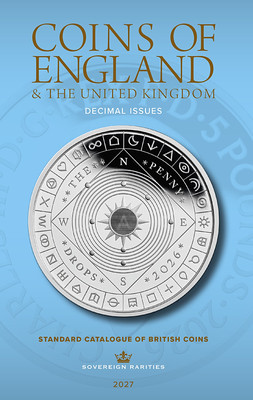
Sovereign Rarities are proud to present the 2027 editions of the Coins of England and the United Kingdom, otherwise known as the Standard Catalogue of English Coins, the historic reference work for British coins.
Comprising Pre-decimal and Decimal issues, and with over 5,000 price revisions, these are not only the go-to guide for collectors and detectorists alike, but are a fascinating insight into British history.
A new feature this year are QR codes, which you can scan easily with your mobile phone camera to view further examples across differing monarchs, series and denominations on our website, alongside high-resolution images and detailed cataloguing.
With delivery expected in early December, the Pre-decimal issue is available for £35 and the fast-growing Decimal issue for £30, plus postage.
Order both issues for a total of £65 and enjoy FREE UK postage.
Coins of England & the United Kingdom 2027 Pre-Decimal issue
Regular price £35
The historic reference work for British coins is the only catalogue featuring all major coin types from Celtic and Roman Britain through to the pre-decimal coinage of Elizabeth II, arranged in chronological order and divided, within each reign, into coinages, metals, denominations and varieties.
The catalogue includes information helpful for explaining numismatic terms and guides beginners with their budding coin collections, as well as providing independently-agreed updated values for each and every coin. Hammered British coinage is seen from our Celtic ancestors, through periods including Roman, Anglo-Saxon and Norman, Plantagenet, Lancastrian and Yorkist, up to Tudor and Stuart, in which periods British milled coins start to be produced for the first time, specifically in 1561 during the reign of Elizabeth I.
Coins have been used by states and monarchs for millennia to communicate with their peoples; Coins of England as such is not only a collectors reference book, but provides an insight into British history itself, casting light upon the land's culture, religion, politics and technological development. Over 3,000 price changes were made in the latest edition to reflect market movement across the past year.
Formerly published by Spink & Son (often known as the "Spink Coins of England") and before that by B.A. Seaby Limited (known then as the "Seaby Standard Catalogue"), Sovereign Rarities are proud to continue to update and publish these trusted issues.


Hardback
216 x 138mm
1150g
616 pages with colour illustrations throughout
ISBN 978-1-917269-05-6
For more information, or to order, see:
Coins of England & the United Kingdom 2027 Pre-Decimal issue
(https://www.sovr.co.uk/products/coins-of-england-the-united-kingdom-2027-pre-decimal-issue-lm43201)
Coins of England & the United Kingdom 2027 Decimal
Regular price £30
The Decimal volume comprises the entirety of the decimal coinage minted by the Royal Mint during the reign of Queen Elizabeth II since 1971, and subsequently the coinage of King Charles III.
Sets and commemorative issues are also reflected, as well as coins from exclusive Royal Mint series such as the Great Engravers, Queen's Beasts and City Views ranges, giving a full and accurate display of our modern British coinage.



For more information, or to order, see:
Coins of England & the United Kingdom 2027 Decimal
(https://www.sovr.co.uk/products/coins-of-england-the-united-kingdom-2027-decimal-lm43202)

NEW BOOK: KNEASS-GOBRECHT TRANSITIONAL HEAD LARGE CENTS
A Special Offerings in our Online Bookstore email from Kolbe & Fanning Numismatic Booksellers alerted me to this recently-published book on transitional Large Cents. They're out of stock now, but interested readers can contact author Ken Laymon at k_laymon@yahoo.com. -Editor


THE KNEASS-GOBRECHT TRANSITIONAL HEAD LARGE CENTS: 1835–1839.
Laymon, Kenneth.
N.p. 2025. 4to, original brown linen, gilt. 45 leaves, printed on one side only; illustrated in color. New. Item #7989
An interesting recent publication focusing on the five years that witnessed the transition from the Coronet Head to the Braided Hair large cents.
For more information, or to order, see:
THE KNEASS-GOBRECHT TRANSITIONAL HEAD LARGE CENTS: 1835–1839.
(https://www.numislit.com/pages/books/7989/kenneth-laymon/the-kneass-gobrecht-transitional-head-large-cents-1835-1839)

NEW BOOK: 100 GREATEST U.S. PAPER CURRENCY, 2ND ED
Whitman has published a new edition of 100 Greatest United States Paper Currency. Here is the press release. -Editor
 Whitman Brands is pleased to announce the release of 100 Greatest United
States Paper Currency, Second Edition, a fully revised and updated exploration of America's most
celebrated banknotes. Authored by numismatic experts Art Friedberg and Dustin Johnston, the
new edition revisits the landmark reference first published in 2005, offering collectors a fresh
perspective on the rarity, history, artistry, and enduring appeal of United States paper money.
More than two decades after the original edition, the book returns with a newly evaluated and re- ranked selection of 100 remarkable banknotes, reflecting significant advances in numismatic research, market activity, and collector interest. Featuring expanded historical commentary, updated rarity information, and stunning high-resolution color photography, the second edition celebrates the extraordinary currency that has helped tell America's story for 250 years.
From legendary rarities such as the 1890 "Grand Watermelon" Treasury Note and the 1863 $20 Gold Certificate to collector favorites including the colorful 1869 "Rainbow" Notes and beautifully engraved 1896 Educational Series, the volume explores the most fascinating achievements in American banknote design and production. High-denomination icons, including the $10,000 Federal Reserve Note, appear alongside historically significant issues that remain accessible to today's collectors.
Each entry combines engaging historical background, expert commentary, industry-standard Friedberg catalog numbers, and estimated populations, creating a richly illustrated reference for collectors of all experience levels.

A New Perspective on America's Greatest Banknotes
The second edition includes a new foreword by Patrick Ian Perez, Chief Publishing Officer of Whitman Brands, who places the book's return in the context of a rapidly evolving paper money marketplace.
"Paper money collecting has entered a remarkable new era, driven by growing collector interest, groundbreaking research, and greater access to numismatic information than ever before," said Perez. "When the original edition was published, it inspired collectors to discover, pursue, and appreciate some of the most extraordinary notes in American history. Twenty years later, we're proud to introduce a completely refreshed edition that reflects how far the hobby has come while making these incredible stories accessible to a new generation of collectors."
The updated rankings reflect new discoveries, evolving collector preferences, and important market developments since the original publication. While legendary rarities remain prominent, the authors also recognize more attainable notes that offer collectors an opportunity to own meaningful pieces of American history.
In recognition of today's dynamic marketplace, the new edition intentionally omits individual valuations, emphasizing instead the historical significance, rarity, and enduring collectability of each note. Collectors seeking current market information can turn to Whitman's expanding portfolio of paper money references and pricing resources.
Whitman's Award-Winning 100 Greatest® Series Continues to Grow

100 Greatest United States Paper Currency joins Whitman's award-winning 100 Greatest® series, which celebrates the most historic, valuable, and collectible treasures of numismatics and related collecting fields. Combining authoritative research, compelling storytelling, exceptional photography, and expert rankings, the series has become a distinctive part of Whitman's publishing portfolio.
The series has enjoyed renewed momentum following the successful sixth edition of 100 Greatest United States Coins by Jeff Garrett. Featuring a refreshed design and expanded format options, the latest edition has been enthusiastically received by collectors and the numismatic trade. Its availability in multiple formats, including special custom editions, has broadened its reach, while the compact 6-by-9-inch edition has proven especially popular as an affordable and accessible entry point for collectors.
Today, the 100 Greatest library spans nearly ten titles and editions, covering a diverse range of collecting interests, including 100 Greatest United States Coins, 100 Greatest United States Modern Coins, 100 Greatest Ancient Coins, 100 Greatest Women on Coins, 100 Greatest United States Paper Currency, and 100 Greatest Canadian Coins and Tokens, among others.
The 100 Greatest brand is also expanding beyond traditional publishing into new collectible formats and licensing opportunities. Through a licensing partnership with Minted Legends, the celebrated 100 Greatest United States Coins title is entering the trading card space for the first time, transforming some of America's most iconic coin designs into premium precious-metal collectible cards. The release, planned for November 11, 2027 @ 5pm PST on Whatnot, introduces the series to a new generation of collectors while giving longtime numismatists an entirely new way to engage with its celebrated rankings. This initiative reflects Whitman's continued commitment to expanding its trusted numismatic content and intellectual property into innovative products that connect the history of coin collecting with the evolving collectibles market.
Explore the complete series at https://whitman.com/series/100-greatest-series/.
Expanding Whitman's Paper Money Publishing Program
The release of 100 Greatest United States Paper Currency, Second Edition is part of a broader initiative to expand and modernize Whitman's paper money reference library, combining established industry standards with new and updated titles for today's collectors.
 In January 2027, Whitman is scheduled to release the 24th edition of Friedberg's Paper Money of the
United States, marking the first time the celebrated reference will be published under the Whitman
imprint. For more than 70 years, the landmark catalog has served as an authoritative resource
for identifying, studying, and valuing American currency, with new editions traditionally
appearing approximately every two years.
The thoroughly updated 24th edition will feature 348 pages, approximately 1,000 full-color photographs, and 10,000 market values. Coverage extends from the earliest Federal issues of 1861 through modern Series 2021 production, with expanded Colonial and Continental Currency coverage, newly assigned Friedberg numbers, updated auction records, and detailed reference information for collectors and dealers.
Whitman has also begun production on a new edition of Collector's Guide to Modern Federal Reserve Notes, reviving an important specialty reference that has not seen a new edition since 2010. The forthcoming volume will address a significant area of modern U.S. currency collecting and further strengthen Whitman's growing portfolio of specialized paper money resources.
Together, these publishing initiatives reinforce Whitman's commitment to preserving numismatic scholarship, updating foundational references, and providing collectors with the information and tools they need to discover, understand, and enjoy American paper currency.
About the Authors
Arthur L. "Art" Friedberg is one of the world's leading authorities on coins and paper money and a lifelong contributor to numismatic scholarship. A graduate of The George Washington University with an M.B.A. from New York University, he joined his family's Coin & Currency Institute in the 1970s and continues to own and operate the company today. Friedberg is coauthor of the internationally recognized Gold Coins of the World and Paper Money of the United States and has contributed to numerous important numismatic references. His work with Whitman includes Catalog of Modern World Coins, United States Paper Money, and much more. A former president of the International Association of Professional Numismatists, Friedberg has received numerous honors, including the IAPN Prix d'Honneur, the American Numismatic Association Medal of Merit and Heath Literary Award, and the Swiss Vrenelli Prize. He has also been a longtime columnist for Coin World and contributor to The Numismatist.
Dustin Johnston is a leading authority on United States and world paper money and a partner at Heritage Auctions. Since joining Heritage in 1998, he has worked across nearly every facet of the auction business and currently oversees its Currency division, including acquisitions, purchasing, cataloging, marketing, and inventory management. Named a partner in 2024, Johnston has played an influential role in the development of the modern paper money marketplace. He serves on multiple industry boards and was recognized among Coin World's Top 100 Most Influential People in Numismatics.
About the Book
Title: 100 Greatest United States Paper Currency, Second Edition
Authors: Art Friedberg and Dustin Johnston
/
Foreword: Patrick Ian Perez
Publisher: Whitman-CDN Publishing
Edition: Second
Publication Date: October 27, 2026
ISBN: 9780794851569, 9780794851484
Format: Hardcover 10x12, 6x9
Retail Price: $39.95, $24.95
Availability: Whitman.com, authorized numismatic dealers, and leading booksellers.

JAN JOZEF LIS (1940-2026)
Charles Riley submitted this notice of the passing of dealer Jan Lis. Thank you. -Editor
Jan Lis portrait medal
Jan Lis died on 2nd October 2026 aged 85. He was born in the turbulence of wartime Poland and came to England as a boy in 1947 - despite this arrival at an early age he always retained a hint of his homeland in his voice. In the early 1970s he became the proprietor of the Beaver Hotel in Earls Court, London, so called because it had been an Overseas Visitor Centre for Canadians, whose national symbolic animal is the beaver. Alongside this he dealt in European art and commemorative medals under the monika of the Beaver Coin Room, exhibiting at the main coin fairs in England and occasionally overseas.
In the 1980s he struck a bronze advertising plaquette and in 1988 the medallist Jane McAdam Freud cast a limited edition bronze portrait medal which referred to his surname (which means fox in Polish) as well as the Beaver Hotel and Coin Room. On 27th April 1982 he was a signatory to the foundation agreement of the British Art Medal Society.

advertising plaquette
Jan was softly-spoken and of a kindly disposition. He was married twice and had two sons by each marriage, who survive him as well as grandchildren. His funeral service took the form of a full Requiem Mass conducted in Latin at the Brompton Oratory in London on 5th November. It was attended by many of his friends and family as well as colleagues from the numismatic world.
To read the earlier E-Sylum article, see:
NUMISMATIST JAN LIS AND THE BEAVER COIN ROOM
(https://www.coinbooks.org/v21/esylum_v21n14a09.html)


NEW JERSEY NUMISMATIC SOCIETY PHOTO
The latest addition to the Newman Numismatic Portal is a group photo of the New Jersey Numismatic Society. Project Coordinator Len Augsburger provided the following report. -Editor
New Jersey Numismatic Society Group Photo
Courtesy of Jeff Burke and Greg Heim, Newman Portal added a group picture of the New Jersey Society membership in 1989. Numismatic bibliophiles will immediately recognize Charles Davis, front row center, who seems to have not aged a day in nearly 40 years! Jeff and Greg were able to name almost all the members, but a few in the back row remain unidentified. E-Sylum readers are invited to chime in.

Front Row: John Lorenzo, Ernie Kusch, Charlie Davis, Bill Schoener, Spencer Peck
Middle Row: Bill Moore, Herb Silberman, Malcolm Heckman, Bob Schonwalter, Harry Rescigno
Back Row: Bob Gilbert, (unidentified), Jim Brandt, (unidentified), (unidentified), Mark Auerbach, Elliot Durann, Carl Feldman, Arno Safran, Greg Heim, Chris Connell
Can anyone help with identifications? -Editor
Link to New Jersey Numismatic Society member photo on Newman Portal:
https://nnp.washu.edu/Documents/Detail/new-jersey-numismatic-society-membership-photo/8179181
Link to New Jersey Numismatic Society Archives:
https://nnp.washu.edu/numismatics-archives-list/list/archives-subcollection/36512

VIDEO: NUMISMATIC WARRIOR QUEENS
The David Lisot Video Library on the Newman Numismatic Portal can be found at:
https://nnp.wustl.edu/library/multimediadetail/522852
We highlight one of his videos each week in The E-Sylum. Here's one from 2016 featuring Prue Fitts. -Editor

Prue Fitts speaks at the 2016 ANA World's Fair of Money in Anaheim, CA.
To watch the complete video, see:
Numismatic Warrior Queens
(https://youtu.be/mOtalRT1QIk)
Numismatic Warrior Queens
(https://archive.org/details/ANA16029NumismaticWarriorQueens_1)

MORE ON NORMAND PEPIN
George Cuhaj submitted these thoughts on Normand Pepin, and several photos. Thank you. -Editor
 Sad to learn that my long time collector friend Normand Pepin has died.
We became friends during the heyday of NYC coin shows in the mid-1970s thru 1993 going to different club meetings three times a month (Long Island Coin Club, Flushing Coin Club) before we switched to the New York Numismatic Club and Bronx Coin Club and working the shows setting the bourse cases up, dealer signs and then participating in the Young Numismatist events.
We shared some interesting experiences such as attending Archbishop Fulton J. Sheen's funeral in December 1979 together. We attended the marathon Museum of Broadcasting Monty Python event, viewing every show in order. In my cathedral usher days I got him to assist in the trenches at some big events. We attended the NYC sale at the 7th regiment armory of the S.S United States china, silver service, art, and even stateroom blankets. However I could never get him to visit Wisconsin, and after his father's death, he never returned to Montreal where he still kept a family apartment. It took him several years to even dispose of his father's car, and as he could not drive he would sit in it during NYC's alternate side street clean days so it would not get a ticket.
He did not do much writing or competitive exhibiting. He had five classic Canadian patterns, and then eventually bought the remnants of Fr. Edward Hogan's medal collection which he would show small bits of at various club show-and-tell sessions. He attended club meetings with great attention, and eventually would have a no-miss devotion to them, but he was never selected to be an officer as he was not a citizen.
He moved from the Montreal area with his parents as a youth, attended an exclusive French language school on the Upper East Side and then one year at Pace University. After that bad experience he took to spending hours watching the stock ticker in the smoke filled rooms of several brokerage houses, had the spark of an idea for an information fulfillment company, but that never came to anything but a name and a few non-disclosure agreements. Later on he would be found attending corporate annual meetings and collecting swag.
He started out in High School as a runner for a local jewelry store. Soon he was doing part time work at Spink America with Bob Archer, then at William Doyle and back to close Spink America under Michael Hodder. A few years later saw him doing service to R.M. Smythe downtown and when they were sold, midtown under the Spink name again, dealing with large lots of stamps (yikes). All along the way, gaining knowledge.
Then he became a gentleman of leisure. Volunteering at the ANS Library. His family were active members of St. Ignatus Loyola parish on Park Avenue. I last saw him at my mom's June 2022 memorial service, soon thereafter our frequent phone calls stopped and soon thereafter he lost his bearing and began a downward spiral.

Normand Pepin with his mentor Father Hogan

Normand Pepin the Spink USA table with Dr. Jay Galst
during a Wall Street Bourse event

John Kleeberg and Normand Pepin
Here are more thoughts from Mike Hodder. -Editor
I am saddened to hear that Normand Pepin has died and at an early age. My wife and I were remembering Normand a few days ago, then I read the notice of his death in last week's E-Sylum.
Normand was a kind, agreeable young man when we knew him. He was a perfect gentleman, gracious, considerate and consistently deferential to whomever he was speaking with. An old-timer before his time. He always had a project going the nature of which he could not describe at the time but which was on the point of completion and would be a game changer in some unspecified fashion when done. He was a Montrealer by birth but a New Yorker by nature, a character who'd fit in Heard About Town.
Normand and George Cuhaj worked together at the New York offices of Spink & Son, Ltd, the London coin and medal dealers. I inherited Normand when I was tasked with running the New York operation in the early summer of '83. Normand's duties at Spink were, I found, unspecified but full-time, or at least as full time as Normand cared for them to be. The operation was winding down when I came on board, running a substantial deficit. I think we all had read the handwriting on the wall and knew we'd be for the chop before too long. I was at the Long Beach show later when the call came from London to close up shop by the end of January, 1984. Delivering that news to the three staffers in New York during the Xmas season was hard.
We have very fond memories of Normand Pepin. My wife reminds me of the Great Ice Cream Controversy, for one. The question arose in the office, what was the best brand of ice cream to be had in Manhattan in 1983: Ben & Jerry's, Häagen-Dazs, Breyer's, etc. A day was chosen for the gustatory investigation, my wife took the subway in from Brooklyn and she and Normand trekked to the West Side to hunt for ice cream brands. They came back an hour or so later with bags filled with tubs of different brands, spread them out on the expensive designer table that passed for my desk and we grabbed spoons and bowls. No business was lost as no one came in the front door and the phone didn't ring, either. I'd like to say the Danes won but all that sticks in memory was the fun we had.
Normand was a one-off, his mould has been broken and we won't see another like him, again. Always well dressed, always composed, always gentlemanly. Lester Merkin liked him. One of those whose loss is truly felt.
Here are some more photos courtesy George Cuhaj. -Editor

Normand Pepin and Kenneth Mackenzie

Normand Pepin at the Museum of Finance,
steel intaglio plates from ABNCo
Thanks, everyone. -Editor
To read the earlier E-Sylum article, see:
NORMAND PEPIN (1961-2026)
(https://www.coinbooks.org/v29/esylum_v29n45a07.html)

MORE ON XRF COIN COMPOSITION ANALYSIS
Traces of Gold?
Dick Hanscom writes:
"Might I suggest that the presence of gold in these CN coins could be due to trace gold in the copper that could not be removed, or perhaps was not worth removing? I seem to recall reading that the Siberian copper kopeks were at a different standard from the Russian coppers because they had traces of gold that could not be refined out."
Check the Machine
Jonathan Brecher writes:
"Regarding the XRF article in last week's E-Sylum, I'm struck by the comment, "All three coins share an absolutely identical, non-standard trace element profile."
"Whenever I see odd results that are consistently odd, my first thought would always be to look at the source of the results, in this case the machine doing the reading. That article implies that all of the coins were analyzed by the same machine. If that's the case, one possible explanation is that the machine is slightly miscalibrated.
"One way to test that would be to see if a second machine gives the same results. That of course needs a second machine, which might not be easily available.
"Another way to test would be to look at more examples. If many more coins give the same odd readings — especially when looking at "fresh from the mint" recent strikes — that would be a a good sign that the machine is reporting trace elements that aren't actually there."
Trace Elements Are Normal
Pete Smith writes:
Some ten years ago I did some experiments with XRF testing. I had access to a table top model at a local refiner. I brought in several Spanish colonial eight real coins from the 1790's.
I was looking for some correlation between the Spanish "dollars" and the United States 1792 half dismes. I did not find any significant correlation.
We put one coin in the machine and tested five different locations on the coin. The results were different each time.
I was told that XRF testing was qualitative but not quantitative. In other words, we could see what was there but not how much was there.
Silver coins begin with a silver bar poured from molten medal. As the metal cools, the elements may solidify at different rates. Trace elements may migrate to the outer edges of the bar and show up as distorted results during testing.
Back in the eighteenth century, it was impossible for refiners to produce pure silver and copper. The results always include trace elements and these can help distinguish old coins from modern copies.
The recent article in The E-Sylum stated, "To my astonishment, both coins share an absolutely identical trace element profile that does not match their official recipes." The USSR 10 Kopecks piece is 80 percent copper and 20 percent nickel. The U. S. Buffalo nickel is 75 percent copper and 25 percent nickel. The trace elements show different amount of the same metals.
I don't believe that testing one coin can prove the composition of any larger class of coins. If ten coins were tested, the range of results might show a significant pattern. In short, the appearance of trace elements is entirely normal and not significant.
John Lorenzo's Thoughts
John Lorenzo writes:
"Winston Zack's interpretation is the more scientifically conservative and defensible conclusion. While the reported trace elements may initially appear similar, the data do not demonstrate an identical metallurgical fingerprint. The Soviet 10 Kopecks and Buffalo nickel differ in their copper, nickel, manganese, iron, cobalt, and reported gold concentrations, and the same variability is present among the Swiss, Danish, and Kuwaiti coins. Trace amounts of iron, manganese, and cobalt are commonly encountered in copper-nickel alloys because these elements occur naturally in ore deposits, refining streams, alloying materials, industrial equipment, and recycled metal feedstocks. Their presence alone is therefore insufficient evidence for a common source of metal or a shared technological program.
A second issue is the limitation of handheld XRF technology when evaluating trace constituents. Portable XRF instruments are excellent for determining major alloy components such as copper and nickel, but measurement uncertainty increases substantially as concentrations approach the lower detection limits of the instrument. Surface contamination, corrosion products, dirt, handling residues, wear patterns, calibration algorithms, and spectral interferences can all influence reported trace-element values. The reported gold concentrations are particularly problematic because gold is not an expected constituent of these coinage alloys. At levels of only a few hundredths of a percent, such readings should be treated cautiously until confirmed by more sensitive laboratory techniques. Many experienced XRF users have observed occasional trace precious-metal or platinum-group-element identifications that are difficult to reconcile with known metallurgy and are more likely related to instrumental limitations than genuine alloy composition.
For these reasons, XRF data alone cannot establish provenance. Even if every trace element reported by the instrument were genuine, similar elemental compositions can arise from numerous unrelated ore bodies, refining operations, recycling streams, and manufacturing processes. Two mints on opposite sides of the world can independently produce alloys with comparable trace impurities simply because they are drawing upon broadly similar industrial metal supplies. Provenance studies therefore require much more than a comparison of a few trace elements. Researchers typically seek converging lines of evidence from elemental chemistry, metallurgical structure, production records, historical documentation, and large comparative datasets before proposing a common source of metal.
When provenance is the objective, isotope analysis is generally far more powerful than XRF elemental screening. In particular, lead isotope analysis measures the relative abundances of naturally occurring lead isotopes such as ^204Pb, ^206Pb, ^207Pb, and ^208Pb. Because ore deposits formed under different geological conditions and at different times, they often possess distinctive isotopic signatures that survive mining, smelting, and alloy manufacture. As a result, two coins can exhibit nearly identical elemental compositions yet originate from completely different sources of metal, while metals from the same ore body may retain comparable isotopic characteristics despite later processing. For this reason, modern provenance research in archaeology and archaeometallurgy frequently relies on isotopic studies in combination with elemental analysis. XRF can help identify what elements are present, but isotopic techniques provide a much stronger basis for determining where a metal originated and whether a true metallurgical connection exists between otherwise unrelated objects."
Numismatic Research using XRF
Kavan Ratnatunga writes:
"I am currently doing numismatic research on the metallurgy of ancient Lankan coins. My goal is to trace the geographical origin of their precious metals (gold and silver) and study ancient minting technologies by measuring trace impurities. In 2026 February, I obtained an ElvaX Jewelry Lab benchtop XRF spectrometer equipped with an SDD detector with 0.127 keV FWHM at Mn Ka. ( https://elvatech.com/products/elvax-jewelry-lab/ )
"I am a retired Astrophysicist who developed automated image analysis software for the NASA Hubble Space Telescope. Using this experience, I am currently developing statistical digital spectral analysis software to improve on the ElvaX software given with the instrument for use in the jewelry trade. I would like to get in contact with those doing Numismatic Research using XRF. WhatsApp: +94712537551 email: kavanr@gmail.com"
Thanks, everyone. -Editor
To read the earlier E-Sylum article, see:
QUERY: XRF COIN COMPOSITION ANALYSIS
(https://www.coinbooks.org/v29/esylum_v29n45a16.html)

MORE ON BLACKINTON
Fairbanks Coin Club Medals
Dick Hanscom writes:
"When I was growing up in Massachusetts, a friend of the family collected New Hampshire town medals in silver. I thought that was pretty neat, and collected them in bronze (I could not afford silver). Many of these were made by Blackinton, as well as Robbins. I continued for a short time after coming to Fairbanks in 1974. I still have them.
"Upon arrival in Fairbanks, I joined the Fairbanks Coin Club. At that time, the FCC Pioneer Medals were made by Wendells of MN. I was very familiar with Blackinton products and convinced the FCC to switch to Blackinton for their 1975 Pioneer medals. Blackinton continued to make the FCC medals until we stopped with the 1981 issue.
"In 1980, two $25 gift tokens were made for the Tiki Cove (pewter) and Black Angus (bronze) restaurants, with a brass "gold" nugget on the common obverse."
Dick added this image to show the difference between Wendells and Blackinton. -Editor

Julio Kilenyi Blackinton Medals
Harry Waterson writes:
"I have a couple of Blackinton Medals on my desk. That is because I am in the process of cataloging them for my Julio Kilenyi Catalog. They are NRA Leech Cup Match shooting medals. Kilenyi donated the designs to the NRA in 1929. There are many Leech Cup medals and at some point Blackinton started making uniface examples and put their own name on the reverse. I have 1979 and 1985 examples of that. Yet to be photographed. At the same time they took the Kilenyi signature off the obverse. Ugh. Blackinton made a specialty of NRA medals and other shooting medals. I have included some examples. All are available on eBay at the moment.
"Here is the citation that details the Kilenyi gift to the NRA:
Bradley, L. G. - A Christmas Gift to the Shooters of America; The American Rifleman, Vol. LXXVIII, No.1, The National Rifle Association of America, Washington, DC Jan. 1930 pp26-27"


1940 Leech Cup medal


1940 - Sterling

1953 NRA


1956 Kennewick


1958 Seafair


1959


1964 Kitsap
Thanks, everyone. -Editor
To read the earlier E-Sylum articleS, see:
HOW BADGE AND MEDAL MAKER BLACKINTON USES AI
(https://www.coinbooks.org/v29/esylum_v29n44a16.html)
NOTES FROM E-SYLUM READERS: NOVEMBER 8, 2026 :
More on Blackinton
(https://www.coinbooks.org/v29/esylum_v29n45a15.html)

NOTES FROM E-SYLUM READERS: NOVEMBER 15, 2026
More on the Continental Dollars
Saul Teichman writes:
 I saw the nice article on Robert Rodriguez's book and work on the silver Continental Dollars.
I created photo libraries which are available on the Newman portal for the following ones which may be of interest to collectors.
dollars-in-brass-newman-1-a-1-b/8060465)
1776 Continental Dollars in Pewter (Newman 1-A, 1-B)
(https://nnp.washu.edu/documents/detail/continental-
dollars-in-pewter-newman-1-a-1-b/8060468)
1776 Continental Dollars in Silver (Newman 1-C, 3-D)
(https://nnp.washu.edu/documents/detail/continental-
dollars-in-silver-newman-1-c-3-d/8060476)
1776 Continental Dollars (Newman 4-D, 5-D)
(https://nnp.washu.edu/documents/detail/continental-
dollars-newman-4-d-5-d/8060470)


Thank you! -Editor
To read the earlier E-Sylum article, see:
NEW BOOK: THE CONTINENTAL DOLLAR
(https://www.coinbooks.org/v29/esylum_v29n45a04.html)
Bechtler Gold Coins in the Brand Journals
Regarding the Virgil Brand collection,
Saul Teichman adds:
 "With regard to the Bechtler's, I have a listing of those which appeared in the Brand journals as attached.
Some of these may have enough information in the journals from which to apply Kagin #s to them as well as duplicate some of the work done by Bob Cassling. I cannot guarantee that I didn't miss any.
Those that begin with M are Chicago Coin inventory items."

Saul adds:
Additional information regarding the splitting of the coins between Brand's sons Armin & Horace as well as the sale of some of these can be found at the following links.
https://archive.org/details/ringbinderusagol00bran_0/
page/204/mode/2up
https://archive.org/details/ringbinderusagol00bran_0/
page/270/mode/2up
Thank you! -Editor
To read the earlier E-Sylum article, see:
NNP ADDS TERRITORIAL GOLD COIN DATABASE
(https://www.coinbooks.org/v29/esylum_v29n45a08.html)
Comment on Dr. Howard Minners
 Vic Mason writes:
"What a wonderful life and brilliant career Dr. Howard Minners had. Thanks for sharing that with your readers."
To read the earlier E-Sylum article, see:
HOWARD ALYN MINNERS (1931-2026)
(https://www.coinbooks.org/v29/
esylum_v29n45a05.html)
Book: Perspectives on the Renaissance Medal
David Gladfelter writes:
 "I wanted to call attention to a fine volume edited by Dr. Scher consisting of papers delivered at symposia in Edinburgh and New York in 1994 in connection with "The Currency of Fame" exhibition. This volume is titled "Perspectives on the Renaissance Medal" and was published in 2000 by Garland Publishing, Inc. and the American Numismatic Society. The book was available at another symposium held at the Grolier Club in New York on October 27, 2001, titled "Numismatics in the Age of Grolier".
As you might expect, New York City was then still a place of pervasive gloom following the death and destruction of September 11. Attending that symposium completely took my mind off the terrible aftermath, for a few hours at least. The speakers at the Grolier Club were Professor Henri Zerner, Harvard University, moderator; Luke Syson, curator of medals at the British Museum; Profeessor John Cunnally, co-curator with Dr. Scher of the exhibition; Dr. Christian E. Dekesel, author of the first of a series of standard bibliographies of 16th century numismatic books; Jean-Baptiste Giard, conservateur-émerité of the cabinet des Médailles of the Bibliothèque nationale, and Dr. Scher. This was the only time I had met these gentlemen – this book is my memory of the event."
Thank you - I was unaware of this one. -Editor
To read the earlier E-Sylum article, see:
STEPHEN K. SCHER (1934-2026)
(https://www.coinbooks.org/v29/esylum_v29n45a06.html)
More on Flowlines
Craig Sholley writes:
Kudos to Pete Smith for the good catch. Yes, the blank is extruded outward during coining. Readers need not take Pete's, yours, or my word for it, a quick internet search will reveal dozens of tech articles on metal flow during coining and embossing operations. Also, the ASM Handbook has an entire chapter on coining.
And, for the truly obsessed, there are a few computer programs using finite element analysis to model metal flow during coining. A speech on the subject would be certain to send people screaming from the room.
I would like to correct one point in Pete's discussion - the dies themselves do not show flowlines. Extant coining dies, such as the 1806 O-123/124 half dollar obverse, 1809 O-110 half dollar obverse, and the 1818 N-9 cent obverse, clearly illustrate this point. There are a few others, but I think the attached images for these three will be sufficient.
Later state coins (and splashers of the 1806 half dollar die) all show some degree of flowlining with those on 1809-110 half dollar being the most extensive. However, the dies themselves show no such features.
So, what's going on? The answer is die wear. Coining dies are very slightly convex to ensure the coin releases from the dies. As the friction of striking wears the dies, this convexity increases to the point that the strike pressure is reduced to the point that it fails to flatten the stretching metal and often fails to fully force the metal into die recesses (like the bases of letters).
In some cases the pressure is so reduced that the blank metal extrudes out of recesses such as stars and letters resulting in heavy flowlines from the vertices resulting in the classic comment, "stars and letters drawn to the rim."
For those who wish to see a couple of the dies for themselves, the 1806 half dollar and 1818 cents dies are in the ANS collection. The 1809 half dollar die is in private hands. It showed up at the 2000 ANA. Brad Karoleff may know the owner.

1806 Half with Minor Flowlines

1809 O-110 Flowlines Half Dollar obverse die

1809 O-110 Flowlines Half Dollar obverse flowlines


1818 N-9 Cent Die and Flowlines

1806 Half Dollar Splasher
Thank you! -Editor
To read the earlier E-Sylum article, see:
COMMENTS ON FLOWLINES
(https://www.coinbooks.org/v29/esylum_v29n45a13.html)
U.S. Paper Money Denominations

Pablo Hoffman shared this YouTube short about U.S. paper money denominations. Thanks. -Editor
To watch the video, see:
https://www.youtube.com/shorts/
2T4VhRwBnEs

VOCABULARY TERM: SURVIVAL RATIO
Here's another entry from Dick Johnson's Encyclopedia of Coin and Medal Terminology. -Editor
Survival Ratio. An estimate of the number of specimens still in existence as a percentage of the original quantity struck. This is usually based on the number of specimens that come on the market, or a survey of collections (or negatively an analysis of collectors' want lists). It indicates rarity of the specimen.
Anyone making a survival ratio estimate must take into consideration how the original quantity was distributed. Here are two theoretical examples (in the extremes): (1) Entire production was sent to museums throughout the world and they placed the items in permanent collections – the survival ratio could be 90-95% (widely dispersed and saved under excellent preservation conditions). (2) If all distributed to public, as a parade medal say, the survival ratio could be as low as 1% (narrow distribution without good preservation standards).
What survives? Coins and medals have a high degree of survivability. People tend to keep these, they are not discarded; museums retain coins and medals, often with large collections and entire departments devoted to the acquiring, protecting and studying these objects. They are artifacts that are highly regarded by man. They are significant to the study of history, art, iconography, economics, metallurgy and a number of other sciences.
If an analysis is made of what survives and why, and contrast this with what is discarded and why, what we would learn is interesting. The major factor of surviving is: beauty. Man venerates beautiful objects, preserving them as best he can. A second factor is importance. Man tends to save important objects. Other factors include first or pivotal objects, that perhaps changed history. Also who created the object? The artist is a factor.
Surprisingly, rarity is not a factor, nor is condition. Objects in which only one have been made – or millions – have been discarded, in contrast to objects in which one, or one of a million, have been saved. Objects made of precious metals are vulnerable, they have often been melted at times in history by uncaring people for their metal content alone, irrespective of, or disregarding, their cultural, historical or numismatic importance. Thus gold coins and medals often have a low survival ratio, unless, of course, they are beautiful or important. See the example on gold medal destruction in the box under melting.
To read the complete entry on the Newman Numismatic Portal, see:
Survival Ratio
(https://nnp.washu.edu/Documents/Detail/survival-ratio/4362384)

TWO 1792 HALF DISME STORIES
E-Sylum Feature Writer and American Numismatic Biographies author Pete Smith submitted this follow-up on a recent 1792 Half Disme offering. -Editor
The November 8 issue of The E-Sylum mentioned the upcoming sale of a 1792 half disme by Stack's Bowers on November 17. Here are two stories that are not mentioned in the Auction catalog.
My description of the coin took a full page in 1792: Birth of a Nation's Coinage. I thought the sale history was particularly interesting. This is what I wrote:
"The coin provides an interesting case study for pedigree research, certification and gradeflation. An observer who does not have the complete story may form an incorrect opinion of value.
Superior 1989:891 "The handsome specimen from Bowers & Ruddy's renowned Garrett Sale…"
And seven months later, Superior 1990:3550 "Although the present coin does not come with a pedigree attached to it, because it is in such marvelous condition, chances are good it was one of those early pieces given out by Jefferson."
In later sales the Garrett pedigree was also not mentioned.
- When sold at auction in 1914, it was described as extremely fine.
- When sold in the 1981 Garrett sale, the coin was uncertified and described as Choice AU.
- When sold by Superior in 1989 with the Garrett pedigree, the coin was described as AU-55.
- When sold in 1990 without the Garrett pedigree, the coin was in a PCGS MS-63 holder and realized $60,500. Four months earlier Superior sold a PCGS MS-65 coin for $137,500.
- In 1997 the coin was reported to be in a PCGS MS-64 holder.
- When offered for sale by Bowers and Ruddy in 2004 as lot 1383, it was certified by NGC as MS-66.
- For the Heritage sale of April 27, 2006, the catalog listed the highest graded 1792 half dismes. This listing stated that the Garrett coin was now in an NGC MS-66 holder. This information has subsequently been repeated in other catalogs.
- The Garrett coin was downgraded by NGC to MS-65 in 2009. The NGC MS-66 coin was deleted from the census.
- On 5/14/2015 it was recertified NGC MS-65 3319274-001.
- The coin that brought $137,500 in 1990, sold for $528,750 in 2014, still in an MS-65 holder. The Garrett coin, in an MS-63 holder that brought $60,500 in 1990, brought $552,000 in 2009, in an MS-65 holder."
The Garrett 1792 half disme made an appearance on the Pawn Stars TV show on January 29, 2018. Walt Husak brought it into the shop and offered it to host Rick Harrison. He declined to buy it.
Husak did not own the coin. At the time it was owned by Steve Contursi and Rare Coin Wholesalers. It was offered several years from 2011 to 2014 at the ANA WFOM.
This is an example of a contrived story on the show that was arranged in advance.

EVOLUTION OF THE ANA SEAL AS A MEDAL
Continuing our conversation about Nick Graver's enigmatic ANA pins, E-Sylum Feature Writer and American Numismatic Biographies author Pete Smith submitted this article on the evolution of the American Numismatic Association seal as a medal. Thank you! -Editor
ANA Vice President Joseph Hooper proposed a design for an Association Medal that was published in the April 1892 issue of The Numismatist. His description included:
 "A volume of Ancient History underneath the Numisma Students lamp;
meaning that the Science takes first place as a truthful historical record,
and is above written history. The rays of light thrown out from the flame
signify the light thrown on ancient history by our science. The aid of
education is shown by the hand pouring, from an ancient vial, oil into
the lamp."
 The first ANA Convention badge with the seal was issued in 1910 with
a New York Numismatic Club reverse. It was struck by Whitehead and
Hoag in chocolate brown and 38 mm. Design was by Jonathan M.
Swanson. The first 200 were serial numbered. The book cover has no
title.
 The October 1911 issue of The Numismatist had a photo of "The
Association Medal" hanging from a pin bar.
Members could order name bars for previous conventions and continue to add bars as they attended more conventions.
 The February 1912 issue of The Numismatist had a line drawing of the
association seal. This was similar to the 1911 photo.
The book title is "ANCIENT / HISTORY."
 The 1925 ANA Convention in Detroit medal used the ANA Seal on the
obverse with DETROIT on the spine of the book. The pendant was 35
mm with scalloped edge. It was struck by Whitehead and Hoag.
 The 1948 ANA Convention included the ANA Seal on the back of the
convention medal. Diameter was 32 mm. The seal had been reengraved
by Julius Winder in 1947.
The book title reads, "ASSOCIATION / HISTORY."
The hand pouring oil into the lamp looks to me like a sea serpent.
In 1949 the ANA began to recognize 25 years of membership with a medal and the ANA Seal. Member name and number was engraved on the back. The medals are undated but a date may be engraved.
 One undated ANA Membership medal has a dotted ring near the edge
This was struck in .999 silver.
The book title is "AMERICA / HISTORY."
 Another undated 32 mm ANA Membership medal has rings near the
edge. It was first issued in 1954.
The book title is "AMERICA / HISTORY."
 The 1960 convention medal was designed by James Ford Clapp, Jr. It
featured a flat book and rays coming from the flame. There is no hand
filling the lamp.
 The seventy-fifth (Diamond) anniversary for the ANA was celebrated in
1966. The medal was 3-inch diameter. It was struck as a commemorative
medal at the United States Mint. Book cover reads ANCIENT /
HISTORY.
This is the closest attempt to use the 1891 Joseph Hooper design.
 A Sterling Silver medal was struck in proof for the 50th anniversary of
National Coin Week in 1974. It was also struck in bronze. The book
cover is marked DLS/SCUPT / AUG. 1974. Size was 39 mm, struck by
the Franklin Mint. They did not identify the sculptor.
Distribution included 26 silver medals and 676 bronze medals.
 In 1980, the ANA adopted a new logo designed by N. Neil Harris. It is
similar to the 1960 ANA Convention medal. That awkward hand of
Education has been eliminated.
The ANA began to use other logos without the lamp of knowledge. Use of the terms "Logo" and "Seal" were often confusing.
 The Harris design was interpreted in medal by Joseph Dilorenzo and for
years was attached to ANA exhibit award plaques. Size was 63 mm.
A version of this medal is also used for 50th year membership medals.
Lettering on the spine of the book is not explained.
 The ANA Convention in Detroit in 1984 had the ANA medal with an
open book. It was struck in silver and bronze with and without an
integral loop by Medallic Art Company. Diameter was 31.45 mm. or
1.25 inches. Design was by Marshall M. Fredericks.
 The 1985 National Coin Week Participation Medal had an open book
without DE PROFUNDIS. It was deigned by N. Neil Harris and struck
by Medallic Art Company. Struck in bronze, size was 38 mm or 1.5
inches. The increase in size from 1984 is in the added rim.
 In 1987 the ANA produced a brass medal for the Casa de Moneda de
Mexico and struck at the Mexico Mint. Size was 20 mm. The legend
shows 1891 / ORGANIZED in two lines.
 In 1988, the ANA authorized a twelve-piece set of two-ounce medals in
.999 silver with Norman Rockwell themes. The reverse with the ANA
logo was struck in low relief. These were produced by the Liberty Mint
in cooperation with Creative Minting, Inc. Minting was limited to just
10,000 pieces. Issue price in 1988 was $49.95. The ANA received $1.50
from each sale. How much did the ANA actually get?
 For the 1999 ANA Convention, banquet and award medals were given in
Sterling silver struck by the Franklin Mint and marked 108th
Anniversary. Size was 38.1 mm. The same design was used for 2000
with the legend "109th ANNIVERSARY" and 2001 with the legend
"110th ANNIVERSARY."
 A calendar medal was struck in 2000 in bronze with 3-inch diameter and
struck by Hoffman Mint. It came with a wood stand and presentation
box. Mintage was 1000 pieces.
This is very similar to the 1980 medal, but not identical.
 On July 5, 2008, the ANA created the George Heath Society for
members who donate $10,000 per year.
 In September 2017, the ANA issued a 1/4 Ounce .999 Silver medal
struck by the Silver Towne Mint. These were encapsulated by NGC.
Mintage was limited to 2000 pieces.
 In April 2024, the ANA issued a 22 mm pewter token for National Coin
Week. It was struck at ANA Headquarters in Colorado Springs during a
Mini-Mint presentation. The same die was used to strike an aluminum
token in 2018.
This is a listing of tokens and medals with the ANA lamp and is probably incomplete. The lamp also appears on membership pins.
The ANA may have had a standardized logo for use in print publications. When used on a medal, the design was reimagined each time. Each of the nineteen medals shown is different.
Small versions of the ANA Lamp of Knowledge often appear along with other design elements on the annual convention medals.
To read the earlier E-Sylum articles, see:
THE EARLY ANA PIN AND THE FIRST ANA SEAL
(https://www.coinbooks.org/v29/esylum_v29n44a08.html)
NOTES FROM E-SYLUM READERS: NOVEMBER 8, 2026 : More on That Magnifying Glass
(https://www.coinbooks.org/v29/esylum_v29n45a15.html)

MORE ON THE ANA PINS
Doug Ward submitted these notes on lapel pins in general, and a discovery relating to the ANA pin Nick Graver asked about. Thanks! -Editor
 I did some digging into lapel pins. Seemingly, screw back pins were not commonly made until
the early 1900s. The earliest example I found seems to date to 1881 with another to 1892, so
it's conceivable Nick's pins date to the 1890s, although doubtful. Those early pins were made
by a company well known to numismatists, now and particularly in the early 1900s – Whitehead
& Hoag. Founded in 1881, they were early innovators in all-things pins. They were also the
premier maker of medals for early numismatics prior to 1959, including many for the ANA and
ANS. And they had significant ties to the US Mint at Philadelphia. They struck the Heath Medal,
the ANA's first, as well as numerous others. They were much better known to the early
numismatic community than any other pin makers would have been.
Whitehead & Hoag was determined to incorporate their logo onto most medals and pins, and would charge more if it was excluded. For screw back pins, their logo was consistently located on the back of the screw nut. Unfortunately, the nuts on the back of Nick Graver's pins were removed decades ago, before he acquired them. This is probably why they became artifacts rather than being sold or distributed and why they remained together as a group. The only inscription on the back of the pins is the word "STERLING." That inscription also appears on the edge of the Heath Medal, together with "WHITEHEAD – HOAG." Again, in my limited searching, sterling silver was not commonly used to make screw back lapel pins and I found none similarly labeled. Sterling silver was commonly used to make numismatic medals. Early pins were more commonly made of brass, gilt brass and 10 or 14 carat gold.
Another prominent maker of lapel pins was Bastian Bros. Corp. of Rochester, NY, founded in 1895. They also made medals, but in letters to the ANS that ability was only introduced in 1919. They were making and advertising lapel pins in the early 1900s. However, the earliest of their screw back pins I was able to find date to the 1920s or 30s. Bastian Bros. was less consistent with their logo placement, with some appearing on the pin back and others on the nut. Bastian Bros. bought Whitehead & Hoag in 1959 and promptly destroyed its thorough manufacturing records. They're still in business and I've asked them for possible information.
As David Fanning mentioned, the question of when Nick's pins were made remains unknown and will until more information comes to light. Perhaps there is further information waiting to be found in The Numismatist. I would think more of these pins exist than just the nine Nick's had. They were made purposely and likely by an ANA member for an ANA event. Hopefully, someone recognizes them or has one with a nut that will shed more light on their origin.
Also, I'm curious what David thinks the loop and wavy device below it represents, as part of the ANA's lamp? The consensus is it's not a magnifying loop. Perhaps it is the lip of a vessel pouring oil into the lamp? That would be consistent with the original seal's description. I believe the first appearance of the seal's design with the loop device and looped handle is in the January 1907 issue of The Numismatist. Nick's pins likely appeared sometime after that.
Hold the presses: I found a reference to Nick's pin in The Numismatist. It's described in the August 1943 issue, page 641, in regard to the Chicago ANA convention:
"There are three buttons (new) also available, which may be worn on the lapel at any time: the
bronze and gold, 5/8 inch in diameter at 50 and 85 cents respectively, bearing the Association
seal, and a smaller silver button, 3/16 inch, at 70 cents, with the central portion of the seal and
the initials ANA. These are especially attractive, and may be had by members regardless of the
convention."
(Emphasis mine). Great discovery! -Editor
Nick's silver pins are actually a little bigger than 3/8 inch in diameter or 11mm. There's no image in The Numismatist article. That solves the mystery. Although, if anyone has one we might yet find out who the manufacturer was. My money is on Whitehead & Hoag!
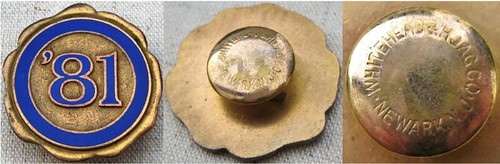
'81 screw back pin made by Whitehead & Hoag,
possibly in 1881. Courtesy of Worthpoint.

1892 dated screw back pin made by Whitehead & Hoag,
probably in 1892. Courtesy of Ebay.

American Legion screw back pin made by Bastian Bros. Co.,
probably made in the 1920's. Courtesy of Pinterest.
To read the earlier E-Sylum articles, see:
THE EARLY ANA PIN AND THE FIRST ANA SEAL
(https://www.coinbooks.org/v29/esylum_v29n44a08.html)
NOTES FROM E-SYLUM READERS: NOVEMBER 8, 2026 : More on That Magnifying Glass
(https://www.coinbooks.org/v29/esylum_v29n45a15.html)

TREASURE TALK WITH BOB EVANS, EPISODE 17
In January 2025, our good friend Bob Evans began publishing a series of blog articles on the Finest Known website detailing his experience as co-discoverer and curator of the treasures recovered from the wreck of the S.S. Central America. Subject of the book "Ship of Gold", many exhibits, countless interviews and articles, books and auction catalogs feature the legendary haul of gold coins, bars, nuggets, gold dust and more from the 1857 shipwreck. Here's another excerpt - see the complete article online. -Editor

I first became aware of the S.S. Central America and its treasure in 1983. Project founder Tommy Thompson shared with me the research he had begun, a file containing Xerox copies of microfilm of newspapers from 1857, much of it barely legible.

Along with the stack of papers there were two rolled-up scrolls of poster-size white paper with a spreadsheet chart he called the "Data Correlation Matrix," a name that described its function, and so was more in tune with his engineering mind than just calling it a "spreadsheet." He liked to name things.
Thompson asked me, an underemployed 29-year-old geologist (also his neighbor,) to take over "The Matrix" and to put more information on it. This spreadsheet had vertical "columns" that represented individual survivor or witness accounts of the sinking and its aftermath. The accounts were entered into horizontal "rows" that represented three-hour time slots. Eventually, The Matrix was transcribed into a standard computerized spreadsheet, so the data could be shared with Dr. Larry Stone, an expert search theory mathematician.
I scoured the 1857 newspapers of cities connected to the SSCA story, starting with New York and the eastern seaboard, but expanding to San Francisco, as well as to the hometowns of certain passengers. I was looking to continue what had been started, a gleaning of the historical record for "critical path data," another of Thompson's terms that was also functionally accurate. Critical path data was anything that related to the physics of the final days of the SSCA, the two days leading up to the sinking, and the day following, when survivors were rescued by vessels who came upon the scene. Celestial coordinates were prime targets for the research. These were readings taken by mariners that gave the latitude, longitude and time for different moments during the saga. But other parts of the accounts mattered as well, with descriptions of the storm, the direction and strength of the wind, and the progressively deteriorating condition of the ship
I read the various accounts in detail, trying to find every bit of SSCA history that might reveal critical path data. Anyone who has attempted this kind of research in earnest knows that smallest details in the already small and fuzzy print can reveal important information. So, while my focus was on critical path data, my scrutiny of the fine print, word by hard-to-decipher word, drew me into the character of the age, and the characters that inhabited it. There were certain accounts that contained no information for The Matrix, but still framed the social and business context of the people who were on board.
See the complete article for the story of the ship's captain, Navy Commander William Lewis Herndon and his earlier expedition to Peru. -Editor


Herndon and his report to Congress
The California Gold Rush was a great human melting pot. Of course, most of the crew and passengers of the SSCA were Americans, from the northern and southern states, as well as some who already considered themselves Californians. There were also some Europeans, perhaps headed home, or maybe contemplating a new life in a fresh Land of Opportunity. Among others, there were prominent South Americans, with connections in Peru and elsewhere, their points of origin listed with their names, in newspaper charts of the saved and the lost.
It was logical that Peruvians were on board. Spain had engaged in maritime commerce with its South American colonies or former colonies for over three centuries. For much of that time, the influx of "Spanish" silver and gold was a cornerstone of the entire European economy.
The route from the South American mines to Spain ran to the Pacific coast, then by ship to Panama City, then over the isthmus to Portobelo, (near Colón,) the same part of the narrow isthmus later used by the Panama Railroad and the Canal. All of Panama had been a part of Nueva Granada, now Colombia, and it remained so until it seceded from Colombia (with U.S. backing) in 1903, and the Canal Zone was established.
Spanish colonial treasure shipments were not regularly scheduled. A treasure fleet would gather annually at Portobelo, along with sufficient firepower to fend off the English pirates. If more cover was necessary, they could assemble at Cartagena, a walled city with its heavily armed harbor on the main Caribbean coast of Colombia. The Spanish system of treasure fleets persisted for centuries.
By the time of the California Gold Rush, this pipeline of treasure had dwindled, and the former Spanish colonies were now independent nations. But they shared a common language, and many still traded with the former motherland. South American businessmen could take advantage of regularly scheduled steamships from Panama to New York. New York had regularly scheduled steamships to Spain and other parts of Europe.
Ocean-crossing steamships with regular schedules were a recent innovation. When the railroad was finished across Panama in 1855, the steamship route between New York and Aspinwall (now a part of Colón) settled into a standard pattern. On the fifth and twentieth of every month, a steamship would leave New York headed to the Caribbean coast of Panama. A corresponding steamer departed San Francisco on the same schedule destined for Panama City. The idea was to arrive on opposite coasts of Panama on the same day, and to make the transfer across the narrow land bridge by rail in a single day.
On the Atlantic leg of this arrangement, two steamships alternated in a sort of maritime dance, with one in Panama, filling with New-York-bound passengers, mail and gold, and the other in New York embarking the next group of hundreds of passengers, mail and business communications headed to California.
Steamship service from New York to various European ports was also very regular, more so than passage from Panama to those same ports. Gold destined for Europe instead of New York often shipped directly from the isthmus, to avoid a second charge for freight and insurance. That gold waited in Panama for a steamer with the right Old-World destination. But Europe-bound travelers could trim days off their journey by taking the Atlantic portion of the California to New York route. Plus, in the days of rampant tropical diseases, it was better to wait in New York than in Panama.
We could see this international character reflected in the hometowns or home countries appended to the names of the saved and the lost.
A "new" treasure:
In 1988, our project discovered the Central America and its commercial gold. The published list told us there should be more than two tons of gold in this shipment. At the end of the 1989 season we had recovered over one ton, bringing it ashore in Norfolk on October the 5th. (See Treasure Talk Episode 1.) The following summer, as the 1990 season progressed, it became apparent that the exposed treasure we had found, resting on the vestiges of the steamship's timbers in the stern, did not add up to two tons. We had developed 3-D visual technology that greatly speeded up our operations, and it also aided our ability to interpret and understand what we were seeing a great deal more than we could with flat imagery.
The Garden of Gold was spectacular, an exposed pile of degraded boxes and bags of gold, sitting close to the ship's rudder, on the portside of the stern. Corals and starfish and others had colonized this precious jumble, as if it was just another hard substrate.

But the deposit stopped a little to the portside of the shipwreck's centerline, yielding abruptly to a scattered pile of coal and debris, with no gold. The starboard side of the shipwreck's stern was buried in sediment, a meter or more of that fluffy pteropod ooze I described in Treasure Talk Episode 5, Part 1. Considering the sharp truncation of the treasure deposit, and examining the 3-D images, I developed a theory that I proposed to test, over on the buried starboard side.
Our remotely operated vehicle (ROV) Nemo was outfitted with thrusters. These propellors could be used to navigate the ROV, but a thruster could also be mounted on the small backhoe that constituted the left arm of Nemo, so we could direct a strong current toward the seafloor we were working in front of our cameras and tools. We used this thruster to blow away sediment, exposing treasure and other features.
I wanted to use the prop-wash of the thruster to explore a little, to blow and see what we could expose. The images suggested that the SSCA had opened like an enormous book as it degraded, with the keel marking the hinge of the book's binding.
As the shipwreck collapsed over decades, the starboard side acted a little like a snow fence. Currents around the shipwreck drive the fluffy, shelly sediment along the bottom for a long time before it settles. The prevailing average current brought sediment across the collapsing starboard side, and deposited a thick cushion of ooze, like a big drift of snow. The thick drift didn't reach the collapsed portside, where the timbers were swept clean, and we found the treasure exposed and teeming with life.
I wondered if there was gold buried under the sediment on the starboard side, treasure that had separated from the portside deposit when the shipwreck splayed open. We were still finding and recovering some gold from the exposed portside deposit, so there was a little skepticism about my plan among my colleagues in the control room. But I strongly felt that a couple hours exploring the counterpart starboard area would be worth it. We had recovered the core of the "Garden," and results were diminishing.
Mike landed Nemo over a little to the starboard side of the line of the keel, aft of the thick blanket of sediment that covered where we thought we would find the stern. The thruster started blowing.
An enormous cloud resulted, as Nemo blew and blew. After a minute or two we couldn't see a thing. Still, Mike continued to direct the thrusters down at the dirt, feeling his way back and forth in a pattern, like hosing a fire through the smoke. After many minutes, he paused and we waited for the cloud to clear. It took close to an hour.
 While the fog was dissipating, boredom was setting in, and my crewmates started to grumble. "What are we doing?" "Oh yeah… That's right… It's something Bob wanted to see." I could feel the impatience growing. They were accustomed to picking up gold, not cloud-gazing. Then I suggested that we zoom the cameras in on a tiny, bright point of light that was becoming clearer and brighter. An assay chip! The corner of a gold ingot!
The cameras zoomed out and the control room erupted with excitement. A huge pile of gold bars was exposed in the bottom of the pit we had just dug. Indeed, it was cause for celebration. We had found the top of another pile, the missing ton of gold.

Examining the extent and boundaries of this pile, we encountered another mystery. We were facing forward in ship orientation. Just in front of where Nemo landed, at the far stern of the deposit, we found a big pile of coins, but they didn't look like the piles of gold we were used to.

These were not double eagles, which had seen in great abundance. There was plenty of rust, as expected. But there was none of that golden shine, peeking through spots where the rust fell off. The coins were gray, and we quickly realized they must be silver. Our video camera could focus in on the features of individual coins and bars, so we zoomed in, trying to read the words on the grayish disks and figure out what they were.

"RAZON." What the heck does "razon" mean? The answer was revealed when we recovered a few specimens.


1855 Chile silver 50 centavos


1854 Chile silver peso
Aha! Coins from Chile! A South American connection!
There was a large pile of these coins, both 50 centavos and pesos from Chile. Remnants of a canvas bag clung to some of the coins, and it had branded others with a textile pattern shown in the toning.
Barry Schatz was Tommy's friend from their teenage years, a high school classmate from Defiance, a small county seat in far northwest Ohio. Barry was a skilled writer, so Thompson recruited him to become our company wordsmith and PR guy, writing the investor letters, interacting with the press.
For reasons I never understood, (maybe it was a girl he met,) Barry from Defiance, Ohio became fluent in Spanish and Portuguese. He sounded like a native speaker, with very little American accent, and he used to fake a Latino origin. If he flubbed his Spanish slightly in conversation, he would apologize and explain that he was Brazilian. He majored in Latin-American Studies at the University of Florida, and he hated Ohio weather.
Barry was ashore when word of the Chilean coins reached the home office. We received a message from him explaining that "Por la razon o la fuerza" translated as "By reason or by force" and that it was the Chilean national motto.
When I brought word of this translation into the control room, the guys laughed. With an American perspective on the brutal dictatorship of Augusto Pinochet, someone chuckled, "I guess things haven't changed much in Chile!" (Note: In 1990, things in Chile were in fact changing, as a democratically elected government was installed.) But a question remained. Why were there so many Chilean silver coins found amidst the commercial shipment's degraded boxes of gold ingots and coins? The answer was found in the grim chart of the lost, hundreds of names listed in the New York Herald on September 22, 1857.

Spanish names were frequently miscast or downright butchered by the typesetters of the day. This gentleman's name is variously rendered in print. I have seen "Parqual" and "Escuerdo" as examples. I have averaged the misspellings, applied some logic, and I have settled on "Pasqual Esquerra." From the Herald's list and others, we learn that he was a merchant in Valparaiso, who hailed from Spain. These bags of Chilean silver were his.
Why were they found with the commercial shipment? There could be two explanations. The bags of silver constituted quite a lot of weight, well over a hundred pounds. Señor Esquerra probably consigned it to Purser William Hull when he came aboard at Aspinwall. The Purser stored it with the other heavy, precious freight, the commercial shipment from California, which was loaded at the same time.
This interpretation is supported by the position of the Chilean coins, all the way in the stern of the deposit. Pasqual Esquerra purchased his ticket at Aspinwall on September 2, the day before the SSCA welcomed the New York bound passengers and gold shipment from California. The Chilean silver may have been the first treasure that was loaded, tucked away in the back of the gold room.
An alternative possibility is that these bags of silver became intermingled as the shipwreck degraded and collapsed. Esquerra could have stored his silver in his First-Class cabin, which may have been in the stern, directly above the gold room in the hold. When the decks collapsed it could have tumbled down to where we found it.
As with any new discovery, I found this one fascinating. After the dive when we first recovered it, I had a close look as I catalogued and stored this exotic silver in my lab. The coins were all affected by the 133 years in ocean water and they showed varying degrees of corrosion, not like the gleaming gold I had usually handled. Not surprising. These "seawater-affected" silver pesos and half pesos from Chile, dated 1853 to 1856, authenticate themselves as part of the SSCA treasure, and part of its story.
The Chilean silver was a complete surprise. When we began the S.S. Central America Project, we were looking for the greatest lost treasure in United States history. We were seeking California gold. We found it, but we also chanced into a large amount of South American silver.
It has been said that history doesn't repeat itself, but it rhymes. Sometimes the rhymes are not perfect, but they are subtle and ironic. Captain Herndon's story is such a case. In 1851, he was exploring the Andes and the Amazon on behalf of the United States, gathering data to see if there was a more efficient way to get South American silver to the world than shipping it over the mountains to the Pacific. This hypothetical new route proved impractical as a commercial enterprise, but his studies revealed the upper Amazon to the world. I'm sure this was not on his mind, but in 1857 on his final voyage, his ship carried silver that had been packed out of the Andes on the backs of llamas.
Bob Evans adds:
"This was a fun story to write. I have been thinking about this South American connection for decades (literally.) I distinctly remember musing about this subject over drinks (with Barry Schatz, mentioned in the article) in the early 90s. The American steamships servicing the Panama Route were of international utility and importance.
"But since these coins are "low-ball" specimens, seawater-affected silver coins from a shipwreck yielding tons of gold, I had not written about them at length until now. It's a great sidebar to the larger history."
Thank you - this is important and interesting numismatic history. -Editor
To read the complete article, see:
Treasure Talk 17: The South American Connection
(https://finestknown.com/treasure-talk-17-the-south-american-connection/)
For the complete series, see:
Category Archives: Treasure Talk with Bob Evans
(https://finestknown.com/treasure-talk-with-bob-evans/)
To read the earlier E-Sylum article, see:
TREASURE TALK WITH BOB EVANS, EPISODE 16
(https://www.coinbooks.org/v29/esylum_v29n44a13.html)
WILLIS BANK NOTE LIST AND COUNTERFEIT DETECTOR
This week's 'Special Offerings in our Online Bookstore' email from Kolbe & Fanning Numismatic Booksellers also included this interesting counterfeit detector. With permission, we're republishing the description here. Thank you. Sorry - it's already been sold. -Editor
 WILLIS & CO.'S BANK NOTE LIST, AND COUNTERFEIT DETECTOR.
Willis & Co.
(Boston): (Hotchkiss & Co. and T. Groom & Co.). Volume VIII, No. 9 (June 1851). 4to, original printed pictorial advertising brown paper covers, accompanied by an additional sheet on the same stock comprising 4 additional pages of advertising. 24 pages; engraving on the front cover and in the text depicting "the new Fifty Dollar Gold piece, stamped by the U.S. Assayer at San Francisco." Covers a trifle worn and discolored. Very good or better. Item #7992
Dillistin pages 112–113. A particularly interesting issue of this short-lived publication, issued from 1843 until 1854, when financial difficulties brought it to an end. The early illustration of the Humbert slug is notable, as is the text accompanying it:
 There are few of these yet received in the Atlantic cities. Two that have been weighed at the U.S. Mint in Philadelphia, have been found to weigh 1308 1-2 grains and 1310 grains respectively. These coins are obviously not intended for circulation, the shape being ill adapted for the pocket; but they are intended as a substitute for the gold dust in transshipment from California to the Atlantic States, and to give it a certain value, while that of the dust has been hitherto variable. It is further proposed to convert gold dust into larger coins or bars, say of $100 and $200 each, and perhaps bars of $500, or even larger sums. These would serve quite as well for the reserve usually maintained by our banks, and could be more easily counted in large payments." Following it is an article on "New Three Cent Coins," including "a fac simile of the face and reverse of the coin." It serves mainly as a long diatribe on recent coin design: "the head was entirely removed from the silver pieces, and a feeble, ill-designed, sitting figure took its place... the eagles and half eagles, half and quarter dollars, have become more clumsy and flat. The twenty dollar piece... is a miserable affair... The three cent piece caps the climax of bad design and poor workmanship.
In an article entitled "Statistics of California Gold," dollar amounts totaling $1,517,000 are cited of gold dust "coined or stamped" by the U.S. Assay Office, Baldwin & Co., Dubosq & Co., and others, and the total yield of California gold for the first three months of 1851 is given as $16,030,000. Ex John J. Ford, Jr. Library (Kolbe Sale 96, lot 1286 at $500 hammer).
To read the complete item description, see:
WILLIS & CO.'S BANK NOTE LIST, AND COUNTERFEIT DETECTOR.
(https://www.numislit.com/pages/books/7992/willis-co/willis-co-s-bank-note-list-and-counterfeit-detector)

INTERNATIONAL STEEL & COPPER PLATE CONVENTION ALBUMS
Three lots in the Archives International Auctions sale 118 showcase souvenir albums from the 1916, 1918 and 1921 conventions of the International Plate Printers and Die Stampers Union. Great history and workmanship. Below are the lot descriptions with additional notes from the consignor. -Editor
Consignor's note:
The 1916 Ottawa Convention Volume (BABNCo)
The 1916 Ottawa volume represents a foundational piece of early 20th-century international labor and security-printing heritage. Issued by the British American Bank Note Company (BABNCo) for the Canadian convention, it features an extraordinary, primary-period intaglio title plate executed on ultra-thin, translucent India paper rather than standard card stock. Its historical weight is directly linked to the landmark February 1916 Parliament Hill fire in Ottawa, which destroyed Canada's Centre Block and reshaped wartime security protocols surrounding government and financial printing. Produced in severely restricted, wartime press runs for delegates, its contemporary proof impressions were pulled directly off the steel die during original production. Having escaped both the disbinding practice of mid-century dealers and the catastrophic losses of the 1916 era, this volume remains a rare, intact witness to early Canadian security printing.

Ottawa, Canada....., July 17th–22nd, 1916. This oblong, cord-tied souvenir album has 23 pages, including the front cover. The cover bears an intaglio lion's head within an ornate frame with the Royal Arms, and the script-engraved title page features a beaver vignette with the American Bank Note Co., Ottawa imprint. The highlight is a superb full-page intaglio advertising poster for the British American Bank Note Company, Ottawa, "Incorporated 1866." It is printed in sepia with elaborate lettering, a winged allegorical female holding a torch aloft, and a list of the firm's products, including bank notes, bonds, stock certificates, cheques, drafts, bills of exchange, and postage and revenue stamps, along with its Montreal office at 2 Place d'Armes Square. Other BABNCo intaglio plates include a mountain railway river gorge and "View Westward in Prince of Wales Sound, Hudson's Strait," after a Dr. R. Bell photo of 1884. Also included are Elbert Hubbard's "Loyalty" in engraved script, and photogravures of the Parliament Buildings (the Centre Block burned in February 1916), Quebec City and a habitant weaver at her loom. Cover worn with small tears, foxing and toning; interior AU.
To read the complete item description, see:
Canada 1916 International Steel Copper Plate Printers Union 24th Annual Convention Souvenir Album
(https://auction.archivesinternational.com/Canada-1916-International-Steel-Copper-Plate-Printers-Union-24th-Annual-Convention-Souvenir-Album_i61504508)
Consignor's note:
2. The 1918 Washington, D.C. Convention Volume (BEP / ABNC Era)
Issued during the height of World War I, the 1918 Washington, D.C. volume sits at a critical historical turning point for American security engravers. Printed for the initial gathering following the union's official July 1918 American Federation of Labor (AFL) charter, the volume contains primary intaglio proof impressions produced under strict wartime paper and security protocols. The total quantity produced for attendee delegates was inherently tiny, and the vast majority were lost to wartime paper drives or disbound for individual framing over the past century. Structurally, it serves as an irreplaceable historical bridge between Bureau of Engraving and Printing (BEP) master engravers and private bank note firm output during a period of intense wartime security production.


Washington, D.C....., July 15th–20th, 1918. This impressive oblong, ribbon-tied souvenir album has 32 pages. It was produced for the union whose members printed the nation's currency, bonds and stamps at the Bureau of Engraving and Printing. The cover bears a finely engraved intaglio portrait of George Washington, and the script-engraved title page features a vignette of the U.S. Capitol. Highlights include a superb intaglio portrait of President Woodrow Wilson, signed in the plate by G.F.C. Smillie, the Bureau's master portrait engraver, and a flying American Eagle vignette with "E Pluribus Unum." John Peterson & Son photogravures depict the Bureau of Engraving and Printing and the battleship U.S.S. North Dakota (photo by N.L. Stebbins). A.W. Elson & Co., Boston, fine art photogravures reproduce paintings by Rosa Bonheur ("Deer in the Forest–Twilight," from the Metropolitan Museum), Émile Renouf ("The Helping Hand"), Charles Burton Barber ("Wake Up!") and George de Forest Brush ("The Indian and the Lily"), each with a printed descriptive tissue guard. This is a scarce wartime showcase of American security engraving and printing craftsmanship. Covers worn with small faults and foxing, interior like new.
To read the complete item description, see:
DC 1918 International Steel Copper Plate Printers Union 26th Annual Convention Souvenir Album wit
(https://auction.archivesinternational.com/DC-1918-International-Steel-Copper-Plate-Printers-Union-26th-Annual-Convention-Souvenir-Album-wit_i61504507)
Consignor's note:
3. The 1921 New York Convention Volume (ABNC — The Unrecorded Apex)
The 1921 New York volume is the crown jewel and absolute apex rarity of the triad. Produced by the American Bank Note Company (ABNC) for the International Steel and Copper Plate Engravers' League—a short-lived pre-merger trade guild that existed independently for only seven years (1918–1925)—this item is completely unrecorded in standard reference literature, collector censuses, and Souvenir Card Collectors Society (SCCS) Forerunner checklists.
The volume is anchored by master engraver Marcus W. Baldwin's iconic portrait engraving of Warren G. Harding—a live-period master impression executed at the dawn of Harding's presidency in 1921, two full years prior to his death and the famous 1923 BEP memorial stamp issue. Printed in a microscopic press run strictly for convention delegates, its interior plates feature pristine intaglio impressions pulled on translucent India paper with zero foxing, staining, or rim trimming. Because no other complete, intact copy has surfaced in public auction archives or trade databases, it represents a true "ghost" survivor—an institutional-grade discovery piece that establishes the benchmark census for pre-1925 American security printing presentation books."


New York..., July 11–16, 1921. This souvenir booklet was issued for the 29th Annual Convention of the International Plate Printers and Die Stampers Union of North America (AFL). It is bound with the title page of the Third Annual Convention of the International Steel and Copper Plate Engravers League. Both title pages carry the American Bank Note Company imprint, with engraved script and classic ABNC allegorical vignettes. All images are intaglio printed, including a President Warren G. Harding portrait engraved by M.W. Baldwin, "The Torn Hat" after Thomas Sully, the Battle of Harlem Heights commemorative tablet, and a landscape by John Andrew & Son. Period trade advertisements from Whiting Paper, Babcock Printing Press, John Sellers & Sons, and Crane & Pike are interleaved. 17 pages. Almost new condition with a few minor foxing spots. A scarce piece of security-printing labor history.
To read the complete item description, see:
NY 1921 International Plate Printers and Die Stampers Union 29th Annual Convention Souvenir Booklet
(https://auction.archivesinternational.com/NY-1921-International-Plate-Printers-and-Die-Stampers-Union-29th-Annual-Convention-Souvenir-Booklet_i61504504)
Do any of our readers have a collection of these? -Editor
THE BOOK BAZARRE
ARCHIVES INTERNATIONAL SALE 118 ADDITIONS
Here are some additional selected lots from the November 17-18 sale by Archives International Auctions. -Editor

Canada. Victoria 25 Cents, 1883 H, 25C. Heaton Mint. Mintage of 960,000 pieces, a scarce date in better grades. Even dove-gray toning with light high-point wear only. PCGS graded AU 50. PCGS certification #51011824. Composition: .925 fine silver, 5.81 grams, 0.1728 troy oz ASW.
To read the complete item description, see:
Canada Victoria 25 Cents 1883 H 25C KM 5 PCGS AU50
(https://auction.archivesinternational.com/Canada-Victoria-25-Cents-1883-H-25C-KM-5-PCGS-AU50_i61504374 )
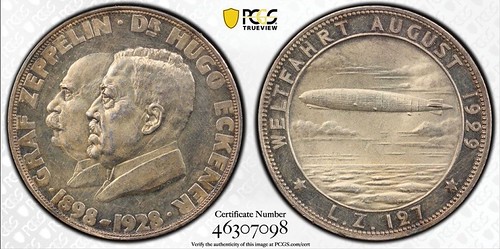
Germany. Weimar Republic silver medal for the airship LZ 127 Graf Zeppelin, by Josef Bernhart. Jugate busts of Count Zeppelin and Dr. Hugo Eckener, dated 1898-1928. Light even toning over reflective surfaces. PCGS graded SP 63. PCGS certification #46307098. Composition: .900 fine silver, 36mm, approx. 24.9 grams.
To read the complete item description, see:
Germany Weimar Republic Graf Zeppelin Dr Hugo Eckener Silver Medal 1929 LZ 127 Kaiser 510 h
(https://auction.archivesinternational.com/Germany-Weimar-Republic-Graf-Zeppelin-Dr-Hugo-Eckener-Silver-Medal-1929-LZ-127-Kaiser-510-h_i61504392)

Germany. Weimar Republic Graf Zeppelin 5 Reichsmark, 1930 F, 5 Mk. Stuttgart. Commemorates the 1929 round-the-world flight of the LZ 127. Soft gray toning with nearly full luster. PCGS graded AU 58. PCGS certification #46311735. Composition: .500 fine silver, 25 grams, 0.4019 troy oz ASW.
To read the complete item description, see:
Germany Weimar Republic Graf Zeppelin World Flight 5 Reichsmark 1930 F 5 Mk KM 68 J 343 PCGS
(https://auction.archivesinternational.com/Germany-Weimar-Republic-Graf-Zeppelin-World-Flight-5-Reichsmark-1930-F-5-Mk-KM-68-J-343-PCGS_i61504393)
To read the earlier E-Sylum article, see:
ARCHIVES INTERNATIONAL SALE 118 SELECTIONS
(https://www.coinbooks.org/v29/esylum_v29n45a26.html)

HERITAGE: KHANUM JAN FAMILY ANCIENT COINS
Heritage Auctions will be holding their Khanum Jan Family Trust Collection Ancient Coins Showcase Auction on November 16, 2026. Select items are discussed below. -Editor


SELEUCID KINGDOM. Antiochus I Soter (281-261 BC). AR tetradrachm (29mm, 17.16 gm, 5h). NGC Choice AU 5/5 - 3/5, brushed. Ecbatana. Diademed head of Antiochus I right, dotted border / BAΣIΛEΩΣ / ANT-IOXOY, Apollo seated left on omphalus, testing three arrows in right hand, left hand on grounded bow; ΞΔΩ monogram in upper left field, complex monogram in circle above grazing horse in lower left field. SC 409.1a var. (secondary monogram placement).
From the Khanum Jan Collection
To read the complete item description, see:
SELEUCID KINGDOM. Antiochus I Soter (281-261 BC). AR tetradrachm
(29mm, 17.16 gm, 5h). NGC Choice AU 5/5 - 3/5, brushed.
(https://coins.ha.com/itm/ancients/greek/greek-seleucid-kingdom-antiochus-i-soter-281-261-bc-ar-tetradrachm-29mm-1716-gm-5h-ngc-choice-au-5-5-3-5-/a/61670-21004.s)


PARTHIAN KINGDOM. Vologases I (ca. AD 50-78). AR drachm (20mm, 3.09 gm, 12h). NGC AU. Ecbatana. Diademed, draped bust of Vologases I left, royal wart on forehead, long square-cut beard, wearing double banded diadem with double loop, spiral torque, and earring; abbreviation of king's name behind, dotted border / Blundered legend, archer (Arsaces I) enthroned right, in Parthian dress, with bow in outstretched right hand; AT monogram with pellet below bow. Sunrise 423 var. (control). Sellwood 70.1. Shore 377.
From the Khanum Jan Collection.
To read the complete item description, see:
PARTHIAN KINGDOM. Vologases I (ca. AD 50-78). AR drachm (20mm,
3.09 gm, 12h). NGC AU.
(https://coins.ha.com/itm/ancients/greek/greek-parthian-kingdom-vologases-i-ca-ad-50-78-ar-drachm-20mm-309-gm-12h-ngc-au/a/61670-21073.s)


SASANIAN KINGDOM. Zamasp (AD 497-499). AR drachm (28mm, 2h). NGC XF, brushed. Draped bust of Zamasp right, wearing earring and mural crown with inner crescent, korymbos set on second crescent, ribbon on left shoulder; small bust of Ahura Mazda left with wreath before / Fire altar with ribbon; altar flanked by attendant on either side, turned inward, star in upper left field, crescent in upper right field. Cf. Sunrise 963 for type. Göbl I/1.
From the Khanum Jan Collection.
To read the complete item description, see:
SASANIAN KINGDOM. Zamasp (AD 497-499). AR drachm (28mm, 2h). NGC
XF, brushed.
(https://coins.ha.com/itm/ancients/near-east/near-east-sasanian-kingdom-zamasp-ad-497-499-ar-drachm-28mm-2h-ngc-xf-brushed/a/61670-21114.s)


Caracalla, as Augustus (AD 198-217). AR denarius (18mm, 6h). NGC AU, brushed. Rome, ca. AD 210-213. ANTONINVS PIVS-AVG BRIT, laureate head of Caracalla right / MONETA AVG, Moneta standing facing, head left, scales in outstretched right hand, cornucopia cradled in left arm. RIC IV.I 224.
From the Khanum Jan Collection.
Born in Lugdunum in AD 188, while his father was serving as governor of Gaul, Lucius Septimius Bassianus started out life as a cheerful, affable youth whose character deteriorated as he gained more prestige and power. His father, Septimius Severus, seized the throne and defended it against all rival claimants during the civil wars of AD 193-197. Bassianus was named Caesar in AD 195 and was further elevated to co-Augustus with his father three years later, when he was only 10. His name was changed to Marcus Aurelius Antoninus in honor of the revered Antonine dynasty, but the boy preferred barbarian manners and fashions, and he soon earned a nickname after a type of hooded Germanic cloak he liked to wear - Caracalla (or, in modern terms, "hoodie"). Caracalla also arranged for the assassination of his brother, Geta, months after they took power as co-emperors following the death of their father. He was later assassinated by a disgruntled soldier after Caracalla had denied him a promotion. This soldier acted at the behest of Macrinus, who declared himself emperor three days later.
To read the complete item description, see:
Caracalla, as Augustus (AD 198-217). AR denarius (18mm, 6h). NGC
AU, brushed.
(https://coins.ha.com/itm/ancients/roman-imperial/roman-imperial-caracalla-as-augustus-ad-198-217-ar-denarius-18mm-6h-ngc-au-brushed/a/61670-21159.s)


PARTHIAN KINGDOM. Phraates III (ca. 70-57 BC). AR drachm (20mm, 1h). NGC Choice XF, brushed. Rhagai mint, ca. 62 BC. Diademed facing bust, with trim beard, elaborate robes and a necklace with a central medallion / BAΣIΛEΩΣ / MEΓAΛOY / AP-ΣAKOY / KAI ΦIΛE#923;ΛANOYΣ / EΠIΦANOYΣ / ΘEOΠATOPOΣ / EYEPΓETOY, archer (Arsakes I) seated right on throne, holding bow; ΓP monogram below bow. Sellwood (Darius?) 35.1. Shore 165. Sunrise 330-331.
From the Khanum Jan Collection.
To read the complete item description, see:
PARTHIAN KINGDOM. Phraates III (ca. 70-57 BC). AR drachm (20mm,
1h). NGC Choice XF, brushed.
(https://coins.ha.com/itm/ancients/greek/greek-parthian-kingdom-phraates-iii-ca-70-57-bc-ar-drachm-20mm-1h-ngc-choice-xf-brushed/a/61670-21061.s)


SELEUCID KINGDOM. Seleucus IV Philopator (187-175 BC). AR tetradrachm (26mm, 16.50 gm, 12h). NGC Choice XF 5/5 - 2/5, brushed. Ecbatana. Diademed head of Seleucus IV right, with youthful features, diadem ties falling horizontally behind; filleted border / BASI?EOS / SE?EY-KOY, Apollo seated left on omphalus, examining arrow held in right hand, resting left on grounded bow; complex monogram in outer left field, horse head left in outer right field. SC 1352. Rare.
From the Khanum Jan Collection
To read the complete item description, see:
SELEUCID KINGDOM. Seleucus IV Philopator (187-175 BC). AR
tetradrachm (26mm, 16.50 gm, 12h). NGC Choice XF 5/5 - 2/5,
brushed.
(https://coins.ha.com/itm/ancients/greek/greek-seleucid-kingdom-seleucus-iv-philopator-187-175-bc-ar-tetradrachm-26mm-1650-gm-12h-ngc-choice-xf-5-5/a/61670-21008.s)
DAVISSON'S E-AUCTION 54 REMINDER
Davisson's is holding their E-Auction 54 on November 18. Here's an overview from Allan, Marnie, & Lief Davisson. -Editor
E-Auction 54 closes this coming Wednesday, November 18th! Lots begin closing at 10 a.m. U.S. Central Time. Now is a perfect time to browse and place any early bids, and be sure to come back and bid live on Wednesday!
 Our sale closes with an attractive offering of World and U.S. coinage, including a choice example of America's first gold dollar. Read on for the final survey of our November sale.
Our Wednesday auction opens, as do all our sales, with gold coins – ancient, world, and U.S. – highlighted by an attractive handful of US gold pieces. Especially notable are choice examples of two rare 19th century historic gold rush private issues minted during regional gold rushes — U.S. Territorial or Pioneer gold, and California Pioneer fractional gold (minted around the 1848 California Gold Rush) — catalogued by Walter Breen.

Christopher Bechtler, a German metallurgist, operated a private mint in Rutherford County, North Carolina, with the assistance of his son and nephew. The region of North Carolina and Georgia where they were located was the primary source of gold for the early U.S., prior to the California gold strikes of 1848.
The Bechtlers minted the first U.S. gold dollar in 1831, long before the U.S. mint began striking circulation issues in 1849. The Bechtler issues were of high quality and reliable fineness, and circulated widely in the region. (Red Book)
Complementing the rare Bechtler dollar (lot 8) are three other gold dollars: two circulation issues (lots 6 & 7), and a rare Mint State octagonal California Pioneer fractional issue (lot 9). All four coins are attractive and in notably high grades.

Our non-gold section includes a focused selection of choice 1800s issues, along with a few 19th century errors, circulation issues, and high grade commemorative half dollars.
Our Medieval and World offering features a few select and historic pieces, all pre-1900, from Ceylon to Siberia. Of particular note is a Liberian token of the American Colonization Society, an early 1800s organization formed to send free African-Americans to Africa as an alternative to emancipation within the United States. They established a colony on the west coast of Africa in 1822, initially named Christopolis before being renamed Monrovia in honor of President James Monroe. In 1847 they declared independence, forming the sovereign republic of Liberia, the first modern republic in Africa.
Publishing an auction is an all-consuming task. Combining different consignments and individual pieces into a cohesive and diverse offering, printing and mailing the catalog, sending publicity to magazines and newsletters and clients, all of it comes to a close this Wednesday. We have greatly enjoyed assembling this sale, and hope you find some worthwhile pieces for your own collection.
Warm regards,
Allan, Marnie, & Lief
For more information, or to bid, see:
https://auctions.davcoin.com/auction/e-auction-54-1003
To read the earlier E-Sylum article, see:
DAVISSON'S E-AUCTION 54
(https://www.coinbooks.org/v29/esylum_v29n44a25.html)
STACK'S BOWERS: NOVEMBER 2026 SHOWCASE SELECTIONS
Stack's Bowers will be holding their next Showcase Auction November 16-25, 2026.. Select items are discussed below. -Editor


Extremely Rare High-Relief Small Module Franklin One of Five Recorded by Margolis 1777 B. Franklin Américain Portrait Medallion. Fur Cap without Spectacles. By Jean-Baptiste Nini. Margolis-11, Baiardi-Sibille 94, Greenslet GM-5, Storelli-LXII, Villers-Unlisted. Terracotta. 121.0 mm, approximately 9.4 mm at the edge. 264.0 grams. Obverse with incuse signature and date, NINI / F 1777 on truncation, left of coat of arms. B FRANKLIN AMERICAIN around, separated by five stops, with raised plain border. Small pellet in border at 12 o'clock, corresponding to a small fleur de lys impressed in the reverse inward from 10 o'clock. Made with a suspension hole from the top edge through to the back, as typical.
Oblique edges finished in a fairly pronounced but thin bevel around the reverse rim. Handsome light orange-brown terracotta is uniform in tone across the entire face. Sharply defined with a uniformly smooth surface texture typical of Nini originals. A small obverse edge chip is noted just past 2 o'clock affecting only the outer border, while the reverse is free of any such impairment. Rare, and nicer than most seen of these earlier high-relief types.
Small-diameter medallions in higher relief like this are believed to predate the lower-relief designs that saw wider distribution. There are multiple variants, yet all are very rare and command significant premiums over the more widely distributed Margolis-17 type, in low relief. In Margolis' detailed study, he located only five of this variety, including this, discovered in a secondary find of his holdings (along with the M-17 in the sale), explaining why it was not included in the primary offering of his Nini medallions in our Spring 2024 sale. Others were noted at the Musee des Beaux-Arts, Blois, France; the Fogg Art Museum at Harvard University and in another private collection, the latter example curiously missing its reverse fleur de lys. A direct comparison with an example of Margolis-10, this same type but without the obverse pellet at 12 o'clock and fleur de lys, reveals that they were made with precisely the same mold. If this is true of all Margolis-10 and 11 medallions, then they are numbered in exactly the sequence of production - all bearing the pellet, an addition to the mold, were made after all those without it.
Provenance: From the Richard Margolis Collection. Earlier from our (Stack's) Americana Sale of January 2009, lot 5657.
To read the complete item description, see:
Extremely Rare High-Relief Small Module Franklin
(https://auctions.stacksbowers.com/lots/view/3-1XJYW3/1777-b-franklin-amricain-portrait-medallion-fur-cap-without-spectacles-by-jean-baptiste-nini-margolis-11-baiardi-sibille-94-green)


1824 Lafayette Visit Medalet. Musante GW-112, Baker-198A, Fuld-LA.1824.12. Silver. VF Details--Bent (PCGS). 14.0 mm. The loop is almost always missing from tokens of this type, as here. Handsome olive-gray patina overall, both sides with universally bold detail at the assigned grade level. The vintage and purpose of these medalets are undisputed. They were struck to mark the occasion of the Marquis de Lafayette's return to the United States for an American tour in 1824. He arrived on August 15 and across the following 14 months, he visited each of the States of the Union where he was met with all manner of fanfare, from the casual donning of thematic gloves, badges, belts, combs, chains, socks, silks and anything else one might imagine, to more formal engagements such as visits to Mount Vernon. Though a French National, he was arguably the second greatest celebrity in the United States, with only George Washington ahead of him.
The matter of who made these medalets presents quite the opposite situation. For most of the last 199 years, these medalets have been attributed to Charles Cushing Wright, though a proposal in 2008 that they were made by a Joseph Lewis seems to have stuck quickly. This is not a proper attribution, however, and we discussed this in some depth in our offering of the Sydney F. Martin Collection specimen in our Winter 2022 sale, lot 2128.
Despite the lingering questions, these medalets have long been prized for their unique historic significance marking Lafayette's American tour. They are quite rare today. Our online archives include about a dozen different examples sold over the last 15 years or so, while Heritage seems to have sold only a couple. Even the ANS Collection seems to be missing the type.
Provenance: From Presidential Coin and Antique Co., Inc.'s Auction Eighty-One, June 2011, lot 226.
To read the complete item description, see:
1824 Lafayette Visit Medalet. Musante GW-112, Baker-198A, Fuld-LA.1824.12. Silver. VF Details--Bent (PCGS).
(https://auctions.stacksbowers.com/lots/view/3-1XJZ32/1824-lafayette-visit-medalet-musante-gw-112-baker-198a-fuld-la182412-silver-vf-details-bent-pcgs)


Lovely Oak Tree Twopence Ex Richard Picker 1662 Oak Tree Twopence. Noe-33, Salmon 1-B, W-240. Rarity-5. Large 2. EF-40 (PCGS). 10.5 grains. Cataloged as Noe-34 in our (Stack's) October 1984 Picker Collection sale, although the reverse crack through the tops of the digits 166 in the date and to the left is not present, and your current cataloger (JLA) believes this is more accurately attributed as Noe-33. Perfectly struck and centered with all details on the planchet and boldly to sharply rendered. Some honest even wear, but no post-production blemishes of note. Richly toned and original with glints of antique gold and crimson-red to dominant steel gray. An impressive numismatic provenance further enhances the desirability of this choice Large 2 Oak Tree twopence.
Provenance: From the Emerald Coast Collection. Earlier from our (Stack's) sale of Selections from the Richard Picker Collection of Colonial & Early American Coins, October 1984, lot 19.
To read the complete item description, see:
Lovely Oak Tree Twopence
(https://auctions.stacksbowers.com/lots/view/3-1XJZLW/1662-oak-tree-twopence-noe-33-salmon-1-b-w-240-rarity-5-large-2-ef-40-pcgs)


Impressive Original American Plantations Token Undated (1688) American Plantations Token, or 1/24 Part Real. Original. Newman 2-B, W-1135. Rarity-5+. 7 Harp Strings. MS-64 (NGC). From our November 2020 offering of the E Pluribus Unum Collection, where it was described as:
A good deal of silvery luster persists across attractive medium gray surfaces, tinted with a bit of gold. Hints of green are seen on both sides. Sharp and fairly even in appearance, though the rims have begun to crumble a bit and tinpest has attacked the crown above the Hibernian shield. A circular pit on the horse's forequarters is noted as an identifier, but this piece is largely free of the tinpest corrosion that plagues these pieces. Good sharpness and eye appeal, a better than usual example of this historic early tin coinage. This stands as the single finest original American Plantation token ever certified by NGC. PCGS has never graded one finer than MS-63.
Provenance: From the Winslet Collection. Earlier from our sale of the E Pluribus Unum Collection, Part II, November 2020 Auction, lot 4038.
To read the complete item description, see:
Impressive Original American Plantations Token
(https://auctions.stacksbowers.com/lots/view/3-1XK2UM/undated-1688-american-plantations-token-or-124-part-real-original-newman-2-b-w-1135-rarity-5-7-harp-strings-ms-64-ngc)


Lovely Mint State (1722) Rosa Americana Twopence From the Nelson, Boyd, and Ford Collections Undated (1722) Rosa Americana Twopence. Martin 2.1-B.1, W-1322. Rarity-3. Motto in Ribbon. MS-63 (NGC). A beautiful and original example, with abundant golden surface mellowed in areas to chestnut brown. Glossy and free of any significant marks or flaws, just the occasional natural planchet pit and a little spot over the last letter A in AMERICANA. The reverse is lightly double struck, but detail on both sides is exceptionally strong. The look of this coin is simply superb, and it's difficult to imagine an example with better aesthetics at this grade level. The provenance is also about as impressive as one could ever hope for on a Rosa Americana twopence, extending back over a century to the collection of the man who wrote the first long-used reference on the series.
Provenance: From the Winslet Collection. Earlier ex Philip Nelson; F.C.C. Boyd, December 1913; Boyd estate; John J. Ford, Jr.; our (Stack's) sale of the John J. Ford, Jr. Collection, Part IX, May 2005, lot 86.
To read the complete item description, see:
Lovely Mint State (1722) Rosa Americana Twopence
(https://auctions.stacksbowers.com/lots/view/3-1XK2VV/undated-1722-rosa-americana-twopence-martin-21-b1-w-1322-rarity-3-motto-in-ribbon-ms-63-ngc)


Important Mint State Long Worm 1783 Chalmers Shilling The Only Chalmers Shilling Ever Certified as Mint State by PCGS 1783 John Chalmers Shilling. W-1790. Rarity-4. Birds, Long Worm. MS-62 (NGC). A superb example of this classic American type, struck in Annapolis when it served as the home of the Continental Congress and, thus, served as the U.S. capital at the time. Striking variations impact the quality of Chalmers shillings as much as pure grade considerations, and this piece ranks with the finest Long Worn shillings known on both fronts. Both sides show frosty luster and lovely originality, with medium silver gray surfaces toned in lightly gold shades across both sides. The obverse is ideally centered, with the thick denticles surrounding the entire circumference. The entire length of the denticles are visible in the southeast quadrant of that side, while they are truncated at the northwest quadrant, where the planchet is trivially out of round. The usual axial misalignment is milder here than often seen, though the right side of the obverse is more deeply struck than the left. The depth of that impression shows the full rounded relief of the birds, the snake, and the legends; it also shows that the snake and birds are essentially free of internal detail. The reverse is aligned to roughly 1 o'clock, with ANNAPOLIS around the top above the handshake. A substantial unstruck area is seen outside the denticles at the base of that side. The legends are complete and bold despite the absence of the denticles across the top of that side. A thin planchet striation, as often seen on these, crosses the reverse, extending from the comma after CHALMERS to below the letters CH of that word. A pair of more subtle striations are seen at the central reverse as well. No significant post-striking flaws are seen: no digs, no scratches, no evidence of poor handling. The aesthetic appeal is immense, which is no less a testament to this coin's quality because it also has a high technical grade. This issue doesn't often survive choice or beautiful. This one breaks that pattern.
This coin, last sold by us 15 years ago, remains the only certified Mint State Long Worm we have ever handled. We've sold just three others certified as AU, one each graded 55, 53, and 50, and we've sold nothing better than AU-50 since 2017. Further, it's the only Chalmers shilling of any variety that PCGS has ever graded as Mint State, making this a prime target for connoisseurs of Confederation-era rarities. This piece was certified as PCGS/CAC MS-62 when we last offered it in 2011, and it remains the featured plate at PCGS CoinFacts
John Chalmers was a well regarded silversmith in Annapolis when he made the decision to coin his own small change coins out of melted down cut pistareens, which then made up a substantial proportion of the circulating medium in the Chesapeake region. Pistareens were first imported into the region in huge numbers in 1755, when General Edward Braddock ordered £4,000 to £5,000 worth of the lower fineness 2 reales made at Spain's mainland mints. Braddock was in Williamsburg, Virginia when he asked for them and Alexandria, Virginia when he received them. The coins, whose central cross made them easy to cut into halves (worth 10 cents) and quarters (5 cents), quickly spread throughout the region. Braddock first saw their utility while stationed in Gibraltar in 1753 and 1754. By 1784, when Jefferson wrote his Notes on Coinage, he described them - with his usual perspective that places Virginia as the center of the world - as a coin "perfectly familiar to us all." Not coincidentally, Jefferson wrote his Notes on Coinage while he was a Congressional delegate in Annapolis between March and May of 1784. At that time, the Chalmers workshop and mint was in sight of the State House, just two blocks up Cornhill Street from Chalmers' front door. Jefferson and his fellow delegates undoubtedly encountered these Chalmers coins in the temporary capital of the United States. When Washington resigned his commission in the State House chambers on December 22, 1783, he may well have had a Chalmers shilling or two in his pocket.
With its distinctive designs, accomplished by engraved Thomas Sparrow, the Chalmers shillings have always been a standout in an advanced cabinet of early American coins. This superlative survivor is perhaps the Chalmers non pareil, fit for a world class collection.
Provenance: From the Winslet Collection. Earlier, acquired privately from Don Taxay in the 1970s; Howard Collection; our Chicago ANA Auction of August 2011, lot 7170, as PCGS/CAC MS-62, where it realized $63,250. Featured at PCGS CoinFacts.
To read the complete item description, see:
Important Mint State Long Worm 1783 Chalmers Shilling
(https://auctions.stacksbowers.com/lots/view/3-1XK2Z7/1783-john-chalmers-shilling-w-1790-rarity-4-birds-long-worm-ms-62-ngc)


The Exceptional Boyd-Ford Theatre at New York Token Undated (ca. 1797) Theatre at New York Token. W-9080. Rarity-6. MS-65 RB (NGC). A superb example of this popular late 18th century token rarity, one struck in England but depicting the Park Theatre in New York City as it was in 1797. We last offered this piece in our 2004 Ford II sale, where it was described as:
A really lovely example of this popular Conder token. The obverse shows about 50% of the original mint red around the theatre building and the periphery while the reverse has traces of mint color in the protected areas. Elsewhere, the obverse is a light brown while the reverse is darker in the center. Nice and sharp, with the brickwork inside the arches on the theatre building showing clearly, the eagle on the pediment bold and the gunports of the vessels in the distance on the reverse quite clear. Struck from a fairly early state of the reverse, the die quite clearly buckled on the right and sinking, but FLOURISH still fully legible and the surface not raised very high. Since that time, this piece has remained atop the NGC Census and tied for finest on the PCGS Population Report. The Syd Martin Proof-64+ BN (PCGS) is the only example we've sold in the last seven years. This appears to be the first auction appearance for an example in this lofty grade.
The Theatre at New York token has been popular in American circles for a long time. The American Journal of Numismatics, April 1868, noted, "This rare and interesting token represents the Park Theatre, destroyed by fire May 25, 1820, but afterwards rebuilt in a style somewhat different from that of the building exhibited on the coin."
The cornerstone was laid on May 5, 1795, on Chatham Row, New York City. At first called the New Theatre, the facility officially opened on Monday, January 29, 1798. Featured was Shakespeare's As You Like It, preceded by an address by Mr. Hodgkinson and a prelude by Mr. Milne, and followed by "Purse, or American Tar," a musical entertainment. Up to about 2,300 people could be seated. In 1806 the building was sold to John Jacob Astor and John K. Beekman for $50,000. They were the owners at the time of the fire.
This token was probably issued in 1798, when passion in England for collecting Conder tokens was fading rapidly. The dies were executed by Benjamin Jacob, a Birmingham engraver, auctioneer, and ironmonger. Coining was accomplished at a factory operated by Peter Skidmore, in partnership with his father John, at 15 Coppice Row, Clerkenwell, London from 1797 to 1809. The penny size is unusual in the context of Conder-style tokens and was part of a series of Skidmore issues of this format, illustrating various buildings. About 20 of these are known, most in fairly high grades as they were not intended to circulate. This one is unquestionably several steps above a typical survivor.
Provenance: From the Winslet Collection. Earlier ex F.C.C. Boyd collection; Boyd estate; John J. Ford, Jr.; our (Stack's) sale of the John J. Ford, Jr. Collection, Part II, May 2004, lot 327.
To read the complete item description, see:
The Exceptional Boyd-Ford Theatre at New York Token
(https://auctions.stacksbowers.com/lots/view/3-1XK4BK/undated-ca-1797-theatre-at-new-york-token-w-9080-rarity-6-ms-65-rb-ngc)


Beautiful Gem (1795) Liberty and Security Penny Undated (1795) Washington Liberty and Security Penny. Musante GW-45, Baker-30, W-11050. Copper. ASYLUM Edge. MS-66 BN (NGC). A superlative example of this important early American type, alone atop the NGC Census and unsurpassed at PCGS or in our experience as well. Rich light brown surfaces glow with luster, gently faded down from mint color. Some traces of red persist, especially at the peripheries, but the whole look of this coin is one that was allowed to simply mellow from bright red to its fixed and beautiful brown shade. The strike is superb, with full detail on even the often-soft central reverse. The fields and devices are essentially immaculate, with only a little mark below the epaulet worth noting. This piece is choice to the point of being nearly flawless. The edge lettering is bold, applied after striking (as typical) and thus leaving some impact on the rims. This was chosen for inclusion in the Partrick Collection and the Winslet Collection for good reason: it's almost impossible to imagine a better one.
This type, unlike so many of the Washington portrait pieces of this era, actually saw American pockets. Examples have been found, often very well worn, by metal detectorists in the United States. This adds an important layer of desirability that some related issues cannot claim.
Provenance: From the Winslet Collection. Earlier ex Robert Vlack; Donald G. Partrick; Heritage's sale of the Donald G. Partrick Collection, March 2021, lot 15432.
To read the complete item description, see:
Beautiful Gem (1795) Liberty and Security Penny
(https://auctions.stacksbowers.com/lots/view/3-1XK4CJ/undated-1795-washington-liberty-and-security-penny-musante-gw-45-baker-30-w-11050-copper-asylum-edge-ms-66-bn-ngc)

STACK'S BOWERS: NOVEMBER 2026 RARITIES SELECTIONS
Stack's Bowers will be holding their next Showcase Auction Rarities Night on November 17, 2026. Select items are discussed below. -Editor


Unique and Intriguing 1912 Pattern Quarter Dollar Electrotrial By James Earle Fraser, of Buffalo Nickel Fame Judd-C1912-3 1912 Pattern Quarter Dollar. Uniface Obverse Electrotrial. Design by James Earle Fraser. Judd-C1912-3, Pollock-5175. Rarity-8+. White Metal. Plain Edge. Genuine (PCGS). Liberty head left, similar in some respects to that by Charles E. Barber seen on the regular issue Liberty Head nickel of 1883 to 1913, but less refined. Thirteen stars encircle the periphery, and the date 1912 is below. Several adjustment marks or similar as-made features on seen on the blank reverse. Both sides with uniform pewter gray color, and essentially as made.
This obverse electrotrial is privately made, by James Earle Fraser, who is best known among today's collectors as designer of the Buffalo nickel, 1913 to 1938. As reported when we (as Bowers and Ruddy) offered this piece in our July 1981 sale:
No pattern coins made from this design. Researcher William S. Nawrocki claims to have found an obscure reference in the Fraser files, of this as the design for a silver dollar. No plasters of this design in the Lepczyk sale. It is believed unique, and this is the plate coin for the type in both the Judd (10th edition) and Pollock (1994) references on pattern and related coinage, pp. 319 and 442, respectively, and is also plated on the uspatterns.com website. An intriguing piece for the advanced collector of Fraser's extensive and much-admired work.
Provenance: From the Charles "Cheech" Litman Collection. Earlier ex James Earle and Laura Gardin Fraser estate; Fred Weinberg, Numismatics Ltd.; our (Bowers and Ruddy's) William R. Sieck Collection sale, July 1981, lot 2424; our (Bowers and Ruddy's) Michael Steig Collection sale, September 1982, lot 1813; our (Bowers and Ruddy's) Rare Coin Review, No. 44, 1982, p. 9; Dave Berg Rare Coin Investments, Ltd. The plate coin for the type in both the Judd (10th edition) and Pollock (1994) references on pattern and related coinage, pp. 319 and 442, respectively, and is also plated on the uspatterns.com website.
To read the complete item description, see:
Unique and Intriguing 1912 Pattern Quarter Dollar Electrotrial By James Earle Fraser, of Buffalo Nickel Fame
(https://auctions.stacksbowers.com/lots/view/3-1XFKAV/1912-pattern-quarter-dollar-uniface-obverse-electrotrial-design-by-james-earle-fraser-judd-c1912-3-pollock-5175-rarity-8-white-me)


Condition Census 1795 Draped Bust Dollar BB-51 Off-Center Bust Variety 1795 Draped Bust Silver Dollar. BB-51, B-14. Rarity-1. Off-Center Bust. MS-64+ (PCGS). A truly memorable example that ranks high in the Condition Census for the Off-Center Bust variety of the popular first year 1795 Draped Bust dollar. Both sides display warm pearl gray patina with splashes of iridescent rose-russet, pinkish-apricot and, to a lesser extent, cobalt blue toning. The surfaces are also awash in full frosty mint luster. The obverse exhibits a concentration of adjustment marks from the border at the letters LIB in LIBERTY into Liberty's hair. Fainter adjustment marks are found along the obverse border from 12 to 3 o'clock, although the reverse is free of these. Adjustment marks are as made and were commonly used by early U.S. Mint employees to bring overweight silver and gold planchets down to the statutory level. The presence of these features has resulted in somewhat soft striking detail at stars 11 to 12 and the letters LIB in LIBERTY, but otherwise we note impressively sharp definition throughout much of the design. Liberty's portrait and the eagle are particularly well executed with even most of the intricate design elements crisp. A beautiful and exceptionally well preserved example that will delight both high grade type collectors and advanced early dollar enthusiasts.
Two different die combinations were used for the 1795 Draped Bust dollar. The die pair believed to have been struck first is the so-called Off-Center Bust variety, BB-51, which features Liberty appearing too far to the left from the center, a position used only on this die pair. This positioning was corrected to a more aesthetically pleasing centered location on the second variety, the BB-52 pair. The precise number struck and timing of each variety is unclear. Mint records from the time are not as thorough as scholars would like and much of what can be determined is conjecture. The commonly cited mintage figure of 42,738 is believed to be only a portion of the overall total for the 1795 Draped Bust dollar. Writing in his excellent 2022 reference Eagle Poised on a Bank of Clouds Harry E. Salyards estimates that 83,178 coins were produced of both BB-51 and BB-52, and that while the first deliveries almost certainly took place in late September or early October, the later deliveries likely extended into 1796.
BB-51 is the more plentiful of the two die marriages of this issue, and Salyards suggests that 725 to 1,200 coins are extant in all grades. With the typical survivor grading VF, however, even EF and AU coins are scarce in an absolute sense, and rare relative to the demand for them in today's numismatic hobby. Mint State examples are rare by any measure. This is among our most significant offerings for both the issue and variety of all time, and it is sure to see spirited competition when bidding opens.
Provenance: Property from an Alabama Family. Earlier from our (Bowers and Ruddy's) Newport Collection sale, January 1975, lot 375; our (Bowers and Merena's) Four Landmark Collections sale, March 1989, lot 1943; our (Bowers and Merena's) Collections of R.H. Gore, Jr. & Dennis Irving Long sale, January 1990, lot 345; Ira & Larry Goldberg's sale of February 2002, lot 3204; Heritage's sale of the Jack Lee Collection, III, November 2005 Dallas, TX Signature Auction, lot 2187; our sale of the Larry H. Miller Collection, December 2020 Auction, lot 1091.
To read the complete item description, see:
Condition Census 1795 Draped Bust Dollar
(https://auctions.stacksbowers.com/lots/view/3-1XFKVM/1795-draped-bust-silver-dollar-bb-51-b-14-rarity-1-off-center-bust-ms-64-pcgs)


Rare Mint State 1872-CC Liberty Seated Dollar Ex Bareford Numismatic Provenance to 1950 1872-CC Liberty Seated Silver Dollar. OC-1. Rarity-3+. MS-61 (PCGS). As one of the few Uncirculated survivors of this elusive Carson City Mint issue, this coin stands tall among our extensive Liberty Seated dollar offerings through the years. Predominantly bright silver gray in appearance, both sides also reveal blushes of vivid cobalt blue and reddish-gold iridescence at the borders. The strike is well executed with bold to sharp detail over most design elements. Glossy in texture also lightly hairlined to confirm a long-ago cleaning, although the in-hand appearance is attractive with no sizeable marks to distract the unaided eye.
The Carson City Mint produced only 3,150 silver dollars in 1872. Repeating a standard scenario for early gold and silver issues from this coinage facility, the 1872-CC dollars were routinely released into local and regional commerce. Probably some were eventually shipped to China, where there was a great appetite for silver metal. Writing in his 2020 reference The Confident Carson City Coin Collector, CC-Mint expert Rusty Goe estimates that 250 to 300 exist today in all grades. A similar estimate by Dick Osburn and Brian Cushing (2018) suggest just 250 surviving pieces in total. The latter acknowledge a small hoard of about 100 examples having been distributed in 2015 through 2017, though in general market appearances for straight-graded EF and AU examples tend to be few and far between. For Mint State survivors they are even fewer, not surprising since Rusty Goe asserts that only 17 to 20 coins are extant at this level. Advanced specialists in Liberty Seated dollars and Carson City Mint coinage would be wise to take full advantage of this significant opportunity.
Provenance: From Numismatic Gallery's sale of February 1950, lot 163; our (Stack's) sale of the Harold L. Bareford Collection, October 1981, lot 430.
To read the complete item description, see:
Rare Mint State 1872-CC Liberty Seated Dollar
(https://auctions.stacksbowers.com/lots/view/3-1XFL1L/1872-cc-liberty-seated-silver-dollar-oc-1-rarity-3-ms-61-pcgs)


Exquisite Superb Deep Cameo Proof 1895 Silver Dollar The "King of the Morgan Dollars" 1895 Morgan Silver Dollar. JD-3. Rarity-4. Proof-67 Deep Cameo (PCGS). This extremely beautiful 1895 Morgan dollar should be seen to be fully appreciated. The obverse is untoned and presents sharp contrast between satiny devices and deeply mirrored fields. Deep Cameo contrast is also noted for the reverse, where there is also delicate pale silver and gold iridescent toning toward the left border. The detail is razor sharp throughout, smooth and the virtually pristine surfaces will please even the most discerning Morgan dollar enthusiast.
The alleged sole Proof-only issue in the popular Morgan silver dollar series, the Philadelphia Mint 1895 has long enjoyed legendary status. Early generations of collectors were puzzled by an entry in Mint records that showed a circulation strike delivery of 12,000 coins for this year, and many theories arose to explain why the only 1895-dated examples found were believed to be survivors of the year's 880-piece Proof issue. Some said the circulation strikes were never made at all and the 12,000-piece figure represented a bookkeeping error. Others suggest that the 12,000-coin mintage reported for 1895 represents an adjustment to the Mint's ledgers to account for a final delivery of 1894-dated silver dollars. Modern numismatic scholarship has not only challenged these traditional theories, but overturned them, in the process going a long way toward finally solving the mystery of the 1895 Philadelphia Mint Morgan dollar issue.
In an article titled "King of Morgan Dollars Revisited" (2006, 2018), Roger W. Burdette provides conclusive evidence from available government documents that, indeed, the Philadelphia Mint did produce 12,000 circulation strike Morgan dollars from 1895-dated dies. This conclusion is picked up and expanded upon by John W. Dannreuther in the 2025 volume in his United States Proof Coins reference series:
The explanation lies in the retirement of Chief Coiner William S. Steele on May 31 and his planchets-on-hand problem. All 1894 proof and working dies were destroyed per the 1873 coinage act (and subsequent "Section 3550 Revised Statutes") at the beginning of 1895 (on January 2, 1895 per the Mint die use and destruction document). When the order was issued that no circulation strikes were to be struck in Philadelphia, the coiner had a problem. Coiner Steele still had 13,000 unstruck dollar planchets on hand. To balance his books before he left his position, proof dies were prepared and the coins were struck with proof dies - there were no working dies... - thus, proof-only dies struck the on-hand planchets. One can assume he did not disobey the order not to strike circulation strike dollars, as these were technically "Proofs." Only 12,000 coins were of deliverable quality of the 13,000 presumedly struck and they went through the normal channels prescribed by the 1873 coinage act.
Indeed, six of the circulation strikes were provided to the Assay Commission (along with four of the Proof 1895 dollars). Since there are upward of 300 circulated 1895 Philadelphia Mint Morgan dollars extant, and neither the Mint nor contemporary collectors would have deliberately disposed of that many Proofs by placing them into circulation, it is likely that somewhere between half a bag and two full 1,000-coin bags of circulation strike 1895 Philadelphia Mint dollars were released into commerce through normal channels. The balance of the 12,000-piece circulation strike mintage is presumed to have been destroyed as part of the 270,232,722 silver dollars melted under provision of the Pittman Silver Purchase Act of 1918. Dannreuther also takes up the challenge as to what to call these circulation strike 1895 Morgan dollars struck from Proof dies - a situation that he believes is unique in American numismatics. Since the 25 trade dollars struck in 1874 from polished working dies (JD-2, No Period) have been classified as "Semi-Proofs" by Dannreuther, and certified as Specimens by PCGS, the author whimsically proposes the term "semi-circulation strikes" for the circulation strike 1895 silver dollars struck from Proof dies.
Of the four die marriages confirmed for the 1895 Morgan dollar, JD-1 and JD-2 account for the vast majority of survivors. They are believed to have struck the 790 Proofs delivered for distribution in the year's Proof sets, as well as most of the "semi-circulation strikes" that were released into commercial channels and account for the majority of circulated survivors. JD-3 (as here) and JD-4 are significantly scarcer and, according to Dannreuther, "may constitute the 90 coins delivered in September with the 790 Proofs for sets mostly comprised of the first two varieties [JD-1 and JD-2]."
Provenance: Property from an Alabama Family. Earlier from our sale of the Blue Moon Collection, Part I, March 2017 Baltimore Auction, lot 2617.
To read the complete item description, see:
Exquisite Superb Deep Cameo Proof 1895 Silver Dollar
(https://auctions.stacksbowers.com/lots/view/3-1XFL5J/1895-morgan-silver-dollar-jd-3-rarity-4-proof-67-deep-cameo-pcgs)


Landmark Rarity 1885 Trade Dollar Only Five Examples Known The Olsen-French Specimen 1885 Trade Dollar. JD-1, JK-1. Rarity-7+. Proof-63+ (PCGS). CAC. Both sides of this legendary rarity in the trade dollar series are dusted with iridescent antique silver toning. A few blushes of slightly warmer sandy-rose tinting are evident, mostly around the obverse periphery and over the lower right reverse. That side of the coin is fully struck with razor sharp detail from the rim to the center, and every one of the eagle's feathers is crisply delineated. The obverse is fully defined overall with a touch of softness confined to stars 5 and 6, which lack radial lines. The top of Liberty's head and the tip of the coronet are also a bit lightly struck, but we stress that most Proof 1885 trade dollars are softly struck to one degree or another along the upper obverse border. This coin is more sharply struck than the Eliasberg specimen, which is soft from stars 5 to 10. Carefully preserved surfaces approach Choice Proof quality and offer plenty of visual appeal.
The 1885 trade dollar is one of the greatest of all American numismatic classics, with a ranking of 15 in the popular and influential book 100 Greatest U.S. Coins (5th Edition, 2019) by Jeff Garrett and Ron Guth. The 1885 trade dollar is rarer than the 1787 Brasher doubloon (seven known), is about three times rarer than the 1804 dollar (16 known), is tied with the 1913 Liberty Head nickel (five known), and is nearly on a par with the 1822 half eagle (three known). It is significant to note that neither the Smithsonian Institution nor the American Numismatic Society, possessors of two of the finest cabinets of American coins ever assembled, have either an 1884 or an 1885 trade dollar. Nor does the American Numismatic Association have one. The same can be said for virtually every other collection in existence, public or private, for apart from the piece offered here, just four coins are believed to exist.
Some of the following historical information on the 1885 trade dollar is excerpted and updated from Q. David Bowers' 1997 cataloging of the Eliasberg specimen, incorporating the latest scholarship on this issue.
History of the 1885 Trade Dollar In certain ways the story of the 1885 trade dollar parallels that of the 1884, although with several differences. For starters, the 1885 is twice as rare, and considering that aspect, has appeared on the market less often than the mintage of five coins would suggest. Most of America's truly great collections lacked an example, and today, as noted, the great museums have no 1885 trade dollars either.
The 1885 trade dollar is not mentioned in the Annual Report of the Director of the Mint for that year. Additionally, while the "Die Record Book," a notebook kept in the Die Department of the Philadelphia Mint from 1880 to 1886 by A.W. Downing (with a few notations by A.W. Straub; both men had the same first two initials), mentions an obverse and reverse die made for the Proof 1884 trade dollar in January of that year, no related notation is given for the 1885 trade dollar. These are significant and potentially revealing omissions, although they are by no means conclusive.
Indeed, numismatic scholars are confident that the 1885 trade dollars are products of the United States Mint, and were made in the year indicated. All five coins were certainly struck at the Philadelphia Mint from Proof dies, presumably during a single press run. The obverse and reverse dies for this issue were made from regular Mint master dies and prepared in the normal Proof manner. Apart from the date, a Proof 1885 trade dollar is identical in all aspects to one dated 1884, 1883, or any other earlier date of the Type II/II hub style.
We can even narrow down the exact striking period of these coins to the roughly six month period between January 2, 1885, when both the obverse and reverse dies of the Proof 1884 trade dollar were destroyed (as mandated by the Mint Act of 1873), and June 1885, when Archibald Loudon Snowden turned in his resignation as superintendent of the Philadelphia Mint. Snowden enjoyed a long, if interrupted, career at the Mint, first joining its staff in 1857 as a Register under his uncle, Mint Director James Ross Snowden. A. Loudon Snowden's various tenures covered the period of U.S. Mint history when many of the most famous restrikes, patterns and fantasy pieces were clandestinely struck for distribution to contemporary collectors. It is easy to assume that, before his departure in June 1885, Snowden had a hand in the production and/or survival of the five Proof 1885 trade dollars. Conversely, his successor as superintendent of the Philadelphia Mint, Daniel Fox, has no known association with the production or distribution of numismatic rarities and appears to have closely followed the rules that forbade selling patterns, restrikes and similar coins to collectors.
While numismatic scholars are confident of their answers to the questions, "When were the 1885 trade dollars made?" and "Where were the 1885 trade dollars made?", why they were made is less clear and still a topic of debate. Traditional numismatic wisdom has it that these coins were struck clandestinely by or, at the very least, at the direction of A. Loudon Snowden for personal gain. Proof for this theory comes from the lack of official documentation regarding the 1885 trade dollar, as related above. Yet it is not necessarily unusual for such mintages to have been omitted from the records, and other instances occur throughout numismatics.
Those who ascribe to the clandestine striking theory also point to the fact that the 1885 trade dollars were not generally known to numismatists until early in the 20th century. This also means very little, however, as numerous other 19th century rarities, including many patterns, were not known until after the turn of the century, nor were the 1873-CC No Arrows dime, 1854-S quarter eagle, and certain other coins produced during the 19th century. Augustus G. Heaton, who was one of the most careful students of American coins, was not aware of the existence of the 1870-S Liberty Seated silver dollar when he wrote his Mint Marks book in 1893, and Mint records are silent on that coin's production. New discoveries are always being made and will continue to be made. We note as a more modern example the 1978 discovery of the unique 1870-S half dime, an issue that is also not mentioned in Mint records.
That the Mint neither publicized the 1884 and 1885 trade dollars at the time of striking nor made them available on open sale to collectors is not necessarily unusual either. Many highly acclaimed rarities of the era including the 1877 pattern half dollars, the 1872 pattern Amazonian silver coins, the 1879 pattern Schoolgirl dollar, the 1882 pattern Shield Earring dollar, and the Coiled Hair four-dollar gold Stellas of 1879 and 1880 - to give a very short list - were obtained only through dealers who enjoyed special connections at the Mint. We are not stating that this was an excellent practice, for it was not. Yet even so, Mint officials and contemporary dealers can be credited with preserving for posterity coins that might not have survived otherwise.
It is highly unlikely that anyone within the Philadelphia Mint in 1884 or 1885 considered these trade dollars to be a significant source of secret profit. First, trade dollars were not popular with numismatists at the time. Second, if they had been made for a profit - as were, for example, restrikes of the 1856 Flying Eagle cent and the 1804 Class III silver dollar - they would have been marketed long before the early 20th century.
The Philadelphia Mint had been producing Proof trade dollars for collectors from the start of the series in 1873, and exclusively from 1878 onward. In early 1884, Superintendent Snowden received orders from the Treasury Department to cease production, sale and other distribution of trade dollars. The trade dollar was not officially discontinued until 1887, however, so it is possible that Snowden had his staff once again, as they had done in January 1884, make all of the necessary preparations for the striking of Proof 1885 trade dollars for sale to collectors as part of the year's Proof sets. What could have followed is a repeat of what happened with the 1884 trade dollars: Superintendent Snowden acquired five examples from the initial batch of Proof 1885 trade dollars delivered to the medal clerk. Until the 1930s, it was legal for Mint employees to obtain examples of new coinage in exchange for the equivalent amount of coin or bullion, which is almost certainly how Snowden acquired the 10 Proof 1884 trade dollars, and could also have been how he acquired the five Proofs of 1885. Shortly thereafter, however, Snowden would have been instructed that trade dollars were not to be included in the 1885 Proof sets; no additional coins were struck after that declaration, and any additional specimens that were still with the medal clerk would have been destroyed through melting.
While the foregoing scenario makes sense in theory, the exact status of the Proof 1885 trade dollars remains a mystery. They may have been produced clandestinely after all or, like their 1884 counterparts, they could be legitimately produced and obtained survivors from a Proof mintage that was cancelled early in the year, and after Mint employees had already taken the first steps for a large coinage. In the end it matters little, for the extreme rarity of this issue and the desirability of owning an example have been recognized since the early 20th century.
Provenance: Property from an Alabama Family. Earlier ex Philadelphia Mint Superintendent A. Loudon Snowden, 1885; William H. Woodin, 1910 (probably); unknown intermediaries; B. Max Mehl's sale of the Fred Olsen Collection, November 1944, lot 1767; George Sealy Ewalt; our (Stack's) sale of the George Sealy Ewalt Collection, November 1965, lot 43; Leo A. Young; RARCOA's session of Auction '80, August 1980, lot 1626; Julian Leidman; Mike Follett; private collection; RARCOA's session of Auction '84, July 1984, lot 1810; John N. Rowe, III; L.R. French, Jr.; our (Stack's) sale of the L.R. French, Jr. Collection, January 1989, lot 202; Charles Barasch (International Coins & Currency, Inc.), circa 1992; E. Horatio Morgan Collection; our sale of the E. Horatio Morgan Collection, March 2020 Auction, lot 3216; Rare Coin Wholesalers (Steven & Michael Contursi).
To read the complete item description, see:
Landmark Rarity 1885 Trade Dollar
(https://auctions.stacksbowers.com/lots/view/3-1XFL9M/1885-trade-dollar-jd-1-jk-1-rarity-7-proof-63-pcgs-cac)


Historic 1848 CAL. Quarter Eagle Our Nation's First Commemorative Coin 1848 Liberty Head Quarter Eagle. CAL. MS-61 (PCGS). A sparkling, vivid and handsome Mint State example, an attractive coin with subtly reflective fields supporting frosty motifs. Warm orange-gold in color with distinctive pinkish-rose highlights. Nicely struck in virtually all areas, though there is some weakness within the eagle's right leg plumage on the reverse, a sticking point with most quarter eagles of the era and hardly detracting given the overall quality of this piece.
In 1848 some 230 or so ounces of gold bullion from the recently discovered California gold fields was sent to Secretary of War William L. Marcy by Colonel R.B. Mason, acting military governor of California. Marcy turned the bullion over to the Mint, where it was used to strike 1,389 quarter eagles. In order to denote the origin of the gold used for this special limited mintage, the letters CAL. were punched into the upper reverse field above the eagle's head on all specimens struck. This distinguishing feature marks the 1848 CAL. quarter eagle as our nation's first commemorative issue, produced 44 years prior to the 1892 Columbian Exposition half dollar.
Given the popularity of the California Gold Rush era with numismatists and other collectors, the 1848 CAL. has long enjoyed strong demand. Indeed, the acquisition of an 1848 CAL. quarter eagle is a defining moment in the formation of any collection. Survivors are scarce, and appearances on the open market are rare, so much so that even the offering of a lower grade example represents an important opportunity. In PCGS MS-61, the offered coin is one of the finer certified and one of the nicest to appear in our sales in the last decade. Representing a fleeting opportunity for advanced specialists in Liberty Head quarter eagles and the numismatics of the California Gold Rush era, the present coin is sure to see spirited bidding at auction and fetch a strong price. Ranked #70 in the fifth edition (2019) of the influential reference 100 Greatest U.S. Coins by Jeff Garrett and Ron Guth.
Provenance: Property from an Alabama Family.
To read the complete item description, see:
Historic 1848 CAL. Quarter Eagle
(https://auctions.stacksbowers.com/lots/view/3-1XFLBJ/1848-liberty-head-quarter-eagle-cal-ms-61-pcgs)


Handsome and Fully Original Sandblast Proof 1911 Double Eagle 1911 Saint-Gaudens Double Eagle. JD-1. Rarity-5. Proof-65+ (PCGS). CAC. A fully original piece that displays the characteristic finish of this Sandblast Proof issue, both sides exhibit a coarse grain matte-like texture comprised of myriad sparkling facets. The color is a deep mustard-yellow with a tinge of rose, also characteristic of the issue, and the devices are fully defined from a razor sharp strike. Free of distracting "shiny spots" or other blemishes, and in fact overall smooth, this solidly graded Gem has some legitimate claim to an even higher grade.
Of the 1911 Proof double eagle only 100 were made. The Mint called these Sandblast Proofs at the time, but collectors often refer to them as "Matte Proofs." They were fashioned by taking a 1911 double eagle carefully struck on a hydraulic medal press and blasting it with a stream of tiny sand particles. This process was popularized at the Paris Mint in the 1890s and attracted the attention of artists and medalists in America, inspiring the Mint to use it for certain products such as Assay Commission medals.
As desired as Sandblast Proofs are by today's discerning numismatists, in their era they were not widely sought by collectors. Either not all of the 100 pieces struck were distributed, or most were later spent. John W. Dannreuther (2018) estimates that no more than 75 of the 1911 date survive today. Proof gold double eagles had little resale value and both B. Max Mehl and Henry Chapman stated that as they could only be sold for $21 or so, they often turned them in to the banks! Incredible to contemplate today. (Mehl once told Dave Bowers that he was in the dining car of a train, had left his wallet in the sleeping car, so spent a Proof Barber half dollar he had in his pocket).
In his May 1915 sale of the B.W. Smith Collection Mehl offered lot 13: "1911 Sandblast Proof. Very scarce, as but few Proofs were struck." It realized $20.60.
Beginning in a very significant way in the 1970s, the long-overlooked Sandblast Proofs achieved great market demand, which has continued ever since. We anticipate a great deal of excitement as this wonderful Gem crosses the auction block.
Provenance: Property from an Alabama Family.
To read the complete item description, see:
Handsome and Fully Original Sandblast Proof 1911 Double Eagle
(https://auctions.stacksbowers.com/lots/view/3-1XFLZ7/1911-saint-gaudens-double-eagle-jd-1-rarity-5-proof-65-pcgs-cac)


Exquisite 1855 Wass, Molitor & Co. $50 Classic California Gold Rush Era Rarity 1855 Wass, Molitor & Co. $50. K-9. Rarity-5. AU-58 (PCGS). Truly memorable quality for this visually striking, eagerly sought, yet extremely challenging California Gold Rush issue. Survivors of Wass, Molitor & Co.'s $50 issue are usually heavily marked, at least moderately worn, and all too often outright impaired due to surface damage, repairs, and the like. Remarkably, none of these or any other significant detractions are seen here. Thoroughly PQ for the type, this piece carries evidence of minimal commercial use that takes the form of trivial high point wear to the design motifs and a few generally minor marks. Overall detail is sharp and allows full appreciation of this classic motif. The only mark that is worthy of individually attention - and then again only for provenance purposes - is a dull nick on Liberty's chin. The ubiquitous hairlines are seen on both sides, but they are light, minimally distracting, and represent a combination of light commercial and minimal numismatic handling. Considerable frosty luster and faint semi-reflective tendences persist, and they are joined by handsome color in light, even olive-gold. Extremely limited PCGS certification totals at both the Choice AU and Mint State grade levels solidifies the awesome condition rarity of this highly significant coin.
The story of Wass, Molitor & Company has its beginnings in the Austro-Hungarian Empire and the 1848-1849 war for Hungarian independence. Born in Hungary, Count Samuel C. Wass and Agoston P. Molitor both studied metallurgy in Germany before returning to their native country to pursue their careers in the Hungarian mining regions. There they remained until the winds of revolution that had been swirling around Europe swept into Hungary, culminating in a declaration of independence from the Austro-Hungarian Empire on April 18, 1848. Quickly Poland allied with the Hungarian revolutionaries and war against Austria and the Hapsburg emperor spread throughout the region. The war was finally suppressed in October of 1849, and many of the pro-Hungarian independence revolutionaries were forced into exile, including both Wass and Molitor. Seeing opportunity in North America, many Hungarian expatriates arrived in the United States just as the California Gold Rush was gathering momentum.
Arriving in California from the Old World, these immigrants found a booming economy struggling to cope with explosive growth. Within two years of the discovery of gold, the population in Northern California had quadrupled and continued to grow every day. Unfortunately, the money supply did not grow at the same rate and coinage of any sort was scarce. Transporting freshly mined gold to the mints back East was a long and arduous process and repeated petitions for a branch mint made to Congress back in Washington were met with opposition and would be held up for several years. While other parts of the country would address such monetary crises with currency, in the West paper was met with almost universal distrust. Indeed this was codified into Article IV section 34 of the 1849 California Constitution which forbade any bank to "make, issue, or put in circulation, any bill, check, ticket, certificate, promissory note, or other paper, or the paper of any bank, to circulate as money." Gold dust proved useful as a stop-gap measure but could be easily adulterated and its purity could not be consistently assured. Many local jewelers and assayers attempted to fill the need for coins but these efforts met with varying degrees of success.
Samuel Wass arrived in San Francisco in October 1850 and set immediately to work in the California gold fields. He produced a detailed geological report of the region which was published in the Alta California on January 13, 1851. Wass prefaced his report with the following explanation as to his reasoning behind his journey to the West:
Gentlemen-As a native of a mining country in Europe I have felt a great deal of interest in all that I have heard and read about this country. My curiosity was highly excited during my sojourn in the States, having received so many accounts of the extraordinary formations and riches of nature in California. I made up my mind to visit the place in the company with two friends… Wass quickly established a reputation as a highly regarded expert in metallurgy and the latest mining technology from Europe. Sometime in early 1851, Molitor arrived to California and soon joined his fellow expatriate. On October 14, 1851, the pair announced the formation of Wass, Molitor & Co. as an assay office located in San Francisco on Montgomery Street below Bush Street. Success came quickly to the firm and they relocated to the fireproof building formerly occupied by banker and Civil War general Henry M. Naglee, on the corner of Montgomery and Merchant streets. There, they set up an extensive smelting operation and assay laboratory that was widely praised in the local newspapers for its modernity. At least one newspaper noted that the firm did not endeavor to produce their own coins but rather used whatever was on hand to pay depositors. This may have been the impetus for the assayers to contemplate entering the coining business. In January 1852, Wass, Molitor & Co. announced that they were prepared to begin producing what they referred to as "small coin" in $5 and $10 denominations. The purity levels fell below federal standard, so to compensate, the coins were made slightly heavier. Their coins soon fetched a premium in circulation and were eagerly accepted in trade. The amount of these coins that were struck is not known, but may have been sufficient that no further coining operations were required for the next two years.
In the meantime, Congress finally granted approval for a branch mint to be established in San Francisco which commenced operations in 1854. The difficulty of acquiring the necessary parting acids for refining raw gold meant that it would be some time before the San Francisco Mint would be able to strike enough coins to relieve the region's monetary shortages. After an especially lengthy layoff at the Mint, in March 1855 a group of prominent merchants and bankers petitioned Wass, Molitor & Co. to resume coining operations. The firm responded in the Alta California that it was prepared to do so within a week. Shortly thereafter, Wass, Molitor & Co. resumed striking coins and produced $10, $20, and round $50 gold pieces. These, too, proved to be popular and circulated widely until the San Francisco Mint was able to produce the much-needed federal coins in a more consistent manner.
The design of the $50 piece is more functional than artistic. The bust on the obverse is small, seemingly more befitting a $20 coin. The reverse with its simple wreath surrounding the denomination resembles the contemporary fractional gold pieces. The May 16, 1855, Alta California reported that "Wass, Molitor & Co. have commenced issuing their fifty and twenty dollar pieces, at the rate of $38,000 per day. The coin is above the U.S. standard and is confidently received in trade throughout the State." The round shape also seems to have helped acceptance of the coins since they were easier to handle than their octagonal counterparts from the United States Assay Office of Gold. Despite their brief tenure in circulation at the tail end of the private gold issuing period, the $50 coins were readily absorbed into trade. By late 1855 Wass, Molitor & Co.'s coins were no longer required. Sometime in late 1855 or early 1856, Wass, Molitor & Co. dissolved and reorganized as Wass, Usznay & Co. Around this time, Wass left the region but eventually returned to continue the assay business with his son. Agoston Molitor left for London in 1856 and did not return to the United States.
Provenance: Property from an Alabama Family.
To read the complete item description, see:
Exquisite 1855 Wass, Molitor & Co. $50
(https://auctions.stacksbowers.com/lots/view/3-1XFMRQ/1855-wass-molitor-co-50-k-9-rarity-5-au-58-pcgs)

SMALLS AUCTIONS SALE 389
Smalls Auctions will be holding Sale 389 on November 22, 2026. Select items are discussed below. -Editor
Smalls Auctions Sale 389 includes three coins that were once part of the renowned Jerome Remick Collection, which was sold through Spink, London in November 2006. Remick was the co-author of the 'Guidebook and Catalogue of British Commonwealth Coins', the definitive guide for the series, which was based on the comprehensive collection he assembled across many decades. The three coins on offer are a testament to his critical eye, achieving the highest known grades in the NGC and PCGS population reports.


Isle of Man 1709 Penny, NGC XF45 BN (Equal Finest Known) Highest graded NGC XF45 BN & PCGS VF20BN (1) & 25 BN (1)
To read the complete item description, see:
Isle of Man 1709 Penny, NGC XF45 BN (Equal Finest Known)
(https://www.smallsauctions.com/auctions/top-of-the-pops-the-best-coins-of-the-british-commonwealth/lot-235-isle-of-man-1709-penny-ngc-xf45-bn-equal-finest-known/)


Jersey 1841 Proof 1/13th Shilling, NGC PF64 BN (Sole Finest Known) Highest graded NGC PF64 BN (1) & PCGS PR63 BN (1)
To read the complete item description, see:
Jersey 1841 Proof 1/13th Shilling, NGC PF64 BN (Sole Finest Known)
(https://www.smallsauctions.com/auctions/top-of-the-pops-the-best-coins-of-the-british-commonwealth/lot-239-jersey-1841-proof-113th-shilling-ngc-pf64-bn-sole-finest-known/)


Jersey 1861 1/13 Shilling, NGC MS65 RB (Sole Finest Known) Next highest graded NGC MS62BN (1) 63 (2) 64 (1) & PCGS None
To read the complete item description, see:
Jersey 1861 1/13 Shilling, NGC MS65 RB (Sole Finest Known)
(https://www.smallsauctions.com/auctions/top-of-the-pops-the-best-coins-of-the-british-commonwealth/lot-240-jersey-1861-113-shilling-ngc-ms65-rb-sole-finest-known/)
The sale also includes three Proof Record coins struck by the Royal Mint, London. These were struck for inclusion in the Royal Mint Collection and those of its Branch Mints, and are exceedingly rare, with mintages of only 6 to 10 pieces. They include an Iceland 1940 Proof Set from the Melbourne Mint Museum Collection, and East Africa 1937 and 1942 Proof Ten Cent coins possibly from the same source. Like the Remick coins, all three rank as the finest known examples.
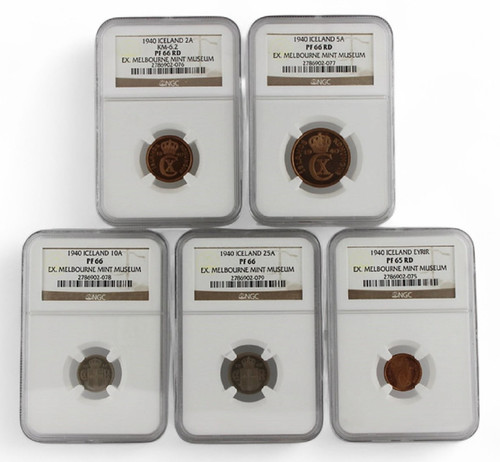
Iceland 1940 Proof Set of 1,2, 5,10 & 25 Aurar, NGC PF65 to 66RD (5 coins) (Sole finest) Individual grades for each Coin : 1 Eyrir - NGC PF65RD, 2 Aurar - NGC PF66RD, 5 Aurar - NGC PF66R, 10 Aurar - NGC PF66 & 25 Aurar - NGC PF66.Museum quality. Well-matched & very rare
To read the complete item description, see:
Iceland 1940 Proof Set of 1,2, 5,10 & 25 Aurar, NGC PF65 to 66RD (5 coins) (Sole finest)
(https://www.smallsauctions.com/auctions/top-of-the-pops-the-best-coins-of-the-british-commonwealth/lot-230-iceland-1940-proof-set-of-12-510-25-aurar-ngc-pf65-to-66rd-5-coins/)

East Africa (British) 1942 (L) Proof Record Ten Cent, PCGS PR67+RD (Sole Finest) Highest graded NGC PF65 RD (2) 66 RD (1) & PCGS PR67+ RDD (1)
To read the complete item description, see:
East Africa (British) 1942 (L) Proof Record Ten Cent, PCGS PR67+RD (Sole Finest)
(https://www.smallsauctions.com/auctions/top-of-the-pops-the-best-coins-of-the-british-commonwealth/lot-220-east-africa-british-1942-l-proof-record-ten-cent-pcgs-pr67rd-sole/)
They truly represent the best of the best in terms of condition, rarity and pedigree.
The catalogue is at https://www.smallsauctions.com
STUDY PROBES SOURCE OF FAKE COIN'S METAL
A British Museum study proposes that a counterfeiter may have melted down more common ancient coins to create a fake rarity. Here's an excerpt - see the complete article online. -Editor

Economic Times AI image
Can someone wonder that even a small bronze coin can raise a big question. Is it really ancient, or was it made much later to look that way?
In 2017, a coin from the Pember collection was brought to the British Museum to be compared with known examples before a sale. The design looked familiar, but some details didn't sit right next to other examples. The check grew into an investigation of a group of coins linked to Ithaca, the Greek island tied to the hero Odysseus.
What came out of it was unusual. The coins suspected of being forgeries may have been made from metal melted down from genuine ancient objects.
Looking odd was not the whole problem. The researchers found two variants of the design. One had a fuller Greek inscription and a monogram beside the bird. The other had a shorter inscription and no monogram.
The second group was also strikingly consistent in how the designs had been struck, which the researchers considered unusual for coins from an ancient mint. Measurements and the alignment of the designs added to the doubt.
There was a further wrinkle. Similar examples were already in the British Museum's collection. So this wasn't about one coin offered for sale. The researchers had to look at the collection's history as well as the objects.
In the follow-up study in Archaeometry, Laura Perucchetti and Amelia Dowler analysed six coins with X-ray fluorescence equipment. The technique measures which elements are present in a material, so researchers can compare the makeup of different objects.
They found chemical differences between the two groups. That backed the suspicion that one variant hadn't been made the same way as the genuine Hellenistic coins.
The researchers then proposed an explanation. A skilled counterfeiter may have melted down more common ancient coins or other old metal objects and used the material to make new pieces. If so, the metal could have an ancient history even though the coin's design was not ancient at all.
That is a hypothesis about how the suspected fakes were made. It is not a record of a known forger at work, and the study doesn't name who made them.
To read the complete article, see:
A fake Greek coin may have been made from real ancient metal. Here is how scientists spotted it
(https://economictimes.indiatimes.com/news/new-updates/a-fake-greek-coin-may-have-been-made-from-real-ancient-metal-here-is-how-scientists-spotted-it/articleshow/135773482.cms)
GOLD ANGLO-SAXON THRYMSA QUESTIONED
Is it too rare to be real? Numismatic experts squared off in the English county of Norfolk over the authenticity of a unique gold Anglo-Saxon thrymsa submitted by a metal detectorist. Here's an excerpt - see the complete article online. -Editor

The object was found at an undisclosed location and reported the Norfolk coroner to adjudicate whether it be declared treasure.
But at a remarkable hearing, a disagreement saw one expert suggest it could be a potentially unique discovery while two others questioned if it was even genuine.
The unusual proceedings attracted a packed courtroom at Norfolk County Hall, where metal detectorist Ray Jenkins was joined by friends and family to hear the fate of his discovery.
Even staff at County Hall had filled the public gallery, drawn by a fascinating archaeological mystery which was about to expose a fundamental disagreement between experts.
On one side was Dr Adrian Marsden, a specialist in historic coins, who insisted the gold coin, known as a thrymsa, was genuine.
On the other were Dr John Naylor, National Finds Adviser for the Portable Antiquities Scheme at the Ashmolean Museum, University of Oxford, and Dr Wendy Scott, a curator at Norwich Castle Museum, who both challenged its authenticity.
Dr Marsden attended the hearing in person alongside the finder, while Dr Naylor and Dr Scott gave their evidence by live video link.
At the centre of the dispute was a coin believed to date from around AD 625, the period of the famous Sutton Hoo burial, but featuring designs which experts said were unlike those ordinarily associated with the period.
For Dr Marsden, that was precisely what made the discovery so exciting.
He argued that experts needed to recognise the significance of the Norfolk findspot, drawing comparisons with Rendlesham in Suffolk, an important Anglo-Saxon royal settlement.

His frustration centred on what he regarded as a circular argument: that an object potentially representing the first known example of its type was being doubted precisely because no other examples existed.
If every previously unknown object was dismissed because it differed from established examples, his argument suggested, how could archaeology ever recognise something genuinely new?
The competing interpretations left the court confronting an intriguing archaeological dilemma.
Were the unusual details evidence that the coin could not have been made in the seventh century, or were they the very characteristics which made it an extraordinary discovery?
The court has not yet issued a verdict. Interesting case, which reminds me of Eric Newman's investigation of the Good Samaritan Shilling. Are readers aware of similar numismatic disputes over ancient or medeival coinage? -Editor
To read the complete article, see:
Too rare to be real? Questions asked over gold coin
(https://www.wymondhamandattleboroughmercury.co.uk/
news/26719821.rare-real-questions-asked-gold-coin/)
MEDAL FOR SOLDIER WHO REPRIMANDED HEGSETH
An incident at Arlington National Cemetery on Veteran's Day led to a Joint Service Commendation Medal award. Here's a CNN article excerpt - see the complete article online. -Editor

Secretary of Defense Pete Hegseth awarded the soldier who reprimanded him and members of his staff at the Tomb of the Unknown Soldier a Joint Service Commendation Medal on Thursday.
A Pentagon official confirmed that Hegseth welcomed the 3rd Infantry Regiment, known as The Old Guard, to the Pentagon "where he proudly awarded Specialist Iglesias the Joint Service Commendation Medal for the execution of his duties at the Tomb of the unknown Soldier on November 11, 2026."
CNN first reported the incident.
Hegseth, his wife, chief of staff Ricky Buria, deputy chief of staff Patrick Weaver and senior adviser and deputy assistant Tami Radabaugh were taking photos in front of the tomb after a Veterans Day ceremony on Wednesday at Arlington National Cemetery when some in the group were heard laughing and chatting after the photos were taken. The soldier patrolling in front of the tomb, Spc. Thomas Iglesias, stopped walking and faced the group.
"All visitors will maintain an atmosphere of silence and respect at all times," Iglesias called out.
To read the complete article, see:
Hegseth awards medal to soldier who reprimanded him and aides at Arlington Cemetery
(https://www.cnn.com/2026/11/12/politics/hegseth-awards-medal-soldier-reprimanded-him?shem=dsdf,sharefoc,agadiscoversdl,adpsc,,sh/x/discover/m1/4)
Pete Hegseth and a cemetery lesson in self-government
(https://www.washingtonpost.com/opinions/2026/11/13/pete-hegseth-arlington-soldier-self-government-lesson/)
LOOSE CHANGE: NOVEMBER 15, 2026
Here are some additional items in the media this week that may be of interest. -Editor
Coin World published a short article on the recent launch ceremony for the Gettysburg Address Quarter. Here's an excerpt - see the complete article online. -Editor

Between 1,000 and 1,500 members of the public, collectors and invited guests joined the United States Mint at Gettysburg National Military Park Oct. 21 to celebrate the release of the Gettysburg Address quarter dollar, the fifth and final quarter dollar in the 2026 Semiquincentennial Circulating Coin Program.
ACNB, formerly known as Adams County National Bank in Gettysburg, served as the coin exchange sponsor, exchanging for like cash $30,000 in 40-coin rolls of 1776~2026-P Gettysburg Address quarter dollars.
Participating purchasers were at first permitted to exchange cash for a maximum 10 rolls per person, but that was later reduced to two rolls to allow all those standing in line to get some of the new coins.
Brandon Beach, Treasurer of the United States, and Paul Hollis, Director of the Mint, spoke at the event.
"More than 160 years after President Lincoln spoke at Gettysburg, his words continue to resonate," said United States Mint Director Paul Hollis. "This quarter carries his powerful message of liberty, sacrifice, and national purpose forward to a new generation."
"Gettysburg is a place where the meaning of Lincoln's words continues to resonate," said Gettysburg National Military Park Superintendent Stephanie Stephens. "This quarter provides a unique opportunity to carry the Gettysburg Address — and its enduring message of sacrifice, liberty, and a government of the people — into the hands of Americans across the country."
To read the complete article, see:
Crowd turns out at final quarter launch
(https://www.coinworld.com/news/us-coins/crowd-turns-out-at-final-quarter-launch)
To read the earlier E-Sylum article, see:
GETTYSBURG ADDRESS QUARTER LAUNCH CEREMONY
(https://www.coinbooks.org/v29/esylum_v29n42a26.html)
An Omaha coin dealer helped a veteran confirm that the U.S. Air Force One-Ounce Silver Medals he purchased online are fake. -Editor

Army veteran Chris Bowen bought 50 silver dollar coins online to give to fellow veterans. A coin expert said the coins are fake.
Bowen hands out silver coins to veterans he meets who served in all branches of the military. He spent about $1,500 on the coins from a New York seller. He said he will not give them to other veterans.
Chris Holtberg of Millard Jewelry and Coin to examined the collection. How to tell which coin is real and which is fake?
"On a machine," Holtberg said.
Holtberg said the machine is a precious metal verifier that can measure a coin's density.
"Well, the density is different, and that's what the machine records and tells you it's fake," Holtberg said.
To read the complete article, see:
Omaha Army veteran finds silver dollars he bought online are fake, coin expert says
(https://www.wowt.com/2026/11/12/omaha-army-veteran-finds-silver-dollars-he-bought-online-are-fake-coin-expert-says/)
Jim Haas passed along this story about a UK metal detectorist's find of a medieval gold reliquary cross in a freshly plowed field in southeastern England. Thanks. -Editor

The cross was found by 58-year-old metal detecting hobbyist Shelley Couzins in August, news agency Southwest News Service (SWNS) reported. The discovery was only recently publicized.
Couzins, a grandmother of five who took up metal detecting four years ago, told SWNS she was out with a group on the Isle of Sheppey in Kent in the United Kingdom when, after five hours of searching, she found nothing but "rubbish."
She soon unearthed a gold cross but initially dismissed it as costume jewelry.
It wasn't until she returned to the group's main tent that fellow hobbyists told her the cross was made of real gold.
The cross, which weighs 10.6 grams, was subsequently reported to a Finds Liaison Officer under England's treasure reporting process.
The artifact is being assessed by the British Museum, according to SWNS. Its ultimate ownership and value have yet to be determined.
If acquired through the treasure process, the cross would be valued, with any resulting reward expected to be split between Couzins and the landowner.
To read the complete article, see:
Grandmother mistakes medieval gold cross for costume jewelry before learning its five-figure value
(https://www.foxnews.com/travel/grandmother-mistakes-medieval-gold-cross-costume-jewelry-learning-five-figure-value)
THE ORIGIN OF PCGS
A CoinWeek article tells the story of the origin of the Professional Coin Grading Service (PCGS). Here's an excerpt - see the complete article online. -Editor

The story begins in 1985, when several prominent coin dealers regularly gathered after coin shows to work on an ambitious research project.
Their original goal involved producing a comprehensive reference book. They wanted to combine coin prices, rarity information, auction transactions, and grading research into a powerful numismatic resource.
However, the discussions increasingly focused on a problem that threatened the rare coin market.
Coin grading lacked consistent acceptance among dealers. Consequently, two experts could assign different grades to the same coin. Those differences often translated into substantial changes in market value.
Moreover, overgrading and misleading sales practices had damaged collector confidence.
David Hall, Gordon Wrubel, John Dannreuther, Bruce Amspacher, and other dealers believed the industry needed a better solution.
Then came the moment that changed everything.
According to Dannreuther, Hall entered one of their hotel room meetings carrying a Washington quarter inside a new plastic holder.
Rather than simply publishing a book about coin grades, Hall proposed creating a business that would grade coins, encapsulate them, and stand behind its opinions.
Dannreuther later recalled Hall's proposal:
"We can grade and encapsulate coins and guarantee them."
The idea combined expert judgment, secure encapsulation, and a financial guarantee into a service that collectors and dealers could use throughout the marketplace.
That simple proposal became the foundation of Professional Coin Grading Service.
To read the complete article, see:
The 25-Cent Quarter That Launched PCGS, and Sold for $46,125
(https://coinweek.com/the-25-cent-quarter-that-launched-pcgs-and-sold-for-46125/)
YOU'VE GOT BOOKS!
For our bibliophiles: inspired by the announcement of a remake, here's an article about the heart of Nora Ephron's script for the classic rom-com "You've Got Mail". Here's an excerpt - see the complete article online. -Editor

In Ephron's telling, Kathleen and Joe can't stand each other because she owns a small business and he is the heir to a Barnes & Noble–like behemoth mega-chain. In the hands of a lesser artist, that premise could mean only one thing: David good, Goliath bad. But Ephron, one of the most ingeniously astute observers of American life and culture, knew better. The real tension, she realized, wasn't between rapacious corporate America and the small business owners struggling to survive its onslaught but between one fantastic retail operation, a cozy nook where everybody knows your name, and another, a big, brightly lit emporium with a terrific selection and decent coffee. When these two compete, we all win, because that right there is the truly revolutionary nature of capitalism: replacing a very good product with an even better one, making money by giving us better options, always innovating and always growing and inviting us all along for the ride.
Joe himself puts it best. In one of the film's funniest scenes, he's incensed when a TV reporter, eager to frame the story as underdog local business fighting the evil national chain, edits Joe's interview to make it seem like he's a corporate hack who cares only about the bottom line. "That's not all I said," he rants to a friend, played by Dave Chappelle. "I said we were great. I said you could sit and read for hours and no one will bother you. I said we have 150,000 titles. I showed them the New York section. I said we were a goddamn piazza! A place in the city where people can mingle and mix and be." And if you truly love books, and New York, and spending time with other people, it's a very hard proposition to beat.
You've Got Mail works, then, not because it's a story of opposites attracting each other but because it makes it clear that Kathleen and Joe aren't opposites at all. They each start the film enmeshed with a partner who, on paper, couldn't be more suitable—she with a blowhard liberal writer glued to his typewriter, he with a soulless and striving publishing exec—but slowly realize that there's much more to life than such corny caricatures of left-wing piety or right-wing greed. They find their way into each other's arms because both ultimately care a lot about the book-buying experience. Great Americans that they are, they understand that shopping is no mere material exercise in wasting time and spending money, but a form of self-expression, an affirmation, an exercise in building community and generating value. We can imagine them snuggling on the couch long after the movie's over, drinking tall decaf cappuccinos and imagining how to make browsing for books even more gratifying for their friends and neighbors.
That was 28 years ago. These days, the Barnes & Noble on the Upper West Side is itself the quaint small business, a lone retail holdout in a city mile riddled with either empty storefronts or odorous cannabis dispensaries. Still, it thrives because it turns out Joe was exactly right: Now that buying books involves clicking buttons and waiting for some underpaid, overtaxed delivery worker to drop off your volume of choice at your doorstep, people are pining for that piazza feel again, which is why the number of independent bookstores in the U.S. has grown by 70 percent since 2020, and why, in 2024 alone, Barnes & Noble opened 50 new locations stateside, with dozens more coming soon.
To read the complete article, see:
Bring Back the America of ‘You've Got Mail'
(https://www.thefp.com/p/bring-back-the-america-of-youve-got)
ABOUT THIS ISSUE: NOVEMBER 15, 2026
My big numismatic event this week was visiting the Whitman Baltimore Expo on Thursday - I expect to have a Diary article in next week's issue.
Back in the day I had quite a collection of vinyl record albums (which are coming back into style now in a more niche market). I was reminded of that long-sold collection when I came across an online offering of Alice Cooper's 1973 "Billion Dollar Babies". What caught my eye was the inclusion of a Billion Dollar Babies banknote.

There's no end to the marketing applications of ersatz banknotes and I've never tried collecting these. But one generation's junk is another generation's treasure - today we have books cataloging 19th century advertising notes. Maybe this baby will end up in a slab up for auction all by itself.
Seen online: "I may be the only person in the world who doesn't much like Oreos. To me, they taste like potting soil discs with lard in between."
And here are some interesting non-numismatic articles I came across this week. The first one is a fun read about my favorite watering hole, the neighborhood bar I grew up near back in Pittsburgh. It's thriving today, and I recommend it to anyone visiting town.
What Makes The Bulldog Pub Much More Than Just a Neighborhood Watering Hole (https://www.pittsburghmagazine.com/what-makes-the-bulldog-pub-much-more-than-just-a-neighborhood-watering-hole/)
The 100-Year-Old Pittsburgh Bakery Whose Ovens Never Go Cold (https://opensince.substack.com/p/the-100-year-old-pittsburgh-bakery)
Reclaiming Mary Cassatt: putting overlooked American artist back at heart of impressionism (https://www.theguardian.com/artanddesign/2026/nov/15/reclaiming-mary-cassatt-putting-overlooked-american-artist-back-at-heart-of-impressionism)
'Depicts humanity at its most grotesque': Why the 300-year-old novel Gulliver's Travels is so misunderstood (https://www.bbc.com/culture/article/20261106-why-the-300-year-old-novel-gullivers-travels-is-so-misunderstood)
What is an Enigma machine? (https://www.christies.com/en/stories/collecting-guide-enigma-machines-79256fe652064942ad30c8167d4af51d)
Fable 5.2 and Jagged AGI [the first video is amazing] (https://www.oneusefulthing.org/p/fable-52-and-jagged-agi)
From the firehouse to a Bronx pawn shop, Steve Buscemi is a lifelong New Yorker (https://www.npr.org/2026/11/12/nx-s1-6032768/steve-buscemi-wild-horse-nine-pickpocket-new-york?shem=dsdf,sharefoc,agadiscoversdl,adpsc,,sh/x/discover/m1/4)
Scholar Dishes About Finding a Long-Lost Caravaggio Painting in Paris (https://www.artnews.com/art-news/news/lost-caravaggio-painting-rediscovered-paris-terzaghi-1234805289/)
Lost draft of Martin Luther King Jr.'s ‘I Have a Dream' speech rediscovered (https://www.washingtonpost.com/politics/2026/11/09/lost-draft-martin-luther-king-jrs-i-have-dream-speech-rediscovered/)
-Editor

Editor Wayne Homren, Assistant Editor Garrett Ziss
Wayne Homren
Wayne Homren is the founding editor of The E-Sylum and a consultant for the Newman Numismatic Portal. His collecting interests at various times included U.S. Encased Postage Stamps, merchant counterstamps, Pittsburgh Obsolete paper money, Civil War tokens and scrip, Carnegie Hero Medals, charge coins and numismatic literature. He also collects and has given presentations on the work of Money Artist J.S.G. Boggs. In the non-numismatic world he's worked in artificial intelligence, data science, and as a Program Manager for the U.S. Department of Defense.
Garrett Ziss
Garrett Ziss is a numismatic collector and researcher, with a focus on American paper money and early U.S. silver and copper coins. He is also a part-time U.S. coin cataloger for Heritage Auctions. Garrett assists Editor Wayne Homren by editing and formatting a selection of articles and images each week. When he's not engaged in numismatics, Garrett is pursuing a Master's Degree in Quantitative Economics at the University of Pittsburgh.

Contributors Pete Smith and Greg Bennick
Pete Smith
Numismatic researcher and author Pete Smith of Minnesota has written about early American coppers, Vermont coinage, numismatic literature, tokens and medals, the history of the U.S. Mint and much more. Author of American Numismatic Biographies, he contributes original articles to The E-Sylum often highlighting interesting figures in American numismatic history.
Greg Bennick
Greg Bennick (www.gregbennick.com) is a keynote speaker and long time coin collector with a focus on major mint error coins and US counterstamps. He is on the board of both CONECA and TAMS and enjoys having in-depth conversations with prominent numismatists from all areas of the hobby. Have ideas for other interviewees? Contact him anytime
via instagram @minterrors.
He can also be reached by email at
minterrors@gmail.com.


Website host John Nebel and webmaster Bruce Perdue
John Nebel
Numismatist, photographer, and ANS Board member and Fellow John Nebel of Boulder, CO helped the ANA and other clubs like NBS get online in the early days of the internet, hosting websites gratis through his Computer Systems Design Co. To this day he hosts some 50 ANA member club sites along with our
coinbooks.org site, making the club and our E-Sylum archive available to collectors and researchers worldwide.
Bruce Perdue
Encased coinage collector (encasedcoins.info) Bruce Perdue of Aurora, Illinois has been the volunteer NBS webmaster from its early days and works each week to add the latest E-Sylum issue to our archive and send out the email announcement.

|
|
The E-Sylum is an electronic publication of the Numismatic Bibliomania Society Copyright © 1998 - 2026 | |