Visit our NBS Sponsors











About UsThe Numismatic Bibliomania Society is a non-profit association devoted to the study and enjoyment of numismatic literature. For more information please see our web site at coinbooks.org SubscriptionsThose wishing to become new E-Sylum subscribers can go to the following web page
Subscribe
MembershipThere is a membership application available on the web site Membership Application To join, print the application and return it with your check to the address printed on the application. Print/Digital membership is $40 to addresses in the U.S., and $60 elsewhere. A digital-only membership is available for $25. For those without web access, write to: Jeff Dickerson, Treasurer AsylumFor Asylum mailing address changes and other membership questions, contact Jeff at this email address: treasurer@coinbooks.org SubmissionsTo submit items for publication in The E-Sylum, write to the Editor at this address: whomren@gmail.com BUY THE BOOK BEFORE THE COINSale Calendar |
- WAYNE'S WORDS: THE E-SYLUM JULY 5, 2026
- KOLBE & FANNING WEB SALE NUMBER 6
- NEW BOOK: ESSAYS FOR VICTOR D. BRENNER
- NEW BOOK: COLLIER COLLECTION OF GREEK AND ROMAN COINS
- NEW BOOK: PECUNIA NON OLET
- MORE ON THE ENCYCLOPEDIA OF ENCASED POSTAGE
- KM AND PICK CATALOGS ACQUIRED BY CCG
- CHARLES CAINE ANDERSON, SR. (1934-2026)
- US SAVINGS BONDS WITH JOHN WAYNE
- VIDEO: MEMPHIS PAPER MONEY SHOW MEMORIES
- NOTES FROM E-SYLUM READERS: JULY 5, 2026
- VOCABULARY TERM: SQUARE SHAPE
- KEN BRESSETT INTERVIEW, PART SIX
- NUMISMAGRAM MEDAL SELECTIONS: JULY 5, 2026
- HERITAGE: RUSSIAN COINS SHOWCASE
- DAVISSONS: E-AUCTION 53
- HERITAGE: 2026 SUMMER FUN U.S. COINS
- HERITAGE TO SELL STARLUST COLUMBIANA
- NOONANS JULY 2026 PAPER MONEY SALE
- U.S. ENCASED POSTAGE STAMPS
- OPTICAL EFFECTS IN EARLY MEDALS
- 1876: COLORADO'S FREE SILVER CRUSADE
- 1920 SAINT LUCIA TEN SHILLINGS SPECIMEN NOTE
- IMAGE OF $100 BILL WITH TRUMP SIGNATURE
- NEBRASKA DEALER SELLING COINS ON WHATNOT
- LOOSE CHANGE: JULY 5, 2026
- FIRST BANK OF THE UNITED STATES REOPENS
- ABOUT THIS ISSUE: JULY 5, 2026
Content presented in The E-Sylum is not necessarily researched or independently fact-checked, and views expressed do not necessarily represent those of the Numismatic Bibliomania Society.
WAYNE'S WORDS: THE E-SYLUM JULY 5, 2026
 New subscribers this week include:
Bernadette Vegas, courtesy Steve Starlust; and
Rob Martin.
Welcome aboard! We now have 6,440 subscribers.
New subscribers this week include:
Bernadette Vegas, courtesy Steve Starlust; and
Rob Martin.
Welcome aboard! We now have 6,440 subscribers.
Thank you for reading The E-Sylum. If you enjoy it, please send me the email addresses of friends you think may enjoy it as well and I'll send them a subscription. Contact me at whomren@gmail.com anytime regarding your subscription, or questions, comments or suggestions about our content.
This week we open with a numismatic literature sale, three new books, updates from the Newman Numismatic Portal, notes from readers, and more.
Other topics this week include Victor D. Brenner, Charles Anderson, John Wayne, Ken Bressett, Moxie CrimeFighter Jillette, square coins and medals, Russian coins, fixed price and auction selections, encased postage stamps, Free Silver, Trump's signature, WhatNot, and the First Bank of the United States.
To learn more about the Usefulness of Ancient Medals, the James M. Collier Collection, Flavian coinage, Savings Bonds, the Memphis Paper Money Show, Qing Dynasty cash coins, World War Zero, the Confederate Cent restrike, Columbiana, the Legendary Coupon Hunt, beard tokens, and the numismatic corporate jet trip, read on. And remember: Money Does Not Stink! Have a great week, everyone.
Wayne Homren
Editor, The E-Sylum

Image of the week
KOLBE & FANNING WEB SALE NUMBER 6
Numismatic Booksellers Kolbe & Fanning will hold a new web sale on Thursday, July 16, 2026. Here's the announcement. -Editor

We will be holding Web Sale #6 of Numismatic Books on Thursday, July 16, starting at 12:00 PM Eastern. This sale focuses on inexpensive but useful books, catalogues and other publications on coins from all times and places. It will take place live online, in much the same format as our Premier Auctions, and all lots in the Web Sale will begin at a very low $10 opening bid.
Bidders may register for the sale, browse lots, and place absentee bids beginning immediately at bid.numislit.com.


Addison's Dialogues upon the Usefulness of Ancient Medals (1753)
Bompois on Macedonian coins before and after the Romans, ex BCD

William Cotton's 1885 work on the tokens of Worcestershire


Xinjiang Numismatics, edited by Dong Xingxuan et a
Goodwin's 2005 Arab-Byzantine Coinage


Paoletti's 8 Reales Cobs of Potosí (2006)
The 1859 first edition of Montroville Dickeson's American Numismatical Manual


Rea et al.'s 2010 Early Quarter Dollars of the United States Mint
The 2008 ANS special edition of the Red Book
Please review the Terms of Sale and update your registration information before bidding.
Register early to bid online
Kolbe & Fanning use Auction Mobility as our third-party online bidding platform, which is separate from our retail site. Auction Mobility is an app-based platform allowing users the ability to participate in the sale through phones, tablets and computers. To register for the sale, bidders must go to
bid.numislit.com and sign up. Once you have set up an account, you may browse lots, place advance bids, or participate in the live sale online. Those wishing to participate on their devices can download the Kolbe & Fanning app through the Apple or Google Play Store.
NEW BOOK: ESSAYS FOR VICTOR D. BRENNER
The ANS has published the latest volume of the Proceedings of the Coinage of the Americas Conference, edited by Jesse Kraft. The 2021 event focused on sculptor Victor David Brenner. Here's the announcement. -Editor
 The American Numismatic Society is pleased to announce the release of Essays for the 150th Anniversary of the Birth of Victor D. Brenner, Proceedings of the Coinage of the Americas Conference No. 17 (2021). Since the mid-1980s, the Coinage of the Americas Conference (COAC) has been considered the leading venue for the presentation of academic research pertaining to numismatics of the Western Hemisphere.
The book is currently available for pre-order and will ship in August 2026.
Organized in 2021 to commemorate the 150th anniversary of Victor David Brenner's birth at the Coinage of the Americas Conference (COAC), hosted by the American Numismatic Society, this assembly of scholarship honors one of the most influential figures in American numismatic history. Best known as the sculptor of the 1909 Lincoln Wheat cent-the longest-running design in the history of U.S. coinage-Brenner was a master of the Beaux-Arts style. The chapters within this volume offer a multifaceted look at his career, including detailed examinations of specific, lesser-known medals and commemorative pieces; an exploration of how Brenner's Lithuanian roots and European training influenced his American works; and a critical look at his role in the Golden Age of American numismatics and his mentorship within the medallic arts community.
Whether you are a seasoned numismatist or a student of American art history, these proceedings provide fresh insights into the man who transformed the way Americans interact with numismatic artwork.
About the Proceedings of the Coinage of the Americas Conference
Since the mid-1980s, the Coinage of the Americas Conference (COAC) has been considered the leading venue for the presentation of academic research pertaining to numismatics of the Western Hemisphere.
For more information, or to order, see:
Essays for the 150th Anniversary of the Birth of Victor D. Brenner
(https://numismatics.org/store/coac2021/)

NEW BOOK: COLLIER COLLECTION OF GREEK AND ROMAN COINS
Another new ANS publication documents the collection of Greek and Roman coins of James M. Collier. -Editor
 The James M. Collier Collection of Greek and Roman Coins: A Selection
by Dimitrios Gerothanasis, Johannes Stelzhammer, Alan Walker and Rex Gao
Professor James M. Collier was an ardent lover of the history and culture of Europe and the ancient world, and a passionate collector of ancient Greek and Roman coins. Born in 1943 in Bellingham, Washington, he pursued his early academic training at Pacific Lutheran University (PLU) in Tacoma, receiving a Bachelor of Arts in History in 1965. After graduating from PLU, he worked for the Boeing Corporation as an engineer. When he was seconded to Washington, DC, on the Minuteman project, his office was located—quite fortuitously, as it turned out—across from the National Gallery of Art. For two years he spent every lunch hour at the Gallery, where he discovered his real love for art and art history.
Returning to the Pacific Northwest, he attended the University of Oregon and graduated with a Master of Arts in Art History in 1970. He then pursued a PhD in Art History at the University of Michigan, completing the degree in 1975. He was appointed an Assistant Professor in the Art History Department at Auburn University (Auburn, Alabama), where he eventually was tenured and became department chair. Over the course of his academic career, he lectured widely and published on the Italian Renaissance and Early Netherlandish perspective—the subject of his doctoral dissertation, entitled "Linear Perspective in Flemish Painting and the Art of Petrus Christus and Dirk Bouts."
Professor Collier was published as an artist as well. In 1987, he left his teaching post and devoted himself to his passion for painting, studying at the National Academy of Design in New York City. He and his wife, Carole Anne Menzi Collier, moved to Amsterdam in 1990 and eventually attained dual citizenship. He continued to pursue and share his love of art and ancient coinage for the rest of his life.
The Collier Prize in Ancient Numismatics was first given by the American Numismatic Society (ANS) in 2022. Established by Carole Anne Menzi Collier in memory of her late husband, James M. Collier, the biennial award honors the best book, catalogue, or online digital work in the field of ancient numismatics (650 bc–ad 300). In 2025, the ancient Greek and Roman coins of the Collier Collection were sold at auction to fund the endowment; highlights from the collection are featured within.
"Ancient numismatics . . . intersects art history, political history, economic history, and religious studies," writes ANS Executive Director Ute Wartenberg Kagan. "When done properly, it is a truly interdisciplinary field that benefits scholars willing to explore different disciplines." The Collier Prize rewards this important, often underappreciated work and encourages the scholars who undertake it.
Description
Hardback
ISBN-13 9780897227490
ISBN-10 0897227492
Pages: xii + 144 p.
Size:152 x 229 mm
TABLE OF CONTENTS
Foreword, by Ute Wartenberg Kagan
The James M. Collier Collection, by Dimitrios Gerothanasis
The Collier Prize in Ancient Numismatics, by Peter van Alfen
Introduction, by Carole Anne Menzi Collier
For more information, or to order, see:
The James M. Collier Collection of Greek and Roman Coins: A Selection
(https://numismatics.org/store/the-james-m-collier-collection-of-greek-and-roman-coins-a-selection/)
To read the earlier E-Sylum articles, see:
ANS COLLIER PRIZE IN ANCIENT NUMISMATICS
(https://www.coinbooks.org/v23/esylum_v23n49a06.html)
ANS TO ESTABLISH COLLIER PRIZE
(https://www.coinbooks.org/v28/esylum_v28n13a18.html)

NEW BOOK: PECUNIA NON OLET
The new book by Emanuele Latella PECVNIA NON OLET. Le monete raccontano l'impero dei Flavi (which translates roughly to Money Does Not Stink: Coins Tell the Story of the Flavian Empire) is available. Here's a press release. The article was translated to English via ChatGPT. -Garrett
 PECVNIA NON OLET. Le monete raccontano l'impero dei Flavi
By: Emanuele Latella
Coinage, history, politics, and economics in Rome from AD 69 to 96: coins tell the story of the Flavian Empire in a book by Emanuele Latella.
Among the latest and most interesting publications devoted to coinage—not only as collectible objects but also as historical sources and documents—we would like to highlight PECVNIA NON OLET: Coins Tell the Story of the Flavian Empire, the result of research by Emanuele Latella, a scholar of Roman history and numismatics. The book has recently been published by Edizioni D'Andrea.
Presented in A4 format, with a full-color 488-page layout (ISBN 979-12-82072-11-3, price €85.00), the volume represents a decidedly innovative work compared with the usual catalogs of Roman coins. Rather than simply cataloging coinage, it tells the story of the Flavian dynasty through its coinage, beginning with Judea and continuing through the consolidation of power in Rome and the eventual downfall of Domitian.
Rigor, analysis, and a critical reassessment of historical and numismatic sources form the basis of Emanuele Latella's methodology. As Massimo Franco Jabes writes in the introduction, Latella "combines the precision of technical investigation with the ability to interpret Flavian coinage as the political and artistic expression of a dynasty."
In PECVNIA NON OLET: Coins Tell the Story of the Flavian Empire, particular attention is given to the succession of public offices inherited from the Republican system that the dynasty's three emperors—Vespasian, Titus, and Domitian—held, following a practice already established under Augustus. It is also worth emphasizing that, despite the work's historical and economic focus, it presents previously unpublished coins and, above all, uses coinage as the central narrative thread through which to understand several of the decisive decades in the history of Imperial Rome.
Written in a clear and engaging style and richly illustrated with images of coins and related material, the volume becomes a genuine journey—both original and compelling—through Rome during the years AD 69 to 96. Remarkably, the author is neither an academically trained historian nor a professional numismatist, but rather a collector who, after years of research, has produced an original scholarly contribution of unexpected depth.
These and other qualities are also highlighted by Umberto Moruzzi, president of the Italian Professional Numismatists, in his foreword. He writes: "The importance of private research and collecting has been, and continues to be, fundamental to the development of numismatic studies." He also refers to the 2005 Faro Convention, adopted by Italy in 2020, which affirms the "right to cultural heritage" for private citizens.
It is a right that Emanuele Latella has transformed, through PECVNIA NON OLET: Coins Tell the Story of the Flavian Empire, into an opportunity—and into a book from which readers can gain not only a wealth of fascinating knowledge about history and numismatics, but also a sound research methodology and inspiration for future publications.
For more information, or to order, see:
PECVNIA NON OLET. Le monete raccontano l'impero dei Flavi
(https://www.cronacanumismatica.com/pecvnia-non-olet-le-monete-raccontano-l-impero-dei-flavi/)
PECVNIA NON OLET. Le monete raccontano l'impero dei Flavi
(https://www.palazzoesposizioniroma.it/evento/presentazione-del-libro-pecvnia-non-olet-le-monete-raccontano-limpero-dei-flavi-di-emanuele-latella)
Liberdomus
(https://www.liberdomus.it/)

MORE ON THE ENCYCLOPEDIA OF ENCASED POSTAGE
Here is an excerpt from the recently-published Encyclopedia of Encased Postage by Paul Montz. -Editor
 There have been many instances in the course of human history that have required the
innovation of an emergency currency. The first instance of stamps being used as a
currency substitute was circa 1843 in England. However, in only two major emergencies
has the solution been postage stamps: the U.S. Civil War and the aftermath of World
War I, both in the form of encased postage stamps. Terms used to describe this genre
include encased postage, kapselgeld, enkapselmarken, notgeld, timbres-monnaies,
jetons-monnaie, emergency money, tokens, or simply capsules.
There have been many instances in the course of human history that have required the
innovation of an emergency currency. The first instance of stamps being used as a
currency substitute was circa 1843 in England. However, in only two major emergencies
has the solution been postage stamps: the U.S. Civil War and the aftermath of World
War I, both in the form of encased postage stamps. Terms used to describe this genre
include encased postage, kapselgeld, enkapselmarken, notgeld, timbres-monnaies,
jetons-monnaie, emergency money, tokens, or simply capsules.
An often-neglected area of numismatics, encased postage is as interesting a pursuit as any, combining numismatics and philately, art, and history. In fact, it has been said that encased postage is the link between philately and numismatics. I ask where can you start a collection with as little as $20 that combines all these things and has such a variety of issues, colors, and merchant advertising? Even a nice example of U.S. encased postage from the Civil War, a variety which may have only 100 pieces known, can be had for around $200-300. ALL encased postage is scarce and is a worthy challenge for any numismatist or philatelist.
In Europe after the First World War, most metals were in very short supply and governments were not able to produce small denomination coins because of this. Tokens in base metal (aluminum, zinc, etc.) and emergency currency were produced to fill the gap, but it wasn't enough. In certain circumstances, stamps were granted official legal tender status, such as during the Boer War in South Africa. Stamps became a medium of exchange, but after a few uses, they became sticky and dirty and ultimately lost their value. Next, putting the stamps in containers such as envelopes or cellophane pockets was tried, but these could not hold up to intense circulation. At about the same time, some merchants were putting together small booklets of stamps together which held the stamps for use and had advertising on the outside, but these were found to be inconvenient and not much protection from moisture. Clearly, a more durable material that protected the stamp was needed, something resembling a coin.
It is unclear if the use of encased postage after World War I was inspired by John Gault's invention or if the idea sprung up independently from a pressing need for emergency small change. The idea of a clear protective substance to cover a stamp and use advertising is not a complicated one after all, and the style of the encasements that were developed does differ quite a bit from the U.S. pieces. They come in a large variety of case types, including various metals and plastic. Adding yet another variable to the mix, many world types have a background color around the stamp which can be quite varied and adds another dimension to collecting them. Most world issues are also different from Gault's in that the stamp generally is not folded over its backing and is shown completely. This is at least one reason why world encasements tend to be larger than their U.S. counterparts. In 1919, a Frenchman, M. Bouchaud Praceiq, received a patent for an encased stamp, which was further granted in Italy, Austria, and some other countries. The German Patent Office refused to issue a patent, however, as they were aware of the previous American patent by Gault. This is why in Germany there were so many kinds of encased issues, whereas in many other countries, only a few firms were licensed to produce them.
Austrian encased postage began appearing somewhat later than did the extensive French, German, and Italian emissions. The earlier issues were mainly produced for use as emergency money, particularly the higher denominations. Some of the later issues were made for advertising purposes or even as collector's items. In some countries, scarce stamps were used by stamp traders in producing their own souvenir items! When regular coinage was resumed, encased postage disappeared as quickly as it had come.
Not all encased postage was produced to relieve coin shortages. Some were produced strictly for advertising purposes or as collector's items. It can be assumed that the items with the largest production were made for the purposes of circulation. After the periods of use, many encased pieces were destroyed to get the stamp out by collectors. I don't think this is done today, but clearly it has happened in the past.
The book passes my back-of-the-book test; I always look there for appendices, credits, bibliography, credits, and index. The Encyclopedia of Encased Postage didn't disappoint. The index and bibliography are extensive and detailed, including references to The E-Sylum. The bibliography is especially helpful, including both printed and online material and a separate section for useful references not used directly in the book. Many thanks to Paul for researching and writing this much-needed work - with the information all in one place, the conditions are set for new collections to be formed.
Look for additional book excerpts in this and future issues. Meanwhile, order your full copy and see how many different encased postage stamps you can find at your next coin show. The book includes a value guide. Many are available under $100, but far more are listed at higher valuations from $200 and up. Buyers armed with the book can recognize bargains. Happy hunting! -Editor
For more information, or to order, see:
THE ENCYCLOPEDIA OF ENCASED POSTAGE
(https://www.numislit.com/pages/books/7855/paul-montz/encyclopedia-of-encased-postage)
To read the earlier E-Sylum article, see:
NEW BOOK: ENCYCLOPEDIA OF ENCASED POSTAGE
(https://www.coinbooks.org/v29/esylum_v29n25a03.html)
KM AND PICK CATALOGS ACQUIRED BY CCG
That headline is an alphabet soup of abbreviations, but the first paragraph explains. Thanks to Kavan Ratnatunga for passing this news along. -Editor
 The Certified Collectibles Group, whose companies include NGC® and PMG®, is proud to announce that it has acquired the KM™ and Pick™ catalogs, the leading reference systems for world coins and banknotes.
"The KM and Pick catalogs are two of the most famous and widely used reference systems in numismatics, and they have found a great home with NGC and PMG," said Max Spiegel, president of the Certified Collectibles Group. "As the global leaders in world coin and banknote grading, we look forward to investing in these databases to make them even more comprehensive, accurate, and accessible to collectors and dealers worldwide."
Catalog systems are enormously helpful to collectors and dealers because they facilitate identification, research and valuation of collectibles. The KM and Pick catalogs aim to assign a reference number to every collectible in existence and provide associated images, specifications data such as mintage and design details, and valuation information by grade.

The KM numbering system is named for Chester Krause and Clifford Mishler, who developed and maintained it with meticulous attention to detail in order to create the Standard Catalog of World Coins. The inaugural book was published in 1972 and eventually split into several volumes (each covering a century).

The Pick numbering system is named for numismatist Albert Pick, whose research led to the publication of the first edition of the Standard Catalog of World Paper Money in 1975.
NGC makes the KM catalog available for free to collectors and dealers through its World Coin Price Guide at NGCcoin.com. PMG includes the Pick numbers for world banknotes on its certification labels and utilizes this same numbering system in its PMG Population Report and PMG Registry. PMG also makes the Pick catalog available for free through its World Paper Money Price Guide at PMGnotes.com.
I added book cover images for illustration, but the article says nothing about publishing new editions of the two works. This seems to be just about the two numbering systems for coins and paper money, giving NGC and PMG the right to use the systems in its holders and databases. NGC and PMG already announced a licensing agreement for the two numbering systems in 2021. The latest deal is a purchase.
The earlier articles linked below summarize the history of the books, which went from Krause Publications to Random House and AIM Media. The printed book titles were split off to Random House and have never been heard from again. Kavan notes that "the age of huge catalogs is gone; I can't see them returning except to your phone with a yearly subscription." I'm not an active collector and don't subscribe to AIM's NumisMaster service. I understand updates are rolled out monthly, but I can't see their "What's New in NumisMaster" reports. -Editor
To read the complete article, see:
NGC and PMG Acquire the KM and Pick Catalogs of World Coins and Banknotes
(https://www.ngccoin.com/news/article/15389/ngc-pmg-acquire-km-pick-catalogs/)
To read the earlier E-Sylum articles, see:
F+W MEDIA ASSET SALES APPROVED
(https://www.coinbooks.org/v22/esylum_v22n25a06.html)
KRAUSE NUMISMATIC PERIODICALS UNDER AIM
(https://www.coinbooks.org/v22/esylum_v22n29a07.html)
MORE ON THE KRAUSE STANDARD CATALOGS
(https://www.coinbooks.org/v23/esylum_v23n32a07.html)
NGC, PMG AND AIM TEAM UP ON PRICING DATA
(https://www.coinbooks.org/v24/esylum_v24n04a15.html)
CHARLES CAINE ANDERSON, SR. (1934-2026)
The ANS announced the passing of benefactor Charles C. Anderson, Sr. Sorry to hear this news. -Editor
 The American Numismatic Society is greatly saddened by the death of its Honorary Life Fellow, former Trustee, and Benefactor, Charles C. Anderson Sr. Mr. Anderson passed away on June 24, 2026. After joining the ANS in 1999, he became one of the organization's most committed supporters. From 2004–10, he served as a Trustee of the Society, during a period when it was undergoing a major transformation and moving into its current headquarters at 75 Varick Street. Over the years, Mr. Anderson took an active interest in the Society, which he generously supported by offering advice on numismatic publishing initiatives, contributing ideas, and providing financial support.
"It is hard for me to imagine a world without Charles Anderson," said Dr. Ute Wartenberg Kagan, Sydney F. Martin Executive Director. "He was an extraordinarily successful businessman, who always found time for a chat. He showed us all that family and friends matter the most. He provided us at the ANS with help and friendship, which I will miss immensely."
An obituary will appear in the ANS Magazine.
Here's what Pete Smith's American Numismatic Biographies has to say. I only had the pleasure of meeting Charles once. As a former co-owner of Whitman Publications with his brother Joel and supporter of multiple hobby organizations, his positive impact was significant. See some earlier articles linked below for more information.
I added a 2023 photo of Charles flanked by John Feigenbaum and Mary Burleson of Whitman Publishing. -Editor

Born in Florence, Alabama. Graduate of the University of North Alabama.
His family business grew from two newsstands selling fireworks. After banning fireworks in 1946, they were legalized again in 1957. In 1972, Anderson was one of the first American businessmen invited to trade with China.
American Promotional Events, under the trade name TNT Fireworks, is the country's largest importer and distributor of fireworks from China. Anderson News Corp. claims to be the country's largest distributor of magazines.
Owner of Anderson Press, parent of ANACS, and Whitman Publishing. Also owner of Books-a-Million, and Treat Entertainment, parent of H. E. Harris, distributor of numismatic and philatelic products.
He served as president of the Alabama Numismatic Association.
In 2007, ANACS was sold to James Taylor.
In 2021 he was on the Coin World list of The Most Influential People in Numismatics 1960-2020.
To read the complete entry, see:
In Memory of Charles C. Anderson, Sr.
(https://numismatics.org/pocketchange/in-memory-of-charles-c-anderson-sr/)
Dennis Tucker writes:
I was hired as Whitman's publisher in December 2004. Three weeks later, still getting my feet underneath me, I was scheduled to fly to the Florida United Numismatists show with Charles Anderson. To set the scene: Mr. Anderson wasn't my boss, or my boss's boss … or even HIS boss. He occupied more Olympian heights as chairman of the vast combined Anderson Companies. To say that I was on pins and needles as the trip approached would be an understatement.
Before the flight, Dave Bowers—another legend in the business whom I'd started to come to know personally only within the preceding few weeks—put the scenario in perspective. Dave impishly told me (more than once) how the Anderson companies employed fifteen thousand people and "There probably are longtime vice presidents who haven't flown on the corporate jet with Charles Anderson!" Thanks, Dave. That didn't exactly ease my anxiety!
I needn't have worried. Mr. Anderson was so friendly and down to earth. I admit I was still nervous as the jet took off for Fort Lauderdale from Atlanta, but he made me feel like I belonged there and that my thoughts and observations were valuable. I remember Mr. Anderson, Mary Counts, and I spent the flight going over complex spreadsheets for various ongoing projects. Mr. Anderson's command of every aspect and detail of his businesses was impressive.
Through the twenty years I worked for him, I witnessed that unparalleled acumen over and over. I never stopped feeling amazed and inspired by him. Over the years I had a growing level of understanding that his business savvy was as natural, as fundamental, to Mr. Anderson as was his kindness, his generosity, his genuine caring for people he dealt with whether they were C-suite or entry-level. And I saw how his personal culture became corporate culture throughout the Anderson empire. Honesty, integrity, hard work. Respect for tradition, combined with the courage and confidence to try new things. The importance of using your gifts and resources for philanthropy. And, always, respect and appreciation for your associates.
Mr. Anderson's energy, creativity, and vision made wonderful opportunities for several generations of people throughout the United States and around the world. I'll always remember him and be grateful to him. Specific to Whitman Publishing and Anderson Press, I'm thankful that he brought together a unique team at the perfect time to accomplish amazing things through our work—a renaissance in American publishing that will probably never be equaled.
To read earlier E-Sylum articles, see:
JOEL R. ANDERSON (1944-2020)
(https://www.coinbooks.org/v23/esylum_v23n42a09.html)
MORE ON THE 16TH 1804 DOLLAR PROVENANCE
(https://www.coinbooks.org/v28/esylum_v28n38a13.html)

US SAVINGS BONDS WITH JOHN WAYNE
Newman Numismatic Portal Project Coordinator Len Augsburger provided the following report. -Editor

Take Stock in America
Those of us who recall the Bicentennial can't help but acknowledge the national mood is greatly different in today's America. In 1976, John Wayne took to the airwaves to promote U.S. savings bonds, playing to both personal and patriotic motivation to make investments in government debt. Paula Cole asked "Where is my John Wayne?" in her 1996 song "Where Have All the Cowboys Gone?" and the role of a national hero like Wayne seems anachronistic in the current era, when radical opinion refuses to accept consensus as a matter of course. In any case, John Wayne's tagline, "Take Stock in America," was deft marketing.
Remarkably, there is no single, comprehensive guide to collecting U.S. savings bonds, unlike the well-known paper money references such as Newman (colonial paper money), Haxby (obsolete notes), or Freidberg (United States paper money). Such paper instruments are rapidly disappearing. This author acquired U.S. I-bonds some time ago, with interest tied to the inflation rate, and the transaction was fully processed online.
Link to "US Savings Bonds With John Wayne":
https://www.youtube.com/watch?v=ZcAvFWhWBW4
https://archive.org/details/1976USSavingsBondsWithJohnWayne
To read earlier E-Sylum articles, see:
NEW BOOK: WORLD WAR II SAVINGS BONDS AND STAMPS
(https://www.coinbooks.org/esylum_v14n13a04.html)
LOOSE CHANGE FOR WAR BONDS
(https://www.coinbooks.org/v25/esylum_v25n17a07.html)
VIDEO: MEMPHIS PAPER MONEY SHOW MEMORIES
The David Lisot Video Library on the Newman Numismatic Portal can be found at:
https://nnp.wustl.edu/library/multimediadetail/522852
We highlight one of his videos each week in The E-Sylum. Here's one from 2016 about the Memphis Paper Money Show. -Editor
After 40 years there are some tales to be told at the last Paper Money Convention to be held in Memphis before it moves to Kansas City. Some of the people include John Rowe, Alan Mincho, Len glazer, Mike Crabb, Harry Jones and more.
Speakers: Lyn Knight & friends. From the 2016 International Paper Money Show.
To watch the complete video, see:
Memphis Paper Money Show Memories After 40 Years
(https://youtu.be/WzVSEP2cl54)
Memphis Paper Money Show Memories After 40 Years
(https://nnp.wustl.edu/library/book/540332)
NOTES FROM E-SYLUM READERS: JULY 5, 2026
More on Esperanto Coins
Larry Bennett writes:
 "I was surprised and pleased to read the article in the June 28, 2026, issue regarding Esperanto Coins. I have the 1, 5, and 10 steloj coins from 1959 and the 25 steloj coin from 1965. I also have a Croatia 25 kuna coin celebrating the 1997 Croatian Esperanto Conference.
"I have an article (in English) with more information on Esperanto in Numismatics and photos of the 10 and 25 steloj coins. The 1 stelo coin is brass and does not photograph well.
"I also have a photocopy of a Jan. 17, 1994 article in WORLD COIN NEWS titled: "Pardon me, How much is that in spesmiloj?" The author of that article was Christopher Batio.
"My wife and I have been to at least 5 world Esperanto Conferences and over 30 local and regional conferences. It is a great second language for traveling and to meet people using a common language!"


Esperanto 10 steloj


Esperanto 25 steloj
Thanks - great topic. On a related note, see the Washington Post article about the fake gibberish language Minionese spoken by the yellow Minions movie characters. -Editor
To read the complete article, see:
The fake language that captured moviegoers' hearts
(https://www.washingtonpost.com/style/2026/07/03/fake-language-that-captured-moviegoers-hearts/)
To read the earlier E-Sylum articles, see:
ABOUT THIS ISSUE: JUNE 14, 2026
(https://www.coinbooks.org/v29/esylum_v29n24a27.html)
COINS OF ESPERANTO INVENTOR L. L. ZAMENHOF
(https://www.coinbooks.org/v29/esylum_v29n26a19.html)
The Previous Owner of Donald Miller's House
In his article last week about Donald Miller of Indiana, PA, Pete Smith asked, "Who was the previous owner of the house and why is that important?" -Editor
Larry Dziubek writes:
"Could the previous owner of Miller's house have been JIMMY STEWART ?"

 Very close, but technically incorrect. A precious OCCUPANT of the house was the famed Hollywood actor James "Jimmy" Stewart who grew up there, but the owner was Stewart's father. The family moved there when Jimmy was five. It was a short walk to the family hardware store which proudly displayed his Academy Award statue in the front window. His father remained in the home until his death in 1961.
The Millers told me they once hosted a 1990s reunion of cast members from Stewart's classic film "It's a Wonderful Life."
-Editor
Very close, but technically incorrect. A precious OCCUPANT of the house was the famed Hollywood actor James "Jimmy" Stewart who grew up there, but the owner was Stewart's father. The family moved there when Jimmy was five. It was a short walk to the family hardware store which proudly displayed his Academy Award statue in the front window. His father remained in the home until his death in 1961.
The Millers told me they once hosted a 1990s reunion of cast members from Stewart's classic film "It's a Wonderful Life."
-Editor
For more information, see:
James Stewart Home - Pennsylvania
104 North 7th Street - Indiana , PA 15701
(http://www.historyshomes.com/detail.cfm?id=130)
A Hometown Homage to James Stewart
(https://www.insp.com/stories/a-hometown-homage-to-james-stewart/)
It's a Wonderful Life (1946)
(https://thefilmspectrum.com/?p=9240)
FOR MOVIE'S CAST MEMBERS, IT'S A WONDERFUL REUNION
(https://scholar.lib.vt.edu/VA-news/ROA-Times/issues/1993/rt9312/931207/12070076.htm)
To read the earlier E-Sylum article, see:
DONALD MAXWELL MILLER (1913-1995)
(https://www.coinbooks.org/v29/esylum_v29n26a14.html)
Video: Qing Dynasty Cash Coins
Joe Cribb writes:
"A video featuring a discussion by two of China's leading experts on China's ancient coinage. Professor Alex Fang Chengyu (Hong Kong City University) and Dr Tong Yu (Ningbo Economics and Finance University) introduce many aspects of Chinese traditional coinage, focussing on the Qing Period. It's in Chinese, but with good easily followed subtitles."
Thank you! -Editor
In this episode, Spink China's Head of Numismatics (Asia) Elaine Fung along with Dr. Yu Tong and Professor Alex Fang take a deep dive into the rigorous and exquisite world of Qing Dynasty Cash Coins. We discussed the thousand years old ancient philosophy behind its design to the meticulous start from hand engraved models all the way to mass production as well as other lesser known uses of cash coins in the palace and with the common people at the time.
We also focused on a numismatic titan – Dr. Werner Burger, who spent over 40 years honing on a single craft and thus managed to build a comprehensive collection of Qing Cash that contains thousands of varieties and pieces. With a unique insight, he used his expertise on western taxonomy to dissect every part of the official Qing Dynasty palace documents, which in turn created an unprecedented comprehensive study on Qing Dynasty cash coins. Dr. Tong and Professor Fang told us their first hand insight from working with this collection, and their astonishment when seeing rarities come to life in their hands.
We not only tried to introduce Qing cash to a wider audience. The conversation more importantly was a candid discussion on the purpose of collecting, whether it is just to compile and complete, to reach for the stars to get a better return in the future or truly to preserve each piece's tangible history.
To watch the complete video, see:
Unmasking Qing Cash - Episode 24
(https://www.youtube.com/watch?v=Ppf3jotyz8E)
Remembering Numismatic Scholar David J. Ginsburg
Jeff Burke writes:
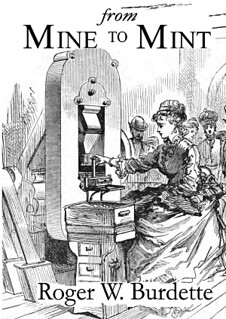 The late David J. Ginsburg (1958-2016) suggested several times that I read Roger Burdette's
comprehensive magnum opus From Mine to Mint. Regrettably, I never got around to it until
now, having neglected the chance to talk with Dave in person about his contributions to this
volume.
The late David J. Ginsburg (1958-2016) suggested several times that I read Roger Burdette's
comprehensive magnum opus From Mine to Mint. Regrettably, I never got around to it until
now, having neglected the chance to talk with Dave in person about his contributions to this
volume.
Dave had an endless curiosity about fiscal documents, early paper money, southern gold and economic operations in the nineteenth century. He often shared his early documents, coins and paper money with us during the show-and-tell segments of our monthly New Jersey Numismatic Society (NJNS) meetings.
As for From Mine to Mint, Burdette notes in his acknowledgments, "Dave Ginsburg opened his incredible store of financial, legal and gold movement information in the United States." (From Mine to Mint, p. 9). It is heartening to remember Dave by reading this book.
Dave and I shared a passion for numismatic writing, serving as club officers in the NJNS and promoting the importance of public libraries. Ginsburg served as a trustee of the Glen Ridge Library Board. He was the person who suggested that I publish an article in The E-Sylum, which I did in 2014. At the time of his unexpected passing on February 3, 2016, Dave was getting ready to submit several numismatic manuscripts for publication. A fine thinker and friend gone too soon.
Thank you. I miss Dave's regular The E-Sylum contributions. -Editor
To read the earlier E-Sylum articles, see:
NEW BOOK: FROM MINE TO MINT
(https://www.coinbooks.org/esylum_v16n12a04.html)
BOOK REVIEW: FROM MINE TO MINT
(https://www.coinbooks.org/esylum_v16n17a06.html)
Washington at the Barber Shop
John Sallay passed along this cartoon by John O'Brien from this week's New Yorker. Thanks! -Editor


VOCABULARY TERM: SQUARE SHAPE
Here's another entry from Dick Johnson's Encyclopedia of Coin and Medal Terminology. I added the medal image from the Frick collection. -Editor
Square Shape. A coin or medal with four edges of equal length and four right angles. Modern symbolism for the square shape is difference and independence, to be the square peg in a world of round holes. Earlier it meant order and stability, as the four seasons or the four stages in man's life. A square shape is considered less sensual to the human touch than the circle because of the corners. A square panel is called a meotope, often a square frame enclosing a medallic design.
Square coins. Coins of roughly square shape exist for a major reason of the ease of preparing the blank. Cutting square blanks is easy with a pair of shears and can be done manually. Thus provisional or emergency coinage is frequently in square or diamond (klippe) shape. In modern times with modern equipment Netherlands struck a square 5-cent coin (1913-43) with rounded corners.


Giangiacomo Trivulzio Medal
Square medals. While a square medal might be confused with a plaquette, both having four right angle corners by definition, a plaquette is usually one sided and thinner.
A square medal always has two sides, obverse and reverse, and sufficient thickness for its medallic design. An early example was the Giangiacomo Trivulzio Medal of 1449, by Cristofano Caradosso (Kress 192). A recent example is the Society of Medalist Issue number 69 by Robert Weinman.
To read the complete entry on the Newman Numismatic Portal, see:
Square Shape
(https://nnp.wustl.edu/library/dictionarydetail/516798)
KEN BRESSETT INTERVIEW, PART SIX
Greg Bennick's latest interview for the Newman Numismatic Portal is with "Mr. Redbook". Ken Bressett. Here's the final part, with Ken's stories involving Penn Jillette's family, Q. David Bowers, the Atocha dive, the Royal Numismatic Society obituary mix-up, and his major honors including the ANA Hall of Fame. -Editor
 GREG BENNICK: So, before we planned the interview, you made quick mention
of something which was mind-boggling to me. I know that Penn Jillette of
Penn & Teller—his father was a coin dealer—but I would not have made the
connection had you not emailed me saying that you enjoyed my juggling
performance because of your connection with Penn. So, please tell me
more. I would love to know more about that and you made mention to me of having some anecdotes about your connection to Penn and his father, which is a numismatic connection as I understand it.
GREG BENNICK: So, before we planned the interview, you made quick mention
of something which was mind-boggling to me. I know that Penn Jillette of
Penn & Teller—his father was a coin dealer—but I would not have made the
connection had you not emailed me saying that you enjoyed my juggling
performance because of your connection with Penn. So, please tell me
more. I would love to know more about that and you made mention to me of having some anecdotes about your connection to Penn and his father, which is a numismatic connection as I understand it.
KEN BRESSETT: Right! I first met Sam, his father, at a coin club meeting because we lived fairly close together and we went to the same coin club meetings. In fact, I had started a coin club in my hometown in Keene, New Hampshire, and Sam used to come to those meetings. We got to know each other very well and found out that we didn't live very far apart. So there was a solid connection between Penn's father Sam, and then my wife and myself and Sam and Valerie.
And so, we just had that connection. Let me see now: when Penn was born, they were expecting another girl. Val, Penn's mother, and Sam and I knew that when she was pregnant, they were expecting another girl. I don't know why, but it was going to be another girl. And they were going to name her Penny because that was what Sam collected mostly—large cents and small cents. He loved pennies. So he was going to name this girl Penny. And that's how Penn got his name. When it turned out to be a boy, they just named him Penn.
GREG BENNICK: Wow.
KEN BRESSETT: That's how that happened.
GREG BENNICK: That's fascinating. I had no idea.
KEN BRESSETT: I think I mentioned about Penn's one fingernail that's always red?
GREG BENNICK: You did mention that, and I would love to hear the story.
KEN BRESSETT: Penn is really devoted to his father and mother. He was very, very close to them. He looks and acts a lot like his father. His father was a big, burly guy. He was a jail guard when he wasn't collecting coins and acting as a coin dealer. Penn is about his size. But in his devotion to his mother—to remind him always of her and to be close to her—that's why he has that one red fingernail.
GREG BENNICK: I had no idea.
KEN BRESSETT: Yep. And now, Penn has some children. He has two children. Did you know that?
GREG BENNICK: I knew he had one. I thought he had a daughter, but I didn't realize he had two.
KEN BRESSETT: Yes, he has a son named Zolten, which is after his wife. His wife's name was Emily Zolten. But anyway, his daughter, who is now an amateur magician, is named Moxie. But do you know her full name?
GREG BENNICK: I don't, no.
KEN BRESSETT: Her full name is Moxie CrimeFighter Jillette.
GREG BENNICK: Wow, what a name.
KEN BRESSETT: He told me once that he named her that because he wanted her to have a special name—Moxie. And in case she ever got arrested for speeding or something like that, she could say, "I'm such a crime fighter, that's my middle name!"
GREG BENNICK: Wow.
KEN BRESSETT: But it truly is Moxie CrimeFighter Jillette.
GREG BENNICK: Incredible.
KEN BRESSETT: Do you know what Moxie is?
GREG BENNICK: Moxie is having character, personality, vivaciousness?
KEN BRESSETT: Well, yes and no. Moxie is a carbonated drink. It's the first non-alcoholic carbonated drink, guaranteed not to contain anything harmful. Invented in the 1880s. Very popular in New England. Being an old New Englander, I know all about Moxie.
There's another New Englander who knows all about Moxie, and that is Q. David Bowers. He wrote a book called The Moxie Encyclopedia, Volume 1.
GREG BENNICK: Why does this not surprise me?
KEN BRESSETT: And it was a joke too, because there is no Volume 2.
GREG BENNICK: Amazing.
KEN BRESSETT: It's fun what you know when you really get into numismatics.
GREG BENNICK: Absolutely. Tell me about your interactions with Dave Bowers.
KEN BRESSETT: We've always been very, very close. He's used me often for peer review of his manuscripts or to write a foreword. He once invited me to go to work for him, but I didn't want to move at the time. I probably should have—he's been immensely successful at everything he does. But we've been very close friends our entire lives.
GREG BENNICK: You also mentioned the Atocha and diving. Could you tell me, tell me more about that?
KEN BRESSETT: Yes. Mel Fisher was a con artist who sold stock in his fake company called - I forgot the real name of his company - but it had to do with deep sea diving recoveries. He would take a potential investor in his company out on a little boat ride and, have a diver go down where he thinks there might be treasure and the diver would come up with a, a doubloon, or a piece of eight. And everybody got excited and the investor wanted to invest in the company right away because he knew this was going to be wonderful.
I think he must have sold many more shares than he really should have. One fine day, good old Mel Fisher discovered, the sunken ship, the treasure ship, the Atocha. And nobody wanted to believe him by then. He phoned the ANA and said, "You have somebody there on staff, because you're a numismatic association. You have somebody there that knows about sunken treasure and, can verify that these coins are genuine and that we've discovered a gold mine here." And, they said, "Yes, we have, Robert Hoge, our museum curator, and, Kenneth Bressett, who is in the education department." And they said, "Send them on." And they paid our all our expenses to go to Florida, off the Keys. We had to go out and learn to do scuba diving.
GREG BENNICK: Wow.
KEN BRESSETT: I'm a PADI certified diver. Still am.
GREG BENNICK: That's great. We have that in common. I'm a PADI certified rescue diver too, so this is wonderful.
KEN BRESSETT: Oh, good for you. Good for you. When I did the dive with Fisher, it was only about 60 feet. Deep enough to need a dive master. We verified his coins. I saw emeralds, gold bars, the big chain. Sometimes you see pictures of divers with this huge gold chain around their neck. When we left, they had a party for us, and I wore that big gold chain all evening.
GREG BENNICK: I had no idea. Again, I'm sure we could talk for hours and uncover more adventures, and eventually you're going to be running across the surface of a moon, with a handful of coins or across the tundra of Africa.
KEN BRESSETT: (Laughs) Yes.
GREG BENNICK: So, an unusual question. When you had emailed me back, you made mention of something that I thought I must have read it wrong, or maybe I read it right and it's just bizarre, but you wrote about your obituary from the Royal Numismatic Society?
KEN BRESSETT: (Laughs) Yes.
GREG BENNICK: Please enlighten me.
KEN BRESSETT: Well, as the story goes, the story of my death has been greatly exaggerated. (Laughs) I was a member of the Royal Numismatic Society for many years and that is really a great honor to be in the Royal Numismatic Society in England.
GREG BENNICK: Sure.
KEN BRESSETT: It's a special appointment from the Prince. I was very happy to do that and to be that and have that honor. But I only went to England occasionally, and I didn't get to their meetings. I got the subscription to their annual reports and books and things like that. There came a time when I thought, "My goodness, I'm spending a lot of money on this and getting very little out of it because I no longer collect those coins and I've moved on with my interest. So I didn't renew my subscription. That was it.
GREG BENNICK: Right.
KEN BRESSETT: And nobody, I mean nobody would give up their membership in the Royal Numismatic Society unless they had died. So they figured I had died! And they wrote a nice little obit for me.
GREG BENNICK: Oh, wow.
KEN BRESSETT: (Laughs) So that's the story. And it really happened.
GREG BENNICK: Okay, so I did read it correctly.
KEN BRESSETT: Yes, you did. Yes!
GREG BENNICK: Wow.
KEN BRESSETT: Even though it was greatly exaggerated.
GREG BENNICK: Greatly exaggerated. Well, this is, this is wonderful. I would be remiss if I didn't ask you about some of your appointments. You were on the Citizens Advisory Committee and the US Assay Commission as well. You were appointed to the Assay Commission by President Johnson, as I understand.
KEN BRESSETT: Yes, that's correct in 1966.
GREG BENNICK: Can you tell me a little bit about that work with the US Assay Commission?
KEN BRESSETT: The Assay Commission was founded in 1792 or 1793. It verified the weight and purity of the nation's coins. It continued until around 1968. It was a nice custom. You had to be fairly well known to be appointed by the president. I was fortunate to do that and to get the appointment and get a presidential medal for doing it.
GREG BENNICK: And you still have the medal?
KEN BRESSETT: Oh, absolutely.
KEN BRESSETT: I have the medal and in fact, I've collected Assay Commission medals, which are rather scarce because people don't really give them up until they die. And, so that's just another branch of my collecting.
GREG BENNICK: I think it's fantastic. So let me do this before we wrap up. You know, of all the books that you've been a part of creating over the years, the association with the Red Book is most widely known. Are there other publications that you feel most connected to, in your time working on and contributing to books and whatnot?
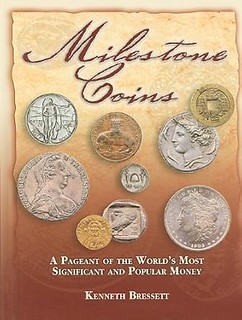
KEN BRESSETT: There's a book called Milestone Coins that I particularly like. that I wrote - I don't know exactly when that was - a few years ago. Its a series of short stories about very interesting coins that tell the history of the world through this small number of twenty coins or whatever it is. I particularly like that book.
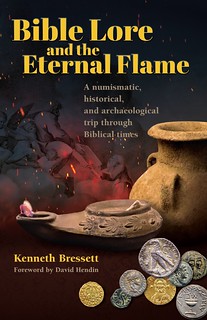
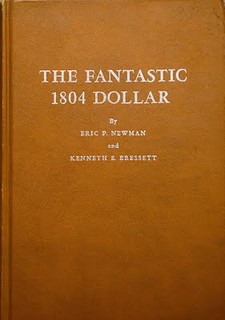
Another one I'm attached to is Money of the Bible. I collect the coins mentioned in the Bible. A sequel was Bible Lore and the Eternal Flame. And of course, the Fantastic 1804 Dollar was something that I did with Eric Newman and that's been wonderful.
GREG BENNICK: Yeah, that's one that I'm looking at across the room even as we speak right now.
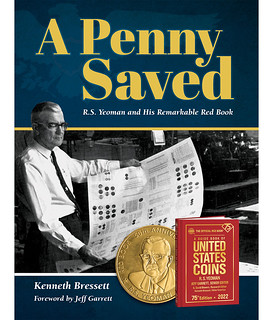
KEN BRESSETT: There's something called A Penny Saved. Like the sayings of Ben Franklin, "a penny saved is a penny earned." But, the book called A Penny Saved is the story of Yeoman and the Red Book. And it has in it my biography. Up to that date anyway. I haven't finished writing my biography yet, but I'm still working on it.
GREG BENNICK: Unlike the Royal Canadian, or the Royal Numismatic Society who have completed your biography.
KEN BRESSETT: (laughter) Right. Right.
GREG BENNICK: Well, Ken, this has been absolutely wonderful. Is there anything that we missed that you hoped that I would ask that we haven't talked about? We are trying to be comprehensive and covering a wide number of things that I found interesting or that I thought other people would find interesting. Is there anything that I didn't cover that maybe you'd want to mention?
KEN BRESSETT: Well I'm as proud as I can be of my election to the Hall of Fame of the ANA.
GREG BENNICK: Oh yeah!
KEN BRESSETT: American Numismatic Association Hall of Fame. There are only like seven living members. That has been something that has made me feel that my work and my efforts have been really acknowledged. So I guess that was one of the big things in my life was getting into the Hall of Fame.
GREG BENNICK: I'm so glad. That was in the 1990s, right? 1996?KEN BRESSETT: Yes, I think that's correct.
GREG BENNICK: Well, I'm so glad that you have that sense of being acknowledged. I mean, that plus every single numismatist walking the earth who's been influenced by you, basically all of us. So, I mean, everybody is deeply thankful. When you walk around Colorado Springs, it's like a rockstar has just walked into our neighborhood. So it's wonderful to have a chance to talk to you today. I'm so happy about it.
KEN BRESSETT: Well, I really appreciate you're saying that. Again, I hope this is what you wanted to hear and I hope you enjoy all of this.
GREG BENNICK: Absolutely is. I'll just mention right now that if people are interested in hearing more interviews, I've done more interviews on the Newman Numismatic Portal. You can look up those interviews with other people who are fascinating and amazing, maybe not with some of the wild stories that Ken has told today but equally interesting. I always am looking for ideas for new interviewees and people can be in touch anytime. But Ken, thank you so much. I really appreciate it.
KEN BRESSETT: Oh, good. Well, I thank you and I really enjoyed it and I thank you for all your efforts.
GREG BENNICK: Thanks, Ken. Have a wonderful day and I'll talk to you soon.
KEN BRESSETT: All right. Thank you.
 About the Interviewer
Greg Bennick (www.gregbennick.com) is a keynote speaker and long time coin collector with a focus on major mint error coins and US counterstamps. He is on the board of both CONECA and TAMS and enjoys having in-depth conversations with prominent numismatists from all areas of the hobby. Have ideas for other interviewees? Contact him anytime
via instagram @minterrors.
He can also be reached by email at
minterrors@gmail.com.
To watch the complete video, see:
Ken Bressett, Interviewed by Greg Bennick
(https://www.youtube.com/watch?v=emQlt4zLTxU&t=1s)
To read the earlier E-Sylum article, see:
KEN BRESSETT INTERVIEW, PART ONE
(https://www.coinbooks.org/v29/esylum_v29n22a17.html)
KEN BRESSETT INTERVIEW, PART TWO
(https://www.coinbooks.org/v29/esylum_v29n23a18.html)
KEN BRESSETT INTERVIEW, PART THREE (https://www.coinbooks.org/v29/esylum_v29n24a14.html
KEN BRESSETT INTERVIEW, PART FOUR (https://www.coinbooks.org/v29/esylum_v29n25a12.html)
KEN BRESSETT INTERVIEW, PART FIVE (https://www.coinbooks.org/v29/esylum_v29n26a15.html)

NUMISMAGRAM MEDAL SELECTIONS: JULY 5, 2026
Numismagram's Jeremy Bostwick sent along these five medals from his most recent upload of new material to his site. For all of the new items, please visit https://www.numismagram.com/inventory. -Garrett

102998 | UNITED STATES & GERMANY. Colonial America and Preußen (Prussia) silver Medal. Issued 1763. The Treaty of Hubertusburg and the end of the Seven Years' War (French and Indian War in America) (44mm, 21.90 g, 12h). By Johann Leonhard Oexlein.
IAM REDIRE AVDET (now she dares to return...), Astraea/Virgo standing facing, head right, holding scepter and grain ear; mountains and plowman in background; in two lines in exergue, GERMANIA / PACATA (...with Germany being at peace) // NVNCIA PACIS (the messenger of Peace), view of the Hubertusburg Palace; above, Fama (Rumor) flying right, blowing in one trumpet and holding another; D 15 FEBR MDCCLXIII in exergue. Edge: Plain.
Betts 446; Pax in Nummis 595; Olding 931; Henckel 1658. PCGS AU-58. Exceptionally lustrous and vibrant, with some darker toning populating the peripheries. An enchanting near mint example with great eye appeal. Christopher McDowell, in Medals of the Americas, The Betts Companion (1747-1763), sheds new light upon the female figure gracing the obverse of these types, whom we have long described as Germania, but has now been more accurately described as Astraea/Virgo.
Sometimes referred to as 'World War Zero,' given its scale overall number of belligerent powers, the Seven Years' War began primarily with Austria's desire to recover Silesia from the Kingdom of Prussia. Since Great Britain had been aiming to increase her colonial possessions in the New World at the expense of France, the strife in the American theater began to merge with that in Europe, resulting in a legitimate global conflict, with every major European power taking the side of either Great Britain/Prussia or France/Austria. In addition to North America and Europe, skirmishes also played out in Central America, the western coast of Africa, India, and the Philippines. Ultimately, a peace was achieved through the Treaty of Paris, formally ending all conflicts save for the Silesian question; the Treaty of Hubertusburg, signed five days later, ended the issue between Prussia and Austria, formally ending the war.
Hubertusburg Palace was begun in 1721 at the behest of August II ‘the Strong,' the Elector of Sachsen (Saxony) and King of Poland, and completed just three years later in 1724. The naming for the new palace emanated from the fact that August commissioned its construction on 3 November during the feast of St. Hubertus. What was originally a baroque castle—one of the largest in Europe at the time—was rebuilt in the decades following August's death by his son and successor, August III—this time in rococo fashion. Used a great deal as a hunting lodge, the palace was left virtually unoccupied at the outbreak of the Seven Years' War in 1756. Upon the conclusion of the war in that theater, a peace treaty was ratified there, though furniture from nearby venues needed to be retrieved in order to furnish the mostly empty palace, as it had been wholly plundered during the war. Shortly thereafter, its use as a leisure residence was over, as it served as a military hospital during the Napoleonic Wars and a penitentiary during the second half of the 19th century.
To read the complete item description, see:
102998 | UNITED STATES & GERMANY. Colonial America and Preußen (Prussia) silver Medal.
(https://www.numismagram.com/product-page/102998)

103556 | FRANCE. National Convention bell metal Medal. Issued 1792/Year 1 of the Republic (38mm, 12h). By André Galle in Lyon.
LIBERTE FRANÇOISE / L'AN I DE LA R F, head of Liberty left, with hair flowing freely and with pole surmounted by Phrygian cap over far shoulder // A LA / CONVENTION / NATIONALE / PAR LES / ARTISTES REUNIS / DE LYON / PUR METAL / DE CLOCHE / FRAPPE EN / MDCCXCII in ten lines; all within garlanded oak wreath.
Mazard 318a; Guilloteau 338; Bramsen 190b. PCGS MS-62. Dark chestnut-brown surfaces, with some appealing brilliance that elevates the finer details of the portrait, with a minor stain noted below it. On account of the composition (melted down bells), the level of craftsmanship of surviving examples tends to be on the poorer side.
Ex Heritage 3089 (22 January 2021), lot 32514.
A popular and attractive type that clearly drew great inspiration from the Libertas Americana medal issued a decade prior, and paralleled the contemporary American coinage during the mint's initial outputs of "flowing hair" designs.
To read the complete item description, see:
103556 | FRANCE. National Convention bell metal Medal.
(https://www.numismagram.com/product-page/103556)

103348 | UNITED STATES & ITALY. Christopher Columbus/"Memento" white metal Medal. Issued 1893 for the Columbian Exposition in Chicago (59mm, 80.87 g, 12h). By Ludovico Pogliaghi & Angelo Cappuccio for Stefano Johnson in Milano.
MEMENTO OF THE WORLD'S FAIR / CHICAGO 1893, CHRISTOPHER COLUMBUS, robed bust facing slightly left // The fruits of Columbus's first voyage: Winged personification of Civilization facing slightly left, head right, surrounded by Genii representing Education, Commerce, and Industry; to lower right, native chief, maiden, and two warriors crouching defensively; at a distance, coastline with the U.S. Capitol before rising sun; around, border comprised of alternating stars and state shields. Edge: Plain.
Eglit 105; Starlust ST-eg-105wm; Rulau p. 100 note. Choice Mint State. Highly flashy and radiant in the fields, with some scattered hairlines noted, but great overall contrast between fields and devices.
During the lead-up to the quadricentennial of Columbus's initial contact with the New World, numerous medals were designed and struck, both in the United States—in conjunction with the 1893 Columbian Exposition in Chicago—and abroad—sometimes for this event or for similar others. In this case, the so-called "Civilization" medal was produced commemorating the quadricentennial in Italy by the highly-accomplished medal manufacturer, Stefano Johnson in Milano. The reverse for the "Civilization" type was then paired the following year with a modified obverse and English inscription used for the Columbian Exposition held in Chicago.
To read the complete item description, see:
103348 | UNITED STATES & ITALY. Christopher Columbus/"Memento" white metal Medal.
(https://www.numismagram.com/product-page/103348)

103641 | UNITED STATES. New Netherlands Tercentenary bronze Medal. Issued 1914 for the 300th anniversary of the founding of New York City (69mm, 128.44 g, 12h). By Paul Manship for the Circle of Friends, and struck by Joseph K. Davison & Sons in Philadelphia.
TERCENTENARY NEW YORK / 1914, armored, draped, and mural-crowned civic personification of New York City seated facing on throne, holding torch and building model; to left and right, respectively, shields bearing serpent-entwined caduceus and anchor (representing commerce and shipping), each surmounted by Phrygian cap; cornucopiae in garlanded cartouche in exergue // NEW NETHERLAND FOUNDED / 1614, Dutchman, holding musket set upon ground, and Native American, holding pipe and longbow, standing facing one another, in background between, ship under sail right, with small windmill to upper left; in exergue, beaver right in garlanded cartouche. Edge: CIRCLE OF FRIENDS / DAVISON PHILA.
Alexander COF-11.1; Marqusee 253; 100 Greatest American Medals and Tokens 162. Choice Mint State. Tan-brown surfaces, with a mostly matte aspect. A very rare and sublime issue from one of the more popular American medalists of the early 20th century.
To read the complete item description, see:
103641 | UNITED STATES. New Netherlands Tercentenary bronze Medal.
(https://www.numismagram.com/product-page/103641)

103614 | UNITED STATES. Ruth Bader Ginsburg bronze Medal. Issued 2013. Jewish-American Hall of Fame series: commemorating the second woman (and first Jewish woman) on the US Supreme Court (48mm x 46mm, 76.96 g, 12h). By Eugene Daub for the Highland mint.
JUSTICE - RUTH / BADER / GINSBURG, robed bust facing slightly right, wearing her distinctive jabot // Moses seated facing, holding Ten Commandments; in five lines in exergue, THE DEMAND / FOR JUSTICE RUNS / THROUGH THE ENTIRETY / OF THE JEWISH / TRADITION. Edge: 065.
JAHF 44. Choice Mint State. Tan-bronze surfaces, with some darker antiqued hues in the recesses. Serially numbered 65 of 100 produced.
To read the complete item description, see:
103614 | UNITED STATES. Ruth Bader Ginsburg bronze Medal.
(https://www.numismagram.com/product-page/103614)
HERITAGE: RUSSIAN COINS SHOWCASE
Heritage Auctions will be hosting their Russian World Coins Showcase Auction on July 6. Select items are discussed below. -Garrett


Peter I bronze "Beard Tax" Token 1705 VF35 Brown NGC, Bit-3893 (R2), Rudenko-b.3. 'Narrow Beard' type, with countermark. Despite the quality, this token radiates with desirability as it falls in a fascinating place in history.
Following Peter I's travels to Europe, where he encountered far fewer men wearing facial hair, he wished for Russia to become more like Europe and have men shave their beards. As this caused great consternation, a compromise was achieved by allowing men to keep their facial hair through the payment of an annual tax. Proof of payment was conveyed through carrying one of these tokens--generally issued in copper--as a form of receipt.
To read the complete item description, see:
Peter I bronze "Beard Tax" Token 1705 VF35 Brown NGC,
(https://coins.ha.com/itm/russia/russia-peter-i-bronze-beard-tax-token-1705-vf35-brown-ngc-/a/61653-22014.s?ic4=ListView-ShortDescription-071515)


Anna Rouble 1732/1 AU50 NGC, Kadashevsky mint, KM192.1, Dav-1670. Overdate variety on a handsome representative.
To read the complete item description, see:
Anna Rouble 1732/1 AU50 NGC,
(https://coins.ha.com/itm/russia/russia-anna-rouble-1732-1-au50-ngc-/a/61653-22017.s?ctrack=200071&type=featured-2-coinus-news-tem070126)


Alexander I of Russia gold 50 Zlotych 1819-IB AU Details (Obverse Cleaned) NGC, Warsaw mint, KM-C103, Fr-105, Bit-806. Large head variety. The less frequently encountered of the types. Blazing saffron gives this piece a distinctive, rich color, enhanced by luster that causes the sharp details on the reverse to glitter. Seldom found in Mint State.
To read the complete item description, see:
Alexander I of Russia gold 50 Zlotych 1819-IB AU Details
(Obverse Cleaned) NGC,
(https://coins.ha.com/itm/poland/poland-alexander-i-of-russia-gold-50-zlotych-1819-ib-au-details-obverse-cleaned-ngc-/a/61653-22008.s?ctrack=200071&type=featured-2-coinus-news-tem070126)


Nicholas II Rouble 1898-A? MS61 NGC, St. Petersburg mint, KM-Y59.3, Bit-43. Deeply mirrored fields and a brilliant luster on the obverse and reverse.
To read the complete item description, see:
Nicholas II Rouble 1898-A? MS61 NGC,
(https://coins.ha.com/itm/russia/russia-nicholas-ii-rouble-1898-aand-1043-ms61-ngc-/a/61653-22069.s?ctrack=200071&type=featured-3-coinus-news-tem070126)


Nicholas II gold 5 Roubles 1909-?? MS66 NGC, St. Petersburg mint, KM-Y62, Fr-180.
To read the complete item description, see:
Nicholas II gold 5 Roubles 1909-?? MS66 NGC,
(https://coins.ha.com/itm/russia/russia-nicholas-ii-gold-5-roubles-1909-and-1069-and-1041-ms66-ngc-/a/61653-22089.s?ctrack=200071&type=featured-1-coinus-news-tem070126)


USSR gold & platinum "Order of Lenin" Medal ND (1930) AU, Werlich-Figure 1278, page 426. 38.5x37.9mm (just badge). 41.40gm. XRF: 23 karat (.958). "[Moheth?i? ?bop] The Monastery Courtyard 423742" on reverse. BADGE: Gold and platinum circular medallion. In the center is a portrait of Lenin in platinum against a dark azure enamel background bordered with a gold wreath of rye. Above Lenin's head is a red banner inscribed in gold with the name, LENIN. Below the portrait is a red hammer and sickle, above and to the left is a small, gold five-pointed Star. When first issued the Badge had a portrait against a background of factories, and a tractor. On November 19, 1931 the production of badges of this design was stopped and old-type badges were exchanged for the present type. As a consequence, the old type are extremely rare-only two or three are known to be in existence. No Star. RIBBON: Red moire edged in gold with gold stripe towards each edge.
To read the complete item description, see:
USSR gold & platinum "Order of Lenin" Medal ND (1930) AU,
(https://coins.ha.com/itm/russia/russia-ussr-gold-and-platinum-order-of-lenin-medal-nd-1930-au-/a/61653-22118.s?ctrack=200071&type=featured-1-coinus-news-tem070126)


USSR gold "Hero of the Socialist Order" Medal ND (1938) AU, Werlich-Figure 1276, page 426. 31mm (just badge). 22.40gm. XRF: 22 karat (.916). "[????? ????????????????? ??y?a] Heroes of Socialist Labor 18504" on reverse. BADGE: Five pointed gold star with raised hammer and sickle in the center. On the reverse is the Russian inscription HERO OF SOCIALIST LABOR with an identification number in the top ray. No Star. RIBBON: Red moire.
To read the complete item description, see:
USSR gold "Hero of the Socialist Order" Medal ND (1938) AU,
(https://coins.ha.com/itm/russia/russia-ussr-gold-hero-of-the-socialist-order-medal-nd-1938-au-/a/61653-22120.s?ctrack=200071&type=featured-3-coinus-news-tem070126)

DAVISSONS: E-AUCTION 53
Davissons' will be hosting E-Auction 53, featuring British, World, and U.S. coins and tokens. The sale closes on July 8. Here is the press release. -Garrett
E-Auction 53 closes next week, on Wednesday, July 8th 2026!
Be sure to browse the 331 carefully selected lots over the weekend, and come back to bid live with us next week!
Read on as we survey the second half of the sale, featuring British, World, and U.S. coins and tokens, highlighted by The Harold Welch Collection of British trade tokens.

We recently acquired the final part of a British collection formed by one of the first serious collectors to take part in our auctions in the early days—material his heirs found recently. (We purchased the main portion of his collection nearly a decade ago.) You will see a few pieces here and more in subsequent sales. Interspersed are coins from other consignments, such as the historic Edward VI sovereign above.


These coins reminded me of our decision to run auctions rather than fixed priced lists. Pulling together enough material to present a respectable auction was our first challenge. Then there was the physical challenge of producing a catalog with the photography and printing technology at the time.
There was also the decision to not have a buyer's fee—something that was becoming prominent at the time and something I found annoying as a buyer.


This sale's provincial token coinage offering includes more of the quality collection formed by Harold Welch. The Kempson and Skidmore penny size building tokens of the era—Middlesex, and the halfpenny Warwickshire issues are a particularly well designed series that provides a look at the cityscapes people experienced at the time. Look also for a few choice Spence issues and a short section of Angusshire issues.


The sale wraps up with a mixture of historic crowns, some high quality United States type coins including some Carson City dollars and a few unusual but fascinating bits including three "box medals."
We have enjoyed putting this sale together, and hope you find things of interest. And if you have a few pieces that you want to de-access in anticipation of something different, or an entire collection you have worked on, do get in touch. We will treat your material with great care, bring all our experience to bear in cataloging and presentation to our worldwide client base, and will produce a printed catalog that you will have as a record of what you have achieved.

HERITAGE: 2026 SUMMER FUN U.S. COINS
Heritage Auctions will be hosting their Summer FUN U.S. Coins Auction on July 16-18, including the Fudd, Cole Carter and Bellaire collections. Here is the press release. -Garrett
A rare double eagle that is among the most desirable classic U.S. gold coins will be one of the top attractions in Heritage's July 16–18 Summer FUN US Coins Signature® Auction. Boasting more than 1,400 lots, the event will feature exceptional coins of all denominations, from Colonials to proof Trade dollars, Morgan dollars, patterns and gold.


1888 Double Eagle, PR64 Deep Cameo PCGS
An extraordinary 1888 Double Eagle, PR64 Deep Cameo PCGS hails from the 1888 proof mintage of either 102 or 105 pieces. Only 20-25 proofs remain, most of which are firmly held in advanced double eagle collections. The Cameo examples range from PR61 to PR66, with 16 examples listed. Deep cameos, including the one offered in this auction, fall between PR64 and PR66. This is one of just four carrying a PR64 grade.
"This is a remarkable coin that was designed by James B. Longacre, the former Chief Engraver of the U.S. Mint, and struck during the Gilded Age, when proof gold coins were a mark of distinction for collectors," says Todd Imhof, Executive Vice President at Heritage Auctions. "The demand is only multiplied by the remaining population that has dwindled over the years because so many were lost, melted or impaired. Collectors building the finest type sets often seek a Deep Cameo proof because they represent the series at its artistic best — a description exemplified beautifully by this coin."


1797 Draped Bust Half Dollar, O-101a, VF20 PCGS. Amato Unlisted....
A 1797 Draped Bust Half Dollar, O-101a, VF20 PCGS is a beautiful example of one of the rarest silver type coins, a treasure that ranks among the most desirable issues for early half dollar collectors. Housed in an early PCGS "rattler" holder, it is an example previously unknown at Heritage, and unlisted in the Amato reference — the Overton-101a, Tompkins-1 variety.
"This is one of the few unlisted Small Eagle half dollars, with no auction appearances we can confirm in the last quarter century," says Imhof. "Fewer than 4,000 Draped Bust, Small Eagle half dollars were struck in 1796 and 1797 combined, and of those, only about 175 remain, making this an important piece that will assume a prominent place in a new collection once it crosses the auction block."


1831 JR-2 Capped Bust Dime, PR67 NGC
Capped Bust dimes rarely are seen in proof format, which is helping to drive intense interest in a 1831 JR-2 Capped Bust Dime, PR67 NGC that will be offered in this auction and ranks at the top of Heritage's roster of high-grade JR-2 proof dimes. Long ago, renowned numismatist David Akers estimated six to eight 1831 JR-2 proof dimes survive, while more recently, Early United States Dimes mentions at least three JR-2 proofs and an unspecified number of JR-4 proofs. PCGS estimates 15-20 proofs from 1831, but that total is regarded as generous. Heritage's current roster lists eight 1931 proof dimes for all varieties combined. This type is believed to have been designed by former U.S. Mint assistant engraver John Reich.


1861-Dated Confederate Cent, Haseltine's Copper Restrike, PR63 Brown PCGS. CAC. Breen-8008, Bertram-B861-202...
Also in play is an 1861-Dated Confederate Cent, PR63 Brown PCGS. CAC. Coin dealer John W. Haseltine's circa-1874 copper restrike is believed to have been struck from Robert Lovett's dies, reportedly produced in New York in 1861 — the same year that coins were made for the Union in the same mints at New Orleans, Charlotte and Dahlonega. Actual coinage from the Confederacy was quite limited. For years numismatic texts called the 1861-dated copper-nickel coin an original, but the first example appeared in 1873, after which 11 more were revealed and marketed along with "restrikes" in bronze, silver and gold. This famous restrike is the Breen-8008, Bertram-B861-202 variety.


1932-S Quarter MS66+ PCGS. CAC
Collectors will have an opportunity to bid on the finest certified example of a 1932-S Quarter MS66+ PCGS. CAC. The 1932-S is one of the two key issues in the Washington series, more available in the top MS66 grade than its Denver counterpart, although it is still conditionally rare this fine. PCGS and NGC combined report only 20 examples graded in MS66, only three of which are endorsed by CAC. The coin offered in this auction is the only one that is Plus-designated, making it the sole finest 1932-S quarter certified. Most current high-ranking Registry Sets lack a 1932-S in MS66, opting instead for the more accessible MS65 or MS65+ grades.
The Fudd Collection
The auction includes 101 lots from the collection of John Erickson, who was given the "Fudd" nickname by his fraternity brothers at the University of Minnesota. Erickson built several collections, which also included troves of pocket watches and hockey memorabilia and the largest and finest date collection of Liberty double eagles — first by assembling the largest date collection of Liberty double eagles and then trading up in coin quality. Included among the highlights from the collection:


1930-S Eagle, MS64+ PCGS CAC
A 1930-S Eagle, MS64+ PCGS CAC is a beautiful example of an extremely rare issue that rarely reaches the auction block. Of the 96,000 examples of the issue that were struck, as many as 95,000 were melted down after 1933. Most branch Mint dates of post-1916 eagles and double eagles remained in Treasury vaults and were melted in the late 1930s, making them very rare today; 1920-S and 1930-S Indian Head eagles are exceedingly elusive. Most 1930-S eagles never left the Mint. Only an estimated 150-200 Mint State examples remain. The vast majority of survivors are in Mint State, and the example offered in this auction is in the upper range of that grade distribution.


1884-S Double Eagle, MS65+ PCGS CAC
An 1884-S Double Eagle, MS65+ PCGS CAC once resided in the collection of D. Brent Pogue and is the finest example at PCGS. Most San Francisco double eagles from the era follow a similar pattern, with examples carrying grades of VF through MS62 appearing with some frequency, while finer-graded examples are far more elusive, in part because gold circulated far more readily in the West than it did in the East. Double eagles were the American trade coin of choice, enjoying much higher mintages than the lower gold denominations due to their convenience — exporting one double eagle is easier than two eagles or four half eagles. This example appears to be one of the few non-exported survivors, or at the very least, one that miraculously survived without the bagmarks that are the hallmark of repatriated examples.


1920-S Double Eagle, MS62
A 1920-S Double Eagle, MS62 is one of an estimated 80-120 survivors from an original mintage of 558,000. The 1920-S kicks off the final run of Saint-Gaudens issues, after a four-year production hiatus. The branch mint issues largely avoided exportation, as these Mints were physically further from the United States financial epicenter of New York than the Philadelphia Mint. These issues were almost entirely stored as reserves, either at the Treasury Department in Washington, D.C., or at the 12 Federal Reserve banks, so, when the double eagles stored by the government were melted in the late 1930s, it included almost the entire mintage of these branch mint issues. The 1920-S produced one of the smallest surviving populations in absolute numbers, with an estimated 40-60 each in circulated and Mint State grades.
Other highlights from the Fudd Collection include, but are not limited to:
- An elusive 1927-S Saint-Gaudens Double Eagle, MS62 PCGS CAC
- The finest PCGS-graded example of an 1872-S Double Eagle, MS64 PCGS
- An 1861-S Double Eagle, AU55 NGC
- A 1920-S Indian Eagle, MS61 NGC
- An 1855 Wass & Molitor Twenty Dollar, Small Head, S.S. Central America #2 AU55 PCGS
Cole Carter Collection
The auction includes 116 lots from this assemblage that includes many key issues and varieties across multiple denominations. Among the highlights are three well-matched proof sets:
- An 1866 Nine-Piece Proof Set PR61 to PR65 PCGS
- An 1872 10-Piece Proof Set, PR62 to PR64 NGC
- An 1873 10-Piece Proof Set PR63 to PR 65 PCGS
Bellaire Collection
Also offered are 86 lots from the Bellaire Collection, which spans the range of denominations from cents to silver dollars, but strays from the blueprint of many top collections in that it contains no gold coins. Silver and copper issues dominate the assemblage, alongside a few Buffalo and Shield nickels. Early dollars, Gobrecht dollars, Seated dollars and Trade dollars provide many Choice examples, including several attractive early dimes and Bust dimes. Highlights include, but are not limited to:
- A 1794 V-4, LM-4 Half Dime, VF30 PCGS that is an earlier die state of this frequently seen 1794 variety
- A 1915-S Panama-Pacific Quarter Eagle, MS65 NGC that boasts an extraordinary medium yellow-gold color
- An 1895 JD-1 Proof Morgan Dollar NCS Proof AU Details FAM-2 JD-1 that is one of only 880 proofs distributed by the Philadelphia Mint; the low proof mintage was either an accounting error on the Mint report, or the coins were melted — none has appeared in numismatic channels
- An 1873-CC Seated Dollar, XF40 Details ANACS Details. XF40 Details that is rare in any grade — the Seated dollar date's mintage of 2,300 was further diminished by a number of coins melted prior to pending introduction of the Trade dollar
Images and information about all lots in the auction can be found at HA.com/1394.
HERITAGE TO SELL STARLUST COLUMBIANA
Steve Starlust authored the book Referencing Columbiana based on his 1,500 piece collection of medals, badges and souvenirs of the World's Columbian Exposition. Heritage will now be selling the collection. Here's an announcement. The date is yet to be set, but some lots will be previewed at the Pittsburgh ANA. -Editor
for World's Columbian Exposition Auction
In just 16 months, as an ANA member attending shows and events, Steve has accomplished the following:
-
 Wrote a book on the World's Columbian Expo that has sold hundreds and won "Best Reference Book of 2025 (Tokens and Medals)" by the Numismatic Literary Guild
- TAMS will be giving him an award for Best Reference Book at the upcoming ANA Pittsburgh
- Heritage Auctions has decided to do an exclusive "Steve Starlust Showcase Auction" on his Columbian Exposition collection and will be previewing NGC graded medals, and over 75 rare badges, tickets, and souvenirs in the auction beginning at their ANA Pittsburgh booth and continuing at future events. If you're at the ANA money show in Pittsburgh visit the Heritage Auctions booth to see a preview of his fantastic collection and say hello to Steve who will have copies of his award winning book.
- The theme of this dynamic auction has been agreed apon by Heritage and Starlust as "America is ReDiscovering Columbus - Something for every collector".
- NGC has printed a "first-ever" slab label insert for the World's Columbian Expo designed by Steve and the NGC art department. This limited edition label features the Ferris Wheel and "Steve Starlust Collection". He has submitted 300 items to be graded. NGC may be adopting some of his exclusive reference numbers from his book on their attributions.


Heritage, NGC, and Whitman Brands have suggested they would like to publish the next edition of his book "Referencing Columbiana" Volume One in 2027.
Jeff Shevlin will be promoting it to his so-called followers. TAMS will also be promoting it along with other publications and numismatic outlets.


"This has been quite a pleasant surprise for me. I would like to thank the ANA for acknowledging my book in their library along with so many other industry leaders and coin sellers praising it," Steve commented.
For more information on this premier showcase auction, or to order the new "Preview Deluxe" edition of Referencing Columbiana, contact Steve at stevestarlust@gmail.com.


To read the earlier E-Sylum article, see:
NEW BOOK: REFERENCING COLUMBIANA
(https://www.coinbooks.org/v28/esylum_v28n10a04.html)
NOONANS JULY 2026 PAPER MONEY SALE
This Noonans press release describes highlights of the firm's upcoming sale of British and Irish banknotes. -Editor
 Three extremely rare Irish banknotes, all bearing the serial number 000001 will be among the
highlights of Noonans auction of British and Irish Banknotes on Wednesday, July 8, 2026. The
trio of extremely special notes - a set of Ploughman notes (£10, £5 and £1) issued by the Royal
Bank of Ireland, all bearing serial number 000001 are expected to fetch £8,000-10,000; £6,000-
7,000 and £4,000-5,000 respectively [lots 407-405].
Three extremely rare Irish banknotes, all bearing the serial number 000001 will be among the
highlights of Noonans auction of British and Irish Banknotes on Wednesday, July 8, 2026. The
trio of extremely special notes - a set of Ploughman notes (£10, £5 and £1) issued by the Royal
Bank of Ireland, all bearing serial number 000001 are expected to fetch £8,000-10,000; £6,000-
7,000 and £4,000-5,000 respectively [lots 407-405].
As Ted Edmunds, Banknote Specialist at Noonans commented: "Given the rarity, condition and serial number, we believe this set of £1, £5 and £10 are arguably the finest set of Irish notes ever offered at auction."



Lots 405-407
Among the Scottish section of the auction is a Pudsey £5 note from the Bank of Scotland, dating from July 2015, with serial number PUDSEY05 which is estimated at £5,000-7,000 [lot 500].

Lot 500
As Andrew Pattison, Head of Noonans Banknote Department commented: "The ‘Pudsey' notes are the rarest polymer banknotes ever issued. In the decade since they were first auctioned for Children In Need, the value of the mere 50 notes produced has rocketed, and collectors are sure to be willing to bid heavily for this example with serial number 5."

Lot 98

Lot 125
Within the section devoted to English banknotes are several examples from the Bank of England. A rare £5 note that was issued in Hull on October 11, 1900, and signed by Chief Cashier Horace G. Bowen is estimated at £15,000-£20,000 [lot 104]. While an excessively rare £10 note signed by Abraham Newland and dated 29 October 1798 with the serial number 249, is estimated at £12,000-£16,000 [lot 98]. Other regional Bank of England notes include an incredibly rare £100 note that was issued in Leeds, dating from 13 August 1929 and signed by Basil G. Catterns – of which only four are known (Estimate: £7,000-£9,000) [lot 125], while a very fine and exceptionally rare £20 note, dated 28 June 1918 and signed by Ernest M Harvey, that was issued in Birmingham, with only two examples known – carries an estimate of £4,000- £5,000 [lot 112].
Lot 679

761
From the Isle of Man is an extremely rare £1 note dated 1 October 1891 which is estimated at £8,000-£10,000 [lot 679], and from the States of Guernsey, a superb example of an incredibly rare emergency First World War Issue 5 Shillings (6 Francs) banknote dating from 5 August 1914, is estimated at £4,000-£5,000 [lot 761].
For more information, see:
https://www.noonans.co.uk/
U.S. ENCASED POSTAGE STAMPS
With permission, we're publishing this excerpt on U.S. encased postage stamps from the recently-published Encyclopedia of Encased Postage by Paul Montz. -Editor
It wasn't until the Civil War that stamps became an important currency medium.
Hoarding of hard currency (i.e., coinage) was one of the first symptoms of commercial
economic problems at the beginning of the Civil War. The Treasury and the Mint were
not ready for the crisis of a severe coin shortage. The Treasury suspended all specie
payments in December 1861, creating even more speculation and hoarding. This
caused a panic among those responsible for the economy. Silver coins started to be
hoarded in 1862 and eventually the smallest copper denominations were removed from
circulation. Add to this the uncertainty at that time of which side would prevail in the war,
the coin shortage became dire. By July 1862, coins were worth 20% more than paper
money. The government's inability to provide enough coins for trade to be facilitated
caused the public to seek out alternatives, including copper tokens, cardboard "good
fors," and government-issued stamps (Hodder and Bowers).
Soon, improvements were devised, such as pasting stamps onto boards for transactions under $100, which started to appear in July 1862. Notes with affixed stamps were produced by some merchants in various denominations under $1. The Department of the Treasury began issuing stamps pasted to their letterhead which were cut to a uniform size. Stamps could be exchanged for greenbacks by an act of July 17, 1862. This authorized the Secretary of the Treasury to supply postage and other stamps for use as currency in payments to the United States less than $5. Another proposal was the use of small envelopes (now referred to as Postage Stamp Envelopes), some with an advertising message, to keep the stamps clean, but that had the disadvantage of needing to open the envelope to confirm the stamp value.
 During all this confusion, John Gault submitted his idea of postage stamp encasements
to the U.S. Patent Office, and on August 12, 1862, a patent was granted. Gault called
his product "The New Metallic Currency" in his advertising.
Encased postage stamps (sometimes written shorthand as the acronym EPS) proved to
be very popular as a circulating medium and are one of the most important private
coinage issues in American history. Gault's first issues were primarily blank on the
obverse, showing only his name and the patent date in small letters. He soon realized
that he could sell advertising in this unused space. By providing a place for advertising
on the obverses, encased postage not only contributed to easing a coinage emergency
but also created an advertising medium. The idea was a popular one, as he was able to
get 31 different merchants (advertising 34 different products) to participate, including his
own pieces and those with his later partner, Kirkpatrick. Gault must have used
salesmen, particularly in the Midwest, to gain more advertisers.
During all this confusion, John Gault submitted his idea of postage stamp encasements
to the U.S. Patent Office, and on August 12, 1862, a patent was granted. Gault called
his product "The New Metallic Currency" in his advertising.
Encased postage stamps (sometimes written shorthand as the acronym EPS) proved to
be very popular as a circulating medium and are one of the most important private
coinage issues in American history. Gault's first issues were primarily blank on the
obverse, showing only his name and the patent date in small letters. He soon realized
that he could sell advertising in this unused space. By providing a place for advertising
on the obverses, encased postage not only contributed to easing a coinage emergency
but also created an advertising medium. The idea was a popular one, as he was able to
get 31 different merchants (advertising 34 different products) to participate, including his
own pieces and those with his later partner, Kirkpatrick. Gault must have used
salesmen, particularly in the Midwest, to gain more advertisers.
Gault made money in two ways: he sold the encased stamps to firms that needed coinage for 20% over face value (the same premium silver coinage was bringing at the time) and he charged advertisers a two-cent premium for putting their messages on the back.
The components of a U.S. encased postage stamp are simply a round piece of mica, a stamp, a piece of cardboard, a brass frame, and a brass back. The cardboard was cut into rounds, and the stamp corners were folded over the edges. The protective mica was then placed on top, and the assembly was inserted into the brass back, then the brass frame was fitted over the combination, with button-making machinery used to form the brass enclosure.
Arlie Slabaugh has estimated that the smaller firms ordered 500-2000 pieces. He interpolates from that that the larger issuers such as Ayer ordered many thousands (200,000 by one account, mostly 1- and 3-cent denominations). James Ruddy studied the rarity of merchants carefully and based on offerings over a long period of time, came up with the following rarest merchants, beginning with Arthur M. Claflin, the rarest, and followed by B.F. Miles, Sands' Ale, N. & G. Taylor & Co., Pearce, Tolle & Holton, and Dougan.
The encased stamps were made by the Scovill Manufacturing Company of Waterbury, Connecticut, a major producer of buttons for the military. The cases were made from a brass disc (the advertising side) and the "wraparound" stamp frame with the tabs. The surface of the wraparound comes in two different types, those with a ribbed surface and those with smooth. The ribbing has been the topic of much speculation, but according to Fred Reed, the ribbed pieces were simply those pieces made using leftover button stock. Once Gault ramped up to full production, smooth brass stock was used. The ribbed type is generally rarer than the smooth. The ribbed type only exists for some of the advertisers.
It was Postage Currency that was the ultimate replacement for Gault's encased postage, along with the inability of Gault to purchase enough stamps for his product, the influx of official copper-nickel cents and privately issued Civil War Tokens, and not having enough companies interested in advertising. The alternatives to encased postage were much cheaper to produce and became more attractive economically. It is uncertain how long he was able to continue production, but Summer 1863 seems to be the latest he could have continued.
Arnold Perl once estimated that Gault operated his venture for about eight months. The alternative approaches began to take hold and by the summer of 1863, the coin shortage had begun to fade. In all, Gault's output of all types reliably totals over 750,000 pieces, according to the Smithsonian Institution. Only $50,000 or a bit more in encased postage ever circulated. For a short period, the U.S. government was actually considering using Gault's invention but ultimately decided on Fractional Currency as the better solution. Encased postage continued to circulate throughout the war and was occasionally seen in circulation as late as the 1870's.
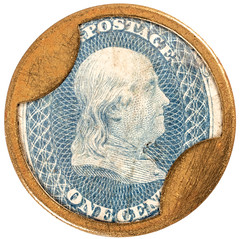 I collected these for many years, and assisted Fred Reed with research for his 1995 book, Civil War Encased Stamps, The Issuers and Their Times . This account rings true, and answers a question raised in an earlier issue.
Simcha Kuritzky asked how Gault put a "rectangular peg in a round hole", and Montz confirms that Gault folded the stamps over a round cardboard backing.
I collected these for many years, and assisted Fred Reed with research for his 1995 book, Civil War Encased Stamps, The Issuers and Their Times . This account rings true, and answers a question raised in an earlier issue.
Simcha Kuritzky asked how Gault put a "rectangular peg in a round hole", and Montz confirms that Gault folded the stamps over a round cardboard backing.
The U.S. section pictures one example of the advertising side of each issuing merchant. Prices are listed for each stamp denomination. More photos and detail on varieties and the issuing merchants can be found in more specialized books on the topic like Reed and Hodder-Bowers. -Editor
For more information, or to order, see:
THE ENCYCLOPEDIA OF ENCASED POSTAGE
(https://www.numislit.com/pages/books/7855/paul-montz/encyclopedia-of-encased-postage)
To read the earlier E-Sylum articles, see:
WAYNE'S NUMISMATIC DIARY: MAY 31, 2026 : Education
(https://www.coinbooks.org/v29/esylum_v29n22a20.html)
NEW BOOK: ENCYCLOPEDIA OF ENCASED POSTAGE
(https://www.coinbooks.org/v29/esylum_v29n25a03.html)

OPTICAL EFFECTS IN EARLY MEDALS
Reader Gary Gianotti published a press release this week following up on his earlier claims of initials and messaging hidden in the designs of early medals including engraved Washington Indian Peace medals. See the links below to read earlier E-Sylum articles and the full 2015 Colonial Newsletter article by Gary and Ron Miller and subsequent reactions by Bill Nyberg and others. Here's an excerpt from this week's release, which claims that "optical effects were intentionally designed" by the medal makers. -Editor


As the United States marks the 250th anniversary of its founding, Connecticut historical researcher and collector Gary Gianotti is asking historians, museums, scientists, and Native American scholars to take a fresh look at two George Washington Indian Peace Medals that have become the focus of more than three decades of interdisciplinary research.
At the center of Gianotti's work are forensic scientific testing and barely surviving historical records that identify a 1789 silver medallion as what may be the very first federally authorized sovereign art artifact, along with an official 1792 George Washington Indian Peace Medal attributed as the earliest surviving scientific artwork by United States Mint first engraver Joseph Wright. Through archival research, scientific examination, historical analysis, and collaboration with independent specialists, Gianotti has developed a research framework that presents evidence which may expand understanding of early American diplomacy, federal symbolism, and artistic innovation during the nation's transition into the Federal Government.
 Gianotti's evidence and forensic reports present what he believes is a different untold history, suggesting these medals should be understood not only as diplomatic objects but also as sophisticated works of federal art that have been overlooked in plain sight. His research proposes that their engraved imagery, symbolism, and optical effects were intentionally designed to produce a visual physiological effect that American Indian chiefs may have interpreted as evidence that the Founding Fathers possessed extraordinary or even magical powers. Through these illusionary artistic effects, George Washington may have appeared to possess an authority, permanence, and national identity that transcended cultural boundaries. Gianotti believes these artistic features deserve renewed scholarly examination using modern forensic technology, which he believes documents optical illusion experimentation immediately preceding the creation of these medallions and other surviving works.
To read the complete press release, see:
Connecticut Researcher Calls for National Reassessment of America's Earliest Federal Diplomatic Artifacts Ahead of the Nation's 250th Anniversary
(https://www.usatoday.com/press-release/story/35894/connecticut-researcher-calls-for-national-reassessment-of-americas-earliest-federal-diplomatic-artifacts-ahead-of-the-nations-250th-anniversary/)
To read earlier E-Sylum articles, see:
JOSEPH LOVELL WRIGHT JR: PEACE MEDAL DESIGNER?
(https://www.coinbooks.org/v23/esylum_v23n07a12.html)
LOOSE CHANGE: JULY 5, 2020 : Gary Gianotti Interviewed
(https://www.coinbooks.org/v23/esylum_v23n27a31.html)
NOTES ON WASHINGTON OVAL PEACE MEDALS
(https://www.coinbooks.org/v23/esylum_v23n51a14.html)
To read the Colonial Newsletter article and follow-up discussion, see:
The Colonial Newsletter #159
(https://archive.org/details/CNLno159)
The Colonial Newsletter #160
(https://archive.org/details/CNL160/page/n3/mode/2up)
THE BOOK BAZARRE
1876: COLORADO'S FREE SILVER CRUSADE
The resumption of silver coin production in large quantities in 1876 had profound implications for the political and economic situation in Colorado. -Garrett

Workers at the Boston & Colorado Gold and Silver Smelting Company pose next to stacked silver ingots in Empire in this 1875 photograph by Joseph Collier. (Courtesy of Denver Public Library Special Collections, X-60031)
The special cargo arrived on the evening of May 3, 1876, on a westbound express train to Denver, where it was watched carefully and wheeled in through the side door at the Colorado National Bank.
The barrel looked "quite as unpretentious and common as an ordinary beer keg," the Rocky Mountain News reported the following day — but inside were five heavy sacks full of a product that would dominate the soon-to-be state of Colorado's politics for the next quarter century.
"SILVER ONCE MORE," blared the News' headline.
"(The) keg full of silver shiners, fresh and bright from the mint … contained 275 pounds of coin, in the denominations of quarters and halves," read the report. "The Colorado National also received, per the afternoon train, a bag of $100 in specie from their correspondents in St. Louis, the coin consisting of halves, quarters, and dimes, tied up in small paper packages."
Similar shipments were being made to banks across the country following Congress' April 1876 passage of a bill to resume the minting of silver coins, which had been out of circulation for 14 years, having been replaced during the Civil War by fractional paper currency — also known as postage currency, since the designs of the paper notes, in denominations ranging from 5 to 50 cents, had been adapted from U.S. postage stamps.
"The pockets of all classes of tradesmen were jingling last night with the old time quarters and half dollar pieces," said the News in a follow-up on May 5. "It was only silver coin, but it had the right jingle about it, and a fistful of it had a solid, honest feeling."
Congressional approval of new fractional silver coins in early 1876 was among the first concessions to these demands — and the excitement that greeted Denver's first keg of freshly minted quarters and dimes was an early example of what would evolve into a political mania in the Centennial State in the final decades of the 19th century.
The Silverite movement, which advocated for a return to bimetallism — or "free silver," as advocates called it — united mining interests in the West with populist firebrands across the country, who accused wealthy capitalists in the East and overseas of "demonetizing" silver in order to artificially limit the money supply.
By the end of the Centennial year, Colorado newspapers were regularly publishing editorials on what they described as "Patrician Gold Against Plebian Silver," and letters alleging that "the money kings of Europe, with the Rothchilds at their head, have undertaken to make gold the only medium of exchange in the world." The 1873 Coinage Act, which had been uncontroversial at the time of its passage, would later be christened by Colorado Sen. Henry Teller, in a speech on the Senate floor, as the "Crime of 1873.".
1920 SAINT LUCIA TEN SHILLINGS SPECIMEN NOTE
Stack's Bowers Director of Consignments & Senior Numismatist Dennis Hengeveld published an article about Saint Lucia and its banknotes. -Editor

Last year, in our 2025 Summer Global Showcase Auction, we sold a specimen 10/- Shillings issued by the government of the Leeward Islands at Antigua. Dated 1st of January 1921, the note saw intense bidding, and realized $37,200. Now, a year later, we are working on the 2026 iteration of this sale, and a note came across my desk that is the perfect companion to that note, though it might be even rarer. At first glance, the notes appear identical, but a keen observer will note that our new offering was printed for Saint Lucia, and is dated a few months earlier, 1st October 1920. One of just two notes printed for Saint Lucia by the government at the time, it is the sole fully printed example in the PMG population report, with no issued notes or other specimens graded (we are aware of uniface black-and-white proofs, but those, in my opinion, are far less desirable). Not surprisingly, the note is the plate note in the Banknote Book, and in Pick it is listed merely as ‘requires confirmation,' with no picture or further details given.
What is now Saint Lucia was first inhabited by numerous indigenous groups as early as 3000 years ago (although evidence for early settlement is lacking), including the Ciboney, Arawak, and Kalinago (Caribs). European knowledge of the island dates to the early 16th century, and over the next several hundred years, several European powers, primarily the French and the English, fought over control of the island. The first European settlements were unsuccessful, as the native Caribs fiercely resisted European colonization, and the Europeans also struggled with disease and internal conflict. French interests purchased Saint Lucia in 1650, and the first successful French settlement followed the next year. Over the next 150 years, the island changed hands between the French and British 14 times. After the French were defeated for the final time in June 1803, British control was affirmed, and the island was officially ceded to Great Britain in 1814. At the time, the majority of the people living on Saint Lucia were enslaved. The French abolished slavery in 1794, and many newly freed slaves joined the French Army against the British. When the latter were victorious, slavery was reintroduced and remained in place until 1834, when slavery was abolished. (An ‘apprenticeship' system persisted until 1838, often cited as the true end of slavery in the British Empire).
Enslaved people were mostly put to work on sugar plantations owned by wealthy Europeans, and sugar became the island's primary cash crop. Throughout the 19th century, however, this began to change. Although sugar had once been central to Saint Lucia's plantation economy, the industry began to decline after emancipation. Without enslaved labor, plantation owners struggled to maintain the same production system, especially as many formerly enslaved people sought greater independence through small farming, wage labor, or subsistence agriculture. At the same time, Saint Lucian sugar faced increasing competition from beet sugar in European markets, and many estates were unable to modernize or remain profitable. By the late 19th century, several large sugar estates had already fallen into decline, and although sugar production continued into the 20th century, it became less and less important to the island's economy.
During the first four decades of the 20th century, Saint Lucia's economy remained heavily agricultural, but it was in a period of transition. The old sugar economy continued to weaken, while small farmers and estate owners increasingly turned to other crops. Diversification was especially important because peasant farmers played a central role in sustaining agricultural production after the decline of sugar. Bananas first appeared to offer a promising new export industry in the 1920s, especially after the Swift Banana Company began operating in Saint Lucia in 1923. By 1925, bananas were being treated as one of the island's chief exports, but the company's withdrawal in 1927 caused exports to fall sharply and left many growers without reliable access to foreign markets. A second attempt to develop the banana trade began in 1934, when the Saint Lucia Banana Growers Association was formed. Banana production increased again in the mid-1930s, but the industry remained dependent on foreign companies and shipping arrangements, making it vulnerable to overproduction, low prices, and global trade disruptions. By the end of the decade, Saint Lucia had not yet found a stable replacement for sugar, and much of the population remained dependent on small-scale farming, low-wage labor, and uncertain export markets.
With an already small economy in transition, it is no surprise that the need for paper money was limited. Private banks, primarily Barclays Bank (D.C.O.), supplied much of the Caribbean with higher denominations, and for most day-to-day transactions, British coinage was used. By 1920, however, silver coin shortages and hoarding caused significant problems, prompting the government to introduce two denominations of paper money into circulation. The specimen we are offering in our upcoming Global Showcase auction is one of the few fully printed examples of this issue to have survived. It will be an exceptional opportunity for the British Commonwealth or Caribbean collector and one that we surely don't expect to repeat anytime soon.
To read the complete article, see:
Saint Lucia Rarity Coming to the Summer 2026 Global Showcase Auction
(https://stacksbowers.com/saint-lucia-rarity-coming-to-the-summer-2026-global-showcase-auction/)
IMAGE OF $100 BILL WITH TRUMP SIGNATURE
Kavan Ratnatunga passed along this CNN article with a mockup image of the new Federal Reserve Note with the signature of President Trump. Thanks. -Editor

President Donald Trump posted a new image Friday of a $100 bill bearing his signature, months after the Treasury Department announced that, for the first time, a sitting president's signature would be featured on US paper currency.
 Treasury Secretary Scott Bessent said in March that the administration planned to feature Trump's signature on US currency in honor of the 250th anniversary of the United States. CNN has reached out to Treasury inquiring whether the $100 bills with Trump's signature are currently being printed.
The image shows the president's signature above Bessent's. Previously, the $100 bill featured the signatures of the Treasury secretary and the treasurer of the United States, but not the sitting president.
Some in Congress have wanted to go a step further and put Trump's likeness on currency, introducing a bill to get his portrait on a $250 anniversary bill. That outcome is far less likely, given it would need the support of Democratic senators in Congress. US code states that "Only the portrait of a deceased individual may appear on United States currency and securities," but the House bill seeks to "create an exception for individuals who are or were President of the United States."
To read the complete article, see:
Trump posts new image of $100 bill with his signature
(https://edition.cnn.com/2026/07/03/politics/trump-100-dollar-bill-signature)
To read the earlier E-Sylum article, see:
TRUMP TO PUT SIGNATURE ON U.S. CURRENCY
(https://www.coinbooks.org/v29/esylum_v29n13a25.html)
NEBRASKA DEALER SELLING COINS ON WHATNOT
Len Augsburger passed along this Wall Street Journal article about a Nebraska dealer selling coins on WhatNot. Thanks. Here's an excerpt - see the complete article online. -Editor
 On a Sunday night in mid-May, Bjorn Bergstrom went down to the basement of his coin shop in Kearney, Neb., switched on his livestream and put a coin on the screen for thousands of strangers to bid on.
He had set out to test the limits of a rapidly growing new shopping economy built for today's social media culture.
Bergstrom, 41, spends most nights on a live-shopping app called Whatnot, where hosts like him auction collectibles in real time to an audience that simultaneously banters and bids on his goods. He would leave his webcam on for a full week, three times as long as his previous record.
He figured the more time he was there, the more new viewers would wander in. After all, his best viewership is in the night-owl hours when there is little else to pull people from their phones. And his fervent regulars might support the occasion with more purchases, too. That could help him reach his goal of selling $2 million worth of coins in a week.
These livestreams double partly as a community when people live their lives more than ever online. That is an opportunity for sellers.
"People don't want to hear an advertisement," Bergstrom said. "People want human stories they can follow."
Bergstrom is one of the platform's top U.S. coin sellers, moving roughly $8.4 million in his highest selling month this year.
 Before the weeklong marathon, he and his team mapped out a schedule so the stream would never go dark while orders were packed, labeled and shipped. He and four co-hosts rotated, with Bergstrom anchoring the prime hours and bleeding into some of the others' time slots.
Bergstrom stumbled into livestreaming after a decade running a coin dealership in Kearney (population 34,000). Experimenting with Whatnot started as a way to combat a slowdown in business in 2023. Now in year four, he employs about 30 people.
To learn how to captivate an online audience, Bergstrom studied MrBeast-style creators on YouTube and TikTok. After all, no one needs to buy collectible coins.
One common event across Whatnot, and on Bergstrom's show, is what's called a sudden-death auction. He posts a coin on the screen beside a countdown clock with as few as two seconds on it, and whoever holds the high bid when it hits zero wins.
Bergstrom releases coins in unpredictable bursts so buyers stay glued to their screens.
After $125,000 in giveaways and the other costs of running the stream, Bergstrom says the marathon cleared roughly $155,000 in profit, less than in a quieter week.
Still, his channel had drawn 717 first-time buyers and moved about 20,700 items. The livestream ran 177 hours and 10 minutes in all, receiving at least 26,000 comments, including emojis, according to Resellbot estimates.
To read the complete article, see:
How One Man Makes Millions Selling Coins Live on the Internet
(https://www.wsj.com/business/retail/one-man-tries-to-make-2-million-selling-coins-at-the-internets-outer-limits-ad9b6f4f)
LOOSE CHANGE: JULY 5, 2026
Here are some additional items in the media this week that may be of interest. -Editor
A new book identifies a shipwreck off the British coast as the 400-year-old Dutch trading ship ‘Dom van Keulen'. -Editor

A shipwreck off the British coast, including a treasure of hundreds of gold coins, has finally been identified after 30 years.
The 400-year-old ship discovered off the coast of Devon, England, has now been identified as the Dutch trading ship ‘Dom van Keulen', which sailed from Morocco for the Netherlands in the autumn of 1633.
Found by the South West Maritime Archaeology Group, its cargo included 9,000 Barbary ducats (widely used European coins made of gold or silver), and gold Moroccan coins, along with 320 goat skins, 150 bags of gum arabic, and 64 bags of saltpeter.
The announcement came in a new book, From Morocco to the Coast of England: The Story of the Dom van Keulen and its Remarkable Cargo.
"It is thought that most of the cargo was salvaged at the time, but more than 400 coins remained on the seabed until they were discovered by the Archaeology Group in 1995," said Professor Dave Parham, professor of maritime archaeology at Bournemouth University and the book's co-editor who collaborated with the British Museum on the research.
To read the complete article, see:
Intrigue From 17th C. Shipwreck Carrying Moroccan Gold Coins is Solved After 30 Years
(https://www.goodnewsnetwork.org/intrigue-of-17th-century-shipwreck-carrying-gold-coins-is-solved-after-30-years/)
A dig in Senon, France uncovered three large amphorae filled with Roman coins. -Editor

Archaeologists in northeastern France have uncovered an ancient neighborhood beneath the town of Senon, where they found three ceramic jars filled with Roman coins. The hoard is huge, numbering at least 25,000 bronze and copper coins from the 3rd-century CE. The discovery was made during a routine excavation. Now, the surprising find offers new insight into how people in the late Roman Empire stored and managed their money.
The dig, led by France's National Institute for Preventive Archaeological Research (INRAP), spans 1,500 square meters. It has peeled back the layers of Senon's past, revealing how the settlement evolved from a Gallic village into a thriving Roman town—and how, eventually, it vanished in fire.
One blaze around the early 4th century marks a turning point. It was during this turbulent time—perhaps between 280 and 310 CE—that someone buried three large amphorae of coins beneath their floorboards.
Each vessel lay sunk into the ground, their necks level with the floor. Inside were tens of thousands of bronze and copper coins bearing the faces of emperors like Victorinus, Tetricus I, and Tetricus II, the rulers of the short-lived Gallic Empire that broke away from Rome in the 3rd century.
To read the complete article, see:
Archaeologists in France Dig Up a Jar Packed With Tens of Thousands of 1,800-Year-Old Roman Coins
(https://www.zmescience.com/science/archaeology/1800-year-old-roman-coins-france-archaeology/)
Paul Horner passed along this article about a promotion from Bed Bath & Beyond. Thanks. -Editor
 Bed Bath & Beyond is giving its iconic blue coupon a second life — and shoppers who held onto one could cash in.
The company recently announced a nationwide "Legendary Coupon Hunt" to find the oldest surviving Bed Bath & Beyond coupon in America, while giving its customers a shot at a $100,000 home makeover.
Through July 13, shoppers can bring any Bed Bath & Beyond coupon to participating Bed Bath & Beyond + The Container Store and Kirkland's Home stores nationwide.
Bed Bath & Beyond said the campaign is designed to send Americans searching through kitchen drawers, glove compartments, attics, basements and old scrapbooks for its coupons.
To read the complete article, see:
Bed Bath & Beyond launches hunt for America's oldest coupon with $100K prize up for grabs
(https://www.foxbusiness.com/retail/bed-bath-beyond-launches-hunt-americas-oldest-coupon-100k-prize-up-grabs)
A New Orleans publication has an interview with U.S. Mint Director Paul Hollis. Here's an excerpt - see the complete article online. -Editor
 While taxpayers are spending tens of millions of dollars on America's 250th anniversary celebrations, such as a huge state fair on the National Mall and an epic fireworks show, a Mandeville native is raising millions for the government through the production and sale of coins that remember scenes from American history.
"The Mint this year is making more coin design changes than you've ever seen in your entire life," said Director of the U.S. Mint Paul Hollis, a former northshore state legislator and Board of Elementary & Secondary Education member.
The nation's semiquincentennial is providing not just an opportunity to tell America's story on special editions of nickels, dimes, quarters, half-dollar and dollar coins. The historic milestone also provides the Mint with a way to increase its revenue.
To read the complete article, see:
Meet the Louisiana man behind the U.S. Mint's new 250th anniversary coins
(https://www.nola.com/news/politics/national_politics/remembering-us-history-on-special-2026-coins/article_1a7fee9b-eb20-48cc-833c-e0543d1cb8ff.html)
Finally, the U.S. Mint published a video featuring Director Paul Hollis and four former Mint directors celebrating America's 250th anniversary and the role U.S. coinage has played in the nation's history. -Editor
To watch the complete video, see:
Celebrating 250 Years of Independence
(https://www.youtube.com/watch?v=rdlRBoxTMPE)
FIRST BANK OF THE UNITED STATES REOPENS
The First Bank of the United States building in Philadelphia has opened to the public as a museum following a $43 million renovation. Part of Philadelphia's Independence National Historical Park, it sits near Independence Hall. Check it out sometime! -Editor

Independence National Historical Park and Independence Historical Trust [held] a public ribbon cutting on July 1 to celebrate the multi-year, $43 million renovation of the historic First Bank of the United States.
"For more than two centuries, the First Bank building has stood as a symbol of the nation's transition from revolution to republic," said Steven Sims, superintendent of Independence National Historical Park. "The building connects the victory of the Revolution to the difficult work of creating a functioning government, economy, and civic identity in the years that followed."
Chartered in 1791 under the leadership of Treasury Secretary Alexander Hamilton, the First Bank of the United States operated until 1811 as the nation's first federally chartered bank. The institution played a central role in stabilizing the young nation's economy, managing war debt, and establishing the federal government's credibility in global financial markets. Authorized by legislation signed by President George Washington, the Bank helped lay the foundation for the country's early financial system and affirmed the federal government's authority to shape the nation's economic future.
 The restoration effort reflects a longstanding partnership between the National Park Service and Independence Historical Trust, the nonprofit philanthropic partner of Independence National Historical Park. The Great American Outdoors Act Legacy Restoration Fund, signed into law by President Trump in 2020, provided the National Park Service with $39.3 million to restore the interior and exterior of the national historic landmark and make critical improvements to enable public visitation for the first time in decades, including replacing leaking metal roofing, stabilizing, cleaning, and repairing marble and brick masonry, enhancing accessibility, correcting moisture incursion problems, and updating the electrical and HVAC systems. The Trust contributed an additional $4.5 million toward the building's rehabilitation and design and continues to raise funds for exhibits and long-term stewardship of the site.
Exhibits in the building highlight the role of art and artifacts in American history and diplomacy. Developed in partnership with the U.S. Department of State and Drexel University, the exhibits feature items from U.S. embassies and the City's Atwater Kent Collection at Drexel University, including commemorative objects related to Philadelphia's celebrations of the 1876 Centennial, 1926 Sesquicentennial, and 1976 Bicentennial.
Philadelphia's civic and cultural institutions have long served as stewards of the nation's founding story, preserving the documents, debates, and places that shaped the United States. From the halls where independence was declared to the archives that safeguard early federal records, the city continues to care for the tangible legacy of the American experiment. The reopening of the First Bank building carries that stewardship forward, returning visitors to a site where foundational questions of economic governance were first put into practice.
The First Bank reopening is part of a broader slate of projects by Independence National Historical Park and Independence Historical Trust to celebrate America's 250th anniversary. In preparation for the Semiquincentennial, and in alignment with Executive Order 14253, Independence National Historical Park has completed infrastructure repairs and improvements to historic structures and features on Independence Square, including Independence Hall, Congress Hall, and Old City Hall. Together, the park and the Trust will break ground on the Join or Die sculpture initiative and install an America 250 time capsule to engage future generations. These projects reflect a coordinated investment in preserving, enhancing, and activating the nation's most historic square mile at a once-in-a-generation milestone moment.
To read the complete article, see:
Historic First Bank of the United States Building to Reopen July 1
(https://inht.org/first-bank-reopens-july-1/)
See also:
One of America's Most Important Historic Buildings Just Reopened to the Public After Nearly 50 Years
(https://www.travelandleisure.com/first-bank-of-usa-reopens-as-museum-12009944)
Philly's First Bank of the United States Reopens This Summer as a Museum: What to Know
(https://www.visitphilly.com/things-to-do/attractions/first-bank-of-the-united-states/)
ABOUT THIS ISSUE: JULY 5, 2026
Well, I've finally officially retired from my day job, and collected some numismatic souvenirs in the form of challenge coins and medals. My Retirement Festival of lunches, parties and Happy Hours concluded Friday with a party with neighbors at our home. I'll have to wear this new T-shirt to the Pittsburgh ANA.

At lunch Saturday my tab came to $13.76. Although I'd told myself I'd never do this again, I offered a $20 bill and a penny "if that helps." The new cashier declined, but a more seasoned employee told her "you could just give him back a quarter." Instead she slowly and carefully counted out the change the cash register calculated - $6.24. The coins still confused her - "dimes are ten," he coached her. I bit my tongue and refrained from rolling my eyes.
On Sunday at another lunch venue, the tab was $17.47. I paid with a $20 bill and 47 cents in change, expecting an easy three dollars back. I got a quizzical look, two dollar bills and a handful of change. Thinking (yet again) "I give up!", I dropped the coins in the tip jar.
Seen online this week:
- My aunt said she wasn't an alcoholic because she drank wine
- Psychic Fair Cancelled due to unforeseen circumstances
Finally, here are some interesting non-numismatic articles I came across this week, starting with a interesting BBC article on America's "long-lost 'secret' colony" and one on the tiny Caribbean island lifeline for the American Revolution.
New Sweden: The US's long-lost 'secret' colony (https://www.bbc.com/travel/article/20260629-new-sweden-the-uss-long-lost-secret-colony)
How a tiny Caribbean island made American independence possible (https://theconversation.com/how-a-tiny-caribbean-island-made-american-independence-possible-284412)
In the 'biggest book giveaway in history' WWII soldiers received pocket-sized reads (https://www.npr.org/2026/05/25/nx-s1-5823711/soldiers-books-world-war-ii)
The Cherry Sisters: good or bad? (https://jack-el-hai.medium.com/the-cherry-sisters-good-or-bad-6f6104051749)
Confessions of an Art Linkletter Kid (https://jack-el-hai.medium.com/confessions-of-an-art-linkletter-kid-8f646f4e0fe4)
From undressed to dressed up: Pittsburgh's porn palaces are now cultural assets (https://www.pghcitypaper.com/news-2/history/pittsburghs-porn-palaces-are-now-cultural-assets-harris-theater-garden-theatre/)
So come on back Jesus And pick up John Wayne on the way (https://genius.com/Willie-nelson-come-on-back-jesus-lyrics)
This Simple White Line Is America's Greatest Unsung Innovation (https://www.wsj.com/business/white-line-road-invention-america-250-8ce6bb89)
Ridley: The most important thing to happen in 1776 (https://rationaloptimistsociety.substack.com/p/ridley-the-most-important-thing-to)
Oil Refineries Get the Headlines but Ukraine's Airfield Strikes May Hurt Russia More (https://www.wesodonnell.com/p/oil-refineries-get-the-headlines)
How the Country I Was Taught to Hate Saved My Life (https://www.thefp.com/p/how-the-country-i-was-taught-to-hate)
America's Next 250 (https://www.notboring.co/p/americas-next-250)
-Editor


Editor Wayne Homren, Assistant Editor Garrett Ziss
Wayne Homren
Wayne Homren is the founding editor of The E-Sylum and a consultant for the Newman Numismatic Portal. His collecting interests at various times included U.S. Encased Postage Stamps, merchant counterstamps, Pittsburgh Obsolete paper money, Civil War tokens and scrip, Carnegie Hero Medals, charge coins and numismatic literature. He also collects and has given presentations on the work of Money Artist J.S.G. Boggs. In the non-numismatic world he's worked in artificial intelligence, data science, and as a Program Manager for the U.S. Department of Defense.
Garrett Ziss
Garrett Ziss is a numismatic collector and researcher, with a focus on American paper money and early U.S. silver and copper coins. He is also a part-time U.S. coin cataloger for Heritage Auctions. Garrett assists Editor Wayne Homren by editing and formatting a selection of articles and images each week. When he's not engaged in numismatics, Garrett is pursuing a Master's Degree in Quantitative Economics at the University of Pittsburgh.

Contributors Pete Smith and Greg Bennick
Pete Smith
Numismatic researcher and author Pete Smith of Minnesota has written about early American coppers, Vermont coinage, numismatic literature, tokens and medals, the history of the U.S. Mint and much more. Author of American Numismatic Biographies, he contributes original articles to The E-Sylum often highlighting interesting figures in American numismatic history.
Greg Bennick
Greg Bennick (www.gregbennick.com) is a keynote speaker and long time coin collector with a focus on major mint error coins and US counterstamps. He is on the board of both CONECA and TAMS and enjoys having in-depth conversations with prominent numismatists from all areas of the hobby. Have ideas for other interviewees? Contact him anytime
via instagram @minterrors.
He can also be reached by email at
minterrors@gmail.com.

Website host John Nebel and webmaster Bruce Perdue
John Nebel
Numismatist, photographer, and ANS Board member and Fellow John Nebel of Boulder, CO helped the ANA and other clubs like NBS get online in the early days of the internet, hosting websites gratis through his Computer Systems Design Co. To this day he hosts some 50 ANA member club sites along with our
coinbooks.org site, making the club and our E-Sylum archive available to collectors and researchers worldwide.
Bruce Perdue
Encased coinage collector (encasedcoins.info) Bruce Perdue of Aurora, Illinois has been the volunteer NBS webmaster from its early days and works each week to add the latest E-Sylum issue to our archive and send out the email announcement.

|
|
The E-Sylum is an electronic publication of the Numismatic Bibliomania Society Copyright © 1998 - 2026 | |