Visit our NBS Sponsors









About UsThe Numismatic Bibliomania Society is a non-profit association devoted to the study and enjoyment of numismatic literature. For more information please see our web site at coinbooks.org SubscriptionsThose wishing to become new E-Sylum subscribers can go to the following web page
Subscribe
MembershipThere is a membership application available on the web site Membership Application To join, print the application and return it with your check to the address printed on the application. Print/Digital membership is $40 to addresses in the U.S., and $60 elsewhere. A digital-only membership is available for $25. For those without web access, write to: Jeff Dickerson, Treasurer AsylumFor Asylum mailing address changes and other membership questions, contact Jeff at this email address: treasurer@coinbooks.org SubmissionsTo submit items for publication in The E-Sylum, write to the Editor at this address: whomren@gmail.com BUY THE BOOK BEFORE THE COINSale CalendarWatch here for updates! |
- WAYNE'S WORDS: THE E-SYLUM NOVEMBER 22, 2026
- BRYCE BROWN SALE OF DICK JOHNSON RESEARCH FILES
- REMINDER: LANG NUMISMATIC LITERATURE AUCTION 14
- NEW BOOK: HADRIAN - COINAGE AND IMPERIAL POLICY
- NEW BOOK: THE TOURNOIS GROSCHEN
- NEW BOOK: DUTCH EAST INDIES PLANTATION TOKENS
- MOLL'S GUIDE TO VINTAGE COIN FOLDERS AND ALBUMS
- PERIODICAL: TAMS JOURNAL NOVEMBER-DECEMBER 2026
- JOHN CHRISTOPHER LAVENDER (1968–2026)
- ISAAC SELIGMAN'S ANS MEMBER SURVEY
- VIDEO: OLYMPIC GAMES
- ANA PHILANTHROPY AWARDS FOR HALPERIN, SHIVA
- 2027 ANS GALA TO HONOR BCD
- NUMISMATIC LITERATURE ON ABEBOOKS
- BOOK PRICING SITE COMPARISON
- CHATGPT'S TAKE ON THE E-SYLUM
- NOTES FROM E-SYLUM READERS: NOVEMBER 22, 2026
- CAPT. HERNDON AND THE AMAZON VALLEY
- 2026 ARTS OF MONEY: THE FRASERS
- VOCABULARY TERM: TABLE MEDAL
- MORE ON FLOWLINES
- STACK'S BOWERS: RON ABLER CENTENNIAL MEDALS
- ROBINSON'S 133RD AUCTION
- WAYNE'S NUMISMATIC DIARY: NOVEMBER 22, 2026
- LEACH'S ACCOUNT OF 1906 SAN FRANCISCO MINT FIRE
- THE 1911 PATTERN BUFFALO 'CENT'
- THE CENT IS OFFICIALLY DEAD
- FEATURED WEBSITE: ANCIENT COINS
- ABOUT THIS ISSUE: NOVEMBER 22, 2026
Content presented in The E-Sylum is not necessarily researched or independently fact-checked, and views expressed do not necessarily represent those of the Numismatic Bibliomania Society.
WAYNE'S WORDS: THE E-SYLUM NOVEMBER 22, 2026
 New subscribers this week include: Seidwa.
Welcome aboard!
Thank you for reading The E-Sylum. If you enjoy it, please send me the email addresses of friends you think may enjoy it as well and I'll send them a subscription. Contact me at whomren@gmail.com anytime regarding your subscription, or questions, comments or suggestions about our content.
We have a new advertiser this week: Van Acker Coin Auctions. Thank you for your support! When you're out at coin shows or shopping online and encounter one of our advertisers, please thank them for supporting our weekly effort - we wouldn't be able to deliver our publication at this scale and frequency without their assistance.
This week we open with two numismatic literature sales, three new books (and one old one), a periodical, updates from the Newman Numismatic Portal, and more.
Other topics this week include the coinage of Hadrian, Dutch East Indies plantation tokens, coin folders and albums, ANA and ANS honors, finding and pricing numismatic literature, the Frasers, table medals, auction previews, and the Whitman Baltimore Expo.
To learn more about electroforming, the Circle of Friends of the Medallion, medieval imitations of the French gros tournois, John Christopher Lavender, Isaac Seligman, Andrew Shiva, Ron Abler, Live Auctioneers, 1895 Dollars, the Maastricht Bank Note Fair, Synagogue Coin Hoards, silver Continental Dollars, and the most valuable 1964 Red Book, read on. Have a great week, everyone!
Wayne Homren
Editor, The E-Sylum


Image of the week
BRYCE BROWN SALE OF DICK JOHNSON RESEARCH FILES
Bryce Brown is auctioning the Dick Johnson research files on eBay. Here's the announcement. -Editor

Dick Johnson with his research files
Dick Johnson's research files are decades-long accumulations of information, publications, ephemera, photographs, and his writings (mostly unpublished). The majority of these groups consist of materials that would be difficult or impossible to recompile.
These lots are now open for bidding on eBay, under seller name numismatic-reference-library. All lots will close Wednesday evening, November 25, 2026.
Link: https://www.ebay.com/usr/numismatic-reference-library
Any questions can be asked through eBay, or by contacting Bryce Brown at numismatics@att.net.


This is a great opportunity for researchers and bibliophiles! -Editor


To read the earlier E-Sylum articles, see:
BRYCE BROWN SALE OF DICK JOHNSON LIBRARY
(https://www.coinbooks.org/v28/esylum_v28n49a03.html)
BRYCE BROWN DICK JOHNSON LIBRARY SALE, PART II">
(https://www.coinbooks.org/v28/esylum_v28n52a02.html)

REMINDER: LANG NUMISMATIC LITERATURE AUCTION 14
Here's a final reminder of the 14th numismatic literature auction from Numismatic Antiquarian Bookshop Lang, which closes November 25, 2026. -Editor

Our 14th auction at Numismatisches Antiquariat Lang, which will take place on November 25, 2026, via the AUEX auction platform. The highlight of this auction is an extensive and diverse selection of 1,364 lots of numismatic literature. In addition to numerous interesting individual works, you can look forward to standard reference works, historical publications, and bibliophile rarities.
Special highlights of our 14th auction include:
- Indian Numismatics: An interesting selection of specialized books and literature on the history of coins from the Indian subcontinent.
- Jordan Library: An extensive collection of literature on North American numismatics.
- Numismatic Journals: A diverse selection of specialized journals and periodicals.
- Historical Auction Catalogs: Numerous bound auction catalogs from the period before 1945. Among them are also several personal copies that, with their individual notes and inscriptions, offer a particularly interesting glimpse into the history of auctions and collecting.
- Bibliophile Works: Lovers of rare and bibliophile literature will also find something to their liking.

Details:
- Date: November 25, 2026
- Location: Online on the Auex.de auction platform
- Time: Starting at 5:00 p.m. CET
Of course, you also have the option to submit advance bids. These can be conveniently submitted via the following platforms:
- SIXBID
- biddr
- NumisBids
We cordially invite you to explore our auction and see for yourself the diversity and uniqueness of the items on offer. We look forward to your participation and hope you enjoy browsing the auction and have success with your bids!
Please remember to register in a timely manner so that you can participate in the auction. If you have any questions or are interested in specific items, we are, of course, happy to assist you at any time.

To read the earlier E-Sylum articles, see:
LANG NUMISMATIC LITERATURE AUCTION 14
(https://www.coinbooks.org/v29/esylum_v29n44a02.html)
LANG NUMISMATIC LITERATURE AUCTION 14
(https://www.coinbooks.org/v29/esylum_v29n45a03.html)
NEW BOOK: HADRIAN - COINAGE AND IMPERIAL POLICY
In their October 2026 News from the ANS, the American Numismatic Society announced the publication of the two-volume 764 page hardback book Hadrian - Coinage and Imperial Policy by Martin Beckmann was available for pre-order. Well, copies are now in stock and available to purchase. ANS members will receive a 30% discount. Here's the book's description. -Editor


Hadrian
Coinage and Imperial Policy
By Martin Beckmann
Historians have long sought to understand Hadrian's policies, his priorities, and his approach to his imperial role, but the evidence is elusive. The sparse literary sources, written well after his time, are often unreliable, and epigraphy and archaeology, which are based on fragmentary objects, tend to focus on local audiences. Hadrian's coinage, on the other hand, is of the highest authority: it is available in great bulk, it offers both written and visual evidence, and it was directed at an empire-wide audience. Unfortunately, it also tends to lack the imperial titles that often make imperial coinage easy to date.
Hadrian: Coinage and Imperial Policy addresses the difficulty from a new direction by systematically applying the methodology of die analysis, which previously had been used only in isolated cases. Focusing on coins produced in the name of Hadrian and his relatives at the central mint in Rome, the author uses die analysis to help recreate the sequence of the mint's coin production, which clarifies the interrelationship of the different coin types and allows us to clearly identify the complete iconographic repertoire of the coinage at specific points in time.
The main text details the implications of this analysis for the chronology of Hadrian's coinage, using charts to illustrate the dies and their links. It then traces the development of Hadrian's coinage in detail and across all metals, and summarizes the study's results in a catalogue of reverse types. References to the works of Strack and Abdy (RIC2 II.3) allow readers to look up the relevant coins in the Online Coins of the Roman Empire (OCRE) database hosted by the American Numismatic Society, which provides many more examples of each described and illustrated type. This book is a companion to the recent RIC2 II.3 on the coinage of Hadrian, as some chronological arrangements differ from Abdy.
For more information, or to order, see:
Hadrian: Coinage and Imperial Policy (U.S. orders)
(https://isdistribution.com/work/hadrian/)
Hadrian: Coinage and Imperial Policy (International orders)
(https://www.brepols.net/products/IS-9780897227575-1)
To read the complete article, see:
NEW BOOK: HADRIAN - COINAGE AND IMPERIAL POLICY
(https://www.coinbooks.org/v29/esylum_v29n40a04.html)

NEW BOOK: THE TOURNOIS GROSCHEN
A new book has been published in German about the medieval imitations of the French gros tournois, particularly those issued in territories corresponding to present-day Germany, the Netherlands, Belgium and Luxembourg. Here's a Google-translated description from the publisher's site. -Editor
Der Turnosengroschen
Marc Steputat
 "The Tournois Groschen" is a comprehensive numismatic reference work on the restrikes of the French Gros Tournois outside of France. It focuses on the castle-type coins minted in what are now the Netherlands, Belgium, Luxembourg, and Germany.
The work covers approximately 50 principalities and more than 80 issuing authorities, documenting over 300 coin types and variants. More than 265 coin illustrations allow for a direct comparison of the different mintings, legends, and mint marks. The catalog is supplemented by brief historical chronologies of the respective principalities and issuing authorities, as well as information on minting locations, minting rights, and historical context.
The book combines numismatic identification with regional and economic historical background and is aimed at collectors, museums, coin cabinets, local historians, and scholars. It is intended to help identify, compare, and historically contextualize previously difficult-to-classify Tournois Groschen.
About the Author
Marc Steputat is an author and local historian from the Heinsberg district. His particular focus is on medieval numismatics of the 13th and 14th centuries, especially in the Rhine and Meuse region.
With his first book, "The Coins and Local Chronicles of Heinsberg and the Surrounding Area," he combined numismatic research with the history of his home region. The work was awarded the Helmut A. Crous History Prize in 2025.
For several years, Steputat has been intensively studying the Turnosengroschen (a type of medieval coin) and its restrikes in what are now the Netherlands, Belgium, Luxembourg, and Germany. He maintains regular professional exchange with numismatists, collectors, museums, and other specialist institutions. His work combines the identification and documentation of medieval coins with historical sources, regional historical contexts, and research into rulers, minting authorities, and minting locations.
With "The Turnosengroschen," he presents a comprehensive reference work on a previously only partially documented area of ??medieval numismatic history.
Title: Der Turnosengroschen
Author: Marc Steputat
Format: Hardcover
Pages: 470 pages
ISBN: 978-3-69674-984-2
Publisher: BoD - Books on Demand
Release date: November 17, 2026
Language: German
Keywords: Tournois, Gros tournois, medieval coins, numismatics, groschen
For more information, or to order, see:
Der Turnosengroschen
(https://buchshop.bod.de/der-turnosengroschen-marc-steputat-9783696749842)

NEW BOOK: DUTCH EAST INDIES PLANTATION TOKENS
The 7th edition of Adrian Lansen's book on plantation tokens of the Dutch East Indies has been published. -Editor
 Plantation Tokens of the Dutch East Indies
7th edition November 2026
Author : A.J. Lansen
This 7th edition is a compilation of all my previous publications on the Dutch East Indies Tokens. The first edition was published in 2001, the other six in the period 2017-2024. I also had the opportunity to collect a lot of new information on the North Borneo plantation tokens which resulted in a completely new release about these tokens in December 2025.

This 7th edition now lists 413 tokens, including some trade tokens and a lot of new information about the estates and trade companies. A large proportion of the tokens are also depicted with sharper and clearer details than in previous editions. Each token is identified by its denomination, shape, size, weight, metal composition and die axis position. Insofar as possible, a color illustration has been provided. The Preface and Acknowledgements are in English text, the Introduction/Inleiding is in Dutch and English text. The Token catalogue is in English text too. This edition includes additional content: History of the tokens with German inscription: "Unternehmung " and an extensive bibliography.


Corrections, complementary information or other comments regarding these tokens and their use will be warmly welcomed by the author, who can be reached at the following address:
A.J. Lansen, Haanderik 94, 3401 ET IJsselstein, The Netherlands.
Mail : lansenkil@hotmail.nl , ajlansen@caiway.nl or killansen@outlook.com

MOLL'S GUIDE TO VINTAGE COIN FOLDERS AND ALBUMS
A few weeks back I caught Justin Hinh's Instagram post about a book I wasn't aware of. Do any of our other readers have a copy of this one? Great find. -Editor


This was the very first book published [that I'm aware of] that focuses exclusively on coin folders & albums. It was written by Thomas Moll and printed in 2007. While David Lange and Donald Kocken's books focus on the history of folders & albums, Thomas Moll focused exclusively on their utility as coin storage.
There is basically no info about him online. The only search result I came across was a review by David Lange about this book, and even he was scratching his head on Moll's exclusive focus on utility.
It's an odd book for sure, but it's an excellent reference book. Moll created an extensive catalog of Dansco and Whitman folders & albums. Many of which I didn't know existed, such as the Cuba and Japan brown folders. His catalog is not complete [I noticed a few were missing], but his book is the first reference I've found to the Dansco's Continental Line series of albums.
I'm slowly working through creating a complete catalog of every Dansco album & folder including pictures, but you'll have to wait another day [or year] for that.


So thank you Mr. Moll, now I have a few more folders & albums to hunt down to put into my already overflowing library.
To read the complete post, see:
https://www.instagram.com/p/DcI1TPlG6FB/
PERIODICAL: TAMS JOURNAL NOVEMBER-DECEMBER 2026
The November-December 2026 issue of The TAMS Journal has been published. TAMS is a great organization with a top-notch periodical. If you've never been a member, or your membership has lapsed, now's a great time to sign up. -Editor
The TAMS Journal
V66, N6 | November-December 2026
Articles
 Anthony Nicholas Brady Memorial Medal 1914
Harry Waterson
The Goodman's Fields Brewhouse Token
John Duff
The Delayed Gold Medal of a Free Black Colonel in Spanish Peru in the late 18th Century
Dr. Ángel O. Navarro Zayas
The 1910 San Francisco Bakery, Cookery, Confectionery, and Pure Food Exhibition
Michael Wehner
New So-Called Dollar Discovery Referencing the 1906 Oklahoma Enabling Act
Roman Golebiowski
An Unusual 1895 Centennial Medal
David E. Schenkman


Columns
From the President
Bill Hyder
Fingers on the Keyboard
Greg Burns
So-Called Dollar Stories
Jeff Shevlin
Token and Medal Trailblazers
Pete Smith
This & That
Harry Waterson
American Token Manufacturers & Their Agents
David E. Schenkman
Counterstamp Corner
Greg Bennick
Sixty Years Ago in TAMS
Greg Burns
Mavericks
Ryan Kordziel
Society News and Reports
General News/Pleas
Secretary's Report
Donna Moon
TAMS Meetings and Banquet Report
From the Bookshelf
Peter Irion


Here's Editor Greg Burns' Fingers on the Keyboard report. -Editor
 The TAMS meetings
and banquet are history,
with a report deeper into
this issue. If you weren't
there, then start thinking
of the August event next
year (our shizzle will be
on the 11th of 2027 in
Rosemont, aka Chicago). I've already
got my room reservations. How about
you? Better get on the stick!
This issue's got the usual complement of articles and columns, so hope the stream of token-and medal-related fuel is enough to stoke your fire. My list of articles for future issues is running a little bit on the low side at the moment, so if you find yourself with some unattached minutes in these colder months, try warming your fingers on your keyboard putting together something for TAMSJ within the avenues of your specialty. I'll do my best to be helpful for anyone approaching this for the first time, and I guarantee that it will be both easier than you think, and that you'll find it extremely rewarding to see your work in print.
I'm happy to see the boost of new members in Donna's report on the opposite page. While 15 isn't a record by any stretch, it is an impressive number to add to our society. Maybe you have some friends who'd like to join and receive TAMSJ. An application is on page 310, and easy to share with others.
The topic of Artificial Intelligence (AI) is interesting, especially since you're reading a magazine. How much content that's in here do you think is AI-generated? Less or more than one might imagine? It certainly has it's uses, but there are some boundaries TAMSJ observes. Mmm, stories for another day I guess.
Warmest holiday wishes to you and yours. While we adore all our readers, we love you the best!
For more information on the Token and Medal Society (TAMS), see:
https://www.tokenandmedal.org/

JOHN CHRISTOPHER LAVENDER (1968–2026)
Bob Leonard alerted me to this post from Leu Numismatik announcing the passing of John Christopher Lavender. Thank you. -Editor

It is with great sadness that we share the news of the passing of our dear colleague and friend John Christopher Lavender, who died unexpectedly on 26 October 2026, at the age of 58.
John was a passionate numismatist, a gifted cataloguer, and, above all, a wonderful person whose knowledge, kindness, and unmistakably dry sense of humor will be deeply missed by all of us at Leu Numismatik.
Born in Bethesda, Maryland, John grew up in various parts of the United States and Germany, as his father's career in the US Air Force took the family from place to place. He later studied history at the University of Georgia, a subject that would remain one of his great passions throughout his life. Shortly after graduating, he came across a newspaper advertisement for a position with a coin dealer, setting him on a path that would become his life's work.
Over the course of his career, John worked with several renowned numismatic firms, including Classical Numismatic Group (CNG), while also operating his own VCoins shop for many years. He possessed an impressive breadth of numismatic knowledge, spanning Greek, Roman, Byzantine, and modern coinage, with a particular fondness for the later Roman Empire and its fascinating coinage of the fourth century.
For the past three and a half years, John was a valued member of our extended team at Leu, cataloguing countless coins for our web auctions. A self-proclaimed "history buff," he particularly enjoyed exploring the historical background of the pieces he described, contributing numerous engaging historical notes to our catalogues. His curiosity extended well beyond numismatics: among his other interests were classical guitar and the search for ancient arrowheads in his native Georgia.
Those of us who worked closely with John will remember not only his dedication and remarkable knowledge, but also his warmth, reliability, and wonderfully dry wit. Conversations with him were often as entertaining as they were enlightening. Despite facing health challenges in recent years, John maintained his positive outlook and continued doing the work he loved until the very end.
We are deeply grateful to have known John and to have had him as part of the Leu family. His passing leaves a void that will be difficult to fill, both professionally and personally.
Our thoughts and heartfelt condolences are with his children, his siblings, and all those who knew and loved him.
John, you will be greatly missed.
The entire Leu Numismatik Team

ISAAC SELIGMAN'S ANS MEMBER SURVEY
The latest addition to the Newman Numismatic Portal is a circa 1890 membership survey from ANS member Isaac Seligman. Project Coordinator Len Augsburger provided the following report. -Editor

Extract of Edouard Frossard location change survey
Vintage ANS Member Survey Appears in the Wild
Sometime around 1890, the American Numismatic Society conducted two surveys of its membership, for the purposes of collecting biographical information and secondly to consider a location change. A total of 86 members responded to the biographical survey, while 38 completed the location change questionnaire. Membership at this time was approximately 200 people. Newman Portal scanned these surveys at the ANS library in 2021.
At the recent Baltimore show, a location change survey was located in the stock of Charles Davis. Completed by Isaac N. Seligman, the form was apparently filled out but never submitted. Seligman opined that ANS should move closer to Central Park; at this time the ANS was meeting in New York University space on 20th Street. This item was acquired and forwarded to the ANS for their collection.

Isaac Seligman's ANS Member Survey
Link to Isaac Seligman location change survey on Newman Portal:
https://nnp.washu.edu/Documents/Detail/seligman-isaac-n.-membership-survey./8180104
Link to 1889 ANS location change surveys on Newman Portal:
https://nnp.washu.edu/numismatics-archives-list/list/archives-subcollection/36574
Link to 1890 ANS membership surveys:
https://nnp.washu.edu/numismatics-archives-list/list/archives-subcollection/36599

VIDEO: OLYMPIC GAMES
The David Lisot Video Library on the Newman Numismatic Portal can be found at:
https://nnp.wustl.edu/library/multimediadetail/522852
We highlight one of his videos each week in The E-Sylum. Here's one from 2016 with ANA Curator Douglas Mudd speaking about the numismatics of the Olympic Games. -Editor

ANA Curator Douglas Mudd speaks at the 2016 ANA World's Fair of Money in Anaheim, CA.
To watch the complete video, see:
Olympic Games: History and Numismatics
(https://youtu.be/itYVFoy2PRM)
Olympic Games: History and Numismatics
(https://archive.org/details/ANA16021HistoryOlympics_1)

ANA PHILANTHROPY AWARDS FOR HALPERIN, SHIVA
The ANA announced its latest Philanthropy Awards. Here is the press release. -Editor
The American Numismatic Association's (ANA) Philanthropy Award publicly honors those who have made significant contributions to the Association that further its strategic mission to expand, enhance, and sustain the hobby of coin collecting. This year, the ANA recognizes James L. Halperin and Andrew Shiva.
 Jim Halperin entered the coin industry at 16 and later cofounded Heritage Auctions. A pioneer in coin grading, technology, and numismatics, Halperin helped shape the hobby for generations and is equally committed to giving back. Through the Halperin Foundation, he supports art, health, and education initiatives. Guided by a belief that success carries responsibility, Halperin plans to direct much of his collection's value to charitable causes.

 Andrew Shiva began collecting U.S. National Bank notes after discovering a 1917 $2 note at a Paris flea market in 1989. His passion expanded from collecting to researching note signers, banking history, and preservation. He founded the National Currency Foundation in 2011 and is a research associate with the National Numismatic Collection at the Smithsonian Institution's National Museum of American History. Shiva has been a generous supporter of the ANA through the Susan Isabel Foundation, a charitable organization established in honor of his mother.

2027 ANS GALA TO HONOR BCD
Here is the press release for the upcoming ANS Gala, a highlight of the numismatic year for many. -Editor

ANS to Honor the Collector BCD at Its 2027 Gala
The Board of Trustees of the American Numismatic Society (ANS) is pleased to announce that the 2027 Trustees' Award will be presented to BCD, one of the most renowned collectors in numismatics. The award will be presented at the ANS Annual Gala on January 14, 2027, at the Harvard Club of New York City.
Behind the letters BCD stands one of the greatest collections of ancient Greek coins ever assembled. It focused on coins of the Peloponnese, central Greece, and especially Thessaly, from 500 BC to the third century AD. In 2001, BCD began to sell his coins in regular auctions, of which the last one appeared in 2012. These catalogues, undertaken by different auction houses, have become standard references in their own right. Yet what makes the man behind the letters remarkable is his desire to learn everything about the coins he collected, a passion that gave rise to one of the great numismatic libraries. Based in Athens until a few years ago, the library welcomed researchers, collectors, and students alike.
ANS Sydney F. Martin Executive Director Ute Wartenberg notes, "Over the last twenty-five years, the Trustees' Award has celebrated our most dedicated supporters. We are very proud to honor BCD, whose generosity and learning have enriched generations of scholars and collectors."
The Annual Gala provides critical support for the Society's mission through proceeds from ticket sales, sponsorships, advertising, and other donations. Held amongst the tapestries and old-world splendor of the Harvard Club's grandest room, guests will enjoy dinner and entertainment, including a live auction. The Trustees' Award was established in 2003 and honors those who have helped in extraordinary ways to forward the mission of the ANS. For more information about the Annual Gala, visit numismatics.org/2027gala/.
Founded in 1858, the American Numismatic Society studies and promotes numismatics. With 1,300 members worldwide, ANS holds more than 800,000 coins, medals, monetary objects, and related items dating to 2000 BCE. Its library and archives hold about 100,000 books, documents, and artifacts. The Society also develops digital numismatic resources and is one of the largest publishers of scholarly numismatic research. Educational programs on coins and money are held on a regular basis.

NUMISMATIC LITERATURE ON ABEBOOKS
Dale Batko is a freelance writer based in Michigan. Following up on his earlier article on finding numismatic literature on HaithiTrust, Dale submitted this item on using AbeBooks. Thank you. -Editor
Introduction
 Are you having difficulty locating unusual or older numismatic publications? AbeBooks.com has millions of books and other materials available online from thousands of sellers worldwide.
Searching can be done anonymously. Accounts are free to create though and do not require an upfront commitment to purchase. A standard search includes options for Author, Title, Keyword, and ISBN. An advanced search includes additional fields for Publisher, Date, Price, Type, Condition, Binding, Language, Attributes, and Seller. If you are not ready to do a detailed search, you can Browse Collections, which includes Art & Collectibles, Fiction, and Non-Fiction.
Search Using Keywords
 A quick way to find items is to use broad keywords like numismatic (94,000+ results) or coin (220,000+ results). Refining the search criteria is the best way to narrow the results to better match what you are looking for. Selecting Books within Product Type finds 147,626 matches.
Product Type Filter Options
 Condition is another excellent filter. It directly relates to price. I recommend specifying Very Good or Good as items of that quality are readable, durable, and often affordable. This is helpful if you are on a budget. Books in New, Fine, or Near Fine condition can be cost-prohibitive, often going for several hundred dollars. Now we are down to 24,717 matches.
Binding separates search results according to Hardcover and Softcover. I find that a quality hardcover holds up better over the long term. The next thing to consider are Collectible Attributes. My favorite of these is the Dust Jacket option, which leaves us with 1,343 matches.
Collectible Attributes Filter Options
 I apply the Published Year filter to focus on my preferred date range, 1900-1975. The quality of the writing is just more appealing to me compared to books published in the last fifty years. How they say things are just as important as what they say. The Published Year filter brings us down to 535 matches.
 Since I can sort the search results by price after I narrow the list using filters, I skip specifying anything within the Price area. Now, we come to Seller Rating. This is extremely important! A seller with poor ratings may quickly lead to disappointment. Though I strongly prefer 5-star sellers, I am fine with specifying 4-Star seller and up. That gets our search results down to 495 matches.
Seller Rating Filter Options
 Be wary of the Featured items related to your search area on the screen. I was shown four items ranging in price from $200.00 to $6,500.00! At the top of the remaining search results are several Sort By options. This defaults to Relevance based upon your search criteria and applied filters. Those related to Author, Title, and Price can be helpful, depending upon your needs. Now it is time to have some fun! Browse the list and click Add to Basket on your favorite items. No need to worry. You can always remove items from your basket before checking out. Review the details about the items and the sellers.
Book and Reseller Details
After settling on an item, click Add to Basket. Your Shopping Basket and Item count appear on screen. Double-check the item quantity and price, including the shipping charge, if any. Apply any coupon code that you may have, then check the price once again to verify the coupon code took effect. Then click Checkout.

At this point, you will be prompted to sign on. If you do not have an account, now is the time to create one! Two fields are required: Email and Password. Then click Sign On. After signing on, you need to provide Shipping Information and Payment Method. If everything looks correct in those areas, it is time to review the Order Summary and click Place Your Order.
The screen refreshes and your order details are displayed. Make note of the Estimated Delivery. International shipments are always slower. An email is also sent to your address. Open it and inspect the details. Click View Order Details to view all of the order details online.
Conclusion
There is a seemingly endless number of websites online today. Locating the right piece of numismatic literature can be a challenging and lengthy process. Using AbeBooks.com can improve research timelines while generating better quality results.
 About the Author
Dale Batko is a Michigan-based freelance writer. His articles have appeared in 9 countries, on 6 continents, in 5 languages, over the last 30 years. He started collecting coins at 10 years old.
Sources:
https://www.abebooks.com/
(https://www.abebooks.com/)
To read the earlier E-Sylum article, see:
NUMISMATIC LITERATURE ON HATHITRUST.ORG
(https://www.coinbooks.org/v29/esylum_v29n38a11.html)

BOOK PRICING SITE COMPARISON
Checking online for pricing information on that rare or out of print numismatic book you're thinking of buying? Book dealer Scott Brown recently published a (non-numismatic) comparison of typical searches across multiple sites. Here's an excerpt - see the complete article online. -Editor
 American Book Prices Current had no competitor for almost fifty years.2 In 2002, the collector Bruce McKinney launched Rare Book Hub (then Americana Exchange), a subscription-based online record of auction sales. ABPC had auction data going back a century, but it was locked up in printed volumes for each year.
Rare Book Hub was open to everyone equally. It lacked depth at first, a problem McKinney addressed by scanning old auction catalogs, dealer lists, and bibliographies at an aggressive pace. RBH abandoned ABPC's curatorial approach, replacing it with a messier but more robust full-text search of auction house descriptions. Rare Book Hub also published results within days or weeks of the auctions. If a first edition of To Kill a Mockingbird set a new record, subscribers to Rare Book Hub learned almost immediately. Devotees of ABPC learned about it the following year, when the new volume came out.
Within a decade, ABPC was a shadow of its former self, even if it still had devoted subscribers. The decline of ABPC's fortunes and the increasing reliance of the book trade on RBH is an example of what Turing Prize–winner Rich Sutton calls The Bitter Lesson. "General methods that leverage computation are ultimately the most effective, and by a large margin," Sutton wrote. Rephrasing that for auction results, Over time, computational power always supplants human curation..
Methodology
For this survey, I picked ten books (expanded to 11) to research. My list included some standard rarities (Johnson's Dictionary, Darwin's Beagle narrative, and the "peacock" edition of Pride and Prejudice). Americana was represented by Banditti of the Plains (1894), a classic account of the cattle business. I included the Hogarth trade edition of Virginia Woolf's Orlando, an inscribed first edition of the Pulitzer Prize–winning A Bell for Adano because I had one on my desk, and a book by the artist Stanislaw Szukalski with an original woodcut because someone was trying to sell me a copy. ABSA can search millions of sales of ISBN books on Biblio, so I included several more recent titles, like Stephen King's The Gunslinger, Sarah Maas's Throne of Glass, Seth Klarman's cult investing book, Margin of Safety, and the first American hardcover edition of Philip K. Dick's Solar Lottery.
I searched the titles on various book-price sites. Detailed results are presented at the end, if you want to reach your own conclusions.
Top Recommendations
The Gold Standard: Rare Book Hub
Cost: $600/year Rare Book Hub has 16 million records in its database, and that number grows by thousands every week. By comparison, Biblio's ABSA claims 1.5 million auction records over 50 years.
For many titles I checked, Rare Book Hub recorded recent sales that no other site found, and it reports prices with the buyer's premium added.
RBH is limited to auction results (plus some dealer catalogs) by design. It isn't a good source of information about low-dollar and recent books that haven't been around long enough to sell at mainstream auctions.
Free Alternative: Live Auctioneers
Live Auctioneers is a platform that auction houses use to host online sales. With a free user account, book collectors can search 29 million sold items, including tons of books. The results show hammer prices; the buyer's premium is not included and can be hard to figure out.
The past-item search is not full text. It searches more than titles but not everything in the description. For example, when I searched Szukalski Design, I found five sold lots, two of which included the limited edition print. When I searched "Szukalski 150" (where 150 is the number of copies with the print), I got no results even though the number 150 appeared in both descriptions of the limited issue.
One serious shortcoming is that Christie's and Sotheby's results are mostly missing from Live Auctioneers. When I checked, there were 53 and 48 past auctions with results, respectively, compared to 2,691 for Bonhams, for example. However, if you don't subscribe to Rare Book Hub because of the cost, you probably aren't trying to determine the prices of many books sold by the two top auction houses.
Invaluable's search is much better than Live Auctioneers and its past sales include thousands of Christie's and Sotheby's auctions and results from more than a thousand auction houses not covered by Live Auctioneers. Access to its price data, if you aren't granted free access as a reward for using the site to bid, is expensive. People who collect art as well as books may find it worthwhile. Most books-only collectors and dealers are better off with other options.
Hard-charging Newcomer: ChatGPT
In my test searches, I posed the most basic question possible to ChatGPT: "Could you check the auction records of this book?"
The results were acceptable, but far from comprehensive. Equal to or better than ABSA (formerly ABPC), not as good as the free Live Auctioneers, and far short of Rare Book Hub.
However, when I asked it to try harder and look for more examples of recent sales, it did. In the case of the Peacock edition of Pride and Prejudice, it turned up a recent copy sold during a design sale that no other source found. With a $20/month ChatGPT subscription and some custom instructions for how to search and report auction results, ChatGPT can be a strong competitor, as good as or better than Live Auctioneers (which ChatGPT uses as a source of data), and almost as good as Rare Book Hub for 40% of the cost.
Numismatic literature is a very specialized niche of the book trade, but I checked out Live Auctioneers with a few searches, and it did come up with some sales I wasn't aware of, such as a 1964 Red Book that Heritage sold for $360. Why so much for a common book? The Heritage listing gave me the answer, but to test ChatGPT I asked it, "What is the highest price realized for a 1964 "Red Book" A Guide Book of United States Coins by R. S. Yeoman?" -Editor
The highest documented auction realization I could locate for the 1964 (17th edition) Red Book by R. S. Yeoman is:
 $450.00
- Auctioneer: Heritage Auctions
- Sale date: November 2, 2018
- Auction: Armstrong Family Collection, Part I
- Lot: 52894
- Condition: Fine
- Special feature: The book came directly from the Armstrong family collection and included a Collectibles Authentication Guaranty (CAG) photo certificate and provenance statement signed by Neil Armstrong's sons, Rick and Mark.
Source: Heritage Auctions – Lot 52894 .
Important distinction: The $450 price reflects the exceptional Neil Armstrong provenance, not the ordinary market value of a 1964 Red Book. Ordinary copies generally sell for just a few dollars.
I would regard $450 as the highest verified auction result I found, rather than a guaranteed all-time auction record.
A perfect response if you ask me. The astonishing premium over the price of a typical copy of this common book is indeed an important distinction. The difference between the $360 and $450 prices reported by Live Auctioneers and ChatGPT was the Buyer's Premium. I wonder how ChatGPT managed to get that number - I had to log in to the Heritage platform to see the price realized. Maybe a bigger question today is how many younger collectors even know who Neil Armstrong was? -Editor
To read the complete lot description, see:
Coin Collecting: 1964 "Red Book" A Guide Book of United States Coins by R. S. Yeoman Directly From The Arm...
(https://historical.ha.com/itm/space-exploration/book-magazine/coin-collecting-1964-red-book-a-guide-book-of-united-states-coins-by-r-s-yeoman/a/6205-52894.s)
To read the complete article, see:
The Bitter Lesson of Book Pricing Sites
(https://downtownbrown.substack.com/p/comparison-of-book-price-sites)
CHATGPT'S TAKE ON THE E-SYLUM
I was intrigued to read in the previous article in this issue that booksellers are finding ChatGPT to be an increasingly useful source for rare book prices. So I thought I'd ask it a question about a topic I know a lot about. If you're so smart ChatGPT, tell me "Why is the E-Sylum gaining advertisers recently?" Here's its verbatim response. -Editor
The most likely reason The E-Sylum is becoming more attractive to advertisers is that it has established itself as a highly targeted advertising vehicle for the numismatic industry. Its value isn't necessarily the size of its readership; it's the quality and specialization of that readership.
There are several reasons this makes commercial sense.
1. It reaches exactly the right audience
The E-Sylum reaches approximately 6,300 subscribers, but these aren't random readers. They include:
- Serious coin and currency collectors.
- Numismatic dealers and auctioneers.
- Researchers and authors.
- Numismatic librarians and institutional professionals.
- Collectors of medals, tokens, and numismatic literature.
For a specialist auction house or coin dealer, reaching 6,300 interested readers may be considerably more valuable than reaching 100,000 general-interest readers.
2. Its content is commercially relevant
The E-Sylum regularly features:
- Auction announcements and previews.
- New numismatic books and publications.
- Dealer offerings.
- Coin discoveries and research.
- Grading, authentication, and collecting developments.
This puts advertisers in front of readers who are already interested in buying, selling, researching, or collecting numismatic material.
That's spot-on. Just two nitpicks: we avoid discussing grading, and the publication name should be italicized: The E-Sylum. -Editor
3. Its credibility has increased
There are important signs of institutional recognition: The E-Sylum regularly features:
- The E-Sylum celebrated its 28th anniversary in September 2026.
- It won first place in the ANA's electronic club-publication competition in 2025.
- It has an established international network of respected numismatic authors, researchers, and contributors.
- Its relationship with the American Numismatic Association extends its distribution and visibility.
That credibility matters to advertisers. They want to be associated with a publication trusted by serious collectors.
4. There appears to be renewed advertiser interest in 2026
Consider the recent examples:
| Date | New advertiser or sponsor |
|---|---|
| October 4 | CAC Grading |
| October 18 | Boardwalk Numismatics |
| November 1 | Noonan's of Mayfair and Ibercoin |
| November 15 | Smalls Auctions |
These are significant because they represent different segments of the numismatic marketplace, including grading, dealing, and auctions.
5. My interpretation: The E-Sylum is becoming a specialized marketing channel
- I think there are three underlying commercial developments:
- Digital advertising is attractive to niche businesses. Dealers can reach a defined audience without paying for broad advertising that reaches people with no interest in coins.
- International exposure matters. An auction house in Spain or Britain can reach American collectors and vice versa.
- Trust and relevance are valuable. The E-Sylum's editorial environment gives advertisers access to an established numismatic community rather than an anonymous internet audience.
One important qualification
I wouldn't conclude that advertiser growth is being driven by subscriber growth. The published figures were approximately 6,300 subscribers in late 2026, and the readership has fluctuated. The more interesting development appears to be increased commercial interest in the existing audience.
My bottom line: The E-Sylum may be demonstrating something important about the numismatic marketplace: a relatively small but knowledgeable, internationally connected audience can be more commercially valuable than a much larger general audience.
I would be particularly interested in whether Wayne Homren has changed the advertising sales approach, pricing, or sponsorship packages. That could help explain why several new advertisers have appeared in such a short period. I haven't found public evidence establishing that he has made such a change.
Also spot-on. While the ANA no longer distributes The E-Sylum to its members now that they've built up their own publications beyond The Numismatist, that was true for a time. And ChatGPT is clearly up-to-date in reading The E-Sylum, nailing the recent additions of new advertisers.
To answer its questions - we haven't changed our pricing or sponsorship packages. I wouldn't say the sales approach has changed either, but the recent Pittsburgh ANA convention gave me the opportunity to walk around and identify and speak with potential new advertisers and follow up with details afterwards, accounting for CAC, Boardwalk and Noonan's. Ibercoin, Smalls and Van Acker were unsolicited.
That was a fun exercise. AI does an impressive job of reading, synthesizing and analyzing and presenting large quantities of text. While it didn't identify a catalyst for the unsolicited advertisers, I still have the old-fashioned way to find out - I'll just ask them.
-Editor

NOTES FROM E-SYLUM READERS: NOVEMBER 22, 2026
E-Sylum Kudos
 Jim Haas writes:
"Is it my imagination or was last week's issue a tad longer than usual?"
It was indeed a big one. I used to call a larger issue a "whopper", but they just kept getting even bigger. Like fast food soft drinks, we don't have a small size anymore - just large and larger. -Editor
Steve Hill of Sovereign Rarities writes:
"There were so many interesting things to digest this week, everything from memories of Normand Pepin, to Bob Evans treasure talk which is always so informative, to the XRF comments on composition analysis and the questioning of the gold Anglo-Saxon thrymsa. A great read all in all and took most of my commute to London!
"Thanks for all your efforts as always, it is much appreciated."
John Sallay writes:
"I just read this week's E-Sylum and saw the most recent discovery by Doug Ward! Even beyond the various input you've published over the last few weeks — and the excellent article this week by Pete Smith on the evolution of the ANA seal — this pretty much nails it.
"The E-Sylum is completely amazing and you do an absolutely terrific job! Even in just this one issue, there was not only this ANA seal pin conclusion, but also important new discussions on XRF testing, Blackinton and other medalists, flow lines, and other topics, not to mention the ongoing stream of news on people, new books, and upcoming auctions.
"Thank you, and please keep up the great work!"
Thanks everyone. Last week's issue took a while to put together, but the work was worth it. Thanks to everyone for their great contributions. -Editor
To read the earlier issue, see:
https://www.coinbooks.org/v29/esylum_v29n46.html
Collecting Coins in New Jersey
Alan Weinberg writes:
"Examining the photo of the attending members at the 1989 New Jersey Numismatic Society, I am struck by so many members appearing to be in their 30-40s. That was the way it was back then. I go back to 1958 collecting coins in New Jersey. Now almost 83.
"I recall Bill Anton taking me to a NJ meeting and legendary large cent collector Willard Blaisdell was meeting chair. He was old then.
"New Jersey in early 60s had numerous coin shows just about every week. Choice unattributed NJ coppers were all over the place at $25 each. Same with gem Unc turban head 1/2 dimes. Toning was frowned upon. Had to be bright to be Uncirculated"
To read the earlier E-Sylum article, see:
NEW JERSEY NUMISMATIC SOCIETY PHOTO
(https://www.coinbooks.org/v29/esylum_v29n46a06.html)
More on the 1895 Dollars


John Dannreuther's comments are on track with both the archival research and Philadelphia Mint practices. As soon as the 1895 dollars were delivered all went to the Cashier's vault where newly delivered coins sat for a while until decision was made on which large was to receive them.
The "Coinage Executed" journal for 1896 (RG104 Entry 271 Vol 4; Jan-Feb 1896 p136-137) shows that Philadelphia delivered no dollar coins for circulation in January 1896. Thus, there were no more circulation dollar coins delivered from June 30, 1895 to January 31, 1896.
This is a meaningful distinction. Newly minted dollars from June 1895 would normally have been placed at front of the Cashier's vault, and any new dollar coins then placed in front of the 1895s. But, with no new dollars struck for seven ( 7 ) months, the 1895 dollars were the first at- hand to satisfy any requests by the US Treasurer or visitors/employees. [We might be able to track any 1895s distributed on Treasurer's orders if we had either of the following document files - RG-50 E-151 Silver Dollar Movements, or RG104 E-330 "Cashier's Daily Statements" for June 1895 through February 1896. Unfortunately, E-151 journals end in 1891; and E-330 statements for the desired time period have not been located.]
Public correspondence from 1894 into the 1910s, shows that there was interest in 1894 dollars, but little public interest in 1895 circulation dollars until 5 to 10 years later. (There is an incomplete list of 1895 proof set purchasers, but there's no mention of circulation coins.)
A final minor note – the only manufacturing difference between a proof die and a circulation coin die was careful polishing of proof dies to a mirror surface. Proofs were struck on an hydraulic medal press in 1895, and circulation coins were struck on ordinary Ulhorn-type toggle presses at much lower pressure and attention to quality.
Thank you! -Editor
To read the earlier E-Sylum article, see:
STACK'S BOWERS: NOVEMBER 2026 RARITIES SELECTIONS
(https://www.coinbooks.org/v29/esylum_v29n46a23.html)
The Maastricht Bank Note Fair

Richard Lobel of Coincraft in London writes:
I, along with my wife Claire, who is in charge of our banknote department, and her assistant Poli, recently attended the largest and most exciting banknote fair in the world! That is no exaggeration, 225 tables, dealers from over 80 different countries from New Zealand to Peru, from India to Argentina, Canada, the United States, China. Most countries in Europe and even parts of Africa, dealers attended and enjoyed the fair. It is the biggest and the best in the world for banknotes. It has moved to Maastricht, it needed the additional space.
It is run by my good friend Dimitri Waltmans assisted by his wife Claudia and their delightful daughter Laura. He runs a fair the way it should be run, catering to collectors while assisting the dealers as well. There is a breakfast one morning (sponsored by Stacks Bowers) and a drinks and snacks event Friday evening. The pre-bourse is Tuesday to Thursday (which we never seem to make as things are too hectic in London) and a dealer's only day on Friday. Saturday and Sunday it is open to collectors for FREE! Other fair operators please note. On Thursday evening, as is the norm, we go with a small group of friends from Israel, Cuba, Brazil, the United Kingdom and the United States to Valkenburg to feast on spare ribs. We have been going to this restaurant for about 25 years, the food is outstanding. There are many other banknote dealers eating there as well, as they know great ribs and the atmosphere is so friendly and inviting. It is almost like our clubhouse.
The fair itself is a great place, not only to buy and sell banknotes, but also to catch up with friends from all over the world. To keep each other informed as to what is actually happening in the business and to sit down and renew friendships. We use the fair as a source to get new inventory for our collectors. After all, when you do 40+ catalogues a year you have to have something new for your collectors. We go by Eurostar to Brussels and then have a car pick us up and drive us the 135 kilometers to Maastricht. Funny, we can go from London to Brussels in just over two hours by train, including going under the Channel, but the Belgium to The Netherlands train service is so much trouble that it is quicker and easier to be driven. To be honest Eurostar is wonderful.
The Fair is hard work, from 8 in the morning till 8 at night, but it is well worth it. On Sunday we go back to Brussels and get back on the train to London and are back in our own beds for a good night's sleep. Monday it is back to work. The Fair is held twice a year and this April / May Fair, Dimitri is going to double the size of the room and add coin dealers. I wish him well, because he is a good friend, but I do worry that the Fair will lose some of its uniqueness when you add coin dealers. And that is the personal opinion of a coin dealer (71 years in the business).
Richard Lobel, Founder of Coincraft, Britain's Coin Shop (and of course we also do banknotes)
Thank you. Sounds like a great event. -Editor
For more information, see:
https://mifevents.com/
The Brink's-Mat Gold Heist
Jeff Burke writes:
"Beth and I enjoyed watching "The Gold," a BBC dramatization about the Brink's-Mat gold heist in 1983. Readers can watch this show on PBS Masterpiece."
Thanks - check it out. Here's an overview from the show's webpage. -Editor
About the Show
The Gold features a star-studded cast including Hugh Bonneville (Downton Abbey, Paddington in Peru), Jack Lowden (Slow Horses), Dominic Cooper (The Devil's Double), Charlotte Spencer (The Duke), Emun Elliott (Guilt), Tom Cullen (Becoming Elizabeth), Stefanie Martini (The Last Kingdom) and Amanda Drew (Ellis).
On November 26, 1983, six armed men broke into the Brink's-Mat security depot near London's Heathrow Airport, and inadvertently stumbled across gold bullion worth £26m — the disposal of which led to a vast international money laundering operation and left controversy and murder in its wake.
Inspired by extensive research and interviews with some of those involved in the events, The Gold is a pulsating dramatization which takes a journey into a 1980s world awash with cheap money and loosened morals to tell this extraordinary and epic story for the first time in its entirety.
The Gold Season 2 is currently airing on MASTERPIECE on Sundays at 10/9c.
For more information, see:
About the Show
(https://www.pbs.org/wgbh/masterpiece/shows/the-gold/)
Synagogue Coin Hoards
David Menchell writes:
 "I wanted the readers of E-Sylum to be aware of this article on ancient coin hoards in the latest issue of Biblical Archeology Review. The article discusses the discovery of hoards found at the sites of approximately two dozen ancient synagogues throughout the Middle East. The size of the hoards varies from a few dozen to an amazing group of over 20 thousand coins. The article discusses how the coins were stored, the coin types found, and some theories on why the hoards were created.
"I recommend this publication for those collectors who are interested in Middle Eastern history extending from the early Egypt and Mesopotamia through the Hellenistic Greek and Roman Periods. Just a reminder that information about coins may appear in other publications beyond traditional numismatic literature. Further information about this topic can be found at ancientsynagoguecoins.com."
Good point. Thank you. -Editor
See also:
Biblical Archaeology Review, Winter 2026
(https://www.biblicalarchaeology.org/magazine-issue/biblical-archaeology-review-winter-2026/)
Mystery Money: Synagogue Coin Hoards
(https://library.biblicalarchaeology.org/department/mystery-money-synagogue-coin-hoards/)
Query: 1976 $2 with Red Parachutist Stamp
Eric Holcomb writes:
 The Pacific Northwest Numismatic Association (PNNA) recently received an inquiry about the two 1976 $2 Federal Reserve Notes in the attached photos, which have a red rubber ink stamp depicting a parachutist.
According to the person inquiring, "The family recollection is that these were received already stamped in Washington State during the 1976 reintroduction, as a promotional or collector giveaway, possibly through a bank.
Other owners have reported parachute-stamped 1976 notes, including a nearly consecutive group, but I haven't found a documented issuer or origin.
Does anyone recognize this specific emblem? I'm looking for the distributing bank or organization, contemporary advertising or documentation, and any completed sales of matching notes."

Great question - can anyone help? One could joke that these must be commemorating the 1971 jump of hijacker "D. B. Cooper". But anything's possible. -Editor
THE BOOK BAZARRE
CAPT. HERNDON AND THE AMAZON VALLEY
Cary Bown submitted these observations on the opening of the Amazon Valley to steam navigation. Interesting topic. Thank you. -Editor
 Regarding "Treasure Talk with Bob Evans", a series I have greatly enjoyed, in episode 17, Mr. Evans states:
In 1851, he (Captain Wm. Herndon) was exploring the Andes and the Amazon on behalf of the United States, gathering data to see if there was a more efficient way to get South American silver to the world than shipping it over the mountains to the Pacific. This hypothetical new route proved impractical as a commercial enterprise, but his studies revealed the upper Amazon to the world.
In the 1952 reprint of Herndon's 1853 "Exploration of the valley of the Amazon", the editor, Hamilton Basso offers another motivation for the expedition:
 Although there is no evidence to indicate that Maury [Herndon's former superior officer] was directly responsible for Herndon's mission, we may be reasonably certain that he had a large hand in it. The opening of the Amazon Valley to steam navigation, beneficial though it might prove to be to the American economy, had for Maury an even higher value. He saw it as a means of preserving the Union. As a Virginian, Maury was naturally sympathetic to the hopes and ambitions of the South, but even as a Virginian he was not completely blinded by sectional loyalties. Recognizing the explosive potentialities of slavery, he had gradually evolved his own remedy for getting rid of it - let the slaves of the South be sold to the planters of the Amazon and then prohibit slavery in the South by law.
"The Southern states," he wrote in 1850, "may emancipate just as New York and Massachusetts. But large numbers of slaves were not set free. They, after the emancipation acts became laws, were sold to the South, and so the South may sell to the Amazon.
See "Exploration of the Valley of the Amazon / by William Lewis Herndon; edited and with an introd. by Hamilton Basso." 1952. Intro xii – xvii.
Mr. Evans' last sentence quoted above, states that Herndon's "studies revealed the upper Amazon to the world." Herndon's account may have extended the knowledge of the upper Amazon; it certainly caught the attention of a young Samuel Clemens (AKA Mark Twain), but seventeen years earlier, another naval officer, Lt. William Smyth of the British Navy authored "Narrative of a Journey from Lima to Para, Across the Andes and Down the Amazon: Undertaken with a View of Ascertaining the Practicability of a Navigable Communication with the Atlantic", which undoubtedly revealed much about the entire Amazon previously unknown to the British Admiralty and to the general public.
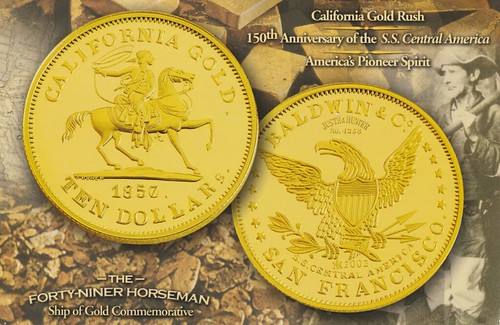
An interesting connection, William Smyth has a very slender connection to the SSCA gold, in that some of the gold from the recovered Justh & Hunter ingots was used to strike a reproduction of the 1850 Baldwin & Co. $10 coin, i.e. the "Vaquero" or "Horseman", as a 1857/0 commemorative under the auspices of the California Historical Society. The design of the original coin, dies engraved by Albert Küner, has been traced back to Smyth's "Californians Throwing the Lasso" featured in vol. II of Capt. Frederick Wm. Beechey's "Expedition to the Pacific and Beering's Straight, to co-operate with the Polar Expeditions…", 1831.
To read the earlier E-Sylum article, see:
1849 $20 CENTRAL AMERICA COMMEMORATIVE
(https://www.coinbooks.org/v28/esylum_v28n27a26.html)
TREASURE TALK WITH BOB EVANS, EPISODE 17
(https://www.coinbooks.org/v29/esylum_v29n46a16.html)
2026 ARTS OF MONEY: THE FRASERS
Carlos Kearns posted a note on LinkedIn about the recent Arts of Money event about the work of James Earle Fraser and his wife Laura Gardin Fraser. Below right: Carlos Kearns, Tom Uram, and Chang Bullock. -Editor

 Tom Uram and I hosted our fourth series of the Arts of Money presentation and exhibits last week at the National Arts Club in New York. We had an excellent discussion of the works of two extraordinary artists, James Earle Fraser and Laura Gardin Fraser. Theirs was a partnership responsible for the Buffalo Nickel, the Oregon Trail Half Dollar, and numerous medals, plaques and statues bearing tribute to their life's work. Alex Krapf, President of the American Numismatic Society, delivered this story with great enthusiasm and appreciation. We had a sense of who they were as people and as artists. Their work continues to this day and we had an excellent presentation by Dr. Larry Brown on modern US coinage which used their iconic designs. With the gracious help of the American Numismatic Society and collectors Tom Uram, Chang Bullock and myself, attendees had the chance to see both the coins and other examples of the Fraser's beautiful work.
Next year we celebrate the work of the designer of the Peace Dollar, Anthony de Francisci.

Alex Krapf speaking
To read the complete article, see:
https://www.linkedin.com/feed/update/urn:li:activity:
7525955818882695168/
VOCABULARY TERM: TABLE MEDAL
Here's another entry from Dick Johnson's Encyclopedia of Coin and Medal Terminology. -Editor
Table Medal. A medal not intended to be worn, as is a decoration, pin or badge, and therefore "lie on the table." Table medals, obviously, do not have loops for suspension or any device for attaching to a garment. By extension a table medal could be any medal, awarded or not, that has no suspension and cannot be worn (this could include many kinds of medals – historical, commemorative, commercial, even art medals – so table medal is not a precise term).
To read the complete entry on the Newman Numismatic Portal, see:
Table Medal
(https://nnp.washu.edu/Documents/Detail/table-medal/4362406)
MORE ON FLOWLINES
E-Sylum Feature Writer and American Numismatic Biographies author Pete Smith submitted these additional remarks on flowlines. Thank you. -Editor
I want to respond to Craig Sholley and his comments in the November 15 issue of The E-Sylum. He said that "I would like to correct one point in Pete's discussion – the dies themselves do not show flowlines."
I have made mistakes in items submitted to The E-Sylum and I try to admit them and correct them. If I believe I am right, I will defend my position.
As I was pondering my response, the November issue of The Reading Room arrived from the ANA. This included an article on "Peaks & Valleys: Luster explained" by Nate Leonauskas. It included this explanation:
"The immense pressure causes the metal to behave almost like a liquid, flowing into the incuse portions of the die (i.e., the portrait, lettering, or other main devices). These flow lines on the planchet effectively etch themselves into the die each time a coin is struck, causing noticeable striations which reflect light. This varies from coin to coin and mint to mint, as different designs, striking pressures, planchet characteristics, die polish, and other factors impact the flow lines and, in turn, the luster."
The article was about luster, but the point is that peaks and valleys in the die are pressed into the planchet to show as valleys and peaks on the stuck coin. If these peaks and valleys are in the die, they should be visible.
In the case of luster, the flowlines are microscopic. With continued use of the die, they may get broader and deeper until they can be seen without magnification on late die states.


Sholley's item was illustrated with photos of a couple of dies. These dies appear to me to be rusted so the original surfaces are impaired. Very few two-hundred-year-old dies are available for examination. Perhaps none of them have survived in a condition where the flowlines can be seen. However, the lines seen on the coins had to come from lines in the dies.
To read The Reading Room article, see:
Peaks & Valleys: Luster Explained
(https://readingroom.money.org/peaks-valleys-luster-explained/)
To read the earlier E-Sylum article, see:
NOTES FROM E-SYLUM READERS: NOVEMBER 15, 2026 : More on Flowlines
(https://www.coinbooks.org/v29/esylum_v29n46a11.html)

STACK'S BOWERS: RON ABLER CENTENNIAL MEDALS
Stack's Bowers will be selling the second half of the Ron Abler collection Centennial Medals on December 4, 2026. Ron was a regular member of my Northern Virginia numismatic social group, Nummis Nova. He was a knowledgeable collector, and is greatly missed. Here's the SGB collection summary, followed by several selected lots. -Editor

While 2026 is being celebrated all over the world as the semiquincentennial of American independence, it also represents the sesquicentennial of the 1876 Centennial Exposition and related centennial celebrations all over the United States. Ronald Abler of Maryland devoted a lifetime of collecting energy and scholarly inquiry into medals and related items celebrating the 1876 U.S. Centennial, culminating in his 2013 A Cabinet of Centennial Medals, published online at www.CentennialMedals.com and on the Newman Numismatic Portal. With abundant information on mulings, die varieties, composition, and more, it stands as the greatest contribution made to the Centennial Medal field. While Hibler and Kappen cataloged the "so-called dollars" well, and Arlie Slabaugh's monogram is still useful for Centennial storecard tokens, Abler was the first to see all Centennial associated numismatic items as parts of the same story.
The title of his book was well chosen, as the Abler Collection was kept in a literal medal cabinet, organized by drawer. We're proud to offer the contents of those drawers, organized as he did and cataloged by Abler number. The vast majority of the pieces in the collection are the plate pieces in the Abler book, adding special significance to each of the interesting items to be offered from this fascinating collection.
The first half of the Abler Collection was sold in Stack's Bowers Galleries' September 2026 Tokens and Medals Collectors Choice Auction, while the second half, featuring nearly 500 lots of individual rarities and small groupings, is offered in our upcoming December 2026 Tokens and Medals Collectors Choice Auction. Below are just a few of many wonderful highlights to the collection, while you can peruse the complete offerings from the Abler Centennial Cabinet in the current auction by clicking here.


1876 Triumphal Arch Keystone Medal. Musante GW-875, Baker-408B, Abler-400wm. White Metal. MS-64 PL (NGC). 31.4 mm.
Provenance: From the Ronald Abler Collection of Centennial Medals.
To read the complete item description, see:
1876 Triumphal Arch Keystone Medal. Musante GW-875, Baker-408B, Abler-400wm. White Metal. MS-64 PL (NGC).
(https://auctions.stacksbowers.com/lots/view/3-1Y41SI/1876-triumphal-arch-keystone-medal-musante-gw-875-baker-408b-abler-400wm-white-metal-ms-64-pl-ngc)


1876 Massachusetts American Independence Centennial Medal. Julian CM-38, Abler-1880si. Silver. MS-62 (PCGS). 19.1 mm x 25.5 mm, oval. Pierced for suspension, with jump ring.
Provenance: From the Ronald Abler Collection of Centennial Medals.
To read the complete item description, see:
1876 Massachusetts American Independence Centennial Medal. Julian CM-38, Abler-1880si. Silver. MS-62 (PCGS).
(https://auctions.stacksbowers.com/lots/view/3-1Y43EC/1876-massachusetts-american-independence-centennial-medal-julian-cm-38-abler-1880si-silver-ms-62-pcgs)


1881 Battle of Groton Heights Centennial Medal. HK-125. Rarity-5. White Metal. MS-65 (PCGS). 40.0 mm.
Provenance: From the Ronald Abler Collection of Centennial Medals.
To read the complete item description, see:
1881 Battle of Groton Heights Centennial Medal. HK-125. Rarity-5. White Metal. MS-65 (PCGS).
(https://auctions.stacksbowers.com/lots/view/3-1Y43UE/1881-battle-of-groton-heights-centennial-medal-hk-125-rarity-5-white-metal-ms-65-pcgs)


1876 U.S. Presbyterian Church John Witherspoon, Signer of the Declaration of Independence Medal. Abler-2080wm. White Metal. Choice About Uncirculated. 50.8 mm.
Provenance: From the Ronald Abler Collection of Centennial Medals.
To read the complete item description, see:
1876 U.S. Presbyterian Church John Witherspoon, Signer of the Declaration of Independence Medal. Abler-2080wm. White Metal. Choice About Uncirculated.
(https://auctions.stacksbowers.com/lots/view/3-1Y44JR/1876-us-presbyterian-church-john-witherspoon-signer-of-the-declaration-of-independence-medal-abler-2080wm-white-metal-choice-about)


PENNSYLVANIA. Philadelphia. "1842" (1876) Harbach's Original Walnut Candy Centennial Token. Rulau Pa-Ph 123. White Metal. Plain Edge. MS-61 (PCGS). 25.0 mm.
Provenance: From the Ronald Abler Collection of Centennial Medals.
To read the complete item description, see:
PENNSYLVANIA. Philadelphia. "1842" (1876) Harbach's Original Walnut Candy Centennial Token. Rulau Pa-Ph 123. White Metal. Plain Edge. MS-61 (PCGS).
(https://auctions.stacksbowers.com/lots/view/3-1Y461M/pennsylvania-philadelphia-1842-1876-harbachs-original-walnut-candy-centennial-token-rulau-pa-ph-123-white-metal-plain-edge-ms)


PENNSYLVANIA. Philadelphia. "1776" (1876) A.J. Weidener Centennial Token. Rulau Pa-Ph 480. White Metal. Plain Edge. MS-65 (PCGS). 23.0 mm.
Provenance: From the Ronald Abler Collection of Centennial Medals.
To read the complete item description, see:
PENNSYLVANIA. Philadelphia. "1776" (1876) A.J. Weidener Centennial Token. Rulau Pa-Ph 480. White Metal. Plain Edge. MS-65 (PCGS).
(https://auctions.stacksbowers.com/lots/view/3-1Y46XX/pennsylvania-philadelphia-1776-1876-aj-weidener-centennial-token-rulau-pa-ph-480-white-metal-plain-edge-ms-65-pcgs)


PENNSYLVANIA. Philadelphia. Undated (1876) Whitman & Son Centennial Token. Rulau Pa-Ph 489A, var. Copper. Plain Edge. Obverse D. MS-65 BN (PCGS). 23.0 mm. This die pairing is unlisted in the 2004 Rulau reference on U.S. tokens.
Provenance: From the Ronald Abler Collection of Centennial Medals.
To read the complete item description, see:
PENNSYLVANIA. Philadelphia. Undated (1876) Whitman & Son Centennial Token. Rulau Pa-Ph 489A, var. Copper. Plain Edge. Obverse D. MS-65 BN (PCGS).
(https://auctions.stacksbowers.com/lots/view/3-1Y4718/pennsylvania-philadelphia-undated-1876-whitman-son-centennial-token-rulau-pa-ph-489a-var-copper-plain-edge-obverse-d-ms-65-b)


PENNSYLVANIA. Philadelphia. Undated (1876) John E. Vallee Centennial Token. Rulau Pa-Ph 797G. Copper. Plain Edge. MS-65 BN (PCGS). 23.0 mm.
Provenance: From the Ronald Abler Collection of Centennial Medals.
To read the complete item description, see:
PENNSYLVANIA. Philadelphia. Undated (1876) John E. Vallee Centennial Token. Rulau Pa-Ph 797G. Copper. Plain Edge. MS-65 BN (PCGS).
(https://auctions.stacksbowers.com/lots/view/3-1Y4806/pennsylvania-philadelphia-undated-1876-john-e-vallee-centennial-token-rulau-pa-ph-797g-copper-plain-edge-ms-65-bn-pcgs)


PENNSYLVANIA. Philadelphia. "1776" (1876) Thomas De Puy Centennial Token. Rulau Pa-Ph 892B. Brass. Plain Edge. MS-64 (PCGS). 23.0 mm.
Provenance: From the Ronald Abler Collection of Centennial Medals.
To read the complete item description, see:
PENNSYLVANIA. Philadelphia. "1776" (1876) Thomas De Puy Centennial Token. Rulau Pa-Ph 892B. Brass. Plain Edge. MS-64 (PCGS).
(https://auctions.stacksbowers.com/lots/view/3-1Y48UO/pennsylvania-philadelphia-1776-1876-thomas-de-puy-centennial-token-rulau-pa-ph-892b-brass-plain-edge-ms-64-pcgs)

ROBINSON'S 133RD AUCTION
Dealer Frank S. Robinson's 133rd mail and internet auction of Ancient and Early Coins will include 630 lots, low starting bids, and no buyer fee. LIVE BIDDING will take place beginning at 11 AM Eastern Time December 13 on the biddr.com website. Here is the press release. -Editor


Lot 24
Greek coins include two nice Armenian Tigranes II Tetradrachm; a classic Athenian "Owl" tetradrachm in choice quality; an unusually nice F-VF Cleopatra portrait bronze; an EF Sybaris stater; and an excellent run of Parthian coins.
Notable among Roman coins are an EF Claudius Sestertius wth arch reverse; a Choice EF Nerva sestertius; a high grade Paulina denarius; and a Choice EF Antoninianus of Macrianus.


Lot 52
The sale also includes Byzantine and other early coinages, with a good group of German State coins with many Thalers; many group lots; literature, and a section of items offered at fixed prices.
Robinson holds about three auctions annually, and tries to offer a broad range of material for advanced collectors as well as bargain hunters. Catalogs are free; contact Robinson at Box 8600A, Albany, NY 12208; phone 518-482-2639; e-mail frank@fsrcoin.com.


Lot 101
For more information, or to bid, see:
http://www.fsrcoin.com/ppp.html
(http://www.fsrcoin.com/ppp.html)
https://www.biddr.com/fsrcoin/auction?a=7671
(https://www.biddr.com/fsrcoin/auction?a=7671)
WAYNE'S NUMISMATIC DIARY: NOVEMBER 22, 2026
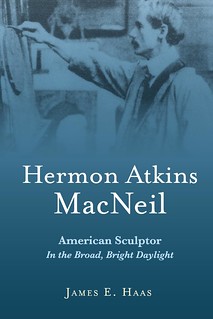 First, a little catch-up. Here's my account of a visit to the Whitman Baltimore Expo last Thursday, November 12th. I had an uneventful drive north on a cool and grey day. After parking at the Hyatt I walked past the convention center to meet Jim Haas across the street from the Pratt Street Ale House where we had a nice lunch. A history buff, Jim is author of the book on Standing Liberty quarter designer Harmon MacNeil and an E-Sylum subscriber and contributor.
He lives in Maryland and accompanied me on an earlier Baltimore visit to the George Peabody Library and Evergreen Museum & Library at Johns Hopkins University.
Once at the show we were met by Whitman's Michael Pfeiffer, who directed us through a streamlined registration process that had us on our way to the bourse in the blink of an eye. We first walked to the table of longtime E-Sylum sponsor Doug Winter and his wife Irma. I introduced Jim to Doug, who immediately asked about getting a copy of Jim's MacNeil book. We'll follow up and get one to him. After talking about Doug and Irma's recent vacation in Thailand, I joked with Doug that Irma is sitting on the right side of the table - spouses on the aisle side will say, "You SPENT HOW MUCH on that coin???", while spouses on the other side can say, "You MADE HOW MUCH on that coin??? I'm going shopping."
To read the earlier E-Sylum articles, see:
NEW BOOK: HERMON ATKINS MACNEIL
(https://www.coinbooks.org/v25/esylum_v25n43a02.html)
WAYNE'S NUMISMATIC DIARY: AUGUST 23, 2026
(https://www.coinbooks.org/v29/esylum_v29n34a18.html)
Book Signing: The Continental Dollar


Dan Carr experimental Continental Dollar strikes
Rob's book is about the known silver Continental Dollars. Laboratory analysis using X-ray micro-diffraction technology revealed evidence of the host planchets beneath the coins' visible designs. Working with Dan Carr, the team produced 112 experimental Continental Dollars in four different metals under varying striking conditions to better understand how the originals could have been manufactured.

Rob Rodriguez and his neckwear


RIGHT: Rob Rodriguez and Dr. Robert Fagaly

Chris MacDowell and Julia Casey

Julia Casey, Erik Goldstein, and
Chris MacDowell listening to Rob Rodriguez
I bought my copy, which Rob kindly signed. I'm looking forward to reading it. Yesterday Rob shared this photo of his book "entering the George Washington Mount Vernon Museum. Lesley Parilla, Chief Librarian, and Adam Early, Executive Director and Senior Curator, accepted it."

Mount Vernon Museum. Lesley Parilla, Adam Early, Rob Rodriguez
To read the earlier E-Sylum articles, see:
THE ROMANO-WARSHAW SILVER CONTINENTAL DOLLAR
(https://www.coinbooks.org/v29/esylum_v29n24.html)
NEW BOOK: THE CONTINENTAL DOLLAR
(https://www.coinbooks.org/v29/esylum_v29n45a04.html)
John Kraljevich
I stopped at the Stack's Bowers table to visit with John Kraljevich.
He introduced me to Matt Virga and we discussed his new app for attributing coin die varieties.
NBS Board Member Roger Siboni stopped by for a chat; we talked about Matt's app and how it could make life easier for collectors, dealers and cataloguers alike. More details to come in a future issue.

John Kraljevich, Roger Siboni
Books
I stopped by the table of bookseller Charlie Davis and spoke a bit with him and Neil Musante. I didn't take any photos this time. I did get these shots over at the supply dealer, who had a good selection of new books.


And More...


Kids on the bourse floor
The Monticello Bank

After stepping into the lobby I waited to meet Len Augsburger and Greg Bennick. We took an Uber to a nice Italian restaurant in Fell's Point. After a wonderful evening of food and conversation we walked back to the convention center. Len and Greg headed to the Hyatt for a Colonial Coin Collectors Club (C4) event, and I got in my car for the ride home to Virginia. It was a fun day of numismatics.
The November 2026 Nummis Nova
On Tuesday, November 17th I drove to J. Gilbert's in McLean for the monthly meeting of my Northern Virginia Numismatic social Group, Nummis Nova. Roger Burdette was our host. Mike Markowitz had been the first to arrive, and met me in the lobby. We were soon seated in a private room in back. Others quickly joined us, including Roger, Erik Douglas, Mike Packard, Chris Neuzil, Jon Radel, and Julian Leidman.
Earlier that day, Roger emailed us a recent find in the National Archives - a letter from San Francisco Mint Superintendent Frank Leach describing the valiant efforts to save the Mint from the raging fire following the 1906 earthquake. See an excerpt in another article in this issue.
As usual, I brought some new acquisitions including my Monticello bank note and these books.


 I also passed around these oddball non-numismatic items I picked up from my sister recently, because who doesn't like weird little gadgets? The first is an "Addiator", a little stylus-operated pocket mechanical addition and subtraction gizmo. Who needs to lug around a smartphone when you've got one of these little babies? It comes with a spiffy leatherette case and fold-out instruction manual. The second item is a James-Bond-worthy combination pen and lighter from Ronson. Let's see your smartphone do either of those. When the cyberwar comes and the lights go out I'll be in good shape.


The Addiator


Ronson Penciliter
Here are some of my photos from the evening.

Roger Burdette, Julian Leidman, Mike Packard

Mike Markowitz, Erik Douglas, Jon Radel


Chris Neuzil examining show-and-tell items


A Byzantine coin and three dollar coins
Experiments in Wear
Chris Neuzil writes:
"The three dollar coins are Mike Packard's and my pocket-piece experiments in wear. Mike has carried the two presidential dollars for more than a decade I think and they're down to VF or maybe even F. The Sacagawea at bottom I've carried around for around a year and it's maybe a nice XF."
 Mike Packard's Book Award Medal
Mike Packard shared the 'Sydney E. Martin Memorial Numismatic Publication Award' he received from C4 (the Colonial Coin Collectors Club) for his book "The Cents and Half Cents of Massachusetts." The book was also awarded 'The EAC Book of the Year Award for 2026.' Congratulations! The book is available at
numisbook.com and
numislit.com.


To read the earlier E-Sylum articles, see:
NEW BOOK: CENTS AND HALF CENTS OF MASSACHUSETTS
(https://www.coinbooks.org/v28/esylum_v28n41a04.html)
BOOK REVIEW: CENTS AND HALF CENTS OF MASSACHUSETTS
(https://www.coinbooks.org/v28/esylum_v28n46a07.html)

LEACH'S ACCOUNT OF 1906 SAN FRANCISCO MINT FIRE
Roger Burdette provided a transcription of an April 22, 1906 letter from San Francisco Mint Superintendent Frank Leach to Mint Director George Roberts the day after the city was struck with raging fires unleashed by a massive earthquake. Leach and Mint personnel fought valiantly, and with much of the city destroyed, the Mint stood damaged, but intact. Here's a lengthy excerpt. A fascinating, scary account. -Editor
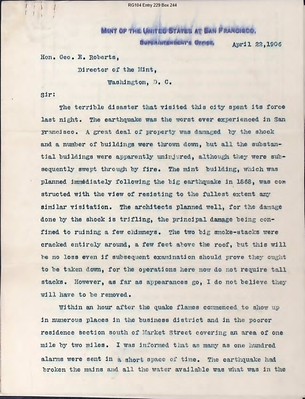 The terrible disaster that visited this city spent its force last night. The earthquake was the worst
ever experienced in San Francisco. A great deal of property was damaged by the shock and a
number of buildings were thrown down, but all the substantial buildings were apparently
uninjured, although they were subsequently swept through by fire. The mint building, which was
planned immediately following the big earthquake in 1868, was constructed with the view of
resisting to the fullest extent any similar visitation. The architects planned well, for the damage
done by the shock is trifling, the principal damage being confined to ruining a few chimneys.
Within an hour after the quake flames commenced to show up in numerous places in the business district and in the poorer residence section south of Market Street covering an area of one mile by two miles. I was informed that as many as one hundred alarms were sent in a short space of time. The earthquake had broken the mains and all the water available was what was in the pipes. The department succeeded in putting out some of the fires, but they were too numerous, and in a little while the fire was beyond the control of any human agency, and spread in all directions. It burned down to the eastern water-front and was stopped there with the aid of apparatus stationed along the wharves, the wide spaces there helping also to check its progress. Westward the fire took its course, being stubbornly fought by dynamiters and the crippled fire department, but no success followed their efforts for thirty-six hours, when a wide street, Van Ness Avenue, was reached. Here by dynamiting, back-firing and with the aid of the department, the fire was controlled and a large residence section saved. From Van Ness and Market another arm of the fire continued over into the S. W. part of the city, where it was headed off about a mile and a half further out. Over this area a very large residence and manufacturing district was burned out. The entire business part of the city was swept by the flames. I can learn of only two large business houses which escaped; one was near the water-front, and the other near the railroad. With the renewal of the wooden parts and windows, several of the modern buildings will be made as good as new. I hear that the stock of goods in one of these large buildings consisting of hardware and machinery was uninjured, although the lower stories were gutted, and that the large office building at the corner of Market and California Streets with its contents was safe.
Our building was the only building directly in the path of the fire, after it had burned one mile, that withstood the attack. Everything around us was destroyed, and it was only by the heroic conduct of the men that the building was saved. Some two or three years ago it occurred to me that we ought to be equipped with fire apparatus so to be able to put out any blazes that might start in the building, never thinking of its application against an attack from the outside, and it is wholly due to the furnishing of that equipment that the mint was saved. After the earthquake about 50 employees reported at the mint, which includes the watchmen who had been on duty during the last watch. The fire had reached fifth and Mission Streets before I could get to the building, but Mr. McLaughlin, Superintendent of Machinery, and Capt. Hawes had proved equal to the emergency and were making a grand fight against the flames. I had to make a wide detour on foot, going around the north side of the city and working my way through the guards to reach the building. Upon arriving at the mint I found our greatest danger would be when the fire worked around to the north side, so I immediately distributed the men on the various floors from the basement to the roof, and had all inflammable stuff removed to the other side of the building, the shutters closed on the lower stories and lines of hose ready to put out the fires if they should appear in the building. We had considerable lumber upon the roof where we had been making new tanks. The old tanks had been taken down and sawed up into fire wood and had been thrown off into the court, making a rubbish pile there which subsequently was a great menace to the building. Lieut. G. R. Armstrong, 6th Infantry, was here with a detail of soldiers, and his men as well as himself were very active with their assistance.
When the big buildings to the north of us on Market Street caught they sent terrific showers of burning material over the mint. It came down into the court as thick as hail, in pieces from the size of a walnut to the size of a man's hat, and I had two streams from the basement busily occupied in extinguishing flames started by these flakes of fire. The roof, you can imagine, was a pretty warm place. Mr. McLaughlin, with head melter Kennedy, assisted by Autzen, Terry and some of the soldiers, remained there to the end. After the danger was over they came down, blistered with heat and so blinded with the smoke they could hardly see.
The basement and refinery floors gave us the hardest battle to save. The fire would creep in behind the shutters and between cracks in the basement, giving off a blinding, choking smoke and terrific heat, but the stream of water handled by workmen Cuneo and Fredrichs, aided by J. C. Hansen, baffled the fire in that quarter.
On the refinery and adjusting room floor another lot of heroic fellows, Chittenden, foreman Bierce, Hastings, Hammill, E. Fisher, McCabe, French, Butler, Sherman, Mackie, Leith, assistant assayer Martin, Toner, Currier and Jacobs, headed by Captain Hawes, fought the fire with buckets and two streams of water. With blistered hands and faces they stood their ground, being driven back time and time again. At one time the smoke was so thick and choking they were driven to the extreme south end, or assay part, of the building, but I had some windows on the east side opened which gave them a little fresh air, and back the boys went at it again. Getting another stream of water with a greater head we found that we were able to control the situation, and that the flames could get no foothold upon the mint.
THE 1911 PATTERN BUFFALO 'CENT'
Here's an interesting piece from the Stack's Bowers Summer 2026 Global Showcase Auction that we didn't get a chance to highlight before. I wasn't aware of this one. -Editor
Unusual Uniface Reverse Electrotrial of Fraser's Buffalo Design Cent-Size, Dated 1911 Exceedingly Rare 1911 Pattern Buffalo "Cent." Uniface Reverse Electrotrial. Design by James Earle Fraser. (Uncertified). 18.2 mm x 18.5 mm. 3.32 grams. This intriguing piece is mentioned in an article titled "The James Fraser Lincoln Cent - 1911" written by Roger W. Burdette and published by Coin World on November 14, 2025. The author discusses the considerable controversy surrounding the recently introduced Lincoln cent and outlines the little-known efforts of artist James Earle Fraser to not only redesign the nickel five-cent piece, but also provide a more suitable portrait of Lincoln for the cent. Among the correspondence between Fraser and Treasury Department officials quoted by Burdette is a letter dated June 13, 1911 from the artist to Mint Director George Evan Roberts that states:
I think your idea of the Lincoln head is a splendid one and I shall be very glad to make you some sketches as soon as possible and let you see them. I think they should be reduced to the actual size of the coin; otherwise we will not be really able to judge them, even in the sketch period. I will have that done here, where I can watch the process. The "process" Fraser referred to is that used to create both the electrotrial offered in this lot and the two-set piece of uniface pattern Buffalo nickel electrotrials offered in the following lot. As Burdette explains:
Fraser's "sketches" were small models in plaster or wax. It was these which Fraser had reduced by Medallic Art company to approximate coin-size, and electrotypes created. The casts were rough because they were made quickly and because the sketch models were not finished compositions. This is the point in design creation where the sculptor separated himself from his predecessors. Instead of expecting non-artists, such as the director and secretary [of the Mint and Treasury, respectively], to look at drawings or models and imagine coins, Fraser took the extra time and effort to make coin-like medals. These could be handled and examined as if they were real coins, and helped "sell" Fraser's designs to officials.
A uniface obverse electrotrial of one of Fraser's proposed Lincoln portrait designs for the obverse of the cent is pictured in the Burdette Coin World article of November 14, 2025.
Curiously, however, no documentation has been found that discusses Fraser's possible redesign of the Lincoln cent reverse. Yet we do have the present uniface reverse electrotrial. It features a left facing bison with a large hump behind its head, standing on a straight groundline below which is the date 1911. Readers will recognize the superficial similarities between this design and that of Fraser eventually adopted for regular issue Buffalo nickel coinage in 1913, but at 18.2 mm x 18.5 mm the size of this electrotrial approximates that of the Lincoln cent (19.0 mm), not the nickel five-cent piece (21.2 mm). As well, the side of the electrotrial with the design has been painted or plated to simulate a bronze coin, not a nickel one.
Even so, the Fraser sketch that most closely matches the detail seen in the bison (large hump) on this electrotrial has the denomination 5 CENTS instead of a date in exergue. And Burdette again:
This also begs the question of a connection between Lincoln and American bison. Original range of bison included the states where Lincoln later lived, but by 1800 almost all bison east of the Mississippi had been exterminated. If there was a connection, it was tenuous at best.
To read the complete item description, see:
Unusual Uniface Reverse Electrotrial of Fraser's Buffalo Design
(https://auctions.stacksbowers.com/lots/view/3-1UQ7YA/1911-pattern-buffalo-cent-uniface-reverse-electrotrial-design-by-james-earle-fraser-uncertified)
THE CENT IS OFFICIALLY DEAD
Len Augsburger passed along this New York Times article about legislation putting the final nail in the coffin of the U.S. cent. Thanks. Here's an excerpt - see the complete article online. -Editor
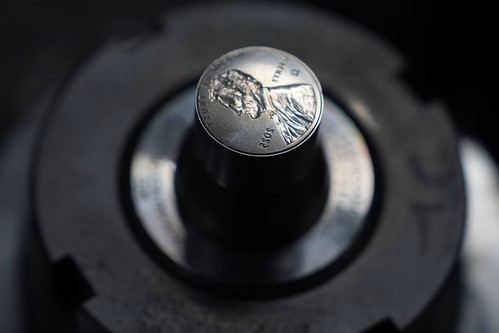
Though the humble penny's demise was declared a year ago, after President Trump sought an end to its run as a unit of U.S. currency, it was never quite legally laid to rest — until now.
On Friday, Mr. Trump signed into law the Common Cents Act, officially ending production of the one-cent coin that cost nearly four cents to mint. The act passed in September with no opposition in either the House or Senate.
Representative Lisa McClain, Republican of Michigan, one of the bill's sponsors, noted in a statement that the outsize cost of minting pennies was a sign that "something is broken." One of her co-sponsors, Senator Cynthia Lummis, Republican of Wyoming, also released a statement, saying, "We have modernized our coinage for the future."
The law officially directs the Treasury Department to halt its minting of the penny, save for special collector coins. But the cessation of its production already came to pass on Nov. 12, 2025. On that day, the U.S. Mint stamped the last of its pennies at a special ceremony held in the place of the coin's 1793 birth, Philadelphia.
The roughly 114 billion pennies in existence, the Treasury Department wrote in online guidance, would circulate "for as long as possible." How long that might be would largely depend on "consumer behavior." The Treasury guidance encouraged businesses to round up or down to the nearest five cents — only on cash transactions — and sought to assuage consumers' concerns about rising costs by noting that the rounding would average out. The federal cost savings, the Treasury estimated, would be $56 million annually.
The new act formalizes that rounding guidance. It also paves the way for cheaper materials in minting the nickel, which costs nearly 14 cents to make.
To read the complete article (subscription required), see:
The Penny Is Dead. Now It's Official.
(https://www.nytimes.com/2026/11/21/us/politics/penny-mint-trump-common-cent-act.html)
FEATURED WEBSITE: ANCIENT COINS
This week's Featured Website was suggested by website visitor Andrew Talbot. Thank you - this one looks very useful.
Ancient Coins is the clear guide above Numista, CoinArchives, OCRE, CRRO, museum databases, and auction archives: it helps you choose which source to use, when to trust it, and what to check next. Start with the full ancient coin database directory, then move into the research page that matches the evidence you have.

https://ancient-coins.org/
ABOUT THIS ISSUE: NOVEMBER 22, 2026
Nothing much numismatic this week outside of what's in my Diary article. I had dinner with a neighbor and part of the conversation focused on Money Artist J.S.G Boggs. Another day a package arrived from Kolbe & Fanning with a lot I'd won in their recent web sale - a brand new dust-jacketed copy of the Quarterman reprint of Attinelli's Numisgraphics. Couldn't resist the urge.
Seen online:
- I once tested my hot pepper limit during a trip to Thailand. I couldn't leave the country until my head grew back and my face matched my passport again.
- Headline: AI is a normal technolgoy
Finally, here are some interesting non-numismatic articles I came across this week.
The first cross-country U.S. road trip in a car took 63.5 days. (https://interestingfacts.com/fact/the-first-cross-country-road-trip-in-a-car-took-63-5-days/)
Archaeologists uncover possible 19th-century castaway camp on island 'at the end of the world' (https://phys.org/news/2026-11-archaeologists-uncover-19th-century-castaway.html)
The Confessions of an AI Fraud Kingpin (https://www.404media.co/the-confessions-of-an-ai-fraud-kingpin-onlyfake-owner-nazarenko/)
Hardware Is Software (https://unchartedterritories.tomaspueyo.com/p/hardware-is-software)
The 19th-Century Secret Society Preserving the History of the West (https://www.atlasobscura.com/articles/e-clampus-vitus-secret-society)
Waterford Foundation Nears End of John Wesley Church Restoration (https://www.loudounnow.com/news/waterford-foundation-nears-end-of-john-wesley-church-restoration/article_328acb90-b288-4353-8781-e49f96099973.html)
-Editor

Editor Wayne Homren, Assistant Editor Garrett Ziss
Wayne Homren
Wayne Homren is the founding editor of The E-Sylum and a consultant for the Newman Numismatic Portal. His collecting interests at various times included U.S. Encased Postage Stamps, merchant counterstamps, Pittsburgh Obsolete paper money, Civil War tokens and scrip, Carnegie Hero Medals, charge coins and numismatic literature. He also collects and has given presentations on the work of Money Artist J.S.G. Boggs. In the non-numismatic world he's worked in artificial intelligence, data science, and as a Program Manager for the U.S. Department of Defense.
Garrett Ziss
Garrett Ziss is a numismatic collector and researcher, with a focus on American paper money and early U.S. silver and copper coins. He is also a part-time U.S. coin cataloger for Heritage Auctions. Garrett assists Editor Wayne Homren by editing and formatting a selection of articles and images each week. When he's not engaged in numismatics, Garrett is pursuing a Master's Degree in Quantitative Economics at the University of Pittsburgh.

Contributors Pete Smith and Greg Bennick
Pete Smith
Numismatic researcher and author Pete Smith of Minnesota has written about early American coppers, Vermont coinage, numismatic literature, tokens and medals, the history of the U.S. Mint and much more. Author of American Numismatic Biographies, he contributes original articles to The E-Sylum often highlighting interesting figures in American numismatic history.
Greg Bennick
Greg Bennick (www.gregbennick.com) is a keynote speaker and long time coin collector with a focus on major mint error coins and US counterstamps. He is on the board of both CONECA and TAMS and enjoys having in-depth conversations with prominent numismatists from all areas of the hobby. Have ideas for other interviewees? Contact him anytime
via instagram @minterrors.
He can also be reached by email at
minterrors@gmail.com.

Website host John Nebel and webmaster Bruce Perdue
John Nebel
Numismatist, photographer, and ANS Board member and Fellow John Nebel of Boulder, CO helped the ANA and other clubs like NBS get online in the early days of the internet, hosting websites gratis through his Computer Systems Design Co. To this day he hosts some 50 ANA member club sites along with our
coinbooks.org site, making the club and our E-Sylum archive available to collectors and researchers worldwide.
Bruce Perdue
Encased coinage collector (encasedcoins.info) Bruce Perdue of Aurora, Illinois has been the volunteer NBS webmaster from its early days and works each week to add the latest E-Sylum issue to our archive and send out the email announcement.

|
|
The E-Sylum is an electronic publication of the Numismatic Bibliomania Society Copyright © 1998 - 2026 | |