Visit our NBS Sponsors









About UsThe Numismatic Bibliomania Society is a non-profit association devoted to the study and enjoyment of numismatic literature. For more information please see our web site at coinbooks.org SubscriptionsThose wishing to become new E-Sylum subscribers can go to the following web page
Subscribe
MembershipThere is a membership application available on the web site Membership Application To join, print the application and return it with your check to the address printed on the application. Print/Digital membership is $40 to addresses in the U.S., and $60 elsewhere. A digital-only membership is available for $25. For those without web access, write to: Jeff Dickerson, Treasurer AsylumFor Asylum mailing address changes and other membership questions, contact Jeff at this email address: treasurer@coinbooks.org SubmissionsTo submit items for publication in The E-Sylum, write to the Editor at this address: whomren@gmail.com BUY THE BOOK BEFORE THE COINSale Calendar
|
- WAYNE'S WORDS: THE E-SYLUM SEPTEMBER 27, 2026
- ASYLUM AUTUMN 2026 ISSUE PUBLISHED
- LANG NUMISMATIC LITERATURE AUCTION 13 REMINDER
- KOLBE & FANNING SALE 178 RESULTS
- NEW BOOK: THE ALMIGHTY DOLLAR
- NEW BOOK: MADMAN'S GUIDE TO COLLECTING
- 2026 SUMMER FUN VIDEOS AVAILABLE
- VIDEO: CALIFORNIA AGRICULTURAL SOCIETY MEDALS
- ANOTHER SANTINI PRIZE MEDAL
- NOTES FROM E-SYLUM READERS: SEPTEMBER 27, 2026
- ANA RECOGNIZES 2026 HONOREES
- VOCABULARY TERM: STUDY
- ROPER NEW ENGLAND SIXPENCE ANALYSIS
- THE RITTENHOUSE PEDIGREE PROBLEM
- PROFILE: RICHARD GREEVER
- TREASURE TALK WITH BEN COSTELLO: CHAPTER ONE
- STACK'S MARKETPLACE: GREAT BRITAIN
- ARCHIVES INTERNATIONAL SALE 117 SELECTIONS
- STACK'S BOWERS: FALL 2026 MAASTRICHT SALE
- HERITAGE: THE ODYSSEY COLLECTION
- GERMANY'S LARGEST HADRIAN-ERA COIN FIND
- COIN STUDY MAPS THE ROMAN WORLD
- VIKING AGE SILVER HOARD FOUND IN FINLAND
- VIKING AGE SILVER HOARD FOUND IN DENMARK
- THE 2018 PRINCESS AND FROG MEDAL
- RHODE ISLAND'S WASHINGTON TRUST
- LOOSE CHANGE: SEPTEMBER 27, 2026
- ABOUT THIS ISSUE: SEPTEMBER 27, 2026
Content presented in The E-Sylum is not necessarily researched or independently fact-checked, and views expressed do not necessarily represent those of the Numismatic Bibliomania Society.
WAYNE'S WORDS: THE E-SYLUM SEPTEMBER 27, 2026
 Thank you for reading The E-Sylum. If you enjoy it, please send me the email addresses of friends you think may enjoy it as well and I'll send them a subscription. Contact me at whomren@gmail.com anytime regarding your subscription, or questions, comments or suggestions about our content.
This week we open with a new issue of The Asylum, two numismatic literature auctions, updates from the ANA and the Newman Numismatic Portal, and more.
Other topics this week include the dollar, agricultural society medals, Santini medals, the Roper New England Sixpence, Richard Greever, Ben Costello, fixed price and auction selections, ancient coin finds and studies, and the Princess and the Frog medal.
To learn more about the 2026 Summer FUN show, Berghoff waiter's tokens, Nathanael Greene's Society of the Cincinnati medal, Jeff Garrett, Elliot Eng, scanning electron micrographs, the 1715 Fleet Society, the Peace of Breda medal, the East African Currency Board, and the kingdom of Poyais, read on. Have a great week, everyone!
Wayne Homren
Editor, The E-Sylum

Image of the week
ASYLUM AUTUMN 2026 ISSUE PUBLISHED
The Autumn 2026 issue of The Asylum is on the way from our sponsor, the Numismatic Bibliomania Society. -Editor
Welcome to The Asylum's Autumn 2026 edition.
In this issue:
-
 NBS at the World's Fair of Money
- Charity Auction Raises Funds for NBS
- Cassie Brand Presents Book Matters at the NBS Symposium
- NBS Treasurer Report
- The Asylum Awards
- Call for numismatic authors and volunteers: NBS Publishing Grant Committee
- In Memoriam: Patrick McBride 1952-2026 By Sandy Pearl
- Planning to Meet in the Irish Pub By Wayne Homren
- The L.G. Schlesinger y Guzmán Collection Catalog of 1914 By Adrián González-Salinas
- "Somewhat Slipshod and Amateurish" My Most Obscure Coin Book By David Pickup
Call for numismatic authors and volunteers: NBS Publishing Grant Committee
The following publishing grant was approved unanimously at the 2025 NBS board meeting. The NBS will support numismatic authors in two ways: contributing to the printing costs of general numismatic books, and/or acting as the publisher for any book proposals that fall within the mission of supporting and creating interest in numismatic literature as an area of collecting.
The NBS is calling for book proposals in these two categories. They are also calling for volunteers for a committee to evaluate book proposals once submitted. Any interested parties should contact NBS president Leonard Augsburger at president@coinbooks.org.
General numismatic books:
The NBS will support numismatic authors by paying half of the printing bill of approved books for self-published works advancing new numismatic research. Numismatic authors are often self-published, especially those studying niche subjects with a smaller field of collecting, and often have trouble securing traditional publishing and distribution support for their books. They most often only want to break even on their expenses but find the cost of publishing a printed book prohibitive. The NBS is in a position to help bring this research to interested collectors and expand the breadth of numismatic knowledge by distributing new information on more focused topics, thereby increasing the availability of numismatic literature.
This grant would range from $2000–$5000 and be paid directly to the printer at the book's completion. The author must cover the cost of research, preparing the manuscript for printing and the deposit to the printer, which is usually half of the total print bill. The author is also responsible for securing distribution of the book.
Authors must submit a completed manuscript to a publishing committee formed for the review of the manuscript when the book is ready to be sent to the printer. This committee would consist of three volunteer NBS members in good standing, one of whom should be an officer. These committee members should be familiar with the subject matter of the book and be able to make judgments on the quality of the research, as well as the writing and aesthetics of the book, and be able to suggest edits, if necessary. A cost estimate must also be submitted by the author from the intended printer.
In return, the author will acknowledge the grant from the NBS in the printed book.
Books on numismatic literature:
The NBS will act as the publisher for books that fall within their stated mission of supporting the interest in numismatic literature and bringing new numismatic literature to a wider audience.
This grant would cover the entire cost of publishing approved books dealing primarily with numismatic literature. The cost could range from $5000–$20,000. Authors must submit a completed manuscript to a publication committee formed for the review of the manuscript, either when it is ready to be sent to a layout artist or to the printer. This committee would consist of three volunteer NBS members in good standing, one of whom should be an officer. These committee members should be familiar with the subject matter of the book and be able to make judgments on the quality of the research, as well as the writing and aesthetics of the book, and be able to suggest edits, if necessary. The committee will also collect price estimates on any services needed, such as editorial, layout, printing and distribution, with input from the author.
The NBS will be listed as the publisher and be responsible for the book's completion and distribution, as well as the collection and distribution of proceeds. The NBS will use the proceeds to cover their own expenses first and distribute any proceeds exceeding their costs to the author.
NBS Membership Renewal Time!
 Please renew your membership in the NBS to continue receiving The Asylum. Go to coinbooks.org to pay by PayPal or download a membership form today. Your current expiration date is printed to the right of your name on your subscription envelope, which should be arriving soon.

LANG NUMISMATIC LITERATURE AUCTION 13 REMINDER
REMINDER: The 13th numismatic literature auction from Numismatic Antiquarian Bookshop Lang runs September 29 and 30, 2026. -Editor

Dear friends of numismatic literature,
This time it's going to be big—no, even bigger! On September 29 and 30, 2026, our 13th auction of numismatic literature will take place, as usual, on the Auex platform. You read that right: two days with approximately 2,000 lots. There's sure to be something for you!
In addition to the third part of Duplicates from the Library of Neu Numismatik AG, you can look forward to a wide selection of numismatic literature covering various fields, including items from the library of a former coin dealer.
Details:
- Date: September 29 and 30, 2026
- Location: Online on the auction platform Auex.de
- Time: both times from 5:00 p.m. CEST

As usual, you can find the complete range of items and the option to place advance bids at Auex.de. Advance bids can also be placed via the following platforms: Biddr, Sixbid, or NumisBids.
Please remember to register in good time in order to participate in the auction. If you have any questions or are interested in specific literature, we are of course happy to advise you at this stage.
We look forward to your participation and wish you every success!
For more information, or to bid, see:
https://auktionen.numismatisches-antiquariat.de/de-de/auctions/lots?cat_id=175
KOLBE & FANNING SALE 178 RESULTS
The results of Kolbe & Fanning's 178th numismatic literature sale are in. Here's the post-sale press release, and the prices are impressive. -Editor
 The auction of the numismatic library formed by Robert A. Schuman, M.D., held on Saturday, September 26, by Kolbe & Fanning Numismatic Booksellers, was a great success, with many exceptional results. The total sale results were about 160% of the pre-sale estimate. The Schuman Library focused on numismatics of the United States, and was perhaps most notable for its exceptional photographically illustrated auction catalogues and its holdings of rare and desirable works on large cents and Hard Times Tokens.
Some particularly notable results include:

Lots 7
Lot 7: J.N.T. Levick's annotated copy of Frank Dewette Andrews's 1881 first edition of his study on middle- and late-date large cents brought a record $24,000


Lots 41 and 47
Lot 41: a fine example of S.H. & H. Chapman's rare photographically plated 1905 catalogue of the Charles Morris collection brought $16,800
Lot 47: John J. Ford, Jr.'s example of the rare plated edition of S.H. Chapman's 1909 catalogue of the Charles Gordon Zug collection sold for $19,200


Lots 132 and 152
Lot 132: Tom Elder's 1911 catalogue of the William H. Woodin collection, one of a few issued with 18 photographic plates, realized $10,800
Lot 152: Ford's example of Tom Elder's 1920 catalogue of the Craig Clare collection, one of only a few copies issued with 13 photographic plates, sold for $13,200


Lots 154 and 155
Lot 154: Elder's 1921 catalogue of the Lynch, Walker & Tilden collections, with the complete complement of 22 photographic plates, brought $10,800
Lot 155: the photographically illustrated example of Elder's 1921 catalogue of the Lewis C. Gehring collection, with 19 plates, realized $15,600
 Lot 158: the very rare 1926 Elder Catalogue of the G.W. Lee collection of United States large cents, with 3 photographic plates, brought $10,200.
(The sale prices above include the 20% buyer's premium.)
As can be seen, the sale was dominated by Schuman's collection of classic photographically illustrated auction catalogues of the period from before the Second World War. These catalogues, always popular, have seen renewed interest in recent years, with particularly rare catalogues bringing very strong prices. Condition is also a priority of today's collectors, and Bob Schuman was known for emphasizing condition at a time when many collectors considered it a secondary concern. This emphasis on condition and rarity paid off in Saturday's sale.
The complete catalogue can be viewed at bid.numislit.com (go to "Past Auctions"), and a copy of the prices realized list, as well as a PDF of the printed catalogue, can be downloaded from the main Kolbe & Fanning site at numislit.com. We appreciate all of the interest expressed in the sale and thank our clients for their continuing business!
To view the lots and prices realized online, see:
Robert A. Schuman, M.D. Library - Sale 178
(https://bid.numislit.com/auctions/1-DAL43N/robert-a-schuman-md-library-sale-178)
To read the earlier E-Sylum articles, see:
BOOK REVIEW: THE TRUE HARD TIMES TOKENS BY ROBERT SCHUMAN
(https://www.coinbooks.org/esylum_v14n05a08.html)
ROBERT A. SCHUMAN, M.D. (1945–2026)
(https://www.coinbooks.org/v29/esylum_v29n05a05.html)
KOLBE & FANNING SALE 178 ANNOUNCED
(https://www.coinbooks.org/v29/esylum_v29n36a03.html)
KOLBE & FANNING SALE 178 HIGHLIGHTS
(https://www.coinbooks.org/v29/esylum_v29n37a02.html)
MORE KOLBE & FANNING SALE 178 HIGHLIGHTS
(https://www.coinbooks.org/v29/esylum_v29n38a02.html)
PROFILE: ROBERT A. SCHUMAN, M.D.
(https://www.coinbooks.org/v29/esylum_v29n38a13.html)

NEW BOOK: THE ALMIGHTY DOLLAR
Leslie Citrome suggested this new book on the history of the dollar. Thanks! Here the Amazon description. -Editor
The Almighty Dollar: 500 Years of the World's Most Powerful Money
by Brendan Greeley
 In this ambitious and groundbreaking history of the dollar, financial journalist and economic scholar Brendan Greeley makes a new argument about the origins of our money—and the people and nations who have surrendered to it.
America's money is global money—nearly every nation in the world writes international contracts in dollars, and in 2023, central banks around the world held nearly $6.7 trillion in dollar reserves, three times any other currency. Today, the United States' global hegemony rests largely on its ability to produce unlimited treasury bonds that are sold around the world, dollars that supported America's explosive growth in the twentieth century and funded its massive wars in the twenty-first. American power and the American dollar have become synonymous.
Yet in this brilliant 500-year history, Brendan Greeley argues that America's sovereignty over the dollar is an illusion—that the dollar had already empowered and destroyed nations long before it washed up on colonial shores, and that no country or king has or can ever truly control it. Reaching back to the dollar's birth as the taler in the 15th-century silver mines of St. Joachimsthal, Greeley reveals how the dollar first thrived as a commodity for merchants and bankers—a big, silver coin that was trusted around the world, even as the miners who pulled it from the ground had trouble getting paid in that same silver. Greeley traces a captivatingly complex path across time and place, from the industrial collapse at the heart of Spain's 17th-century silver empire, to the birth of American paper dollars in colonial Maryland, 19th-century New Orleans bank failures, and the small town of Hawarden, Iowa, which created its own dollars during the Great Depression. At every surprising turn, Greeley upends assumptions about global currencies and draws out the centuries-old tension between how dollars are manufactured and whom they actually serve.
Singular in its breadth, The Almighty Dollar dismantles the myth that America created or has ever truly controlled the dollar. Through meticulous research and vividly rendered stories of merchants, monarchs, and everyday people both past and present, Greeley shows how the dollar became America's greatest export, spawning a vast financial industry that enriches the wealthy, even as the rest of the country's industries suffer.
Publisher ? : ? Crown Currency
Publication date ? : ? May 19, 2026
Language ? : ? English
Print length ? : ? 432 pages
ISBN-10 ? : ? 0593138880
ISBN-13 ? : ? 978-0593138885
Item Weight ? : ? 1.31 pounds
Dimensions ? : ? 6.39 x 1.43 x 9.53 inches
For more information, or to order, see:
The Almighty Dollar: 500 Years of the World's Most Powerful Money
(https://www.amazon.com/Almighty-Dollar-Years-Worlds-Powerful/dp/0593138880)

NEW BOOK: MADMAN'S GUIDE TO COLLECTING
Gerry Tebben passed along a Wall Street Journal review of a book on our sister hobby of stamp collecting. -Editor
Gerry writes:
Reviewer Timothy Farrington notes, "... you will almost certainly enjoy Robert Irwin's delightful "The Madman's Guide to Stamp Collecting." Even if you don't, you might, as this hodgepodge of anecdotes, trivia and theories is less about stamps in particular and more about the compulsion to collect in all its facets.
It sounds like a book just made for coin collectors, too.
Here's an excerpt - see the complete article online. -Editor
 Postage stamps used to come apart with a string of muted pops, their perforations separating serially like tiny zippers. Today's self-adhesive stamps offer scallop-cut edges in lame imitation but must be peeled rather than pulled. And so the old feeling is gone, another species of tactile pleasure made extinct by technological improvement.
If you care about this sort of thing (and why wouldn't you?), you will almost certainly enjoy Robert Irwin's delightful "The Madman's Guide to Stamp Collecting." Even if you don't, you might, as this hodgepodge of anecdotes, trivia and theories is less about stamps in particular and more about the compulsion to collect in all its facets. Among other topics, Irwin covers "Classification; Nostalgia; Anal Retentiveness; . . . Completeness; Sexuality of Collecting; Secrecy and Subversion; Digressiveness; Boyhood; Dutchness; Boredom; Death."
The book starts with a quick tour of psychoanalytic notions about the urge to collect. Sigmund Freud, to put it crudely, suggested that collecting was a pursuit of control intended to make up for an infantile lack of bowel control. "Other psychoanalytically minded theorists," Irwin writes, "have suggested that the male penchant for collecting might be a substitute for erotic conquests." Still others have argued that collectors are "damaged personalities who have been driven to collect in attempts to repair traumas experienced in early infancy." Collecting, one wrote, is a "magical escape into a remote and private world."
Irwin calls this view "oddly patronizing." But while "traumas" does seem extreme, it's striking how many of the accounts he has gathered seem like a wounded soul's quest for escape. For the historian Peter Gay, born in Berlin in 1923, stamp collecting was an "invisible barrier that cut him off from the Nazi-dominated city," Irwin writes; Gay called the hobby an "island of order." Stamps have similarly been a medium for the building of fanciful alternate worlds. Starting in boyhood, an American designer and artist named Donald Evans created thousands of fictitious stamps from nonexistent countries, using a typewriter to punch out the perforations. For the state of Mangiare ("to eat" in Italian), Evans made a set of 25 stamps of fruits and vegetables. At one point, Irwin notes, Mangiare was occupied by Antipasti.
By the end, the hyperbolic term "madman" seems like an understatement for Irwin's subjects, many of whom are, at a minimum, fantasists. Abdurrahman Bruce Alfonso de Bourbon Condé, born Bruce Chalmers in San Juan Capistrano, Calif., imagined himself the descendant of French royalty and talked himself into a job as head of the Yemeni philatelic office in the 1950s, having been a boyhood pen pal of King Muhammad al-Badr. (Their correspondence started with a request for stamps.) After an antiroyal uprising, Condé ended up in exile, where he supported himself by writing for stamp magazines.
Gerry can't help but add:
"Stamp magazines must pay better than coin periodicals."
Publisher ? : ? Pushkin Press
Publication date ? : ? June 2, 2026
Format: Paperback
Language ? : ? English
Print length ? : ? 240 pages
ISBN-10 ? : ? 1805337769
ISBN-13 ? : ? 978-1805337768
Item Weight ? : ? 13 ounces
Dimensions ? : ? 5.1 x 0.72 x 7.77 inches
To read the complete article, see:
‘The Madman's Guide to Stamp Collecting' Review: Sticking to What They Know
(https://www.wsj.com/arts-culture/books/the-madmans-guide-to-stamp-collecting-review-sticking-to-what-they-know-e96da0e9)
For more information, or to order, see:
The Madman's Guide to Stamp Collecting
(https://www.amazon.com/Madmans-Guide-Stamp-Collecting/dp/1805337769/ref=sr_1_1)
The Madman's Guide to Stamp Collecting
(https://www.barnesandnoble.com/w/the-madmans-guide-to-stamp-collecting-robert-irwin/1147967505)


2026 SUMMER FUN VIDEOS AVAILABLE
The latest additions to the Newman Numismatic Portal are videos from the 2026 Summer FUN show. Project Coordinator Len Augsburger provided the following report. -Editor
2026 Summer FUN Videos Available
 Courtesy of Florida United Numismatists (FUN), the educational forum videos from their Summer (July 2026) convention are now available on NNP. Presentations include Tom Scopp speaking on the first American coin, in addition to Bill Jones' talk on double eagle type sets. Col. Steve Howard holds forth on the 2026 coin market, while Jay Chamberlain speaks on history of the U.S. Mints. NNP acknowledges Steve Martin of FUN for his assistance with this content.
An NNP navigation hint - sort by "date descending" after accessing the series page. This will display the most recent videos in the series.
Link to FUN videos on NNP:
https://nnp.washu.edu/multimedia-list/list/multimedia-subcollections/38519
Link to NNP Blog:
https://nnp.washu.edu/nnp-blog

VIDEO: CALIFORNIA AGRICULTURAL SOCIETY MEDALS
The David Lisot Video Library on the Newman Numismatic Portal can be found at:
https://nnp.wustl.edu/library/multimediadetail/522852
We highlight one of his videos each week in The E-Sylum. Here's one from 2016 with Michael Wehner speaking about the early medals of the California State Agricultural Society. -Editor

Michael F. Wehner speaks at the 2016 ANA World's Fair of Money in Anaheim, CA.
To watch the complete video, see:
Early Medals of the California State Agricultural Society
(https://youtu.be/ngDFOS4e0ug)
Early Medals of the California State Agricultural Society
(https://archive.org/details/ANA16018EarlyMedals_1)
ANOTHER SANTINI PRIZE MEDAL
In earlier articles, Jonathan Brecher and Zach Filis discussed Washington and Lee University's Santini Prize Medal (Julian SC-63). Zach wrote that "In May of 1871, Joseph Santini wrote to Robert E. Lee at the college ..." -Editor
 John Dannreuther writes:
"Lee died in 1870, so I am guessing he didn't get an answer. I believe he wrote to Washington & Lee University, although I guess it is possible he did not know Lee had passed."
Zach Filis writes:
"Good catch by John. He's absolutely correct. I was searching Robert E. Lee's archives all day and wrote Robert when I meant his son, George Washington Custis Lee who replaced Robert as President after his death. Sorry for the mistake. Attached is the first page of the letter, courtesy of W&L."
The Harry D. Campbell Santini Medal and Presentation Box
Zach sent along improved photos of the Harry D. Campbell Santini medal and its presentation box. Thanks! -Editor


Harry D. Campbell Santini Medal


The 1903 David Vance Guthrie Santini Medal and Presentation Box
Zach also discovered another Santini medal; this one was presented to David Vance Guthrie in 1903. -Editor


1903 David Vance Guthrie Santini Medal

Thanks, everyone. Great topic. -Editor
To read the earlier E-Sylum article, see:
MORE ON THE SANTINI PRIZE MEDAL
(https://www.coinbooks.org/v29/esylum_v29n38a09.html)

NOTES FROM E-SYLUM READERS: SEPTEMBER 27, 2026
Chicago's Berghoff Restaurant
Bruce Smith writes:
 "Thanks for the link to the article on the Berghoff. My family moved to Chicago in 1963, and the Berghoff was my favorite restaurant during the time we lived there. I was a kid, but I remember many of the waiters having German accents. No orders were written down, yet everything arrived where it was supposed to go.
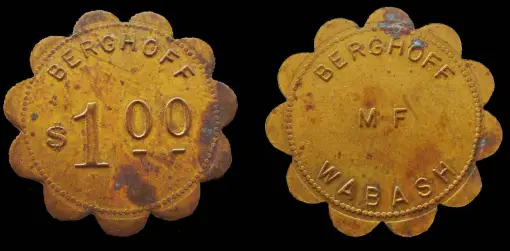
"The menus had a printed date with specials notices attached with paperclips. The bean soup was outstanding, the creamed spinach was legendary, and I was very fond of the roast duck with sauce Cumberland (cherry). The prices seem ridiculously low today, but even at the time things were very reasonable. In 1970, my duck dinner was $2.70. The waiters paid for orders with tokens when they picked up food from the kitchen and then settled up at the end of the night. I'd love to have one of those tokens.
"There was a second location on Wabash for a while. The standup bar at the original Adams Street location did not admit women until 1969 when NOW members demanded service, Gloria Steinham being the first. Mike Royko wrote an amusing column about the day that bastion of chauvinism fell. Thanks again for sharing the story."
This was one of the non-numismatic links I included with the About This Issue article. Glad it was of interest. Actually, the tokens are a numismatic connection we've touched on before - there have been exhibits of them at ANA conventions. Here's an image of one from the Wabash location I found online. -Editor
To read the complete article, see:
The Nickel Beer That Turned Into 128 Years
(https://opensince.substack.com/p/the-nickel-beer-that-turned-into)
To read the earlier E-Sylum articles, see:
2024 ANA CONVENTION EXHIBIT GUIDE
(https://www.coinbooks.org/v27/esylum_v27n31a08.html)
2025 NATIONAL MONEY SHOW EXHIBIT WINNERS
(https://www.coinbooks.org/v28/esylum_v28n13a07.html)
ABOUT THIS ISSUE: SEPTEMBER 20, 2026
(https://www.coinbooks.org/v29/esylum_v29n38a24.html)
Wikipedia Editing Assistance Sought
Joseph A. Ceravone writes:
 I was super excited to read the article on Dorothy H. Cox in the June 21st edition of the E-Sylum. Although her life and connection to numismatics was incredibly interesting, what drew my interest is that she spent the remainder of her life in Cheshire, CT.
I call Cheshire my home as I was born and raised there. My most earliest interests in numismatics started at the Cheshire public library.
The reason I am reaching out is that I am seeking help for someone to help me update the notable person section under the Cheshire, CT Wikipedia page. I have tried doing it myself but I keep getting blocked and don't know how to unblock myself. I am wanting to add her name to the Cheshire page with a link back to her Wikipedia page that was previously created.
Such an amazing person and patriot should be recognized not only for her war time contributions to our society but also her connections with Yale University.
Thank you for any help provided.
Great idea. I think we have some experienced Wikipedia editors among our readers. Can anyone assist? Thanks. -Editor
To read the earlier E-Sylum article, see:
DOROTHY HANNAH COX (1892-1977)
(https://www.coinbooks.org/v29/esylum_v29n25a11.html)
More on Nathanael Greene's "Society of the Cincinnati" Medal
Bob Fagaly, Secretary, New York State Society of the Cincinnati writes:
"Thanks for the article on Nathaniel Greene's Eagle. I'd love to know its provenance and any other information you learned in Pittsburgh."
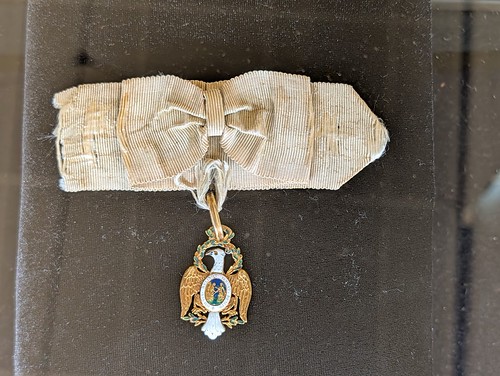
Well, it was originally auctioned by Sotheby's in 2011 and exhibited in Pittsburgh by Brian Hendelson of Classic Coin Company. -Editor
To read the complete lot description, see:
General Nathanael Greene's Enameled Gold Order of the Cincinnati, designed by major Pierre L'Enfant, and construction attributed to by Duval & Francastel, Paris, 1784
(https://www.sothebys.com/en/auctions/ecatalogue/2011/important-americana-including-american-stoneware-assembled-by-mr-and-mrs-edwin-hochberg-n08710/lot.177.html)
To read the earlier E-Sylum articles, see:
1921 PROOF DOUBLE EAGLE APPEARANCE AT ANA
(https://www.coinbooks.org/v29/esylum_v29n25a20.html)
WAYNE'S NUMISMATIC DIARY: 2026 ANA, PART 4
(https://www.coinbooks.org/v29/esylum_v29n38a19.html)
Jimmie Clark Steelman Jr. (1958-2026)
Ken Berger writes:
 "I want to notify readers of the recent passing of Jimmie Steelman. Jimmie was a major collector in the field of Philippine numismatics, especially emergency & guerrilla notes. He also specialized in notes & financial papers from colonial Connecticut. He passed away just five days after his 68th birthday."
Sorry to hear that news. Ken also provided the above photo. Does anyone have other photos or remembrances to share? -Editor
To read Jimmie's online obituary, see:
Jimmie Clark Steelman Jr.
(https://www.echovita.com/us/obituaries/ca/san-diego/jimmie-steelman-jr-22132083)
 Shiny Penny Find
In the life-is-like-a-box-of-chocolates department, Jim Haas writes:
"I was in a supermarket this other day, paid cash, saw a shiny penny, but did not look closely at it. A few minutes ago I did, and to my surprise it was a 1958-D wheaty. You never know what you're gonna get."
Congratulations - a very rare event these days. -Editor
 The Coffer App
Ayden Sullivan writes:
"I'm a high school senior in Chicago and a collector. I built Coffer, a free iPhone app now on the App Store that lets collectors scan coins, PCGS/NGC slab labels and banknotes, then tracks the value of their collection using price data from sources like eBay, PCGS and Numista, with bullion at spot."
Coffer includes a Coin of the Week and Artifact of the Week feature. -Editor
For more information, see:
Coffer
(https://coffer.it.com/)
Coffer - Collectables
(https://apps.apple.com/us/app/coffer-collectables/id6805283682)

ANA RECOGNIZES 2026 HONOREES
The ANA has recognized the 2026 Numismatist of the Year, Young Numismatist of the Year, and other highly involved hobbyists. Here is the press release. -Garrett
This year, the American Numismatic Association (ANA) proudly honors a dedicated numismatist, an inspiring young collector, and seven passionate hobbyists whose contributions have elevated the collecting community. The Numismatist of the Year was celebrated at the 135th Anniversary Awards Banquet during the Pittsburgh World's Fair of Money®. The Young Numismatist of the Year and Glenn Smedley Memorial Award recipients were presented during the convention's Member Awards Celebration. Both events applaud those whose enthusiasm and commitment continue to enrich the world of numismatics.
 The Numismatist of the Year award recognizes collectors at the regional and/or national level who have demonstrated outstanding leadership within the hobby and the ANA. The 2026 recipient is Jeff Garrett.
The founder of Mid-American Rare Coin Galleries, Garrett is one of the leading experts in U.S. coinage and has been a member of the Professional Numismatists Guide since 1982. He has handled two significant numismatic finds—the Major General Clayton L. Bissell short snorter and the Great Kentucky Hoard. He served as one of the original graders for Professional Coin Grading Service, and he currently works as a consultant to Numismatic Guaranty Company. He has authored a number of essential numismatic references and is the valuation editor for A Guide Book of United States Coins (the "Red Book").
Garrett has long been involved in the ANA, serving as governor (2009-11), vice president (2013-15), and president (2015-17). He has attended every ANA convention since 1974, and he continues to support the Edward C. Rochette Money Museum, encourage donor engagement, and fund scholarships. A member of the Dr. George F. Heath Society, he has donated extensive time and resources to further the ANA's educational mission.
 Young Numismatists of America (YNA) President Elliot Eng is the 2026 Young Numismatist of the Year, an award sponsored by U.S. Coins & Jewelry. A member of the YNA since its inception, Eng has tirelessly worked to support the organization, helping it grow over 110 members from 30-plus states and multiple countries. He has also been heavily involved in the ANA since he joined in 2021, serving as a head cataloger for the ANA's Annual YN Auctions in 2025 and 2026 and completing several of the ANA's Currency Connector projects.
Eng has also proven himself a talented author, earning the second place Bill Fivaz Young Numismatist Literary Award in 2022 and publishing over 20 articles in a variety of numismatic publications. He currently serves as a co-columnist for the Reading Room.
Eng is continuing to grow in the world of professional numismatics. He became the youngest-ever attendee of the Stack's Bowers Galleries Professional Numismatist Program in the summer of 2025. As a result of his hard work during the program, the auction firm offered Eng a full-time summer internship, which he began in May.
The ANA is recognizing five exceptional individuals with a 2026 Glenn Smedley Memorial Award. These highly involved hobbyists demonstrate positivity, cooperation, dependability, and strong communication skills.
A prolific writer and exhibitor, professor Mark Benvenuto has penned 1,600 articles for local, regional, and national numismatic publications and received more than 60 literary awards in a 30-year timespan. He has also created 61 numismatic exhibits since 1991.


Mark Benvenuto and Devin Hipp
Devin Hipp has built a reputation as one of the most forward-thinking professionals in the modern coin trade. He formulated curricula for Witter Coin U and Stack's Bowers Galleries' Professional Numismatist Program and recently cofounded Numismatic Rarities Exchange (NREX).
Prominent dealer Don Ketterling launched his numismatic career in the 1960s. A well-respected, trustworthy coin expert, he now runs DH Ketterling Consulting as a numismatic advisor. He has taught advanced coin grading courses at the ANA's Summer Seminar since 2011.


Don Ketterling and Mike Sutton
After more than two decades of service, Mike Sutton recently retired from his position as president of the Bluegrass Coin Club in Lexington, Kentucky. During his tenure, he hosted hundreds of monthly meetings for club members to connect and share knowledge.
 The collecting bug bit David Tyler when he received a few foreign coins in change as a child, and his interest in world currency persists to this day. He joined the Bluegrass Coin Club in 1998 and served as treasurer for nearly 25 years.
The ANA World's Fair of Money (WorldsFairOfMoney.com) was hosted at the David L. Lawrence Convention Center in Pittsburgh, PA. The show brings coin collectors together from all over the world, featuring hundreds of dealers, displays of rare treasures, educational opportunities, family activities, and more.

VOCABULARY TERM: STUDY
Here's another entry from Dick Johnson's Encyclopedia of Coin and Medal Terminology. -Editor
Study. A trial design for an artistic creation, as a preliminary drawing for an intended medallic or numismatic item; a sketch. Medallic studies may be two-dimensional as a drawing, or three-dimensional as a sketch in clay, plasteline or plaster. Often the design is quickly prepared to test a design concept; no detail is present, but relief is roughly outlined, particularly the device and lettering. Studies for coins and medals are usually done exact size – or oversize – as the size of the intended model. Since the end product is fairly small, studies are never done in miniature – like a maquette of a large statue.
 Often an artist will destroy these early studies keeping only the one selected for production. This was the custom, for example, of American sculptor Harold Tovish, whose 1965 creation, Meshed Faces, was one of the first medallic objects and who indeed destroy his unaccepted first prototypes of this innovative creation. Some studies (the French term is étude, the Italian is abbozzo) do survive and are eagerly sought by collectors of important medals. Clay studies of the U.S. gold coins, created by Augustus St-Gaudens, still exist today and are on display at his museum in Cornish, New Hampshire. See design, drawings and sketches.
To read the complete entry on the Newman Numismatic Portal, see:
Study
(https://nnp.washu.edu/Documents/Detail/study/4362360)

ROPER NEW ENGLAND SIXPENCE ANALYSIS
Christopher F. Pilliod (Reading, PA), Christopher J. Salmon (Paradise Valley, AZ), James Rosen (Bloomfield, CT), and Anthony Terranova (New York, NY) collaborated on research into the originality of the Roper New England Sixpence. Details of their analysis have been published previously in the Journal of Early American Numismatics, Vol. 8, no.1, pp1-10, June 2025. Jim Rosen submitted this summary for E-Sylum readers. Thank you. See the earlier publication for more information and details. -Editor
Excerpts from
THE ROPER NEW ENGLAND SIXPENCE:
SCIENTIFIC ANALYSIS PROVES ORIGINALITY

Figure 1. The Roper New England sixpence
When Stack's auctioned John L. Roper's New England sixpence in December 1983, it was described as "fabulous" and "the finest" of seven known specimens (Figure 1)[1]. This assessment was shared by many preeminent numismatists of the day, including John J. Ford, Jr., Richard Picker, Eric Newman, Norman Stack, David Sonderman and others and is consistent with the sharply defined and essentially pristine appearance of the stamped NE and VI impressions.
The coin recently came under scrutiny because of anomalies visible in the unstruck obverse and reverse fields that some observers believed to be plugs used to repair two small holes[2]. Detailed research and analysis will show that the anomalies were present in the hand-made planchets before striking and do not represent subsequent remediation.
METHODS
Christopher F. Pilliod, Senior Staff Metallurgist at Carpenter Technology in Reading, Pennsylvania, performed a series of physical tests on the sixpence, employing several state-of-the-art metallurgical techniques, including:
- Differential Interference Contrast Light Microscopy (DIC Microscopy).
- X-Ray Fluorescence Microprobe (XRF Microprobe).
- Scanning Electron Microscopy (SEM).
FINDINGS AND DISCUSSION
DIC Microscopy showed two distinct anomalies adjacent to one another. Figure 2 shows these at 11.4x magnification. The surface morphology of the anomalies is grossly similar to that of the surrounding unstruck field of the coin.

Figure 2. DIC Microscopy showing the two adjacent anomalies. (11.4x magnification).
XRF Microprobe is the ideal nondestructive method for compositional (elemental) analysis of a metal specimen. The silver and copper contents found in the anomalous areas and in the surrounding planchet show quite good agreement. Each is found to be composed of about 95% silver and 4% copper. As shown by previous research, these measurements are consistent with findings of Massachusetts silver coins of all series, as well as in all of the hollowware and flatware produced in the workshop of the mintmaster/silversmiths John Hull and Robert Sanderson, Sr.[3] More telling is the lead content. Lead was employed in the pyrometric refining of silver in the seventeenth century to separate it from copper. As a result, residual lead is normally found in silver coins of the period. The results showed that the anomalies and the surrounding unaffected planchet show similar silver, copper, and residual lead levels, in proportions typically found in the seventeenth-century products of the Hull and Sanderson workshop.[4] It is doubtful that such consistent results would be observed if a silver plug were placed in the setting of a modern repair.
SEM. Surface imaging with SEM yielded highly detailed images for study (Figure 3). No evidence of mechanical movement, blending, or smoothing of metal between the boundary of the anomalies and the surrounding planchet was detectable. Evidence of purposeful movement of metal would be expected in the vicinity of a plug, whether it was introduced at the mint prior to striking or done later in the setting of a repair. The absence of these findings is thus significant and constitutes strong evidence that the small anomalous areas are not plugs.
However, the strongest evidence against plugging is found in closely examining the surface topography of the coin. Note that in Figure 2, the distribution of porosity and micro-tears is uniform across the anomalies and the surrounding planchet. This is of critical importance in determining the origin of the anomalies.
Lastly, molten metal is required to create plug repairs, resulting in significant heating of the surrounding planchet. Although heating can result in microporosity or blistering, none is found in the recesses of the nearby struck area.[5] The thermal conductivity of silver is very high, and any heating for repair work would instantaneously migrate to the recesses of the nearby stamped areas. The absence of such features is further evidence against plugging.

Figure 3. Scanning Electron Micrograph. The boundary of the anomaly is indicated by an arrow. (43x magnification)
What, then, accounts for these anomalies? According to Pilliod, the most plausible explanation is that they result from small fragments of silver that never fully melted and were subsequently incorporated into the solid ingot as partially fused "inclusions." He likens the process to placing an ice cube in a glass of water and then putting it in the freezer: once the surrounding liquid solidifies, the original ice cube remains as a distinct and discernible unit within the newly frozen mass.
The differential contrast micrograph in Figure 4 is the critical image of the subject coin, proving incontrovertibly that the anomalies were produced during planchet preparation and not either as a mint-produced plug (to correct weight or surface) or as a later repair. The stark difference between the smooth topography of the stamped area and the micro-pitted area of the planchet should be noted.

Figure 4. DIC Micrograph. The anomalous areas exhibit the same microporosity as the surrounding unstruck portion of the planchet. Additionally, there is no evidence of tooling around the anomalous areas. Note as well that the recessed stamped area is smooth and shows no evidence of heating
CONCLUSION
The fact that the anomalies and the entire surrounding unstruck planchet share identical surface features and that these features are absent in the deeply struck areas proves that the anomalies were present in the planchet prior to striking and were therefore present in the coin as made. The deepest impressions of the struck areas are entirely devoid of microporosity, as the pores were entirely flattened and smoothed in these areas. These deep areas and their walls retain some original mint luster and show no evidence of secondary heating, as would be expected if a plug was introduced to patch a hole. The similar levels of residual lead in both the anomalous areas and the surrounding planchet provide further evidence that the anomalies are as made and were present in the original planchet.
NOTES:
[1] The John L. Roper, 2nd Collection of Colonial & Early American Coins, December 8, 9, 1983, Stack's, 11.
[2] Rosen, James and Anthony Terranova. 2024. "A New England Sixpence…Re-visited," C4 Newsletter, vol. 32, No. 3, 58-61.
[3] Salmon, Christopher J. 2010, The Silver Coins of Massachusetts, New York: The American Numismatic Society, 72.
[4] Note that these findings were first reported by Yale University Art Gallery curator Patricia E. Kane on page 5 and Appendix A of her 1987 Yale PhD dissertation, John Hull and Robert Sanderson, Sr., First Masters of New England Silver.
[5] Borckardt, Mark, et al. 2022. (1652) "New England ‘NE' Coinage Census," Journal of Early American Numismatics, vol. 5, no. 2, 35-114 (mentioned on pp. 40-41).

THE RITTENHOUSE PEDIGREE PROBLEM
E-Sylum Feature Writer and American Numismatic Biographies author Pete Smith submitted this article on a 1792 half disme pedigree. Thanks! -Editor
The finest known 1792 half disme, the Cardinal MS68 coin, is coming up for auction again. Readers may be interested in the story behind the Rittenhouse pedigree. I wrote to Karl Moulton about the pedigree and this was his response on September 10, 2015.
 When Martin Logies (Cardinal collection) was helping to publish the Henry Voigt book
(which came out in 2007), he and I were talking on the phone one evening when he related that
he had just acquired a 1792 half disme - MS 68 in an NGC holder.
When Martin Logies (Cardinal collection) was helping to publish the Henry Voigt book
(which came out in 2007), he and I were talking on the phone one evening when he related that
he had just acquired a 1792 half disme - MS 68 in an NGC holder.
I naturally asked him about it and he mentioned the Knoxville connection, and that he had recently acquired the coin from Contursi for, I believe, $1.5 million.
The following day, my mind got the better of me because that characteristics of the coin he described seemed familiar. It turns out that I had recently put my nose in the 1919 ANA sale by Henry Chapman and had actually remembered his description (which I thought was a near perfect match).
When Martin and I next spoke, I asked him to have the coin in hand. He wasn't aware of the 1919 ANA sale, so I read it to him. He agreed on all points of the description, so I told him that he had the identical piece and it was from Rittenhouse family.
He announced this shortly afterwards (don't know exactly how or where) and it was thought of as that coin ever since. Come to think about it, it probably was first announced on the Voigt book cover."
So, the Rittenhouse pedigree was established over the phone based on one old lot description and no consideration of other coins or lot descriptions. It must be a Rittenhouse coin because that is what it states on the PCGS holder.
When I read the Cardinal lot description in the Stack's Bowers sale of January 24, 2013, lot 13093, I noticed something I had missed before. The catalog reproduced the Chapman 10/4/1919 lot 249 description. It said:
"on upper edge across the top of the coin and just above the inscription it is not struck up and shows file marks in the planchet."
In my opinion, if the Chapman coin shows file marks and the Cardinal coin does not, they are not the same coin. The Pittman coin has light scratches near the obverse rim and the Bartlett coin has heavy scratches, making both better matches to the Chapman coin.
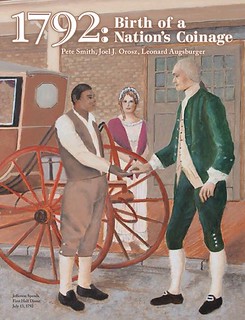 I wrote up my thoughts for page 150 of 1792: Birth of a Nation's Coinage. The Cardinal coin
cannot be traced back before the Stack's sale of October 18, 1988.
I wrote up my thoughts for page 150 of 1792: Birth of a Nation's Coinage. The Cardinal coin
cannot be traced back before the Stack's sale of October 18, 1988.
The buyer of the coin in 2013 was Brian Hendelson. I talked with him at the Central States show on April 26, 2013, and told him my opinion on the coin. I followed up and sent him a draft of my text on May 12, 2013.
Hendelson loaned the coin to the ANA for display at the 2013 World's Fair of Money. I wrote to ANA Curator Doug Mudd on July 22, 2013, and told him of the problems with the Rittenhouse attribution. The ANA continued to exhibit the coin several times as the Rittenhouse coin.
As publication of the book approached, I sent Hendelson a draft of the coin description on March 3, 2016. He did not respond, continued to exhibit the coin and sold it with the Rittenhouse pedigree around May 2018.
Now it is being offered at auction again with pedigree back only to 1988. The current lot description states, "we make no claims today that the presently offered example is the same coin that Henry Chapman sold in 1919, yet we cannot rule out that possibility."
I attempted to rule out that possibility in the 1792 book.
Pete's 1792 coauthors Joel Orosz and Len Augsburger concur with his assessment. -Editor
Joel adds:
"It is all but impossible to definitively match a current coin to a lot in an historical auction catalog without a photograph, but in this case the coin at hand doesn't even match the catalog's description. "
To read the earlier E-Sylum articles, see:
NEW BOOK: 1792: BIRTH OF A NATION'S COINAGE
(https://www.coinbooks.org/v20/esylum_v20n13a02.html)
BOOK REVIEW: 1792: BIRTH OF A NATION‘S COINAGE
(https://www.coinbooks.org/v20/esylum_v20n15a07.html)
PROFILE: RICHARD GREEVER
John Sallay passed along this nice interview of Richard Greever, mostly focusing on his tokencatalog.com website. Thanks! Here's an excerpt - see the complete article online. -Editor

Richard Greever. That's his website, TokenCatalog.com, on the computer monitor.
I was recently researching an obscure topic and stumbled across something interesting in my Google search results: a website called TokenCatalog.com, which attempts to document the seemingly limitless world of tokens.
Nowadays, of course, the term "token" often refers to the digital world — crypto tokens, AI tokens, security tokens, that sort of thing. But TokenCatalog.com is about physical tokens — coin-like items that can be used in lieu of cash. Some are issued by private businesses (a "Good for One Drink" chit at a local bar, or scrip to be used at the company store), others by governmental agencies (subway tokens). TokenCatalog.com claims to have photos of over 600,000 of them.
I'd never much thought about tokens as collectibles until I came across the TokenCatalog.com site, but a quick check of eBay revealed that token collecting is definitely a thing. I wanted to know more, so I contacted the site's founder, Richard Greever, and asked if I could interview him. Here's the transcript of a Zoom call we recently had, edited for length and clarity.
Inconspicuous Consumption: Please tell me a little bit about yourself. How old are you, where do you live, and what do you do for a living?
Richard Greever: I'm 68 years old. I'm currently back in California, although I lived in Hawaii for the past 15 years or so. And I'm retired from a career as a software engineer — embedded systems, telecommunication systems for corporate systems, working on their software.
IC: Do you collect anything besides tokens?
Greever:: Not really. I collected coins as a kid, sort of lost interest in that over the years, and then started picking that up again. But then prices of everything went crazy and around 2000 or so, so my wife said, "You should try tokens. They're cheap."
IC: So that's when you got bitten by the token bug, so to speak?
Greever: Yeah. I bought a bunch of them from Fred Holabird, this well-known Western Americana dealer in Nevada. He had an auction and I said to him, "Can I buy all the unsold lots?" So I got about 150 tokens from Oregon. I knew nothing about them and they were all different. It was cool.
IC: So you started out with 150 tokens. How many do you have now?
Greever: Probably 10,000.
IC: Whoa! So your wife really didn't know what she was getting into there, right?
Greever: Yeah, she's scratching her head like, "That wasn't what was supposed to happen."
IC: Well, at least it's 10,000 of something that's fairly small. Speaking of which, how do you have them arranged or displayed or stored?

A portion of Greever's Oregon token collection
Greever: They're not really displayed except for on the website. The bulk of them are Oregon state tokens, because of that first group of them I got. That's how I collected coins as a kid — you fill up the penny book until you've filled in every hole. It took a long time for me to figure out that with tokens, you can't fill in every hole. You're never finished. There are always new ones turning up, being found.
I still focus on specific areas. I do Oregon, I do Hawaii trade tokens, and I did Santa Clara County in California. And I used to have a collection of California saloon tokens, but I sold that a bunch of years ago. Anyway, that's how I sort of organize things — by where they're from, by town and by state.
IC: When did you launch the website?
Greever: I think it was 2006. I'd been collecting for a number of years, and I was frustrated because I couldn't find any information about the tokens I had. Like, what is this design? How many were made? Here's one that has a big hole in the center — were they all that way, or was that a mistake?
So I created the website and started cataloging my collection as I acquired more tokens and adding whatever information I could about them.
IC: So your goal was to create the most comprehensive token library, database, catalog, whatever you want to call it, as possible?
Greever: My goal was to create a tool that would enable that to happen. When I started working on the website, I had several thousand Oregon tokens — I was just buying everything Oregon. And then I thought, oh, wouldn't it be cool if I entered all mine and you entered all yours and everybody entered all of theirs, then there would be this massive database. You'd see all different wear, different varieties.
And then, after spending a year of entering tokens onto the database as pretty much a full-time job, I realized nobody else in their right mind will ever do this. So it was never my intent to be the one to catalog everything. It was more to make a tool so others could do the same thing I was trying to do. And then what gets displayed to the public is a union of everything that's been put in.
IC: You just said no one else in their right mind would do this, but lots of people actually have done it. It has become a crowdsourced project, so to speak, right?
Greever: Yeah. There are definitely people who help research stuff on the site. There are certain personalities that I think are addicted to what I created — and I'm one of them! I mean, I'm on the site every day, playing around. What I'm trying to do is just find more information about what's already there. Ideally, I'd like to know who made every token, who the vendor was and when.
To read the complete article, see:
Collection Agency: A More Inconspicuous Coin Category
(https://www.inconspicuous.info/p/collection-agency-a-more-inconspicuous)
TREASURE TALK WITH BEN COSTELLO: CHAPTER ONE
An article on the Finest Known website opens a planned series with Ben Costello, President of the 1715 Fleet Society. Here's an excerpt - see the complete article online. -Editor

As Finest Known Treasure Talk with Bob Evans continues to share stories of history's greatest treasures, we are excited to broaden the series with contributions from respected experts throughout the treasure community. It is a genuine pleasure to introduce this inaugural feature by my friend and esteemed colleague, Ben Costello, President of the 1715 Fleet Society. Ben's enthusiasm for the 1715 Fleet, combined with years of dedicated research and collecting, shines through in his writing. I hope you'll enjoy the first chapter of his journey into one of history's most captivating treasure stories. I'm honored to share Ben's work with our readers and look forward to the chapters ahead.
-Adam Crum, President, Finest Known

My first encounter with the 1715 Fleet came in January 2004. I had only recently begun collecting shipwreck coins. As a lifelong student of history, I found the idea of owning coins that had rested on the ocean floor for centuries irresistible. I explored coins from several famous wrecks, but I had yet to discover a true collecting passion.
That changed the day an auction catalog arrived in the mail.
On its cover were two of the most beautiful gold coins I had ever seen. I was immediately captivated. I had to know their story, where they had come from, and why they had survived. Those questions led me to the 1715 Fleet.
Before the auction, I immersed myself in everything I could find about the Fleet and its tragic loss. I learned that the two featured coins had been struck at different Spanish colonial mints, one in Mexico City in 1714, the other in Lima, Peru, in 1712. The more I learned, the more I realized the 1715 Fleet represented everything I loved: history, adventure, tragedy, romance, and, of course, treasure.
I also knew I had to own those coins.

Unable to attend the auction in Orlando, I arranged for an agent to bid on my behalf while we remained in constant contact by telephone. Together, we succeeded in acquiring both coins. That moment marked the beginning of what would become a lifelong passion.
Owning the coins only deepened my curiosity. I contacted the auction house seeking recommendations for books on the 1715 Fleet and was referred to Chicago book dealer Dave Crooks. During our conversation, Dave suggested I contact Frank Noga of the Cleveland area, whose extensive connections within the shipwreck community made him an invaluable resource.
Dave was right.
Frank and I quickly became friends after meeting in August 2004. Through him I was introduced to Lou Ullian, an original member of the Real Eight Company, whose pioneering salvage operations recovered much of the 1715 Fleet treasure from the early 1960s through the mid-1970s. Suddenly, I found myself learning firsthand from individuals who had helped write the modern history of the Fleet.
To read the complete article, see:
Chapter One: A Chance Encounter with History
(https://finestknown.com/chapter-one-a-chance-encounter-with-history/)

STACK'S MARKETPLACE: GREAT BRITAIN
Stack's Marketplace will be selling the following four British coins and medals as part of this week's featured items. -Garrett


GREAT BRITAIN. Defeat of the Spanish Armada Silver Medal, 1596. Elizabeth I. NGC MS-62. Eimer-67; MI-163-148; Van Loon-I-1476. Diameter: 52mm. Weight: 45.20 gms. By Gerard van Bijlaer. Struck rather than cast. Obverse: The Spanish Armada in distress, ship in forefront heavily damaged and sinking, "Jehovah" in Hebrew at top flanked by date, QVID ME PERSEQVERIS around; Reverse: Hand issuing from heaven holds cord connecting shields of arms of the allied England, France, and United Provinces, the latter in the shape of a heart, RVMPITVR HAVD FACILE around. An evocative medal struck in commemoration of the disastrous losses suffered by the Second Spanish Armada as part of the Eighty Years' War and the concurrent Anglo-Spanish War. In July 1596, English and Dutch troops captured and sacked the city of Cádiz, resulting in heavy economic losses for Spain and contributing to the bankruptcy of the royal treasury in that year. In retaliation, Spain set forth to attack the English coast in October. However, heavy storms in the Bay of Biscay devastated the fleet, resulting in its retreat before even coming into contact with English forces. This event is evidently mocked on this medal with the text "QUID ME PERSEQUERIS" ("Why pursue me?), while the reverse "RUMPITUR HAUD FACILE" ("Breaking is not easy") emphasizes the combined strength of the allied forces.
To read the complete item description, see:
GREAT BRITAIN. Defeat of the Spanish Armada Silver Medal, 1596. Elizabeth I. NGC MS-62.
(https://mycollections.stacksbowers.com/shop/world-coins/great-britain-defeat-of-the-spanish-armada-silver-medal-1596-elizabeth-i-ngc-ms-62/019ff7f3-6ec4-71c6-9ad0-225bb56a227e)


GREAT BRITAIN. Battle of Turnhout Silver Medal, 1597. Elizabeth I. NGC MS-61. MI-169/452; Van Loon-I-pp.475-77, xi. Diameter: 51mm. Weight: 45.40 gms. By Gerard van Bijlaer. Struck rather than cast. Obverse: Trophy of arms mounted on spear, map of conquered territory between the Ems, Rhine and Meuse rivers in background, with names of towns taken; Reverse: Nine lines of text. Commemorating the Battle of Turnhout, won by the allied forces of the Dutch Republic and the Kingdom of England against those of the Spanish Empire as part of the Eighty Years' War and the concurrent Anglo-Spanish War.
To read the complete item description, see:
GREAT BRITAIN. Battle of Turnhout Silver Medal, 1597. Elizabeth I. NGC MS-61.
(https://mycollections.stacksbowers.com/shop/world-coins/great-britain-battle-of-turnhout-silver-medal-1597-elizabeth-i-ngc-ms-61/019ff7f3-767e-7006-862b-813cc00bd197)


GREAT BRITAIN. Peace of Breda Silver Medal, 1667. NGC MS-61. MI-534/164; Eimer-242; van Loon-II, p. 583, 4. Diameter: 44mm. By C. Adolfszoon. Obverse: Pair of Dutch and English ships sailing side by side; Reverse: Shields of arms of England and Dutch Republic suspended from laurel wreath, crossed palm frond and laurel branch below, "BRITAIN:BATAV:PAX" on ribbon below, date at bottom.
To read the complete item description, see:
GREAT BRITAIN. Peace of Breda Silver Medal, 1667. NGC MS-61.
(https://mycollections.stacksbowers.com/shop/world-coins/great-britain-peace-of-breda-silver-medal-1667-ngc-ms-61/019fcec1-212b-70e1-ad4d-45df2061fd13)


GREAT BRITAIN. Silver Uniface Reverse Crown Pattern, ND (1817). London Mint. George III. PCGS PROOF-63. L&S-168; ESC-Unlisted. Mintage: 2. Weight: 36.62 gms. Edge: Plain. By Benedetto Pistrucci. Obverse: Blank; Reverse: St. George slaying the dragon within wide garter with large buckle, the garter ruled with horizontal lines. An EXTREMELY RARE and highly important trial striking of the first Pattern for what would become the first "modern" Crown. The reverse die of this issue is the same as that used upon the famed 1817 Pattern Crown (L&S-163), of which four examples are known bearing two distinct obverse dies. The patterns and the present trial are all recorded to have been struck out of collar on broad, thick silver planchets that are approximately 20% overweight relative to the circulating denomination; this indicates that these pieces were struck concurrently. This Pattern is considered the first to bear Pistrucci's iconic and highly original conception of St. George and the dragon; two other such Patterns would be issued in that year (L&S-166 and L&S-167), but which exhibit designs closer to the final circulating issue and which were struck on planchets of normal size and weight. In the Ferrari ("Nobleman") auction of the present example, it is noted: "In mint state and of the very greatest rarity as only two were struck thus". The Lingford sale (Glendining & Co. - 10/1950) of the second known example similarly notes that "only two specimens were struck". No additional examples have arisen since. As such, this is one of a mere six known examples in silver of this historic first "St. George and the dragon" design (there is one additional known example of a reverse trial in lead). The present example exhibits a great degree of originality, the surfaces deeply toned and lustrous, with satiny shine pervading the entirety of the reverse fields. The design is fully struck, with extraordinary detail visible upon the heads and upper bodies of the St. George and his horse. An EXTREMELY RARE opportunity for connoisseurs of British numismatics.
To read the complete item description, see:
GREAT BRITAIN. Silver Uniface Reverse Crown Pattern, ND (1817). London Mint. George III. PCGS PROOF-63.
(https://mycollections.stacksbowers.com/shop/world-coins/great-britain-silver-uniface-reverse-crown-pattern-nd-1817-london-mint-george-iii-pcgs-proof-63/019fcec1-274a-7172-8ad9-c3bf06d4c02d)

THE BOOK BAZARRE
ARCHIVES INTERNATIONAL SALE 117 SELECTIONS
Here are some selected lots from the September 30 sale by Archives International Auctions. -Garrett

Mexico, ND (1900-1910). 1000 Pesos, P-Unlisted M205s, Specimen Banknote, Black and red/orange print with seated allegorical figure beside shield at right with harbor scene in rear, Back is orange with denomination at center, Specimen overprints and POC's, S/N C 0000, PMG graded Gem Uncirculated 66 EPQ with comment "Printer's Stamp," ABNC.
To read the complete item description, see:
Mexico Bono de Caja Banco Central Mexicano ND 1900 10 1000 Pesos Specimen Banknote
(https://auction.archivesinternational.com/Mexico-Bono-de-Caja-Banco-Central-Mexicano-ND-1900-10-1000-Pesos-Specimen-Banknote_i61091684)

Russia, 1912 (1912-17). 500 Rubles, P-14b, Issued Banknote, Black on green and m/c underprint, Back is black and white with Peter I at left, S/N GO115678, PMG graded Gem Uncirculated 66 EPQ.
To read the complete item description, see:
Russia State Credit Note 1912 1912 to 1917 Issued Banknote
(https://auction.archivesinternational.com/Russia-State-Credit-Note-1912-1912-to-1917-Issued-Banknote_i61091701)

Massachusetts Treasury note, Boston, April 1, 1786, No. 2091, Five Pounds, issued to J. Straw or bearer pursuant to state law, redeemable against the March 1786 tax, signed by Alexander Hodgdon, Treasurer.
To read the complete item description, see:
MA Massachusetts Treasury Note Five Pounds Boston 1786
(https://auction.archivesinternational.com/MA-Massachusetts-Treasury-Note-Five-Pounds-Boston-1786_i61091769)


Philadelphia, Pennsylvania, May 10, 1775. $30, CC-10, P-S110, Issued Banknote, Black with 'Si Recte Facies' on emblem with wreath on a tomb, Back has Latin seals, S/N 16844, PCGS graded Very Choice New 64 with comment "Small Repair on Back in LR Corner."
To read the complete item description, see:
PA Continental Currency Congress First Issue 30 May 10 1775 Issued Banknote
(https://auction.archivesinternational.com/PA-Continental-Currency-Congress-First-Issue-30-May-10-1775-Issued-Banknote_i61091772)


U.S., 1886. Silver Certificate. $10, Fr.# 294, Issued Banknote, Rosecrans | Huston signatures, large red Treasury seal, Thomas A. Hendricks portrait at center in ornate frame, S/N B8902064 pp D. PMG graded Very Fine 25 with comments "Stains Lightened." Printer: BEP.
To read the complete item description, see:
U S Silver Certificate 1886 10 Fr 294 Issued Banknote PMG Very Fine 25
(https://auction.archivesinternational.com/U-S-Silver-Certificate-1886-10-Fr-294-Issued-Banknote-PMG-Very-Fine-25_i61091870)


Providence, Rhode Island, 1882. The Roger Williams National Bank of Providence, Charter # 1506. $5 Brown Back, Fr.# 469, Issued National Currency, James A. Garfield portrait, charter number on back, S/N H957403, bank serial 4901, pp B. PMG graded Very Fine 20. Printer: BEP.
To read the complete item description, see:
RI Roger Williams National Bank of Providence Rhode Island 5 Series of 1882 Brown Back Ch 15
(https://auction.archivesinternational.com/RI-Roger-Williams-National-Bank-of-Providence-Rhode-Island-5-Series-of-1882-Brown-Back-Ch-15_i61091904)

Lander County, Seely Ledge, Nevada Territory, (Offices in San Francisco, California), May 18th, 1863. 51 Shares, I/U Capital Stock Certificate, S/N 12, Black text with black border with light green underprint, Mining scene at center. VF condition. Issued to George R. Turner, signed by M.A. Whaley as President, The Buena Vista Mine, located at Seely Ledge in Lander County, is a gold, silver, and lead mine at an elevation of 6,348 feet. Towne & Bacon.
To read the complete item description, see:
Nevada Territory Buena Vista Mining Co 1863 I U Stock Certificate
(https://auction.archivesinternational.com/Nevada-Territory-Buena-Vista-Mining-Co-1863-I-U-Stock-Certificate_i61092044)
STACK'S BOWERS: FALL 2026 MAASTRICHT SALE
Stack's Bowers will be hosting their Fall 2026 Maastricht Showcase Auction of World Paper Money on October 1. Select items are discussed below. -Garrett


Sole Finest Graded ANDORRA. Consell General de les Valls d'Andorra. 10 Pessetes, 19.12.1936. P-4. PMG Choice Uncirculated 63. The key denomination of this series. This is the only uncirculated example found in the PMG population report, with the next finest a sole AU50 graded note. Reported printing of only 1,000 notes. The notes from Andorra, issued during the Spanish Civil War, are short-lived, and popular as a result. Only two series were issued, with the same design, the first in blue and the second (in brown) issued a year later.
To read the complete item description, see:
Sole Finest Graded
(https://auctions.stacksbowers.com/lots/view/3-1VZKR3/andorra-consell-general-de-les-valls-dandorra-10-pessetes-19121936-p-4-pmg-choice-uncirculated-63)


Sole Finest Specimen of Classic Issue EAST AFRICA. East African Currency Board. 100 Shillings, 1.1.1933. P-23s. Specimen. PMG Gem Uncirculated 66 EPQ. An incredibly important opportunity for the specialist and a note of the greatest importance to the British colonial or African specialist. Not only is this the sole finest specimen of this type in the PMG population report, but the near absence of issued notes in the marketplace (just two well-circulated examples have been graded by PMG to date) means that this type is lacking from most advanced collections. While lower denominations of the East African Currency Board are sometimes encountered, and higher denominations are rarities, the 100 Shillings is one of those notes that might get overlooked. Nevertheless, it is a major rarity, and specialists will know that the present offering should be strongly considered not just for its condition, but also for its rarity and attractiveness. Certainly one of the highlights in the present sale, not to be missed
To read the complete item description, see:
Sole Finest Specimen of Classic Issue
(https://auctions.stacksbowers.com/lots/view/3-1VZLM1/east-africa-east-african-currency-board-100-shillings-111933-p-23s-specimen-pmg-gem-uncirculated-66-epq)


Exceptional 'Fallah' 1 Pound in AU EGYPT. National Bank of Egypt. 1 Pound, 3.7.1926. P-20. Hanafy#M4a. PMG About Uncirculated 55. A popular and important type from Egypt that, while often seen in circulated grades, is a major rarity at the About Uncirculated level. While three notes grade finer in the PMG population report as of the time of cataloging, we have been unable to find many auction results of this type in grades above Very Fine. In addition, the note offered in the present lot is entirely problem-free, with very limited signs of circulation, good color, and excellent paper quality. For the advanced specialist in Egyptian paper money attempting to build one of the finest collections, this is certainly a lot to strongly consider.
To read the complete item description, see:
Exceptional 'Fallah' 1 Pound in AU
(https://auctions.stacksbowers.com/lots/view/3-1VZLQJ/egypt-national-bank-of-egypt-1-pound-371926-p-20-hanafym4a-pmg-about-uncirculated-55)


Sole Finest Graded Example GERMANY. Reichsbank. 20 Billionen Mark, 5.2.1924. P-138. PMG Superb Gem Uncirculated 67 EPQ. Sole finest graded example of one of the key varieties issued during hyperinflation in Germany in the early 1920s. A type most often encountered in heavily circulated condition; uncirculated survivors are very rare, with just a handful of UNCs graded by PMG, with this sitting proudly at the top of the population report. For advanced German specialists, this represents an important opportunity not to be missed. As can be expected at this grade level, it comes with near-perfect centering, strong embossing, and total originality.
To read the complete item description, see:
Sole Finest Graded Example
(https://auctions.stacksbowers.com/lots/view/3-1VZM2O/germany-reichsbank-20-billionen-mark-521924-p-138-pmg-superb-gem-uncirculated-67-epq)
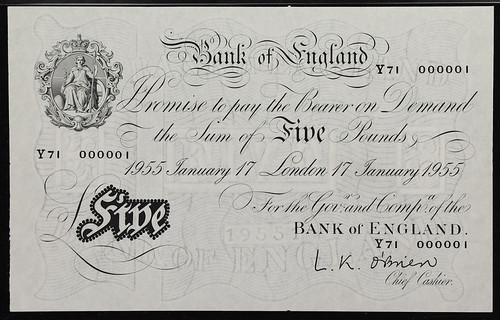
GREAT BRITAIN. Bank of England. 5 Pounds, 17.1.1955. P-345. B275-276. Serial Number 1. PMG About Uncirculated 55 EPQ. The crown jewel of this trio of notes, with the very first serial number for this signature, and no doubt one of the true highlights of the present sale. This 5 Pound is of particular importance, not only because it includes the letter that originally came with the notes signed by L.K. O'Brien himself (dated 1962, the year he retired as Governor of the Bank of England), but also because this was the last iteration of the white (uniface) 5 Pound note. These so-called 'White Fivers' trace their origin back to the earliest days of the Bank of England, and while small design updates took place over the years, the design essentially remained the same, eventually influencing other notes across the British Commonwealth in their design (such as the Ghana 1000 Pounds). While we could write another page or two on these three notes, we will keep this short, but strongly urge you to consider this offering, as it is one of those notes where you don't want to wake up the next day wishing you had bid just one more increment.
To read the complete item description, see:
GREAT BRITAIN. Bank of England. 5 Pounds, 17.1.1955. P-345. B275-276. Serial Number 1. PMG About Uncirculated 55 EPQ.
(https://auctions.stacksbowers.com/lots/view/3-1VZM6H/great-britain-bank-of-england-5-pounds-1711955-p-345-b275-276-serial-number-1-pmg-about-uncirculated-55-epq)


Attractive and Unique QEII 5 Pound Printer's Models GREAT BRITAIN. Lot of (2). Bank of England. 5 Pounds, ND (ca. 1960s). P-Unlisted. Front & Back Printer's Models. PMG Choice Uncirculated 64 EPQ to Gem Uncirculated 66 EPQ. Of the greatest historical importance, these printer's models represent 'what could have been.' Produced for the Bank of England by an unknown printer, these date to the early 1960s, or possibly a little earlier. The signature of L.K. O'Brien dates it to 1955 to 1962, as that is when he was in office as Governor of the Bank of England. It is possible this was prepared at the same time as the helmeted Britannia design was introduced into circulation. The portrait of Queen Elizabeth II seen here was never used on British paper money, but was seen on the Jamaica 5 Pounds issued during the same era. While there are design similarities with the issued notes, this is clearly a very preliminary design, and in all likelihood, the present printer's models are all that survive. Of the greatest historical importance and the first public offering since this pair first appeared at public auction in 2019.
To read the complete item description, see:
Attractive and Unique QEII 5 Pound Printer's Models
(https://auctions.stacksbowers.com/lots/view/3-1VZM72/great-britain-lot-of-2-bank-of-england-5-pounds-nd-ca-1960s-p-unlisted-front-back-printers-models-pmg-choice-uncirculated)

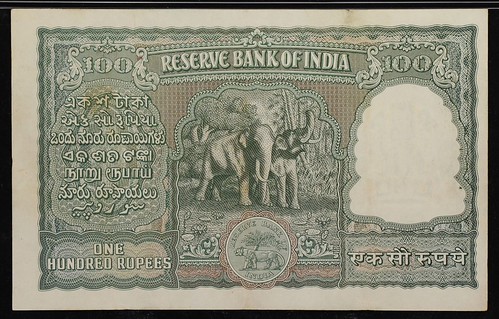
Popular Persian Gulf 100 Rupees in XF INDIA. Reserve Bank of India. 100 Rupees, ND (1959-70). P-R4. Jhun&Rez 6.12.4.1. Persian Gulf Note. PMG Choice Extremely Fine 45. An exceptionally scarce and popular Persian Gulf 100 Rupees. India issued this series of notes strictly for use in Persian Gulf countries to regulate the amount of Reserve Bank currency leaving the country. This note is in slightly lower grade than the piece we recently sold as part of the Golden Falcon collection. However, don't let the opportunity to acquire two notes of this type in a short time span deceive you; our last offering prior to this year was four years ago. PMG Comments "Staple Holes at Issue."
To read the complete item description, see:
Popular Persian Gulf 100 Rupees in XF
(https://auctions.stacksbowers.com/lots/view/3-1VZMD3/india-reserve-bank-of-india-100-rupees-nd-1959-70-p-r4-jhun-rez-61241-persian-gulf-note-pmg-choice-extremely-fine-45)

Eye-Catching Presentation Album from Libya LIBYA. Lot of (14) in Presentation Album. Kingdom of Libya. 5 Piastres to 10 Pounds, 1.1.1952. P-12 to P-18. Specimens. Uncirculated. Complete set of the King Idris issue of the Kingdom of Libya in a presentation album. Rare in this format, two copies of each note are mounted in this album, ensuring that both sides are visible. We believe the notes to be fully printed on both sides, but the caveat is that with its current mounting, this is impossible to confirm with absolute certainty. Specimens from this series are sometimes encountered, but complete presentation albums, such as this, are very rare. Exceptional opportunity for the Middle Eastern specialist.
To read the complete item description, see:
Eye-Catching Presentation Album from Libya
(https://auctions.stacksbowers.com/lots/view/3-1VZMQV/libya-lot-of-14-in-presentation-album-kingdom-of-libya-5-piastres-to-10-pounds-111952-p-12-to-p-18-specimens-uncirculated)
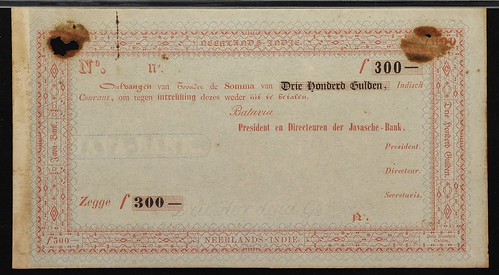
Trophy 1850s 300 Gulden Remainder NETHERLANDS INDIES. Javasche Bank. 300 Gulden, ND (1853-58). P-30r. Remainder. PMG Uncirculated 62 Net. Previously Mounted, Internal Damage. In the 1850s, paper money in the Netherlands Indies (modern-day Indonesia) remained relatively simple, mirroring designs used in the Netherlands. These notes are incredibly rare and rarely encountered in any format. This series, which PMG dates 1853-58 but Plomp dates 1851-64, included denominations ranging from 10 Gulden to 1000 Gulden. The higher denominations, such as this, were printed in red. On all denominations, the back is blank. This remainder of the 300 Gulden is extremely rare, and besides the piece pictured in Plomp, the only example we are aware of. It shows mounting remnants, which have caused some internal damage, although most of the printed areas remain clear. We must note that all remainders we have seen of this series (we know of at least a 1000 Gulden, and Plomp pictures a 25 and 50 Gulden) show similar mounting remnants and damage. A cornerstone offering and a celebrated offering, not to be missed. PMG Comments "Previously Mounted, Internal Damage."
To read the complete item description, see:
Trophy 1850s 300 Gulden Remainder
(https://auctions.stacksbowers.com/lots/view/3-1VZN8B/netherlands-indies-javasche-bank-300-gulden-nd-1853-58-p-30r-remainder-pmg-uncirculated-62-net-previously-mounted-internal-damage)


The Only Circulated 25 Riyals Awarded 'EPQ' Status QATAR & DUBAI. Qatar & Dubai Currency Board. 25 Riyals, ND (1966). P-4a. PMG Very Fine 30 EPQ. An exceptional rarity from Qatar & Dubai and particularly noteworthy as it is the only circulated example of this type that has been awarded 'EPQ' status for its original paper quality by PMG. The 25 Riyals for Qatar and Dubai is a rarity known throughout the collecting world, as it is a key note in an extremely popular series. After the collapse of the Ottoman Empire, Great Britain set up a variety of Protectorates through the Persian Gulf. These political alliances lasted for decades and ceased in 1971 with the independence of the Emirates that would form the United Arab Emirates, which issued its first banknotes in 1973. However, the first banknotes issued for part of the future UAE were issued in Dubai in 1966, when it entered into a currency alliance with Qatar (banknotes in circulation at the time included Indian Rupees and Gulf Rupees, which were also printed in India and of the same basic design, with different colors). The currency union between Qatar & Dubai proved a success, and its banknotes circulated extensively in the two regions. The series, which consisted of six denominations, were printed by the British firm of Bradbury & Wilkinson. All denominations had the same design, but the colors are different and the sizes increase with each denomination. The front of the notes is entirely in Arabic, including the serial numbers, while the back is in English, identifying the notes as being issued by the Qatar & Dubai Currency Board. The 25 Riyals by far had the lowest issuance of the entire series. While the exact number of pieces issued is unknown, an article by Peter Symes published online indicates that just 1,565 were outstanding in October 1997. Most of these appear to have been lost or destroyed, as this denomination is very rarely offered for sale and the number of pieces certified by the grading services is small. An exceptional opportunity for the Middle Eastern specialist.
To read the complete item description, see:
The Only Circulated 25 Riyals Awarded 'EPQ' Status
(https://auctions.stacksbowers.com/lots/view/3-1VZNNP/qatar-dubai-qatar-dubai-currency-board-25-riyals-nd-1966-p-4a-pmg-very-fine-30-epq)

HERITAGE: THE ODYSSEY COLLECTION
Heritage Auctions will be hosting The Odyssey Collection of shipwreck items on October 2. Here is the press release, expanded to include lots from R.M.S. Douro, S.S. Republic, and Charles II. -Garrett
A rare navigation device once used to pinpoint a ship's location through analysis of the stars will be among the top treasures in The Odyssey Collection: Sunken Treasure Americana & Political Showcase Auction Oct. 2 at Heritage Auctions.
 The "Dry Tortugas/Nuestra Señora del Rosario" Shipwreck Astrolabe ND, early 17th Century offered in this auction is among more than 200 lots from several shipwrecks, spanning from the early 1600s to World War II. The S.S. Republic, a Civil War paddlewheel steamship that sank in October 1865 carrying some $400,000 in gold and silver and supplies bound for post-war New Orleans, rested at 1,700 feet below the water's surface off the coast of Georgia for 138 years, until Odyssey Marine Exploration deployed underwater robotics to recover 51,000 coins and 14,000 artifacts.
"The Nuestra Señora del Rosario was part of the 1622 Tierra Firme fleet, of which the most famous galleon was the Atocha. These ships transported vast riches from the Americas back to Spain," says Thomas Ribeiro, numismatist at Heritage Auctions. "When the fleet ran into a hurricane in the Florida Keys, the Rosario struck a rock. Contemporary efforts to salvage the wreck were fruitful and recovered much of the ship's armament and cargo. It wasn't until 1971 that the wreck was rediscovered, near Dry Tortugas, producing many of the extraordinary lots in this auction."
 Also in play is a "S.S. Gairsoppa" Shipwreck silver Ingot of 1156.7 troy oz ND (ca. 1940) that is the very first Gairsoppa bar recovered after more than 70 years under water. The Gairsoppa was loaded with iron, tea and silver ingots shipped from India to England, but it never made it to its final destination after encountering a German U-Boat that sunk the ship during WWII. Only a fraction of the more than 2,500 bars survived the smelting pot after recovery, and they all were of the same kind, different from this rare example of which Odyssey only located three pieces, this present offering the very first ingot to be recovered from the wreck site.
The auction features six lots with ingots, including but not limited to:
- An "S.S. Gairsoppa" Shipwreck silver Ingot of 1020.3 troy oz ND (ca. 1940)
- An "S.S. Gairsoppa" Shipwreck silver Ingot of 1094.8 troy oz ND (ca. 1940)
- An "S.S. Gairsoppa" Shipwreck refined silver ingot (10 oz)
"S.S. Republic" Shipwreck Multi-Coin 50 Cents Shipwreck Clump, 19th Century
A remarkable survivor from the Republic wreck is the "S.S. Republic" Shipwreck Multi-Coin 50 Cents Shipwreck Clump, 19th Century — a clump that includes nearly 30 half dollars. No conservation has been done to the pieces, and the piles of 30 or more coins are fused together by coral encrustation.
Also offered are a number of individual coins, including but not limited to:


An "R.M.S. Douro" Shipwreck Victoria gold Soveriegn 1872 AU (Shipwreck Effect).
An "R.M.S. Douro" Shipwreck Victoria gold Soveriegn 1872 AU (Shipwreck Effect). On April 1st, 1882, The R.M.S. Douro was hit by a Spanish vessel after a critical mistake. While the crew managed to flee the sinking ships, the Captains and a few other crew members sunk with the treasure. Thousands of coins and gold artifacts were finally recovered in the 1990's, mainly British Sovereigns.


An "S.S. Republic" Shipwreck 50 Cents 1858-O MS63 NGC.
An "S.S. Republic" Shipwreck 50 Cents 1858-O MS63 NGC. The SS Republic (also named the SS Tennessee, USS Mobile) was a sidewheel steamship that retains a very storied and historical background during its 12-year service for the United States. Built in Baltimore for the President of the Baltimore and Southern Steam Packet Company (James Hooper, veteran of the War of 1812) in 1853, the SS Republic began its service as a merchant ship upon the Baltimore - Charleston route. Not before long, it became the first trans-Atlantic Baltimore steamship, sailing from England to France. Afterwards, it was used to open the very first passenger steamship service between New York City and Central America.
In 1861, during the outbreak of the Civil War, the (renamed) CSS Tennessee was trapped in New Orleans and was seized for use as a Confederate blockade runner by the Confederate States. After capture, the Tennessee was utilized for the armed Union service, becoming the flagship of the United States Navy Admiral David G. Farragut during the Mississippi Campaign. In September of 1864, it was renamed the USS Mobile to allow another Confederate armored-ram ship to bear the name Tennessee after its capture. The USS Mobile was damaged in a hurricane near the mouth of the Rio Grande and was sent to New York for repairs. After inspection, the ship was judged too expensive to re-commission and was removed from the U.S Navy in December of 1864.
Finally, it was retitled the SS Republic after being sold at auction in 1865, returning to its roots as a cargo-passenger ship on the New York - New Orleans route. On her fifth civilian voyage after the Civil War, a hurricane off the coast of Georgia caused severe hull leaks and sunk on October 25th, 1865. The entire cargo of 5,000 barrels with $400,000 in coins, mostly in gold $10 and $20 pieces, was lost. In 2003, the wreck of the Republic was located, and a salvaging team recovered about one-third (51,000 coins) of the rare 19th-century gold and silver coins that were aboard (currently worth an estimated $75 million).


A Charles II Posthumous gold Cob 2 Escudos ND (1700-1714)-ARC UNC (Shipwreck Effect).
A Charles II Posthumous gold Cob 2 Escudos ND (1700-1714)-ARC UNC (Shipwreck Effect). Santa Fe de Nuevo Reino mint, KM14.2. 6.71gm. Struck during the reign of Philip V.
An "Odyssey Marine Exploration" Towed Sonar was utilized by Odyssey crew to scan the ocean floor to identify anomalies that could indicate sunken ships in its effort to track down possible wreck sites. Known as "Fish" sonar, this piece has been stripped of its interior parts, likely to make it lighter since it once hung from the ceiling at the SHIPWRECK! Pirates & Treasure traveling exhibition, by Odyssey.
Other lots with coins that have undergone no conservation include, but are not limited to:
- "S.S. Republic" Shipwreck Multi-Coin 50 Cents Shipwreck Clump
- "S.S. Republic" Shipwreck Group of Five Uncertified 50 Cents XF (Shipwreck Effect), 19th Century
Other intriguing lots from the ocean floor that can be found in this auction include, but are not limited to:
- A "Site T1215" Roman Empire Olive Oil Amphora, (70-90 A.D.)
- A "Site T1203" Starboard Navigation Light with Wick and Wick Holder, 19th Century
- A "Dry Tortugas/Nuestra Señora del Rosario" Tortoise Shell Comb and Case, early 17th Century
- An "SS Republic" Shipwreck Group of Three Glazed Ceramic Ink Pots with Concretion, 19th Century
- An "S.S. Republic" Shipwreck Porthole, 19th Century
- A "Dry Tortugas/Nuestra Señora del Rosario" Shipwreck Group of Pearls, 17th Century
- A "Dry Tortugas/Nuestra Señora del Rosario" Shipwreck Group of Cannonballs and Musket Balls, 17th Century
Images and information about all lots can be found at HA.com/32176.
GERMANY'S LARGEST HADRIAN-ERA COIN FIND
Howard Berlin forwarded this story about Germany's largest-ever find of Hadrian-era Roman coins. Thanks! -Editor

A massive trove of Roman silver coins dating back to the 2nd century AD have been discovered by an amateur archaeologist in Germany.
"It was clear to me that there was something significant here," said Oliver Riedl, describing the moment he found several coins near Wesseling, south of Cologne, a year ago.
After making the discovery, Riedl contacted the authorities to report the find and request assistance. A team of experts began excavations and uncovered a total of 934 Roman silver coins, also known as "denarii".
The hoard was put on display on Tuesday at the LVR-LandesMuseum Bonn, located in what was once the capital of West Germany.
According to the local authority responsible for archaeological heritage preservation, this is the largest coin hoard from the era of Roman Emperor Hadrian ever found in Germany.
Coin hoards from the Roman period and other distant historical eras are not uncommon in the region. However, according to officials, few 2nd-century discoveries are as extensive as the one found in Wesseling. The institution also said that the current value of the collection is difficult to estimate. Nevertheless, thanks to extensive documentation preserved in written sources, there is a useful point of reference.

Thanks also to Jim Haas and others who passed this story along. -Editor
To read the complete article, see:
Germany's largest-ever trove of Roman coins unearthed
(https://www.dw.com/en/roman-coins-unearthed-germany/a-79379127)
To read other coverage, see:
Amateur archaeologist finds Germany's biggest hoard of ancient Roman silver coins
(https://apnews.com/article/germany-roman-silver-coins-hoard-a0d3d4b13afb3595ce7c475f9a016d2c)
'There was something bigger in the ground here': Metal detectorist in Germany discovers giant Roman-era hoard from time of emperor Hadrian
(https://www.livescience.com/archaeology/romans/there-was-something-bigger-in-the-ground-here-metal-detectorist-in-germany-discovers-giant-roman-era-hoard-from-time-of-emperor-hadrian)

COIN STUDY MAPS THE ROMAN WORLD
Researchers in Brazil have analyzed data on hoards containing four million Roman coins to reconstruct how money moved across the Roman world. Here's an excerpt from SciTechDaily- see the complete article online. -Editor

A denarius from Rome's Republican period
Rome conquered with its legions, but nearly four million ancient coins reveal what truly held its vast territories together: money, markets, and trade.
Researchers have reconstructed how money moved across the Roman world from 155 BCE to 2 CE, revealing an economy that became increasingly connected as Roman power spread. Their findings show how currency initially followed the legions into new territories but remained in circulation only after those regions developed permanent commercial, administrative, religious, and civic institutions.
The work demonstrates how data science is transforming the study of ancient history. Instead of relying only on written accounts, inscriptions, and individual artifacts, researchers can now combine millions of digitized archaeological records to uncover patterns that would otherwise remain invisible.
The study was led by Eduardo Amaral Haddad, a professor at the University of São Paulo's School of Economics, Business, and Accounting (FEA-USP), and Inácio Fernandes Araújo, now a professor at the Luiz de Queiroz College of Agriculture (ESALQ-USP). Both are affiliated with the Regional and Urban Economics Lab at the University of São Paulo (NEREUS-USP) in Brazil.
Their study, published in Humanities and Social Sciences Communications, combined regional economics, spatial analysis, geographic information systems, and international archaeological databases. Its goal was not simply to map where coins appeared, but to use their movement as evidence of how the Roman economy developed.
"Each coin preserved by archaeology provides three key pieces of information: where it was minted, when it was produced, and where it was found some 2,000 years later. Taken in isolation, that information reveals little. However, when millions of records are analyzed together, they can reveal the paths taken by money, the intensity of economic exchanges, the integration between different regions, and even the institutional evolution of one of the largest economies of antiquity," says Haddad.
The project began in 2014 during Haddad's sabbatical at Princeton University in the United States. Although he was there to conduct economics research, an interest in ancient history drew him to weekly seminars organized by the Department of Classical Studies.
"At one of those meetings, I attended a presentation of a study that used shipwreck remains and pottery shards to reconstruct trade networks in the ancient Mediterranean. That idea stuck with me. Shortly thereafter, while exploring the university library, I found a catalog of Roman coins that contained the information I needed: the date of minting, the location where each coin was produced, and the site where it was found during archaeological excavations. I photocopied the catalog, thinking it would be possible to analyze those networks using tools from regional and urban economics," he recalls.
The principal source was Coin Hoards of the Roman Republic Online (CHRR), which records groups of coins from the Republican period. The researchers also used ORBIS, developed by Stanford University, to estimate the time and cost of traveling along ancient roads, rivers, and sea routes.
Additional geographical information came from the Pleiades gazetteer and the Roman Road Network databases. Together, these resources supplied location data for settlements, roads, and ports throughout the ancient Mediterranean.
After reviewing and combining the records, the researchers assembled a dataset of approximately four million coins from 24,646 hoards. These finds represented 5,167 connections between the places where coins were minted and the locations where they were eventually discovered.
To read the complete article, see:
Four Million Ancient Coins Reveal What Really Held the Roman Empire Together
(https://scitechdaily.com/four-million-ancient-coins-reveal-what-really-held-the-roman-empire-together/)
To read the complete paper, see:
Economic footprints: mapping coin circulation and economic networks in ancient Rome
(https://www.nature.com/articles/s41599-026-07815-7)
VIKING AGE SILVER HOARD FOUND IN FINLAND
Paul Horner passed along this article about a Viking Age silver coin hoard found in Finland. Thanks. -Editor

A metal detectorist in Finland unearthed a massive Viking Age silver hoard estimated to contain more than 4,000 coins — the largest discovery of its kind ever found in the country.
The hoard, uncovered by metal detectorist Kalle Lappinen, was found near the village center of Sysmä, a town about 105 miles northeast of Helsinki.
Lappinen discovered the hoard on Sept. 3 and promptly reported it to authorities. Archaeologists from Lahti Museums began recovering the silver the very next day.
The hoard consists of "thousands of silver coins, hack silver, a silver bracelet, a mount and a bead," according to a museum release.
The hoard includes coins from present-day Sweden, Britain and Germany, as well as dirhams originating from areas that are now part of Turkey and Iran.
The recovered coins weigh approximately 10 pounds in total and are believed to date to between 1000 and 1050 A.D., as Lahti Museums archaeologist Esko Tikkala told Fox News Digital.
To read the complete article, see:
Man searching with metal detector unearths massive Viking Age fortune, shattering records
(https://www.foxnews.com/travel/man-searching-metal-detector-unearths-massive-viking-age-fortune-shattering-records)
VIKING AGE SILVER HOARD FOUND IN DENMARK
Not to be outdone, Denmark also announced the discovery of its largest-ever Viking Age silver hoard. Thanks to Jim Haas for passing this along. -Editor

When a resident of northern Denmark started clearing their backyard, the plan was to install a new terrace. They expected a few hours of hard work. But after half an hour of digging, they came across something metallic: a trove of jewelry and coins.
Located in the municipality of Rebild, the backyard revealed the largest hoard of Viking silver ever discovered in Denmark. According to a statement from North Jutland Museums, the treasure includes roughly 700 artifacts and weighs more than 40 pounds. Experts think these items were buried in the tenth century.
"This is an exceptionally important Viking Age silver hoard," archaeologist Torben Sarauw, head of cultural heritage at North Jutland Museums, tells the Art Newspaper's Hadani Ditmars. "It provides a rare insight into the Viking Age silver economy, where silver functioned not only as coinage but also as weighed bullion used for trade, payments and storing wealth."
About 320 objects were found inside a pottery vessel, while the others were scattered nearby. The trove includes bracelets, 47 coins and coin fragments, silver bars, and a small object in the shape of Thor's hammer.
Two of the coins in the hoard are silver pennies minted under King Edward the Elder, who ruled in England between 899 and 924. Other coins, known as dirhams, are marked with Arabic inscriptions. As Sarauw explains in the statement, they shed light on the Vikings' connections to the east.
One of the silver bars is engraved with runes that might say "hutu," perhaps a name or mark of ownership. The hammer, meanwhile, is linked to Thor, the god of thunder in Norse mythology. The Vikings were known to create and wear amulets shaped like Thor's hammer.
To read the complete article, see:
Routine Yard Work Reveals a Trove of Viking Silver—the Largest Treasure of Its Kind Ever Discovered in Denmark
(https://www.smithsonianmag.com/smart-news/routine-yard-work-reveals-a-trove-of-viking-silver-the-largest-treasure-of-its-kind-ever-discovered-in-denmark-180989456/)

THE 2018 PRINCESS AND FROG MEDAL
Matt Salzberg published an article in the September 2026 issue of The Numismatist (the official publication of the American Numismatic Association) about the 2018 "Princess and Frog" medal. With permission, we're republishing it here. Should the medal by Steve Adams be considered as the 130th issue of the Society of Medalists? -Editor


For 65 years, the Society of Medalists brought the work of America's finest sculptors to collectors at an accessible price. Founded in 1929 by Clyde Curlee Trees, owner of the Medallic Art Company (MACO), and philanthropist George Dupont Pratt, the society commissioned two medals per year from a remarkable roster of artists: Laura Gardin Fraser, Paul Manship, Lee Lawrie, John Flanagan, Anthony de Francisci, and dozens more. The series produced 129 regular issues and a handful of special editions before ending in 1995, a casualty of rising production costs and the Medallic Art Company's changing fortunes. At least, that is where the published record ends. It now appears that a 130th issue was produced—and its story has only recently come to light.
AN ATTEMPTED REBOOT
Over the decades, MACO changed hands several times, ultimately landing with Robert and Connie Hoff. In 2009 the Hoffs sold the business to the private Northwest Territorial Mint based in the Pacific Northwest. The firm struggled under the new owner, Ross Hansen. He was later indicted on 20 federal fraud charges for running a Ponzi-like scheme
that defrauded over 2,500 customers of more than $25
million—and had allegedly used customer funds
to finance the MACO acquisition itself. The
company declared bankruptcy in 2016,
and the protracted proceedings split
MACO's assets. In 2018 the American
Numismatic Society (ANS) acquired
MACO's historic archive of art medals, dies, die shells, plaster casts,
galvanos, and photographic records
for $420,000. Separately, Medalcraft
Mint of Green Bay, Wisconsin, purchased MACO's tradename, customer
lists, tools, specific machinery, and certain company-owned dies.
At some point after Medalcraft acquired the MACO tradename and assets, an internal effort championed by a longtime MACO employee began to revive the Society of Medalists series under the Medalcraft banner. The project got far enough that original sculptures were commissioned, dies were cut, and medals were struck/edge-marked as the society's 130th issue. But Medalcraft's ownership halted the project shortly after production began, and the revival never reached the public.
THE MEDAL
The artist chosen for this would-be 130th issue was Steve
Adams, a professional die engraver and sculptor based
in Pennsylvania who has worked in the medallic industry
since the early 1980s. His career has encompassed steel
die engraving, hub production, and sculptural modeling—
the kind of hands-on fabrication work that connects directly to the tradition the Society of Medalists was founded to celebrate.
Adams's design takes its theme from The Princess and the Frog fairy tale. The obverse depicts a princess in ornate medieval dress, kneeling at the edge of a pond beneath a large, gnarled tree. She reaches toward a frog perched on a rock among lily pads. The composition is rich with botanical detail—flowering plants, trailing vines, and foliage frame the scene. A keyhole-shaped opening is cut through the center of the medal in the trunk of the tree. The reverse shows the story's resolution: a prince and princess in flowing robes, holding hands and walking to- ward a fairy-tale castle. Ivy and flowering plants border the scene. The same keyhole opening pierces the medal's center, this time framed by the castle's open gate, as if the viewer is looking through the entrance.

The medal is 75mm in diameter, struck in bronze with a warm brown patina. One edge bears the inscription 2018 MEDALCRAFT MINT - GREEN BAY, WI - BRONZE, and the other reads THE SOCIETY OF MEDALISTS 130TH ISSUE 2018 STEVE ADAMS SC—formally designating it as the next entry in the series. According to Adams, perhaps a dozen medals were struck before the project was canceled.
 A COLLECTOR'S DISCOVERY
My connection to this medal was initially unrelated to the
Society of Medalists. I collect modern hobo nickels
and am completing a book, Modern Hobo Nickels: A Catalog of the Most Important Artists in
the Field. Adams is among the artists I inter-
viewed. In addition to his medallic career, he
is an accomplished hobo-nickel artist
who applies his skills to coin carving,
working in unusually deep relief.
When Adams began clearing out his
workshop and storage in early 2025, he
offered me the original plaster sculpture
of the obverse design and sold me a
first-strike proof of the medal to go
along with it.
 It was only after acquiring these pieces and learning their
backstory that I visited the ANS headquarters in New York
City for an unrelated tour. Walking past their small exhibition
case, something caught my eye. On display was a variant of
the Adams medal, identical but without the keyhole opening
and with a different finish. I had never seen another example,
and the ANS staff were not aware of its connection to an
attempted Society of Medalists revival. It had arrived as part
of the large MACO archive acquisition and been placed on
display for its appealing design. The incredible coincidence that led me to this obscure item (twice!)
inspired me to write this article.
It was only after acquiring these pieces and learning their
backstory that I visited the ANS headquarters in New York
City for an unrelated tour. Walking past their small exhibition
case, something caught my eye. On display was a variant of
the Adams medal, identical but without the keyhole opening
and with a different finish. I had never seen another example,
and the ANS staff were not aware of its connection to an
attempted Society of Medalists revival. It had arrived as part
of the large MACO archive acquisition and been placed on
display for its appealing design. The incredible coincidence that led me to this obscure item (twice!)
inspired me to write this article.
Whether the Adams medal should be formally designated as the 130th issue of the Society of Medalists is a question for the medallic art community to consider. The medals were produced by the entity that had acquired the society's tradename and assets, they bear the official series designation on their edge, and they were created by a professional die engraver working in the tradition the society was founded to promote. The project was simply canceled for business reasons. With only an estimated dozen examples struck, the Adams medal is among the rarest items associated with the Society of Medalists. For collectors who have pursued the series across its six-decade run, this previously undocumented entry adds a surprising final chapter.
Reproduced courtesy of The Numismatist, official publication of the American Numismatic Association ( https://www.money.org/ ).
RHODE ISLAND'S WASHINGTON TRUST
Here's an article about the nation's oldest community bank, Washington Trust in Westerly, Rhode Island. Found via News & Notes from the Society of Paper Money Collectors (Volume XII, Number 12, September 8, 2026). -Editor
 When Washington Trust opened its doors in 1800, John Adams was president, George Washington had died less than a year earlier and the United States was only 24 years removed from the Declaration of Independence.
At the time, southern Rhode Island was growing. Farms, fishing communities, merchants and mills were developing around the Pawcatuck River, but residents had limited access to financial services.
"There were institutions in Providence and New Haven, but really nothing in the local communities," said Michelle Kile, Washington Trust's executive vice president and chief retail banking officer.
Reaching the nearest bank required a lengthy trip by horse or wagon. Local entrepreneurs petitioned the Rhode Island legislature to establish a bank closer to home—one that could safeguard money, extend credit and issue bank notes.
"Our founders had a clear vision," Kile said.
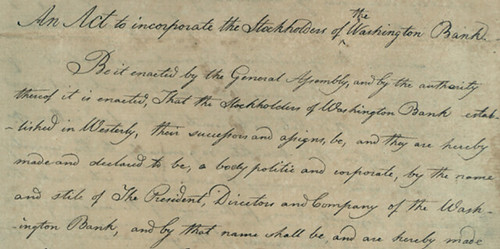
Washington Bank Charter from the Rhode Island Legislature in 1800
The Washington Bank opened in Westerly on Aug. 22, 1800. Named in honor of the nation's first president, the institution is now recognized as the country's oldest community bank.
Its connection to George Washington extended beyond its name.
"We were one of the first institutions to put the likeness of George Washington on a piece of currency," Kile said.
Standardized federal paper currency did not yet exist as it does today. Instead, state and local banks printed and circulated their own bank notes. Washington Trust says it was the first bank to place Washington's likeness on currency—69 years before he appeared on a federally issued one-dollar bill.
Washington Trust celebrated its 225th anniversary in 2025. The company has grown from a small room in Westerly to 28 retail banking branches across Rhode Island and Mystic, Connecticut, along with mortgage and wealth-management offices in Rhode Island, Massachusetts and Connecticut.
The bank is continuing that growth with its 29th branch planned for Pawtucket and its 30th location in Bristol.
To read the complete article, see:
Washington Trust: The Rhode Island bank serving its community since 1800
(https://turnto10.com/news/local/washington-trust-the-rhode-island-bank-serving-its-community-since-1800-america-250-sept-3-2026)
LOOSE CHANGE: SEPTEMBER 27, 2026
Here are some additional items in the media this week that may be of interest. -Editor
The Scripotime stock certificate website posted an article about Poyais, one of the most elaborate and deadly frauds in history. We covered this in 2022 because of the currency notes issued by the nonexistent nation. Wild story. Here's an excerpt, but see the complete article online. -Editor

MacGregor transformed that strip of jungle into something entirely fictional: the Kingdom of Poyais, an independent nation of roughly 16,000 square miles, complete with a capital city (St. Joseph), a cathedral, a bank, a postal service, and a parliamentary constitution, all of which existed only in the documents he commissioned in London. He appointed himself Cazique, Prince of the Poyers, a title he claimed had been bestowed on him by the Miskito king. He designed a flag, minted a currency, and drafted a national anthem. He even granted himself the right to confer knighthoods.
The genius of the scheme was not the invention itself but its packaging. MacGregor arrived in London in 1822 as a decorated foreign dignitary, traveling in a carriage with an elaborate coat of arms. He published a guidebook to Poyais, 355 pages of detailed geography, climate tables, and investment advice, written by "Captain Thomas Strangeways," an officer who did not exist. He commissioned an opera composer to write songs about the beautiful republic. He granted interviews, held court at parties, and let London society do the rest.
In January 1823, the first ship, the Honduras Packet, landed its passengers at the Black River. What they found was not a kingdom but a swamp. There was no capital city, no cathedral, no bank, nothing but dense jungle, marshland, and a handful of scattered settlements. The second and larger expedition, seven ships carrying nearly 200 more settlers, arrived to the same reality. There were no roads, no provisions, and no way to make the fortune they had been promised.
The settlers, to their enormous credit, attempted to build the promised colony anyway. They cleared land and planted crops in soil that would barely yield. Malaria, yellow fever, and dysentery did the rest. By the time a passing British naval vessel offered rescue months later, more than half of the settlers were dead, including, in many cases, entire families. The survivors who made it back to Britain arrived destitute, diseased, and furious.
To read the complete article, see:
Poyais: The Country That Never Was
(https://scripotime.substack.com/p/poyais-country-that-never-was)
To read the earlier E-Sylum article, see:
POYAIS: GREGOR MACGREGOR'S FAKE COUNTRY
(https://www.coinbooks.org/v25/esylum_v25n02a30.html)
Roberto Menchaca García published a nice Numismatic News article on King Farouk of Egypt and his legendary coin collection. Here's an excerpt - see the complete article online. -Editor
 Throughout his reign, the monarch amassed an immense fortune in jewels, money, land, and palaces. King Farouk was always criticized for maintaining an excessively luxurious and lavish lifestyle, which contrasted with the hunger and poverty in his country. He was also a great collector who did not hesitate to use public money to build valuable collections of coins, stamps, jewelry, porcelain, cars, and other items.
The impressive coin collection, known as the Palace Collections of Egypt, was assembled by the king during his reign. The name refers to Farouk's official residence after his accession in 1936, the Royal Palace of Koubbeh, where he housed his collections. The collection was auctioned by the government in 1954 at the palace in Cairo. After the 1952 revolution, the Royal Palace of Koubbeh was converted into a presidential residence.
The Egyptian government hired Baldwin's to catalog the items and Sotheby's to publish an auction catalog and conduct the sales event. The collection was hastily auctioned in nine exhausting sessions, during which 8,500 coins and medals were sold. The first session began on February 24, 1954, with the last on March 6. Given the short time frame in which all the pieces were auctioned, most were sold across 2,798 lots. To this day, that 1954 auction is considered the largest of the 20th century, and many experts believe it has not yet been surpassed in importance or volume by any other auction.
The Cairo auction attracted the world's most renowned numismatic collectors, such as John J. Pittman and Ambassador Henry Webb. In fact, the cores of the famous collections that these men later assembled were built around the pieces acquired at this auction. The event also attracted a significant number of numismatic dealers, including Abe Kosoff and Hans Schulman himself. Everyone knew that the pieces would be sold for well below their real value due to several factors, such as the huge number of lots to be auctioned in such a short time, the remote location of the auction place, and the political instability of the country, which would prevent many interested parties from attending the event. Many of the buyers, like Pittman, even remortgaged their homes or took out credit lines to raise the money needed to buy as many pieces as possible.
To read the complete article, see:
King Farouk's Numismatic Collection
(https://www.numismaticnews.net/king-farouks-numismatic-collection)
Video: Dan O'Dowd and the Tyrant Collection
 In my ANA show diary last week, I mentioned visiting the Tyrants of the Golden Horn Collection exhibit, the Byzantine portion of Dan O'Dowd's coin collection. PCGS produced this YouTube video with O'Dowd introducing himself and discussing how he got started collecting. Check it out! Nice hobby history.
-Editor
In my ANA show diary last week, I mentioned visiting the Tyrants of the Golden Horn Collection exhibit, the Byzantine portion of Dan O'Dowd's coin collection. PCGS produced this YouTube video with O'Dowd introducing himself and discussing how he got started collecting. Check it out! Nice hobby history.
-Editor
Discover how tech billionaire Dan O'Dowd built the Tyrants of the Golden Horn Collection, consisting of more than 250 rare coins spanning 1,700 years of Byzantine history. Authenticated and graded by PCGS, this multimillion-dollar numismatic showcase now stands as one of the greatest ancient coin collections ever assembled.
To watch the complete video, see:
How Dan O'Dowd Built One of the World's Greatest Coin Collections
(https://www.youtube.com/watch?v=lf5FDG5i_Is)
To read the earlier E-Sylum articles, see:
TYRANT COLLECTION OWNER DAN O'DOWD
(https://www.coinbooks.org/v25/esylum_v25n12a18.html)
WAYNE'S NUMISMATIC DIARY: 2026 ANA, PART 4 : Tyrants of the Golden Horn Exhibit
(https://www.coinbooks.org/v29/esylum_v29n38a19.html)
 The Library Robot
The country's first library robot helper lives at Mesa Gateway Library, and he is very cute!
Why it matters: Romi is part tour guide, part selfie station and easily the library's most futuristic helper.
How it works: Romi can greet visitors in eight languages and lead them to different parts of the library.
- His main job is way-finding, but developers are exploring additional features.
- You can touch the screen on his belly to look up books.
To read the complete article, see:
Meet Romi, Mesa's library robot
(https://www.axios.com/local/mesa/2026/09/21/meet-romi-the-library-robot)
ABOUT THIS ISSUE: SEPTEMBER 27, 2026
I've been enjoying my twice-weekly runs of about 3.3 miles to prep for a local 5K race. I started the tradition a few years ago, running in the 2024 and 2025 "5K on the Runway" race at Dulles Airport. At 68 my run is no faster than a lot of people's walks, but I don't mind, even when I'm forced to compare myself against younger people like the woman running the other way on Tuesday, effortlessly bouncing along like a gazelle.
The Dulles race conflicted with the ANA convention this year, so I registered for a race for the local volunteer fire department. It was much smaller event, only 127 runners vs. the thousands at Dulles. There were no age divisions, but I counted 13 of us 60 or older. I came in 10th of that group. As small consolation, I finished ahead of 9 others, 6 who were younger than me, but they were probably walking. Still, it was a nice day and I've got another medal for my collection.

I had a pocketful of change when I stopped for lunch. As I was counting out 76 cents the cashier said I could just pay with the 20 dollar bill in my hand. Before I could roll my eyes, give up and put my change away, a more experienced cashier explained how the cash register would still determine the right change if they entered $20.76. So I did manage to unload my change and get some new bills for my wallet.
Here are some interesting non-numismatic articles I came across this week. In the turnabout-is-fair-play department, the first one is about how customer service desks are now receiving calls from AI.
Your customer service representative would like to speak to a human (https://tech.yahoo.com/ai/articles/customer-representative-speak-human-084701076.html)
10 Once-Common Household Items You Don't See Anymore (https://interestingfacts.com/nostalgic-household-items/)
I Got Older. When Exactly Did I Become a Blasted Idiot? (https://nutmegphantasy.substack.com/p/i-got-older-when-exactly-did-i-become)
Your 12 Good Years (https://danhaylett.substack.com/p/your-12-good-years)
Mathematician reveals the truth behind the Parthenon's optical illusion (https://www.scientificamerican.com/article/mathematician-reveals-the-truth-behind-the-parthenons-optical-illusion/)
The Mail as the Practice of Public Reason (https://hedgehogreview.com/issues/the-fading-promise-of-higher-education/articles/the-revolutionary-post)
Washington's men drank more than 150 bottles of alcohol days before the Constitution was signed. (https://historyfacts.com/famous-figures/fact/george-washington-alcohol-constitution-signing/)
Off the Beaten Path: Unassuming Pittsburgh chapel holds world's second-largest collection of Catholic relics (https://www.post-gazette.com/news/faith-religion/2026/09/22/st-anthony-chapel-troy-hill-vatican/stories/202609190041)
Ari Emanuel Is Finally Getting Around to Watching Entourage (https://archive.ph/kRqYa)
WTF Happened in 1973? (https://substack.com/@stephenmcbride1/note/c-328640808)
-Editor

Editor Wayne Homren, Assistant Editor Garrett Ziss
Wayne Homren
Wayne Homren is the founding editor of The E-Sylum and a consultant for the Newman Numismatic Portal. His collecting interests at various times included U.S. Encased Postage Stamps, merchant counterstamps, Pittsburgh Obsolete paper money, Civil War tokens and scrip, Carnegie Hero Medals, charge coins and numismatic literature. He also collects and has given presentations on the work of Money Artist J.S.G. Boggs. In the non-numismatic world he's worked in artificial intelligence, data science, and as a Program Manager for the U.S. Department of Defense.
Garrett Ziss
Garrett Ziss is a numismatic collector and researcher, with a focus on American paper money and early U.S. silver and copper coins. He is also a part-time U.S. coin cataloger for Heritage Auctions. Garrett assists Editor Wayne Homren by editing and formatting a selection of articles and images each week. When he's not engaged in numismatics, Garrett is pursuing a Master's Degree in Quantitative Economics at the University of Pittsburgh.

Contributors Pete Smith and Greg Bennick
Pete Smith
Numismatic researcher and author Pete Smith of Minnesota has written about early American coppers, Vermont coinage, numismatic literature, tokens and medals, the history of the U.S. Mint and much more. Author of American Numismatic Biographies, he contributes original articles to The E-Sylum often highlighting interesting figures in American numismatic history.
Greg Bennick
Greg Bennick (www.gregbennick.com) is a keynote speaker and long time coin collector with a focus on major mint error coins and US counterstamps. He is on the board of both CONECA and TAMS and enjoys having in-depth conversations with prominent numismatists from all areas of the hobby. Have ideas for other interviewees? Contact him anytime
via instagram @minterrors.
He can also be reached by email at
minterrors@gmail.com.


Website host John Nebel and webmaster Bruce Perdue
John Nebel
Numismatist, photographer, and ANS Board member and Fellow John Nebel of Boulder, CO helped the ANA and other clubs like NBS get online in the early days of the internet, hosting websites gratis through his Computer Systems Design Co. To this day he hosts some 50 ANA member club sites along with our
coinbooks.org site, making the club and our E-Sylum archive available to collectors and researchers worldwide.
Bruce Perdue
Encased coinage collector (encasedcoins.info) Bruce Perdue of Aurora, Illinois has been the volunteer NBS webmaster from its early days and works each week to add the latest E-Sylum issue to our archive and send out the email announcement.

|
|
The E-Sylum is an electronic publication of the Numismatic Bibliomania Society Copyright © 1998 - 2026 | |