Visit our NBS Sponsors









About UsThe Numismatic Bibliomania Society is a non-profit association devoted to the study and enjoyment of numismatic literature. For more information please see our web site at coinbooks.org SubscriptionsThose wishing to become new E-Sylum subscribers can go to the following web page
Subscribe
MembershipThere is a membership application available on the web site Membership Application To join, print the application and return it with your check to the address printed on the application. Print/Digital membership is $40 to addresses in the U.S., and $60 elsewhere. A digital-only membership is available for $25. For those without web access, write to: Jeff Dickerson, Treasurer AsylumFor Asylum mailing address changes and other membership questions, contact Jeff at this email address: treasurer@coinbooks.org SubmissionsTo submit items for publication in The E-Sylum, write to the Editor at this address: whomren@gmail.com BUY THE BOOK BEFORE THE COIN |

- WAYNE'S WORDS: THE E-SYLUM AUGUST 23, 2026
- REMINDER: NBS ACTIVITIES AT THE ANA CONVENTION
- KOLBE & FANNING AT 2026 PITTSBURGH ANA
- NEW JOURNAL OF EARLY AMERICAN NUMISMATICS EDITOR
- THE NEW NEWMAN PORTAL!
- VIDEO: 1794 CONGRESSIONAL MINT COMMITTEE
- DOUG WINTER ON THE CABBAGE COINS PODCAST
- 2026 HIGGINS MUSEUM SEMINAR CONCLUDES
- NOTES FROM E-SYLUM READERS: AUGUST 23, 2026
- VOCABULARY TERM: STRIKE UP, STRUCK UP
- FAULKNER PART 1: SHIPS, COLONIES & COMMERCE
- NUMISMAGRAM MEDAL SELECTIONS: AUGUST 23, 2026
- HERITAGE: ANCIENT COINS PLATINUM HIGHLIGHTS
- HERITAGE: 2026 ANA SIGNATURE SALE
- STACK'S BOWERS: NICHOLAS P. BROWN U.S. ERRORS
- MORE SKYLER LIECHTY INDIAN PEACE MEDALS
- STACK'S BOWERS: CANADIAN BANKNOTES
- WAYNE'S NUMISMATIC DIARY: AUGUST 23, 2026
- HERITAGE: 1795 LARGE CENT STRUCK OVER 1794
- Q. DAVID BOWERS AND THE 1894-S DIME,
- THE BIKINI NIGHTMARE SHORT SNORTER
- CONSUMING MASS QUANTITIES... OF BOOKS
- LOOSE CHANGE: AUGUST 23, 2026
- ABOUT THIS ISSUE: AUGUST 23, 2026
Content presented in The E-Sylum is not necessarily researched or independently fact-checked, and views expressed do not necessarily represent those of the Numismatic Bibliomania Society.
WAYNE'S WORDS: THE E-SYLUM AUGUST 23, 2026
 New subscribers this week include:
David Guest and
Jon Seehusen.
Welcome aboard! We now have 6,388 subscribers.
New subscribers this week include:
David Guest and
Jon Seehusen.
Welcome aboard! We now have 6,388 subscribers.
Thank you for reading The E-Sylum. If you enjoy it, please send me the email addresses of friends you think may enjoy it as well and I'll send them a subscription. Contact me at whomren@gmail.com anytime regarding your subscription, or questions, comments or suggestions about our content.
For those living around Pittsburgh or heading there for the ANA convention, here's a reminder that everyone is invited to a Celebration of Life for Pat McBride, the stalwart officer and worker bee for the Pennsylvania Association of Numismatists (PAN) who also channeled Ben Franklin to promote numismatics at shows all across the country. No RSVPs are needed - just show up at The Priory Hotel Sunday August 30th from 1-4pm. It's on the near North Side just across the river from the Pittsburgh Convention Center. The address is 614 Pressley Street, Pittsburgh, PA.
This week we open with NBS and numismatic literature activities at the Pittsburgh ANA, the Journal of Early American Numismatics, updates from the Newman Numismatic Portal, the Higgins Museum Seminar, and more.
Other topics this week include the 1794 Congressional Mint Committee, Ships, Colonies and Commerce tokens, fixed price and auction selections, error coins, Indian Peace Medals, Canadian banknotes, the 1894-S dime, and how AI companies are scanning (and destroying) massive quantities of books.
To learn more about Anburey's Travels, the new Newman Numismatic Portal, Southern gold coins, National Bank Notes, medallist Jaques Wiener, the Quintuple Stella, the Quaker Peace Medal, the Peabody Library, the Bikini Nightmare and what Dave Bowers, J. Fred Muggs, Mrs. Emery Mae Norweb and Cheech Litman have in common, read on. Have a great week, everyone!
Wayne Homren
Editor, The E-Sylum

Image of the week
REMINDER: NBS ACTIVITIES AT THE ANA CONVENTION
It's here! Here's a final reminder of NBS events at the upcoming American Numismatic Association World's Fair of Money in Pittsburgh, including the NBS Charity Auction. We're looking forward to seeing many of you there! -Editor
The annual ANA convention beckons, with this year's installment taking place in Pittsburgh, August 25-29. As usual, the NBS will host a club table on the bourse floor, in addition to our symposium and general meetings.
KOLBE & FANNING AT 2026 PITTSBURGH ANA
Kolbe & Fanning have a table at next week's ANA, as does Charlie Davis (see last week's article, linked below). Bring your checkbook and add some great numismatic literature to your library. I'll be visiting both tables, along with that of our sponsor, the Numismatic Bibliomania Society. Stop by all three and say hello! -Editor

David and Maria Fanning
Kolbe & Fanning are attending the American Numismatic Association's World's Fair of Money, being held August 25–29, 2026 in Pittsburgh. At Booth 644, we will have a choice selection of rare numismatic literature and new publications available for sale. We will be located next to the Numismatic Bibliomania Society and Charles Davis Numismatic Literature booths, so please stop by and say "hello!"

NEW JOURNAL OF EARLY AMERICAN NUMISMATICS EDITOR
The American Numismatic Society has appointed Jesse Kraft as the new editor of The Journal of Early American Numismatics (JEAN). Here's the announcement. -Editor
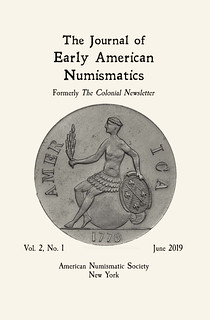 Jesse Kraft, PhD, has been appointed the new editor for The Journal of Early American Numismatics (JEAN). JEAN is a biannually published research publication and the successor to The Colonial Newsletter (CNL), founded in 1960. The CNL published an assemblage of the most seminal studies on colonial and confederation-era coinage of the United States. JEAN expands the focus of the CNL by exploring contributions to colonial numismatics from North, South and Central America.
JEAN has received several Numismatic Literary Guild awards for the Best Club or Not-for-Profit Periodical. Articles published in JEAN which have received NLG prizes include: "The Authentic Fugio Restrike Dies" by Christopher McDowell and Julia Casey, 2020; "Collecting American Colonial Coins in Eighteenth-Century England" by Jeff Rock, 2021; "The Coins Made ‘for the Islands and Mainland of America' by the French West India Company 1670" by Jérôme Jambu, 2022; "John J. Ford: A Life in Three Portraits" by Q. David Bowers, 2020; "The Crane Ring of Rupert, Vermont: A Family of Counterfeiters at Reuben Harmon's Mint" by Julia Casey, 2022: and "The 'Wild Scheme' of Sydney P. Noe: The 1942 Exhibition of Massachusetts Silver at the American Numismatic Society" by Jesse Kraft, 2023.
THE NEW NEWMAN PORTAL!
Newman Numismatic Portal Project Coordinator Len Augsburger submitted this update. Great news! -Editor

Home page of the updated Newman Numismatic Portal
The New Newman Portal
Newman Numismatic Portal Project Coordinator Len Augsburger will speak at the ANA Convention on Friday, August 28, 10AM, on "What's New at the Newman Portal?" This will be part of the ANA Numismatic Theatre program and will take place in room 327 of the convention center.
Since last fall, we've been preparing Newman Portal for the move to a new web platform, and this work is largely complete. Over the next few weeks, we'll be transitioning the old and new sites, and this Numismatic Theatre presentation will cover the rationale and logistics behind this update. E-Sylum readers may wish to explore the new site (URL below), and we'll go more in depth during the convention.
VIDEO: 1794 CONGRESSIONAL MINT COMMITTEE
The David Lisot Video Library on the Newman Numismatic Portal can be found at:
https://nnp.wustl.edu/library/multimediadetail/522852
We highlight one of his videos each week in The E-Sylum. Here's one from 2016 with David Finkelstein speaking about the 1794 Congressional Committee appointed to examine the U. S. Mint. -Editor

DOUG WINTER ON THE CABBAGE COINS PODCAST
Longtime E-Sylum supporter Doug Winter guested recently on the Cabbage Coins Podcast. Linked below is an earlier Newman Portal video with Doug at the January 2026 FUN Show. -Editor

Earlier this month (August, 2026) Doug Winter sat down for a chat with Tony Gryckiewicz of Cabbage Coins and the Cabbage Coins Podcast.
Doug is the leading expert in the world on Southern gold coins and he shares his insights and collecting strategies. This video is quite long, clocking in at over an hour, but we think it is worth your time; especially if you are a beginner in this fascinating area of the market.

2026 HIGGINS MUSEUM SEMINAR CONCLUDES
Curator George Cuhaj submitted this note on the recent Higgins Museum Seminar. Thank you. -Editor

General view of the seminar room during Mark Drengson's presentation
The 2026 Higgins Museum seminar was held at the museum in Okoboji, IA.
Speakers and topics included:

NOTES FROM E-SYLUM READERS: AUGUST 23, 2026
Peter Cross and Longacre
Jim Sandy writes:
"Longacre's Diary for 1862 contains multiple mentions of Peter Cross. Researching Longacre's monument at The Woodlands and its missing medallion, brought me to the Library Company of Philadelphia in April. My notes list Cross's death in October of that year. But I recall reading Longacre visited Cross in hospital at least once, and I believe twice, in the prior weeks to the younger man's passing. It seemed to me they were true friends."
To read the earlier E-Sylum article, see:
ENGRAVER PETER F. CROSS
(https://www.coinbooks.org/v29/esylum_v29n33a12.html)
Other topics this week include Fielding's Entry for P. F. Cross, the WorldBanknotes.eu website, a gold hoard find in Belgium, and False Appetite Wordplay. -Editor

VOCABULARY TERM: STRIKE UP, STRUCK UP
Here's another entry from Dick Johnson's Encyclopedia of Coin and Medal Terminology. -Editor
Strike Up, Struck Up. To bring the surface relief of a numismatic or medallic item to its full intended height by striking in a press with proper dies and proper pressure –or the proper number of impressions (if a multiple-struck item). The pressman is responsible for every piece to be struck during his shift or production run and that they will be fully struck up with all detail intact.. He will frequently examine sample struck pieces (inspection) making sure the relief is as intended.
Press setup and running. To begin a press run of a new coin or medal the pressman or pressroom foreman will SETUP the press, and strike a first specimen or two. This is a trial strike and is purposely at a lower impression than anticipated not to break a die during this stage (thus trial strikes are purposely weakly struck). He will increase the pressure until he feels it will be the proper amount to fully strike up the piece. These are the first strike specimens he will examine very closely.
FAULKNER PART 1: SHIPS, COLONIES & COMMERCE
Jacob Lipson is selling the Christopher Faulkner Collection, Part 1, showing Ships, Colonies & Commerce tokens. Select items are discussed below. -Garrett
 Welcome to the first installment of the Christopher Faulkner Collection. It is my great honour to
present this exceptional selection of Ships, Colonies & Commerce tokens — the opening
chapter in what will be a multi-part offering from this historic collection.
Welcome to the first installment of the Christopher Faulkner Collection. It is my great honour to
present this exceptional selection of Ships, Colonies & Commerce tokens — the opening
chapter in what will be a multi-part offering from this historic collection.
Christopher Faulkner is the author of the seminal works not only on this series, but also on the Prince Edward Island Holey Dollars, the Upper Canada tokens, and the Bouquet Sou series. His scholarship has set a new standard in Canadian numismatics, and his collections in these areas — and others — will be remembered for their quality, completeness, and intellectual rigour.
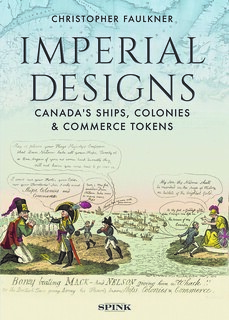
Each lot in this catalogue is offered at a fixed price and includes a high-resolution image, a physical description (including grades provided by Faulkner), commentary, and provenance. The commentary is drawn primarily from Faulkner's Imperial Designs (2019), the definitive study of the Ships series. In select cases, I have added my own observations, either summarizing Chris's analysis or reflecting on recent auction results and comparative material.

NUMISMAGRAM MEDAL SELECTIONS: AUGUST 23, 2026
Numismagram's Jeremy Bostwick sent along these five medals from his most recent upload of new material to his site. For all of the new items, please visit https://www.numismagram.com/inventory. -Garrett

103714 | TURKEY. Ottoman Empire. Constantinople. Santa Sophia (Hagia Sophia) bronze Medal. Issued 1858. Most Remarkable Edifices of Europe series (59mm, 86.92 g, 12h). By Jaques Wiener in Brussels and struck at the Geerts mint in Ixelles.
Interior view of the mosque's north nave; in six lines in exergue, STE SOPHIE À CONSTANTINOPLE / BATIE PAR L'EMPEREUR JUSTINIEN 532-537 / CONVERTIE IN MOSQUÉE 1453 / RESTAURÉE SOUS LE RÈGNE DU SULTAN / ABDUL MEDJID 1847-1849 / PAR G. FOSSATI // View of the mosque's central nave. Edge: Plain.
Ross M208 (R3); van Hoydonck 206; Reinecke 60. PCGS SP-64. Rich, glossy brown surfaces, with a good deal of brilliance; inconsequential rim bruise on the obverse noted merely for completeness. A very rare type that is the key to a series that has continued to grow in popularity, and one that can reach rather dizzying heights, such as an NGC MS-63 Brown, which realized a total of $4,560 [!] in the Stack's Bowers September 2024 World CCO, lot 75603.
From what is today eastern Netherlands and western Germany, the Wieners were a Jewish family of exceptional medalists, especially known for numerous numismatic works throughout the Kingdom of Belgium. Eldest brother Jacob (Jacques), along with younger brothers Leopold and Charles, created some of the finest works of medallic art of the 19th century, and all are particularly noted for their work in the highly detailed and intricate work of architectural renderings.

HERITAGE: ANCIENT COINS PLATINUM HIGHLIGHTS
Heritage Auctions will be hosting their ANA World & Ancient Coins Platinum Session and Signature Auction from September 1-5. The following items were highlighted in Shanna Schmidt's Newsletter #245. Her website is http://www.shannaschmidt.com/. -Garrett


SICILY. Syracuse. Dionysius I (405-370 BC). AR decadrachm (37mm, 42.88 gm, 5h). NGC AU 4/5 - 3/5, Fine Style, light marks. Reverse die signed by Euainetos, ca. 400 BC. Racing quadriga driven left by charioteer, reins in left hand, kentron in right; Nike flying right above to crown him, military arms, including aspis (shield), greaves, cuirass, and crested Attic helmet, all joined by horizontal spear, ?T?? ("prizes") below all in exergue, dotted border / S?-??-?-?-S?O?, head of Arethusa left, hair wreathed with barley ears, wearing triple pendant earring and beaded necklace; four dolphins swimming around, ? below chin, EY-AINE (die-engraver's signature) below bottom dolphin. SNG Lloyd 1413 (same dies). Gallatin (DI/RIX). HGC 2, 1299. A simply beautiful example of this classic issue, struck on a oblong flan in sound metal, with none of the usual obverse die rust. Light iridescent toning.
From the Randy & Nancy Best Collection. Ex Vecchi, Sale 16 (9 October 1999), Lot 76; Hess-Leu, Auction 49 (27 April 1971), Lot 70.

HERITAGE: 2026 ANA SIGNATURE SALE
Heritage Auctions will be hosting their ANA Signature Sale from August 31 - September 5. Here is the press release. -Garrett
The finest of only four privately held examples of the famous Quintuple Stella from one of the most prominent collections in all of numismatics will be among the top attractions at Heritage's ANA U.S. Coins Signature® Auction August 31–September 5.


1879 Liberty Head Quintuple Stella, Judd-1643, Pollock-1843, Low R.7, PR64+ Deep Cameo PCGS
The gorgeous 1879 Liberty Head Quintuple Stella, Judd-1643, Pollock-1843, Low R.7, PR64+ Deep Cameo PCGS is part of The Bob R. Simpson Collection, Part XIII. Simpson's collection is one of the most celebrated in all of numismatics. It is one of five known examples, one of which is held in the National Numismatic Collection at the Smithsonian.
STACK'S BOWERS: NICHOLAS P. BROWN U.S. ERRORS
Stack's Bowers will be selling the Nicholas P. Brown Collection of U.S. Mint Errors as part of their Summer 2026 Global Showcase Auction on September 1. Select items are discussed below. -Garrett


Famous 1968 No S Roosevelt Dime Rarity Ranked #8 of the 100 Greatest U.S. Modern Coins 1968 No S Roosevelt Dime. FS-501. Proof-69 * (NGC). A stunning example of this landmark modern U.S. Mint Proof issue, as struck, virtually pristine, and possessed of outstanding eye appeal. The obverse exhibits a dusting of pale silvery iridescence, while the equally attractive reverse exhibits iridescent champagne-gold that deepens to a halo of similar, albeit slightly bolder color around the border. The finish is modestly cameoed, especially on the obverse, which feature helps to explain the coveted * designation from NGC for superior eye appeal. Fully struck and exquisite.
MORE SKYLER LIECHTY INDIAN PEACE MEDALS
Stack's Bowers will be selling the Skyler Liechty Collection of Indian Peace Medals on August 31. Additional selections are discussed below. -Garrett


Possibly Unique 1781 Tupac Amaru Revolt Rarity (ca. 1781) Tupac Amaru Revolt Medal. Silver. Medina-14. Extremely Fine. 39.8 mm. 33.79 grams. Lima (?) Mint. Plain edge. Pleasing antique silver gray with lively, attractive surfaces highlighted with old traces of pale violet and rich gold. Nicely centered and well struck on both sides. Scattered marks are seen, rims a bit knocked and bruised, but the visual appeal is excellent.
A March 2006 article in Numismatics International by Alan Luedeking offers some insight on the backdrop of this medal. After the execution of Amaru in 1781, the regent at Charcas in Bolivia, Jeronimo Ruedas, wrote to Viceroy Juan Jose de Vertiz at Lima to inform him he had medals made at Potosi to recognize some of natives who remained allied and helpful to the Crown.
STACK'S BOWERS: CANADIAN BANKNOTES
Stack's Bowers will be selling A Gentleman's Collection of Canadian Banknotes as part of their Summer 2026 Global Showcase Auction on August 31. Select items are discussed below. -Garrett


Landmark British Guiana Rarity Only Two in Private Hands BRITISH GUIANA. Royal Bank of Canada. 5 Dollars, 2.1.1913. P-S131. CH #630-34-02. PMG Very Fine 20. An incredible rarity for Canadian Chartered and Commonwealth collectors alike. Collectors may be familiar with the 1920 issue of the Royal Bank of Canada for British Guiana, which is sometimes encountered, but it was not the first. This 1913-dated provisional issue was issued in limited quantities (along with a $20 and $100) following the acquisition of the British Guiana Bank by Royal Bank of Canada in 1914, expanding the operations of this Montreal-based bank into South America. These provisional issues are extremely rare in any format. Of this $5, we are aware of three, including the present piece, with one of those permanently impounded in the National Currency Collection of Canada (which is also overprinted 'Specimen'). The present piece traces its pedigree back to a June 1974 Walter D. Allan sale, which appears to be the last public offering of this note, and in the past 50 years, we are aware of just one other example appearing at public auction, at a NASCA sale in 1987. That is also the note that appears in the Canadian Note Registry twice, with serial numbers 011553/D and 044553/D, but a comparison with the note pictured in Pick confirms it is the same note, reducing the number of known examples to just three. An incredible opportunity for the specialist and an offering we certainly don't expect to repeat anytime soon. PMG Comments "Trimmed, Spindle Holes, Ink Stamp."

WAYNE'S NUMISMATIC DIARY: AUGUST 23, 2026
Since retiring I've been shooting for 10,000 steps a day, and lately I've been averaging over 11,000. Most of my walks are around our neighborhood or the shopping plazas where I stop for lunch or errands. By Monday evening I'd already made my quota for the day, but I looked out and saw a nice sunset. I told my wife, "I'm going for a walk..." I hoofed it over to a nearby lake to get an unobstructed sky view. I took several photos, and this is my favorite.

I ended up at nearly 14,000 steps. It's again true what I once wrote during the Covid lockdown - I've become an online dating profile - I like sleeping in, long walks, sunsets, red wine and chocolate. Sorry ladies - still taken.
Since retiring I've also tried to set aside one day a week for exploring - a long walk, visit to a museum or town (or all three!) Tuesday the 18th was the monthly dinner meeting of my northern Virginia numismatic social group Nummis Nova. Julian Leidman was our host. Getting to Julian's meetings in Maryland used to be straightforward for me - I worked up in Maryland and could drive to the restaurant straight after work. Driving up from Virginia, at least during rush hour, is a much more painful experience. So I made it a day of exploring in Maryland.
In the morning I proved my Stoic credentials. Stopping in at a 7-11, an employee was cleaning the soda fountain and somehow water squirted onto my arm. Many people would curse and complain, but I spontaneously laughed and said, "It's OK - I've had worse things happen to me - I can handle it." I grabbed a paper towel to dry off and went about my business.
I started off meeting Jim Haas, author of the book on Standing Liberty quarter designer Harmon MacNeil. As a fellow history buff, he was game to join me in my adventure. I picked him up at home and after a nice lunch at the Park Tavern in Severna Park, we made our way to Baltimore's "cathedral of books," the George Peabody Library. Since reading about it I'd wanted to visit - what bibliophile wouldn't want to see a beautiful building filled with great books? Here are some photos.
THE BOOK BAZARRE
HERITAGE: 1795 LARGE CENT STRUCK OVER 1794
Heritage Auctions will be selling a high-grade 1795 S-76 large cent struck over a 1794 S-71 large cent as part of their ANA Signature Sale from August 31 to September 5. It is discussed below. -Garrett


1795 1C Lettered Edge, S-76, B-4 -- Struck Over 1794 S-71 Cent -- R.8, AU58+ PCGS. Ex: Jeff Garrett's European Discovery. 13.6 grams. The cataloger received a text from Kentucky numismatist Jeff Garrett in late January asking about a large cent in the photos that he attached to the text. At the time, Garrett was attending the Berlin Coin Fair in Germany. This is the coin of his query, along with two other large cents that are offered in the present sale: the finest known 1819 N-4 cent and a lovely 1850 middle die state N-13 cent.
The 1795 strike is attributed as S-76 and likely refined as S-76b based on the die state. The date is widely spaced with the flag of the 5 joined to Liberty's bust. The date layout is found only on obverse dies 2 and 3 according to Dr. William H. Sheldon's popular reference, Penny Whimsy. Those two dies were used for S-74, 75, 76, and NC-3. The reverse has ONE CENT placed high inside the wreath as found on S-76 and no others.

This important cent was struck over a
previously struck 1794 large cent that shows the 7, 9, and 4 from
the host coin between the D in UNITED, the first S of STATES, and
the border. Careful examination of the undertype shows a strike
from the dies identified as Sheldon-71, including clash marks from
those dies. The 1794 host coin appears slightly off center while
the 1795 strike is properly centered. The chocolate-brown surfaces
retain cartwheel luster with the appearance of scattered marks that
are primarily remnants of the undertype. Slight wear appears on the
high points, limiting the grade of this impressive piece.
There are two other 1795 S-76 cents known to us that show 1794 large cent undertype, both in lower grade. One example that appeared in our 2015 Chicago ANA auction was cataloged as "possibly struck over an off-center 1794 S-71 cent." That example has no evidence of the 1794 date. The other example is identified as a 1795 S-76b cent that was struck over an 80% off-center 1794 S-63 cent that shows the "Fallen 4" date.
Until January 2026, the present coin was unknown to the current generation of early copper aficionados. Breen mentioned two flip-over double strike 1795 S-76 cents, and the present piece could easily be mistaken for such a mint error. Those pieces and others that are similarly described should be studied carefully to rule out a 1794 undertype.
Just over 20 years ago, the present
writer cataloged a similar item: a 1795 BB-14 silver dollar that
was struck over a 1794 dollar. Unlike that unique early dollar,
this cent shows the 1794 date. The two pieces would make a
fascinating pair for exhibition.
From Jeff Garrett's European Discovery.
To read the complete item description, see:
1795 1C Lettered Edge, S-76, B-4 -- Struck Over 1794 S-71 Cent
-- R.8, AU58+ PCGS.
(https://coins.ha.com/itm/large-cents/1795-1c-lettered-edge-s-76-b-4-struck-over-1794-s-71-cent-r8-au58-pcgs-pcgs-35720-/a/1396-3429.s)
Q. DAVID BOWERS AND THE 1894-S DIME,
Stack's Bowers published an entertaining article about s legendary rarity, the 1894-S dime. We're republishing it here with permission. -Editor

Rarities like the 1894-S dime, an American classic, have layers of desirability. Some collectors are most attracted to a tiny population, some to an elite reputation, some to an oft-recited history.
The 1894-S dime featured in lot 2056 of our Rarities Night session in the Summer 2026 Global Showcase Auction, has a special dimension of importance that no other coin, of this issue or any other, could ever claim.
THE BIKINI NIGHTMARE SHORT SNORTER
Tom Sparks contributed a nice article to the August 20, 2026 MPC Gram about a really interesting atomic age souvenir - a Bikini (Atoll) Nightmare Short Snorter. We're republishing it here with permission. Thank you. -Editor


Here are images of the U.S. Army Air Forces Air Transport Command Short Snorter with reference to "Bikini (Atoll) Nightmare" that I shared at the ANA Summer Seminar.
This certificate was issued to Colonel John K. Hester, AC, on 30 June 1946 for crossing the International Dateline.
It is signed by the following who were traveling together as part of an official global military inspection trip that coincided with Operation Crossroads, the historic postwar atomic bomb tests at Bikini Atoll:
CONSUMING MASS QUANTITIES... OF BOOKS
Last week we discussed the mysterious bulk orders used and rare bookdealers have been receiving, suspecting that AI labs are scanning them for training data to improve their models. Well, a curious journalist put a tracking device in a rare book, and this is what they learned. -Editor
 Amazon is buying massive quantities of books, scanning them for AI training data, and destroying them in the process.
A 404 Media investigation was able to reveal Amazon's book buying operation, which hasn't been previously reported, by placing a tracking device in a rare book we suspected would be acquired by an AI company for training data, and following it around the country to its final destination.
That final destination was an Amazon warehouse in Las Vegas, Nevada. Amazon employees who work at this location say all they do is receive massive shipments of printed books which they then cut the bindings off in order to scan the books more quickly. The printed book is destroyed in the process. The logo of the Amazon team that works at this warehouse, called VGT3, is a dinosaur, brandishing its teeth and with a book in its hands.
LOOSE CHANGE: AUGUST 23, 2026
Here are some additional items in the media this week that may be of interest. -Editor
Syracusan Gold Coin Found in Ancient Necropolis
 Archaeologists have uncovered a rare fifth-century BC Syracusan gold coin during an emergency excavation at the Maddalusa necropolis near Agrigento, Sicily.
The discovery was made during the recovery of a Greek tile-covered burial, known as a cappuccina tomb, in the coastal dunes west of the mouth of the Akragas River. The excavation, carried out under the direction of the Agrigento Superintendency, revealed an exceptionally well-preserved gold coin dating to the final decades of the fifth century BC.
Archaeologists have uncovered a rare fifth-century BC Syracusan gold coin during an emergency excavation at the Maddalusa necropolis near Agrigento, Sicily.
The discovery was made during the recovery of a Greek tile-covered burial, known as a cappuccina tomb, in the coastal dunes west of the mouth of the Akragas River. The excavation, carried out under the direction of the Agrigento Superintendency, revealed an exceptionally well-preserved gold coin dating to the final decades of the fifth century BC.
The obverse depicts the head of Heracles facing left, wearing the leontè—the skin of the Nemean Lion, which the Greek hero defeated during his first labour. The reverse features a quadripartite incuse square enclosing a small female head, accompanied by the inscription Syra, identifying the coin as an issue from Syracuse.
According to archaeologists, the coin belongs to an extraordinary series of gold issues struck by Syracuse during the Carthaginian invasion of Sicily at the end of the fifth century BC. The city minted these coins to help finance its military campaign as it allied with Akragas against the advancing Carthaginian forces.
To read the complete article, see:
Rare Syracusan gold coin unearthed in ancient necropolis
(https://www.heritagedaily.com/2026/08/rare-syracusan-gold-coin-unearthed-in-ancient-necropolis/158873)
Other topics this week include Stanley Gibbons Baldwin's CEO Iain Murphy, and numismatic exhibit judging. -Editor
ABOUT THIS ISSUE: AUGUST 23, 2026
My Diary this week covers most of my numismatic activity outside The E-Sylum. Despite my great start on Monday my walking slowed a bit for the week with a couple rainy days. I expect I'll make up for it hoofing across the bourse floor at next week's ANA in Pittsburgh.
Seen online:
- I named my dog "Five Miles" so I can tell people I walk Five Miles every day
- Just because your dog drinks from the toilet, doesn't mean you should
Finally, here are some interesting non-numismatic articles I came across this week.
Gotha: A family tree of the world's royalty (https://gotha.world/)
Ordinary Abundance (https://ordinaryabundance.com/)
How much medicine has progressed (https://worksinprogress.co/issue/future-of-medicine/)
A father of silicon carbide, this centenarian still works at Pitt: 'I like doing physics. Why should I retire?' (https://www.post-gazette.com/news/health/2026/08/14/jim-choyke-pitt-physicist/stories/202608160007)
Scoop: Stripe says "the singularity" has begun (https://www.axios.com/2026/08/19/stripe-payments-openrouter-singularity)
Stripe's August 2026 Investor Letter (https://www.documentcloud.org/documents/28565866-stripes-august-2026-investor-letter/)
I Saw the Future of AI in a Robot That Can Learn on the Spot (https://www.wired.com/story/generalist-ai-robots-learn-like-clever-toddlers/)
World-first biological data center uses 16 million living human neurons to process data (https://interestingengineering.com/innovation/world-first-biological-data-center)
LBJ would prank guests at his ranch by driving his car into the lake. (https://historyfacts.com/famous-figures/fact/lbj-amphicar-prank/?lctg=fc99d453-51bd-454f-b10d-ed4d7ce03f91)
-Editor


Editor Wayne Homren, Assistant Editor Garrett Ziss

|
|
| |